We've ranked the best british history books using expert recommendations, sales data, and millions of reader ratings. At Shortform, we know books. Our book guides are the best in the world. Learn why.
Cover unavailable
1
The Plantagenets: The Warrior Kings and Queens Who Made England
Dan Jones
5.0
The first Plantagenet king inherited a blood-soaked kingdom from the Normans and transformed it into an empire stretched at its peak from Scotland to Jerusalem. In this epic history, Dan Jones vividly resurrects this fierce and seductive royal dynasty and its mythic world.
We meet the captivating Eleanor of Aquitaine, twice queen and the most famous woman in Christendom; her son, Richard the Lionheart, who fought Saladin in the Third Crusade; and King John, a tyrant who was forced to sign Magna Carta, which formed the basis of our own Bill of Rights.
This is the era of chivalry, of Robin Hood and the Knights Templar, the Black Death, the founding of Parliament, the Black Prince, and the Hundred Year’s War. It will appeal as much to readers of Tudor history as to fans of 'Game of Thrones.
…
Cover unavailable
2
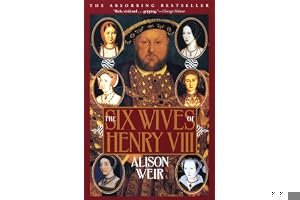
The Six Wives of Henry VIII
Alison Weir
4.8
Weir has tirelessly made her way through the entire labyrinth of Tudor history to tell the collective story of the six wives of Henry VIII--a vivid, full-blooded portrait of six very different women--in a work of sound and brilliant scholarship. Illustrations.
Cover unavailable
3
Wolf Hall
Hilary Mantel
4.7
Tudor England. Henry VIII is on the throne, but has no heir. Cardinal Wolsey is charged with securing his divorce. Into this atmosphere of distrust comes Thomas Cromwell - a man as ruthlessly ambitious in his wider politics as he is for himself.
His reforming agenda is carried out in the grip of a self-interested parliament and a king who fluctuates between romantic passions and murderous rages.
Recommended by Neera Tanden, Thomas Penn, and Vanora Bennett.
Hilary Mantel possesses an extraordinary historical imagination and her recreation of the world of the 1530s through the eyes of Thomas Cromwell is, I think, utterly convincing. [source]
Vanora Bennett
The Tudor monarchy has a big moment with England leaving the Church of Rome for love – that’s the moment every film and television writer is interested in. She turns it upside down. [source]
Cover unavailable
4
The Wars of the Roses: The Fall of the Plantagenets and the Rise of the Tudors
Dan Jones
4.7
The author of the New York Times bestseller The Plantagenets chronicles the next chapter in British history—the historical backdrop for Game of Thrones
From the author of Magna Carta: The Birth of Liberty
The crown of England changed hands five times over the course of the fifteenth century, as two branches of the Plantagenet dynasty fought to the death for the right to rule. In this riveting follow-up to The Plantagenets, celebrated historian Dan Jones describes how the longest-reigning British royal family tore itself apart until it was finally replaced by the Tudors.
Some of the greatest heroes and villains of history were thrown together in these turbulent times, from Joan of Arc to Henry V, whose victory at Agincourt marked the high point of the medieval monarchy, and Richard III, who murdered his own nephews in a desperate bid to secure his stolen crown. This was a period when headstrong queens and consorts seized power and bent men to their will. With vivid descriptions of the battles of Towton and Bosworth, where the last Plantagenet king was slain, this dramatic narrative history revels in bedlam and intrigue. It also offers a long-overdue corrective to Tudor propaganda, dismantling their self-serving account of what they called the Wars of the Roses.
…
Cover unavailable
5
The Time Traveller's Guide to Medieval England: A Handbook for Visitors to the Fourteenth Century
Ian Mortimer
4.7
Imagine you could get into a time machine and travel back to the 14th century. This text sets out to explain what life was like in the most immediate way, through taking the reader to the Middle Ages, and showing everything from the horrors of leprosy and war to the ridiculous excesses of roasted larks and haute couture.
Cover unavailable
6
Foundation: The History of England from Its Earliest Beginnings to the Tudors
Peter Ackroyd
4.6
Peter Ackroyd, whose work has always been underpinned by a profound interest in and understanding of England’s history, now tells the epic story of England itself.
In Foundation, the chronicler of London and of its river, the Thames, takes us from the primeval forests of England’s prehistory to the death, in 1509, of the first Tudor king, Henry VII. He guides us from the building of Stonehenge to the founding of the two great glories of medieval England: common law and the cathedrals. He shows us glimpses of the country’s most distant past—and Neolithic stirrup found in a grave, a Roman fort, a Saxon tomb, a medieval manor house—and describes in rich prose the successive waves of invaders who made England English, despite being themselves Roman, Viking, Saxon, or Norman French.
With his extraordinary skill for evoking time and place and his acute eye for the telling detail, Ackroyd recounts the story of warring kings, of civil strife, and foreign wars. But he also gives us a vivid sense of how England’s early people lived: the homes they built, the clothes the wore, the food they ate, even the jokes they told. All are brought vividly to life through the narrative mastery of one of Britain’s finest writers.
…
Cover unavailable
7
The Children of Henry VIII
Alison Weir
4.6
At his death in 1547, King Henry VIII left four heirs to the English throne: his only son, the nine-year-old Prince Edward; the Lady Mary, the adult daughter of his first wife, Catherine of Aragon; the Lady Elizabeth, the daughter of his second wife, Anne Boleyn, and his young great-niece, the Lady Jane Grey. These are the players in a royal drama that ultimate led to Elizabeth's ascension to the throne--one of the most spectacularly successful reigns in English history.
…
Cover unavailable
8
Eleanor of Aquitaine: A Life (World Leaders Past & Present)
Alison Weir
4.6
In this beautifully written biography, Alison Weir paints a vibrant portrait of a truly exceptional woman and provides new insights into her intimate world.
Renowned in her time for being the most beautiful woman in Europe, the wife of two kings and mother of three, Eleanor of Aquitaine was one of the great heroines of the Middle Ages. At a time when women were regarded as little more than chattel, Eleanor managed to defy convention as she exercised power in the political sphere and crucial influence over her husbands and sons.
Eleanor of Aquitaine lived a long life of many contrasts, of splendor and desolation, power and peril, and in this stunning narrative, Weir captures the woman--and the queen--in all her glory. With astonishing historic detail, mesmerizing pageantry, and irresistible accounts of royal scandal and intrigue, she recreates not only a remarkable personality but a magnificent past era.
…
Recommended by Nancy Goldstone.
Nancy Goldstone
This is one of Alison Weir’s best books. I think she has managed to teach history to more people than Oxford University, because her books are so well written and easy to follow. She is especially good at taking time to explain the world that she writes about, so the reader gets a real feel for what it was like to live in the middle ages. Her books emphasise the colour and pageantry of that era – what everyone wore, what their jewels were like. I love that kind of book. [source]
Cover unavailable
9
The Life of Elizabeth I
Alison Weir
4.5
NEW YORK TIMES BESTSELLER
Perhaps the most influential sovereign England has ever known, Queen Elizabeth I remained an extremely private person throughout her reign, keeping her own counsel and sharing secrets with no one--not even her closest, most trusted advisers. Now, in this brilliantly researched, fascinating new book, acclaimed biographer Alison Weir shares provocative new interpretations and fresh insights on this enigmatic figure.
Against a lavish backdrop of pageantry and passion, intrigue and war, Weir dispels the myths surrounding Elizabeth I and examines the contradictions of her character. Elizabeth I loved the Earl of Leicester, but did she conspire to murder his wife? She called herself the Virgin Queen, but how chaste was she through dozens of liaisons? She never married—was her choice to remain single tied to the chilling fate of her mother, Anne Boleyn? An enthralling epic that is also an amazingly intimate portrait, The Life of Elizabeth I is a mesmerizing, stunning reading experience.
…
Cover unavailable
10
The Ghost Map: The Story of London's Most Terrifying Epidemic—and How It Changed Science, Cities, and the Modern World
Steven Johnson
4.5
From Steven Johnson, the dynamic thinker routinely compared to James Gleick, Dava Sobel, and Malcolm Gladwell, The Ghost Map is a riveting page-turner about a real-life historical hero, Dr. John Snow. It's the summer of 1854, and London is just emerging as one of the first modern cities in the world. But lacking the infrastructure—garbage removal, clean water, sewers—necessary to support its rapidly expanding population, the city has become the perfect breeding ground for a terrifying disease no one knows how to cure. As the cholera outbreak takes hold, a physician and a local curate are spurred to action—and ultimately solve the most pressing medical riddle of their time. In a triumph of multidisciplinary thinking, Johnson illuminates the intertwined histories and inter-connectedness of the spread of disease, contagion theory, the rise of cities, and the nature of scientific inquiry, offering both a riveting history and a powerful explanation of how it has shaped the world we live in.
…
Recommended by Alison Alvarez, Seth Mnookin, and Stephen Evans.
Alison Alvarez
I read the Ghost Map, a book about 1854 London Cholera outbreak. The outbreak was stopped because of a map created by Dr. John Snow. You can see hints of this map in some of our customer discovery tools because it was such an effective way of pinpointing a solution to a seemingly insurmountable problem. [source]
Seth Mnookin
The Ghost Map is a book that I oftentimes give to people to show them how cool and exciting and accessible and gripping stories about scientific discoveries can be. [source]
Stephen Evans
Johnson looks at London during a specific moment in time, August 1854, and focuses on a particular incident, an outbreak of cholera in Soho, in Central London. [source]
In his book, Smith fervently extolled the simple yet enlightened notion that individuals are fully capable of setting and regulating prices for their own goods and services. He argued passionately in favor of free trade, yet stood up for the little guy. The Wealth of Nations provided the first--and still the most eloquent--integrated description of the workings of a market economy.
Obama, unsurprisingly, appears to be more drawn to stories sympathetic to the working classes than is McCain. Obama cites John Steinbeck’s “In Dubious Battle,” about a labor dispute; Robert Caro’s “Power Broker,” about Robert Moses; and Studs Terkel’s “Working.” But he also includes Adam Smith’s “Wealth of Nations” and “Theory of Moral Sentiments” on his list. [source]
Which books should be read by every single intelligent person on planet? … The Wealth of Nations (Smith) to learn that capitalism is an economy of greed, a force of nature unto itself. If you read all of the above works you will glean profound insight into most of what has driven the history of the western world. [source]
Cover unavailable
12
The White Queen (The Plantagenet and Tudor Novels, #2; The Cousins War #1)
Philippa Gregory
4.5
Brother turns on brother. The throne of England is at stake. The deadly Wars of the Roses have begun. . . ."They ruled England before the Tudors, and now internationally bestselling author Philippa Gregory brings the Plantagenets to life through the dramatic and intimate stories of the secret players: the indomitable women."Elizabeth Woodville, a woman of extraordinary beauty and ambition, secretly marries the newly crowned boy king. While she rises to the demands of her exalted position and fights for the success of her family, her two sons become the central figures in a famous unsolved mystery that has confounded historians for centuries: the lost princes in the Tower of London. Philippa Gregory brings the artistry and intellect of a master writer and storyteller to a new era in history and begins what is sure to be another bestselling classic series.
…
Cover unavailable
13
The Wars of the Roses
Alison Weir
4.5
Lancaster and York. For much of the fifteenth century, these two families were locked in battle for control of the English throne. Kings were murdered and deposed. Armies marched on London. Old noble names were ruined while rising dynasties seized power and lands. The war between the royal houses of Lancaster and York, the most complex in English history, profoundly altered the course of the monarchy. Alison Weir, one of the foremost authorities on British history, brings brilliantly to life both the war itself and the larger-tha-life figures who fought it on the great stage of England. The Wars of the Roses is history at its very best—swift and compelling, rich in character, pageantry, and drama, and vivid in its re-creation of an astonishing period of history.
Look for special features inside. Join the Circle for author chats and more. RandomHouseReadersCircle.com
…
Cover unavailable
14
The Other Boleyn Girl (The Plantagenet and Tudor Novels, #9)
Philippa Gregory
4.5
This is an alternate cover edition of ISBN 9780743227445
Two sisters competing for the greatest prize: The love of a king
When Mary Boleyn comes to court as an innocent girl of fourteen, she catches the eye of Henry VIII. Dazzled, Mary falls in love with both her golden prince and her growing role as unofficial queen. However, she soon realises just how much she is a pawn in her family's ambitious plots as the king's interest begins to wane and she is forced to step aside for her best friend and rival: her sister, Anne. Then Mary knows that she must defy her family and her king and take fate into her own hands.
A rich and compelling novel of love, sex, ambition, and intrigue, The Other Boleyn Girl introduces a woman of extraordinary determination and desire who lived at the heart of the most exciting and glamourous court in Europe and survived by following her heart.
…
Cover unavailable
15
The Princes in the Tower
Alison Weir
4.5
Despite five centuries of investigation by historians, the sinister deaths of the boy king Edward V and his younger brother Richard, Duke of York, remain two of the most fascinating murder mysteries in English history. Did Richard III really kill “the Princes in the Tower,” as is commonly believed, or was the murderer someone else entirely?
Carefully examining every shred of contemporary evidence as well as dozens of modern accounts, Alison Weir reconstructs the entire chain of events leading to the double murder. We are witnesses to the rivalry, ambition, intrigue, and struggle for power that culminated in the imprisonment of the princes and the hushed-up murders that secured Richard’s claim to the throne as Richard III.
A masterpiece of historical research and a riveting story of conspiracy and deception, The Princes in the Tower at last provides a solution to this age-old puzzle.
Look for special features inside. Join the Circle for author chats and more. RandomHouseReadersCircle.com
…
Cover unavailable
16
She-Wolves: The Women Who Ruled England Before Elizabeth
Helen Castor
4.4
When Edward VI - Henry VIII’s longed-for son - died in 1553, extraordinarily, there was no one left to claim the title King of England. For the first time, all the contenders for the crown were female.
In 1553, England was about to experience the ‘monstrous regiment’ - the unnatural rule - of a woman. But female rule in England also had a past. Four hundred years before Edward’s death, Matilda, daughter of Henry I and granddaughter of William the Conquerer, came tantalisingly close to securing her hold on the power of the crown. And between the 12th and the 15th centuries three more exceptional women - Eleanor of Aquitaine, Isabella of France, and Margaret of Anjou - discovered, as queens consort and dowager, how much was possible if the presumptions of male rule were not confronted so explicitly.
The stories of these women - told here in all their vivid humanity - illustrate the paradox which the female heirs to the Tudor throne had no choice but to negotiate. Man was the head of woman; and the king was the head of all. How, then, could a woman be king, how could royal power lie in female hands?
…
Cover unavailable
17
A Great and Terrible King: Edward I and the Forging of Britain
Marc Morris
4.4
Edward I is familiar to millions as "Longshanks," conqueror of Scotland and nemesis of Sir William Wallace (in "Braveheart"). Yet this story forms only the final chapter of the king's action-packed life. Earlier, Edward had defeated and killed the famous Simon de Montfort in battle; travelled to the Holy Land; conquered Wales, extinguishing forever its native rulers and constructing a magnificent chain of castles. He raised the greatest armies of the Middle Ages and summoned the largest parliaments; notoriously, he expelled all the Jews from his kingdom.The longest-lived of England's medieval kings, he fathered fifteen children with his first wife, Eleanor of Castile, and, after her death, he erected the Eleanor Crosses—the grandest funeral monuments ever fashioned for an English monarch.
In this book, Marc Morris examines afresh the forces that drove Edward throughout his relentless career: his character, his Christian faith, and his sense of England's destiny—a sense shaped in particular by the tales of the legendary King Arthur. He also explores the competing reasons that led Edward's opponents (including Robert Bruce) to resist him.
The result is a sweeping story, immaculately researched yet compellingly told, and a vivid picture of medieval Britain at the moment when its future was decided.
…
Cover unavailable
18
The Last Lion: Winston Spencer Churchill: Visions of Glory 1874-1932
William Manchester
4.4
s/t: Winston Spencer Churchill: Visions of Glory 1874-1932 When Winston Spencer Churchill was born in Blenheim Palace, Imperial Britain stood at the splendid pinnacle of her power. Yet within a few years, the Empire would hover on the brink of a catastrophic new era. This first volume of the best-selling biography of the adventurer, aristocrat, soldier, and statesman covers the first 58 years of the remarkable man whose courageous vision guided the destiny of those darkly troubled times and who looms today as one of the greatest figures of the 20th century.
Black and white photos & illustrations.
…
Cover unavailable
19
The Norman Conquest: The Battle of Hastings and the Fall of Anglo-Saxon England
Marc Morris
4.4
An upstart French duke who sets out to conquer the most powerful and unified kingdom in Christendom. An invasion force on a scale not seen since the days of the Romans. One of the bloodiest and most decisive battles ever fought.
This new history explains why the Norman Conquest was the most significant cultural and military episode in English history. Assessing the original evidence at every turn, Marc Morris goes beyond the familiar outline to explain why England was at once so powerful and yet so vulnerable to William the Conqueror s attack; why the Normans, in some respects less sophisticated, possessed the military cutting edge; how William s hopes of a united Anglo-Norman realm unraveled, dashed by English rebellions, Viking invasions, and the insatiable demands of his fellow conquerors."
…
Cover unavailable
20
The Making of the English Working Class
E. P. Thompson
4.4
This account of artisan & working-class society in its formative years, 1780-1832, adds an important dimension to our understanding of the 19th century. E.P. Thompson shows how the working class took part in its own making & recreates the whole life experience of people who suffered loss of status & freedom, who underwent degradation & who yet created a culture & political consciousness of great vitality. "Thompson's book has been called controversial, but perhaps only because so many have forgotten how explosive England was during the Regency & the early reign of Victoria. Without any reservation, The Making of the English Working Class is the most important study of those days since the classic work of the Hammonds."--Commentary "Mr Thompson's deeply human imagination & controlled passion help us to recapture the agonies, heroisms & illusions of the working class as it made itself. No one interested in the history of the English people should fail to read his book."--Times Literary Supplement
…
Cover unavailable
21
The English and their History
Robert Tombs
4.4
In The English and their History, the first full-length account to appear in one volume for many decades, Robert Tombs gives us the history of the English people, and of how the stories they have told about themselves have shaped them, from the prehistoric 'dreamtime' through to the present day.
If a nation is a group of people with a sense of kinship, a political identity and representative institutions, then the English have a claim to be the oldest nation in the world. They first came into existence as an idea, before they had a common ruler and before the country they lived in even had a name. They have lasted as a recognizable entity ever since, and their defining national institutions can be traced back to the earliest years of their history.
The English have come a long way from those precarious days of invasion and conquest, with many spectacular changes of fortune. Their political, economic and cultural contacts have left traces for good and ill across the world. This book describes their history and its meanings from their beginnings in the monasteries of Northumbria and the wetlands of Wessex to the cosmopolitan energy of today's England. Robert Tombs draws out important threads running through the story, including participatory government, language, law, religion, the land and the sea, and ever-changing relations with other peoples. Not the least of these connections are the ways the English have understood their own history, have argued about it, forgotten it, and yet been shaped by it. These diverse and sometimes conflicting understandings are an inherent part of their identity.
Rather to their surprise, as ties within the United Kingdom loosen, the English are suddenly beginning a new period in their long history. Especially at times of change, history can help us to think about the sort of people we are and wish to be. This book, the first single-volume work on this scale for more than half a century, and which incorporates a wealth of recent scholarship, presents a challenging modern account of this immense and continuing story, bringing out the strength and resilience of English government, the deep patterns of division, and yet also the persistent capacity to come together in the face of danger.
…
Cover unavailable
22
The Anarchy: The East India Company, Corporate Violence, and the Pillage of an Empire
The story of how the East India Company took over large swaths of Asia, and the devastating results of the corporation running a country.
In August 1765, the East India Company defeated the young Mughal emperor and set up, in his place, a government run by English traders who collected taxes through means of a private army.
The creation of this new government marked the moment that the East India Company ceased to be a conventional company and became something much more unusual: an international corporation transformed into an aggressive colonial power. Over the course of the next 47 years, the company's reach grew until almost all of India south of Delhi was effectively ruled from a boardroom in the city of London.
…
Recommended by Andrew Adonis, Carl Malamud, Ken Juster, and 3 others.
Andrew Adonis
Anyone who thinks there’s much good to say about the British Empire should read @DalrympleWill’s brilliant book on the East India Company. A long tale of plunder, extortion, war & murder Maybe the ‘dominions’ are different, but not for indigenous peoples of Australia & N Zealand [source]
Great to welcome renowned author @DalrympleWill to #RooseveltHouse. Excellent discussion with this warm and thoughtful writer about his new book “The Anarchy,” which broadens our understanding of India’s complex history. #CulturalDiplomacy https://t.co/va2FL5Uefy [source]
Cover unavailable
23
Tudors: The History of England from Henry VIII to Elizabeth I
Peter Ackroyd
4.3
Rich in detail and atmosphere and told in vivid prose, Tudors recounts the transformation of England from a settled Catholic country to a Protestant superpower. It is the story of Henry VIII's cataclysmic break with Rome, and his relentless pursuit of both the perfect wife and the perfect heir; of how the brief reign of the teenage king, Edward VI, gave way to the violent reimposition of Catholicism and the stench of bonfires under 'Bloody Mary'. It tells, too, of the long reign of Elizabeth I, which, though marked by civil strife, plots against the queen and even an invasion force, finally brought stability. Above all, however, it is the story of the English Reformation and the making of the Anglican Church. At the beginning of the sixteenth century, England was still largely feudal and looked to Rome for direction; at its end, it was a country where good governance was the duty of the state, not the church, and where men and women began to look to themselves for answers rather than to those who ruled them.
…
Cover unavailable
24
Victoria, The Queen: An Intimate Biography of the Woman Who Ruled an Empire
I knew nothing about Queen Victoria but Julia Baird does an amazing job of making her accessible and interesting–and captures just what life was like for a woman in the 19th century, even if she was a queen! [source]
Cover unavailable
25
The Time Traveler's Guide to Elizabethan England
Ian Mortimer
4.3
The author of The Time Traveler’s Guide to Medieval England takes you through the world of Shakespeare and Queen Elizabeth I
From the author of The Time Traveler’s Guide to Medieval England, this popular history explores daily life in Queen Elizabeth’s England, taking us inside the homes and minds of ordinary citizens as well as luminaries of the period, including Shakespeare, Christopher Marlowe, Sir Walter Raleigh, and Sir Francis Drake.
Organized as a travel guide for the time-hopping tourist, Mortimer relates in delightful (and occasionally disturbing) detail everything from the sounds and smells of sixteenth-century England to the complex and contradictory Elizabethan attitudes toward violence, class, sex, and religion.
Original enough to interest those with previous knowledge of Elizabethan England and accessible enough to entertain those without, The Time Traveler’s Guide is a book for Elizabethan enthusiasts and history buffs alike.
…
Cover unavailable
26
Henry VIII: The King and His Court
Alison Weir
4.3
Henry VIII, renowned for his command of power and celebrated for his intellect, presided over one of the most magnificent–and dangerous–courts in Renaissance Europe. Never before has a detailed, personal biography of this charismatic monarch been set against the cultural, social, and political background of his glittering court. Now Alison Weir, author of the finest royal chronicles of our time, brings to vibrant life the turbulent, complex figure of the King. Packed with colorful description, meticulous in historical detail, rich in pageantry, intrigue, passion, and luxury, Weir brilliantly renders King Henry VIII, his court, and the fascinating men and women who vied for its pleasures and rewards. The result is an absolutely spellbinding read.
The sun is setting on the Western world. Slowly but surely, the direction in which the world spins has reversed: where for the last five centuries the globe turned westwards on its axis, it now turns to the east...For centuries, fame and fortune was to be found in the west - in the New World of the Americas. Today, it is the east which calls out to those in search of adventure and riches. The region stretching from eastern Europe and sweeping right across Central Asia deep into China and India, is taking centre stage in international politics, commerce and culture - and is shaping the modern world. This region, the true centre of the earth, is obscure to many in the English-speaking world. Yet this is where civilization itself began, where the world's great religions were born and took root. The Silk Roads were no exotic series of connections, but networks that linked continents and oceans together. Along them flowed ideas, goods, disease and death. This was where empires were won - and where they were lost. As a new era emerges, the patterns of exchange are mirroring those that have criss-crossed Asia for millennia. The Silk Roads are rising again. A major reassessment of world history, The Silk Roads> is an important account of the forces that have shaped the global economy and the political renaissance in the re-emerging east.
…
Recommended by Professor Frank Mcdonough and Raoul Pal.
Professor Frank Mcdonough
Christmas is coming and if you want to give a thought-provoking book to that history fan in your life then the recent books by the brilliant @peterfrankopan will satisfy. Some write books, this guy changes perceptions. https://t.co/gWZWZnv5TN [source]
Raoul Pal
@The92ers @zerohedge It’s fascinating. The Peter Frankopan book on the Silk Roads told history well from the perspective of Iran in particular [source]
Cover unavailable
28
The Wives of Henry VIII
Antonia Fraser
4.3
In a sweeping narrative, Fraser traces the cultural, familial and political roots of each of Henry's queens, pushes aside the stereotypes that have long defined them, and illuminates the complex character of each. The result is a superb work of history through which these six women become as memorable for their own achievements--and mistakes--as they have always been for their fateful link to Henry VIII. Illustrations.
…
Cover unavailable
29
Georgiana: Duchess of Devonshire
Amanda Foreman
4.3
The winner of Britain's prestigious Whitbread Prize and a bestseller there for months, this wonderfully readable biography offers a rich, rollicking picture of late-eighteenth-century British aristocracy and the intimate story of a woman who for a time was its undisputed leader.
Lady Georgiana Spencer was the great-great-great-great-aunt of Diana, Princess of Wales, and was nearly as famous in her day. In 1774, at the age of seventeen, Georgiana achieved immediate celebrity by marrying one of England's richest and most influential aristocrats, the Duke of Devonshire. Launched into a world of wealth and power, she quickly became the queen of fashionable society, adored by the Prince of Wales, a dear friend of Marie-Antoinette, and leader of the most important salon of her time. Not content with the role of society hostess, she used her connections to enter politics, eventually becoming more influential than most of the men who held office.
Her good works and social exploits made her loved by the multitudes, but Georgiana's public success, like Diana's, concealed a personal life that was fraught with suffering. The Duke of Devonshire was unimpressed by his wife's legendary charms, preferring instead those of her closest friend, a woman with whom Georgiana herself was rumored to be on intimate terms. For over twenty years, the three lived together in a jealous and uneasy ménage à trois, during which time both women bore the Duke's children—as well as those of other men.
Foreman's descriptions of Georgiana's uncontrollable gambling, all-night drinking, drug taking, and love affairs with the leading politicians of the day give us fascinating insight into the lives of the British aristocracy in the era of the madness of King George III, the American and French revolutions, and the defeat of Napoleon.
A gifted young historian whom critics are already likening to Antonia Fraser, Amanda Foreman draws on a wealth of fresh research and writes colorfully and penetratingly about the fascinating Georgiana, whose struggle against her own weaknesses, whose great beauty and flamboyance, and whose determination to play a part in the affairs of the world make her a vibrant, astonishingly contemporary figure.
…
Cover unavailable
30
The Lady in the Tower: The Fall of Anne Boleyn
Alison Weir
4.3
The imprisonment and execution of Queen Anne Boleyn, Henry VIII's second wife, in May 1536 was unprecedented in English history. It was sensational in its day, and has exerted endless fascination over the minds of historians, novelists, dramatists, poets, artists and film-makers ever since.
Anne was imprisoned in the Tower of London on 2 May 1536, and tried and found guilty of high treason on 15 May. Her supposed crimes included adultery with five men, one her own brother, and plotting the King's death.
Mystery surrounds the circumstances leading up to her arrest. Was it Henry VIII who, estranged from Anne, instructed Master Secretary Thomas Cromwell to fabricate evidence to get rid of her so that he could marry Jane Seymour? Or did Cromwell, for reasons of his own, construct a case against Anne and her faction, and then present compelling evidence before the King? Or was Anne, in fact, guilty as charged?
Never before has there been a book devoted entirely to Anne Boleyn's fall. Alison Weir has reassessed the evidence, demolished many romantic myths and popular misconceptions, and rewritten the story of Anne's fall, creating a richly researched and impressively detailed portrait of the dramatic last days of one of the most influential and important figures in English history.
…
Cover unavailable
31
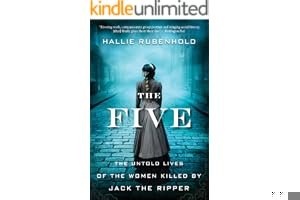
The Five: The Untold Lives of the Women Killed by Jack the Ripper
Hallie Rubenhold
4.3
Winner of the Baillie Gifford Prize for Non-Fiction
Five devastating human stories and a dark and moving portrait of Victorian London—the untold lives of the women killed by Jack the Ripper.
Polly, Annie, Elizabeth, Catherine and Mary-Jane are famous for the same thing, though they never met. They came from Fleet Street, Knightsbridge, Wolverhampton, Sweden, and Wales. They wrote ballads, ran coffee houses, lived on country estates, they breathed ink-dust from printing presses and escaped people-traffickers.
What they had in common was the year of their murders: 1888. The person responsible was never identified, but the character created by the press to fill that gap has become far more famous than any of these five women.
For more than a century, newspapers have been keen to tell us that "the Ripper" preyed on prostitutes. Not only is this untrue, as historian Hallie Rubenhold has discovered, it has prevented the real stories of these fascinating women from being told. Now, in this devastating narrative of five lives, Rubenhold finally sets the record straight, revealing a world not just of Dickens and Queen Victoria, but of poverty, homelessness and rampant misogyny. They died because they were in the wrong place at the wrong time—but their greatest misfortune was to be born a woman.
…
Recommended by Isabelle Khurshudyan and Sarah Churchwell.
Isabelle Khurshudyan
.@HallieRubenhold is awesome and you should check this book out! https://t.co/RL8L1xF8xZ [source]
Sarah Churchwell
Massive congratulations to @HallieRubenhold for being longlisted for the @BGPrize for her brilliant book The Five!! So well deserved and a complete thrill for #twitterstorians! 🎉🎊📚💃 [source]
Cover unavailable
32
Mary Queen of Scots
Antonia Fraser
4.3
Author of Marie Antoinette
She was the quintessential queen: statuesque, regal, dazzlingly beautiful. Her royal birth gave her claim to the thrones of two nations; her marriage to the young French dauphin promised to place a third glorious crown on her noble head.
Instead, Mary Stuart became the victim of her own impulsive heart, scandalizing her world with a foolish passion that would lead to abduction, rape and even murder. Betrayed by those she most trusted, she would be lured into a deadly game of power, only to lose to her envious and unforgiving cousin, Elizabeth I.
Here is her story, a queen who lost a throne for love, a monarch pampered and adored even as she was led to her beheading, the unforgettable woman who became a legend for all time.
…
Cover unavailable
33
A History of Britain: At the Edge of the World? 3500 BC-AD 1603 (A History of Britain, #1)
Simon Schama
4.3
Simon Schama's magesterial new book encompasses over 1,500 years of Britain's history, from the first Roman invasions to the early seventeenth century, and the extraordinary reign of Queen Elizabeth I. Schama, the author of the highly acclaimed Citizens and The Embarrassment of Riches, is one of the most popular and celebrated historians of our day, and in this magnificent work he brings history to dramatic life with a wealth of stories and vivid, colorful detail, reanimating familiar figures and events and drawing them skillfully into a powerful and compelling narrative. Schama's perspective moves from the birth of civilization to the Norman Conquest; through the religious wars and turbulance of the Middle Ages to the sovereignties of Henry II, Richard I and King John; through the outbreak of the Black Death, which destroyed nearly half of Europe's population, through the reign of Edward I and the growth of national identity in Wales and Scotland, to the intricate conflicts of the Tudors and the clash between Elizabeth I and Mary Queen of Scots. Driven by the drama of the stories themselves but exploring at the same time a network of interconnected themes--the formation of a nation state, the cyclical nature of power, the struggles between the oppressors and the oppressed--this is a superbly readable and illuminating account of a great nation, and its extraordinary history.
…
Cover unavailable
34
The Professor and the Madman: A Tale of Murder, Insanity and the Making of the Oxford English Dictionary
Simon Winchester
4.3
The Professor and the Madman, masterfully researched and eloquently written, is an extraordinary tale of madness, genius, and the incredible obsessions of two remarkable men that led to the making of the Oxford English Dictionary -- and literary history. The compilation of the OED, begun in 1857, was one of the most ambitious projects ever undertaken. As definitions were collected, the overseeing committee, led by Professor James Murray, discovered that one man, Dr. W. C. Minor, had submitted more than ten thousand. When the committee insisted on honoring him, a shocking truth came to light: Dr. Minor, an American Civil War veteran, was also an inmate at an asylum for the criminally insane.
…
Recommended by Peter Gilliver.
Peter Gilliver
W.C. Minor was a member of the public, but he just happened to be a murderer who was banged up in Broadmoor. [source]
Cover unavailable
35
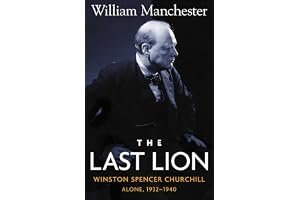
The Last Lion: Winston Spencer Churchill: Alone, 1932-40
William Manchester
4.3
In this powerful biography, the middle volume of William Manchester’s critically acclaimed trilogy, Winston Churchill wages his defining campaign: not against Hitler’s war machine but against his own reluctant countrymen. Manchester contends that even more than his leadership in combat, Churchill’s finest hour was the uphill battle against appeasement. As Parliament received with jeers and scorn his warnings against the growing Nazi threat, Churchill stood alone—only to be vindicated by history as a beacon of hope amid the gathering storm. Praise for The Last Lion: Alone
“Manchester has such control over a huge and moving narrative, such illumination of character . . . that he can claim the considerable achievement of having assembled enough powerful evidence to support Isaiah Berlin’s judgment of Churchill as ‘the largest human being of our time.’”—The New Yorker “Memorable.”—San Francisco Chronicle
“Stirring . . . As Manchester points out several times, it’s as if the age, having produced a Hitler, then summoned Churchill as the only figure equal to the task of vanquishing him. The years Alone are the pivotal years of Churchill’s career.”—The Boston Sunday Globe “The best Churchill biography [for] this generation . . . Even readers who know the basic story will find much that is new.”—Newsweek
“A triumph . . . equal in stature to the first volume of the series.”—Newsday “Vivid . . . history in the grand manner.”—The Washington Post
“Compelling reading.”—The Times (London)
…
Cover unavailable
36
Empire: How Britain Made the Modern World
Niall Ferguson
4.3
Once vast swathes of the globe were coloured imperial red and Britannia ruled not just the waves, but the prairies of America, the plains of Asia, the jungles of Africa and the deserts of Arabia. Just how did a small, rainy island in the North Atlantic achieve all this? And why did the empire on which the sun literally never set finally decline and fall? Niall Ferguson's acclaimed Empire brilliantly unfolds the imperial story in all its splendours and its miseries, showing how a gang of buccaneers and gold-diggers planted the seed of the biggest empire in all history - and set the world on the road to modernity.
'The most brilliant British historian of his generation ... Ferguson examines the roles of "pirates, planters, missionaries, mandarins, bankers and bankrupts" in the creation of history's largest empire ... he writes with splendid panache ... and a seemingly effortless, debonair wit' Andrew Roberts
'Dazzling ... wonderfully readable' New York Review of Books
'A remarkably readable précis of the whole British imperial story - triumphs, deceits, decencies, kindnesses, cruelties and all' Jan Morris
'Empire is a pleasure to read and brims with insights and intelligence' Sunday Times
…
Cover unavailable
37
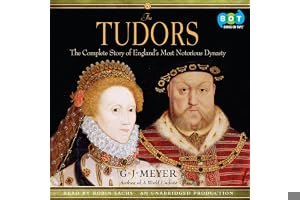
The Tudors: The Complete Story of England's Most Notorious Dynasty
G.J. Meyer
4.3
For the first time in decades, here, in a single volume, is a fresh look at the fabled Tudor dynasty, comprising some of the most enigmatic figures ever to rule a country. Acclaimed historian G. J. Meyer reveals the flesh-and-bone reality in all its wild excess.
In 1485, young Henry Tudor, whose claim to the throne was so weak as to be almost laughable, crossed the English Channel from France at the head of a ragtag little army and took the crown from the family that had ruled England for almost four hundred years. Half a century later his son, Henry VIII, desperate to rid himself of his first wife in order to marry a second, launched a reign of terror aimed at taking powers no previous monarch had even dreamed of possessing. In the process he plunged his kingdom into generations of division and disorder, creating a legacy of blood and betrayal that would blight the lives of his children and the destiny of his country.
The boy king Edward VI, a fervent believer in reforming the English church, died before bringing to fruition his dream of a second English Reformation. Mary I, the disgraced daughter of Catherine of Aragon, tried and failed to reestablish the Catholic Church and produce an heir. And finally came Elizabeth I, who devoted her life to creating an image of herself as Gloriana the Virgin Queen but, behind that mask, sacrificed all chance of personal happiness in order to survive.
The Tudors weaves together all the sinners and saints, the tragedies and triumphs, the high dreams and dark crimes, that reveal the Tudor era to be, in its enthralling, notorious truth, as momentous and as fascinating as the fictions audiences have come to love.
…
Cover unavailable
38
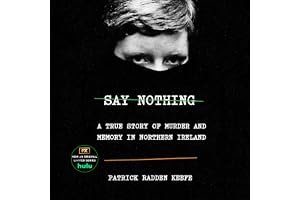
Say Nothing: A True Story of Murder and Memory in Northern Ireland
Patrick Radden Keefe
4.3
14 hours, 40 minutes
From award-winning New Yorker staff writer Patrick Radden Keefe, a stunning, intricate narrative about a notorious killing in Northern Ireland and its devastating repercussions
In December 1972, Jean McConville, a thirty-eight-year-old mother of ten, was dragged from her Belfast home by masked intruders, her children clinging to her legs. They never saw her again. Her abduction was one of the most notorious episodes of the vicious conflict known as The Troubles. Everyone in the neighborhood knew the I.R.A. was responsible. But in a climate of fear and paranoia, no one would speak of it. In 2003, five years after an accord brought an uneasy peace to Northern Ireland, a set of human bones was discovered on a beach. McConville's children knew it was their mother when they were told a blue safety pin was attached to the dress--with so many kids, she had always kept it handy for diapers or ripped clothes.
Patrick Radden Keefe's mesmerizing book on the bitter conflict in Northern Ireland and its aftermath uses the McConville case as a starting point for the tale of a society wracked by a violent guerrilla war, a war whose consequences have never been reckoned with. The brutal violence seared not only people like the McConville children, but also I.R.A. members embittered by a peace that fell far short of the goal of a united Ireland, and left them wondering whether the killings they committed were not justified acts of war, but simple murders. From radical and impetuous I.R.A. terrorists such as Dolours Price, who, when she was barely out of her teens, was already planting bombs in London and targeting informers for execution; to the ferocious I.R.A. mastermind known as The Dark; to the spy games and dirty schemes of the British Army; to Gerry Adams, who negotiated the peace but betrayed his hardcore comrades by denying his I.R.A. past, Say Nothing conjures a world of passion, betrayal, vengeance, and anguish.
…
Recommended by Carrie Johnson, Margot Wallström, Mikko Takkunen, and 3 others.
Carrie Johnson
The best book I read last year. 📚 https://t.co/CULq9zZHEU [source]
Margot Wallström
I recommend the book ”Say nothing” about Northern Ireland and IRA. It makes fascinating reading about memories, murder, mourning and making peace. [source]
Mikko Takkunen
Just finished reading this remarkable book by @praddenkeefe. I was baffled getting this from @VeronicaSanchis as I don’t remember ever showing particular interest in the Troubles, but she obviously knows me better than I do. https://t.co/KlBCF41y47 https://t.co/PnJlLCZyQD [source]
Cover unavailable
39
Mary Boleyn: The Mistress of Kings
Alison Weir
4.3
Mary Boleyn (c.1500-1543) was no less fascinating than her ill-fated queen consort sister Anne. In fact, her own claims to fame are numerous: She was not only an influential member of King Henry VIII's court circle; she was one of his mistresses and perhaps the mother of two of his children. In addition, the apparently prolific Mary was rumored to have been also a mistress of the King's rival, Francis I of France. Alison Weir's Mary Boleyn substantially redeems her subject's reputation by disputing her scandalous portrayal in Philippa Gregory's novel The Other Boleyn Girl. Our most detailed view yet of a power behind the throne. With titles like Elizabeth and The Lady in the Tower, Weir has carved out a niche as one of the foremost biographers of British royalty.
…
Cover unavailable
40
Elizabeth and Mary: Cousins, Rivals, Queens
Jane Dunn
4.3
The political and religious conflicts between Queen Elizabeth I and the doomed Mary, Queen of Scots, have for centuries captured our imagination and inspired memorable dramas played out on stage, screen, and in opera. But few books have brought to life more vividly the exquisite texture of two women's rivalry, spurred on by the ambitions and machinations of the forceful men who surrounded them. The drama has terrific resonance even now as women continue to struggle in their bid for executive power.
Against the backdrop of sixteenth-century England, Scotland, and France, Dunn paints portraits of a pair of protagonists whose formidable strengths were placed in relentless opposition. Protestant Elizabeth, the bastard daughter of Anne Boleyn, whose legitimacy had to be vouchsafed by legal means, glowed with executive ability and a visionary energy as bright as her red hair. Mary, the Catholic successor whom England's rivals wished to see on the throne, was charming, feminine, and deeply persuasive. That two such women, queens in their own right, should have been contemporaries and neighbours sets in motion a joint biography of rare spark and page-turning power.
…
Cover unavailable
41
Bring Up the Bodies
Hilary Mantel
4.2
Alternate Cover Edition ISBN 0805090037 (ISBN13: 9780805090031)
The sequel to Hilary Mantel's international bestseller and Man Booker Prize winner Wolf Hall explores one of the most mystifying and frightening episodes in English history: the downfall of Anne Boleyn. ... Though he battled for years to marry her, Henry VIII has become disenchanted with the audacious Anne Boleyn. She has failed to give him a son, and her sharp intelligence and strong will have alienated his old friends and the noble families of England.
When the discarded Katherine, Henry's first wife, dies in exile from the court, Anne stands starkly exposed, the focus of gossip and malice, setting in motion a dramatic trial of the queen and her suitors for adultery and treason.
At a word from Henry, Thomas Cromwell is ready to bring her down. Over a few terrifying weeks, Anne is ensnared in a web of conspiracy, while the demure Jane Seymour stands waiting her turn for the poisoned wedding ring. But Anne and her powerful family will not yield without a ferocious struggle. To defeat the Boleyns, Cromwell must ally himself with his enemies. What price will he pay for Annie's head? (front flap)
…
Cover unavailable
42
The Rise and Fall of the British Empire
Lawrence James
4.2
Great Britain's geopolitical role has undergone many changes over the last four centuries. Once a maritime superpower and ruler of half the world, Britain now occupies an isolated position as an economically fragile island often at odds with her European neighbors. Lawrence James has written a comprehensive, perceptive and insighful history of the British Empire. Spanning the years from 1600 to the present day, this critically acclaimed book combines detailed scholarship with readable popular history.
Alternate cover for ISBN 10: 0140058508 / ISBN 13: 9780140058505
Everyone knows 1066 as the date of the Norman invasion and conquest of England. But how many of us can place that event in the context of the entire dramatic year in which it took place? From the death of Edward the Confessor in early January to the Christmas coronation of Duke William of Normandy, there is an almost uncanny symmetry, as well as a relentlessly exciting surge, of events leading to and from Hastings.
…
Cover unavailable
45
The Spy and the Traitor: The Greatest Espionage Story of the Cold War
Ben Macintyre
4.2
The celebrated author of A Spy Among Friends and Rogue Heroes returns with his greatest spy story yet, a thrilling Cold War-era tale of Oleg Gordievsky, the Russian whose secret work helped hasten the collapse of the Soviet Union.
If anyone could be considered a Russian counterpart to the infamous British double-agent Kim Philby, it was Oleg Gordievsky. The son of two KGB agents and the product of the best Soviet institutions, the savvy, sophisticated Gordievsky grew to see his nation's communism as both criminal and philistine. He took his first posting for Russian intelligence in 1968 and eventually became the Soviet Union's top man in London, but from 1973 on he was secretly working for MI6.
For nearly a decade, as the Cold War reached its twilight, Gordievsky helped the West turn the tables on the KGB, exposing Russian spies and helping to foil countless intelligence plots, as the Soviet leadership grew increasingly paranoid at the United States's nuclear first-strike capabilities and brought the world closer to the brink of war. Desperate to keep the circle of trust close, MI6 never revealed Gordievsky's name to its counterparts in the CIA, which in turn grew obsessed with figuring out the identity of Britain's obviously top-level source. Their obsession ultimately doomed Gordievsky: the CIA officer assigned to identify him was none other than Aldrich Ames, the man who would become infamous for secretly spying for the Soviets.
Unfolding the delicious three-way gamesmanship between America, Britain, and the Soviet Union, and culminating in the gripping cinematic beat-by-beat of Gordievsky's nail-biting escape from Moscow in 1985, Ben Macintyre's latest may be his best yet. Like the greatest novels of John le Carré, it brings readers deep into a world of treachery and betrayal, where the lines bleed between the personal and the professional, and one man's hatred of communism had the power to change the future of nations.
just finished this yesterday. absolutely fantastic book. super recommend if you're into spycraft and espionage. bravo @BenMacintyre1 https://t.co/4OG4C1cBQ1 [source]
I had a great conversation with Ambassador Micheal Lund Jeppesen of @DKinAfghanistan . On the sidelines of our rich conversation we spoke of the Spy & the Traitor a great book in which Denmark's intelligence features highly. Proud of our alliance & cooperation. https://t.co/47GMb7ETWr [source]
Gady Epstein
Think I’ll read a non-China spy story for a change. Have heard great things about this book https://t.co/QcBa0ozRfG [source]
Cover unavailable
46
Rebellion: The History of England from James I to the Glorious Revolution
Peter Ackroyd
4.2
Peter Ackroyd has been praised as one of the greatest living chroniclers of Britain and its people. In Rebellion, he continues his dazzling account of the history of England, beginning with the progress south of the Scottish king, James VI, who on the death of Elizabeth I became the first Stuart king of England, and ending with the deposition and flight into exile of his grandson, James II.
The Stuart monarchy brought together the two nations of England and Scotland into one realm, albeit a realm still marked by political divisions that echo to this day. More importantly, perhaps, the Stuart era was marked by the cruel depredations of civil war, and the killing of a king. Shrewd and opinionated, James I was eloquent on matters as diverse as theology, witchcraft, and the abuses of tobacco, but his attitude to the English parliament sowed the seeds of the division that would split the country during the reign of his hapless heir, Charles I. Ackroyd offers a brilliant, warts-and-all portrayal of Charles's nemesis, Oliver Cromwell, Parliament's great military leader and England's only dictator, who began his career as a political liberator but ended it as much of a despot as "that man of blood," the king he executed.
England's turbulent seventeenth century is vividly laid out before us, but so too is the cultural and social life of the period, notable for its extraordinarily rich literature, including Shakespeare's late masterpieces, Jacobean tragedy, the poetry of John Donne and Milton and Thomas Hobbes's great philosophical treatise, Leviathan. In addition to its account of England's royalty, Rebellion also gives us a very real sense of the lives of ordinary English men and women, lived out against a backdrop of constant disruption and uncertainty.
…
Cover unavailable
47
Churchill: Walking with Destiny
Andrew Roberts
4.2
A NEW YORK TIMES BESTSELLER
“Unarguably the best single-volume biography of Churchill . . . A brilliant feat of storytelling, monumental in scope, yet put together with tenderness for a man who had always believed that he would be Britain’s savior.” —Wall Street Journal
In this landmark biography of Winston Churchill based on extensive new material, the true genius of the man, statesman and leader can finally be fully seen and understood by the bestselling, award-winning author of Napoleon and The Storm of War.
When we seek an example of unalloyed courage, the man who comes to mind is Winston Churchill: the visionary leader, immune from the consensus of the day, who stood firmly for his beliefs when everyone doubted him. But how did young Winston become Churchill? What gave him the strength to take on the superior force of Nazi Germany when bombs rained on London and so many others had caved? In The Storm of War, Andrew Roberts gave us a tantalizing glimpse of Churchill the war leader. Now, at last, we have the full and definitive biography, as personally revealing as it is compulsively readable, about one of the great leaders of all time.
Roberts was granted exclusive access to extensive new material: the transcripts of war cabinet meetings-- the equivalent of the Nixon and JFK tapes--diaries, letters, unpublished memoirs, and detailed notes taken by the king after their bi-weekly meetings. Having read every one of Churchill's letters--including deeply personal ones that Churchill's son Randolph had previously chosen to withhold--and spoken to more than one hundred people who knew or worked with him, Roberts identifies the hidden forces fueling Churchill's drive. Churchill put his faith in the British Empire and fought as hard to preserve it as he did to defend London. Having started his career in India and South Africa, he understood better than most idealists how hard it can be to pacify reluctant people far from home. We think of Churchill as a hero of the age of mechanized warfare, but Roberts's masterwork reveals that he has as much to teach us about the challenges we face today--and the fundamental values of courage, tenacity, leadership, and moral conviction.
…
Recommended by Robert Benzie.
Robert Benzie
Best book I have read this year. https://t.co/Vv3GlB426d [source]
Cover unavailable
48
The Red Queen (The Plantagenet and Tudor Novels, #3; Cousins War #2)
Philippa Gregory
4.2
The second book in Philippa's stunning new trilogy, The Cousins' War, brings to life the story of Margaret Beaufort, a shadowy and mysterious character in the first book of the series - The White Queen - but who now takes centre stage in the bitter struggle of The War of the Roses.
The Red Queen tells the story of the child-bride of Edmund Tudor, who, although widowed in her early teens, uses her determination of character and wily plotting to infiltrate the house of York under the guise of loyal friend and servant, undermine the support for Richard III and ultimately ensure that her only son, Henry Tudor, triumphs as King of England.
Through collaboration with the dowager Queen Elizabeth Woodville, Margaret agrees to a betrothal between Henry and Elizabeth's daughter, thereby uniting the families and resolving the Cousins War once and for all by founding of the Tudor dynasty.
…
Cover unavailable
49
A Spy Among Friends: Kim Philby and the Great Betrayal
Ben Macintyre
4.2
Master storyteller Ben Macintyre’s most ambitious work to date brings to life the twentieth century’s greatest spy story.
Kim Philby was the greatest spy in history, a brilliant and charming man who rose to head Britain’s counterintelligence against the Soviet Union during the height of the Cold War—while he was secretly working for the enemy. And nobody thought he knew Philby like Nicholas Elliott, Philby’s best friend and fellow officer in MI6. The two men had gone to the same schools, belonged to the same exclusive clubs, grown close through the crucible of wartime intelligence work and long nights of drink and revelry. It was madness for one to think the other might be a communist spy, bent on subverting Western values and the power of the free world.
But Philby was secretly betraying his friend. Every word Elliott breathed to Philby was transmitted back to Moscow—and not just Elliott’s words, for in America, Philby had made another powerful friend: James Jesus Angleton, the crafty, paranoid head of CIA counterintelligence. Angleton's and Elliott’s unwitting disclosures helped Philby sink almost every important Anglo-American spy operation for twenty years, leading countless operatives to their doom. Even as the web of suspicion closed around him, and Philby was driven to greater lies to protect his cover, his two friends never abandoned him—until it was too late. The stunning truth of his betrayal would have devastating consequences on the two men who thought they knew him best, and on the intelligence services he left crippled in his wake.
Told with heart-pounding suspense and keen psychological insight, and based on personal papers and never-before-seen British intelligence files, A Spy Among Friends is Ben Macintyre’s best book yet, a high-water mark in Cold War history telling.
From the Hardcover edition.
…
Cover unavailable
50
Hero of the Empire: The Boer War, a Daring Escape, and the Making of Winston Churchill
Candice Millard
4.2
From New York Times bestselling author of Destiny of the Republic and The River of Doubt, a thrilling narrative of Winston Churchill's extraordinary and little-known exploits during the Boer War At age twenty-four, Winston Churchill was utterly convinced it was his destiny to become prime minister of England one day, despite the fact he had just lost his first election campaign for Parliament. He believed that to achieve his goal he must do something spectacular on the battlefield. Despite deliberately putting himself in extreme danger as a British Army officer in colonial wars in India and Sudan, and as a journalist covering a Cuban uprising against the Spanish, glory and fame had eluded him.
Churchill arrived in South Africa in 1899, valet and crates of vintage wine in tow, there to cover the brutal colonial war the British were fighting with Boer rebels. But just two weeks after his arrival, the soldiers he was accompanying on an armored train were ambushed, and Churchill was taken prisoner. Remarkably, he pulled off a daring escape--but then had to traverse hundreds of miles of enemy territory, alone, with nothing but a crumpled wad of cash, four slabs of chocolate, and his wits to guide him.
The story of his escape is incredible enough, but then Churchill enlisted, returned to South Africa, fought in several battles, and ultimately liberated the men with whom he had been imprisoned.
Churchill would later remark that this period, "could I have seen my future, was to lay the foundations of my later life." Millard spins an epic story of bravery, savagery, and chance encounters with a cast of historical characters--including Rudyard Kipling, Lord Kitchener, and Mohandas Gandhi--with whom he would later share the world stage. But Hero of the Empire is more than an adventure story, for the lessons Churchill took from the Boer War would profoundly affect 20th century history.
From the Hardcover edition.
…
Cover unavailable
51
Queen Isabella: Treachery, Adultery, and Murder in Medieval England
Alison Weir
4.2
In this vibrant biography, acclaimed author Alison Weir reexamines the life of Isabella of England, one of history’s most notorious and charismatic queens. Isabella arrived in London in 1308, the spirited twelve-year-old daughter of King Philip IV of France. Her marriage to the heir to England’s throne was designed to heal old political wounds between the two countries, and in the years that followed she became an important figure, a determined and clever woman whose influence would come to last centuries. Many myths and legends have been woven around Isabella’s story, but in this first full biography in more than 150 years, Alison Weir gives a groundbreaking new perspective.
…
Cover unavailable
52
Elizabeth I: The Exhibition Catalogue
David Starkey
4.2
This lavishly illustrated book ties in with a major international exhibition opening at the National Maritime Museum in Greenwich on 1 May 2003. Timed to commemorate the 400th anniversary since the death of Queen Elizabeth I in 1603, and sponsored by Morgan Stanley, the exhibition brings together a wealth of paintings, manuscripts, fine art objects and personal effects which illuminate Elizabeth's fascinating history. Elizabeth was born at Greenwich and spent her first months at Greenwich Palace, on the site of what is now a World Heritage Site, Maritime Greenwich. The book, containing contributions from a number of well-known experts on Tudor history, will focus on Elizabeth's Court as well as her relationship with the City of London and its increasingly influential mercantile class. It will also reflect the importance of Elizabeth's maritime adventurers, and their role in creating wealth for the crown, burgeoning maritime enterprise and the beginnings of an overseas empire.
…
Recommended by Helen Hackett.
Helen Hackett
I chose this one because it is a catalogue of an excellent exhibition at the National Maritime Museum in 2003. That was one of a whole lot of events and publications for the 400-year anniversary of Elizabeth’s death in 1603. This volume is particularly interesting because it is a really rich, full, broad catalogue where they tried to present some unusual things that people haven’t seen before, because, of course, Elizabeth I is so familiar to us. [source]
Cover unavailable
53
Six Wives: The Queens of Henry VIII
David Starkey
4.2
No one in history had a more eventful career in matrimony than Henry VIII. His marriages were daring and tumultuous, and made instant legends of six very different women. In this remarkable study, David Starkey argues that the king was not a depraved philanderer but someone seeking happiness -- and a son. Knowingly or not, he elevated a group of women to extraordinary heights and changed the way a nation was governed.
Six Wives is a masterful work of history that intimately examines the rituals of diplomacy, marriage, pregnancy, and religion that were part of daily life for women at the Tudor Court. Weaving new facts and fresh interpretations into a spellbinding account of the emotional drama surrounding Henry's six marriages, David Starkey reveals the central role that the queens played in determining policy. With an equally keen eye for romantic and political intrigue, he brilliantly recaptures the story of Henry's wives and the England they ruled.
…
Cover unavailable
54
The British Are Coming: The War for America, Lexington to Princeton, 1775-1777
Rick Atkinson
4.2
In the initial volume of the Revolution Trilogy Rick Atkinson recounts the first twenty-one months of America’s violent war for independence. From the battles at Lexington and Concord in spring 1775 to those at Trenton and Princeton in winter 1777, American militiamen and then the ragged Continental Army take on the world’s most formidable fighting force. It is a saga alive with astonishing characters: Henry Knox, the former bookseller with an uncanny understanding of artillery; Nathanael Greene, the bumpkin who becomes a brilliant battle captain; Benjamin Franklin, who proves to be the wiliest of diplomats; George Washington, the commander in chief who learns the difficult art of leadership when the war seems all but lost. The story is also told from the British perspective, making the mortal conflict between the redcoats and the rebels all the more compelling.
…
Recommended by Mount Vernon.
Mount Vernon
@DEdHoggatt Great response, and congratulations! You've been selected to win Rick Atkinson's new book, 'The British Are Coming!' Please DM us to claim your prize, and thank you for participating in our contest! [source]
Cover unavailable
55
Katherine Swynford: The Story of John of Gaunt and His Scandalous Duchess
Alison Weir
4.2
In her remarkable new book, Alison Weir recounts one of the greatest love stories of medieval England. It is the extraordinary tale of an exceptional woman, Katherine Swynford, who became first the mistress and later the wife of John of Gaunt, Duke of Lancaster.
Katherine Swynford’s charismatic lover was one of the most powerful princes of the 14th century, the effective ruler of England behind the throne of his father Edward III in his declining years, and during the minority of his nephew, Richard II. Katherine herself was enigmatic and intriguing, renowned for her beauty, and regarded by some as dangerous. Her existence was played out against the backdrop of court life at the height of the age of chivalry and she knew most of the great figures of the time — including her brother-in-law, Geoffrey Chaucer. She lived through much of the Hundred Years War, the Black Death, and the Peasants’ Revolt. She knew loss, adversity, and heartbreak, and she survived them all triumphantly. Although Katherine’s story provides unique insights into the life of a medieval woman, she was far from typical in that age. She was an important person in her own right, a woman who had remarkable opportunities, made her own choices, flouted convention, and took control of her own destiny — even of her own public image.
Weir brilliantly retrieves Katherine Swynford from the footnotes of history and gives her life and breath again. Perhaps the most dynastically important woman within the English monarchy, she was the mother of the Beauforts and through them the ancestress of the Yorkist kings, the Tudors, the Stuarts, and every other sovereign since — a legacy that has shaped the history of Britain.
…
Cover unavailable
56
The Constant Princess (The Plantagenet and Tudor Novels, #6)
Philippa Gregory
4.2
Splendid and sumptuous historical novel from the internationally bestselling author, Philippa Gregory, telling of the early life of Katherine of Aragon.
We think of Katherine of Aragon as the barren wife of a notorious king; but behind this legacy lies a fascinating story.
Katherine of Aragon is born Catalina, the Spanish Infanta, to parents who are both rulers and warriors. Aged four, she is betrothed to Arthur, Prince of Wales, and is raised to be Queen of England. She is never in doubt that it is her destiny to rule that far-off, wet, cold land.
Her faith is tested when her prospective father-in-law greets her arrival in her new country with a great insult; Arthur seems little better than a boy; the food is strange and the customs coarse. Slowly she adapts to the first Tudor court, and life as Arthur’s wife grows ever more bearable.
But when the studious young man dies, she is left to make her own future: how can she now be queen, and found a dynasty? Only by marrying Arthur’s young brother, the sunny but spoilt Henry. His father and grandmother are against it; her powerful parents prove little use. Yet Katherine is her mother’s daughter and her fighting spirit is strong.
She will do anything to achieve her aim; even if it means telling the greatest lie, and holding to it.
…
Cover unavailable
57
The Boleyn Inheritance (The Plantagenet and Tudor Novels, #10)
Philippa Gregory
4.2
Three Women Who Share One Fate: The Boleyn Inheritance
Anne of Cleves She runs from her tiny country, her hateful mother, and her abusive brother to a throne whose last three occupants are dead. King Henry VIII, her new husband, instantly dislikes her. Without friends, family, or even an understanding of the language being spoken around her, she must literally save her neck in a court ruled by a deadly game of politics and the terror of an unpredictable and vengeful king. Her Boleyn Inheritance: accusations and false witnesses.
Katherine Howard She catches the king's eye within moments of arriving at court, setting in motion the dreadful machine of politics, intrigue, and treason that she does not understand. She only knows that she is beautiful, that men desire her, that she is young and in love -- but not with the diseased old man who made her queen, beds her night after night, and killed her cousin Anne. Her Boleyn Inheritance: the threat of the axe.
Jane Rochford She is the Boleyn girl whose testimony sent her husband and sister-in-law to their deaths. She is the trusted friend of two threatened queens, the perfectly loyal spy for her uncle, the Duke of Norfolk, and a canny survivor in the murderous court of a most dangerous king. Throughout Europe, her name is a byword for malice, jealousy, and twisted lust. Her Boleyn Inheritance: a fortune and a title, in exchange for her soul.
The Boleyn Inheritance is a novel drawn tight as a lute string about a court ruled by the gallows and three women whose positions brought them wealth, admiration, and power as well as deceit, betrayal, and terror. Once again, Philippa Gregory has brought a vanished world to life - the whisper of a silk skirt on a stone stair, the yellow glow of candlelight illuminating a hastily written note, the murmurs of the crowd gathering on Tower Green below the newly built scaffold. In The Boleyn Inheritance Gregory is at her intelligent and page-turning best.
…
Cover unavailable
58
The Life and Death of Anne Boleyn
Eric Ives
4.2
This definitive full biography of Anne Boleyn, based on the latest scholarly research, focusses on Anne’s life and legacy and establishes Anne as a figure of considerable importance and influence in her own right.
Cover unavailable
59
Ecclesiastical History of the English People
Bede, D. H. Farmer, Ronald Latham, Leo Sherley-Price
4.2
Starting with the invasion of Julius Caesar in the fifth century, Bede recorded the history of the English up to his own day in 731 A.D. A scholarly monk working in the north-east of England, Bede wrote the five books of his history in Latin. The Ecclesiastical History is his most famous work, and this edition provides the authoritative Colgrave translation, as well as a new translation of the Greater Chronicle, never before published in English. His Letter to Egbert gives his final reflections on the English Church just before his death. This is the only edition to include all three texts, and they are illuminated further by a detailed introduction and explanatory notes.
About the Series: For over 100 years Oxford World's Classics has made available the broadest spectrum of literature from around the globe. Each affordable volume reflects Oxford's commitment to scholarship, providing the most accurate text plus a wealth of other valuable features, including expert introductions by leading authorities, voluminous notes to clarify the text, up-to-date bibliographies for further study, and much more.
Bede is writing about 130 years after the English had first experienced Christianity. [source]
Cover unavailable
60
Bloodlands: Europe Between Hitler and Stalin
Timothy Snyder
4.1
Americans call the Second World War “The Good War.” But before it even began, America’s wartime ally Josef Stalin had killed millions of his own citizens—and kept killing them during and after the war. Before Hitler was finally defeated, he had murdered six million Jews and nearly as many other Europeans. At war’s end, both the German and the Soviet killing sites fell behind the iron curtain, leaving the history of mass killing in darkness. Bloodlands is a new kind of European history, presenting the mass murders committed by the Nazi and Stalinist regimes as two aspects of a single history, in the time and place where they occurred: between Germany and Russia, when Hitler and Stalin both held power. Assiduously researched, deeply humane, and utterly definitive, Bloodlands will be required reading for anyone seeking to understand the central tragedy of modern history.
From Booklist
If there is an explanation for the political killing perpetrated in eastern Europe in the 1930s and 1940s, historian Snyder roots it in agriculture. Stalin wanted to collectivize farmers; Hitler wanted to eliminate them so Germans could colonize the land. The dictators wielded frightening power to advance such fantasies toward reality, and the despots toted up about 14 million corpses between them, so stupefying a figure that Snyder sets himself three goals here: to break down the number into the various actions of murder that comprise it, from liquidation of the kulaks to the final solution; to restore humanity to the victims via surviving testimony to their fates; and to deny Hitler and Stalin any historical justification for their policies, which at the time had legions of supporters and have some even today. Such scope may render Snyder’s project too imposing to casual readers, but it would engage those exposed to the period’s chronology and major interpretive issues, such as the extent to which the Nazi and Soviet systems may be compared. Solid and judicious scholarship for large WWII collections.
This book is about…the Stalinist repression of the areas known as the borderlands, which Snyder has termed the bloodlands. Snyder is looking at the deliberate mass murder of civilians in a particular zone of Europe between about 1930, at the start of the second Ukraine famine, and 1945. [source]
Edward Lucas
Bloodlands: Europe Between Hitler and Stalin offers the best account of the most important and terrible years of the last century, when Joseph Stalin and Adolf Hitler jointly consigned the territories and people between their two empires to the meat-grinder. [source]
Cover unavailable
61
The King's Speech: How One Man Saved the British Monarchy
Mark Logue, Peter Conradi
4.1
One man saved the British Royal Family in the first decades of the 20th century - he wasn't a prime minister or an archbishop of Canterbury. He was an almost unknown, and self-taught, speech therapist named Lionel Logue, whom one newspaper in the 1930s famously dubbed 'The Quack who saved a King'.
Logue wasn't a British aristocrat or even an Englishman - he was a commoner and an Australian to boot. Nevertheless it was the outgoing, amiable Logue who single-handedly turned the nervous, tongue-tied Duke of York into one of Britain's greatest kings after his brother, Edward VIII, abdicated in 1936 over his love of Mrs Simpson.
This is the previously untold story of the remarkable relationship between Logue and the haunted future King George VI, written with Logue's grandson and drawing exclusively from his grandfather Lionel's diaries and archive. It throws an extraordinary light on the intimacy of the two men, and the vital role the King's wife, the late Queen Elizabeth, the Queen Mother, played in bringing them together to save her husband's reputation and reign.
'The King's Speech: How One Man Saved the British Monarchy' is an astonishing insight into a private world. Logue's diaries also reveal, for the first time, the torment the future King suffered at the hands of his father George V because of his stammer. Never before has there been such a personal portrait of the British monarchy - at a time of its greatest crisis - seen through the eyes of an Australian commoner who was proud to serve, and save, his King.
…
Cover unavailable
62
Winter King: Henry VII and the Dawn of Tudor England
Thomas Penn
4.1
It was 1501. England had been ravaged for decades by conspiracy, violence, murders, coups and countercoups. Through luck, guile and ruthlessness, Henry VII, the first of the Tudor kings, had clambered to the top of the heap--a fugitive with a flimsy claim to England's throne. For many he remained a usurper, a false king.
But Henry had a crucial asset: his queen and their children, the living embodiment of his hoped-for dynasty. Queen Elizabeth was a member of the House of York. Henry himself was from the House of Lancaster, so between them they united the warring parties that had fought the bloody century-long War of the Roses. Now their older son, Arthur, was about to marry a Spanish princess. On a cold November day sixteen-year-old Catherine of Aragon arrived in London for a wedding that would mark a triumphal moment in Henry's reign.
In this remarkable book, Thomas Penn re-creates the story of the tragic, magnetic Henry VII--a controlling, paranoid, avaricious monarch who was entering the most perilous years of his long reign.
Rich with drama and insight, Winter King is an astonishing story of pageantry, treachery, intrigue and incident--and the fraught, dangerous birth of Tudor England.
…
Cover unavailable
63
The Lady of the Rivers (The Plantagenet and Tudor Novels, #1; Cousins War #3)
Philippa Gregory
4.1
Jacquetta, daughter of the Count of Luxembourg and kinswoman to half the royalty of Europe, was married to the great Englishman John, Duke of Bedford, uncle to Henry VI. Widowed at the age of 19, she took the extraordinary risk of marrying a gentleman of her household for love, and then carved out a new life for herself.
Cover unavailable
64
The Last Lion: Winston Spencer Churchill: Defender of the Realm, 1940-1965 (The Last Lion, #3)
William Manchester, Paul Reid
4.1
Spanning the years of 1940-1965, The Last Lion picks up shortly after Winston Churchill became Prime Minister—when his tiny island nation stood alone against the overwhelming might of Nazi Germany. The Churchill conjured up by William Manchester and Paul Reid is a man of indomitable courage, lightning fast intellect, and an irresistible will to action.
The Last Lion brilliantly recounts how Churchill organized his nation's military response and defense; compelled FDR into supporting America's beleaguered cousins, and personified the "never surrender" ethos that helped the Allies win the war, while at the same time adapting himself and his country to the inevitable shift of world power from the British Empire to the United States.
More than twenty years in the making, The Last Lion presents a revelatory and unparalleled portrait of this brilliant, flawed, and dynamic leader. This is popular history at its most stirring.
…
Cover unavailable
65
The Greatest Knight: The Remarkable Life of William Marshal, The Power Behind Five English Thrones
Thomas Asbridge
4.1
Cover unavailable
66
Elizabeth of York: A Tudor Queen and Her World
Alison Weir
4.1
Many are familiar with the story of the much-married King Henry VIII of England and the celebrated reign of his daughter, Elizabeth I. But it is often forgotten that the life of the first Tudor queen, Elizabeth of York, Henry’s mother and Elizabeth’s grandmother, spanned one of England’s most dramatic and perilous periods. Now New York Times bestselling author and acclaimed historian Alison Weir presents the first modern biography of this extraordinary woman, whose very existence united the realm and ensured the survival of the Plantagenet bloodline.
Her birth was greeted with as much pomp and ceremony as that of a male heir. The first child of King Edward IV, Elizabeth enjoyed all the glittering trappings of royalty. But after the death of her father; the disappearance and probable murder of her brothers—the Princes in the Tower; and the usurpation of the throne by her calculating uncle Richard III, Elizabeth found her world turned upside-down: She and her siblings were declared bastards.
As Richard’s wife, Anne Neville, was dying, there were murmurs that the king sought to marry his niece Elizabeth, knowing that most people believed her to be England’s rightful queen. Weir addresses Elizabeth’s possible role in this and her covert support for Henry Tudor, the exiled pretender who defeated Richard at the Battle of Bosworth and was crowned Henry VII, first sovereign of the House of Tudor. Elizabeth’s subsequent marriage to Henry united the houses of York and Lancaster and signaled the end of the Wars of the Roses. For centuries historians have asserted that, as queen, she was kept under Henry’s firm grasp, but Weir shows that Elizabeth proved to be a model consort—pious and generous—who enjoyed the confidence of her husband, exerted a tangible and beneficial influence, and was revered by her son, the future King Henry VIII.
Drawing from a rich trove of historical records, Weir gives a long overdue and much-deserved look at this unforgettable princess whose line descends to today’s British monarch—a woman who overcame tragedy and danger to become one of England’s most beloved consorts.
…
Cover unavailable
67
Blood Sisters: The Women Behind The Wars Of The Roses
Sarah Gristwoo
4.1
From best-selling historian, Sarah Gristwood comes the true story behind Philippa Gregory’s recent novels – the women who gave birth to the Tudor dynasty. It is a fiery history of Queens, the perils of power and of how the Wars of the Roses were ended – not by knights in battle, but the sinewy political skills of women.
The events of the Wars of the Roses are usually described in terms of the men involved; Richard, Duke of York, Henry VI, Edward IV and Henry VII. The reality though, argues Sarah Gristwood, was quite different. These years were also packed with women's drama and – in the tales of conflicted maternity and monstrous births – alive with female energy.
In this completely original book, acclaimed author Sarah Gristwood sheds light on a neglected dimension of English history: the impact of Tudor women on the Wars of the Roses. She examines Cecily Neville, the wife of Richard Duke of York, who was deprived of being queen when her husband died at the Battle of Wakefield; Elizabeth Woodville, a widow with several children who married Edward IV in secret and was crowned queen consort; Margaret Beaufort, mother of Henry VII, whose ambitions centred on her son and whose persuasions are likely to have lead her husband Lord Stanley, previously allied with the Yorkists, to play his part in Henry's victory.
Until now, the lives of these women have remained little known to the general public. Sarah Gristwood tells their stories in detail for the first time. Captivating and original, this is historical writing of the most important kind.
…
Cover unavailable
68
Rogue Heroes: The History of the SAS, Britain's Secret Special Forces Unit That Sabotaged the Nazis and Changed the Nature of War
Ben Macintyre
4.1
In the summer of 1941, at the height of the war in the Western Desert, a bored and eccentric young officer, David Stirling, came up with a plan that was radical and entirely against the rules: a small undercover unit that would inflict mayhem behind enemy lines.
Despite intense opposition, Winston Churchill personally gave Stirling permission to recruit the toughest, brightest and most ruthless soldiers he could find. So began the most celebrated and mysterious military organisation in the world: the SAS.
Now, 75 years later, the SAS has finally decided to tell its astonishing story. It has opened its secret archives for the first time, granting historian Ben Macintyre full access to a treasure trove of unseen reports, memos, diaries, letters, maps and photographs, as well as free rein to interview surviving Originals and those who knew them.
The result is an exhilarating tale of fearlessness and heroism, recklessness and tragedy; of extraordinary men who were willing to take monumental risks. It is a story about the meaning of courage.
…
Cover unavailable
69
Tudor: The Family Story
Leanda de Lisle
4.1
# For 'Best Books about the Tudors: facts behind the Wolf Hall trilogy' the Times of London recommends Tudor: The Family Story
Sunday Times top ten Bestseller; BBC History Book of the Year; a Daily Telegraph Book of the Year; a History Today Book of the Year
The Tudors are England’s most notorious royal family. But, as Leanda de Lisle’s gripping new history reveals, they are a family still more extraordinary than the one we thought we knew.
The Tudor canon typically starts with the Battle of Bosworth in 1485, before speeding on to Henry VIII and the Reformation. But this leaves out the family’s obscure Welsh origins, the ordinary man known as Owen Tudor who would fall (literally) into a Queen’s lap—and later her bed. It passes by the courage of Margaret Beaufort, the pregnant thirteen-year-old girl who would help found the Tudor dynasty, and the childhood and painful exile of her son, the future Henry VII. It ignores the fact that the Tudors were shaped by their past—those parts they wished to remember and those they wished to forget.
By creating a full family portrait set against the background of this past, de Lisle enables us to see the Tudor dynasty in its own terms, and presents new perspectives and revelations on key figures and events. De Lisle discovers a family dominated by remarkable women doing everything possible to secure its future; shows why the princes in the Tower had to vanish; and reexamines the bloodiness of Mary’s reign, Elizabeth’s fraught relationships with her cousins, and the true significance of previously overlooked figures. Throughout the Tudor story, Leanda de Lisle emphasizes the supreme importance of achieving peace and stability in a violent and uncertain world, and of protecting and securing the bloodline.
Tudor is bristling with religious and political intrigue but at heart is a thrilling story of one family’s determined and flamboyant ambition.
…
Cover unavailable
70
The Sunne in Splendour
Sharon Kay Penman
4.1
A glorious novel of the controversial Richard III - a monarch betrayed in life by his allies and betrayed in death by history.
In this beautifully rendered modern classic, Sharon Kay Penman redeems Richard III - vilified as the bitter, twisted, scheming hunchback who murdered his nephews, the princes in the Tower - from his maligned place in history with a dazzling combination of research and storytelling.
Born into the treacherous courts of fifteenth-century England, in the midst of what history has called The War of the Roses, Richard was raised in the shadow of his charismatic brother, King Edward IV. Loyal to his friends and passionately in love with the one woman who was denied him, Richard emerges as a gifted man far more sinned against than sinning.
This magnificent retelling of his life is filled with all of the sights and sounds of battle, the customs and lore of the fifteenth century, the rigors of court politics, and the passions and prejudices of royalty.
…
Cover unavailable
71
The Perfect King: The Life of Edward III, Father of the English Nation
Ian Mortimer
4.1
He ordered his uncle to be beheaded; he usurped his father's throne; he taxed his people more than any other previous king, and he started a war which lasted for more than a hundred years. Yet for centuries Edward III (1327-77) was celebrated as the most brilliant of all English monarchs. In this first full study of his character and life, Ian Mortimer shows how under Edward the feudal kingdom of England became a highly organised nation, capable of raising large revenues and deploying a new type of projectile-based warfare, culminating in the crushing victory over the French at Crecy. Yet under his rule England also experienced its longest period of domestic peace in the middle ages, giving rise to a massive increase of the nation's wealth through the wool trade, with huge consequences for society, art and architecture. It is to Edward that England owes its system of parliamentary representation, its local justice system, its national flag and the recognition of English as the language of the nation. Nineteenth century historians saw in Edward the opportunity to decry a warmonger, and painted him as a self-seeking, rapacious, tax-gathering conqueror. Yet as this book shows, beneath the strong warrior king was a compassionate, conscientious and often merciful man - resolute yet devoted to his wife, friends and family. He emerges as a strikingly modern figure, to whom many will be able to relate - the father of both the English people and the English nation.
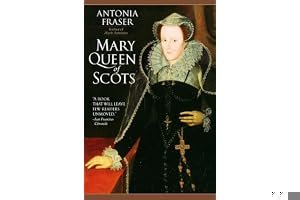
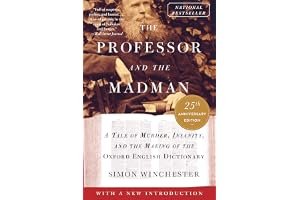
…
Cover unavailable
72
World Without End (Kingsbridge, #2)
Ken Follett
4.1
World Without End takes place in the same town of Kingsbridge, two centuries after the townspeople finished building the exquisite Gothic cathedral that was at the heart of The Pillars of the Earth. The cathedral and the priory are again at the center of a web of love and hate, greed and pride, ambition and revenge, but this sequel stands on its own. This time the men and women of an extraordinary cast of characters find themselves at a crossroads of new ideas—about medicine, commerce, architecture, and justice. In a world where proponents of the old ways fiercely battle those with progressive minds, the intrigue and tension quickly reach a boiling point against the devastating backdrop of the greatest natural disaster ever to strike the human race—the Black Death.
…
Cover unavailable
73
The Birth of Britain (A History of the English Speaking Peoples, #1)
Winston Churchill, Andrew Roberts
4.1
"This history will endure; not only because Sir Winston has written it, but also because of its own inherent virtues - its narrative power, its fine judgment of war and politics, of soldiers and statesmen, and even more because it reflects a tradition of what Englishmen in the hey-day of their empire thought and felt about their country's past." The Daily Telegraph
Spanning four volumes and many centuries of history, from Caesar's invasion of Britain to the start of World War I, A History of the English-Speaking Peoples stands as one of Winston S. Churchill's most magnificent literary works. Begun during Churchill's 'wilderness years' when he was out of government, first published in 1956 after his leadership through the darkest days of World War II had cemented his place in history and completed when Churchill was in his 80s, it remains to this day a compelling and vivid history.
The first volume - The Birth of Britain - tells the story of the formation of the British state, from the arrival of Julius Caesar and the Roman Empire through the invasions of the Vikings and the Normans, the signing of the Magna Carta and establishment of the mother of parliaments to the War of the Roses.
…
Cover unavailable
74
We Two: Victoria and Albert: Rulers, Partners, Rivals
Gillian Gill
4.1
It was the most influential marriage of the nineteenth century–and one of history’s most enduring love stories. Traditional biographies tell us that Queen Victoria inherited the throne as a naïve teenager, when the British Empire was at the height of its power, and seemed doomed to find failure as a monarch and misery as a woman until she married her German cousin Albert and accepted him as her lord and master. Now renowned chronicler Gillian Gill turns this familiar story on its head, revealing a strong, feisty queen and a brilliant, fragile prince working together to build a family based on support, trust, and fidelity, qualities neither had seen much of as children. The love affair that emerges is far more captivating, complex, and relevant than that depicted in any previous account.
The epic relationship began poorly. The cousins first met as teenagers for a few brief, awkward, chaperoned weeks in 1836. At seventeen, charming rather than beautiful, Victoria already “showed signs of wanting her own way.” Albert, the boy who had been groomed for her since birth, was chubby, self-absorbed, and showed no interest in girls, let alone this princess. So when they met again in 1839 as queen and presumed prince-consort-to-be, neither had particularly high hopes. But the queen was delighted to discover a grown man, refined, accomplished, and whiskered. “Albert is beautiful!” Victoria wrote, and she proposed just three days later.
As Gill reveals, Victoria and Albert entered their marriage longing for intimate companionship, yet each was determined to be the ruler. This dynamic would continue through the years–each spouse, headstrong and impassioned, eager to lead the marriage on his or her own terms. For two decades, Victoria and Albert engaged in a very public contest for dominance. Against all odds, the marriage succeeded, but it was always a work in progress. And in the end, it was Albert’s early death that set the Queen free to create the myth of her marriage as a peaceful idyll and her husband as Galahad, pure and perfect.
As Gill shows, the marriage of Victoria and Albert was great not because it was perfect but because it was passionate and complicated. Wonderfully nuanced, surprising, often acerbic–and informed by revealing excerpts from the pair’s journals and letters–We Two is a revolutionary portrait of a queen and her prince, a fascinating modern perspective on a couple who have become a legend.
…
Cover unavailable
75
The Splendid and the Vile: A Saga of Churchill, Family, and Defiance During the Blitz
Erik Larson
4.1
The #1 New York Times bestselling author of Dead Wake and The Devil in the White City delivers a startlingly fresh portrait of Winston Churchill and London during the Blitz
On Winston Churchill's first day as prime minister, Hitler invaded Holland and Belgium. Poland and Czechoslovakia had already fallen, and the Dunkirk evacuation was just two weeks away. For the next twelve months, Hitler would wage a relentless bombing campaign, killing 45,000 Britons (30,000 of them Londoners) and destroying two million homes. It was up to Churchill to hold the country together and persuade President Franklin Roosevelt that Britain was a worthy ally--that she was willing to fight to the end.
In The Splendid and the Vile, Erik Larson shows, in cinematic detail, how Churchill taught the British people "the art of being fearless." It is a story of political brinksmanship but also an intimate domestic drama, set against the backdrop of Churchill's prime-ministerial country house, Chequers, and his wartime residence, Ditchley, where Churchill and his entourage go when the moon is brightest and the bombing threat is highest. Drawing on a wealth of untapped sources, including recently declassified files, intelligence reports, and personal diaries only now available, Larson provides a new lens on London's darkest year through the day-to-day experience of Churchill and his family: his wife, Clementine; their daughters, Sarah, Diana, and the youngest, Mary, who chafes against her parents' wartime protectiveness; their son, Randolph, and his beautiful, unhappy wife, Pamela; her illicit lover, a dashing American emissary; and the cadre of close advisors who comprised Churchill's "Secret Circle," including his dangerously observant private secretary, John Colville; newspaper baron Lord Beaverbrook; and the Rasputin-like Federick Lindemann.
The Splendid and the Vile takes readers out of today's political dysfunction and back to a time of true leadership, when--in the face of unrelenting horror--Churchill's eloquence, strategic brilliance, and perseverance bound a country, and a family, together.
…
Cover unavailable
76
How the Scots Invented the Modern World: The True Story of How Western Europe's Poorest Nation Created Our World & Everything in It
Arthur Herman
4.1
Who formed the first literate society? Who invented our modern ideas of democracy and free market capitalism? The Scots. As historian and author Arthur Herman reveals, in the eighteenth and nineteenth centuries Scotland made crucial contributions to science, philosophy, literature, education, medicine, commerce, and politics—contributions that have formed and nurtured the modern West ever since. This book is not just about Scotland: it is an exciting account of the origins of the modern world. No one who takes this incredible historical trek will ever view the Scots—or the modern West—in the same way again.
A lot of really important stuff like: the first modern nation, the first literate society, the ideas for (modern) democracy and free markets, all originated with the Scots. [source]
Raluca Radu
In terms of business, some of the must-read books I would mention are Hooked by Nir Eyal, Web Analytics: An Hour A Day by Avinash Kaushik, Call To Action and Always Be Testing by Bryan Eisenberg, Epic Content Marketing by Joe Pulizzi, How To Build Websites That Sell by Peep Laja, Content Chemistry by Andy Crestodina. [source]
Cover unavailable
77
Mary Queen of Scots and the Murder of Lord Darnley
Alison Weir
4.1
On the night of 10 February 1567 an explosion devastated the Edinburgh residence of Henry Stewart, Lord Darnley, second husband of Mary, Queen of Scots. The noise was heard as far away as Holyrood Palace, where Queen Mary was attending a wedding masque. Those arriving at the scene of devastation found, in the garden, the naked corpses of Darnley and his valet. Neither had died in the explosion, but both bodies bore marks of strangulation.
It was clear that they had been murdered and the house destroyed in an attempt to obliterate the evidence. Darnley was not a popular king-consort, but he was regarded by many as having a valid claim to the English throne. For this reason Elizabeth I had opposed his family's longstanding wish to marry him to Mary Stuart, who herself claimed to be the rightful queen of England.
Alison Weir's investigation of Darnley's murder is set against one of the most dramatic periods in British history. Her conclusions shed a brilliant new light on the actions and motives of the conspirators and, in particular, the extent of Mary's own involvement.
…
Cover unavailable
78
The Road to Wigan Pier
George Orwell
4.1
A searing account of George Orwell’s experiences of working-class life in the bleak industrial heartlands of Yorkshire and Lancashire, The Road to Wigan Pier is a brilliant and bitter polemic that has lost none of its political impact over time. His graphically unforgettable descriptions of social injustice, slum housing, mining conditions, squalor, hunger and growing unemployment are written with unblinking honesty, fury and great humanity.
The Road to Wigan Pier is a very transitional book. It shows all the attention to detail and the thought of street-level reportage that distinguishes Down and Out in Paris and London, but it’s moving forward to a political position—the political position—that will underlie what Orwell starts writing in the 1940s, for which we now celebrate him. [source]
It’s amazing how much of the abusive ideology revealed in his account of the miners is still present in today’s gig economy. [source]
Cover unavailable
79
The Courtiers: Splendor and Intrigue in the Georgian Court at Kensington Palace
Lucy Worsley
4.1
Kensington Palace is now most famous as the former home of Diana, Princess of Wales, but the palace's glory days came between 1714 and 1760, during the reigns of George I and II . In the eighteenth century, this palace was a world of skulduggery, intrigue, politicking, etiquette, wigs, and beauty spots, where fans whistled open like switchblades and unusual people were kept as curiosities. Lucy Worsley's The Courtiers charts the trajectory of the fantastically quarrelsome Hanovers and the last great gasp of British court life. Structured around the paintings of courtiers and servants that line the walls of the King's Staircase of Kensington Palace-paintings you can see at the palace today-The Courtiers goes behind closed doors to meet a pushy young painter, a maid of honor with a secret marriage, a vice chamberlain with many vices, a bedchamber woman with a violent husband, two aging royal mistresses, and many more. The result is an indelible portrait of court life leading up to the famous reign of George III , and a feast for both Anglophiles and lovers of history and royalty.
…
Cover unavailable
80
Inside the Victorian Home: A Portrait of Domestic Life in Victorian England
Judith Flanders
4.1
Nineteenth-century Britain was then the world's most prosperous nation, yet Victorians would bury meat in earth and wring sheets out in boiling water with their bare hands. Such drudgery was routine for the parents of people still living, but the knowledge of it has passed as if it had never been.
Following the daily life of a middle-class Victorian house from room to room; from childbirth in the master bedroom through the kitchen, scullery, dining room, and parlor, all the way to the sickroom; Judith Flanders draws on diaries, advice books, and other sources to resurrect an age so close in time yet so alien to our own. 100 illustrations, 32 pages of color.
…
Cover unavailable
81
Crown and Country: A History of England Through the Monarchy
David Starkey
4.1
From one of our finest historians comes an outstanding exploration of the British monarchy from the retreat of the Romans up until the modern day. This compendium volume of two earlier books is fully revised and updated.
The monarchy is one of Britain’s most revered institutions – but also one of its most tumultuous. In Crown and Country, David Starkey charts its rollercoaster history from earliest times to the present; from the courtly love of the Middle Ages, through the turbulent reign of the Tudors, to the chaos of the Civil War.
Starkey brings this tempestuous story up to date in this complete history, guiding us through the Abdication Crisis to the dissolution of the marriage of Prince Charles and Lady Diana Spencer. He draws upon rank and romance in light of the wedding of Kate Middleton and Prince William and brings to life a cast of colourful characters and some riveting stories. Crown and Country is both a brilliant overview of the monarchy and a vividly iconoclastic portrait of British culture, politics and nationhood.
…
Cover unavailable
82
Victoria's Daughters
Jerrold M. Packard
4.1
The story of five women who shared one of the most extraordinary and privileged sisterhoods of all time.
Vicky, Alice, Helena, and Beatrice were historically unique sisters, born to a sovereign who ruled over a quarter of the earth's people and who gave her name to an era: Queen Victoria. Two of these princesses would themselves produce children of immense consequence. All five would curiously come to share many of the social restrictions and familial machinations borne by nineteenth-century women of less-exulted class.
Victoria and Albert's precocious firstborn child, Vicky, wed a Prussian prince in a political match her high-minded father hoped would bring about a more liberal Anglo-German order. That vision met with disaster when Vicky's son Wilhelm-- to be known as Kaiser Wilhelm-- turned against both England and his mother, keeping her out of the public eye for the rest of her life. Gentle, quiet Alice had a happier marriage, one that produced Alexandra, later to become Tsarina of Russia, and yet another Victoria, whose union with a Battenberg prince was to found the present Mountbatten clan. However, she suffered from melancholia and died at age thirty-five of what appears to have been a deliberate, grief-fueled exposure to the diphtheria germs that had carried away her youngest daughter. Middle child Helena struggled against obesity and drug addition but was to have lasting effect as Albert's literary executor. By contrast, her glittering and at times scandalous sister Louise, the most beautiful of the five siblings, escaped the claustrophobic stodginess of the European royal courts by marrying a handsome Scottish commoner, who became governor general of Canada, and eventually settled into artistic salon life as a respected sculptor. And as the baby of the royal brood of nine, rebelling only briefly to forge a short-lived marriage, Beatrice lived under the thumb of her mother as a kind of personal secretary until the queen's death.
Principally researched at the houses and palaces of its five subjects in London, Scotland, Berlin, Darmstadt, and Ottawa-- and entertainingly written by an experienced biographer whose last book concerned Victoria's final days-- Victoria's Daughters closely examines a generation of royal women who were dominated by their mother, married off as much for political advantage as for love, and finally passed over entirely with the accession of their n0 brother Bertie to the throne. Packard provides valuable insights into their complex, oft-tragic lives as daughters of their time.
…
Cover unavailable
83
The Pillars of the Earth (Kingsbridge, #1)
Ken Follett
4.1
Ken Follett is known worldwide as the master of split-second suspense, but his most beloved and bestselling book tells the magnificent tale of a twelfth-century monk driven to do the seemingly impossible: build the greatest Gothic cathedral the world has ever known.
Everything readers expect from Follett is here: intrigue, fast-paced action, and passionate romance. But what makes The Pillars of the Earth extraordinary is the time the twelfth century; the place feudal England; and the subject the building of a glorious cathedral. Follett has re-created the crude, flamboyant England of the Middle Ages in every detail. The vast forests, the walled towns, the castles, and the monasteries become a familiar landscape.
Against this richly imagined and intricately interwoven backdrop, filled with the ravages of war and the rhythms of daily life, the master storyteller draws the reader irresistibly into the intertwined lives of his characters into their dreams, their labors, and their loves: Tom, the master builder; Aliena, the ravishingly beautiful noblewoman; Philip, the prior of Kingsbridge; Jack, the artist in stone; and Ellen, the woman of the forest who casts a terrifying curse. From humble stonemason to imperious monarch, each character is brought vividly to life.
The building of the cathedral, with the almost eerie artistry of the unschooled stonemasons, is the center of the drama. Around the site of the construction, Follett weaves a story of betrayal, revenge, and love, which begins with the public hanging of an innocent man and ends with the humiliation of a king.
For the Movie tie-in edition with the same ISBN go to this Alternate Cover Edition
Nobody who reads it—nobody who reads it—looks at a church or a cathedral the same. I made me think about my own life differently, reading that book, the experience of reading that book. What a treasure. [source]
Theresa Evanoff
One of my favourite non-business book is “Pillars of the Earth”, by Ken Follett. I have read this many times over the years, and still enjoy eit ach time. I love how the characters are all very complex, strategic, and how the story weaves together on so many levels. [source]
Cover unavailable
84
The Kingmaker's Daughter (The Cousins' War #4)
Philippa Gregory
4.0
In this New York Times bestseller that inspired the critically acclaimed Starz miniseries The White Queen, Philippa Gregory tells the tale of Anne Neville, a beautiful young woman who must navigate the treachery of the English court as her father, known as the Kingmaker, uses her and her sister as pawns in his political game.
The Kingmaker’s Daughter—Philippa Gregory’s first sister story since The Other Boleyn Girl—is the gripping tale of the daughters of the man known as the Kingmaker, Richard Neville, Earl of Warwick: the most powerful magnate in fifteenth-century England. Without a son and heir, he uses his daughters, Anne and Isabel, as pawns in his political games, and they grow up to be influential players in their own right.
At the court of Edward IV and his beautiful queen, Elizabeth Woodville, Anne grows from a delightful child to become ever more fearful and desperate when her father makes war on his former friends. Married at age fourteen, she is soon left widowed and fatherless, her mother in sanctuary and her sister married to the enemy. Anne manages her own escape by marrying Richard, Duke of Gloucester, but her choice will set her on a collision course with the overwhelming power of the royal family.
…
Cover unavailable
85
History of Britain and Ireland: The Definitive Visual Guide
DK
4.0
From the Roman conquest of 43 CE to the Norman conquest of 1066, and from the Elizabethan age to the Iraq and Afghan wars of the 21st century, DK's History of Britain and Ireland traces the key events that have shaped Great Britain and Ireland from earliest times to the present day.
Cover unavailable
86
The Queen's Fool (The Plantagenet and Tudor Novels, #12)
Philippa Gregory
4.0
A young woman caught in the rivalry between Queen Mary and her half sister, Elizabeth, must find her true destiny amid treason, poisonous rivalries, loss of faith, and unrequited love.
It is winter, 1553. Pursued by the Inquisition, Hannah Green, a fourteen-year-old Jewish girl, is forced to flee Spain with her father. But Hannah is no ordinary refugee. Her gift of "Sight," the ability to foresee the future, is priceless in the troubled times of the Tudor court. Hannah is adopted by the glamorous Robert Dudley, the charismatic son of King Edward's protector, who brings her to court as a "holy fool" for Queen Mary and, ultimately, Queen Elizabeth. Hired as a fool but working as a spy; promised in wedlock but in love with her master; endangered by the laws against heresy, treason, and witchcraft, Hannah must choose between the safe life of a commoner and the dangerous intrigues of the royal family that are inextricably bound up in her own yearnings and desires.
Teeming with vibrant period detail and peopled by characters seamlessly woven into the sweeping tapestry of history, The Queen's Fool is another rich and emotionally resonant gem from this wonderful storyteller.
…
Cover unavailable
87
Elizabeth the Queen: The Life of a Modern Monarch
Sally Bedell Smith, Rosalyn Landor, et al
4.0
NEW YORK TIMES BESTSELLER • Perfect for fans of The Crown, this magisterial biography of Queen Elizabeth II is a close-up view of the woman we’ve known only from a distance—and a captivating window into the last great monarchy.
From the moment of her ascension to the throne in 1952 at the age of twenty-five, Queen Elizabeth II has been the object of unparalleled scrutiny. But through the fog of glamour and gossip, how well do we really know the world’s most famous monarch? Drawing on numerous interviews and never-before-revealed documents, acclaimed biographer Sally Bedell Smith pulls back the curtain to show in intimate detail the public and private lives of Queen Elizabeth II, who has led her country and Commonwealth through the wars and upheavals of the last sixty years with unparalleled composure, intelligence, and grace.
In Elizabeth the Queen, we meet the young girl who suddenly becomes “heiress presumptive” when her uncle abdicates the throne. We meet the thirteen-year-old Lilibet as she falls in love with a young navy cadet named Philip and becomes determined to marry him, even though her parents prefer wealthier English aristocrats. We see the teenage Lilibet repairing army trucks during World War II and standing with Winston Churchill on the balcony of Buckingham Palace on V-E Day. We see the young Queen struggling to balance the demands of her job with her role as the mother of two young children. Sally Bedell Smith brings us inside the palace doors and into the Queen’s daily routines—the “red boxes” of documents she reviews each day, the weekly meetings she has had with twelve prime ministers, her physically demanding tours abroad, and the constant scrutiny of the press—as well as her personal relationships: with Prince Philip, her husband of sixty-four years and the love of her life; her children and their often-disastrous marriages; her grandchildren and friends.
…
Cover unavailable
88
Innocent Traitor
Alison Weir
4.0
BONUS: This edition contains an excerpt from Alison Weir's Mary Boleyn.
I am now a condemned traitor . . . I am to die when I have hardly begun to live.
Historical expertise marries page-turning fiction in Alison Weir’s enthralling debut novel, breathing new life into one of the most significant and tumultuous periods of the English monarchy. It is the story of Lady Jane Grey–“the Nine Days’ Queen” –a fifteen-year-old girl who unwittingly finds herself at the center of the religious and civil unrest that nearly toppled the fabled House of Tudor during the sixteenth century.
The child of a scheming father and a ruthless mother, for whom she is merely a pawn in a dynastic game with the highest stakes, Jane Grey was born during the harrowingly turbulent period between Anne Boleyn’s beheading and the demise of Jane’s infamous great-uncle, King Henry VIII. With the premature passing of Jane’ s adolescent cousin, and Henry’s successor, King Edward VI, comes a struggle for supremacy fueled by political machinations and lethal religious fervor.
Unabashedly honest and exceptionally intelligent, Jane possesses a sound strength of character beyond her years that equips her to weather the vicious storm. And though she has no ambitions to rule, preferring to immerse herself in books and religious studies, she is forced to accept the crown, and by so doing sets off a firestorm of intrigue, betrayal, and tragedy.
Alison Weir uses her unmatched skills as a historian to enliven the many dynamic characters of this majestic drama. Along with Lady Jane Grey, Weir vividly renders her devious parents; her much-loved nanny; the benevolent Queen Katherine Parr; Jane’s ambitious cousins; the Catholic “Bloody” Mary, who will stop at nothing to seize the throne; and the Protestant and future queen Elizabeth. Readers venture inside royal drawing rooms and bedchambers to witness the power-grabbing that swirls around Lady Jane Grey from the day of her birth to her unbearably poignant death. Innocent Traitor paints a complete and compelling portrait of this captivating young woman, a faithful servant of God whose short reign and brief life would make her a legend.
…
Cover unavailable
89
London Under: The Secret History Beneath the Streets
Peter Ackroyd
4.0
London Under is a wonderful, atmospheric, historical, imaginative, oozing little study of everything that goes on under London, from original springs and streams and Roman amphitheatres to Victorian sewers and gang hide-outs. The depth below is hot, much warmer than the surface and this book tunnels down through the geological layers, meeting the creatures that dwell in darkness, real and fictional -- rats and eels, monsters and ghosts.
There is a bronze-age trackway under the Isle of Dogs, Wren found Anglo-Saxon graves under St Paul's, and the monastery of Whitefriars lies beneath Fleet Street. In Kensal Green cemetery there was a hydraulic device to lower bodies into the catacombs below -- "Welcome to the lower depths". A door in the plinth of statue of Boadicea on Westminster Bridge leads to a huge tunnel, packed with cables -- gas, water, telephone. When the Metropolitan Line was opened in 1864 the guards asked for permission to grow beards to protect themselves against the sulphurous fumes, and called their engines by the names of tyrants -- Czar, Kaiser, Mogul -- and even Pluto, god of the underworld.
Going under London is to penetrate history, to enter a hidden world. "The vastness of the space, a second earth," writes Peter Ackroyd, "elicits sensations of wonder and of terror. It partakes of myth and dream in equal measure."
…
Cover unavailable
90
Chernobyl: History of a Tragedy
Serhii PLOKHY
4.0
On 26 April 1986 at 1.23am a reactor at the Chernobyl Nuclear Power Plant in Soviet Ukraine exploded. While the authorities scrambled to understand what was occurring, workers, engineers, firefighters and those living in the area were abandoned to their fate. The blast put the world on the brink of nuclear annihilation, contaminating over half of Europe with radioactive fallout.
In Chernobyl, award-winning historian Serhii Plokhy draws on recently opened archives to recreate these events in all their drama, telling the stories of the scientists, workers, soldiers, and policemen who found themselves caught in a nuclear nightmare. While the immediate cause of the accident was a turbine test gone wrong, he shows how its deeper roots lay in the nature of the Soviet political system and the ingrained flaws of its nuclear industry. A little more than five years later, the Soviet Union would fall apart, destroyed from within by its unsustainable ideology and the dysfunctional systems laid bare in the wake of the disaster.
A moment by moment account of the heroes, perpetrators and victims of a tragedy, Chernobyl is the first full account of a gripping, unforgettable Cold War story.
He’s really good here at laying down the background of the disaster itself, the plant’s construction, the days leading up to it, the moments the accident occurred. He talks about the accident itself, the delay in informing the public, the censorship of news, the trial of the nuclear power plant operators who he thinks were treated as scapegoats, and the political outcomes of all this deception. [source]
It’s just a really thrilling book, as well as being a really interesting history of that time. But the reason why I think it’s also a brilliant political book is fundamentally what Plokhii reveals in his writing, is that the failure of Chernobyl was fundamentally a failure of a political system, as well as a failure of a scientific system. [source]
Cover unavailable
91
Becoming Queen
Kate Williams
4.0
'I will be good,' promised the thirteen-year-old Victoria, when she understood that she would be Queen of the most powerful country in the world. That, of course, is a matter of opinion. And there are other layers to the story.
With a combination of novelistic flair and historical accuracy, Kate Williams begins by relating the heartbreaking story of Princess Charlotte, the Queen who never was, and her impact on the young Victoria. Our perception of Victoria the Queen is coloured by portraits of her older, widowed self - her dour expression embodying the repressive morality propagated in her time. But Becoming Queen reveals an energetic and vibrant woman, determined to battle for power. It also documents the Byzantine machinations behind Victoria's quest to occupy the throne, and shows how her struggles did not end when finally the crown was placed on her head.
In the late eighteenth century, monarchies were in crisis across Europe. Discontented with their mad King, George III, and his spendthrift offspring, the English pinned their hopes on the only legitimate grandchild: Princess Charlotte, daughter of George, Prince of Wales. But Charlotte died at the age of twenty-two, a few hours after giving birth to a stillborn son. A grieving nation immediately began venerating her as someone who would have made an ideal Queen while Charlotte's rackety uncles embarked on a race to produce the next heir.
No one thought that little Victoria, daughter of the Duke of Kent, would ascend the throne. She, in turn, became increasingly determined to take control of her own destiny, and clashed constantly not only with her hugely ambitious mother but with her protégé and household comptroller, the Irish adventurer, John Conroy. After she became Queen, ministers, even her beloved Prince Albert, still attempted to steal power away from her.
Revealing how Charlotte's death shaped Victoria's reign and laying bare the passions that swirled around the throne, Becoming Queen is an absorbingly dramatic tale of secrets, sexual repression and endless conflict. After her lauded biography of Emma Hamilton, England's Mistress, Kate Williams has produced a most original and intimate portrait of Great Britain's longest reigning monarch.
…
Cover unavailable
92
Jane Austen's England
Roy Adkins, Lesley Adkins
4.0
A cultural snapshot of everyday life in the world of Jane Austen
Jane Austen, arguably the greatest novelist of the English language, wrote brilliantly about the gentry and aristocracy of two centuries ago in her accounts of young women looking for love. Jane Austen’s England explores the customs and culture of the real England of her everyday existence depicted in her classic novels as well as those by Byron, Keats, and Shelley. Drawing upon a rich array of contemporary sources, including many previously unpublished manuscripts, diaries, and personal letters, Roy and Lesley Adkins vividly portray the daily lives of ordinary people, discussing topics as diverse as birth, marriage, religion, sexual practices, hygiene, highwaymen, and superstitions.
From chores like fetching water to healing with medicinal leeches, from selling wives in the marketplace to buying smuggled gin, from the hardships faced by young boys and girls in the mines to the familiar sight of corpses swinging on gibbets, Jane Austen’s England offers an authoritative and gripping account that is sometimes humorous, often shocking, but always entertaining.
…
Cover unavailable
93
What Jane Austen Ate and Charles Dickens Knew: From Fox Hunting to Whist—the Facts of Daily Life in 19th-Century England
Daniel Pool
4.0
A "delightful reader's companion"; (The New York Times) to the great nineteenth-century British novels of Austen, Dickens, Trollope, the Brontës, and more, this lively guide clarifies the sometimes bizarre maze of rules and customs that governed life in Victorian England.
For anyone who has ever wondered whether a duke outranked an earl, when to yell "Tally Ho!" at a fox hunt, or how one landed in "debtor's prison"; this book serves as an indispensable historical and literary resource. Author Daniel Pool provides countless intriguing details (did you know that the "plums" in Christmas plum pudding were actually raisins?) on the Church of England, sex, Parliament, dinner parties, country house visiting, and a host of other aspects of nineteenth-century English life—both "upstairs" and "downstairs."
An illuminating glossary gives at a glance the meaning and significance of terms ranging from "ague" to "wainscoting," the specifics of the currency system, and a lively host of other details and curiosities of the day.
…
Cover unavailable
94
The Heir Apparent: A Life of Edward VII, the Playboy Prince
Jane Ridley
4.0
King Edward the VII, affectionately called Bertie, was fifty-nine when he took the throne in 1901, upon the death of his mother Queen Victoria. To everyone's great surprise, this playboy prince sobered up and became an extremely effective leader and the founder of England's modern monarchy. For readers of Sally Bedell Smith's Elizabeth the Queen and Robert K. Massie's Catherine the Great.
"This is not only the best biography of King Edward VII; it's also one of the best books about royalty ever published." So began the London Independent's review of this wonderfully entertaining biography of Britain's playboy king-a Prince Charles of the Victorian age, only a lot more fun-who waited for nearly six decades to get his chance to rule. A notorious gambler, glutton and womanizer (he was dubbed "Edward the Caresser"), the world was his oyster as this aging Prince of Wales took advantage of his royal entitlements to travel, hunt, socialize, over-indulge-he smoked a dozen cigars a day-and bed a string of mistresses and married women in addition to his own wife. His mother Queen Victoria despaired: "Bertie, I grieve to say, shows more and more how totally, totally unfit he is for ever becoming king." And yet by the time he died in 1910, after only nine years on the throne, he had proven to be a hard working, effective king and an ace diplomat, at home and abroad.
A bestseller in the UK, this "exhaustively researched, richly colorful and wittily observed biography" (the London Sunday Times) is a tremendously entertaining read for history buffs and royal watchers.
…
Cover unavailable
95
The Last Kingdom (The Saxon Stories, #1)
Bernard Cornwell
4.0
This is the story of the making of England in the 9th and 10th centuries, the years in which King Alfred the Great, his son and grandson defeated the Danish Vikings who had invaded and occupied three of England’s four kingdoms.
The story is seen through the eyes of Uhtred, a dispossessed nobleman, who is captured as a child by the Danes and then raised by them so that, by the time the Northmen begin their assault on Wessex (Alfred’s kingdom and the last territory in English hands) Uhtred almost thinks of himself as a Dane. He certainly has no love for Alfred, whom he considers a pious weakling and no match for Viking savagery, yet when Alfred unexpectedly defeats the Danes and the Danes themselves turn on Uhtred, he is finally forced to choose sides. By now he is a young man, in love, trained to fight and ready to take his place in the dreaded shield wall. Above all, though, he wishes to recover his father’s land, the enchanting fort of Bebbanburg by the wild northern sea.
This thrilling adventure—based on existing records of Bernard Cornwell’s ancestors—depicts a time when law and order were ripped violently apart by a pagan assault on Christian England, an assault that came very close to destroying England.
…
Cover unavailable
96
The King's Curse (The Plantagenet and Tudor Novels, #7; Cousins War #6)
Philippa Gregory
4.0
The final novel in the Cousins’ War series, the basis for the critically acclaimed Starz miniseries, The White Queen, by #1 New York Times bestselling author and “the queen of royal fiction” (USA TODAY) Philippa Gregory tells the fascinating story of Margaret Pole, cousin to the “White Princess,” Elizabeth of York, and lady-in-waiting to Katherine of Aragon.
Regarded as yet another threat to the volatile King Henry VII’s claim to the throne, Margaret Pole, cousin to Elizabeth of York (known as the White Princess) and daughter of George, Duke of Clarence, is married off to a steady and kind Lancaster supporter—Sir Richard Pole. For his loyalty, Sir Richard is entrusted with the governorship of Wales, but Margaret’s contented daily life is changed forever with the arrival of Arthur, the young Prince of Wales, and his beautiful bride, Katherine of Aragon. Margaret soon becomes a trusted advisor and friend to the honeymooning couple, hiding her own royal connections in service to the Tudors.
After the sudden death of Prince Arthur, Katherine leaves for London a widow, and fulfills her deathbed promise to her husband by marrying his brother, Henry VIII. Margaret’s world is turned upside down by the surprising summons to court, where she becomes the chief lady-in-waiting to Queen Katherine. But this charmed life of the wealthiest and “holiest” woman in England lasts only until the rise of Anne Boleyn, and the dramatic deterioration of the Tudor court. Margaret has to choose whether her allegiance is to the increasingly tyrannical king, or to her beloved queen; to the religion she loves or the theology which serves the new masters. Caught between the old world and the new, Margaret Pole has to find her own way as she carries the knowledge of an old curse on all the Tudors.
…
Cover unavailable
97
A World on Fire: Britain's Crucial Role in the American Civil War
Amanda Foreman
4.0
NEW YORK TIMES BESTSELLER
10 BEST BOOKS • THE NEW YORK TIMES BOOK REVIEW • 2011 NAMED ONE OF THE BEST BOOKS OF THE YEAR BY The Washington Post • The New Yorker • Chicago Tribune • The Economist • Nancy Pearl, NPR • Bloomberg.com • Library Journal • Publishers Weekly
Acclaimed historian Amanda Foreman follows the phenomenal success of her New York Times bestseller Georgiana: Duchess of Devonshire with her long-awaited second work of nonfiction: the fascinating story of the American Civil War and the major role played by Britain and its citizens in that epic struggle.
Even before the first rumblings of secession shook the halls of Congress, British involvement in the coming schism was inevitable. Britain was dependent on the South for cotton, and in turn the Confederacy relied almost exclusively on Britain for guns, bullets, and ships. The Union sought to block any diplomacy between the two and consistently teetered on the brink of war with Britain. For four years the complex web of relationships between the countries led to defeats and victories both minute and history-making. In A World on Fire, Amanda Foreman examines the fraught relations from multiple angles while she introduces characters both humble and grand, bringing them to vivid life over the course of her sweeping and brilliant narrative.
Between 1861 and 1865, thousands of British citizens volunteered for service on both sides of the Civil War. From the first cannon blasts on Fort Sumter to Lee’s surrender at Appomattox, they served as officers and infantrymen, sailors and nurses, blockade runners and spies. Through personal letters, diaries, and journals, Foreman has woven together their experiences to form a panoramic yet intimate view of the war on the front lines, in the prison camps, and in the great cities of both the Union and the Confederacy. Through the eyes of these brave volunteers we see the details of the struggle for life and the great and powerful forces that threatened to demolish a nation.
In the drawing rooms of London and the offices of Washington, on muddy fields and aboard packed ships, Foreman reveals the decisions made, the beliefs held and contested, and the personal triumphs and sacrifices that ultimately led to the reunification of America. A World on Fire is a complex and groundbreaking work that will surely cement Amanda Foreman’s position as one of the most influential historians of our time.
Featuring some of the very best from Terry Deary's Horrible Histories series, and displayed in a great printed lift top storage box, this fantastic set is a must have for any child's book shelf. This Horrible Histories box set of fantastic children's books includes practically all of the series' favourites, including Rotten Romans, Vicious Vikings and Savage Stone Age and encourages children to really engage with historical subjects in a way that they will thoroughly enjoy. By picking out the fun parts of the subject, mainly the gory and revolting bits, this Horrible Histories set makes learning fun and exciting and a little less of a chore. As well as being invaluable for school history projects, this set is both educational and fun, with books that children will choose to read again and again. This collection includes: Savage Stone-AgeAwesome EgyptiansGroovy GreeksRotten RomansCult-Throat CeltsSmashing SaxonsVicious VikingsStormin NormansAngry AztecsIncredible IncasMeasly Middle AgesTerrible TudorsSlimy StuartsGorgeous GeorgiansVile VictoriansVillainous VictoriansBarmy British EmpireFrightful First World WarWoeful Second World WarBlitzed BritsThis paperback book set measures: 20 x 21 x 14cm.
…
Cover unavailable
99
Queen of Scots: The True Life of Mary Stuart
John Guy
4.0
Recommended by Helen Castor.
Helen Castor
The thing I admire so much about John Guy’s work is his ability to go into the archive and bring an extraordinary forensic eye to bear on documents which have already been pored over by generations of historians – and yet to bring something new to it. [source]
Cover unavailable
100
The Gunpowder Plot
Antonia Fraser
4.0
Antonia Fraser, a popular historian, has delved into archives across Europe to unravel the true story of the plot by fanatical Roman Catholics to blow up the Houses of Parliament and King James I at the opening of Parliament in 1605.