

#316 Brian Keating - Brian Keating - The First Object Ever Found From Another Solar System
In this episode of the Shawn Ryan Show, astrophysicist Brian Keating explores topics ranging from government UFO disclosures to the origins of the universe. Keating explains why he finds official alien revelations lacking in scientific rigor, arguing that extraordinary claims require extraordinary evidence rather than anecdotal testimony. He contrasts this with the substantial evidence supporting cosmological theories like the Big Bang, discussing cosmic microwave background radiation, gravitational waves, and the universe's accelerating expansion.
Beyond scientific topics, Keating and Ryan examine the relationship between science and faith, challenging the assumption that these frameworks are incompatible. The conversation also addresses conspiracy theories about the moon landing and explores how government credibility affects public trust. Finally, Keating shares his perspective on finding lasting fulfillment beyond material success, emphasizing the importance of family, regular disconnection from work, and creating enduring value that outlives personal achievement.


This is a preview of the Shortform summary of the Jun 25, 2026 episode of the Shawn Ryan Show
Sign up for Shortform to access the whole episode summary along with additional materials like counterarguments and context.
1-Page Summary
Alien/UFO Disclosure and Evidence Standards
Government Disclosures Lack Scientific Evidence
Brian Keating compares ongoing UFO disclosure promises to perpetual disappointment, noting that even major government releases contain no meaningful evidence—only hearsay and anecdotes. He emphasizes that claims about alien encounters or physics-defying technology consistently lack reproducible data, relying instead on uncorroborated testimony. Even assertions about non-human "biologics" and interdimensional beings remain purely anecdotal, with no data satisfying scientific standards.
Keating and Shawn Ryan point out that government credibility has been undermined by repeated deception on COVID-19, military actions, and major policies, which weakens trust in UFO disclosures. Keating warns that public fascination with aliens often serves as a distraction from pressing policy failures. Ryan observes that major UFO revelations frequently coincide with scandals or controversial actions, seemingly designed to shift public attention. He adds that the UFO community is fragmented, with self-proclaimed experts competing for attention rather than collaborating on genuine investigation.
Apply Rigorous Standards to Extraordinary Claims
Keating advocates examining alien claims using the same scientific standards applied to other extraordinary assertions, emphasizing falsifiability and testability. He pushes back on suggestions that only those with military experience can assess UFO claims, arguing that scientific expertise is crucial when evaluating assertions that allegedly defy physics. While acknowledging that witnesses may have seen unexplainable things, Keating maintains that eyewitness accounts without supporting data cannot constitute scientific evidence. He emphasizes that "extraordinary claims demand extraordinary evidence," and the burden of proof lies with those making such assertions.
Cosmology and the Universe's Origins
Evidence for the Big Bang
Keating explains that overwhelming evidence supports the Big Bang theory, particularly the cosmic microwave background (CMB) radiation—relic heat from the universe's earliest moments. This radiation, first detected by Penzias and Wilson in 1965, provided the first physical proof that the universe originated from an extremely hot, dense state. To observe these faint signals, astronomers seek dry, high-altitude locations like Antarctica's South Pole and Chile's Atacama Desert to minimize atmospheric interference.
Gravitational waves complement traditional observation methods by revealing violent cosmic events invisible to light-based telescopes. Keating recounts the milestone detection of gravitational waves from colliding black holes, confirming Einstein's predictions. If cosmic inflation theory is correct, primordial gravitational waves from the Big Bang would have left detectable imprints in the CMB, potentially supporting multiverse theories.
Universe's Expansion and Composition
Keating describes how Edwin Hubble demonstrated that galaxies recede at speeds proportional to their distance, proving that space itself is dynamic. Crucially, this expansion is accelerating, not slowing, leading cosmologists to conclude that most of the universe consists of dark matter and dark energy rather than ordinary matter.
While evidence strongly supports the Big Bang, Keating describes alternative models, including cyclic universes that expand and contract through repeated cycles, multiverse theories proposing our universe as one among infinite bubbles with distinct laws, and string theory suggesting extra dimensions where universes ignite through membrane collisions.
Science vs. Conspiracy Theories
Moon Landing Evidence
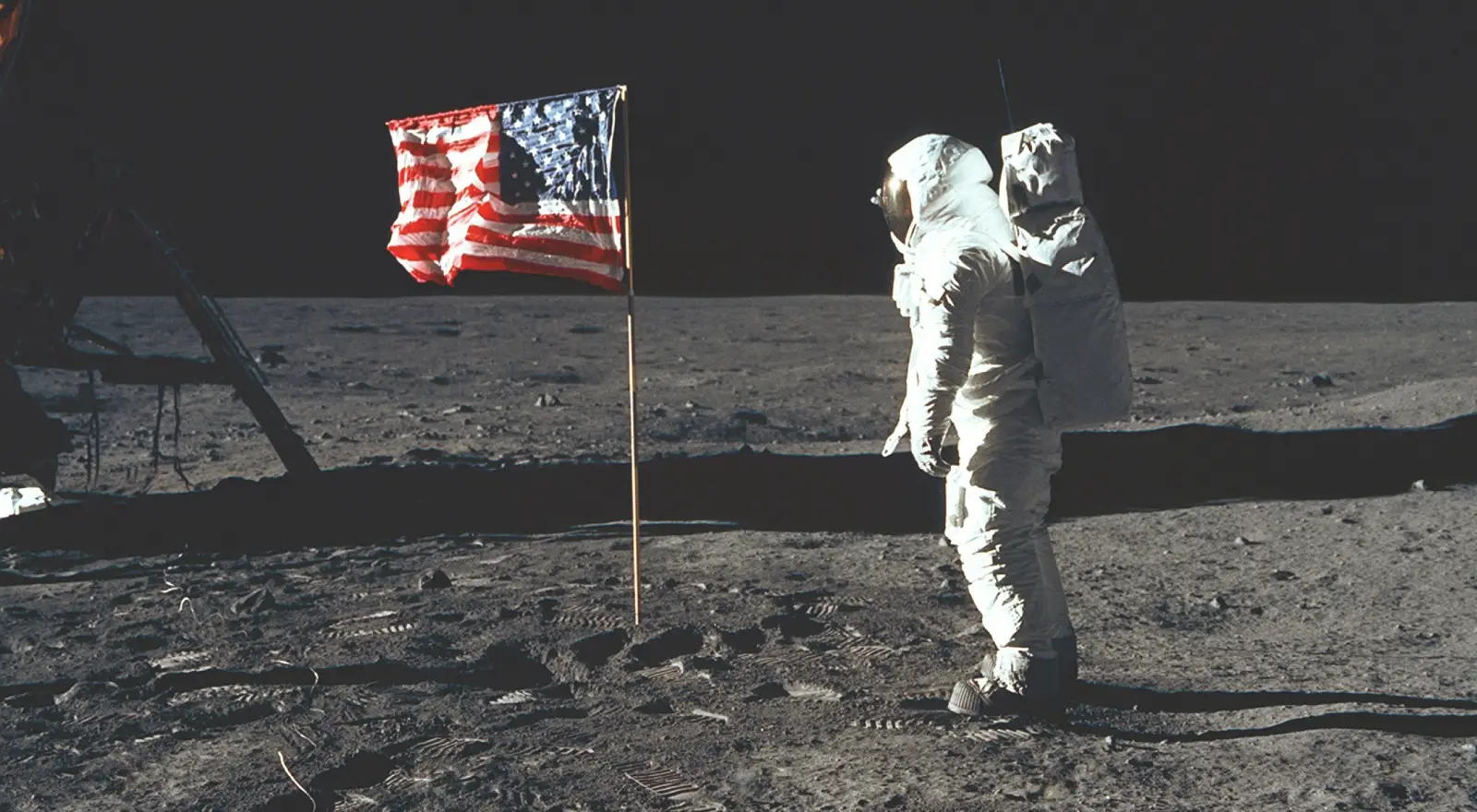
Keating describes the Apollo moon landings as one of humanity's greatest achievements, supported by overwhelming evidence. He details how the Soviet Union, America's fiercest Cold War competitor, tracked Apollo 11's approach, coordinated telemetry with NASA, and after confirming the landing with independent data, congratulated President Nixon. Both American and Soviet missions left retroreflectors on the lunar surface that scientists like Tom Murphy at UC San Diego use for laser ranging, measuring the Moon's distance to within millimeters.
When addressing claims that the technology was "lost," Keating explains that while Saturn V rockets are no longer manufactured, the underlying engineering knowledge persists. The decision not to repeat the feat is driven by priorities and cost, not lost capability.
Healthy Skepticism vs. Conspiracy Thinking
Ryan and Keating discuss how government deception on various issues has eroded institutional credibility, fueling conspiracy theories even about well-documented events. Keating argues that rigorous scientific reasoning helps distinguish plausible from implausible claims, noting that genuine skepticism involves evaluating evidence carefully. He emphasizes that assuming all official narratives are false mirrors blindly accepting them—both stances abandon rational evidence evaluation.
Keating debunks common conspiracy arguments, explaining that Apollo missions flew trajectories over the poles to minimize exposure to Van Allen radiation belts, and that asteroid belts are mostly empty space with negligible collision risk. He illustrates the line between science and pseudoscience using astrology, which makes unfalsifiable claims that cannot be disproven or tested, removing it from scientific consideration.
Science and Faith as Compatible Systems
Complementary Frameworks for Understanding
Keating explores how science and faith serve as complementary frameworks rather than conflicting systems. He points out that science cannot address metaphysical questions of meaning, purpose, or value. Religious texts, while not scientific manuals, reflect enduring human insights and ethics. Keating states, "I don't read the Bible as a science book... They're different purposes, right?" He approaches religious practice with the same evidence standards and logic used in physical sciences, testing claims and seeking verification.
Historically, conflict between science and religion arose from institutional defense of power rather than inherent opposition. Keating provides examples of Giordano Bruno and Galileo, whose scientific truths threatened Church authority. He notes that scientific societies contain a higher proportion of believers than the general population, contradicting narratives that science and faith are incompatible.
Evidence-Based Faith
Keating highlights how Hebrew tradition anticipated harmony between discovery and spiritual insight. In Hebrew, the word for "faith," emunah, implies evidence-based confidence. He contrasts belief and knowledge, emphasizing that as a scientist, he seeks evidence for both gravity and God. Keating finds the Hebrew concept that God originated "beginningness" resonant with the Big Bang theory, though he clarifies that cosmic origins are scientific questions, not proofs of God's existence. He encourages applying scientific rigor to faith, recognizing that while empirical proof of God remains elusive, this process strengthens conviction.
Life Philosophy and Meaning
The Limits of Material Success
Keating and Ryan discuss how material success and career achievements yield only temporary happiness due to the "hedonic treadmill." Keating explains that due to entropy, contentment is inherently unstable. Ryan describes how increased wealth generates additional wants, resulting in being "owned" by possessions. Keating confirms that happiness plateaus once basic needs are met, and Ryan adds that fame may boost ego but fails to fulfill deeper needs.
Sabbath and Disconnection
Keating credits his well-being to strictly taking one day off each week—his Sabbath—where he abstains from work, email, and digital communication. He describes this as sacred time for family, spirituality, and reflection, emphasizing that resting without guilt prevents individuals from becoming "enslaved" by relentless achievement seeking. Ryan agrees that forced disconnection from devices would lead to greater happiness, since real connection comes from uninterrupted time with loved ones.
Lasting Fulfillment
Keating emphasizes that true fulfillment arises from creating enduring value, mentoring others, and building institutions that outlive personal consumption or status. He asserts that family relationships, especially raising children, provide unique challenges that prompt personal growth and meaning. Referring to entropy, he explains that while happiness from circumstances is finite, pain from loss can be infinite, teaching that one should focus on creating order, nurturing relationships, and contributing to communities.
Keating shares his personal philosophy for choosing a life partner, describing how he developed an "algorithm" for dating: evaluating each partner by imagining, "If I had a daughter with this woman, would I be happy for my child to be like her?" This criterion shifted his decision-making toward alignment with core values for family and future children, ultimately helping him choose a partner who embodied the qualities he wished his children to emulate.
1-Page Summary
Additional Materials
Counterarguments
- While government UFO disclosures may lack conclusive scientific evidence, the release of previously classified information and pilot testimonies can still be valuable for prompting further investigation and transparency.
- Anecdotal and eyewitness accounts, though not meeting strict scientific standards, have historically played a role in initiating scientific inquiry and discovery.
- Distrust in government does not automatically invalidate all information released; each claim should be evaluated on its own merits.
- Public interest in UFOs and extraterrestrial life can inspire curiosity and engagement with science, rather than merely serving as a distraction from policy issues.
- The fragmentation of the UFO community is not unique; many scientific fields experience internal disagreements and competition.
- Military experience can provide relevant context and technical expertise for interpreting certain types of UFO data, such as radar or flight characteristics.
- The demand for "extraordinary evidence" is a high bar that may not always be immediately achievable for emerging or poorly understood phenomena.
- Alternative cosmological models, while less supported than the Big Bang, are still actively researched and debated within the scientific community.
- Some critics argue that the scientific community can be dismissive of unconventional ideas, potentially slowing the acceptance of novel evidence.
- The compatibility of science and faith is debated; some philosophers and scientists maintain that the two frameworks are fundamentally incompatible.
- The assertion that scientific societies contain a higher proportion of believers than the general population is contested and may vary by region and discipline.
- The concept of the "hedonic treadmill" is supported by some research, but other studies suggest that individuals can achieve lasting increases in happiness through intentional activities and mindset changes.
- Not all individuals find fulfillment in family or mentoring; sources of meaning and happiness can be highly personal and diverse.
Actionables
- you can keep a personal “extraordinary claims” journal where you briefly note any sensational news or claims you encounter, then rate each one on a simple scale for evidence quality (for example: 1 = only hearsay, 2 = some data, 3 = reproducible evidence), helping you build a habit of evidence-based thinking in daily life.
- a practical way to strengthen trust in information sources is to create a “credibility tracker” for news and official statements you encounter, jotting down when a source has been accurate or misleading in the past, so you can make more informed decisions about what to believe.
- you can set aside one day each week as a “digital sabbath” by turning off all devices and planning low-cost, meaningful activities with family or friends, such as cooking together, taking a walk, or sharing stories, to foster deeper relationships and reflection without digital distractions.

Get access to the context and additional materials
Alien/UFO Disclosure and Evidence Standards
Government UFO Disclosures Lack Scientific Evidence Despite Public Interest
Brian Keating compares the ongoing promise of alien or UFO disclosure to an unfulfilled expectation, likening it to waiting for someone to reveal their intentions and being continually let down. He points out that even the largest government disclosures, such as those released by President Trump and the Department of War, contain nothing substantial—no meaningful evidence, just underwhelming revelations. Keating describes these disclosures as filled with hearsay and anecdotes: phrases like "trust me, bro," or "I heard" replace tangible evidence. As a scientist, he finds this particularly frustrating and repeatedly calls for actual data, rather than unverifiable stories.
Alien Encounter Claims Lack Evidence and Rely On Anecdotes, Not Reproducible Data
Keating notes that claims about alien encounters or technology that allegedly surpasses known physics always lack reproducible data. Instead of physical evidence, the community relies on anecdotes and uncorroborated testimony—even from whistleblowers or military personnel such as David Grush. Keating is clear that, as much as he respects individuals making these claims, there is still a total absence of physical evidence backing up their assertions.
Claims of Non-human Biologics and Interdimensional Beings Lack Scientific Proof
Keating expresses skepticism toward claims of non-human “biologics” and interdimensional beings, explaining that evidence remains purely anecdotal and could just as well be mundane phenomena—such as a deer carcass found near an alleged crash site. He highlights that even extraordinary assertions like these have not produced data that would satisfy any scientific proof. There are multiple hypotheses—foreign adversary technology, mass hysteria, true alien visitation—but none can be validated without rigorous evidence.
Government Disclosures' Credibility Undermined by Past Deception in Covid-19, Military Actions, and Major Policies
Keating and Shawn Ryan point out that trust in government is at an all-time low, due to repeated deception about issues such as COVID-19, taxes, military actions, and other major policies. These deceptions undermine the credibility of government UFO disclosures. Keating even refers to some of the releases and narratives as “psyops,” designed to manipulate the public rather than reveal truth.
Alien Narratives Distract From Policy Failures Amid Public Interest and Scientific Evidence Disconnect
Keating cautions that the intense public interest in UFOs and aliens serves as a distraction from more pressing policy issues. He calls this "bread and saucers"—a modern equivalent of Rome’s bread and circuses—suggesting that alien disclosures often arrive at moments when the public needs to be distracted from scandals or unpopular military interventions.
UFO Revelations Often Coincide With Major Scandals or Controversial Military Interventions
Shawn Ryan observes that major UFO “revelations” frequently coincide with scandals or controversial actions, such as the Epstein revelations or unpopular wars. Their timing, he says, seems designed to shift public attention away from more damaging stories.
UFO Experts Compete For Attention, Hindering Genuine Investigation
Ryan adds that the so-called UFO community is fragmented, with self-appointed “experts” more invested in personal fame and front-page exposure than in genuine collaboration or investigation. This competition leads to constant teases of disclosure, but never any substantive breakthroughs. Keating notes that there is always the promise that real disclosure is “coming soon”—a perpetual anticipation scenario similar to how the public is told nuclear fusion will always be a future breakthrough but never a present reality.
Unfulfilled Disclosure Promises: Perpetual Nuclear Fusion "Breakthroughs" Maintain Public Fascination Without Proof
Keating compares the perpetual hype and unfulfilled promises of alien disclosure to the status of nuclear fusion: always just out of reach, never delivering on the grand claims.
Evaluate Alien Claims Using the Same Epistemological Standards as Other Extraordinary Assertions, Ensuring Fals ...
Here’s what you’ll find in our full summary
Alien/UFO Disclosure and Evidence Standards
Additional Materials
Counterarguments
- While government disclosures may lack definitive scientific evidence, the release of previously classified information and official acknowledgment of unidentified aerial phenomena (UAP) represents a significant shift in transparency and may warrant further investigation rather than outright dismissal.
- Anecdotal evidence and eyewitness testimony, especially from trained military personnel and pilots, are considered valuable in many fields (such as aviation safety and criminal investigations) and can serve as a starting point for scientific inquiry, even if not conclusive on their own.
- The absence of reproducible data does not necessarily mean that all claims are fabricated or unworthy of study; it may reflect the limitations of current detection technologies or the sporadic nature of the phenomena.
- Dismissing all claims of non-human biologics or interdimensional beings as mundane phenomena may overlook the possibility of rare or poorly understood natural events that merit scientific attention.
- The existence of multiple hypotheses (foreign technology, mass hysteria, true alien visitation) demonstrates that the scientific community is open to a range of explanations and is not dogmatically opposed to extraordinary possibilities.
- While public trust in government may be low, this does not automatically invalidate all information released by official sources; each claim should be evaluated on its own merits.
- The suggestion that UFO disclosures are primarily psyops or distractions from policy failures is itself a hypothesis that requires evidence and should not be assumed without substantiation.
- Public interest in UFOs and aliens can drive scientific curiosity and funding for research into atmospheric, astronomical, and technological phenomena, potentially leading to unrelated scientific advancements.
- The competitive nature of the UFO community is not unique and is common in many fields where recognition and funding are li ...
Actionables
- You can practice evaluating extraordinary claims in everyday life by asking for specific, testable evidence before accepting them, such as requesting data or independent verification when someone shares a sensational story or news item. For example, if a friend claims to have seen something unexplainable, ask what physical evidence or corroborating sources exist, and consider how the claim could be tested or falsified.
- A practical way to build your own filter for sensational news is to keep a simple checklist of questions—like "Is there reproducible data?", "Are there independent sources?", and "Does this contradict established science?"—and use it whenever you encounter claims about unexplained phenomena or government disclosures. This helps you quickly assess credibility and avoid being swayed by anecdotes or hearsay.
- You can track patterns i ...
Get access to the context and additional materials
Cosmology and the Universe's Origins
Cosmic Microwave Background Radiation Shows the Universe Began Hot and Dense, Expanding and Cooling Since, Evidencing the Big Bang's Aftermath
Brian Keating explains that there is overwhelming scientific evidence supporting the Big Bang theory and the universe's ongoing expansion. One major piece of evidence is the cosmic microwave background (CMB) radiation—relic heat from the universe’s earliest moments, saturating all of space and left over from the fusion of the first elements, hydrogen and helium. Keating notes that telescopes designed to detect this radiation do not see light but microwave energy, which now appears as long-wavelength, low-energy radiation about two millimeters wide (150 GHz), having cooled from energetic gamma rays or ultraviolet light by the universe's expansion.
Early Universe Microwaves Detected In Dry Locations
To observe these ancient microwaves—faint signals from the Big Bang—astronomers seek extremely dry, high-altitude locations to minimize interference from atmospheric water, which absorbs microwaves. Sites like the South Pole in Antarctica and Chile's Atacama Desert (at 5,200 meters above sea level) are optimal, despite the difficult environment requiring researchers to wear oxygen due to reduced atmospheric pressure. While satellites have also been used for CMB observation, ground-based telescopes are favored due to the significant expense and challenge of launching instruments into space.
Cosmic Radiation Discovery by Penzias and Wilson in 1965: Evidence of Universe's Initial Dense, Hot State
The cosmic microwave background was first detected in 1965 by Penzias and Wilson near New York City, an achievement that earned them the Nobel Prize. This detection provided the first physical (not just theoretical) proof that the universe originated from an extremely hot, dense state. The leftover heat is a fossil from the Big Bang, traversing space and time, allowing scientists to build instruments that capture and study this "baby picture" of the universe.
Information in This Radiation's Signature and Patterns Reveals the Universe's Early Moments and Initial Expansion Processes
Features and patterns found in the CMB's signature reveal detailed information about the universe’s first moments, the conditions that prevailed, and the processes at work during the initial rapid expansion after the Big Bang. Keating mentions the critical importance of imaging this background to directly witness the energetic infancy of cosmic history.
Gravitational Waves Complement Traditional Methods By Revealing Violent, Energetic Cosmic Events Invisible to Light-Based Observation
Gravitational Waves Distort Spacetime for Cosmic Observation
Einstein predicted in the 1930s that dramatic cosmic events could produce gravitational waves—ripples in the very fabric of spacetime, not just fluctuations of light. Gravitational waves cause measurable oscillations, such as briefly increasing or decreasing an object's weight as a wave passes.
Gravitational Wave Detection From Black Hole Collisions Confirms Einstein's Predictions and Massive Energy Conversions
Keating recounts the milestone discovery of gravitational waves on Earth from the collision of two black holes, each about 30 times the mass of the sun, merging into one black hole weighing 59 solar masses. The missing mass was converted to gravitational waves, radiating energy across spacetime. This observation confirmed Einstein’s predictions and demonstrated that information about cosmic violence can be gleaned only through gravitational waves, as some cataclysmic phenomena are completely invisible to traditional, light-based telescopes.
Primordial Gravitational Waves Could Support Inflation and Multiverse Theories, Addressing Space-Time's Origins
Keating explains that if the theory of cosmic inflation is correct, the Big Bang created shockwaves—primordial gravitational waves—that would have left detectable imprints in the CMB. Detecting these primordial ripples would provide vital support not only for inflation but for the idea of a multiverse and might even clarify the true origins and structure of spacetime itself. In 2014, Keating’s group announced they may have found such a signature—“shrapnel” from the Big Bang—but they later retracted the claim, demonstrating the technical difficulty and uncertainty inherent in probing the deepest cosmic origins.
Universe's Expansion Accelerates, Indicating Dark Energy and Dynamic Spatial Properties Based On Energy Density and Distribution
Keating describes how the expansion of the universe—first demonstrated by Edwin Hubble, who found that galaxies are receding from us at speeds proportional to their distance—proves that space itself is dynamic, as Einstein had argued, not static as Newton once suggested. Gravity and spacetime interact dynamically: more energy results in a faster expansion of space.
Einstein's Accepted Phenomenon: Galaxies Recede At Velocities Proportional to Distance
The observation that galaxies move away faster the further they are from us, based on Hubble’s law, means that if the process runs backward in time, all matter was once concentrated in one point—a singularity—supporting the Big Bang framework. Keating stresses there is no controversy among cosmologists regarding the reality of expansion, only about exactly how fast it occurs.
Accelerating Expansion Challenges Universe's Composition and Fate Understanding
Crucially, this expansion is not slowing but accelerating, as if the universe is constantly pressing its “accelerator.” This realization radically changed cosmologists’ understanding of the universe’s fa ...
Here’s what you’ll find in our full summary
Cosmology and the Universe's Origins
Additional Materials
Counterarguments
- While the CMB is widely interpreted as evidence for the Big Bang, some alternative cosmological models (such as the steady-state theory or plasma cosmology) have proposed different explanations for the CMB, though these are not widely accepted in the current scientific community.
- The interpretation of CMB patterns relies on complex models and assumptions about the early universe; uncertainties in these models can affect conclusions drawn from the data.
- The detection of gravitational waves is a recent achievement, and while it confirms aspects of general relativity, it does not directly address the universe’s origin or the validity of the Big Bang theory.
- The existence and nature of dark matter and dark energy remain unconfirmed by direct detection; their properties are inferred from gravitational effects and cosmological observations, leaving room for alternative explanations or modifications to gravity.
- The multiverse hypothesis, while a popular theoretical idea, currently lacks direct empirical evidence and is considered by some scientists to be untestable or outside the realm of empirical science.
- String theory, though mathematically rich, has not yet produced testable predictions tha ...
Actionables
- you can use the concept of cosmic relics to create a personal time capsule that captures your current environment, thoughts, and experiences, then revisit it years later to observe how your own "background" has shifted over time, mirroring how scientists study the universe's past through the cosmic microwave background.
- a practical way to explore the idea of invisible phenomena shaping reality is to keep a daily log of subtle influences in your life—like moods, habits, or relationships—that aren't directly visible but have measurable effects, similar to how gravitational waves reveal unseen cosmic events.
- you can ...

Get access to the context and additional materials
Science vs. Conspiracy Theories
Moon Landing: Humanity's Achievement With Retroreflector Evidence
Brian Keating describes the Apollo moon landings as one of humanity’s greatest achievements, accomplished through extraordinary cooperation involving hundreds of thousands of people. Despite conspiracy theories, there is overwhelming scientific and historical evidence supporting the authenticity of the Apollo missions.
Soviet Officials, Despite Being America's Main Space Race Competitor, Confirmed Apollo Lansworth's Authenticity via Telemetry and Congratulated President Nixon
Keating details how, on July 19th, 1969, the Soviet Union closely tracked Apollo 11’s approach to the Moon, even coordinating telemetry with NASA officials to avoid their own uncrewed probe colliding with the U.S. lunar module. The Soviets—America’s fiercest Cold War competitors, with every interest in exposing a U.S. failure—monitored the landing and, after confirming the event with their independent data, congratulated President Nixon. Later, the Soviets landed their own equipment on the Moon and directly confirmed the presence and placement of Apollo’s equipment, including the retroreflectors.
Laser Ranging Measures Moon Distance With Millimeter Accuracy
Both American and Soviet lunar missions left retroreflectors—special mirrored devices—on the lunar surface. Using laser ranging, contemporary Earth-based scientists, like Tom Murphy at UC San Diego, bounce lasers off these reflectors and measure the Moon’s precise distance to within a millimeter. The ongoing success of these experiments provides concrete, unbroken evidence that humans and technology have reached and placed devices on the moon.
Tech Loss Arguments Confuse Spacecraft Designs With Knowledge to Build New Systems
When asked why humans have not returned to the Moon since the 1970s and whether the “technology was lost,” Keating explains that arguments about lost technology misunderstand the difference between hardware and know-how. While Saturn V rockets are no longer manufactured, and blueprints may not be at hand, the underlying engineering and scientific knowledge persist. As with historical aircraft like the B-17: they are not mass-produced anymore, but given resources, modern engineers can re-create them if needed. The decision not to repeat a feat is driven by priorities and cost, not a loss of technological ability.
Conspiracy Theories Thrive On Government Deception, but Trust Should Remain In Science and History
Shawn Ryan and Brian Keating discuss how repeated government lies—on issues such as Covid-19, military actions, and taxes—have eroded public trust in institutions, fueling the growth of conspiracy theories about even well-documented events like the moon landings. Keating acknowledges that skepticism about authority is warranted given past deceptions, but stresses that healthy skepticism does not mean accepting every alternative theory.
Government Lies On Covid-19, Military, and Policies Erode Institutional Credibility
Ryan and Keating agree that institutional lying damages credibility and breeds suspicion. This creates an environment where even well-established historical facts, like the Apollo landings, come under irrational doubt. Ryan notes the difficulty of restoring public trust after decades of deception.
Healthy Skepticism Doesn't Require Accepting all Alternatives; Scientific Methods Help Discern Plausible From Implausible Claims
Keating argues that rigorous scientific reasoning helps distinguish plausible from implausible claims. Scientists are motivated to disprove, not blindly accept, prevailing views. Genuine skepticism involves evaluating evidence carefully, not simply imagining that official narratives are always false.
Assuming all Official Narratives Are False Mirrors Blindly Accepting Them, Both Abandoning Rational Evidence Evaluation
Assuming every government statement is a lie is as irrational as believing all are true. Both stances abandon critical analysis and reject the process of weighing credible evidence.
Extraordinary Claims Require Consistent Skepticism Across all Domains
Keating addresses commonly repeated conspiracy arguments regarding the dangers of the Van Allen radiation belts and asteroid belts encountered on the way to the moon.
Minimal Threat To Spacecraft From Van Allen Belts Near Poles, Debunking Moon Landing Argument
Keating explains that the Van Allen belts are concentrated chiefly near Earth’s equator, while Apollo missions flew trajectories over the poles, minimizing exposure. The actual radiation dose was minor—comparable to two or three chest X-rays. Likewise, satellites routinely pass through these belts without harm.
Asteroid Belts in Fiction as Dense Obstacles: Vast Expanses With Negligible Collision Risks Fueling Physics Misconceptions and Conspiracy Theories
Contrary to m ...
Here’s what you’ll find in our full summary
Science vs. Conspiracy Theories
Additional Materials
Counterarguments
- While the Apollo missions are widely regarded as monumental achievements, some critics argue that the immense cost could have been allocated to address pressing social issues on Earth, such as poverty or healthcare.
- The existence of retroreflectors on the Moon is consistent with human placement, but it is theoretically possible (though not supported by evidence) that unmanned missions could have delivered such devices, as the Soviet Union did with their Lunokhod rovers.
- The fact that the Soviet Union congratulated the U.S. on the Apollo landings is strong circumstantial evidence, but it does not constitute direct, independent verification of every aspect of the missions.
- The discontinuation of Saturn V production and the loss of some technical documentation have led to real challenges in replicating similar large-scale engineering projects, as seen in delays and cost overruns in modern space programs.
- While scientific reasoning is a powerful tool for evaluating claims, the scientific community is not immune to groupthink, funding pressures, or institutional biases, which can sometimes delay the acceptance of valid alternative hypotheses.
- The assertion that all extraordinary claims require the same level of evidence may overlook the practical limitations of historical investigation, where d ...
Actionables
- you can practice evaluating extraordinary claims in daily life by keeping a simple log where you write down any surprising or sensational claim you encounter (in news, social media, or conversation), then list what evidence would actually disprove it and whether that evidence is available
- For example, if you hear a claim about a new health fad, jot down what would count as strong evidence against it and check if such evidence exists. This builds your habit of seeking falsifiability and credible support before accepting or rejecting claims.
- a practical way to strengthen your trust in well-supported facts is to compare independent sources from different countries or organizations when you hear about major events or scientific achievements
- For instance, when you read about a new space mission, look for confirmation from agencies or news outlets outside your country. This helps you recognize the value of independent verification and reduces the influence of local biases or misinformation.
- you can reduce the ...

Get access to the context and additional materials
Science and Faith as Compatible Systems
Brian Keating explores how science and faith, rather than being in conflict, serve as complementary frameworks to understand reality. He draws on history, religious language, and his own scientific inquiry to illustrate their compatibility and distinct roles.
Faith and Science: Complementary Frameworks For Understanding Reality
Keating points out that science cannot address the metaphysical questions of meaning, purpose, or value that matter most in human experience. He recounts the story of rabbis in the Bergen-Belsen concentration camp who put God on trial to grapple with the nature of suffering and the purpose of creation, then immediately proceeded with prayers. This illustrates how faith speaks to levels of meaning beyond empirical measurement, providing resources for questions that science cannot resolve.
He emphasizes that religious texts, while not scientific manuals, reflect enduring human insights and ethics. Keating states, “I don't read the Bible as a science book... They're different purposes, right?” He finds religious stories eternal, offering timeless lessons that remain relevant for thousands of years. The challenge and honesty of the Gospels, for example, lie in their acknowledgment of mysteries and unanswered questions—miracles are accepted as they are, not dissected for scientific plausibility. These texts remain valuable as living repositories of ethical dilemmas, the flaws and aspirations of humanity, and existential struggles.
For Keating, a scientist’s faith involves critically engaging with tradition through the same evidence standards and logic used in the physical sciences. He approaches religious practice with the tools of a scientist: testing claims, seeking verification, and valuing what can be proven or falsified. Keating asserts that while belief without evidence is common in faith, the pursuit of evidence-based conviction provides strength to his personal faith, paralleling his scientific work.
Conflict Between Science and Religion Stemmed From Power Suppressing Knowledge, Not Faith and Reason
Historically, conflict between scientific advancement and religion often arose from institutional defense of power rather than from inherent opposition between faith and scientific reason. Keating provides the example of Giordano Bruno, a Catholic priest executed in 1600 for declaring that every star might have its own planets—views threatening to the power of the Catholic Church at the time. Galileo, whose observations challenged the geocentric worldview supported by both ancient authorities and religious interpretation, was forced into imprisonment for his scientific truths. The Catholic Church’s actions, including the burning of Bruno and imprisonment of Galileo, were not about faith per se but about defending institutional authority.
Pope John Paul II later acknowledged Galileo’s correctness without issuing a full formal pardon, demonstrating institutional reluctance to wholly reconcile with the scientific discoveries that had been previously suppressed. These examples reveal the real source of conflict: political and authoritative interests, rather than any necessary contradiction between the methods and aims of science and religion.
Furthermore, Keating observes that scientific societies contain a higher proportion of believers than the general population, which contradicts the prevalent narrative that science and faith are fundamentally incompatible.
God and Science: Harmony Between Discovery and Design
Keating highlights how the Hebrew tradition anticipated the harmony between scientific discovery and spiritual insight. In Hebrew, the word for “faith,” emunah, implies evidence-based confidence—he connects it to the English “amen,” signifying affirmation. He contrasts belief and knowledge, emphasizing that as a scientist, he seeks evidence for both gravity and God rather than merely believing. Keating asserts, “You believe in God or you have evidenc ...
Here’s what you’ll find in our full summary
Science and Faith as Compatible Systems
Additional Materials
Counterarguments
- Some philosophers and scientists argue that science can, at least in part, address questions of meaning, purpose, and value through evolutionary biology, psychology, and neuroscience, which explore the origins and functions of these concepts.
- Critics contend that religious texts often contain claims about the natural world that have been empirically disproven, challenging the idea that they are entirely separate from scientific inquiry.
- The assertion that faith provides unique resources for grappling with suffering and purpose is contested by secular philosophies and humanist traditions, which also offer frameworks for addressing these issues without recourse to the supernatural.
- Some argue that accepting miracles without requiring scientific plausibility can undermine critical thinking and promote credulity.
- The claim that scientific communities contain a higher proportion of believers than the general population is disputed by surveys indicating that scientists, especially in elite institutions, are less likely to hold religious beliefs than the general public.
- The idea that historical conflicts between science and religion were solely about institutional power is challenged by evidence of genuine doctrinal and epistemological disagreements between religious and scientific worldviews.
- The concept of approaching faith with scientific rigor is questioned by those who argue that faith, by definition, involves belief without sufficient evidence, making it fundamentally d ...
Actionables
- you can keep a dual-notebook journal, using one side for recording personal questions about meaning, purpose, or suffering, and the other for tracking how you explore these questions through both scientific reasoning and faith-based reflection, helping you notice where each approach offers unique insights or leaves mysteries.
- a practical way to test and strengthen your convictions is to write down a belief or value you hold, then list what evidence, experiences, or reasoning support it, and what would make you reconsider or revise it, mirroring how you might evaluate a scientific hypothesis.
- you can set aside a weekly time to read a short passa ...
Get access to the context and additional materials
Life Philosophy and Meaning
Material Gains and Career Success Yield Limited Happiness Due to Hedonic Adaptation, Creating a Treadmill Where Satisfaction Lags Behind Expectations
Brian Keating and Shawn Ryan discuss how material success and career achievements lead only to temporary increases in happiness, a phenomenon known as the "hedonic treadmill." Keating explains that, due to entropy—the natural order toward disorder and chaos—contentment is inherently unstable and fleeting. He offers the example of doubling one’s money or followers and asks if this would double happiness; both agree it would not. Ryan describes a cartoon where a person continually desires more—first a car, then a plane, then something else—until life ends, illustrating endless wanting. He observes that the more money one makes, the more additional wants arise, resulting in being “owned” by possessions.
Keating confirms that even with increased wealth or social status, true or lasting happiness plateaus once basic needs are met. Ryan adds that fame or bigger audiences may boost ego, but they are unreliable sources of well-being and may even be corrosive. He cites the competitive nature of fame, remarking that no one can stay number one forever, and that such pursuits often inflate the ego while failing to fulfill deeper needs. Keating references Jim Carrey’s sentiment that wealth and fame are not “the answer,” reinforcing that fulfillment stalls in competitive domains and does not scale infinitely with external achievements.
Sabbath or Media Disconnection Restores Psychology and Realigns Genuine Priorities
Keating credits his own well-being to strictly taking one day off each week—his Sabbath—where he abstains from work, email, and digital communication. He describes this as a sacred time for family, spirituality, and reflection. He emphasizes that resting without guilt, observed through the commandment to keep the Sabbath, not only recharges productivity but also prevents individuals from becoming “enslaved” by relentless achievement seeking. Keating refers to biblical commandments about periodic rests, such as the Sabbath, allowing land to rest, and freeing slaves as structures designed for human benefit, reflecting a deep wisdom about the need for recurring disconnection.
He encourages others to dedicate one-seventh of their life to non-achievement priorities, emphasizing presence with family and friends, as well as community. Ryan agrees that forced disconnection from devices and occupations—even if it initially feels like punishment—would lead to greater happiness, since real connection and contentment come not from productivity or status but from uninterrupted time with loved ones. Keating insists that establishing these boundaries is essential for mental health and satisfaction. He describes the psychological benefits of such rest, arguing that productivity requires detachment and recovery, not endless effort.
Sources of Lasting Fulfillment: Creating Value, Raising Children, Contributing To Communities and Causes Beyond one's Lifespan
Keating emphasizes that true, lasting fulfillment arises from creating enduring value, mentoring others, writing, and building institutions, activities that outlive personal consumption or status. He asserts that family relationships, especially raising children, provide unique challenges, sufferings, and joys that prompt personal growth and meaning. Referring to entropy ...
Here’s what you’ll find in our full summary
Life Philosophy and Meaning
Additional Materials
Clarifications
- Hedonic adaptation is a psychological phenomenon where people quickly return to a baseline level of happiness after positive or negative events. This means that increases in wealth, status, or possessions only temporarily boost happiness before people get used to them. The "hedonic treadmill" metaphor describes how individuals keep pursuing more to maintain happiness, but never achieve lasting satisfaction. It explains why continual striving for material gains often fails to produce enduring well-being.
- Entropy, in physics, measures the natural tendency of systems to move from order to disorder over time. Applied metaphorically to happiness, it suggests that positive feelings naturally fade as life’s circumstances change and become less predictable. This means contentment is temporary and requires ongoing effort to maintain or renew. It highlights why lasting happiness cannot rely solely on external achievements or possessions.
- Jim Carrey, a famous actor and comedian, has publicly spoken about how wealth and fame did not bring him lasting happiness. He emphasizes that external success cannot fulfill deeper emotional and spiritual needs. Carrey advocates for seeking meaning beyond material achievements, such as personal growth and connection. His views highlight the limitations of fame as a source of true fulfillment.
- The biblical commandments about Sabbath, land rest (Sabbatical year), and freeing slaves (Jubilee) come from ancient Jewish law in the Torah. They mandated regular periods of rest for people, land, and servants to prevent exploitation and promote social justice. These laws reflect a rhythm of work and rest designed to sustain human well-being and community health. Their relevance today lies in encouraging intentional breaks from work and consumption to restore balance and prevent burnout.
- The idea of dedicating "one-seventh of life" comes from the concept of the Sabbath, a day of rest observed weekly in many religious traditions. It means setting aside one day every seven days to pause work and achievement-focused activities. This practice helps restore mental health, prevent burnout, and foster deeper personal connections. It reflects a rhythm of work and rest that balances productivity with well-being.
- Fame and large audiences often create pressure to maintain a public image, leading to stress and anxiety. They can foster dependency on external validation, making self-worth fragile and fluctuating. The competitive nature of fame can cause isolation and distrust, as relationships may become superficial or opportunistic. Over time, this undermines genuine happiness and emotional stability.
- Creating enduring value means producing work or contributions that have a lasting positive impact beyond one’s lifetime. Examples include building institutions, ...
Counterarguments
- While material success and career achievements may not guarantee lasting happiness, for individuals living in poverty or under economic insecurity, material gains can provide significant and sustained improvements in well-being and life satisfaction.
- The concept of hedonic adaptation is well-documented, but research also shows that people can increase their baseline happiness through intentional activities, gratitude, and mindset shifts, not just through rest or disconnection.
- Some individuals find deep meaning and fulfillment in their careers or creative pursuits, and for them, achievement and productivity are not merely sources of fleeting happiness but integral to their sense of purpose.
- The idea that contentment is inherently unstable due to entropy is a philosophical interpretation; many traditions and psychological approaches (such as mindfulness or Stoicism) teach that stable contentment is achievable through mental discipline and perspective, regardless of external circumstances.
- The assertion that fame and larger audiences are unreliable or corrosive sources of well-being may not apply universally; some people use their platforms for positive impact and derive genuine satisfaction from public engagement.
- Regular rest and disconnection, such as observing a Sabbath, may not be practical or desirable for everyone, especially those with demanding jobs, caregiving responsibilities, or non-traditional work schedules.
- The emphasis on family and raising children as primary sour ...


Get access to the context and additional materials


Create Summaries for anything on the web
Download the Shortform Chrome extension for your browser
