

Andrew Huberman: The Simple Habits That Will Transform Your Health
In this episode of On Purpose with Jay Shetty, Andrew Huberman shares evidence-based protocols for optimizing health by working with the body's natural rhythms. He explains how morning sunlight exposure, hydration, and exercise can spike cortisol levels to improve energy and mood, while evening routines that dim lights and reduce stimulation support quality sleep. Huberman also covers the natural afternoon energy dip, exercise principles, and practical breathwork techniques for nervous system regulation.
Beyond physical health, the conversation explores mental and spiritual practices grounded in both neuroscience and Eastern philosophy. Huberman and Shetty discuss meditation's measurable benefits, the nature of thought patterns, and how practices like prayer and gratitude can transform well-being. They examine the concept of energy management through service, the integration of Western science with contemplative traditions, and the importance of balancing effort with acceptance in pursuit of meaningful growth.
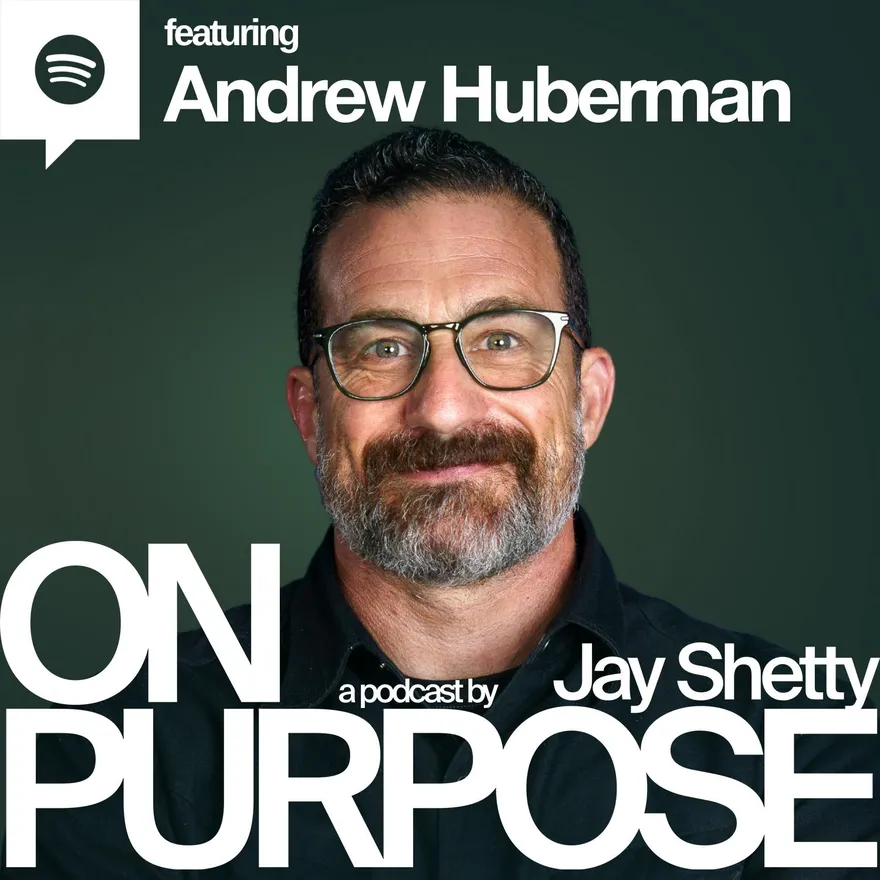

This is a preview of the Shortform summary of the Sep 7, 2026 episode of the On Purpose with Jay Shetty
Sign up for Shortform to access the whole episode summary along with additional materials like counterarguments and context.
1-Page Summary
Circadian Rhythm Protocols For Health and Energy Optimization
Andrew Huberman and Jay Shetty discuss evidence-based routines that align with the body's natural circadian rhythms to optimize health, energy, and sleep quality.
Morning Routines Enhance Daytime Alertness and Sleep Quality
Huberman emphasizes getting bright sunlight exposure within three hours of waking to spike morning cortisol by up to 50%, which improves energy and mood throughout the day. Drinking water upon waking, exercising early, and even five minutes of meditation further boost the cortisol awakening response. These practices can be completed in about 30 minutes and easily integrate into daily routines.
Understanding the Cortisol Curve
High morning cortisol is essential for immunity, blood sugar regulation, and stress resilience. This peak triggers a negative feedback loop that creates a downward curve throughout the day, naturally inducing sleep by evening. Without a strong morning spike, people experience a flattened curve linked to low energy, mood disturbance, and insomnia with early morning awakening around 2–3 a.m. Successfully elevating morning cortisol also allows quicker recovery from daily stress. This pattern benefits all demographics and applies across gender, age, and even during cancer treatment.
Afternoon Energy Dip
A natural drop in body temperature in the early afternoon causes sleepiness around 2–3 p.m. Huberman recommends accepting this dip rather than fighting it. Short restful practices like yoga nidra, exhale-focused breathing, or meditation restore energy without the grogginess that naps can cause. Delaying caffeine by 60–90 minutes after waking helps prevent an afternoon crash by allowing adenosine to clear naturally. Recognizing that this dip is natural removes pressure to maintain constant performance and allows people to work with their biology.
Evening Routines Lower Cortisol for Better Sleep
Dimming lights in the evening signals the pineal gland to increase melatonin production, aided by low evening cortisol levels. Huberman limits late-day caffeine and hydration while engaging in calming practices that activate the parasympathetic nervous system. High morning cortisol directly supports a healthy evening decrease, creating a seesaw effect with melatonin that optimizes sleep quality.
Exercise Principles
Regular resistance training with compound movements maintains muscle mass, bone density, and metabolic health. Huberman suggests that cardiovascular health requires daily walking and at least one weekly high-intensity interval session. Morning workouts enhance the natural cortisol spike, while late-day intense exercise requires evening wind-down protocols to manage cortisol and protect sleep quality.
Neuroscience-Based Mental Health Tools and Thought Mechanisms
Huberman outlines practical mental health strategies grounded in neuroscience, drawing from research by Richie Davidson and Wendy Suzuki showing that even five to thirteen minutes of daily meditation lowers heart rate, improves heart rate variability, and enhances mood and sleep. Brief sessions strengthen neural circuits for focus, though the initial week often increases anxiety as the brain adapts. Three to six days of consistent practice are enough to engrain the habit.
Thought Mechanism and Selective Filtering
Huberman likens thought processes to a library where focusing on one concept activates associated ideas through interconnected sensory networks. Becoming a "selective filter" for thoughts is central to mental health—ruminating on problems rarely yields solutions, while shifting attention to sensation or breath interrupts negative cycles and opens access to new insights.
Breathwork and Self-Observation
Deliberate breathwork provides scientifically validated regulation of the nervous system through respiratory sinus arrhythmia. Lengthening the exhale slows heart rate and activates the parasympathetic system, making it a powerful tool to interrupt stress. Developing metacognitive skill through meditation and self-observation allows conscious redirection of attention away from unhelpful thought spirals, providing liberation from automatic thoughts and emotional reactivity.
Spirituality, Prayer, and Faith as Pathways to Peace
Shetty describes prayer as recognition of human limitation and connection with something greater, while Huberman shares that daily prayer has transformed his thinking, brought peace, and improved decision-making. He prays for others nightly, fostering compassion and forgiveness, and describes prayer as "giving over his will" to a higher power, which enables transformation that willpower alone cannot achieve. This process runs counter to neuroscience's understanding of top-down control, yet its results are consistent.
Acknowledging Limits and Scientific Support
Both emphasize that accepting human limits catalyzes spiritual peace and reduces pressure from constant striving. Huberman notes that neuroscience increasingly supports age-old spiritual teachings, citing 25 years of meditation research that has established scientific legitimacy through randomized controlled trials. He describes how neurosurgeon colleagues report experiences beyond textbook explanations, suggesting Western science and Eastern wisdom work in alignment. Gratitude practice serves as foundational fuel for all positive spiritual work, counteracting the brain's natural bias toward threat detection, though it requires daily practice to rewire mental habits.
Energy Management Through Service, Gratitude, and Balanced Effort
Shetty explains that many people view energy as finite, creating stress and anxiety. However, energy grows through service and giving when performed with genuine compassion, opposing the scarcity mindset. Historical leaders exemplified this renewable energy principle through service rather than personal benefit. The paradox is that hoarding energy causes stagnation, while serving others replenishes it.
Balanced Mentorship and Effort
True vitality in wisdom comes from both receiving from mentors and teaching mentees. Having only one direction leads to either stagnation or depletion. Shetty advocates receiving, embodying, and transmitting wisdom, mirroring natural systems like water and nutrient cycles. He introduces the "too tight, too loose" principle—holding a bird too tightly crushes it, too loosely and it flies away. This middle path requires continuous calibration in relationships, goals, and effort, balancing rigidity with commitment.
Service as Primary Fuel
Genuine service paradoxically generates more energy than self-focused effort and provides transcendent meaning beyond what neuroscience fully explains. People who experience fulfillment serve purposes larger than personal achievement, making service the primary fuel for meaningful work and relationships.
Integration of Western Neuroscience With Eastern Philosophical Traditions
Huberman observes that neuroscience increasingly confirms insights from Eastern contemplative traditions. Shetty provides the Eastern metaphor of the mind as a chariot pulled by five horses representing the senses, with intelligence serving as the discerning faculty. This mirrors what Western neuroscience calls executive function and self-regulation. The concept of neuroplasticity aligns with yogic and Buddhist assertions that the mind can be trained, and practices like pranayama now have explanations in terms of effects on the autonomic nervous system.
Both systems are necessary for deep human flourishing—neuroscience provides precision and rigor while Eastern philosophies offer holistic integration spanning physical, mental, emotional, and spiritual domains. However, oversimplified binary views on science versus spirituality, body versus mind, and effort versus grace undermine human potential. True personal growth arises from holding apparent opposites together, an insight increasingly supported by modern neuroscience.
1-Page Summary
Additional Materials
Counterarguments
- The evidence for sunlight exposure spiking morning cortisol by "up to 50%" and its direct impact on mood and energy may be overstated; individual responses vary, and some studies show more modest effects.
- Not everyone can access bright sunlight within three hours of waking due to geography, weather, or work schedules, limiting the universal applicability of this recommendation.
- The importance of a high morning cortisol spike for all demographics, including those with certain health conditions (e.g., adrenal disorders), is not universally supported and may not be appropriate advice for everyone.
- The link between a flattened cortisol curve and specific symptoms like early morning awakening or mood disturbance is correlational, not necessarily causal.
- Afternoon energy dips are influenced by multiple factors, including sleep quality, diet, and individual chronotype, not just body temperature.
- The recommendation to delay caffeine intake may not be necessary or beneficial for everyone, as caffeine metabolism and sensitivity are highly individual.
- The assertion that short restful practices can universally restore energy without grogginess may not hold for all individuals; some may still experience post-rest lethargy.
- The benefits of resistance training and high-intensity interval training are well-supported, but the optimal frequency, intensity, and timing can vary based on age, health status, and personal goals.
- The claim that daily meditation of 5–13 minutes is sufficient for all the listed benefits may not apply to everyone; some individuals require longer or different forms of practice to see results.
- The idea that prayer or spiritual practices universally foster peace, compassion, and improved decision-making is subjective and may not resonate with non-religious individuals or those from different cultural backgrounds.
- The assertion that neuroscience increasingly supports all spiritual teachings is an overgeneralization; some spiritual claims remain outside the scope of scientific validation.
- The concept that energy grows through service and giving may not account for caregiver burnout or the need for personal boundaries, especially in high-demand environments.
- The metaphorical alignment between Eastern and Western models of the mind is illustrative but not a direct equivalence; significant philosophical and methodological differences remain.
- The integration of Western neuroscience and Eastern philosophy is promising, but practical and epistemological challenges persist in merging these frameworks.
- The dismissal of binary thinking (e.g., science vs. spirituality) may overlook the value of clear distinctions in certain contexts, such as clinical decision-making or scientific research.
Actionables
- you can set a daily “energy calibration” timer on your phone for three key times (morning, early afternoon, and evening) to prompt a quick self-check: step outside for sunlight or fresh air in the morning, do a 2-minute body scan or slow breathing after lunch, and dim lights plus silence notifications an hour before bed to reinforce natural energy and sleep rhythms.
- a practical way to balance giving and receiving is to keep a simple “energy ledger” in your notes app, where you jot down one act of service or kindness you did and one way you accepted help or mentorship each day, helping you spot patterns of stagnation or depletion and adjust your approach for more vitality.
- you can use a “thought traffic light” sticky note on your workspace: when you notice rumination or unhelpful thoughts, pause and label them as red (stop and breathe), yellow (observe and redirect to a sensation), or green (move forward with a new focus), training your mind to filter thoughts and shift attention for better mental health.
Get access to the context and additional materials
Circadian Rhythm Protocols For Health and Energy Optimization
Optimizing health and energy begins with understanding and working with the body’s natural circadian rhythms. Andrew Huberman and Jay Shetty discuss evidence-based routines that align with these daily biological cycles, focusing on maximizing the effectiveness of morning, afternoon, and evening periods to boost alertness, mood, and sleep quality.
Morning Routines Enhance Daytime Alertness and Sleep Quality
Morning Sunlight Boosts Cortisol by 50%, Vital for Energy & Sleep Conditioning
Huberman emphasizes the importance of getting outside for bright sunlight exposure within the first three hours of waking, regardless of weather conditions. Direct exposure to sunlight (without sunglasses or hats that block light) spikes morning cortisol by up to 50% above baseline levels. Artificial light, like a 10,000 Lux lamp, can substitute if sunlight isn’t available, but sunlight is preferable. Most people notice more consistent energy and better mood throughout the day when they start with this practice.
Water Upon Waking Elevates Cortisol, Supporting Body's Awakening Response
Drinking water immediately upon waking helps spike cortisol further, reinforcing the body's natural awakening response. This supports hydration and primes the body for movement and energy.
Morning Exercise Within Three Hours Of Waking Boosts Cortisol and Enhances Alertness Benefits
Movement early in the day—ideally within the first three hours of waking—raises cortisol, leading to sustained energy and alertness. Huberman notes that early exercise is particularly effective for promoting a sharp increase in morning cortisol. This effect can be achieved regardless of other morning commitments and can even be compatible with taking care of family or pets.
Meditation Upon Waking Trains Mind For Better Decisions and Stress Reduction
A brief meditation, even as short as 10 focused breaths or five minutes, right after waking trains the mind for focused awareness. Huberman's research demonstrates that as little as five minutes of morning meditation improves heart rate variability, mood, and sleep, and enhances daily decision-making and stress resilience.
30-minute Morning Practices Easily Integrate Into Routines
All the recommended morning protocols (sunlight exposure, hydration, movement, and meditation) can be completed in about 30 minutes and are easily integrated into daily life.
Understanding the Cortisol Curve: Why Morning Elevation Is Essential
Morning Cortisol Supports Immunity, Blood Sugar, and Stress Resilience
Cortisol’s job is to mobilize glucose (blood sugar) for energy and support immune function. The natural sharp spike in cortisol upon waking (the cortisol awakening response) sets the foundation for high alertness, mood, and immunity throughout the day.
Cortisol's Negative Feedback: High Morning Levels Suppress the Hormone, Forming a Sleep-Inducing Downward Curve
High morning cortisol initiates a negative feedback loop, gradually suppressing cortisol production over the day and creating a downward curve that naturally induces sleep by evening. This pattern leads to high morning energy and a healthy sleep drive at night.
People Who Don't Spike Morning Cortisol Often Have a Flattened Curve, Leading To Low Energy, Mood Disruption, Poor Blood Sugar Control, and Insomnia With Early Morning Awakening Around 2 to 3 Am
Failing to trigger a strong morning cortisol peak results in a flattened curve, which is linked to low energy, mood disturbance, poor blood sugar regulation, and the classic pattern of falling asleep quickly but waking at 2 or 3 a.m. This happens due to an incorrectly timed cortisol rise.
High Morning Cortisol Allows Quicker Recovery From Daily Stress-Induced Spikes, Shortening Hormonal Disruptions
Successfully elevating cortisol in the morning enhances resilience to stress by ensuring that cortisol spikes from daily challenges reset to baseline more quickly. This improved recovery lessens anxiety and supports emotional stability throughout the day.
Cortisol Pattern Beneficial Across all Demographics
This circadian cortisol pattern is not gender- or age-specific; it applies to men, women, children, and even during pregnancy. Research shows that even cancer treatments are more effective when patients have a well-established high morning and low evening cortisol rhythm.
Afternoon Energy Dip: A Natural Occurrence Manageable Through Acceptance and Interventions
Temperature Drop Triggers Afternoon Sleepiness
A natural drop in body temperature in the early afternoon prompts sleepiness and reduced alertness. This "afternoon dip," typically felt around 2–3 p.m., mirrors the body’s temperature and cortisol curves.
Embrace the Afternoon Dip With Restful Practices
Instead of fighting this dip, Huberman recommends accepting it. Short restful practices—like 5–10 minutes of yoga nidra, breathing exercises that emphasize long exhales, meditation, or simply lying down with eyes closed—restore mental and physical energy effectively, without causing grogginess or sleep inertia as naps might.
Delay Caffeine Intake 60-90 Mins After Waking to Clear Adenosine and Prevent Afternoon Crash
Huberman also advises delaying caffeine by 60–90 minutes after waking. This allows adenosine, a sleep-promoting molecule, to clear naturally, reducing the likelihood of a pronounced afternoon crash. Taking caffeine too soon suppresses adenosine temporarily, but as its effects wear off, adenosine floods back, causing post-lunch sluggishness.
Afternoon Rest With Exhale Breathing or Meditation Restores Vigor Without Sleep Inertia, Unlike Naps
While naps can lead to grogginess (sleep inertia) and may disrupt nighttime sleep, brief, restorative practices like deep breathing with an exhale focus or meditation enhance energy and reduce stress without these downsides.
Understanding That the Afternoon Dip Is Natural Removes the Pressure to Maintain Constant Performance and Allows Individuals to Work With Their Biology Rather Than Against It
Recognizing and working with the biology of the afternoon dip—rather than resisting it—enables people to optimize performance across the day and sustain healthy rhythms.
Evening Routines Lower Cortisol for Better Sleep
Dimming Lights Signals Pineal Gland to Increase Melatonin Production, Aided by Low Evening Cortisol Levels
As evening approaches, dimming household lights signals the pineal gland to release melatonin, the sleep hormone. This process is greatly aided by low evening cortisol, itself a product of the ear ...
Here’s what you’ll find in our full summary
Circadian Rhythm Protocols For Health and Energy Optimization
Additional Materials
Counterarguments
- The evidence supporting the necessity of direct sunlight exposure (without sunglasses or hats) for optimal cortisol increase is not universally accepted; some studies suggest that indirect sunlight or exposure through windows can still have beneficial effects on circadian rhythms.
- The claim that drinking water immediately upon waking significantly elevates cortisol lacks robust scientific backing; hydration is important, but its direct effect on cortisol levels is not well established.
- While morning exercise can boost alertness for some, individual chronotypes vary, and some people may perform better or feel more energized with afternoon or evening exercise.
- The assertion that a specific 30-minute morning routine is easily integrated into daily life may not account for individuals with demanding schedules, caregiving responsibilities, or disabilities.
- The relationship between morning cortisol spikes and long-term health outcomes is complex, and not all research agrees that higher morning cortisol is universally beneficial; chronic high cortisol can be harmful.
- The idea that a flattened cortisol curve is always detrimental oversimplifies the issue; some individuals with atypical cortisol patterns do not experience negative health effects.
- Recommendations to delay caffeine intake by 60–90 minutes after waking are based on limited evidence, and individual responses to caffeine and adenosine clearance can vary widely.
- The suggestion that naps are generally less beneficial than brief restful practices is debated; for some people, short naps can improve alertness and performance without causing sleep inertia.
- The protocols may not be suitable or n ...
Actionables
- you can set a recurring morning phone alarm labeled with a checklist of sunlight, water, movement, and meditation to prompt you to complete each step in sequence, helping you build a consistent routine that aligns with your natural rhythms and ensures you don’t skip any key activity.
- a practical way to support your afternoon energy is to schedule a daily 5-minute “restorative pause” on your calendar at the time you usually feel the afternoon dip, using a calming playlist or guided audio to help you relax without falling asleep and return to your tasks refreshed.
- you ...
Get access to the context and additional materials
Neuroscience-Based Mental Health Tools and Thought Mechanisms
Andrew Huberman draws from scientific research and personal insight to outline practical mental health strategies grounded in neuroscience. Meditation, breathwork, and metacognitive awareness emerge as accessible self-regulation techniques that can reshape physiological and psychological well-being.
Meditation Has Measurable Physiological and Psychological Benefits Beyond Stress Reduction
Huberman, referencing Richie Davidson and Wendy Suzuki’s lab at NYU, explains that even five to thirteen minutes of daily meditation can lower heart rate, improve heart rate variability, and enhance mood and sleep quality. Suzuki’s research shows that brief, repeatable meditation practices—sometimes as little as three days a week—are sustainable and produce real gains in attention and focus. Huberman notes that these short sessions enhance the brain’s neural circuits for focus, resulting in improved concentration in other life domains.
Importantly, he cites research that the initial week of meditation often increases anxiety, as learning to sit still while feeling stress strengthens stress tolerance and drives neural adaptation. Many avoid meditation because it initially feels uncomfortable or difficult, but Huberman says three to six days of consistent, attentive practice are enough to engrain the habit into the nervous system. The more attention and presence one brings, the faster the habit forms.
Thought Mechanism: Attractor States Link Sensory Networks
Huberman likens thought processes to a magical library: focusing on a single thought or sensory object (for instance, a glass table) activates not only the immediate mental representation but also associated qualities and related concepts—much like pulling out one book and finding all the nearby books suddenly related. The brain’s sensory networks collaborate to generate layered, associative mental experience.
He emphasizes that a core practice of mental health is becoming a “selective filter” for which thoughts gain focus. Without intentional redirection, the brain can become trapped in repetitive, unproductive patterns—like a ball bearing lodged in a trench. Ruminating on problems does not usually yield solutions; instead, shifting attention away from looping thoughts and toward sensation or breath opens access to new insights and interrupts negative cycles.
Breathwork Regulates the Autonomic Nervous System and Emotions
Huberman explains that deliberate breathwork provides direct, scientifically validated regulation of the nervous system. Inhaling deeply increases heart rate and alertness via respiratory sinus arrhythmia involving the vagus nerve. Lengthening the exhale or consciously emphasizing it slows heart rate and activates the parasympathetic “rest and digest” system. Just five minutes focused on exhaling can noticeably calm physiology—these effects are meas ...
Here’s what you’ll find in our full summary
Neuroscience-Based Mental Health Tools and Thought Mechanisms
Additional Materials
Clarifications
- Heart rate variability (HRV) is the variation in time intervals between consecutive heartbeats. It reflects the balance and flexibility of the autonomic nervous system, particularly how well the body adapts to stress. Higher HRV generally indicates better cardiovascular fitness and resilience to stress. Low HRV is linked to increased risk of stress-related health problems.
- The vagus nerve is a key part of the parasympathetic nervous system, which controls rest and relaxation responses. It helps slow the heart rate and reduce inflammation when activated. Breathwork, especially slow exhalation, stimulates the vagus nerve to promote calmness. This nerve also connects the brain to organs like the heart and lungs, enabling mind-body regulation.
- Respiratory sinus arrhythmia (RSA) is a natural variation in heart rate that occurs during the breathing cycle. When you inhale, your heart rate slightly speeds up; when you exhale, it slows down. This fluctuation is controlled by the vagus nerve, which links breathing to the autonomic nervous system. RSA reflects healthy heart-lung communication and is a marker of good parasympathetic nervous system function.
- Attractor states are stable patterns of neural activity that the brain tends to settle into during thinking. They represent recurring thoughts or mental states that can dominate attention and influence behavior. These states arise from the brain's network dynamics, where certain neural circuits reinforce each other, making some thoughts more persistent. Understanding attractor states helps explain why breaking repetitive or negative thought loops can be challenging.
- Sensory networks in the brain process different types of sensory information, such as sight, sound, and touch, in specialized but interconnected regions. These networks communicate through neural pathways, allowing the brain to link related sensory inputs and form integrated perceptions. This integration enables the brain to associate a single sensory experience with related memories, emotions, or concepts. As a result, focusing on one sensory input can activate a broader network of related mental content.
- Metacognitive awareness is the ability to observe and understand your own thought processes. Unlike regular thinking, which involves generating thoughts, metacognition involves reflecting on how and why you think. It helps you recognize unhelpful patterns and consciously choose where to focus your attention. This skill enables better control over emotions and decision-making.
- Meditation enhances focus by strengthening the prefrontal cortex, which governs attention control and executive function. It also reduces activity in the amygdala, the brain’s fear and stress center, lowering stress responses. Repeated meditation promotes neuroplasticity, creating new neural connections that improve stress tolerance. This neural adaptation helps the brain shift from reactive to regulated states during stress.
- Exhale-focused breathing stimulates the vagus nerve, which is a key component of the parasympathetic nervous system. This nerve sends signals to slow the heart rate and promote relaxation. Longer exhales increase vagal tone, enhancing the body's "rest and digest" response. This physiological shift reduces stress hormones and calms the nervous system.
- When beginning meditation, the mind often becomes more aware of underlying stress and anxious thoughts previously ignored. This heightened awareness can temporarily amplify feelings of anxiety as the brain confronts discomfort directly. Over time, repeated exposure to these sensations builds tolerance and reduces reactivity through neural adaptation. This process strengthens the brain’s ability to remain calm despite stress, leading to long-term benefits.
- A "selective filter" in mental health refers to the brain's ability to consciousl ...
Counterarguments
- While meditation and breathwork have demonstrated benefits, the magnitude and consistency of these effects can vary significantly between individuals, and not everyone experiences substantial improvements in mood, focus, or physiological markers.
- Some studies suggest that the initial increase in anxiety during meditation may discourage individuals with certain mental health conditions (e.g., severe anxiety or PTSD) from continuing, and for some, meditation may not be advisable without professional guidance.
- The claim that meditation habits can be engrained in the nervous system within three to six days may oversimplify the process of habit formation, which research often shows can take weeks or months and is influenced by individual differences.
- The neuroscience underlying concepts like "attractor states" and the metaphor of the brain as a "selective filter" for thoughts is still an area of active research, and some neuroscientists caution against over-interpreting or oversimplifying these mechanisms.
- While breathwork can influence the autonomic nervous system, its effects may be temporary and may not address underlying causes of chronic stress or mental health disorders.
- The assertion that self-observation ...
Get access to the context and additional materials
Spirituality, Prayer, and Faith as Pathways to Peace
Jay Shetty and Andrew Huberman explore how the practices of prayer, spirituality, and faith serve as powerful anchors in modern life, offering enhanced peace, compassion, and even support from scientific findings.
Prayer Anchors Life In Connection Beyond Control
Jay Shetty describes prayer as a recognition of human limitation—an acceptance that no one can hold all burdens alone. Shetty emphasizes that prayer provides a way to accept fallibility and connects individuals with something greater than themselves, cultivating a sense that an expansive force can hold, understand, and make space for everyone, offering comfort and perspective beyond what the senses provide.
Andrew Huberman shares that regular prayer has fundamentally transformed his thinking, brought a greater sense of peace, improved his decision-making, and allowed him to appreciate beauty and meaning that he previously overlooked. He practices daily prayer every night, never missing it, whether he is tired on the couch or just before bed. Huberman’s prayers focus on others, the world, and even for people with whom he has had difficulties, fostering greater compassion, forgiveness, and inner peace. He likens the discipline and consistency of prayer to physical training, explaining that the structure rewires neural and emotional patterns over time.
Huberman describes prayer as “giving over his will” and “offering burdens” to a higher power or God, allowing for effective action and resilience that willpower alone cannot achieve. He notes that people often struggle to change behaviors despite all knowledge and resources, but when they relinquish control to a higher power, transformation often follows—an outcome that defies standard neuroscientific expectations of top-down mental control. Huberman admits that the way prayer works “runs totally counter-current” to neuroscience’s understanding of the prefrontal cortex and impulse control, yet its results are consistent in his experience and in others', suggesting prayer works on dimensions that current science cannot fully explain.
He also compares the perseverance required in prayer—especially during periods of doubt or difficulty—to persistence needed in academic or fitness pursuits. By releasing the need to control every outcome in favor of faith, Huberman says, the “path kind of opens up,” making challenges easier to navigate.
Acknowledging Limits Is Key to Spiritual Peace
Both Shetty and Huberman underscore the centrality of accepting human limits as a catalyst for spiritual peace. Recognizing that exhaustive personal effort cannot address every challenge opens up space for faith and reduces the pressures of constant striving. Surrendering to this acknowledgment requires trust rather than further control, fostering resilience and spiritual growth.
Huberman cautions that high achievers often overlook their own limits and spiritual needs, relying solely on discipline and productivity, which can be unsustainable. He advocates combining science, discipline, and faith as a more sustainable, resilient approach to life—an integration that exceeds what any single method can offer. This balanced approach acknowledges the power of accepting limits and the importance of trust and surrender alongside effort.
Neuroscience Supports Age-old Spiritual Teachings
Huberman details the convergence between recent neuroscience and long-held spiritual practices. Over the last 25 years, sustained federal funding for meditation research—at first considered too fringe—has established scientific legitimacy for practices like mindfulness and gratitude through randomized controlled trials and peer-reviewed publication. Huberman credits pioneers like Richie Davidson, whose lab at the University of Wisconsin produced foundational research (including the book "Altered Traits") that used MRI studies to explore the neural effects of meditation in ...
Here’s what you’ll find in our full summary
Spirituality, Prayer, and Faith as Pathways to Peace
Additional Materials
Counterarguments
- The transformative effects attributed to prayer may be explained by psychological mechanisms such as reflection, self-soothing, and cognitive restructuring, rather than connection to a higher power.
- Scientific studies on prayer’s efficacy in improving health or well-being have produced mixed results, with some large-scale studies finding no significant effects beyond placebo or relaxation techniques.
- The benefits of practices like meditation, mindfulness, and gratitude can be achieved through secular approaches without invoking spirituality or faith.
- The claim that prayer “rewires neural and emotional patterns” is supported by evidence for meditation and mindfulness, but direct neuroscientific evidence for prayer specifically is less robust.
- Experiences described as “miraculous” or “beyond scientific understanding” by medical professionals are anecdotal and do not constitute scientific proof of phenomena outside current knowledge.
- The assertion that Western science and Eastern wisdom are converging may overstate the degree of alignment, as many scientific and spiritual claims remain fundamentally different in methodology and epistemology.
- Emph ...
Actionables
- You can set a daily five-minute timer to write down one thing you’re struggling to control and one thing you’re grateful for, then physically place the note in a box or jar to symbolize letting go and shifting focus, reinforcing both surrender and gratitude as practical habits.
- A practical way to foster compassion and forgiveness is to choose one person you find challenging and, for a week, intentionally perform a small, anonymous act of kindness for them (such as leaving a positive note or doing a helpful task), focusing your thoughts on their well-being during the process.
- You can create a simple “limits and strengths” char ...
Get access to the context and additional materials
Energy Management Through Service, Gratitude, and Balanced Effort
Jay Shetty and Andrew Huberman explore how humans understand and manage their life energy, emphasizing the importance of moving beyond a scarcity mindset, embracing service, and finding balance in effort and mentorship to sustain energy, wisdom, and fulfillment.
Born With Life Energy, Access Renewable Energy Beyond Self
Shetty explains that many people live with a finite view of energy, feeling there is only so much to give and that it must be hoarded or carefully rationed. He likens this to having just one glass of water and not knowing where more will come from, which causes stress and anxiety. Huberman expands, stating that while everyone is born with a certain life energy, the way this energy is directed is important, and that it need not be seen as strictly finite.
Energy Grows Through Service and Giving, Opposing the Scarcity Mindset
Shetty argues that the flow of energy follows different principles than physical resources: "The more I give to you, if I'm giving out of genuine compassion, the more I receive from above. It's not mathematically finite." He emphasizes that by aligning with something greater than oneself—through prayer, contemplation, or connection—energy renews itself. Service and giving, rather than depleting the self, actually replenish vitality, opposing the conventional scarcity mindset.
Historical Leaders Exemplified This Renewable Energy Principle By Utilizing Their Vitality For Service Rather Than Personal Benefit
Shetty points out that transformative figures who have changed the world did so through service. Their seemingly boundless energy stemmed from a source larger than themselves and was directed fully towards the benefit of others, not personal gain.
Finite Energy Breeds Conflict; Abundant Energy Brings Peace
Huberman observes that much conflict arises from the belief that energy is finite and must be taken or defended, which breeds competition and aggression. He contrasts this with communities, such as those in the "blue zones," who sustain their energy and vitality through ongoing cycles of giving, connection, and balanced replenishment—bringing peace rather than conflict.
Paradox: Hoarding Energy Stalls Growth; Serving Others Replenishes It
The paradox, as Shetty puts it, is that trying to hoard energy or only receive without giving causes stagnation. This is a distinctly human tendency and the source of much stuckness. In contrast, true energetic flow comes through a cycle of receiving, embodying, and transmitting energy and kindness—serving others replenishes rather than drains.
Balanced Mentorship Circulates Wisdom By Learning From Mentors and Teaching Mentees
Stagnation From Receiving Mentorship Without Sharing Wisdom
Shetty says that true vitality in wisdom and mentorship is achieved by both receiving from mentors and sharing with mentees. If a person has only a mentor and no mentees, they become stuck in constant receiving. Conversely, having only mentees and no mentor leads to depletion, as they have no source from which to replenish their wisdom.
Mentors Deplete Themselves By Drawing From Finite Reserves Without Guidance From Above or Experienced Sources
Mentors who neglect to seek their own guidance or learning risk exhausting themselves as they draw only from finite reserves; a balanced flow comes from both learning and teaching.
Ideal Human State: Receive, Embody, and Transmit Wisdom, Creating Energy Circulation
The ideal, Shetty notes, is a loop—receiving insight and compassion, integrating these within oneself, and sharing onward. This creates a current of energy and wisdom that sustains itself and others.
Flow: Receiving, Integrating, and Mirroring Natural Systems Like Water and Nutrient Cycles, Suggesting a Fundamental Law of Vitality and Sustainability
This principle mirrors natural systems—like cycles of water and nutrients—where nothing stagnates, and the ongoing flow is the very source of sustenance and renewal.
"Too Tight, too Loose" Principle For Effort, Goals, Relationships Yields Sustainable Success Without Burnout
Excessive Control and Anxiety Sabotage Relationships By Preventing Natural Unfolding
Shetty uses the metaphor of holding a bird: “Don’t hold it too tightly, you’ll crush it. Don’t hold it too loosely, it will fly away and be hurt.” This mirrors the common challenge in relationships and goals—over-control and anxiety can sabotage growth and connection.
Holding Effort too Loosely Removes the Engagement and Commitment Required For Meaningful Change, Similar To Holding a Bird Lightly It Flies Away
Holding effort too loosely, with insufficient commitment or passion, removes the engagement needed for meaningful change—just as a bird held too lightly will escape and potenti ...
Here’s what you’ll find in our full summary
Energy Management Through Service, Gratitude, and Balanced Effort
Additional Materials
Clarifications
- "Life energy" refers to a non-physical, often spiritual or emotional vitality that fuels motivation, creativity, and well-being. Unlike physical energy, which is measurable and finite (like calories or electricity), life energy is experienced subjectively and can be renewed through mental, emotional, and social practices. It is linked to feelings of purpose, connection, and inner balance rather than material resources. This concept is common in many philosophical and spiritual traditions, emphasizing growth and renewal beyond physical limits.
- The scarcity mindset views energy as a limited resource that depletes with use, causing fear of running out. In contrast, the renewable energy concept sees giving and service as actions that activate psychological and social feedback loops, increasing motivation and emotional vitality. Acts of kindness and connection stimulate brain chemicals like oxytocin and dopamine, which enhance feelings of energy and well-being. This creates a positive cycle where generosity fuels more energy rather than diminishing it.
- "Something greater than oneself" refers to a source of meaning or power beyond individual ego, such as a spiritual belief, nature, or a collective purpose. Prayer, contemplation, or connection are practices that help individuals align with this source, fostering a sense of peace and renewal. These practices shift focus from self-centered concerns to broader perspectives, reducing stress and replenishing mental and emotional energy. This alignment can create a feeling of being supported by a larger force, which sustains vitality.
- "Blue zones" are regions where people live significantly longer and healthier lives than average. These areas share lifestyle traits like strong social connections, regular physical activity, and purposeful living. Their communities emphasize mutual support and balanced energy exchange, contributing to sustained vitality. Studying blue zones helps understand how social and environmental factors promote well-being and longevity.
- Hoarding energy reflects a mindset of scarcity, causing fear and withdrawal that block emotional and social growth. Serving others activates positive feedback loops in the brain, releasing chemicals like oxytocin that boost mood and vitality. This outward flow creates connection and purpose, which renew internal energy reserves. Thus, energy is amplified through generosity rather than diminished.
- Mentorship is a dynamic exchange where wisdom flows both ways: mentors provide guidance, while mentees offer fresh perspectives and questions that stimulate growth. When someone only receives mentorship without teaching others, they may become passive and dependent, limiting their development. Conversely, mentors who only teach without learning risk burnout and outdated knowledge. Balanced mentorship sustains vitality by continuously renewing insight through mutual learning and sharing.
- The "middle path" originates from Buddhist philosophy, advocating a balanced approach between extremes. It means avoiding both excessive control and complete passivity to maintain harmony and effectiveness. Applying this to effort, goals, and relationships encourages flexibility, responsiveness, and sustainable engagement. This balance prevents burnout and fosters growth by adapting to changing circumstances.
- The "too tight, too loose" principle originates from balance theories in psychology and stress management, emphasizing moderation in effort and control. Exc ...
Counterarguments
- The idea that energy is renewed through service and giving may not account for people who experience burnout from caregiving or overextending themselves in service roles, suggesting that giving can sometimes deplete rather than replenish energy.
- The claim that aligning with something greater than oneself always renews energy may not resonate with individuals who do not hold spiritual or religious beliefs, or who find meaning in self-directed pursuits.
- The assertion that historical leaders had boundless energy due to service may overlook other factors such as privilege, support systems, or personal ambition.
- The notion that believing energy is finite breeds conflict may oversimplify the causes of competition and aggression, which can also stem from structural inequalities or resource scarcity.
- The analogy between energy flow and natural cycles like water or nutrients may not fully capture the complexities of human psychology and social dynamics.
- The emphasis on service as the primary source of fulfillment may not apply to everyone; some individuals find meaning and motivation in personal achievement, creativity, or self-exploration.
- The "middle path" approach to effort and relationships, whi ...
Get access to the context and additional materials
Integration of Western Neuroscience With Eastern Philosophical Traditions
Andrew Huberman and Jay Shetty discuss the profound intersections between contemporary neuroscience and ancient Eastern philosophical systems. They explore how time-tested spiritual metaphors illuminate the neural dynamics of the mind and how the convergences between these two domains present both opportunities and challenges for understanding human flourishing.
Neuroscience Validates Ancient Eastern Philosophical Insights
Neuroscience increasingly confirms insights that originated in Eastern contemplative traditions centuries ago. Andrew Huberman observes that many conclusions drawn by cutting-edge neuroscience regarding the mind and consciousness are reminiscent of ancient Eastern concepts—they were simply articulated in different language and emerged from long-standing practices and deep introspection.
Jay Shetty provides the Eastern metaphor of the mind as a chariot pulled by five horses, each representing one of the senses: hearing, smelling, touching, tasting, and seeing. The unruly horses—senses responding to external stimuli—can cause the chariot (the mind) to be pulled in chaotic directions, mirroring the everyday human experience of distraction and competing desires. This metaphor reflects how untrained senses and an unrefined mind lead to scattered attention and reactive behavior.
Within this framework, the intelligence (“the God” in the chariot) serves as the discerning faculty, evaluating sensory input and providing guidance to avoid conditioned, impulsive actions—for example, resisting habitual overindulgence or self-destructive patterns. If intelligence is sufficiently developed, it reins in the senses and mind when they are drawn to unhealthy or undesirable behaviors. According to Shetty, this process mirrors cognitive mechanisms Western neuroscience refers to as executive function and self-regulation, supported by neural networks coordinating impulse control and judgment.
Both disciplines recognize the mind’s malleability. Neuroscience’s concept of neuroplasticity—the brain’s capability to reorganize itself through practice and experience—closely aligns with the yogic and Buddhist assertion that the mind can be trained and refined. Eastern practices such as pranayama (breath control) and meditation are now explained in terms of effects on the autonomic nervous system and neural circuits involved in attention, stress response, and metacognition. The Buddhist and Advaita Vedanta notions of the mind’s separation from pure awareness and the cultivation of thought observation correlate with neuroscience’s understanding of meta-cognition and observational awareness.
The enduring mind-chariot metaphor is an early example of modeling executive control, now paralleled by neuroscience in describing how various brain circuits and systems coordinate impulse, decision-making, and self-restraint. These convergences indicate that contemplative traditions engaged in rigorous, centuries-long experiments on consciousness and mind, producing insights that are only now being systematically validated by science.
Integrating Both Systems For a Complete Understanding of Human Health
While Western neuroscience excels at identifying mechanisms, measuring outcomes, and developing interventions, it often fails to address the holistic integrations found in traditional Eastern systems. Eastern philosophies offer detailed maps of consciousness, methods for personal tra ...
Here’s what you’ll find in our full summary
Integration of Western Neuroscience With Eastern Philosophical Traditions
Additional Materials
Clarifications
- Executive function refers to a set of mental skills that help manage and control behavior, including planning, attention, and impulse control. It enables individuals to make decisions, resist temptations, and adapt to new situations. These functions are primarily governed by the prefrontal cortex of the brain. Effective executive function is essential for self-regulation, allowing a person to align actions with long-term goals rather than immediate desires.
- Neuroplasticity is the brain's ability to change its structure and function in response to learning, experience, or injury. It involves forming new neural connections and strengthening or weakening existing ones. This adaptability allows the brain to recover from damage and improve skills through practice. Neuroplasticity underlies how habits form and how therapies can reshape thought patterns.
- Pranayama is a set of controlled breathing techniques used in yoga to regulate the breath. It influences the autonomic nervous system by activating the parasympathetic branch, which promotes relaxation and reduces stress. Different patterns of inhalation, exhalation, and breath retention can modulate heart rate, blood pressure, and emotional states. These physiological changes support improved focus, calmness, and emotional balance.
- Metacognition is the ability to think about and monitor your own thinking processes. It involves self-awareness of how you learn, remember, and solve problems. Observational awareness is the practice of noticing your thoughts and feelings without immediately reacting to them. Both skills help improve self-control and decision-making by creating mental space between stimulus and response.
- Advaita Vedanta is a non-dualistic school of Hindu philosophy that teaches the ultimate reality is a singular, unchanging consciousness called Brahman. It posits that the individual self (Atman) is not separate but identical to this pure awareness. The goal is to realize this unity, transcending the illusion of separateness and duality. This realization leads to liberation (moksha) from suffering and the cycle of rebirth.
- The "mind as a chariot pulled by five horses" metaphor originates from ancient Indian philosophy, particularly the Katha Upanishad. The chariot represents the self or consciousness, the horses symbolize the five senses, and the reins represent the mind controlling the senses. The metaphor illustrates how the senses can lead the mind astray if not properly guided by intellect or wisdom. It emphasizes the need for disciplined control to achieve focused awareness and self-mastery.
- In Eastern philosophy, the "mind" refers to the stream of thoughts, emotions, and sensory experiences that arise and change constantly. "Pure awareness" is the unchanging, silent presence that observes these mental activities without attachment or identification. This awareness is considered the true self or consciousness beyond the fluctuations of the mind. Recognizing this distinction is key to practices like meditation, which cultivate detachment from mental noise to experience deeper clarity and peace.
- "Holding apparent opposites together" means accepting that two seemingly contradictory qualities can coexist and both be true. In personal growth, this involves balancing effort with relaxation, control with letting go, and discipline with openness. Embracing paradoxes helps avoid rigid thinking and fosters flexibility, resilience, and deeper understanding. This approach reflects many Eastern philosophies that see reality as complex and interconnected rather than black-and-white.
- Western neuroscience focuses on empirical study, using experiments and technology to understand brain mechanisms and behavior. Eastern philosophical systems emphasize experiential knowledge, introspection, and holistic integration of mind, body, and spirit. Neuroscience seeks measurable outcomes and interventions, while Eastern traditions provide frameworks for personal transformation and spiritual growth. Together, they offer complementary perspectives on human health and consciousness.
- The autonomic nervous system (ANS) controls involuntary bodily functions li ...
Counterarguments
- While there are parallels between Eastern philosophical concepts and neuroscience findings, many similarities may be superficial or metaphorical rather than evidence of direct equivalence or validation.
- Neuroscience is an empirical science based on testable hypotheses and measurable outcomes, whereas Eastern contemplative traditions are rooted in subjective experience and cultural context, making direct comparison challenging.
- The claim that neuroscience "validates" ancient insights can be overstated; scientific validation requires rigorous testing, and not all traditional practices or beliefs withstand such scrutiny.
- Some Eastern practices and concepts have not been empirically supported or may even conflict with current scientific understanding.
- The metaphor of the mind as a chariot, while illustrative, is not a scientific model and may oversimplify the complexity of neural processes involved in executive function and self-regulation.
- The assertion that contemplative traditions conducted "rigorous, centuries-long experiments" may be misleading, as these were not controlled scientific experiments but rather philosophical and spiritual explorations.
- Integrating spiritual or metaphysical concepts into scientific frameworks can risk conflating distinct domains and may introduce untestable or non-falsifiable elements into ...
Get access to the context and additional materials

 1-Page Summary
- Circadian Rhythm Protocols For Health and Energy Optimization
- Neuroscience-Based Mental Health Tools and Thought Mechanisms
- Spirituality, Prayer, and Faith as Pathways to Peace
- Energy Management Through Service, Gratitude, and Balanced Effort
- Integration of Western Neuroscience With Eastern Philosophical Traditions
Create Summaries for anything on the web
Download the Shortform Chrome extension for your browser
