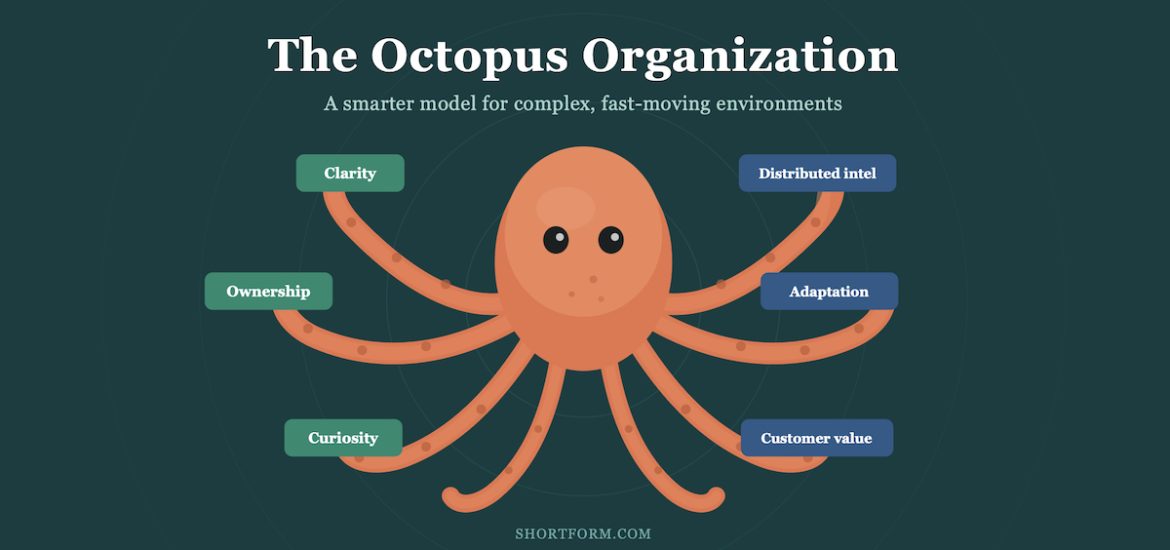
An octopus adapts continuously through distributed intelligence rather than central command. So, what is an “Octopus Organization”? It’s a refreshing alternative to companies that are rigid, hollow, and dependent on outside direction.
Amazon Web Services strategists Phil Le-Brun and Jana Werner argue that most companies are still built for a world of standardization and control that no longer reflects how work actually gets done. Their book The Octopus Organization identifies the specific habits that keep companies stuck and gives any leader, at any level, a practical place to start changing. Read on to explore Le-Brun and Werner’s insights into what an Octopus Organization is and the structural pillars that support it.
Table of Contents
Octopus Organizations vs. Tin Man Organizations
Have you ever felt like a cog in a machine? Le-Brun and Werner explain that, for most of the 20th century, organizations were designed to resemble machines. In their book, they contrast these “Tin Man Organizations” with “Octopus Organizations.” They detail what an Octopus Organization is—and make the case for why it’s a better way.
(Shortform note: Le-Brun and Werner are executive strategists at Amazon Web Services with experience leading large-scale organizational change—Le-Brun as the former international CIO of McDonald’s and Werner as a leader of corporate transformations across Europe. Drawing on that experience and on extensive interviews with executives across industries, they identify dysfunctions [which they call “antipatterns”] that keep companies stuck.)
Tin Man Organizations
When your goal is to manufacture consistent products, provide a standardized service, or produce predictable results, variation is a liability. So the right model is hierarchical and standardized—one with clear roles, defined processes, and decisions made at the top and executed below. Le-Brun and Werner call companies that follow this model “Tin Man Organizations,” borrowing the name of a character in L. Frank Baum’s 1900 novel The Wizard of Oz who was rigid, hollow, and reliant on others’ instructions. The authors point out that this model was genuinely well-suited to its era.
(Shortform note: In Baum’s novel, the Tin Woodman is a human woodcutter who falls under a witch’s curse and is rebuilt by a tinsmith, one part at a time, until no trace of the original remains. In Henry Littlefield’s 1964 analysis [the most influential scholarly reading of the book], this makes him a symbol of the industrial laborer—not the machine, but the person the machine consumed. Fritz Lang’s 1927 film Metropolis illustrates the same idea on a larger scale. It depicts a city with thinkers in towers above and workers tending machinery below ground. No worker makes a decision—they follow the rhythm of the clock and the machine—and the roles of “head” and “hands” have been assigned to entirely different groups of people.)
Why We Need an Alternative to Tin Man Organizations
To understand why many organizations need to move beyond the top-down structure, it’s important to understand the distinction between complicated and complex problems. The traditional model created organizations that thrived in what Le-Brun and Werner call a “complicated” world, one where solving problems was like building an engine. However intricate the system (with thousands of interlocking parts), every process was knowable, repeatable, and fundamentally predictable. If something broke, you identified the faulty component and fixed it. Complicated problems reward analysis, specialization, and control—and traditional organizations excelled at providing exactly those capabilities at scale.
The problem is that most organizations now operate in a world better described as complex. It’s dynamic and interconnected—a small change in one place produces ripple effects that no model can predict. Le-Brun and Werner note that new technologies quickly reshape industries, customer expectations shift in ways that resist prediction, and the work that many organizations do has become much more relational. In such complex environments, the features that made the traditional model effective become liabilities: Rigid structures can’t flex, centralized decision-making can’t respond quickly enough to what’s happening at the edges, and standardized processes can’t accommodate the variation that complex problems demand.
| Separating Thinking From Doing The traditional model wasn’t how organizations inevitably evolved, but the way someone designed them. That someone was Frederick Winslow Taylor, a 19th-century engineer who believed there was one optimal way to perform any task. His “scientific management” system broke every job into measurable steps, separated planning from execution, and concentrated decision-making at the top. This creates the kind of tight controls and external incentives that Daniel Pink argues in Drive work well for routine, repetitive tasks—such as those that were the bread and butter of the workplaces Taylor studied. Taylor’s model worked in the world he lived in, but the world has changed in two significant ways. The first affects the nature of work itself: Pink shows that algorithmic, assembly-line jobs have been outsourced or automated, and what remains requires judgment and creativity—qualities Taylor’s system suppresses. The second change has occurred in the work environment. In Team of Teams, Stanley McChrystal describes how the US military’s task force in Iraq, built on Taylor’s principles, was outmaneuvered by a decentralized adversary. The problem? Taylor’s system separates thinking from doing. That works when you can reliably anticipate reality—but not when you’re in an environment Le-Brun and Werner would call complex, where the people closest to the action are best positioned to see what happens and respond. |
What Octopus Organizations Do Differently
The octopus evolved for exactly this kind of complex environment. It has a central brain, but much of its nervous system is distributed through its arms, each of which is capable of sensing and responding to its surroundings independently while still coordinating with the whole. An octopus can also reshape itself to move through any space, change its appearance to camouflage itself, and adjust its behavior based on what it encounters. Le-Brun and Werner argue that this is the model modern organizations need—not machines optimized for a fixed task, but living systems capable of adaptation.
| How an Octopus’s Intelligence Really Works For any organization trying to distribute intelligence, the question is this: What does the center contribute, and what do the edges handle? Octopus neuroscience offers one answer. An octopus has 500 million neurons, but the central brain claims fewer than one in 10 of them. Two-thirds are distributed across its arms, and the rest are in its optic lobes. While a human motor cortex maintains a precise internal model of where each of our limbs are in space, the octopus brain has no such model. Instead of choreographing movements, it issues a mission—hunt, hide, or navigate—and leaves it to the arms to explore and share information with each other through an arm-to-arm channel that the central brain doesn’t appear to have access to. But the arms aren’t solely dependent on their own learning. Scientists have found that, when octopuses are trained on a task using one arm, they can transfer that knowledge to arms that weren’t involved in the training, meaning the distributed system works because of what the center holds in common, not despite it. Le-Brun and Werner argue that a shared sense of what an organization is working toward makes a similar, group-level distributed intelligence possible. As in the octopus brain, the contribution of a leader in an Octopus Organization is to set the agenda, and that shared agenda is what keeps the arms working together, not at cross-purposes. |
The contrast between traditional organizations and Octopus Organizations is clearly visible in how they operate. For example, in a traditional strategy meeting, prepared slides are presented in sequence and questions have to wait until the end; the room is meant for the consumption of information, not the creation of new ideas. In the same kind of meeting at an Octopus Organization, a diverse group of people (perhaps frontline workers and executives alike) pitch ideas and challenge each other’s thinking. Likewise, where a traditionally structured company treats innovation as the job of a dedicated department, an Octopus Organization treats it as the daily work of every team.
| How to Close the Gap Between Permission and Participation It’s easy to assume that, once you create the opportunity by inviting diverse voices into the room or telling everyone that innovation is their job, participation will follow. But two prerequisites—genuine comprehension and psychological safety—determine whether it actually does, and the first is harder to create than it looks. In a typical meeting, a presenter might work through a series of slides while others follow along, but Colin Bryar and Bill Carr explain in Working Backwards that slides can only convey basic ideas, and passively following along doesn’t create the depth of understanding that people need so they can build on each other’s thinking. Amazon’s fix is to start each meeting in silence, with everyone reading a detailed memo at their own pace. That way, when discussion begins, people can truly engage with a topic rather than just reacting to the presenter. The same logic applies to innovation. Asking everyone to treat innovation as part of their everyday work also asks them to take interpersonal risks such as sharing half-formed ideas, challenging existing practices, and running experiments that might fail. In Teaming, Harvard researcher Amy C. Edmondson explains that the condition that makes people willing to take those risks is psychological safety—the belief that speaking up or admitting mistakes won’t result in embarrassment or punishment. Without a work environment that creates a genuine sense that these risks are safe to take, people protect themselves by withholding ideas rather than sharing them. |
Le-Brun and Werner observe that traditional organizations tend to concentrate intelligence at the top, while Octopus Organizations distribute it throughout. But distributing intelligence matters only insofar as it brings decision-making closer to the people best positioned to understand and serve customers. A single organizing question—Does this create more value for our customers?—is the test against which every Octopus Organization behavior needs to be measured.
(Shortform note: Distributing decisions and treating customer value as something every action must enhance are two ideas that together produced Agile—an approach to management that emphasizes incremental progress and close collaboration. Jeff Sutherland’s Scrum [Agile’s most widely adopted implementation], organizes work into short cycles called Sprints that begin by asking how the planned work will increase customer value and end with a demonstration where customers give feedback. But, even with these tools in place, it’s not easy to follow through. Companies that adopt Scrum often get the practices right without distributing real decision-making authority or letting customer feedback genuinely change their course.)
The 3 Qualities of an Octopus Organization
Le-Brun and Werner explain that an Octopus Organization cultivates three qualities:
- clarity—a common purpose and priorities
- ownership—genuine agency over the work
- curiosity—the drive to continuously learn and adapt
When conditions are unpredictable, organizations need people to exercise judgment—to sense what’s happening, decide what matters, and act without waiting for direction. Complex environments demand clarity, ownership, and curiosity.
In this section, I’ll examine each of these qualities in turn, exploring what each one requires, how organizations typically fall short, and what Octopus Organizations do instead. The authors call the recurring habits that undermine these qualities “antipatterns”—conditioned organizational responses that feel sensible in the moment but that consistently produce bad outcomes. The book identifies 36 of these, organized under the three foundational qualities; the following sections walk through the most instructive examples of each.
Quality #1: Clarity
Clarity means that everyone in an organization knows what they’re working toward, why it matters, and what success looks like. This sounds straightforward, but Le-Brun and Werner find that organizations consistently overestimate how much clarity they’ve actually created. Here’s a quick test: If you asked five members of your leadership team to independently write down the organization’s top three priorities and who’s accountable for each, would they give you the same answers? In most organizations, they wouldn’t. Research by organizational expert Daniel Coyle found that only 2% of employees could accurately describe their company’s purpose—despite 64% of executives believing they had communicated it clearly.
(Shortform note: The gap Coyle describes might be harder to close than it first appears, and not only because leaders communicate poorly. In The Culture Code, Coyle argues that a genuine shared sense of purpose is actually the third thing a healthy organization develops, not the first. That’s because it depends on two prior conditions: safety [the same psychological safety that Amy Edmondson describes in Teaming] and vulnerability [the willingness to admit uncertainty and ask for help]. When those conditions are missing, even clear communication doesn’t fully land, and the gap between what leadership thinks it has communicated and what people have actually absorbed stays invisible.)
How Tin Man Organizations Fail on Clarity
The most common way organizations undermine clarity is through language. Their mission statements may be packed with phrases such as “delivering stakeholder value” or “becoming the best”—words that sound meaningful in a boardroom but don’t help anyone decide what to work on or what to say no to. Without this clarity, even talented, motivated people can’t make good decisions because they lack the context to know what “good” means in their situation. The problem usually isn’t deliberate vagueness. When an organization struggles to articulate its purpose in plain language, it almost always signals a genuine absence of agreement at the top.
(Shortform note: Experts agree with Le-Brun and Werner that the language problem—mission statements packed with words such as “passion” and “innovation” that sound meaningful but don’t help anyone decide what to work on—is more than a communication failure. In Good Strategy Bad Strategy, Richard Rumelt calls this kind of language “fluff” and explains where it typically comes from. Making an actual strategic choice means favoring some priorities over others, which means disappointing specific people with real power. Rather than choosing, many leadership teams fall back on language so vague that it lets them accommodate everyone’s vision simultaneously.)
The same problem of failing to commit to a clear direction shows up in strategy. Many organizations try to pursue too many things at once, producing plans so broad they could belong to almost anyone in their industry and that describe what any competitor might aspire to. Le-Brun and Werner suggest a test: Remove your company’s name from a recent strategy document and replace it with a rival’s. If the document still makes sense, the strategy isn’t genuinely yours; it doesn’t reflect specific choices about where to compete and, crucially, where not to.
Metrics present a related trap. When hitting a number becomes the goal, people find ways to hit it regardless of whether doing so advances the organization’s actual aims. For example, a tailor shop that measures success by how many alterations its tailors complete each week will see high output. But a quickly hemmed pair of trousers that doesn’t fit the customer properly isn’t a success, and a customer who has to return to have their pants hemmed a second time hasn’t been well served. Octopus Organizations treat measurement as a tool for learning rather than a scoreboard, regularly asking whether what they track still tells them something useful.
(Shortform note: Optimizing a number without advancing the real goal is only one version of the metrics trap. John Doerr’s Measure What Matters points to another: measuring the wrong thing. YouTube spent years tracking clicks, views, and revenue until its team stopped to ask what they actually cared about and realized the answer was how much time people spent genuinely watching videos. Before, they’d never questioned whether the system was measuring the right thing at all. To guard against both failures, Doerr recommends pairing every volume metric with a quality counterpart—“complete 10 alterations per day” alongside “receive no returns for poor fit”—which makes it harder to hit a number at the expense of what it’s meant to represent.)
Quality #2: Ownership
Ownership, the second quality of an Octopus Organization, means having genuine agency over your work—the ability to make real decisions, take initiative, and be accountable for outcomes, not just to execute a predefined task. Le-Brun and Werner argue that this is the natural human state. Children don’t need to be encouraged to explore, take initiative, or claim mastery over their environment. What organizations manage to do (often without realizing it) is train that instinct out of people.
How Tin Man Organizations Fail on Ownership
The most fundamental barrier to ownership is the fear that speaking up will cost you something. You can spot this in meetings where people wait to see which way the most senior person is leaning before sharing their own view, raising concerns only afterward in the hallway. Le-Brun and Werner note that this happens even when leaders invite candor because people’s experience has taught them what typically happens when someone states an uncomfortable truth. Building ownership requires creating conditions where people believe that speaking up won’t put their reputation or job at risk. Leaders do this by admitting what they don’t know, treating mistakes as material for learning, and demonstrating that they want to hear bad news.
A second, more structural barrier is the proliferation of approval processes. In most organizations, blocking a decision carries less personal risk than approving one, which creates an incentive for cautious behavior that slows everything down. Le-Brun and Werner describe an insurance company whose promising new product feature was reviewed by legal, marketing, security, and the CEO before stalling entirely—all while a competitor launched first. The fix isn’t to abandon oversight but to be judicious about whether you need gates (checkpoints where someone can simply say no) or guardrails (boundaries that define what teams are free to do without asking permission).
Perhaps the most important question ownership raises is a simple one: Does anyone actually own this outcome, not as a task or a section of a presentation, but the result itself? Le-Brun and Werner argue that most organizations have plenty of people attending meetings, offering input, and providing partial approvals without designating anyone who is fully, personally accountable for making something happen. They call the people who would fill this role “single-threaded leaders”—people with genuine decision-making authority, a clear remit, and a real stake in the result. Creating a culture of ownership in an Octopus Organization means designing roles so that accountability is genuine, not merely declared.
Quality #3: Curiosity
Curiosity, the third quality of Octopus Organizations, is the drive to ask questions, test assumptions, and update your understanding of what’s true—even when the answers are inconvenient. Curiosity allows an organization to keep learning as its environment changes, rather than doubling down on what used to work. Le-Brun and Werner argue that organizations talk about valuing curiosity more often than they reward it. Research cited in the book found that twice as many organizations claim to cultivate a culture of curiosity as actually practice one—the gap between what organizations say and what they incentivize tends to be widest exactly where curiosity matters most.
How Tin Man Organizations Fail on Curiosity
The clearest example of how well organizations foster curiosity is how they handle failure. When failure is treated as something to be hidden or survived rather than examined, teams do exactly what you’d expect—they prop up failing projects, obscure setbacks from leadership, and avoid running experiments that might produce the wrong answer. The result is that organizations accumulate large, expensive failures rather than small, informative ones. Octopus Organizations change this by framing initiatives as experiments where the goal isn’t to succeed on the first try—but to learn what’s true as quickly and cheaply as possible.
(Shortform note: The shift Le-Brun and Werner describe—from protecting failing projects to learning from them—depends on a design decision that’s easy to overlook: A useful experiment has to be capable of failing. In The Lean Startup, Eric Ries argues that a hypothesis earns the name only if it makes specific, observable predictions—predictions that could turn out to be wrong. An experiment designed to confirm what you already believe isn’t an experiment; it’s confirmation bias with extra steps, and it produces the same large, expensive failures as no experiment at all. Under Ries’s framework, a negative result isn’t failure; it’s data. It tells you something true about your assumptions before you’ve committed further resources.)
Curiosity also demands something counterintuitive—the willingness to tackle the hardest and most uncertain part of a project first. A founder who spends her first year perfecting a product before testing whether anyone will pay for it has done the easier thing before the essential one. She skipped the question she needed to answer first: Will anyone want this, and at this price? Le-Brun and Werner describe this as a common failure. Teams gravitate toward tasks they already know how to do, building the impressive and visible parts of a project, while deferring the test that would reveal whether the whole thing is even worthwhile. Octopus Organizations counter this by identifying the riskiest assumption in any project and testing it first.
Amazon formalizes this through a practice called “Working Backwards.” Before committing resources to building anything, teams write a mock press release describing the finished product as if it already exists. The exercise forces clarity about whom the product is for, what problem it solves, and why a customer would care. This kind of distributed curiosity is also what produces genuine innovation. Many organizations miss the connection, treating innovation as a dedicated function confined to a lab, assigned to particular people, or subject to a formal process. By designating specific people to innovate on behalf of everyone else, they inadvertently communicate that the job of most employees is execution, not exploration.
| Why You Need to Ask the Hard Question Before You’re Invested in the Answer When you work on the comfortable parts of a project first, that creates momentum. Momentum makes the harder questions about your initial assumptions feel more threatening to ask—and more like a verdict on everything you’ve already invested. Both Amazon’s “Working Backwards” practice and Le-Brun and Werner’s advice to challenge the riskiest assumption first are designed to prevent this problem; they force you to tackle what you’re most uncertain about before you have anything to protect. Teams at NASA have a similar process for embracing uncertainty early in a project. Before engineers begin designing a spacecraft, the people who will operate the mission are asked to write out what a successful mission looks like—not to provide engineering specs, but to give a plain account of what needs to happen from launch through every stage of the mission until it achieves its objective. The idea is that, if the engineers can’t yet describe what success looks like from the perspective of the person doing the work, they shouldn’t start building toward it. Ozan Varol explains in Think Like a Rocket Scientist that NASA applies the same principle once a spacecraft is built, too. Rather than building a spacecraft and hoping it survives conditions in space, engineers put the hardware through those conditions—vacuum, thermal extremes, the violence of launch—before anything leaves the ground. The goal is to find out what breaks while breaking it is still a solvable problem. This is why both practices enable more innovative design: When you know that failure will be caught early and cheaply (rather than causing catastrophe), you can create and test more ambitious ideas. |
Le-Brun and Werner argue that innovation labs consistently disappoint because they structurally separate innovation from the everyday customer observations that drive it. Amazon Prime began out of one engineer’s observation about how customers were experiencing shipping, not as a strategic initiative. It emerged because someone close to the work was paying attention and had the space to act on what they noticed. An Octopus Organization that values curiosity gives everyone the tools and permission to surface problems, test ideas, and make improvements—because these processes are where most of the best ideas actually come from.
(Shortform note: Some experts suggest that innovation labs fail, not because separating them from other parts of the business is wrong, but because separation without communication is a dead end. In Loonshots, Safi Bahcall calls this “the PARC trap” after Xerox’s Palo Alto Research Center, which developed innovations that went on to define modern computing—none of which Xerox brought to market. The distance between the lab and the core business wasn’t the problem; it was that there was no feedback loop to connect them. This suggests that a dedicated innovation team can work, but only if it’s actively paired with exchange between the people developing ideas and the people closest to customers.)
Learn More About Octopus Organizations
To better understand what an Octopus Organization is and how to create one, read Phil Le-Brun and Jana Werner’s book The Octopus Organization and Shortform’s comprehensive guide to it. We provide analysis, connections to ideas from other leading business thinkers, and an exercise to help you apply the book’s principles. Also, check out my article on how to become an Octopus Organization.
FAQ
What is an Octopus Organization? An Octopus Organization is a company that distributes intelligence, decision-making, and ownership throughout its workforce rather than concentrating them at the top. Like an octopus, whose arms can sense and respond to their environment independently, these organizations empower people closest to the work to act without waiting for central direction.
What is a Tin Man Organization? A Tin Man Organization is a traditionally structured, hierarchical company built for standardization and control—rigid, hollow, and dependent on top-down direction. The term comes from Phil Le-Brun and Jana Werner’s book The Octopus Organization, borrowing the character from The Wizard of Oz.
What are the three qualities of an Octopus Organization? Le-Brun and Werner identify clarity (a shared sense of purpose and priorities), ownership (genuine agency over one’s work), and curiosity (the drive to continuously learn and adapt).
What kinds of problems do Octopus Organizations solve better? They excel in complex, unpredictable environments where conditions shift rapidly and the people closest to customers are best positioned to respond—as opposed to complicated but predictable problems, where traditional hierarchical models still work well.
