184 Best Solid-State Physics Books of All Time
We've ranked the best solid-state physics books using expert recommendations, sales data, and millions of reader ratings. At Shortform, we know books. Our book guides are the best in the world. Learn why.
1
2Encyclopedia of Electronic Components, Volume 3: Sensors for Location, Presence, Proximity, Orientation, Oscillation, Force, Load, Human Input, Liquid and Gas Properties, Light, Heat, Sound, and Electricity
Perfect for teachers, hobbyists, engineers, and students of all ages, this reference puts reliable, fact-checked information right at your fingertips--whether you're refreshing your memory or exploring a component for the first time. Beginners will quickly grasp important concepts, and more experienced users will find the specific details their projects require.
Volume 3 covers components for sensing the physical world, including light, sound, heat, motion, ambient, and electrical sensors.
Unique: the first and only encyclopedia set on electronic components, distilled into three separate volumes
Incredibly detailed: includes information distilled from hundreds of sources
Easy to browse: parts are clearly organized by component type
Authoritative: fact-checked by expert advisors to ensure that the information is both current and accurate
Reliable: a more consistent source of information than online sources, product datasheets, and manufacturer's tutorials
Instructive: each component description provides details about substitutions, common problems, and workarounds
Comprehensive: Volume 1 covers power, electromagnetism, and discrete semi-conductors; Volume 2 includes integrated circuits, and light and sound sources; Volume 3 covers a range of sensing devices.
3Encyclopedia of Electronic Components Volume 2: Leds, Lcds, Audio, Thyristors, Digital Logic, and Amplification
Perfect for teachers, hobbyists, engineers, and students of all ages, this reference puts reliable, fact-checked information right at your fingertips--whether you're refreshing your memory or exploring a component for the first time. Beginners will quickly grasp important concepts, and more experienced users will find the specific details their projects require.
Volume 2 covers signal processing, including LEDs, LCDs, audio, thyristors, digital logic, and amplification.
Unique: the first and only encyclopedia set on electronic components, distilled into three separate volumes
Incredibly detailed: includes information distilled from hundreds of sources
Easy to browse: parts are clearly organized by component type
Authoritative: fact-checked by expert advisors to ensure that the information is both current and accurate
Reliable: a more consistent source of information than online sources, product datasheets, and manufacturer's tutorials
Instructive: each component description provides details about substitutions, common problems, and workarounds
Comprehensive: Volume 1 covers power, electromagnetism, and discrete semiconductors; Volume 2 includes LEDs, LCDs, audio, thyristors, digital logic, and amplification; Volume 3 covers a range of sensing devices.
4Make: More Electronics: Learning Through Discovery
This book picks up where Make: Electronics left off: you'll learn about power amplification, switching, and motors. This book also covers analog integrated circuits, randomicity, and an assortment of sensors. With step-by-step instructions, and hundreds of color photographs and illustrations, this book will help you use -- and understand -- intermediate to advanced electronics concepts and techniques.
Solid State Physics
Change It!: Solids, Liquids, Gases and You
Superconductivity, Superfluids, and Condensates
Introduction to Solid State Physics
• A very important chapter on nanophysics has been written by an active worker in the field. This field is the liveliest addition to solid state science during the past ten years
• The text uses the simplifications made possible by the wide availability of computer technology. Searches using keywords on a search engine (such as Google) easily generate many fresh and useful references
9Basics of Electrical Engineering for Beginners: Master the fundamentals of electricity, circuits, and electronics with hands-on projects—perfect for curious learners, hobbyists, and aspiring engineers
BASICS OF ELECTRICAL ENGINEERING FOR BEGINNERSLearn and Apply Core Concepts Quickly. Build Your Knowledge with Practical Examples – No Background Required!Are you struggling to understand electricity no matter how many videos you watch or how many pages you read?You’re not alone, and this book is exactly what you’ve been searching for.Basics of Electrical Engineering for Beginners is the go-to guide trusted by students, hobbyists, aspiring engineers, and even schools across the U.S. to build a rock-solid foundation in electrical concepts. Whether you're just starting out or have tried and failed to "get it" before, this book finally makes it click, using visual explanations, practical projects, and zero fluff.Finally Understand What Others Make ConfusingNo more getting lost in theory-heavy textbooks or YouTube rabbit holes. This book walks you step-by-step through every core concept, clearly, visually, and in plain English.✅ Voltage, current, and resistance explained with real-world analogies✅ Ohm’s Law, Kirchhoff’s Laws, and power equations broken down with crystal clarity✅ Capacitors, inductors, diodes, and transistors made understandable—even for beginners✅ AC vs DC, grounding, and safety tips so you stop guessing and start applying✅ Real-life examples from home electronics, solar energy, EVs, and moreHands-On Learning, Not Just ReadingThis isn’t a sit-back-and-read kind of book. You'll build circuits, use tools, and apply everything you learn.🔌 Create a working LED circuit🔋 Explore how solar chargers work⚡️ Build a mini electromagnet🧰 Learn to use a multimeter like a proWhether you're preparing for engineering school, starting your first project, or just want to finally understand the wires in your wall — this book makes it achievable.Why This Book Works When Others Don’tUnlike dry college textbooks or vague online content, this guide is:✅ Step-by-step and method-driven – You always know what to do next✅ Highly visual – With intuitive diagrams that make complex ideas easy✅ Beginner-approved – No prior knowledge or math background required✅ Modern and practical – Includes renewable energy, EVs, IoT, and real-world relevance✅ Includes digital access – Comes with a high-resolution PDF for quick reference anytimeWhat You'll Learn:The true relationship between voltage, current, resistance, and powerHow to read circuit diagrams and use essential tools like multimetersWhat AC and DC really mean—and how they’re used in your homeHow capacitors and inductors store energy and where they're usedReal-world circuit troubleshooting and safety fundamentalsThe building blocks of semiconductors and basic electronicsHow electrical engineering powers smart devices, solar panels, and electric vehiclesWho This Book Is For:✔️ Beginners who want to understand electricity once and for all✔️ High school or college students who need a clear head-start✔️ DIYers, hobbyists, and makers getting into electronics✔️ Career-changers looking to explore engineering fundamentals✔️ Anyone tired of second-guessing, rewinding tutorials, and feeling stuckStop Guessing. Start Understanding.With this book, you won’t just memorize, you’ll truly understand.Click "ADD TO CART" and start mastering electrical engineering—step by step.
10Electrical Engineering Worked Problems: Clear explanations, proven strategies, and fully worked step-by-step solutions for students, self-learners, ... (Electrical Engineering Exam Prep Series)
FROM FORMULAS TO METHOD — A BOOK OF FULLY WORKED CIRCUIT EXERCISES: Learn electrical engineering by practicing with step-by-step solutions that teach you how to read circuits and choose the right method, without logical jumps.Struggling with electrical engineering exercises even after hours of study, because the steps never feel clear?You know the formulas, but when you face a circuit you don’t know where to start or in what order to proceed?For every problem, you’re unsure which tool to use, Ohm, Kirchhoff, superposition, Thevenin or Norton and when?You’re not alone. This book is a collection of solved problems designed to turn theory into an orderly, coherent, and verifiable procedure, with a recurring framework in every exercise:Circuit description → Solution strategy → Detailed development → Misleading Path → Results verificationNo fluff. Clear explanations, visual diagrams, and worked examples that help you identify nodes, branches, and loops, execute steps correctly (signs, directions, reference choices), and check your results so circuit analysis becomes natural, reliable, and repeatable.Concrete benefits for you:- Save study time: less trial-and-error, more method.- Always know what to do next: every worked problem follows the same pathCircuit description → Strategy → Step-by-step development → Checks- Build exam confidence: you train the exact decision-making you need under time pressure (where to start, what to choose, what to write).- Avoid common mistakes: “misleading paths” are highlighted so you learn what looks right but fails in practice.- Strengthen solid foundations: from DC basics to the tools used later in electronics and power applications.What will you practice in this book? (through fully worked exercises)- How voltage, current, and resistance behave in real circuits (not just in formulas)- Equivalent resistances, voltage dividers, and systematic use of Ohm’s law- Kirchhoff’s laws with a consistent choice of nodes, directions, and references- The right tool for the right circuit: Δ–Y transformations, superposition, Thevenin/Norton, nodal/mesh methods- Clear step-by-step AC problem solving: power in AC, power factor, RLC resonanceWho Is This Book For?- High school and college students who want a clear and structured path into electrical engineering.- Complete beginners with no prior knowledge, eager to finally understand the basics of electrotechnics step by step..- Self-learners and enthusiasts who are tired of vague tutorials and dense textbooks, and want practical, visual explanations insteadReady to move from confusion to mastery? Start mastering electrical engineering todayClick Buy Now and start solving circuits with method, speed, and confidence.
Problems in Solid State Physics with Solutions
Solid State Physics: Essential Concepts
States of Matter
Starting with a chapter on thermodynamics and statistical mechanics, the text proceeds to in-depth discussions of perfect gases, electrons in metals, Bose condensation, fluid structure, potential energy, Weiss molecular field theory, van der Waals equation, and other pertinent aspects of phase transitions. Many helpful illustrative problems appear at the end of each chapter, and annotated bibliographies offer further guidance.
The best, the VERY BEST opening para for a Book, ever ... EVER ... Goodstein's "States of Matter" via @quantian1 https://t.co/8UEk7rghI6 [source]
14Operational Amplifiers & Linear Integrated Circuits: Theory and Application
Now in its third edition, Operational Amplifiers & Linear Integrated Circuits offers an extensive and detailed exploration of the modern op amp and associated specialized linear integrated circuits. The exploration begins with a fundamental building building block, the differential amplifier. The decibel, Bode plots and negative feedback concepts are introduced. The theory of basic amplifier circuits is presented along with applications. Practical performance aspects such as frequency response, slew rate, offset, drift and noise are presented. Chapters are dedicated to specialized devices and applications such linear and switching regulator, non-linear amplifiers, oscillators and function generators, active filters, and AD and DA conversion. Circuit simulations are integrated throughout the chapters. Each of the twelve chapters includes a list of learning outcomes, a summary, review questions and a large number of exercises grouped in terms of Analysis, Design, Challenge and Computer Simulation. Appendices include the answers to the odd-numbered exercises. This is the print version of the on-line OER. The current revision number and date are version 3.2.11 16 October 2024.
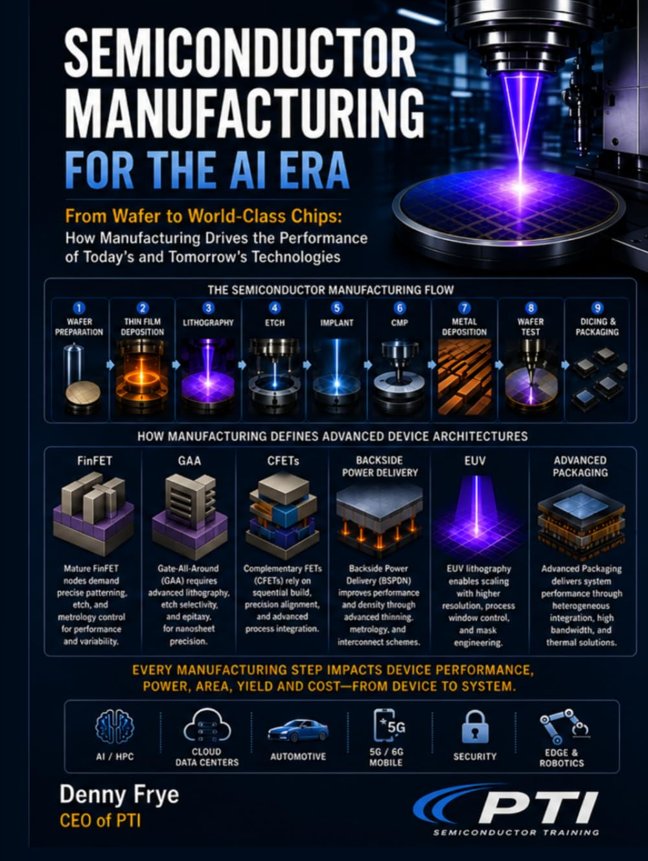
15Semiconductor Manufacturing for the AI Era
Master the Technologies Powering the AI RevolutionThe semiconductor industry is the foundation of the modern digital world. From AI and high-performance computing to global communications, semiconductors are indispensable. But as device architectures shrink to the Angstrom scale, classical scaling laws are failing, and manufacturing rules are being rewritten.Semiconductor Manufacturing for the AI Era provides a practical, highly technical guide to the processes, equipment, and physics driving today's semiconductor ecosystem. Authored by industry veterans Denny Frye and Cory Frye, this textbook bridges theoretical device physics and real-world mega-fab operations.Comprehensive Coverage of the Complete Manufacturing FlowWhether tackling the complexities of High-NA EUV lithography or navigating the transition from FinFET to Gate-All-Around (GAA) Nanosheets, this book breaks down the barriers to understanding advanced nodes. Explore the entire fabrication lifecycle, from silicon growth and UPW infrastructure to advanced deposition and plasma etching.Key Topics and Learning Objectives Include:The AI Paradigm Shift: Understand the Von Neumann bottleneck, Memory Wall, and why the industry is transitioning to GPUs, TPUs, and High Bandwidth Memory (HBM) architectures.Advanced Transistor Architectures: Explore the limits of Moore's and Dennard's Laws, and the geometric evolution from planar devices to FinFET, GAA RibbonFETs, and vertical Complementary FETs (CFET).Nanoscale Device Physics: Grasp the quantum realities of sub-5nm nodes, including quantum confinement, Direct Tunneling, Short Channel Effects, and High-k/Metal Gate (HKMG) work-function engineering.Lithography at the Edge: Dive into the optical physics of 193i Immersion, Phase Shift Masks (PSM), and Laser-Produced Plasma (LPP) systems powering EUV and High-NA patterning.Fab Infrastructure & Contamination Control: Learn how mega-fabs maintain ISO Class micro-environments, handle Airborne Molecular Contamination (AMC), and overcome the 3D drying crisis using supercritical CO2.Vacuum & Plasma Technology: Master the thermodynamics of non-equilibrium cold plasmas, Paschen's Law, Inductively Coupled Plasmas (ICP), and Atomic Layer Etching (ALE).Thin-Film Deposition: Uncover surface reaction kinetics of CVD, PVD, and the self-limiting nature of Atomic Layer Deposition (ALD) for conformal 3D coating.Doping & Thermal Processing: Navigate the shift from beamline ion implantation to conformal Plasma Doping (PLAD) and millisecond laser spike annealing for ultra-shallow junctions.Engineered Substrates: Discover Silicon-On-Insulator (SOI) mechanics and the transition to wide-bandgap materials like Silicon Carbide (SiC) and Gallium Nitride (GaN).Who This Book Is ForDesigned for a rigorous academic and professional audience, this text is essential for engineering students, newly hired fab technicians, process engineers, and technical managers. With detailed equations, thermodynamic models, and real-world calculations, it serves as both a foundational textbook and a daily reference guide.Equip yourself with the knowledge to understand the systems driving the global economy, AI innovation, and national security.Scroll up and click "Buy Now" to secure your definitive guide!
16Step-by-Step Electrical Engineering: Learn and Apply Core Concepts Quickly. Build Your Knowledge with Practical Examples - No
Solid State Physics
18Transmission Electron Microscopy: A Textbook for Materials Science
19Radio Electronics for Amateur Radio Operators - Measurement And Circuit Theory:: From Atoms to AntennasTM
Volume 2: Radio Electronics for Amateur Radio Operators - Measurement and Circuit Theory: Entry Level ElectronicsOnce you understand the basic components of electronics, the next step is learning how to measure, analyze, and work with real electrical circuits. This is where theory becomes practical skill.Volume 2 moves beyond individual electronic parts and begins teaching the tools, circuit behavior, and power systems that form the backbone of every piece of radio equipment. You will learn how to safely measure electrical values, understand DC and AC circuit operation, and work with the power systems that keep every station on the air.Module 5 — Test Equipment Basics introduces the essential instruments used throughout electronics and amateur radio. Multimeters, oscilloscopes, signal generators, frequency counters, wattmeters, antenna analyzers, dummy loads, and spectrum analyzers are all explained in practical terms. You will learn what each instrument measures, how it works, how to connect it safely, and how to interpret the readings you see while troubleshooting or operating radio equipment.Module 6 — DC Circuit Theory develops a complete understanding of direct current circuits and electrical behavior. Voltage, current, resistance, power dissipation, series and parallel circuits, Kirchhoff’s Laws, voltage dividers, current flow, and circuit analysis are all covered step-by-step using practical examples tied directly to amateur radio systems. By the end of this module you will understand how DC power moves through a circuit and how electronic devices behave under load.Module 7 — AC Circuit Theory explains the alternating current principles that make radio communication possible. Frequency, phase, reactance, impedance, resonance, capacitive and inductive behavior, transformers, filters, and waveform analysis are developed systematically using real radio applications. Concepts that often confuse beginners — including phase shift and reactive components — are explained clearly in practical language tied directly to RF systems and signal behavior.Module 8 — Power Supplies explores the systems responsible for converting and regulating electrical energy inside radio equipment. Linear power supplies, switching supplies, transformers, rectifiers, filtering, voltage regulation, ripple reduction, battery systems, charging circuits, grounding, and power distribution are all covered in detail. You will learn why stable power is critical to radio performance and how poor power systems can introduce noise, instability, and interference into your station.Together these four modules build the practical foundation needed to understand, troubleshoot, and safely work with real electronic circuits. Whether your goal is building equipment, repairing radios, improving your technical operating skills, or developing a deeper understanding of how modern radio systems function, Volume 2 provides the knowledge that turns electronics theory into practical hands-on ability.
20Electrical Engineering Formulas and 200 Quizzes Made Easy: A Step-by-Step Beginner’s Guide with 200 Solved and Explained Quizzes, and All the Formulas ... Engineering Exam Prep Series Book 2)
FROM CONFUSION TO CLARITY: Learn electrical engineering formulas from scratch—progress fast with 200 quizzes and fully explained solutions.❓ Are you having trouble understanding what electrical formulas really mean when you’re faced with a real circuit?❓ Tired of feeling unprepared to pass your electrical engineering exams?A Step-by-Step Beginner’s Guide with 200 solved quizzes, clear explanations, and the essential formulas at your fingertips.ADDITIONAL PDF CONTENT INCLUDED with your purchase:✔ Explained-simply formula sheet✔ Compact formula tables for instant review and exam prep✔ 200 tests with solutions. Guided practice, and fast results.Why it really works✅ Starts from the “why”: each formula is tied to its physical meaning and use case (e.g., RMS, power factor, resonance)✅ Repeatable procedure: you know where to start, which law to pick (Ohm/KCL/KVL/Thévenin/Norton), and the order to apply it✅ Focused practice: quizzes mirror classroom and entry-level exam styles, with worked solutions to build method and confidenceConcrete benefits for you:✔ Reduce study time: less confusion, more results, thanks to one place for formulas + practice✔ Always know what to do next: Formula → Concept → Example → Quiz → Solution ✔ Tackle tests with confidence: 200 questions distributed across the key areas you’ll be examined on✔ Build a robust foundation: ready for electronics, power and advanced EE courses (transformers, three-phase, lines)📘 What Will You Learn in This Book?🔹 Fundamentals: current, voltage, power, resistivity; resistance and conductance🔹 DC circuits: series/parallel, voltage & current dividers, KCL/KVL, Thévenin & Norton methods🔹 AC analysis: R/L/C impedances, RMS, power triangle and cosφ, resonance basics🔹 Transformers & efficiency: turns/voltage/current ratios; copper losses and η (efficiency🔹 Transmission lines: characteristic impedance, velocity, reflection coefficient Γ and matching🔹 Three-phase systems: line-to-phase relations, balanced three-phase power🔹 Electrostatics & magnetism: Coulomb’s law, electric field/potential, capacitor energy, magnetic field, Faraday/inductance🎯 Who Is This Book For?✔ High-school and first-year college students who want a clear and structured path with instant practice✔ Complete beginners and self-learners who need a compact reference plus guided quizzes with solutions✔ Exam candidates who want exam-style questions and reasoning to verify understanding quickly🎯 Ready to move from confusion to mastery?Start mastering electrical engineering step by step with the formulas you’ll use and the 200 solved quizzes that prove you can apply them. Buy now and study with method, speed, and confidence
21FE ELECTRICAL AND COMPUTER EXAM PREP 2026-2028: Complete Study Guide to Master All NCEES Review Topics with Practice Tests and Detailed Solutions for EIT Certification
Master the FE Electrical and Computer Exam with Confidence and a Clear Success StrategyAre you studying harder but still not seeing the results you need on the FE Exam?What if one book could cut your preparation time in half, eliminate exam-day anxiety, and put the EIT credential firmly within your reach?The FE Electrical and Computer Examination is one of the most demanding credentialing hurdles in engineering. With 110 questions spanning 18 topic areas and only 5 hours and 20 minutes to complete them, there is no room for gaps in preparation. This guide was built to close every one of those gaps systematically, completely, and efficiently.Sam G. Thompson was three years out of her electrical engineering program when she decided it was time. She had attempted the FE once before, studied using scattered online resources, and walked out of the testing center knowing she had fallen short. "I knew the theory," she said. "What I didn't have was a structured, exam-focused system." She found this book, committed 8 weeks to the structured study plan inside, and passed on her next attempt with above-average scores in every category. Today she is a licensed PE candidate at a Portland energy firm. Sam's story is not unusual. It is exactly what focused, intelligent preparation produces.Built on the current NCEES FE Electrical and Computer examination blueprint, this guide covers all 18 topic areas with the clarity needed to turn confusion into mastery. Topics include Mathematics, Probability and Statistics, Engineering Economics, Ethics, Circuit Analysis, Linear Systems, Signal Processing, Electronics, Power Systems, Electromagnetics, Control Systems, Communications, Computer Networks, Digital Systems, Computer Systems, and Software Development.Inside this exam prep guide, you will find:3,700 practice test questions to sharpen problem-solving speed and accuracy.Clear explanations that teach you why an answer is correct, not just how to memorize it.Step-by-step methods that make complex engineering questions manageable.Full NCEES topic coverage so you prepare with purpose.An organized study structure that keeps you consistent.Targeted review support that eliminates wasted study time.Confidence-building practice for a strong first attempt.What You Will Master: Every formula across all 18 NCEES topic areas. AC and DC circuit analysis, phasors, impedance, and three-phase power. Transformer design, motor slip, and rotating machine theory. Digital logic, Boolean minimization, state machines, and cache architecture. Shannon capacity, ARQ protocols, RSA cryptography, and network delay analysis. Maxwell's equations, wave propagation, and transmission line behavior. Control system stability, Bode plots, Routh criteria, and PID design.EXCLUSIVE BONUS PACKAGE: Paperback and Hardcover Editions. Scan the QR code inside to unlock:2,500 extra practice questions across all 18 topic areas.220 full-length simulation mock examinations.1,000 pamphlet flashcards for rapid concept review.800+ video lessons with fully worked problems.Comprehensive key topic formula reference.Complete structured study plan with weekly milestones.Common constants and physical properties reference.Comprehensive Glossary of Terms and AcronymsTI-36X Pro calculator guide and units conversion chart.Your credential is within reach. Your career is waiting. Thousands of engineers have passed the FE Examination using structured, exam-focused preparation. You have exactly the same ability. What you need is the right system.Add this book to your cart NOW and take your final, focused step toward the EIT certification that changes everything.
22Space Groups for Solid State Scientists
Rare Earth Iron Permanent Magnets
Electronic Properties of Doped Semiconductors
Magnetism: A Very Short Introduction (Very Short Introductions, #317)
Elementary Solid State Physics: Principles and Applications
Fundamentals of the Theory of Metals
Targeted at undergraduate students majoring in physics as well as graduate and postgraduate students, research workers, and teachers, this is an essential reference on the topic of electromagnetism and superconductivity in metals. No special knowledge of metals beyond a course in general physics is needed, although the author does presume a knowledge of quantum mechanics and quantum statistics.
Optical Properties of Solids
Introduction to Superconductivity
30Semiconductor Physics and Devices: Basic Principles
31Fundamentals and Exercises of Electrical Engineering: Theory, Theorems, and Applications in DC and AC with Applied Exercises (Electrical Engineering Exam Prep Series Book 1)
You know Ohm's law. Kirchhoff's, too. Maybe Thevenin and Norton.But hand you a real circuit, and you freeze.Where do you start? Which law applies, and in what order?That's not a knowledge gap. It's a method gap — and it's exactly what keeps smart, hardworking people stuck.FROM CONFUSION TO CLARITY: in 280 pages, go from zero to confident with clear explanations, intuitive illustrations, and step-by-step procedures — already helping beginners, students, and enthusiasts get there.Beyond the basics, you’ll gain a rock-solid foundation in Electrostatics, Electromagnetism, and Solid-State Devices, along with an introduction to Microelectronics and VLSI circuits.Written by a Professional Engineer.Our 7-DAY LEARNING STRATEGY gives you a repeatable method instead of more theory to memorize:Theory and Intuitive Illustrations → Exercises → Solution Strategies → Step-by-Step Solutions.No fluff. No jargon. Clear explanations, visual diagrams, and worked examples in circuit analysis that will make circuits click—even if you’re starting from scratch.ADDITIONAL PDF CONTENT INCLUDED WITH YOUR PURCHASE:- Full-color book- Simply-explained formula sheet- 200 tests with solutions. Guided practice for fast results.WHY IT REALLY WORKS- Starts with the “why”: Every law comes from real physical phenomena, explained with simple visuals- Repeatable procedures: You know where to start, which laws to choose, and what order to apply them in.- Physical phenomena and principles explained in detail with real-life examples to connect theory to reality.- Intuitive illustrations: Learn faster and remember longerCONCRETE BENEFITS FOR YOU- Reduce study time: less confusion, more results.- Always know what to do next: Theory → Exercise → Strategy → Solution.- Tackle exams and real-world problems with confidence; you’ve already seen how to solve them.- Build robust foundations for electronics, electronic sensors, power systems, and advanced applications.- Understand the basics of modern integrated circuitsWHAT WILL YOU LEARN IN THIS BOOK?- The difference between voltage, current, and resistance and how they really interact- The role of resistors, capacitors, inductors, diodes, semiconductors, and electronic sensors, so you can use them in real projects.- Electrostatics, magnetism, and electromagnetism, explained with real-world examples.- Confidently analyze AC and DC circuits with step-by-step methods you can apply right away- How to confidently apply Ohm’s, Kirchhoff’s, Thevenin’s, and Norton’s theorems- An Exam Success Toolkit with practice problems and revision notes to boost your results fast- An introduction to microelectronics, MOSFETs, CMOS logic, and basic VLSI circuit conceptsWHO IS THIS BOOK FOR?- High school and college students who want a clear and structured path into electrical engineering.- Complete beginners with no prior knowledge, who want to finally understand the basics of electrotechnics step by step.- Self-learners and enthusiasts who are tired of vague tutorials and dense textbooks, and want practical, visual explanations insteadReady to move from confusion to mastery?Master Electrical Engineering faster with a proven method that builds clarity, speed, and confidence from day one.
32Semiconductor Devices: Theory and Application
Across 17 chapters, Semiconductor Devices covers the theory and application of discrete semiconductor devices including various types of diodes, bipolar junction transistors, JFETs, MOSFETs and IGBTs. Applications include rectifying, clipping, clamping, switching, small signal amplifiers and followers, and class A, B and D power amplifiers. Focusing on practical aspects of analysis and design, interpretations of device data sheets are integrated throughout the chapters. Computer simulations of circuit responses are included as well. Each chapter features a set of learning objectives, numerous sample problems, and a variety of exercises designed to hone and test circuit design and analysis skills. Now in it's second edition, Semiconductor Devices earned praise from university reviewers: "This book is well organized (and) introduces the basic concepts with clear definitions and terminologies." "Each chapter discusses one dedicated topic, and it is easy for the reader to focus on the content." "The features and applications of semiconductor devices are described accurately by the text, the equations, and the graphics in this book. The semiconductor devices that are discussed...are the popular ones in industry. They are not likely to be discarded in the near future." "Overall, I would recommend adopting this book". A companion laboratory manual is also available. This is the print version of the on-line OER. The current revision number and date are version 2.0.10, 04 August 2026.
Introduction to Power Electronics. Paul H. Chappell
34Basic Solid State Electronics
Electronic fundamentals covered in the illustrated, easy-to-understand text include: semiconductors; power supplies; audio and video amplifiers, transmitters, and receivers; digital circuits; and microprocessors.
35Solid State Electronic Devices
36Principles of Electronic Materials and Devices
Solids, Liquids, and Gases (Rookie Read-About Science)
Rookie Read-About Physical Science series introduces the youngest readers (Ages 6-7) to physical science concepts. Each book features critical-thinking questions throughout the text; a simple, hands-on experiment; a glossary and more.
38JOURNEYMAN ELECTRICIAN EXAM PREP: From STRESS to SUCCESS: Master Every Question with Comprehensive Walkthroughs and a Failpro
39Operational Amplifiers & Linear Integrated Circuits: Laboratory Manual
This is the companion laboratory manual to accompany the third edition of Operational Amplifiers & Linear Integrated Circuits. Twenty two separate experiments are available. Topics include the differential amplifier, the comparator, inverting and non-inverting amplifiers, slew rate, gain-bandwidth product, operational transconductance amplifier, DC offset, precision rectifiers, transfer function generation, linear regulation, integration, differentiation, oscillators, active filters, and more. Each exercise includes a summary of the relevant theory, a parts list and equipment inventory. Most exercises can be completed using just a dual output DC power supply, digital multimeter, AC waveform generator and a digital oscilloscope. This is the print version of the on-line OER. The current revision number and date are version 3.1.6, 16 October 2024.
40A Different Universe: Reinventing Physics From the Bottom Down
In this age of superstring theories and Big Bang cosmology, we're used to thinking of the unknown as impossibly distant from our everyday lives. But in A Different Universe, Nobel Laureate Robert Laughlin argues that the scientific frontier is right under our fingers. Instead of looking for ultimate theories, Laughlin considers the world of emergent properties-meaning the properties, such as the hardness and shape of a crystal, that result from the organization of large numbers of atoms. Laughlin shows us how the most fundamental laws of physics are in fact emergent. A Different Universe is a truly mind-bending book that shows us why everything we think about fundamental physical laws needs to change.
Operation and Modeling of the Mos Transistor
Start Programming & Simulating PLC in Your Laptop from Scratch: A No BS, No Fluff, PLC Programming Volume 1: The Practical Approach Coding PLC from Beginning ... without a Real PLC with Real World Example
Solid State Physics: Structure and Properties of Materials
44The Electronic Structure and Chemistry of Solids
45IC Mask Design
Cellular Solids: Structure and Properties
All about Matter
Solid State Physics
• A carefully written and structured text to help students fullyunderstand this exciting subject.
• A flow diagram allowing topics to be studied in differentorders or omitted altogether.
• Optional "starred" and highlighted sections containing moreadvanced and specialised material for the more ambitiousreader.
• Carefully selected problems at the end of each chapter designedto assist learning. Solutions are provided at the end of thebook.
The Physics of Superconductors: Introduction to Fundamentals and Applications
Google Classroom 2020: An Easy Guide on How to Teach Digitally in 2020 and To Manage Your Google Classroom Effectively
51Electronics 1 Part One Laminate Reference Chart
As an engineer, tradesman or electronics student, this guide will help with over 50 diagrams and equations.
Principles Of Corporate Finance
53Introductory Electronic Devices and Circuits: Conventional Flow Version
Lecture Notes on Electron Correlation and Magnetism
Introductory Electronic Devices and Circuits: Electron Flow Version
Solid-State Physics: An Introduction to Principles of Materials Science
Secrets of the Amazon Firestick & How to Profit From Them
Electronic Structure and the Properties of Solids: The Physics of the Chemical Bond
In this comprehensive and innovative text, Professor Harrison (Stanford University) offers a basic understanding of the electronic structure of covalent and ionic solids, simple metals, transition metals, and their compounds. The book illuminates the relationships of the electronic structures of these materials and shows how to calculate dielectric, conducting, and bonding properties for each. Also described are various methods of approximating electronic structure, providing insight and even quantitative results from the comparisons. Dr. Harrison has also included an especially helpful "Solid State Table of the Elements" that provides all the parameters needed to estimate almost any property of any solid, with a hand-held calculator, using the techniques developed in the book.
Designed for graduate or advanced undergraduate students who have completed an undergraduate course in quantum mechanics or atomic and modern physics, the text treats the relation between structure and properties comprehensively for all solids rather than for small classes of solids. This makes it an indispensable reference for all who make use of approximative methods for electronic-structure engineering, semiconductor development and materials science.
The problems at the ends of the chapters are an important aspect of the book. They clearly show that the calculations for systems and properties of genuine and current interest are actually quite elementary. Prefaces. Problems. Tables. Appendixes. Solid State Table of the Elements. Bibliography. Author and Subject Indexes.
"Will doubtless exert a lasting influence on the solid-state physics literature." — Physics Today
59The Solid State: An Introduction to the Physics of Crystals for Students of Physics, Materials Science, and Engineering
Many-Particle Physics
61Field-Effect Transistor Amp Analysis and Design
Wave Motion in Elastic Solids
Chapters 1–4 cover wave motion in the simple structural shapes, namely strings, longitudinal rod motion, beams and membranes, plates and (cylindrical) shells. Chapters 5–8 deal with wave propagation as governed by the three-dimensional equations of elasticity and cover waves in infinite media, waves in half-space, scattering and diffraction, and waves in thick rods, plates, and shells.
To make the book as self-contained as possible, three appendices offer introductory material on elasticity equations, integral transforms and experimental methods in stress waves. In addition, the author has presented fairly complete development of a number of topics in the mechanics and mathematics of the subject, such as simple transform solutions, orthogonality conditions, approximate theories of plates and asymptotic methods.
Throughout, emphasis has been placed on showing results, drawn from both theoretical and experimental studies, as well as theoretical development of the subject. Moreover, there are over 100 problems distributed throughout the text to help students grasp the material. The result is an excellent resource for both undergraduate and graduate courses and an authoritative reference and review for research workers and professionals.
IC Layout Basics: A Practical Guide (McGraw-Hill Professional Engineering)
* Integrated circuit processes
* Layout techniques
* Fundamental device concepts
* Wafer processes
Writing for technicians without an engineering degree, the authors present concepts from the ground up, building on the simple until the complex becomes crystal clear. Examples, self-tests, and sidebars reinforce the material and make it all quick and painless. For maximum retention, each chapter includes preview points, "motivation" boxes, and executive summaries.
Symmetry Principles in Solid State and Molecular Physics
Professor Lax provides examples in optical absorption selection rules, spin-orbit coupling, and crystal field theory, plus a complete demonstration of projection techniques. He also develops short-cut and invariant methods for solving molecular vibration problems and for determining the form of crystal tensors; develops the translational properties of crystals, including Bravais lattices and space groups; and explains relevant applications to electron phonon scattering, optical absorption selection rules, electronic energy bands, electron dynamics, and effective Hamiltonians. To illustrate several of these topics, and to show the relation between the microscopic and macroscopic views of elasticity, the author presents a complete study of the diamond structure.
Among the unique features of this volume are its use of subgroup techniques, its consideration of the influence of time reversal on selection rules, its use of shell theorems and invariance techniques to construct the form of tensors, and its use of broken symmetry to relate the symmetry of valence and molecular orbitals to the symmetry of electron molecular wave functions. The book also contains more than 200 carefully selected problems.
Matter: A Very Short Introduction
This Very Short Introduction takes us on a journey from the human scale of matter in the familiar everyday forms of solids, liquids, and gases to plasmas, exotic forms of quantum matter, and antimatter. On the largest scales matter is sculpted by gravity into planets, stars, galaxies, and vast clusters of galaxies. All the matter that that we normally encounter however constitutes only 5% of the matter that exists. The remaining 95% comes in two mysterious forms: dark matter and dark energy. Dark matter is necessary to stop the galaxies from flying apart, and dark energy is needed to explain the observed acceleration of the expansion of the universe. Geoff Cottrell explores the latest research into matter, and shows that there is still a lot we don't know about the stuff our universe is made of.
ABOUT THE SERIES: The Very Short Introductions series from Oxford University Press contains hundreds of titles in almost every subject area. These pocket-sized books are the perfect way to get ahead in a new subject quickly. Our expert authors combine facts, analysis, perspective, new ideas, and enthusiasm to make interesting and challenging topics highly readable.
JavaScript: Advanced Features and Programming Techniques (Step-By-Step JavaScript Book 3)
67Quantum Theory of Solids
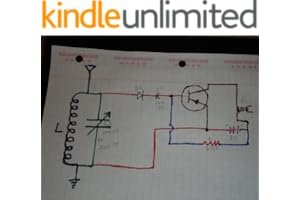
68Hot Rodding the Fox Hole Radio (Foxhole Homestead)
69An Introduction to Semiconductor Devices
Excellent pedagogy is present throughout the book in the form of interesting chapters openers, worked examples, a variety of exercises, key terms, and end of chapter problems.
70Radio Frequency Transistors: Principles and Practical Applications
An entire chapter devoted solely to LDMOS high power RF transistors has been added to the new edition. A comparison is given between LDMOS FETs, TMOS FETs and bipolar transistors, showing clearly why LDMOS is the designer's choice for high power, linear amplifiers in today's rapidly expanding digital world of communications. Coverage also includes applications of LDMOS RF high power transistors in current generation cellular technologies, the design of LDMOS high power amplifiers, and comments about the latest efforts to model LDMOS RF power devices.
Other topics covered include the selection of matched high power RF transistors, input impedance matching of high power transistors, interstage matching, and capacitors and inductors at radio frequencies.
Solid State Physics: An Introduction
This successful brief course in solid state physics is now in its second edition. The clear and concise introduction not only describes all the basic phenomena and concepts, but also such advanced issues as magnetism and superconductivity. Each section starts with a gentle introduction, covering basic principles, progressing to a more advanced level in order to present a comprehensive overview of the subject. The book is providing qualitative discussions that help undergraduates understand concepts even if they can't follow all the mathematical detail.
The revised edition has been carefully updated to present an up-to-date account of the essential topics and recent developments in this exciting field of physics. The coverage now includes ground-breaking materials with high relevance for applications in communication and energy, like graphene and topological insulators, as well as transparent conductors.
The text assumes only basic mathematical knowledge on the part of the reader and includes more than 100 discussion questions and some 70 problems, with solutions free to lecturers from the Wiley-VCH website. The author's webpage provides Online Notes on x-ray scattering, elastic constants, the quantum Hall effect, tight binding model, atomic magnetism, and topological insulators.
This new edition includes the following updates and new features:
• Expanded coverage of mechanical properties of solids, including an improved discussion of the yield stress
• Crystal structure, mechanical properties, and band structure of graphene
• The coverage of electronic properties of metals is expanded by a section on the quantum hall effect including exercises. New topics include the tight-binding model and an expanded discussion on Bloch waves.
• With respect to semiconductors, the discussion of solar cells has been extended and improved.
• Revised coverage of magnetism, with additional material on atomic magnetism
• More extensive treatment of finite solids and nanostructures, now including topological insulators
• Recommendations for further reading have been updated and increased.
• New exercises on Hall mobility, light penetrating metals, band structure
Simple Guide to Over-the-Air Free TV
Problems and Solutions on Solid State Physics, Relativity and Miscellaneous Topics
74IC Layout Basics: A Practical Guide a Practical Guide
MASTER IC LAYOUT WITHOUT AN ENGINEERING BACKGROUND!Tto new chip applications such as cell phones, personal digital assistants, and consumer electronics, electronic semiconductor usage has exploded, creating an unprecedented demand for technicians skilled in CMOS and bipolar design and layout. In IC LAYOUT BASICS, you get the same top-notch material utilized in IBM's successful training courses. This essential primerbrings you up to speed on:
* Integrated circuit processes
* Layout techniques
* Fundamental device concepts
* Wafer processes
Writing for technicians without an engineering degree, the authors present concepts from the ground up, building on the simple until the complex becomes crystal clear. Examples, self-tests, and sidebars reinforce the material and make it all quick and painless. For maximum retention, each chapter includes preview points, "motivation" boxes, and executive summaries.
75Microchip Fabrication: A Practical Guide to Semiconductor Processing, Sixth Edition: A Practical Guide to Semiconductor Processing
State-of-the-art processes and cutting-edge technologies used in the patterning, doping, and layering steps are discussed in this new edition. Filled with detailed illustrations and real-world examples, this is a comprehensive, up-to-date introduction to the technological backbone of the high-tech industry.
COVERAGE INCLUDES:
The semiconductor industry Properties of semiconductor materials and chemicals Crystal growth and silicon wafer preparation Wafer fabrication and packaging Contamination control Productivity and process yields Oxidation The ten-step patterning process--surface preparation to exposure; developing to final inspection Next generation lithography Doping Layer deposition Metallization Process and device evaluation The business of wafer fabrication Devices and integrated circuit formation Integrated circuits Packaging
Solid State Theory
Semiconductor Device Modeling with Spice
78Electrical Degradation and Breakdown in Polymers
79Electronic Genie: THE TANGLED HISTORY OF SILICON
Google Classroom: 2018 User Manual to Learn Everything You Need to Know About Google Classroom (Google Classroom guide with tips and tricks)
81GROUNDING & EARTHING SYSTEMS – PV EDITION: Grounding of Photovoltaic Panels and Inverters: Practical Guidelines for Preventing and Correcting Operational Errors. (Grounding & Earthing Series Book 3)
Modern photovoltaic installations are complex electrical systems exposed to lightning, surges, insulation faults, environmental stress, and decades of continuous operation. Safe performance depends not only on energy production, but on how grounding, bonding, surge protection, cable routing, connectors, and verification work together.Grounding, Bonding & Protection in Photovoltaic Installations provides a practical engineering guide to the safety mechanisms that determine whether a PV system remains reliable or develops dangerous faults. The book explains how design errors, installation defects, poor component coordination, and inadequate testing can lead to overheating, arcing, equipment damage, touch-voltage hazards, and repeated inverter shutdowns.WHO THIS BOOK IS FORThis book is written for:• Photovoltaic installers and industrial electricians• Solar-system designers and electrical engineers• Commissioning and maintenance technicians• Electrical inspectors and safety auditors• Contractors working with residential, commercial, and utility-scale PV systems• Technical students entering the solar industryWHAT YOU WILL LEARNInside this book, you will learn how to:• Understand the role of grounding and bonding in PV safety• Recognize dangerous potential differences on metallic structures• Select and coordinate surge protective devices for AC and DC circuits• Identify the causes of connector heating, arcing, and melting• Evaluate TT, TN-S, and mixed earthing arrangements• Design safer string configurations for different operating conditions• Consider cold-weather voltage rise and inverter input limits• Route and protect PV cables against abrasion, movement, and thermal stress• Test grounding continuity, bonding, insulation resistance, and polarity• Inspect surge-protection systems and identify degraded components• Interpret inverter alarms as evidence of wider installation problems• Investigate real failures and establish the root cause• Improve long-term reliability through documented inspection and maintenanceTECHNICAL AREAS COVEREDThe book examines the main components, systems, measurements, and failure mechanisms found in modern photovoltaic installations, including:• Protective earthing and equipotential bonding• TT, TN-S, and mixed earthing arrangements• Grounding electrodes, conductors, and metallic mounting structures• AC and DC surge protective devices• Lightning-related and switching overvoltages• PV strings, combiner boxes, and inverter inputs• Open-circuit voltage and cold-temperature correction• DC connectors and crimped terminations• String cables, trunk cables, and AC output circuits• Insulation faults, leakage paths, and ground-fault conditions• Touch-voltage hazards and live module frames• Continuity, polarity, voltage, current, and insulation testing• Thermal inspection and hotspot identification• Rooftop, commercial, and large-scale solar installationsWHY THIS BOOK MATTERSMany serious PV failures begin with a small defect: a loose connector, an unbonded frame, an incorrectly selected SPD, a damaged cable, or a test that was never completed. These defects may remain hidden until a storm, insulation failure, or thermal cycle exposes them.Written in a clear, manufacturer-neutral style, this book combines practical engineering guidance with realistic failure analysis. It helps readers identify weak points before they become dangerous, verify protective measures correctly, and build photovoltaic systems that are safer, more reliable, and easier to maintain.
Men of Physics: L. D. Landau, Vol. 1- Low Temperature and Solid State Physics
83Principles of Semiconductor Devices
Designed for upper-level undergraduate and graduate courses, Principles of Semiconductor Devices, Second Edition, presents the semiconductor-physics and device principles in a way that upgrades classical semiconductor theory and enables proper interpretations of numerous quantum effects in modern devices. The semiconductor theory is directly linked to practical applications, including the links to the SPICE models and parameters that are commonly used during circuit design.
The text is divided into three parts: Part I explains semiconductor physics; Part II presents the principles of operation and modeling of the fundamental junctions and transistors; and Part III provides supplementary topics, including a dedicated chapter on the physics of nanoscale devices, description of the SPICE models and equivalent circuits that are needed for circuit design, introductions to the most important specific devices (photonic devices, JFETs and MESFETs, negative-resistance diodes, and power devices), and an overview of integrated-circuit technologies. The chapters and the sections in each chapter are organized so as to enable instructors to select more rigorous and design-related topics as they see fit.
84