We've ranked the best korean history books using expert recommendations, sales data, and millions of reader ratings. At Shortform, we know books. Our book guides are the best in the world. Learn why.
Cover unavailable
1
Nothing to Envy: Ordinary Lives in North Korea
Barbara Demick, Karen White, et al
5.0
Nothing to Envy follows the lives of six North Koreans over fifteen years—a chaotic period that saw the death of Kim Il-sung, the unchallenged rise to power of his son Kim Jong-il, and the devastation of a far-ranging famine that killed one-fifth of the population.
Taking us into a landscape most of us have never before seen, award-winning journalist Barbara Demick brings to life what it means to be living under the most repressive totalitarian regime today—an Orwellian world that is by choice not connected to the Internet, in which radio and television dials are welded to the one government station, and where displays of affection are punished; a police state where informants are rewarded and where an offhand remark can send a person to the gulag for life.
Demick takes us deep inside the country, beyond the reach of government censors. Through meticulous and sensitive reporting, we see her six subjects—average North Korean citizens—fall in love, raise families, nurture ambitions, and struggle for survival. One by one, we experience the moments when they realize that their government has betrayed them.
Nothing to Envy is a groundbreaking addition to the literature of totalitarianism and an eye-opening look at a closed world that is of increasing global importance.
…
Recommended by Hyeonseo Lee.
Hyeonseo Lee
She includes great details that show everyday life in North Korea. [source]
Cover unavailable
2
Pachinko
Min Jin Lee
4.8
In the early 1900s, teenaged Sunja, the adored daughter of a crippled fisherman, falls for a wealthy stranger at the seashore near her home in Korea. He promises her the world, but when she discovers she is pregnant--and that her lover is married--she refuses to be bought. Instead, she accepts an offer of marriage from a gentle, sickly minister passing through on his way to Japan. But her decision to abandon her home, and to reject her son's powerful father, sets off a dramatic saga that will echo down through the generations.
Richly told and profoundly moving, Pachinko is a story of love, sacrifice, ambition, and loyalty. From bustling street markets to the halls of Japan's finest universities to the pachinko parlors of the criminal underworld, Lee's complex and passionate characters--strong, stubborn women, devoted sisters and sons, fathers shaken by moral crisis--survive and thrive against the indifferent arc of history.
Member of the Group of 30, and former CEO of Westpac will be spending her summer months reading a memoir, a novel and historical non-fiction. Lab Girl—Hope Jahren Pachinko—Min Jin Lee The Boys in the Boat: Nine Americans and Their Epic Quest for Gold at the 1936 Berlin Olympics—Daniel James Brown [source]
Cover unavailable
3
Destined for War: Can America and China Escape Thucydides’s Trap?
Graham Allison
4.8
CHINA AND THE UNITED STATES ARE HEADING TOWARD A WAR NEITHER WANTS. The reason is Thucydides’s Trap, a deadly pattern of structural stress that results when a rising power challenges a ruling one. This phenomenon is as old as history itself. About the Peloponnesian War that devastated ancient Greece, the historian Thucydides explained: “It was the rise of Athens and the fear that this instilled in Sparta that made war inevitable.” Over the past 500 years, these conditions have occurred sixteen times. War broke out in twelve of them. Today, as an unstoppable China approaches an immovable America and both Xi Jinping and Donald Trump promise to make their countries “great again,” the seventeenth case looks grim. Unless China is willing to scale back its ambitions or Washington can accept becoming number two in the Pacific, a trade conflict, cyberattack, or accident at sea could soon escalate into all-out war.
In Destined for War, the eminent Harvard scholar Graham Allison explains why Thucydides’s Trap is the best lens for understanding U.S.-China relations in the twenty-first century. Through uncanny historical parallels and war scenarios, he shows how close we are to the unthinkable. Yet, stressing that war is not inevitable, Allison also reveals how clashing powers have kept the peace in the past — and what painful steps the United States and China must take to avoid disaster today.
…
Recommended by Fareed Zakaria, Kin Kariisa, and Will MacAskill.
It was such a memorable and humbling moment meeting Prof. Allison Graham, professor of government at Harvard, on the sidelines of Jeju Forum for Peace and Prosperity here in Jeju Island, South Korea. His book Destined for War is a fascinating read. https://t.co/ZB3HhBHgLY [source]
Will MacAskill
The last 70 years are a fairly unusual state. We don’t really know why they’ve been so unusually peaceful. This could all change in the 21st century. [source]
Cover unavailable
4
In Order to Live: A North Korean Girl's Journey to Freedom
Yeonmi Park
4.6
Human rights activist Park, who fled North Korea with her mother in 2007 at age 13 and eventually made it to South Korea two years later after a harrowing ordeal, recognized that in order to be "completely free," she had to confront the truth of her past. It is an ugly, shameful story of being sold with her mother into slave marriages by Chinese brokers, and although she at first tried to hide the painful details when blending into South Korean society, she realized how her survival story could inspire others. Moreover, her sister had also escaped earlier and had vanished into China for years, prompting the author to go public with her story in the hope of finding her sister.
…
Cover unavailable
5
The Girl with Seven Names: Escape From North Korea
Hyeonseo Lee
4.6
With this compelling and unforgettable memoir based on her acclaimed TED Talk, which has over 10 million views, Hyeonseo Lee becomes one of the first female defectors from North Korea to share her story; like I Am Malala and Infidel, this is a narrative of sacrifice, survival, and extraordinary courage.
As a child growing up in North Korea, Hyeonseo Lee was one of millions trapped by the secretive and brutal communist regime created by dictator Kim Il-Sung and his successors (son Kim Jong-Il and grandson Kim Jong-Un). Although her privileged family background insulated her from the cruelest horrors of the regime, living near the border with China gave her some exposure to the world beyond the confines of the Hermit Kingdom. When the famine of the 1990s struck, she began to wonder, question and to realise that she had been brainwashed her entire life. Given the repression, poverty and starvation she witnessed surely her country could not be, as she had been told, “the best on the planet”?Aged seventeen, she decided to escape North Korea. She could not have imagined that it would be twelve years before she was reunited with her family. Rumours of her escape were spreading, and she and her family could incur the punishments of the government authorities—involving imprisonment, torture, and possible public execution—if she returned. Hyeonseo instead remained in China and rapidly learned Chinese in an effort to adapt and survive. This is the unique story not only of Hyeonseo’s escape from the darkness into the light, but also of her coming of age, education and the resolve she found to rebuild her life—not once, but twice—first in China, then in South Korea. Twelve years and two lifetimes later, she would return to the North Korean border in a daring mission to bring her mother and brother to South Korea, risking her own life in the process. Against the odds, she and her family survived one of the most arduous, costly and dangerous journeys imaginable. Strong, brave and eloquent, this memoir is a triumph of her remarkable spirit.
…
Cover unavailable
6
Aquariums of Pyongyang: Ten Years in the North Korean Gulag
Pierre Rigoulot
4.6
An account of the brutish conditions in North Korea. The Aquariums of Pyongyang is a heartbreaking story of survival. It is to be understood that the story is not unique in that there are thousands of families in North Korea being persecuted and starved even today. That there are still operating concentration camps as well as the implementation of the 3-generation rule, wherein everyone in the family is punished up to 3-generations for even the most minuscule crimes. Above all The Aquariums of Pyongyang is the story of Kang Chol-Hwan's triumph over the North Korean government's dehumanizing oppression. -Dominic Chu
…
Recommended by Andrei Lankov.
Cover unavailable
7
This Kind of War: The Classic Military History of the Korean War
T. R. Fehrenbach
4.6
Updated with maps, photographs, and battlefield diagrams, this special fiftieth anniversary edition of the classic history of the Korean War is a dramatic and hard-hitting account of the conflict written from the perspective of those who fought it. Partly drawn from official records, operations journals, and histories, it is based largely on the compelling personal narratives of the small-unit commanders and their troops. Unlike any other work on the Korean War, it provides both a clear panoramic overview and a sharply drawn "you were there" account of American troops in fierce combat against the North Korean and Chinese communist invaders. As Americans and North Koreans continue to face each other across the 38th Parallel, This Kind of War commemorates the past and offers vital lessons for the future.
…
Cover unavailable
8
Under the Loving Care of the Fatherly Leader: North Korea and the Kim Dynasty
Bradley K. Martin
4.5
Under the Loving Care of the Fatherly Leader offers in-depth portraits of North Korea's two ruthless and bizarrely Orwellian leaders, Kim Il-Sung and Kim Jong-Il. Lifting North Korea's curtain of self-imposed isolation, this book will take readers inside a society, that to a Westerner, will appear to be from another planet. Subsisting on a diet short on food grains and long on lies, North Koreans have been indoctrinated from birth to follow unquestioningly a father-son team of megalomaniacs.
To North Koreans, the Kims are more than just leaders. Kim Il-Sung is the country's leading novelist, philosopher, historian, educator, designer, literary critic, architect, general, farmer, and ping-pong trainer. Radios are made so they can only be tuned to the official state frequency. "Newspapers" are filled with endless columns of Kim speeches and propaganda. And instead of Christmas, North Koreans celebrate Kim's birthday--and he presents each child a present, just like Santa.
The regime that the Kim Dynasty has built remains technically at war with the United States nearly a half century after the armistice that halted actual fighting in the Korean War. This fascinating and complete history takes full advantage of a great deal of source material that has only recently become available (some from archives in Moscow and Beijing), and brings the reader up to the tensions of the current day. For as this book will explain, North Korea appears more and more to be the greatest threat among the Axis of Evil countries--with some defector testimony warning that Kim Jong-Il has enough chemical weapons to wipe out the entire population of South Korea.
…
Recommended by Andrei Lankov.
Cover unavailable
9
Korea: The Impossible Country: South Korea's Amazing Rise from the Ashes: The Inside Story of an Economic, Political and Cultural Phenomenon
Daniel Tudor
4.5
In just fifty years, South Korea has transformed itself from a failed state, ruined and partitioned by war and decades of colonial rule, into an economic powerhouse and a democracy that serves as a model for other countries.
How was it able to achieve this with no natural resources and a tradition of authoritarian rule? Who are the Koreans and how did they accomplish this second Asian miracle? Through a comprehensive exploration of Korean history, culture and society, and interviews with dozens of experts celebrated journalist Daniel Tudor seeks answers to these and many other fascinating questions in Korea: The Impossible Country. Tudor touches on topics as diverse as shamanism, clan-ism, the dilemma posed by North Korea, and the growing international appeal of its popular culture.
This new edition has been updated with additional materials on recent events including the Park impeachment and the sinking of the Sewol Ferry. Although South Korea has long been overshadowed by Japan and China, Korea: The Impossible Country illuminates how this small country is one of the great success stories of the postwar period.
…
Cover unavailable
10
Escape from Camp 14: One Man's Remarkable Odyssey from North Korea to Freedom in the West
Blaine Harden
4.4
A New York Times bestseller, the shocking story of one of the few people born in a North Korean political prison to have escaped and survived.
North Korea is isolated and hungry, bankrupt and belligerent. It is also armed with nuclear weapons. Between 150,000 and 200,000 people are being held in its political prison camps, which have existed twice as long as Stalin's Soviet gulags and twelve times as long as the Nazi concentration camps. Very few born and raised in these camps have escaped. But Shin Donghyuk did.
In Escape from Camp 14, acclaimed journalist Blaine Harden tells the story of Shin Dong-hyuk and through the lens of Shin's life unlocks the secrets of the world's most repressive totalitarian state. Shin knew nothing of civilized existence-he saw his mother as a competitor for food, guards raised him to be a snitch, and he witnessed the execution of his own family. Through Harden's harrowing narrative of Shin's life and remarkable escape, he offers an unequaled inside account of one of the world's darkest nations and a riveting tale of endurance, courage, and survival.
…
Cover unavailable
11
Without You, There Is No Us: My Time with the Sons of North Korea's Elite
Suki Kim
4.4
A haunting memoir of teaching English to the sons of North Korea's ruling class during the last six months of Kim Jong-il's reign
Every day, three times a day, the students march in two straight lines, singing praises to Kim Jong-il and North Korea: Without you, there is no motherland. Without you, there is no us. It is a chilling scene, but gradually Suki Kim, too, learns the tune and, without noticing, begins to hum it. It is 2011, and all universities in North Korea have been shut down for an entire year, the students sent to construction fields - except for the 270 students at Pyongyang University of Science and Technology (PUST), a walled compound where portraits of Kim Il-sung and Kim Jong-il look on impassively from the walls of every room, and where Suki has accepted a job teaching English. Over the next six months, she will eat three meals a day with her young charges and struggle to teach them to write, all under the watchful eye of the regime.
Life at PUST is lonely and claustrophobic, especially for Suki, whose letters are read by censors and who must hide her notes and photographs not only from her minders but from her colleagues - evangelical Christian missionaries who don't know or choose to ignore that Suki doesn't share their faith. She is mystified by how easily her students lie, unnerved by their obedience to the regime. To them, everything in North Korea is the best, the tallest, the most delicious, the envy of all nations. Still, she cannot help but love them - their boyish enthusiasm, their eagerness to please, the flashes of curiosity that have not yet been extinguished.
As the weeks pass, she begins to hint at the existence of a world beyond their own - at such exotic activities as surfing the Internet or traveling freely and, more dangerously, at electoral democracy and other ideas forbidden in a country where defectors risk torture and execution. The students in turn offer Suki tantalizing glimpses into their lives, from their thoughts on how to impress girls to their disappointment that soccer games are only televised when the North Korean team wins. Then Kim Jong-il dies, leaving the students devastated, and leading Suki to question whether the gulf between her world and theirs can ever be bridged.
Without You, There Is No Us offers a moving and incalculably rare glimpse of life in the world's most unknowable country, and at the privileged young men she calls "soldiers and slaves."
Sources of Korean Tradition: From Early Times Through the Sixteenth Century
Peter H. Lee
4.4
Drawn from Peter H. Lee's Sourcebook of Korean Civilization, Volume I, this abridged introductory collection offers students and general readers primary readings in the social, intellectual, and religious traditions of Korea from ancient times through the sixteenth century. Sources of Korean Tradition is arranged according to the major epochs of Korean history, including sections on: Korean culture - its origins, writing, education, poetry, song, social life, and rituals; religion - the rise of Buddhism and Confucianism; the economy - the land, agriculture, commerce, and currency; and its changing political structures.
A superb collection by the foremost scholars in the field, Sources of Korean Tradition is supplemented by a bibliography and prefaces by both editors. An impressive storehouse for the grand corpus of thought, beliefs, and customs held by people of Korea for centuries, this volume is a valuable companion for those interested in the history of Korea and East Asian studies.
…
Cover unavailable
13
The Last Stand of Fox Company: A True Story of U.S. Marines in Combat
Bob Drury
4.4
November 1950, the Korean Peninsula: After General MacArthur ignores Mao’s warnings and pushes his UN forces deep into North Korea, his 10,000 First Division Marines find themselves surrounded and hopelessly outnumbered by 100,000 Chinese soldiers near the Chosin Reservoir. Their only chance for survival is to fight their way south through the Toktong Pass, a narrow gorge that will need to be held open at all costs. The mission is handed to Captain William Barber and the 234 Marines of Fox Company, a courageous but undermanned unit of the First Marines. Barber and his men climb seven miles of frozen terrain to a rocky promontory overlooking the pass, where they will endure four days and five nights of nearly continuous Chinese attempts to take Fox Hill. Amid the relentless violence, three-quarters of Fox’s Marines are killed, wounded, or captured. Just when it looks like the outfit will be overrun, Lt. Colonel Raymond Davis, a fearless Marine officer who is fighting south from Chosin, volunteers to lead a daring mission that cuts a hole in the Chinese lines and relieves the men of Fox. This is a fast-paced and gripping account of heroism and sacrifice in the face of impossible odds.
…
Cover unavailable
14
A History of Korea
Kyung Moon Hwang
4.4
Presenting the richness of Korean civilization from early state formation to the jarring transformations resulting in two distinctive trajectories of modern development, this book introduces the country's major historical events, patterns, and debates. Organised both chronologically and thematically, it explore recurring themes such as Korean identity, external influence, and family and gender. This lively narrative assumes no prior knowledge, inviting readers to appreciate both the distinctiveness and universality of Korean history, while integrating it into East Asian history more broadly.
Fully revised throughout, this second edition explores recent developments in Korean history and places greater emphasis on historiography, with each chapter including extensive discussion of how the events and themes under consideration have been viewed up to the present day.
…
Cover unavailable
15
The Jakarta Method: Washington's Anticommunist Crusade and the Mass Murder Program that Shaped Our World
Vincent Bevins
4.4
A hidden history of CIA activities in Indonesia and Latin America---no less violent or consequential than other, prominent Cold War disasters, but widely overlooked for one important reason: here the CIA was successful. During the Cold War, the U.S. effort to contain communism resulted in several disgraceful and disastrous conflicts: Vietnam, Cuba, Korea. But other conflicts in Indonesia, Brazil, Chile, and other Latin American countries have arguably had a bigger hand in shaping today's world, yet the very nature of U.S. participation in them has been shrouded for decades. Until now.
In 1965, nearly one million civilians were killed in Indonesia with U.S. assistance. The strategy went as follows: act early, play up the threat of a communist revolution, find the natural anti-communist elements in society, fund them, overthrow the sitting government, give the full backing of Washington to the new authoritarian state, and finally, turn a blind eye to the body count that mounts in its wake. It was a brutally efficient playbook that the CIA then emulated in Latin America in the decade that followed.
In this bold and comprehensive new history, Washington Post reporter Vincent Bevins uses newly unveiled CIA documents and countless hours of interviews to reconstruct this chillingly overlooked chapter in U.S. history and reveal a hidden legacy that spans the globe. For decades, these conflicts have been minimized as a non-violent, "cold" war. But those who suffered its consequences have long known differently.
…
Cover unavailable
16
The Forgotten Highlander: An Incredible WWII Story of Survival in the Pacific
Alistair Urquhart
4.4
This is the extraordinary and moving tale by an ex-POW and last surviving member of the Gordon Highlanders regiment that was captured by the Japanese in Singapore.
Cover unavailable
17
Korean History in Maps: From Prehistory to the Twenty-First Century
Lee Injae, Owen Miller, et al.
4.4
Korean History in Maps is a beautifully presented, full-color atlas covering all periods of Korean history from prehistoric times to the present day. It is the first atlas of its kind to be specifically designed for students in English-speaking countries. There is a map for each era in Korean history, showing every major kingdom or polity that existed on the Korean peninsula, and maps are also included for topics of additional historical interest, including each major war that took place. In addition, the atlas contains chronologies, lists of monarchs, and overviews of the politics, economy, society, and culture for each era which are complemented by numerous photos and full color images of artifacts, paintings, and architectural structures. This fascinating historical atlas is a complete reference work and unique teaching tool for all scholars and students of Korean and East Asian history.
…
Cover unavailable
18
Single Handed: The Inspiring True Story of Tibor "Teddy" Rubin--Holocaust Survivor, Korean War Hero, and Medal of Honor Recipient
Daniel M. Cohen
4.4
From a World War II concentration camp to the Korean War to the White House, this is the story of Tibor “Teddy” Rubin, the only Holocaust survivor ever to receive a Medal of Honor... After being captured by Nazis and living through a year in the Mauthausen concentration camp, young Hungarian immigrant Tibor Rubin arrived in America, penniless and barely speaking English. In 1950, he volunteered for service in the Korean War. After numerous acts of heroism, including single-handedly defending a hill against enemy soldiers, rescuing a wounded comrade amid sniper fire, and commandeering a machine gun, he was captured and spent two and a half years in captivity.
Still, it wasn’t until 2005, when Tibor was seventy-six, that he received the Medal of Honor from President George W. Bush—making the former Hungarian refugee the only Holocaust survivor to earn America’s highest military distinction.
Drawing on eyewitness accounts and extensive interviews, Single-Handed is the inspiring account of the life of Tibor “Teddy” Rubin, a stirring portrait of a true American hero.
…
Cover unavailable
19
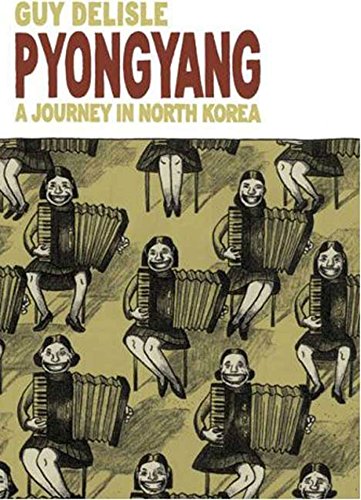
Pyongyang: A Journey in North Korea
Guy Delisle, Helge Dascher
4.4
Famously referred to as one of the "Axis of Evil" countries, North Korea remains one of the most secretive and mysterious nations in the world today. In early 2001 cartoonist Guy Delisle became one of the few Westerners to be allowed access to the fortress-like country. While living in the nation's capital for two months on a work visa for a French film animation company, Delisle observed what he was allowed to see of the culture and lives of the few North Koreans he encountered; his findings form the basis of this graphic novel.
Guy Delisle was born in Quebec City in 1966 and has spent the last decade living and working in the South of France with his wife and son. Delisle has spent ten years, mostly in Europe, working in animation, an experience that taught him about movement and drawing. He is now currently focusing on his cartooning. Delisle has written and drawn six graphic novels, including "Pyongyang," his first graphic novel in English.
…
Recommended by Sung J. Woo.
Sung J. Woo
Well, this is a comic book really, or a graphic novel if you want to make it sound more serious. Although it’s non-fiction, actually. It’s by a French guy, which is surprising. He went to Pyongyang, the capital of North Korea, to supervise an animation and he was there for two months getting to know the country. So this book is really a collection of his observations and how he saw the country and how strange it was to be there. The thing about the comic medium is that it’s perfect for representing the completely unreal state of that nation. This is a country unlike anywhere else and the comic book is more apt than any other form. There is a huge amount of propaganda in North Korea against South Korea, where I’m from. They say everyone’s spy, the living conditions are terrible and how horrible it is. But in South Korea there is the exact flip side of that. When I was growing up they said it’s terrible in North Korea, everyone’s a spy and the living conditions are horrible. [source]
Cover unavailable
20
The Two Koreas: A Contemporary History (Revised and Updated Edition)
Don Oberdorfer
4.3
Don Oberdorfer has written a gripping narrative history of Korea's travails and triumphs over the past three decades. The Two Koreas places the tensions between North and South within a historical context, with a special emphasis on the involvement of outside powers.
Cover unavailable
21
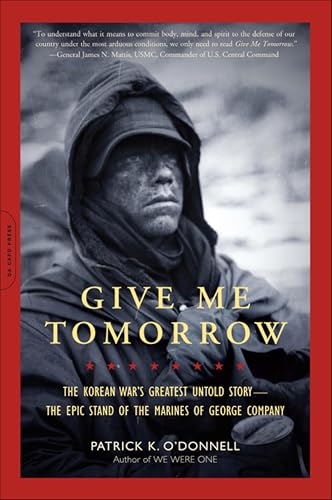
Give Me Tomorrow: The Korean War's Greatest Untold Story--The Epic Stand of the Marines of George Company
Patrick K. O'Donnell
4.3
An epic story of valor and sacrifice by a legendary Marine company in the Korean War brought to gripping, cinematic light by an acclaimed historian ("Gives the brave Marines of George Company long overdue recognition"--New York Post) "What would you want if you could have any wish?" asked the photojournalist of the haggard, bloodied Marine before him. The Marine gaped at his interviewer. The photographer snapped his picture, which became the iconic Korean War image featured on this book's jacket. "Give me tomorrow," he said at last.
After nearly four months of continuous and agonizing combat on the battlefields of Korea, such a simple request seemed impossible. For many men of George Company, or "Bloody George" as they were known-one of the Forgotten War's most decorated yet unrecognized companies-it was a wish that would not come true.
This is the untold story of "Bloody George," a Marine company formed quickly to answer its nation's call to duty in 1950. This small band of men-a colorful cast of characters, including a Native American fighting to earn his honor as a warrior, a Southern boy from Tennessee at odds with a Northern blue-blood reporter-turned-Marine, and a pair of twins who exemplified to the group the true meaning of brotherhood-were mostly green troops who had been rushed through training to fill America's urgent need on the Korean front. They would find themselves at the tip of the spear in some of the Korean War's bloodiest battles.
After storming ashore at Inchon and fighting house-to-house in Seoul, George Company, one of America's last units in reserve, found itself on the frozen tundra of the Chosin Reservoir facing elements of an entire division of Chinese troops. They didn't realize it then, but they were soon to become crucial to the battle-modern-day Spartans called upon to hold off ten times their number. Give Me Tomorrow is their unforgettable story of bravery and courage.
Thoroughly researched and vividly told, Give Me Tomorrow is fitting testament to the heroic deeds of George Company. They will never again be forgotten.
…
Cover unavailable
22
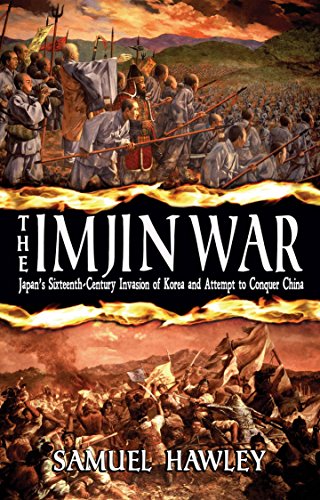
The Imjin War: Japan's Sixteenth-Century Invasion of Korea and Attempt to Conquer China
Samuel Hawley
4.3
In May of 1592, Japanese dictator Toyotomi Hideyoshi sent a 158,800-man army of invasion from Kyushu to Pusan on Korea’s southern tip. His objective: to conquer Korea, then China, and then the whole of Asia. The resulting seven years of fighting, known in Korea as imjin waeran, the “Imjin invasion,” after the year of the water dragon in which it began, dwarfed contemporary conflicts in Europe and was one of the most devastating wars to grip East Asia in the past thousand years.
The Imjin War is the most comprehensive account ever published in English of this cataclysmic event, so little known in the West. It begins with the political and cultural background of Korea, Japan and China, explores the diplomatic impasse that led to the war, describes every major incident and battle from 1592 to 1598 and introduces a fascinating cast of characters along the way. There is Hideyoshi, hosting garden parties as his armies march toward Beijing; Korean admiral Yi Sun-sin, emerging from a prison cell to take on the Japanese navy with just thirteen ships; Chinese commander Zhao Chengxun, suffering defeat after promising to “scatter the Japanese to the four winds”; the courtesan Chu Non-gae, luring a samurai into her arms and then jumping into the Nam River with him locked in her embrace.
One nation fighting to expand, another to survive. Shockwaves extending across China and beyond. The Imjin War is an epic tale of grand perspective and intimate detail of an upheaval that would shape East Asia for centuries to come.
…
Cover unavailable
23
White Chrysanthemum
Mary Lynn Bracht, Greta Jung
4.3
In the spirit of Lilac Girls, the heartbreaking history of Korea is brought to life in this deeply moving and redemptive debut that follows two sisters separated by World War II.
Korea, 1943. Hana has lived her entire life under Japanese occupation. As a haenyeo, a female diver of the sea, she enjoys an independence that few other Koreans can still claim. Until the day Hana saves her younger sister from a Japanese soldier and is herself captured and transported to Manchuria. There she is forced to become a “comfort woman” in a Japanese military brothel. But haenyeo are women of power and strength. She will find her way home.
South Korea, 2011. Emi has spent more than sixty years trying to forget the sacrifice her sister made, but she must confront the past to discover peace. Seeing the healing of her children and her country, can Emi move beyond the legacy of war to find forgiveness?
Suspenseful, hopeful, and ultimately redemptive, White Chrysanthemum tells a story of two sisters whose love for each other is strong enough to triumph over the grim evils of war.
…
Cover unavailable
24
Dog Company: A True Story of American Soldiers Abandoned by Their High Command
Roger Hill
4.3
Now with a foreword by Sean Hannity!
The Army does not want you to read this book. It does not want to advertise its detention system that coddles enemy fighters while putting American soldiers at risk. It does not want to reveal the new lawyered-up Pentagon war ethic that prosecutes U.S. soldiers and Marines while setting free spies who kill Americans. This very system ambushed Captain Roger Hill and his men. Hill, a West Point grad and decorated combat veteran, was a rising young officer who had always followed the letter of the military law. In 2007, Hill got his dream job: infantry commander in the storied 101st Airborne. His new unit, Dog Company, 1-506th, had just returned stateside from the hell of Ramadi. The men were brilliant in combat but unpolished at home, where paperwork and inspections filled their days. With tough love, Hill and his First Sergeant, an old-school former drill instructor named Tommy Scott, turned the company into the top performers in the battalion. Hill and Scott then led Dog Company into combat in Afghanistan, where a third of their men became battlefield casualties after just six months. Meanwhile, Hill found himself at war with his own battalion commander, a charismatic but difficult man who threatened to relieve Hill at every turn. After two of his men died on a routine patrol, Hill and a counterintelligence team busted a dozen enemy infiltrators on their base in the violent province of Wardak. Abandoned by his high command, Hill suddenly faced an excruciating choice: follow Army rules the way he always had, or damn the rules to his own destruction and protect the men he'd grown to love.
…
Cover unavailable
25
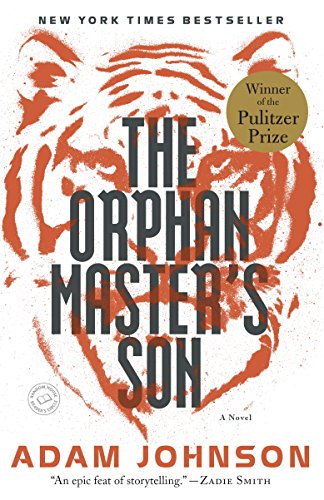
The Orphan Master's Son
Adam Johnson
4.3
An epic novel and a thrilling literary discovery, The Orphan Master's Son follows a young man's journey through the icy waters, dark tunnels, and eerie spy chambers of the world's most mysterious dictatorship, North Korea.
Pak Jun Do is the haunted son of a lost mother - a singer "stolen" to Pyongyang - and an influential father who runs Long Tomorrows, a work camp for orphans. There the boy is given his first taste of power, picking which orphans eat first and which will be lent out for manual labor. Recognized for his loyalty and keen instincts, Jun Do comes to the attention of superiors in the state, rises in the ranks, and starts on a road from which there will be no return.
Considering himself "a humble citizen of the greatest nation in the world," Jun Do becomes a professional kidnapper who must navigate the shifting rules, arbitrary violence, and baffling demands of his Korean overlords in order to stay alive. Driven to the absolute limit of what any human being could endure, he boldly takes on the treacherous role of rival to Kim Jong Il in an attempt to save the woman he loves, Sun Moon, a legendary actress "so pure, she didn't know what starving people looked like."
Part breathless thriller, part story of innocence lost, part story of romantic love, The Orphan Master's Son is also a riveting portrait of a world heretofore hidden from view: a North Korea rife with hunger, corruption, and casual cruelty but also camaraderie, stolen moments of beauty, and love. A towering literary achievement, The Orphan Master's Son ushers Adam Johnson into the small group of today's greatest writers.
--jacket description
…
Cover unavailable
26
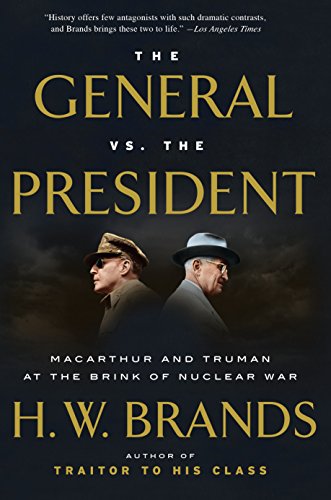
The General vs. the President: MacArthur and Truman at the Brink of Nuclear War
H. W. Brands
4.3
From master storyteller and historian H. W. Brands, twice a finalist for the Pulitzer Prize, comes the riveting story of how President Harry Truman and General Douglas MacArthur squared off to decide America's future in the aftermath of World War II.
At the height of the Korean War, President Harry S. Truman committed a gaffe that sent shock waves around the world. When asked by a reporter about the possible use of atomic weapons in response to China's entry into the war, Truman replied testily, "The military commander in the field will have charge of the use of the weapons, as he always has." This suggested that General Douglas MacArthur, the willful, fearless, and highly decorated commander of the American and U.N. forces, had his finger on the nuclear trigger. A correction quickly followed, but the damage was done; two visions for America's path forward were clearly in opposition, and one man would have to make way.
Truman was one of the most unpopular presidents in American history. Heir to a struggling economy, a ruined Europe, and increasing tension with the Soviet Union, on no issue was the path ahead clear and easy. General MacArthur, by contrast, was incredibly popular, as untouchable as any officer has ever been in America. The lessons he drew from World War II were absolute: appeasement leads to disaster and a showdown with the communists was inevitable--the sooner the better. In the nuclear era, when the Soviets, too, had the bomb, the specter of a catastrophic third World War lurked menacingly close on the horizon.
The contest of wills between these two titanic characters unfolds against the turbulent backdrop of a faraway war and terrors conjured at home by Joseph McCarthy. From the drama of Stalin's blockade of West Berlin to the daring landing of MacArthur's forces at Inchon to the shocking entrance of China into the war, " The General and the President vividly evokes the making of a new American era."
…
Cover unavailable
27
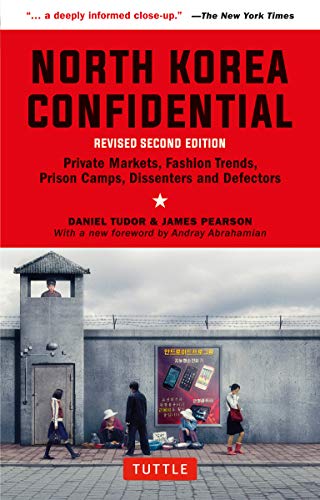
North Korea Confidential: Private Markets, Fashion Trends, Prison Camps, Dissenters and Defectors
Daniel Tudor, James Pearson
4.3
Named one of the best books of 2015 by The Economist
Private Markets, Fashion Trends, Prison Camps, Dissenters and Defectors.
North Korea is one of the most troubled societies on earth. The country's 24 million people live under a violent dictatorship led by a single family, which relentlessly pursues the development of nuclear arms, which periodically incites risky military clashes with the larger, richer, liberal South, and which forces each and every person to play a role in the "theater state" even as it pays little more than lip service to the wellbeing of the overwhelming majority.
With this profoundly anachronistic system eventually failed in the 1990s, it triggered a famine that decimated the countryside and obliterated the lives of many hundreds of thousands of people. However, it also changed the lives of those who survived forever.
A lawless form of marketization came to replace the iron rice bowl of work in state companies, and the Orwellian mind control of the Korean Workers' Party was replaced for many by dreams of trade and profit. A new North Korea Society was born from the horrors of the era—one that is more susceptible to outside information than ever before with the advent of k-pop and video-carrying USB sticks. This is the North Korean society that is described in this book.
In seven fascinating chapters, the authors explore what life is actually like in modern North Korea today for the ordinary "man and woman on the street." They interview experts and tap a broad variety of sources to bring a startling new insider's view of North Korean society—from members of Pyongyang's ruling families to defectors from different periods and regions, to diplomats and NGOs with years of experience in the country, to cross-border traders from neighboring China, and textual accounts appearing in English, Korean and Chinese sources. The resulting stories reveal the horror as well as the innovation and humor which abound in this fascinating country.
…
Recommended by Hyeonseo Lee.
Hyeonseo Lee
Some of the information is revelatory, especially about black market trade with China – foreign films and books have been smuggled in. [source]
Cover unavailable
28
Human Acts
Han Kang
4.3
From the internationally bestselling author of The Vegetarian, a rare and astonishing (The Observer) portrait of political unrest and the universal struggle for justice.
In the midst of a violent student uprising in South Korea, a young boy named Dong-ho is shockingly killed.
The story of this tragic episode unfolds in a sequence of interconnected chapters as the victims and the bereaved encounter suppression, denial, and the echoing agony of the massacre. From Dong-ho's best friend who meets his own fateful end; to an editor struggling against censorship; to a prisoner and a factory worker, each suffering from traumatic memories; and to Dong-ho's own grief-stricken mother; and through their collective heartbreak and acts of hope is the tale of a brutalized people in search of a voice.
An award-winning, controversial bestseller, Human Acts is a timeless, pointillist portrait of an historic event with reverberations still being felt today, by turns tracing the harsh reality of oppression and the resounding, extraordinary poetry of humanity.
…
Cover unavailable
29
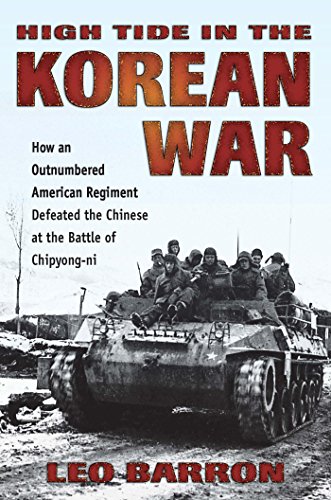
High Tide in the Korean War: How an Outnumbered American Regiment Defeated the Chinese at the Battle of Chipyong-Ni
Leo Barron
4.3
By early 1951, American forces and their UN allies had been driven more than 100 miles down the Korean peninsula by the Chinese. The situation was bleak when Gen. Matthew Ridgway ordered a last stand at the village of Chipyong-ni. There a single regiment (the 23rd Infantry) of fewer than 5,000 U.S. soldiers defeated a Chinese division of 25,000 men in what has been called the Gettysburg of the Korean War.
…
Cover unavailable
30
The Hidden History of the Korean War: 1950–1951 (A Nonconformist History of Our Times, #2)
I. F. Stone
4.3
In 1945 US troops arrived in Korea for what would become America’s longest-lasting conflict. While history books claim without equivocation that the war lasted from 1950 to 1953, those who have actually served there know better. By closely analyzing US intelligence before June 25, 1950 (the war’s official start), and the actions of key players like John Foster Dulles, General Douglas MacArthur, and Chiang Kai-shek, the great investigative reporter I. F. Stone demolishes the official story of America’s “forgotten war” by shedding new light on the tangled sequence of events that led to it.
…
Recommended by Bruce Cumings.
Bruce Cumings
This book is very interesting. I F Stone was a famous iconoclastic investigative reporter. His method was to read a whole bunch of newspapers every day, clip them, and then read what the government was saying publicly through government reports, speeches and the like, and then try to figure out what was going on. And he got many things right about the Korean War using that method. In the early 1950s he was condemning the carpet bombing which the U.S. did in North Korea. This was an enemy that had almost no defence and no air power. I don’t think many people understand that North Korea suffered the same kind of fire-bombing that the British and Americans did in World War II against Japan and Germany – and yet North Korea was a small country. [source]
Cover unavailable
31
Letters from Korean History 1: From prehistory to Unified Silla and Balhae
Eun Bong Park
4.3
Cover unavailable
32
New Millennium South Korea: Neoliberal Capitalism and Transnational Movements
Jesook Song
4.3
Despite the common held belief that Asian nations have displayed anti-market tendencies of under-consumption and export-oriented trade since the Asian financial crisis, in the 10 years since the crisis, South Korea has bucked this trend accruing a higher debt rate than the US. This groundbreaking collection of essays addresses questions such as how did the open market policies and restructuring processes implemented during the Asian financial crisis magnify the consumption and debt level in South Korea to such an extent? What is the impact of these financial changes on the daily lives of people in different cultural and socio-economic groups? In examining these questions the authors provide valuable insight into the rise of financial capitalism, transnational mobility and the implications of neoliberal governing tactics following the Asian Financial Crisis.
Examining South Korea's transformation during the early years of the 21st century, New Millenium South Korea will be of interest to anthropologists, economists and sociologists, as well as students and scholars of Korean Studies.
…
Cover unavailable
33
Korea's Development Under Park Chung Hee
Hyung-A Kim
4.3
Based on personal interviews with the principal policy-makers of the 1970s, Korea's Development under Park Chung-Hee examines how the president sought to develop South Korea into an independent, autonomous sovereign state both economically and militarily. Kim provides a new narrative in the complex task of exploring the paradoxical nature and effects of Korea's rapid development which maintains that any judgement of Park must consider his achievements in the socio-economic, cultural and political context in which they took place. Aspects of Park's government analyzed include: *his abhorrence of Korea's reliance on the US presence *the Korean model of state-guided industrialization *Park's rapid development strategy *the role of the ruling elites *Park's clandestine nuclear development program *the heavy chemical industrialisation of the 1970s The prevailing popularity of Park in the eyes of the Korean public is significant and relevant to their acceptance of how their national development was achieved. This book tells that story while simultaneously recognizing the flaws in the process. With a great deal of material never before published, scholars of Korean politics and history at all levels will find this book a stimulating account of South Korea in the 1960s and 1970s.
…
Cover unavailable
34
A Concise History of Korea: From Antiquity to the Present
Michael J. Seth
4.3
Now in a fully revised and updated edition, this comprehensive book surveys Korean history from Neolithic times to the present. Michael J. Seth explores the origins and development of Korean society, politics, and still little-known cultural heritage from their inception to the two Korean states of today. Telling the remarkable story of the origins and evolution of a society that borrowed and adopted from abroad, Seth describes how various tribal peoples in the peninsula came together to form one of the world's most distinctive communities. He shows how this ancient, culturally and ethnically homogeneous society was wrenched into the world of late-nineteenth-century imperialism, fell victim to Japanese expansionism, and then became arbitrarily divided into two opposed halves, North and South, after World War II. Tracing the seven decades since 1945, the book explains how the two Koreas, with their deeply different political and social systems and geopolitical orientations, evolved into sharply contrasting societies. South Korea, after an unpromising start, became one of the few postcolonial developing states to enter the ranks of the first world, with a globally competitive economy, a democratic political system, and a cosmopolitan and dynamic culture. North Korea, by contrast, became one of the world's most totalitarian and isolated societies, a nuclear power with an impoverished and famine-stricken population. Seth describes and analyzes the radically different and historically unprecedented trajectories of the two Koreas, formerly one tight-knit society. Throughout, he adds a rare dimension by placing Korean history into broader global perspective. All readers looking for a balanced, knowledgeable history will be richly rewarded with this clear and concise book.
…
Cover unavailable
35
Letters from Korean History 3: Joseon - from founding to later years
Eun Bong Park and translation by Ben Jackson
4.3
Cover unavailable
36
The Living Reed: A Novel of Korea
Pearl S. Buck
4.2
The Living Reed follows four generations of one family, the Kims, beginning with Il-han and his father, both advisors to the royal family in Korea. When Japan invades and the queen is killed, Il-han takes his family into hiding. In the ensuing years, he and his family take part in the secret war against the Japanese occupation. Pearl S. Buck's epic tells the history of Korea through the lives of one family. She paints an amazing portrait of the country, and makes us empathize with their struggle for sovereignty through her beautifully drawn characters.
…
Cover unavailable
37
The Memoirs of Lady Hyegyŏng: The Autobiographical Writings of a Crown Princess of Eighteenth-Century Korea
JaHyun Kim Haboush
4.2
Lady Hyegyong's memoirs, which recount the chilling murder of her husband by his father, is one of the best known and most popular classics of Korean literature. From 1795 until 1805 Lady Hyegyong composed this masterpiece, which depicts a court life whose drama and pathos is of Shakespearean proportions. Presented in its social, cultural, and historical contexts, this complete English translation opens a door into a world teeming with conflicting passions, political intrigue, and the daily preoccupations of a deeply intelligent and articulate woman.
JaHyun Kim Haboush's accurate, fluid translation captures the intimate and expressive voice of this consummate storyteller. The Memoirs of Lady Hyegyong is a unique exploration of Korean selfhood and of how the genre of autobiography fared in premodern times.
…
Cover unavailable
38
History of Korea: A Captivating Guide to Korean History, Including Events Such as the Mongol Invasions, the Split into North and South, and the Korean War
Captivating History
4.2
Cover unavailable
39
The Korean War: A History
Bruce Cumings
4.2
A BRACING ACCOUNT OF A WAR THAT IS EITHER MISUNDERSTOOD, FORGOTTEN, OR WILLFULLY IGNORED
For Americans, it was a discrete conflict lasting from 1950 to 1953. But for the Asian world the Korean War was a generations-long struggle that still haunts contemporary events. With access to new evidence and secret materials from both here and abroad, including an archive of captured North Korean documents, Bruce Cumings reveals the war as it was actually fought. He describes its origin as a civil war, preordained long before the first shots were fired in June 1950 by lingering fury over Japan’s occupation of Korea from 1910 to 1945. Cumings then shares the neglected history of America’s post–World War II occupation of Korea, reveals untold stories of bloody insurgencies and rebellions, and tells of the United States officially entering the action on the side of the South, exposing as never before the appalling massacres and atrocities committed on all sides.
Elegantly written and blisteringly honest, The Korean War is, like the war it illuminates, brief, devastating, and essential.
…
Cover unavailable
40
Goryeo Dynasty: Korea's Age of Enlightenment, 918-1392
Kumja Paik Kim, Kaz Tsuruta
4.2
Containing over 100 photos of Korean art pieces along with thoughtful essays, Goryeo Dynasty: Korea's Age of Enlightenment 918-1392 captures this fundamental period of Korean history.
Few people are aware that the name Korea is derived from Goryeo of the Goryeo dynasty (918-1392). Under the patronage of the royal court, the aristocracy and the Buddhist elite—whose taste are for luxury and refinement was unprecedented in the history of Korea—spectacular achievements were made in all areas of the arts during this period.
This catalogue documents not only the famous Goryeo achievements in ceramics but also lesser known Buddhist paintings, illuminated sutras, sculpture, lacquer, and metal crafts. Drawing from thirty-five contributing institutions, it brings together some of the most exquisite works of Korean art from the tenth to the fourteenth century, including many that have never before traveled to the West. A valuable resource to anyone interested in the classic arts of East Asia.
…
Cover unavailable
41
The Real North Korea: Life and Politics in the Failed Stalinist Utopia
Andrei Lankov
4.2
Andrei Lankov has gone where few outsiders have ever been. A native of the former Soviet Union, he lived as an exchange student in North Korea in the 1980s. He has studied it for his entire career, using his fluency in Korean and personal contacts to build a rich, nuanced understanding. In The Real North Korea, Lankov substitutes cold, clear analysis for the overheated rhetoric surrounding this opaque police state. After providing an accessible history of the nation, he turns his focus to what North Korea is, what its leadership thinks, and how its people cope with living in such an oppressive and poor place. He argues that North Korea is not irrational, and nothing shows this better than its continuing survival against all odds. A living political fossil, it clings to existence in the face of limited resources and a zombie economy, manipulating great powers despite its weakness. Its leaders are not ideological zealots or madmen, but perhaps the best practitioners of Machiavellian politics that can be found in the modern world. Even though they preside over a failed state, they have successfully used diplomacy-including nuclear threats-to extract support from other nations. But while the people in charge have been ruthless and successful in holding on to power, Lankov goes on to argue that this cannot continue forever, since the old system is slowly falling apart. In the long run, with or without reform, the regime is unsustainable. Lankov contends that reforms, if attempted, will trigger a dramatic implosion of the regime. They will not prolong its existence. Based on vast expertise, this book reveals how average North Koreans live, how their leaders rule, and how both survive.
…
Cover unavailable
42
SOUTH KOREA: The Price of Efficiency and Success
John Gonzalez
4.2
South Korea's extraordinary economic and technological transformation after the Korean War (1950-1953) is often referred to by observers and historians as the 'Miracle on the Han River". The nation underwent an astonishing makeover from being one one of the poorest countries to become the 12th largest economy in the world and 4th in Asia. South Korea also became one of the most technologically advanced countries in a short span.
As in other capitalist economies and despite South Korea's undeniable success, some people have benefited from the economic and technological attainments, while others have been left out regardless of their effort to overcome the challenges of a playing field that favors the affluent. While other capitalist economies have experienced a similar widening divide between the haves and have-nots, the social inequality in South Korea appears to be exacerbated by cultural and behavior patterns that are deeply rooted in a society that values education, efficiency, hard work, individual and collective sacrifice, youth, beauty, and materialism. Some of the most impacted are low-income people, the elderly, the young, and middle-aged individuals.
The authors look behind the public face of South Korea through personal observations and their cultural lenses, extensive research, and careful analysis, to identify both the factors that contributed to the country's remarkable trajectory and the price that Koreans have had to pay for the nation's astounding accomplishments. The authors blend storytelling with hard evidence to show how the cultural and behavioral attitudes of Koreans contributed to the nation's incredible achievements as well as its current challenges. They share their experiences through storytelling and capture Koreans being themselves without the glamour and glitz of K-Pop, K-Beauty, and K-Drama.
When the Future Disappears: The Modernist Imagination in Late Colonial Korea
Janet Poole
4.2
Taking a panoramic view of Korea's dynamic literary production in the final decade of Japanese rule, When the Future Disappears locates the imprint of a new temporal sense in Korean modernism: the impression of time interrupted, with no promise of a future. As colonial subjects of an empire headed toward total war, Korean writers in this global fascist moment produced some of the most sophisticated writings of twentieth-century modernism.
Yi T'aejun, Ch'oe Myongik, Im Hwa, So Insik, Ch'oe Chaeso, Pak T'aewon, Kim Namch'on, and O Changhwan, among other Korean writers, lived through a rare colonial history in which their vernacular language was first inducted into the modern, only to be shut out again through the violence of state power. The colonial suppression of Korean-language publications was an effort to mobilize toward war, and it forced Korean writers to face the loss of their letters and devise new, creative forms of expression. Their remarkable struggle reflects the stark foreclosure at the heart of the modern colonial experience. Straddling cultural, intellectual, and literary history, this book maps the different strategies, including abstraction, irony, paradox, and even silence, that Korean writers used to narrate life within the Japanese empire.
…
Cover unavailable
44
GRAND ROYAL PALACES OF KOREA: Over 200 Pages of Beautiful Photos With Cultural and Historical Background Explanations In English
Yeong-hun Lee
4.2
Cover unavailable
45
Korea's Place in the Sun: A Modern History
Bruce Cumings Ph.D.
4.2
Korea has endured a "fractured, shattered twentieth century," and this updated edition brings Bruce Cumings's leading history of the modern era into the present. The small country, overshadowed in the imperial era, crammed against great powers during the Cold War, and divided and decimated by the Korean War, has recently seen the first real hints of reunification. But positive movements forward are tempered by frustrating steps backward. In the late 1990s South Korea survived its most severe economic crisis since the Korean War, forcing a successful restructuring of its political economy. Suffering through floods, droughts, and a famine that cost the lives of millions of people, North Korea has been labeled part of an "axis of evil" by the George W. Bush administration and has renewed its nuclear threats. On both sides Korea seems poised to continue its fractured existence on into the new century, with potential ramifications for the rest of the world.
…
Cover unavailable
46
China: A History
John Keay
4.2
An authoritative account of five thousand years of Chinese history Many nations define themselves in terms of territory or people; China defines itself in terms of history. Taking into account the country's unrivaled, voluminous tradition of history writing, John Keay has composed a vital and illuminating overview of the nation's complex and vivid past. Keay's authoritative history examines 5,000 years in China, from the time of the Three Dynasties through Chairman Mao and the current economic transformation of the country. Crisp, judicious, and engaging, China is the classic single-volume history for anyone seeking to understand the present and future of this immensely powerful nation.
…
Cover unavailable
47
Six Silent Men, Book Two (101st Lrp/Rangers)
Kenn Miller
4.2
In the summer of 1967, the good old days were ending for the hard-core 1st Brigade LRRPs of the 101st Airborne Division, perhaps the finest maneuver element of its size in the history of the United States Army. It was a bitter pill. After working on their own in Vietnam for more than two years, the Brigade LRRPs were ordered to join forces with the division once again.
But even as these formidable hunters and killers were themselves swallowed up by the Screaming Eagles' Division LRPs to eventually become F Co., 58th Infantry, they continued the deadly, daring LRRP tradition. From saturation patrols along the Laotian border to near-suicide missions and compromised positions in the always dangerous A Shau valley, the F/58th unflinchingly faced death every day and became one of the most highly decorated companies in the history of the 101st.
…
Cover unavailable
48
North Korean Government: A Contemporary History (Nutshell Books Book 1)
Nutshell Books
4.2
Cover unavailable
49
A History of Korea: From Antiquity to the Present
Michael J. Seth
4.2
In this comprehensive yet compact book, Michael J. Seth surveys Korean history from Neolithic times to the present. He explores the origins and development of Korean society, politics, and its still little-known cultural heritage from their inception to the two Korean states of today. Telling the remarkable story of the origins and evolution of a society that borrowed and adopted from abroad, Seth describes how various tribal peoples in the peninsula came together to form one of the world's most distinctive communities. He shows how this ancient, culturally and ethnically homogeneous society was wrenched into the world of late-nineteenth-century imperialism, fell victim to Japanese expansionism, and then became arbitrarily divided into two opposed halves, North and South, after World War II. Tracing the past seven decades, the book explains how the two Koreas, with their deeply different political and social systems and geopolitical orientations, evolved into sharply contrasting societies. South Korea, after an unpromising start, became one of the few postcolonial developing states to enter the ranks of the first world, with a globally competitive economy, a democratic political system, and a cosmopolitan and dynamic culture. North Korea, by contrast, became one of the world's most totalitarian and isolated societies, a nuclear power with an impoverished and famine-stricken population. Seth describes and analyzes the radically different and historically unprecedented trajectories of the two Koreas, formerly one tight-knit society. Throughout, he adds a rich dimension by placing Korean history into broader global perspective and by including primary readings from each era. All readers looking for a balanced, knowledgeable history will be richly rewarded with this clear and concise book.
…
Cover unavailable
50
Dear Reader: The Unauthorized Autobiography of Kim Jong Il
Michael Malice
4.2
No country is as misunderstood as North Korea, and no modern tyrant has remained more mysterious than the Dear Leader, Kim Jong Il. Now, celebrity ghostwriter Michael Malice pulls back the curtain to expose the life story of the "Incarnation of Love and Morality." Taken directly from books spirited out of Pyongyang, DEAR READER is a carefully reconstructed first-person account of the man behind the mythology. From his miraculous rainbow-filled birth during the fiery conflict of World War II, Kim Jong Il watched as his beloved Korea finally earned its freedom from the cursed Japanese. Mere years later, the wicked US imperialists took their chance at conquering the liberated nation—with devastating results. But that's only the beginning of the Dear Leader’s story. In DEAR READER, Kim Jong Il explains: How he can shrink time Why he despises the Mona Lisa How he recreated the arts in Korea Why the Juche idea is the greatest concept ever discovered by man How he handled the crippling famine Why Kim Jong Un was chosen as successor over his elder brothers. With nothing left uncovered, drawing straight from dozens of books, hundreds of articles and thousands of years of Korean history, DEAR READER is both the definitive account of Kim Jong Il's life and the complete stranger-than-fiction history of the world's most unique country.
…
Cover unavailable
51
The Proletarian Gamble: Korean Workers in Interwar Japan
Ken C. Kawashima
4.2
Koreans constituted the largest colonial labor force in imperial Japan during the 1920s and 1930s. Caught between the Scylla of agricultural destitution in Korea and the Charybdis of industrial depression in Japan, migrant Korean peasants arrived on Japanese soil amid extreme instability in the labor and housing markets. In The Proletarian Gamble, Ken C. Kawashima maintains that contingent labor is a defining characteristic of capitalist commodity economies. He scrutinizes how the labor power of Korean workers in Japan was commodified, and how these workers both fought against the racist and contingent conditions of exchange and combated institutionalized racism.Kawashima draws on previously unseen archival materials from interwar Japan as he describes how Korean migrants struggled against various recruitment practices, unfair and discriminatory wages, sudden firings, racist housing practices, and excessive bureaucratic red tape. Demonstrating that there was no single Korean “minority,” he reveals how Koreans exploited fellow Koreans and how the stratification of their communities worked to the advantage of state and capital. However, Kawashima also describes how, when migrant workers did organize—as when they became involved in Rōsō (the largest Korean communist labor union in Japan) and in Zenkyō (the Japanese communist labor union)—their diverse struggles were united toward a common goal. In The Proletarian Gamble, his analysis of the Korean migrant workers' experiences opens into a much broader rethinking of the fundamental nature of capitalist commodity economies and the analytical categories of the proletariat, surplus populations, commodification, and state power.
…
Cover unavailable
52
Made in North Korea: Graphics From Everyday Life in the DPRK
Nick Bonner
4.2
North Korea uncensored and unfiltered – ordinary life in the world's most secretive nation, captured in never-before-seen ephemera.
Made in North Korea uncovers the fascinating and surprisingly beautiful graphic culture of North Korea - from packaging to hotel brochures, luggage tags to tickets for the world-famous mass games. From his base in Beijing, Bonner has been running tours into North Korea for over twenty years, and along the way collecting graphic ephemera. He has amassed thousands of items that, as a collection, provide an extraordinary and rare insight into North Korea's state-controlled graphic output, and the lives of ordinary North Koreans.
…
Cover unavailable
53
A Thousand Miles to Freedom: My Escape from North Korea
Eunsun Kim
4.2
Eunsun Kim was born in North Korea, one of the most secretive and oppressive countries in the modern world. As a child Eunsun loved her country…despite her school field trips to public executions, daily self-criticism sessions, and the increasing gnaw of hunger as the country-wide famine escalated.
By the time she was eleven years old, Eunsun's father and grandparents had died of starvation, and Eunsun too was in danger of starving. Finally, her mother decided to escape North Korea with Eunsun and her sister, not knowing that they were embarking on a journey that would take them nine long years to complete. Before finally reaching South Korea and freedom, Eunsun and her family would live homeless, fall into the hands of Chinese human traffickers, survive a North Korean labor camp, and cross the deserts of Mongolia on foot.
Now, in A Thousand Miles to Freedom, Eunsun is sharing her remarkable story to give voice to the tens of millions of North Koreans still suffering in silence. Told with grace and courage, her memoir is a riveting exposé of North Korea's totalitarian regime and, ultimately, a testament to the strength and resilience of the human spirit.
…
Cover unavailable
54
MiG Alley: The US Air Force in Korea, 1950–53
Thomas McKelvey Cleaver
4.2
Of the many myths that emerged following the end of the Korean War, the prevailing one in the West was that of the absolute supremacy of US Air Force pilots and aircraft over their Soviet-supplied opponents. The claims of the 10:1 victory-loss ratio achieved by the US Air Force fighter pilots flying the North American F-86 Sabre against their communist adversaries, amongst other such fabrications, went unchallenged until the end of the Cold War, when Soviet records of the conflict were finally opened. From that point onwards, a very different story began to emerge. Far from decisive American victories over an unsophisticated opponent, the aerial battles of the Korean War were, at least in the early years, evenly matched affairs, fought to an approximate 1:1 victory-loss ratio. Though the Soviet victories declined over the following years, this had more to do with home politics than American tactics. Regardless of the accuracy of claims and wartime propaganda, one fact stands clear: in the battle for air supremacy over Korea, the US Air Force denied to its opponents the opportunity to intervene over the battlefield. In the face of overwhelming enemy manpower superiority, this allowed the United Nations forces to hold the line in Korea until an armistice that protected South Korea could be put into effect In addition to the aerial combat over MiG Alley, this title covers the full range of US Air Force activities over Korea, including the failed strategic bombing campaign and the escalating nuclear threat. Incorporating first-hand accounts from those involved, both US and Russian, this new history of the US Air Force in Korea reveals the full story of this bitter struggle in the Eastern skies.
…
Cover unavailable
55
Ghost Flames: Life and Death in a Hidden War, Korea 1950-1953
Charles J. Hanley
4.2
A narrative, character-driven account of the Korean War that sheds light on the atrocities and hardships suffered by all sides in the "forgotten" conflict. Although it was then perceived as a far-off and inconclusive engagement, the Korean War was a decisive and deeply destructive conflict. American forces dropped 635,000 tons of bombs over Korea --- more than the entire Pacific campaign of World War II --- and millions of Koreans perished. Today, mass graves still litter the countryside and two nuclear-armed forces stand at odds.
In Ghost Flames, Charles Hanley adds new color and urgency by telling the history of the war through the eyes of twenty one individuals --- soldiers and civilians, male and female, young and old, witnesses both to atrocity and to heroism. The narrative unfolds in interwoven episodes, month by month, from the hilltop trench lines, the refugee camps and the prisoner-of-war camps.
In time for the 70th anniversary of the beginning of the war, Hanley offers a people's history of the devastating events on the Korean Peninsula.
…
Cover unavailable
56
Korean Workers: The Culture and Politics of Class Formation
Hagen Koo
4.1
Forty years of rapid industrialization have transformed millions of South Korean peasants and their sons and daughters into urban factory workers. Hagen Koo explores the experiences of this first generation of industrial workers and describes its struggles to improve working conditions in the factory and to search for justice in society.
The working class in South Korea was born in a cultural and political environment extremely hostile to its development, Koo says. Korean workers forged their collective identity much more rapidly, however, than did their counterparts in other newly industrialized countries in East Asia. This book investigates how South Korea's once-docile and submissive workers reinvented themselves so quickly into a class with a distinct identity and consciousness.
Based on sources ranging from workers' personal writings to union reports to in-depth interviews, this book is a penetrating analysis of the South Korean working-class experience. Koo reveals how culture and politics simultaneously suppressed and facilitated class formation in South Korea. With chapters exploring the roles of women, students, and church organizations in the struggle, the book reflects Koo's broader interest in the social and cultural dimensions of industrial transformation.
--Ruth Berins Collier, University of California, Berkeley "Work and Occupations"
…
Cover unavailable
57
Battleships of the United States Navy
Michael Green
4.1
From 1895 to 1944 the US Navy commissioned some 60 steel-clad battleships; the first being Indiana (BB-1) and the last USS Missouri (BB-63). After an impressive showing in the Spanish-American War and the 'Great White Fleet's' circumnavigation of the world, US battleships played only a minor role in the First World War. They came into their own in WW2 primarily bombarding enemy held coastal regions and supporting Allied operations in Europe and the Pacific. Their firepower was awesome and the later examples had nine 16-inch and up to twenty 5-inch guns plus copious antiaircraft defenses.
On the few occasions these mighty ships took on Japanese counterparts, they performed brilliantly but protection of the increasingly important aircraft couriers was more decisive. Armor plate nearly a foot and a half thick saved many from fatal attack from suicidal kamikaze pilots.
Post WW2 the battleships were relegated to war reserve status but later their value projecting American military power worldwide and their conversion to platforms for cruise missile saw their rebirth. The last US battleship retired in 1992 having served in the Korean and Vietnam War, the Middle East and finally Desert Storm.
This fine book gives the expert and layman a privileged overview of one of the greatest weapon systems in military history.
…
Cover unavailable
58
Art of the Joseon Dynasty, 1392�1910: Treasures from Korea
Hyunsoo Woo
4.1
Art of the Joseon Dynasty is the first major publication outside of Korea to survey the artistic production of the world’s longest-ruling Confucian dynasty, which reigned on the Korean peninsula from 1392 to 1910. The Joseon dynasty left a substantial legacy for modern Korea, influencing contemporary etiquette, cultural norms, and societal attitudes. Beautifully illustrated with color images of some 200 masterworks from major Korean public and private collections, this important volume offers readers a detailed look at the fascinating art of the Joseon, from the exquisitely crafted pieces used by the court to scholarly implements, ritual items, and Buddhist arts. A variety of mediums, including prints, paintings, calligraphy, books, ceramics, sculptures, metal works, and costumes and textiles, are organized around five key themes: the king and his court, Joseon society, ancestral rites, Buddhism in a Confucian society, and Joseon in modern times.
…
Cover unavailable
59
Escaping the Trap: The U.S. Army X Corps in Northeast Korea, 1950
Roy E. Appleman
4.1
Cover unavailable
60
Zen Sourcebook: Traditional Documents from China, Korea, and Japan
Stephen Addiss
4.1
"Featuring a carefully selected collection of source documents, this tome includes traditional teaching tools from the Zen Buddhist traditions of China (Ch'an), Korea (Son), and Japan (Zen), including texts created by women. The selections provide both a good feel for the varieties of Zen and an experience of its common core. . . . The texts are experiential teachings and include storytelling, poetry, autobiographies, catechisms, calligraphy, paintings, and koans (paradoxical meditation questions that are intended to help aspirants transcend logical, linguistic limitations). Contextual commentary prefaces each text. Wade-Giles transliteration is used, although Pinyin, Korean, Japanese, and Sanskrit terms are linked in appendixes. An insightful introduction by Arai contributes a religious studies perspective. The bibliography references full translations of the selections. A thought-provoking discussion about the problems of translation is included. . . . Summing Up: Highly recommended. All levels." --Choice
…
Cover unavailable
61
The Confucian Transformation of Korea: A Study of Society and Ideology
Martina Deuchler
4.1
Legislation to change Korean society along Confucian lines began at the founding of the Chosŏn dynasty in 1392 and had apparently achieved its purpose by the mid seventeenth century. Until this important new study, however, the nature of Koryŏ society, the stresses induced by the new legislation, and society's resistance to the Neo-Confucian changes imposed by the Chosŏn elite have remained largely unexplored.
To explain which aspects of life in Koryŏ came under attack and why, Martina Deuchler draws on social anthropology to examine ancestor worship, mourning, inheritance, marriage, the position of women, and the formation of descent groups. To examine how Neo-Confucian ideology could become an effective instrument for altering basic aspects of Koryŏ life, she traces shifts in political and social power as well as the cumulative effect of changes over time. What emerges is a subtle analysis of Chosŏn Korean social and ideological history.
…
Cover unavailable
62
Koreans in America
Bong Youn Choy
4.1
Cover unavailable
63
Samsung Rising: The Inside Story of the South Korean Giant That Set Out to Beat Apple and Conquer Tech
Geoffrey Cain
4.1
Cover unavailable
64
The Darkest Summer: Pusan and Inchon 1950: The Battles That Saved South Korea--and the Marines--from Extinction
Bill Sloan
4.1
The Darkest Summer is the dramatic story of the first three months of the Korean War as it has never been told before. A narrative studded with gripping eyewitness accounts, it focuses on the fateful days when the Korean War’s most decisive battles were fought and the Americans who fought them went— however briefly—from the depths of despair to the exultation of total conquest. Drawing on exclusive interviews with dozens of surviving U.S. veterans, it reveals how one ninety-day period changed the course of modern history and opens a unique and revealing window on an all-but-forgotten war.
…
Cover unavailable
65
The North Korean Revolution, 1945-1950
Charles K. Armstrong
4.1
North Korea, despite a shattered economy and a populace suffering from widespread hunger, has outlived repeated forecasts of its imminent demise. Charles K. Armstrong contends that a major source of North Korea's strength and resiliency, as well as of its flaws and shortcomings, lies in the poorly understood origins of its system of government. He examines the genesis of the Democratic People's Republic of Korea (DPRK) both as an important yet rarely studied example of a communist state and as part of modern Korean history.North Korea is one of the last redoubts of unreformed Marxism-Leninism in the world. Yet it is not a Soviet satellite in the East European manner, nor is its government the result of a local revolution, as in Cuba and Vietnam. Instead, the DPRK represents a unique indigenization of Soviet Stalinism, Armstrong finds. The system that formed under the umbrella of the Soviet occupation quickly developed into a nationalist regime as programs initiated from above merged with distinctive local conditions. Armstrong's account is based on long-classified documents captured by U.S. forces during the Korean War. This enormous archive of over 1.6 million pages provides unprecedented insight into the making of the Pyongyang regime and fuels the author's argument that the North Korean state is likely to remain viable for some years to come.
-- "Foreign Affairs"
…
Cover unavailable
66
A Brief History of Korea: Isolation, War, Despotism and Revival: The Fascinating Story of a Resilient But Divided People
Michael J. Seth
4.1
Exploring Korean history from its ancient roots to the present day, A Brief History of Korea is the story of a people with a rich and united culture that has become two Koreas in modern times--one isolated and secretive and the other among the world's most successful economies. Korean culture developed on a 600-mile-long peninsula, bordered on the north by mountains and three sides by the sea, set apart from the Asian mainland.
Korea was one of the last countries in Asia to be visited by Westerners and its borders have remained largely unchanged since it was unified in the seventh century. Though it is one of the world's oldest and most ethnically homogeneous states, Korea was not born in a vacuum. Geographically isolated, the country was heavily influenced by powerful China and was often used as a bridge to the mainland by Japan.
Calling themselves as "a shrimp among whales," Koreans borrowed elements of government, culture and religion all the while fiercely fighting to maintain independence from powerful neighbors. This fascinating book tells the story of Korean domestic dynasties, empires and states, as well as foreign conquest, occupation and division. Today, the two Koreas are starkly different--North Korea a nation closed to the world and South Korea an economic powerhouse and center of Asian democracy.
Chronicling significant events right up through 2018's Singapore Summit, author Michael J. Seth presents a relevant, interesting and important history of Korea within a larger global context. Korea's history is a turbulent one, but ultimately the story of a resistant and resourceful people in search of lasting peace.
…
Cover unavailable
67
The Making of Minjung
Namhee Lee
4.1
In this sweeping intellectual and cultural history of the minjung (common people's) movement in South Korea, Namhee Lee shows how the movement arose in the 1970s and 1980s in response to the repressive authoritarian regime and grew out of a widespread sense that the nation's failed history left Korean identity profoundly incomplete.The Making of Minjung captures the movement in its many dimensions, presenting its intellectual trajectory as a discourse and its impact as a political movement, as well as raising questions about how intellectuals represented the minjung. Lee's portrait is based on a wide range of sources: underground pamphlets, diaries, court documents, contemporary newspaper reports, and interviews with participants. Thousands of students and intellectuals left universities during this period and became factory workers, forging an intellectual-labor alliance perhaps unique in world history. At the same time, minjung cultural activists reinvigorated traditional folk theater, created a new minjung literature, and influenced religious practices and academic disciplines.In its transformative scope, the minjung phenomenon is comparable to better-known contemporaneous movements in South Africa, Latin America, and Eastern Europe. Understanding the minjung movement is essential to understanding South Korea's recent resistance to U.S. influence. Along with its well-known economic transformation, South Korea has also had a profound social and political transformation. The minjung movement drove this transformation, and this book tells its story comprehensively and critically.
--Joseph Wong, University of Toronto
…
Cover unavailable
68
North Korea Journal
Michael Palin
4.1
THE BOOK BEHIND THE HIT DOCUMENTARY
A glimpse of life inside the world’s most secretive country, as told by Britain’s best-loved travel writer.
In May 2018, former Monty Python stalwart and intrepid globetrotter Michael Palin spent two weeks in the notoriously secretive Democratic People’s Republic of Korea, a cut-off land without internet or phone signal, where the countryside has barely moved beyond a centuries-old peasant economy but where the cities have gleaming skyscrapers and luxurious underground train stations. His resulting documentary for Channel 5 was widely acclaimed.
Now he shares his day-by-day diary of his visit, in which he describes not only what he saw – and his fleeting views of what the authorities didn’t want him to see – but recounts the conversations he had with the country’s inhabitants, talks candidly about his encounters with officialdom, and records his musings about a land wholly unlike any other he has ever visited – one that inspires fascination and fear in equal measure.
Written with Palin’s trademark warmth and wit, and illustrated with beautiful colour photographs throughout, the journal offers a rare insight into the North Korea behind the headlines.
…
Cover unavailable
69
Sources of Korean Tradition: From the Sixteenth to the Twentieth Centuries
Peter H. Lee, Wm. Theodore de Bary, Yôngho Ch'oe
4.1
Modeled after the classic Sources of Chinese Tradition, Sources of Japanese Tradition, and Sources of Indian Tradition, this collection of seminal primary readings in the social, intellectual, and religious traditions of Korea from the sixteenth century to the present day lays the groundwork for understanding Korean civilization and demonstrates how leading intellectuals and public figures in Korea have looked at life, the traditions of their ancestors, and the world they lived in.
The selections range from the mid- and late Chos�n dynasty in the sixteenth century, through the encounter with the West and imperialist Japan in the late ninteenth and early twentieth centuries, to the political and cultural events in South and North Korea since 1945--ending with President Kim Taejung's 1998 inaugural address.
…
Cover unavailable
70
Fighting for the Enemy: Koreans in Japan's War, 1937-1945
Brandon Palmer
4.1
Fighting for the Enemy explores the participation of Koreans in the Japanese military and supporting industries before and during World War II, first through voluntary enlistment and eventually through conscription. Contrary to popular belief among Korean nationalists, this involvement was not entirely coerced. Brandon Palmer examines this ambiguous situation in the context of Japan's long-term colonial effort to assimilate Koreans into Japanese sociopolitical life and documents the many ways Koreans-short of openly resisting-avoided full cooperation with Japanese war efforts.
Much media attention has been given to Japan's exploitation of "comfort women" in Korea and elsewhere in East Asia during the colonial period, but, until now, there has been no extended, objective analysis of the exploitation of the thousands of young Korean men who served in Japan's military and auxiliary occupations.
…
Cover unavailable
71
This Kind of War: Korea- A Study in Unpreparedness
T. R Fehrenbach
4.1
Cover unavailable
72
Military History Crossword Puzzles: Large Print Edition:Volume 2: WW1 to Iraq 1: Large Print Crosswords for Seniors, History Lovers (Creative Books and Puzzles)
Creative Activities
4.1
Cover unavailable
73
A New History of Asian America. Shelley Sang-Hee Lee
Shelley Sang-Hee Lee
4.1
A New History of Asian America is a fresh and up-to-date history of Asians in the United States from the late eighteenth century to the present. Drawing on current scholarship, Shelley Lee brings forward the many strands of Asian American history, highlighting the distinctive nature of the Asian American experience while placing the narrative in the context of the major trajectories and turning points of U.S. history. Covering the history of Filipinos, Koreans, Asian Indians, and Southeast Indians as well as Chinese and Japanese, the book gives full attention to the diversity within Asian America. A robust companion website features additional resources for students, including primary documents, a timeline, links, videos, and an image gallery.
From the building of the transcontinental railroad to the celebrity of Jeremy Lin, people of Asian descent have been involved in and affected by the history of America. A New History of Asian America gives twenty-first-century students a clear, comprehensive, and contemporary introduction to this vital history.
…
Cover unavailable
74
North Korea: What Everyone Needs to Know®
Patrick McEachern
4.1
Cover unavailable
75
Under the Black Umbrella: Voices from Colonial Korea, 1910-1945
Hildi Kang
4.1
In the rich and varied life stories in Under the Black Umbrella, elderly Koreans recall incidents that illustrate the complexities of Korea during the colonial period. Hildi Kang here reinvigorates a period of Korean history long shrouded in the silence of those who endured under the black umbrella of Japanese colonial rule. Existing descriptions of the colonial period tend to focus on extremes: imperial repression and national resistance, Japanese subjugation and Korean suffering, Korean backwardness and Japanese progress. Most people, Kang says, have read or heard only the horror stories which, although true, tell only a small segment of colonial life.The varied accounts in Under the Black Umbrella reveal a truth that is both more ambiguous and more human--the small-scale, mundane realities of life in colonial Korea. Accessible and attractive narratives, linked by brief historical overviews, provide a large and fully textured view of Korea under Japanese rule. Looking past racial hatred and repression, Kang reveals small acts of resistance carried out by Koreans, as well as gestures of fairness by Japanese colonizers. Impressive for the history it recovers and preserves, Under the Black Umbrella is a candid, human account of a complicated time in a contested place.
--Gi-Wook Shin, University of California, Los Angeles "Korea Times"
…
Cover unavailable
76
A Korean History for International Readers: What Do Koreans Talk About Their Own History and Culture?
The Association of Korean History…
4.1
This book is a historical text that covers Korean history from its foundation to the modern era. It especially deals with pre-modern societies of Korea in detail. Despite its long history, life in its society and its culture are rarely spoken of outsides the peninsula. Rather than arranging the historical events chronologically, this book focuses more on the details of the historical events by questioning how the diverse experiences that Koreans had affected their life and culture and what influences that culture had on constructing Korean history. This is the reason why we publish this book, although there are already numerous books that introduced Korean history. Readers could realize what Koreans have endured and how it lead to their position in the world today. It also mentions their moral values and what they believe is right or wrong.
…
Cover unavailable
77
The Korean War Trivia Book: Interesting Stories and Random Facts From The Korean War (Trivia War Books Book 4)
Bill O'Neill
4.1
It was on your screen when you watched the 2018 Olympics, and it’s in the background every time Donald Trump sends out a tweet about Kim Jong-un. It’s the Korean War.
You may not have heard as much about the Korean War as you have about the American Civil War, World War Two, or the Vietnam War. It’s not the topic of dozens of movies every year, and many Americans never learned about it, even once, in school. The Korean War was part of the Cold War – a more familiar subject – but while Sputnik, the Berlin Wall, and MAD have faded from our collective memory of what the Cold War was, the Korean War remains the one part of the Cold War that’s still active.
The Korean War has everything: rebel uprisings, a totalitarian regime, mad dictators, and mysterious, lying media. It might sound like it’s right out of a dystopian sci-fi novel, but it really happened, and is still happening today.
With this book in hand, you’ll finally learn the ins and outs of the Korean War. You’ll learn the key players and the big events. Who was Kim Il-sung, and what is the demilitarized zone? But you’ll also learn some facts that get left out of the history books. So open up this book and get ready to find out…
Why Korea was a prime target for a Cold War conflict.
How a dictator comes to power.
What life was like for normal Korean citizens during the war.
How you can visit North Korea today – and why you might, or might not, want to,
And much, much more!
…
Cover unavailable
78
China at War: Triumph and Tragedy in the Emergence of the New China
Hans van de Ven
4.1
China's mid-twentieth-century wars pose extraordinary interpretive challenges. The issue is not just that the Chinese fought for such a long time--from the Marco Polo Bridge Incident of July 1937 until the close of the Korean War in 1953--across such vast territory. As Hans van de Ven explains, the greatest puzzles lie in understanding China's simultaneous external and internal wars. Much is at stake, politically, in how this story is told.
Today in its official history and public commemorations, the People's Republic asserts Chinese unity against Japan during World War II. But this overwrites the era's stark divisions between Communists and Nationalists, increasingly erasing the civil war from memory. Van de Ven argues that the war with Japan, the civil war, and its aftermath were in fact of a piece--a singular process of conflict and political change. Reintegrating the Communist uprising with the Sino-Japanese War, he shows how the Communists took advantage of wartime to increase their appeal, how fissures between the Nationalists and Communists affected anti-Japanese resistance, and how the fractious coalition fostered conditions for revolution.
In the process, the Chinese invented an influential paradigm of war, wherein the Clausewitzian model of total war between well-defined interstate enemies gave way to murky campaigns of national liberation involving diverse domestic and outside belligerents. This history disappears when the realities of China's mid-century conflicts are stripped from public view. China at War recovers them.
…
Cover unavailable
79
Brokers of Empire: Japanese Settler Colonialism in Korea, 1876-1945
Jun Uchida
4.1
Between 1876 and 1945, thousands of Japanese civilians--merchants, traders, prostitutes, journalists, teachers, and adventurers--left their homeland for a new life on the Korean peninsula. Although most migrants were guided primarily by personal profit and only secondarily by national interest, their mundane lives and the state's ambitions were inextricably entwined in the rise of imperial Japan. Despite having formed one of the largest colonial communities in the twentieth century, these settlers and their empire-building activities have all but vanished from the public memory of Japan's presence in Korea.
Drawing on previously unused materials in multi-language archives, Jun Uchida looks behind the official organs of state and military control to focus on the obscured history of these settlers, especially the first generation of "pioneers" between the 1910s and 1930s who actively mediated the colonial management of Korea as its grassroots movers and shakers. By uncovering the downplayed but dynamic role played by settler leaders who operated among multiple parties--between the settler community and the Government-General, between Japanese colonizer and Korean colonized, between colony and metropole--this study examines how these "brokers of empire" advanced their commercial and political interests while contributing to the expansionist project of imperial Japan.
…
Cover unavailable
80
Red Azalea
Anchee Min
4.1
Red Azalea is Anchee Min’s celebrated memoir of growing up in the last years of Mao’s China. As a child, she was asked to publicly humiliate a teacher; at seventeen, she was sent to work at a labor collective. Forbidden to speak, dress, read, write, or love as she pleased, she found a lifeline in a secret love affair with another woman. Miraculously selected for the film version of one of Madame Mao’s political operas, Min’s life changed overnight. Then Chairman Mao suddenly died, taking with him an entire world. A revelatory and disturbing portrait of China, Anchee Min’s memoir is exceptional for its candor, its poignancy, its courage, and for its prose.
…
Cover unavailable
81
A Force So Swift: Mao, Truman, and the Birth of Modern China, 1949
Kevin Peraino
4.1
A gripping narrative of the Truman Administration's response to the fall of Nationalist China and the triumph of Mao Zedong's Communist forces in 1949--an extraordinary political revolution that continues to shape East Asian politics to this day.
In the opening months of 1949, U.S. President Harry S. Truman found himself faced with a looming diplomatic catastrophe--"perhaps the greatest that this country has ever suffered," as the journalist Walter Lippmann put it. Throughout the spring and summer, Mao Zedong's Communist armies fanned out across mainland China, annihilating the rival troops of America's one-time ally Chiang Kai-shek and taking control of Beijing, Shanghai, and other major cities. As Truman and his aides--including his shrewd, ruthless secretary of state, Dean Acheson--scrambled to formulate a response, they were forced to contend not only with Mao, but also with unrelenting political enemies at home, in Congress and even within the administration. Over the course of this tumultuous year, Mao fashioned a new revolutionary government in Beijing, laying the foundation for the creation of modern China, while Chiang Kai-shek fled to the island sanctuary of Taiwan. These events transformed American foreign policy--leading, ultimately, to decades of friction with Communist China, a long-standing U.S. commitment to Taiwan, and the subsequent wars in Korea and Vietnam.
Drawing on Chinese and Russian sources, as well as recently declassified CIA documents, Kevin Peraino tells the story of this remarkable year through the eyes of the key players, including Mao Zedong, President Truman, Secretary of State Acheson, Minnesota congressman Walter Judd, and Madame Chiang Kai-shek, the influential first lady of the Republic of China. Truman and his administration struggled to navigate a disorienting new political landscape that was being reshaped daily by the emerging technology of television, the rising tensions of the Cold War with the Soviet Union, and growing fears of spying, infiltration, and Russia’s acquisition of the atomic bomb.
Today, the legacy of 1949 is more relevant than ever to the relationships between China, the United States, and the rest of the world, as Beijing asserts its claims in the South China Sea and tensions endure between Taiwan and the mainland. Yet at the heart of the book is a story for any season--a thoughtful and moving examination of the fierce determination of the human will.
…
Cover unavailable
82
Tibet, Tibet: A Personal History of a Lost Land
Patrick French
4.1
At different times in its history Tibet has been renowned for pacifism and martial prowess, enlightenment and cruelty. The Dalai Lama may be the only religious leader who can inspire the devotion of agnostics. Patrick French has been fascinated by Tibet since he was a teenager. He has read its history, agitated for its freedom, and risked arrest to travel through its remote interior. His love and knowledge inform every page of this learned, literate, and impassioned book.
Talking with nomads and Buddhist nuns, exiles and collaborators, French portrays a nation demoralized by a half-century of Chinese occupation and forced to depend on the patronage of Western dilettantes. He demolishes many of the myths accruing to Tibet–including those centering around the radiant figure of the Dalai Lama. Combining the best of history, travel writing, and memoir, Tibet, Tibet is a work of extraordinary power and insight.
…
Cover unavailable
83
The Origins of the Korean War, Volume I: Liberation and the Emergence of Separate Regimes, 1945-1947
Bruce Cumings
4.1
Distributed for Yuksabipyungsa Press
In Volume II of The Origins of the Korean War, Cumings examines the internal political-economic development of the two Korean states and the consequences, for Korea, of Cold War rivalry between the United States and the Soviet Union. He investigates the intense border fighting and internal political instability that preceded the Northern invasion and challenges the notion of sudden Soviet-sponsored intervention. He discusses, among other topics, the containment doctrine as applied to South Korea and the subsequent adoption by the United States of a "rollback" policy aimed at eliminating communism in North Korea.
…
Cover unavailable
84
Korea Between Empires, 1895-1919
Andre Schmid
4.0
"Korea Between Empires" chronicles the development of a Korean national consciousness. It focuses on two critical periods in Korean history and asks how key concepts and symbols were created and integrated into political programs to create an original Korean understanding of national identity, the nation-state, and nationalism. Looking at the often-ignored questions of representation, narrative, and rhetoric in the construction of public sentiment, Andre Schmid traces the genealogies of cultural assumptions and linguistic turns evident in Korea's major newspapers during the social and political upheavals of the late nineteenth and early twentieth centuries.
Newspapers were the primary location for the re-imagining of the nation, enabling readers to move away from the conceptual framework inherited from a Confucian and dynastic past toward a nationalist vision that was deeply rooted in global ideologies of capitalist modernity. As producers and disseminators of knowledge about the nation, newspapers mediated perceptions of Korea's precarious place amid Chinese and Japanese colonial ambitions and were vitally important to the rise of a nationalist movement in Korea.
…
Cover unavailable
85
Famine in North Korea: Markets, Aid, and Reform
Stephan Haggard and Marcus Noland
4.0
In the mid-1990s, as many as one million North Koreans died in one of the worst famines of the twentieth century. The socialist food distribution system collapsed primarily because of a misguided push for self-reliance, but was compounded by the regime's failure to formulate a quick response-including the blocking of desperately needed humanitarian relief.
As households, enterprises, local party organs, and military units tried to cope with the economic collapse, a grassroots process of marketization took root. However, rather than embracing these changes, the North Korean regime opted for tentative economic reforms with ambiguous benefits and a self-destructive foreign policy. As a result, a chronic food shortage continues to plague North Korea today.
In their carefully researched book, Stephan Haggard and Marcus Noland present the most comprehensive and penetrating account of the famine to date, examining not only the origins and aftermath of the crisis but also the regime's response to outside aid and the effect of its current policies on the country's economic future. Their study begins by considering the root causes of the famine, weighing the effects of the decline in the availability of food against its poor distribution. Then it takes a close look at the aid effort, addressing the difficulty of monitoring assistance within the country, and concludes with an analysis of current economic reforms and strategies of engagement.
North Korea's famine exemplified the depredations that can arise from tyrannical rule and the dilemmas such regimes pose for the humanitarian community, as well as the obstacles inherent in achieving economic and political reform. To reveal the state's culpability in this tragic event is a vital project of historical recovery, one that is especially critical in light of our current engagement with the "North Korean question."
…
Recommended by Andrei Lankov.
Cover unavailable
86
Wrongful Deaths: Selected Inquest Records from Nineteenth-Century Korea
Sun Joo Kim, Jungwon Kim
4.0
This collection presents and analyzes inquest records that tell the stories of ordinary Korean people under the Choson court (1392-1910). Extending the study of this period, usually limited to elites, into the realm of everyday life, each inquest record includes a detailed postmortem examination and features testimony from everyone directly or indirectly related to the incident. The result is an amazingly vivid, colloquial account of the vibrant, multifaceted sociocultural and legal culture of early modern Korea.
…
Cover unavailable
87
The Future Is Asian
Parag Khanna
4.0
In the 19th century, the world was Europeanized. In the 20th century, it was Americanized. Now, in the 21st century, the world is being Asianized.
The “Asian Century” is even bigger than you think. Far greater than just China, the new Asian system taking shape is a multi-civilizational order spanning Saudi Arabia to Japan, Russia to Australia, Turkey to Indonesia—linking five billion people through trade, finance, infrastructure, and diplomatic networks that together represent 40 percent of global GDP. China has taken a lead in building the new Silk Roads across Asia, but it will not lead it alone. Rather, Asia is rapidly returning to the centuries-old patterns of commerce, conflict, and cultural exchange that thrived long before European colonialism and American dominance. Asians will determine their own future—and as they collectively assert their interests around the world, they will determine ours as well.
There is no more important region of the world for us to better understand than Asia – and thus we cannot afford to keep getting Asia so wrong. Asia’s complexity has led to common misdiagnoses: Western thinking on Asia conflates the entire region with China, predicts imminent World War III around every corner, and regularly forecasts debt-driven collapse for the region’s major economies. But in reality, the region is experiencing a confident new wave of growth led by younger societies from India to the Philippines, nationalist leaders have put aside territorial disputes in favor of integration, and today’s infrastructure investments are the platform for the next generation of digital innovation.
If the nineteenth century featured the Europeanization of the world, and the twentieth century its Americanization, then the twenty-first century is the time of Asianization. From investment portfolios and trade wars to Hollywood movies and university admissions, no aspect of life is immune from Asianization. With America’s tech sector dependent on Asian talent and politicians praising Asia’s glittering cities and efficient governments, Asia is permanently in our nation’s consciousness. We know this will be the Asian century. Now we finally have an accurate picture of what it will look like.
…
Cover unavailable
88
The Reluctant Communist: My Desertion, Court-Martial, and Forty-Year Imprisonment in North Korea
Charles Robert Jenkins
4.0
In January of 1965, twenty-four-year-old U.S. Army sergeant Charles Robert Jenkins abandoned his post in South Korea, walked across the DMZ, and surrendered to communist North Korean soldiers standing sentry along the world's most heavily militarized border. He believed his action would get him back to the States and a short jail sentence. Instead he found himself in another sort of prison, where for forty years he suffered under one of the most brutal and repressive regimes the world has known. This fast-paced, harrowing tale, told plainly and simply by Jenkins (with journalist Jim Frederick), takes the reader behind the North Korean curtain and reveals the inner workings of its isolated society while offering a powerful testament to the human spirit.
…
Cover unavailable
89
Becoming Kim Jong Un: A Former CIA Officer's Insights into North Korea's Enigmatic Young Dictator
Jung H. Pak
4.0
A groundbreaking account of the rise of North Korea's dictator Kim Jong Un, from his nuclear ambitions to his summits with President Donald J. Trump--from a former CIA analyst considered one of the leading American experts on the North Korean leader inside and outside the U.S. government.
When Kim Jong Un became the leader of North Korea following his father's death in 2011, predictions about his imminent fall were rife. North Korea was isolated, poor, unable to feed its people, and clinging to its nuclear program for legitimacy. Surely this twentysomething with the bizarre haircut and no leadership experience would soon be usurped by his elders. Instead the opposite happened. Now in his mid-thirties, Kim Jong Un has solidified his grip on his country and brought the U.S. and the region to the brink of war. Still, we know so little about him--or how he rules.
Enter former CIA analyst Jung Pak, whose brilliant Brookings Institution essay "The Education of Kim Jong Un" cemented her status as the go-to authority on the calculating young leader. From the beginning of Kim's reign, Pak has been at the forefront of shaping U.S. policy on North Korea and providing strategic assessments for leadership at the highest levels in the government, and in this masterly book, she traces and explains Kim's ascent on the world stage, from the brutal purges he carried out to consolidate his power to his abrupt pivot to diplomatic engagement that led to his historic--and still poorly understood--summits with President Trump. She also sheds light on how a top intelligence analyst assesses thorny national security problems, avoiding biases, questioning assumptions, and identifying risks as well as opportunities.
In piecing together Kim's wholly unique life, Pak argues that his personality, perceptions, and preferences are underestimated by Washington policy wonks who assume he sees the world as they do. As the North Korea nuclear threat grows, Becoming Kim Jong Un gives readers the first authoritative, behind-the-scenes look at Kim's personality and motivations, creating an insightful biography of the enigmatic man who will likely rule the Hermit Kingdom for decades--and has already left an indelible imprint on world history.
…
Cover unavailable
90
The Korean War
Carter Malkasian
4.0
The Korean War was a significant turning point in the Cold War. This book explains how the conflict in a small peninsula in East Asia had a tremendous impact on the entire international system and the balance of power between the two superpowers, America and Russia. Through the conflict, the West demonstrated its resolve to thwart Communist aggression and the armed forces of China, the Soviet Union and the United States came into direct combat for the only time during the Cold War.
…
Cover unavailable
91
Tradition, Treaties, and Trade: Qing Imperialism and Choson Korea, 1850-1910 (Harvard East Asian Monographs)
Kirk W. Larsen
4.0
Relations between the Chosaeon and Qing states are often cited as the prime example of the operation of the traditional Chinese tribute system. In contrast, this work contends that the motivations, tactics and successes (and failures) of the late Qing Empire in Chosaeon Korea mirrored those of other 19th-century imperialists."
Cover unavailable
92
The Korean War: An International History
Wada Haruki
4.0
This classic history of the Korean War--from its origins through the armistice--is now available in English for the first time. Wada Haruki, one of the world's leading scholars of the war, has thoroughly revised his definitive study to incorporate new sources and debates. Drawing on archival and other primary sources in Russia, China, the United States, South Korea, Taiwan, and Japan, the author moves beyond national histories to provide the first comprehensive understanding of the Korean War as an international conflict from the perspective of all of the major actors. Tracing the North Korean invasion of South Korea in riveting detail, Wada provides new insights into the behavior of Joseph Stalin, Mao Zedong, Harry Truman, Kim Il Sung, and Syngman Rhee. He also provides new insights into the behavior of leaders and diplomats in Korea, China, Russia, and Eastern Europe and their rivals in other nations. He traces the course of the war from its origins in the failed attempts of both North and South Korean leaders to unify their country by force, ultimately escalating into a Sino-American war on the Korean Peninsula. Although sixty years have passed since the armistice, the Korean conflict has never really ended. Tensions remain high on the peninsula as Washington, Beijing, and Pyongyang, as well as Seoul and Pyongyang, face off. With rising international conflicts in East Asia, it is even more timely now to address the origins of the Korean War, the nature of the confrontation, and the ways in which it continues to shape the geopolitical landscape of Northeast Asia and the Western Pacific. With his unmatched ability to draw on sources from every country involved, Wada paints a rich and full portrait of a conflict that continues to generate controversy.
…
Cover unavailable
93
Assimilating Seoul: Japanese Rule and the Politics of Public Space in Colonial Korea, 1910-1945
Todd A. Henry
4.0
Assimilating Seoul, the first book-length study written in English about Seoul during the colonial period, challenges conventional nationalist paradigms by revealing the intersection of Korean and Japanese history in this important capital. Through microhistories of Shinto festivals, industrial expositions, and sanitation campaigns, Todd A. Henry offers a transnational account that treats the city's public spaces as contact zones, showing how residents negotiated pressures to become loyal, industrious, and hygienic subjects of the Japanese empire. Unlike previous, top-down analyses, this ethnographic history investigates modalities of Japanese rule as experienced from below. Although the colonial state set ambitious goals for the integration of Koreans, Japanese settler elites and lower-class expatriates shaped the speed and direction of assimilation by bending government initiatives to their own interests and identities. Meanwhile, Korean men and women of different classes and generations rearticulated the terms and degree of their incorporation into a multiethnic polity. Assimilating Seoul captures these fascinating responses to an empire that used the lure of empowerment to disguise the reality of alienation.
…
Cover unavailable
94
The Comfort Women: Sexual Violence and Postcolonial Memory in Korea and Japan
C. Sarah Soh
4.0
In an era marked by atrocities perpetrated on a grand scale, the tragedy of the so-called comfort women—mostly Korean women forced into prostitution by the Japanese army—endures as one of the darkest events of World War II. These women have usually been labeled victims of a war crime, a simplistic view that makes it easy to pin blame on the policies of imperial Japan and therefore easier to consign the episode to a war-torn past. In this revelatory study, C. Sarah Soh provocatively disputes this master narrative.
Soh reveals that the forces of Japanese colonialism and Korean patriarchy together shaped the fate of Korean comfort women—a double bind made strikingly apparent in the cases of women cast into sexual slavery after fleeing abuse at home. Other victims were press-ganged into prostitution, sometimes with the help of Korean procurers. Drawing on historical research and interviews with survivors, Soh tells the stories of these women from girlhood through their subjugation and beyond to their efforts to overcome the traumas of their past. Finally, Soh examines the array of factors— from South Korean nationalist politics to the aims of the international women’s human rights movement—that have contributed to the incomplete view of the tragedy that still dominates today.
…
Cover unavailable
95
Offspring of Empire: The Koch'ang Kims and the Colonial Origins of Korean Capitalism, 1876-1945
Carter J. Eckert
4.0
Winner of the John Whitney Hall Book Prize, sponsored by the Association for Asian Studies
Cover unavailable
96
The Korean War: An Interactive Modern History Adventure
Michael Burgan
4.0
Each book looks at an event that changed our world, with in-depth information about the event, those involved, and the issues at stake at the time, as well as the aftermath and consquences.
Cover unavailable
97
A New History of Korea
Ki-baik Lee, Edward W. Wagner, et al.
4.0
The first English-language history of Korea to appear in more than a decade, this translation offers Western readers a distillation of the latest and best scholarship on Korean history and culture from the earliest times to the student revolution of 1960. The most widely read and respected general history, A New History of Korea (Han'guksa sillon) was first published in 1961 and has undergone two major revisions and updatings.
Translated twice into Japanese and currently being translated into Chinese as well, Ki-baik Lee's work presents a new periodization of his country's history, based on a fresh analysis of the changing composition of the leadership elite. The book is noteworthy, too, for its full and integrated discussion of major currents in Korea's cultural history. The translation, three years in preparation, has been done by specialists in the field.
…
Cover unavailable
98
Mao's Military Romanticism: China and the Korean War, 1950-1953
Shu Guang Zhang
4.0
This is the first English-language military history of what the People's Republic of China called the "War to Resist U.S. Aggression and Aid Korea." Based upon a vast array of recently available Chinese sources, it provides a revealing new look at the far-reaching influence of Mao Zedong's political and military thought on China's conduct of the war.
As Shu Guang Zhang reminds us, many observers in 1950 thought it foolhardy for this young and underdeveloped communist nation to engage in yet another war. Coming so soon after its costly civil war with the Nationalists, the Korean crisis presented China with the uninviting prospect of fighting a technologically superior (and nuclear-armed) opponent on foreign terrain.
Mao, however, was convinced from more than a decade of fighting against the Japanese and the Nationalists that political gain and warfare were inseparable. ("Political power grows out of the barrel of a gun," he'd declared as early as 1927.) Zhang argues that war in Korea offered Mao yet another opportunity to expand and consolidate his political power at home, while at the same time uniting the Chinese proletariat against Yankee imperialism and proving to the international community that China had arrived as a major world power.
As Zhang shows, Mao's decision to go to war against the United States was guided by a devoutly romantic belief that human forces would always triumph over modern technology. Victory, according to Mao, did not necessarily go to those who had bigger and better guns. It was reserved instead for those who possessed an unwavering commitment to a superior cause.
Merging the martial thought of both Clausewitz and Sun-Tze with Marx's concept of class struggle, Mao galvanized China's military and citizenry at every level to fight a people's war against Yankee imperialism. Fueled by Mao's call to safeguard China and East Asia from American invasions, the Chinese showed how a relatively outgunned but inspired fighting force could deprive a technologically superior opponent of victory in a limited war. As Zhang concludes, subsequent conflicts in Vietnam and elsewhere have proven the value of that lesson.
…
Cover unavailable
99
Korean War: A History From Beginning to End
Hourly History
4.0
The Korean War, which began in 1950 and ended in 1953, is not considered one of the major wars of the twentieth century. However, in reality, it was profoundly impactful on global history. As an early crisis of the Cold War, it set important precedents for how conflicts would be handled during this era. But also, it has shaped Korea’s history for more than half a century.
Inside you will read about... ✓ Korea before World War II ✓ The End of World War II and the Cold War Context ✓ The Korean War Begins ✓ The United States Enters the Korean War ✓ The Korean War Escalates ✓ Stalemate at the 38th Parallel ✓ After the War
It was destructive, and brought many atrocities on both sides. What is more, still to this day, Korea remains divided along the 38th parallel, and the people of North and South Korea live very different lives.
…
Cover unavailable
100
A Dragon's Head and a Serpent's Tail: Ming China and the First Great East Asian War, 1592–1598