We've ranked the best islamic history books using expert recommendations, sales data, and millions of reader ratings. At Shortform, we know books. Our book guides are the best in the world. Learn why.
Cover unavailable
1
Destiny Disrupted: A History of the World Through Islamic Eyes
Tamim Ansary
5.0
We in the west share a common narrative of world history. But our story largely omits a whole civilization whose citizens shared an entirely different narrative for a thousand years.In Destiny Disrupted, Tamim Ansary tells the rich story of world history as the Islamic world saw it, from the time of Mohammed to the fall of the Ottoman Empire and beyond. He clarifies why our civilizations grew up oblivious to each other, what happened when they intersected, and how the Islamic world was affected by its slow recognition that Europe—a place it long perceived as primitive and disorganized—had somehow hijacked destiny.
…
Cover unavailable
2
Lost Islamic History: Reclaiming Muslim Civilisation from the Past
Firas Alkhateeb
4.8
Islam has been one of the most powerful religious, social and political forces in history. Over the last 1400 years, from origins in Arabia, a succession of Muslim polities and later empires expanded to control territories and peoples that ultimately stretched from southern France to East Africa and South East Asia. Yet many of the contributions of Muslim thinkers, scientists and theologians, not to mention rulers, statesmen and soldiers, have been occluded. This book rescues from oblivion and neglect some of these personalities and institutions while offering the reader a new narrative of this lost Islamic history. The Umayyads, Abbasids, and Ottomans feature in the story, as do Muslim Spain, the savannah kingdoms of West Africa and the Mughal Empire, along with the later European colonization of Muslim lands and the development of modern nation-states in the Muslim world. Throughout, the impact of Islamic belief on scientific advancement, social structures, and cultural development is given due prominence, and the text is complemented by portraits of key personalities, inventions and little known historical nuggets. The history of Islam and of the world's Muslims brings together diverse peoples, geographies and states, all interwoven into one narrative that begins with Muhammad and continues to this day.
…
Cover unavailable
3
Muhammad: His Life Based on the Earliest Sources
Martin Lings
4.8
Martin Lings’ biography of Muhammad is an internationally acclaimed, comprehensive, and authoritative account of the life of the prophet. Based on the sira, the eighth- and ninth-century Arabic biographies that recount numerous events in the prophet’s life, it contains original English translations of many important passages that reveal the words of men and women who heard Muhammad speak and witnessed the events of his life.
Scrupulous and exhaustive in its fidelity to its sources, Muhammad: His Life Based on the Earliest Sources is presented in a narrative style that is easily comprehensible, yet authentic and inspiring in its use of language, reflecting both the simplicity and grandeur of the story it tells. This revised edition includes new sections detailing the prophet’s expanding influence and his spreading of the message of Islam into Syria and its neighboring states. It represents the final updates made to the text before the author’s death in 2005. The book has been published in 12 languages and has received numerous awards, including acknowledgment as best biography of the prophet in English at the National Seerate Conference in Islamabad.
…
Cover unavailable
4
The Qur'an
Maulana Muhammad Ali
4.8
One of the most influential books in the history of literature, recognized as the greatest literary masterpiece in Arabic, the Qur'an is the supreme authority and living source of all Islamic teaching, the sacred text that sets out the creed, rituals, ethics, and laws of Islam. Yet despite the growing interest in Islamic teachings and culture, there has never been a truly satisfactory English translation of the Qur'an, until now. This superb new translation of the Qur'an is written in contemporary language that remains faithful to the meaning and spirit of the original, making the text crystal clear while retaining all of this great work's eloquence. The translation is accurate and completely free from the archaisms, incoherence, and alien structures that mar existing translations. Thus, for the first time, English-speaking readers will have a text of the Qur'an which is easy to use and comprehensible. Furthermore, Haleem includes notes that explain geographical, historical, and personal allusions as well as an index in which Qur'anic material is arranged into topics for easy reference. His introduction traces the history of the Qur'an, examines its structure and stylistic features, and considers issues related to militancy, intolerance, and the subjection of women. Clearly written and filled with helpful information and guidance, this brilliant translation of the Qur'an is the best available introduction to the faith of Moslems around the world.
…
Recommended by Ahmad Thomson, Ayaan Hirsi Ali, and Naeem Ul Haque.
Ahmad Thomson
When I accepted Islam I’d done it on the basis of meeting Shaykh Abdalqadir and the people around him, and I realised that I knew nothing about it really. So obviously one of the first things was to learn the basics – and I thought I’d better read the Qur’an because that’s the book of the Muslims! At the time I had the Arberry translation which is accurate, and which in some measure conveys the poetry of the very pure Arabic of the original. In fact, at the time of the Prophet, blessings and peace be on him, some people accepted Islam on the basis of the purity of the Arabic in which the Qur’an is written: they said, ‘This couldn’t have been written by a human being!’ As the years passed I had access to the Muhammad Pickthall and Yusuf Ali translations, which are written in a rather Biblical English. Their use of vocabulary was not always appropriate, because sometimes it included words that have taken on certain connotations through the way they are used in the European Christian tradition. For example, the word ‘sin’ is used to translate the word dhanb in Arabic – but dhanb really means a wrong action which holds you back from the mercy of your Lord. So this is a completely different way of looking at a wrong action, and there’s no guilt attached to it. The Bewley translation is a beautiful translation, where some of the key terms are not translated but transliterated, with a small glossary at the back defining what each term means. This helps you to keep to the original meaning of the Qur’an – it’s a clear, crisp rendering of its meaning in English. I often read a translation of an ayat and I think I never remember reading that before, and I compare it with how Pickthall or Yusuf Ali translated it – and I see that they didn’t quite hit the mark. Read 4 Al-Muwatta of Imam Malik by Translated by Aisha Bewley and Ya'qub Johnson Read [source]
The Koran is supposed to be the words of God and the Hadith are the sayings and deeds of the prophet. The Koran has the basic commands; the Hadith or the Sunna, is a sort of manual. It is supposed to be a guideline of how to understand the Koran, because people say that it’s not explicit enough. The Hadith is a compilation of six volumes and they are called the Sahith Sitta – Sitta just means six and Sahith means authentic. [source]
Naeem Ul Haque
The judiciary must not forget that far far above our constitution is the ultimate book of principles and that is the wholly Quran. Every judge in the country must keep a copy of Quran with translation on his/ her desk so that the judge can realise that the Law of God is Supreme. [source]
Cover unavailable
5
The Muqaddimah: An Introduction to History - Abridged Edition
Ibn Ibn Khaldûn, N. J. Dawood, Franz Rosenthal, Bruce B. Lawrence
4.6
"The Muqaddimah," often translated as "Introduction" or "Prolegomenon," is the most important Islamic history of the premodern world. Written by the great fourteenth-century Arab scholar Ibn Khaldun (d. 1406), this monumental work established the foundations of several fields of knowledge, including the philosophy of history, sociology, ethnography, and economics. The first complete English translation, by the eminent Islamicist and interpreter of Arabic literature Franz Rosenthal, was published in three volumes in 1958 as part of the Bollingen Series and received immediate acclaim in the United States and abroad. A one-volume abridged version of Rosenthal's masterful translation first appeared in 1969. This Princeton Classics edition of the abridged version includes Rosenthal's original introduction as well as a contemporary introduction by Bruce B. Lawrence. This volume makes available a seminal work of Islam and medieval and ancient history to twenty-first century audiences. "
It's a history of the world written by an intellectual who lived in the 1300s. It focuses on how society and culture flow, including the creation of cities, politics, commerce and science. While much of what was believed then is now disproven after 700 more years of progress, it's still very interesting to see what was understood at this time and the overall worldview when it's all considered together. [source]
Felipe Fernández-Armesto
The reason I chose this book is that it’s the first work of global history that has what we might now qualify as a social scientific theory, instead of just representing history as providential—although Ibn Khaldun is a fatalist: he does believe that everything is in the hands of God. But he sees God as working in history through what we might call social mechanisms, in particular through the antipathy, the struggle, the dialectic, if you like, between settled and pastoral peoples. [source]
He spends about two and a half years writing the first draught of the Muqaddimah, which he will work on for the rest of his life. It’s one hell of a great work. It’s intended as a prolegomenon – an introduction to what he is going to write – and the complexity starts there, really, because he started out with one idea of what he was going to write about…. And then he broadens and broadens [source]
Cover unavailable
6
No god but God: The Origins, Evolution and Future of Islam
Reza Aslan
4.6
A fascinating, accessible introduction to Islam from the author of the #1 New York Times bestseller Zealot
INTERNATIONAL BESTSELLER • A finalist for the Guardian First Book Award
In No god but God, internationally acclaimed scholar Reza Aslan explains Islam—the origins and evolution of the faith—in all its beauty and complexity. This updated edition addresses the events of the past decade, analyzing how they have influenced Islam’s position in modern culture. Aslan explores what the popular demonstrations pushing for democracy in the Middle East mean for the future of Islam in the region, how the Internet and social media have affected Islam’s evolution, and how the war on terror has altered the geopolitical balance of power in the Middle East. He also provides an update on the contemporary Muslim women’s movement, a discussion of the controversy over veiling in Europe, an in-depth history of Jihadism, and a look at how Muslims living in North America and Europe are changing the face of Islam. Timely and persuasive, No god but God is an elegantly written account that explains this magnificent yet misunderstood faith.
…
Recommended by David Cortright.
David Cortright
For me, this is the best introduction to Islam. I think all of us in the West are trying to learn more about Islamic culture and religion. Aslan writes so beautifully about what Islam represents – its theological, cultural and economic dimensions. It’s the most eye-opening and illuminating book I’ve read on the subject. It gave me a sense of respect for Islamic culture and the great scientific and cultural contributions of its past. [source]
Cover unavailable
7
Genghis Khan and the Making of the Modern World
Jack Weatherford
4.5
The name Genghis Khan often conjures the image of a relentless, bloodthirsty barbarian on horseback leading a ruthless band of nomadic warriors in the looting of the civilized world. But the surprising truth is that Genghis Khan was a visionary leader whose conquests joined backward Europe with the flourishing cultures of Asia to trigger a global awakening, an unprecedented explosion of technologies, trade, and ideas. In Genghis Khan and the Making of the Modern World, Jack Weatherford, the only Western scholar ever to be allowed into the Mongols’ “Great Taboo”—Genghis Khan’s homeland and forbidden burial site—tracks the astonishing story of Genghis Khan and his descendants, and their conquest and transformation of the world.
Fighting his way to power on the remote steppes of Mongolia, Genghis Khan developed revolutionary military strategies and weaponry that emphasized rapid attack and siege warfare, which he then brilliantly used to overwhelm opposing armies in Asia, break the back of the Islamic world, and render the armored knights of Europe obsolete. Under Genghis Khan, the Mongol army never numbered more than 100,000 warriors, yet it subjugated more lands and people in twenty-five years than the Romans conquered in four hundred. With an empire that stretched from Siberia to India, from Vietnam to Hungary, and from Korea to the Balkans, the Mongols dramatically redrew the map of the globe, connecting disparate kingdoms into a new world order.
But contrary to popular wisdom, Weatherford reveals that the Mongols were not just masters of conquest, but possessed a genius for progressive and benevolent rule. On every level and from any perspective, the scale and scope of Genghis Khan’s accomplishments challenge the limits of imagination. Genghis Khan was an innovative leader, the first ruler in many conquered countries to put the power of law above his own power, encourage religious freedom, create public schools, grant diplomatic immunity, abolish torture, and institute free trade. The trade routes he created became lucrative pathways for commerce, but also for ideas, technologies, and expertise that transformed the way people lived. The Mongols introduced the first international paper currency and postal system and developed and spread revolutionary technologies like printing, the cannon, compass, and abacus. They took local foods and products like lemons, carrots, noodles, tea, rugs, playing cards, and pants and turned them into staples of life around the world. The Mongols were the architects of a new way of life at a pivotal time in history.
In Genghis Khan and the Making of the Modern World, Jack Weatherford resurrects the true history of Genghis Khan, from the story of his relentless rise through Mongol tribal culture to the waging of his devastatingly successful wars and the explosion of civilization that the Mongol Empire unleashed. This dazzling work of revisionist history doesn’t just paint an unprecedented portrait of a great leader and his legacy, but challenges us to reconsider how the modern world was made.
…
Recommended by Ben Horowitz, Daymond John, Lisa Ling, and 2 others.
Unexpectedly the most interesting book on the topic of how you think about inclusion. [source]
Daymond John
Founder/FUBU
Daymond John said this is one of his most-recommended books. [source]
Lisa Ling
Genghis Khan was a great democratizer. His Mongol Empire conquered more territory in 25 years than the Romans did in 200. [source]
Cover unavailable
8
The Essential Rumi
Jalal al-Din Rumi
4.5
This revised and expanded edition of The Essential Rumi includes a new introduction by Coleman Barks and more than 80 never-before-published poems.
Through his lyrical translations, Coleman Barks has been instrumental in bringing this exquisite literature to a remarkably wide range of readers, making the ecstatic, spiritual poetry of thirteenth-century Sufi Mystic Rumi more popular than ever.
The Essential Rumi continues to be the bestselling of all Rumi books, and the definitive selection of his beautiful, mystical poetry.
…
Recommended by Adam Robinson, Adam Robinson, and Zainab Salbi.
Adam Robinson
The author’s gotten me in touch with the mystical, and the mysterious, and the magical in life. [source]
Adam Robinson
The author’s gotten me in touch with the mystical, and the mysterious, and the magical in life. [source]
Zainab Salbi
In the evolution of my journey I learned that the way that we can transform women’s lives and our lives generally is not necessarily only through the warrior’s ways. I do not deny the warrior’s ways. I have ridden the horse and carried the armour! But as I evolve in my own growth I have learnt that the way we can truly achieve transformation and change is through our own inner peace. It is through seeing our inner joy and inner happiness and through love. [source]
Cover unavailable
9
1001 Inventions: The Enduring Legacy of Muslim Civilization
Salim T.S. Al-Hassani
4.5
1001 Inventions: The Enduring Legacy of Muslim Civilization takes readers on a journey through years of forgotten Islamic history to discover one thousand fascinating scientific and technological inventions still being used throughout the world today. Take a look at all of the discoveries that led to the great technological advances of our time; engineering, early medicinal practices, and the origins of cartography are just a few of the areas explored in this book.
1001 Inventions provides unique insight into a significant time period in Muslim history that has been looked over by much of the world. A time where discoveries were made and inventions were created that have impacted how Western civilization and the rest of the world lives today. The book will cover seven aspects of life relatable to everyone, including home, school, hospital, market, town, world and universe.
…
Cover unavailable
10
After the Prophet: The Epic Story of the Shia-Sunni Split in Islam
Lesley Hazleton
4.5
In this gripping narrative history, Lesley Hazleton tells the tragic story at the heart of the ongoing rivalry between the Sunni and Shia branches of Islam, a rift that dominates the news now more than ever.
Even as Muhammad lay dying, the battle over who would take control of the new Islamic nation had begun, beginning a succession crisis marked by power grabs, assassination, political intrigue, and passionate faith. Soon Islam was embroiled in civil war, pitting its founder's controversial wife Aisha against his son-in-law Ali, and shattering Muhammad’s ideal of unity. Combining meticulous research with compelling storytelling, After the Prophet explores the volatile intersection of religion and politics, psychology and culture, and history and current events. It is an indispensable guide to the depth and power of the Shia–Sunni split.
…
Recommended by Aydogan Vatandas.
Aydogan Vatandas
What I am reading now. Great book on such a complicated topic.. https://t.co/vnmxdEDLpT [source]
Cover unavailable
11
Stories of the Prophets
Ibn Kathir
4.5
Cover unavailable
12
(Ar-Raheeq Al-Makhtum) The Sealed Nectar: Biography of the Noble Prophet (SAW)
Safi-ur-Rahman al-Mubarkpuri
4.5
A complete authoritative book on the life of Prophet Muhammad (SAW) by Sheikh Safi-ur-Rahman al-Mubarkpuri. The Sealed Nectar (Ar-Raheeq Al-Makhtum) Biography of the Noble Prophet (SAW) was awarded First Prize at the worldwide competition on the biography of the Prophet (SAW) held at Makkah Mukarramah in 1979 by the Muslim World League. Whoever wants to know the whole life style of the Prophet in detail must read this book.
…
Recommended by Faisal Javed Khan.
Faisal Javed Khan
"The Sealed Nectar" Such an amazing book on the life of Prophet Muhammad (S.A.W) Also available in Urdu Translation titled "Ar-Raheeq Al-Makhtum" https://t.co/TSs4QSm67S [source]
Cover unavailable
13
The Crusades: The Authoritative History of the War for the Holy Land
Thomas Asbridge
4.5
The Crusades is an authoritative, accessible single-volume history of the brutal struggle for the Holy Land in the Middle Ages. Thomas Asbridge—a renowned historian who writes with “maximum vividness” (Joan Acocella, The New Yorker)—covers the years 1095 to 1291 in this big, ambitious, readable account of one of the most fascinating periods in history. From Richard the Lionheart to the mighty Saladin, from the emperors of Byzantium to the Knights Templar, Asbridge’s book is a magnificent epic of Holy War between the Christian and Islamic worlds, full of adventure, intrigue, and sweeping grandeur.
…
Cover unavailable
14
All the Shah's Men: An American Coup and the Roots of Middle East Terror
Stephen Kinzer
4.4
An American Coup & the Roots of Middle East Terror Half a century ago, the United States overthrew a Middle Eastern government for the first time. The victim was Mohammad Mossadegh, the democratically elected prime minister of Iran. Although the coup seemed a success at first, today it serves as a chilling lesson about the dangers of foreign intervention.In this book, veteran New York Times correspondent Stephen Kinzer gives the first full account of this fateful operation. His account is centered around an hour-by-hour reconstruction of the events of August 1953, and concludes with an assessment of the coup's "haunting and terrible legacy."Operation Ajax, as the plot was code-named, reshaped the history of Iran, the Middle East, and the world. It restored Mohammad Reza Shah to the Peacock Throne, allowing him to impose a tyranny that ultimately sparked the Islamic Revolution of 1979. The Islamic Revolution, in turn, inspired fundamentalists throughout the Muslim world, including the Taliban and terrorists who thrived under its protection."It is not far-fetched," Kinzer asserts in this book, "to draw a line from Operation Ajax through the Shah's repressive regime and the Islamic Revolution to the fireballs that engulfed the World Trade Center in New York."Drawing on research in the United States and Iran, and using material from a long-secret CIA report, Kinzer explains the background of the coup and tells how it was carried out. It is a cloak-and-dagger story of spies, saboteurs, and secret agents. There are accounts of bribes, staged riots, suitcases full of cash, and midnight meetings between the Shah and CIA agent Kermit Roosevelt, who was smuggled in and out of the royal palace under a blanket in the back seat of a car. Roosevelt,the grandson of President Theodore Roosevelt, was a real-life James Bond in an era when CIA agents operated mainly by their wits. After his first coup attempt failed, he organized a second attempt that succeeded three days later.The colorful cast of characters includes the terrified young Shah, who fled his country at the first sign of trouble; General H. Norman Schwarzkopf, father of the Gulf War commander and the radio voice of "Gang Busters," who flew to Tehran on a secret mission that helped set the coup in motion; and the fiery Prime Minister Mossadegh, who outraged the West by nationalizing the immensely profitable Anglo-Iranian Oil Company. The British, outraged by the seizure of their oil company, persuaded President Dwight Eisenhower that Mossadegh was leading Iran toward Communism. Eisenhower and Prime Minister Winston Churchill of Great Britain became the coup's main sponsors.Brimming with insights into Middle Eastern history and American foreign policy, this book is an eye-opening look at an event whose unintended consequences--Islamic revolution and violent anti-Americanism--have shaped the modern world. As the United States assumes an ever-widening role in the Middle East, it is essential reading.
…
Recommended by Chris Abbott and Demetri Sevastopulo.
Chris Abbott
Kinzer gives a good and quick introduction to Iranian history and its relationships with America and Britain. [source]
Demetri Sevastopulo
On a totally different topic, this book by @stephenkinzer is a great look at US & UK relations with #Iran before the revolution. Lots of interesting similarities with the situation today. https://t.co/rlv8Ip0Kjn https://t.co/gz7InQkMk4 [source]
Cover unavailable
15
الأندلس من الفتح إلى السقوط
Dr. Ragheb Al-Sergany and د راغب السرجاني
4.3
يعتبر تاريخ الأندلس من أهم الفترات في التاريخ الإسلامي؛ حيث حكَمَ المُسلِمون الأندلس أكثر من ثمانية قرونٍ، ازدهَرَ فيها المُسلِمون ازدِهارًا كبيرًا، وتقدَّموا في جميع مناحِي الحياة تقدُّمًا أذهلَ العالم كلَّه، وحقَّقوا انتِصارات كثيرة على أعدائِهم، حتى وقعَت الانقسامات والانشقاقات بين صفوف المسلمين، حتى استعانَ بعضُهم بالأعداء على إخوانِهم المُسلمين، ثم دبَّت الهزيمة النفسية، وبدأ الأعداء في التغلُّب على أكثر بلاد الأندلس، حتى كان آخر معقِل من معاقِل المُسلمين سقوطًا «غرناطة»، ثم وقعَت المآسِي بعد ذلك للمُسلمين لما حكَمَ الإسبان الأندلس وسامُوا أهلَها سوءَ العذاب، ثم تحوَّلَت البلادُ الإسلامية الزاهِرة إلى بلادٍ نصرانية لا تزال على هذه الحال إلى وقتنا. وهذا الكتاب يُلخِّصُ لنا في جُزئَين قصةَ الأندلس منذ بداية نشأتها حتى سقَطَت في يد الإسبان.
…
Cover unavailable
16
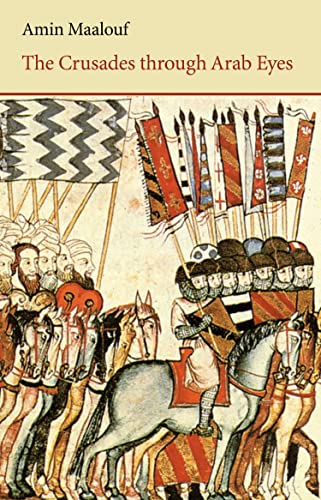
The Crusades Through Arab Eyes
Amin Maalouf
4.3
The author has combed the works of contemporary Arab chronicles of the Crusades, eyewitnesses, and often participants. He retells their story and offers insights into the historical forces that shape Arab and Islamic consciousness today.
Cover unavailable
17
Islam: A Short History
Karen Armstrong
4.3
Cover unavailable
18
Stories of the Prophets
Hafiz Ibn Kathir
4.3
In this book, the stories of the prophets have been compiled from 'Al-Bidayah wan-Nihayah' (The Beginning and the End) which is a great work of the famous Muslim exegete and historian Ibn Kathir and has a prominent place in the Islamic literature. The stories of the prophets and all the events in their lives have been supported by the Qur'anic Verses and the Sunnah (traditions) of the Prophet (S). Wherever it was necessary, other sources have also been reported for the sake of historical accounts, but on such places a comparative study has been made to prove the authenticity of the sources. Ibn Kathir has reproduced the views and interpretations of all the great exegetes of the Qur'an of his time. The systemic narratives of the Stories of the Prophets have been written in chronological order which renders a historical style to the book.
…
Cover unavailable
19
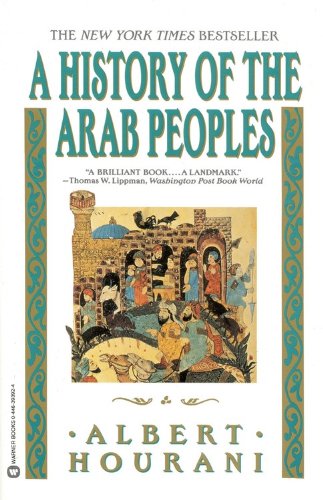
A History of the Arab Peoples
Albert Hourani
4.3
Encyclopedic and panoramic in its scope, this fascinating work chronicles the rich spiritual, political, and cultural institutions of Arab history through 13 centuries.
No region in the world today is more important than the Middle East: no people more misunderstood than the Arabs. In this definitive masterwork, distinguished Oxford historian Albert Hourani offers the most lucid, enlightening history ever written on the subject. From the rise of Islam to the Palestinian issue, from the Prophet Mohammed to Mu'ammar al-Qadhafi. A History of the Arab Peoples chronicles the rich spiritual, political and cultural institutions of this civilization through thirteen centuries of war, peace, literature and religion. Lauded by authorities, encyclopedic and panoramic in its scope, here is a remarkable window on today's conflicts and on the future of a glorious and troubled land.
Hourani picked up on Khaldun’s cyclical notion of the rise and fall of Arab empires, and these almost Weberian notions of loyalty, as the key themes with which to weave a history of the Arab peoples. [source]
Tarek Osman
The key illuminating point is how the culture that has emerged in that part of the world has gathered those people and really united them by a common thread. [source]
Cover unavailable
20
30 days of learning and good deeds: (Islamic books for kids)
Bachar Karroum
4.3
Cover unavailable
21
1453: The Holy War for Constantinople and the Clash of Islam and the West
Roger Crowley
4.3
Now in trade paperback, a gripping exploration of the fall of Constantinople and its connection to the world we live in today The fall of Constantinople in 1453 signaled a shift in history, and the end of the Byzantium Empire. Roger Crowley's readable and comprehensive account of the battle between Mehmed II, sultan of the Ottoman Empire, and Constantine XI, the 57th emperor of Byzantium, illuminates the period in history that was a precursor to the current jihad between the West and the Middle East.
…
Cover unavailable
22
The World's Religions
Huston Smith
4.3
The World’s Religions, by beloved author and pioneering professor Huston Smith (Tales of Wonder), is the definitive classic for introducing the essential elements and teachings of the world's predominant faiths, including Hinduism, Buddhism, Confucianism, Taoism, Judaism, Christianity, Islam, as well as regional native traditions.
This revised and updated edition provides sympathetic descriptions of the various traditions, explaining how they work “from the inside,” which is a big reason why this cherished classic has sold more than two million copies since it first appeared in 1958.
…
Cover unavailable
23
A Peace to End All Peace: The Fall of the Ottoman Empire and The Creation of the Modern Middle East
David Fromkin
4.3
The critically acclaimed New York Times bestselling account of how the modern Middle East came into being after World War I, and why it is in upheaval today
In our time the Middle East has proven a battleground of rival religions, ideologies, nationalisms, and dynasties. All of these conflicts, including the hostilities between Arabs and Israelis that have flared yet again, come down, in a sense, to the extent to which the Middle East will continue to live with its political inheritance: the arrangements, unities, and divisions imposed upon the region by the Allies after the First World War.
In A Peace to End All Peace, David Fromkin reveals how and why the Allies came to remake the geography and politics of the Middle East, drawing lines on an empty map that eventually became the new countries of Iraq, Israel, Jordan, and Lebanon. Focusing on the formative years of 1914 to 1922, when all-even an alliance between Arab nationalism and Zionism-seemed possible he raises questions about what might have been done differently, and answers questions about why things were done as they were. The current battle for a Palestinian homeland has its roots in these events of 85 years ago.
…
Cover unavailable
24
Misquoting Muhammad: The Challenge and Choices of Interpreting the Prophet's Legacy
Jonathan A.C. Brown
4.2
Few things provoke controversy in the modern world like the religion brought by Muhammad. Modern media are replete with alarm over jihad, underage marriage and the threat of amputation or stoning under Shariah law. Sometimes rumor, sometimes based in fact and often misunderstood, the tenets of Islamic law and dogma were not set in the religion’s founding moments. They were developed over centuries by the clerical class of Muslim scholars.
Misquoting Muhammad takes the reader back in time through Islamic civilization and traces how and why such controversies developed, offering an inside view into how key and controversial aspects of Islam took shape. From the protests of the Arab Spring to Istanbul at the fall of the Ottoman Empire, and from the ochre red walls of Delhi’s great mosques to the trade routes of Islam’s Indian Ocean world, Misquoting Muhammad lays out how Muslim intellectuals have sought to balance reason and revelation, weigh science and religion, and negotiate the eternal truths of scripture amid shifting values.
…
Cover unavailable
25
Seven Pillars of Wisdom: A Triumph
T.E. Lawrence
4.2
Seven Pillars of Wisdom is an unusual and rich work. It encompasses an account of the Arab Revolt against the Turks during the First World War alongside general Middle Eastern and military history, politics, adventure and drama. It is also a memoir of the soldier known as 'Lawrence of Arabia'.Lawrence is a fascinating and controversial figure and his talent as a vivid and imaginative writer shines through on every page of this, his masterpiece. Seven Pillars of Wisdom provides a unique portrait of this extraordinary man and an insight into the birth of the Arab nation.
Yes, it’s a book about Lawrence’s experiences during World War I, when he was stationed in North African and the Middle East. He writes about some of the lessons that he learnt from the military leaders from the Allies, and the Bedouin and tribal leaders. The book was influential to me because I can see his contribution as an Arabist. [source]
Someone once asked me, if a fire burnt down my house what would be the one thing I would walk out with? And it’s a first-edition, leather-bound copy of this incredible book signed by my grandfather. My grandfather was himself a surgeon at a casualty clearing station on the Western Front. [source]
Cover unavailable
26
Arabs: A 3,000-Year History of Peoples, Tribes and Empires
Tim Mackintosh-Smith
4.2
A riveting, comprehensive history of the Arab peoples and tribes that explores the role of language as a cultural touchstone
This kaleidoscopic book covers almost 3,000 years of Arab history and shines a light on the footloose Arab peoples and tribes who conquered lands and disseminated their language and culture over vast distances. Tracing this process to the origins of the Arabic language, rather than the advent of Islam, Tim Mackintosh-Smith begins his narrative more than a thousand years before Muhammad and focuses on how Arabic, both spoken and written, has functioned as a vital source of shared cultural identity over the millennia.
Mackintosh-Smith reveals how linguistic developments—from pre-Islamic poetry to the growth of script, Muhammad’s use of writing, and the later problems of printing Arabic—have helped and hindered the progress of Arab history, and investigates how, even in today’s politically fractured post–Arab Spring environment, Arabic itself is still a source of unity and disunity.
…
Cover unavailable
27
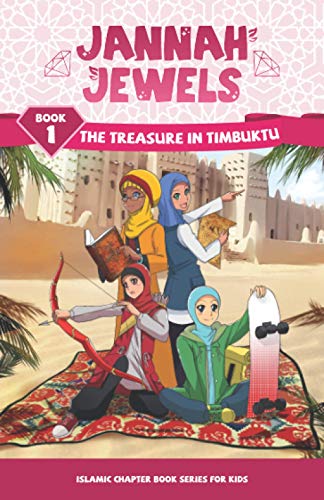
Jannah Jewels Book 1: The Treasure of Timbuktu
N. Rafiq
4.2
The Jannah Jewels land in the ancient city of Timbuktu in Mali. Suddenly, they are caught in the middle of a mystery. Someone has stolen a priceless manuscript! While following clues, they find the Grand Mosque and discover the Treasure King. Who exactly is the Treasure King and can the Jannah Jewels restore the missing manuscript into a Golden Clock before time runs out?
Ghost Wars: The Secret History of the CIA, Afghanistan, and Bin Laden from the Soviet Invasion to September 10, 2001
Steve Coll
4.2
The news-breaking book that has sent shockwaves through the Bush White House, Ghost Wars is the most accurate and revealing account yet of the CIA's secret involvement in al-Qaeda's evolution. It won the Pulitzer Prize in 2005.
Prize-winning journalist Steve Coll has spent years reporting from the Middle East, accessed previously classified government files and interviewed senior US officials and foreign spymasters. Here he gives the full inside story of the CIA's covert funding of an Islamic jihad against Soviet forces in Afghanistan, explores how this sowed the seeds of Bin Laden's rise, traces how he built his global network and brings to life the dramatic battles within the US government over national security. Above all, he lays bare American intelligence's continual failure to grasp the rising threat of terrorism in the years leading to 9/11 - and its devastating consequences.
…
Cover unavailable
31
The Ornament of the World: How Muslims, Jews, and Christians Created a Culture of Tolerance in Medieval Spain
Maria Rosa Menocal
4.2
Undoing the familiar notion of the Middle Ages as a period of religious persecution and intellectual stagnation, María Menocal now brings us a portrait of a medieval culture where literature, science, and tolerance flourished for 500 years.The story begins as a young prince in exile—the last heir to an Islamic dynasty—founds a new kingdom on the Iberian peninsula: al-Andalus. Combining the best of what Muslim, Jewish, and Christian cultures had to offer, al-Andalus and its successors influenced the rest of Europe in dramatic ways, from the death of liturgical Latin and the spread of secular poetry, to remarkable feats in architecture, science, and technology. The glory of the Andalusian kingdoms endured until the Renaissance, when Christian monarchs forcibly converted, executed, or expelled non-Catholics from Spain. In this wonderful book, we can finally explore the lost history whose legacy is still with us in countless ways.
Author Biography: María Rosa Menocal is R. Selden Rose Professor of Spanish and Portuguese and head of the Whitney Humanities Center at Yale University. She lives in New Haven, CT.
…
Recommended by David Marquand.
David Marquand
This had a huge influence on me when I was researching my latest book. I think the biggest threat to the values of pluralist democracy in present day Europe is Islamophobia. There is a very serious danger that this will be to the 21st century what anti-semitism was to the last century. I don’t think it has done so yet, but it could. I found the Rosa Menocal book quite inspiring because of what it showed about the possibility of the Muslim, Christian and Jewish civilisations living together. They managed to co-exist peacefully and to learn from each other in the period that we think of as the Middle Ages or even the Dark Ages the eighth to 16th centuries. [source]
Cover unavailable
32
A Commentary on the Depiction of Prophet Muhammad: Shama'il Muhammadiyyah
Imam al-Tirmidhi
4.2
A Commentary on Imam al-Tirmidhi's Shama'il Muhammadiyyah, the most famous and widely accepted work on the description of the Prophet (sallahu alayhi wa sallam).
Description:
The Shama’il of Imām al-Tirmidhī is one of the most extensive and celebrated works on the description and attributes of the Messenger of Allah (s). The 415 narrations were carefully selected by the great muhaddith to craft a vivid depiction of the Prophet (s). Through this, a portrait of his blessed physical appearance, habits, worship, daily routine, spirituality and much more is painted by those most beloved to him: his noble companions and family members.
To aid the reader in extracting the maximum beauty and wisdom from the narrations, we have carefully selected explanatory gems from over forty classical and contemporary works. Some of the scholars from whom we have taken include: Abdul Razzaq al-Badr, Ibn Hajar al-Asqalanī, Alī al-Qārī, Al-Bajūrī, Ibn Hajar al-Haytamī, Abū Bakr ibn al-‘Arabī , Al-Nawawī, Ibn al-Uthaymīn, Al-Ghazālī, Qadī ‘Iyyād, Ibn Taymiyyah, Ibn al-Qayyim, Al-Shawkānī, Muhammad Amīn al-Shanqītī, Ibn Abdul Barr, Ibn Rajab, Al-Qastalanī, Ibn Kathīr, Abdul Rahman al-Mubarakfūrī, Abū Hafs al-Sūhrawardī, Ibn al-Jawzī, Abdul Muhsin al-Abbad, Al-Suyūtī, Hafith al-Iraqī, Al-San’anī, Ibn Battal, Nasiruddīn al-Albānī and many more.
Ibn Kathīr said, “Scholars authored many titles on the depiction of the Prophet (s), some of which were dedicated books and some of which were chapters in books. From the best books authored about the depiction of the Prophet (s) is the book of Abū 'Īsa, Muhammad ibn 'Īsa al-Sulamī al-Tirmidhi, known as al-Shama'il.” [Al -Bidaya wal Nihayah 8/385]
Abdul Razzaq al-Badr said, "This blessed book is from the best and most beneficial books written about the character and depiction of the Prophet (s) and its author made it such an excellent work through his structuring of it and the hadiths he included therein. This is the reason why many scholars praise the book and consider it from the best books authored about this topic."
…
Cover unavailable
33
The Life of the Prophet Muhammad
Leila Azzam, Aisha Gouverneur, et al.
4.2
This children's book on the life of the Prophet Muhammad is taken from traditional Muslim biographical literature, including hadith. Passages from the Qur'an are used throughout to reinforce the stories. The material is authentic and the style lively and attractive. Although the book has been written for children of 10 to 15 years of age, it can be usefully read by anyone as an introduction because of its completeness and clarity. There are 32 colour illustrations although there has been no attempt to portray either the Prophet or his Companions. The illustrations are representative of traditional Islamic life as lived in many Arab countries and portray scenes that have occurred in those countries for over a thousand years.
…
Cover unavailable
34
Muhammad: A Biography of the Prophet
Karen Armstrong
4.2
A fresh, evenhanded biography of the founder of Islam by the author of "A History of God." "Portrays Muhammad as a passionate, complex, fallible human being."-- "Publishers Weekly"
Cover unavailable
35
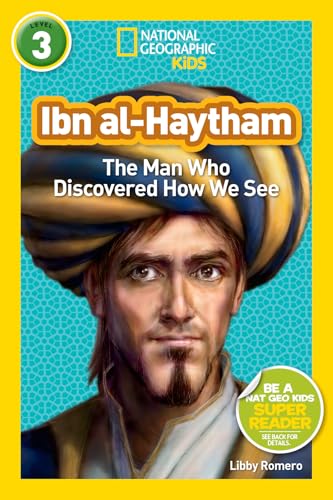
Ibn al-Haytham: The Man Who Discovered How We See
Libby Romero
4.2
Celebrated in a film featuring Omar Sharif in his final role, meet the scientist known as the "Father of Optics," Ibn al-Haytham!
During the golden age of science, knowledge, and invention in Muslim civilization -- also known as the "Dark Ages" in Western Europe -- this incredible scholar discovered how we see and set the stage for the methods we now know as the scientific process. Packed with beautiful and engaging photos, kids will learn all about this fascinating scientist.
The Level 3 text provides accessible, yet wide-ranging, information for independent readers. This book is a companion to the international educational campaign, "1001 Inventions and the World of Ibn al-Haytham," that includes interactive exhibits, workshops, live shows, and a 12-minute film starring Omar Sharif in his final film role before his death.
…
Cover unavailable
36
Return of a King: The Battle for Afghanistan
William Dalrymple
4.2
In the spring of 1839 British forces invaded Afghanistan for the first time, re-establishing Shah Shuja on the throne, in reality as their puppet, and ushering in a period of conflict over the territory still unresolved today. In 1842, the Afghan people rose in answer to the call for jihad against the foreign occupiers, and the country exploded into violent rebellion. In what is arguably the greatest military humiliation ever suffered by the West in the East, more than eighteen thousand cold and hungry British troops, Indian sepoys and camp followers retreated through the icy mountain passes, and of the last survivors who made their final stand at the village of Gandamak, only one man, Dr Brydon, made it through to the British garrison at Jellalabad. An entire army of what was then the most powerful military nation in the world was utterly routed by poorly equipped tribesmen. The West's first disastrous entanglement in Afghanistan has clear and relevant parallels with the current deepening crisis today, with extraordinary similarities between what NATO faces in cities like Kabul and Kandahar, and that faced by the British in the very same cities, fighting the very same tribes, nearly two centuries ago. History at its most urgent, The Return of a King is the definitive analysis of the first Afghan war. With access to a whole range of previously undiscovered sources, including crucial new material in Russian, Urdu and Persian, and contemporary Afghan accounts including the autobiography of Shah Shuja himself, prize-winning and bestselling historian William Dalrymple's masterful retelling of Britain's greatest imperial disaster is a powerful and important parable of neo-colonial ambition and cultural collision, folly and hubris, for our times.
…
Cover unavailable
37
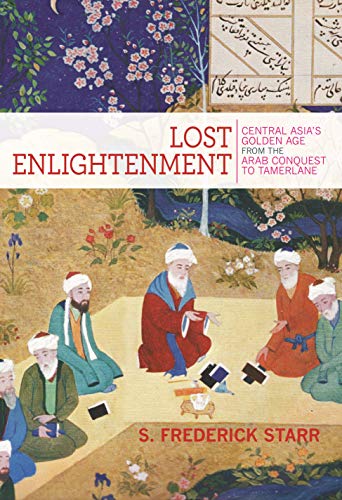
Lost Enlightenment: Central Asia's Golden Age from the Arab Conquest to Tamerlane
S. Frederick Starr
4.2
In this sweeping and richly illustrated history, S. Frederick Starr tells the fascinating but largely unknown story of Central Asia's medieval enlightenment through the eventful lives and astonishing accomplishments of its greatest minds--remarkable figures who built a bridge to the modern world. Because nearly all of these figures wrote in Arabic, they were long assumed to have been Arabs. In fact, they were from Central Asia--drawn from the Persianate and Turkic peoples of a region that today extends from Kazakhstan southward through Afghanistan, and from the easternmost province of Iran through Xinjiang, China.
Lost Enlightenment recounts how, between the years 800 and 1200, Central Asia led the world in trade and economic development, the size and sophistication of its cities, the refinement of its arts, and, above all, in the advancement of knowledge in many fields. Central Asians achieved signal breakthroughs in astronomy, mathematics, geology, medicine, chemistry, music, social science, philosophy, and theology, among other subjects. They gave algebra its name, calculated the earth's diameter with unprecedented precision, wrote the books that later defined European medicine, and penned some of the world's greatest poetry. One scholar, working in Afghanistan, even predicted the existence of North and South America--five centuries before Columbus. Rarely in history has a more impressive group of polymaths appeared at one place and time. No wonder that their writings influenced European culture from the time of St. Thomas Aquinas down to the scientific revolution, and had a similarly deep impact in India and much of Asia.
Lost Enlightenment chronicles this forgotten age of achievement, seeks to explain its rise, and explores the competing theories about the cause of its eventual demise. Informed by the latest scholarship yet written in a lively and accessible style, this is a book that will surprise general readers and specialists alike.
-- "Library Journal"
…
Cover unavailable
38
In the Shadow of the Sword: The Birth of Islam and the Rise of the Global Arab Empire
Tom Holland
4.2
The acclaimed author of Rubicon and other superb works of popular history now produces a thrillingly panoramic (and incredibly timely) account of the rise of Islam.
No less significant than the collapse of the Roman Republic or the Persian invasion of Greece, the evolution of the Arab empire is one of the supreme narratives of ancient history, a story dazzlingly rich in drama, character, and achievement. Just like the Romans, the Arabs came from nowhere to carve out a stupefyingly vast dominion—except that they achieved their conquests not over the course of centuries as the Romans did but in a matter of decades. Just like the Greeks during the Persian wars, they overcame seemingly insuperable odds to emerge triumphant against the greatest empire of the day—not by standing on the defensive, however, but by hurling themselves against all who lay in their path.
…
Cover unavailable
39
Women and Gender in Islam: Historical Roots of a Modern Debate
Leila Ahmed
4.2
Are Islamic societies inherently oppressive to women? Is the trend among Islamic women to appear once again in veils and other traditional clothing a symbol of regression or an effort to return to a “pure” Islam that was just and fair to both sexes? In this book Leila Ahmed adds a new perspective to the current debate about women and Islam by exploring its historical roots, tracing the developments in Islamic discourses on women and gender from the ancient world to the present.
In order to distinguish what was distinctive about the earliest Islamic doctrine on women, Ahmed first describes the gender systems in place in the Middle East before the rise of Islam. She then focuses on those Arab societies that played a key role in elaborating the dominant Islamic discourses about women and gender: Arabia during the period in which Islam was founded; Iraq during the classical age, when the prescriptive core of legal and religious discourse on women was formulated; and Egypt during the nineteenth and twentieth centuries, when exposure to Western societies led to dramatic social change and to the emergence of new discourses on women. Throughout, Ahmed not only considers the Islamic texts in which central ideologies about women and gender developed or were debated but also places this discourse in its social and historical context. Her book is thus a fascinating survey of Islamic debates and ideologies about women and the historical circumstances of their position in society, the first such discussion using the analytic tools of contemporary gender studies.
Arabic lessons to help in understanding the Koranic text.
Cover unavailable
41
A History of Islamic Societies
Ira M. Lapidus
4.2
Cover unavailable
42
The Travels of Ibn Battutah
Tim Mackintosh-Smith
4.2
Ibn Battutah was just 21 when he set out in 1325 from his native Tangier on a pilgrimage to Mecca. He did not return to Morocco for another 29 years, traveling instead through more than 40 countries on the modern map, covering 75,000 miles and getting as far north as the Volga, as far east as China, and as far south as Tanzania. He wrote of his travels, and comes across as a superb ethnographer, biographer, anecdotal historian, and occasional botanist and gastronome. With this edition by Mackintosh-Smith, Battuta's Travels takes its place alongside other indestructible masterpieces of the travel-writing genre.
…
Recommended by Tim Mackintosh-Smith and Ziauddin Sardar.
Tim Mackintosh-Smith
If you read this book, it seems quite chaotic, but there is an underlying structure to it. I think there are two elements to this structure. [source]
Ziauddin Sardar
Travel is both a physical and a mental exercise – it is about immersing yourself in another culture. Travelling is the process of letting go of yourself and immersing yourself into different ways of knowing and seeing. If you cannot do this, you haven’t travelled. It’s certainly not a holiday – travelling is not staying in five-star hotels. [source]
Cover unavailable
43
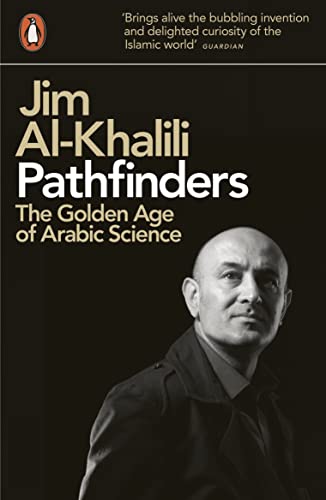
Pathfinders: The Golden Age of Arabic Science
Jim Al-Khalili
4.2
In Pathfinders: The Golden Age of Arabic Science, Jim al-Khalili celebrates the forgotten pioneers who helped shape our understanding of the world.
For over 700 years the international language of science was Arabic. Surveying the golden age of Arabic science, Jim Al-Khalili reintroduces such figures as the Iraqi physicist Ibn al-Haytham, who practised the modern scientific method over half a century before Bacon; al-Khwarizmi, the greatest mathematician of the medieval world; and Abu Rayhan al-Biruni, a Persian polymath to rival Leonardo da Vinci.
'Jim Al-Khalili has a passion for bringing to a wider audience not just the facts of science but its history ... Just as the legacy of Copernicus and Darwin belongs to all of us, so does that of Ibn Sina and Ibn al-Haytham' Independent
'He has brought a great story out of the shadows' Literary Review
'His command of Arabic and mathematical physics invests his story with sympathy as well as authority' Guardian
'A fascinating and user-friendly guide' Sunday Telegraph
'This captivating book is a timely reminder of the debt owed by the West to the intellectual achievements of Arab, Persian and Muslim scholars' The Times
Jim Al-Khalili OBE is Professor of Physics at the University of Surrey, where he also holds the first Surrey chair in the public engagement in science. He was awarded the Royal Society Michael Faraday Prize for science communication in 2007, elected Honorary Fellow of the British Association for the Advancement of Science and has also received the Institute of Physic's Public Awareness of Physics Award. Born in Baghdad, Jim was educated in Iraq until the age of 16 and it was there, being taught by Arabic teachers in Arabic that he first heard and learnt about the great Arab scientists and philosophers.
…
Recommended by Andrew Lawrence.
Andrew Lawrence
This is a history book, but about the history of science. It was an eye opener to me because I thought I knew about Arabic science and I didn’t. The story that most scientists will tell you is, “First there were the Greeks who did these wonderful things, and then later on there was the Renaissance and the Scientific Revolution. In between the Arabs and Islam held the torch.” The picture you get is that they kept the knowledge alive between Aristotle and Newton as it were and passed the torch down by transmitting what the Greeks had done. [source]
Cover unavailable
44
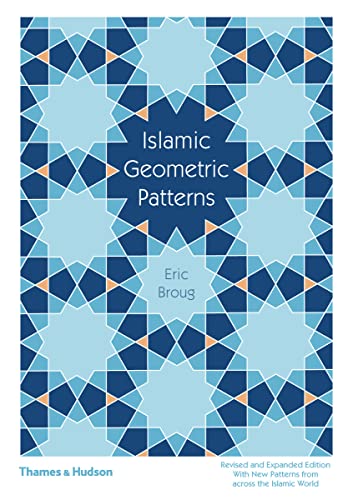
Islamic Geometric Patterns
Eric Broug
4.2
Cover unavailable
45
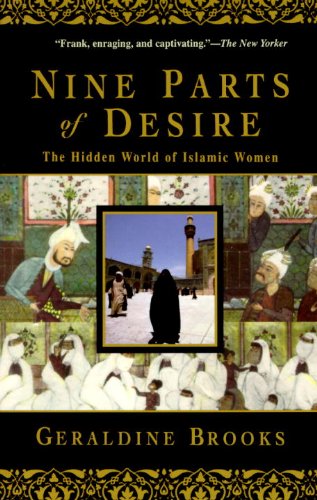
Nine Parts of Desire: The Hidden World of Islamic Women
Geraldine Brooks
4.2
With a New Afterword
As a prizewinning foreign correspondent for The Wall Street Journal, Geraldine Brooks spent six years covering the Middle East through wars, insurrections, and the volcanic upheaval of resurgent fundamentalism. Yet for her, headline events were only the backdrop to a less obvious but more enduring drama: the daily life of Muslim women. Nine Parts of Desireis the story of Brooks' intrepid journey toward an understanding of the women behind the veils, and of the often contradictory political, religious, and cultural forces that shape their lives. Defying our stereotypes about the Muslim world, Brooks' acute analysis of the world's fastest growing religion deftly illustrates how Islam's holiest texts have been misused to justify repression of women, and how male pride and power have warped the original message of a once liberating faith.
…
Cover unavailable
46
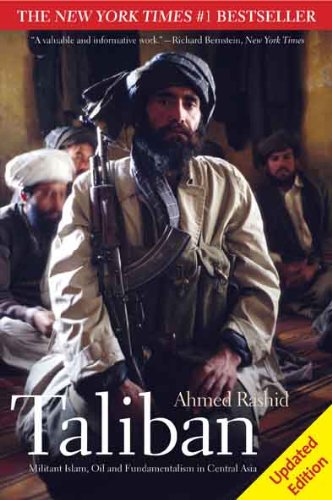
Taliban: Militant Islam, Oil and Fundamentalism in Central Asia
Ahmed Rashid
4.2
Correspondent Ahmed Rashid brings the shadowy world of the Taliban—the world’s most extreme & radical Islamic organization—into sharp focus in this enormously insightful book. He offers the only authoritative account of the Taliban available to English-language readers, explaining the Taliban’s rise to power, its impact on Afghanistan & the region, its role in oil & gas company decisions, & the effects of changing American attitudes toward the Taliban. He also describes the new face of Islamic fundamentalism & explains why Afghanistan has become the world center for international terrorism. New to this updated edition of the #1 NY Times Bestseller with more than 1.5 million copies sold worldwide: How the Taliban has regained its strength. How & why the Taliban has spread across Central Asia. How the Taliban has helped Al’Qaida’s spread into Europe, North Africa, the Middle East & the Far East. Why the Afghan people feel the United States is losing the war. A major new introduction and an all-new final chapter.
…
Recommended by Jonathan Powell.
Jonathan Powell
9/11 was a big shock. When the first plane hit I thought it was an accident. When I was told of a second plane, I assumed it was a loop on the film. Once I knew the truth, I spent the rest of the day dealing with the consequences and trying to make sure the UK wasn’t under attack. [source]
Cover unavailable
47
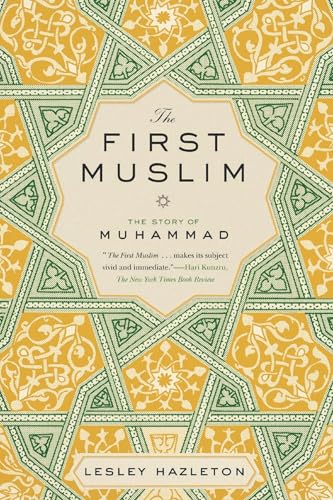
The First Muslim: The Story of Muhammad
Lesley Hazleton
4.2
The extraordinary life of the man who founded Islam, and the world he inhabited—and remade.
Look out for Lesley Hazleton's new book, Agnostic: A Spirited Manifesto, coming in February 2016.
Muhammad’s was a life of almost unparalleled historical importance; yet for all the iconic power of his name, the intensely dramatic story of the prophet of Islam is not well known. In The First Muslim, Lesley Hazleton brings him vibrantly to life. Drawing on early eyewitness sources and on history, politics, religion, and psychology, she renders him as a man in full, in all his complexity and vitality.
Hazleton’s account follows the arc of Muhammad’s rise from powerlessness to power, from anonymity to renown, from insignificance to lasting significance. How did a child shunted to the margins end up revolutionizing his world? How did a merchant come to challenge the established order with a new vision of social justice? How did the pariah hounded out of Mecca turn exile into a new and victorious beginning? How did the outsider become the ultimate insider?
Impeccably researched and thrillingly readable, Hazleton’s narrative creates vivid insight into a man navigating between idealism and pragmatism, faith and politics, nonviolence and violence, rejection and acclaim. The First Muslim illuminates not only an immensely significant figure but his lastingly relevant legacy.
…
Cover unavailable
48
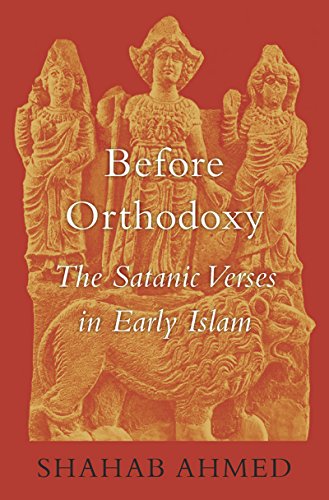
Before Orthodoxy: The Satanic Verses in Early Islam
Shahab Ahmed
4.1
One of the most controversial episodes in the life of the Prophet Muhammad concerns an incident in which he allegedly mistook words suggested by Satan as divine revelation. Known as the Satanic verses, these praises to the pagan deities contradict the Islamic belief that Allah is one and absolute. Muslims today--of all sects--deny that the incident of the Satanic verses took place. But as Shahab Ahmed explains, Muslims did not always hold this view.
Before Orthodoxy wrestles with the question of how religions establish truth--especially religions such as Islam that lack a centralized authority to codify beliefs. Taking the now universally rejected incident of the Satanic verses as a case study in the formation of Islamic orthodoxy, Ahmed shows that early Muslims, circa 632 to 800 CE, held the exact opposite belief. For them, the Satanic verses were an established fact in the history of the Prophet. Ahmed offers a detailed account of the attitudes of Muslims to the Satanic verses in the first two centuries of Islam and traces the chains of transmission in the historical reports known as riwāyah.
Touching directly on the nature of Muhammad's prophetic visions, the interpretation of the Satanic verses incident is a question of profound importance in Islam, one that plays a role in defining the limits of what Muslims may legitimately say and do--issues crucial to understanding the contemporary Islamic world.
…
Cover unavailable
49
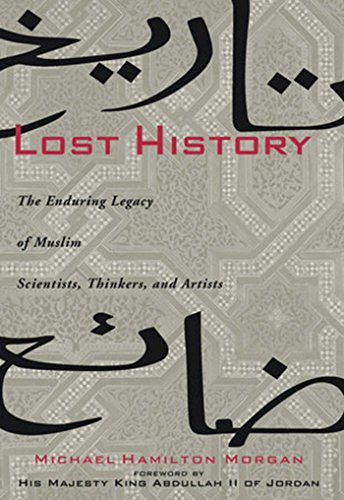
Lost History: The Enduring Legacy of Muslim Scientists, Thinkers, and Artists
Michael H. Morgan
4.1
In an era when the relationship between Islam and the West seems mainly defined by mistrust and misunderstanding, we often forget that for centuries Muslim civilization was the envy of the world. Essential reading for anyone seeking to understand the major role played by the early Muslim world in influencing modern society, Lost History fills an important void. Written by an award-winning author and former diplomat with extensive experience in the Muslim world, it provides new insight not only into Islam's historic achievements but also the ancient resentments that fuel today's bitter conflicts.
Michael Hamilton Morgan reveals how early Muslim advancements in science and culture lay the cornerstones of the European Renaissance, the Enlightenment, and modern Western society. As he chronicles the Golden Ages of Islam, beginning in 570 a.d. with the birth of Muhammad, and resonating today, he introduces scholars like Ibn Al-Haytham, Ibn Sina, Al-Tusi, Al-Khwarizmi, and Omar Khayyam, towering figures who revolutionized the mathematics, astronomy, and medicine of their time and paved the way for Newton, Copernicus, and many others. And he reminds us that inspired leaders from Muhammad to Suleiman the Magnificent and beyond championed religious tolerance, encouraged intellectual inquiry, and sponsored artistic, architectural, and literary works that still dazzle us with their brilliance. Lost History finally affords pioneering leaders with the proper credit and respect they so richly deserve.
…
Cover unavailable
50
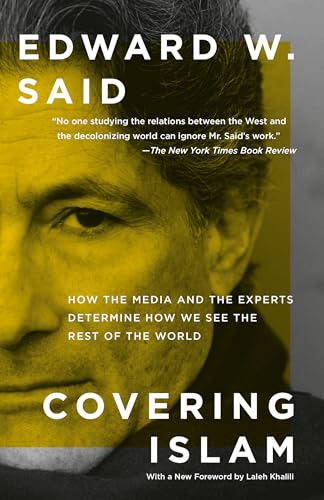
Covering Islam: How the Media and the Experts Determine How We See the Rest of the World
Edward W. Said
4.1
From the Iranian hostage crisis through the Gulf War and the bombing of the World Trade Center, the American news media have portrayed "Islam" as a monolithic entity, synonymous with terrorism and religious hysteria. In this classic work, now updated, the author of Culture and Imperialism reveals the hidden agendas and distortions of fact that underlie even the most "objective" coverage of the Islamic world.
…
Recommended by Issandr El Amrani and Lorraine Adams.
Issandr El Amrani
This book, although less intellectually challenging than Orientalism, is very important as well. In a sense it is even more important. [source]
Lorraine Adams
He insisted that news is partial and dependent on official interpretation that may serve a private interest rather than a national interest. [source]
Cover unavailable
51
The Sufis
Idries Shah
4.1
When it first appeared in 1964, The Sufis was welcomed as the decisive work on the subject of Sufi Thought. Rich in scope, author Idries Shah explained clearly the traditions and philosophy of the Sufis to a Western audience for the first time. In the five decades since its release, the book has been translated into more than two dozen languages, and has found a wide readership in both East and West. Containing detailed information on the major Sufi thinkers, and literary characters, such as Nasrudin, it is regarded as a key work on both Sufism and Eastern Philosophy. A text in scores of leading universities around the world for courses on Sufism, Eastern thought and Islamic philosophy, The Sufis has been used by psychologists and physicists, by school teachers, lawyers, social workers, and by ordinary members of the public.
…
Cover unavailable
52
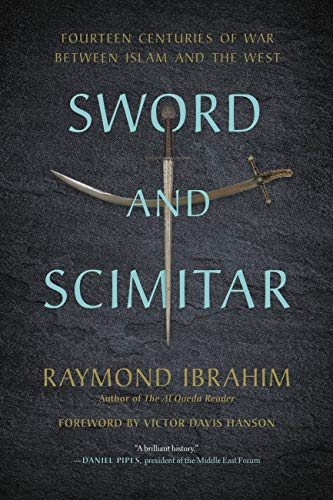
Sword and Scimitar: Fourteen Centuries of War between Islam and the West
Raymond Ibrahim
4.1
A sweeping history of the often-violent conflict between Islam and the West, shedding a revealing light on current hostilities
The West and Islam--the sword and the scimitar--have clashed since the mid-seventh century, when, according to Muslim tradition, the Byzantine emperor rejected Prophet Muhammad's order to abandon Christianity and convert to Islam, unleashing a centuries-long jihad on Christendom.
Sword and Scimitar chronicles the significant battles that arose from this ages-old Islamic jihad, beginning with the first major Islamic attack on Christian land in 636, through the occupation of the Middle East that prompted the Crusades and the far-flung conquests of the Ottoman Turks, to the European colonization of the Muslim world in the 1800s, when Islam largely went on the retreat--until its reemergence in recent times. Using original sources in Arabic, Greek, Latin, and Turkish, preeminent historian Raymond Ibrahim describes each battle in vivid detail and explains the effect the outcome had on larger historical currents of the age and how the military lessons of the battle reflect the cultural faultlines between Islam and the West.
The majority of these landmark battles are now forgotten or considered inconsequential. Yet today, as the West faces a resurgence of this enduring Islamic jihad, Sword and Scimitar provides the needed historical context to understand the current relationship between the West and the Islamic world, and why the Islamic State is merely the latest chapter of an old history.
…
Cover unavailable
53
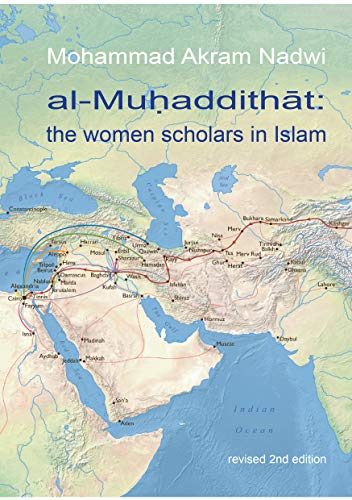
Al-Muhaddithat: The Women Scholars in Islam
Muḥammad Akram Nadwī
4.1
This book is an adaptation in English of the prefatory volume of a 40-volume biographical dictionary (in Arabic) of women scholars of the Prophet s hadith. Learned women enjoyed high public standing and authority in the formative years of Islam. For centuries thereafter, women travelled intensively for religious knowledge and routinely attended the most prestigious mosques and madrasas across the Islamic world. Typical documents (like class registers and ijazahs from women authorizing men to teach) and the glowing testimonies about their women teachers from the most revered ulema are cited in detail. An overview chapter, with accompanying maps, traces the spread of centres of hadith learning for women, and their eventual decline. The information summarized here is essential to a balanced appreciation of the role of women in Islamic society.
…
Cover unavailable
54
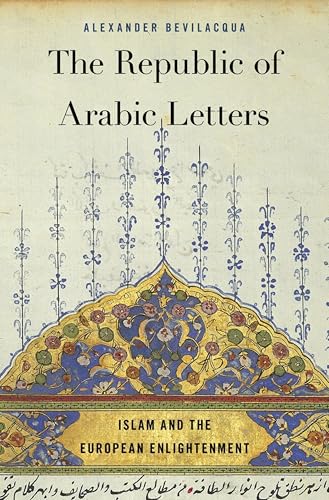
The Republic of Arabic Letters: Islam and the European Enlightenment
Alexander Bevilacqua
4.1
In the seventeenth and eighteenth centuries, a pioneering community of Christian scholars laid the groundwork for the modern Western understanding of Islamic civilization. These men produced the first accurate translation of the Qur’an into a European language, mapped the branches of the Islamic arts and sciences, and wrote Muslim history using Arabic sources. The Republic of Arabic Letters reconstructs this process, revealing the influence of Catholic and Protestant intellectuals on the secular Enlightenment understanding of Islam and its written traditions.
Drawing on Arabic, English, French, German, Italian, and Latin sources, Alexander Bevilacqua’s rich intellectual history retraces the routes―both mental and physical―that Christian scholars traveled to acquire, study, and comprehend Arabic manuscripts. The knowledge they generated was deeply indebted to native Muslim traditions, especially Ottoman ones. Eventually the translations, compilations, and histories they produced reached such luminaries as Voltaire and Edward Gibbon, who not only assimilated the factual content of these works but wove their interpretations into the fabric of Enlightenment thought.
The Republic of Arabic Letters shows that the Western effort to learn about Islam and its religious and intellectual traditions issued not from a secular agenda but from the scholarly commitments of a select group of Christians. These authors cast aside inherited views and bequeathed a new understanding of Islam to the modern West.
How Islam Shaped the Enlightenment - By JACOB SOLL review of ISLAM AND THE EUROPEAN ENLIGHTENMENT by Alexander Bevilacqua A new book recovers the work of scholars who helped establish greater understanding between religions. Great review. https://t.co/x2kpa77S6o [source]
Terrific book - great to see it out in p/back @ABevilacqua7 👏👏👏 https://t.co/GWYKe8t80e [source]
Cover unavailable
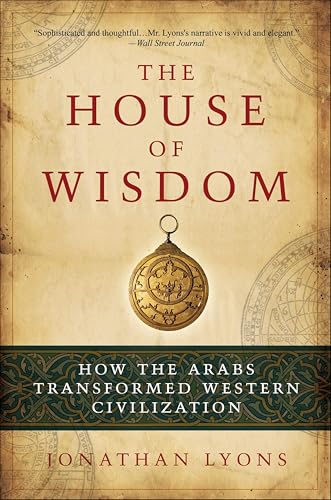
55
The House Of Wisdom
Jonathan Lyons
4.1
The remarkable story of how medieval Arab scholars made dazzling advances in science and philosophy—and of the itinerant Europeans who brought this knowledge back to the West.
For centuries following the fall of Rome, western Europe was a benighted backwater, a world of subsistence farming, minimal literacy, and violent conflict. Meanwhile Arab culture was thriving, dazzling those Europeans fortunate enough to catch even a glimpse of the scientific advances coming from Baghdad, Antioch, or the cities of Persia, Central Asia, and Muslim Spain. T here, philosophers, mathematicians, and astronomers were steadily advancing the frontiers of knowledge and revitalizing the works of Plato and Aristotle. I n the royal library of Baghdad, known as the House of Wisdom, an army of scholars worked at the behest of the Abbasid caliphs. At a time when the best book collections in Europe held several dozen volumes, the House of Wisdom boasted as many as four hundred thousand.
Even while their countrymen waged bloody Crusades against Muslims, a handful of intrepid Christian scholars, thirsty for knowledge, traveled to Arab lands and returned with priceless jewels of science, medicine, and philosophy that laid the foundation for the Renaissance. I n this brilliant, evocative book, Lyons shows just how much "Western" culture owes to the glories of medieval Arab civilization, and reveals the untold story of how Europe drank from the well of Muslim learning.
…
Cover unavailable
56
Seeing Islam as Others Saw It: A Survey and Evaluation of Christian, Jewish, and Zoroastrian Writings on Early Islam
Robert G. Hoyland
4.1
This book offers a new approach to the vexing question of how to write the early history of Islam. The first part discusses the nature of the Muslim and non-Muslim source material for the seventh- and eighth-century Middle East and argues that by lessening the divide between these two traditions, which has largely been erected by modern scholarship, we can come to a better appreciation of this crucial period. The second part gives a detailed survey of sources and an analysis of some 120 non-Muslim texts, all of which provide information about the first century and a half of Islam (roughly A.D. 620-780). The third part furnishes examples, according to the approach suggested in the first part and with the material presented in the second part, how one might write the history of this time. The fourth part takes the form of excurses on various topics, such as the process of Islamization, the phenomenon of conversion to Islam, the development of techniques for determining the direction of prayer, and the conquest of Egypt.
Because this work views Islamic history with the aid of non-Muslim texts and assesses the latter in the light of Muslim writings, it will be essential reading for historians of Islam, Christianity, Judaism, or Zoroastrianism--indeed, for all those with an interest in cultures of the eastern Mediterranean in its traditional phase from Late Antiquity to medieval times.
…
Cover unavailable
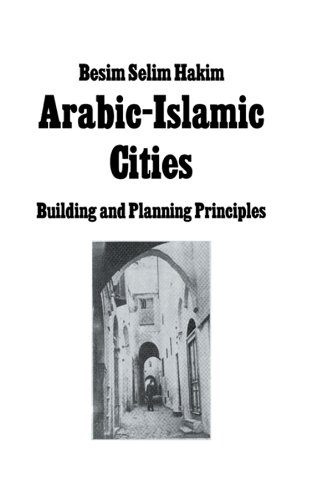
57
Arabic-Islamic Cities: Building and Planning Principles
Besim S. Hakim
4.1
This is a pioneering study of how traditional towns and cities were conceived, organized, and developed over long periods of time following simple rules that were based on the society's norms and ethical values. Sources were used that date back to the fourteenth century and earlier. Although the study is embedded in the Arab-Islamic culture of North Africa and the Middle East, its implications are universal particularly in light of scientific discoveries of natural processes and the underlying principles of complexity theory and the processes that bring about emergence. Generative processes that shaped urban form are clearly demonstrated in the book. The study also sheds light on the implications of responsibility allocation to the various parties who are involved in the development process and the resulting patterns of decision-making that affect change and growth in the built environment. All of these issues are of significance when trying to understand the concepts that relate to various aspects of sustainability, the future potential of eco-cities, and the nature of policies and programs that are required for the immediate present and for the future. This work is a major contribution for enhancing the theories and practice of urban planning and design.
…
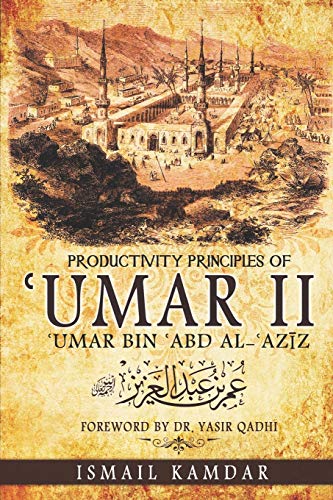
Cover unavailable
58
Umar Bin Abdul Aziz
Ismail Kamdar and Yasir Qadhi
4.1
This book describes, among other things, the principles based upon which 'Umar ibn Abd Al-Aziz governed the Muslims during his caliphate: among those principles were mutual consultation, justice, equality among people, and honoring of freedoms. With the turn of every page, the reader will come to appreciate the fact that 'Umar was exceptional in his Faith, distinguished in his knowledge, profoundly wise in his thinking, remarkable in his eloquence, noble in his manners and great in the contribution he made to this Nation. English readers have long been deprived of the life story of this outstanding Islamic hero and exemplar. While there are some short and scattered accounts about his general life, this is the first book to deal specifically with 'Umar bin 'Abd al-Aziz's reforms, which is surprising given that he has been attributed the title of Mujaddid (Reformer; Reviver) within Islamic scholarship, in great detail.
…
Cover unavailable
59
The Eye of the Beholder: The Life of Muhammad As Viewed by the Early Muslims--A Textual Analysis (Studies in Late Antiquity and Early Islam, Vol. 5) (Studies in Late Antiquity and Early Islam)
Uri Rubin
4.1
Cover unavailable
60
The Politically Incorrect Guide to Islam (and the Crusades)
Robert Spencer
4.1
"The courageous Robert Spencer busts myths and tells truths about jihadists that no one else will tell." —MICHELLE MALKIN
While many choose to simply blame the West for provoking terrorists, Robert Spencer’s new book The Politically Incorrect Guide to Islam (and the Crusades)™ reveals why it is time to ignore political correctness and identify the enemy - if we hope to ever defeat them.
In a fast-paced, politically incorrect tour of Islamic teachings and Crusades history, Spencer reveals the roots of Islamic violence and hatred. Spencer refutes the myths popularized by left-wing academics and Islamic apologists who justify their political agendas with contrived historical “facts.”
Exposing myth after myth, The Politically Incorrect Guide to Islam (and the Crusades)™ tackles Islam’s institutionalized mistreatment of non-Muslims, the stifling effect Islam has on science and free inquiry, the ghastly lure of Islam’s X-rated Paradise for suicide bombers and jihad terrorists, the brutal Islamic conquests of the Christian lands of the Middle East and North Africa, and more.
InThe Politically Incorrect Guide to Islam (and the Crusades)™, you will learn:
How Muhammad did not teach “peace and tolerance”—instead he led armies and ordered the assassination of his enemies Why American Muslim groups and left-wing academics are engaged in a huge cover-up of Islamic doctrine and historyHow today’s jihad terrorists following the Qur’an’s command to make war on Jews and Christians have the same motives and goals as the Muslims who fought the Crusaders Why the Crusades were not acts of unprovoked aggression by Europe against the Islamic world, but a delayed response to centuries of Muslim aggression What must be done today—from reading the Qur’an to reclassifying Muslim organizations—in order to defeat jihad terrorists
…
Cover unavailable
61
Ibn Fadlān and the Land of Darkness: Arab Travellers in the Far North
Ibn Fadlan, Paul Lunde, Caroline Stone
4.1
In 922 AD, an Arab envoy from Baghdad named Ibn Fadlan encountered a party of Viking traders on the upper reaches of the Volga River. In his subsequent report on his mission he gave a meticulous and astonishingly objective description of Viking customs, dress, table manners, religion and sexual practices, as well as the only eyewitness account ever written of a Viking ship cremation.
Between the ninth and fourteenth centuries, Arab travellers such as Ibn Fadlan journeyed widely and frequently into the far north, crossing territories that now include Russia, Uzbekistan and Kazakhstan. Their fascinating accounts describe how the numerous tribes and peoples they encountered traded furs, paid tribute and waged wars. This accessible new translation offers an illuminating insight into the world of the Arab geographers, and the medieval lands of the far north.
In the early 10th century, Ibn Fadlan is sent on a mission to Vulgar Bulgaria, which is a long way into the north of Russia. He reports on all the different peoples he meets on the way. [source]
Cover unavailable
62
The Fall of Constantinople 1453
Steven Runciman
4.1
This classic account shows how the fall of Constantinople in May 1453, after a siege of several weeks, came as a bitter shock to Western Christendom. The city's plight had been neglected, and negligible help was sent in this crisis. To the Turks, victory not only brought a new imperial capital, but guaranteed that their empire would last. To the Greeks, the conquest meant the end of the civilisation of Byzantium, and led to the exodus of scholars stimulating the tremendous expansion of Greek studies in the European Renaissance.
"... an excellent tale, full of suspense and pathos... He [Sir Steven Runciman] tells the story and, as always, tells it very elegantly." - History
"This is a marvel of learning lightly worn..." - The Guardian
…
Cover unavailable
63
The Fall of the Ottomans: The Great War in the Middle East
Eugene Rogan
4.1
In 1914 the Ottoman Empire was depleted of men and resources after years of war against Balkan nationalist and Italian forces. But in the aftermath of the assassination in Sarajevo, the powers of Europe were sliding inexorably toward war, and not even the Middle East could escape the vast and enduring consequences of one of the most destructive conflicts in human history. The Great War spelled the end of the Ottomans, unleashing powerful forces that would forever change the face of the Middle East.
In The Fall of the Ottomans, award-winning historian Eugene Rogan brings the First World War and its immediate aftermath in the Middle East to vivid life, uncovering the often ignored story of the region's crucial role in the conflict. Bolstered by German money, arms, and military advisors, the Ottomans took on the Russian, British, and French forces, and tried to provoke Jihad against the Allies in their Muslim colonies. Unlike the static killing fields of the Western Front, the war in the Middle East was fast-moving and unpredictable, with the Turks inflicting decisive defeats on the Entente in Gallipoli, Mesopotamia, and Gaza before the tide of battle turned in the Allies' favor. The great cities of Baghdad, Jerusalem, and, finally, Damascus fell to invading armies before the Ottomans agreed to an armistice in 1918.
The postwar settlement led to the partition of Ottoman lands between the victorious powers, and laid the groundwork for the ongoing conflicts that continue to plague the modern Arab world. A sweeping narrative of battles and political intrigue from Gallipoli to Arabia, The Fall of the Ottomans is essential reading for anyone seeking to understand the Great War and the making of the modern Middle East.
…
Cover unavailable
64
Myanmar's Buddhist-Muslim Crisis: Rohingya, Arakanese, and Burmese Narratives of Siege and Fear
John Clifford Holt
4.1
Myanmar's Buddhist-Muslim Crisis is a probing search into the reasons and rationalizations behind the violence occurring in Myanmar, especially the oppressive military campaigns waged against Rohingya Muslims by the army in 2016 and 2017. Over more than three years John Holt traveled around Myanmar engaging in sustained conversations with prominent and articulate participants and observers. What emerges from his peregrinations is a series of compelling portraits revealing both deep insights and entrenched misunderstandings.
To understand the conflict, Holt must first accurately capture the viewpoints of his different conversation partners, who include Buddhists and Muslims, men and women, monks and laypeople, activists and scholars. Conversations range widely over issues such as the rise of Buddhist nationalism; the sometimes enigmatic and unexpected positions taken by Aung San Suu Kyii; use of the controversial term "Rohingya"; the impact of state-sponsored propaganda on the Burmese public; resistance to narratives emanating from international media, the United Nations, and the international diplomatic community; the frustrations of local political leaders who have felt left out of the policy-making process in the Rakhine State; and the constructive hopes and efforts still being made by forward-looking activists in Yangon. Three main perspectives emerge from the voices he listens to, those of Arakanese Buddhists who are native to Rakhine (once called Arakan), where much of the conflict has taken place; Burmese Buddhists (or Bamars), who make up the vast majority of Myanmar's population; and the Rohingya Muslims, whose tragic story has been widely disseminated by the international media.
What surfaces in conversation after conversation among all three groups is a narrative of siege: all see themselves as the aggrieved party, and all recount a history of being under siege. John Holt gives voice to these different perspectives as an engaged and concerned participant, offering both a critical and empathetic account of Myanmar's tragic predicament. Readers follow the hopes and dismay of this seasoned scholar of Theravada Buddhism as he seeks his own understanding of the variously impassioned forces in play in this still unfolding drama.
…
Cover unavailable
65
The World of Late Antiquity 150-750
Peter Brown, Geoffrey Barraclough
4.1
This remarkable study in social and cultural change explains how and why the Late Antique world, between c. 150 and c. 750, came to differ from "Classical civilization."
These centuries, as the author demonstrates, were the era in which the most deeply rooted of ancient institutions disappeared for all time. By 476 the Roman empire had vanished from western Europe; by 655 the Persian empire had vanished from the Near East.
Peter Brown, Professor of History at Princeton University, examines these changes and men's reactions to them, but his account shows that the period was also one of outstanding new beginnings and defines the far-reaching impact both of Christianity on Europe and of Islam on the Near East. The result is a lucid answer to a crucial question in world history; how the exceptionally homogeneous Mediterranean world of c. 200 became divided into the three mutually estranged societies of the Middle Ages: Catholic Western Europe, Byzantium and Islam. We still live with the results of these contrasts.
What I like about this book is that it is focused on cultural, religious and philosophical changes, particularly in the Greek-speaking world where they were strongest. [source]
Cover unavailable
66
Aristotle's Children: How Christians, Muslims, and Jews Rediscovered Ancient Wisdom and Illuminated the Middle Ages
Richard E. Rubenstein
4.1
Europe was in the long slumber of the Middle Ages, the Roman Empire was in tatters, and the Greek language was all but forgotten, until a group of twelfth-century scholars rediscovered and translated the works of Aristotle. His ideas spread like wildfire across Europe, offering the scientific view that the natural world, including the soul of man, was a proper subject of study. The rediscovery of these ancient ideas sparked riots and heresy trials, caused major upheavals in the Catholic Church, and also set the stage for today's rift between reason and religion.
In Aristotle's Children, Richard Rubenstein transports us back in history, rendering the controversies of the Middle Ages lively and accessible-and allowing us to understand the philosophical ideas that are fundamental to modern thought.
…
Recommended by Edith Hall.
Edith Hall
I really enjoyed this book. I learnt a huge amount from it, and I found it fun to read, but also because its author has an agenda which goes beyond telling the story of Aristotle. [source]
Cover unavailable
67
The Venture of Islam, Vol 3: The Gunpowder Empires and Modern Times
Marshall G. S. Hodgson
4.1
The Venture of Islam has been honored as a magisterial work of the mind since its publication in early 1975. In this three-volume study, illustrated with charts and maps, Hodgson traces and interprets the historical development of Islamic civilization from before the birth of Muhammad to the middle of the twentieth century. This work grew out of the famous course on Islamic civilization that Hodgson created and taught for many years at the University of Chicago.
In this concluding volume of The Venture of Islam, Hodgson describes the second flowering of Islam: the Safavi, Timuri, and Ottoman empires. The final part of the volume analyzes the widespread Islamic heritage in today's world.
"This is a nonpareil work, not only because of its command of its subject but also because it demonstrates how, ideally, history should be written."—The New Yorker
…
Cover unavailable
68
ثلاثية غرناطة
رضوى عاشور Radwa Ashour
4.1
ثلاثية غرناطة هي ثلاثية روائية تتكون من ثلاث روايات للكاتبة المصرية رضوى عاشور و هم على التوالي: غرناطة - مريمة - الرحيل.
وتدور الأحداث في مملكة غرناطة بعد سقوط جميع الممالك الإسلامية في الأندلس، و تبدأ أحداث الثلاثية في عام 1491م، وهو العام الذي سقطت فيه غرناطة بإعلان المعاهدة التي تنازل بمقتضاها (أبو عبد الله محمد الصغير) آخر ملوك غرناطة عن ملكه لملكي قشتالة وأراجون، وتنتهى بمخالفة آخر أبطالها الأحياء (عليّ) لقرار ترحيل المسلمين حينما يكتشف أن الموت في الرحيل عن الأندلس و ليس في البقاء.
…
Cover unavailable
69
Hadith: Muhammad's Legacy in the Medieval and Modern World
Jonathan A.C. Brown
4.1
Contrary to popular opinion, the bulk of Islamic law does not come from the Qur'an but rather from hadith, first-hand reports of the prophet Muhammad's words and deeds, passed from generation to generation. However, with varying accounts often only committed to paper a century after the death of Muhammad, Islamic scholars, past and present, have been faced with complex questions of historical authenticity. Informative and accessible, this wide-ranging introduction provides a detailed exploration of the collection and criticism of hadith and examines the controversy surrounding its role in modern Islam. Complete with a glossary, extensive bibliography, and helpful diagrams, Hadith: An Introduction is perfectly suited to students, scholars, and the general reader interested in this critical element of Islam.
…
Cover unavailable
70
عبقرية الإمام علي
عباس محمود العقا
4.1
نبذة موقع النيل والفرات: يدور على صفحات هذا الكتاب حديث عن الإمام علي بن أبي طالب، هذا الحديث له صلة بالنفس الإنسانية في كل مناصيها، وفي سيرته ملتقى بالعواطف الجياشة، والأحاسيس المتطلعة إلى الرحمة والإكبار، لأنه الشهيد أبو الشهداء... وملتقى بالخيال، حيث دار حول شجاعته منزع الحقيقة ومنزع التخيل... وملتقى بالفكر، فهو صاحب آراء لم تسبق في التصرف والشريعة والأخلاق، ويعتبر صاحب مذهب حكيم بين حكماء العصور. أوتي من الذكاء ما هو أشبه بذكاء الباحثين المنقبين منه بذكاء الساسة المتغلبين، وملتقى مع الذوق الأدبي أو الفني، تراه في منهجه البلاغي والأدبي، وملتقى مع الشكوى والتمرد، أو الرغبة في التجديد والإصلاح، فصار اسمه علماً يلتفت به كل منصوب، وصيحة ينادي بها كل طالب إنصاف، وصارت الدعوة "العلوية" كأنها الدعوة المرادفة لكلمته "إصلاح".
وعن صفات الإمام وعن شخصيته وعن حياته يتحدث العقاد على هذه الصفحات فجاء الكتاب رائعاً بالشخصية التي تناولها وبكاتب سطورها. هذا في طهارة نشأته وعراقة أروقته، ونقاد سريرته، وعلو همته، وقوة إرادته، وغزارة علمه وثقافته، وروعة زهره وحكمته، وصدق إيمانه وشجاعته، وثباته على الحق ونصرته، وتضحيته في سبيله بروحه ومهجته... والآخر (الكاتب) في جمال عرضه، وصحة نقده، وقوة رده، وحلاوة لفظه، ودقة فهمه، وبراعة فكره، ونبل قصده...
…
Cover unavailable
71
The Siege of Mecca: The Forgotten Uprising in Islam's Holiest Shrine and the Birth of al-Qaeda
Yaroslav Trofimov
4.1
In "The Siege of Mecca," acclaimed journalist Yaroslav Trofimov pulls back the curtain on a thrilling, pivotal, and overlooked episode of modern history, examining its repercussions on the Middle East and the world.On November 20, 1979, worldwide attention was focused on Tehran, where the Iranian hostage crisis was entering its third week. That same morning, gunmen stunned the world by seizing the Grand Mosque in Mecca, creating a siege that trapped 100,000 people and lasted two weeks, inflaming Muslim rage against the United States and causing hundreds of deaths. But in the days before CNN and Al Jazeera, the press barely took notice. Trofimov interviews for the first time scores of direct participants in the siege, and draws upon hundreds of newly declassified documents. With the pacing, detail, and suspense of a real-life thriller, "The Siege of Mecca" reveals the long-lasting aftereffects of the uprising and its influence on the world today. "From the Trade Paperback edition."
…
Cover unavailable
72
Makkah at the Time of Prophet Muhammad (PBUH): An Illustrated Reference with Maps of Key Homes, Mountains, and Other Landmarks
Binimad Al-Ateeqi
4.1
Cover unavailable
73
Muhammad: A Prophet for Our Time
Karen Armstrong
4.1
No view of the modern world is complete without an understanding of Islam. To understand Islam, we must understand Muhammad- as a Prophet and Man
British author Karen Armstrong explains "western shallow understanding" of Muslims’ prophet Muhammad and presents a clear and solid account of His biography. She clears up a huge amount of western fallacies about the Prophet presenting credible justifications and rich referencing. ‘We must approach his life in a balanced way, in order to appreciate his considerable achievements’, says in her book’s introduction and boldly states 'The Prophet Muhammad' was not a man of violence’
Karen Armstrong has used abundant literature to support an impartial account of the Prophet’s life as an individual and a leader. He is reported to be a man who embraced all the distinguished human qualities that every human must follow and learn from. She affirmed that Muhammad’s struggle was not driven by a hope to impose religious orthodoxy but to ‘change people’s hearts and minds’. He was entrusted to convey and disseminate Allah’s final religion and extricate people from the darkness of ignorance and despotism.
‘We have a long history of Islamophobia in Western culture that dates back to the time of the Crusades’, Armstrong declares before she asserts that ‘Muhammad was not a man of violence’. She calls on people to ‘approach his life in a balanced way, in order to appreciate his considerable achievements’. According to Armstrong, misconception about Muhammed and His religion cultivates inaccurate prejudice, which harms human values of tolerance, liberality, and compassion.
…
Cover unavailable
74
الموسوعة الميسرة في التاريخ الإسلامي, #1
فريق البحوث والدراسات الإسلامية, راغب السرجانى
4.1
Cover unavailable
75
God's Battalions: The Case for the Crusades
Rodney Stark
4.1
In God’s Battalions, distinguished scholar Rodney Stark puts forth a controversial argument that the Crusades were a justified war waged against Muslim terror and aggression. Stark, the author of The Rise of Christianity, reviews the history of the seven major crusades from 1095-1291 in this fascinating work of religious revisionist history.
Cover unavailable
76
The Ottoman Centuries
Lord Kinross
4.1
The Ottoman Empire began in 1300 under the almost legendary Osman I, reached its apogee in the sixteenth century under Suleiman the Magnificent, whose forces threatened the gates of Vienna, and gradually diminished thereafter until Mehmed VI was sent into exile by Mustafa Kemal (Ataturk).
In this definitive history of the Ottoman Empire, Lord Kinross, painstaking historian and superb writer, never loses sight of the larger issues, economic, political, and social. At the same time he delineates his characters with obvious zest, displaying them in all their extravagance, audacity and, sometimes, ruthlessness.
…
Cover unavailable
77
Did Muhammad Exist?: An Inquiry into Islam's Obscure Origins
Robert Spencer
4.1
Are jihadists dying for a fiction? Everything you thought you knew about Islam is about to change. Did Muhammad exist? It is a question that few have thought—or dared—to ask. Virtually everyone, Muslim and non-Muslim alike, takes for granted that the prophet of Islam lived and led in seventh-century Arabia. But this widely accepted story begins to crumble on close examination, as Robert Spencer shows in his eye-opening new book. In his blockbuster bestseller The Truth about Muhammad, Spencer revealed the shocking contents of the earliest Islamic biographical material about the prophet of Islam. Now, in Did Muhammad Exist?, he uncovers that material’s surprisingly shaky historical foundations. Spencer meticulously examines historical records, archaeological findings, and pioneering new scholarship to reconstruct what we can know about Muhammad, the Qur’an, and the early days of Islam. The evidence he presents challenges the most fundamental assumptions about Islam’s origins. Did Muhammad Exist? reveals: How the earliest biographical material about Muhammad dates from at least 125 years after his reported death How six decades passed before the Arabian conquerors—or the people they conquered—even mentioned Muhammad, the Qur’an, or Islam The startling evidence that the Qur’an was constructed from existing materials—including pre-Islamic Christian texts How even Muslim scholars acknowledge that countless reports of Muhammad’s deeds were fabricated Why a famous mosque inscription may refer not to Muhammad but, astonishingly, to Jesus How the oldest records referring to a man named Muhammad bear little resemblance to the now-standard Islamic account of the life of the prophet The many indications that Arabian leaders fashioned Islam for political reasons Far from an anti-Islamic polemic, Did Muhammad Exist? is a sober but unflinching look at the origins of one of the world’s major religions. While Judaism and Christianity have been subjected to searching historical criticism for more than two centuries, Islam has never received the same treatment on any significant scale. The real story of Muhammad and early Islam has long remained in the shadows. Robert Spencer brings it into the light at long last.
…
Cover unavailable
78
Servants of Allah: African Muslims Enslaved in the Americas
Sylviane A. Diouf
4.0
Despite the explosion in work on African American and religious history, little is known about Black Muslims who came to America as slaves. Most assume that what Muslim faith any Africans did bring with them was quickly absorbed into the new Christian milieu. But, surprisingly, as Sylviane Diouf shows in this new, meticulously researched volume, Islam flourished during slavery on a large scale.
Servants of Allah presents a history of African Muslim slaves, following them from Africa to the Americas. It details how, even while enslaved many Black Muslims managed to follow most of the precepts of their religion. Literate, urban, and well traveled, Black Muslims drew on their organization and the strength of their beliefs to play a major part in the most well known slave uprisings. Though Islam did not survive in the Americas in its orthodox form, its mark can be found in certain religions, traditions, and artistic creations of people of African descent.
But for all their accomplishments and contributions to the cultures of the African Diaspora, the Muslim slaves have been largely ignored. Servants of Allah is the first book to examine the role of Islam in the lives of both individual practitioners and in the American slave community as a whole, while also shedding light on the legacy of Islam in today's American and Caribbean cultures.
Choice Outstanding Academic Title of 1999.
…
Cover unavailable
79
Osman's Dream: The History of the Ottoman Empire
Caroline Finkel
4.0
The definitive history of the Ottoman Empire The Ottoman Empire was one of the largest and most influential empires in world history. Its reach extended to three continents and it survived for more than six centuries, but its history is too often colored by the memory of its bloody final throes on the battlefields of World War I. In this magisterial work-the first definitive account written for the general reader-renowned scholar and journalist Caroline Finkel lucidly recounts the epic story of the Ottoman Empire from its origins in the thirteenth century through its destruction in the twentieth.
…
Cover unavailable
80
Analysing Muslim Traditions: Studies in Legal, Exegetical and Maghazi Hadith
Harald Motzki
4.0
Since its inception, the study of ad th conducted by scholars trained in the Western academic tradition has been marked by sharp methodological debates. A focal issue is the origin and development of traditions on the advent of Islam. Scholars' verdicts on these traditions have ranged from late fabrications without any historical value for the time concerning which the narrations purport to give information to early, accurately transmitted texts that allow one to reconstruct Islamic origins . Starting from previous contributions to the debate, the studies collected in this volume show that, by careful analysis of their texts and chains of transmission, the history of Muslim traditions can be reconstructed with a high degree of probability and their historicity assessed afresh."
…
Cover unavailable
81
Muhammad and the Believers: At the Origins of Islam
Fred McGraw Donner
4.0
The origins of Islam have been the subject of increasing controversy in recent years. The traditional view, which presents Islam as a self-consciously distinct religion tied to the life and revelations of the prophet Muhammad in western Arabia, has since the 1970s been challenged by historians engaged in critical study of the Muslim sources.
In Muhammad and the Believers, the eminent historian Fred Donner offers a lucid and original vision of how Islam first evolved. He argues that the origins of Islam lie in what we may call the "Believers' movement" begun by the prophet Muhammad--a movement of religious reform emphasizing strict monotheism and righteous behavior in conformity with God's revealed law. The Believers' movement thus included righteous Christians and Jews in its early years, because like the Qur'anic Believers, Christians and Jews were monotheists and agreed to live righteously in obedience to their revealed law. The conviction that Muslims constituted a separate religious community, utterly distinct from Christians and Jews, emerged a century later, when the leaders of the Believers' movement decided that only those who saw the Qur'an as the final revelation of the One God and Muhammad as the final prophet, qualified as Believers. This separated them decisively from monotheists who adhered to the Gospels or Torah.
…
Cover unavailable
82
Tales of the Dervishes: Teaching Stories of the Sufi Masters Over the Past Thousand Years
Idries Shah
4.0
Dervish tales are more than fable, legend, or folklore. For centuries dervish masters have instructed their disciples by means of these teaching stories, which are said to increase perception and knowledge and provide a better understanding of man and the world. In wit, construction, and piquancy, they compare with the finest tales of any culture. Idries Shah spent many years traveling through three continents to collect and compare oral versions of these remarkable stories. This anthology, presented in the dervish manner, contains stories drawn from the repertories of dervish masters over a period of more than a thousand years.
…
Cover unavailable
83
Mecca: The Sacred City
Ziauddin Sardar
4.0
Mecca is, for many, the heart of Islam. It is the birthplace of Muhammad, the direction to which Muslims turn when they pray, and the site of pilgrimage that annually draws some three million Muslims from all corners of the world. Yet the significance of Mecca is more than purely religious. What happens in Mecca and how Muslims think about the political and cultural history of Mecca has had and continues to have a profound influence on world events to this day.
In this insighful book, Ziauddin Sardar unravels the meaning and significance of Mecca. Tracing its history, from its origins as a “barren valley” in the desert to its evolution as a trading town and sudden emergence as the religious center of a world empire, Sardar examines the religious struggles and rebellions in Mecca that have significantly shaped Muslim culture. An illuminative, lyrical, and witty blend of history, reportage, and memoir, Mecca reflects all that is profound and enlightening, curious and amusing about Mecca and takes us behind the closed doors to one of the most important places in the world today.
…
Cover unavailable
84
God's Crucible: Islam and the Making of Europe, 570-1215
David Levering Lewis
4.0
Hailed by critics as an essential book, God's Crucible is a bold, new interpretation of Islamic Spain and the birth of Europe from one of our greatest historians. David Levering Lewis's narrative, filled with accounts of some of the greatest battles in world history, reveals how cosmopolitan, Muslim al-Andalus flourished—a beacon of cooperation and tolerance—while proto-Europe floundered in opposition.At the beginning of the eighth century, the Arabs brought a momentous revolution in power, religion, and culture to Dark Ages Europe. David Levering Lewis's masterful history begins with the fall of the Persian and Roman empires, followed by the rise of the prophet Muhammad and the creation of Muslim Spain. Five centuries of engagement between the Muslim imperium and an emerging Europe followed, from the Muslim conquest of Visigoth Hispania in 711 to Latin Christendom's declaration of unconditional warfare on the Caliphate in 1215. Lewis's narrative, filled with accounts of some of the greatest battles in world history, reveals how cosmopolitan, Muslim al-Andalus flourished—a beacon of cooperation and tolerance between Islam, Judaism, and Christianity—while proto-Europe, defining itself in opposition to Islam, made virtues out of hereditary aristocracy, religious intolerance, perpetual war, and slavery. A cautionary tale, God's Crucible provides a new interpretation of world-altering events whose influence remains as current as today's headlines.
…
Cover unavailable
85
In God's Path: The Arab Conquests and the Creation of an Islamic Empire
Robert G. Hoyland
4.0
In just over a hundred years--from the death of Muhammad in 632 to the beginning of the Abbasid Caliphate in 750--the followers of the Prophet swept across the whole of the Middle East, North Africa, and Spain. Their armies threatened states as far flung as the Franks in Western Europe and the Tang Empire in China. The conquered territory was larger than the Roman Empire at its greatest expansion, and it was claimed for the Arabs in roughly half the time. How this collection of Arabian tribes was able to engulf so many empires, states, and armies in such a short period has perplexed historians for centuries. Most accounts of the Arab invasions have been based almost solely on the early Muslim sources, which were composed centuries later to illustrate the divinely chosen status of the Arabs. Robert Hoyland's groundbreaking new history assimilates not only the rich biographical information of the early Muslim sources but also the many non-Arabic sources, contemporaneous or near- contemporaneous with the conquests.
In God's Path begins with a broad picture of the Late Antique world prior to the Prophet's arrival, a world dominated by two superpowers: Byzantium and Sasanian Persia. In between these empires, emerged a distinct Arabian identity, which helped forge the inhabitants of western Arabia into a formidable fighting force. The Arabs are the principal actors in this drama yet, as Hoyland shows, the peoples along the edges of Byzantium and Persia--the Khazars, Bulgars, Avars, and Turks--all played critical roles in the remaking of the old world order. The new faith propagated by Muhammad and his successors made it possible for many of the conquered peoples to join the Arabs in creating the first Islamic Empire. Well-paced, comprehensive, and eminently readable, In God's Path presents a sweeping narrative of a transformational period in world history.
…
Cover unavailable
86
The Great Arab Conquests: How The Spread Of Islam Changed The World We Live In
Hugh Kennedy
4.0
Today’s Arab world was created at breathtaking speed. In just over 100 years following the death of Mohammed in 632, Arabs had subjugated a territory with an east-west expanse greater than the Roman Empire. They did it in about one-half the time. By the mid-8th century, Arab armies had conquered the 1000-year-old Persian Empire, reduced the Byzantine Empire to little more than a city-state based around Constantinople, and destroyed the Visigoth kingdom of Spain. The cultural and linguistic effects of this early Islamic expansion reverberate today. This is the first popular English-language account in many years of this astonishing remaking of the political and religious map of the world. Hugh Kennedy’s sweeping narrative reveals how the Arab armies conquered almost everything in their path, and brings to light the unique characteristics of Islamic rule. One of the few academic historians with a genuine talent for story telling, Kennedy offers a compelling mix of larger-than-life characters, fierce battles, and the great clash of civilizations and religions.
…
Cover unavailable
87
عبقرية محمد
عباس محمود العقا
4.0
نبذة المؤلف: إنه لنافع لمن يقدرون محمداً، وليس بنافع لمحمد أن يقدروه؛ لأنه فى عظمته الخالدة لا يضار بإنكار، ولا ينال منه بغى الجهلاء، إلا كما نال منه بغى الكفار.. وإنه لنافع للمسلم أن يقدر محمداً بالشواهد والبينات التى يراها غير المسلم، فلا يسعه إلا أن يقدرها ويجرى على مجراه فيها.. لأن مسلماً يقدر محمداً على هذا النحو يحب محمداً مرتين: مرة بحكم دينه الذى لا يشاركه فيه غيره، ومرة بحكم الشمائل الإنسانية التى يشترك فيها جميع الناس. وحسبنا من "عبقرية محمد" أن نقيم البرهان على أن محمداً عظيم فى كل ميزان: عظيم فى ميزان الدين، وعظيم فى ميزان العلم، وعظيم فى ميزان الشعور، وعظيم عند من يختلفون فى العقائد، ولا يسعهم أن يختلفوا فى الطبائع الآدمية، إلا أن يرين العنت على الطبائع فتنحرف عن السواء وهى خاسرة بانحرافها، ولا خسارة على السواء. إن عمل محمد لكاف جد الكفاية لتخويله المكان الأسنى من التعظيم والإعجاب والثناء... إنه نقل قومه من الإيمان بالأصنام إلى الإيمان بالله، ولم تكن أصناماً كأصناه يويان، يحسب للمعجب بها ذوق الجمال إن فاته أن يحسب له هدى الضمير.. ولكنها أصنام شائهات كتعاويذ السحر التى تفسد الأذواق وتفسد العقول..فنقلهم محمد من عبادة هذه الدمامة إلى عبادة الحق الأعلى.. عبادة خالق الكون الذى لا خالق سواه، ونقل العالم كله من ركود إلى حركة، ومن فوضى إلى نظام، ومن مهانة حيوانية إلى كرامة إنسانية، ولم ينقله هذه النقلة قبله ولا بعده أحد من أصحاب الدعوات... إن عمله هذا لكاف لتخويله المكان الأسنى بين صفوف الأخيار الخالدين، فما من أحد يضن على صاحب هذا العمل بالتوقير ثم يجود بالتوقير على اسم إنسان. إلا أننا نمضى خطوة وراء هذا، حين نقول إن التعظيم حق "لعبقرية محمد" ولو لم تقترن بعمل محمد.. لأن العبقرية قيمة فى النفس قبل أن تبرزها الأعمال، ويكتب لها التوفيق، وهى وحدها قيمة يغالى بها التقويم.. فإذا رجح بمحمد ميزان العبقرية، وميزان العمل، وميزان العقيدة؛ فهو نبى عظيم وبطل عظيم وإنسان عظيم. وحسبنا من كتابنا هذا أن يكون بناناً تومىء إلى تلك العظمة فى آفاقها، فإن البنان لأقدر على الإشارة من الباع على الإحاطة، وأفضل من عجز المحيط طاقة المشير..
…
Cover unavailable
88
The Complete Infidel's Guide to the Koran
Robert Spencer
4.0
The Complete Infidel’s Guide to the Koran exposes how the Koran incites hatred and violence and is anti-democratic, anti-freedom, and intolerant of any other ideology. Stripping out the obsolete debate, The Complete Infidel’s Guide to the Koran focuses on the decrees toward Jews and Christians, how they were viewed by Muhammad, what “the infidels” have done wrong and what the Koran has in store for them.
The Complete Infidel’s Guide to the Koran is the essential primer to comprehending one of the most cryptic and misunderstood religious texts. Robert Spencer sheds light on the violence inherent in the Koran and reveals the frightening implications for the War on Terror, the U.S. and the world.
In The Complete Infidel’s Guide to the Koran you will learn: The true meaning of celebrated and seemingly benign verses, such as “Strive in the way of Allah” and “Persecution is worse than slaughter” How the Koran sanctions domestic abuse, honor killing, and murder How the Koran not only discourages Infidels from reading it, but mandates that they don’t even touch it Why Obama, Clinton, and others are dangerously close to supporting a multiculturalism based on an ideology that aims to destroy the principles America holds dear
…
Cover unavailable
89
Islamic Art and Architecture, 650-1250
Richard Ettinghausen, Oleg Grabar, et al.
4.0
This richly illustrated book provides an unsurpassed overview of Islamic art and architecture from the seventh to thirteenth centuries, a time of formation of a new artistic culture and its first, medieval, flowering in the vast area from the Atlantic to India. Inspired by Ettinghausen and Grabar's original text, this book has been completely rewritten and updated to take into account recent information and methodological advances.
…
Cover unavailable
90
The Succession to Muhammad: A Study of the Early Caliphate
Madelung
4.0
In a convincing reinterpretation of early Islamic history, Wilferd Madelung examines the conflict that developed after the death of Muhammad for control of the Muslim community. He demonstrates how this conflict, which marked the demise of the first four caliphs, resulted in the lasting schism between Sunnite and Shi'ite Islam. In contrast to recent scholarly trends, the author takes up the Shi'i cause, arguing in defense of the succession of 'Ali. This book will make a major scholarly contribution to the debate over succession.
…
Cover unavailable
91
Arabic Thought in the Liberal Age 1798 -1939
Albert Hourani
4.0
This reissue again makes available Hourani's comprehensive study of the roots of Arab nationalism in the 19th and early 20th centuries. It focuses on the movement of ideas in two countries, Egypt and Lebanon. The author has written a new preface that puts new emphasis on research and interpretation.
Cover unavailable
92
The Caliphate (Pelican Books)
Hugh Kenned
4.0
What is a caliphate? Who can be caliph? And how are contemporary ideologues such as ISIS reviving - and abusing - the term today?
In the first modern account of a subject of critical importance today, acclaimed historian Hugh Kennedy answers these questions by chronicling the rich history of the caliphate, from the death of Muhammad to the present. At its height, the caliphate stretched from Spain to China and was the most powerful political entity in western Eurasia. In an era when Paris and London boasted a few thousand inhabitants, Baghdad and Cairo were sophisticated centres of trade and culture, and the Ummayad and Abbasid caliphates were distinguished by extraordinary advances in science, medicine and architecture. By ending with the recent re-emergence of caliphal ideology within fundamentalist Islam, The Caliphate underscores why it is crucial that we understand this form of Islamic government before groups such as ISIS distort its practice completely.
…
Cover unavailable
93
Greek Thought, Arabic Culture: The Graeco-Arabic Translation Movement in Baghdad and Early Abbasid Society
Dimitri Gutas
4.0
From the middle of the eighth century to the tenth century, almost all non-literary and non-historical secular Greek books, including such diverse topics as astrology, alchemy, physics, botany and medicine, that were not available throughout the eastern Byzantine Empire and the Near East, were translated into Arabic. Greek Thought, Arabic Culture explores the major social, political and ideological factors that occasioned the unprecedented translation movement from Greek into Arabic in Baghdad, the newly founded capital of the Arab dynasty of the 'Abbasids', during the first two centuries of their rule. Dimitri Gutas draws upon the preceding historical and philological scholarship in Greco-Arabic studies and the study of medieval translations of secular Greek works into Arabic and analyses the social and historical reasons for this phenomenon. Dimitri Gutas provides a stimulating, erudite and well-documented survey of this key movement in the transmission of ancient Greek culture to the Middle Ages.
…
Recommended by Amira Bennison and Peter Adamson.
Amira Bennison
Gutas is very keen to flag up the role of the caliphs as patrons committed to an intellectual project. [source]
Peter Adamson
About an enormous movement when Greek works of science and philosophy were translated into Arabic. [source]
Cover unavailable
94
The New Concise History of the Crusades (Critical Issues in World and International History)
Thomas F. Madden
4.0
A third edition of this book is now available. How have the crusades contributed to Islamist rage and terrorism today? Were the crusades the Christian equivalent of modern jihad? In this sweeping yet crisp history, Thomas F. Madden offers a brilliant and compelling narrative of the crusades and their contemporary relevance. With a cry of "God wills it!" medieval knights ushered in a new era in European history. Across Europe a wave of pious enthusiasm led many thousands to leave their homes, family, and friends to march to distant lands in a great struggle for Christ. Yet the crusades were more than simply a holy war. They represent a synthesis of attitudes and values that were uniquely medieval so medieval, in fact, that the crusading movement is rarely understood today. Placing all the major crusades within the medieval social, economic, religious, and intellectual environments that gave birth to the movement and nurtured it for centuries, Madden brings the distant medieval world vividly to life. From Palestine and Europe's farthest reaches, each crusade is recounted in a clear, concise narrative. The author gives special attention as well to the crusades' effects on the Islamic world and the Christian Byzantine East. More information is available on the author's website."
…
Cover unavailable
95
Classical Arabic Philosophy: An Anthology of Sources
Jon McGinnis and David C. Reisman
4.0
This volume introduces the major classical Arabic philosophers through substantial selections from the key works (many of which appear in translation for the first time here) in each of the fields--including logic, philosophy of science, natural philosophy, metaphysics, ethics, and politics--to which they made significant contributions.
An extensive Introduction situating the works within their historical, cultural, and philosophical contexts offers support to students approaching the subject for the first time, as well as to instructors with little or no formal training in Arabic thought. A glossary, select bibliography, and index are also included.
…
Cover unavailable
96
The Truth About Muhammad: Founder of the World's Most Intolerant Religion
Robert Spencer
4.0
Muhammad: a frank look at his influential (and violent) life and teachings In The Truth about Muhammad, New York Times bestselling author and Islam expert Robert Spencer offers an honest and telling portrait of the founder of Islam-perhaps the first such portrait in half a century-unbounded by fear and political correctness, unflinching, and willing to face the hard facts about Muhammad's life that continue to affect our world today.
From Muhammad's first "revelation" from Allah (which filled him with terror that he was demonpossessed) to his deathbed (from which he called down curses upon Jews and Christians), it's all here-told with extensive documentation from the sources that Muslims themselves consider most reliable about Muhammad.
Spencer details Muhammad's development from a preacher of hellfire and damnation into a political and military leader who expanded his rule by force of arms, promising his warriors luridly physical delights in Paradise if they were killed in his cause. He explains how the Qur'an's teaching on warfare against unbelievers developed-with constant war to establish the hegemony of Islamic law as the last stage.
Spencer also gives the truth about Muhammad's convenient "revelations" justifying his own licentiousness; his joy in the brutal murders of his enemies; and above all, his clear marching orders to his followers to convert non-Muslims to Islam-or force them to live as inferiors under Islamic rule.
In The Truth about Muhammad, you'll learn
- The truth about Muhammad's multiple marriages (including one to a nine-year-old) - How Muhammad set legal standards that make it virtually impossible to prove rape in Islamic countries - How Muhammad's example justifies jihad and terrorism - The real "Satanic verses" incident (not the Salman Rushdie version) that remains a scandal to Muslims - How Muhammad's faulty knowledge of Judaism and Christianity has influenced Islamic theology--and colored Muslim relations with Jews and Christians to this day.
Recognizing the true nature of Islam, Spencer argues, is essential for judging the prospects for largescale Islamic reform, the effective prosecution of the War on Terror, the democracy project in Afghanistan and Iraq, and immigration and border control to protect the United States from terrorism.
All of which makes it crucial for every citizen (and policymaker) who loves freedom to read and ponder The Truth about Muhammad
…
Cover unavailable
97
Khadija: The First Muslim and the Wife of the Prophet Muhammad
Resit Haylamaz
4.0
Cover unavailable
98
History of Islam (3 Volumes)
Akbar Shah Najeebabadi
4.0
Cover unavailable
99
The First Crusade: The Call from the East
Peter Frankopan
4.0
According to tradition, the First Crusade began at the instigation of Pope Urban II and culminated in July 1099, when thousands of western European knights liberated Jerusalem from the rising menace of Islam. But what if the First Crusade's real catalyst lay far to the east of Rome? In this groundbreaking book, countering nearly a millennium of scholarship, Peter Frankopan reveals the untold history of the First Crusade.
Nearly all historians of the First Crusade focus on the papacy and its willing warriors in the West, along with innumerable popular tales of bravery, tragedy, and resilience. In sharp contrast, Frankopan examines events from the East, in particular from Constantinople, seat of the Christian Byzantine Empire. The result is revelatory. The true instigator of the First Crusade, we see, was the Emperor Alexios I Komnenos, who in 1095, with his realm under siege from the Turks and on the point of collapse, begged the pope for military support.
Basing his account on long-ignored eastern sources, Frankopan also gives a provocative and highly original explanation of the world-changing events that followed the First Crusade. The Vatican's victory cemented papal power, while Constantinople, the heart of the still-vital Byzantine Empire, never recovered. As a result, both Alexios and Byzantium were consigned to the margins of history. From Frankopan's revolutionary work, we gain a more faithful understanding of the way the taking of Jerusalem set the stage for western Europe's dominance up to the present day and shaped the modern world.
…
Cover unavailable
100
The Tragedy of Islam: Admissions of a Muslim Imam
Imam Mohammad Tawhidi
4.0
Imam Mohammad Tawhidi is a third-generation Iranian-born Australian Muslim Imam and a publicly ordained Islamic authority who comes from a prominent Islamic lineage. His ancestors were the companions of Prophet Mohammad and played a significant role in the early Islamic conquests.
Imam Tawhidi ended his relationship with the Iranian regime and continued his studies in the Holy Cities in Iraq. In 2014, ISIS conquered large parts of Iraq's territory and murdered members of Tawhidi's family. In 2015, Imam Tawhidi began to gradually call for reform within Muslim societies. His views have been broadcast on international media and have been met with both criticism and praise.
In this book, Tawhidi takes you on a unique journey detailing the highlights of his life that prompted his transition from an extremist into a reformist. He then emphasizes the theological, jurisprudential and historical difficulties of Islamic thought and Islamic governance, including insights that have never been published before.
Celebrated as the Imam of Peace, Tawhidi's international activism against Islamic extremism has earned him a nomination for the 2019 Australian of the Year Awards.


 1
1