We've ranked the best geometry books using expert recommendations, sales data, and millions of reader ratings. At Shortform, we know books. Our book guides are the best in the world. Learn why.
Cover unavailable
1
Flatland: A Romance of Many Dimensions
Edwin A. Abbott
5.0
This masterpiece of science (and mathematical) fiction is a delightfully unique and highly entertaining satire that has charmed readers for more than 100 years. The work of English clergyman, educator and Shakespearean scholar Edwin A. Abbott (1838-1926), it describes the journeys of A. Square [sic – ed.], a mathematician and resident of the two-dimensional Flatland, where women-thin, straight lines-are the lowliest of shapes, and where men may have any number of sides, depending on their social status. Through strange occurrences that bring him into contact with a host of geometric forms, Square has adventures in Spaceland (three dimensions), Lineland (one dimension) and Pointland (no dimensions) and ultimately entertains thoughts of visiting a land of four dimensions—a revolutionary idea for which he is returned to his two-dimensional world. Charmingly illustrated by the author, Flatland is not only fascinating reading, it is still a first-rate fictional introduction to the concept of the multiple dimensions of space. "Instructive, entertaining, and stimulating to the imagination." — Mathematics Teacher.

Bryan Johnson recommended this book on Twitter. [source]
Cover unavailable
2
The Greedy Triangle
Marilyn Burns, Gordon Silveria
4.8
In this lively introduction to shapes and polygons, a bored triangle is turned into a quadrilateral after a visit to the shapeshifter. Delighted with his new career opportunities--as a TV screen and a picture frame--he decides the more angles the better, until an accident teaches him a lesson. Includes special teaching section. Full color.
Cover unavailable
3
Euclid's Elements
Euclid, Dana Densmore, T.L. Heath
4.7
Green Lion Press has prepared a new one-volume edition of T.L. Heath's translation of the thirteen books of Euclid's Elements. In keeping with Green Lion's design commitment, diagrams have been placed on every spread for convenient reference while working through the proofs; running heads on every page indicate both Euclid's book number and proposition numbers for that page; and adequate space for notes is allowed between propositions and around diagrams. The all-new index has built into it a glossary of Euclid's Greek terms.
Heath's translation has stood the test of time, and, as one done by a renowned scholar of ancient mathematics, it can be relied upon not to have inadvertantly introduced modern concepts or nomenclature.
We have excised the voluminous historical and scholarly commentary that swells the Dover edition to three volumes and impedes classroom use of the original text. The single volume is not only more convenient, but less expensive as well.
…
Cover unavailable
4
Differential Forms in Algebraic Topology
Raoul Bott, Loring W. Tu
4.6
Developed from a first-year graduate course in algebraic topology, this text is an informal introduction to some of the main ideas of contemporary homotopy and cohomology theory. The materials are structured around four core areas: de Rham theory, the Cech-de Rham complex, spectral sequences, and characteristic classes. By using the de Rham theory of differential forms as a prototype of cohomology, the machineries of algebraic topology are made easier to assimilate. With its stress on concreteness, motivation, and readability, this book is equally suitable for self-study and as a one-semester course in topology.
Eric Weinstein recommended this book on Twitter. [source]
Cover unavailable
5
Sir Cumference and the First Round Table: A Math Adventure
Cindy Neuschwander, Wayne Geehan
4.6
Join Sir Cumference, Lady Di of Ameter, and their son Radius for wordplay, puns, and problem solving in this geometry-packed math adventure. King Arthur was a good ruler, but now he needs a good ruler. What would you do if the neighboring kingdom were threatening war? Naturally, you'd call your strongest and bravest knights together to come up with a solution. But when your conference table causes more problems than the threat of your enemy, you need expert help. Enter Sir Cumference, his wife Lady Di of Ameter, and their son Radius. With the help of the carpenter, Geo of Metry, this sharp-minded team designs the perfect table conducive to discussing the perfect plan for peace. The first in Sir Cumference series, SIR CUMFERENCE AND THE FIRST ROUND TABLE makes math fun and accessible for everyone.
…
Cover unavailable
6
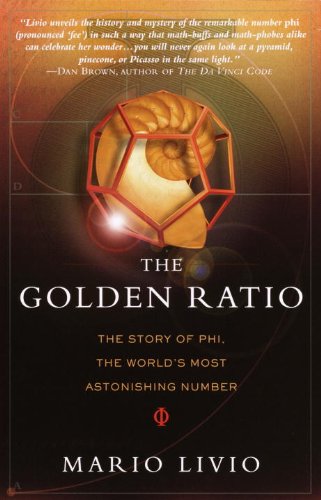
The Golden Ratio: The Story of Phi, the World's Most Astonishing Number
Mario Livio
4.5
Throughout history, thinkers from mathematicians to theologians have pondered the mysterious relationship between numbers and the nature of reality. In this fascinating book, Mario Livio tells the tale of a number at the heart of that mystery: phi, or 1.6180339887...This curious mathematical relationship, widely known as "The Golden Ratio," was discovered by Euclid more than two thousand years ago because of its crucial role in the construction of the pentagram, to which magical properties had been attributed. Since then it has shown a propensity to appear in the most astonishing variety of places, from mollusk shells, sunflower florets, and rose petals to the shape of the galaxy. Psychological studies have investigated whether the Golden Ratio is the most aesthetically pleasing proportion extant, and it has been asserted that the creators of the Pyramids and the Parthenon employed it. It is believed to feature in works of art from Leonardo da Vinci's Mona Lisa to Salvador Dali's The Sacrament of the Last Supper, and poets and composers have used it in their works. It has even been found to be connected to the behavior of the stock market!
The Golden Ratio is a captivating journey through art and architecture, botany and biology, physics and mathematics. It tells the human story of numerous phi-fixated individuals, including the followers of Pythagoras who believed that this proportion revealed the hand of God; astronomer Johannes Kepler, who saw phi as the greatest treasure of geometry; such Renaissance thinkers as mathematician Leonardo Fibonacci of Pisa; and such masters of the modern world as Goethe, Cezanne, Bartok, and physicist Roger Penrose. Wherever his quest for the meaning of phi takes him, Mario Livio reveals the world as a place where order, beauty, and eternal mystery will always coexist.
From the Hardcover edition.
…
Recommended by Kirk Borne.
Kirk Borne
Some Fun with Gentle Chaos, the Golden Ratio, and Stochastic Number Theory, with Gaming Applications: https://t.co/oQG0y3vA22 #abdsc by @granvilleDSC @DataScienceCtrl #Mathematics #Statistics ————— Learn all about the Golden Ratio in this fantastic book: https://t.co/9QxN9ECpH7 https://t.co/Mt45UZFFHH [source]
Cover unavailable
7
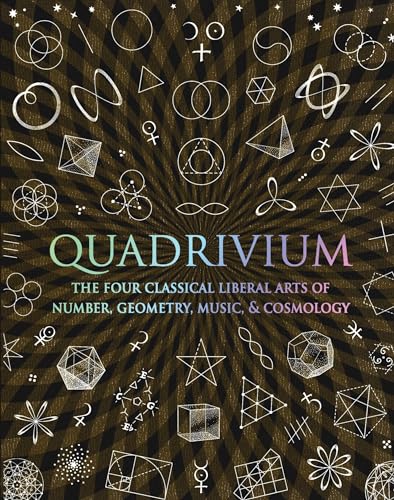
Quadrivium: The Four Classical Liberal Arts of Number, Geometry, Music, & Cosmology
Miranda Lundy
4.5
The quadrivium-the classical curriculum-comprises the four liberal arts of number, geometry, music, and cosmology. It was studied from antiquity to the Renaissance as a way of glimpsing the nature of reality. Geometry is number in space; music is number in time; and comology expresses number in space and time. Number, music, and geometry are metaphysical truths: life across the universe investigates them; they foreshadow the physical sciences.
Quadrivium is the first volume to bring together these four subjects in many hundreds of years. Composed of six successful titles in the Wooden Books series-Sacred Geometry, Sacred Number, Harmonograph, The Elements of Music, Platonic & Archimedean Solids, and A Little Book of Coincidence-it makes ancient wisdom and its astonishing interconnectedness accessible to us today.
Beautifully produced in six different colors of ink, Quadrivium will appeal to anyone interested in mathematics, music, astronomy, and how the universe works.
…
Cover unavailable
8
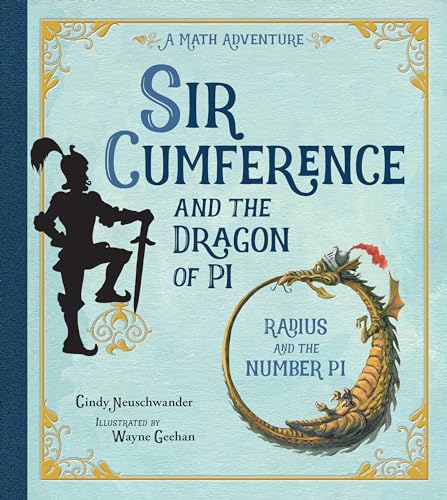
Sir Cumference and the Dragon of Pi
Cindy Neuschwander, Wayne Geehan
4.4
Sir Cumference, Lady Di of Ameter, and Radius are back in their second Math Adventure! This time, a potion has changed Sir Cumference into a fire-breathing dragon. Can Radius change him back? Join Radius on his quest through the castle to solve a riddle that will reveal the cure. It lies in discovering the magic number that is the same for all circles.
Cover unavailable
9
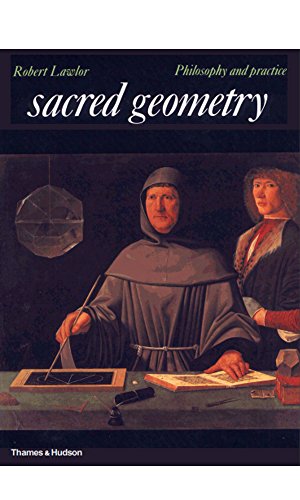
Sacred Geometry: Philosophy and Practice
Robert Lawlor
4.4
The thinkers of ancient Egypt, Greece and India recognized that numbers governed much of what they saw in their world and hence provided an approach to its divine creator. Robert Lawlor sets out the system that determines the dimension and the form of both man-made and natural structures, from Gothic cathedrals to flowers, from music to the human body. By also involving the reader in practical experiments, he leads with ease from simple principles to a grasp of the logarithmic spiral, the Golden Proportion, the squaring of the circle and other ubiquitous ratios and proportions.
Art and Imagination: These large-format, gloriously-illustrated paperbacks cover Eastern and Western religion and philosophy, including myth and magic, alchemy and astrology. The distinguished authors bring a wealth of knowledge, visionary thinking and accessible writing to each intriguing subject.
…
Cover unavailable
10
A Comprehensive Introduction to Differential Geometry, Vol. 1
Eric Weinstein recommended this book on Twitter. [source]
Cover unavailable
11
Geometry Revisited
H. S. M. Coxeter, Samuel L. Greitzer
4.4
Among the many beautiful and nontrivial theorems in geometry found in Geometry Revisited are the theorems of Ceva, Menelaus, Pappus, Desargues, Pascal, and Brianchon. A nice proof is given of Morley's remarkable theorem on angle trisectors. The transformational point of view is emphasized: reflections, rotations, translations, similarities, inversions, and affine and projective transformations. Many fascinating properties of circles, triangles, quadrilaterals, and conics are developed.
…
Cover unavailable
12
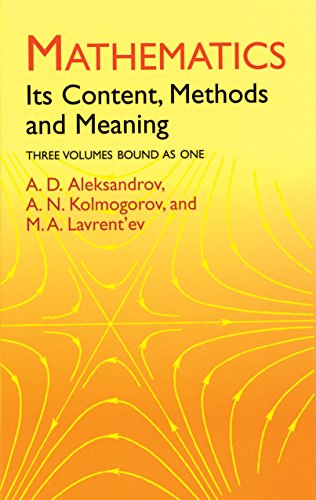
Mathematics: Its Content, Methods and Meaning
A. D. Aleksandrov, A. N. Kolmogorov, M. A. Lavrent’ev
4.4
". . . Nothing less than a major contribution to the scientific culture of this world." — The New York Times Book Review This major survey of mathematics, featuring the work of 18 outstanding Russian mathematicians and including material on both elementary and advanced levels, encompasses 20 prime subject areas in mathematics in terms of their simple origins and their subsequent sophisticated developement. As Professor Morris Kline of New York University noted, "This unique work presents the amazing panorama of mathematics proper. It is the best answer in print to what mathematics contains both on the elementary and advanced levels." Beginning with an overview and analysis of mathematics, the first of three major divisions of the book progresses to an exploration of analytic geometry, algebra, and ordinary differential equations. The second part introduces partial differential equations, along with theories of curves and surfaces, the calculus of variations, and functions of a complex variable. It furthur examines prime numbers, the theory of probability, approximations, and the role of computers in mathematics. The theory of functions of a real variable opens the final section, followed by discussions of linear algebra and nonEuclidian geometry, topology, functional analysis, and groups and other algebraic systems. Thorough, coherent explanations of each topic are further augumented by numerous illustrative figures, and every chapter concludes with a suggested reading list. Formerly issued as a three-volume set, this mathematical masterpiece is now available in a convenient and modestly priced one-volume edition, perfect for study or reference. "This is a masterful English translation of a stupendous and formidable mathematical masterpiece . . ." — Social Science
There is something admirable about the school of the Russians: they are thinkers doing math, with remarkable clarity, minimal formalism, and total absence of unnecessary pedantry one finds in more modern texts (in the post Bourbaki era). This is of course surprising as one would have expected the exact opposite from the products of the communist era. Mathematicians should be using this book as a model for their own composition. You can read it and reread it. Professors should assign this in addition to modern texts, as readers can get intutions, something alas absent from modern texts. [source]
Cover unavailable
13
Grandfather Tang's Story
Ann Tompert, Robert Andrew Parker
4.4
Illus. in full color. "Drawing on a Chinese form of storytelling with seven shapes cut from a square of paper, Tompert recounts the tale of two fox fairies. Parker's pen-and-watercolor art adds drama, while the tangram insets will motivate children to try their own versions. Ingenious."-- "Bulletin, Center for Children's Books."
Cover unavailable
14
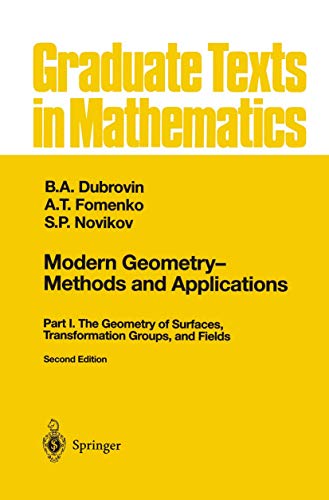
Modern Geometry -- Methods and Applications: Part I: The Geometry of Surfaces, Transformation Groups, and Fields
This is the first volume of a three-volume introduction to modern geometry which emphasizes applications to other areas of mathematics and theoretical physics. Topics covered include tensors and their differential calculus, the calculus of variations in one and several dimensions, and geometric field theory. This new edition offers substantial revisions, and the material is written in concrete language with terminology acceptable to physicists.
Eric Weinstein recommended this book on Twitter. [source]

Cover unavailable
15
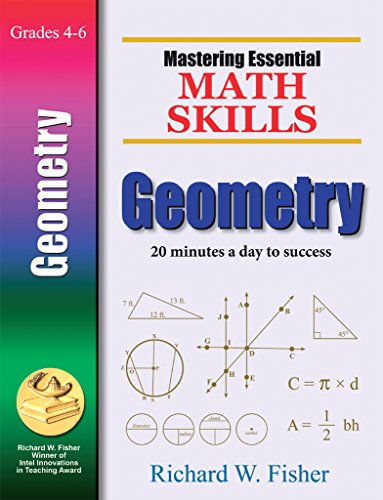
Mastering Essential Math Skills: Geometry
Richard W. Fisher
4.3
*A proven system of teaching for teachers, parents, and students who want to learn on their own.
*Requires only 20 minutes per day.
*Presented in a simple format that everyone can understand.
*Each lesson flows smoothly and logically to the next.
*Each lesson is short, concise, and straight to the point.
*Each new topic is clearly explained.
*Lots of examples with step-by-step solutions.
*Each lesson includes valuable helpful hints.
*Review is built into each lesson. Students will retain what they have learned.
*Each lesson includes Problem Solving. This ensures that students will learn to apply their knowledge to real-life situations.
*Includes a "How to Use This Book" section, and an easy-to-use answer key.
…
Cover unavailable
16
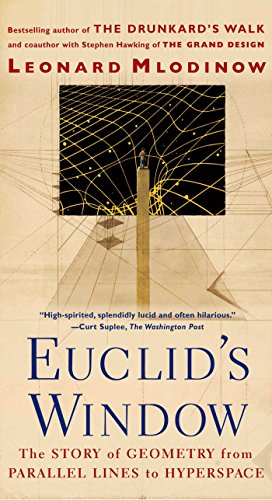
Euclid's Window: The Story of Geometry from Parallel Lines to Hyperspace
Leonard Mlodinow
4.3
Through Euclid's Window Leonard Mlodinow brilliantly and delightfully leads us on a journey through five revolutions in geometry, from the Greek concept of parallel lines to the latest notions of hyperspace. Here is an altogether new, refreshing, alternative history of math revealing how simple questions anyone might ask about space -- in the living room or in some other galaxy -- have been the hidden engine of the highest achievements in science and technology. Based on Mlodinow's extensive historical research; his studies alongside colleagues such as Richard Feynman and Kip Thorne; and interviews with leading physicists and mathematicians such as Murray Gell-Mann, Edward Witten, and Brian Greene, Euclid's Window is an extraordinary blend of rigorous, authoritative investigation and accessible, good-humored storytelling that makes a stunningly original argument asserting the primacy of geometry. For those who have looked through Euclid's Window, no space, no thing, and no time will ever be quite the same.
…
Cover unavailable
17
Perfect Square
Michael Hall
4.3
A perfect square is transformed in this adventure story that will transport you far beyond the four equal sides of this square book.
Cover unavailable
18
Geometry and the Imagination
David Hilbert, S. Cohn-Vossen
4.3
Suitable for beginners and experienced mathematicians, this book begins with examples of the simplest curves and surfaces, including thread constructions of certain quadrics and other surfaces. It offers a discussion of linkages and the geometry of configurations of points and rods that are connected and, perhaps, constrained in some way.
Cover unavailable
19
Lost in Math: How Beauty Leads Physics Astray
Sabine Hossenfelder
4.3
A contrarian argues that modern physicists' obsession with beauty has given us wonderful math but bad science.
Whether pondering black holes or predicting discoveries at CERN, physicists believe the best theories are beautiful, natural, and elegant, and this standard separates popular theories from disposable ones. This is why, Sabine Hossenfelder argues, we have not seen a major breakthrough in the foundations of physics for more than four decades. The belief in beauty has become so dogmatic that it now conflicts with scientific objectivity: observation has been unable to confirm mindboggling theories, like supersymmetry or grand unification, invented by physicists based on aesthetic criteria. Worse, these "too good to not be true" theories are actually untestable and they have left the field in a cul-de-sac. To escape, physicists must rethink their methods. Only by embracing reality as it is can science discover the truth.
…
Recommended by Barbara Kiser.
Barbara Kiser
This is a firecracker of a book—a shot across the bows of theoretical physics. Sabine Hossenfelder, a theoretical physicist working on quantum gravity and blogger, confronts failures in her field head-on. [source]
Cover unavailable
20
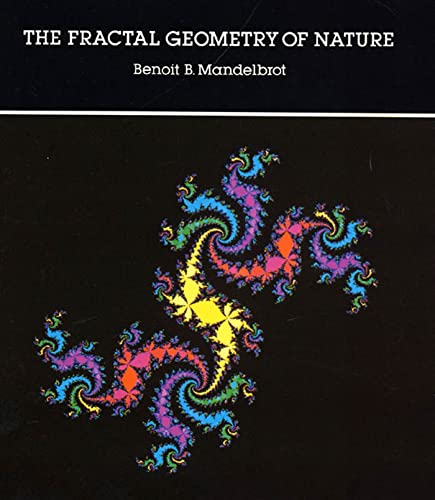
The Fractal Geometry of Nature
Benoit B. Mandelbrot
4.3
Clouds are not spheres, mountains are not cones, and lightning does not travel in a straight line. The complexity of nature's shapes differs in kind, not merely degree, from that of the shapes of ordinary geometry, the geometry of fractal shapes.
Now that the field has expanded greatly with many active researchers, Mandelbrot presents the definitive overview of the origins of his ideas and their new applications. The Fractal Geometry of Nature is based on his highly acclaimed earlier work, but has much broader and deeper coverage and more extensive illustrations.
…
Cover unavailable
21
Painless Geometry
Lynette Long Ph.D.
4.3
The thought of solving theorems or postulates leaves some students quivering in their boots. . . but not anymore! This must-have guide takes the pain out of learning geometry once and for all. The author demonstrates how solving geometric problems amounts to fitting parts together to solve interesting puzzles. Students discover relationships that exist between parallel and perpendicular lines; analyze the characteristics of distinct shapes such as circles, quadrilaterals, and triangles; and learn how geometric principles can solve real-world problems.
Like all titles in Barron's Painless Series, this book presents informal, student-friendly approaches to learning geometry, emphasizing interesting details, outlining potential pitfalls step by step, offering "Brain Tickler" quizzes, and more.
…
Cover unavailable
22
The Thirteen Books of the Elements, Books 1 - 2
Thomas L. Heath
4.3
Volume 1 of 3-volume set containing complete English text of all 13 books of the Elements plus critical apparatus analyzing each definition, postulate, and proposition in great detail. Covers textual and linguistic matters; mathematical analyses of Euclid's ideas; commentators; refutations, supports, extrapolations, reinterpretations and historical notes. Vol. 1 includes Introduction, Books 1-2: Triangles, rectangles.
…
Cover unavailable
23
How to Solve It: A New Aspect of Mathematical Method
George Pólya
4.3
A perennial bestseller by eminent mathematician G. Polya, How to Solve It will show anyone in any field how to think straight. In lucid and appealing prose, Polya reveals how the mathematical method of demonstrating a proof or finding an unknown can be of help in attacking any problem that can be "reasoned" out--from building a bridge to winning a game of anagrams. Generations of readers have relished Polya's deft--indeed, brilliant--instructions on stripping away irrelevancies and going straight to the heart of the problem.
…
Cover unavailable
24
Mathematical Models
H. Martyn Cundy, A. P. Rollett
4.3
This is the classic book of detailed instructions for making a wide variety of mathematical models of all kinds. Complete nets are given for all regular Archimedean and stellated polyhedra together with a number of interesting compounds. There are sections on paper folding, dissections, curve stitching, linkages, the drawing of loci and envelopes and the construction of plane tessellations. The volume is fully illustrated with diagrams and photographs of models in paper and other materials and all have been successfully made and tested.
Note, for books that provide the nets and instructions to make various solids, look at Make Shapes 1, Make Shapes 2, and Paper Polyhedra in Colour. Cundy and Rollett provides both a wider range of nets but not in ready-made form.
Ideals, Varieties, and Algorithms: An Introduction to Computational Algebraic Geometry and Commutative Algebra
David A. Cox
4.3
This text covers topics in algebraic geometry and commutative algebra with a strong perspective toward practical and computational aspects. The first four chapters form the core of the book. A comprehensive chart in the Preface illustrates a variety of ways to proceed with the material once these chapters are covered. In addition to the fundamentals of algebraic geometry the elimination theorem, the extension theorem, the closure theorem and the Nullstellensatz this new edition incorporates several substantial changes, all of which are listed in the Preface. The largest revision incorporates a new Chapter (ten), which presents some of the essentials of progress made over the last decades in computing Grobner bases. The book also includes current computer algebra material in Appendix C and updated independent projects (Appendix D).
The book may serve as a first or second course in undergraduate abstract algebra and with some supplementation perhaps, for beginning graduate level courses in algebraic geometry or computational algebra. Prerequisites for the reader include linear algebra and a proof-oriented course.It is assumed that the reader has access to a computer algebra system. Appendix C describes features of Maple, Mathematica(r) and Sage, as well as other systems that are most relevant to the text. Pseudocode is used in the text; Appendix B carefully describes the pseudocode used.
From the reviews of previous editions:
The book gives an introduction to Buchberger s algorithm with applications to syzygies, Hilbert polynomials, primary decompositions. There is an introduction to classical algebraic geometry with applications to the ideal membership problem, solving polynomial equations and elimination theory. The book is well-written. The reviewer is sure that it will be an excellent guide to introduce further undergraduates in the algorithmic aspect of commutative algebra and algebraic geometry.
Peter Schenzel, zbMATH, 2007
I consider the book to be wonderful. ... The exposition is very clear, there are many helpful pictures and there are a great many instructive exercises, some quite challenging ... offers the heart and soul of modern commutative and algebraic geometry.
The American Mathematical Monthly
"
…
Cover unavailable
26
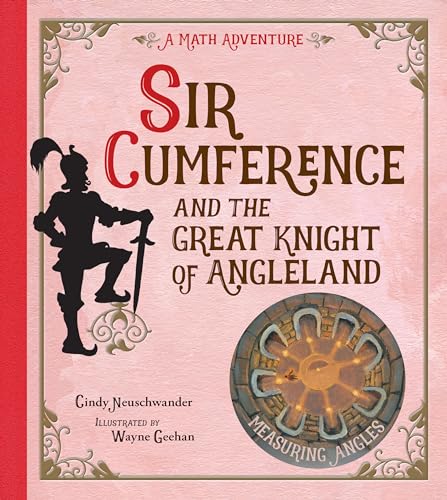
Sir Cumference and the Great Knight of Angleland
Cindy Neuschwander, Wayne Geehan
4.3
Radius is on a quest to earn his knighthood! With only a circular medallion, a mysterious poem, and his own wits to guide him, he must find and rescue a missing king.
Cover unavailable
27
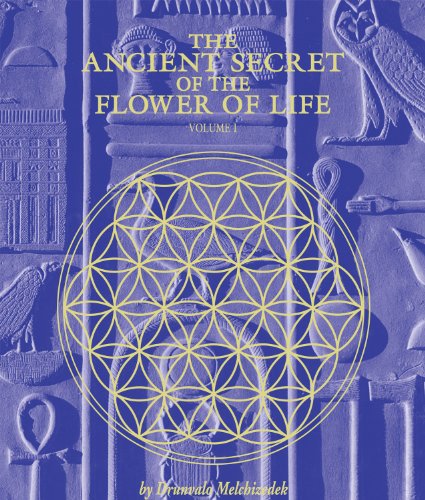
The Ancient Secret of the Flower of Life: Volume 1
Drunvalo Melchizedek
4.3
Once, all life in the universe knew the Flower of Life as the creation pattern. Now a new dawn is streaming through the windows of perception. This book is one of those windows. Drunvalo Melchizedek presents the Flower of Life Workshop, illuminating the mysteries of how we came to be.
Cover unavailable
28
A Comprehensive Introduction to Differential Geometry, Volume 2
Eric Weinstein recommended this book on Twitter. [source]
Cover unavailable
29
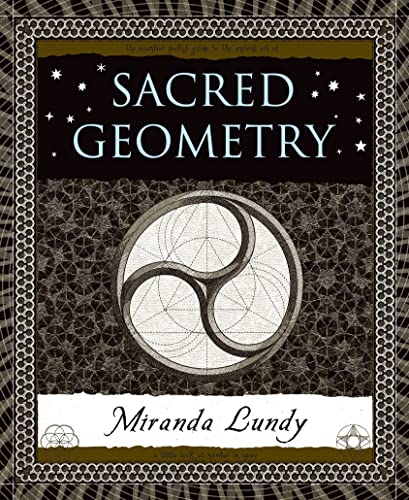
Sacred Geometry
Miranda Lundy
4.2
Geometry is one of a group of special sciences - Number, Music and Cosmology are the others - found identically in nearly every culture on earth. In this small volume, Miranda Lundy presents a unique introduction to this most ancient and timeless of universal sciences. Sacred Geometry demonstrates what happens to space in two dimensions - a subject last flowering in the art, science and architecture of the Renaissance and seen in the designs of Stonehenge, mosque decorations and church windows. With exquisite hand-drawn images throughout showing the relationship between shapes, the patterns of coin circles, and the definition of the golden section, it will forever alter the way in which you look at a triangle, hexagon, arch, or spiral.
…
Cover unavailable
30
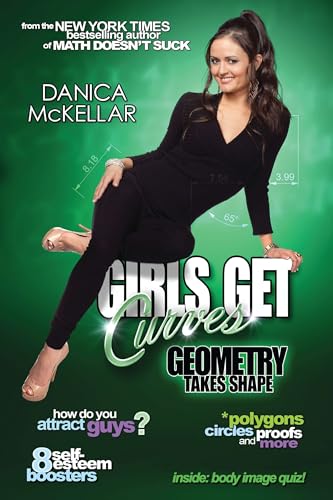
Girls Get Curves: Geometry Takes Shape
Danica McKellar
4.2
New York Times bestselling author and mathemetician Danica McKellar tackles all the angles—and curves—of geometry
In her three previous bestselling books Math Doesn't Suck, Kiss My Math, and Hot X: Algebra Exposed!, actress and math genius Danica McKellar shattered the “math nerd” stereotype by showing girls how to ace their math classes and feel cool while doing it.
Sizzling with Danica's trademark sass and style, her fourth book, Girls Get Curves, shows her readers how to feel confident, get in the driver's seat, and master the core concepts of high school geometry, including congruent triangles, quadrilaterals, circles, proofs, theorems, and more!
Combining reader favorites like personality quizzes, fun doodles, real-life testimonials from successful women, and stories about her own experiences with illuminating step-by-step math lessons, Girls Get Curves will make girls feel like Danica is their own personal tutor.
As hundreds of thousands of girls already know, Danica's irreverent, lighthearted approach opens the door to math success and higher scores, while also boosting their self-esteem in all areas of life. Girls Get Curves makes geometry understandable, relevant, and maybe even a little (gasp!) fun for girls.
…
Cover unavailable
31
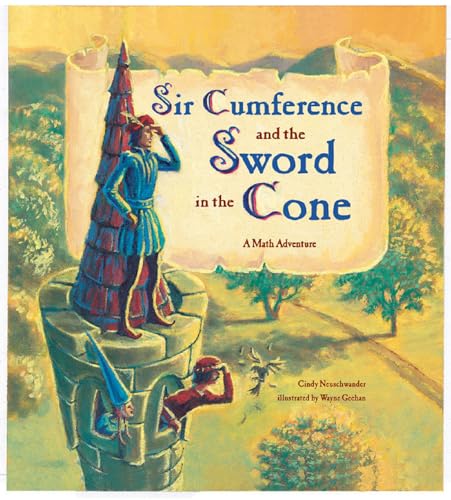
Sir Cumference and the Sword in the Cone
Cindy Neuschwander, Wayne Geehan
4.2
King Arthur has issued a challenge. The first knight to find the sword Edgecalibur will be the next king. Join Sir Cumference, Lady Di of Ameter, and their son, Radius, as they race to help their friend, Vertex, find the sword and discover the secrets of cubes, pyramids, cylinders, and cones.
Cover unavailable
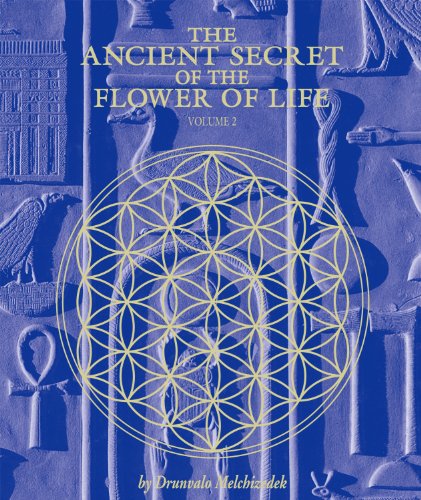
32
The Ancient Secret of the Flower of Life: Volume 2
Drunvalo Melchizedek
4.2
The sacred Flower of Life pattern, the primary geometric generator of all physical form, is explored in even more depth in this volume, the second half of the Flower of Life workshop. The proportions of the human body, the nuances of human consciousness, the sizes and distances of the stars, planets and moons, even the creations of humankind, are all shown to reflect their origins in this beautiful and divine image. Through an intricate and detailed geometrical mapping, Drunvalo Melchizedek shows how the seemingly simple design of the Flower of Life contains the genesis of our entire third-dimensional existence. From the pyramids and mysteries of Egypt to the new race of Indigo children, Drunvalo presents the sacred geometries of the Reality and the subtle energies that shape our world. We are led through a divinely inspired labyrinth of science and stories, logic and coincidence, on a path of remembering where we come from and the wonder and magic of who we are.
Finally, for the first time in print, Drunvalo shares the instructions for the Mer-Ka-Ba meditation, step-by-step techniques for the re-creation of the energy field of the evolved human, which is the key to ascension and the next dimensional world. If done from love, this ancient process of breathing prana opens up for us a world of tantalizing possibility in this dimension, from protective powers to the healing of oneself, of others and even of the planet.
Embrace the examined vision and understanding that Drunvalo offers to the world. Coincidences abound, miracles flourish and amazing stories of mysteries unveiled arise as the author probes the Ancient Secret of the Flower of Life.
…
Cover unavailable
33
The Road to Reality: A Complete Guide to the Laws of the Universe
Roger Penrose
4.2
Roger Penrose, one of the most accomplished scientists of our time, presents the only comprehensive and comprehensible account of the physics of the universe. From the very first attempts by the Greeks to grapple with the complexities of our known world to the latest application of infinity in physics, The Road to Reality carefully explores the movement of the smallest atomic particles and reaches into the vastness of intergalactic space. Here, Penrose examines the mathematical foundations of the physical universe, exposing the underlying beauty of physics and giving us one the most important works in modern science writing.
…
Cover unavailable
34
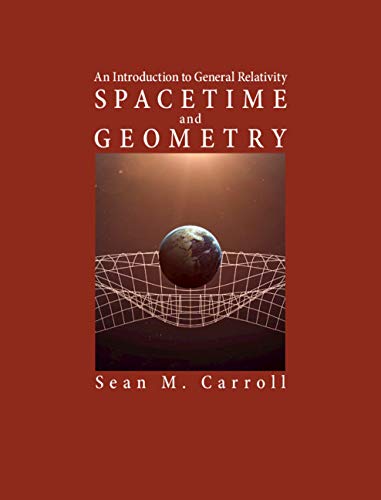
Spacetime and Geometry: An Introduction to General Relativity
Sean Carroll
4.2
Spacetime and Geometry: An Introduction to General Relativity provides a lucid and thoroughly modern introduction to general relativity. With an accessible and lively writing style, it introduces modern techniques to what can often be a formal and intimidating subject. Readers are led from the physics of flat spacetime (special relativity), through the intricacies of differential geometry and Einstein's equations, and on to exciting applications such as black holes, gravitational radiation, and cosmology.
…
Cover unavailable
35
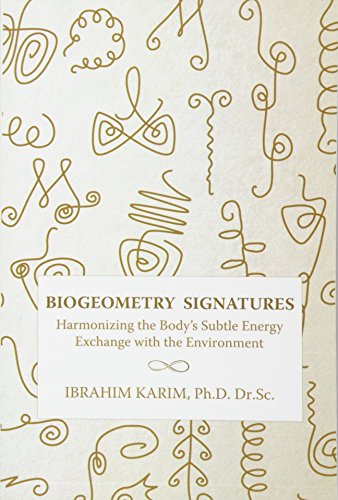
BioGeometry Signatures: Harmonizing the Body's Subtle Energy Exchange with the Environment
Ibrahim Karim Dr.Sc.
4.2
Based on over 45 years of research, BioGeometry Signatures are linear diagrams that help balance the subtle energy of body organs. The organ subtle energy patterns are accessed through BioGeometry Signatures placed externally in the body’s energy fields to create a connection through Resonance of Shape. “This is a book that will change the way you think about your body and your health. It shows that we are not separate from the shapes, angles and proportions that surround us all the time, and that these shapes create energetic patterns that can introduce equilibrium and harmony into our own biological makeup. This is a modern science of energy balancing that provides the key to the hidden ancient knowledge of great civilizations. With BioGeometry, Dr. Ibrahim Karim has demonstrated how powerful simple shapes can be in altering the functioning of our physical, mental, and spiritual worlds. This has been frequently demonstrated in architectural and design projects, environmental balancing solutions including the mitigation of the effects of electro-pollution and geopathic stress, in health and wellness projects, and in the efforts of individuals in their personal spiritual development. In this book on BioGeometry Signatures, once again you see how powerful certain carefully created shapes can be in altering the physical functioning of organ systems, in supporting healing, and in changing physical and mental states. Work with them, let them touch you, and feel how they can assist you in your own search for harmony.” Michael J. Maley, Ph.D. Instructor in BioGeometry
…
Cover unavailable
36
Anathem
Neal Stephenson
4.2
Fraa Erasmas is a young avout living in the Concent of Saunt Edhar, a sanctuary for mathematicians, scientists, and philosophers, protected from the corrupting influences of the outside "saecular" world by ancient stone, honored traditions, and complex rituals. Over the centuries, cities and governments have risen and fallen beyond the concent's walls. Three times during history's darkest epochs violence born of superstition and ignorance has invaded and devastated the cloistered mathic community. Yet the avout have always managed to adapt in the wake of catastrophe, becoming out of necessity even more austere and less dependent on technology and material things. And Erasmas has no fear of the outside—the Extramuros—for the last of the terrible times was long, long ago.
Now, in celebration of the week-long, once-in-a-decade rite of Apert, the fraas and suurs prepare to venture beyond the concent's gates—at the same time opening them wide to welcome the curious "extras" in. During his first Apert as a fraa, Erasmas eagerly anticipates reconnecting with the landmarks and family he hasn't seen since he was "collected." But before the week is out, both the existence he abandoned and the one he embraced will stand poised on the brink of cataclysmic change.
Powerful unforeseen forces jeopardize the peaceful stability of mathic life and the established ennui of the Extramuros—a threat that only an unsteady alliance of saecular and avout can oppose—as, one by one, Erasmas and his colleagues, teachers, and friends are summoned forth from the safety of the concent in hopes of warding off global disaster. Suddenly burdened with a staggering responsibility, Erasmas finds himself a major player in a drama that will determine the future of his world—as he sets out on an extraordinary odyssey that will carry him to the most dangerous, inhospitable corners of the planet . . . and beyond.
…
Cover unavailable
37
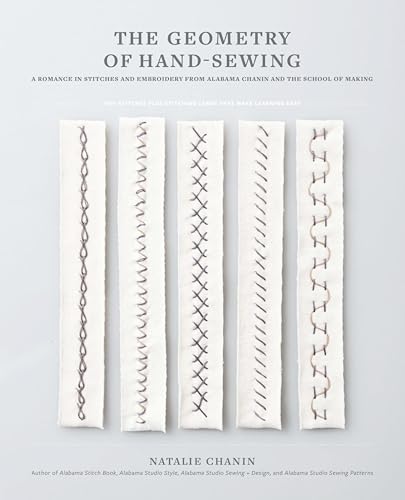
The Geometry of Hand-Sewing: A Romance in Stitches and Embroidery from Alabama Chanin and The School of Making
Natalie Chanin and Sun Young Park
4.2
As makers, we tend to learn different stitches over time without thinking much about how they relate to one another. But when Natalie Chanin and her Alabama Chanin and The School of Making teams began to look at needlework closely, they realized all stitches are based on geometric grid systems—and by using grids as guides, they could make learning stitches, even seemingly elaborate ones, as easy as child’s play.
In The Geometry of Hand-Sewing Chanin presents their breakthrough method, featuring illustrated instructions (for both right- and left-handed stitchers) for more than 100 stitches—from the most basic straight and chain to the more fanciful feather and herringbone; photos of both right and wrong sides; and guidelines for modifying stitches to increase one’s repertoire further. To simplify learning, the book also includes two plastic stitching cards die-cut with the grids on which every stitch in the book is based. These reusable cards can be stitched through for practicing ( just as children use lacing cards to learn to tie shoes) or used as stencils for transferring grids to fabric.
…
Cover unavailable
38
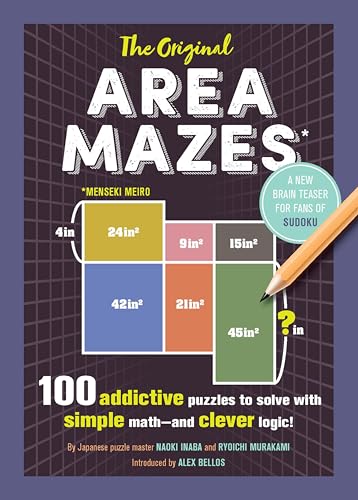
The Original Area Mazes: 100 Addictive Puzzles to Solve with Simple Math—and Clever Logic!
Naoki Inaba
4.2
The rules are simple . . . The math is easy . . .The puzzles get harder and harder!
Once you match wits with area mazes, you’ll be hooked! Your quest is to navigate a network of rectangles to find a missing value.
Just Remember: Area = length × width Use spatial reasoning to find helpful relationships Whole numbers are all you need. You can always get the answer without using fractions!
Originally invented for gifted students, area mazes (menseki meiro), have taken all of Japan by storm. Are you a sudoku fanatic? Do you play brain games to stay sharp? Did you love geometry . . . or would you like to finally show it who’s boss? Feed your brain some area mazes—they could be just what you’re craving!
…
Cover unavailable
39
The Geometry of Physics: An Introduction
Theodore Frankel
4.2
Theodore Frankel explains those parts of exterior differential forms, differential geometry, algebraic and differential topology, Lie groups, vector bundles and Chern forms essential to a better understanding of classical and modern physics and engineering. Key highlights of his new edition are the inclusion of three new appendices that cover symmetries, quarks, and meson masses; representations and hyperelastic bodies; and orbits and Morse-Bott Theory in compact Lie groups. Geometric intuition is developed through a rather extensive introduction to the study of surfaces in ordinary space. First Edition Hb (1997): 0-521-38334-X First Edition Pb (1999): 0-521-38753-1
…
Cover unavailable
40
GRE Prep 2020-2021: 4 Hours of Complete GRE Practice Tests with Answers & Explanations! Proven Strategies to Maximize Your Score (Graduate School Test Preparation)
Gary Hill
4.2
Cover unavailable
41
Kiselev's Geometry / Book II. Stereometry
A. P. Kiselev, Alexander Givental
4.2
Cover unavailable
42
What's Your Angle, Pythagoras? A Math Adventure
Julie Ellis, Phyllis Hornung
4.2
Cover unavailable
43
Introduction to Geometry
H. S. M. Coxeter
4.2
This classic work is now available in an unabridged paperback edition. The Second Edition retains all the characterisitcs that made the first edition so popular: brilliant exposition, the flexibility permitted by relatively self-contained chapters, and broad coverage ranging from topics in the Euclidean plane, to affine geometry, projective geometry, differential geometry, and topology. The Second Edition incorporates improvements in the text and in some proofs, takes note of the solution of the 4-color map problem, and provides answers to most of the exercises.
…
Cover unavailable
44
Sir Cumference and the Isle of Immeter
Cindy Neuschwander, Wayne Geehan
4.2
When young Per visits her uncle Sir Cumference and his family, she learns how to play the game, "Inners and Edges." After she finds a clue linking the game to the mysterious castle on the island of Immeter, she must figure out how to find the perimeter and area of a circle to unlock the island's secret.
Math skills taught include finding the area and perimeter of a rectangle and a circle. Introduces an underlying concept of calculus -- using straight lines to measure curves.
…
Cover unavailable
45
Regular Polytopes
H. S. M. Coxeter
4.2
Foremost book available on polytopes, incorporating ancient Greek and most modern work done on them. Beginning with polygons and polyhedrons, the book moves on to multi-dimensional polytopes in a way that anyone with a basic knowledge of geometry and trigonometry can easily understand. Definitions of symbols. Eight tables plus many diagrams and examples. 1963 edition.
Cover unavailable
46
Riemann Surfaces
Hershel M. Farkas, Irwin Kra
4.2
This text covers Riemann surface theory from elementary aspects to the fontiers of current research. Open and closed surfaces are treated with emphasis on the compact case, while basic tools are developed to describe the analytic, geometric, and algebraic properties of Riemann surfaces and the associated Abelian varities. Topics covered include existence of meromorphic functions, the Riemann-Roch theorem, Abel's theorem, the Jacobi inversion problem, Noether's theorem, and the Riemann vanishing theorem. A complete treatment of the uniformization of Riemann sufaces via Fuchsian groups, including branched coverings, is presented, as are alternate proofs for the most important results, showing the diversity of approaches to the subject. Of interest not only to pure mathematicians, but also to physicists interested in string theory and related topics.
…
Cover unavailable
47
Shapes, Shapes, Shapes
Tana Hoban
4.2
Whenever you are -- inside or outside -- there are shapes to discover. And with Tana Hoban's help you will begin to see them. Look around. How many circles, squares, stars, triangles, hearts, and rectangles can you see?
They are everywhere!
Cover unavailable
48
Continuous Symmetry: From Euclid to Klein
William Barker, Roger Howe
4.1
The fundamental idea of geometry is that of symmetry. With that principle as the starting point, Barker and Howe begin an insightful and rewarding study of Euclidean geometry. The primary focus of the book is on transformations of the plane. The transformational point of view provides both a path for deeper understanding of traditional synthetic geometry and tools for providing proofs that spring from a consistent point of view. As a result, proofs become more comprehensible, as techniques can be used and reused in similar settings. The approach to the material is very concrete, with complete explanations of all the important ideas, including foundational background. The discussions of the nine-point circle and wallpaper groups are particular examples of how the strength of the transformational point of view and the care of the authors' exposition combine to give a remarkable presentation of topics in geometry. This text is for a one-semester undergraduate course on geometry. It is richly illustrated and contains hundreds of exercises.
…
Cover unavailable
49
Regents Exams and Answers: Geometry
Andre Castagna
4.1
Barron’s Regents Exams and Answers: Geometry provides essential review for students taking the Geometry Regents, including actual exams administered for the course, thorough answer explanations, and comprehensive review of all topics.
This edition features:
Six actual, administered Regents exams so students can get familiar with the test Comprehensive review questions grouped by topic, to help refresh skills learned in class Thorough explanations for all answers Score analysis charts to help identify strengths and weaknesses Study tips and test-taking strategies
All pertinent geometry topics are covered, such as basic angle and segment relationships (parallel lines, polygons, triangle relationships), constructions, transformations, triangle congruence and writing proofs, similarity and right triangle geometry, parallelograms, circles and arcs, coordinate geometry, and volume (modeling 3-D shapes in practical applications).
Looking for additional practice and review? Check out Barron’s Geometry Power Pack two-volume set, which includes Let’s Review Geometry in addition to the Regents Exams and Answers: Geometry book.
…
Cover unavailable
50
Let's Review Geometry
Andre CastagnaPh.D.
4.1
Always study with the most up-to-date prep! Look for Let's Review Regents: Geometry 2020, ISBN 978-1-5062-5402-9, on sale January 07, 2020.
Publisher's Note: Products purchased from third-party sellers are not guaranteed by the publisher for quality, authenticity, or access to any online entitles included with the product.
Cover unavailable
51
Tutor in a Book's Geometry
Jo Greig and James R. Shiletto Ph.D
4.1
Need help with Geometry? Designed to replicate the services of a skilled private tutor, the new and improved Tutor in a Book's Geometry is at your service! TIB's Geometry is an extremely thorough, teen tested and effective geometry tutorial.
TIB's Geometry includes more than 500 of the right, well-illustrated, carefully worked out and explained proofs and problems. Throughout TIB's Geometry, there is ongoing, specific guidance as to the most effective solution and test taking strategies. Recurring patterns, which provide solutions to proofs, are pointed out, explained and illustrated using the visual aids that students find so helpful. Also included are dozens of graphic organizers, which help students understand, remember and recognize the connections between concepts.
TIB's author Jo Greig intended this book to level the playing field between the students who have tutors and those that don't. As a long time, very successful private mathematics tutor and teacher, Jo Greig knew exactly how best to accomplish this! TIB's Geometry 294 pages are packed with every explanation, drawing, hint and memory tool possible! Not only does it have examples of the right proofs and problems, it also manages to impart every bit of the enthusiasm that great tutors impart to their private tutoring students. Ms. Greig holds a bachelors' degree in mathematics. Dr. J. Shiletto, the book's mathematics editor, holds a Ph.D in mathematics.
…
Cover unavailable
52
Geometry - Grades 7-10
Sara Freeman
4.1
This easy-to-use workbook is chock full of stimulating activities that will jumpstart your students' interest in geometry while providing practice with the major geometry concepts. A variety of puzzles, mazes, games, and self-check formats will challenge students to think creatively as they sharpen their geometry skills. Each page begins with a clear explanation of the featured geometry topic, providing extra review and reinforcement. A special assessment section is included at the end of the book to help students prepare for standardized tests. 48 pages
…
Cover unavailable
53
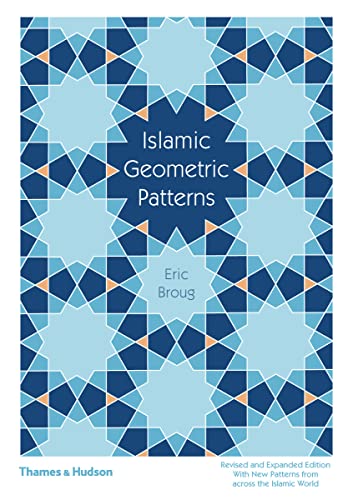
Islamic Geometric Patterns
Eric Broug
4.1
Cover unavailable
54
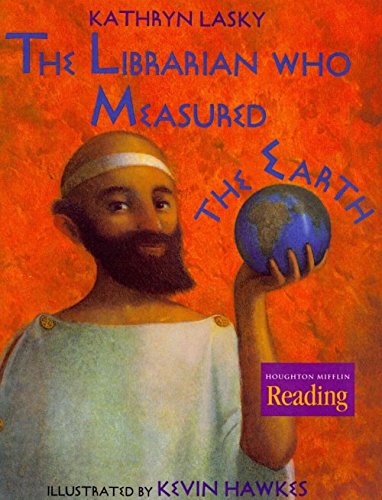
The Librarian Who Measured the Earth
Kathryn Lasky
4.1
A perfect introduction to mathematical concepts for young readers, written by a Newbery honor-winning author!
This colorfully illustrated biography of the Greek philosopher and scientist Eratosthenes, who compiled the first geography book and accurately measured the globe's circumference, is just right for budding mathematicians, scientists, historians, and librarians! Filled with fascinating details about Eratosthenes's world (and in print since 1994), kids are sure to flip through the pages time and again.
…
Cover unavailable
55
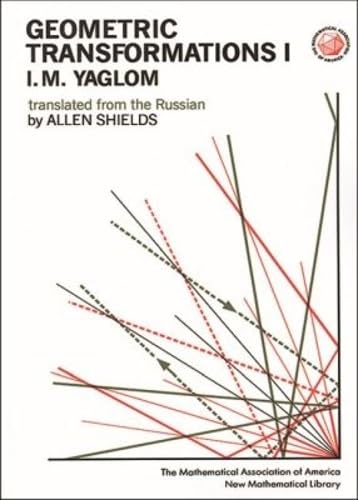
Geometric Transformations I
I. M. Yaglom
4.1
Almost everyoneis acquainted with plane Euclidean geometry as it is usually taught in high school. This book introduces the reader to a completely different way of looking at familiar geometrical facts. It is concerned with transformations of the plane that do not alter the shapes and sizes of geometric figures. Such transformations play a fundamental role in the group theoretic approach to geometry.
The treatment is direct and simple. The reader is introduced to new ideas and then is urged to solve problems using these ideas. The problems form an essential part of this book and the solutions are given in detail in the second half of the book.
…
Cover unavailable
56
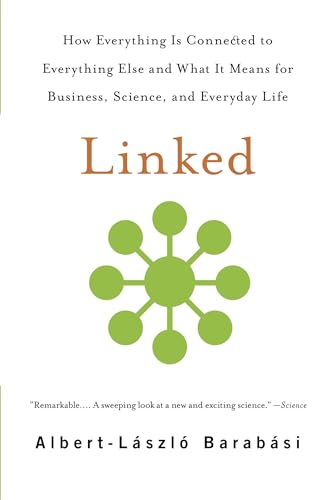
Linked: How Everything Is Connected to Everything Else and What It Means for Business, Science, and Everyday Life
Albert-Laszlo Barabasi
4.1
In the 1980's, James Gleick's Chaos introduced the world to complexity. Now, Albert-László Barabási's Linked reveals the next major scientific leap: the study of networks. We've long suspected that we live in a small world, where everything is connected to everything else. Indeed, networks are pervasive--from the human brain to the Internet to the economy to our group of friends. These linkages, it turns out, aren't random. All networks, to the great surprise of scientists, have an underlying order and follow simple laws. Understanding the structure and behavior of these networks will help us do some amazing things, from designing the optimal organization of a firm to stopping a disease outbreak before it spreads catastrophically.In Linked, Barabási, a physicist whose work has revolutionized the study of networks, traces the development of this rapidly unfolding science and introduces us to the scientists carrying out this pioneering work. These "new cartographers" are mapping networks in a wide range of scientific disciplines, proving that social networks, corporations, and cells are more similar than they are different, and providing important new insights into the interconnected world around us. This knowledge, says Barabási, can shed light on the robustness of the Internet, the spread of fads and viruses, even the future of democracy. Engaging and authoritative, Linked provides an exciting preview of the next century in science, guaranteed to be transformed by these amazing discoveries.From Linked:This book has a simple message: think networks. It is about how networks emerge, what they look like, and how they evolve. It aims to develop a web-based view of nature, society, and technology, providing a unified framework to better understand issues ranging from the vulnerability of the Internet to the spread of diseases. Networks are present everywhere. All we need is an eye for them...We will see the challenges doctors face when they attempt to cure a disease by focusing on a single molecule or gene, disregarding the complex interconnected nature of the living matter. We will see that hackers are not alone in attacking networks: we all play Goliath, firing shots at a fragile ecological network that, without further support, could soon replicate our worst nightmares by turning us into an isolated group of species...Linked is meant to be an eye-opening trip that challenges you to walk across disciplines by stepping out of the box of reductionism. It is an invitation to explore link by link the next scientific revolution: the new science of networks.
…
Recommended by Anne-Marie Slaughter and Bill Barhydt.
Anne-Marie Slaughter
Linked is about how to understand the world in terms of networks. To understand network science the first thing to do is to visualise the world the way you visualise the Internet or even the universe – hubs of infinitely intersecting networks. As the author says, everything can be reduced to links and nodes. This book is a very accessible introduction to the science of networks and to how to think about everything from anthills to traffic jams to complex conflict from the perspective of network science. [source]
Bill Barhydt
Written before Facebook, this book predicts what the world will look like with amazing precision. [source]
Cover unavailable
57
Which One Doesn't Belong?: A Shapes Book
Christopher Danielson
4.1
Which One Doesn’t Belong? has won the Mathical Book Prize, which will be presented to Christopher Danielson at the National Math Festival in Washington, DC on April 22, 2017. The Mathical Book Prize is an annual award for fiction and nonfiction books that inspire children of all ages to see math in the world around them.
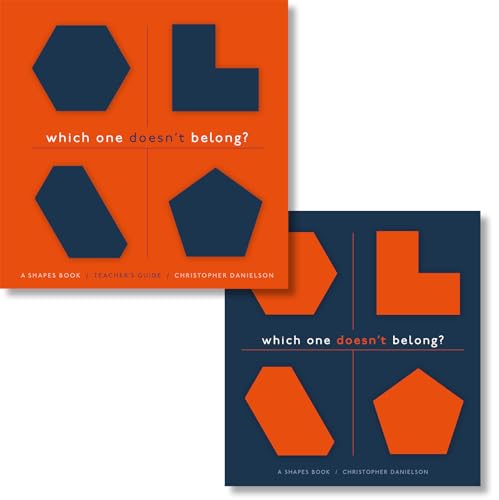
Every colorful page of Christopher Danielson’s children’s picture book, Which One Doesn’t Belong?, contains a thoughtfully designed set of four shapes. Each of the shapes can be a correct answer to the question “Which one doesn’t belong?” Because all their answers are right answers, students naturally shift their focus to justifications and arguments based on the shapes’ geometric properties.
In the companion teacher’s guide,(978-1-62531-081-1) Danielson shows how to facilitate rich discussions and teach mathematical argumentation using Which One Doesn’t Belong? He models how to listen closely and respectfully to students’ ideas about shapes. Danielson synthesizes research about how children learn geometry, discusses the role of geometry in the mathematics curriculum, and gives plenty of practical advice about different ways to implement Which One Doesn’t Belong? in classrooms. He also discusses the mathematical ideas likely to emerge on each page and—drawing from his direct experience using Which One Doesn’t Belong? at several different grade levels—helps teachers anticipate and think about students’ likely answers.
Most curricula treat geometry as little more than vocabulary lessons. Which One Doesn’t Belong? and its accompanying guide are powerful, flexible resources teachers can use to provoke lively discussions and deep learning about shapes with students of all ages.
…
Cover unavailable
58
Sacred Geometry Activations Oraclebook and Deck
Lon
4.1
For thousands of years, sacred geometry has been a part of every culture. It is the bond that connects us all to the cosmos; it is the true design of our soul.Quantum artist LON has created 44 Activations that encourage your analytical mind to step aside so you can enter the domain of the subconscious and the soul, and connect to the quantum field the space of infinite potential. Working with these cards on a daily basis will help you to think outside the box, create a deeper sense of peace in your life, and become a powerful conscious creator.
…
Cover unavailable
59
Geometry: A Comprehensive Course
Dan Pedoe
4.1
Lucid, well-written introduction to elementary geometry usually included in undergraduate and first-year graduate courses in mathematics. Topics include vector algebra in the plane, circles and coaxial systems, mappings of the Euclidean plane, similitudes, isometries, mappings of the intensive plane, much more. Includes over 500 exercises.
Cover unavailable
60
Projective Geometry
H.S.M. Coxeter
4.1
In Euclidean geometry, constructions are made with ruler and compass. Projective geometry is simpler: its constructions require only a ruler. In projective geometry one never measures anything, instead, one relates one set of points to another by a projectivity. The first two chapters of this book introduce the important concepts of the subject and provide the logical foundations. The third and fourth chapters introduce the famous theorems of Desargues and Pappus. Chapters 5 and 6 make use of projectivities on a line and plane, respectively. The next three chapters develop a self-contained account of von Staudt's approach to the theory of conics. The modern approach used in that development is exploited in Chapter 10, which deals with the simplest finite geometry that is rich enough to illustrate all the theorems nontrivially. The concluding chapters show the connections among projective, Euclidean, and analytic geometry.
…
Cover unavailable
61
Non-Euclidean Geometry
H. S. M. Coxeter
4.1
This is a reissue of Professor Coxeter's classic text on non-Euclidean geometry. It begins with a historical introductory chapter, and then devotes three chapters to surveying real projective geometry, and three to elliptic geometry. After this the Euclidean and hyperbolic geometries are built up axiomatically as special cases of a more general descriptive geometry. This text should be of use to anybody with an interest in geometry.
…
Cover unavailable
62
Analysis, Manifolds and Physics, Part II - Revised and Enlarged Edition
Yvonne Choquet-Bruhat
4.1
Twelve problems have been added to the first edition; four of them are supplements to problems in the first edition. The others deal with issues that have become important, since the first edition of Volume II, in recent developments of various areas of physics. All the problems have their foundations in volume 1 of the 2-Volume set Analysis, Manifolds and Physics. It would have been prohibitively expensive to insert the new problems at their respective places. They are grouped together at the end of this volume, their logical place is indicated by a number of parenthesis following the title.
…
Cover unavailable
63
The Symmetries of Things
John H. Conway
4.1
Start with a single shape. Repeat it in some way--translation, reflection over a line, rotation around a point--and you have created symmetry. Symmetry is a fundamental phenomenon in art, science, and nature that has been captured, described, and analyzed using mathematical concepts for a long time. Inspired by the geometric intuition of Bill Thurston and empowered by his own analytical skills, John Conway, with his coauthors, has developed a comprehensive mathematical theory of symmetry that allows the description and classification of symmetries in numerous geometric environments.
This richly and compellingly illustrated book addresses the phenomenological, analytical, and mathematical aspects of symmetry on three levels that build on one another and will speak to interested lay people, artists, working mathematicians, and researchers.
…
Cover unavailable
64
Mummy Math: An Adventure in Geometry
Cindy Neuschwander, Bryan Langdo
4.1
Matt, Bibi, and their dog Riley crawled through the tiny opening first. FWUMP! A secret door suddenly closed behind them . . .
Matt and Bibi use math to escape from a pharaoh's tomb!
When the Zills family is summoned to Egypt to help find the hidden burial site of an ancient pharaoh, Matt and Bibi are locked into an adventure they did not expect. Stuck inside a pyramid with only each other, their dog Riley, and geometric hieroglyphics to help them find their way, the twins must use their math knowledge to solve the riddles on the walls and locate the burial chamber.
Luckily, the two know their stuff when it comes to geometric solids.
…
Cover unavailable
65
A Beginner's Guide to Constructing the Universe: The Mathematical Archetypes of Nature, Art, and Science
Michael S. Schneider
4.1
The Universe May Be a Mystery,But It's No Secret Michael Schneider leads us on a spectacular, lavishly illustrated journey along the numbers one through ten to explore the mathematical principles made visible in flowers, shells, crystals, plants, and the human body, expressed in the symbolic language of folk sayings and fairy tales, myth and religion, art and architecture. This is a new view of mathematics, not the one we learned at school but a comprehensive guide to the patterns that recur through the universe and underlie human affairs. A Beginner's Guide to Constructing, the Universe shows you: Why cans, pizza, and manhole covers are round.Why one and two weren't considered numbers by the ancient Greeks.Why squares show up so often in goddess art and board games.What property makes the spiral the most widespread shape in nature, from embryos and hair curls to hurricanes and galaxies. How the human body shares the design of a bean plant and the solar system. How a snowflake is like Stonehenge, and a beehive like a calendar. How our ten fingers hold the secrets of both a lobster a cathedral, and much more.
…
Cover unavailable
66
A Panoramic View of Riemannian Geometry
Marcel Berger
4.1
Riemannian geometry has today become a vast and important subject. This new book of Marcel Berger sets out to introduce readers to most of the living topics of the field and convey them quickly to the main results known to date. These results are stated without detailed proofs but the main ideas involved are described and motivated. This enables the reader to obtain a sweeping panoramic view of almost the entirety of the field. However, since a Riemannian manifold is, even initially, a subtle object, appealing to highly non-natural concepts, the first three chapters devote themselves to introducing the various concepts and tools of Riemannian geometry in the most natural and motivating way, following in particular Gauss and Riemann.
…
Cover unavailable
67
REA's Ready, Set, Go! Geometry Workbook
Mel Friedman and Geometry Study Gudies
4.1
Many students continue to struggle in high school math courses because they failed to master the basic mathematical skills. REA’s new Ready, Set, Go! Workbook series takes the confusion out of math, helping students raise their grades and score higher on important exams. What makes REA’s workbooks different? For starters, students will actually like using them. Here’s why: When students apply the skills they’ve mastered in our workbooks, they can do better in class, raise their grades, and score higher on the all-important end-of-course, graduation, and exit exams. Some of the math topics covered in the Geometry Workbook include:Whether used in a classroom, for home or self study, or with a tutor, this workbook gets students ready for important math tests and exams, set to take on new challenges, and helps them go forward in their studies!
…
Cover unavailable
68
The Shape of Space: How to Visualize Surfaces and Three-Dimensional Manifolds
Jeffrey R. Weeks
4.1
Maintaining the standard of excellence set by the previous edition, this textbook covers the basic geometry of two- and three-dimensional spaces Written by a master expositor, leading researcher in the field, and MacArthur Fellow, it includes experiments to determine the true shape of the universe and contains illustrated examples and engaging exercises that teach mind-expanding ideas in an intuitive and informal way. Bridging the gap from geometry to the latest work in observational cosmology, the book illustrates the connection between geometry and the behavior of the physical universe and explains how radiation remaining from the big bang may reveal the actual shape of the universe.
…
Cover unavailable
69
Friendshape
Amy Krouse Rosenthal, Tom Lichtenheld
4.1
The bestselling creators of EXCLAMATION MARK! introduce a triangle, circle, square, and rectangle who celebrate the gift of friendship.
Friends shape who we are. They make us laugh. They fill us with fun. They stand by us during life's up and downs. And even when we disagree with our friends, if they're tried-and-true, they don't stay bent out of shape for long. That's the beauty of a good buddy. This joyous book rejoices in the simple beauties of friendship, and reminds readers of all ages that it's good to have a group of pals.
…
Cover unavailable
70
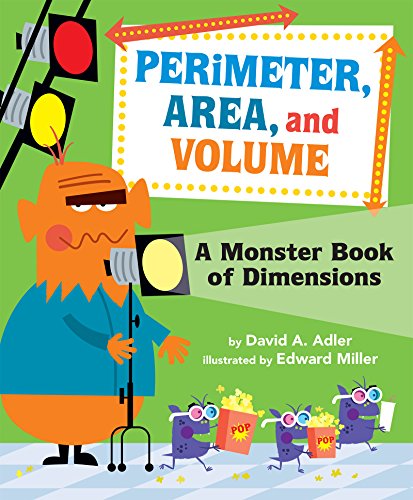
Perimeter, Area, and Volume: A Monster Book of Dimensions
David A Adler, Edward Miller
4.1
Readers are invited to the premiere of a 3-D movie. The star-studded cast of monsters will help them calculate the perimeter of the set, the area of the movie screen, and the volume of their popcorn box. Learning about dimensions has never been so entertaining.
Cover unavailable
71
5th Grade Common Core Math: Daily Practice Workbook - Part I: Multiple Choice | 1000+ Practice Questions and Video Explanations | Argo Brothers
Argo Brothers
4.1
Cover unavailable
72
Multiple View Geometry in Computer Vision
Richard Hartley, Andrew Zisserman
4.1
A basic problem in computer vision is to understand the structure of a real world scene. This book covers relevant geometric principles and how to represent objects algebraically so they can be computed and applied. Recent major developments in the theory and practice of scene reconstruction are described in detail in a unified framework. Richard Hartley and Andrew Zisserman provide comprehensive background material and explain how to apply the methods and implement the algorithms. First Edition HB (2000): 0-521-62304-9
…
Cover unavailable
73
Differential Geometry: Cartan's Generalization of Klein's Erlangen Program
R.W. Sharpe, S.S. Chern
4.1
Cartan geometries were the first examples of connections on a principal bundle. They seem to be almost unknown these days, in spite of the great beauty and conceptual power they confer on geometry. The aim of the present book is to fill the gap in the literature on differential geometry by the missing notion of Cartan connections. Although the author had in mind a book accessible to graduate students, potential readers would also include working differential geometers who would like to know more about what Cartan did, which was to give a notion of "espaces g'n'ralis's" (= Cartan geometries) generalizing homogeneous spaces (= Klein geometries) in the same way that Riemannian geometry generalizes Euclidean geometry. In addition, physicists will be interested to see the fully satisfying way in which their gauge theory can be truly regarded as geometry.
…
Cover unavailable
74
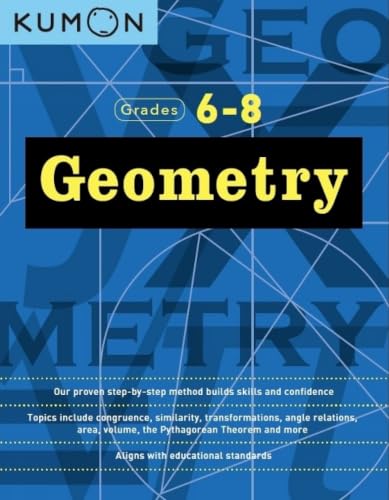
Geometry (Grades 6-8)
Kumon
4.1
Cover unavailable
75
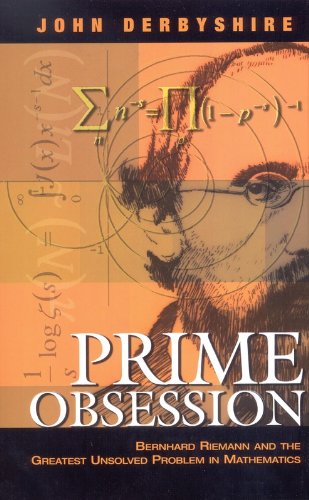
Prime Obsession: Bernhard Riemann and the Greatest Unsolved Problem in Mathematics
John Derbyshire
4.1
In 1859, Bernhard Riemann, a little-known thirty-two year old mathematician, made a hypothesis while presenting a paper to the Berlin Academy titled “On the Number of Prime Numbers Less Than a Given Quantity.” Today, after 150 years of careful research and exhaustive study, the Riemann Hypothesis remains unsolved, with a one-million-dollar prize earmarked for the first person to conquer it. Alternating passages of extraordinarily lucid mathematical exposition with chapters of elegantly composed biography and history, Prime Obsession is a fascinating and fluent account of an epic mathematical mystery that continues to challenge and excite the world.
…
Cover unavailable
76
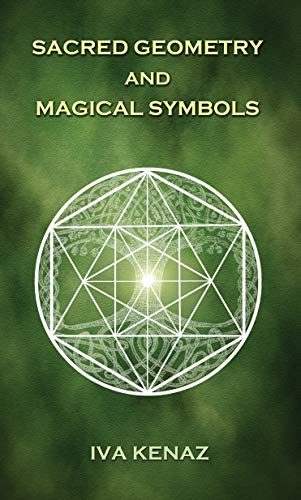
Sacred Geometry and Magical Symbols
Iva Kenaz
4.1
All symbols originate in geometric figures which give form to the observed world as well as the microcosm and macrocosm. Sacred geometry is a teaching that focuses on geometric proportions and patterns in nature. The knowledge of magical symbols and sacred geometry was revered and preserved by many ancient civilisations including those in Mesopotamia, Egypt, India and Greece. Magical symbols and geometry worked together as keys to understanding nature and the philosophical meaning of existence.
This book is a simple guide to understanding magical symbols by taking in account their original geometric patterns and mythological correlations. Each chapter addresses a different geometric figure and its derived magical symbols. It’s a journey from the source shape of the circle, the well from which the other shapes arise, to the Tree of Life where they all connect.
…
Cover unavailable
77
Special Relativity and Classical Field Theory: The Theoretical Minimum
Leonard Susskind
4.1
A funny, insightful, and self-contained guide to Einstein's relativity theory and classical field theories--including electromagnetism
Physicist Leonard Susskind and data engineer Art Friedman are back. This time, they introduce readers to Einstein's special relativity and Maxwell's classical field theory. Using their typical brand of real math, enlightening drawings, and humor, Susskind and Friedman walk us through the complexities of waves, forces, and particles by exploring special relativity and electromagnetism. It's a must-read for both devotees of the series and any armchair physicist who wants to improve their knowledge of physics' deepest truths.
…
Cover unavailable
78
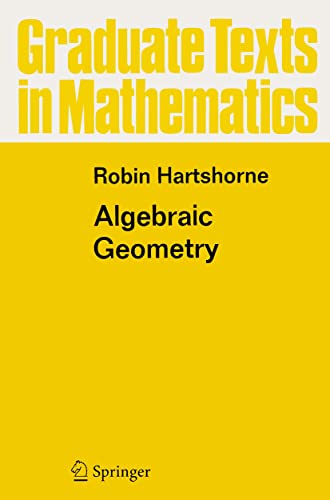
Algebraic Geometry
Robin Hartshorne
4.1
Robin Hartshorne studied algebraic geometry with Oscar Zariski and David Mumford at Harvard, and with J.-P. Serre and A. Grothendieck in Paris. After receiving his Ph.D. from Princeton in 1963, Hartshorne became a Junior Fellow at Harvard, then taught there for several years. In 1972 he moved to California where he is now Professor at the University of California at Berkeley. He is the author of "Residues and Duality" (1966), "Foundations of Projective Geometry (1968), "Ample Subvarieties of Algebraic Varieties" (1970), and numerous research titles. His current research interest is the geometry of projective varieties and vector bundles. He has been a visiting professor at the College de France and at Kyoto University, where he gave lectures in French and in Japanese, respectively. Professor Hartshorne is married to Edie Churchill, educator and psychotherapist, and has two sons. He has travelled widely, speaks several foreign languages, and is an experienced mountain climber. He is also an accomplished amateur musician: he has played the flute for many years, and during his last visit to Kyoto he began studying the shakuhachi.
…
Cover unavailable
79
Geometric Transformations II
I. M. Yaglom, Allen Shields
4.1
Cover unavailable
80
The World Is Not a Rectangle: A Portrait of Architect Zaha Hadid
Jeanette Winter
4.1
A Washington Post Best Children’s Book of 2017 Parents’ Choice Recommended
Get to know Zaha Hadid in this nonfiction picture book about the famed architect’s life and her triumph over adversity from celebrated author-illustrator Jeanette Winter.
Zaha Hadid grew up in Baghdad, Iraq, and dreamed of designing her own cities. After studying architecture in London, she opened her own studio and started designing buildings. But as a Muslim woman, Hadid faced many obstacles. Determined to succeed, she worked hard for many years, and achieved her goals—and now you can see the buildings Hadid has designed all over the world.
…
Cover unavailable
81
Geometry, Relativity and the Fourth Dimension
Rudolf v.B. Rucker
4.1
This is a highly readable, popular exposition of the fourth dimension and the structure of the universe. A remarkable pictorial discussion of the curved space-time we call home, it achieves even greater impact through the use of 141 excellent illustrations. This is the first sustained visual account of many important topics in relativity theory that up till now have only been treated separately. Finding a perfect analogy in the situation of the geometrical characters in Flatland, Professor Rucker continues the adventures of the two-dimensional world visited by a three-dimensional being to explain our three-dimensional world in terms of the fourth dimension. Following this adventure into the fourth dimension, the author discusses non-Euclidean geometry, curved space, time as a higher dimension, special relativity, time travel, and the shape of space-time. The mathematics is sound throughout, but the casual reader may skip those few sections that seem too purely mathematical and still follow the line of argument. Readable and interesting in itself, the annotated bibliography is a valuable guide to further study. Professor Rucker teaches mathematics at the State University of New York in Geneseo. Students and laymen will find his discussion to be unusually stimulating. Experienced mathematicians and physicists will find a great deal of original material here and many unexpected novelties. Annotated bibliography. 44 problems.
…
Cover unavailable
82
A Cloak for the Dreamer
Aileen Friedman, Kim Howard
4.1
A tailor asks each of his sons to make a cloak that will keep out the wind and rain. One son uses rectangles; another uses squares and triangles; the youngest uses circles, making a cloak full of holes. His father finds a (geometric) way to fix the cloak. Used in Math By All Means: Geometry, Grades 1-2.
Cover unavailable
83
Anne of Green Gables Collection: Anne of Green Gables, Anne of the Island, and More Anne Shirley Books (OBG Classics)
Lucy Maud Montgomery
4.1
Cover unavailable
84
Sacred Geometry: Deciphering the Code
Stephen Skinner
4.1
A fascinating and inspirational look at the vital link between the hidden geometrical order of the universe, geometry in nature, and the geometry of the man-made world.
The Da Vinci Code has awakened the public to the powerful and very ancient idea that religious truths and mathematical principles are intimately intertwined. Sacred Geometry offers an accessible way of understanding how that connection is revealed in nature and the arts. Over the centuries, temple builders have relied on magic numbers to shape sacred spaces, astronomers have used geometry to calculate holy seasons, and philosophers have observed the harmony of the universe in the numerical properties of music. By showing how the discoveries of mathematics are manifested over and over again in biology and physics, and how they have inspired the greatest works of art, this illuminating study reveals the universal principles that link us to the infinite.
…
Cover unavailable
85
Kiselev's Geometry / Book I. Planimetry
A. P. Kiselev, Alexander Givental
4.1
Cover unavailable
86
The Arithmetic of Elliptic Curves
Joseph H. Silverman
4.0
Treats the arithmetic theory of elliptic curves in its modern formulation through the use of basic algebraic number theory and algebraic geometry. This book outlines necessary algebro-geometric results and offers an exposition of the geometry of elliptic curves, the formal group of an elliptic curve, and elliptic curves over finite fields.
Cover unavailable
87
Glimpses of Algebra and Geometry
Gabor Toth
4.0
Previous edition sold 2000 copies in 3 years; Explores the subtle connections between Number Theory, Classical Geometry and Modern Algebra; Over 180 illustrations, as well as text and Maple files, are available via the web facilitate understanding: http: //mathsgi01.rutgers.edu/cgi-bin/wrap/gt... Contains an insert with 4-color illustrations; Includes numerous examples and worked-out problem
Cover unavailable
88
Riemannian Manifolds: An Introduction to Curvature
John M. Lee
4.0
This text is designed for a one-quarter or one-semester graduate course on Riemannian geometry. It focuses on developing an intimate acquaintance with the geometric meaning of curvature and thereby introduces and demonstrates all the main technical tools needed for a more advanced study of Riemannian manifolds. The book begins with a careful treatment of the machinery of metrics, connections, and geodesics, and then introduces the curvature tensor as a way of measuring whether a Riemannian manifold is locally equivalent to Euclidean space. Submanifold theory is developed next in order to give the curvature tensor a concrete quantitative interpretation. The remainder of the text is devoted to proving the four most fundamental theorems relating curvature and topology: the Gauss-Bonnet Theorem, the Cartan-Hadamard Theorem, Bonnet's Theorem, and the characterization of manifolds of constant curvature. This unique volume will appeal especially to students by presenting a selective introduction to the main ideas of the subject in an easily accessible way. The material is ideal for a single course, but broad enough to provide students with a firm foundation from which to pursue research or develop applications in Riemannian geometry and other fields that use its tools.
…
Cover unavailable
89
Challenging Problems in Geometry
Alfred S. Posamentier
4.0
Designed for high school students and teachers with an interest in mathematical problem-solving, this volume offers a wealth of nonroutine problems in geometry that stimulate students to explore unfamiliar or little-known aspects of mathematics. Included are nearly 200 problems dealing with congruence and parallelism, the Pythagorean theorem, circles, area relationships, Ptolemy and the cyclic quadrilateral, collinearity and concurrency, and many other subjects. Within each topic, the problems are arranged in approximate order of difficulty. Detailed solutions (as well as hints) are provided for all problems, and specific answers for most. Invaluable as a supplement to a basic geometry textbook, this volume offers both further explorations on specific topics and practice in developing problem-solving techniques.
…
Cover unavailable
90
Algebra and Geometry: Anything But Square! (Basher Science)
Dan Green and Simon Basher
4.0
The best-selling author of Math and Punctuation now turns his attention to the fun and funky characters in Geometry and Algebra. Meet Polygon and Plane, Reflection and Rotation, Odd Number and his buddy Even Number and the three amigos Sine, Cosine and Tangent. Discover the secrets of their world and how they like to throw their numbers about. Bringing his charming manga-style artwork and tongue-and-cheek approach to explaining the basics, Basher brings a whole new spin to the world of higher math.
…
Cover unavailable
91
Geometry, Topology and Physics (Graduate Student Series in Physics)
Mikio Nakahara
4.0
This series of books in physics and related subjects is designed to meet the needs of graduate students. Although not primarily research texts, they point out the direction which research is currently taking and where it is expected to lead.
Almost 12 years have passed by since we wrote Chaos and Fractals. At the time we were hoping that our approach of writing a book which would be both accessible without mathematical sophistication and portray these exiting new fields in an authentic manner would find an audience. Now we know it did. We know from many reviews and personal letters that the book is used in a wide range of ways: researchers use it to acquaint themselves, teachers use it in college and university courses, students use it for background reading, and there is also a substantial audience of lay people who just want to know what chaos and fractals are about. Every book that is somewhat technical in nature is likely to have a number of misprints and errors in its first edition. Some of these were caught and brought to our attention by our readers. One of them, Hermann Flaschka, deserves to be thanked in particular for his suggestions and improvements. This second edition has several changes. We have taken out the two appendices from the firstedition. At the time of the first edition Yuval Fishers contribution, which we published as an appendix was probably the first complete expository account on fractal image compression. Meanwhile, Yuvals book Fractal Image Compression: Theory and Application appeared and is now the publication to refer to.
…
Cover unavailable
93
Introduction to Smooth Manifolds
John Lee
4.0
This book is an introductory graduate-level textbook on the theory of smooth manifolds. Its goal is to familiarize students with the tools they will need in order to use manifolds in mathematical or scientific research--- smooth structures, tangent vectors and covectors, vector bundles, immersed and embedded submanifolds, tensors, differential forms, de Rham cohomology, vector fields, flows, foliations, Lie derivatives, Lie groups, Lie algebras, and more. The approach is as concrete as possible, with pictures and intuitive discussions of how one should think geometrically about the abstract concepts, while making full use of the powerful tools that modern mathematics has to offer.
This second edition has been extensively revised and clarified, and the topics have been substantially rearranged. The book now introduces the two most important analytic tools, the rank theorem and the fundamental theorem on flows, much earlier so that they can be used throughout the book. A few new topics have been added, notably Sard's theorem and transversality, a proof that infinitesimal Lie group actions generate global group actions, a more thorough study of first-order partial differential equations, a brief treatment of degree theory for smooth maps between compact manifolds, and an introduction to contact structures.
Prerequisites include a solid acquaintance with general topology, the fundamental group, and covering spaces, as well as basic undergraduate linear algebra and real analysis.
…
Cover unavailable
94
Introduction to Differential Topology
T Bröcker
4.0
This book is intended as an elementary introduction to differential manifolds. The authors concentrate on the intuitive geometric aspects and explain not only the basic properties but also teach how to do the basic geometrical constructions. An integral part of the work are the many diagrams which illustrate the proofs. The text is liberally supplied with exercises and will be welcomed by students with some basic knowledge of analysis and topology.
…
Cover unavailable
95
Three-Dimensional Geometry and Topology, Volume 1
William P. Thurston, Silvio Levy
4.0
This book develops some of the extraordinary richness, beauty, and power of geometry in two and three dimensions, and the strong connection of geometry with topology. Hyperbolic geometry is the star. A strong effort has been made to convey not just denatured formal reasoning (definitions, theorems, and proofs), but a living feeling for the subject. There are many figures, examples, and exercises of varying difficulty.
This book was the origin of a grand scheme developed by Thurston that is now coming to fruition. In the 1920s and 1930s the mathematics of two-dimensional spaces was formalized. It was Thurston's goal to do the same for three-dimensional spaces. To do this, he had to establish the strong connection of geometry to topology--the study of qualitative questions about geometrical structures. The author created a new set of concepts, and the expression Thurston-type geometry has become a commonplace.
Three-Dimensional Geometry and Topology had its origins in the form of notes for a graduate course the author taught at Princeton University between 1978 and 1980. Thurston shared his notes, duplicating and sending them to whoever requested them. Eventually, the mailing list grew to more than one thousand names. The book is the culmination of two decades of research and has become the most important and influential text in the field. Its content also provided the methods needed to solve one of mathematics' oldest unsolved problems--the Poincar� Conjecture.
In 2005 Thurston won the first AMS Book Prize, for Three-dimensional Geometry and Topology. The prize recognizes an outstanding research book that makes a seminal contribution to the research literature. Thurston received the Fields Medal, the mathematical equivalent of the Nobel Prize, in 1982 for the depth and originality of his contributions to mathematics. In 1979 he was awarded the Alan T. Waterman Award, which recognizes an outstanding young researcher in any field of science or engineering supported by the National Science Foundation.
…
Cover unavailable
96
Geometry: Euclid and Beyond
Robin Hartshorne
4.0
In recent years, I have been teaching a junior-senior-level course on the classi- cal geometries. This book has grown out of that teaching experience. I assume only high-school geometry and some abstract algebra. The course begins in Chapter 1 with a critical examination of Euclid's Elements. Students are expected to read concurrently Books I-IV of Euclid's text, which must be obtained sepa- rately. The remainder of the book is an exploration of questions that arise natu- rally from this reading, together with their modern answers. To shore up the foundations we use Hilbert's axioms. The Cartesian plane over a field provides an analytic model of the theory, and conversely, we see that one can introduce coordinates into an abstract geometry. The theory of area is analyzed by cutting figures into triangles. The algebra of field extensions provides a method for deciding which geometrical constructions are possible. The investigation of the parallel postulate leads to the various non-Euclidean geometries. And in the last chapter we provide what is missing from Euclid's treatment of the five Platonic solids in Book XIII of the Elements. For a one-semester course such as I teach, Chapters 1 and 2 form the core material, which takes six to eight weeks.
…
Cover unavailable
97
Algebraic Topology from a Homotopical Viewpoint
Marcelo Aguilar, Samuel Gitler, Carlos Prieto, S.B. Sontz
4.0
The authors present introductory material in algebraic topology from a novel point of view in using a homotopy-theoretic approach. This carefully written book can be read by any student who knows some topology, providing a useful method to quickly learn this novel homotopy-theoretic point of view of algebraic topology.
Cover unavailable
98
Geometry
David A. Brannan, Matthew F. Esplen, Jeremy J. Gray
4.0
This textbook demonstrates the excitement and beauty of geometry. The approach is that of Klein in his Erlangen program: a geometry is a space together with a set of transformations of that space. The authors explore various geometries: affine, projective, inversive, non-Euclidean and spherical. In each case they carefully explain key results and discuss the relationship among geometries. This richly illustrated and clearly written text includes full solutions to over 200 problems and is suitable both for undergraduate courses on geometry and as a resource for self study.
…
Cover unavailable
99
Geometry and Trigonometry for Calculus
Peter H. Selby
4.0
An introduction to trigonometry and plane and analytic geometry with a final chapter on limits, so that the student is well prepared to begin calculus and advanced mathematics. Its major emphasis is on graphic representation of problems and upon their solution by the combined analytic methods of geometry and algebra.
Cover unavailable
100
Geometry: 1,001 Practice Problems for Dummies (+ Free Online Practice)
Allen Ma and Amber Kuang
4.0
Practice makes perfect! Get perfect with a thousand and one practice problems!"1,001 Geometry Practice Problems For Dummies "gives you 1,001 opportunities to practice solving problems that deal with core geometry topics, such as points, lines, angles, and planes, as well as area and volume of shapes. You'll also find practice problems on more advanced topics, such as proofs, theorems, and postulates. The companion website gives you free online access to all 1,001 practice problems and solutions. You can track your progress and ID where you should focus your study time. The online component works in conjunction with the book to help you polish your skills and build confidence.
As the perfect companion to "Geometry For Dummies" or a stand-alone practice tool for students, this book & website will help you put your geometry skills into practice, encouraging deeper understanding and retention. The companion website includes: All 1,001 practice problemsCustomizable practice sets for self-directed studyProblems ranked as easy, medium, and hardFree one-year access to the online questions bank
With "1,001 Geometry Practice Problems For Dummies," you'll get the practice you need to master geometry and gain confidence in the classroom.