We've ranked the best environmental studies books using expert recommendations, sales data, and millions of reader ratings. At Shortform, we know books. Our book guides are the best in the world. Learn why.
Cover unavailable
1
Braiding Sweetgrass: Indigenous Wisdom, Scientific Knowledge, and the Teachings of Plants
As a botanist, Robin Wall Kimmerer has been trained to ask questions of nature with the tools of science. As a member of the Citizen Potawatomi Nation, she embraces the notion that plants and animals are our oldest teachers. In Braiding Sweetgrass, Kimmerer brings these lenses of knowledge together to show that the awakening of a wider ecological consciousness requires the acknowledgment and celebration of our reciprocal relationship with the rest of the living world. For only when we can hear the languages of other beings are we capable of understanding the generosity of the earth, and learning to give our own gifts in return.
…
Recommended by Oliver Sacks Fdn. and Sarah Taber.
Oliver Sacks Fdn.
As a writer, Oliver Sacks found gardens essential to the creative process. Check out our year-end newsletter, devoted to some beautiful books by botanist-writers that would make great gifts for all your plant-loving friends. https://t.co/2U8iEv4L1x https://t.co/IK1cgIMJhE [source]
Sarah Taber
Yeah that's because most of those books are actually just sanctimonious classists pretending they're trying to fix problems. That's why they're depressing If you want a book that's actually about moving forward, "Braiding Sweetgrass" is FANTASTIC. https://t.co/Drr1tmwhSs [source]
100,000 years ago, at least six human species inhabited the earth. Today there is just one. Us. Homo sapiens.
How did our species succeed in the battle for dominance? Why did our foraging ancestors come together to create cities and kingdoms? How did we come to believe in gods, nations and human rights; to trust money, books and laws; and to be enslaved by bureaucracy, timetables and consumerism? And what will our world be like in the millennia to come?
In Sapiens, Dr Yuval Noah Harari spans the whole of human history, from the very first humans to walk the earth to the radical – and sometimes devastating – breakthroughs of the Cognitive, Agricultural and Scientific Revolutions. Drawing on insights from biology, anthropology, paleontology and economics, he explores how the currents of history have shaped our human societies, the animals and plants around us, and even our personalities. Have we become happier as history has unfolded? Can we ever free our behaviour from the heritage of our ancestors? And what, if anything, can we do to influence the course of the centuries to come?
Bold, wide-ranging and provocative, Sapiens challenges everything we thought we knew about being human: our thoughts, our actions, our power ... and our future.
Both Melinda and I read this one, and it has sparked lots of great conversations at our dinner table. Harari takes on a daunting challenge: to tell the entire history of the human race in just 400 pages. He also writes about our species today and how artificial intelligence, genetic engineering, and other technologies will change us in the future. Although I found things to disagree with—especially Harari’s claim that humans were better off before we started farming—I would recommend Sapiens to anyone who’s interested in the history and future of our species. [source]
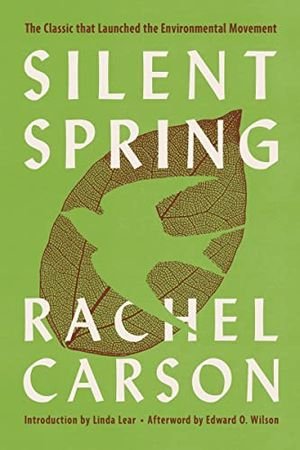
Rachel Carson’s Silent Spring was first published in three serialized excerpts in the New Yorker in June of 1962. The book appeared in September of that year and the outcry that followed its publication forced the banning of DDT and spurred revolutionary changes in the laws affecting our air, land, and water. Carson’s passionate concern for the future of our planet reverberated powerfully throughout the world, and her eloquent book was instrumental in launching the environmental movement. It is without question one of the landmark books of the twentieth century.
I’d start with Silent Spring by Rachel Carson, which looked at how pesticide use was harming, and in some cases killing, animals and humans, and really was the first book of its kind to illustrate this environmental destruction. I’ve been so involved in the environment for years and years and that has been a great guideline – it was really the awakening, if you will, to the environmental movement and to the progress we’ve made over the last quarter century or more. [source]
Over the last half-billion years, there have been five mass extinctions, when the diversity of life on earth suddenly and dramatically contracted. Scientists around the world are currently monitoring the sixth extinction, predicted to be the most devastating extinction event since the asteroid impact that wiped out the dinosaurs. This time around, the cataclysm is us.
In prose that is at once frank, entertaining, and deeply informed, The New Yorker writer Elizabeth Kolbert tells us why and how human beings have altered life on the planet in a way no species has before. Interweaving research in half a dozen disciplines, descriptions of the fascinating species that have already been lost, and the history of extinction as a concept, Kolbert provides a moving and comprehensive account of the disappearances occurring before our very eyes. She shows that the sixth extinction is likely to be mankind's most lasting legacy, compelling us to rethink the fundamental question of what it means to be human.
The president also released a list of his summer favorites back in 2015: All That Is, James Salter The Sixth Extinction, Elizabeth Kolbert The Lowland, Jhumpa Lahiri Between the World and Me, Ta-Nehisi Coates Washington: A Life, Ron Chernow All the Light We Cannot See, Anthony Doerr [source]
The Sixth Extinction: An Unnatural History, by Elizabeth Kolbert. Climate change is a big problem—one of the biggest we’ll face this century—but it’s not the only environmental concern on the horizon. Humans are putting down massive amounts of pavement, moving species around the planet, over-fishing and acidifying the oceans, changing the chemical composition of rivers, and more. Natural scientists posit that there have been five extinction events in the Earth’s history (think of the asteroid that wiped out the dinosaurs), and Kolbert makes a compelling case that human activity is leading to the sixth. Unlike a lot of people who write about the environment, Kolbert doesn’t resort to hype. She just lays out the facts and wraps them in memorable anecdotes. It’s a sobering but engaging and informative read. [source]
"In his autobiography, Walmart's founder expounds on the principles of discount retailing and discusses his core values of frugality and a bias for action — a willingness to try a lot of things and make many mistakes. Bezos included both in Amazon's corporate values," Brad Stone writes. [source]
Cover unavailable
5
The Omnivore's Dilemma: A Natural History of Four Meals
What should we have for dinner? For omnivore's like ourselves, this simple question has always posed a dilemma: When you can eat just about anything nature (or the supermarket) has to offer, deciding what you should eat will inevitably stir anxiety, especially when some of the foods on offer might shorten your life. Today, buffeted by one food fad after another, America is suffering from what can only be described as a national eating disorder. The omnivore's dilemma has returned with a vengeance, as the cornucopia of the modern American supermarket and fast-food outlet confronts us with a bewildering and treacherous food landscape. What's at stake in our eating choices is not only our own and our children's health, but the health of the environment that sustains life on earth.
The Omnivore's Dilemma is a groundbreaking book in which one of America's most fascinating, original, and elegant writers turns his own omnivorous mind to the seemingly straightforward question of what we should have for dinner. The question has confronted us since man discovered fire, but, according to Michael Pollan, the bestselling author of The Botany of Desire, how we answer it today, ath the dawn of the twenty-first century, may well determine our very survival as a species. Should we eat a fast-food hamburger? Something organic> Or perhaps something we hunt, gather or grow ourselves?
To find out, Pollan follows each of the food chains that sustain us--industrial food, organic or alternative food, and food we forage ourselves--from the source to a final meal, and in the process develops a definitive account of the American way of eating. His absorbing narrative takes us from Iowa cornfields to food laboratories, from feedlots and fast-food restaurants to organic farms and hunting grounds, always emphasizing our dynamic coevolutionary relationship with the handful of plant and animal species we depend on. Each time Pollan sits down to a meal, he deploys his unique blend of personal and investigative journalism to trace the origins of everything consumed, revealing what we unwittingly ingest and explaining how our taste for particular foods and flavors reflects our evolutionary inheritance.
The surprising answers Pollan offers to the simple question posed by this book have profound political, economic, psychological, and even mortal implications for all of us. Ultimately, this is a book as much about visionary solutions as it is about problems, and Pollan contends that, when it comes to food, doing the right thing often turns out to be the tastiest thing an eater can do. Beautifully written and thrillingly argued, The Omnivore's Dilemma promises to change the way we think about the politics and pleasure of eating. For anyone who reads it, dinner will never again look, or taste, quite the same. --jacket
…
Recommended by Barry Estabrook, Gabriel Coarna, Paul Rozin, and 1 others.
Barry Estabrook
Michael Pollan looks at food production through four meals. One is a fast-food meal, the other is an industrial-scale organic meal, then there is a small-scale organic meal and finally he actually goes out and either grows or kills, in the case of the meat, the entire meal himself. That is the narrative. [source]
Gabriel Coarna
Michael Pollan's "The Omnivore's Dilemma" --more precisely, the first 3rd of it-- was what first made me realize how badly the Earth, as an ecosystem, is out of balance. [source]
Paul Rozin
Michael Pollan is an excellent journalist who specializes in the food domain.He proposes relying more on whole foods and less on processed foods, like Oreo Cookies. He argues that unprocessed foods are more nutritious, more wholistic and better for the environment. [source]
Meadows’ Thinking in Systems, is a concise and crucial book offering insight for problem solving on scales ranging from the personal to the global. Edited by the Sustainability Institute’s Diana Wright, this essential primer brings systems thinking out of the realm of computers and equations and into the tangible world, showing readers how to develop the systems-thinking skills that thought leaders across the globe consider critical for 21st-century life.
Some of the biggest problems facing the world—war, hunger, poverty, and environmental degradation—are essentially system failures. They cannot be solved by fixing one piece in isolation from the others, because even seemingly minor details have enormous power to undermine the best efforts of too-narrow thinking.
While readers will learn the conceptual tools and methods of systems thinking, the heart of the book is grander than methodology. Donella Meadows was known as much for nurturing positive outcomes as she was for delving into the science behind global dilemmas. She reminds readers to pay attention to what is important, not just what is quantifiable, to stay humble, and to stay a learner.
In a world growing ever more complicated, crowded, and interdependent, Thinking in Systems helps readers avoid confusion and helplessness, the first step toward finding proactive and effective solutions.
…
Recommended by Tobi Lütke, Kate Raworth, and Mira Kirshenbaum.
Tobi Lütke
Founder & CEO/Shopify
Tobi Lütke recommended this book on the podcast "The Knowledge Project". [source]
In The Hidden Life of Trees, Peter Wohlleben shares his deep love of woods and forests and explains the amazing processes of life, death, and regeneration he has observed in the woodland and the amazing scientific processes behind the wonders of which we are blissfully unaware. Much like human families, tree parents live together with their children, communicate with them, and support them as they grow, sharing nutrients with those who are sick or struggling and creating an ecosystem that mitigates the impact of extremes of heat and cold for the whole group. As a result of such interactions, trees in a family or community are protected and can live to be very old. In contrast, solitary trees, like street kids, have a tough time of it and in most cases die much earlier than those in a group.
Drawing on groundbreaking new discoveries, Wohlleben presents the science behind the secret and previously unknown life of trees and their communication abilities; he describes how these discoveries have informed his own practices in the forest around him. As he says, a happy forest is a healthy forest, and he believes that eco-friendly practices not only are economically sustainable but also benefit the health of our planet and the mental and physical health of all who live on Earth.
First published in 1949, A Sand County Almanac combines some of the finest nature writing since Thoreau with an outspoken and highly ethical regard for America's relationship to the land.
Written with an unparalleled understanding of the ways of nature, the book includes a section on the monthly changes of the Wisconsin countryside; another part that gathers informal pieces written by Leopold over a forty-year period as he traveled through the woodlands of Wisconsin, Iowa, Arizona, Sonora, Oregon, Manitoba, and elsewhere; and a final section in which Leopold addresses the philosophical issues involved in wildlife conservation. As the forerunner of such important books as Annie Dillard's Pilgrim at Tinker Creek, Edward Abbey's Desert Solitaire, and Robert Finch's The Primal Place, this classic work remains as relevant today as it was sixty-five years ago.
…
Recommended by Isabella Tree, Mark Boyle, and Mike Phillips.
Isabella Tree
Leopold wrote that one of the penalties of an ecological education is that one lives alone in a world of wounds. To me, that rings painfully true. [source]
At Walden Pond, Henry David Thoreau reflected on simpler living in the natural world. By removing himself from the distractions of materialism, Thoreau hoped to not only improve his spiritual life but also gain a better understanding of society through solitary introspection.
In Walden, Thoreau condenses his two-year, two-month, two-day stay into a single year, using the four seasons to symbolize human development—a cycle of life shared by both nature and man. A celebration of personal renewal through self-reliance, independence, and simplicity, composed for all of us living in “quiet desperation,” Walden is eternal.
…
Recommended by Emma Watson, Donna Dickenson, Emily Thomas, and 5 others.
Donna Dickenson
He discusses how the original ideals that America was founded on were being compromised, and how massive industrial interests were starting to dominate. [source]
Emily Thomas
The beginning is hard going. Once you get past that, then suddenly you’re into these beautiful and inspiring descriptions of nature. [source]
Joan Boixados
In case you were deceived and expected me to name Walden by Henry David Thoreau, you should read it too if you haven’t, it obviously is the inspiration to Walden Two. :) [source]
Cover unavailable
10
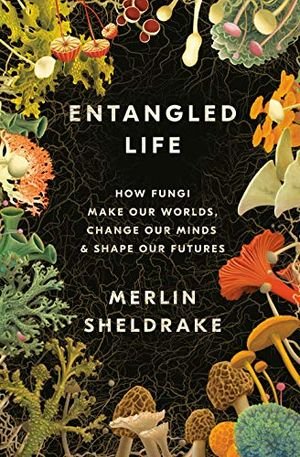
Entangled Life: How Fungi Make Our Worlds, Change Our Minds & Shape Our Futures
A mind-bending journey into the hidden world of fungi that will change your understanding of life on earth
"A dazzling, vibrant, vision-changing book . . . I ended it wonderstruck at the fungal world--the secrets of which modern science is only now beginning to fathom."--Robert Macfarlane, author of Underland
When we think of fungi, we likely think of mushrooms. But mushrooms are only fruiting bodies, analogous to apples on a tree. Most fungi live out of sight, yet make up a massively diverse kingdom of organisms that supports and sustains nearly all living systems. Fungi provide a key to understanding the planet on which we live, and the ways we think, feel, and behave.
In Entangled Life, the brilliant young biologist Merlin Sheldrake shows us the world from a fungal point of view, providing an exhilarating change of perspective. Sheldrake's vivid exploration takes us from yeast to psychedelics, to the fungi that range for miles underground and are the largest organisms on the planet, to those that link plants together in complex networks known as the "Wood Wide Web," to those that infiltrate and manipulate insect bodies with devastating precision.
Fungi throw our concepts of individuality and even intelligence into question. They are metabolic masters, earth makers, and key players in most of life's processes. They can change our minds, heal our bodies, and even help us remediate environmental disaster. By examining fungi on their own terms, Sheldrake reveals how these extraordinary organisms--and our relationships with them--are changing our understanding of how life works.
Praise for Entangled Life
"Fungi are everywhere, and Merlin Sheldrake is an ideal guide to their mysteries. He’s passionate, deeply knowledgeable, and a wonderful writer.”—Elizabeth Kolbert, author of The Sixth Extinction
“I was completely unprepared for Sheldrake’s book. It rolled me over like a tsunami, leaving the landscape rearranged but all the more beautiful.”—Nicholas Humphrey, Emeritus Professor of Psychology at the London School of Economics and author of A History of the Mind and Soul Dust
“Sheldrake’s charm and curiosity make for a book that is delightful to read but also grand and dizzying in how thoroughly it recalibrates our understanding of the natural world and the often overlooked organisms within it.”—Ed Yong, author of I Contain Multitudes
Sheldrake uses fungi to demonstrate the entangledness of everything in the natural world. For him, no questions are out of bounds. There are no canonical principles which cannot and should not be interrogated. And he approaches it with an effervescent, child-like enthusiasm. [source]
Cover unavailable
11
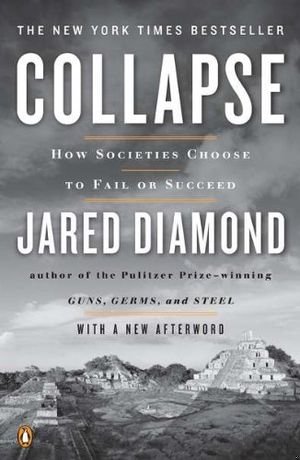
Collapse: How Societies Choose to Fail or Succeed
Jared Diamond
4.5
In Jared Diamond’s follow-up to the Pulitzer-Prize winning Guns, Germs and Steel, the author explores how climate change, the population explosion and political discord create the conditions for the collapse of civilization
Environmental damage, climate change, globalization, rapid population growth, and unwise political choices were all factors in the demise of societies around the world, but some found solutions and persisted. As in Guns, Germs, and Steel, Diamond traces the fundamental pattern of catastrophe, and weaves an all-encompassing global thesis through a series of fascinating historical-cultural narratives. Collapse moves from the Polynesian cultures on Easter Island to the flourishing American civilizations of the Anasazi and the Maya and finally to the doomed Viking colony on Greenland. Similar problems face us today and have already brought disaster to Rwanda and Haiti, even as China and Australia are trying to cope in innovative ways. Despite our own society’s apparently inexhaustible wealth and unrivaled political power, ominous warning signs have begun to emerge even in ecologically robust areas like Montana.
Brilliant, illuminating, and immensely absorbing, Collapse is destined to take its place as one of the essential books of our time, raising the urgent question: How can our world best avoid committing ecological suicide?
…
Recommended by Bill Gates, Daniel Headrick, David Pilling, and 3 others.
I found this to be an interesting follow-up to the excellent Guns, Germs, and Steel. It examines the downfall of some of history's greatest civilizations. [source]
Daniel Headrick
I found Jared Diamond’s book Collapse more valuable in influencing my own thinking, because it shows the importance of culture in determining how humans deal with environmental threats. …….The author investigates the successes and failures of a number of civilisations which had reached a crisis point, and looks at why some succeeded and others hadn’t. [source]
David Pilling
This is a warning that societies can do this. We, as a human society, could do this if we’re not careful. If we stretch the earth beyond its planetary limits, we could ruin the soil, we could ruin the ocean, we could ruin the air, and we could drain the ocean of fish. He sees evidence all around that we’re doing precisely that. He sees a limit to technology to solve our problems. [source]
A penetrating, page-turning tour of a post-human Earth
In The World Without Us, Alan Weisman offers an utterly original approach to questions of humanity's impact on the planet: he asks us to envision our Earth, without us. In this far-reaching narrative, Weisman explains how our massive infrastructure would collapse and finally vanish without human presence; which everyday items may become immortalized as fossils; how copper pipes and wiring would be crushed into mere seams of reddish rock; why some of our earliest buildings might be the last architecture left; and how plastic, bronze sculpture, radio waves, and some man-made molecules may be our most lasting gifts to the universe.
The World Without Us reveals how, just days after humans disappear, floods in New York's subways would start eroding the city's foundations, and how, as the world's cities crumble, asphalt jungles would give way to real ones. It describes the distinct ways that organic and chemically treated farms would revert to wild, how billions more birds would flourish, and how cockroaches in unheated cities would perish without us. Drawing on the expertise of engineers, atmospheric scientists, art conservators, zoologists, oil refiners, marine biologists, astrophysicists, religious leaders from rabbis to the Dalai Lama, and paleontologists—who describe a prehuman world inhabited by megafauna like giant sloths that stood taller than mammoths—Weisman illustrates what the planet might be like today, if not for us.
From places already devoid of humans (a last fragment of primeval European forest; the Korean DMZ; Chernobyl), Weisman reveals Earth's tremendous capacity for self-healing. As he shows which human devastations are indelible, and which examples of our highest art and culture would endure longest, Weisman's narrative ultimately drives toward a radical but persuasive solution that needn't depend on our demise. It is narrative nonfiction at its finest, and in posing an irresistible concept with both gravity and a highly readable touch, it looks deeply at our effects on the planet in a way that no other book has.
Today is World Book Day, a wonderful opportunity to address this #ChallengeRichard sent in by Mike Gonzalez of New Jersey: Make a list of your top 65 books to read in a lifetime. [source]
Cover unavailable
13
I Contain Multitudes: The Microbes Within Us and a Grander View of Life
Every animal, whether human, squid, or wasp, is home to millions of bacteria and other microbes. Many people think of microbes as germs to be eradicated, but those that live with us—the microbiome—build our bodies, protect our health, shape our identities, and grant us incredible abilities. In this astonishing book, Ed Yong takes us on a grand tour through our microbial partners, and introduces us to the scientists on the front lines of discovery.
Yong, whose humor is as evident as his erudition, prompts us to look at ourselves and our animal companions in a new light—less as individuals and more as the interconnected, interdependent multitudes we assuredly are. The microbes in our bodies are part of our immune systems and protect us from disease. Those in cows and termites digest the plants they eat. In the deep oceans, mysterious creatures without mouths or guts depend on microbes for all their energy. Bacteria provide squids with invisibility cloaks, help beetles to bring down forests, and allow worms to cause diseases that afflict millions of people.
I Contain Multitudes is the story of these extraordinary partnerships, between the creatures we are familiar with and those we are not. It reveals how we humans are disrupting these partnerships and how we might manipulate them for our own good. It will change both our view of nature and our sense of where we belong in it.
The U.S. scientific community has long led the world in research on such areas as public health, environmental science, and issues affecting quality of life. Our scientists have produced landmark studies on the dangers of DDT, tobacco smoke, acid rain, and global warming. But at the same time, a small yet potent subset of this community leads the world in vehement denial of these dangers.
Merchants of Doubt tells the story of how a loose-knit group of high-level scientists and scientific advisers, with deep connections in politics and industry, ran effective campaigns to mislead the public and deny well-established scientific knowledge over four decades. Remarkably, the same individuals surface repeatedly—some of the same figures who have claimed that the science of global warming is "not settled" denied the truth of studies linking smoking to lung cancer, coal smoke to acid rain, and CFCs to the ozone hole. "Doubt is our product," wrote one tobacco executive. These "experts" supplied it.
Naomi Oreskes and Erik M. Conway, historians of science, roll back the rug on this dark corner of the American scientific community, showing how ideology and corporate interests, aided by a too-compliant media, have skewed public understanding of some of the most pressing issues of our era.
Fast food has hastened the malling of our landscape, widened the chasm between rich and poor, fueled an epidemic of obesity, and propelled American cultural imperialism abroad. That's a lengthy list of charges, but here Eric Schlosser makes them stick with an artful mix of first-rate reportage, wry wit, and careful reasoning.
Schlosser's myth-shattering survey stretches from California's subdivisions where the business was born to the industrial corridor along the New Jersey Turnpike where many fast food's flavors are concocted. Along the way, he unearths a trove of fascinating, unsettling truths -- from the unholy alliance between fast food and Hollywood to the seismic changes the industry has wrought in food production, popular culture, and even real estate. (back cover)
…
Recommended by Richard Branson, Antonio Eram, Barry Estabrook, and 1 others.
Today is World Book Day, a wonderful opportunity to address this #ChallengeRichard sent in by Mike Gonzalez of New Jersey: Make a list of your top 65 books to read in a lifetime. [source]
Antonio Eram
This book was recommended by Antonio when asked for titles he would recommend to young people interested in his career path. [source]
Barry Estabrook
Eric Schlosser takes apart a single fast-food meal and shows not only how it affects our health but also how the people who serve it to you are treated. He also looks at how the people in the slaughterhouses working with the cattle are treated, and so it shows you the true picture of the all-American meal – burgers and fries. [source]
Cover unavailable
16
Finding the Mother Tree: Discovering the Wisdom of the Forest
From the best-selling, award-winning author of Landmarks and The Old Ways, a haunting voyage into the planet’s past and future.
Hailed as "the great nature writer of this generation" (Wall Street Journal), Robert Macfarlane is the celebrated author of books about the intersections of the human and the natural realms. In Underland, he delivers his masterpiece: an epic exploration of the Earth’s underworlds as they exist in myth, literature, memory, and the land itself.
In this highly anticipated sequel to his international bestseller The Old Ways, Macfarlane takes us on an extraordinary journey into our relationship with darkness, burial, and what lies beneath the surface of both place and mind. Traveling through “deep time”—the dizzying expanses of geologic time that stretch away from the present—he moves from the birth of the universe to a post-human future, from the prehistoric art of Norwegian sea caves to the blue depths of the Greenland ice cap, from Bronze Age funeral chambers to the catacomb labyrinth below Paris, and from the underground fungal networks through which trees communicate to a deep-sunk “hiding place” where nuclear waste will be stored for 100,000 years to come. Woven through Macfarlane’s own travels are the unforgettable stories of descents into the underland made across history by explorers, artists, cavers, divers, mourners, dreamers, and murderers, all of whom have been drawn for different reasons to seek what Cormac McCarthy calls “the awful darkness within the world.”
Global in its geography and written with great lyricism and power, Underland speaks powerfully to our present moment. Taking a deep-time view of our planet, Macfarlane here asks a vital and unsettling question: “Are we being good ancestors to the future Earth?” Underland marks a new turn in Macfarlane’s long-term mapping of the relations of landscape and the human heart. From its remarkable opening pages to its deeply moving conclusion, it is a journey into wonder, loss, fear, and hope. At once ancient and urgent, this is a book that will change the way you see the world.
…
Recommended by Alastair Humphreys, Cal Flyn, and Jonathan Green.
Alastair Humphreys
The cleverest and nicest man in the world of travel writing has just published a brilliant new book which you should definitely buy. And so has @robgmacfarlane... 😂 https://t.co/7tWMRoB08W https://t.co/2UmUfDUqpt [source]
Cal Flyn
Having climbed the highest heights in his debut Mountains of the Mind, Macfarlane now dives down to the lowest of the lows. He goes caving in limestone caverns deep underground, rattles through salt mines under the sea in carts and stumbles across (literal) underground subcultures in the Paris catacombs, all interwoven with learned digressions into geological epochs and classical conceptions of the underworld. What can I say? Macfarlane is the most remarkable writer. [source]
Jonathan Green
@mmbrenn yes the best book i read last year without question. beautiful. harrowing. [source]
Cover unavailable
18
Apocalypse Never: How the Left's New Lies About Climate Change Hurt People and Nature
An environmental expert unleashes a scientific, fact-based broadside against eco-alarmism and the excesses of the left, arguing that climate change and other environmental problems are real but not apocalyptic and require practical, not radical, solutions.
Many environmentalists claim the world as we know it will soon come to an end unless we radically change how we live our lives. They demand we stop eating meat, ban plastics, and significantly reduce how much we drive and fly.
Climate change is real, says Michael Shellenberger in Apocalypse Never, but it’s not the end of the world. It is not even our most serious environmental problem. Most environmental trends, including population, pollution, and resource use, are all going in the right direction.
The left profits from hyping climate change as apocalypse while opposing obvious solutions. Schemes like “The Green New Deal” would transfer wealth to well-connected elites, raise energy costs, and hurt wildlife.
Poverty, not prosperity, is the real enemy of the environment. We use can produce more food using less land and water, move from wood to coal to natural gas to nuclear, and safely capture and contain plastic waste. But all of that will require standing up to the eco-alarmism in the way of environmental protection.
…
Cover unavailable
19
Pilgrim at Tinker Creek
Annie Dillard
4.3
An exhilarating meditation on nature and its seasons—a personal narrative highlighting one year's exploration on foot in the author's own neighborhood in Tinker Creek, Virginia. In the summer, Dillard stalks muskrats in the creek and contemplates wave mechanics; in the fall she watches a monarch butterfly migration and dreams of Arctic caribou. She tries to con a coot; she collects pond water and examines it under a microscope. She unties a snake skin, witnesses a flood, and plays 'King of the Meadow' with a field of grasshoppers.
…
Recommended by Laura Dassow Walls and Sara Maitland.
Laura Dassow Walls
She’s enacting Thoreau, but in a 20th-century context: she takes on quantum physics, the latest research on DNA and the nature of life. [source]
Sara Maitland
This book, which won the Pulitzer literature prize when it was released, is the most beautiful book about the wild. [source]
Cover unavailable
20
Midnight in Chernobyl: The Untold Story of the World's Greatest Nuclear Disaster
Adam Higginbotham
4.3
The definitive, dramatic untold story of the Chernobyl nuclear power plant disaster, based on original reporting and new archival research.
April 25, 1986, in Chernobyl, was a turning point in world history. The disaster not only changed the world’s perception of nuclear power and the science that spawned it, but also our understanding of the planet’s delicate ecology. With the images of the abandoned homes and playgrounds beyond the barbed wire of the 30-kilometer Exclusion Zone, the rusting graveyards of contaminated trucks and helicopters, the farmland lashed with black rain, the event fixed for all time the notion of radiation as an invisible killer.
Chernobyl was also a key event in the destruction of the Soviet Union, and, with it, the United States’ victory in the Cold War. For Moscow, it was a political and financial catastrophe as much as an environmental and scientific one. With a total cost of 18 billion rubles—at the time equivalent to $18 billion—Chernobyl bankrupted an already teetering economy and revealed to its population a state built upon a pillar of lies.
The full story of the events that started that night in the control room of Reactor No.4 of the V.I. Lenin Nuclear Power Plant has never been told—until now. Through two decades of reporting, new archival information, and firsthand interviews with witnesses, journalist Adam Higginbotham tells the full dramatic story, including Alexander Akimov and Anatoli Dyatlov, who represented the best and worst of Soviet life; denizens of a vanished world of secret policemen, internal passports, food lines, and heroic self-sacrifice for the Motherland. Midnight in Chernobyl, award-worthy nonfiction that reads like sci-fi, shows not only the final epic struggle of a dying empire but also the story of individual heroism and desperate, ingenious technical improvisation joining forces against a new kind of enemy.
…
Recommended by Maggie Koerthbaker.
Maggie Koerthbaker
So I'm reading "Midnight in Chernobyl" because obviously TV viewing needs to come with a syllabus afterwards. https://t.co/bWCLHTy7fq It is very interesting contrasting the fictionalized show, the history book, and the essays meant to debunk aspects of the show. [source]
Cover unavailable
21
The Botany of Desire: A Plant's-Eye View of the World
Michael Pollan
4.3
Every schoolchild learns about the mutually beneficial dance of honeybees and flowers: The bee collects nectar and pollen to make honey and, in the process, spreads the flowers’ genes far and wide. InThe Botany of Desire, Michael Pollan ingeniously demonstrates how people and domesticated plants have formed a similarly reciprocal relationship. He masterfully links four fundamental human desires—sweetness, beauty, intoxication, and control—with the plants that satisfy them: the apple, the tulip, marijuana, and the potato. In telling the stories of four familiar species, Pollan illustrates how the plants have evolved to satisfy humankind’s most basic yearnings. And just as we’ve benefited from these plants, we have also done well by them. So who is really domesticating whom?
…
Recommended by David George Haskell and Kenneth Cox.
David George Haskell
Through the stories of four familiar plant species–apples, tulips, marijuana, and potatoes–he demolishes the erroneous impression that we’re in charge. [source]
Kenneth Cox
You can’t fail to be fascinated by this exposition of the motivations of plants to cuddle up to humans. One of several excellent Michael Pollan books, it’s a fun read. [source]
Cover unavailable
22
Desert Solitaire
Edward Abbey
4.3
First published in 1968, Desert Solitaire is one of Edward Abbey’s most critically acclaimed works and marks his first foray into the world of nonfiction writing. Written while Abbey was working as a ranger at Arches National Park outside of Moab, Utah, Desert Solitaire is a rare view of one man’s quest to experience nature in its purest form.
Through prose that is by turns passionate and poetic, Abbey reflects on the condition of our remaining wilderness and the future of a civilization that cannot reconcile itself to living in the natural world as well as his own internal struggle with morality. As the world continues its rapid development, Abbey’s cry to maintain the natural beauty of the West remains just as relevant today as when this book was written.
Abbey is full of passion, fury and contempt – a fiery fighter to shake up the sometimes over-tranquil atmosphere of nature writing. [source]
Cover unavailable
23
The Uninhabitable Earth: Life After Warming
David Wallace-Wells
4.3
It is worse, much worse, than you think. If your anxiety about global warming is dominated by fears of sea-level rise, you are barely scratching the surface of what terrors are possible. In California, wildfires now rage year-round, destroying thousands of homes. Across the US, "500-year" storms pummel communities month after month, and floods displace tens of millions annually.
This is only a preview of the changes to come. And they are coming fast. Without a revolution in how billions of humans conduct their lives, parts of the Earth could become close to uninhabitable, and other parts horrifically inhospitable, as soon as the end of this century.
In his travelogue of our near future, David Wallace-Wells brings into stark relief the climate troubles that await--food shortages, refugee emergencies, and other crises that will reshape the globe. But the world will be remade by warming in more profound ways as well, transforming our politics, our culture, our relationship to technology, and our sense of history. It will be all-encompassing, shaping and distorting nearly every aspect of human life as it is lived today.
Like An Inconvenient Truth and Silent Spring before it, The Uninhabitable Earth is both a meditation on the devastation we have brought upon ourselves and an impassioned call to action. For just as the world was brought to the brink of catastrophe within the span of a lifetime, the responsibility to avoid it now belongs to a single generation.
…
Recommended by Elizabeth Kolbert, Gerald Butts, Jonathan Safran Foer, and 1 others.
Elizabeth Kolbert
Author
David Wallace-Wells argues that the impacts of climate change will be much graver than most people realize, and he's right. The Uninhabitable Earth is a timely and provocative work. [source]
Gerald Butts
This is a terrific book. Not as depressing as it may sound, even oddly hopeful in the end. Great read if you suddenly have time on your hands. https://t.co/2Bo5DeT3Aa [source]
Most of us know the gist, if not the details, of the climate change crisis. And yet it is almost impossible to sustain strong feelings about it. David Wallace-Wells has now provided the details, and with writing that is not only clear and forceful, but often imaginative and even funny, he has found a way to make the information deeply felt. [source]
Cover unavailable
24
The Prize: The Epic Quest for Oil, Money, and Power
Daniel Yergin
4.3
The Prize recounts the panoramic history of oil -- and the struggle for wealth and power that has always surrounded oil. This struggle has shaken the world economy, dictated the outcome of wars, and transformed the destiny of men and nations.
The Prize is as much a history of the twentieth century as of the oil industry itself. The canvas of history is enormous -- from the drilling of the first well in Pennsylvania through two great world wars to the Iraqi invasion of Kuwait and Operation Desert Storm.
A wonderfully readable history of the development of the oil age. [source]
Cover unavailable
25
Drawdown: The Most Comprehensive Plan Ever Proposed to Reverse Global Warming
Paul Hawken
4.2
- New York Times bestseller -
The 100 most substantive solutions to reverse global warming, based on meticulous research by leading scientists and policymakers around the world
"At this point in time, the Drawdown book is exactly what is needed; a credible, conservative solution-by-solution narrative that we can do it. Reading it is an effective inoculation against the widespread perception of doom that humanity cannot and will not solve the climate crisis. Reported by-effects include increased determination and a sense of grounded hope." --Per Espen Stoknes, Author, What We Think About When We Try Not To Think About Global Warming "There's been no real way for ordinary people to get an understanding of what they can do and what impact it can have. There remains no single, comprehensive, reliable compendium of carbon-reduction solutions across sectors. At least until now. . . . The public is hungry for this kind of practical wisdom." --David Roberts, Vox "This is the ideal environmental sciences textbook--only it is too interesting and inspiring to be called a textbook." --Peter Kareiva, Director of the Institute of the Environment and Sustainability, UCLA
In the face of widespread fear and apathy, an international coalition of researchers, professionals, and scientists have come together to offer a set of realistic and bold solutions to climate change. One hundred techniques and practices are described here--some are well known; some you may have never heard of. They range from clean energy to educating girls in lower-income countries to land use practices that pull carbon out of the air. The solutions exist, are economically viable, and communities throughout the world are currently enacting them with skill and determination. If deployed collectively on a global scale over the next thirty years, they represent a credible path forward, not just to slow the earth's warming but to reach drawdown, that point in time when greenhouse gases in the atmosphere peak and begin to decline. These measures promise cascading benefits to human health, security, prosperity, and well-being--giving us every reason to see this planetary crisis as an opportunity to create a just and livable world.
…
Recommended by Andreas Kuhlmann, Jessica Rolph, John Elkington, and 1 others.
Andreas Kuhlmann
Drawdown is an exceptional example of cooperation between some of the sharpest thinkers on climate and energy matters, an atlas that has the potential to save the planet. [source]
Jessica Rolph
This book is a beautiful, inspiring, and deeply satisfying read. Most importantly it is no more doom and gloom. It is OPTIMISTIC and empowering. Paul Hawken is a true visionary and a brilliant voice for real solutions. [source]
John Elkington
I am blown away by Drawdown. Like hearing an advance copy of Sergeant Pepper, back in the day. [source]
Cover unavailable
26
On Fire: The (Burning) Case for a Green New Deal
Naomi Klein
4.2
#1 international and New York Times bestselling author Naomi Klein, author of The Shock Doctrine and This Changes Everything, makes the case for a Green New Deal—explaining how bold climate action can be a blueprint for a just and thriving society.
For more than twenty years, Naomi Klein has been the foremost chronicler of the economic war waged on both people and planet—and an unapologetic champion of a sweeping environmental agenda with justice at its center. In lucid, elegant dispatches from the frontlines of contemporary natural disaster, she pens surging, indispensable essays for a wide public: prescient advisories and dire warnings of what future awaits us if we refuse to act, as well as hopeful glimpses of a far better future. On Fire: The (Burning) Case for a Green New Deal gathers for the first time more than a decade of her impassioned writing, and pairs it with new material on the staggeringly high stakes of our immediate political and economic choices.
These long-form essays show Klein at her most prophetic and philosophical, investigating the climate crisis not only as a profound political challenge but as a spiritual and imaginative one, as well. Delving into topics ranging from the clash between ecological time and our culture of “perpetual now,” to the soaring history of humans changing and evolving rapidly in the face of grave threats, to rising white supremacy and fortressed borders as a form of “climate barbarism,” this is a rousing call to action for a planet on the brink.
With reports spanning from the ghostly Great Barrier Reef, to the annual smoke-choked skies of the Pacific Northwest, to post-hurricane Puerto Rico, to a Vatican attempting an unprecedented “ecological conversion,” Klein makes the case that we will rise to the existential challenge of climate change only if we are willing to transform the systems that produced this crisis.
An expansive, far-ranging exploration that sees the battle for a greener world as indistinguishable from the fight for our lives, On Fire captures the burning urgency of the climate crisis, as well as the fiery energy of a rising political movement demanding a catalytic Green New Deal.
…
Recommended by Daniel Bryan.
Daniel Bryan
Love @NaomiAKlein’s new book, On Fire: The (Burning) Case for a Green New Deal. It makes powerful, compelling arguments for how we can not only combat climate change, but create a more just society in the process. Quotes and ideas in the thread #GreenNewDeal [source]
Cover unavailable
27
Gathering Moss: A Natural and Cultural History of Mosses
Robin Wall Kimmerer
4.2
Living at the limits of our ordinary perception, mosses are a common but largely unnoticed element of the natural world. Gathering Moss is a beautifully written mix of science and personal reflection that invites readers to explore and learn from the elegantly simple lives of mosses.Robin Wall Kimmerer's book is not an identification guide, nor is it a scientific treatise. Rather, it is a series of linked personal essays that will lead general readers and scientists alike to an understanding of how mosses live and how their lives are intertwined with the lives of countless other beings, from salmon and hummingbirds to redwoods and rednecks. Kimmerer clearly and artfully explains the biology of mosses, while at the same time reflecting on what these fascinating organisms have to teach us.
Drawing on her diverse experiences as a scientist, mother, teacher, and writer of Native American heritage, Kimmerer explains the stories of mosses in scientific terms as well as in the framework of indigenous ways of knowing. In her book, the natural history and cultural relationships of mosses become a powerful metaphor for ways of living in the world.
Gathering Moss will appeal to a wide range of readers, from bryologists to those interested in natural history and the environment, Native Americans, and contemporary nature and science writing.
…
Recommended by Caspar Henderson.
Caspar Henderson
She writes vividly about what it’s like to walk across moss in bare feet and to notice it for the first time and to notice the incredible world within moss and the creatures that live within it. [source]
Cover unavailable
28
The Nature Fix: Why Nature Makes Us Happier, Healthier, and More Creative
From forest trails in Korea, to islands in Finland, to eucalyptus groves in California, Florence Williams investigates the science behind nature’s positive effects on the brain. Delving into brand-new research, she uncovers the powers of the natural world to improve health, promote reflection and innovation, and strengthen our relationships. As our modern lives shift dramatically indoors, these ideas—and the answers they yield—are more urgent than ever.
…
Cover unavailable
29
Eating Animals
Jonathan Safran Foer
4.2
Jonathan Safran Foer spent much of his life oscillating between enthusiastic carnivore and occasional vegetarian. Once he started a family, the moral dimensions of food became increasingly important. Faced with the prospect of being unable to explain why we eat some animals and not others, Foer set out to explore the origins of many eating traditions and the fictions involved with creating them. Traveling to the darkest corners of our dining habits, Foer raises the unspoken question behind every fish we eat, every chicken we fry, and every burger we grill. Part memoir and part investigative report, Eating Animals is a book that, in the words of the Los Angeles Times, places Jonathan Safran Foer "at the table with our greatest philosophers."
…
Recommended by Louise Gray.
Louise Gray
It’s a really powerful book and I know many people who it has made vegetarian. [source]
Cover unavailable
30
Cadillac Desert: The American West and Its Disappearing Water
Marc Reisner
4.2
The story of the American West is the story of a relentless quest for a precious resource: water. It is a tale of rivers diverted and dammed, of political corruption and intrigue, of billion-dollar battles over water rights, of ecologic and economic disaster. In Cadillac Desert Marc Reisner writes of the earliest settlers, lured by the promise of paradise, and of the ruthless tactics employed by Los Angeles politicians and business interests to ensure the city's growth. He documents the bitter rivalry between two government giants, the Bureau of Reclamation and the U.S. Army Corps of Engineers, in the competition to transform the West.
Based on more than a decade of research, Cadillac Desert is a stunning expose and a dramatic, intriguing history of the creation of an Eden—an Eden that may be only a mirage.
…
Cover unavailable
31
This Changes Everything: Capitalism vs. The Climate
Naomi Klein
4.2
Forget everything you think you know about global warming. It's not about carbon – it's about capitalism. The good news is that we can seize this crisis to transform our failed economic system and build something radically better.
In her most provocative book yet, Naomi Klein, author of the global bestsellers The Shock Doctrine and No Logo, exposes the myths that are clouding climate debate.
You have been told the market will save us, when in fact the addiction to profit and growth is digging us in deeper every day. You have been told it's impossible to get off fossil fuels when in fact we know exactly how to do it – it just requires breaking every rule in the 'free-market' playbook. You have also been told that humanity is too greedy and selfish to rise to this challenge. In fact, all around the world, the fight back is already succeeding in ways both surprising and inspiring.
It's about changing the world, before the world changes so drastically that no one is safe. Either we leap – or we sink. This Changes Everything is a book that will redefine our era.
…
Cover unavailable
32
Cradle to Cradle: Remaking the Way We Make Things
William McDonough
4.2
"Reduce, reuse, recycle," urge environmentalists; in other words, do more with less in order to minimize damage. But as architect William McDonough and chemist Michael Braungart point out in this provocative, visionary book, such an approach only perpetuates the one-way, "cradle to grave" manufacturing model, dating to the Industrial Revolution, that creates such fantastic amounts of waste and pollution in the first place. Why not challenge the belief that human industry must damage the natural world? In fact, why not take nature itself as our model for making things? A tree produces thousands of blossoms in order to create another tree, yet we consider its abundance not wasteful but safe, beautiful, and highly effective.
Waste equals food.
Guided by this principle, McDonough and Braungart explain how products can be designed from the outset so that, after their useful lives, they will provide nourishment for something new. They can be conceived as "biological nutrients" that will easily reenter the water or soil without depositing synthetic materials and toxins. Or they can be "technical nutrients" that will continually circulate as pure and valuable materials within closed-loop industrial cycles, rather than being "recycled" -- really, downcycled -- into low-grade materials and uses. Drawing on their experience in (re)designing everything from carpeting to corporate campuses, McDonough and Braungart make an exciting and viable case for putting eco-effectiveness into practice, and show how anyone involved with making anything can begin to do as well.
…
Recommended by Joe Gebbia, Jerry McNerney, and Kate Raworth.
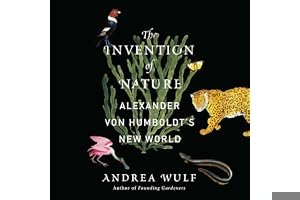
The Invention of Nature: Alexander von Humboldt's New World
Andrea Wulf
4.2
The acclaimed author of Founding Gardeners reveals the forgotten life of Alexander von Humboldt, the visionary German naturalist whose ideas changed the way we see the natural world—and in the process created modern environmentalism.
Alexander von Humboldt (1769 – 1859) was an intrepid explorer and the most famous scientist of his age. In North America, his name still graces four counties, thirteen towns, a river, parks, bays, lakes, and mountains. His restless life was packed with adventure and discovery, whether he was climbing the highest volcanoes in the world or racing through anthrax-infected Siberia or translating his research into bestselling publications that changed science and thinking. Among Humboldt’s most revolutionary ideas was a radical vision of nature, that it is a complex and interconnected global force that does not exist for the use of humankind alone.
Now Andrea Wulf brings the man and his achievements back into focus: his daring expeditions and investigation of wild environments around the world and his discoveries of similarities between climate and vegetation zones on different continents. She also discusses his prediction of human-induced climate change, his remarkable ability to fashion poetic narrative out of scientific observation, and his relationships with iconic figures such as Simón Bolívar and Thomas Jefferson. Wulf examines how Humboldt’s writings inspired other naturalists and poets such as Darwin, Wordsworth, and Goethe, and she makes the compelling case that it was Humboldt’s influence that led John Muir to his ideas of natural preservation and that shaped Thoreau’s Walden.
With this brilliantly researched and compellingly written book, Andrea Wulf shows the myriad fundamental ways in which Humboldt created our understanding of the natural world, and she champions a renewed interest in this vital and lost player in environmental history and science.
…
Cover unavailable
35
Nature's Metropolis: Chicago and the Great West
William Cronon
4.2
In this groundbreaking work, William Cronon gives us an environmental perspective on the history of nineteenth-century America. By exploring the ecological and economic changes that made Chicago America's most dynamic city and the Great West its hinterland, Mr. Cronon opens a new window onto our national past. This is the story of city and country becoming ever more tightly bound in a system so powerful that it reshaped the American landscape and transformed American culture. The world that emerged is our own.
Nature’s Metropolis tells the story of Chicago’s relationship with the great American hinterland. It certainly shaped my understanding of the role that cities played in the 19th century. William Cronon tells this story through a series of commodities, from the timber of the early forest that came down through Lake Michigan, to the corn of Iowa that produced the pigs that were slaughtered in Chicago and then shipped back east. He tells the story of the triumph of Chicago over the earlier porkopolis Cincinnati, which was due to the fact that Chicago enabled America to access the wealth of the Iowa farmland, which was significantly more productive than the old hinterland of the Ohio River Valley. [source]
Cover unavailable
36
Isaac's Storm: A Man, a Time, and the Deadliest Hurricane in History
Erik Larson
4.2
National Bestseller
September 8, 1900, began innocently in the seaside town of Galveston, Texas. Even Isaac Cline, resident meteorologist for the U.S. Weather Bureau failed to grasp the true meaning of the strange deep-sea swells and peculiar winds that greeted the city that morning. Mere hours later, Galveston found itself submerged in a monster hurricane that completely destroyed the town and killed over six thousand people in what remains the greatest natural disaster in American history--and Isaac Cline found himself the victim of a devastating personal tragedy.
Using Cline's own telegrams, letters, and reports, the testimony of scores of survivors, and our latest understanding of the science of hurricanes, Erik Larson builds a chronicle of one man's heroic struggle and fatal miscalculation in the face of a storm of unimaginable magnitude. Riveting, powerful, and unbearably suspenseful, Isaac's Storm is the story of what can happen when human arrogance meets the great uncontrollable force of nature.
…
Recommended by Deborah Blum.
Deborah Blum
That is exactly right – the Galveston Hurricane in 1900. It killed thousands of people. I was just thinking after this latest round of tornadoes what a storm-torn continent we are. But that was the worst of them. There has never been a hurricane like that to hit the United States and essentially to remove a community, destroy a generation living there. [source]
Cover unavailable
37
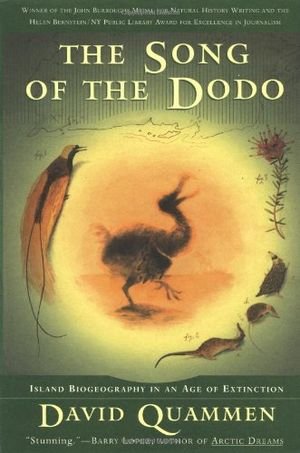
The Song of the Dodo: Island Biogeography in an Age of Extinctions
David Quammen
4.2
David Quammen's book, The Song of the Dodo, is a brilliant, stirring work, breathtaking in its scope, far-reaching in its message -- a crucial book in precarious times, which radically alters the way in which we understand the natural world and our place in that world. It's also a book full of entertainment and wonders. In The Song of the Dodo, we follow Quammen's keen intellect through the ideas, theories, and experiments of prominent naturalists of the last two centuries. We trail after him as he travels the world, tracking the subject of island biogeography, which encompasses nothing less than the study of the origin and extinction of all species. Why is this island idea so important? Because islands are where species most commonly go extinct -- and because, as Quammen points out, we live in an age when all of Earth's landscapes are being chopped into island-like fragments by human activity. Through his eyes, we glimpse the nature of evolution and extinction, and in so doing come to understand the monumental diversity of our planet, and the importance of preserving its wild landscapes, animals, and plants. We also meet some fascinating human characters. By the book's end we are wiser, and more deeply concerned, but Quammen leaves us with a message of excitement and hope.
…
Recommended by Isabella Tree, Sean B Carroll, and TC Boyle.
Isabella Tree
Quammen’s wondrous peregrination of islands takes us on a journey of evolutions and extinctions in order to illustrate how like islands our continents have become. [source]
Sean B Carroll
The book covers the role that islands have played in our thinking about how nature works. [source]
A brilliant journalist who can tell scientific stories with the kind of panache you’d expect from a novelist. [source]
Cover unavailable
38
The Monkey Wrench Gang (Monkey Wrench Gang, #1)
Edward Abbey
4.2
Ed Abbey called The Monkey Wrench Gang, his 1975 novel, a "comic extravaganza." Some readers have remarked that the book is more a comic book than a real novel, and it's true that reading this incendiary call to protect the American wilderness requires more than a little of the old willing suspension of disbelief.
The story centers on Vietnam veteran George Washington Hayduke III, who returns to the desert to find his beloved canyons and rivers threatened by industrial development. On a rafting trip down the Colorado River, Hayduke joins forces with feminist saboteur Bonnie Abbzug, wilderness guide Seldom Seen Smith, and billboard torcher Doc Sarvis, M.D., and together they wander off to wage war on the big yellow machines, on dam builders and road builders and strip miners. As they do, his characters voice Abbey's concerns about wilderness preservation ("Hell of a place to lose a cow," Smith thinks to himself while roaming through the canyonlands of southern Utah. "Hell of a place to lose your heart. Hell of a place... to lose. Period").
Moving from one improbable situation to the next, packing more adventure into the space of a few weeks than most real people do in a lifetime, the motley gang puts fear into the hearts of their enemies, laughing all the while. It's comic, yes, and required reading for anyone who has come to love the desert.
The book itself is hilarious, and brilliant in its own right. It’s importance, however, in part stems from the wider impact it had in the years following its publication. It’s widely understood that the book gave rise to radical environmental groups across the world from the 1980s onwards. [source]
Cover unavailable
39
What the Eyes Don't See: A Story of Crisis, Resistance, and Hope in an American City
Mona Hanna-Attisha
4.2
The dramatic story of the Flint water crisis--an inspiring tale of scientific resistance by a relentless physician who stood up to power.
Flint was already a troubled city in 2014 when the state of Michigan--in the name of austerity--shifted the source of its water supply from Lake Huron to the Flint River. Soon after, citizens began complaining about the water that flowed from their taps--but officials rebuffed them, insisting that the water was fine. Dr. Mona Hanna-Attisha, a pediatrician at the city's public hospital, took state officials at their word and encouraged the parents and children in her care to continue drinking the water--after all, it was American tap water, blessed with the state's seal of approval.
But a conversation at a cookout with an old friend, leaked documents from a rogue environmental inspector, and the activism of a concerned mother raised red flags about lead--a neurotoxin whose irreversible effects fall most heavily on children. Even as circumstantial evidence mounted and protests grew, Dr. Mona knew that the only thing that could stop the lead poisoning was undeniable proof-- and that to get it, she'd have to enter the fight of her life.
What the Eyes Don't See is the inspiring story of how Dr. Mona--accompanied by an idiosyncratic team of researchers, parents, friends, and community leaders--proved that Flint's kids were exposed to lead and then fought her own government and a brutal backlash to expose that truth to the world. Paced like a scientific thriller, this book shows how misguided austerity policies, the withdrawal of democratic government, and callous bureaucratic indifference placed an entire city at risk. And at the center of the story is Dr. Mona herself--an immigrant, doctor, scientist, and mother whose family's activist roots inspired her pursuit of justice.
What the Eyes Don't See is a riveting, beautifully rendered account of a shameful disaster that became a tale of hope, the story of a city on the ropes that came together to fight for justice, self-determination, and the right to build a better world for their--and all of our--children.
…
Recommended by Lexi Alexander.
Lexi Alexander
Congrats Doctor Hanna-Attisha. Well deserved. It’s a great book https://t.co/XgoMjECOOW [source]
Cover unavailable
40
The Forest Unseen: A Year’s Watch in Nature
David George Haskell
4.2
A biologist reveals the secret world hidden in a single square meter of forest.
In this wholly original book, biologist David Haskell uses a one-square-meter patch of old-growth Tennessee forest as a window onto the entire natural world. Visiting it almost daily for one year to trace nature’s path through the seasons, he brings the forest and its inhabitants to vivid life.
Each of this book’s short chapters begins with a simple observation: a salamander scuttling across the leaf litter; the first blossom of spring wildflowers. From these, Haskell spins a brilliant web of biology and ecology, explaining the science that binds together the tiniest microbes and the largest mammals and describing the ecosystems that have cycled for thousands—sometimes millions—of years. Each visit to the forest presents a nature story in miniature as Haskell elegantly teases out the intricate relationships that order the creatures and plants that call it home.
Written with remarkable grace and empathy, The Forest Unseen is a grand tour of nature in all its profundity. Haskell is a perfect guide into the world that exists beneath our feet and beyond our backyards.
…
Cover unavailable
41
Ishmael
Daniel Quinn, Anthony Heald, et al
4.1
An Adventure of the Mind and Spirit
The narrator of this extraordinary tale is a man in search for truth. He answers an ad in a local newspaper from a teacher looking for serious pupils, only to find himself alone in an abandoned office with a full-grown gorilla who is nibbling delicately on a slender branch. "You are the teacher?" he asks incredulously. "I am the teacher," the gorilla replies. Ishmael is a creature of immense wisdom and he has a story to tell, one that no other human being has ever heard. It is a story that extends backward and forward over the lifespan of the earth from the birth of time to a future there is still time save. Like all great teachers, Ishmael refuses to make the lesson easy; he demands the final illumination to come from within ourselves. Is it man's destiny to rule the world? Or is it a higher destiny possible for him-- one more wonderful than he has ever imagined?
…
Cover unavailable
42
The Death and Life of the Great Lakes
Dan Egan
4.1
A master reporter’s landmark work of contemporary ecology.
The Great Lakes hold 20 percent of the world’s freshwater, and they provide food, work, and weekend fun for tens of millions of Americans. Yet they are under threat as never before.
In a work of narrative reporting in the vein of Rachel Carson and Elizabeth Kolbert, prize-winning reporter Dan Egan delivers an eye-opening portrait of our nation’s greatest natural resource as it faces ecological calamity. He tells the story of the St. Lawrence Seaway and the Chicago ship canal—good ideas in their time that have had horrendous consequences. He explains how invasive species such as Asian carp, sea lamprey, and zebra mussels have decimated native species and endanger the entire United States. And he examines new risks, such as unsafe drinking water, the threat of water diversions, and “dead zones” that cover hundreds of square miles of water—while showing how the Great Lakes can be restored and preserved for generations to come.
…
Cover unavailable
43
Psilocybin Mushrooms of the World: An Identification Guide
Paul Stamets
4.1
From the author of GROWING GOURMET AND MEDICINAL MUSHROOMS comes the only identification guide exclusively devoted to the world's psilocybin-containing mushrooms. Detailed descriptions and color photographs for over 100 species are provided, as well as an exploration of their long-standing (and often religious) use by ancient peoples and their continued significance to modern-day culture. Some of the species included have just been discovered in the past year or two, and still others have never before been photographed in their natural habitats.
…
Cover unavailable
44
Annals of the Former World
John McPhee
4.1
The Pulitzer Prize-winning view of the continent, across the fortieth parallel and down through 4.6 billion years
Twenty years ago, when John McPhee began his journeys back and forth across the United States, he planned to describe a cross section of North America at about the fortieth parallel and, in the process, come to an understanding not only of the science but of the style of the geologists he traveled with. The structure of the book never changed, but its breadth caused him to complete it in stages, under the overall title Annals of the Former World.
Like the terrain it covers, Annals of the Former World tells a multilayered tale, and the reader may choose one of many paths through it. As clearly and succinctly written as it is profoundly informed, this is our finest popular survey of geology and a masterpiece of modern nonfiction.
Annals of the Former World is the winner of the 1999 Pulitzer Prize for Nonfiction.
Published in 1951, The Sea Around Us is one of the most remarkably successful books ever written about the natural world. Rachel Carson's rare ability to combine scientific insight with moving, poetic prose catapulted her book to first place on The New York Times best-seller list, where it enjoyed wide attention for thirty-one consecutive weeks. It remained on the list for more than a year and a half and ultimately sold well over a million copies, has been translated into 28 languages, inspired an Academy Award-winning documentary, and won both the 1952 National Book Award and the John Burroughs Medal.
This classic work remains as fresh today as when it first appeared. Carson's writing teems with stunning, memorable images--the newly formed Earth cooling beneath an endlessly overcast sky; the centuries of nonstop rain that created the oceans; giant squids battling sperm whales hundreds of fathoms below the surface; and incredibly powerful tides moving 100 billion tons of water daily in the Bay of Fundy. Quite simply, she captures the mystery and allure of the ocean with a compelling blend of imagination and expertise.
Reintroducing a classic work to a whole new generation of readers, this Special Edition features a new chapter written by Jeffrey Levinton, a leading expert in marine ecology, that brings the scientific side of The Sea Around Us completely up to date. Levinton incorporates the most recent thinking on continental drift, coral reefs, the spread of the ocean floor, the deterioration of the oceans, mass extinction of sea life, and many other topics. In addition, acclaimed nature writer Ann Zwinger has contributed a brief foreword.
Today, with the oceans endangered by the dumping of medical waste and ecological disasters such as the Exxon oil spill in Alaska, this illuminating volume provides a timely reminder of both the fragility and the importance of the ocean and the life that abounds within it. Anyone who loves the sea, or who is concerned about our natural environment, will want to read this classic work.
…
Recommended by Jan Zalasiewicz.
Jan Zalasiewicz
It’s beautifully written: it’s poetic, evocative, and creates an air of mystery. [source]
Cover unavailable
46
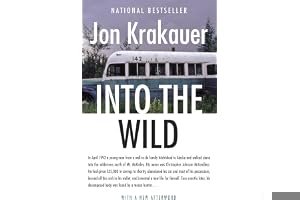
Into the Wild
Jon Krakauer
4.1
Librarian's Note: An alternate cover edition can be found here
In April, 1992, a young man from a well-to-do family hitchhiked to Alaska and walked alone into the wilderness north of Mt. McKinley. His name was Christopher Johnson McCandless. He had given $25,000 in savings to charity, abandoned his car and most of his possessions, burned all the cash in his wallet, and invented a new life for himself. Four months later, a party of moose hunters found his decomposed body. How McCandless came to die is the unforgettable story of Into the Wild.
Immediately after graduating from college in 1991, McCandless had roamed through the West and Southwest on a vision quest like those made by his heroes Jack London and John Muir. In the Mojave Desert he abandoned his car, stripped it of its license plates, and burned all of his cash. He would give himself a new name, Alexander Supertramp, and, unencumbered by money and belongings, he would be free to wallow in the raw, unfiltered experiences that nature presented. Craving a blank spot on the map, McCandless simply threw away the maps. Leaving behind his desperate parents and sister, he vanished into the wild.
…
Recommended by Holger Seim.
Holger Seim
When it comes to adventure stories, Into the Wild. [source]
Cover unavailable
47
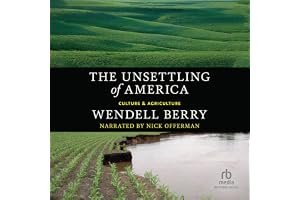
The Unsettling of America: Culture and Agriculture
Wendell Berry
4.1
Since its publication by Sierra Club Books in 1977, The Unsettling of America has been recognized as a classic of American letters. In it, Wendell Berry argues that good farming is a cultural development and spiritual discipline. Today’s agribusiness, however, takes farming out of its cultural context and away from families. As a result, we as a nation are more estranged from the land—from the intimate knowledge, love, and care of it. Sadly, as Berry notes in his Afterword to this third edition, his arguments and observations are more relevant than ever. We continue to suffer loss of community, the devaluation of human work, and the destruction of nature under an economic system dedicated to the mechanistic pursuit of products and profits. Although “this book has not had the happy fate of being proved wrong,” Berry writes, there are good people working “to make something comely and enduring of our life on this earth.” Wendell Berry is one of those people, writing and working, as ever, with passion, eloquence, and conviction.
…
Cover unavailable
48
We Are the Weather: Saving the Planet Begins at Breakfast
Jonathan Safran Foer
4.1
Some people reject the fact, overwhelmingly supported by scientists, that our planet is warming because of human activity. But do those of us who accept the reality of human-caused climate change truly believe it? If we did, surely we would be roused to act on what we know. Will future generations distinguish between those who didn’t believe in the science of global warming and those who said they accepted the science but failed to change their lives in response?
In We Are the Weather, Jonathan Safran Foer explores the central global dilemma of our time in a surprising, deeply personal, and urgent new way. The task of saving the planet will involve a great reckoning with ourselves—with our all-too-human reluctance to sacrifice immediate comfort for the sake of the future. We have, he reveals, turned our planet into a farm for growing animal products, and the consequences are catastrophic. Only collective action will save our home and way of life. And it all starts with what we eat—and don’t eat—for breakfast.
A brilliant book. Advocates a world war scale emergency response to climate change. And reminds us how much human behaviour can change for the better when the chips are down and we understand and FEEL like the stakes are high. https://t.co/GekPX3xwN0 [source]
Matt Haig
A brilliant book. Advocates a world war scale emergency response to climate change. And reminds us how much human behaviour can change for the better when the chips are down and we understand and FEEL like the stakes are high. https://t.co/GekPX3xwN0 [source]
Cover unavailable
49
PPI FE Review Manual: Rapid Preparation for the Fundamentals of Engineering Exam, 3rd Edition (Paperback) – A Comprehensive Preparation Guide for the FE Exam
MichaelR. Lindeburg
4.1
*Add the convenience of accessing this book anytime, anywhere on your personal device with the eTextbook version for only $59 at ppi2pass.com/etextbook-program.*
FE Review Manual, 3rd Edition
Michael R. Lindeburg PE’s FE Review Manual, 3rd Edition offers complete review for the FE exam. This book is part of comprehensive learning management systems designed to help you pass the FE exam the first time.
Select your discipline below and see the details of our complete learning management systems.
FE Industrial Review Bundle (FEIERB) FE Environmental Review Bundle (FEENRB)
Topics Covered
Computational Tools Dynamics, Kinematics, and Vibrations Electricity and Magnetism Engineering Economics Ethics and Professional Practice Fluid Mechanics Heat Transfer Material Properties and Processing Mathematics Materials Measurement, Instrumentation, and Controls Mechanical Design and Analysis Mechanics of Materials Probability and Statistics Statics Thermodynamics
Key Features:
Equations, figures, and tables for NCEES FE Reference Handbook to familiarize you with the reference you’ll have on exam day. Concise explanations supported by exam-like example problems, with step-by-step solutions to reinforce the theory and application of fundamental concepts. A robust index with thousands of terms to facilitate referencing. Binding: Paperback Publisher: PPI, A Kaplan Company
Important notice! It has been brought to our attention that counterfeit PPI books have been circulating. Counterfeit books have missing material as well as incorrect and outdated content.
While we are actively working to resolve this issue, we would like our customers to be aware that this issue exists and to be leary of books not purchased directly through PPI. If you suspect a fraudulent seller, please email details to marketing@ppi2pass.com.
…
Cover unavailable
50
The Ends of the World: Volcanic Apocalypses, Lethal Oceans, and Our Quest to Understand Earth's Past Mass Extinctions
Peter Brannen
4.1
As new groundbreaking research suggests that climate change played a major role in the most extreme catastrophes in the planet's history, award-winning science journalist Peter Brannen takes us on a wild ride through the planet's five mass extinctions and, in the process, offers us a glimpse of our increasingly dangerous future
Our world has ended five times: it has been broiled, frozen, poison-gassed, smothered, and pelted by asteroids. In The Ends of the World, Peter Brannen dives into deep time, exploring Earth’s past dead ends, and in the process, offers us a glimpse of our possible future.
Many scientists now believe that the climate shifts of the twenty-first century have analogs in these five extinctions. Using the visible clues these devastations have left behind in the fossil record, The Ends of the World takes us inside “scenes of the crime,” from South Africa to the New York Palisades, to tell the story of each extinction. Brannen examines the fossil record—which is rife with creatures like dragonflies the size of sea gulls and guillotine-mouthed fish—and introduces us to the researchers on the front lines who, using the forensic tools of modern science, are piecing together what really happened at the crime scenes of the Earth’s biggest whodunits.
Part road trip, part history, and part cautionary tale, The Ends of the World takes us on a tour of the ways that our planet has clawed itself back from the grave, and casts our future in a completely new light.
…
Cover unavailable
51
A Life on Our Planet: My Witness Statement and a Vision for the Future
Sir David Attenborough
4.1
Cover unavailable
52
Upstream: Selected Essays
Mary Oliver
4.1
One of O, The Oprah Magazine's Ten Best Books of the Year!
The New York Times bestselling collection of essays from beloved poet, Mary Oliver.
"In the beginning I was so young and such a stranger to myself I hardly existed. I had to go out into the world and see it and hear it and react to it, before I knew at all who I was, what I was, what I wanted to be."
So begins Upstream, a collection of essays in which reveredpoet Mary Oliver reflects on her willingness, as a young child and as an adult, to lose herself within the beauty and mysteries of both the natural world and the world of literature. Emphasizing the significance of her childhood "friend" Walt Whitman, through whose work she first understood that a poem is a temple, "a place to enter, and in which to feel," and who encouraged her to vanish into the world of her writing, Oliver meditates on the forces that allowed her to create a life for herself out of work and love. As she writes, "I could not be a poet without the natural world. Someone else could. But not me. For me the door to the woods is the door to the temple."
Upstream follows Oliver as she contemplates the pleasure of artistic labor, her boundless curiosity for the flora and fauna that surround her, and the responsibility she has inherited from Shelley, Wordsworth, Emerson, Poe, and Frost, the great thinkers and writers of the past, to live thoughtfully, intelligently, and to observe with passion. Throughout this collection, Oliver positions not just herself upstream but us as well as she encourages us all to keep moving, to lose ourselves in the awe of the unknown, and to give power and time to the creative and whimsical urges that live within us.
…
Cover unavailable
53
Changes in the Land: Indians, Colonists, and the Ecology of New England
William Cronon
4.1
The book that launched environmental history now updated.
Winner of the Francis Parkman Prize
In this landmark work of environmental history, William Cronon offers an original and profound explanation of the effects European colonists' sense of property and their pursuit of capitalism had upon the ecosystems of New England. Reissued here with an updated afterword by the author and a new preface by the distinguished colonialist John Demos, Changes in the Land, provides a brilliant inter-disciplinary interpretation of how land and people influence one another. With its chilling closing line, "The people of plenty were a people of waste," Cronon's enduring and thought-provoking book is ethno-ecological history at its best.
…
Recommended by Matt Garcia.
Matt Garcia
Many see Cronon’s book as ecological studies or environmental history. But what I see is his study of the consequences of raising livestock on the land, the consequences of extracting food from a place . . . in this first book, he also makes clear that livestock agricultural practices, food production practices, have consequences. [source]
Cover unavailable
54
The One-Straw Revolution
Masanobu Fukuoka
4.1
Fukuoka demonstrates how the way we look at farming influences the way we look at health, the school, nature, nutrition, spiritual health and life itself. He joins the healing of the land to the process of purifying the human spirit and proposes a way of life and a way of farming in which such healing can take place.
Cover unavailable
55
Organic Mushroom Farming and Mycoremediation: Simple to Advanced and Experimental Techniques for Indoor and Outdoor Cultivation
Tradd Cotter
4.1
What would it take to grow mushrooms in space? How can mushroom cultivation help us manage, or at least make use of, invasive species such as kudzu and water hyacinth and thereby reduce dependence on herbicides? Is it possible to develop a low-cost and easy-to-implement mushroom-growing kit that would provide high-quality edible protein and bioremediation in the wake of a natural disaster? How can we advance our understanding of morel cultivation so that growers stand a better chance of success?
For more than twenty years, mycology expert Tradd Cotter has been pondering these questions and conducting trials in search of the answers. In Organic Mushroom Farming and Mycoremediation, Cotter not only offers readers an in-depth exploration of best organic mushroom cultivation practices; he shares the results of his groundbreaking research and offers myriad ways to apply your cultivation skills and further incorporate mushrooms into your life--whether your goal is to help your community clean up industrial pollution or simply to settle down at the end of the day with a cold Reishi-infused homebrew ale.
The book first guides readers through an in-depth exploration of indoor and outdoor cultivation. Covered skills range from integrating wood-chip beds spawned with king stropharia into your garden and building a "trenched raft" of hardwood logs plugged with shiitake spawn to producing oysters indoors on spent coffee grounds in a 4�4 space or on pasteurized sawdust in vertical plastic columns. For those who aspire to the self-sufficiency gained by generating and expanding spawn rather than purchasing it, Cotter offers in-depth coverage of lab techniques, including low-cost alternatives that make use of existing infrastructure and materials.
Cotter also reports his groundbreaking research cultivating morels both indoors and out, "training" mycelium to respond to specific contaminants, and perpetuating spawn on cardboard without the use of electricity. Readers will discover information on making tinctures, powders, and mushroom-infused honey; making an antibacterial mushroom cutting board; and growing mushrooms on your old denim jeans.
Geared toward readers who want to grow mushrooms without the use of pesticides, Cotter takes "organic" one step further by introducing an entirely new way of thinking--one that looks at the potential to grow mushrooms on just about anything, just about anywhere, and by anyone.
…
Cover unavailable
56
Mushrooms Demystified
David Arora
4.1
Simply the best and most complete mushroom field guide and reference book, MUSHROOMS DEMYSTIFIED includes descriptions and keys to more than 2,000 species of mushrooms, with more than 950 photographs. Mushroom authority David Arora provides a beginner's checklist of the 70 most distinctive and common mushrooms, plus detailed chapters on terminology, classification, habitats, mushroom cookery, mushroom toxins, and the meanings of scientific mushroom names. Beginning and experienced mushroom hunters everywhere will find MUSHROOMS DEMYSTIFIED a delightful, informative, and indispensible companion.
…
Cover unavailable
57
The Wild Trees: A Story of Passion and Daring
Richard Preston
4.1
From the #1 bestselling author of The Hot Zone comes an amazing account of scientific and spiritual passion for the tallest trees in the world, the startling biosystem of Rthe canopy, S and those who are committed to the preservation of this astonishing and largely unknown world.
Cover unavailable
58
Mycelium Running: How Mushrooms Can Help Save the World
Paul Stamets
4.1
Mycelium Running is a manual for the mycological rescue of the planet. That’s right: growing more mushrooms may be the best thing we can do to save the environment, and in this groundbreaking text from mushroom expert Paul Stamets, you’ll find out how.
The basic science goes like this: Microscopic cells called “mycelium”--the fruit of which are mushrooms--recycle carbon, nitrogen, and other essential elements as they break down plant and animal debris in the creation of rich new soil. What Stamets has discovered is that we can capitalize on mycelium’s digestive power and target it to decompose toxic wastes and pollutants (mycoremediation), catch and reduce silt from streambeds and pathogens from agricultural watersheds (mycofiltration), control insect populations (mycopesticides), and generally enhance the health of our forests and gardens (mycoforestry and myco-gardening).
In this comprehensive guide, you’ll find chapters detailing each of these four exciting branches of what Stamets has coined “mycorestoration,” as well as chapters on the medicinal and nutritional properties of mushrooms, inoculation methods, log and stump culture, and species selection for various environmental purposes. Heavily referenced and beautifully illustrated, this book is destined to be a classic reference for bemushroomed generations to come.
…
Cover unavailable
59
Feral: Rewilding the Land, the Sea, and Human Life
George Monbiot
4.1
To be an environmentalist early in the twenty-first century is always to be defending, arguing, acknowledging the hurdles we face in our efforts to protect wild places and fight climate change. But let’s be honest: hedging has never inspired anyone.
So what if we stopped hedging? What if we grounded our efforts to solve environmental problems in hope instead, and let nature make our case for us? That’s what George Monbiot does in Feral, a lyrical, unabashedly romantic vision of how, by inviting nature back into our lives, we can simultaneously cure our “ecological boredom” and begin repairing centuries of environmental damage. Monbiot takes readers on an enchanting journey around the world to explore ecosystems that have been “rewilded”: freed from human intervention and allowed—in some cases for the first time in millennia—to resume their natural ecological processes. We share his awe, and wonder, as he kayaks among dolphins and seabirds off the coast of Wales and wanders the forests of Eastern Europe, where lynx and wolf packs are reclaiming their ancient hunting grounds. Through his eyes, we see environmental success—and begin to envision a future world where humans and nature are no longer separate and antagonistic, but are together part of a single, healing world.
Monbiot’s commitment is fierce, his passion infectious, his writing compelling. Readers willing to leave the confines of civilization and join him on his bewitching journey will emerge changed—and ready to change our world for the better.
…
Recommended by Amy Liptrot and Isabella Tree.
Amy Liptrot
This is a bold and radical book, which changed the way I look at the countryside. [source]
Isabella Tree
Monbiot pushed the boundaries of what rewilding should mean. [source]
Cover unavailable
60
Animal, Vegetable, Miracle: A Year of Food Life
Barbara Kingsolver
4.1
Author Barbara Kingsolver and her family abandoned the industrial-food pipeline to live a rural life—vowing that, for one year, they'd only buy food raised in their own neighborhood, grow it themselves, or learn to live without it. Part memoir, part journalistic investigation, Animal, Vegetable, Miracle is an enthralling narrative that will open your eyes in a hundred new ways to an old truth: You are what you eat.
…
Cover unavailable
61
A Thousand Mornings: Poems
Mary Oliver
4.1
The New York Times-bestselling collection of poems from celebrated poet Mary Oliver
In A Thousand Mornings, Mary Oliver returns to the imagery that has come to define her life’s work, transporting us to the marshland and coastline of her beloved home, Provincetown, Massachusetts. Whether studying the leaves of a tree or mourning her treasured dog Percy, Oliver is open to the teachings contained in the smallest of moments and explores with startling clarity, humor, and kindness the mysteries of our daily experience.
…
Cover unavailable
62
The Great Derangement: Climate Change and the Unthinkable
Amitav Ghosh
4.1
Are we deranged? The acclaimed Indian novelist Amitav Ghosh argues that future generations may well think so. How else to explain our imaginative failure in the face of global warming? In his first major book of nonfiction since In an Antique Land, Ghosh examines our inability—at the level of literature, history, and politics—to grasp the scale and violence of climate change.
The extreme nature of today’s climate events, Ghosh asserts, make them peculiarly resistant to contemporary modes of thinking and imagining. This is particularly true of serious literary fiction: hundred-year storms and freakish tornadoes simply feel too improbable for the novel; they are automatically consigned to other genres. In the writing of history, too, the climate crisis has sometimes led to gross simplifications; Ghosh shows that the history of the carbon economy is a tangled global story with many contradictory and counterintuitive elements.
Ghosh ends by suggesting that politics, much like literature, has become a matter of personal moral reckoning rather than an arena of collective action. But to limit fiction and politics to individual moral adventure comes at a great cost. The climate crisis asks us to imagine other forms of human existence—a task to which fiction, Ghosh argues, is the best suited of all cultural forms. His book serves as a great writer’s summons to confront the most urgent task of our time.
…
Recommended by Naomi Oreskes.
Naomi Oreskes
Quite a lot, as anyone who reads the book will see. It’s absolutely fascinating on a number of levels. First, we have a famous, articulate and politically astute novelist taking up the issue of climate change. I think that’s extremely important because one of the arguments that Amitav makes in this book, which I agree with one hundred percent, is that for too long this problem has been discussed as scientific question; it’s mostly been covered by science journalists and written up in the science pages of the newspapers. But it’s fundamentally no longer a scientific question. The science — the key scientific issues — have been resolved now for a long time, but it’s a political question because we have to do something about it. It’s an economic question because it has to do with how we run our economies based on fossil fuels, and it’s also a deeply historical question. [source]
Cover unavailable
63
A Walk in the Woods: Rediscovering America on the Appalachian Trail
Bill Bryson
4.1
The Appalachian Trail stretches from Georgia to Maine and covers some of the most breathtaking terrain in America—majestic mountains, silent forests, sparking lakes. If you’re going to take a hike, it’s probably the place to go. And Bill Bryson is surely the most entertaining guide you’ll find. He introduces us to the history and ecology of the trail and to some of the other hardy (or just foolhardy) folks he meets along the way—and a couple of bears. Already a classic, A Walk in the Woods will make you long for the great outdoors (or at least a comfortable chair to sit and read in).
…
Cover unavailable
64
The Spell of the Sensuous: Perception and Language in a More-Than-Human World
David Abram
4.1
Winner of the International Lannan Literary Award for Nonfiction
Animal tracks, word magic, the speech of stones, the power of letters, and the taste of the wind all figure prominently in this intellectual tour de force that returns us to our senses and to the sensuous terrain that sustains us. This major work of ecological philosophy startles the senses out of habitual ways of perception.
For a thousand generations, human beings viewed themselves as part of the wider community of nature, and they carried on active relationships not only with other people with other animals, plants, and natural objects (including mountains, rivers, winds, and weather patters) that we have only lately come to think of as "inanimate." How, then, did humans come to sever their ancient reciprocity with the natural world? What will it take for us to recover a sustaining relation with the breathing earth?
In The Spell of the Sensuous David Abram draws on sources as diverse as the philosophy of Merleau-Ponty, Balinese shamanism, Apache storytelling, and his own experience as an accomplished sleight-of-hand of magician to reveal the subtle dependence of human cognition on the natural environment. He explores the character of perception and excavates the sensual foundations of language, which--even at its most abstract--echoes the calls and cries of the earth. On every page of this lyrical work, Abram weaves his arguments with a passion, a precision, and an intellectual daring that recall such writers as Loren Eisleley, Annie Dillard, and Barry Lopez.
…
Cover unavailable
65
Diet for a Small Planet
Frances Moore Lappe
4.1
Here again is the extraordinary bestselling book that taught America the social and personal significance of a new way of eating-- one that remains a complete guide for eating well in the 90s. Featuring: simple rules for a healthy diet; a streamlined, easy-to-use format; delicious food combinations of protein-rich meals without meat; hundreds of wonderful recipes, and much more.
Recommended by Steve Jobs, Ruth Reichl, and Yale Program On Climate Change Communication.
In that first year at Reed, Jobs also read "Diet for a Small Planet," a book about protein-rich vegetarianism that went on to sell three million copies. It was a breakthrough. "That's when I pretty much swore off meat for good," Jobs told Isaacson. [source]
When this book came out in the early 1970s, it was revolutionary. I feel this is a book that hasn’t gotten its due. [source]
Yale Program On Climate Change Communication
Frances Moore Lappé's best-selling book “Diet for a Small Planet” changed the way many people in the 1970s viewed the food system and its inefficiencies: https://t.co/xla4y5Nuzd via @nytimes https://t.co/wNIgZLCI9Z [source]
Cover unavailable
66
The Snow Leopard
Peter Matthiessen
4.1
When Matthiessen went to Nepal to study the Himalayan blue sheep and, possibly, to glimpse the rare and beautiful snow leopard, he undertook his five-week trek as winter snows were sweeping into the high passes. This is a radiant and deeply moving account of a "true pilgrimage, a journey of the heart."
Recommended by Nick Pyenson.
Nick Pyenson
The book stands apart and it remains fresh because of the ways that Matthiessen weaves his exploration of the outer world with his own inner one. [source]
Cover unavailable
67
Field Notes from a Catastrophe: Man, Nature, and Climate Change
Elizabeth Kolbert
4.1
Elizabeth Kolbert's environmental classic Field Notes from a Catastrophe first developed out of a groundbreaking, National Magazine Award-winning three-part series in The New Yorker. She expanded it into a still-concise yet richly researched and damning book about climate change: a primer on the greatest challenge facing the world today.
But in the years since, the story has continued to develop; the situation has become more dire, even as our understanding grows. Now, Kolbert returns to the defining book of her career. She'll add a chapter bringing things up-to-date on the existing text, plus she'll add three new chapters--on ocean acidification, the tar sands, and a Danish town that's gone carbon neutral--making it, again, a must-read for our moment.
…
Recommended by Gaia Vince and Kate Marvel.
Gaia Vince
Field Notes was refreshing, a trailblazer. Kolbert actually went to communities affected, on the frontline of climate change. [source]
Kate Marvel
Kolbert gives glimpses into what climate change actually means. She shows the interconnectedness of climate and ecosystems and society. [source]
Cover unavailable
68
The Science of Plants: Inside Their Secret World (DK Secret World Encyclopedias)
DK
4.1
Cover unavailable
69
Safety Professional's Reference and Study Guide
W. David Yates
4.1
While there are numerous technical resources available, often you have to search through a plethora of them to find the information you use on a daily basis. And maintaining a library suitable for a comprehensive practice can become quite costly. The new edition of a bestseller, Safety Professional's Reference and Study Guide, Second Edition provides a single-source reference that contains all the information required to handle the day-to-day tasks of a practicing industrial hygienist.
New Chapters in the Second Edition cover:
Behavior-based safety programs
Safety auditing procedures and techniques
Environmental management
Measuring health and safety performance
OSHA's laboratory safety standard
Process safety management standard
BCSPs Code of Ethics
The book provides a quick desk reference as well as a resource for preparations for the Associate Safety Professional (ASP), Certified Safety Professional (CSP), Occupational Health and Safety Technologist (OHST), and the Construction Health and Safety Technologist (CHST) examinations. A collection of information drawn from textbooks, journals, and the author's more than 25 years of experience, the reference provides, as the title implies, not just a study guide but a reference that has staying power on your library shelf.
…
Cover unavailable
70
How Can I Help?: Saving Nature with Your Yard
Douglas W. Tallamy
4.1
Cover unavailable
71
Scientific American September 2026
Scientific American
4.1
Scientific American covers the most important and exciting research, ideas and knowledge in science, health, technology, the environment and society. It is committed to sharing trustworthy knowledge and enhancing our understanding of the world .
Cover unavailable
72
The Mushroom at the End of the World: On the Possibility of Life in Capitalist Ruins
Anna Lowenhaupt Tsing
4.1
What a rare mushroom can teach us about sustaining life on a fragile planet
Matsutake is the most valuable mushroom in the world--and a weed that grows in human-disturbed forests across the northern hemisphere. Through its ability to nurture trees, matsutake helps forests to grow in daunting places. It is also an edible delicacy in Japan, where it sometimes commands astronomical prices. In all its contradictions, matsutake offers insights into areas far beyond just mushrooms and addresses a crucial question: what manages to live in the ruins we have made?
A tale of diversity within our damaged landscapes, The Mushroom at the End of the World follows one of the strangest commodity chains of our times to explore the unexpected corners of capitalism. Here, we witness the varied and peculiar worlds of matsutake commerce: the worlds of Japanese gourmets, capitalist traders, Hmong jungle fighters, industrial forests, Yi Chinese goat herders, Finnish nature guides, and more. These companions also lead us into fungal ecologies and forest histories to better understand the promise of cohabitation in a time of massive human destruction.
By investigating one of the world's most sought-after fungi, The Mushroom at the End of the World presents an original examination into the relation between capitalist destruction and collaborative survival within multispecies landscapes, the prerequisite for continuing life on earth.
-- "Publisher's Weekly"
…
Cover unavailable
73
Slow Violence and the Environmentalism of the Poor
Rob Nixon
4.1
The violence wrought by climate change, toxic drift, deforestation, oil spills, and the environmental aftermath of war takes place gradually and often invisibly. Using the innovative concept of slow violence to describe these threats, Rob Nixon focuses on the inattention we have paid to the attritional lethality of many environmental crises, in contrast with the sensational, spectacle-driven messaging that impels public activism today. Slow violence, because it is so readily ignored by a hard-charging capitalism, exacerbates the vulnerability of ecosystems and of people who are poor, disempowered, and often involuntarily displaced, while fueling social conflicts that arise from desperation as life-sustaining conditions erode.
In a book of extraordinary scope, Nixon examines a cluster of writer-activists affiliated with the environmentalism of the poor in the global South. By approaching environmental justice literature from this transnational perspective, he exposes the limitations of the national and local frames that dominate environmental writing. And by skillfully illuminating the strategies these writer-activists deploy to give dramatic visibility to environmental emergencies, Nixon invites his readers to engage with some of the most pressing challenges of our time.
…
Cover unavailable
74
The Future We Choose: Surviving the Climate Crisis
Christiana Figueres, Tom Rivett-Carnac
4.1
In this cautionary but optimistic book, Figueres and Rivett-Carnac--the architects of the 2015 Paris Climate Change Agreement--tackle arguably the most urgent and consequential challenge humankind has ever faced: the world's changing climate and the fate of humanity.
In The Future We Choose, the authors outline two possible scenarios for the planet. In one, they describe what life on Earth will be like by 2050 if we fail to meet the Paris targets for carbon dioxide emission reduction. In the other, they describe what it will take to create and live in a carbon neutral, regenerative world. They argue for confronting the climate crisis head on, with determination and optimism.
How we all of us address the climate crisis in the next thirty years will determine not only the world we will live in but also the world we will bequeath to our children and theirs. The Future We Choose presents our options and tells us, in no uncertain terms, what governments, corporations, and each of us can and must do to fend off disaster.
…
Recommended by Fred Krupp.
Fred Krupp
I love this message of hope and empowerment from @CFigueres former UNFCCC executive secretary. This book is exactly what we need. Get your copy today: https://t.co/XwRo3oQw0i https://t.co/VKpoJsZbiE [source]
Cover unavailable
75
The Bird Way: A New Look at How Birds Talk, Work, Play, Parent, and Think
Jennifer Ackerman
4.0
From the New York Times bestselling author of The Genius of Birds, a radical investigation into the bird way of being, and the recent scientific research that is dramatically shifting our understanding of birds -- how they live and how they think.
"There is the mammal way and there is the bird way." This is one scientist's pithy distinction between mammal brains and bird brains: two ways to make a highly intelligent mind. But the bird way is much more than a unique pattern of brain wiring, and lately, scientists have taken a new look at bird behaviors they have, for years, dismissed as anomalies or mysteries. What they are finding is upending the traditional view of how birds conduct their lives, how they communicate, forage, court, breed, survive. They're also revealing the remarkable intelligence underlying these activities, abilities we once considered uniquely our own--deception, manipulation, cheating, kidnapping, infanticide, but also, ingenious communication between species, cooperation, collaboration, altruism, culture, and play.
Some of these extraordinary behaviors are biological conundrums that seem to push the edges of--well--birdness: A mother bird that kills her own infant sons, and another that selflessly tends to the young of other birds as if they were her own. Young birds that devote themselves to feeding their siblings and others so competitive they'll stab their nestmates to death. Birds that give gifts and birds that steal, birds that dance or drum, that paint their creations or paint themselves, birds that build walls of sound to keep out intruders and birds that summon playmates with a special call--and may hold the secret to our own penchant for playfulness and the evolution of laughter.
Drawing on personal observations, the latest science, and her bird-related travel around the world, from the tropical rainforests of eastern Australia and the remote woodlands of northern Japan, to the rolling hills of lower Austria and the islands of Alaska's Kachemak Bay, Ackerman shows there is clearly no single bird way of being. In every respect, in plumage, form, song, flight, lifestyle, niche, and behavior, birds vary. It's what we love about them. As E.O Wilson once said, when you have seen one bird, you have not seen them all.
Forthcoming in May 2020 from Jennifer Ackerman - The Bird Way: A New Look at How Birds Talk, Work, Play, Parent, and Think
…
Cover unavailable
76
The Edge of the Sea
Rachel Carson, Bob Hines, Sue Hubbell
4.0
Rachel Carson, author of Silent Spring, writes this book focusing on the plants and invertebrates surviving in the Atlantic zones between the lowest and the highest tides, between Newfoundland and the Florida keys. It's Appendix and Index make it a great reference tool for those interested in plant and animal life around tidepools.
Cover unavailable
77
A Terrible Thing to Waste: Environmental Racism and Its Assault on the American Mind
Harriet A. Washington
4.0
A "powerful and indispensable book" on the devastating consequences of environmental racism--and what we can do to remedy its toxic effects on marginalized communities.
Did you know...
Middle-class African-American households with incomes between $50,000 and $60,000 live in neighborhoods that are more polluted than those of very poor white households with incomes less than $10,000.
When swallowed, a lead-paint chip no larger than a fingernail can send a toddler into a coma. One-tenth of that amount will lower IQ.
Nearly two out of every five African-American homes in Baltimore are plagued by lead-based paint. Almost all of the 37,500 Baltimore children who suffered lead poisoning from 2003 to 2015 were African-American.
From injuries caused by lead poisoning to the devastating effects of atmospheric pollution, infectious disease, and industrial waste, Americans of color are harmed by environmental hazards in staggeringly disproportionate numbers. This systemic onslaught of toxic exposure and institutional negligence causes irreparable physical harm to millions of people across the country--cutting lives tragically short and needlessly burdening the health care system. But these deadly environments create another insidious and often overlooked consequence: robbing communities of color, and America as a whole, of intellectual power.
The 1994 publication of The Bell Curve and its controversial thesis, catapulted the topic of genetic racial differences in IQ to the forefront of a renewed and heated debate. Now, in A Terrible Thing to Waste, award-winning science writer Harriet A. Washington adds her incisive analysis to the fray, arguing that IQ is a biased and flawed metric, but that it is useful for tracking cognitive damage. She tears apart the spurious notion of intelligence as an inherited trait, using copious data that instead point to a different cause of the reported African American-white IQ gap: environmental racism--a confluence of racism and other institutional factors that relegate marginalized communities to living and working near sites of toxic waste, pollution, and insufficient sanitation services. She investigates heavy metals, neuro-toxins, deficient prenatal care, bad nutrition, and even pathogens as chief agents influencing intelligence to explain why communities of color are disproportionately affected--and what can be done to remedy this devastating problem.
Featuring extensive scientific research and Washington's sharp, lively reporting, A Terrible Thing to Waste is sure to outrage, transform the conversation, and inspire debate.
…
Cover unavailable
78
Molecules: The Elements and the Architecture of Everything
Theodore Gray and Nick Mann
4.0
In this paperback edition of the beloved second book in Theodore Gray's bestselling (1.5 million copies) Elements trilogy, Gray demonstrates how the elements of the periodic table combine into the molecules that form the things that make up our world.
Molecules is the second book in the million-copy bestselling Elements trilogy. In Molecules, Theodore Gray takes the next step in the story that began with the periodic table in his best-selling book, The Elements: A Visual Exploration of Every Known Atom in the Universe (2015) and culminated with the publication of Reactions: An Illustrated Exploration of Elements, Molecules, and Change in the Universe (2017). Here, he explores through fascinating stories and trademark stunning photography the most interesting, essential, useful, and beautiful of the millions of chemical structures that make up every material in the world.
Gray begins with an explanation of how atoms bond to form molecules and compounds, as well as the difference between organic and inorganic chemistry. He then goes on to explore the vast array of materials molecules can create, including: soaps and solvents; goops and oils; rocks and ores; ropes and fibers; painkillers and dangerous drugs; sweeteners; perfumes and stink bombs; colors and pigments; and controversial compounds including asbestos, CFCs, and thimerosal.
Big, gorgeous photographs, as well as diagrams of the compounds and their chemical bonds, rendered with never before seen beauty, fill the pages and capture molecules in their various states.
It's the perfect book for his loyal fans who've been eager for more and for anyone fascinated with the mysteries of the material world.
…
Cover unavailable
79
Reading the Forested Landscape: A Natural History of New England
Tom Wessels
4.0
An intrepid sleuth and articulate tutor, Wessels teaches us to read a landscape the way we might solve a mystery. What exactly is the meaning of all those stone walls in the middle of the forest? Why do beech and birch trees have smooth bark when the bark of all other northern species is rough? How do you tell the age of a beaver pond and determine if beavers still live there? Why are pine trees dominant in one patch of forest and maples in another? What happened to the American chestnut? Turn to this book for the answers, and no walk in the woods will ever be the same.
…
Cover unavailable
80
Here Comes the Sun: A Last Chance for the Climate and a Fresh Chance for Civilization
Bill McKibben
4.0
From the acclaimed environmentalist, a call to harness the power of the sun and rewrite our scientific, economic, and political future.Our climate, and our democracy, are melting down. But Bill McKibben, one of the first to sound the alarm about the climate crisis, insists the moment is also full of possibility. Energy from the sun and wind is suddenly the cheapest power on the planet and growing faster than any energy source in history―if we can keep accelerating the pace, we have a chance.Here Comes the Sun tells the story of the sudden spike in power from the sun and wind―and the desperate fight of the fossil fuel industry and their politicians to hold this new power at bay. From the everyday citizens who installed solar panels equal to a third of Pakistan’s electric grid in a year to the world’s sixth-largest economy―California―nearly halving its use of natural gas in the last two years, Bill McKibben traces the arrival of plentiful, inexpensive solar energy. And he shows how solar power is more than just a path out of the climate crisis: it is a chance to reorder the world on saner and more humane grounds. You can’t hoard solar energy or hold it in reserves―it’s available to all.There’s no guarantee we can make this change in time, but there is a hope―in McKibben’s eyes, our best hope for a new civilization: one that looks up to the sun, every day, as the star that fuels our world.
…
Cover unavailable
81
Dirt to Soil: One Family's Journey Into Regenerative Agriculture
Gabe Brown
4.0
Gabe Brown didn't set out to change the world when he first started working alongside his father-in-law on the family farm in North Dakota. But as a series of weather-related crop disasters put Brown and his wife, Shelly, in desperate financial straits, they started making bold changes to their farm. Brown--in an effort to simply survive--began experimenting with new practices he'd learned about from reading and talking with innovative researchers and ranchers. As he and his family struggled to keep the farm viable, they found themselves on an amazing journey into a new type of farming: regenerative agriculture.
…
Cover unavailable
82
Food of the Gods: The Search for the Original Tree of Knowledge
Terence McKenna
4.0
s/t: A Radical History of Plants, Drugs & Human Evolution For the first time in paperback, the critically acclaimed counterculture manifesto by the wildly popular McKenna. "Deserves to be a modern classic on mind-altering drugs & hallucinogens."--The Washington Post. Photos & illustrations.
Cover unavailable
83
Inconvenient Facts: The Science That Al Gore Doesn't Want You to Know
Gregory Wrightstone
4.0
You have been inundated with reports from media, governments, think tanks and “experts” saying that our climate is changing for the worse and it is our fault. Increases in droughts, heat waves, tornadoes and poison ivy—to name a few—are all blamed on our “sins of emissions” from burning fossil fuels and increasing carbon dioxide in the atmosphere. Yet, you don’t quite buy into this human-caused climate apocalypse. You aren’t sure about the details because you don’t have all the facts and likely aren’t a scientist. Inconvenient Facts was specifically created for you. Writing in plain English and providing easily understood charts and figures, Gregory Wrightstone presents the science to assess the basis of the threatened Thermageddon.
The book’s 60 “inconvenient facts” come from government sources, peer-reviewed literature or scholarly works, set forth in a way that is lucid and entertaining. The information likely will challenge your current understanding of many apocalyptic predictions about our ever dynamic climate.
You will learn that the planet is improving, not in spite of increasing CO2 and rising temperature, but because of it. The very framework of the climate-catastrophe argument will be confronted with scientific fact. Arm yourself with the truth.
…
Cover unavailable
84
Small Is Beautiful: Economics as if People Mattered
E. F. Schumacher
4.0
"Nothing less than a full-scale assault on conventional economic wisdom." —Newsweek
One the 100 most influential books published since World War II —The Times Literary Supplement
Hailed as an "eco-bible" by Time magazine, E.F. Schumacher's riveting, richly researched statement on sustainability has become more relevant and vital with each year since its initial groundbreaking publication during the 1973 energy crisis. A landmark statement against "bigger is better" industrialism, Schumacher's Small Is Beautiful paved the way for twenty-first century books on environmentalism and economics, like Jeffrey Sachs's The End of Poverty, Paul Hawken's Natural Capitalism, Mohammad Yunis's Banker to the Poor, and Bill McKibben's Deep Economy. This timely reissue offers a crucial message for the modern world struggling to balance economic growth with the human costs of globalization.
A stunning collection of personal observations that uses images of the American West to probe larger concerns in lyrical, evocative prose that is a true celebration of the region.
Cover unavailable
86
The Water Will Come: Rising Seas, Sinking Cities, and the Remaking of the Civilized World
Jeff Goodell
4.0
What if Atlantis wasn't a myth, but an early precursor to a new age of great flooding? Across the globe, scientists and civilians alike are noticing rapidly rising sea levels, and higher and higher tides pushing more water directly into the places we live, from our most vibrant, historic cities to our last remaining traditional coastal villages. With each crack in the great ice sheets of the Arctic and Antarctica, and each tick upwards of Earth's thermometer, we are moving closer to the brink of broad disaster.
By century's end, hundreds of millions of people will be retreating from the world's shores as our coasts become inundated and our landscapes transformed. From island nations to the world's major cities, coastal regions will disappear. Engineering projects to hold back the water are bold and may buy some time. Yet despite international efforts and tireless research, there is no permanent solution-no barriers to erect or walls to build-that will protect us in the end from the drowning of the world as we know it.
The Water Will Come is the definitive account of the coming water, why and how this will happen, and what it will all mean. As he travels across twelve countries and reports from the front lines, acclaimed journalist Jeff Goodell employs fact, science, and first-person, on-the-ground journalism to show vivid scenes from what already is becoming a water world.
"An immersive, mildly gonzo and depressingly well-timed book about the drenching effects of global warming, and a powerful reminder that we can bury our heads in the sand about climate change for only so long before the sand itself disappears." (Jennifer Senior, New York Times)
This harrowing, compulsively readable, and carefully researched book lays out in clear-eyed detail what Earth's changing climate means for us today, and what it will mean for future generations... It's a thriller in which the hero in peril is us [source]
Elizabeth Kolbert
Author
Jeff Goodell has taken on some of the most important issues of our time, from coal mining to geoengineering. In The Water Will Come, he explains the threat of sea level rise with characteristic rigor and intelligence. The result is at once deeply persuasive and deeply unsettling. [source]
Cover unavailable
87
The Story of More: How We Got to Climate Change and Where to Go from Here
Hope Jahren
4.0
From the bestselling author of Lab Girl comes a slim, urgent missive on the defining issue of our time: here is Hope Jahren on climate change, our timeless pursuit of more, and how the same human ambition that got us here can also be our salvation. A Vintage Original.
Hope Jahren is an award-winning geobiologist, a brilliant writer, and one of the seven billion people with whom we share this earth.The Story of More is her impassioned open letter to humanity as we stand at the crossroads of survival and extinction. Jahren celebrates the long history of our enterprising spirit--which has tamed wild crops, cured diseases, and sent us to the moon--but also shows how that spirit has created excesses that are quickly warming our planet to dangerous levels. In short, highly readable chapters, she takes us through the science behind the key inventions--from electric power to large-scale farming and automobiles--that, even as they help us, release untenable amounts of carbon dioxide. She explains the current and projected consequences of greenhouse gases--from superstorms to rising sea levels--and the science-based tools that could help us fight back. At once an explainer on the mechanisms of warming and a capsule history of human development, The Story of More illuminates the link between our consumption habits and our endangered earth, showing us how we can use less and share more. It is the essential pocket primer on climate change that will leave an indelible impact on everyone who reads it.
…
Cover unavailable
88
Culture and Conservation: Beyond Anthropocentrism
Eleanor Shoreman-Ouimet and Helen Kopnina
4.0
Today, there is growing interest in conservation and anthropologists have an important role to play in helpingconservation succeed for the sake of humanity and for the sake of other species. Equally important, however, is the fact that we, as the species that causes extinctions, have a moral responsibility to those whose evolutionary unfolding and very future we threaten.
This volume is an examination of the relationship between conservation and the social sciences, particularly anthropology. It calls for increased collaboration between anthropologists, conservationists and environmental scientists, and advocates for a shift towards an environmentally focused perspective that embraces not only cultural values and human rights, but also the intrinsic value and rights to life of nonhuman species. This book demonstrates that cultural and biological diversity are intimately interlinked, and equally threatened by the industrialism that endangers the planet's life-giving processes. The consideration of ecological data, as well as an expansion of ethics that embraces more than one species, is essential to a well-rounded understanding of the connections between human behavior and environmental wellbeing.
This book gives students and researchers in anthropology, conservation, environmental ethics and across the social sciences an invaluable insight into how innovative and intensive new interdisciplinary approaches, questions, ethics and subject pools can close the gap between culture and conservation.
…
Cover unavailable
89
What Has Nature Ever Done for Us?: How Money Really Does Grow on Trees
Tony Juniper
4.0
From Indian vultures to Chinese bees, Nature provides the 'natural services' that keep the economy going. From the recycling miracles in the soil; an army of predators ridding us of unwanted pests; an abundance of life creating a genetic codebook that underpins our food, pharmaceutical industries and much more, it has been estimated that these and other services are each year worth about double global GDP. Yet we take most of Nature's services for granted, imagining them free and limitless ... until they suddenly switch off.
…
Cover unavailable
90
Steps to an Ecology of Mind: Collected Essays in Anthropology, Psychiatry, Evolution, and Epistemology
Gregory Bateson
4.0
Gregory Bateson was a philosopher, anthropologist, photographer, naturalist, and poet, as well as the husband and collaborator of Margaret Mead. With a new foreword by his daughter Mary Katherine Bateson, this classic anthology of his major work will continue to delight and inform generations of readers.
"This collection amounts to a retrospective exhibition of a working life. . . . Bateson has come to this position during a career that carried him not only into anthropology, for which he was first trained, but into psychiatry, genetics, and communication theory. . . . He . . . examines the nature of the mind, seeing it not as a nebulous something, somehow lodged somewhere in the body of each man, but as a network of interactions relating the individual with his society and his species and with the universe at large."—D. W. Harding, New York Review of Books
"[Bateson's] view of the world, of science, of culture, and of man is vast and challenging. His efforts at synthesis are tantalizingly and cryptically suggestive. . . .This is a book we should all read and ponder."—Roger Keesing, American Anthropologist
…
Cover unavailable
91
Lab Girl
Hope Jahren
4.0
Acclaimed scientist Hope Jahren has built three laboratories in which she’s studied trees, flowers, seeds, and soil. Her first book is a revelatory treatise on plant life—but it is also so much more. Lab Girl is a book about work, love, and the mountains that can be moved when those two things come together. It is told through Jahren’s stories: about her childhood in rural Minnesota with an uncompromising mother and a father who encouraged hours of play in his classroom’s labs; about how she found a sanctuary in science, and learned to perform lab work done “with both the heart and the hands”; and about the inevitable disappointments, but also the triumphs and exhilarating discoveries, of scientific work.
Yet at the core of this book is the story of a relationship Jahren forged with a brilliant, wounded man named Bill, who becomes her lab partner and best friend. Their sometimes rogue adventures in science take them from the Midwest across the United States and back again, over the Atlantic to the ever-light skies of the North Pole and to tropical Hawaii, where she and her lab currently make their home.
…
Recommended by Gail Kelly.
Cover unavailable
92
The Secret Teachings of Plants: The Intelligence of the Heart in the Direct Perception of Nature
Stephen Harrod Buhner
4.0
Reveals the use of direct perception in understanding Nature, medicinal plants, and the healing of human disease
• Explores the techniques used by indigenous and Western peoples to learn directly from the plants themselves, including those of Henry David Thoreau, Goethe, and Masanobu Fukuoka, author of The One Straw Revolution
• Contains leading-edge information on the heart as an organ of perception
All ancient and indigenous peoples insisted their knowledge of plant medicines came from the plants themselves and not through trial-and-error experimentation. Less well known is that many Western peoples made this same assertion. There are, in fact, two modes of cognition available to all human beings--the brain-based linear and the heart-based holistic. The heart-centered mode of perception can be exceptionally accurate and detailed in its information gathering capacities if, as indigenous and ancient peoples asserted, the heart’s ability as an organ of perception is developed. Author Stephen Harrod Buhner explores this second mode of perception in great detail through the work of numerous remarkable people, from Luther Burbank, who cultivated the majority of food plants we now take for granted, to the great German poet and scientist Goethe and his studies of the metamorphosis of plants. Buhner explores the commonalities among these individuals in their approach to learning from the plant world and outlines the specific steps involved. Readers will gain the tools necessary to gather information directly from the heart of Nature, to directly learn the medicinal uses of plants, to engage in diagnosis of disease, and to understand the soul-making process that such deep connection with the world engenders.
…
Cover unavailable
93
My Ishmael (Ishmael, #3)
Daniel Quinn
4.0
Winner of the Turner Tomorrow Fellowship, Daniel Quinn's Ishmael is a bestseller and a testament for a burgeoning spiritual movement. Now Quinn presents an extraordinary sequel, a companion novel so startlingly original that even Ishmael's most faithful readers will not predict its outcome....
When Ishmael places an advertisement for pupils with "an earnest desire to save the world," he does not expect a child to answer him. But twelve-year-old Julie Gerchak is undaunted by Ishmael's reluctance to teach someone so young, and convinces him to take her on as his next student. Ishmael knows he can't apply the same strategies with Julie that he used with his first pupil, Alan Lomax--nor can he hope for the same outcome. But young Julie proves that she is ready to forge her own spiritual path--and arrive at her own destination. And when the time comes to choose a pupil to carry out his greatest mission yet, Ishmael makes a daring decision--a choice that just might change the world.
…
Cover unavailable
94
The Heat Will Kill You First: Life and Death on a Scorched Planet
Jeff Goodell
4.0
Cover unavailable
95
Staying with the Trouble: Making Kin in the Chthulucene
Donna J. Haraway
4.0
In the midst of spiraling ecological devastation, multispecies feminist theorist Donna J. Haraway offers provocative new ways to reconfigure our relations to the earth and all its inhabitants. She eschews referring to our current epoch as the Anthropocene, preferring to conceptualize it as what she calls the Chthulucene, as it more aptly and fully describes our epoch as one in which the human and nonhuman are inextricably linked in tentacular practices. The Chthulucene, Haraway explains, requires sym-poiesis, or making-with, rather than auto-poiesis, or self-making. Learning to stay with the trouble of living and dying together on a damaged earth will prove more conducive to the kind of thinking that would provide the means to building more livable futures. Theoretically and methodologically driven by the signifier SF—string figures, science fact, science fiction, speculative feminism, speculative fabulation, so far—Staying with the Trouble further cements Haraway's reputation as one of the most daring and original thinkers of our time.
…
Cover unavailable
96
Practice of the Wild
Gary Snyder
4.0
Gary Snyder has been a major cultural force in America for five decades. Future readers will come to see this book as one of the central texts on wilderness and the interaction of nature and culture. The nine essays in The Practice of the Wild reveal why Snyder has gone on to become one of America's cultural leaders, comprehending things about our world before they were ever discussed in public. With thoughts ranging from political and spiritual matters to those regarding the environment and the art of becoming native to this continent, this collection of essays, first published in 1990, reflect the mature centerpiece of the author's work and thought.
…
Cover unavailable
97
The Carbon Wave: A Story of Democracy, Parenthood, and the Race to Protect Our Planet
Leah C. Stokes
4.0
The true, inspiring story of the new parents who spearheaded an unlikely climate victory. From the rising climate advocate named to the Time100 Next list, for political junkies and anyone who cares about the environment.They were perhaps an unlikely trio: the professor Leah Stokes, the policy wonk Sonia Aggarwal in the White House, and the DC insider Adrian Deveny in the Senate, but together, they crafted the boldest climate legislation of our time. In The Carbon Wave, Stokes chronicles the turbulent path of their climate bill as it veered between breakthrough and collapse—from the hopeful beginnings of the Green New Deal in 2018, to the bill’s near-certain defeat by Senator Joe Manchin in the winter of 2021, to the surprise passage of the landmark legislation in August 2022. During this critical time, the author was pregnant or in the NICU with her premature twins, and Aggarwal and Deveny were new parents too.Interlacing personal narratives with stories from Congress, the White House, and outside activists, Stokes shows how dogged perseverance and collective action can still bend the course of history. The book concludes with an update from the second Trump administration, explaining the parts of the bill that were—and were not—rolled back, and why we should remain hopeful that progress is still being made.Everyone has been told to shrink their carbon footprint and lighten their load on our planet by changing their behavior. But what if instead of making ourselves smaller, we joined with others to maximize our impact? That’s the carbon wave. And this book shows us how to make it.
…
Cover unavailable
98
The Journey Home: Some Words in Defense of the American West
Edward Abbey
4.0
The Journey Home ranges from the surreal cityscapes of Hoboken and Manhattan to the solitary splendor of the deserts and mountains of the Southwest. It is alive with ranchers, dam builders, kissing bugs, and mountain lions. In a voice edged with chagrin, Edward Abbey offers a portrait of the American West that we'll not soon forget, offering us the observations of a man who left the urban world behind to think about the natural world and the myths buried therein.
Abbey, our foremost "ecological philosopher," has a voice like no other. He can be wildly funny, ferociously acerbic, and unexpectedly moving as he ardently champions our natural wilderness and castigates those who would ravish it for the perverse pleasure of profit.
…
Cover unavailable
99
To Speak for the Trees: My Life's Journey from Ancient Celtic Wisdom to a Healing Vision of the Forest
Diana Beresford-Kroeger
4.0
Canadian botanist, biochemist and visionary Diana Beresford-Kroeger's startling insights into the hidden life of trees have already sparked a quiet revolution in how we understand our relationship to forests. Now, in a captivating account of how her life led her to these illuminating and crucial ideas, she shows us how forests can not only heal us but save the planet.
When Diana Beresford-Kroeger--whose father was a member of the Anglo-Irish aristocracy and whose mother was an O'Donoghue, one of the stronghold families who carried on the ancient Celtic traditions--was orphaned as a child, she could have been sent to the Magdalene Laundries. Instead, the O'Donoghue elders, most of them scholars and freehold farmers in the Lisheens valley in County Cork, took her under their wing. Diana became the last ward under the Brehon Law. Over the course of three summers, she was taught the ways of the Celtic triad of mind, body and soul. This included the philosophy of healing, the laws of the trees, Brehon wisdom and the Ogham alphabet, all of it rooted in a vision of nature that saw trees and forests as fundamental to human survival and spirituality. Already a precociously gifted scholar, Diana found that her grounding in the ancient ways led her to fresh scientific concepts. Out of that huge and holistic vision have come the observations that put her at the forefront of her field: the discovery of mother trees at the heart of a forest; the fact that trees are a living library, have a chemical language and communicate in a quantum world; the major idea that trees heal living creatures through the aerosols they release and that they carry a great wealth of natural antibiotics and other healing substances; and, perhaps most significantly, that planting trees can actively regulate the atmosphere and the oceans, and even stabilize our climate. This book is not only the story of a remarkable scientist and her ideas, it harvests all of her powerful knowledge about why trees matter, and why trees are a viable, achievable solution to climate change. Diana eloquently shows us that if we can understand the intricate ways in which the health and welfare of every living creature is connected to the global forest, and strengthen those connections, we will still have time to mend the self-destructive ways that are leading to drastic fires, droughts and floods.
…
Cover unavailable
100
Not the End of the World: How We Can Be the First Generation to Build a Sustainable Planet