We've ranked the best academic writing books using expert recommendations, sales data, and millions of reader ratings. At Shortform, we know books. Our book guides are the best in the world. Learn why.
Immensely helpful and illuminating to any aspiring writer, Stephen King’s critically lauded, classic bestseller shares the experiences, habits, and convictions that have shaped him and his work.
"Long live the King" hailed Entertainment Weekly upon publication of Stephen King’s On Writing. Part memoir, part master class by one of the bestselling authors of all time, this superb volume is a revealing and practical view of the writer’s craft, comprising the basic tools of the trade every writer must have. King’s advice is grounded in his vivid memories from childhood through his emergence as a writer, from his struggling early career to his widely reported, near-fatal accident in 1999—and how the inextricable link between writing and living spurred his recovery. Brilliantly structured, friendly and inspiring, On Writing will empower and entertain everyone who reads it—fans, writers, and anyone who loves a great story well told.
I read a bunch of books on writing before I wrote my first book and the two that stuck with me were Stephen King’s book and “On Writing Well” by Zinsser (which is a bit on the technical side). [source]
Alina Varlanuta
My professional path – copywriting – somehow intertwines with my unprofessional (hahaha) path – writing so I would recommend reading literature for both. Somehow reading and writing are two ways of doing the same thing: storytelling (even when you read you tell yourself a story in your own voice, bringing your personal emotion and empathy to the story you’re reading). The only difference is that when I’m reading, panic is far away from me, in a safe place. Nevertheless, the words below helped me rewrite and think twice before adding an exclamation point: On Writing by Stephen King. [source]
Andrew Cowan
Yes. It is a surprise to a lot of people that this book is so widely read on university campuses and so widely recommended by teachers of writing. Students love it. It’s bracing: there’s no nonsense. He says somewhere in the foreword or preface that it is a short book because most books are filled with bullshit and he is determined not to offer bullshit but to tell it like it is. [source]
Cover unavailable
2
On Writing Well: The Classic Guide To Writing Nonfiction
On Writing Well has been praised for its sound advice, its clarity and the warmth of its style. It is a book for everybody who wants to learn how to write or who needs to do some writing to get through the day, as almost everybody does in the age of e-mail and the Internet. Whether you want to write about people or places, science and technology, business, sports, the arts or about yourself in the increasingly popular memoir genre, On Writing Well offers you fundamental priciples as well as the insights of a distinguished writer and teacher. With more than a million copies sold, this volume has stood the test of time and remains a valuable resource for writers and would-be writers.
I read a bunch of books on writing before I wrote my first book and the two that stuck with me were Stephen King’s book and “On Writing Well” by Zinsser (which is a bit on the technical side). [source]
Tim O'Reilly
Founder/O'Reilly Media
On Writing Well, by William Zinsser. I wouldn't say this book influenced me, since my principles of writing were established long before I read it. However, it does capture many things that I believe about effective writing. [source]
Great blunt advice about writing better non-fiction. So inspiring. [source]
Cover unavailable
3
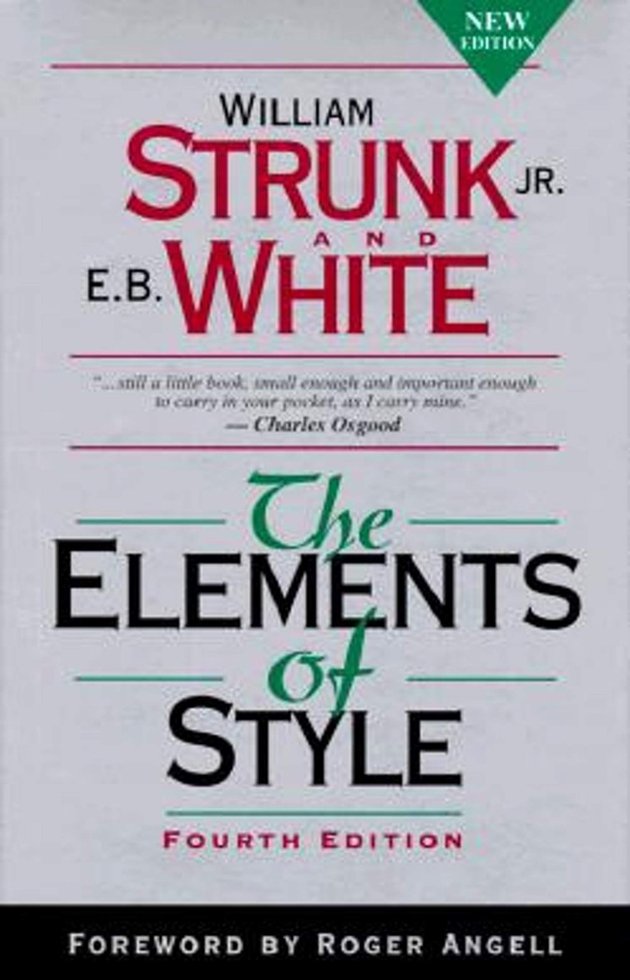
The Elements of Style
William Jr. Strunk
4.9
You know the authors' names. You recognize the title. You've probably used this book yourself. And now "The Elements of Style"-the most widely read and employed English style manual-is available in a specially bound 50th Anniversary Edition that offers the title's vast audience an opportunity to own a more durable and elegantly bound edition of this time-tested classic. Offering the same content as the Fourth Edition, revised in 1999, the new casebound 50th Anniversary Edition includes a brief overview of the book's illustrious history. Used extensively by individual writers as well as high school and college students of writing, it has conveyed the principles of English style to millions of readers. This new deluxe edition makes the perfect gift for writers of any age and ability level. Fifty Years of Acclaim for "The Elements of Style," by William Strunk Jr. and E.B. White "I first read "Elements of Style" during the summer before I went off to Exeter, and I still direct my students at Harvard to their definition about the difference between 'that' and 'which.' It is the Bible for good, clear writing." -- Henry Louis Gates Jr. "For writers of all kinds and sizes the world begins and ends with Strunk and White's "Elements of Style." Only something to actually write about trumps the list of what is required to put words together in some kind of coherent way. I treasure its presence in my life and salute its fifty years of glory and accomplishment." -- Jim Lehrer ""The Elements of Style" remains an unwavering beacon of light in these grammatically troubled times. I would be lost without it." -- Ann Patchett "To the extent I know how to write clearly at all, I probably taught myself while I was teaching others -- seventh graders, in Flint, Michigan, in 1967. I taught them with a copy of Strunk & White lying in full view on my desk, sort of in the way the Gideons leave Bibles in cheap hotel rooms, as a way of saying to the hapless inhabitant: 'In case your reckless ways should strand you here, there's help.' S&W doesn't really teach you how to write, it just tantalizingly reminds you that there's an orderly way to go about it, that clarity's ever your ideal, but -- really -- it's all going to be up to you." -- Richard Ford ""The Elements of Style" never seems to go out of date. Its counsel is sound and funny, wise and unpretentious. And while its precepts are a foundation of direct communication, Strunk and White do not insist on a way of writing beyond clear expression. The rest is up to the imagination, the intelligence within." -- David Remnick, editor of "The New Yorker" "It's the toughness-the irreverence and implicit laughter-that attracted me to the little book when I was seventeen. I fell in love with Strunk & White's loathing for cant and bloviation, the ruthless cutting of crap, jargon, and extra words. For me, that skeptical directness included a tacit permission by "The Elements of Style" to break its rules on occasion: an alloy of generosity in the blade, a grace I still admire and still learn from." -- Robert Pinsky "In the quest for clarity, one can have no better guides than Strunk and White. For me, their book has been invaluable and remains essential." -- Dan Rather "Eschew surplusage! A perfect book." --Jonathan Lethem "Not until I started teaching writing and I reread "The Elements of Style" did I realize that most everything I would be teaching young writers, and everything I would be learning myself as a writer, was contained between the covers of this slim, elegant, wise little book." -- Julia Alvarez "Strunk and White seared their way into my brain long ago, and I benefit from them daily." -- Steven J. Dubner, co-author of "Freakonomics" "Since high school, I have kept a copy of this book handy. That should be unnecessary. I should, by now, have fully internalized "The Elements of Style." But sometimes I get entangled in a paragraph that refuses to be 'clear, brief, bold.' I dip back into "The Elements of Style" and am refreshed. After Scott Simon interviewed me on NPR about whether the word 'e-mail' needs a hyphen (yes, it does), some listeners, including friends of mine, wondered why I had answered in the affirmative when asked, in passing, 'Are you a drunken white man?' Those listeners misheard. 'Strunk and White man' was what Scott said." -- Roy Blount Jr. "Strunk & White--writing's good-natured law firm--still contains enough sparkling good sense to clean up the whole bloviating blogosphere." -- Thomas Mallon "I used Strunk -- that's what we called it, Strunk -- as a student at Berkeley fifty years ago. I didn't know that it was new, and that we were the first generation to be educated in "The Elements of Style." I got a firm foundation in the English language, learned to write basically, and could depict the realistic world. Then I was able to become an impressionist and expressionist." -- Maxine Hong Kingston "Strunk and White's gigantic little book must be the most readable advice on writing ever written. Side by side with Roget, Shakespeare, the Bible, and a dictionary, it's an essential for every writer's shelf." -- X.J. Kennedy" ""With what joy I welcome the fiftieth anniversary of "The Elements of Style." I am greatly indebted to this book for the invaluable help it has given me all these years." -- Horton Foote "Elegant, droll, and perfectly proportioned, and like your favorite aunt, strict but affectionate. And, like your favorite aunt, full of optimism: You can, and will, be a better writer! There has never been a better, briefer, or more loved book about the art and craft of communicating." -- Susan Orlean "This book is an essential tool. It has been of great use to me and is probably responsible for my best writing. I owe my success to Strunk and White; only the mistakes are mine." -- Ben Affleck, in "O, the Oprah Magazine" "This book is a wonderful example of teaching by example. Not only does it recommend clear and concise writing, it demonstrates it. Written in the style of a friend offering help, it is a godsend to anyone wanting to put words on paper. Thank you, Messieurs Strunk and White. And Happy Anniversary, "Elements of Style."" -- S.E. Hinton "When I began to have ... I wouldn't say arguments but conversations in my mind with Strunk and White about a few of their rules and principles, I knew I was coming into my own. If only they were still here to talk things over! No doubt their side of the exchange would be kindly put, well-informed, and wise. They'd probably help me with my side of it. What more could one want from writers reaching out to help other writers?" -- Barbara Wallraff, language columnist for "The Atlantic" "I don't believe there is a serious writer alive who doesn't have a worn copy of 'Strunk & White'on his or her bookshelf." -- Mignon Fogarty, author of "Grammar Girl's Quick and Dirty Tips ""for Better Writing" "This little book has inspired hundreds of thousands of people to write better -- partly by precept and partly by example. It continues to influence more writers than any other. It's a force for good in the world." -- Bryan A. Garner, author of "Garner's Modern American Usage" "I can think of no better guide to good writing, and I always think of this little classic with a warm heart. More importantly, I revisit its pages often. It's the one essential book on writing." -- Jay Parini, author of "Why Poetry Matters" "Clarity and simplicity have always been the goals, and this book shows the way. It has always been a lighthouse in the dark and stormy night of student prose, of all of our prose." -- Ron Carlson "The only rules you are ever going to get from me are all in Strunk and White." --Ursula K. Le Guin, from "Steering the Craft " "["The Elements of Style "is] a book to which I return from time to time, the way I periodically reread Shakespeare. I always discover something new, settle a question that has been puzzling me, or learn a principle of usage that I have been pretending to know, a pretense that has resulted in inconsistency and in the sort of errors from which I can only pray some saintly copy editor will save me." -- Francine Prose, from "Reading"" Like A Writer" ..".still a little book, small enough and important enough to carry in your pocket, as I carry mine." -- Charles Osgood "Almost every writer has a Strunk and White story. One journalism professor spends the first two weeks of school forcing his students to memorize the book. A top editor at a major paper buys copies at yard sales to distribute to her writers and interns. It has even caused love affairs. . . . Could its greatness be any more clear?" -- Jesse Sheidlower, American Editor of the "Oxford"" English Dictionary," on NPR" ""If the English language is one of the finest homes ever devised for the human spirit, "Elements" is the best guided house tour we've got." --David Gelernter, "The Wall Street Journal" ..".Should be the daily companion of anyone who writes for a living and, for that matter, anyone who writes at all." "--"Jonathan Yardley, " Greensboro (N.C.) Daily News" "No book in shorter space, with fewer words, will help any writer more than this persistent little volume." -- Herbert A. Kenny, "The Boston Globe" "Buy it, study it, enjoy it. It's as timeless as a book can be in our age of volubility." -- Charles Poore, "The New York Times" "White is one of the best stylists and most lucid minds in this country. What he says and his way of saying it are equally rewarding." "-- "Edmund Fuller, "The Wall Street Journal ""If you have any young friends who aspire to become writers, the second greatest favor you can do them is to present them with copies of "The Elements of Style." The first greatest, of course, is to shoot them now, while they're happy." -- Dorothy Parker, "Esquire"
…
Recommended by Tobi Lütke, Alina Varlanuta, Ann Handley, and 3 others.
Tobi Lütke
Founder & CEO/Shopify
My most frequently gifted book is this book because I like good writing. [source]
Alina Varlanuta
My professional path – copywriting – somehow intertwines with my unprofessional (hahaha) path – writing so I would recommend reading literature for both. Somehow reading and writing are two ways of doing the same thing: storytelling (even when you read you tell yourself a story in your own voice, bringing your personal emotion and empathy to the story you’re reading). The only difference is that when I’m reading, panic is far away from me, in a safe place. Nevertheless, the words below helped me rewrite and think twice before adding an exclamation point: The Elements of Style. [source]
Bill Nye
This is my guide. I accept that I’ll never write anything as good as the introductory essay by the author. It’s brilliant. [source]
Cover unavailable
4
How to Read a Book: The Classic Guide to Intelligent Reading
With more than half a million paperback copies in print and now in this stunning hardcover keepsake edition, How to Read a Book is the classic and definitive guide to reading comprehension and retention for students of literature, scholars across disciplines, and anyone who just loves to read.
Originally written in 1940 and first published by Simon & Schuster in 1972, How to Read a Book introduces and elucidates the various levels of reading and how to achieve them in order to gain the most understanding and insight from any book. From elementary reading, through systematic skimming and inspectional reading, to speed reading and beyond, readers will learn when and how to “judge a book by its cover,” perceive structure no matter the prose, read critically, and extract the author’s message from the text.
Also included are specific reading techniques that work best for reading particular genres, whether they be practical books, imaginative literature, plays, poetry, history, science and mathematics, philosophy, or social science works. A recommended reading list and multiple comprehension tests are incorporated as well in order to measure progress in reading skills, speed, and understanding.
As poignant and applicable today as it was nearly seventy-five years ago, this beautiful hardcover edition is the perfect way for you to discover or rediscover How to Read a Book, a rare phenomenon and the best and most successful guide to reading comprehension.
…
Recommended by Sergey Brin, Ben Chestnut, Kevin Systrom, and 3 others.
had “How to Read a Book” by Mortimer J. Adler as one of his most recommended books. [source]
Ben Chestnut
Founder & CEO/MailChimp
I also love How to Read a Book by Mortimer Adler. I’m teaching its tips to my children while they’re young, so they can consume books much faster and have more fun reading. [source]
Kevin Systrom
The author's thesis is that the most important part of reading a book is to actually read the table of contents and familiarize yourself with the major structure of the book. [source]
Cover unavailable
5
How to Write a Lot: A Practical Guide to Productive Academic Writing
Paul J. Silvia
4.8
All academics need to write, but many struggle to finish their dissertations, articles, books, or grant proposals. Writing is hard work and can be difficult to wedge into a frenetic academic schedule. How can we write it all while still having a life?
In this second edition of his popular guidebook, Paul Silvia offers fresh advice to help you overcome barriers to writing and use your time more productively. After addressing some common excuses and bad habits, he provides practical strategies to motivate students, professors, researchers, and other academics to become better and more prolific writers. Silvia draws from his own experience in psychology to explain how to write, submit, and revise academic work, from journal articles to books, all without sacrificing evenings, weekends, and vacations. The tips and strategies in this second edition have been updated to apply to academic writing in most disciplines. Also new to this edition is a chapter on writing grant and fellowship proposals.
…
Cover unavailable
6
Bird By Bird: Some Instructions on Writing and Life
Anne Lamott
4.8
Thirty years ago my older brother, who was ten years old at the time, was trying to get a report on birds written that he'd had three months to write. It was due the next day. We were out at our family cabin in Bolinas, and he was at the kitchen table close to tears, surrounded by binder paper and pencils and unopened books on birds, immobilized by the hugeness of the task ahead. Then my father sat down beside him, put his arm around my brother's shoulder, and said, 'Bird by bird, buddy. Just take it bird by bird.'" "Superb writing advice... hilarious, helpful and provocative." -- "New York Times Book Review."
"A warm, generous and hilarious guide through the writer's world and its treacherous swamps." -- "Los Angeles Times."
"A gift to all of us mortals who write or ever wanted to write... sidesplittingly funny, patiently wise and alternately cranky and kind -- a reveille to get off our duffs and start writing "now," while we still can." -- "Seattle Times.
Bird by Bird is one of my absolute favorite books, and I gift it to everybody, which I should probably also give to startup founders, quite frankly. A lot of the lessons are the same. But you can get to your destination, even though you can only see 20 feet in front of you. [source]
It was wonderful to read these two provocative books of essays by two incredibly wise and compassionate women. … Anne Lamott’s book is ostensibly about the art of writing, but really it too is about life and how to tackle the problems, temptations and opportunities life throws at us. Both will make you think and both made me a better person this year. [source]
Cover unavailable
7
They Say / I Say: The Moves That Matter in Academic Writing
Gerald Graff and Cathy Birkenstein
4.8
The book that has taught millions of students to present their arguments as a response to what "they say" has been expanded to define as broadly as possible who's included in "they."
Readings demonstrate the moves that matter in academic writing and represent a multitude of perspectives.
The Fourth Edition includes an anthology of 40 readings--half of which are NEW--that will prompt students to listen, think, and write about five important issues, including new "How Can We Bridge the Differences That Divide Us?"
…
Recommended by Raul Pachecovega.
Raul Pachecovega
They Say/I Say: The Moves that Matter in Academic Writing (my reading notes) https://t.co/wLOB6VMiSO Best book ever to write analytical and argumentative writing. [source]
Cover unavailable
8
Publication Manual of the American Psychological Association(r)
American Psychological Association
4.8
With millions of copies sold, the Publication Manual of the American Psychological Association is the style manual of choice for writers, editors, students, educators, and professionals in psychology, sociology, business, economics, nursing, social work, and justice administration, and other disciplines in which effective communication with words and data is fundamental.
In addition to providing clear guidance on grammar, the mechanics of writing, and APA style, the Publication Manual offers an authoritative and easy-to-use reference and citation system and comprehensive coverage of the treatment of numbers, metrication, statistical and mathematical data, tables, and figures for use in writing, reports, or presentations.
The new edition has been revised and updated to include:
The latest guidelines and examples for referencing electronic and online sources New and revised guidelines for submitting papers electronically Improved guidelines for avoiding plagiarism Simplified formatting guidelines for writers using up-to-date word-processing software All new guidelines for presenting case studies Improved guidelines for the construction of tables Updates on copyright and permissions issues for writers New reference examples for audiovisual media and patents An expanded and improved index for quick and easy access
Writers, scholars, and professionals will also find:
New guidelines on how to choose text, tables, or figures to present data Guidelines for writing cover letters for submitting articles for publication, plus a sample letter Expanded guidelines on the retention of raw data New advice on establishing written agreements for the use of shared data New information on the responsibilities of co-authors
New and experienced readers alike will find the 5th Edition a complete resource for writing, presenting, or publishing with clarity and persuasiveness.
Approximately 400 pages
…
Cover unavailable
9
Style: Lessons in Clarity and Grace
Joseph M. Williams, Joseph Bizup
4.8
"For courses in English and Writing." Emphasizes the importance of style in writing for a global audience "Style: Lessons in Clarity and Grace" asserts that style is a matter of making informed choices in the service of one s readers. While writers know best what they want to say, readers ultimately decide if they ve said it well. This flagship text builds on that premise, with updates on subjects such as gender-neutral writing and writing for global audiences. It brings the authors innovative approach to the needs of today s students, while maintaining that writing with style is a civic and ethical virtue. Also available with Pearson Writer Pearson Writeris a revolutionary digital tool for writers at all levels. Built for mobile devices, it streamlines the tedious and time-consuming aspects of writing, so that students can focus on developing their ideas. Pearson Writermakes it easy to stay organized, track tasks, and stay on top of writing projects. Students can set milestones prior to the due date, manage their sources, organize their notes visually in the Notebook, and even get automatic feedback on their prose. Pearson Writer is now available with Noteclipper, which allows students to save online sources quickly and easily. Features of Pearson Writer: Writing, Grammar, and Research Guide is a go-to resource any time students have a question or need help. Automatic Writing Review checks prose for possible spelling, grammar, and style errors, while offering grammar lessons and suggestions for revising and editing. Citation Generator keeps track of every source throughout students research process and builds a bibliography in the background, taking care of those formatting details. Research Database and NoteClipper make searching for and managing source materials easier. Project Manager and Notebookhelp students stay on top of multiple projects and make organizing ideas and sources less cumbersome. Note: You are purchasing a standalone product; Pearson Writer does not come packaged with this content. Students, if interested in purchasing this title with Pearson Writer, ask your instructor for the correct package ISBN and Course ID. Instructors, contact your Pearson representative for more information. If you would like to purchase both the physical text and Pearson Writer, search for: 013415083X / 9780134150833 Style: Lessons in Clarity and Grace Plus Pearson Writer Access Card Package Package consists of: 032197235X / 9780321972354 Pearson Writer Standalone Access Card 0134080416 / 9780134080413 Style: Lessons in Clarity and Grace "
Writing well and describing things well is very valuable to a good programmer, and even more to a data scientist. [source]
Cover unavailable
10
Writing Science: How to Write Papers That Get Cited and Proposals That Get Funded
Joshua Schimel
4.8
As a scientist, you are a professional writer: your career is built on successful proposals and papers. Success isn't defined by getting papers into print, but by getting them into the reader's consciousness. Writing Science is built upon the idea that successful science writing tells a story. It uses that insight to discuss how to write more effectively. Integrating lessons from other genres of writing with those from the author's years of experience as author, reviewer, and editor, the book shows scientists and students how to present their research in a way that is clear and that will maximize reader comprehension.
The book takes an integrated approach, using the principles of story structure to discuss every aspect of successful science writing, from the overall structure of a paper or proposal to individual sections, paragraphs, sentences, and words. It begins by building core arguments, analyzing why some stories are engaging and memorable while others are quickly forgotten, and proceeds to the elements of story structure, showing how the structures scientists and researchers use in papers and proposals fit into classical models. The book targets the internal structure of a paper, explaining how to write clear and professional sections, paragraphs, and sentences in a way that is clear and compelling. The ideas within a paper should flow seamlessly, drawing readers along. The final section of the book deals with special challenges, such as how to discuss research limitations and how to write for the public.
Writing Science is a much-needed guide to succeeding in modern science. Its insights and strategies will equip science students, scientists, and professionals across a wide range of scientific and technical fields with the tools needed to communicate effectively.
…
Cover unavailable
11
Academic Writing for Graduate Students: Essential Tasks and Skills
John M. Swales and Christine B. Feak
4.8
Like its predecessor, the third edition of Academic Writing for Graduate Students explains understanding the intended audience, the purpose of the paper, and academic genres; includes the use of task-based methodology, analytic group discussion, and genre consciousness-raising; shows how to write summaries and critiques; features Language Focus sections that address linguistic elements as they affect the wider rhetorical objectives; and helps students position themselves as junior scholars in their academic communities.
Among the many changes in the third edition: *newer, longer, and more authentic texts and examples *greater discipline variety in texts (added texts from hard sciences and engineering) *more in-depth treatment of research articles *greater emphasis on vocabulary issues *revised flow-of-ideas section *additional tasks that require students to do their own research *more corpus-informed content *binding that allows the book to lay flat when open.
The Commentary (teacher's notes and key) (978-0-472-03506-9) has been revised expanded.
…
Cover unavailable
12
The Sense of Style: The Thinking Person's Guide to Writing in the 21st Century
Steven Pinker
4.7
A short and entertaining book on the modern art of writing well by New York Times bestselling author Steven Pinker Why is so much writing so bad, and how can we make it better? Is the English language being corrupted by texting and social media? Do the kids today even care about good writing? Why should any of us care?
In The Sense of Style, the bestselling linguist and cognitive scientist Steven Pinker answers these questions and more. Rethinking the usage guide for the twenty-first century, Pinker doesn’t carp about the decline of language or recycle pet peeves from the rulebooks of a century ago. Instead, he applies insights from the sciences of language and mind to the challenge of crafting clear, coherent, and stylish prose.
In this short, cheerful, and eminently practical book, Pinker shows how writing depends on imagination, empathy, coherence, grammatical knowhow, and an ability to savor and reverse engineer the good prose of others. He replaces dogma about usage with reason and evidence, allowing writers and editors to apply the guidelines judiciously, rather than robotically, being mindful of what they are designed to accomplish.
Filled with examples of great and gruesome prose, Pinker shows us how the art of writing can be a form of pleasurable mastery and a fascinating intellectual topic in its own right.
…
Recommended by Ellen Lupton and 1 others.
Cover unavailable
13
Writing Your Journal Article in 12 Weeks: A Guide to Academic Publishing Success
Wendy Laura Belcher
4.7
"This book is a wonderful addition to a graduate course on professional writing, to a writers' group in need of some structure, or even to the lone writer who needs assistance becoming an academic writer." --Chronicle of Higher Education
Wendy Laura Belcher's Writing Your Journal Article in Twelve Weeks: A Guide to Academic Publishing Success isa revolutionary approach to enabling academic authors to overcome their anxieties and produce the publications that are essential to succeeding in their fields. Each week, readers learn a particular feature of strong articles and work on revising theirs accordingly. At the end of twelve weeks, they send their article to a journal. This invaluable resource is the only guide that focuses specifically on publishing humanities and social science journal articles.Key Features
Has a proven record of helping graduate students and professors get published: This workbook, developed over a decade of teaching scholarly writers in a range of disciplines at UCLA and around the world, has already helped hundreds to publish their articles in peer-reviewed journals.
Demystifies the academic publishing process: This workbook is based on actual research about faculty productivity and peer review, students' writing triumphs and failures, as well as the author's experiences as a journal editor and award-winning author.
Proceeds step by manageable step: Within the context of clear deadlines, the workbook provides the instruction, exercises, and structure needed to revise a classroom essay, conference paper, dissertation chapter, master's thesis, or unfinished draft into a journal article and send it to a suitable journal.
Targets the biggest writing challenges: This workbook focuses squarely on the most difficult tasks facing scholarly writers, such as getting motivated, making an argument, and creating a logical whole. Writing Your Journal Article in Twelve Weeks can be used individually or in groups, and is particularly appropriate for graduate student professional development courses, junior faculty orientation workshops, post-doc groups, and journal article writing courses.
Wendy Laura Belcher is assistant professor of African literature at Princeton University in the Department of Comparative Literature and Center for African American Studies. She has taught journal article writing workshops in North America, Europe, and Africa.
Praise for Wendy Belcher and Writing Your Journal Article in Twelve Weeks
"A comprehensive, well-written and beautifully organized book on publishing articles in the humanities and social sciences that will help its readers write forward with a first-rate guide as good company." --Joan Bolker, author of Writing Your Dissertation in Fifteen Minutes a Day"Humorous, direct, authentic ... a seamless weave of experience, anecdote, and research." --Kathleen McHugh, professor and director of the UCLA Center for the Study of Women
"A useful text that will be an excellent resource for any writer attempting to publish their work." --Larry Chandler, Graduate Student
"Wendy Belcher's book is revolutionizing the way younger scholars perceive academic publishing and radically transforming their level of access to it (and consequently to the profession). It is by far the most readable or practical guide to academic writing on the market." --Beth Goodhue, UCLA
"Wendy's guidance has been a tremendous help to me, and the book is great for grad students, junior faculty, or anyone who wants to learn how to write and publish more effectively." -Jake Dorman, The University of Kansas
"Your book struck such a nerve because there is a long chain of assumptions in academia that scholars should just know how to do certain things. The relief among faculty is palpable when I explain in groups that few of us -- even those who have been published in journals -- were ever taught properly. And although it helps everyone who cracks it, your book is especially a godsend for faculty from other cultures." -Carole Sargent, Georgetown University
"Thanks for your wonderful book!" -Georgina Green, Graduate Student
"Absolutely LOVE the book!" -Karra Bikson, Graduate Student
…
Cover unavailable
14
The Craft of Research (Chicago Guides to Writing, Editing, and Publishing)
Wayne C. Booth, Gregory G. Colomb, Joseph M. Williams
4.7
With more than 400,000 copies now in print, The Craft of Research is the unrivaled resource for researchers at every level, from first-year undergraduates to research reporters at corporations and government offices.
Seasoned researchers and educators Gregory G. Colomb and Joseph M. Williams present an updated third edition of their classic handbook, whose first and second editions were written in collaboration with the late Wayne C. Booth. The Craft of Research explains how to build an argument that motivates readers to accept a claim; how to anticipate the reservations of readers and to respond to them appropriately; and how to create introductions and conclusions that answer that most demanding question, “So what?”
The third edition includes an expanded discussion of the essential early stages of a research task: planning and drafting a paper. The authors have revised and fully updated their section on electronic research, emphasizing the need to distinguish between trustworthy sources (such as those found in libraries) and less reliable sources found with a quick Web search. A chapter on warrants has also been thoroughly reviewed to make this difficult subject easier for researchers
Throughout, the authors have preserved the amiable tone, the reliable voice, and the sense of directness that have made this book indispensable for anyone undertaking a research project.
…
Cover unavailable
15
A Manual for Writers of Research Papers, Theses, and Dissertations: Chicago Style for Students and Researchers
Kate L. Turabian
4.7
Dewey. Bellow. Strauss. Friedman. The University of Chicago has been the home of some of the most important thinkers of the modern age. But perhaps no name has been spoken with more respect than Turabian. The dissertation secretary at Chicago for decades, Kate Turabian literally wrote the book on the successful completion and submission of the student paper. Her Manual for Writers of Research Papers, Theses, and Dissertations, created from her years of experience with research projects across all fields, has sold more than seven million copies since it was first published in 1937.
Now, with this seventh edition, Turabian’s Manual has undergone its most extensive revision, ensuring that it will remain the most valuable handbook for writers at every level—from first-year undergraduates, to dissertation writers apprehensively submitting final manuscripts, to senior scholars who may be old hands at research and writing but less familiar with new media citation styles. Gregory G. Colomb, Joseph M. Williams, and the late Wayne C. Booth—the gifted team behind The Craft of Research—and the University of Chicago Press Editorial Staff combined their wide-ranging expertise to remake this classic resource. They preserve Turabian’s clear and practical advice while fully embracing the new modes of research, writing, and source citation brought about by the age of the Internet.
Booth, Colomb, and Williams significantly expand the scope of previous editions by creating a guide, generous in length and tone, to the art of research and writing. Growing out of the authors’ best-selling Craft of Research, this new section provides students with an overview of every step of the research and writing process, from formulating the right questions to reading critically to building arguments and revising drafts. This leads naturally to the second part of the Manual for Writers, which offers an authoritative overview of citation practices in scholarly writing, as well as detailed information on the two main citation styles (“notes-bibliography” and “author-date”). This section has been fully revised to reflect the recommendations of the fifteenth edition of The Chicago Manual of Style and to present an expanded array of source types and updated examples, including guidance on citing electronic sources.
The final section of the book treats issues of style—the details that go into making a strong paper. Here writers will find advice on a wide range of topics, including punctuation, table formatting, and use of quotations. The appendix draws together everything writers need to know about formatting research papers, theses, and dissertations and preparing them for submission. This material has been thoroughly vetted by dissertation officials at colleges and universities across the country.
This seventh edition of Turabian’s Manual for Writers of Research Papers, Theses, and Dissertations is a classic reference revised for a new age. It is tailored to a new generation of writers using tools its original author could not have imagined—while retaining the clarity and authority that generations of scholars have come to associate with the name Turabian.
…
Cover unavailable
16
The Only Grant-Writing Book You'll Ever Need
Ellen Karsh
4.7
From top experts in the field, the definitive guide to grant-writing
Written by two expert authors who have won secured millions of dollars in government and foundation grants, The Only Grant-Writing Book You'll Ever Need is the classic book on grant seeking, providing a comprehensive, step-by-step guide for government, nonprofit, and individual grant seekers. Drawing on decades of experience in grant writing and professional development, Ellen Karsh and Arlen Sue Fox demystify the process of securing grants while offering indispensable advice from funders and recipients. This updated fifth edition includes:
Vital information about grantsmanship in today's ever-changing economic and social climate In-depth interviews with funders, nonprofit leaders, and policy makers about the grants process A new chapter on how to diversify funding and think "outside the box" when grants are scarce Concrete suggestions for developing each section of a proposal Hands-on exercises that let you practice what you learn A detailed description of important websites for grant seekers Strategies for developing and presenting programs that are likely to receive grants
…
Cover unavailable
17
Writing Literature Reviews: A Guide for Students of the Social and Behavioral Sciences
Jose L. Galvan and Melisa C. Galvan
4.7
This useful guide educates students in the preparation of literature reviews for term projects, theses, and dissertations. The authors provide numerous examples from published reviews that illustrate the guidelines discussed throughout the book.
New to the seventh edition:
Each chapter breaks down the larger holistic review of literature exercise into a series of smaller, manageable steps
Practical instructions for navigating today's digital libraries
Comprehensive discussions about digital tools, including bibliographic and plagiarism detection software
Chapter activities that reflect the book's updated content
New model literature reviews
Online resources designed to help instructors plan and teach their courses (www.routledge.com/9780415315746).
…
Cover unavailable
18
The Writing Workshop: Write More, Write Better, Be Happier in Academia
Barbara W Sarnecka
4.7
Research is all about writing, but most PhD programs don't teach students how to produce the writing needed to get a PhD, publish research, or win fellowships and grants. Plus, the academic environment can feel as cold and harsh as the South Pole. But just as penguins form social huddles to survive the Antarctic winter, researchers can form writing groups to help them learn how to write more, write better and be happier in academia. The Writing Workshop tells you everything you need to know about forming and running a successful writing group, and provides invaluable tips on how to become better at and more comfortable with academic writing. Written by a professor of Cognitive Sciences at the University of California, this friendly guide is aimed at early-career researchers such as PhD students, postdoctoral scholars and new faculty members. Chapter topics include: How to form and run a writing workshop; how to plan research and writing projects over the long (one to five years), medium (ten to fifteen weeks), and short (one week) terms; how to establish and maintain a regular daily(ish) writing practice; how to write a literature review, research article, funding proposal or presentation; and how to revise for clarity at the document, paragraph, sentence and word levels. There are templates to help students set writing goals and log their writing practice, plus in-class exercises to help writers learn to hear the difference between effective and ineffective writing. Running through the book is the theme of well-being, and the idea that creativity comes from self-compassion rather than self-punishment. Writing is not only a way of producing scholarly output, but also a way of thinking, learning and generating new ideas. A regular writing practice grounded in a supportive community is something that every early-career scholar deserves and, with this book, it's something every early-career scholar can have.
…
Cover unavailable
19
Stylish Academic Writing
Helen Sword
4.7
Elegant data and ideas deserve elegant expression, argues Helen Sword in this lively guide to academic writing. For scholars frustrated with disciplinary conventions, and for specialists who want to write for a larger audience but are unsure where to begin, here are imaginative, practical, witty pointers that show how to make articles and books a pleasure to read and to write.
Dispelling the myth that you cannot get published without writing wordy, impersonal prose, Sword shows how much journal editors and readers welcome work that avoids excessive jargon and abstraction. Sword s analysis of more than a thousand peer-reviewed articles across a wide range of fields documents a startling gap between how academics typically describe good writing and the turgid prose they regularly produce.
"Stylish Academic Writing" showcases a range of scholars from the sciences, humanities, and social sciences who write with vividness and panache. Individual chapters take up specific elements of style, such as titles and headings, chapter openings, and structure, and close with examples of transferable techniques that any writer can master.
…
Cover unavailable
20
Writing Your Dissertation in Fifteen Minutes a Day
Joan Bolker
4.7
Expert writing advice from the editor of the Boston Globe best-seller, The Writer's Home Companion
Dissertation writers need strong, practical advice, as well as someone to assure them that their struggles aren't unique. Joan Bolker, midwife to more than one hundred dissertations and co-founder of the Harvard Writing Center, offers invaluable suggestions for the graduate-student writer. Using positive reinforcement, she begins by reminding thesis writers that being able to devote themselves to a project that truly interests them can be a pleasurable adventure. She encourages them to pay close attention to their writing method in order to discover their individual work strategies that promote productivity; to stop feeling fearful that they may disappoint their advisors or family members; and to tailor their theses to their own writing style and personality needs. Using field-tested strategies she assists the student through the entire thesis-writing process, offering advice on choosing a topic and an advisor, on disciplining one's self to work at least fifteen minutes each day; setting short-term deadlines, on revising and defing the thesis, and on life and publication after the dissertation. Bolker makes writing the dissertation an enjoyable challenge.
…
Cover unavailable
21
The Scientist's Guide to Writing: How to Write More Easily and Effectively Throughout Your Scientific Career
Stephen B. Heard
4.7
The ability to write clearly is critical to any scientific career. The Scientist's Guide to Writing provides practical advice to help scientists become more effective writers so that their ideas have the greatest possible impact.
Drawing on his own experience as a scientist, graduate adviser, and editor, Stephen Heard emphasizes that the goal of all scientific writing should be absolute clarity; that good writing takes deliberate practice; and that what many scientists need are not long lists of prescriptive rules but rather direct engagement with their behaviors and attitudes when they write. He combines advice on such topics as how to generate and maintain writing momentum with practical tips on structuring a scientific paper, revising a first draft, handling citations, responding to peer reviews, managing coauthorships, and more.
In an accessible, informal tone, The Scientist's Guide to Writing explains essential techniques that students, postdoctoral researchers, and early-career scientists need to write more clearly, efficiently, and easily.
Emphasizes writing as a process, not just a product Encourages habits that improve motivation and productivity Explains the structure of the scientific paper and the function of each part Provides detailed guidance on submission, review, revision, and publication Addresses issues related to coauthorship, English as a second language, and more
…
Recommended by Jacquelyn Gill.
Jacquelyn Gill
@GreenspaceGirl @StephenBHeard As a historian, I also think you'll enjoy his book, which includes a history of scientific writing. [source]
Cover unavailable
22
Understanding Media: The Extensions of Man
Marshall McLuhan, Lewis H. Lapham
4.7
Terms and phrases such as "the global village" and "the medium is the message" are now part of the lexicon, and McLuhan's theories continue to challenge our sensibilities and our assumptions about how and what we communicate.
This reissue of Understanding Media marks the thirtieth anniversary (1964-1994) of Marshall McLuhan's classic expose on the state of the then emerging phenomenon of mass media. Terms and phrases such as "the global village" and "the medium is the message" are now part of the lexicon, and McLuhan's theories continue to challenge our sensibilities and our assumptions about how and what we communicate.
There has been a notable resurgence of interest in McLuhan's work in the last few years, fueled by the recent and continuing conjunctions between the cable companies and the regional phone companies, the appearance of magazines such as WiRed, and the development of new media models and information ecologies, many of which were spawned from MIT's Media Lab. In effect, media now begs to be redefined. In a new introduction to this edition of Understanding Media, Harper's editor Lewis Lapham reevaluates McLuhan's work in the light of the technological as well as the political and social changes that have occurred in the last part of this century.
…
Recommended by Cynthia Johnson.
Cynthia Johnson
This book will help change the way you think about digital marketing tools or social media tools, or any sort of communication device. Really focus on what do they do and how do they work first, and then create the content. [source]
Cover unavailable
23
The Anatomy of Story: 22 Steps to Becoming a Master Storyteller
John Truby
4.7
John Truby is one of the most respected and sought-after story consultants in the film industry, and his students have gone on to pen some of Hollywood's most successful films, including Sleepless in Seattle, Scream, and Shrek. The Anatomy of Story is his long-awaited first book, and it shares all of his secrets for writing a compelling script. Based on the lessons in his award-winning class, Great Screenwriting, The Anatomy of Story draws on a broad range of philosophy and mythology, offering fresh techniques and insightful anecdotes alongside Truby's own unique approach for how to build an effective, multifaceted narrative. Truby's method for constructing a story is at once insightful and practical, focusing on the hero's moral and emotional growth. As a result, writers will dig deep within and explore their own values and worldviews in order to create an effective story. Writers will come away with an extremely precise set of tools to work with--specific, useful techniques to make the audience care about their characters, and that make their characters grow in meaningful ways. They will construct a surprising plot that is unique to their particular concept, and they will learn how to express a moral vision that can genuinely move an audience.
The foundations of story that Truby lays out are so fundamental they are applicable--and essential--to all writers, from novelists and short-story writers to journalists, memoirists, and writers of narrative non-fiction.
…
Cover unavailable
24
Science Research Writing for Non-Native Speakers of English
Hilary Glasman-Deal
4.7
This book is designed to enable non-native English speakers to write science research for publication in English. It can also be used by English speakers and is a practical, user-friendly book intended as a fast, do-it-yourself guide for those whose English language proficiency is above intermediate. The approach is based on material developed from teaching graduate students at Imperial College London and has been extensively piloted. The book guides the reader through the process of writing science research and will also help with writing a Master's or Doctoral thesis in English.Science writing is much easier than it looks because the structure and language are conventional. The aim of this book is to help the reader discover a template or model for science research writing and then to provide the grammar and vocabulary tools needed to operate that model. There are five units: Introduction, Methodology, Results, Discussion/Conclusion and Abstract. The reader develops a model for each section of the research article through sample texts and exercises; this is followed by a Grammar and Writing Skills section designed to respond to frequently-asked questions as well as a Vocabulary list including examples of how the words and phrases are to be used.
…
Cover unavailable
25
How to Write a Thesis
Umberto Eco, Caterina Mongiat Farina, Geoff Farina, Francesco Erspamer
4.7
By the time Umberto Eco published his best-selling novel "The Name of the Rose," he was one of Italy's most celebrated intellectuals, a distinguished academic and the author of influential works on semiotics. Some years before that, in 1977, Eco published a little book for his students, "How to Write a Thesis," in which he offered useful advice on all the steps involved in researching and writing a thesis -- from choosing a topic to organizing a work schedule to writing the final draft. Now in its twenty-third edition in Italy and translated into seventeen languages, "How to Write a Thesis "has become a classic. Remarkably, this is its first, long overdue publication in English.
Eco's approach is anything but dry and academic. He not only offers practical advice but also considers larger questions about the value of the thesis-writing exercise. "How to Write a Thesis" is unlike any other writing manual. It reads like a novel. It is opinionated. It is frequently irreverent, sometimes polemical, and often hilarious. Eco advises students how to avoid "thesis neurosis" and he answers the important question "Must You Read Books?" He reminds students "You are not Proust" and "Write everything that comes into your head, but only in the first draft." Of course, there was no Internet in 1977, but Eco's index card research system offers important lessons about critical thinking and information curating for students of today who may be burdened by Big Data.
"How to Write a Thesis" belongs on the bookshelves of students, teachers, writers, and Eco fans everywhere. Already a classic, it would fit nicely between two other classics: "Strunk and White" and "The Name of the Rose."
This MIT Press edition will be available in three different cover colors.
Contents The Definition and Purpose of a Thesis Choosing the Topic Conducting Research The Work Plan and the Index Cards Writing the Thesis The Final Draft
…
Cover unavailable
26
Writing & Rhetoric Book 1: Fable - Student Edition - A one-semester course for grades 3 or 4 and up
Paul Kortepeter
4.7
Cover unavailable
27
Writing Tools: 50 Essential Strategies for Every Writer
Roy Peter Clark
4.7
A special 10th anniversary edition of Roy Peter Clark's bestselling guide to writing, featuring five bonus tools.
Ten years ago, Roy Peter Clark, America's most influential writing teacher, whittled down almost thirty years of experience in journalism, writing, and teaching into a series of fifty short essays on different aspects of writing. In the past decade, Writing Tools has become a classic guidebook for novices and experts alike and remains one of the best loved books on writing available.
Organized into four sections, "Nuts and Bolts," "Special Effects," "Blueprints for Stories," and "Useful Habits," Writing Tools is infused with more than 200 examples from journalism and literature. This new edition includes five brand new, never-before-shared tools.
Accessible, entertaining, inspiring, and above all, useful for every type of writer, from high school student to novelist, Writing Tools is essential reading.
…
Cover unavailable
28
The Only Academic Phrasebook You'll Ever Need: 600 Examples of Academic Language
Luiz Otavio Barros
4.7
The Only Academic Phrasebook You'll Ever Need is a short, no-nonsense, reader-friendly bank of academic sentence templates. It was written for both graduate and undergraduate students who already know the basics of academic writing but may still struggle to express their ideas using the right words.
The Only Academic Phrasebook You'll Ever Need contains 600 sentence templates organized around the typical sections of an academic paper. Here are some examples:
1. Establishing a research territory: The last few years have seen an increased interest in ____. 2. Describing research gaps: To date, no study has looked specifically at ____. 3. Stating your aims: The aim of this study is to discuss the extent to which ____. 4. Describing the scope and organization of your paper: In chapter ____, the concept of ____ is further explored. 5. General literature review: A number of scholars have attempted to identify ____. 6. Referencing: In his 1799 study, Smith argued that ____. 7. Sampling and data collection: Participants were randomly selected based on ____. 8. Data analysis and discussion: The data provide preliminary evidence that ____.
The Only Academic Phrasebook You'll Ever Need also contains 80 grammar and vocabulary tips for both native and non-native speakers. For example:
1. What's the difference between "effect" and "affect"? "Imply" and "infer"? "They're," "their" and "there"? 2. Is "irregardless" correct? 3. Do you say "the criteria was" or "the criteria were"?
The Only Academic Phrasebook You'll Ever Need is NOT a comprehensive academic writing textbook. It will NOT teach you key academic skills such as choosing the right research question, writing clear paragraphs, dealing with counter arguments and so on.
But it will help you find the best way to say what you want to say so you can ace that paper!
…
Cover unavailable
29
Longman Academic Writing Series 5: Essays to Research Papers
Alan Meyers
4.7
The Longman Academic Writing Series helps students master the academic writing skills needed to succeed in their academic careers. The five-level series spans writing topics from composing sentences to writing research papers. Each level covers the complete writing process from prewriting to revision. Level 5 teaches advanced students to write various genres of academic essays and research papers. The text's writing process approach integrates training in grammar, vocabulary, sentence structure, and research techniques along with essay and research paper organization. FeaturesRealistic writing models from various rhetorical genres explore academic disciplines such as biology, sociology, and history. Vocabulary sections expand students' language awareness and improve the quality of their writing. Sentence structure and grammar review helps students improve writing skills. Preparation for Writing sections provide guidance and practice in researching, evaluating, and documenting sources. A step-by-step approach guides students seamlessly through the writing process. Writing Tips provide useful strategies to enhance students' writing experience. Writing Expansions, including journals, timed writing, and summarizing, build written fluency, critical thinking, and test-taking skills.
…
Cover unavailable
30
Story Engineering: Character Development, Story Concept, Scene Construction
"Here is what I love about this book: It has gobs and gobs of student writing samples with smart and lively explanations of how to use each as the focus of a craft lesson to teach writing. The right models of student writing are the best mentor texts a teacher can find and with this book, you need look no further. . . . Breathe, fellow writing teachers. Much needed and wanted help has arrived." - Ruth Culham, Author of Traits Writing
Sometimes a student's best teacher is another student. If ever there were a book to respond to the pressure to increase students' test scores, this is it. You see, Gretchen Bernabei and Judi Reimer have had amazing success using mentor texts by students to teach writing well in any genre. Now, they "hand over their file drawers" and pair 101 student essays with one-page lessons on topics such as how to:
*Choose a structure across genres
*Extract thesis statement and main points
*Support points with details
*Use rhetorical devices and grammatical constructions
*Write from the point of view of a fictional character
A popular workshop presenter and winner of NCTE's James Moffett Award in 2010, Gretchen Bernabei has been teaching kids to write in middle school and high school classrooms for more than thirty years. In addition to four other professional books and numerous articles for NCTE journals, she is the author of National Geographic School Publications' The Good Writer's Kit, as well as Lightning in a Bottle, a CD of visual writing prompts.
Judi Reimer taught fourth grade in San Antonio, Texas, for seventeen years and continues to advise students and school districts. She has worked as a freelance writer, contributing columns and features for Parents, Ladies' Home Journal, and other national magazines. Judi has also written articles for Studies Weekly classroom publications and has been a freelance writer for American Legacy Publishing.
…
Cover unavailable
32
Writing for Social Scientists: How to Start and Finish Your Thesis, Book, or Article (Chicago Guides to Writing, Editing, and Publishing)
Howard S. Becker and Pamela Richards
4.7
Students and researchers all write under pressure, and those pressures—most lamentably, the desire to impress your audience rather than to communicate with them—often lead to pretentious prose, academic posturing, and, not infrequently, writer’s block.
Sociologist Howard S. Becker has written the classic book on how to conquer these pressures and simply write. First published nearly twenty years ago, Writing for Social Scientists has become a lifesaver for writers in all fields, from beginning students to published authors. Becker’s message is clear: in order to learn how to write, take a deep breath and then begin writing. Revise. Repeat.
It is not always an easy process, as Becker wryly relates. Decades of teaching, researching, and writing have given him plenty of material, and Becker neatly exposes the foibles of academia and its “publish or perish” atmosphere. Wordiness, the passive voice, inserting a “the way in which” when a simple “how” will do—all these mechanisms are a part of the social structure of academic writing. By shrugging off such impediments—or at the very least, putting them aside for a few hours—we can reform our work habits and start writing lucidly without worrying about grades, peer approval, or the “literature.”
In this new edition, Becker takes account of major changes in the computer tools available to writers today, and also substantially expands his analysis of how academic institutions create problems for them. As competition in academia grows increasingly heated, Writing for Social Scientists will provide solace to a new generation of frazzled, would-be writers.
…
Cover unavailable
33
MLA Handbook for Writers of Research Papers
Joseph Gibaldi
4.7
Widely adopted by universities, colleges, and secondary schools, the MLA Handbook gives step-by-step advice on every aspect of writing research papers, from selecting a topic to submitting the completed paper. For over half a century, the MLA Handbook is the guide millions of writers have relied on.
The seventh edition is a comprehensive, up-to-date guide to research and writing in the online environment. It provides an authoritative update of MLA documentation style for use in student writing, including simplified guidelines for citing works published on the Web and new recommendations for citing several kinds of works, such as digital files and graphic narratives.
Every copy of the seventh edition of the MLA Handbook comes with a code for accessing the accompanying Web site. New to this edition, the Web site provides
- the full text of the print volume of the MLA Handbook - over two hundred additional examples - several research-project narratives--stories, with sample papers, that illustrate the steps successful students take in researching and writing papers - searching of the entire site, including the full text of the MLA Handbook - continuous access throughout the life of the seventh edition of the MLA Handbook
…
Cover unavailable
34
Longman Academic Writing Series 3 Sb with Online Resources
Alice Oshima and Ann Hogue
4.7
The Longman Academic Writing Series helps students master the academic writing skills needed to succeed in their academic careers. The five-level series spans writing topics from composing sentences to writing research papers. Each level covers the complete writing process from prewriting to revision. Level 3 teaches intermediate students to write various genres of academic paragraphs and essays. The text s proven approach integrates training in grammar, mechanics, vocabulary, sentence structure, and paragraph and essay organization along with the writing process. Features Realistic writing models and systematic practice empower students to write effectively in different genres. "
…
Cover unavailable
35
Sourcework: Academic Writing from Sources
Nancy E. Dollahite and Julie Haun
4.7
The second edition of Sourcework, designed to help students make use of outside sources, has been updated and enhanced to better guide writers through the challenges of their first academic research papers. With new university-level readings and updated activities, this flexible text helps students master the writing and critical thinking skills necessary to produce strong academic essays using supporting evidence.
…
Cover unavailable
36
Academic Writing: Concepts and Connections
Teresa Thonney
4.7
Features
* An emphasis on core academic skills: Academic Writing introduces core concepts used across a variety of disciplines in order to help students recognize patterns that appear in all academic reading and writing situations. * Connections across contexts: From traditional science reports written for fellow scholars to blogs written for general audiences, this interdisciplinary text contains a wide range of readings, allowing students to examine how context influences academic writing. * "Concept in Practice" and "Applying the Concepts" features: These features encourage students to apply the critical reading, research, and writing strategies that they learn in composition courses to what they read and write in all of their courses.
…
Cover unavailable
37
Longman Academic Writing Series 1: Sentences to Paragraphs, with Essential Online Resources
Linda Butler
4.7
The Longman Academic Writing Serieshelps students master the academic writing skills needed to succeed in their academic careers. The five-level series spans writing topics from composing sentences to writing research papers. Each level covers the complete writing process from prewriting to revision.
Level 1 teaches beginning students to write sentences and paragraphs. The text's proven approach integrates training in grammar, mechanics, vocabulary, sentence structure, and paragraph organization along with the writing process.
Features • Realistic writing models and systematic practice empower students to write effectively in different genres. • Clear explanations help students grasp and apply key concepts. • Sentence structure, grammar, and mechanics instruction help students develop key writing skills. • A step-by-step approach guides students seamlessly through the writing process.
New to This Edition • New vocabulary sections help students develop language awareness and improve the quality of their writing. • Writing Tips provide useful strategies to enhance students' writing experience. • Writing Expansions, including journals, timed writing, and summarizing, build written fluency and test-taking skills. • A Teacher's Manual at www.pearsonelt.com/tmkeys provides teaching suggestions, answer keys, rubrics, and quizzes.
…
Cover unavailable
38
Writing with Style: Conversations on the Art of Writing
John R. Trimble
4.7
A storehouse of practical writing tips, written in a lively, conversational style.
Cover unavailable
39
Demystifying Dissertation Writing: A Streamlined Process from Choice of Topic to Final Text
Peg Boyle Single, Richard M. Reis
4.7
Research shows that five strategies correlate with the successful completion of a dissertation:
Establishing a consistent writing routine Working with a support group Consulting your advisor Understanding your committee's expectations Setting a realistic and timely schedule
Building on these insights, this book is for anyone who needs help in preparing for, organizing, planning, scheduling, and writing the longest sustained writing project they have encountered, particularly if he or she is not receiving sufficient guidance about the process, but also for anyone looking to boost his or her writing productivity.
The author uncovers much tacit knowledge, provides advice on working with dissertation advisors and committee members, presents proven techniques for the prewriting and writing stages of the dissertation, sets out a system for keeping on schedule, and advocates enlisting peer support.
As Peg Boyle Single states, "my goal is quite simple and straightforward: for you to experience greater efficiency and enjoyment while writing. If you experience anxiety, blocking, impatience, perfectionism or procrastination when you write, then this system is for you. I want you to be able to complete your writing so that you can move on with the rest of your life."
Few scholars, let alone graduate students, have been taught habits of writing fluency and productivity. The writing skills imparted by this book will not only help the reader through the dissertation writing process, but will serve her or him in whatever career she or he embarks on, given the paramount importance of written communication, especially in the academy.
This book presents a system of straightforward and proven techniques that are used by productive writers, and applies them to the dissertation process. In particular, it promotes the concept of writing networks - whether writing partners or groups - to ensure that writing does not become an isolated and tortured process, while not hiding the need for persistence and sustained effort.
This book is intended for graduate students and their advisers in the social sciences, the humanities, and professional fields. It can further serve as a textbook for either informal writing groups led by students or for formal writing seminars offered by departments or graduate colleges. The techniques described will help new faculty advice their students more effectively and even achieve greater fluency in their own writing.
…
Cover unavailable
40
Becoming an Academic Writer: 50 Exercises for Paced, Productive, and Powerful Writing
Patricia Goodson
4.7
With its friendly, step-by-step format, Becoming an Academic Writer by Patricia Goodson helps writers improve their writing by engaging in deep and deliberate practice--a type of practice adopted by expert performers in areas such as sports or music. Featuring 50 exercises, this practical, self-paced guide is flexibly organized so readers can either work their way through all of the exercises in order or focus on the specific areas where they need additional practice building their skills. The Second Edition is enhanced by a new appendix on literature review, new feature boxes, and new chapter summaries.
…
Cover unavailable
41
A PhD Is Not Enough: A Guide To Survival In Science
Peter J. Feibelman
4.7
Despite your graduate education, brainpower, and technical prowess, your career in scientific research is far from assured. Permanent positions are scarce, science survival is rarely part of formal graduate training, and a good mentor is hard to find. This exceptional volume explains what stands between you and fulfilling long-term research career. Bringing the key survival skills into focus, A Ph.D. Is Not Enough! proposes a rational approach to establishing yourself as a scientist. It offers sound advice of selecting a thesis or postdoctoral adviser, choosing among research jobs in academia, government laboratories, and industry, preparing for an employment interview, and defining a research program. This book will help you make your oral presentations effective, your journal articles compelling, and your grant proposals successful. A Ph.D. Is Not Enough should be required reading for anyone on the threshold of a career in science.
…
Cover unavailable
42
The Craft of Scientific Writing
Michael Alley
4.7
We are all apprentices 01 a craft where no one ever becomes a master. -Emest Hemingway In October 1984, the weak writing in a scientific report made national news. The report, which outlined safety procedures during a nuclear attack, advised industrial workers "to don heavy clothes and immerse themselves in a large body of water. " The logic behind this advice was sound: Water is a good absorber of heat, neutrons, and gamma rays. Unfortunately, the way the advice was worded was unclear. Was everyone supposed to be com- up for air? Be- pletely submerged? Was it safe to come sides being unclear, the writing conveyed the wrong im- pression to the public. The report came across as saying "go jump in a lake"-not the impression you want to give someone spending thousands of dollars to fund your re- search. Chances are that Dan Rather will not quote sentences from your documents on national television, no matter how weak the writing iso Still, your writing is important. On a personal level, your writing is the principal way in which people learn about your work. When you commu- nicate weIl, you receive credit for that work. When you do not communicate weIl or are too slow to communi- cate, the credit often go es to someone else. On a larger level, your writing and the writing of other scientists and vii viii Foreword engineers influenees publie poliey about scienee and en- gineering.
…
Recommended by Dr. Martin Gibala.
Dr. Martin Gibala
One of the books that I’ve given out a lot. [source]
Cover unavailable
43
Effective Academic Writing 2: The Short Essay
Alice Savage and Patricia Mayer
4.7
Effective Academic Writing, Second Edition provides the tools necessary for successful academic writing: -Step-by step Writing Process guides and refines writing skills. -Timed Writing practice prepares students for success on high-stakes tests. -Online Writing Tutor on Oxford Learn improves academic writing inside and outside the classroom. -Online Grammar Practice provides extra practice where and when your students need it the most. Step-By-Step Instruction takes students through the complete academic writing process starting at the sentence level and ending with the researched essay.
…
Cover unavailable
44
Getting It Published: A Guide for Scholars and Anyone Else Serious about Serious Books
William Germano
4.7
Writers and publishers depend on one another, but it often seems as if they speak two different languages. Getting It Published is a lively, insider's guide to academic publishing—a book that will tell you not only how publishing works, but how you can make it work for you. Written by a veteran editor with experience in both the university press and commercial worlds, the book fields the big questions in a scholar's life. Why do editors choose some books and decline others? How does a writer decide where to submit a project? How does the review process work, and why is it necessary? What can an author expect from a publishing house—before, during, and after publication? William Germano answers these questions and more, and along the way, offers encouragement, tips, and warnings.
This savvy guide unravels the mysteries of publishing and walks you through the process from start to finish. You'll learn how to think about your book before you submit it and what you need to know about your contract. With wit and humor, Germano also addresses some of the finer points of publishing etiquette, including how—and how not—to approach a busy editor and how to work with other publishing professionals on matters of design, marketing, and publicity. Graduate students, recent Ph.D.'s, and experienced authors alike will appreciate the chapters on "Quotations, Pictures, and Other Headaches" and on compiling and editing collections and anthologies.
"Scholarly publishing is a big, noisy, conversation about the ideas that shape our world," Germano writes, "Here's how to make your book part of that conversation."
…
Cover unavailable
45
Destination Dissertation: A Traveler's Guide to a Done Dissertation
Sonja Foss, William Waters
4.7
Dissertations aren't walls to scale or battles to fight; they are destinations along the path to a professional career. Destination Dissertation is a handbook that helps students successfully develop and complete their dissertations. It uses travel as a metaphor framing the process as an exciting trip of 29 steps that can be completed in less than nine months. Designed for use by students in all disciplines and for both quantitative and qualitative dissertations, the book shows concrete and efficient processes for completing those parts of the dissertation where students tend to get stuck, from conceptualizing a topic to editing the final work. It includes a wealth of real-life examples from throughout the dissertation process, such as creating the proposal and coding data. This time-tested method comes from the authors' successful work at the Denver-based Scholars' Retreat. Essential for all PhD candidates!
…
Cover unavailable
46
Scientific Writing = Thinking in Words
David Lindsay
4.7
Telling people about research is just as important as doing it. But many researchers, who, in all other respects, are competent scientists, are afraid of writing. They are wary of the unwritten rules, the unspoken dogma and the inexplicably complex style, all of which seem to pervade conventional thinking about scientific writing.
This book has been written to expose these phantoms as largely smoke and mirrors, and replace them with principles that make communicating research easier and encourage researchers to write confidently. It presents a way of thinking about writing that emulates the way good scientists think about research.
It concentrates on the structure of articles, rather than simply on grammar and syntax. So, it is an ideal reference for researchers preparing articles for scientific journals, posters, conference presentations, reviews and popular articles; for students preparing theses; and for researchers whose first language is not English.
Scientific Writing = Thinking in Words expounds principles that produce scientific articles in a wide range of disciplines that are focused, concise and, best of all, easy to write and read. As one senior scientist observed, "This book not only made me a better writer; it made me a better scientist".
…
Cover unavailable
47
Effective Academic Writing 1: The Paragraph
Alice Savage, Patricia Mayer
4.7
Effective Academic Writing presents the writing modes and rhetorical devices students need to succeed in an academic setting.
Cover unavailable
48
Writing Essays in English Language and Linguistics
Neil Murray
4.7
English language and linguistics shares many of its writing conventions with those of other disciplines, but there are certain features and expectations that distinguish it as a subject. This book is written specifically to help undergraduate students of English language and linguistics develop the art of writing essays, projects and reports. Written by an author with over 30 years' experience of lecturing in the subject, it is a comprehensive and very readable resource and contains numerous discipline-related examples, practice exercises and an answer key. It includes chapters on referencing (including plagiarism, paraphrase and guidance on referencing styles), stylistic issues that often get overlooked, and writing a dissertation. The book offers practical guidance and a layout that guides students as they work though their project. It will be an invaluable reference tool that students can read cover to cover or dip into as and when required.
…
Cover unavailable
49
Writing & Rhetoric Book 2: Narrative I - Student Edition - A one semester course for grades 3 or 4 and up
Effective Academic Writing, Second Edition provides the tools necessary for successful academic writing: -Step-by step Writing Process guides and refines writing skills. -Timed Writing practice prepares students for success on high-stakes tests. -Online Writing Tutor on Oxford Learn improves academic writing inside and outside the classroom. -Online Grammar Practice provides extra practice where and when your students need it the most. Step-By-Step Instruction takes students through the complete academic writing process starting at the sentence level and ending with the researched essay.
…
Cover unavailable
51
The Vocabulary Builder Workbook: Simple Lessons and Activities to Teach Yourself Over 1,400 Must-Know Words
Chris Lele
4.7
Cover unavailable
52
The Unwritten Rules of Ph.D. Research
Gordon Rugg, Marian Petre
4.7
"A breath of fresh air - I wish someone had told me this beforehand." PhD student, UK
"If you are contemplating a PhD, buy the book and read it straight through to get the larger picture; then re-read each section in greater detail as you tackle each stage of your work. I did the basic research for my PhD in about twelve months, then spent two years writing up the results - and producing possibly too much. It succeeded, but I think I might have made a better job of it if I had read a book like this first. But they didn't exist in those days." Mantex
This book looks at things the other books don’t tell you about doing a PhD - what it’s really like and how to come through it with a happy ending! It covers all the things you wish someone had told you before you started:
What a PhD is really about, and how to do one well The "unwritten rules" of research and of academic writing What your supervisor actually means by terms like "good referencing" and "clean research question" How to write like a skilled researcher How academic careers really work An ideal resource if someone you care about (including yourself!) is undergoing or considering a PhD. This book turns lost, clueless students back into people who know what they are doing, and who can enjoy life again.
…
Cover unavailable
53
The Pre-Writing Handbook for Law Students: A Step-By-Step Guide
Laura P. Graham and Miriam E. Felsenburg
4.7
"This Handbook is the outgrowth of the author's empirical research into the struggles encountered by first-year law students as they begin their legal writing classes."-- page ix.
Cover unavailable
54
The Five Minute Writer: Exercise And Inspiration In Creative Writing In Five Minutes A Day
Margret Geraghty
4.6
This book will inspire you to write, even if you have only a few minutes to spare. It may also change the way you think about writing. Drawing on a mix of disciplines, including psychology, art, linguistics, and advertising, each chapter offers you a writing-related discussion, followed by a five-minute exercise. Whether you are a beginner writer, an experienced writer looking for new ideas, or you simply want to use writing to gain self-awareness, the book will help you to: • Access your inner self, the personal memories that reflect universal patterns of the total human narrative. • Gain fresh insight into the nature of stories and storytelling. • Recognise your own life as an inexhaustible source of story ideas. • Stimulate creative thought, including right-brain techniques for 'stepping outside the box'. • Escape writing blocks. • Establish an enjoyable writing routine. Just pick a page and begin your writer's journey.
…
Cover unavailable
55
Authoring a Ph.D.: How to Plan, Draft, Write and Finish a Doctoral Thesis or Dissertation
Patrick Dunleavy
4.6
Authoring a Ph.D. Thesis involves having creative ideas, working out how to organize them, writing up from plans, upgrading text, and finishing it speedily and to a good standard. It also involves being examined and getting work published. This book provides a huge range of ideas and suggestions to help Ph.D. candidates cope with both the intellectual issues involved and the practical difficulties of organizing their work effectively.
…
Cover unavailable
56
The Oxford Essential Guide to Writing (Essential Resource Library) (Essential Resource Library)
Thomas S. Kane
4.6
Cover unavailable
57
The Literature Review: Six Steps to Success
Lawrence Anthony Machi and Brenda Tyler McEvoy
4.6
From daunting to doable in six steps
The process of literature search and composing a formal literature review can be intimidating. But masters and doctoral candidates in Education and related fields have found academic argumentation to be seamlessly intuitive with the six-step process pioneered by this book. This updated third edition features a wealth of all-new content including:
A flowchart that graphically illustrates Machi and McEvoy's process. Reflective Oversight boxes in each chapter, prompting readers to direct metacognitive activities. Links to online guides and resources. Expanded examples illustrating theoretical concepts.
…
Cover unavailable
58
How To Tame Your PhD
Inger Mewbur
4.6
Doing a thesis or dissertation can be difficult. How do you choose your topic, start your writing, think up new ideas and finish on time - without getting divorced, falling ill or going mad? In this short ebook Dr. Inger Mewburn, founder and editor of The Thesis Whisperer blog, shares her secrets for becoming a more productive researcher and writer. Inger finished her award-winning PhD in three years - despite having a small child, husband and demanding academic job. This book is a selection of her blog posts on thesis writing, which have been re-edited and expanded. This book introduces you to Inger's most important success strategies for getting your PhD finished and acts a companion to The Thesis Whisperer blog.
…
Cover unavailable
59
Eloquent Science: A Practical Guide to Becoming a Better Writer, Speaker and Scientist
David M. Schultz
4.6
Eloquent Science evolved from a workshop aimed at offering atmospheric science students formal guidance in communications, tailored for their eventual scientific careers. Drawing on advice from over twenty books and hundreds of other sources, this volume presents informative and often humorous tips for writing scientific journal articles, while also providing a peek behind the curtain into the operations of editorial boards and publishers of major journals. The volume focuses on writing, reviewing, and speaking and is aimed at the domain of the student or scientist at the start of her career. The volume offers tips on poster presentations, media communication, and advice for non-native speakers of English, as well as appendices on proper punctuation usage and commonly misunderstood meteorological concepts. A further reading section at the end of each chapter suggests additional sources for the interested reader, and sidebars written by experts in the field offer diverse viewpoints on reference topics.
…
Cover unavailable
60
Longman Academic Writing Series 2: Paragraphs, with Essential Online Resources
Ann Hogue
4.6
The Longman Academic Writing Series helps develop student writing from basic composition of sentences and paragraphs to academic essays and research papers. At each level, students are offered guidance in the complete writing process from prewriting to revision, and are provided with clear explanations, extensive practice, and consistent coverage of sentence mechanics and grammar. Highlights
Step-by-step approach helps students produce a well-organized, clearly developed portfolio that is the foundation of academic coursework. Realistic writing models guide writers while clear explanations, supported by examples, help students through typical rough spots. Extensive practice helps students assimilate writing skills to learn to write with accuracy and confidence. Timed writing activities provide a plan for writing paragraphs on tests.
Interactive tasks, such as pair and group work, allow students to receive peer feedback on their individual writing. New Essential Online Resources include grammar for writing and sentence structure activities, teacher support material, teacher's manual, and assessments. Mapped to the Global Scale of English.
…
Cover unavailable
61
Writing & Rhetoric Book 4
Paul Kortepeter
4.6
Cover unavailable
62
Writing Ethnographic Fieldnotes
Robert M. Emerson, Rachel I. Fretz, Linda L. Shaw
4.6
In this companion volume John van Maanen's Tales of the Field, three scholars reveal how the ethnographer turns direct experience and observation into written fieldnotes upon which an ethnography is based.
Drawing on years of teaching and field research experience, the authors develop a series of guidelines, suggestions, and practical advice about how to write useful fieldnotes in a variety of settings, both cultural and institutional. Using actual unfinished, "working" notes as examples, they illustrate options for composing, reviewing, and working fieldnotes into finished texts. They discuss different organizational and descriptive strategies, including evocation of sensory detail, synthesis of complete scenes, the value of partial versus omniscient perspectives, and of first person versus third person accounts. Of particular interest is the author's discussion of notetaking as a mindset. They show how transforming direct observations into vivid descriptions results not simply from good memory but more crucially from learning to envision scenes as written. A good ethnographer, they demonstrate, must learn to remember dialogue and movement like an actor, to see colors and shapes like a painter, and to sense moods and rhythms like a poet.
The authors also emphasize the ethnographer's core interest in presenting the perceptions and meanings which the people studied attach to their own actions. They demonstrate the subtle ways that writers can make the voices of people heard in the texts they produce. Finally, they analyze the "processing" of fieldnotes—the practice of coding notes to identify themes and methods for selecting and weaving together fieldnote excerpts to write a polished ethnography.
This book, however, is more than a "how-to" manual. The authors examine writing fieldnotes as an interactive and interpretive process in which the researcher's own commitments and relationships with those in the field inevitably shape the character and content of those fieldnotes. They explore the conscious and unconscious writing choices that produce fieldnote accounts. And they show how the character and content of these fieldnotes inevitably influence the arguments and analyses the ethnographer can make in the final ethnographic tale.
This book shows that note-taking is a craft that can be taught. Along with Tales of the Field and George Marcus and Michael Fisher's Anthropology as Cultural Criticism, Writing Ethnographic Fieldnotes is an essential tool for students and social scientists alike.
…
Cover unavailable
63
Refining Composition Skills: Academic Writing and Grammar
Regina L. Smalley, Mary K. Ruetten, et al.
4.6
The new edition of this best-selling series combines comprehensive development and practice in the rhetorical modes while integrating instruction in reading, grammar, critical thinking, and vocabulary development. -Developing Composition Skills focuses students on narrating, describing, analyzing, comparing and contrasting, classifying, and evaluating at the paragraph level and offers a complete introduction that bridges the gap between the paragraph and the essay level. -Refining Composition Skills develops essay writing skills needed for success at the college level by thoroughly reviewing and presenting the following rhetorical modes: compare and contrast, example, classification, process analysis, cause and effect, and argument
…
Cover unavailable
64
The Handbook of Scholarly Writing and Publishing
Tonette S. Rocco, Timothy Gary Hatcher, et al.
4.6
The Handbook of Scholarly Writing and Publishing is a groundbreaking resource that offers emerging and experienced scholars from all disciplines a comprehensive review of the essential elements needed to craft scholarly papers and other writing suitable for submission to academic journals. The authors discuss the components of different types of manuscripts, explain the submission process, and offer readers suggestions for working with editors and coauthors, dealing with rejection, and rewriting and resubmitting their work. They include advice for developing quality writing skills, outline the fundamentals of a good review, and offer guidance for becoming an excellent manuscript reviewer.
"One of those rare books that will teach you something new every time you pick it up. It belongs on the desks of emerging scholars and writing professors everywhere."--Nancy L. Zimpher, chancellor, The State University of New York
"Rocco and Hatcher have done every scholar, doctoral student, and committee chair a huge favor by putting this book together. Now in one place we can find resources to help graduate students and scholars get over their writing blocks and fear of writing, and learn how to write successfully."--Alan L. Carsrud, Loretta Rogers Chair of Entrepreneurship Research, Ryerson University, and associate editor, Journal of Small Business Management
"This handbook performs a valuable service by collecting the wisdom of scholars from different disciplines and countries and offering publishing guidance that is both rigorous and systematic. Everyone who writes for scholarly publication will benefit from the insights provided by this book."--Tom Radko, editor, Journal of Scholarly Publishing
…
Cover unavailable
65
The Clockwork Muse: A Practical Guide to Writing Theses, Dissertations & Books
Eviatar Zerubavel
4.6
For anyone who has blanched at the uphill prospect of finishing a long piece of writing, this book holds out something more practical than hope: it offers a plan. The Clockwork Muse is designed to help prospective authors develop a workable timetable for completing long and often formidable projects.
The idea of dashing off a manuscript in a fit of manic inspiration may be romantic, but it is not particularly practical. Instead, Eviatar Zerubavel, a prolific and successful author, describes how to set up a writing schedule and regular work habits that will take most of the anxiety and procrastination out of long-term writing, and even make it enjoyable. The dreaded 'writer's block' often turns out to be simply a need for a better grasp of the temporal organization of work.
The Clockwork Muse rethinks the writing process in terms of time and organization. It offers writers a simple yet comprehensive framework that considers such variables as when to write, for how long, and how often, while keeping a sense of momentum throughout the entire project. It shows how to set priorities, balance ideals against constraints, and find the ideal time to write. For all those whose writing has languished, waiting for the "right moment," The Clockwork Muse announces that the moment has arrived.
…
Cover unavailable
66
An Insider's Guide to Academic Writing: A Brief Rhetoric
Susan Miller-Cochran, Roy Stamper, et al.
4.6
PACKAGE THIS TITLE WITH OUR 2016 MLA SUPPLEMENT, Documenting Sources in MLA Style (package ISBN-13: 9781319084585). Get the most recent updates on MLA citation in a convenient, 40-page resource based on The MLA Handbook, 8th Edition, with plenty of models. Browse our catalog or contact your representative for a full listing of updated titles and packages, or to request a custom ISBN.
Click here to explore the book. All academic writing requires skills in critical thinking, close reading, argumentation and research, but disciplinary differences among the humanities, social sciences, natural sciences, and applied fields leave students and instructors frustrated by a one-size-fits-all approach to these skills. For writing programs committed to preparing students for the full range of disciplines they will enter, An Insider's Guide to Academic Writing presents a proven pedagogy that helps students to adapt to the academic writing tasks of different disciplinary discourse communities.
The pedagogy features a series of flexible, transferable frameworks and concrete connections to the disciplines including unique Insider's video interviews with scholars and peers. Based on the best practices of a first-year composition program that has trained hundreds of teachers who have instructed thousands of students, An Insider's Guide to Academic Writing offers two books in one: an innovative rhetoric of academic writing (available as its own book), and a thematic reader that foregrounds real readings from the disciplines. Use ISBN 978-1-319-05355-0 to get access to the online videos for free with the brief text and ISBN 978-1-319-05354-3 for the version with readings.
…
Cover unavailable
67
The Student's Guide To Writing (Palgrave Study Guides)
John Peck
4.6
Cover unavailable
68
Academic Writing: From Paragraph to Essay
Dorothy E Zemach, Lisa Rumisek
4.6
Academic Writing has been written for intermediate level students who are preparing to study, or are already studying, in an academic environment and need to improve their writing skills.
This book takes students from paragraph structuring to essay writing through a process approach. It teaches learners how to order and link paragraphs into cohesive and coherent essays and to create the various paragraph types that are used in written assignments.
Academic Writing includes work on how to generate ideas, organise material, draft, review and revise written work. It includes a complete answer key and can be used in class or as a self-study book.
…
Cover unavailable
69
Effective Academic Writing 3: The Researched Essay
Rhonda Liss and Jason Davis
4.6
Effective Academic Writing, Second Edition provides the tools necessary for successful academic writing: -Step-by step Writing Process guides and refines writing skills.-Timed Writing practice prepares students for success on high-stakes tests.-Online Writing Tutor on Oxford Learn improves academic writing inside and outside the classroom.-Online Grammar Practice provides extra practice where and when your students need it the most. Step-By-Step Instruction takes students through the complete academic writing process starting at the sentence level and ending with the researched essay.
…
Cover unavailable
70
How to Write Better Essays
Bryan Greetham
4.6
This book takes the reader carefully through each stage of essay writing from interpretation of the question, to the research, planning, writing and revision. Readers are shown how to improve not just study skills like note taking, reading, organization and writing, but their thinking skills too. The reader will learn how to analyze difficult concepts, criticize and evaluate arguments, use evidence, and develop more of their own ideas. This book gives clear practical advice, with a troubleshooting section that deals with a range of common problems.
…
Cover unavailable
71
PhraseBook for Writing Papers and Research in English
Stephen Howe and Kristina Henriksson
4.6
Cover unavailable
72
How to Write a Better Thesis
David Evans, Paul Gruba
4.6
This concise guide emphasizes clear and logical structure as the key to a well-written thesis. Offering concrete examples of common structural problems, and numerous devices, tricks, and tests by which to avoid them, in a direct and conversational tone, it proves that the astute researcher must no longer regard writing as the last chore but rather as a crucial part of the research process. This updated edition reflects the changes in research style brought about by the Internet.
…
Cover unavailable
73
A Pocket Style Manual
Diana Hacker
4.6
Cover unavailable
74
Telling a Research Story: Writing a Literature Review
Christine Feak
4.6
Telling a Research Story: Writing a Literature Review is concerned with the writing of a literature review and is not designed to address any of the preliminary processes leading up to the actual writing of the literature review.
This volume represents a revision and expansion of the material on writing literature reviews that appeared in English in Today's Research World.
This volume progresses from general to specific issues in the writing of literature reviews. It opens with some orientations that raise awareness of the issues that surround the telling of a research story. Issues of structure and matters of language, style, and rhetoric are then discussed. Sections on metadiscourse, citation, and paraphrasing and summarizing are included.
…
Cover unavailable
75
The Elements of Editing
Arthur Plotnik
4.6
A good complement to The Elements of Style. It's a concise introductory manual that is helpful for anyone wishing to brush up on their editing.
Cover unavailable
76
From Dissertation to Book
William Germano
4.6
All new Phd's hope that their dissertations can become books. But a dissertation is written for a committee and a book for the larger world. William Germano's From Dissertation to Book is the essential guide for academic writers who want to revise a doctoral thesis for publication. The author of Getting It Published, Germano draws upon his extensive experience in academic publishing to provide writers with a state-of-the-art view of how to turn a dissertation into a manuscript that publishers will notice.
Acknowledging first that not all theses can become books, Germano shows how some dissertations might have a better life as one or more journal articles or as chapters in a newly conceived book. But even dissertations strong enough to be published as books first need to become book manuscripts, and at the heart of From Dissertation to Book is the idea that revising the dissertation is a fundamental process of adapting from one genre of writing to another.
Germano offers clear guidance on how to do just this. Writers will find advice on such topics as rethinking the table of contents, taming runaway footnotes, shaping chapter length, and confronting the limitations of jargon, alongside helpful timetables for light or heavy revision. With crisp directives, engaging examples, and a sympathetic eye for the foibles of academic writing, From Dissertation to Book reveals to recent PhD's the process of careful and thoughtful revision—a truly invaluable skill as they grow into their new roles as professional writers.
…
Cover unavailable
77
What They Didn't Teach You in Graduate School: 199 Helpful Hints for Success in Your Academic Career
Paul Gray, David E. Drew, Matthew Henry Hall, Laurie Richlin, Steadman Upham
4.6
• 199 tips for getting your PhD and surviving and thriving in your first years of teaching* Irreverent, but serious, guide to what higher education institutions are REALLY like* Illustrated with original cartoons to bring the hints to lifeJust landed your first faculty position? Close to getting your Ph.D., and planning a career in academe? Already in your first job? This insightful guide will help you achieve success. What will academic life be like? How do you discover its tacit rules? Develop the habits and networks needed for success? What issues will you encounter if you re a person of color, or a woman? How is higher education changing? In 199 succinct, and often humorous but seriously practical hints, Paul Gray and David E. Drew share their combined experience of many years as faculty and (recovering) administrators to offer insider advice the kind that 's rarely taught or even talked about in graduate school. For instance, Gray and Drew advise you on what you can do to become known in your field and also to be humble about your Ph.D. They also warn you of the danger points along the Ph.D. path, and the possible stumbling blocks with litigious students. Their hints can cover topics as lofty as quantitative and qualitative methods and as mundane but still as important as negotiating campus parking.For easy reference as you climb the academic ladder, the hints are divided into 15 short chapters and 4 appendices covering the stages and responsibilities of faculty life. As the authors state, It is a good life and it is a lifestyle for which you even get paid . These hints will help you both make a valuable contribution to, and get the most from, academe. And if you arereally penurious, persuade a family member or friend to buy this book for you.
…
Cover unavailable
78
Engaging Ideas: The Professor's Guide to Integrating Writing, Critical Thinking, and Active Learning in the Classroom
John C. Bean
4.6
A practical nuts and bolts guide for teachers from any discipline who want to design interest-provoking writing and critical thinking activities. Engaging Ideas Shows how teachers can encourage inquiry, exploration, discussion, and debate in their courses. Presents a wide variety of strategies for stimulating active learning and for coaching writing and critical thinking. Offers teachers concrete advice on how to design courses, structure assignment, use class time, critique student performance, and model critical thinking activities. Demonstrates how writing can easily be integrated with such other critical thinking activities and inquiry discussions, simulation games, classroom debates, and interactive lectures.
…
Cover unavailable
79
Complete Your Dissertation or Thesis in Two Semesters or Less
Evelyn Hunt Ogden
4.6
This newly updated guide describes how to effectively and efficiently manage the dissertation or thesis process in two semesters or less. Written for doctoral and master's degree students enrolled in on-campus programs and students pursuing accelerated and online-based degree programs, this book demystifies the seemingly daunting process. From choosing a topic and advisor, to efficient researching and the actual writing and defense, Complete Your Dissertation or Thesis in Two Semesters or Less provides students with all the information needed to conquer this academic experience. Updates to this edition include: -An update to the length of graduate studies -Technological advantages now available to graduate students
…
Cover unavailable
80
Academic Legal Writing: Law Rev Articles, Student Notes, Seminar Papers, and Getting on Law Rev (University Casebook Series)
Eugene Volokh
4.6
Designed to help law students write and publish articles, Academic Legal Writing provides detailed instructions for every aspect of the law school writing, research, and publication process. Topics covered include law review articles and student notes, seminar term papers, how to shift from research to writing, cite-checking others' work, publishing, and publicizing written works. With supporting documents available on http://volokh.com/writing, the book helps law students and everyone else involved in academic legal writing: professors save time and effort communicating basic points to students; law schools satisfy the American Bar Association's second- and third-year writing requirements; and law reviews receive better notes from their staff.
…
Cover unavailable
81
Academic Writing: A Handbook for International Students
Stephen Bailey
4.6
Most international students need to write essays and reports for exams and coursework. Yet writing good academic English is a demanding task. This new edition of Academic Writing has been fully revised to help students reach this goal. Clearly organised, the course explains the writing process from start to finish. Each stage is demonstrated and practised, from selecting suitable sources, reading, note-making and planning through to re-writing and proofreading.
The book is divided into short sections which contain examples, explanations and exercises for use in the classroom or self-study. Cross-references allow easy access to relevant sections, and a full answer key is included.
The 3rd edition has been developed in response to suggestions from both students and teachers. Featuring a new website, there is increased coverage of plagiarism, argument, cause and effect, comparison, definitions and academic style. Different forms of writing, including reports and literature reviews, are also covered.
All international students wanting to maximise their academic potential will find this easy-to-use, practical book a valuable guide to writing in English for their degree courses.
You can follow Stephen's blog at the following address:
http: //academicwrite.blogspot.co.uk/
…
Cover unavailable
82
How to Write & Publish a Scientific Paper
Robert A. Day
4.6
This witty and practical guide to organizing, writing, and submitting scientific research for publication in a scholarly scientific journal is designed to help good scientists become good writers. Each edition of this popular work has quickly become an Oryx bestseller, and the new fifth edition has been extensively revised to reflect the significant impact of the Internet and other electronic resources on the writing and publishing of scientific papers.This new edition presents seven new chapters that cover the topics of equipment and software; electronic publishing formats; the Internet and the World Wide Web; publishing on the World Wide Web; electronic journals; e-mail and newsgroups; and searching for information on the Web. Many chapters from the previous edition have also been revised and updated.
…
Cover unavailable
83
From Inquiry to Academic Writing: A Practical Guide
Stuart Greene and April Lidinsky
4.6
Discover academic habits and skills that will help you succeed not only in college but beyond as well as From Inquiry to Academic Writing: A Text and Reader establishes strategies for cross-curricular thinking and writing.
Cover unavailable
84
Academic Writing Now: A Brief Guide for Busy Students--With MLA 2016 Update
David Starkey
4.6
This handy guide helps time-pressed students to write successful academic essays.
Cover unavailable
85
The Six Academic Writing Assignments: Designing the User's Journey
Jim Burke
4.6
Writing assignments are road maps-or they should be. They guide the writer on a journey. They lay out a process, envision a destination. They are designed. As Jim Burke explains it: "What we are really doing when we create a year's worth of writing assignments, of experiences, is designing a story. Each day's class a sentence, each week a paragraph, each unit a chapter in the story of the year students spend in our classes. And as with any good story, there needs to be tension and transformation by the time one arrives at the end, or what I have called 'the user's journey.'"
These maps are crucially important for engaging students with academic writing, which is often unfamiliar territory. Drawing on his extensive review of academic writing assignments across the country, Jim identifies six major categories of writing assignments that help students become better writers, readers, and thinkers:
- Writing to learn - Short answer - Writing on demand - Process paper (which goes through multiple drafts) - Research paper/report - Alternate forms (multimedia presentations, etc.).
For each assignment type, Jim invites us into his own practice. He shows how he composes the assignment, how he creates gateway activities to help prepare students, how he troubleshoots common problems, how he gives response, how he clarifies the criteria on which students will be judged. He also shows how these assignments are related-how the earlier assignments build to later more complex ones
So please join a master teacher at work. Take this journey with him.
…
Cover unavailable
86
From Inquiry to Academic Writing: A Text and Reader
Stuart Greene and April Lidinsky
4.6
Discover academic habits that will help with in college and beyond as From Inquiry to Academic Writing: A Text and Reader establishes strategies for cross-curricular thinking and writing.
Cover unavailable
87
A Sequence for Academic Writing
Laurence Behrens and Leonard J. Rosen
4.6
Rev. ed. of: A sequence for academic writing / Bonnie Beedles, Laurence Behrens, Leonard J. Rosen, 5th ed.
Cover unavailable
88
The Practice of Social Research
Earl R. Babbie
4.6
This thorough revision of Babbie's standard-setting book for the course (known as the "Bible of social research methods") offers students a comprehensive, straightforward introduction to the field of research methods as practiced by sociologists and other social scientists. Emphasizing the importance of the research process, the book shows students how social scientists design research studies, introduces the variety of observation modes used by sociologists, and covers the "how-to's" and "whys" of social research methods. Students learn how to conduct various types of research, when it is appropriate to use each method, and how to analyze qualitative and quantitative data. The 11th edition provides students with the necessary tools for understanding social research methods and for applying these concepts both inside and outside the classroom--as researchers and as consumers of research.
…
Cover unavailable
89
Handbook of Academic Writing for Librarians REVISED EDITION
Christopher V. Hollister
4.6
The Handbook of Academic Writing for Librarians is the most complete reference source available for librarians who need or desire to publish in the professional literature. The Handbook addresses issues and requirements of scholarly writing and publishing in a start-to-finish manner. Standard formats of scholarly writing are addressed: research papers, articles, and books. Sections and chapters include topics such as developing scholarly writing projects in library science, the improvement of academic writing, understanding and managing the peer review process including submission, revision, and how to handle rejection and acceptance, assessing appropriateness of publishing outlets, and copyright.
This primary reference tool for the library and information science (LIS) community supports those who either desire or are required to publish in the professional literature. LIS students at the masters and doctoral levels can also benefit from this comprehensive volume.
…
Cover unavailable
90
Academic Writing, Real World Topics
Michael Rectenwald and Lisa Carl
4.6
Academic Writing, Real World Topics fills a void in the writing-across-the-curriculum textbook market. It draws together articles and essays of actual academic prose as opposed to journalism; it arranges material topically as opposed to by discipline or academic division; and it approaches topics from multiple disciplinary and critical perspectives. With extensive introductions, rhetorical instruction, and suggested additional resources accompanying each chapter, Academic Writing, Real World Topics introduces students to the kinds of research and writing that they will be expected to undertake throughout their college careers and beyond. Readings are drawn from various disciplines across the major divisions of the university and focus on issues of real import to students today, including such topics as living in a digital culture, learning from games, learning in a digital age, living in a global culture, our post-human future, surviving economic crisis, and assessing armed global conflict. The book provides students with an introduction to the diversity, complexity and connectedness of writing in higher education today.
Part I, a short Guide to Academic Writing, teaches rhetorical strategies and approaches to academic writing within and across the major divisions of the academy. For each writing strategy or essay element treated in the Guide, the authors provide examples from the reader, or from one of many resources included in each chapter’s Suggested Additional Resources. Part II, Real World Topics, also refers extensively to the Guide. Thus, the Guide shows student writers how to employ scholarly writing practices as demonstrated by the readings, while the readings invite students to engage with scholarly content.


 1
1