

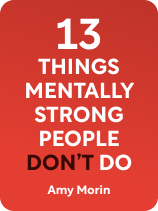
13 Things Mentally Strong People Don't Do
Amy Morin
1-Page Summary1-Page Book Summary of 13 Things Mentally Strong People Don't Do
In 13 Things Mentally Strong People Don’t Do (2017), psychotherapist Amy Morin explores how you can increase your mental strength by avoiding certain behaviors, thought patterns, and habits. She writes that most advice on achieving success focuses on habits you should adopt, but it’s equally important to recognize habits you should avoid—people often sabotage their efforts to improve their lives by continuing to indulge in bad habits even while they adopt good...
Want to learn the ideas in 13 Things Mentally Strong People Don't Do better than ever?
Unlock the full book summary of 13 Things Mentally Strong People Don't Do by signing up for Shortform.
Shortform summaries help you learn 10x better by:
- Being 100% clear and logical: you learn complicated ideas, explained simply
- Adding original insights and analysis, expanding on the book
- Interactive exercises: apply the book's ideas to your own life with our educators' guidance.
Here's a preview of the rest of Shortform's 13 Things Mentally Strong People Don't Do summary:
13 Things Mentally Strong People Don't Do Summary What Is Mental Strength?
Morin describes mental strength as the ability to manage your emotions, thoughts, and behaviors through difficult circumstances. This doesn’t mean powering through difficulties by acting tough, forcing yourself to feel happy, or ignoring your negative emotions. Instead, it means making grounded decisions based on realistic expectations. This can empower you to better manage stress, recover from setbacks, excel in your job, and have healthy relationships—all in all, to reach your full potential.
Mental strength is influenced by a combination of genetics, life experiences, and personality, and Morin notes that it comes more naturally to some people than to others. However, she writes that even if it doesn’t come easily to you, you can increase it—mental strength can be boosted through purposeful, knowledgeable effort.
(Shortform note: Psychologists agree that being mentally strong isn’t about always feeling happy, but instead, having emotional resilience....
Try Shortform for free
Read full summary of 13 Things Mentally Strong People Don't Do
13 Things Mentally Strong People Don't Do Summary How to Think About Mistakes, Failures, and Risk
Much of Morin’s advice is aimed at increasing your resilience in the face of setbacks and struggles. Specifically, she writes that you can increase your mental strength if you:
- Avoid self-pity.
- Don’t fixate on past mistakes.
- Stop repeating the same errors.
- Don’t get derailed by early failures.
- Don’t expect instant success.
Avoid Self-Pity
Morin writes that it’s natural to feel sad about hardships, but if you tell yourself that life has been particularly unfair to you or that your problems are bigger than other people’s, you might start feeling your situation is out of your control, which can demotivate you. When people feel they have little control and that life has been terrible to them, they stop putting effort into their goals. This can trap them in a cycle where they stop making progress, which leads to more self-pity, which further demotivates them and hampers their progress, leading again to more self-pity.
(Shortform note: Some psychologists regard this negative cycle as one of the hardest to extricate yourself from, noting that it often develops during...
What Our Readers Say
This is the best summary of How to Win Friends and Influence People I've ever read. The way you explained the ideas and connected them to other books was amazing.
13 Things Mentally Strong People Don't Do Summary How to Interact With Other People
After explaining how mentally strong people handle failure and risk, Morin addresses how to think and feel about other people in a healthy way. Overall, she encourages you to have a realistic view of the world and your place in it. Specifically, she advises:
- Don’t feel entitled.
- Don’t let jealousy of others’ success consume you.
- Don’t obsess over what you can’t control.
- Don’t try to please everyone.
- Don’t give others power over you.
- Don’t avoid solitude and silence.
Don’t Feel Entitled
Morin writes that it’s common for a person to feel they’re entitled to more rewards than others around them. However, this is an unrealistic, harmful belief, because when we feel we’re owed something, we’re less likely to work hard, we demand unrealistic things from others, and we can end up consumed by bitterness and feelings of victimhood.
This mindset usually springs from either a sense of superiority (where a person feels they’re destined for success and are more valuable than others) or from a sense of injustice (where they feel they’re owed something because of hardships they’ve endured). It’s also cultured by our modern society: Advertisers tell people they...
Try Shortform for free
Read full summary of 13 Things Mentally Strong People Don't Do
Shortform Exercise: Break the Cycle of Repeated Mistakes
Morin explains that mentally strong people neither ignore their mistakes nor dwell on them. Instead, they analyze their errors, identify patterns, and create plans to avoid repeating them. In this exercise, reflect on a recurring mistake and how you can interrupt that cycle.
Think of a mistake you’ve made more than once—this could be a habit, decision pattern, or reaction you tend to repeat. Describe the situation and what typically happens.
Why people love using Shortform
"I LOVE Shortform as these are the BEST summaries I’ve ever seen...and I’ve looked at lots of similar sites. The 1-page summary and then the longer, complete version are so useful. I read Shortform nearly every day."
 Jerry McPhee


