

#2586 - Jocko Willink
In this episode of The Joe Rogan Experience, Jocko Willink and Joe Rogan examine government spending failures across multiple sectors, from homelessness programs and healthcare to infrastructure projects and international aid. They discuss how public funds often fail to address intended problems due to misaligned incentives and corruption, with Willink and Rogan providing specific examples from California and beyond.
The conversation shifts to political polarization and electoral integrity, exploring how America swings between extremes rather than finding moderate solutions. Willink and Rogan also discuss jiu-jitsu's role in personal development and self-defense, American values centered on freedom and capitalism, and the transformation of modern warfare through drone technology. Throughout the episode, they address how entrenched interests resist reform and how regulatory frameworks can either support or hinder innovation and accountability.
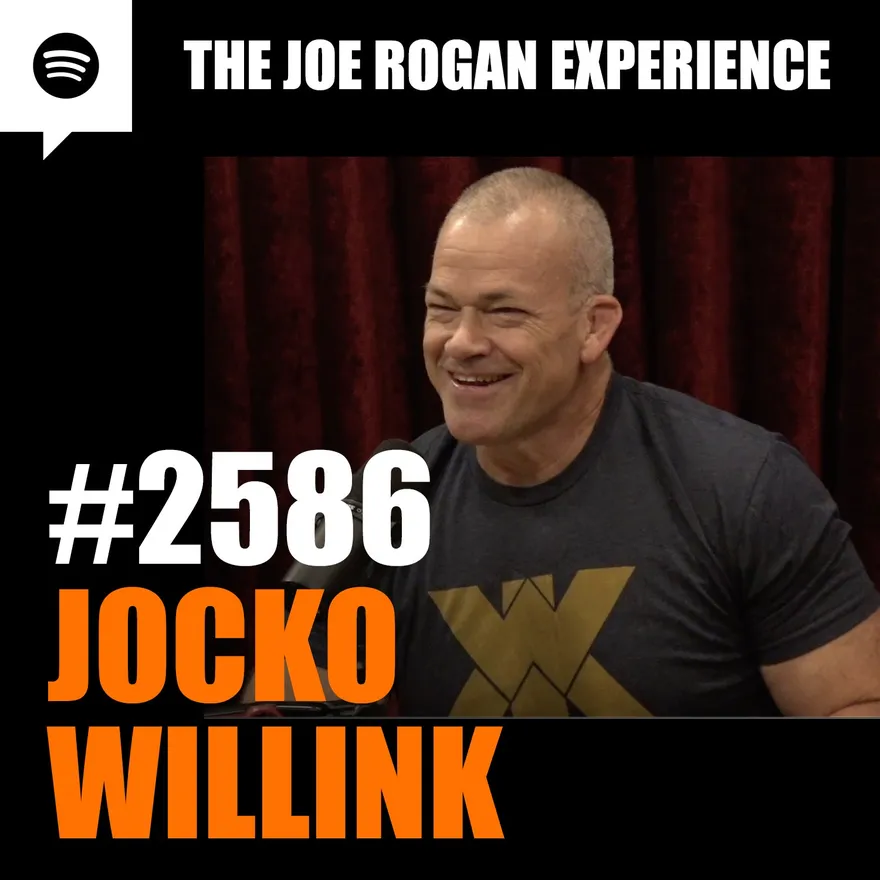

This is a preview of the Shortform summary of the Nov 25, 2026 episode of the The Joe Rogan Experience
Sign up for Shortform to access the whole episode summary along with additional materials like counterarguments and context.
1-Page Summary
Corruption and Waste in Government Spending
Jocko Willink and Joe Rogan discuss widespread fraud and mismanagement across government spending, from homelessness programs to healthcare, international aid, and infrastructure projects. Their conversation reveals how public funds routinely fail to address intended problems and sometimes worsen them through corruption and misaligned incentives.
Homeless Services Funds Prioritize Administration Over Solutions
California's homeless crisis exemplifies this misuse. Despite spending $24 billion over five to six years, the state's homeless population increased by 15%. Rogan notes that over 100 organizations received funding, which was then used primarily for employee wages—some exceeding half a million dollars annually—rather than direct services. Governor Newsom has repeatedly vetoed audit requests, with public reporting not scheduled until 2027. Rogan argues an entire "homeless industrial complex" has developed where organizations profit from perpetuating the problem rather than solving it. Willink adds historical context: deinstitutionalization reduced mental health care beds from 500 to just 17 per 100,000 people, leaving those with serious mental illness without adequate facilities.
Healthcare and International Aid Fraud
Willink details rampant healthcare fraud, particularly fake hospice facilities that bill for non-existent patients through empty addresses and shell organizations. Rogan notes the fraud is so extensive that even Elon Musk expressed concern for his safety if he fully exposed it. Rogan also critiques USAID, claiming much of its funding supports regime change operations rather than genuine humanitarian aid.
Failed Infrastructure Projects
California's high-speed rail has consumed billions over decades yet doesn't reach Los Angeles, requiring bus transfers for the final leg. The hosts note that environmental compliance activities, while important, have contributed to massive cost inflation—with millions spent counting species—making public works projects unsustainable.
Political Polarization and Electoral Integrity
Willink and Rogan explore how America oscillates between political extremes rather than seeking moderate solutions. Willink describes this as a "pendulum effect" where voters rush to the perceived opposition when disappointed, without recognizing that extremes like communism and fascism share similarities. He warns of an "event horizon" where the pendulum swings too far for recovery.
Rogan points out that voter frustration drives electoral outcomes more than ideology. In Texas, Republicans have voted blue over issues like cannabis prohibition and prolonged foreign wars—motivated by broken promises rather than partisan allegiance. In California, both express skepticism about election integrity, noting suspicious mail-in ballot patterns that coincide with unpopular tax increases. They argue that reformers struggle to win because entrenched interests actively "box out" or "villainize" those threatening the status quo.
The hosts also discuss threats to press freedom, particularly the "Stop Nick Shirley Act," which shields government actors from undercover investigative journalism. Willink calls this a direct attack on accountability, while Rogan notes that journalists like Shirley are painted as extremists rather than celebrated for exposing fraud.
Jiu-jitsu and Personal Development
Willink and Rogan emphasize jiu-jitsu's profound impact on personal growth and self-defense. Willink asserts it's the top activity for kids, building confidence, problem-solving skills, and resilience. Childhood training develops neural pathways for strategic thinking that transfer to life challenges, while normalizing discomfort and high-pressure situations.
Willink describes jiu-jitsu as "magic" because it empowers smaller individuals through technique and leverage rather than raw strength, particularly helping women survive encounters with larger attackers. The UFC's rise has dramatically accelerated knowledge sharing—Willink notes that techniques like inverted heel hooks, once advanced, are now taught to beginners. Rogan observes that today's novice fighters possess skills equivalent to world champions from 10-15 years ago.
For self-defense, both strongly advocate jiu-jitsu over striking arts. Rogan points out that striking depends heavily on bone structure and muscle mass, making it unreliable for smaller individuals. Jiu-jitsu's tap-out mechanism allows daily intense training without brain damage, unlike striking sports. Once physical contact occurs, grappling control becomes decisive, making jiu-jitsu the most dependable martial art for real confrontations.
American Values: Freedom and Capitalism
Rogan stresses that America's strength lies in individual freedom and meritocracy—the ability to achieve success through hard work regardless of background. He contrasts this with countries where rigid class structures stifle mobility, celebrating the American narrative of people rising from poverty through grit and ingenuity. However, he voices concern that some young people, influenced by radical professors, now vilify wealth as theft rather than studying it as evidence the system works.
Both hosts warn that excessive regulation, particularly in California, discourages entrepreneurship and drives away innovators. Willink contends that alternatives to capitalism—communism and fascism—ultimately rely on force and control, with both systems wanting total control and suppression of dissent. Rogan argues these systems are utopian in theory but necessarily rely on coercion.
Willink cites SpaceX as proof that market competition drives innovation government programs cannot match, while Rogan points to cannabis policy as an example of ideology trumping evidence—despite generating over $8.4 billion in California tax revenue since 2018, prohibition continues due to lobbying, particularly from the alcohol industry. He notes U.S. alcohol consumption has dropped 18% as cannabis and GLP-1 drugs gain popularity, yet entrenched interests resist change through legislative influence instead of adaptation.
Military Strategy: Drones and Modern Warfare
Willink describes drone footage from Ukraine as a shocking window into how warfare has fundamentally changed, creating "a totally different world." Rogan notes that weaponized high-speed racing drones with explosive payloads are the next escalation, while Willink foresees imminent "drone versus drone" combat. Jamie Vernon introduces quantum communications technology that promises unbreakable encryption for drone control, eliminating electronic warfare vulnerabilities. Willink approves of drone warfare when it lowers soldier casualties, though he stresses the danger of projecting American assumptions onto other societies.
He recalls how Vietnam War strategists expected a 10-to-1 casualty ratio would force surrender, but adversaries valued outcomes differently—leading to catastrophic miscalculation. Willink extends this warning to Iran, questioning who constitutes the enemy and cautioning against assuming Iran's response will fit American expectations. He compares current strategies toward Iran to medieval siege warfare—isolating economically and assuming a breaking point—yet history shows societies often demonstrate greater resilience than planners expect. The hosts conclude that drone footage from conflicts like Ukraine accelerates tactical learning and innovation globally.
1-Page Summary
Additional Materials
Counterarguments
- While government spending inefficiencies exist, many programs have demonstrated measurable positive outcomes, and broad claims of "widespread fraud and corruption" may overlook successful initiatives and necessary administrative costs.
- The increase in California's homeless population is influenced by multiple factors, including rising housing costs and migration, not solely the effectiveness of state spending.
- Administrative costs and competitive salaries can be necessary to attract qualified professionals to manage complex social programs; high wages do not inherently indicate corruption or profiteering.
- Audit delays and reporting schedules may be due to bureaucratic processes or the complexity of large-scale programs, not necessarily intentional efforts to obscure accountability.
- Deinstitutionalization was partly driven by civil rights concerns and the development of community-based mental health care, which, while imperfect, aimed to improve patient autonomy and quality of life.
- While healthcare fraud exists, the majority of healthcare providers operate ethically, and robust anti-fraud measures are in place and continually evolving.
- USAID funds a wide range of humanitarian and development projects globally, with many independent evaluations showing positive impacts on health, education, and infrastructure in recipient countries.
- Environmental compliance in infrastructure projects, though costly, is essential for protecting ecosystems and public health, and can prevent more expensive long-term environmental damage.
- The "pendulum effect" in politics can also be seen as a sign of a functioning democracy where voters have the power to demand change and hold leaders accountable.
- Claims of widespread election fraud or questionable integrity in California have not been substantiated by credible evidence or independent audits.
- Legislation regulating undercover journalism is often intended to protect privacy and prevent unethical practices, not solely to shield government actors from accountability.
- Jiu-jitsu is highly effective for self-defense, but other martial arts and self-defense systems also offer valuable skills and benefits, depending on context and individual needs.
- The narrative that American meritocracy guarantees success for all overlooks persistent structural inequalities related to race, class, and geography.
- Regulation can protect consumers, workers, and the environment, and some innovators and businesses thrive in highly regulated environments.
- While market competition drives innovation, government programs have also produced major technological advances (e.g., the internet, GPS, vaccines).
- Cannabis legalization and regulation are complex policy issues involving public health, safety, and federal law, not solely the result of lobbying by entrenched interests.
- Drone warfare introduces new ethical and strategic challenges, including civilian harm and escalation risks, and does not eliminate the human costs of conflict.
Actionables
- you can track and compare local government spending on public projects or social programs by creating a simple spreadsheet that lists budgets, stated goals, and visible outcomes, then share your findings with neighbors to encourage informed conversations about accountability and effectiveness
- (for example, note how much your city allocates to homelessness or infrastructure each year, look for public reports or news on results, and discuss discrepancies or successes with others in your community)
- a practical way to spot and avoid supporting organizations that may misuse funds is to check for transparency in their financial reports and prioritize donating to groups that clearly show how much goes directly to services versus administrative costs
- (for example, before donating, look for organizations that publish detailed breakdowns of spending, and choose those where a high percentage of funds reach the intended beneficiaries)
- you can strengthen your own resilience to political swings and misinformation by keeping a personal journal where you record your reasons for supporting specific policies or candidates, then revisit your entries after elections to see if outcomes matched your expectations and values
- (for example, write down what you hope a new law or leader will achieve, then check back in six months to reflect on whether those hopes were realized, helping you make more consistent and thoughtful choices in the future)
Get access to the context and additional materials
Corruption and Waste: Homelessness Spending, Medicaid Fraud, Usaid Misuse, Failed Programs
Jocko Willink and Joe Rogan highlight widespread fraud, waste, and abuse in government spending, focusing on homelessness, healthcare, international aid, and major infrastructure projects. Their discussion reveals how public funds often fail to address the intended problems, and sometimes even worsen them, due to corruption, lack of oversight, and misaligned incentives.
Homeless Services Funds Prioritize Administration Over Solutions
California Spent $24 Billion On Homelessness, but the Population Increased By 15%; Funds Diverted To Nonprofits and Admin Costs
California’s continuing homeless crisis exemplifies the misuse of public funds. Despite spending $24 billion over five to six years to tackle homelessness, the state’s homeless population actually increased by 15%. Willink and Rogan are incredulous at the lack of results, with Willink pointing out the American revolutionary response to far less egregious government spending in history.
A substantial share of this money is funneled not to those experiencing homelessness, but to nonprofits, NGOs, and administrative staff. Rogan recounts how over 100 different organizations received funding, which was then used primarily for employee wages and unrelated causes rather than direct services to the homeless. He remarks that people working on homelessness issues in Los Angeles are making salaries in excess of half a million dollars, yet the crisis only grows.
Government Rejects Audit of Homeless Spending, Suggesting Opacity in Taxpayer Fund Use and Beneficiaries
Repeated calls for audits of California’s homeless spending have been vetoed by Governor Gavin Newsom, raising serious questions about transparency. Rogan points out that politicians have requested an investigation to track where the money went, but have been denied. The planned public reporting requirement only takes effect in June 2027, further delaying accountability. Both hosts believe if an audit took place, it would reveal a pattern of funds being siphoned off for purposes unrelated to solving homelessness.
Accountability Lacking, Organizations Profit By Opposing Homelessness Solutions
Rogan asserts that an industry has developed where organizations working on homelessness are incentivized to keep the problem alive. The so-called “homeless industrial complex” thrives on perpetual funding; as homelessness rises, so does the money allocated to fight it, but little of the spending results in tangible improvement. Rogan notes that if the private sector were incentivized to actually reduce homelessness, the approach would be very different.
Deinstitutionalization Cut Mental Health Beds From 500 to 17 per 100,000, Leaving No Help For Homeless With Serious Mental Illness
Willink provides historical context, noting that deinstitutionalization policies reduced mental health care beds from about 500 to just 17 per 100,000 people. As a result, individuals with serious mental illnesses are left without adequate care or facilities, often cycling between the streets and jails, which fail to provide the help they need. Both Willink and Rogan argue that a focus on mental health infrastructure could be a far more effective use of funds than the current, largely administrative response.
Billions Stolen In Medicaid and Healthcare Fraud Through Fake Facilities, Shell Organizations, and Unpunished Schemes
Fraudsters Exploit Healthcare Programs By Creating Fake Hospice Facilities and Billing Addresses to Generate Revenue Without Providing Services or Care
Willink details rampant fraud in the healthcare sector, particularly in California, where fake hospice facilities report dozens of fictitious patients and funnel federal money through empty addresses and shell organizations. Rogan adds that scammers establish entire motels as “offices,” receiving payouts for non-existent services.
Massive Medicaid Fraud Scale: Elon Musk Fears Retaliation For Exposing Powerful Interests' Intimidation
Medicaid fraud is so extensive that, according to Rogan, even Elon Musk expressed concern for his safety if he were to fully expose it. The sums involved are enormous, and powerful interests are vested in covering up these schemes, stymieing efforts at reform or punishment.
Federal Agencies Like Usaid Mainly Serve Regime Change Operations and Fund Politically Aligned Groups Rather Than Genuine Development
Rogan critiques USAID, claiming that instead of providing genuine humanitarian aid, much of its funding is used for regime change operations and supporting groups aligned with U.S. interests abroad. He points to election outcomes in Latin America befo ...
Here’s what you’ll find in our full summary
Corruption and Waste: Homelessness Spending, Medicaid Fraud, Usaid Misuse, Failed Programs
Additional Materials
Counterarguments
- While California’s homeless population increased despite large spending, multiple factors outside government control—such as rising housing costs, economic inequality, and the COVID-19 pandemic—have contributed to homelessness, making it difficult to attribute outcomes solely to program inefficiency or corruption.
- Administrative costs and nonprofit involvement are common in large-scale social programs, as coordination, case management, and compliance require significant resources; some administrative spending is necessary for effective service delivery.
- High salaries in nonprofit or public sector organizations can reflect the need to attract experienced professionals in competitive urban labor markets, rather than being inherently wasteful.
- The lack of audits or delayed transparency does not automatically prove corruption or misuse; bureaucratic delays and political disagreements can also slow oversight processes.
- The assertion that organizations are incentivized to perpetuate homelessness is debated; many nonprofits and service providers are mission-driven and work toward measurable outcomes, with some programs demonstrating localized success.
- Deinstitutionalization was partly driven by civil rights concerns and the desire to avoid warehousing people with mental illness; the reduction in mental health beds is a complex issue involving legal, ethical, and funding considerations.
- Investment in mental health infrastructure is widely supported, but building and operating such facilities also requires significant administrative and ongoing operational spending.
- Medicaid and healthcare fraud are serious issues, but the majority of healthcare providers and facilities operate legally and pro ...
Actionables
- you can track and compare the budgets and outcomes of local public projects by creating a simple spreadsheet, noting how much is spent versus what is actually delivered, to spot patterns of inefficiency or waste in your community
- By keeping tabs on things like new parks, road repairs, or housing initiatives, you’ll start to see if money is being used effectively or if projects stall or balloon in cost without results. This helps you make informed decisions when voting or giving feedback to local officials.
- a practical way to encourage transparency is to regularly request public records or audit reports from your city or county government using online forms or email, then share any findings with neighbors or on local forums
- You don’t need legal expertise—just ask for spending breakdowns or audit results for programs that interest you. Sharing what you learn can spark local conversations and put pressure on officials to be more accountable.
- you can support or volunteer with organizati ...
Get access to the context and additional materials
Political Polarization, Extremism, and Electoral Integrity in America
Joe Rogan and Jocko Willink discuss how America is caught in cycles of political extremism, voter frustration, and threats to electoral and journalistic integrity.
Americans Swing Between Extremes, Not Moderate, Liberty-Preserving Solutions
Willink compares America to a massive ship, difficult to steer or change course, but subject to constant, incremental shifts. He notes the ‘pendulum effect’—Americans as a whole oscillate from one political extreme to another, rarely arriving at moderate, liberty-preserving solutions. Rogan expands, saying that as soon as one party disappoints or fails, voters rush to the perceived opposition, believing a radical shift will fix their dissatisfaction. Willink underscores this with the idea that extremes are an easy mental shortcut: if you dislike the far right, the simplest response isn’t to analyze, but to leap all the way left—and vice versa.
Willink observes that Americans often overreact to groups they dislike, rushing to the ideological opposite without recognizing that communism and fascism actually have much in common—instead of seeking centrist, pragmatic politics, people gravitate toward polarized identity. The effect, Willink says, is a series of reactionary swings that hinder stable governance. He warns that a point could come—an event horizon—where the pendulum swings too far for recovery.
Rogan describes how university-educated youth especially associate the American flag and capitalism with oppression. These young people are “being told all these wacky things in school,” such as the need for equity and that personal wealth acquisition is inherently exploitative. When society doesn’t align with their academic worldview, Rogan contends, some react by seeking to “burn it all down,” favoring guaranteed outcomes over market competition.
Voter Frustration With Broken Promises Drives Electoral Outcomes, Not Ideology
Rogan points out that recent Texas elections defy common partisan expectations, as many Republicans have rejected their own party, voting blue out of frustration with issues like cannabis prohibition, prolonged foreign military intervention, and politicians’ failure to deliver on promises to reduce government size. This widespread sense of betrayal—over issues like war policies, transparency on high-profile criminal cases, and government inaction—leads voters to shift allegiances, not due to ideology, but simple disillusionment.
Rogan notes that, in Texas, voters are “sick of this bullshit with THC, sick of the war, sick of the Epstein files not being released,” resulting in many Republican voters backing Democrats. This shift is driven by broken promises, not left or right allegiance. He gives the example of a competent, rational, pro-business candidate being appealing not for ideology but because of her practical approach—yet even such candidates face an uphill battle in a deeply entrenched partisan landscape.
In California, Willink and Rogan raise concerns about electoral integrity. They note that Democratic wins, particularly in Los Angeles races, were propelled by what they describe as “suspicious” mail-in ballot patterns. They observe cases where a flood of mail-in ballots appeared “disproportionate” to earlier voting patterns, all favoring a single candidate and even coinciding with approval for unpopular tax increases. Willink calls this “total insanity,” and both express skepticism about the legitimacy and transparency of such election results.
Both men argue that politicians proposing sensible reforms—measures to reduce waste, fraud, or the overall scope of government—strug ...
Here’s what you’ll find in our full summary
Political Polarization, Extremism, and Electoral Integrity in America
Additional Materials
Clarifications
- The “pendulum effect” in American politics refers to the tendency of voters to swing between opposing political extremes over time. This happens because dissatisfaction with one party or ideology leads people to support the opposite side in hopes of change. It reflects a cyclical pattern rather than steady, moderate progress. The effect can cause instability and hinder long-term policy solutions.
- Communism and fascism are both authoritarian ideologies that reject liberal democracy and emphasize strong centralized control. They often use propaganda, suppress dissent, and prioritize the state or collective over individual freedoms. Both systems can involve state control of the economy, though communism aims for classless equality while fascism enforces strict social hierarchies. Despite opposing rhetoric, their methods of maintaining power and limiting personal liberty show notable similarities.
- Academic teachings about equity often emphasize fairness by addressing systemic inequalities rather than treating everyone identically. Critics argue that focusing on equity can prioritize group outcomes over individual merit or effort. Some academic perspectives view wealth acquisition as linked to structural advantages, suggesting it can perpetuate social and economic disparities. These ideas challenge traditional views that wealth solely reflects personal success or hard work.
- THC stands for tetrahydrocannabinol, the main psychoactive compound in cannabis. In Texas, cannabis remains largely illegal, making its prohibition a contentious political issue. Voters frustrated with strict drug laws may cross party lines to support candidates favoring cannabis reform. This issue influences electoral outcomes beyond traditional partisan divides.
- The "Epstein files" refer to documents and evidence related to Jeffrey Epstein, a financier accused of sex trafficking involving powerful individuals. Many believe that full disclosure of these files could expose corruption and criminal networks. Voter frustration arises because authorities have been slow or unwilling to release this information, fueling distrust in government transparency. This perceived cover-up contributes to disillusionment with political leaders.
- Glenn Greenwald is a well-known investigative journalist famous for exposing government surveillance and corruption. Comparing Nick Shirley to Greenwald suggests Shirley also uncovers important truths despite facing government opposition. This matters because it highlights the role of independent journalists in holding power accountable. It emphasizes the importance of protecting press freedom against efforts to silence dissent.
- “Suspicious” mail-in ballot patterns refer to unusual voting trends, such as a sudden surge in mail-in votes favoring one candidate disproportionately compared to earlier in-person voting. These patterns raise concerns because they may indicate potential fraud, ballot tampering, or administrative errors. El ...
Counterarguments
- The characterization of American political behavior as a constant swing between extremes may overlook the significant portion of the electorate that consistently supports moderate or centrist candidates and policies, as evidenced by polling data and the existence of bipartisan initiatives.
- The assertion that voters primarily react to disappointment by shifting to the opposite extreme does not account for the large number of independent and swing voters who often seek pragmatic solutions or split their tickets.
- While some university-educated youth critique capitalism and national symbols, surveys show that many young Americans still value democratic institutions and market economies, albeit with calls for reform rather than outright rejection.
- The claim that communism and fascism share significant similarities is contested by most historians and political scientists, who emphasize their distinct ideological foundations and historical antagonism.
- Concerns about mail-in ballot patterns in California have not been substantiated by credible evidence of widespread fraud, and multiple audits and court cases have upheld the integrity of recent elections.
- The idea that reformers are universally "boxed out" or villainized does not account for successful reform-minded politicians at local, state, and federal levels who have enacted significant changes.
- Legislation regulating unde ...
Get access to the context and additional materials
Martial Arts, Jiu-jitsu, and Discipline for Personal Development and Resilience
Jocko Willink and Joe Rogan discuss the profound impact of jiu-jitsu and martial arts, emphasizing personal growth, resilience, and their superiority as self-defense systems. They focus on how jiu-jitsu creates confidence and adaptable problem-solvers from a young age, how its knowledge base has evolved dramatically due to UFC exposure, and why grappling surpasses striking for most real-world and self-defense applications.
Jiu-jitsu: Personal Growth Through Confidence, Problem-Solving, and Resilience
Willink asserts that jiu-jitsu is the number one activity for kids, providing benefits including making friends, gaining physical strength and flexibility, and building confidence. Training instills problem-solving skills and resilience, ensuring that when a child practices jiu-jitsu, all aspects of life improve.
Childhood Jiu-jitsu Training Develops Neural Pathways For Problem-Solving, Strategy, and Adaptability Transferable to Life Challenges
Both agree that early exposure deeply ingrains problem-solving, strategic thinking, and adaptability. Joe Rogan emphasizes that the repetition ingrains responses to stress; after thousands of repetitions, actions like defending an attack become automatic, allowing these problem-solving neural pathways to transfer into everyday resilience.
Teaches Embracing Discomfort As Normal, Reshaping Adversity in Careers and Relationships
Rogan explains that the intensity and discomfort of jiu-jitsu create a new baseline for stress and adversity, making regular life obstacles seem minor in comparison. Grappling with high-pressure situations regularly makes difficulty, discomfort, and pain seem routine, allowing practitioners to handle life’s challenges with greater composure.
Jiu-jitsu Empowers Smaller Individuals By Leveling Physical Disparities
Willink describes jiu-jitsu as “magic,” because it can empower smaller or physically weaker individuals. Through technique and leverage, a smaller, skilled practitioner can control or neutralize a much larger, untrained person, something he reinforces by discussing a legendary small SEAL who was formidable in grappling. He notes jiu-jitsu’s particular power in helping women survive or escape from larger attackers, emphasizing that while victory over a much larger or elite wrestler is rare, the skills greatly improve survival odds and buying time for help.
Controlled High-Stress Training Normalizes Pressure and Prevents Panic
Practicing under safe, high-pressure conditions (like sparring with friends) normalizes the feeling of being under attack. This training prevents panic if someone is grabbed in a real-world situation, as practitioners instantly recognize the scenario and begin to execute their responses automatically.
Jiu-jitsu Knowledge Spread by UFC Boosts Modern Martial Artists' Baseline Skills
The explosion of UFC and MMA has raised the collective standard of martial artists worldwide. Joe Rogan observes that today’s novice fighters, even in developmental leagues like the Dana White Contender Series, possess skills equivalent to world champions from 10–15 years prior.
Modern Jiu-jitsu Students Learn Inverted Heel Hooks Early; 1990s Focused On Basics For Months Due to Proprietary Knowledge
Willink remarks on the rapid evolution: where practitioners once spent months mastering a single technique, now beginners may be learning advanced techniques like inverted heel hooks within their first weeks. This change is attributed to the open sharing and teaching of techniques, contrasting to the early era where knowledge was guarded and progress slower.
Sport's Evolution Accelerates as Elite Athletes Share Innovations, Raising Standards So Novices now Possess World-Class Skills Of Twenty Years Ago
Rogan and Willink agree that elite MMA fighters and grapplers now freely share innovations. This transparency accelerates technical advancement, creating a new baseline where even average practitioners are technically proficient at what was once considered advanced.
Wrestlers and Judokas Exhibit Superhuman Strength as Technique Amplifies Force, Making Control Nearly Impossible Without Specialized Training
They note that accomplished wrestlers and judokas feel superhuman when grappling. Their combination of strength and refined technique makes them massively effective, often feeling impossibly strong even when matched with similarly sized opponents. This disproportionate strength is a product of relentless training, amplifying technique and physical attributes.
Jiu-jitsu Provides Superior ...
Here’s what you’ll find in our full summary
Martial Arts, Jiu-jitsu, and Discipline for Personal Development and Resilience
Additional Materials
Counterarguments
- While jiu-jitsu offers many benefits, other martial arts and sports (such as judo, wrestling, boxing, or team sports) can also foster confidence, discipline, and resilience in children and adults.
- Not all individuals enjoy or thrive in grappling-based environments; some may find striking arts or non-combat sports more engaging or suitable for their personalities and goals.
- The claim that jiu-jitsu is the "number one activity for kids" is subjective and may not account for individual preferences, physical abilities, or access to quality instruction.
- The effectiveness of jiu-jitsu for self-defense can be limited in situations involving multiple attackers, weapons, or environments where grappling is impractical (e.g., confined spaces, hard surfaces).
- While jiu-jitsu can empower smaller individuals, significant size and strength disparities may still present challenges, especially against highly aggressive or trained opponents.
- The assertion that striking arts are unreliable for smaller individuals overlooks the effectiveness of certain striking techniques (e.g., targeting vulnerable areas) and the success of smaller strikers in self-defense scenarios.
- Some critics argue that sport-oriented jiu-jitsu may not always translate directly to real-world self-defense due to rules, attire, or lack of emphasis on striking and situational awareness.
- The risk of injury in jiu-jitsu, while generally lower than in striking arts, is not negligi ...
Actionables
- you can create a personal resilience log by noting daily situations where you feel discomfort or stress, then briefly jot down how you responded and what you learned, helping you track your adaptability and stress management over time just like you would track progress in a physical discipline.
- a practical way to build strategic thinking and problem-solving skills is to set aside five minutes each day to mentally rehearse handling unexpected challenges (like a difficult conversation or a sudden schedule change), focusing on calmly identifying options and choosing the best response, mirroring the adaptability developed in high-pressure training.
- you can empower yourself physi ...
Get access to the context and additional materials
American Values: Freedom, Capitalism, Meritocracy vs. Overreach
Joe Rogan and Jocko Willink argue that the core strengths of America are rooted in individual freedom, the celebration of meritocracy, and the opportunities provided by capitalism. They warn, however, against overregulation and government overreach, and point to the repeated failures and unintended consequences of heavy-handed alternatives.
American Strength: Freedom for Individual Ambition and Success
Rogan stresses that the American flag truly represents the collective American people and the unique experiment in self-government. It stands for equality of opportunity, where individual effort, hard work, and discipline can yield success regardless of background. He highlights the celebrated American narrative: people starting from destitute circumstances and, through grit and ingenuity, achieving remarkable success and giving back to their communities. Rogan contrasts this with countries where rigid class structures and caste systems stifle such mobility, noting that America offers options—whether building businesses, working with one’s hands, or joining the military—that are not innately present in every culture.
Willink agrees, emphasizing that granting people the freedom to pursue their ambitions is inherent in American culture. He warns against losing the national “fire of individual freedom,” arguing it is key to the nation’s ongoing success.
Rogan also voices concern that some young people, influenced by radical professors, now vilify wealth and success, equating it with theft or exploitation. He pushes back by stating that true achievement is evidence the system and personal effort work and should be studied, not disparaged.
At the same time, both hosts caution that excessive regulations and growing bureaucracy—particularly in states like California—discourage entrepreneurship and drive people, along with businesses, away. When government jobs and regulations expand without justification, innovators leave for friendlier environments, leading to stagnation and economic decline.
Alternative to Capitalism: Government Systems Requiring Force to Function
Willink and Rogan discuss how alternatives to capitalism, such as communism and fascism, ultimately hinge on control and coercion. Willink contends communism and fascism are similar in their practical effect: both want total control, high taxation, and suppression of dissent, making the ideological distinction almost meaningless.
Rogan critiques these systems as utopian in theory but necessarily reliant on force for implementation. The redistribution of wealth or seizure of the means of production, in his view, always comes down to some group imposing power with force, often under the guise of creating equality. He argues that such systems commonly end in tyranny, as self-interest persists and only coercion can compel compliance.
Furthermore, the hosts warn that expansive regulatory systems attract corrupt individuals who exploit their positions for personal gain rather than public benefit.
Government Failures Show why Bureaucracy Can't Deliver Services Markets Handle Naturally
Willink gives the example of SpaceX, which reduced launch costs to a tenth of traditional competitors—not by government fiat, but by embracing market competition and the profit motive. He asserts such innovation and efficiency are impossible within government programs stifled by bure ...
Here’s what you’ll find in our full summary
American Values: Freedom, Capitalism, Meritocracy vs. Overreach
Additional Materials
Clarifications
- Joe Rogan is a comedian, podcast host, and commentator known for discussing culture, politics, and personal development. Jocko Willink is a retired Navy SEAL officer, author, and leadership consultant focused on discipline and personal responsibility. Both have large followings and influence public opinion through their media platforms. Their perspectives often emphasize individualism, discipline, and skepticism of government overreach.
- Meritocracy is a social system where individuals advance based on their abilities, effort, and achievements rather than on wealth, family background, or social class. It aims to reward talent and hard work, promoting fairness and efficiency by placing the most capable people in positions of responsibility. Critics argue it can overlook structural inequalities that affect opportunities and may reinforce existing advantages. In practice, meritocracy influences education, employment, and leadership selection processes.
- Government overreach refers to situations where government actions exceed the limits of its legal or constitutional authority. It often involves excessive regulation, intrusion into personal freedoms, or unnecessary expansion of bureaucracy. Such overreach can stifle innovation, limit individual rights, and create inefficiencies. Critics argue it undermines the balance between government power and individual liberty.
- The American flag, known as the Stars and Stripes, was adopted in 1777 during the Revolutionary War as a symbol of unity among the original colonies. It represents the nation's values of liberty, democracy, and the struggle for independence from British rule. Over time, it has become a powerful emblem of national identity, patriotism, and the ideals of freedom and equality. The flag’s design, with stars for states and stripes for colonies, reflects the country’s federal structure and historical origins.
- Rigid class structures and caste systems are social hierarchies where people's status is fixed by birth and rarely changes. These systems limit social mobility, meaning individuals cannot easily improve their economic or social position regardless of effort or talent. Examples include the caste system in India and entrenched aristocracies in some countries. Such structures often restrict access to education, jobs, and political power based on inherited status.
- Capitalism is an economic system where private individuals own property and businesses, and market forces determine production and prices. Communism is a political and economic ideology advocating for communal ownership of all property and the means of production, aiming to eliminate class distinctions. Fascism is an authoritarian system combining strong centralized control, nationalism, and suppression of opposition, often allowing private property but under strict state regulation. Unlike capitalism’s focus on individual freedom, communism and fascism prioritize state control, but fascism maintains hierarchical power and nationalism, while communism seeks a classless society.
- Communism is a political ideology advocating for a classless society where all property is publicly owned and wealth is distributed based on need. Fascism is an authoritarian nationalist ideology that emphasizes strong centralized power, often led by a dictatorial leader, and suppresses opposition. While communism seeks to eliminate class distinctions through collective ownership, fascism maintains class structures but enforces unity through state control and nationalism. Both systems reject liberal democracy and rely on coercion to maintain control.
- Wealth redistribution involves the government collecting money from richer individuals through taxes and giving it to poorer people to reduce economic inequality. Seizure of the means of production means the government or state takes control of factories, land, and businesses, rather than private owners managing them. These actions are often associated with socialist or communist systems aiming to create economic equality. Critics argue this can reduce incentives for innovation and productivity.
- Bureaucracy refers to the complex system of rules, procedures, and officials managing government programs. It often leads to slow decision-making and inflexibility due to rigid protocols. Large bureaucracies can create inefficiencies by prioritizing process over results. This can hinder innovation and responsiveness compared to private sector competition.
- SpaceX is a private aerospace company that revolutionized space travel by drastically lowering launch costs through reusable rocket technology. Traditionally, space exploration was dominated by government agencies like NASA, which operated with large budgets and bureaucratic processes. SpaceX introduced competition and innovation, proving that private companies can achieve space missions more efficiently. This shift challenges the notion that only government programs can handle complex aerospace projects.
- Cannabis was widely used in the U.S. until the early 20th century, when it became criminalized through laws like the Marihuana Tax Act of 1937. The Controlled Substances Act of 1970 classified cannabis as a Schedule I drug, making it federally illegal. Since the 1990s, many states have legalized medical cannabis, and more recently, several states have legalized recreational use. Despite state laws, cannabis remains illegal under federal law, creating legal conflicts and enforcement challenges.
- The alcohol industry often lobbies against cannabis legalization to protect its market share and profits. It funds political campaigns and influences lawmakers to maintain restrictive drug policies. This lobbying can delay or weaken reforms that would allow cannabis to compete openly. Such practices prioritize industry interests over public health or economic benefits.
- GLP-1 drugs like Ozempic mimic a natural hormone that he ...
Counterarguments
- While America offers significant opportunities for social mobility, research shows that upward mobility in the U.S. has declined in recent decades and is lower than in some other developed countries, such as Canada and several European nations.
- Meritocracy in practice can be undermined by systemic inequalities, including disparities in education, healthcare, and access to resources, which can limit the ability of individuals from disadvantaged backgrounds to succeed solely through hard work.
- Excessive deregulation can also lead to negative consequences, such as environmental degradation, financial crises, and worker exploitation, as seen in historical examples like the 2008 financial crisis and various industrial disasters.
- Government intervention has played a crucial role in major American achievements, such as the development of the internet, the interstate highway system, and the original space program (NASA), suggesting that bureaucracy and public investment can foster innovation.
- Many successful economies, such as those in Scandinavia, combine market capitalism with robust social safety nets and higher levels of regulation, achieving high standards of living, economic competitiveness, and social mobility.
- The assertion that communism and fascism are practically indistinguishable overlooks significant ideological and historical differences between the two systems.
- Not all government regulation is inherently stifling; regulations can protect consumers, workers, and the environment, and can create fairer markets by preventing monopolies and fraud.
- Corruption and self-interest can exist in both public and private sectors; market-driven s ...
Get access to the context and additional materials
Military Strategy: Drones & Conflicts (Iran, Ukraine)
Joe Rogan, Jocko Willink, and Jamie Vernon analyze the real-time transformation of military strategy in the age of drones, quantum technology, and unpredictable global conflicts, with a focus on Ukraine and Iran.
Drones Replace Manned Combat, Creating High-Speed Unmanned Warfare
Jocko Willink describes the footage from Ukraine as a shocking window into modern tactical learning, allowing viewers to observe conflicts through helmet cams and, crucially, drone feeds. He emphasizes that drones have fundamentally changed the nature of warfare, creating “a totally different world” that is “very, very horrifying” to witness.
Armed Racing Drones With Explosive Payloads: The Next Escalation in Autonomous Military Technology
Joe Rogan notes that drones in Ukraine increasingly track vehicles and combatants; while sometimes people manage to shoot down drones before impact, the escalating trend is toward Weaponized high-speed “racing drones” equipped with explosive payloads. Rogan predicts these drones will become ever faster and more precise, prompting Jocko to foresee an imminent “drone versus drone” escalation, where remote operators engage in robot warfare without seeing each other or the battlefield.
Jocko explains that while a ground presence might still be necessary to secure territory, robots could eventually fulfill those roles as well. Already, fighter jets are being paired with unmanned “wingman” craft, which will soon outperform human pilots—paralleling how self-driving Teslas now outperform many human drivers.
Quantum Tech Ensures Secure, Unbreakable Drone Encryption, Eliminating Electronic Warfare Vulnerabilities
Jamie Vernon introduces the idea of “Quantum Link” and “quantum communications,” referencing NASA’s success in sending photons between an aircraft and ground station, inaugurating tests of secure quantum communications. This technology, they note, promises unbreakable encryption, potentially revolutionizing drone control by eliminating electronic warfare vulnerabilities—control signals sent at the speed of light cannot be intercepted or jammed by conventional means.
Drone Warfare: Lower Soldier Risk, Fewer Casualties Than Traditional Combat
Willink voices his approval for robot and drone warfare when it lowers risks to soldiers: “I'm all in favor of robot warfare and drone warfare as long as it [saves lives].” Rogan speculates about wars one day becoming robot-versus-robot affairs where “no one dies anymore.” They both agree that, compared to traditional boots-on-the-ground warfare, widespread adoption of unmanned platforms could mean significantly fewer soldier casualties.
Military Unpredictability Stems From Imposing American Cultural Assumptions Onto Diverse Societies
Jocko Willink stresses the danger of projecting American ideas and assumptions about behavior and casualties onto other societies in military planning.
Vietnam War Strategy Assumed 10-to-1 Casualty Ratio Would Force Surrender, but Adversaries Accepted Losses As Their Cultural Calculus Valued Different Outcomes
He recalls how, in Vietnam, American planners believed a 10-to-1 casualty ratio would force the enemy to surrender. The U.S. expected that the other side could not sustain such losses. However, Vietnamese adversaries valued outcomes and sacrifice differently, leading to a gross miscalculation. The U.S. public was unwilling to accept losses at that scale, while the Vietnamese were.
Iran's Response to Military Strikes Defies Prediction Using American Assumptions Due to Differing Regimes and Cultural Frameworks
Jocko extends this to Iran, posing questions about who constitutes the enemy: the people, the regime, or both, and how the regime and people are culturally or politically distinct. He warns against assuming that Iran's response to attacks will fit an American playbook. The will of regimes and societies to endure hardship or casualties often defies easy prediction.
He likens making predictions about war to predicting Mixed Martial Arts fights—many more variables arise in war, including morale, logistics, and the quality of commanders. Predictin ...
Here’s what you’ll find in our full summary
Military Strategy: Drones & Conflicts (Iran, Ukraine)
Additional Materials
Clarifications
- Quantum communication uses the principles of quantum mechanics, such as entanglement and superposition, to transmit information securely. Any attempt to eavesdrop on the quantum channel disturbs the quantum states, alerting the communicating parties to the intrusion. This allows for the creation of encryption keys that are theoretically impossible to intercept or copy without detection. As a result, quantum communication can provide security levels unattainable by classical encryption methods.
- Quantum links use quantum entanglement to transmit information securely, making eavesdropping impossible without detection. Control signals sent via quantum communication travel as photons at light speed through fiber optics or air. This method prevents interception or jamming by conventional electronic warfare because any attempt to measure the quantum state alters it. Practical use requires specialized hardware to generate, transmit, and detect entangled photons over distances.
- Armed racing drones are small, agile drones designed for high speed and maneuverability, originally inspired by competitive drone racing. Unlike traditional military drones, which are larger and slower with longer flight times for surveillance or strikes, racing drones prioritize rapid movement and precision. They can carry explosive payloads, making them effective for quick, targeted attacks in close combat scenarios. Their speed and agility make them harder to detect and intercept compared to conventional drones.
- "Drone versus drone" combat refers to battles where unmanned aerial vehicles (drones) fight each other remotely, without human pilots onboard. Operators control drones using cameras and sensors on the drones, relying on digital feeds rather than direct line-of-sight. This means pilots cannot see the physical battlefield but depend entirely on real-time video and data transmitted from their drones. Such engagements require advanced communication systems and quick decision-making based on remote sensory input.
- Unmanned “wingman” drones are autonomous or remotely piloted aircraft that accompany manned fighter jets during missions. They perform tasks like scouting, electronic warfare, and engaging targets, reducing risk to human pilots. These drones extend the fighter jet’s capabilities by sharing sensor data and executing coordinated tactics. Their use allows for more flexible and safer air combat operations.
- During the Vietnam War, U.S. military strategy relied heavily on attrition, aiming to kill more enemy soldiers than the U.S. lost, believing a 10-to-1 kill ratio would break the enemy's will. This approach assumed the North Vietnamese and Viet Cong would surrender once their losses became unsustainable. However, the enemy's strong ideological commitment and different cultural values made them willing to endure high casualties. This miscalculation contributed to the prolonged conflict and U.S. difficulties in achieving victory.
- Different societies have unique historical experiences, values, and social structures that shape their willingness to endure casualties. Some cultures prioritize collective sacrifice or ideological goals over individual lives, affecting their response to losses. Military strategies based on one culture’s casualty tolerance may fail when applied to another with different priorities. Understanding these differ ...
Counterarguments
- While drones have changed aspects of warfare, many conflicts still rely heavily on traditional ground forces and manned operations, especially in environments where drones are less effective due to terrain, weather, or electronic countermeasures.
- Real-time tactical learning from drone and helmet cam footage can be limited by information overload, propaganda, or selective sharing, potentially distorting the true nature of conflicts.
- The escalation to armed racing drones with explosive payloads may be constrained by technical, logistical, and ethical challenges, as well as counter-drone technologies that are rapidly advancing.
- Drone-versus-drone combat is still in its infancy, and current military doctrine and technology may not yet support large-scale autonomous robot warfare.
- Ground presence remains essential for holding and administering territory, as robots currently lack the ability to interact with civilian populations, provide humanitarian aid, or make complex ethical decisions.
- Unmanned “wingman” drones may not universally outperform human pilots, as human judgment and adaptability remain critical in unpredictable combat scenarios.
- Quantum communication technology, while promising, is still experimental and faces significant practical and logistical hurdles before widespread military adoption.
- Claims that quantum links are unbreakable or immune to interception may be overstated, as new vulnerabilities could emerge with the technology’s development.
- The reduction in soldier casualties through drone warfare does not necessarily translate to fewer civilian casualties or less overall destruction, as remote warfare can lower the threshold for the use of force.
- The idea of wars becoming purely robot-versus-robot affairs is speculative and does not account for the political, economic, and human factors that drive conflict.
- While American planners have sometimes imposed their own cultural assumptions, military strategists increasingly study and account for local cultures and histories in operational planning.
- The Vietnam War example is complex; fac ...
Get access to the context and additional materials

 1-Page Summary
- Corruption and Waste: Homelessness Spending, Medicaid Fraud, Usaid Misuse, Failed Programs
- Political Polarization, Extremism, and Electoral Integrity in America
- Martial Arts, Jiu-jitsu, and Discipline for Personal Development and Resilience
- American Values: Freedom, Capitalism, Meritocracy vs. Overreach
- Military Strategy: Drones & Conflicts (Iran, Ukraine)
Create Summaries for anything on the web
Download the Shortform Chrome extension for your browser
