

#2532 - Tim Robbins
In this episode of The Joe Rogan Experience, actor and activist Tim Robbins and Joe Rogan discuss how technology and algorithms have transformed culture, entertainment, and public discourse. They explore the decline of curated cultural spaces like video stores, the economic pressures facing character-driven films in Hollywood, and the rise of long-form storytelling through streaming platforms. The conversation also addresses AI's implications for creativity and the inadequacy of industry protections for human artists.
Robbins shares his experiences facing backlash for opposing the Iraq War and draws parallels to contemporary suppression of dissent. He discusses his prison theater program and how art can transform lives by fostering emotional expression and building community across divisions. The episode touches on psychedelic experiences, unexplained consciousness phenomena, and the importance of human connection, gratitude, and staying open to life's mysteries in an increasingly isolated digital age.
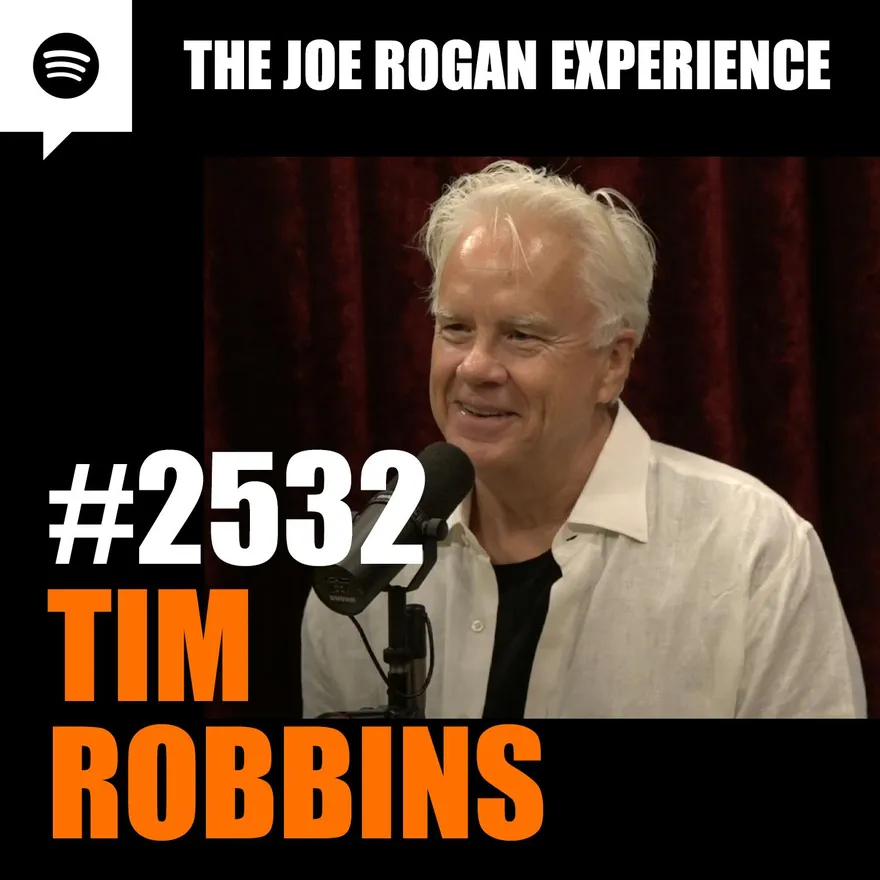

This is a preview of the Shortform summary of the Jul 29, 2026 episode of the The Joe Rogan Experience
Sign up for Shortform to access the whole episode summary along with additional materials like counterarguments and context.
1-Page Summary
Media, Film, and Entertainment Evolution
Tim Robbins and Joe Rogan discuss how the landscape of culture and entertainment has fundamentally changed, affecting how audiences discover and value creative works.
Decline of Curated Cultural Experiences and Active Participation
Robbins mourns the loss of video stores, record stores, and bookstores—community hubs where passionate staff offered personal recommendations and human connection. These spaces have been replaced by algorithmic platforms that lack subtlety and insight. Rogan notes that while sites like IMDB and Rotten Tomatoes provide crowd-sourced ratings, they don't match the depth of critics like Siskel and Ebert, who brought genuine passion to their analyses.
Both remember the excitement of planning for film premieres and the communal ritual of theater attendance. This active participation has given way to passive availability—streaming options and instant access eliminate the need for deliberate choices. Robbins argues that something is lost when there are no obstacles or opportunities for serendipitous discovery.
Economic and Creative Barriers To Storytelling In Hollywood
Robbins recalls that "The Shawshank Redemption" initially drew little box office interest, and observes that character-driven adult dramas like it would struggle to be greenlit today. Studios increasingly favor safe, formulaic projects built around existing stars and proven intellectual property. The current economic model requires major actors to take significant pay cuts, with studios insisting that foreign sales are secured before filming begins. Robbins notes the absence of producers willing to take chances on distinctive, personal films, and recounts that even after major successes, some of his favorite projects struggled to find distribution.
Resurgence of Long-Form Storytelling Through TV and Streaming
The streaming revolution has catalyzed a resurgence in long-form storytelling. Robbins notes that audiences now gravitate toward series that allow for deeper narrative development across 10-hour arcs, a format impossible under the old two-hour film model. Rogan highlights shows like "Stranger Things" and "Ozark" as essentially cinematic storytelling stretched across episodic installments, merging film production values with the scope of serialized television.
Value of Human Creativity in AI Era
Robbins shares that director Reed Morano has advocated for an "AI-free" seal on creative works, allowing consumers to identify projects created solely by humans. Both endorse this idea, likening it to non-GMO food labels. They emphasize the unique impact of works suffused with human imperfection and spontaneity, pointing to moments like Jimi Hendrix's "Star-Spangled Banner" at Woodstock as examples where genuine creativity surpasses technical perfection. While AI can simulate brilliance, Robbins remains convinced that individual experience and imagination set great works apart, and that audiences will continue to crave authenticity.
Activism, Free Speech, and Political Propaganda
Tim's Advocacy Against Iraq War and Its Consequences
Robbins recalls being one of only five famous people who publicly opposed the 2003 Iraq War, leading to severe backlash. The Baseball Hall of Fame canceled his appearance for the 15th anniversary of "Bull Durham," with the head labeling him a traitor. This differed from his earlier opposition to the 1991 Gulf War, when President George H.W. Bush affirmed that opposing war was a democratic right. In 2003, critics accused him of being a terrorist sympathizer. After his play "Embedded" premiered at the Public Theater, some critics labeled it anti-Semitic to discredit his message—a tactic Robbins recognizes as designed to intimidate dissenters.
The Contrast Between Official Narratives and Ground-Level Reality
Despite media hostility, Robbins found real-world reactions far less negative. In New York and San Antonio, people thanked him or respected his right to dissent, revealing a gap between media narrative and ground-level reality. Robbins identified this same tactic during the COVID-19 pandemic, when questioning prevailing narratives led to deplatforming. His conversations in Eastern Europe reinforced the parallel, with many comparing cancel culture to Soviet practices. Robbins and Rogan agree that such suppression contradicts American ideals of free speech.
Troubling Pattern Of Not Holding Wrong Parties Accountable
Robbins laments that promoters of the Iraq War were never held accountable—many received promotions despite the war being widely acknowledged as a mistake. Those who spoke out, like Robbins, received no apologies, while those who enabled the war faced no consequences. This impunity erodes credibility and allows the same voices to dominate new crises unchallenged, while dissenters remain targeted.
Technology's Impact on Society
Rogan and Robbins discuss how technology, especially social media and AI, is reshaping society and affecting psychological wellbeing.
Social Media Algorithms and Their Role in Division
Rogan points out that social media algorithms are designed to highlight what makes users upset, fueling outrage to boost engagement and profits. Robbins agrees, noting these algorithms lure people into constant conflict. Both observe that algorithms and AI bots push narratives on both sides of the political spectrum, making it hard to identify what's real and manufactured.
Robbins recalls observing a London protest during COVID lockdown that was labeled right-wing but actually included diverse groups—hippies, homeopaths, and free speech activists. After sharing this online, he faced attacks that reinforced his realization that public discourse is being manipulated. He laments the disappearance of "water cooler" conversations and accidental real-life interactions, which previously provided opportunities to hear different perspectives. Now algorithms create digital silos, serving only reinforcing content.
Psychological and Social Damage of Constant Digital Connection
Rogan and Robbins discuss how smartphones constantly demand attention, stealing joy and appreciation for the present moment. Rogan describes these devices as invasive and addictive, requiring discipline to avoid unhealthy engagement. Digital communication can also create false impressions that delayed responses are rejections, distorting social dynamics. Rogan highlights how technology makes life reactive rather than intentionally engaged with what truly matters.
Ai's Threat to Creativity and Inadequacy of Unions
Rogan expresses concern over AI's ability to generate screenplays, music, and visual content by drawing on preexisting works without compensating creators. Robbins criticizes unions and guilds for not drawing a hard line against using AI as a replacement for human talent. While Robbins maintains that truly talented individuals will continue to stand out with unique vision, Rogan highlights that economic pressure makes AI-generated content attractive because it's cheaper, threatening the viability of creative careers.
The Power of Theater and Art For Transformation
Theater For Rehabilitation and Emotional Unlocking in Prisons
Robbins describes his nonprofit program, now operating in 18 California prisons, which uses theater as a rehabilitation tool. The program encourages participants to express emotions typically suppressed in prison—sadness, fear, and happiness—since anger is the default and only publicly acceptable emotion. Through Commedia dell'Arte characters and improvisational exercises, participants explore the full range of emotions. Improvisation teaches that responses are a choice, demonstrating that anger doesn't have to be met with anger. The program fosters unexpected connections, with Robbins recounting how rival gang members staged fake fights instead of real ones, creating bonds across gang and racial lines.
The Transformative Potential of Shared Artistic Experience
Robbins observes that theater unites diverse audiences, allowing people with different beliefs to share emotional experiences and build community. He resisted restricting theater access based on vaccine passports during COVID-19, feeling it would betray theater's fundamental purpose of creating an inclusive space for everyone. Robbins asserts that great art provokes audiences and can shift consciousness by challenging rather than merely reaffirming worldviews, citing comedians like George Carlin and Bill Hicks as examples.
Distinction Between Activism Through Theater Versus Symbolic Activism
For Robbins, hands-on activism through theater in prisons provides tangible impact that surpasses symbolic activism. The satisfaction comes from witnessing real change and transformation. This commitment intensified after the Iraq War, prompting him to pursue more direct action. The persuasive power of witnessing transformation firsthand has enabled Robbins and his organization to successfully lobby for increased public funding for arts in correctional programs.
Spirituality, Consciousness, and Human Connection
Psychedelic Experiences as Pathways to Communication Beyond Consciousness
Robbins recounts a transformative ayahuasca journey in which he experiences a vivid encounter with his deceased mother, who reassures him and apologizes for a childhood incident that had haunted him. Rogan affirms that whether interpreted as hallucination or genuine contact, the effect is real and transformative. Robbins also describes his mother's final days, when she claimed her deceased husband had come for her—shortly after, she passed away.
The Mystery of Non-local Consciousness and Unexplained Connections
Robbins and Rogan discuss phenomena like mothers intuitively sensing when their children are in distress from thousands of miles away. Robbins shares a story where his deceased grandfather appeared in a dream saying "Don't worry, I'll take care of it," and shortly after, his young son narrowly avoided being hit by cars. Robbins references research suggesting the heart has neurons and generates an electromagnetic field influential in human communication, explaining why people thrive in community and why isolation is damaging.
Receptivity and Humility: Recognizing Grace
Robbins tells of a Tibetan woman who appeared during a dark period and insisted on caring for him. When he tried to help clean up, she criticized the Western tendency to approach giving as transactional, teaching him that to truly give love, one must also know how to receive it. Robbins reflects that such gifts arrive when one is open and vulnerable, whereas cynicism blinds people to their "angels."
Gratitude and Positive Outlook Essential for Well-Being
Robbins draws from Lucretius's "The Nature of Things," emphasizing that every moment is a miracle. He advocates for waking each day in awe rather than focusing on grievances. Rogan adds that maintaining gratitude is a continual practice, but acknowledging simple gifts can enhance wellbeing. Both warn about the lethality of isolation, with Robbins reiterating that heart connections through family, friends, theater, or pets sustain life and enhance happiness. Rogan advises focusing on love, friendship, and community, which not only enhance individual quality of life but also radiate positivity outward in a ripple effect.
1-Page Summary
Additional Materials
Clarifications
- Gene Siskel and Roger Ebert were influential American film critics known for their televised reviews from the 1970s to the early 2000s. They popularized movie criticism by making it accessible and entertaining through their show "Siskel & Ebert," where they used a "thumbs up/thumbs down" rating system. Their critiques combined deep knowledge, personal passion, and clear explanations, shaping public opinion and film culture. They are often credited with elevating film criticism to a respected art form.
- "The Shawshank Redemption" is a 1994 film based on a Stephen King novella, widely regarded as one of the greatest movies ever made. It tells the story of a banker wrongfully imprisoned who forms a deep friendship and ultimately finds hope and freedom. Despite poor initial box office performance, it gained immense popularity through home video and TV broadcasts. The film is celebrated for its powerful themes of resilience, friendship, and redemption.
- "Foreign sales secured before filming" means that a movie studio sells the rights to distribute the film in other countries before the movie is made. This pre-sale helps the studio raise money upfront to cover production costs. It reduces financial risk by guaranteeing some income regardless of the film's success domestically. Studios often require this to ensure a safer investment.
- AI-free seals on creative works would certify that a piece—such as a film, music, or artwork—was made entirely by human effort without AI assistance. This idea arises because AI tools can now generate or heavily influence creative content by analyzing vast amounts of existing human-made works. Non-GMO labels similarly inform consumers that food products are free from genetically modified organisms, appealing to those who prefer natural or traditional methods. The seal aims to help audiences identify and support authentic human creativity amid increasing AI-generated content.
- Jimi Hendrix's "Star-Spangled Banner" at Woodstock in 1969 was a groundbreaking electric guitar rendition of the U.S. national anthem. It used distortion and feedback to express the turmoil and protest of the Vietnam War era. The performance symbolized artistic rebellion and emotional intensity beyond traditional patriotic music. It remains a powerful example of creativity conveying complex social and political messages.
- The 1991 Gulf War had broad international support and was seen as a response to Iraq's invasion of Kuwait, with a clear UN mandate. In contrast, the 2003 Iraq War was launched primarily by the U.S. without explicit UN approval, based on disputed claims about weapons of mass destruction. Public opinion was deeply divided in 2003, with many questioning the war's legitimacy and motives. This division led to harsher backlash against prominent opponents like Tim Robbins.
- Accusations of anti-Semitism have historically been used to silence or discredit critics by associating them with prejudice against Jewish people, which is widely condemned. This tactic exploits the serious nature of anti-Semitism to delegitimize dissenting views without addressing their substance. It can create fear and social stigma, discouraging open debate. Such misuse undermines genuine efforts to combat real anti-Semitism.
- "Cancel culture" refers to the social practice of withdrawing support from public figures or companies after they have done or said something considered objectionable or offensive. It often involves public shaming and calls for boycotts, aiming to hold individuals accountable but sometimes leading to disproportionate consequences. Soviet practices included state-led censorship, surveillance, and punishment of dissenters to suppress opposition and control public opinion. The comparison highlights concerns that cancel culture similarly suppresses free expression by intimidating or silencing dissenting voices.
- Social media platforms want users to spend more time on their sites to increase ad revenue. They show content that triggers strong emotions, like anger or fear, because it keeps people engaged longer. This often means highlighting controversial or divisive posts that spark arguments. Over time, this creates echo chambers where users mostly see opinions that reinforce their own views.
- AI bots are automated programs that generate and share content on social media to influence opinions. They can mimic human behavior, making it hard to distinguish genuine users from bots. These bots amplify specific political messages by liking, sharing, and commenting, creating artificial trends. Their activity manipulates public perception by flooding platforms with coordinated narratives.
- Digital silos refer to online environments where algorithms show users content that reinforces their existing beliefs, limiting exposure to diverse perspectives. This creates isolated "bubbles" of information, reducing opportunities for spontaneous, varied social interactions found in real life. Unlike casual conversations in physical spaces, digital silos narrow discourse and deepen polarization. They hinder understanding by filtering out conflicting or challenging viewpoints.
- Smartphones create constant connectivity, leading to frequent interruptions that reduce focus and increase stress. Digital communication lacks nonverbal cues, causing people to misinterpret delayed replies as rejection or disinterest. This uncertainty can heighten anxiety and damage relationships. Over time, these effects contribute to a reactive mindset, undermining intentional, present engagement.
- Unions and guilds traditionally protect workers' rights, negotiate fair wages, and ensure safe working conditions in creative industries. They also set standards for hiring practices and intellectual property protections. Their role includes resisting changes that could undermine members' job security or income, such as unregulated AI use. Failure to oppose AI means they have not effectively challenged its potential to replace human creators or secure compensation for AI-generated works.
- Commedia dell'Arte is a form of Italian theater from the 16th century featuring masked stock characters and improvised performances. It relies on exaggerated physical comedy and recognizable character types like Harlequin and Pantalone. This style encourages spontaneity and emotional expression, making it effective for exploring feelings in prison theater. Using these characters helps participants safely experiment with different emotions and social roles.
- Vaccine passports are digital or physical documents proving a person has been vaccinated against COVID-19. They were proposed to allow safer access to public venues by reducing virus spread. Critics argue they create inequality by excluding unvaccinated individuals, whether for medical, personal, or access reasons. Restricting theater access based on them raises concerns about fairness and the fundamental right to public cultural experiences.
- George Carlin and Bill Hicks were influential American stand-up comedians known for their sharp social and political commentary. They challenged mainstream beliefs and authority through satire, often addressing taboo subjects. Their work inspired critical thinking and pushed boundaries in comedy. Both are celebrated for using humor to provoke deeper reflection on society.
- Ayahuasca is a traditional Amazonian plant brew containing psychoactive compounds that induce intense, often visionary, altered states of consciousness. These experiences are used in spiritual and healing contexts to promote emotional insight, personal growth, and connection to deeper aspects of the self or the universe. Many participants report profound psychological and emotional breakthroughs, sometimes described as encounters with spiritual entities or deceased loved ones. The practice is often guided by experienced shamans to ensure safety and meaningful interpretation.
- Non-local consciousness suggests that awareness or mind is not confined to the brain or body but can extend beyond physical boundaries. The heart generates a measurable electromagnetic field, which some researchers propose may facilitate subtle communication between people. This field is much stronger than the brain's electromagnetic field and can be detected several feet away from the body. While intriguing, these ideas remain controversial and are not fully accepted by mainstream science.
- In many spiritual traditions, including Tibetan Buddhism, true giving involves openness to both giving and receiving love without expectation. This teaching emphasizes humility and vulnerability, suggesting that love flows best when it is not transactional or conditional. The story highlights that genuine compassion requires accepting help and affection as much as offering it. This balance fosters deeper human connection and personal growth.
- Lucretius's "The Nature of Things" is a philosophical poem from ancient Rome that explains Epicurean philosophy. It teaches that the universe operates through natural laws without divine intervention, encouraging acceptance of life’s events. The work promotes appreciating the present moment and finding peace by understanding nature. Robbins references it to emphasize gratitude and awe for everyday existence.
Counterarguments
- Algorithmic platforms, while lacking human touch, have dramatically increased access to a wider range of creative works and made discovery more democratic, allowing niche content to find global audiences that local stores could not serve.
- Crowd-sourced ratings aggregate a broader spectrum of opinions than individual critics, potentially offering a more representative view of public taste.
- Instant streaming access has enabled people with limited time, mobility, or resources to participate in cultural experiences that were previously inaccessible.
- The removal of obstacles in digital discovery can also reduce gatekeeping and allow for more diverse voices and stories to reach audiences.
- Hollywood’s focus on established intellectual property and stars is partly a response to audience demand and the high financial risk of film production, not just a lack of creative will.
- The resurgence of long-form storytelling on streaming platforms has also led to content saturation and "binge fatigue," with some viewers preferring concise, self-contained stories.
- An "AI-free" seal could be seen as stigmatizing technological innovation and may not be meaningful to all consumers, some of whom value the efficiency and creativity enabled by AI tools.
- AI-generated content can democratize creative production, allowing people without traditional resources or connections to express themselves and reach audiences.
- The backlash against dissent during the Iraq War and COVID-19 is not universally representative; many people and institutions supported open debate, and some criticism was based on genuine disagreement rather than suppression.
- Accusations of anti-Semitism or other forms of bigotry are sometimes made in good faith when content is perceived as offensive, not solely as a tactic to silence dissent.
- Social media algorithms can also connect people with shared interests and foster supportive communities, not just division and outrage.
- Smartphones and digital devices have enabled new forms of social connection, remote work, and access to information, which many people find enriching and empowering.
- AI-generated content can supplement, rather than replace, human creativity, and some creators use AI as a tool to enhance their own work.
- Unions and guilds face complex challenges in regulating new technologies and must balance protecting members with adapting to industry changes.
- Restricting theater access based on vaccine passports was intended as a public health measure, not as an exclusionary practice, and many theaters found ways to maintain inclusivity while protecting vulnerable populations.
- Not all art that challenges worldviews is effective or well-received; reaffirming shared values can also be a powerful function of art.
- Some people find symbolic activism meaningful and motivating, even if it does not produce immediate tangible results.
- The scientific evidence for non-local consciousness and heart-based communication is limited and remains controversial within the broader scientific community.
- Gratitude and positive outlook are beneficial, but mental health challenges often require more than attitude adjustments, including professional support and systemic change.
- Digital communication and online communities can provide vital support and connection for people who are isolated or marginalized in their offline lives.
Get access to the context and additional materials
Media, Film, and Entertainment Evolution
The landscape of culture, entertainment, and storytelling has undergone seismic shifts, fundamentally altering how audiences discover, experience, and value creative works.
Decline of Curated Cultural Experiences and Active Participation
Tim Robbins mourns the loss of community hubs like video stores and record stores, where personal recommendations from passionate staff offered a sense of discovery and human connection. In that era, someone deeply invested in film or music might suggest a hidden gem such as "Battle of Algiers," or strike up a conversation about what’s new or noteworthy. Bookstores, too, once provided a serendipitous browsing experience. Today, Robbins notes, these have largely vanished, replaced by algorithmic digital platforms. Instead of trusted human “arbiters,” consumers now sift through what is “programmed” by machine logic, which lacks subtlety and insight.
Rogan points out that, while online communities and aggregate ratings on sites like IMDB and Rotten Tomatoes offer some crowd-sourced curation, it’s not equivalent to the personal touch or the depth of appreciation exemplified by critics like Siskel and Ebert—figures who brought deep passion and insight to their recommendations and analyses for extended segments. The sense of occasion is also diminished; Robbins and Rogan both remember the excitement of planning for a film’s premiere, the communal ritual of going to a theater on release day, and the need for commitment: setting aside time, making plans, and embracing the inconvenience as part of the reward.
This active participation and sense of discovery has given way to passive availability: with endless streaming options and instant access on personal devices, audiences no longer need to make deliberate choices. Robbins argues something is lost when there are no limits or obstacles—no need to drive across town, no fixed showtimes, and no opportunity to stumble accidentally into a surprising new film when your first choice is sold out. The experience is convenient but far less special, and there is less opportunity for serendipity or meaningful engagement.
Economic and Creative Barriers To Storytelling In Hollywood
As the culture shifts, so does the business. Robbins recalls his experience with "The Shawshank Redemption," a now-celebrated film that initially drew little box office interest—its challenging title and lack of immediate marketability worked against it. He observes that Hollywood studios increasingly favor safe, formulaic projects aimed at teenagers, built around existing stars and proven intellectual property. Projects like "Shawshank"—character-driven, adult dramas—would have difficulty being greenlit today.
Robbins describes the current economic model where studios and investors require major actors to agree to significant pay cuts for financing to proceed. Rather than investing in risk and innovation, studios seek to minimize their exposure—often insisting that foreign sales are secured before filming even begins, ensuring profits (or at least breaking even) with minimal risk. There is little appetite for gambling on the unknown or on fresh voices. Robbins points to the absence of modern equivalents to past producers who were willing to take chances, resulting in films that could polarize audiences but were undeniably distinctive and personal.
He also recounts that even after major successes and award recognition, some of his favorite post-Oscar films struggled to find distribution—producers were unwilling to risk the cost of a theatrical release, preferring instead to minimize losses rather than potentially discover new classics.
Resurgence of Long-Form Storytelling Through TV and Streaming
The streaming revolution has catalyzed a resurgence in long-form storytelling, providing an unexpected creative outlet. Robbins notes that audiences—especially adults—now gravitate toward series that allow for deeper narrative development across 10-hour (or longer) arcs, a format virtually impossible under the old two-hour film model. Streaming platforms have enabled projects akin to “10-hour films,” where creators have the space and budget to explore character and story at a level of depth formerly reserved for novels.
Rogan highlights the quality and narrative ambition of shows like "Stranger Things" and "Ozark," calling them essentially cinematic storytel ...
Here’s what you’ll find in our full summary
Media, Film, and Entertainment Evolution
Additional Materials
Clarifications
- Tim Robbins is an American actor and filmmaker known for roles in films like "The Shawshank Redemption." Joe Rogan is a comedian, podcast host, and commentator known for discussing culture and media on his popular podcast. Both are influential voices in entertainment with perspectives on industry changes. Their insights reflect personal experience and public commentary on media evolution.
- "The Battle of Algiers" is a 1966 Italian-Algerian film directed by Gillo Pontecorvo. It is a historical war drama depicting the Algerian struggle for independence from French colonial rule in the 1950s. The film is renowned for its realistic style and political impact, often studied for its portrayal of guerrilla warfare and colonialism. It is considered a classic and influential work in political cinema.
- Gene Siskel and Roger Ebert were influential American film critics known for their television show "Siskel & Ebert," where they reviewed movies with engaging discussions. They popularized the "thumbs up/thumbs down" rating system, making film criticism accessible and entertaining to a broad audience. Their deep knowledge and passionate analysis helped shape public opinion and guided viewers' movie choices for decades. They also elevated film criticism to a respected cultural conversation beyond mere opinion.
- "Greenlighting" a film means officially approving and funding its production. This decision is made by studio executives or producers after evaluating the script, budget, and potential profitability. It allows the project to move from planning to actual filming. Without greenlight approval, a film cannot proceed to production.
- Hollywood studios often require actors to accept lower salaries to reduce production costs and attract financing. Securing foreign sales before filming means studios pre-sell distribution rights in international markets to guarantee revenue upfront. This practice lowers financial risk by ensuring some income regardless of domestic box office performance. It prioritizes predictable profits over creative risk-taking.
- "The Shawshank Redemption" is a 1994 film based on a Stephen King novella, initially underperforming at the box office despite critical acclaim. Its complex themes of hope, friendship, and institutionalization made it less immediately marketable compared to typical blockbuster films. Over time, it gained a massive following through home video and TV broadcasts, becoming a beloved classic. The film exemplifies how riskier, character-driven stories can achieve lasting impact despite initial commercial challenges.
- A theatrical release means a film is shown in movie theaters for the public to watch on big screens. Other distribution methods include digital streaming, DVD/Blu-ray sales, and television broadcasts, which allow viewing at home or on personal devices. Theatrical releases often involve higher marketing costs and can build communal viewing experiences. Non-theatrical releases usually have lower costs and reach audiences more directly but may lack the event-like atmosphere of theaters.
- Long-form storytelling refers to narratives told over multiple episodes or seasons, allowing for complex character development and intricate plots. Unlike traditional films, which typically condense a story into about two hours, long-form formats can span many hours, providing more depth and detail. This format is common in TV series and streaming shows, where creators have more time to explore themes and relationships. It enables a more immersive and sustained engagement with the story and characters.
- "Stranger Things" is a science fiction horror series set in the 1980s, blending supernatural elements with nostalgic pop culture. "Ozark" is a crime drama focusing on a family's involvement in money laundering and the dark consequences they face. Both shows are known for their intense storytelling, complex characters, and high production values. They exemplify how streaming platforms support serialized, cinematic-quality narratives.
- An "AI-free" seal would certify that a creative work was made without artificial intelligence involvement. This concept parallels non-GMO labels, which indicate food products are free from genetically modified organisms. Both labe ...
Counterarguments
- Algorithmic recommendations, while lacking human nuance, can expose users to a broader and more diverse range of content than a single store’s staff could provide.
- Online communities and aggregate ratings offer democratized curation, reflecting a wider spectrum of tastes and opinions than a handful of critics or curators.
- The convenience and accessibility of streaming services have enabled people with disabilities, those in remote areas, or with limited time to participate in cultural experiences that were previously inaccessible.
- Passive availability does not preclude active engagement; many viewers still seek out recommendations, participate in online discussions, and organize group viewings.
- The decline of traditional community hubs has been offset by the rise of vibrant online communities, forums, and social media groups centered around shared interests in film, music, and books.
- The economic caution of studios can be seen as a rational response to rising production costs and changing consumer habits, helping to sustain the industry.
- Streaming platforms have created opportunities for diverse voices and international creators to reach global audiences, sometimes bypassing traditional Hollywood gatekeepers.
- Serialized storytelling on streaming platforms allows for more complex and nuanced narratives, which some audiences prefer over the constraints of traditional f ...
Get access to the context and additional materials
Activism, Free Speech, and Political Propaganda
Tim's Advocacy Against Iraq War and Its Consequences
Tim Robbins recalls being one of only five famous people who publicly opposed the 2003 Iraq War, appearing on various television shows and giving speeches against it. His anti-war stance led to severe backlash in the media. Notably, the Baseball Hall of Fame canceled his appearance for the 15th anniversary of "Bull Durham," with the head of the Hall labeling him a traitor and Saddam supporter. The incident prompted Robbins to hire a crisis PR professional, who advised him to address sports writers; many ended up defending his freedom of speech.
Robbins notes this situation differed from his earlier opposition to the 1991 Gulf War. Then, President George H. W. Bush affirmed that opposing the war was a right in a democracy. However, in 2003, critics accused Robbins of being a terrorist sympathizer and subjected him to intense ad hominem attacks. Robbins reflects that such ferocity confirmed he was "over the target," challenging powerful interests.
Shortly after President Bush's "Mission Accomplished" speech, Robbins' play "Embedded" premiered at the Public Theater. Although the play contained no anti-Semitic content, some critics labeled it conspiracy theory and anti-Semitic to discredit Robbins’ message, a tactic he recognizes as intended to intimidate dissenters.
The Contrast Between Official Narratives and Ground-Level Reality
Despite the public and media campaign against him, Robbins found real-world reactions far less hostile. In New York, people thanked him for speaking out or respected his right to dissent, even if they disagreed. When taking his children to school or traveling to San Antonio for the Final Four, Robbins observed little to no animosity. This gap between media narrative and ground-level reality revealed an orchestrated effort to intimidate others into silence, not a genuine reflection of public sentiment.
Robbins identified this tactic during the COVID-19 pandemic as well. People who questioned prevailing policies or narratives faced deplatforming, marginalization, or cancellation—echoing the same dynamic he experienced during the Iraq War debate. His conversations in Eastern Europe reinforced the parallel: in Romania, many compared pandemic-era cancel culture to Soviet practices, where non-compliance led to private records and ruined careers. The comparison highlighted the chilling effect on free discourse; people learned to simulate compliance while avoiding real commitment, a survival strategy with roots in authoritarian regimes.
Robbins and Rogan agree that such suppression fundamentally contradicts the American ideal of free speech. Rogan points out that threats to one's live ...
Here’s what you’ll find in our full summary
Activism, Free Speech, and Political Propaganda
Additional Materials
Clarifications
- The 2003 Iraq War began when the U.S. and allies invaded Iraq, claiming the country possessed weapons of mass destruction (WMDs) and posed a threat. No WMDs were found, leading to widespread criticism and accusations of misleading the public. The war caused significant loss of life, regional instability, and long-term political consequences. It remains controversial due to questions about its justification and the handling of its aftermath.
- The Baseball Hall of Fame is a prestigious institution honoring the greatest players and moments in baseball history. Its events attract significant media attention and public interest, making appearances there influential for celebrities. Canceling Robbins' appearance signaled a public rebuke from a respected cultural organization, amplifying the backlash against him. This action symbolized how his political stance affected his professional and public opportunities beyond direct political arenas.
- During the Iraq War period, being labeled a "traitor" implied betraying national loyalty by opposing government policies. Calling someone a "Saddam supporter" suggested they sympathized with Iraq's dictator, equating dissent with enemy allegiance. These labels aimed to discredit critics by framing opposition as unpatriotic or dangerous. This tactic intensified social and professional backlash against anti-war voices.
- The 1991 Gulf War had broad international support and was seen as a legitimate response to Iraq's invasion of Kuwait, leading to widespread public and political backing. In contrast, the 2003 Iraq War was highly controversial, with many questioning the justification, especially the claims about weapons of mass destruction. Political leaders and media were more divided in 2003, and dissenters faced harsher backlash. The 2003 war's legitimacy was later widely discredited, unlike the 1991 conflict.
- President George H. W. Bush led the U.S. during the 1991 Gulf War, a conflict to expel Iraqi forces from Kuwait. During this time, he publicly acknowledged that citizens had the right to oppose the war, emphasizing democratic values. This stance contrasted with later reactions to dissent in the 2003 Iraq War. His approach reflected a more tolerant attitude toward free speech in wartime.
- "Embedded" is a play by Tim Robbins that critiques the media's role in the Iraq War, focusing on journalists embedded with military units and the resulting propaganda. Its significance lies in challenging official war narratives and exposing manipulation of information. The controversy arose because some critics falsely accused it of anti-Semitism to discredit Robbins and suppress dissent. This tactic reflects broader efforts to intimidate critics by labeling them with extreme accusations.
- "Ad hominem attacks" are criticisms targeting a person's character or motives instead of addressing their arguments. A "conspiracy theory" is an explanation suggesting secret, often malicious, plots by powerful groups without solid evidence. "Anti-Semitic" refers to hostility, prejudice, or discrimination against Jewish people. In this context, these terms describe tactics used to discredit Tim Robbins' anti-war stance by attacking him personally and falsely associating his work with harmful stereotypes.
- "Cancel culture" refers to the social practice of withdrawing support from public figures or companies after they have said or done something considered objectionable. "Deplatforming" means removing someone's access to social media or public forums, limiting their ability to share views. "Marginalization" involves pushing individuals or groups to the edges of society, reducing their influence or visibility. During the COVID-19 pandemic, these actions targeted people who questioned official health policies or narratives.
- During the Soviet era, the government used extensive surveillance and secret police to monitor citizens, punishing dissent through job loss, imprisonment, or worse. People often hid their true opinions to avoid persecution, creating a culture of fear and self-censorship. Pandemic-era cancel culture similarly pressures individuals to conform to dominant views, threatening social or professional consequences for dissent. This parallel highlights how both systems suppress open dialogue and enforce conformity through intimidation.
- "Rogan" refers to Joe Rogan, a well-known American podcast host, comedian, and commentator. He is influential in public discourse, often discussing controversial topics including free speech and censorship. Rogan's platform, "The Jo ...
Counterarguments
- While Tim Robbins was a prominent celebrity critic of the Iraq War, there were numerous other public figures, activists, and organizations who also opposed the war, suggesting he was not as isolated as implied.
- The Baseball Hall of Fame's decision to cancel Robbins' appearance, while controversial, reflected the heightened patriotic sentiment and sensitivities of the time, which affected many public figures, not just Robbins.
- Media backlash against anti-war voices was significant, but there were also major media outlets and journalists who questioned the war and provided platforms for dissenting views.
- The comparison between the suppression of dissent during the Iraq War and Soviet-era practices may be seen as an overstatement, as the consequences for dissent in the U.S. did not involve state violence or imprisonment.
- The lack of accountability for Iraq War promoters is a valid concern, but some journalists and officials did face professional consequences or public criticism, even if not to the extent some might desire.
- The analogy between pandemic-era cancel culture and authoritarian regimes may not fully account for the dif ...

Get access to the context and additional materials
Technology's Impact on Society
Joe Rogan and Tim Robbins discuss the ways technology, especially social media and artificial intelligence, is reshaping society, affecting social dynamics, psychological wellbeing, and the future of creativity.
Social Media Algorithms and Their Role in Division
Rogan points out that social media algorithms are designed to highlight what makes users upset, fueling outrage and conflict in order to boost engagement—which, in turn, increases profits for the companies behind these platforms. Outrageous content is prioritized, leading users to be continually engrossed in negativity rather than appreciate their real-world experiences or maintain a positive perspective. Robbins agrees, noting that these algorithms lure people into constant conflict, which he describes as a force of evil.
Algorithms Fuel Outrage and Conflict to Boost Engagement, Profiting From Anger and Division
Rogan and Robbins agree that on both sides of the political spectrum, algorithms and even AI-powered bots push narratives and stir controversy, making it hard to identify what’s real and what’s manufactured. These tactics sow division intentionally, preventing people from finding common ground and ensuring the powerful maintain control by keeping the public at odds.
Media Misrepresentation of Protests: Covid Events Labeled Right-Wing, Actually Diverse
Robbins recalls being in London during the Covid lockdown and observing a protest that was publicly labeled as a right-wing event. To his surprise, the crowd included hippies, homeopaths, and free speech activists, not just the far-right element presented by mainstream media. After sharing his perspective online, he faced a barrage of attacks—possibly from bots or coordinated groups—with the experience reinforcing his realization that public discourse is being manipulated to appear more divisive than it actually is.
Accidental Conversation Elimination Creates Algorithmic Siloed Worldviews
Robbins laments the disappearance of “water cooler” conversations and accidental real-life interactions during the pandemic. Previously, such in-person exchanges provided opportunities to hear different perspectives and challenged individual worldviews. Now, algorithms create digital silos, serving only reinforcing content and ensuring that people rarely encounter true opposition. As a result, society becomes more divided and less able to build alliances or empathize with others.
Psychological and Social Damage of Constant Digital Connection
Rogan and Robbins discuss how smartphones and constant connectivity add to individuals’ stress and reduce appreciation of real life.
Smartphones Divert Attention and Lessen Appreciation For Real-World Experiences and the Present Moment
Smartphones and social media constantly demand attention, stealing people’s joy and appreciation for the present moment. Rogan describes these devices as invasive and addictive, requiring discipline to avoid unhealthy levels of engagement—especially first thing in the morning. With no education in schools about the negative effects of social media, users, especially children, are left to navigate these consequences alone.
Delayed Responses Seen As Rejection, Creating False Social Dynamic
Digital communication can create the false impression that delayed responses from friends are rejections, distorting social dynamics and fostering unnecessary anxiety.
Tech Blurs the Line Between Active and Passive, Making Life Reactive Instead of Intentionally Engaged
Rogan highlights how the line between active participation and passive distraction has become blurred. Technology elicits constant reactions—buzzes, notifications, or algorithm-driven content—so that life starts to feel reactive rather than intentionally engaged with what truly matters.
Ai's Threat to Creativity and Inadequacy of Unions
Rogan expresses concern over AI’s ability to generate screenplays, music, and visual content by drawing on preexisting works—effectively using writers’, musicians’, and artists’ creations without their compensation or consent. He warns that AI can instantaneously mimic and remix creative styles, producing new stori ...
Here’s what you’ll find in our full summary
Technology's Impact on Society
Additional Materials
Clarifications
- Social media algorithms analyze user behavior like clicks, likes, and watch time to predict what content will keep users engaged. They assign scores to posts based on factors such as relevance, recency, and user interaction history. Content with higher scores is shown more prominently in feeds to maximize user attention. These algorithms continuously learn and adjust based on ongoing user activity to optimize engagement.
- AI-powered bots are automated programs that mimic human behavior on social media platforms. They can rapidly generate and share content, amplifying specific messages or narratives. These bots often spread divisive or misleading information to manipulate public opinion and increase engagement. Their activity makes it difficult to distinguish genuine user interactions from coordinated campaigns.
- Digital silos occur when algorithms tailor content to match users' existing beliefs and preferences, limiting exposure to diverse viewpoints. This personalization reinforces confirmation bias, making people less likely to encounter opposing ideas. Over time, these isolated information bubbles deepen social and ideological divides. The effect reduces opportunities for dialogue and mutual understanding across different groups.
- Mainstream media often simplifies protests by focusing on the most extreme or sensational elements to attract viewers. This can lead to labeling diverse groups with a single political identity, ignoring the variety of participants and motives. Selective coverage may omit peaceful or moderate voices, skewing public perception. Such framing can deepen societal divisions by reinforcing stereotypes and biases.
- Coordinated online attacks involve groups or automated programs (bots) working together to flood social media or comment sections with negative or misleading messages. Bots are software that can mimic human behavior, posting rapidly and amplifying certain viewpoints to manipulate public opinion. These tactics can overwhelm genuine voices, distort discussions, and create false impressions of widespread agreement or opposition. Such activity is often used to intimidate, discredit, or silence individuals and shape narratives.
- Before the pandemic, casual in-person interactions at workplaces or social settings—often called "water cooler" conversations—allowed people to share diverse viewpoints spontaneously. The pandemic forced many to work remotely, eliminating these informal encounters. Without these chance meetings, people lost opportunities to hear differing opinions and build social connections. This shift contributed to more isolated, homogeneous online interactions shaped by algorithms.
- Delayed responses in digital communication can trigger anxiety because people often interpret silence as rejection or disinterest. This misinterpretation stems from the lack of nonverbal cues like tone or facial expressions that help clarify intent in face-to-face interactions. The uncertainty about why someone hasn't replied can lead to overthinking and negative assumptions. This dynamic can strain relationships and increase stress in social interactions.
- Active participation involves consciously engaging with content or activities, making deliberate choices and contributing meaningfully. Passive distraction occurs when one consumes content without focus or intention, often reacting automatically to notifications or stimuli. This shift reduces deep thinking and intentional decision-making, leading to a more reactive and less mindful experience. Over time, passive distraction can diminish attention span and the ability to engage fully with important tasks or relationships.
- AI generates creative content by analyzing vast amounts of existing human-created works to learn patterns, styles, and structures. It uses this learned information to produce new content that mimics or combines these elements in novel ways. This process involves algorithms like machine learning and neural networks that predict and generate text, music, or images based on input data. The AI d ...
Counterarguments
- Social media algorithms can also prioritize positive, informative, or community-building content, depending on user behavior and platform design choices.
- Not all algorithmic amplification leads to division; some users report finding supportive communities and diverse perspectives online.
- AI-powered bots are not universally used for divisive purposes; they can also be deployed to counter misinformation and promote constructive dialogue.
- Media misrepresentation is not always intentional, and coverage of protests can vary widely across different outlets and regions.
- Online discourse can also facilitate exposure to a broader range of viewpoints than some in-person environments, especially for individuals in isolated or homogenous communities.
- Digital silos are not unique to the internet; people have historically self-selected into like-minded groups offline as well.
- Smartphones and digital connectivity can enhance real-world experiences by providing access to information, navigation, and social connection.
- Many users successfully manage their digital habits and report increased productivity, learning, or social connection through technology.
- Delayed digital communication can also allow for more thoughtful responses and reduce pressure for immediate reaction.
- Technology enables new forms of active participation, such as online activism, creative collaboration, and remote work.
- AI-generated content can democratize creativity by lowering barriers to entry for people without traditional tra ...
Get access to the context and additional materials
The Power of Theater and Art For Transformation
Theater For Rehabilitation and Emotional Unlocking in Prisons
Tim Robbins describes his nonprofit program, initially piloted in prisons in Chino and Norco, which has now expanded into 18 California prisons. The program uses theater as a tool for rehabilitation, focusing on formerly incarcerated individuals and encouraging them to express emotions typically suppressed in prison such as sadness, fear, and happiness. Robbins explains that in prison, anger is the default and often the only publicly acceptable emotion, as other emotions are perceived as weaknesses that could be dangerous to reveal. Through the introduction of stock characters from the Commedia dell’Arte and improvisational exercises, participants are prompted to explore and express this full range of emotions.
Improvisation plays a central role, teaching participants that their responses are a matter of choice. When confronted with anger in an improv, facilitators encourage the use of different emotions in response, demonstrating that anger does not have to be met with anger. Robbins stresses that this insight transfers into real-world interactions, where participants gradually understand they have options beyond their survival instincts.
The program also fosters unexpected connections. Robbins recounts how rival gang members, under the order to fight in the yard, instead staged a fake fight—performing combat without hurting each other. By participating in improvisation and shared emotional exercises, bonds are created across gang and racial lines, creating a sense of community and trust that is rare in prison environments.
The Transformative Potential of Shared Artistic Experience
Robbins observes that theater unites diverse audiences, allowing people with different beliefs to share laughter and tears, building a community through a common emotional experience. He emphasizes that a true theater thrives on this diversity, rather than reinforcing ideological conformity.
He points out his resistance to restricting theater access based on vaccine passports during the COVID-19 pandemic. Robbins and his theater staff decided not to reopen under the condition that only those who complied with government mandates could attend. He felt that doing so would betray the fundamental purpose of theater: creating an inclusive space for the whole community, regardless of personal beliefs.
Robbins asserts that great art provokes its audience and can shift consciousness by challenging rather than merely reaffirming worldviews. He cites comedians like George Carlin and Bill Hicks, who used humor and provocation to shatter preconceptions, prompting audiences to reconsider their own beliefs. Robbins argues that art and theater, like philosophy and powerful stand-up comedy, can serve as catalysts ...
Here’s what you’ll find in our full summary
The Power of Theater and Art For Transformation
Additional Materials
Clarifications
- Commedia dell’Arte is a form of Italian theater from the 16th century featuring fixed character types called stock characters. These characters represent specific social roles or personality traits, like the clever servant or the foolish old man. They use exaggerated gestures and masks to express emotions and tell stories. This tradition helps actors explore emotions and human behavior through recognizable, archetypal roles.
- In prison, showing vulnerability can be dangerous because it may invite exploitation or violence. Anger signals strength and deters threats, helping inmates protect themselves. The prison environment often lacks trust, so emotional suppression becomes a survival strategy. This creates a culture where anger is the safest and most accepted emotion to display.
- Improvisational exercises involve spontaneous, unscripted acting that requires participants to react in the moment. These exercises help individuals practice expressing a wide range of emotions safely and creatively. By choosing different emotional responses during improv, participants learn to break habitual patterns, such as defaulting to anger. This process builds emotional flexibility and awareness, which can transfer to real-life situations.
- Symbolic activism involves actions that show support for a cause but often lack direct impact, such as attending events or sharing posts. Hands-on activism requires active participation that creates tangible change, like working directly with affected communities. Symbolic activism can raise awareness but may not lead to concrete results. Hands-on activism tends to build deeper understanding and influence systemic change through lived experience.
- The Iraq War, beginning in 2003, was a controversial U.S.-led military invasion that sparked widespread protest and debate. Tim Robbins, known for his political activism, became more motivated to engage in direct, impactful actions after witnessing the war's consequences. The conflict highlighted systemic issues and injustices, inspiring Robbins to focus on tangible change through his theater programs. This shift led him to prioritize hands-on activism over symbolic gestures.
- Vaccine passports are digital or physical proof of COVID-19 vaccination used to control access to public spaces. Supporters argue they protect public health by reducing virus spread in crowded venues like theaters. Opponents claim they infringe on personal freedoms and create social exclusion. The debate centers on balancing safety with individual rights and inclusivity.
- George Carlin and Bill Hicks were influential stand-up comedians known for their sharp social and political commentary. They used humor to challenge societal norms, question authority, and expose hypocrisy. Their performances often provoked audiences to rethink accepted beliefs and confront uncomfortable truths. This approach helped inspire critical reflection and social awareness beyond mer ...
Counterarguments
- While theater programs may offer emotional benefits, there is limited large-scale empirical evidence demonstrating their long-term effectiveness in reducing recidivism or fundamentally transforming prison culture.
- Emotional expression through theater may not be equally accessible or appealing to all incarcerated individuals, particularly those who are introverted or uncomfortable with performance-based activities.
- The focus on theater as a primary tool for rehabilitation could divert attention and resources from other evidence-based interventions, such as education, vocational training, or mental health services.
- The claim that theater unites diverse audiences and builds community may overlook persistent social, cultural, or ideological divisions that cannot always be bridged through shared artistic experiences.
- Opposing vaccine passport requirements for theater attendance during a public health crisis could be seen as prioritizing inclusivity over the safety and well-being of vulnerable populations.
- The assertion that direct involvement is always more effective t ...
Get access to the context and additional materials
Spirituality, Consciousness, and Human Connection
Psychedelic Experiences as Pathways to Communication Beyond Consciousness
Tim Robbins recounts a transformative ayahuasca journey in which he experiences a vivid encounter with his deceased mother. During this psychedelic state, his mother reassures him, saying, “You’re a warrior; rest, but the fight’s not over.” This message both affirms his resilience and encourages him to continue through challenges. The experience also brings up a lingering childhood memory—a confusion from kindergarten that had haunted him. In the vision, his mother apologizes for not listening to him back then, saying, “you were right about that. I’m sorry we didn’t listen to you.” This acknowledgment provides a profound sense of relief and closure, leaving Tim with a deep, renewed connection as though his mother truly understood him.
Joe Rogan affirms that whether or not one interprets such mystical experiences as hallucination or genuine afterlife contact, the effect is real and transformative. The feelings of connection, validation, and change in perspective are tangible outcomes of the experience. Rogan argues that cynicism diminishes the value of such events, emphasizing that just because they can’t be quantified does not mean they are not real.
Tim also describes his mother’s final days, highlighting her dream of departed loved ones gathering in her house as a sign of reassurance. On the day she died, she claimed her deceased husband Gil had come for her, appearing healthy and strong. Shortly after relating this vision, she passed away. Tim suggests that even skeptics must grapple with the reality and impact of such unexplained phenomena, admitting that these experiences exist beyond conventional understanding but bring comfort and a sense of connection.
The Mystery of Non-local Consciousness and Unexplained Connections
Tim and Joe discuss the phenomenon where mothers intuitively sense when their children are in distress, sometimes from thousands of miles away, or when twins experience parallel emotions and thoughts. Tim shares a story from his own life in which his deceased grandfather appeared in a dream, reassuring him, “Don’t worry, I’ll take care of it.” Just after waking, Tim received a call telling him that his young son, Miles, had narrowly avoided being hit by cars, as though some invisible force had protected him. Tim feels certain that his grandfather’s spiritual intervention saved his son, affirming his belief in unexplored channels of consciousness linking humans beyond the ordinary senses.
Further, Tim references research suggesting the heart has more neurons than some parts of the brain and generates an electromagnetic field influential in human communication. He observes that people thrive in community, experiencing a kind of heart-to-heart electromagnetic connection with others or even with pets. He asserts that this “magical” energy, largely unstudied, explains why isolation is damaging and why being in groups keeps people healthier and more vibrant.
Receptivity and Humility: Recognizing Grace
Tim tells the story of a Tibetan woman who appeared during one of his darkest periods, sensing he was in trouble. She insisted on caring for him—performing Reiki, singing, burning incense, and preparing a meal—despite having little prior connection. When Tim tried to help clean up, she criticized the Western tendency to approach giving as transactional: “That’s the problem with you people in the West. It’s all a business deal... I’m taking care of you. Can you accept that?” She taught him that to truly give love, one must also know how to receive it. This experience, Tim recounts, revealed that “angels exist” in human form and that grace and help come to those open to receiving.
Tim reflects that such gifts often arrive when one is open, vulnerable, and humble—whereas cynicism or emotional closure blinds people to their “angels.” He now believes there is a powerful energy of good in the world and stresses the importance of being receptive to it, recognizing that adversities can be intermingled with profound acts ...
Here’s what you’ll find in our full summary
Spirituality, Consciousness, and Human Connection
Additional Materials
Counterarguments
- The transformative effects of psychedelic or mystical experiences, while subjectively real, can be explained by neurochemical changes in the brain rather than evidence of contact with an afterlife or non-local consciousness.
- Emotional closure and healing derived from visions or dreams may result from the brain’s natural processes of memory integration and psychological coping, not necessarily from external spiritual intervention.
- Claims about the heart’s neurons and electromagnetic fields influencing communication lack robust scientific evidence; the heart’s neural network is not comparable in function or complexity to the brain, and the idea of “heart-to-heart electromagnetic connection” is not supported by mainstream neuroscience.
- Reports of intuitive connections between mothers and children or twins can often be attributed to coincidence, confirmation bias, or the strong emotional bonds and shared experiences rather than unexplained psychic phenomena.
- Deathbed visions and dream visitations, while comforting, are common psychological phenomena that can be explained by the brain’s response to stress, grief, or altered states of consciousness.
- The assertion that Western culture is uniquely transactional in its approach to giving overlooks the diversity and complexity of cultural practices around generosity and reciprocity worldwide.
- The idea that “angels exist” in human form is a metaphorical or spiritual interpretation, not an empiric ...
Actionables
- you can create a daily “heart check-in” by pausing for a minute to notice your heartbeat, then intentionally send a silent wish of well-being to someone you care about, reinforcing both self-awareness and invisible connection.
- a practical way to invite unexpected kindness is to carry a small card or token that says “thank you for your kindness” and give it to someone who helps you in even the smallest way, making you more open to receiving and recognizing acts of grace.
- you can counteract ...
Get access to the context and additional materials


Create Summaries for anything on the web
Download the Shortform Chrome extension for your browser
