

#2527 - Mr. Beast
In this episode of The Joe Rogan Experience, MrBeast discusses his approach to large-scale content creation and the mechanics behind productions like Beast Games, which deployed over 1,200 cameras and required extensive international casting processes. The conversation explores the creator economy's evolution from fringe pursuit to mainstream career path, including practical advice on building sustainable creative careers and the replicable patterns that lead to success in digital content.
The episode also examines broader topics including emerging technologies like AI, VR, and robotics, and their potential to reshape society within the next decade. MrBeast shares his work addressing child labor in West African cacao farming and food waste in America, detailing specific interventions and their measurable impact. Throughout, he and Rogan discuss the intersection of entertainment, technology, and social responsibility in modern content creation.
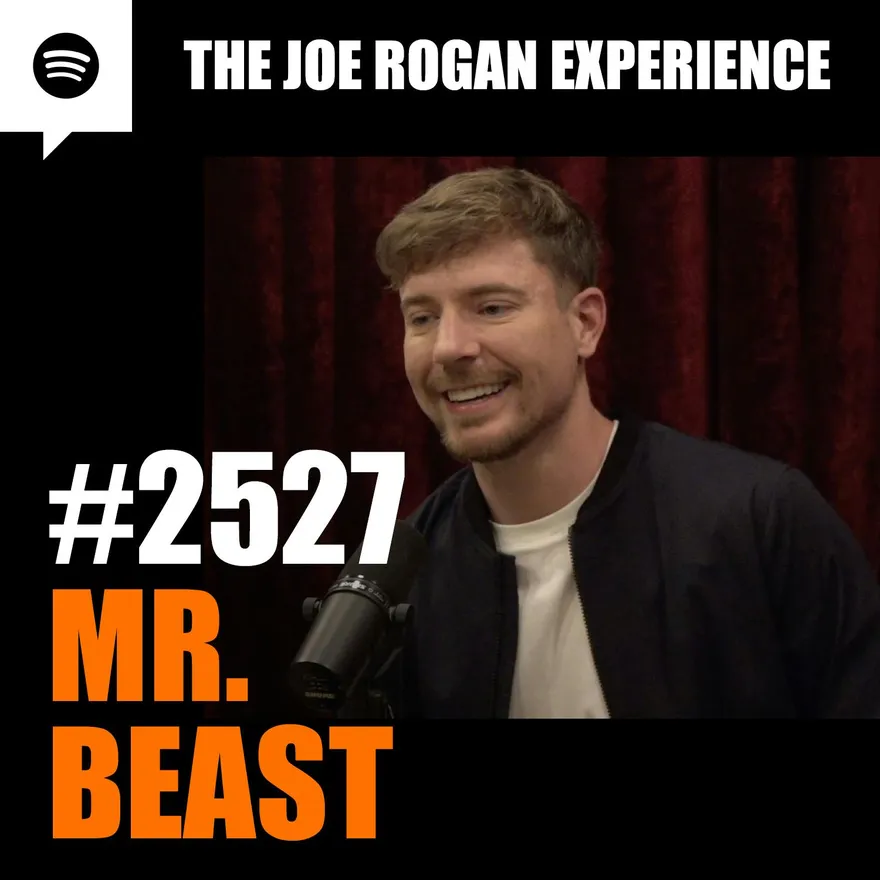

This is a preview of the Shortform summary of the Jul 16, 2026 episode of the The Joe Rogan Experience
Sign up for Shortform to access the whole episode summary along with additional materials like counterarguments and context.
1-Page Summary
Content Creation and Entertainment Production
Beast Games Represents Unprecedented Scale in Unscripted Entertainment
MrBeast's Beast Games demonstrates a revolutionary approach to content creation, combining massive budgets with state-of-the-art technology to create authentic, immersive experiences. His Toronto production transformed an airport hangar with a $15 million investment, featuring 1,000 trap doors and creating thousands of local jobs over six months. The production broke world records by deploying over 1,200 cameras—hundreds more than any previous entertainment production—connected by 27 miles of cables to capture all 1,000 contestants in real time. This required over 150 editors to manage post-production across multiple locations.
MrBeast's philosophy prioritizes quality over profit, investing all available funds into production value rather than cutting corners like traditional TV networks. His approach tackles extraordinary concepts with first-principles thinking, creating viral "purple cow" content that audiences have never seen before. Streaming partners like Prime Video have provided the creative control necessary to preserve the unique appeal that executive interference typically drains from traditional productions.
Casting Global Productions Requires Extensive Processes to Ensure Fair Representation
For his latest international season featuring one contestant per country, MrBeast's casting process cost over $1 million. The team aggregated candidates from about 200 countries, conducting comprehensive background and psychological checks despite varying infrastructure and record-keeping systems across nations. To protect the show's credibility and avoid bias accusations, MrBeast allowed each country's population to vote on their representative, ensuring local communities owned the selection outcome and shielding producers from international criticism.
Zombie Apocalypse Concept Blends Horror, Survival, and Unscripted Competition
MrBeast and Joe Rogan developed a revolutionary game show concept combining horror elements with survival competition. Elite contestants—survivalists, martial artists, Navy SEALs, UFC fighters—would compete in an abandoned city transformed to look 50 years into a post-apocalyptic future. Over 10 days, contestants face escalating zombie waves each night while completing daily puzzles and physical challenges to grow a prize pool from $1 million to potentially $10 million. These tasks force difficult choices between fortifying defenses and pursuing rewards, inducing sleep deprivation and amplifying tension.
The zombie mechanics use gel blasters or paintball guns with sensor vests that light up upon impact, providing safe feedback. Zombie actors, potentially including eliminated contestants, could earn portions of the prize pool for successful eliminations, creating fierce competition on both sides. Set designers would transform an abandoned city into a cinematic hellscape with decaying buildings, overgrown vegetation, and dwindling supplies of ammunition and food.
MrBeast explains that the show's virality stems from high production value, genuine danger and suspense, and its "purple cow effect"—creating content unlike anything viewers have seen before. The unscripted nature, real stakes, and human drama would generate viral clips across social media platforms, driving word-of-mouth momentum unmatched by formulaic programming.
The Creator Economy as a Viable Career Path
The creator economy has transformed from a fringe pursuit into a mainstream career aspiration, with platforms like YouTube removing traditional entertainment gatekeepers and enabling anyone to build an audience and monetize creativity.
From Fringe Idea to Top Career Choice for U.S. Teens
MrBeast notes that in 2009, almost nobody made a living from online content creation. Today, between 8 and 12 million people worldwide earn full-time income from content, representing roughly 4% of all self-identified creators. YouTube exemplifies this explosive growth, hosting just 69,000 podcasts in 2009 but projected to reach 4.5-4.7 million by 2026. Users upload roughly 500 hours of video every minute—translating to 720,000 hours daily. MrBeast's main channel alone reached 850 million unique viewers and 12 billion views in just 90 days, demonstrating unprecedented global reach unimaginable in the cable TV era. Joe Rogan likens the creator economy to "the new Hollywood," with the world's biggest new intellectual properties emerging from this space.
Success Follows a Replicable Pattern
MrBeast and Rogan emphasize four foundational pillars for success: dedicating thousands of hours to the craft, conducting hundreds of content iterations, consuming all available knowledge on the subject, and immersing oneself in communities of like-minded creators. MrBeast argues that treating content creation with the rigor of traditional careers makes it a practical, teachable path. While some find success in two years, the average is four to five, with some requiring a decade. The key is focusing on the journey, normalizing failure, and viewing setbacks as necessary for long-term progress. Living below one's means during slow-growth periods enables risk-taking and perseverance without requiring immediate financial returns.
Benefits of Sharing Knowledge in Creative Fields
MrBeast emphasizes the creator economy's abundance mindset. Unlike television's limited slots that make peers into competitors, the internet offers virtually unlimited audience capacity. He attributes much of his success to relentless openness and collaboration, mentoring others and sharing strategies transparently. Such knowledge-sharing doesn't diminish one's own opportunity but expands the pie for everyone and raises overall quality. MrBeast shares that a new YouTuber claimed to have quit his job and built a successful channel purely by following advice from a podcast, underscoring the ripple effect of transparent mentorship.
Pathways to Sustainable Creative Careers
Joe Rogan highlights that while the creator economy eliminates old barriers, it doesn't remove the need for rigor, patience, and mentorship. He points to shows like "Kill Tony" as evidence of traceable career steps, where unknown comics progress from open mics to featured club spots to televised performances. The creator space isn't limited to broad appeal—any niche can attract a substantial audience. Recent successful creator-led films like "Obsession," "Backrooms," and "Talk to Me" prove that expertise in viral short-form content translates to cinema-quality storytelling, often surpassing conventional studio projects. MrBeast predicts dozens more creator-led films will follow as funding shifts toward these proven online talents.
AI, Technology, and the Future of Human Reality
AI, VR, and Robotics Will Reshape Society Within Ten Years
Joe Rogan predicts that within a decade, technology will advance to where distinguishing between humans and AI-driven robots may become a central societal theme. MrBeast agrees, suggesting younger generations will quickly adapt to the presence of advanced AI and robotics.
MrBeast shares his experience using a large language model to create a convincing digital twin of a board game expert by feeding it extensive YouTube transcripts. The AI responded exactly as the real person would, matching nuanced decision-making styles and mannerisms. He concludes that with sufficient data, AI can realistically replicate any individual's speech and behavior. Both hosts discuss enormous investment pouring into humanoid robotics, predicting widespread societal integration within ten years across various industries.
Technological advances in virtual reality—haptic suits, omni-directional treadmills, and photorealistic rendering—are set to offer immersive experiences nearly indistinguishable from physical reality. MrBeast and Rogan highlight real-time, AI-generated worlds where users can interact with custom digital environments tailored to their preferences. MrBeast describes how virtual environments may become addictive, suggesting that as VR fidelity increases and social features deepen, many will choose permanent digital existence, especially for escapism or social stimulation. Anime like Sword Art Online exemplify a future where virtual life may be preferable to "real life."
Consciousness and Reality's Nature Suggests Simulations May Mimic Reality
Rogan brings up the double-slit experiment, where observation alters quantum outcomes, suggesting that consciousness itself may affect the structure of reality—raising the possibility that reality is observer-dependent. Both hosts reflect on the limitations of human senses, noting we perceive only a narrow portion of the total informational spectrum. They speculate there could be many unknown senses or types of information humans are fundamentally unequipped to detect.
Rogan references thinkers like Elon Musk to explore the simulation hypothesis: if technological civilizations can harvest all the energy of a star, they could run trillions of simulated universes. In that case, the mathematical likelihood of inhabiting the "base" reality becomes exceedingly small.
Reimagining Human Motivation in Post-Scarcity Economics
Rogan speculates that in a future with universal basic income and post-scarcity economics, people will not need to work for survival. Instead, the societal challenge will be cultivating intrinsic motivation and a sense of purpose as robots and AI handle most productive labor. If VR and AI become sufficiently rewarding and immersive, vast numbers may retreat into digital worlds, abandoning participation in physical society while automated infrastructure ensures their physical needs are met. Rogan argues that for fulfillment, humans require meaningful challenge and achievement, stressing the need to teach future generations to pursue difficult tasks for intrinsic rewards rather than mere necessity.
Social Impact and Ethical Business Practices
Chocolate Industry Profits While 1.5-1.8 Million West African Children Labor
MrBeast reveals that an estimated 1.5 to 1.8 million children are engaged in illegal child labor on cacao farms in West Africa, especially in Côte d'Ivoire and Ghana, which produce the majority of the world's cacao. He reports that about 46% of cacao farms in the region use illegal child labor, but since cocoa is traded through cooperatives of aggregated farms rather than direct relationships with individual farms, ethical sourcing becomes nearly impossible. When MrBeast raised the issue with chocolate company executives, he consistently encountered indifference, with many considering child labor an unavoidable part of the industry. The root cause is endemic poverty: large chocolate companies pay farmers so little that they rely on child labor for survival.
MrBeast's Study Reduces Child Labor By 90% In Seven Months
In response, MrBeast launched a West African study through his brand, Feasible, to prove alternatives were actionable. His intervention model combines paying a living income reference price, working with Fair Trade to guarantee democratically elected cooperatives, and performing regular audits and remediation of child labor. In a seven-month case study spanning five villages with about 10,000 people, child laborers dropped from roughly 550 to only about 50—a 90% reduction. His intervention also included building schools to transition children from work to education, since some communities lacked schools altogether.
MrBeast contends that if major chocolate manufacturers adopted this ethical sourcing model—even if it meant slightly reduced profits—hundreds of thousands of children could be freed from illegal labor. He leverages his significant public platform to raise awareness and pressure companies to act, making it easy for big companies to follow these best practices with a clear, data-proven path.
Food Waste Could Feed Millions With Minimal Coordination
MrBeast points out that 40% of all food produced in the U.S. is discarded, largely due to cosmetic imperfections, arbitrary expiration dates, or retail policies—despite much being perfectly edible. Through a nonprofit network, MrBeast has helped redirect this food waste to food banks and community organizations, distributing over 40 million meals across America. The model is simple and cost-effective: the primary resources needed are transportation and distribution since the food itself comes at zero cost. His network recently launched a new facility capable of distributing about 10 million pounds of edible but unsellable food—an estimated 7 million meals—in just 12 months. He emphasizes that scaling food redistribution is highly feasible, requiring only basic logistical investment, and urges retailers and restaurants to redirect surplus food instead of destroying it.
1-Page Summary
Additional Materials
Clarifications
- "Purple cow" is a marketing concept coined by Seth Godin, meaning something remarkably unique that stands out in a crowded market. It refers to creating products or content so exceptional that they naturally attract attention and word-of-mouth promotion. The idea encourages innovation and distinctiveness to break through consumer indifference. In content creation, "purple cow" content is original and memorable, driving viral engagement.
- First-principles thinking involves breaking down complex problems into their most basic elements and building solutions from the ground up. In content development, it means questioning assumptions and creating original ideas rather than relying on existing formulas. This approach encourages innovation by focusing on fundamental truths rather than conventional methods. It helps creators design unique, impactful content that stands out.
- Deploying over 1,200 cameras requires complex synchronization to capture simultaneous footage without interference. The 27 miles of cables transmit high-definition video signals and power, demanding robust infrastructure to prevent data loss and latency. Managing this setup involves advanced networking equipment and precise coordination among camera operators and technicians. Such scale enables comprehensive real-time coverage, essential for immersive and dynamic unscripted content.
- Post-production editing involves assembling, refining, and enhancing raw footage into a final polished product. Managing over 1,200 camera feeds simultaneously requires a large team to handle tasks like syncing, color correction, sound editing, and selecting the best shots. Editors work in shifts across multiple locations to meet tight deadlines and maintain consistent quality. This scale ensures the complex, real-time coverage of 1,000 contestants is coherent and engaging for viewers.
- Aggregating candidates from 200 countries involves navigating diverse legal, cultural, and logistical barriers. Variations in infrastructure and record-keeping complicate verifying identities and backgrounds. Coordinating communication across time zones and languages requires extensive resources and local partnerships. Ensuring fairness demands transparent processes adapted to each country's unique context.
- Gel blasters and paintball guns are non-lethal replica firearms that shoot harmless gel beads or paint-filled pellets. Sensor vests detect hits by lighting up or signaling when struck, ensuring safe and clear feedback during gameplay. This technology allows realistic combat simulation without physical harm. It is commonly used in recreational activities like laser tag or tactical training.
- The double-slit experiment demonstrates that particles like electrons behave differently when observed, showing wave-particle duality. When not observed, particles create an interference pattern typical of waves; when observed, they act like particles, collapsing the wave function. This suggests that the act of measurement or observation affects physical reality at a quantum level. Some interpret this as implying consciousness or observation plays a fundamental role in shaping reality.
- The simulation hypothesis proposes that our reality might be an artificial simulation, like a computer-generated environment. It draws on advances in computing and philosophical arguments about the likelihood of advanced civilizations creating simulated worlds. Key scientific ideas include quantum phenomena suggesting observer-dependent reality and the vast computational power potentially available to future civilizations. Philosophers argue that if many simulations exist, it’s statistically more probable we live in one than in a base reality.
- Post-scarcity economics describes a society where goods, services, and resources are abundant and easily accessible, eliminating traditional economic scarcity. Universal basic income (UBI) is a government policy that provides all citizens with a regular, unconditional sum of money to cover basic living expenses. In a post-scarcity world, UBI ensures financial security as automation and AI reduce the need for human labor. This shifts societal focus from survival to pursuing personal fulfillment and meaningful activities.
- A "living income reference price" is the minimum price paid to farmers that covers basic living expenses, ensuring they can support their families without resorting to child labor. Fair Trade cooperatives are farmer groups certified to meet social, economic, and environmental standards, promoting democratic decision-making and fair wages. Together, they create a transparent, ethical supply chain that empowers farmers and reduces exploitation. This model helps break the cycle of poverty that drives illegal labor practices.
- Cocoa cooperatives are groups of small-scale farmers who pool their harvests to sell collectively, increasing bargaining power and market access. They handle sales and negotiations with buyers, rather than individual farmers selling directly. This aggregation can obscure individual farm practices, making it harder to monitor labor conditions on specific farms. Direct farm relationships involve buyers working one-on-one with farmers, allowing closer oversight but are less common in large-scale cocoa trade.
- Food waste redistribution involves collecting edible food that retailers or producers discard due to appearance flaws ("cosmetic imperfections") or expiration dates set for safety or quality standards ("arbitrary expiration dates"). Cosmetic imperfections refer to fruits or vegetables that look unattractive but are safe to eat. Arbitrary expiration dates often indicate best-by or sell-by dates, not actual spoilage, leading to premature disposal. Efficient logistics focus on timely collection, transportation, and distribution to ensure food reaches those in need before it spoils.
- The creator economy refers to a digital ecosystem where individuals produce and monetize content directly for their audiences, bypassing traditional gatekeepers like studios or networks. It empowers creators with tools and platforms to build personal brands and revenue streams independently. Unlike traditional entertainment, it emphasizes direct audience engagement, diverse niches, and scalable income sources such as sponsorships, merchandise, and subscriptions. This shift democratizes content creation, enabling more varied voices and innovative formats to thrive.
- "Kill Tony" is a live comedy podcast and show where new comedians perform short sets. It serves as a platform for emerging talent to gain experience and exposure. Comedians progress by moving from open mic nights to featured spots on the show, then to larger venues and televised performances. This illustrates a clear, step-by-step career path in comedy.
- Haptic suits use sensors and actuators to simulate touch, pressure, and temperature, allowing users to physically feel virtual environments. Omni-directional treadmills enable natural walking or running movements in any direction while staying in place, enhancing mobility in VR. These technologies work together to increase immersion by engaging multiple senses and allowing realistic physical interaction. They are essential for creating convincing, full-body virtual experiences beyond visual and auditory stimuli.
- A digital twin is a virtual replica of a real person, created using data like speech patterns and behaviors. Large language models analyze extensive text or audio inputs to mimic how that person thinks and responds. These digital twins can be used for simulations, training, or interactive experiences that feel authentic. They enable personalized AI interactions by replicating individual expertise and mannerisms.
- In quantum mechanics, the "observer effect" means that the act of measurement can change the state of a quantum system. The double-slit experiment shows particles behaving differently when observed, suggesting observation influences outcomes. Some interpretations propose consciousness itself plays a role in collapsing quantum possibilities into a single reality. This idea remains debated and is not universally accepted in physics.
Counterarguments
- While Beast Games' massive budgets and technological feats are impressive, such scale may not be sustainable or environmentally responsible, potentially setting unrealistic expectations for other creators or productions.
- The focus on spectacle and virality in MrBeast's content could overshadow deeper storytelling, artistic merit, or social commentary traditionally valued in entertainment.
- Prioritizing quality over profit is admirable, but MrBeast's model is heavily reliant on sponsorships and platform deals, which may not be replicable for most creators.
- Allowing each country's population to vote on their contestant may not ensure true representation, as internet access and awareness vary greatly between countries, potentially skewing results.
- The zombie apocalypse game show concept, while innovative, may blur the line between entertainment and exploitation of participants' stress and sleep deprivation for audience amusement.
- The creator economy's success stories like MrBeast's are exceptional and may not reflect the reality for the vast majority of aspiring creators, many of whom struggle to achieve financial stability.
- The abundance mindset in the creator economy is not universal; algorithmic competition and platform policies can still foster zero-sum dynamics and burnout.
- The rapid growth of content creation has led to oversaturation, making it increasingly difficult for new creators to gain visibility without significant resources or luck.
- The prediction that AI, VR, and robotics will reshape society within ten years is optimistic; technological adoption often faces regulatory, ethical, and socioeconomic barriers that can slow progress.
- The simulation hypothesis, while intriguing, remains speculative and is not supported by empirical evidence.
- While MrBeast's intervention in West African cacao farming is commendable, scaling such models globally may face significant logistical, cultural, and economic challenges.
- Food redistribution, though impactful, addresses symptoms rather than root causes of food insecurity and systemic waste in the food supply chain.
- The narrative that universal basic income and post-scarcity economics will eliminate the need for work may underestimate the complexities of human motivation, societal structure, and economic transition.
Get access to the context and additional materials
Content Creation and Entertainment Production
Beast Games: Massive Budgets and Technology for Authentic Immersive Unscripted Entertainment
MrBeast’s Beast Games epitomize an unprecedented scale of unscripted entertainment, combining extravagant budgets, state-of-the-art technology, and an obsessive pursuit of authenticity and scale rarely seen in traditional media.
Toronto Production: $15M Hangar Transformation, 1,000 Trap Doors, Thousands Employed Over 6 Months
For Beast Games, MrBeast’s team transformed a massive airport hangar in Toronto, spending $15 million on a set that featured a thousand trap doors—all of which activated when contestants were eliminated. The production created thousands of local jobs, securing work spanning six months, as opposed to the typical week-to-week gig structure in entertainment. The undertaking included building an entire city within the hangar and constructing infrastructure on a scale that left cast and crew awed by its size and ambition.
Record-Breaking 1,200 Cameras and 27 Miles of Cables for Real-Time Contestant Footage
MrBeast’s commitment to capturing authentic moments led to breaking the world record for cameras used in any entertainment production. Over 1,200 cameras (hundreds more than the previous record) covered all 1,000 contestants in real time, enabling producers to show people as they truly are, not via heavily curated footage. This required 27 miles of camera cables and the world's largest control room, with millions of dollars put into just the technical setup.
150 Editors Managed Post-Production for 1,000 Contestants Filmed Across Multiple Locations
With thousands of hours of raw footage, over 150 editors worked on post-production, combing through material from multiple locations. Unlike traditional reality TV, where small camera crews produce semi-scripted moments, Beast Games lets participant stories unfold naturally, as hundreds of perspectives are simultaneously documented and then woven into a coherent and engaging narrative.
Quality Over Profit: MrBeast Prioritizes Production Spending to Differentiate From Traditional Media
MrBeast’s philosophy revolves around maximizing content quality rather than minimizing costs for profit. Unlike TV networks, which cut corners to optimize return, he routinely invests all available funds into elevating production value and narrative innovation. Risk and big-picture thinking are central: extraordinary, “impossible” concepts are tackled with a first-principles approach—deciding what’s truly possible given enough time and money. This attitude has resulted in viral, “purple cow” content—distinctive, never-before-seen productions that stick in audiences’ minds. Streaming partners like Prime Video have allowed him the creative control needed, resisting the interference from executives that often drains shows of their soul and unique appeal.
Casting and Contestant Selection for Large Productions Requires Effort to Ensure Fair Representation and Avoid Bias
Massive productions like Beast Games demand meticulous casting to represent global diversity fairly, requiring extensive processes to avoid bias and backlash.
Season With one Contestant per Country Cost Over $1 Million for Aggregating, Background Checks, and Casting, With Multiple Options for Local Voting
In the latest international season, MrBeast cast one contestant from each of about 200 countries. The process cost over $1 million, as the team aggregated candidates, ran comprehensive background and psychological checks, and offered multiple options for each nation. To mitigate accusations of bias or poor selection, they allowed each country's local population to vote on their representative, ensuring contestants were locally chosen and thus ownership of the outcome rested with their own communities.
Complexity and Cost of Psychological Evaluations and Background Checks in 200 Countries With Varying Infrastructure and Record-Keeping
The logistical challenge was immense—some nations had limited record-keeping and infrastructure, with populations smaller than many U.S. towns. Nonetheless, every potential contestant underwent thorough vetting for background and psychological suitability. The complexity of maintaining safety, credibility, and international harmony, particularly across cultures and systems, taxed both budgets and organizational bandwidth but was essential to project integrity.
Allowing Communities to Choose Representatives Ensures Local Choice Quality, Protects Show Credibility, and Prevents International Criticism
Allowing local voting put the power of contestant selection in the communities’ hands, protecting the show from international criticism over representation. If a country’s chosen representative faltered, responsibility and judgement remained with those who voted for them, not the producers, establishing the show’s credibility and shielding it from subjective claims of bias.
Zombie Apocalypse Show Concept Emerged From Creating Unscripted Content Combining Horror, Survival, Game Shows, Practical Effects
MrBeast and Joe Rogan developed a concept for a revolutionary game show that would blend elements of horror, survival, and unscripted competition—all set in a meticulously crafted post-apocalyptic world.
Proposed Show: Elite Contestants in City Facing 10-day Zombie Waves
In this envisioned show, groups of highly capable contestants—survivalists, martial artists, Navy SEALs, UFC fighters—are dropped into a sectioned-off, abandoned city made to look as if it has aged 50 years into a decaying, vine-covered, resource-scarce wasteland.
Daily Tasks and Puzzles Create a Prize Pool Incentivizing Engagement, Leading To Sleep Deprivation and High-Stakes Resource Allocation Decisions
Contestants face escalating challenges nightly over a 10-day stretch, with new “zombie” hordes appearing as night falls. Each day, contestants must complete intricate puzzles or “escape room” tasks and physical challenges to win additional increments of the prize pool, which starts at $1 million but can grow to $10 million, depending on daily successes. These tasks continuously distract them from fortifying defenses, enforce tough choices on resource allocation, and induce sleep depr ...
Here’s what you’ll find in our full summary
Content Creation and Entertainment Production
Additional Materials
Counterarguments
- While Beast Games’ scale and budget are unprecedented, high spending does not inherently guarantee better storytelling or more meaningful entertainment; smaller productions can achieve authenticity and impact with fewer resources.
- The focus on massive infrastructure and technical spectacle may overshadow the human element, potentially making the content feel impersonal or overwhelming for some viewers.
- Employing thousands for a single production may provide temporary jobs, but it does not address the entertainment industry’s broader issues of job security and sustainable employment.
- The use of 1,200 cameras and extensive technical setups could be seen as excessive, with diminishing returns in terms of actual narrative improvement or viewer experience.
- Prioritizing viral, “purple cow” content may encourage spectacle over substance, risking superficiality or sensationalism at the expense of deeper storytelling or social value.
- Allowing local populations to vote for contestants does not fully eliminate potential biases, as voting systems can be influenced by popularity, social media reach, or local inequalities.
- The logistical and financial resources required for global casting and background checks may not be feasible or scalable for most content creators, limiting the model’s broader applicability.
- The emphasis on creative control and lack of executive oversight, while beneficial for originality, may a ...
Actionables
- you can create your own mini unscripted challenge at home by designing a multi-step game or obstacle course using everyday items, inviting friends or family to participate, and recording the event with your phone from multiple angles to capture authentic reactions and storytelling; afterward, edit the footage into a short highlight reel to share with your group, focusing on the most genuine and surprising moments.
- a practical way to experience large-scale collaboration and fair representation is to organize a group decision-making activity (like choosing a movie, meal, or outing) where each participant represents a different perspective or interest, and everyone votes anonymously using simple online polls or paper ballots, ensuring everyone feels included and the process is transparent.
- you ...
Get access to the context and additional materials
The Creator Economy as a Viable Career Path
The creator economy has transformed from a niche pursuit into a mainstream career aspiration for millions, driven by platforms like YouTube that removed traditional entertainment gatekeepers and enabled virtually anyone to build an audience, share their passion, and monetize creativity. This growth has fundamentally changed career possibilities, especially for younger generations.
Creator Economy: From Fringe Idea in 2009 to Top Career For U.S. Teens, Millions Earning Full-Time Via Content Creation
In 2009, almost nobody made a living from online content creation—being a podcaster or YouTuber didn’t register as a real profession. But today, according to estimates referenced by MrBeast and industry analysts, between 8 and 12 million people earn a full-time income from content, out of 200 to 300 million worldwide who consider themselves creators. Roughly 4% of all self-identified creators are professionals whose main source of income is their content.
YouTube exemplifies the explosive growth: the platform hosted just 69,000 podcasts in 2009, a number projected to climb to 4.5–4.7 million by 2026. Each minute, users upload roughly 500 hours of video—translating to 720,000 hours per day—and more than 20 million videos were being uploaded daily even before the surge of YouTube Shorts. Monthly active YouTube users grew from 1.8 billion to over 3 billion in recent years, with no signs of slowing down. MrBeast reports that his main channel alone reached 850 million unique viewers and 12 billion views in just 90 days—an unprecedented global reach, unimaginable in the era of cable TV.
Platforms like YouTube succeeded by integrating with Android, search engines, and broader internet infrastructure. This symbiosis ensures as internet usage expands worldwide, especially outside China, YouTube consumption rises in parallel. The result is a content landscape where anyone can find or build an audience around any niche, from major entertainment genres to the most obscure historical subjects.
For younger generations, content creation is now a leading career goal, with the creator economy likened to “the new Hollywood” by Joe Rogan. MrBeast adds that the world’s biggest new intellectual properties (IPs) are emerging from this space, further drawing audiences away from traditional TV.
The Pattern For Success as a Content Creator Is Replicable: Time, Improvement, Knowledge, and Like-Minded Company
The metric for success in the creator economy is clear and reproducible. MrBeast and Joe Rogan emphasize four foundational pillars: dedicating thousands of hours to the craft, conducting hundreds of content iterations, consuming all available knowledge on the subject, and immersing oneself in communities of like-minded creators. MrBeast argues that treating content creation with the rigor of traditional careers—think of becoming a pilot, musician, or writer—makes it a practical, teachable path: “If you’re a teenager now and you put in 5,000 hours, 500 iterations, you obsess over this thing… you come out the other end with valuable skills—even if you don’t make it as a YouTuber.”
This process takes years, and creators need to normalize failure and constant experimentation. MrBeast notes that some creative stars may find success in two years, but the average is four to five, with some—like himself—requiring a decade. The key is to focus on the journey, love the work, and view setbacks as necessary for long-term progress.
Overcoming societal skepticism is also important. Many families still view college and traditional careers as the only pathways to stability, sometimes leading creators to question themselves during difficult times. MrBeast recounts moments of doubt but stresses the value of surrounding oneself with supportive, honest peers who keep things in perspective. Living below one’s means during slow-growth periods further enables risk-taking and perseverance, as creators don’t need immediate financial returns and can weather the inevitable dry spells.
Benefits Of Sharing Knowledge In Creative Fields
One distinguishing factor of the creator economy is its abundance mindset. Unlike television, where limited slots make peers into competitors, the internet offers virtually unlimited audience capacity—there’s no need to view other creators as rivals. MrBeast attributes much of his own success to relentless openness and collaboration: he mentors others, shares his strategies transparently, and often helps creators who later make millions. This spirit cycles back, as every creator has something new to teach, even if it’s a small improvement.
Such knowledge-sharing proves that mentoring doesn’t diminish one’s own opportunity; rather, it expands the pie for everyone and raises overall quality, which is essential as audiences now freely choose from trillions of annual views across platforms. A case in point: a gym encounter where a new YouTuber claimed to have quit his job and built a successful channel purely by following the advice he heard on a podcast, underscoring the ripple effect of transparent mentorship.
Younger creat ...
Here’s what you’ll find in our full summary
The Creator Economy as a Viable Career Path
Additional Materials
Clarifications
- The creator economy refers to the ecosystem where individuals produce and monetize digital content directly to audiences, bypassing traditional media companies. It includes diverse revenue streams like advertising, sponsorships, merchandise, subscriptions, and fan donations. This economy relies heavily on digital platforms and social media to connect creators with global audiences. It fundamentally shifts power from centralized institutions to individual creators, enabling new forms of entrepreneurship and cultural influence.
- MrBeast is a highly influential YouTuber known for large-scale, philanthropic, and viral content, making him a leading figure in the creator economy. Joe Rogan is a popular podcaster and comedian whose show reaches millions, shaping public opinion on media and careers. Their success and large audiences give weight to their insights on content creation and career development. Both are seen as credible because they have firsthand experience building sustainable creative careers.
- YouTube Shorts are short-form vertical videos, typically up to 60 seconds, designed for quick, mobile-friendly viewing. They differ from regular YouTube videos, which can be much longer and are usually horizontal. Shorts aim to compete with platforms like TikTok by emphasizing fast, engaging content that encourages frequent viewing and easy sharing. This format helps creators reach new audiences quickly and grow their channels.
- In content creation, "intellectual properties (IPs)" refer to original creations like characters, stories, brands, or concepts that creators develop and own. These IPs can be used to produce various types of content, merchandise, or media adaptations, generating ongoing value. Owning strong IPs allows creators to build loyal audiences and expand their influence beyond individual videos or posts. This concept is similar to how traditional entertainment companies own franchises like movies or TV shows.
- Content iterations refer to the process of creating multiple versions or attempts of a piece of content to improve its quality and effectiveness. Each iteration allows creators to test different ideas, formats, or styles and learn what resonates best with their audience. This trial-and-error approach helps refine skills, storytelling, and engagement strategies over time. Hundreds of iterations are necessary because consistent practice and feedback lead to mastery and successful content creation.
- "Living below one’s means" means spending less money than you earn to save resources. For creators, this financial discipline allows them to invest time in growth without pressure for immediate income. It helps manage income fluctuations common in creative careers. This stability supports long-term risk-taking and persistence.
- “Kill Tony” is a popular live podcast and comedy show where aspiring comedians perform short sets and receive immediate feedback. It serves as a real-world example of a clear, step-by-step career path from amateur to professional comedian. The show highlights how creators can progress through stages, gaining experience and exposure incrementally. This model parallels how content creators grow their audiences and skills over time.
- Starting as an amateur on YouTube involves consistently uploading videos to build content and improve skills. Creators analyze audience feedback and platform analytics to refine their style and topics. Collaborating with other creators and engaging with viewers helps grow a loyal community. Over time, this steady effort can lead to exponential subscriber growth as content gains visibility through YouTube’s recommendation algorithms.
- The films “Obsession,” “Backrooms,” and “Talk to Me” are recent examples of movies created by individuals who first gained fame through online platforms rather than traditional film studios. These films showcase how creators skilled in short-form viral content can produce high-quality, widely viewed cinematic works. Their success highlights a shift in the entertainment industry toward valuing digital-native talent. This trend demonstrates that online creators can compete with and even surpass conventional Hollywood productions.
- Platforms like TikTok, YouTube, and Instagram use algorithms that reward engaging, authentic, and visually appealing content, teaching creators to quickly capture attention. These platforms emphasize short-form, relatable videos, helping younger creators develop storytelling skills suited for fast consumption. They provide immediate feedback through likes, comments, and shares, enabling rapid learning and content refinement. Exposure to diverse content styles and trends fosters creativity and adaptability among emerging creators.
- An "abundance mindset" means believing there are enough opportunities and audiences for everyone to succeed without competing over limited resources. In the creator economy, this encourages collaboration and sharing knowledge rather than secrecy or rivalry. It contrasts with a "scarcity mindset," where people see others as competitors fighting for a small pie. This mindset fosters growth and innovation by expanding the overall market and quality of content.
- Mentoring among creators often happens through direct communication like video calls, social media, or collaborative projects. Experienced creators share tips on content strategy, audience engagement, and technical skills. Knowledge-sharing also occurs via public tutorials, live streams, and community forums where creators exchange feedback. This practical support helps newcomers avoid common mistakes and accelerate growth.
- The comparison to “the new Hollywood” means the creator economy is becoming as influential in entertainment as Hollywood once was. It highlights how independent creators now produce popular content that rivals traditional movies and TV shows. This shift decentralizes content production, allowing diverse voices and new intellectual properties to emerge. It also reflects changing audience habits, favoring online platforms over traditional media.
- The 4% statistic highlights that while many people create content, only a small fraction make enough money to rely on it as their main income. This shows the creator economy is highly competitive and success requires significant effort and skill. It also implies most creators do it part-time or as a hobby, not a full career. Understanding this helps set realistic expectations for aspiring creators.
- YouTube’s integration with Android ...
Counterarguments
- While millions aspire to full-time content creation, only a small percentage (about 4%) achieve it, meaning the vast majority do not earn a living from their efforts.
- Income in the creator economy is highly uneven, with a small number of top creators earning the majority of revenue, while most creators earn little or nothing.
- The lack of job security, benefits, and predictable income makes content creation a riskier and less stable career path compared to traditional employment.
- Algorithm changes, platform policy shifts, or demonetization can abruptly impact creators’ livelihoods, making the career path vulnerable to external factors beyond creators’ control.
- The pressure to constantly produce content and maintain relevance can lead to burnout and mental health challenges for creators.
- Success in content creation often requires significant upfront investment in equipment, time, and sometimes marketing, which may not be accessible to everyone.
- The open and collaborative culture described is not universal; some creators experience toxic competition, harassment, or plagiarism.
- The creator economy’s accessibility can lead to market oversaturation, making it increasingly difficult for new creators to stand out or grow an audience.
- Not all niches are equally monetizable; some subjects may attract passion ...
Get access to the context and additional materials
Ai, Technology, and the Future of Human Reality
Ai, Vr, and Robotics Will Reshape Society Within ten Years, Possibly Blurring the Line Between Simulated and Actual Reality
Joe Rogan predicts that within a decade, technology will advance to the point where distinguishing between humans and AI-driven robots may become a central societal theme, possibly sooner. Mr Beast agrees, suggesting younger generations will quickly adapt, normalizing the presence of advanced AI and robotics.
Ai Models Can Create Digital Twins Replicating Speech, Mannerisms, and Decision-Making
Mr Beast shares an experience where he used a large language model to create a convincing digital twin of a board game expert by feeding it extensive transcripts from YouTube videos. The AI responded exactly as the real person would, even matching nuanced decision-making styles and mannerisms. Mr Beast concludes that, with sufficient data, AI can realistically replicate any individual’s speech and behavior, implying robotic surrogates could soon communicate indistinguishably from real people.
Robotics With Ai Integration: Ubiquitous Autonomy Across Industries
Both hosts discuss the enormous investment pouring into humanoid robotics, predicting widespread societal integration. Within ten years, humanoid robots combined with advanced AI could become routine across various industries, performing a wide spectrum of tasks currently perceived as extraordinary.
Haptic Suits, Omnidirectional Treadmills, and Photorealistic Vr Enable Living In Simulated Worlds With Perfect Sensory Fidelity
Technological advances in virtual reality such as haptic suits and omni-directional treadmills, alongside photorealistic rendering, are set to offer immersive experiences nearly indistinguishable from physical reality. Mr Beast and Rogan highlight real-time, AI-generated worlds where users can interact with custom digital environments tailored to their preferences, reducing the friction between physical and virtual experiences.
Addiction Potential in Virtual Environments: Over-Stimulation, Social Connection, and Escapism for the Dissatisfied
Mr Beast describes how virtual environments may become addictive, referencing his own past video game habits. He suggests that as VR fidelity increases and social features deepen, many will choose permanent digital existence, especially for escapism, social stimulation, or in old age. Anime like Sword Art Online exemplify a future where virtual life may be preferable to "real life," presenting complex issues around addiction and societal withdrawal.
Consciousness and Reality's Deterministic or Observational Influence Suggests Simulations May Mimic Reality
Double-Slit Experiment Suggests Observation Affects Quantum Behavior, Implying Consciousness Influences Reality
Joe Rogan brings up the double-slit experiment, where observation alters quantum outcomes, suggesting that consciousness itself may affect the structure of reality—raising the possibility that reality is, in essence, a kind of observer-dependent simulation.
Human Perception Limited to Narrow Sensory Slice, Suggesting Undetected Information and Unknown Senses
Both hosts reflect on the limitations of human senses, noting we perceive only a narrow portion of the total informational spectrum. Referencing a video where they helped blind individuals see, Mr Beast highlights that, without guidance, people may never realize the existence of certain senses. They speculate there could be many unknown senses or types of information humans are fundamentally unequipped to detect, underlining our potentially siloed access to reality.
Probability Suggests Advanced Civilizations Harness Star Energy to Simulate Trillions of Universes, Making the Chance of any Reality Being "Base Reality" Smal ...
Here’s what you’ll find in our full summary
Ai, Technology, and the Future of Human Reality
Additional Materials
Clarifications
- The double-slit experiment demonstrates that particles like electrons exhibit both wave and particle properties. When not observed, particles create an interference pattern typical of waves, but when observed, they behave like particles, hitting specific spots. This suggests that the act of measurement or observation affects the outcome. It challenges classical ideas about reality being independent of observation.
- In quantum physics, particles like electrons behave differently when measured or observed, collapsing from multiple possibilities into a single outcome. This phenomenon, seen in the double-slit experiment, suggests that the act of observation affects the system's state. Some interpretations propose that consciousness or the observer's awareness plays a role in this collapse, linking mind and reality. However, this remains debated and is not universally accepted as proof that consciousness directly shapes physical reality.
- Digital twins are virtual replicas of real people created by AI using large amounts of data about their speech, behavior, and decision patterns. AI models analyze this data to learn how the person talks, thinks, and acts, enabling the digital twin to mimic them accurately. These replicas can interact in ways indistinguishable from the original individual. This technology relies on advanced machine learning techniques like natural language processing and behavioral modeling.
- Haptic suits use sensors and actuators to simulate touch, pressure, and temperature, providing physical feedback to the wearer. Omnidirectional treadmills allow users to walk or run in any direction while staying in one place, enabling natural movement in virtual environments. Together, they enhance immersion by engaging multiple senses and allowing realistic physical interaction. These technologies bridge the gap between virtual actions and real-world sensations.
- Post-scarcity economics describes a society where goods, services, and resources are abundant and easily accessible, eliminating traditional economic scarcity. Universal basic income (UBI) is a government policy that provides all citizens with a regular, unconditional sum of money to cover basic living expenses. Together, they envision a future where people do not need to work for survival, as technology meets most needs automatically. This shifts focus from earning income to finding personal purpose and fulfillment.
- The simulation hypothesis proposes that our reality might be an artificial simulation created by an advanced civilization. If such civilizations can simulate entire universes, the number of simulated realities could vastly outnumber the one original, or "base," reality. Therefore, statistically, it is more likely that we exist within one of these simulations rather than the base reality. This reasoning relies on assumptions about technological capability and the willingness to create many simulations.
- "Base reality" refers to the original, physical universe that exists independently and is not simulated. Simulated realities are artificial environments created by advanced technology that mimic or replicate aspects of base reality. The simulation hypothesis suggests we might be living in one of many such simulations rather than base reality itself. This idea raises questions about the nature of existence and how we can distinguish true reality from simulations.
- AI-generated virtual environments can be customized in real-time by using algorithms that analyze user behavior and preferences instantly. These systems adjust elements like scenery, objects, and interactions dynamically to match the user's desires or emotional state. Machine learning models predict what changes will enhance immersion or enjoyment, enabling seamless adaptation. This creates a personalized experience that evolves continuously as the user interacts with the environment.
- Addiction to virtual environments often involves the brain's reward system, where dopamine release reinforces pleasurable activities. Immersive VR can overstimulate this system, creating strong cravings to return. Psychological factors like escapism and social connection needs also drive repeated use. Over time, this can alter neural pathways, making disengageme ...
Counterarguments
- Predictions about the indistinguishability of AI-driven robots from humans within ten years may be overly optimistic, as current AI and robotics still face significant technical and ethical hurdles.
- The rapid normalization of advanced AI and robotics by younger generations is not guaranteed; cultural, ethical, and socioeconomic factors could slow or complicate adoption.
- AI-generated digital twins can mimic speech and mannerisms, but replicating genuine decision-making and consciousness remains unproven and is a subject of ongoing debate.
- Widespread societal integration of humanoid robots across industries depends on overcoming cost, safety, regulatory, and public acceptance challenges.
- The claim that humanoid robots will routinely perform extraordinary tasks within a decade may underestimate the complexity of real-world environments and human adaptability.
- While VR technology is advancing, achieving "near-perfect sensory fidelity" is still limited by hardware, software, and individual physiological differences.
- The potential for VR addiction is real, but many people may continue to prefer real-world experiences and relationships, limiting large-scale societal withdrawal.
- The double-slit experiment's implications for consciousness influencing reality are controversial and not widely accepted among physicists; most interpretations do not require consciousness to explain quantum phenomena.
- The simulation hypothesis is speculative and lacks empirical evidence; its probability arguments are philosophical rather than scientific.
- Human perception is limited, but technological aids (e.g., sensors, imaging) have already expanded our access to previously undetectable information.
- U ...
Get access to the context and additional materials
Social Impact and Ethical Business Practices
Chocolate Industry Profits While 1.5-1.8 Million West African Children Labor, Companies Ignore Issue
MrBeast reveals the depth of the child labor crisis in West Africa, especially in Côte d’Ivoire and Ghana, which produce the majority of the world’s cacao used for chocolate. According to MrBeast, an estimated 1.5 to 1.8 million children are engaged in illegal child labor on cacao farms, a situation that has persisted for decades. He recounts that when he raised the issue with chocolate company executives, he consistently encountered indifference, with many considering child labor an unavoidable part of the industry. MrBeast reports that about 46% of cacao farms in the region use illegal child labor, but since cocoa is traded through cooperatives of aggregated farms—rather than direct relationships with individual farms—sourcing ethically becomes nearly impossible.
Before MrBeast explored alternatives, there was no industry system guaranteeing that buyers could source ethically produced cacao or significantly reduce child labor. The root cause, he discovered, is endemic poverty: large chocolate companies pay farmers so little that they rely on child labor for survival. Attempts to pay more for ethically sourced cacao were met with confusion and resistance, as such systems and expectations simply did not exist.
MrBeast's West African Study Reveals Ethical Sourcing Reduces Child Labor By 90% In 7 Months
In response, MrBeast launched a West African study through his own supply chain and brand, Feasible, to prove alternatives were actionable and successful. His intervention model combines several strategies: consistently paying a living income reference price (calibrated to meet the actual cost of living locally), working with Fair Trade to guarantee democratically elected cooperatives (ensuring fair allocation of premiums), and performing regular audits and remediation of child labor. Farms participating in this model agree to allow child labor checks in exchange for premium pricing.
The impact was dramatic. In a seven-month case study spanning five villages with about 10,000 people, child laborers dropped from roughly 550 to only about 50—a 90% reduction in under a year. To ensure accuracy, full "remediation" status follows a double-audit process. The remaining cases are scrutinized to verify lasting change. MrBeast notes that some communities lacked schools altogether, since all children previously worked on cacao farms, so his intervention also included building schools to transition children from work to education. He emphasizes that the objective is not just to remove children from labor but to provide them with a future through schooling.
Scaling This Model In West Africa Could Eliminate Child Labor if Chocolate Manufacturers Adopted Similar Sourcing Practices and Accepted Reduced Profits
MrBeast contends that if major chocolate manufacturers adopted this ethical sourcing model—even if it meant slightly reduced profits—hundreds of thousands of children could be freed from illegal labor. He argues that the profits of "Big Chocolate" are more than sufficient to fund such transitions and calls for industry-wide adoption, leveraging his significant public pla ...
Here’s what you’ll find in our full summary
Social Impact and Ethical Business Practices
Additional Materials
Counterarguments
- While MrBeast’s intervention showed a dramatic reduction in child labor in a small sample, scaling such a model across the entire West African cacao industry may face significant logistical, cultural, and economic challenges that were not encountered in the pilot study.
- The complexity of global supply chains and the lack of traceability in cocoa sourcing may make it difficult for large chocolate companies to guarantee that all their cacao is ethically sourced, even with increased investment.
- Paying higher prices to farmers could have unintended economic consequences, such as inflation in local economies or market distortions, if not managed carefully.
- Some critics argue that focusing on Western consumer pressure and corporate responsibility may overlook the role of local governments and the need for systemic policy changes within producing countries.
- Building schools and transitioning children to education is a positive step, but long-term success depends on sustained funding, teacher availability, and community engagement, which may not be guaranteed by private initiatives alone.
- The food redistribution mo ...
Actionables
- you can use a chocolate tracker card in your wallet or phone case that lists brands committed to ethical cacao sourcing, so you can make quick, informed choices when shopping for chocolate and share the card with friends or family when they ask for recommendations
- (For example, print or write a small card with a few vetted brands and a reminder to check for ethical certifications, making it easy to reference or hand out when buying treats or gifts.)
- a practical way to reduce food waste is to set up a weekly “rescued food” meal at home, where you plan one dinner using only ingredients that are close to their expiration date or have cosmetic imperfections
- (For example, designate Friday as your rescued food night, gather items that might otherwise be thrown out, and get creative with recipes—this helps you save money, reduce waste, and develop a habit of mindful consumption.)
- you can encourage ...
Get access to the context and additional materials


Create Summaries for anything on the web
Download the Shortform Chrome extension for your browser
