

#2526 - JD Vance
In this episode of The Joe Rogan Experience, Vice President JD Vance discusses a wide range of policy issues and political topics. The conversation covers the Trump administration's approach to Iran, balancing diplomatic engagement with measured military responses, and addresses criticism from hawkish opponents. Vance explores economic concerns facing young Americans, arguing that job offshoring and wealth concentration have fueled support for socialism among younger generations, and proposes solutions including modernized unions and stricter immigration controls.
The episode also examines election integrity issues, including mail-in voting vulnerabilities and voter ID requirements, as well as the legislative challenges of passing election reform. Vance and Rogan discuss UFO encounters reported by Navy pilots and the barriers to accessing classified information on the subject. Additionally, Vance shares his perspective on Christianity's role in American political economy and public life, advocating for a balanced approach that respects religious expression without government compulsion.
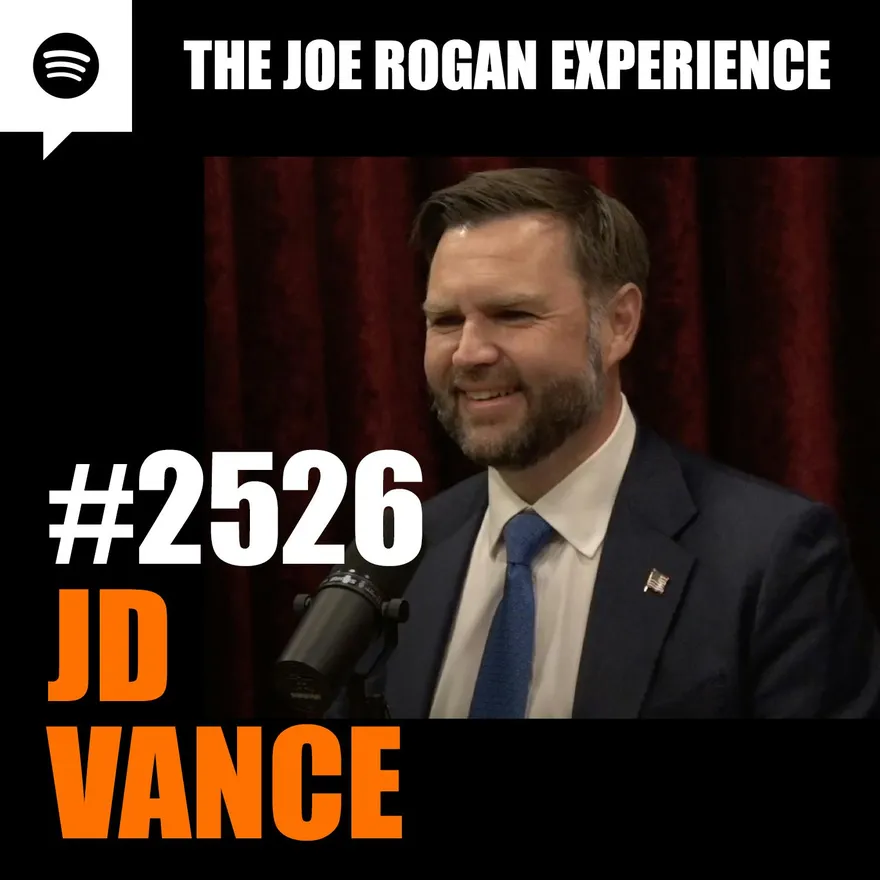

This is a preview of the Shortform summary of the Jul 15, 2026 episode of the The Joe Rogan Experience
Sign up for Shortform to access the whole episode summary along with additional materials like counterarguments and context.
1-Page Summary
Iran's Foreign Policy, Military, and Middle East Talks
Trump Administration Balances Diplomacy and Military In Iran Approach
The Trump administration combines diplomacy with credible military threats in its Iran strategy. A recent memorandum of understanding requires Iran to open the Strait of Hormuz and halt regional violence in exchange for negotiations on a broader nuclear deal and sanctions relief. After signing, oil exports quickly returned to 20 million barrels daily through the strait, but Iranian hardliners attacked ships in protest. The U.S. responded with targeted strikes on the facilities involved, carefully limiting force to defensive responses rather than open-ended campaigns.
The administration's goals include ensuring uninterrupted oil flow through the strait, preventing Iranian nuclear weapons, and maintaining global economic stability. This approach involves engaging pragmatic Iranian factions while responding decisively to hardliner attacks.
Critics Opposing the Iran Deal Lack Alternatives, Seemingly Driven by Ideology Favoring Endless Military Campaigns
Hawkish critics like former Vice President Mike Pence oppose negotiation but struggle to articulate specific objectives beyond perpetual bombing campaigns. Some foreign influence campaigns, including actors tied to Israel, allegedly fund media efforts to shift U.S. public opinion against the deal. The administration rejects large-scale regime change or open-ended war, citing disastrous outcomes in Libya and Syria, and emphasizes that political change in Iran must come from the Iranian people themselves.
Gulf Arab States' $300 Billion Investment: A Mutual Benefit, Not U.S. Concessions to Iran
A major aspect of negotiations involves up to $300 billion in investment from Gulf Arab states into Iran if Iran halts terrorism support and regional aggression. Critics mischaracterize this as a U.S. giveaway, but the investment would come from Iran's regional rivals—the UAE, Saudi Arabia, and others—not from the U.S. Treasury. The arrangement is designed to encourage peaceful compliance and economic reforms, with the U.S. lifting certain sanctions only if Iran meets its obligations.
Foreign Influence Must Not Override U.S. Policy Decisions Based On National Interests
JD Vance acknowledges that countries like Israel and Qatar attempt to influence American foreign policy through lobbying and media campaigns, but emphasizes that the core issue is American leaders' willingness to allow such efforts to determine national policy. Vance insists that U.S. policymakers must prioritize American interests and maintain independence, arguing that sustained diplomacy balanced with measured force serves American interests far better than endless military campaigns.
Worker Power, Inequality, and Socialism Threats in America
Young Americans Back Socialism due to Offshored Jobs and Monopolies Creating an Unattainable System
Vance warns that decades of offshoring jobs and allowing corporate domination have made homeownership and stable family life feel impossible for young Americans. He cites a young engineer who out-earns most of her peers but finds the expectations of owning a house and raising a family "ridiculous" compared to her parents' generation. He also notes that enlisted Marines in Oceanside, California, who once afforded homes there, are now priced out by million-dollar housing costs. Without a credible path to ownership, Vance argues, young people see a "zero-sum environment" and favor socialism as their only hope for equality.
Rapid Economic Transformation Leads To Inequality and Extremism Unless Workers Retain Bargaining Power
Vance points to the Industrial Revolution, which created immense wealth for industrialists while workers endured poor conditions and growing inequality. This imbalance fueled radical movements like fascism and communism. He warns that current trends—especially AI development—risk similar outcomes if wealth is captured solely by tech titans while workers face displacement. Vance contends that "the solution has to be giving normal people actual authority over their own lives." Without robust worker institutions, broader prosperity will give way to support for extreme alternatives.
Rebuilding Worker Power Requires Modernizing Unions For the 21st Century and Controlling Immigration to Prevent Wage Suppression
Vance argues that American labor laws heavily restrict union power compared to European counterparts. He believes unions could become more relevant if allowed greater flexibility to negotiate on behalf of workers. Vance also contends that unrestricted immigration of low-wage workers undermines native workers' bargaining power and suppresses wages, crediting stricter immigration controls for helping stabilize housing costs. He draws on Cesar Chavez's legacy, noting the farmworker leader's opposition to unrestricted immigration because it weakened workers' leverage.
Democratic Socialist Rhetoric On Helping Workers Contradicts Support for Open-Borders That Benefit Wage-Suppressing Corporations
Vance claims that organizations like the DSA contradict their mission by supporting open border policies that serve corporate interests by supplying cheap labor. He argues that the narrative promoted by some progressive groups—that restricting immigration is inherently cruel—actually assists corporations in maintaining depressed wages and undercuts the working class.
Antitrust and Community Participation Ensure Wealth Benefits Society Broadly, Not Just Monopolies and the Ultra-Wealthy
Vance criticizes weak antitrust enforcement since the early 2000s, arguing this allowed market concentration in technology. He calls for vigorous antitrust action to prevent a handful of firms from controlling vital industries. Historically, Vance notes, American communities worked with industries through religious institutions, unions, and civic organizations to ensure economic decisions reflected community values—a model he argues should be renewed to prevent wealth concentration exclusively among monopolies and the ultra-wealthy.
Christian Political Economy: A Middle Path Balancing Property Rights and Inequality
Vance looks to Christian political thought, referencing Pope Leo XIII's late-19th-century encyclical, which recognized the need for a middle path between exploitation and socialism. While Christian tradition values private property and markets, it sees extreme wealth concentration as a profound moral issue. Vance laments that modern politics often frames economic choices as binary—unfettered capitalism or outright socialism—ignoring balanced, principled reform rooted in shared morality and social solidarity.
Election Integrity, Voting Systems, and Election Security
2024 LA Primary Favors Third-Place Candidate, Eliminating Republican In General Election
Joe Rogan discusses the recent Los Angeles primary, where after mail-in ballots were counted, Nithya Raman moved from third to second place, displacing Republican Spencer Pratt from advancing to the general election. Rogan questions the plausibility that mail-in voters would strongly favor the third-place candidate, noting that mail-in ballots are typically expected to reflect the same general preferences as in-person votes. The result was a general election contest between two progressive Democrats, excluding the Republican entirely.
Pennsylvania Court Case Exposes Mail-In Ballot Irregularities Disadvantaging Rural Republicans Over Urban Democrats; Remedy Declined
Vance describes a Pennsylvania court case where a rural voter challenged irregularities that disadvantaged rural Republicans compared to urban Democrats. Urban areas had well-developed mail-in and ballot-harvesting operations that rural areas lacked. The Pennsylvania courts acknowledged these practices harmed rural and Republican representation but ruled that remedying this was a political matter for lawmakers, not a judicial issue.
Voter ID Requirements Are a Security Measure Supported by Most Americans, yet Opponents Falsely Claim They Are Racist
Vance and Rogan express skepticism of claims that voter ID requirements are inherently racist. Vance cites polling showing strong, equal support for voter ID among Black and white Americans. Rogan calls the idea that minorities can't obtain IDs "insane" and "racist," with Vance adding that it's deeply condescending. Both note that primary opposition comes from political operatives rather than the general public, arguing that Democrats oppose federal voter ID based on perceived partisan advantage.
Voter ID and In-person Checks Mitigate Mail-In Ballot Security Vulnerabilities
Rogan and Vance argue that mail-in voting is uniquely vulnerable to fraud, especially ballot harvesting schemes. They cite instances where homeless individuals were paid to use false addresses to obtain mail-in ballots. Both contend that requiring voter ID for both mail-in and in-person voting would greatly reduce fraud by providing consistent identification verification.
Administration's Save America Act With Voter ID Stalls in Senate Filibuster Despite Majority Support
Vance explains that legislation like the Save America Act has considerable Senate support but fails due to the filibuster. Budget reconciliation bills can pass with 50 votes, but non-budget bills require 60 votes. Vance criticizes senators who, despite supporting voter ID, refuse to break the filibuster to achieve it, making meaningful election integrity reforms unlikely unless Senate rules change.
UFOs, Classified Government Programs, and Potential Extraterrestrial Phenomena
Classified Info On UFOs and Potential Alien Materials Restricted From VP
Vance describes that while serving as Vice President, he has effectively unlimited classified access in theory, but day-to-day demands leave little time to focus on the UFO issue. Actually accessing highly compartmentalized UFO materials requires pushing through institutional barriers within intelligence agencies. Specific requests and dedicated time are needed, and even someone as high-ranking as the VP must prioritize this focus to gain access. Rogan emphasizes that security around such information would prevent unauthorized recording, even from top officials.
Lack of New UFO Evidence Since Biden Administration Reduces Urgency For Investigation, Suggesting No Proof of Extraterrestrial Origin
Vance observes that despite many officials with access to classified UFO files during the Biden administration, there has been no publicized breakthrough or major revelation. This lack of new activity diminishes Vance's enthusiasm for pursuing the matter, suggesting either the evidence is ambiguous or true institutional barriers limit even senior officials' access to the most sensitive information.
UFO Encounters by Navy Pilots With Objects Showing Impossible Flight Characteristics Warrant Investigation Despite a Lack of Definitive Evidence
Despite the absence of clear proof, both hosts emphasize the credibility of UFO encounters by naval pilots. Rogan cites Commander David Fravor's account of a craft rapidly descending from 50,000 feet to sea level in an instant—behavior that seemingly defies known physics. Rogan also mentions Ryan Graves' report that after radar upgrades in 2014, Navy pilots began detecting stationary objects at 120 knots and a black cube inside a transparent sphere. While some could be sensor issues, pilot testimonies indicate genuine encounters with unexpected, anomalous objects.
Theories About UFOs: Extraterrestrial, Interdimensional, Advanced Human Tech, and Theological Interpretations
Vance and Rogan explore different interpretations of unidentified aerial phenomena. Vance outlines Eric Weinstein's theory that there may not be much difference between an advanced space alien and a human with futuristic technology—perhaps from another era or a breakaway civilization. Vance suggests that from a theological standpoint, what people label as aliens could be interpreted as angels, demons, or other supernatural entities, noting that broad similarities across historical accounts point to a recurring phenomenon.
UFO Classified Info May Involve Fund Misuse and Congress Deceit, Amnesty Needed For Official Disclosure
Rogan highlights the potential misuse of federal funds and deception of Congress over decades of secret UFO programs. If such black programs exist, officials involved could face significant criminal liability, creating an additional layer of secrecy. Rogan and Vance discuss that substantial amnesty would be needed to encourage whistleblowers to disclose the extent of these programs without fear of prosecution.
Religion, Faith, and Christianity in American Political Economy
Christian Framework for Political Economy Abandoned In U.S. Politics, Replaced by Capitalism-Socialism Binary
Vance argues that the United States has lost an important Christian approach to political economy. Current debates frame economics as a strict choice between libertarian capitalism and socialism, but historically there was a third way rooted in Christian teaching. This Christian tradition values both private property and state protection while also seriously addressing extreme wealth inequality. Vance points to Pope Leo XIII's emphasis on institutional solutions rather than solely redistributive approaches for economic transformation.
Christian Symbols in Government Spaces Acknowledge Legal Tradition, Not Forced Conversion
Vance responds to criticism about displaying the Ten Commandments in public spaces by highlighting their historical and cultural significance to Western law and American constitutional design. He contends such displays acknowledge the foundational role religious texts have played in shaping legal tradition rather than coercing religious beliefs. Vance notes that many public buildings display a variety of cultural and religious influences reflecting the broader tradition of lawgiving in Western civilization. He argues that seeing the Ten Commandments should be understood as recognizing an important cultural foundation, not as forced conversion.
Secularism as State Religion: Overcorrection Discriminating Against Believers
Vance contends that in striving to separate church and state, the United States has sometimes gone too far, effectively replacing religious expression with state-imposed secular philosophy. He cites court rulings prohibiting even student-led prayer at school events, which he believes constitutes suppression of religious expression rather than true neutrality. Vance argues that religious people should not be silenced from civic participation because of their faith, calling for a balanced approach that respects the First Amendment without government compulsion.
Christian Leaders Should Address War and National Security With Humility, Not Assuming Military Campaigns or Leaders Align With God's Will
Commenting on claims that military campaigns or specific political leaders are connected to God's plan, Vance clearly rejects this approach. He warns against commanders claiming that bombing campaigns are divine missions, emphasizing that traditional Christian thought sees war as sometimes necessary but always as a tragic failure of peace. Vance advocates that Christians in authority should stress God's sovereignty while urging serious moral reflection, echoing Lincoln's caution to "hope that you're on God's side," not assume "God has taken your side."
Publicly Living Faith Through Example Over Legislation
Vance insists that faith should be expressed foremost by living with integrity and embodying Christian values in personal and public life rather than through legislating mandatory religious symbols. He describes how he strives to live his Christianity as an example for others, inspiring curiosity about his faith without imposing it. Both Vance and Rogan agree that the most effective way to inspire faith is through the example of a well-lived Christian life, not through government compulsion. In a diverse society, they argue, religious conviction is best shared through example, engagement, and voluntary expression, not state mandate.
1-Page Summary
Additional Materials
Counterarguments
- The Trump administration’s reliance on military threats alongside diplomacy may have escalated tensions and risked unintended conflict, undermining long-term regional stability.
- The memorandum of understanding’s effectiveness is questionable, as Iran’s compliance may be temporary or superficial, and hardliner attacks suggest internal divisions that undermine negotiated outcomes.
- Targeted U.S. strikes, even if limited, can still provoke retaliation and entrench hostility, making sustainable peace more difficult.
- Engaging only “pragmatic” Iranian factions may sideline broader Iranian society and fail to address underlying grievances fueling hardliner influence.
- Critics of the Iran deal may have legitimate concerns about Iran’s regional behavior and the durability of negotiated commitments, even if they lack detailed alternative proposals.
- Allegations of foreign influence campaigns against the Iran deal should be substantiated with clear evidence; many Americans oppose the deal for domestic policy reasons.
- Rejecting regime change does not guarantee that diplomatic engagement will lead to meaningful reform within Iran, as the regime has a history of resisting internal change.
- Gulf Arab investment in Iran could inadvertently strengthen Iran’s regional influence or be diverted to activities contrary to U.S. interests.
- The assumption that economic incentives alone will change Iran’s behavior may underestimate ideological and security motivations driving Iranian policy.
- While foreign lobbying exists, U.S. policymakers are ultimately responsible for their decisions, and bipartisan consensus often shapes foreign policy regardless of outside influence.
- Diplomacy and measured force are not always sufficient to deter adversaries or protect U.S. interests, especially if adversaries perceive U.S. resolve as inconsistent.
- The link between offshoring, monopolies, and support for socialism among young Americans may overlook other factors such as cultural shifts, education, and changing social values.
- Economic inequality and technological change do not inevitably lead to extremism; robust democratic institutions and social safety nets can mitigate these risks.
- Modernizing unions and controlling immigration are not the only ways to strengthen worker power; policies like wage subsidies, portable benefits, and skills training can also help.
- Restricting immigration may harm sectors dependent on immigrant labor and reduce overall economic growth.
- European-style union flexibility may not be directly transferable to the U.S. context due to differences in legal, cultural, and economic systems.
- Democratic socialist support for open borders is not universal, and some left-leaning groups advocate for balanced immigration reform.
- Antitrust enforcement alone may not address all causes of wealth concentration; tax policy, education, and innovation policy also play roles.
- Community collaboration with industry is more challenging in a globalized economy where companies operate across borders and local influence is limited.
- Christian political economy is one of many ethical frameworks; secular or pluralistic approaches may offer alternative solutions to inequality.
- The binary framing of capitalism versus socialism is often used for political messaging, but many policy proposals blend elements of both systems.
- Mail-in ballots favoring a particular candidate may reflect demographic differences in voting methods rather than irregularities.
- Statistical anomalies in election results are not necessarily evidence of fraud or manipulation; thorough audits and transparency are essential for trust.
- Courts declining to intervene in election administration reflects respect for the separation of powers and legislative authority over election rules.
- Voter ID requirements can disproportionately impact marginalized groups who face barriers to obtaining identification, even if overall support is high.
- Claims of widespread mail-in ballot fraud are not substantiated by evidence from multiple studies and court cases.
- The filibuster is a longstanding Senate rule intended to encourage bipartisan consensus; changing it for one issue could have broader institutional consequences.
- Institutional barriers to classified information access exist to protect national security and prevent leaks, not necessarily to conceal wrongdoing.
- The lack of new UFO evidence may reflect the absence of credible data rather than deliberate suppression.
- Extraordinary claims about UFOs require extraordinary evidence; pilot reports, while credible, are not definitive proof of non-human technology.
- Theological interpretations of UFOs are speculative and not universally accepted, even among religious communities.
- Amnesty for officials involved in classified programs could undermine accountability and set a precedent for excusing misconduct.
- The U.S. has a tradition of separating church and state to protect religious freedom for all, and displaying religious symbols in government spaces can be exclusionary to non-Christians.
- Secularism in government is intended to ensure neutrality, not to suppress religious expression in private or community life.
- Prohibiting school-sponsored prayer protects students from coercion and upholds religious liberty in diverse settings.
- Expressing faith through personal example is widely supported, but some argue that public policy should remain neutral to respect all beliefs in a pluralistic society.
Actionables
- you can track how news stories about foreign policy, labor, and elections are presented by different outlets and note which ones disclose funding sources or potential foreign influence, helping you spot bias and make more informed decisions about what to trust and share.
- a practical way to support balanced economic reform is to compare the labor practices and market concentration of companies you buy from, then choose to support businesses that demonstrate fair wages, worker representation, and avoid monopolistic behavior.
- you can reflect on your own civic and religious values by writing a short personal statement about how your beliefs shape your views on economic fairness, public policy, and community life, then use this statement to guide your choices in voting, volunteering, or everyday conversations.
Get access to the context and additional materials
Iran's Foreign Policy, Military, and Middle East Talks
Trump Administration Balances Diplomacy and Military In Iran Approach
The Trump administration pursues a strategy that combines diplomacy with a credible threat of military force in managing its relationship with Iran. Central to recent negotiations is a memorandum of understanding (MOU) that requires Iran to open the Strait of Hormuz and halt violence in return for the opportunity to negotiate a broader nuclear deal and receive sanctions relief. This deal is clear in its demands: Iran must allow the free flow of oil through the strait and reduce regional violence to move the process forward.
Upon signing the MOU, oil exports through the Strait of Hormuz quickly returned to pre-conflict levels, reaching 20 million barrels a day and significantly reducing global oil prices. However, Iranian hardliners, alarmed at relinquishing leverage over this critical global chokepoint, disrupted oil flows by attacking ships. In prompt response, the U.S. struck back at the facilities and personnel involved in these attacks, but with a clear limit: military force is employed only in direct response to violence, avoiding open-ended, indefinite campaigns.
The administration’s goals are threefold: ensure the uninterrupted flow of oil and gas through the Strait of Hormuz, prevent Iran from acquiring nuclear weapons, and recognize the global economic stakes of any strait closure. The delicate balance between military deterrence and diplomatic negotiation involves talking to pragmatist factions in Iran while responding decisively to hostile acts by hardliners. Throughout these phases, the U.S. maintains that its actions—whether military or diplomatic—are always tied to achieving concrete objectives, not pursuing endless military engagement.
Critics Opposing the Iran Deal Lack Alternatives, Seemingly Driven by Ideology Favoring Endless Military Campaigns
Hawkish critics of the administration’s Iran policy, such as former Vice President Mike Pence, argue against negotiation and advocate for a more forceful approach. However, these critics struggle to articulate specific objectives or define what success looks like beyond recommending perpetual bombing campaigns. When pressed, they offer no substantive plan for stopping attacks in the Strait of Hormuz other than continued use of military force and regime change strategies.
Efforts to undermine negotiations also include well-funded foreign influence campaigns. Some elements—including actors tied to Israel—allegedly fund media campaigns and leak information to shift U.S. public opinion against the deal, aiming to perpetuate military conflict. Yet, the administration firmly rejects proposals for large-scale regime change or open-ended war, pointing to disastrous outcomes in Libya and Syria as evidence of failed policies. The administration emphasizes that responsibility for political change in Iran must lie with the Iranian people, not with U.S. military interventions.
Gulf Arab States' $300 Billion Investment: A Mutual Benefit, Not U.S. Concessions to Iran
A major aspect of the negotiation is the potential for up to $300 billion in investment from Gulf Arab states into Iran if the latter halts its support for terrorism and regional aggression. Critics mischaracterize this arrangement as a U.S. cash giveaway, when in reality, the investment would come from Iran’s regional rivals—the UAE, Saudi Arabia, and others—not from the U.S. Treasury. The MOU only stipulates that if Iran meets it ...
Here’s what you’ll find in our full summary
Iran's Foreign Policy, Military, and Middle East Talks
Additional Materials
Counterarguments
- The Trump administration’s approach of combining diplomacy with military threats may risk escalating tensions and could undermine trust in negotiations, making diplomatic solutions harder to achieve.
- The MOU’s requirement for Iran to halt violence and open the Strait of Hormuz may be seen as one-sided, demanding significant concessions from Iran without addressing its security concerns or regional grievances.
- While oil exports increased after the MOU, attributing lower global oil prices solely to this agreement overlooks other market factors such as global demand, alternative suppliers, and OPEC decisions.
- The claim that U.S. military responses are strictly limited to direct attacks may be contested, as even limited strikes can have unintended consequences and risk broader conflict.
- Critics of the administration’s policy may have concerns about the durability of any agreement with Iran, given past instances where negotiated deals have broken down or been reversed by subsequent administrations.
- The assertion that hawkish critics offer no alternatives may not fully acknowledge proposals for increased sanctions, multilateral pressure, or covert operations as alternative strategies.
- The text’s characterization of foreign influence campaigns could be seen as selective, as lobbying and influence efforts are common in U.S. foreign policy debates and not unique to any one country or perspective.
- The $300 billion investment from Gulf Arab states is cont ...
Actionables
- you can practice balancing assertiveness and diplomacy in everyday disagreements by setting clear boundaries while also seeking common ground, such as negotiating household responsibilities or resolving scheduling conflicts with friends, aiming for solutions that address both sides’ needs without escalating tension.
- a practical way to recognize and resist outside influence on your decisions is to track where your information comes from when forming opinions on international news, noting any patterns of bias or repeated narratives, and then intentionally seek out alternative perspectives before making up your mind.
- you can set personal goals with clear, me ...
Get access to the context and additional materials
Worker Power, Inequality, and Socialism Threats in America
JD Vance warns that failing to give young Americans a stake in economic prosperity risks fueling support for socialism, as rising inequality and monopoly power erode the promise of the American Dream and undermine worker security.
Young Americans Back Socialism due to Offshored Jobs and Monopolies Creating an Unattainable System
Vance emphasizes that decades of offshoring jobs and allowing corporations to dominate have made homeownership and stable family life feel impossible for young Americans, even those with high earnings. He recounts how a young engineer, out-earning 75% to 90% of her peers, finds the expectations of owning a house and raising a family “ridiculous” and “unachievable” compared to what her parents’ generation once enjoyed. Vance also cites the Marines in Oceanside, California: whereas enlisted Marines and their families once afforded homes there, million-dollar house prices now bar even Marine officers, reflecting national wage stagnation and runaway housing costs.
Without a credible path to ownership and upward mobility, Vance argues, young people see a “zero-sum environment” and begin to favor socialism as their only hope for equality by forcibly redistributing wealth. He cautions that when youth lack optimism, they grow frustrated and view the system as rigged, gravitating toward radical solutions to “burn it down.”
Rapid Economic Transformation Leads To Inequality and Extremism Unless Workers Retain Bargaining Power
Vance points to history, noting that the Industrial Revolution created immense wealth for industrialists while workers endured poor conditions and growing inequality. This imbalance, he argues, fueled radical movements like fascism in Europe and communism worldwide, as desperate populations struggled for alternatives. He insists that current trends—especially the explosive development of AI—risk similar outcomes if wealth is captured solely by a few tech titans while workers face job displacement and social disruption.
Vance worries that, as during the Industrial Revolution, when people do not feel included in economic progress, social unrest and support for extreme alternatives grow. Both he and Joe Rogan express concern that AI will make jobs and even entire educational paths obsolete. If workers are excluded from the benefits of this new wealth, Vance predicts, broader prosperity will give way to a new surge of support for communism or socialism.
He contends that “the solution has to be giving normal people actual authority over their own lives.” Without robust worker institutions, participation in economic decisions diminishes, leaving people “effectively cut out of the bargain.”
Rebuilding Worker Power Requires Modernizing Unions For the 21st Century and Controlling Immigration to Prevent Wage Suppression
Vance notes that American labor laws heavily restrict the power and flexibility of unions compared to their European counterparts. He argues that in Europe, unions thrive by cooperating more closely with employers and negotiating flexible arrangements, such as allowing trainees to earn less than minimum wage but receive valuable training and benefits—something US law does not permit. He believes unions could become more relevant if allowed greater freedom to negotiate on behalf of workers, adapting to contemporary labor market needs.
Vance also contends that unrestricted immigration of low-wage workers undermines native workers’ bargaining power and suppresses wages. He credits stricter immigration controls for helping stabilize rents and housing costs, asserting that corporations prefer an ample supply of low-wage labor to boost profits and pit workers against one another for the lowest pay. Vance draws on the legacy of Cesar Chavez, noting that the farmworker leader was staunchly opposed to unrestricted immigration because it weakened workers' leverage.
Democratic Socialist Rhetoric On Helping Workers Contradicts Support for Open-Borders That Benefit Wage-Suppressing Corporations
Vance claims that organizations like the DSA (Democratic Socialists of America), which advocate for workers, contradict their mission by supporting open border policies that ultimately serve corporate interests. He argues that open immigration policies supply corporations with cheap labor, directly undermining the wages and power of existing workers and further eroding the middle class.
He believes the narrative promoted by some progressive groups—that restricting immigration is inherently cruel or xenophobic—serves rather to assist corporations in maintaining depressed wages. Vance maintains that the actual impact of such policies is to undercut the working class, which he says contr ...
Here’s what you’ll find in our full summary
Worker Power, Inequality, and Socialism Threats in America
Additional Materials
Clarifications
- JD Vance is an American author and venture capitalist known for his memoir "Hillbilly Elegy," which explores social and economic issues in working-class America. He has become a prominent public commentator on topics like inequality, culture, and politics. Vance's opinions matter because he combines personal experience with political involvement, including serving as a U.S. Senator from Ohio. His views influence debates on economic policy and social issues in the United States.
- The Industrial Revolution, starting in the late 18th century, transformed economies from agrarian to industrial, creating factories and mass production. It led to vast wealth for factory owners but harsh working conditions, low wages, and job insecurity for laborers. This economic shift exposed deep class divides and sparked early labor movements demanding rights and protections. The resulting social tensions influenced political ideologies, including socialism and communism, as workers sought alternatives to exploitation.
- The Democratic Socialists of America (DSA) is a political organization advocating for democratic socialism, aiming to reduce economic inequality through policies like universal healthcare and workers' rights. It supports expanding social welfare programs and increasing government regulation of corporations. The DSA often aligns with progressive movements but is distinct from traditional socialism by emphasizing democratic processes. Its stance on immigration is generally pro-open borders, viewing immigration as a human right and economic benefit.
- Cesar Chavez was a prominent labor leader who co-founded the United Farm Workers union in the 1960s. He organized strikes and boycotts to improve wages and working conditions for farmworkers, many of whom were Latino and faced exploitation. Chavez emphasized nonviolent protest and community solidarity to gain labor rights. His legacy includes raising national awareness of farmworker struggles and inspiring broader labor and civil rights movements.
- Antitrust laws are regulations designed to prevent monopolies and promote competition in markets. They prohibit practices like price-fixing, market division, and abuse of dominant market positions. Enforcement involves government agencies investigating and prosecuting companies that violate these laws to protect consumers and smaller businesses. Effective antitrust action helps ensure no single company can unfairly control an industry or limit consumer choices.
- Pope Leo XIII’s encyclical Rerum Novarum (1891) addressed the social challenges of the Industrial Revolution, advocating for workers' rights and fair wages while upholding private property. It rejected both unregulated capitalism and socialism, promoting a balanced approach to economic justice. The encyclical influenced Catholic social teaching by emphasizing the dignity of labor and the need for social cooperation. Its principles remain relevant as a moral framework for addressing inequality and worker empowerment today.
- European labor laws generally allow unions more flexibility to negotiate varied contracts, including trainee wages and benefits, unlike the stricter U.S. laws that mandate minimum wages and limit such arrangements. European unions often engage in cooperative labor-management partnerships, focusing on long-term workforce development and social dialogue. In contrast, U.S. unions face more legal restrictions on collective bargaining scope and strike actions, weakening their influence. Additionally, European labor systems typically include stronger social safety nets and worker protections embedded in law.
- A "zero-sum environment" means a situation where one person's gain is exactly balanced by another's loss, so total wealth or benefits do not increase. "Worker institutions" refer to organizations like labor unions or cooperatives that represent workers' interests and give them collective bargaining power. These institutions help workers negotiate wages, benefits, and working conditions, balancing power between employees and employers. Without such institutions, individual workers have less influence over economic decisions affecting their lives.
- AI threatens jobs by automating tasks previously done by humans, reducing demand for certain roles. It can also change required skills, making some educational programs obsolete as new technologies emerge. For example, AI-driven software can perform data analysis or customer service, roles traditionally taught in specific courses. This shift forces workers and students to adapt to n ...
Counterarguments
- The link between support for socialism and economic hardship among young Americans is complex; surveys show that many young people support "socialist" policies like universal healthcare or student debt relief, but do not necessarily advocate for full-scale socialism or wealth redistribution.
- While offshoring and corporate consolidation have contributed to economic challenges, factors such as local zoning laws, limited housing supply, and restrictive land-use policies are significant drivers of housing unaffordability, independent of corporate power.
- Wage stagnation and rising housing costs are influenced by multiple factors, including technological change, globalization, and policy decisions at various levels of government, not solely by corporate dominance or offshoring.
- The assertion that open immigration policies universally suppress native workers’ wages is debated; many studies find that immigration has a small or neutral effect on overall wages, and can even boost economic growth and innovation.
- European labor models often rely on strong social safety nets and government intervention, not just union flexibility, and may not be directly transferable to the U.S. context due to cultural and institutional differences.
- The claim that Democratic Socialist organizations support "open borders" is contested; many such groups advocate for humane immigration reform rather than unrestricted immigration.
- Antitrust enforcement has increased in recent years, with both Democratic and Republican administrations pursuing actions against major tech companies, suggesting that concerns about unchecked monopolies are being addressed.
- The historical analogy between the Industrial Revolution and current AI-driven changes may overlook differences in ...

Get access to the context and additional materials
Election Integrity, Voting Systems, and Election Security
2024 la Primary Favors Third-Place Candidate, Eliminating Republican In General Election
Joe Rogan discusses the recent Los Angeles primary, where Karen Bass led after the initial vote count, Spencer Pratt was second, and Nithya Raman was third. However, after mail-in ballots were counted, the final outcome shifted: Nithya Raman moved from third to second place, displacing the Republican candidate, Spencer Pratt, from advancing to the general election. Rogan highlights how unusual this result is, questioning the plausibility that mail-in voters would strongly favor the third-place candidate. Normally, he notes, mail-in ballots are expected to reflect the same general candidate preferences as in-person votes, not dramatically changing the order. Instead, it appeared that mail-in ballots disproportionately benefited Raman, ultimately resulting in a general election contest between two progressive Democrats and excluding the Republican. Rogan questions the logic and integrity of a system where vote share appears “designed” to eliminate a particular candidate.
Pennsylvania Court Case Exposes Mail-In Ballot Irregularities Disadvantaging Rural Republicans Over Urban Democrats; Remedy Declined
JD Vance describes a Pennsylvania court case following the 2020 election where a rural voter challenged irregularities that had disadvantaged rural Republicans compared to urban Democrats. Urban areas like Philadelphia and Pittsburgh, he notes, had well-developed mail-in and ballot-harvesting operations, resources rural areas lacked. This disparity meant rural voters had less opportunity to participate in mail-in voting, which ultimately hurt their representation. The Pennsylvania courts acknowledged that these practices did harm rural and Republican representation, but ruled that remedying this was a political matter for lawmakers, not a judicial issue.
Voter ID Requirements Are a Security Measure Supported by Most Americans, yet Opponents Falsely Claim They Are Racist
JD Vance and Joe Rogan both express skepticism of claims that voter ID requirements are inherently racist. Vance cites polling showing that support for voter ID is strong and essentially equal among Black and white Americans, challenging assertions that such laws disproportionately burden minorities. Rogan calls the idea that minorities can’t obtain IDs from the DMV “insane” and “racist,” with Vance adding that it’s deeply condescending and offensive to suggest that Black and Hispanic Americans can't get identification. Both note that the primary opposition to voter ID comes from political operatives rather than the general public. They also criticize Democrats for opposing federal voter ID rules, arguing that the opposition is based on perceived partisan advantage, not actual voter needs or beliefs.
Voter ID and In-person Checks Mitigate Mail-In Ballot Security Vulnerabilities
Rogan and Vance argue that mail-in voting is uniquely vulnerable to fraud, especially ballot harvesting schemes in which individuals collect and submit ballots on behalf of others, sometimes improperly ...
Here’s what you’ll find in our full summary
Election Integrity, Voting Systems, and Election Security
Additional Materials
Counterarguments
- Mail-in ballots often reflect different demographic and partisan preferences than in-person ballots, as younger, urban, and more progressive voters are more likely to vote by mail, which can legitimately shift election outcomes without indicating fraud or manipulation.
- The expectation that mail-in ballots should mirror in-person voting patterns is not supported by historical data; differences in voting methods often correlate with differences in candidate support.
- Allegations that mail-in ballot results are "designed" to exclude a particular candidate lack evidence and can undermine trust in legitimate election processes.
- Disparities in mail-in voting access between urban and rural areas can be addressed through improved outreach and resources for rural voters, rather than restricting mail-in voting.
- Courts often defer to legislatures on election administration issues to maintain separation of powers, not necessarily because they deny harm or irregularities.
- Multiple studies and court cases have found that voter ID laws can have a small but measurable impact on turnout among certain groups, including minorities, the elderly, and low-income voters, even if most people have IDs.
- While polling shows broad support for voter ID, support does not negate the potential for disparate impact or the importance of ensuring access to identification.
- Some opposition to voter ID laws is based on concerns about administrative errors, costs, and the risk of disenfranchising eligible voters, not solely on partisa ...
Actionables
- You can check your own voter registration status and update your address or ID information to ensure your ballot can't be misused or redirected, reducing the risk of fraud or errors in your name.
- By confirming your registration details online or with your local election office, you help prevent ballots from being sent to outdated addresses or falling into the wrong hands. For example, if you've moved recently, updating your address ensures only you receive your ballot, and verifying your ID on file helps match your identity to your vote.
- A practical way to support election integrity is to encourage friends and family to verify their voter registration and ID status before each election.
- Remind people in your network to check their registration and confirm their information is current, especially if they've moved or changed names. You might send a group text or email with a link to your state's voter portal, making it easy for others to take this step and reduce the c ...

Get access to the context and additional materials
Ufos, Classified Government Programs, and Potential Extraterrestrial Phenomena
The discussion between JD Vance and Joe Rogan explores the complex world of classified government programs relating to unidentified flying objects (UFOs), issues of transparency, theories about the nature of such phenomena, and the institutional and ethical challenges surrounding disclosure.
Classified Info On Ufos and Potential Alien Materials Restricted From Vp
JD Vance describes that while serving as Vice President (VP), he has effectively unlimited classified access in theory. However, day-to-day demands—such as addressing legislation, conducting diplomatic negotiations, or handling critical policy matters—leave little time to focus on the UFO issue. Vance notes that actually accessing highly classified, compartmentalized UFO materials requires not only intent, but pushing through institutional barriers or "gatekeepers" within intelligence agencies. Specific requests and dedicated time are needed to penetrate these barriers, and even someone as high-ranking as the VP must prioritize this focus to gain access.
Vance notes that, despite official claims and rumors that agencies may possess recovered alien craft or materials, he remains unaware of any concrete evidence due to not having had time to pursue investigation deeply. Joe Rogan joins in, emphasizing that security around such information would prevent unauthorized recording or photography, even from top government officials. They speculate that even if such evidence exists, access is tightly controlled and subject to briefing on the grave implications of disclosure, with officials potentially being told to obscure the truth.
Lack of New Ufo Evidence Since Biden Administration Reduces Urgency For Investigation, Suggesting No Proof of Extraterrestrial Origin
Vance further observes that since the Biden administration, despite many officials with access to classified UFO files, there has been no publicized breakthrough, major policy change, or earth-shattering revelation. This lack of new activity somewhat diminishes Vance’s enthusiasm for pursuing the matter, suggesting either the evidence is ambiguous, not as sensational as often believed, or true institutional barriers limit even senior officials’ access to the most sensitive information. Vance points out that the absence of whistleblower activity from newly cleared officials may indicate there is not enough evidence to support dramatic conspiracy theories.
Ufo Encounters by Navy Pilots With Objects Showing Impossible Flight Characteristics Warrant Investigation Despite a Lack of Definitive Evidence
Despite the absence of clear proof, both hosts emphasize the credibility and strangeness of UFO encounters by naval pilots. Joe Rogan cites Commander David Fravor’s account of a craft rapidly descending from 50,000 feet to sea level in an instant—behavior that seemingly defies known physics and has been corroborated by sensor data and trained pilot observations. Vance comments that while one explanation could be sensor error, the pilots’ reactions strongly suggest they were observing something unexplainable, not just misinterpreted visual data.
Ryan Graves Reported 2014 Radar Upgrades Led Pilots to Detect Stationary Objects At 120 Knots and a Black Cube in a Transparent Sphere, Suggesting Sensor Errors or Anomalous Phenomena
Joe Rogan adds Ryan Graves’ report: after new radar upgrades in 2014, Navy pilots began detecting stationary objects at 120 knots and other unexplained phenomena, such as a black cube inside a transparent sphere. While some of these could be dismissed as sensor issues, pilot testimonies indicate genuine encounters with unexpected, anomalous objects.
Pilot Reactions Suggest Encountering the Unexpected, Not Sensor Artifacts
Both hosts emphasize that pilots express genuine surprise and confusion upon witnessing these phenomena, indicating the incidents go beyond mere sensor malfunctions.
Theories About Ufos: Extraterrestrial, Interdimensional, Advanced Human Tech, and Theological Interpretations
Vance and Rogan explore different interpretations of unidentified aerial phenomena. Vance outlines Eric Weinstein’s theory: that there may not be much practica ...
Here’s what you’ll find in our full summary
Ufos, Classified Government Programs, and Potential Extraterrestrial Phenomena
Additional Materials
Counterarguments
- The lack of publicized breakthroughs or whistleblower activity could be due to the genuine absence of extraordinary evidence, rather than institutional barriers or secrecy.
- Many UFO sightings and pilot encounters have been explained by later analysis as misidentified conventional aircraft, atmospheric phenomena, or sensor errors, suggesting that extraordinary claims require extraordinary evidence.
- Theories linking UFOs to religious or supernatural beings are speculative and not supported by empirical evidence; similarities in historical accounts may reflect cultural storytelling rather than a recurring phenomenon.
- The assertion that advanced technology and supernatural abilities are indistinguishable from a less advanced perspective is a philosophical viewpoint, not a factual equivalence.
- The existence of classified programs does not necessarily imply the presence of alien technology or government deception; many classified projects are relat ...
Actionables
- you can create a personal log to document any unusual aerial or atmospheric observations you make, noting details like time, location, weather, and your immediate reactions, which helps you recognize patterns and distinguish between explainable and unexplained phenomena in your environment.
- a practical way to understand the challenges of accessing sensitive information is to set up a mock "classified" folder for your household or friend group, where only certain people can access specific information based on requests and permissions, simulating the barriers and protocols described.
- you can practice c ...
Get access to the context and additional materials
Religion, Faith, and Christianity in American Political Economy
Christian Framework for Political Economy Abandoned In U.S. Politics, Replaced by Capitalism-Socialism Binary
JD Vance argues that the United States has lost an important Christian approach to political economy. He notes that current American debates frame economics as a strict choice between libertarian free-market capitalism and socialism or communism, but historically there was a third way rooted in Christian teaching. This Christian tradition values both private property and state protection of property rights while also seriously addressing the dangers and problems posed by extreme wealth inequality. Vance asserts that Christian economics presents a balanced approach, rejecting both unrestrained markets and extreme redistribution, and draws on the dignity of the person as a basis for economic justice. He points to the tradition of Pope Leo XIII, who emphasized the need for institutional solutions rather than solely redistributive approaches for economic transformation.
Christian Symbols in Government Spaces Acknowledge Legal Tradition, Not Forced Conversion
Vance responds to criticism about displaying the Ten Commandments in public schools and other government spaces by highlighting their historical and cultural significance to Western law and American constitutional design. He contends that such displays serve as an acknowledgment of the foundational role religious texts have played in shaping the legal tradition, rather than as coercive attempts to promote Christianity or force religious beliefs on non-Christian students. Vance notes that many public buildings, including the Supreme Court, display a variety of cultural and religious influences—including Moses descending with tablets—reflecting the broader tradition of lawgiving in Western civilization, which owes much not only to Christianity but also to Jewish and Muslim legal thought.
Vance argues that seeing the Ten Commandments as a non-Christian, such as a Hindu or an atheist, could be understood as recognizing an important cultural foundation of the American classroom and legal system. He asserts that many commandments reflect universal moral principles that most people, religious or not, would agree with. He maintains that America, while majority-Christian and deeply influenced by Christian concepts such as freedom of religion and personal dignity, is also a place where exposure to different beliefs and traditions is a fact of public life. Vance rejects the idea that displaying the Ten Commandments is a form of forced conversion or religious coercion, arguing instead that such measures recognize historical influences, not mandates for personal devotion.
He further states that exposure to religious symbols in public spaces or schools does not hinder students' ability to maintain or practice their own faith, and rejects the notion that seeing the Ten Commandments would coerce secular students or those of other faiths. Instead, he views this argument as implying, incorrectly, that secular philosophies are fragile.
Secularism as State Religion: Overcorrection Discriminating Against Believers
Vance contends that in striving to separate church and state, the United States has sometimes gone too far, effectively replacing religious expression in public spaces with a state-imposed secular philosophy. He cites court rulings that prohibit even student-led prayer at school events or teacher-displayed religious symbols, which he believes constitutes a suppression of religious expression rather than true religious neutrality. Vance points out that the recent approach in the U.S. has been to almost completely remove religion from the public square, privileging secularism by default and thereby discriminating against religious citizens.
He argues that religious people should not be silenced or excluded from civic participation because of their faith, so long as they are not infringing on others' freedoms or enforcing conversion. Instead, Vance calls for a balanced approach that respects the First Amendment, allowing for public engagement of religion without government compulsion or privilege. He stresses that American society is stronger when all citizens can express their values, religious or otherwise, in public life.
Christian Leaders Should Address War and National Security With Humility, Not Assuming Military Campaigns or Leaders Align With God's Will or Are Anointed by Jesus
Commenting on claims made by military leaders that military campaigns or specific political leaders are connected to God’s plan or even anointed by Jesus, Vance clearly rejects this approach. He warns against commanders distorting Christian teachings by claimin ...
Here’s what you’ll find in our full summary
Religion, Faith, and Christianity in American Political Economy
Additional Materials
Counterarguments
- The assertion that the U.S. has "abandoned" a Christian approach to political economy may overlook the ongoing influence of Christian values and organizations in American social policy, charity, and political discourse.
- The framing of American economic debate as a strict binary between capitalism and socialism may oversimplify a more nuanced spectrum of economic thought present in the U.S., including various hybrid models and policy proposals.
- The claim that Christian economics uniquely balances property rights and concern for inequality is contested; other religious and secular traditions also advocate for both property rights and social justice.
- Displaying the Ten Commandments in public schools or government spaces can be perceived by some as government endorsement of a particular religion, potentially conflicting with the Establishment Clause of the First Amendment.
- While the Ten Commandments have influenced Western legal traditions, American law is also deeply rooted in secular Enlightenment principles and English common law, which are not exclusively religious.
- Non-Christian students or citizens may feel excluded or marginalized by religious displays in public institutions, regardless of intent, especially in a religiously diverse society.
- The argument that exposure to religious symbols does not coerce or affect students' beliefs may not account for the experiences of minority faith or non-religious students who report feeling pressured or uncomfortable.
- The idea that secularism in public spaces constitutes a "state religion" is debated; many legal scholars argue that secularism is a framework for neutrality, not an ideology imposed on citizens.
- Court rulings limiting religious expression in public schools a ...
Actionables
- you can start a weekly habit of reviewing local news stories or government decisions and writing a short reflection on how principles like dignity, justice, and respect for diverse beliefs could be better balanced in those situations, helping you practice seeing public life through a lens that values both religious and secular perspectives without privileging one over the other.
- a practical way to embody your values in daily interactions is to intentionally ask colleagues or classmates about their own traditions or beliefs when topics of law, ethics, or public symbols come up, and share your own perspective in a way that highlights shared moral principles rather than focusing on religious differences.
- you can set aside time each month to anonymo ...

Get access to the context and additional materials

 1-Page Summary
- Iran's Foreign Policy, Military, and Middle East Talks
- Worker Power, Inequality, and Socialism Threats in America
- Election Integrity, Voting Systems, and Election Security
- Ufos, Classified Government Programs, and Potential Extraterrestrial Phenomena
- Religion, Faith, and Christianity in American Political Economy
Create Summaries for anything on the web
Download the Shortform Chrome extension for your browser
