

#2515 - Chase Hughes
In this episode of The Joe Rogan Experience, Chase Hughes joins Rogan to discuss a wide range of topics including psychedelic experiences, media manipulation, and the intersection of technology and consciousness. Hughes recounts an extended DMT journey and explores the therapeutic potential of psychedelics for treating conditions like PTSD and addiction. The conversation also examines how government agencies and corporations coordinate to shape narratives, with Hughes explaining his "Psyops Index" for detecting psychological operations in media.
The discussion extends to social dynamics in the modern age, including how social media algorithms amplify division and the performative nature of contemporary society. Hughes and Rogan also explore the mechanics of memory through hypnotic techniques, the role of ego in maintaining beliefs, and emerging technologies like brain-computer interfaces that may fundamentally transform human communication and consciousness.
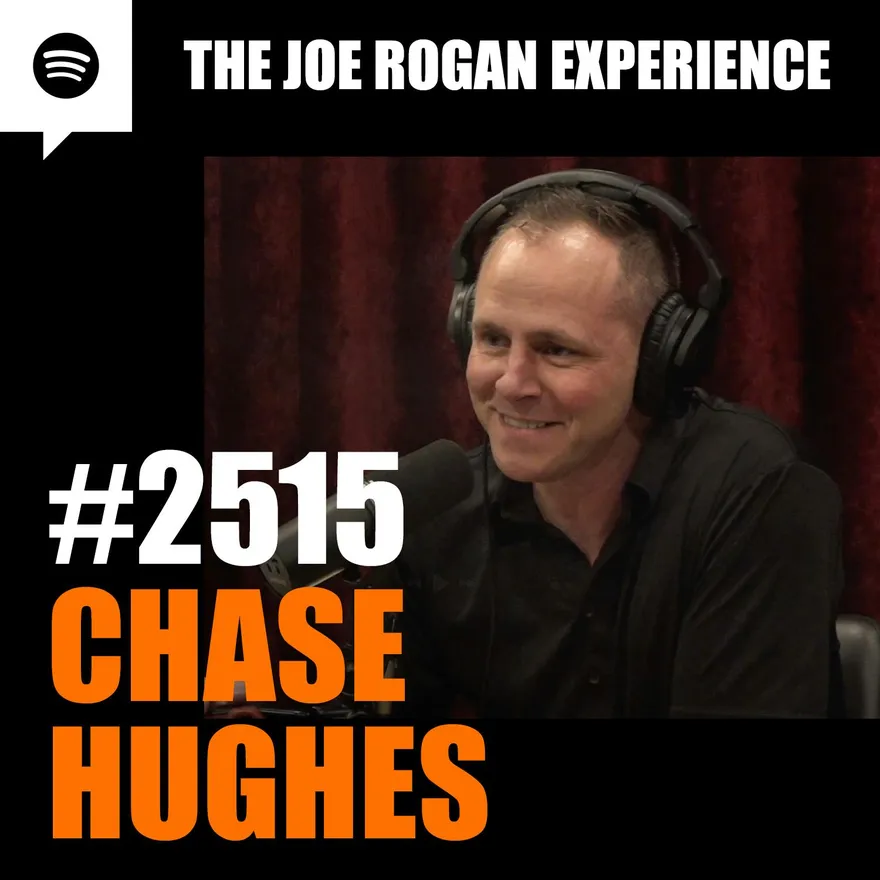

This is a preview of the Shortform summary of the Jun 17, 2026 episode of the The Joe Rogan Experience
Sign up for Shortform to access the whole episode summary along with additional materials like counterarguments and context.
1-Page Summary
Psychedelics, Consciousness, and Therapeutic Transformation
Intravenous DMT and Extended Psychedelic Experiences
Chase Hughes recounts an extraordinary six-hour DMT journey using a medical anesthesia pump that allowed precise control over dosage and duration. He remained at peak DMT intensity for over five hours, experiencing profound disorientation afterward—asking on camera 39 times if he was dead and feeling deep sadness at leaving the DMT realm. Hughes describes having to "wrap himself in ego" to reintegrate into normal reality. To address memory retention challenges, he plans to test combining Alzheimer's drugs with DMT sessions, hoping to bring more insights back from the experience.
The Nature of DMT Experiences and Reality
Hughes emphasizes that DMT experiences differ from typical hallucinations, often featuring structured worlds and sentient beings. He subscribes to Terence McKenna's description of DMT as "death by astonishment," noting that language fails to capture the experience's depth. The conversation explores metaphysical implications, comparing DMT space to dreams where consciousness alone generates convincing subjective realities. Hughes points to visionary artist Alex Gray's Chapel of Sacred Mirrors as an attempt to capture and communicate these experiences through art, though acknowledging art can only hint at, not fully encapsulate, these realities.
Therapeutic Applications and Neurological Benefits
Both hosts highlight growing evidence supporting psychedelics' therapeutic potential. Substances like psilocybin, DMT, and especially ibogaine show effectiveness for treating PTSD, addiction, depression, and anxiety. Ibogaine is singled out for neuroregenerative properties—former Texas governor Rick Perry's brain scans reportedly showed reversal of age-related atrophy after several sessions. Hughes and Rogan discuss anecdotal cases of psilocybin enabling a nonverbal, bedridden dementia patient to regain communication and independence, illustrating how psychedelics can fundamentally restore brain function and enable psychological transformation by revealing beliefs and identity as malleable.
The Dream-Reality Continuum and Consciousness Studies
The hosts explore parallels between dreams and waking reality, arguing both are constructed experiences manufactured by consciousness. DMT journeys illustrate how "objective" reality can reveal itself as consciousness projection. Memory retention difficulties in both dreaming and psychedelic states suggest a cognitive shield preventing non-ordinary state content from integrating into waking awareness. The hosts point to ancient religious art featuring fractal and geometric patterns as visual testimony to psychedelic influences on spiritual traditions, speculating such substances may have historically inspired sacred architecture and ritual practice.
Sacred Mushrooms and Religious History
The dialogue references John Marco Allegro's work linking early Christianity and the Eleusinian mysteries to ritual psychedelic use. Rogan explores theories connecting Amanita muscaria mushrooms to Christmas traditions—shamans collecting mushrooms, traveling by sled, and distributing them down chimneys, while reindeer consumed shaman urine to experience intoxicating effects. The narrative concludes by lamenting psychedelic suppression after the 1970 Controlled Substances Act, suggesting widespread access could foster unity antithetical to social control, making population management more difficult for authorities.
Media Manipulation, Narrative Control, and Psyops
Joe Rogan and Chase Hughes examine how powerful entities coordinate to manipulate information, covering government-corporate overlap in shaping narratives, systematic approaches for detecting psychological operations, and how paid influence distorts media discourse.
Government and Corporate Coordination in Information Control
Hughes traces manipulation back to Operation Mockingbird, when the CIA placed trusted news anchors like Walter Cronkite as assets to spread state-approved narratives. Rogan notes figures like Anderson Cooper, who interned at the CIA, highlighting how such connections persist. The conversation shifts to present-day examples: Rogan recalls Facebook CEO Mark Zuckerberg's admission that the FBI urged censorship of the Hunter Biden laptop story. Financial incentives further compromise objectivity—pharmaceutical companies supply large shares of network advertising revenue, influencing coverage and disincentivizing criticism of the pharmaceutical industry.
The Psyops Index and Detection of Coordinated Manipulation
Hughes details his Psyops Index, a tool assessing whether events or narratives are coordinated psychological operations. The process evaluates pre-ignition factors, operational elements like military drills, and signals such as identical messaging across rival outlets. Hughes and Rogan highlight telltale signs: removal of nuance, false binaries, prepackaged villains, and celebrities across ideological divides echoing identical messages. Hughes's team applies the index daily to current events, aiming to make psychological operations visible and foster public resistance through awareness.
The Failure of Modern Propaganda Techniques
Rogan and Hughes argue contemporary propaganda is losing effectiveness due to alternative media platforms. During COVID-19, attempts to suppress dissenting voices like Rogan's backfired, driving millions to investigate independently and expanding his audience. Efforts to delegitimize Dr. Robert Malone and Dr. Peter McCullough only amplified their reach, undermining traditional information gatekeepers. Hughes likens modern propaganda attempts to out-of-touch authority figures struggling with new media ecosystems.
Paid Propaganda and Artificial Consensus
The hosts discuss how political actors and corporations hire influencers to manufacture grassroots consensus. Creators are offered large sums to push messaging or attack critics, risking permanent reputational harm by sacrificing authenticity. AI bots now comprise significant online activity, amplifying manufactured narratives alongside paid human propagandists. Rogan notes pharmaceutical companies pay people to gaslight and attack on social media, distorting organic opinion and debate, ultimately creating social separation and division.
Social Division, Authenticity, and the Loneliness Epidemic
The Performative Nature of Modern Society
Hughes describes the current era as "becoming more and more performative," where authenticity is replaced by curated personas. Even among close friends or spouses, Hughes admits few reveal their true selves, creating what he calls a "loneliness pandemic." Social media exacerbates this by pressuring individuals to compare their lives to others' highlight reels. Hughes emphasizes authentic connection is eclipsed by constant performance and concealed shame, making genuine love and acceptance difficult or impossible.
Social Media Algorithms and Echo Chamber Amplification
Hughes and Rogan discuss how algorithms contribute to division by showing users the most extreme examples of opposing viewpoints, reinforcing the perception that the other side is insane. Algorithmic amplification also normalizes fringe ideas by congregating like-minded individuals, creating enclaves where bad ideas are validated. Furthermore, algorithmic targeting obscures shared values—Hughes points out that people who differ politically actually want the same things: healthy children, safety, and financial stability. However, platforms' algorithms concentrate and distort differences.
The Fear of Social Punishment and Conformity
Hughes argues the "number one fear of human beings" is the potential judgment and ostracism that drives self-censorship. Celebrity labeling—where famous figures publicly assign derogatory group names—justifies public shaming and enforces compliance. Once a public figure is punished, observers internalize the risk and self-silence. Rogan points out people eagerly destroy reputations built over years for a single misstep, particularly if the person doesn't admit fault. This feedback loop drives further self-censorship and entrenches cognitive dissonance.
The Path Toward Authentic Connection
Despite systemic pressures toward performativity, Hughes notes authentically human, flawed voices now resonate more across media platforms than polished messaging. Audiences are drawn to genuine things: "We like the humanness of things." Mutual vulnerability strengthens bonds more than maintaining illusions of flawlessness. Hughes senses growing awareness of divisive tactics, with more people questioning hatred of neighbors for mere opinion differences. There is hope that by reclaiming authentic expression, society can move beyond the loneliness epidemic toward genuine connection.
Technology, Social Media, and Human-Ai Convergence
The Design of Addictive Digital Platforms
Hughes discusses how social media exploits behavioral psychology to maximize addictive engagement. He shares an experiment with his two-year-old's iPad: changing the screen to red—a color frequency reducing visual stimulation—quickly broke the child's addictive pattern. Rogan emphasizes how rare it is to have a built-in tool disrupting "severe addiction" intentionally created by platforms. Hughes concludes that reality is now engineered through screen content and digital platforms.
Business Model of Data Exploitation and Attention Harvesting
The hosts criticize technology companies for building businesses on attention harvesting regardless of harm to users. Hughes and Rogan highlight how core revenue models rely on advertising: more attention enables more ads and data collection. Rogan describes tech executives as brilliant engineers lacking wisdom or empathy, endlessly optimizing systems for engagement at the expense of wellbeing. He also notes how pharmaceutical advertising influences platforms to downplay vaccine safety stories or alternative treatments.
The Emergence of Ai-human Hybridity
Rogan points to brain-computer interfaces like Neuralink, where a paralyzed patient plays video games with thoughts alone. Rogan notes Elon Musk's assertion that soon people will "talk without words," ushering in a hive mind and convergence of human and AI functioning. He positions this as part of humanity's movement toward "post-biological existence," with pharmaceutical endocrine disruption and normalized gender fluidity separating human experience from traditional understandings of embodiment.
The Future of Communication and Collective Consciousness
Rogan and Hughes discuss convergence of technology and consciousness, referencing UAPs and psychedelics as catalysts for new communication forms. Rogan notes accounts of contact with advanced intelligences unanimously describe telepathic communication. Hughes draws parallels to DMT, historically called "telepathine," associated with telepathic experiences during altered states. Rogan argues this evolution points toward creating a hive mind, merging human consciousness with AI and fundamentally transforming communication and what it means to be human.
Memory, Perspective-Shifting, and Ego Dissolution
Techniques For Editing Memory Through Hypnosis
Hughes explains a hypnotic method for consciously editing memories. Under hypnosis, he guides someone to vividly revisit a memory and make tiny alterations, like putting a pencil dot on their childhood bedroom wall. Repeating this process up to 50 times, each time making small changes and moving the participant forward in time, demonstrates memory's malleability. Once participants are adept at small edits, Hughes moves to perspective shifting—re-experiencing memories from different viewpoints. He emphasizes efficacy lies in switching vantage points within memory, generating genuine downstream effects. This process is done in a relaxed theta brainwave state, and Hughes is cautious never to alter substantial aspects, focusing on minor changes and perspective shifting.
The Ego's Role in Memory and Belief
Hughes and Rogan discuss the ego as the main force maintaining identity by defending existing beliefs, often ignoring new evidence. The ego resists change, clinging to beliefs as though admitting error threatens personal annihilation. Hughes highlights the primal fear of tribal ostracism, which historically threatened survival. Rogan describes how merging identity with ideas is a trap—defending beliefs becomes a battle for existential survival. Most people would rather double down than admit they were wrong, a dynamic central to cognitive dissonance.
Perspective Shifting As Therapeutic Mechanism
Both hypnosis and psychedelics can temporarily displace the ego, making room for new perspectives. Hughes says the "final layer" is using these techniques to revisit painful events with present-day adult perspective. This process doesn't erase or falsify memories; instead, it shifts how they're experienced, lessening emotional charge and rewriting unhealthy scripts from childhood trauma. Rogan and Hughes agree curative power comes not from creating false memories but from authentic perspective shifts, resulting in profound, lasting transformation.
The Illusion of Individual Specialness
Hughes describes the "disease of specialness"—the conviction that one's flaws are uniquely awful while everyone else has things figured out. This belief isolates people, reinforcing fears that honesty will lead to rejection. He stresses everyone is performing to some degree, hiding struggles. Acknowledging this universal tendency enables radical honesty and authentic connection. Recognizing no one truly has everything figured out makes it possible to drop the facade and connect genuinely, dispelling isolating beliefs and fostering mutual understanding.
1-Page Summary
Additional Materials
Counterarguments
- The therapeutic potential of psychedelics, while promising, is still under investigation; large-scale, long-term clinical trials are limited, and some reported benefits remain anecdotal rather than scientifically established.
- The claim that ibogaine can reverse age-related brain atrophy is based on isolated cases and lacks robust peer-reviewed evidence; such effects have not been widely replicated or accepted in mainstream neuroscience.
- The assertion that DMT experiences are fundamentally different from hallucinations produced by other substances is subjective; many neuroscientists argue that all psychedelic experiences are products of altered brain chemistry rather than evidence of external realities or sentient beings.
- The idea that ancient religious art and traditions were directly inspired by psychedelic use is debated among historians and archaeologists; alternative explanations include mathematical, cultural, and symbolic influences unrelated to psychoactive substances.
- The suggestion that widespread psychedelic use would necessarily foster social unity is speculative; psychedelics can also induce anxiety, paranoia, or reinforce existing beliefs, and their effects vary greatly between individuals.
- The narrative that government and corporate media manipulation is pervasive and coordinated is contested; while documented cases exist, many journalists and media organizations operate independently and strive for objectivity.
- The effectiveness of the Psyops Index as a tool for detecting psychological operations has not been independently validated or peer-reviewed.
- The claim that modern propaganda is losing effectiveness due to alternative media overlooks the rise of misinformation, echo chambers, and polarization facilitated by those same platforms.
- The portrayal of social media as the primary cause of the "loneliness pandemic" may oversimplify a complex issue involving economic, cultural, and psychological factors.
- The notion that brain-computer interfaces and AI-human convergence will inevitably lead to a hive mind or post-biological existence is speculative and not universally accepted among experts in neuroscience or technology ethics.
- The use of hypnosis to edit memories raises ethical concerns and the risk of creating false or distorted recollections, despite intentions to avoid substantial changes.
- The "disease of specialness" concept may not account for cultural, developmental, or psychological differences in how individuals experience self-worth and connection.
Actionables
- You can keep a daily “reality diary” where you briefly describe your waking experiences, dreams, and any moments that felt especially vivid or surreal, then compare them to notice how your mind constructs different realities and where the boundaries blur. This helps you become more aware of how consciousness shapes your perception and memory, and can reveal patterns in how you process both ordinary and extraordinary experiences.
- A practical way to foster authentic connection and reduce feelings of isolation is to start a “shared flaws” exchange with a trusted friend or family member, where you each anonymously write down a personal insecurity or mistake and swap them, then discuss how common and human these struggles are. This exercise normalizes imperfection and encourages radical honesty, making it easier to connect with others on a genuine level.
- You can experiment with “perspective journaling” by writing about a challenging memory or belief from your current viewpoint, then intentionally rewrite the same event from the perspective of a compassionate outsider or your future self. This helps loosen the grip of old narratives, reduces emotional charge, and demonstrates how shifting perspective can transform your relationship to past experiences.
Get access to the context and additional materials
Psychedelics, Consciousness, and Therapeutic Transformation
Intravenous DMT and Extended Psychedelic Experiences
Chase Hughes describes an extraordinary six-hour intravenous DMT journey conducted using a medical anesthesia pump, allowing precise control over dosage and experience duration. The environment for the session is intentionally calming, with soft pillows, music, and a supportive setting. The pump enables "altitude" adjustments, letting Hughes experience the deepest DMT states, pause for breaks—such as a bathroom visit—and then resume the journey seamlessly. Hughes recounts remaining at the "highest you can feel on DMT" for over five hours, with a single pause, enabling continuous immersion in the psychedelic state.
The profoundness of the experience left Hughes emotionally and psychologically affected upon return. Hughes confesses to struggling with existential disorientation—after the session, he asked on camera if he was dead thirty-nine times, feeling neither concerned nor frightened but disconnected from reality. He was overcome with sadness at leaving the DMT realm, describing how reintegrating into normal reality required "wrapping himself in ego" to function again, and expressing reluctance to return from the other dimension.
To address the notorious barrier to memory retention from such experiences, Hughes plans to test combining Alzheimer's drugs with DMT sessions, hoping experiments with memory-enhancing medication might improve his ability to bring insights from DMT space back into waking life.
The Nature of DMT Experiences and Reality
Hughes emphasizes that DMT experiences stand apart from typical hallucinations. Instead of random visual noise, users often encounter structured worlds and sentient beings, leading many to resist describing the experience as simply a "hallucination." For instance, Hughes describes being pinned down by alien beings who performed surreal procedures on him—while he retains clear impressions of the events, words fail to capture their full depth or meaning.
Hughes subscribes to Terence McKenna's description of DMT as "death by astonishment," highlighting that language often falls short of conveying the content and reality of the state. Even seasoned users can have DMT sessions that seem unyielding or closed off, as if intent or state of mind determines access to the "other" world.
The dialogue considers the metaphysical implications of DMT, drawing on quantum entanglement and dream logic. In dreams, constructed reality—with fabricated distances, objects, and senses—mirrors how, under DMT, consciousness alone generates a subjective universe. Hughes notes that dreams and DMT space demonstrate the mind’s ability to create intricate, convincing worlds from consciousness itself, where sensory information and even visual structures like galaxies or cells mimic each other across scales.
The challenge of bringing back the ineffable qualities of such trips is partially surmounted by visionary artists like Alex Gray. His Chapel of Sacred Mirrors, a non-denominational spiritual space built in the Hudson Valley, features artwork that attempts to capture and communicate the DMT experience. Rogan and Hughes marvel at Gray's skill in rendering morphing, archetypal faces and forms seen in the DMT space, acknowledging that while art can hint at these realities, it can never fully encapsulate them.
Therapeutic Applications and Neurological Benefits
Both hosts cite a growing body of evidence supporting the therapeutic potential of psychedelics. Substances like psilocybin, DMT, and particularly ibogaine are proving highly effective for treating PTSD, addiction, depression, and anxiety—outperforming conventional treatments in efficacy trials.
Ibogaine is singled out for its remarkable neuroregenerative properties, as illustrated by the example of former Texas governor Rick Perry, whose brain scans purportedly showed reversal of age-related atrophy after several ibogaine sessions. The substance reportedly improved cognitive function and even eliminated signs of atrophy, suggesting that psychedelics can fundamentally restore and repair the brain.
The therapeutic approach addressed in the conversation frames beliefs and mental constructs as malleable—identity is not fixed, and psychedelics provide an opportunity to reframe and rebuild the self, often leading to deep psychological healing and transformation.
Anecdotes extend to psilocybin’s effect on severe dementia, such as a case where a nonverbal, bedridden woman reportedly regained communication and independence after a high-dose mushroom session, with further improvements following subsequent doses. The role of other medicinal mushrooms, such as turkey tail, is also discussed, highlighting real-world cases where these therapies have supported recovery from life-threatening illnesses.
The Dream-Reality Continuum and Consciousness Studies
The conversation explores the deep parallel between dreams and waking reality, arguing that both are constructed experiences manufactured by consciousness. In dreams, one’s mind creates objects, distances, and sensations indistinguishable from waking life, yet all elements are ultimately fabrications within the mind. Experiences like DMT journeys further illustrate that so-called "objective" reality can reveal itself as a projection of consciousness, similar to a lucid dream.
A key barrier in both dreaming and psychedelic states is memory retention. Hughes compares the difficulty of recalling dream or DMT cont ...
Here’s what you’ll find in our full summary
Psychedelics, Consciousness, and Therapeutic Transformation
Additional Materials
Counterarguments
- The therapeutic efficacy of psychedelics, while promising in some studies, is not yet conclusively established for all conditions mentioned (e.g., dementia, PTSD, addiction), and more large-scale, controlled clinical trials are needed before drawing definitive conclusions.
- Anecdotal reports, such as those involving Rick Perry or dramatic dementia recoveries, do not constitute scientific evidence and may be subject to placebo effects, reporting bias, or misinterpretation.
- The neuroregenerative properties of ibogaine and other psychedelics have not been universally replicated or accepted in the scientific community, and some studies have raised concerns about potential neurotoxicity or cardiac risks.
- The use of Alzheimer's drugs to enhance memory retention during psychedelic experiences is experimental and lacks established safety or efficacy data.
- The interpretation of ancient religious art and traditions as evidence of psychedelic influence is speculative and not widely accepted among historians or archaeologists.
- The theory that Amanita muscaria use is the origin of Christmas traditions is controversial and not supported by mainstream scholarship.
- The assertion that prohibition of psychedelics was solely or primarily a means of social control is a contested viewpoint; legal restrictions have also been motivated by concerns about public health, safety, and potential for abuse.
- ...
Actionables
- you can keep a daily log of your dreams and waking experiences side by side to notice patterns in how your mind constructs reality, helping you recognize the similarities between dream logic and waking perceptions and prompting reflection on how your beliefs and identity shift across states.
- a practical way to explore the limits of language is to try describing a vivid dream or intense emotional experience to a friend, then ask them to draw or interpret it, revealing where words fall short and encouraging creative ways to communicate ineffable experiences.
- you can create ...
Get access to the context and additional materials
Media Manipulation, Narrative Control, and Psyops
Joe Rogan and Chase Hughes delve into the multifaceted ways in which powerful entities coordinate to manipulate information, exploring both historic and contemporary examples. Their discussion covers government-corporate overlap in shaping narratives, a systematic approach for detecting psychological operations (psyops), the faltering efficacy of modern propaganda, and how paid influence and artificial consensus distort the true shape of media discourse.
Government and Corporate Coordination in Information Control
Rogan and Hughes trace the manipulation of mass media back to Operation Mockingbird, a CIA campaign that placed trusted news anchors, such as Walter Cronkite, as assets to spread state-approved narratives. Hughes emphasizes that virtually every network was compromised during this era, often with anchors instructed on both what to promote and what to suppress. Rogan notes notable figures like Anderson Cooper, who interned at the CIA during college, highlighting how such connections persist.
The conversation then pivots to present-day analogs: Rogan recalls significant pressure on social media platforms to police content during the COVID-19 pandemic. He references Facebook CEO Mark Zuckerberg's admission that the FBI contacted the company to urge censorship, notably concerning the Hunter Biden laptop story. Through revelations such as the Twitter Files, direct coordination between the federal government and tech firms to suppress certain stories comes to light.
Financial incentives further compromise media objectivity. Pharmaceutical companies supply a large share of network advertising revenue, influencing how networks cover drug-related topics and disincentivizing coverage of vaccine injuries or criticisms of the pharmaceutical industry. Rogan and Hughes underscore that, for many networks, maintaining pharma ad streams trumps unbiased reporting, with executives acutely aware of their funders’ priorities.
The Psyops Index and Detection of Coordinated Manipulation
Chase Hughes details his Psyops Index, a tool designed to assess how likely an event or narrative is a coordinated psychological operation. The process starts with pre-ignition factors (social panic, regulatory action), operational elements (military drills or sudden legislative activity), followed by signals like alignment of messaging across rival news outlets and the appearance of headlines with identical phrasing. The index also evaluates the saturation of simple slogans and the emergence of authority figures across ideological divides echoing each other’s language.
Hughes and Rogan highlight telltale signs of manipulation: removal of nuance, creation of false binaries, presentation of prepackaged villains, injected symbolism, and the urgent manufacturing of “do-or-die” timelines for public buy-in. When news is stripped of complexity, delivering only left-versus-right binaries, and when celebrities and politicians across the spectrum begin reiterating identical messages, Hughes argues that a psyop is likely underway.
Hughes’s team applies the Psyops Index daily to current events, contrasting how issues are presented in media with omitted context and critical nuance. Their goal is to make these psychological operations visible, fostering public resistance through awareness and skepticism.
The Failure of Modern Propaganda Techniques
Rogan and Hughes argue that contemporary propaganda is losing effectiveness. Alternative and independent media platforms have fundamentally shifted the playing field, blunting the power of coordinated narratives. During the COVID-19 era, attempts to suppress dissenting voices like Rogan’s often backfired. When mainstream media and government tried to discredit or “cancel” Rogan—such as when outlets manipulated imagery of him or attacked his choice of medical discussions—it drove millions to investigate his claims independently, dramatically expanding his audience.
Efforts to censor or delegitimize voices such as Dr. Robert Malone, the inventor of mRNA technology, and Dr. Peter McCullough, the most published cardiologist in his field, only amplified their reach, undermining the credibility of traditional information gatekeepers. Rogan points out that despite immense pressure—including coordinated campaigns in ...
Here’s what you’ll find in our full summary
Media Manipulation, Narrative Control, and Psyops
Additional Materials
Counterarguments
- While Operation Mockingbird is a documented historical program, claims that "virtually every network was compromised" and that anchors were systematically instructed on what to promote or suppress are not universally accepted by historians and lack comprehensive evidence.
- Connections between media figures and intelligence agencies, such as Anderson Cooper's internship, do not necessarily imply ongoing influence or manipulation; internships and past employment do not equate to covert operational control.
- The Twitter Files and Mark Zuckerberg's statements indicate government requests to moderate content, but there is debate about whether these actions constitute "censorship" or are part of standard content moderation practices in response to concerns about misinformation.
- Financial incentives from pharmaceutical companies are a concern for potential bias, but there are also journalistic standards, editorial independence policies, and regulatory oversight intended to mitigate undue influence on news coverage.
- The assertion that media executives universally prioritize advertising revenue over unbiased reporting is a generalization; many journalists and outlets strive for integrity and transparency despite financial pressures.
- The effectiveness of the Psyops Index as a tool for detecting coordinated psychological operations is not independently validated and may be subject to confirmation bias or subjective interpretation.
- Identical messaging across media and public figures can result from shared news sources, press releases, or consensus on certain issues, not necessarily from coordinated manipulation.
- The claim that contemporary propaganda is "losing effectiveness" is contested; misinformation and disinformation continue to have significant impacts on public opinion and behavior, as seen in various recent events.
- The amplification of dissenting voi ...
Actionables
- you can create a personal “narrative tracker” by jotting down headlines or talking points you see repeated across different news sources and social media, then noting any identical phrases or themes to spot possible coordinated messaging; for example, keep a small notebook or phone note where you log recurring slogans or urgent calls to action, and review it weekly to see patterns.
- a practical way to reduce the influence of paid or inauthentic voices is to pause before sharing or reacting to emotionally charged posts online, asking yourself if the message uses urgency, villainization, or binary framing, and then seeking out at least one alternative viewpoint before engaging; for instance, if you see a trending hashtag with strong language, look for a less-shared article or post on the same topic before forming an opinion.
- you can strengthen honest collective discourse i ...
Get access to the context and additional materials
Social Division, Authenticity, and the Loneliness Epidemic
The Performative Nature of Modern Society
Chase Hughes describes the current era as one that is "becoming more and more performative," where authenticity is replaced by curated personas designed to meet the expectations of others. Even among close friends or spouses, Hughes admits that few ever reveal their true selves: "I know for a fact that probably not even my spouse has ever seen me... They can't like me. They can't love me because that's not me."
Social media exacerbates this, pressuring individuals to compare their lives to others' highlight reels and to showcase not just their achievements but sometimes their failures, all in a highly curated manner. This performance creates a prevailing sense of isolation—what Hughes calls a "loneliness pandemic." While many recognize this epidemic, few admit to suffering from it personally, highlighting the stigma and reluctance around vulnerability. Hughes emphasizes, "You could stand in a room full of people and still feel lonely," because authentic connection is eclipsed by constant performance and concealed shame. People conceal their true flaws and shame so deeply that they feel "even my wife has never even seen who I truly am," making genuine love and acceptance difficult or impossible.
Social Media Algorithms and Echo Chamber Amplification
Hughes and Rogan discuss how social media algorithms contribute to division by showing users the most extreme and unflattering examples of opposing viewpoints. If someone is on the political left, platforms show them egregious examples from the right, and vice versa, reinforcing the perception that the other side is insane. This strategy amplifies social division and polarizes communities.
Algorithmic amplification also normalizes fringe ideas by congregating like-minded individuals. In the past, if someone had a niche or unpopular idea, it was hard to find agreement; now, social media allows people with any belief or interest—including harmful ones—to find and reinforce each other. This creates enclaves where bad ideas are validated simply because they are echoed, making them appear mainstream or acceptable.
Furthermore, algorithmic targeting obscures shared values. Hughes points out that in everyday life, people who differ politically actually want the same things: healthy children, safety, financial stability, and limited government. However, the platforms’ algorithms concentrate and distort differences, pushing people to believe that those with other views are entirely adversarial and unreasonable.
The Fear of Social Punishment and Conformity
The fear of rejection and ostracization is a powerful driver of self-censorship and conformity. Hughes argues that the "number one fear of human beings" isn’t public speaking itself, but the potential judgment and ostracism that follow. This fear of social punishment makes people avoid expressing their true opinions, muting themselves to avoid being targeted or labeled.
Celebrity labeling, where famous figures publicly assign derogatory group names like "anti-vaxxer" or "conspiracy theorist," justifies public shaming and further enforces compliance. Once a public figure is punished or ostracized—such as Robert Malone—observers internalize the risk and self-silence, normalizing conformity. Rogan points out that people are eager to att ...
Here’s what you’ll find in our full summary
Social Division, Authenticity, and the Loneliness Epidemic
Additional Materials
Clarifications
- Performative behavior involves acting in ways primarily to impress or meet others' expectations rather than expressing true feelings or beliefs. It often involves exaggeration or concealment to create a desired image. Authentic self-expression reflects genuine thoughts, emotions, and identity without concern for external approval. The key difference is that performative behavior is externally motivated, while authentic expression is internally motivated.
- A "loneliness pandemic" refers to a widespread and growing public health crisis where large numbers of people experience chronic feelings of isolation and disconnection. It can lead to serious mental and physical health problems, including depression, anxiety, and increased risk of heart disease. Modern societal changes, such as urbanization, digital communication replacing face-to-face interaction, and social stigma around vulnerability, contribute to this epidemic. Addressing it requires fostering genuine social bonds and reducing barriers to authentic emotional expression.
- Social media algorithms prioritize content that generates strong reactions to keep users engaged longer. They analyze user behavior and show more posts similar to what a person interacts with, reinforcing existing beliefs. This selective exposure limits diverse perspectives, creating "echo chambers" where only like-minded views circulate. Over time, this intensifies polarization by making extreme opinions seem more common and acceptable.
- Social media platforms use algorithms to show users content similar to what they have engaged with before, creating "echo chambers." In these echo chambers, fringe or harmful ideas are repeatedly shared and reinforced, making them seem more common and acceptable. This repetition can desensitize users and legitimize extreme views by giving the illusion of widespread support. Over time, these ideas can shift from being marginalized to appearing mainstream within certain online communities.
- Algorithmic targeting refers to the use of computer programs that analyze user data to deliver personalized content. These algorithms prioritize showing content that aligns with a user's past behavior, increasing engagement but limiting exposure to diverse viewpoints. This selective exposure can reinforce existing beliefs and deepen social divisions by creating "filter bubbles." As a result, people may perceive opposing groups as more extreme or hostile than they actually are.
- Fear of social punishment triggers anxiety and stress, activating the brain's threat response. Ostracism threatens basic human needs for belonging and self-esteem, leading to feelings of loneliness and depression. Public shaming can cause lasting psychological harm by damaging reputation and self-worth. This fear often results in self-censorship and avoidance of authentic expression to prevent social exclusion.
- Celebrity labeling refers to influential public figures assigning stigmatizing labels to individuals or groups, which amplifies social judgment. This practice shapes public opinion by framing certain views as unacceptable or dangerous, discouraging open dialog ...
Counterarguments
- While performative behavior is prevalent, many individuals and communities still value and practice authentic self-expression, both online and offline.
- Close relationships can and often do involve genuine self-revelation; the extent of authenticity varies widely among individuals and couples.
- Social media can also foster authentic connections, support networks, and communities for people who might otherwise feel isolated.
- Not everyone experiences a "loneliness pandemic"; some people report strong social ties and fulfilling relationships despite societal trends.
- Vulnerability and openness about emotional struggles are increasingly normalized and encouraged in many circles, including mental health advocacy and support groups.
- Social media algorithms can also expose users to diverse viewpoints and facilitate constructive dialogue, depending on user behavior and platform design.
- Fringe or harmful ideas have always found ways to spread; social media is one of many channels, and societal mechanisms for challenging such ideas remain active.
- Shared human values are often recognized and celebrated in cross-partisan initiatives, community projects, and grassroots movements.
- Fear of social punishment is not universal; some individuals and groups actively challenge dominant norms and speak out despite risks.
- Public labeling and shaming are not new phenomena and have existed in various forms throughout history; their impact and prevalence may be overstated in some contexts.
- High-profile cases of ostracism are relatively rare compared to the vast number of public fig ...
Get access to the context and additional materials
Technology, Social Media, and Human-Ai Convergence
The Design of Addictive Digital Platforms
Chase Hughes discusses how social media apps and digital platforms exploit behavioral psychology to maximize addictive engagement and time spent on devices. He shares an experiment involving the accessibility color settings on his two-year-old’s iPad: by changing the screen to red—a color frequency that reduces visual stimulation—his child quickly lost interest in the device, breaking what Hughes identifies as a pattern of addictive engagement. The child stopped being captivated by shows and instead shifted attention to other non-digital activities, illustrating how color frequency and visual stimulation drive the compulsive use of screens. Hughes proposes it’s worth trying this experiment for both children and adults.
Joe Rogan responds, emphasizing how rare it is to have a built-in tool that can disrupt the “severe addiction” created intentionally by these platforms. He describes the level of addiction as extremely strong, noting how people struggle to escape its grip. Hughes concludes that reality is now engineered through screen content and digital platforms, underscoring how personal digital devices have become the production tools shaping perception.
Business Model of Data Exploitation and Attention Harvesting
The hosts criticize technology companies for building businesses on attention harvesting, data exploitation, and maximizing time-on-platform regardless of potential harm to users. Hughes and Rogan highlight how the core revenue model for many of these platforms relies on advertising: the more attention a user gives, the more ads can be presented and data can be collected and sold.
Rogan describes these tech executives as brilliant engineers but notes they generally lack wisdom or empathy. He draws a distinction between their technical intelligence and their social or ethical awareness, stating that many are not visionaries or enlightened at all. Instead, they endlessly optimize these systems for engagement at the expense of user wellbeing. He also touches on how pharmaceutical industry advertising influences online discourse: ad revenue pressure leads platforms and content outlets to downplay or ignore stories related to vaccine safety, drug side effects, or alternative treatments.
The Emergence of Ai-human Hybridity
Rogan points to Elon Musk and others who are developing brain-computer interfaces, such as Neuralink, with the eventual goal of direct mind-to-mind communication. He recounts the story of a paralyzed individual—Neuralink’s first patient—being able to play video games solely with his thoughts, using his gaze to control the cursor. This achievement is seen as an “aimbot” for the mind, where thought enables direct interaction with technology, hinting toward a future where even bodily movement could be controlled similarly via neural interfaces.
Rogan notes Musk’s assertion that soon, people will be able to “talk without words”—ushering in a hive mind and the convergence of human and AI functioning. He positions this technological trend as part of humanity’s broader movement toward “post-biological existence,” with pharmaceutical endocrine disruption and the normalization of gender fluidity further separating human experience from strictly biological sex and traditional understandings of embodiment.
He suggests these changes mark the beginnings of transcending p ...
Here’s what you’ll find in our full summary
Technology, Social Media, and Human-Ai Convergence
Additional Materials
Clarifications
- Color frequency refers to the wavelength of light emitted by a screen, with red light having a longer wavelength and lower energy than blue or white light. Blue light is more stimulating to the brain, increasing alertness and engagement, which can contribute to addictive screen use. Red light reduces this stimulation, making the screen less captivating and easier to disengage from. This change can help break compulsive viewing habits by lowering the brain's arousal response.
- Attention harvesting refers to the practice of designing digital platforms to capture and hold users' focus for as long as possible. This is achieved through algorithms that prioritize engaging, often emotionally charged content to trigger repeated interactions. The longer users stay engaged, the more data is collected about their preferences and behaviors, which is then monetized through targeted advertising. This model incentivizes maximizing user attention over user wellbeing, often leading to addictive usage patterns.
- Technical intelligence refers to the ability to design, build, and optimize complex systems or technologies. Social awareness involves understanding how actions affect people and society, including empathy and ethical considerations. Ethical awareness means recognizing moral implications and responsibilities in decision-making. Many tech executives excel in creating technology but may lack insight into its broader social impact.
- Pharmaceutical companies spend large sums on advertising to promote their products and influence public opinion. This financial power can lead media platforms to prioritize content favorable to these companies to maintain advertising revenue. As a result, critical discussions about vaccine safety or drug side effects may be minimized or censored. This creates a bias in online discourse, limiting diverse perspectives and public awareness.
- Brain-computer interfaces (BCIs) are devices that connect the brain directly to external technology, translating neural signals into commands. They work by detecting electrical activity in the brain using sensors, then decoding these signals to control computers, prosthetics, or other devices. This technology enables users to operate machines or communicate without physical movement, relying solely on thought. Advances in BCIs aim to facilitate direct brain-to-brain communication by transmitting decoded neural information between individuals.
- Neuralink is a company developing implantable brain-computer interfaces that enable direct communication between the brain and external devices. Its significance lies in allowing people to control technology, like computers or prosthetics, using only their thoughts. This technology could enhance human cognitive abilities and facilitate seamless integration with AI systems. Ultimately, it represents a step toward merging human consciousness with digital intelligence.
- "Post-biological existence" refers to a future state where human identity and experience are less tied to traditional biological traits. Pharmaceutical endocrine disruption involves chemicals that interfere with hormone systems, potentially altering physical development and biological sex characteristics. Gender fluidity challenges fixed, binary notions of gender, emphasizing a spectrum of identities beyond male and female. Together, these trends suggest a shift away from rigid biological definitions toward more flexible, technology-influenced understandings of human identity.
- Transcending primate consciousness refers to moving beyond the natural cognitive limits of human brain function shaped by evolution. It involves enhancing mental abilities through technology, such as brain-computer interfaces, to access new modes of thinking and perception. Anticipating cognitive advances of non-human intelligences means preparing for or integrating with artificial or alien forms of intelligence that may think differently or more efficiently than humans. This concept suggests a future where human cognition evolves to match or merge with these advanced intelligences.
- Unidentified Aerial Phenomena (UAPs) is a term used by governments and researchers to describe unexplained flying objects or phenomena observed in the sky. Reports often include encounters with beings or crafts exhibiting advanced technology beyond current human capabilities. Many witnesses describe communication with these entities as telepathic, meaning information is exchanged mentally without spoken words. This telepathic aspect is cited to suggest a form of non-verbal, direct mind-to-mind interaction.
- DMT (dimethyltryptamine) is a powerful ...
Counterarguments
- While social media platforms are designed to maximize engagement, not all users experience addiction or negative effects; many people use these platforms in moderation and benefit from social connection, information sharing, and entertainment.
- The impact of color frequency on device engagement may vary between individuals, and there is limited scientific consensus on whether changing screen color universally reduces addictive behavior in adults.
- The assertion that digital platforms intentionally create "severe addiction" may overstate the intentions of all technology companies, as some platforms implement features to encourage healthy usage and digital wellbeing.
- Personal digital devices can also empower users, provide educational opportunities, and facilitate access to important resources, rather than solely engineering reality in a negative sense.
- While advertising is a core revenue model, some platforms are exploring alternative business models, such as subscriptions or donations, to reduce reliance on attention harvesting.
- Not all tech executives lack empathy or ethical awareness; some actively advocate for responsible technology development and user wellbeing.
- The influence of pharmaceutical advertising on online discourse is complex and subject to regulatory oversight in many countries, which may limit the extent of such influence.
- Brain-computer interfaces are still in early stages of development, and ...
Get access to the context and additional materials
Memory, Perspective-Shifting, and Ego Dissolution
Techniques For Editing Memory Through Hypnosis
Chase Hughes explains a hypnotic method for editing memories consciously, distinct from introducing false memories or unintentionally modifying recollections. He describes how, under hypnosis, he guides someone to vividly revisit a memory, such as their childhood bedroom, and make a tiny alteration—like putting a pencil dot on the wall by the light switch. This pixel-level change, inspired by the idea from game development that shifting one pixel enables broader modifications, demonstrates the malleability of memory. Repeating this process up to 50 times, each time making a small, insignificant change and moving the participant forward in time (for instance, from age 6 to age 8), reinforces the permanence of these edits. The participant notes the continued presence of the change, which helps build confidence in their ability to edit memory intentionally.
Once participants are adept at small edits, Hughes moves to perspective shifting: guiding them not to alter the memory itself further, but to re-experience it from a different viewpoint. He might have someone revisit their wedding as an observer from another seat or stand across the table from themselves. Hughes emphasizes that the efficacy lies less in factual change and more in switching vantage points within the memory, which generates genuine, lasting downstream effects in a person’s life.
He notes that this process is typically done in a relaxed and safe theta brainwave state, akin to guided meditation, making the brain more receptive to change. Hughes is cautious never to alter substantial aspects of memory, focusing on minor changes and perspective shifting to avoid overwriting essential truths.
Memory Is Malleable: Understanding Over Change
Hughes asserts that every recollection of memory involves some degree of unintentional editing, as memories are inherently malleable each time we revisit them. More important than changing facts is developing understanding. Teaching perspective-shifting empowers individuals to revisit emotionally charged events with new insight, allowing them to reinterpret the original experience.
The Ego's Role in Memory and Belief
Hughes and Rogan discuss the ego as the main force maintaining an individual’s identity by defending existing beliefs, often to the point of ignoring new evidence. The ego resists change, clinging to beliefs as though admitting error threatens personal annihilation—a phenomenon likened to identity death. Hughes highlights the primal fear of being ostracized from the "tribe," which historically would have threatened survival. This fear makes admitting public mistakes feel especially dangerous.
Rogan describes how merging identity with ideas is a trap: defending beliefs becomes a battle for existential survival. Most people would rather double down or find identity-preserving explanations than admit they were wrong, a dynamic central to cognitive dissonance. Hughes uses the example of national elections, where individuals faced with unexpected results must choose whether to accept they were mistaken or label the rest of the population as foolish to preserve self-concept.
Perspective Shifting As Therapeutic Mechanism
Both hypnosis and psychedelics can temporarily displace the ego, making room for new perspectives. Hughes says the “final layer” is using these techniques to revisit painful events—such as childhood ...
Here’s what you’ll find in our full summary
Memory, Perspective-Shifting, and Ego Dissolution
Additional Materials
Counterarguments
- The efficacy and permanence of memory edits through hypnosis, especially with minor changes, lack robust empirical support in mainstream psychological research.
- While memory is malleable, intentionally editing memories—even in small ways—raises ethical concerns about the potential for unintended consequences or confusion between real and altered recollections.
- Perspective shifting can be beneficial, but its effectiveness may vary significantly between individuals and is not universally transformative.
- The claim that hypnosis or psychedelics reliably induce lasting positive change is not universally accepted; results can be inconsistent and may depend on individual differences, context, and the skill of the facilitator.
- The assertion that the ego universally resists change due to primal fears may oversimplify complex psychological processes and individual variability in openness to change.
- The idea that everyone hides struggles and imperfections, while broadly relatable, may not account for cultur ...
Actionables
- you can keep a memory journal where you write about a challenging memory from multiple viewpoints (your own, another person’s, a neutral observer) to practice shifting perspectives and notice how your feelings or understanding change with each retelling; for example, describe a childhood argument first from your perspective, then from the other person’s, and finally as if you were watching it happen.
- a practical way to reduce the emotional charge of old memories is to record yourself describing a difficult event as your current adult self, then listen back and note any new insights or emotional shifts that arise from hearing your own mature perspective; repeat this process with different memories to reinforce the effect. ...

Get access to the context and additional materials


Create Summaries for anything on the web
Download the Shortform Chrome extension for your browser
