

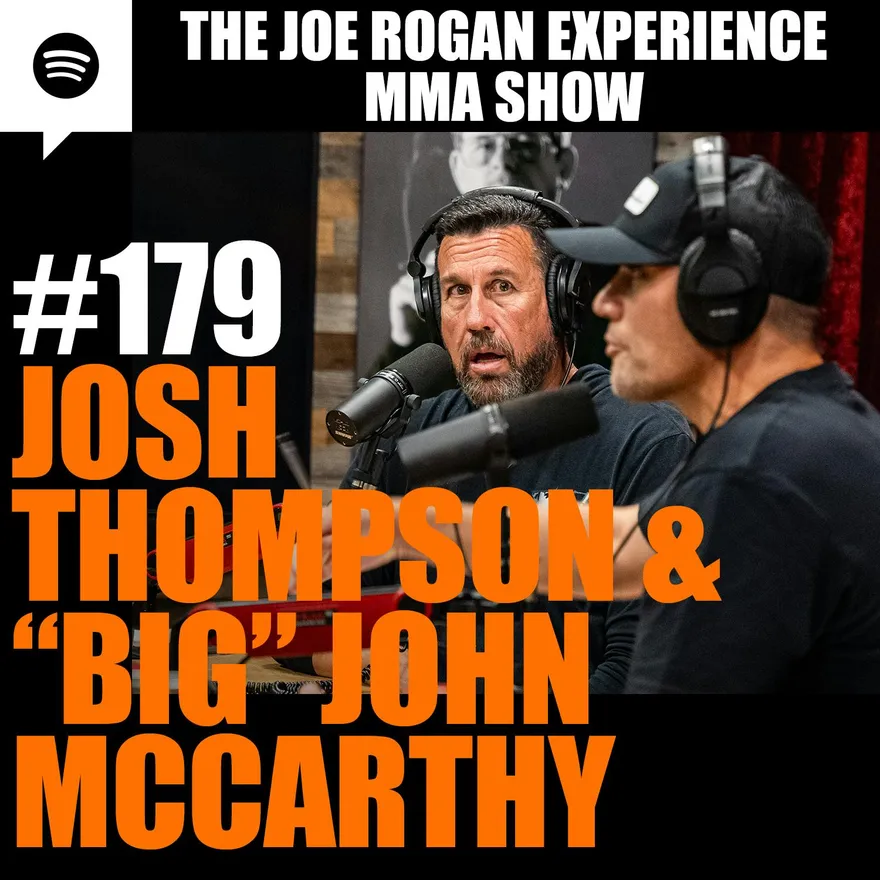
JRE MMA Show #179 with Josh Thompson & "Big" John McCarthy
In this episode of The Joe Rogan Experience, Joe Rogan sits down with MMA referee John McCarthy and fighter Josh Thompson to explore the evolving landscape of mixed martial arts. The conversation covers the sport's most pressing safety concerns, including the dangerous practice of extreme weight cutting and its impact on fighter health and performance. They examine the complexities of officiating, from split-second stoppage decisions to scoring inconsistencies and the challenges of rule standardization across regulatory bodies.
The discussion also analyzes technical innovations and legendary fighters who shaped modern MMA, from Fedor Emelianenko's blueprint for heavyweight dominance to the evolution of striking techniques like calf kicks and wheel kick knockouts. Beyond the cage, the conversation shifts to the broader MMA industry, including UFC market dominance, emerging promotions, and fighter compensation. The episode concludes with commentary on various political and social issues, from government spending and drug policy to the potential of ibogaine for treating addiction and PTSD.

This is a preview of the Shortform summary of the May 27, 2026 episode of the The Joe Rogan Experience
Sign up for Shortform to access the whole episode summary along with additional materials like counterarguments and context.
1-Page Summary
MMA Rules, Fighter Safety, and Refereeing Standards
Joe Rogan, John McCarthy, and Josh Thompson discuss the complexities and controversies surrounding MMA's health practices, rules, and officiating, revealing the sport's evolving nature and persistent challenges.
Weight Cutting and Fighter Health
Extreme weight cutting remains one of MMA's most dangerous practices. Rogan and McCarthy emphasize that drastic dehydration before weigh-ins impairs performance and increases injury risk, with Rogan describing fighters as looking like "concentration camp victims." Unlike other sports where nutritionists support optimal physical condition, MMA mandates dangerous rapid weight loss before competition.
Rogan proposes random weigh-ins during training camps to force fighters to maintain competition weight year-round, though McCarthy notes practical obstacles like jurisdictional issues and costs. Fighters moving to natural weights consistently show better health and performance, while drastic weight fluctuations—exemplified by Max Holloway and Roy Jones Jr.—increase knockout risk and performance decline.
Rule Evolution and Standardization
Rule inconsistency across regulatory bodies undermines fairness and safety. Rogan and McCarthy cite examples like New Jersey refusing to implement unified rules allowing 12-6 elbows, forcing fighters to adjust strategies based on location. Both agree the UFC and regulators should work toward universal, consistently enforced rules.
Referee Decision-Making and Expertise
Refereeing requires rigorous training and split-second judgment under immense pressure. McCarthy recounts stopping a fight due to a broken arm despite protests from fighters and crowds, demonstrating the responsibility officials bear for fighter welfare. Referees must distinguish when fighters are hurt versus when continuation risks lasting harm, often catching injuries broadcast angles miss.
Fight Stoppages and Neurological Considerations
The debate around stoppages following knockdowns reveals how nuanced these decisions are, especially when fighters momentarily revive after hitting the ground. The Apoe4 gene can amplify CTE risk, particularly for athletes with repetitive head trauma. Returning to fighting before the brain fully heals is especially dangerous, and cumulative trauma leads to permanent cognitive decline, memory lapses, and mood changes.
Judging and Scoring Integrity
Scoring controversies persist when judges overemphasize activity and ring control over effective striking and damage. Rogan cites Conor McGregor winning rounds against Mayweather despite landing fewer impactful punches. Split decisions create opportunities for corruption, especially with gambling incentives, leading to FBI investigations into suspicious bouts. Expanding from three to five judges hasn't improved consistency without adequate training and genuine fight expertise.
Fighter Analysis and Combat Sports Techniques
Legendary Fighters and Their Innovations
Fedor Emelianenko revolutionized heavyweight MMA through technical mastery despite lacking imposing size. His unique blend of Russian footwork, explosive entries, and relaxed movement made him difficult to hit. Fedor "wrote the blueprint" for defeating Mirko Cro Cop by pressuring him backward, neutralizing his devastating left kick through high knee checks, and crowding him to eliminate his preferred range. Fedor's rapid submission transitions, including iconic arm bars against much larger opponents, showcased how technical skill overcomes size.
Khabib Nurmagomedov's dominance stemmed from year-round discipline and defensive mastery—never bleeding in the octagon and being hurt by only two UFC opponents. His striking improved significantly over time, culminating in high-level knockdowns while maintaining his grappling dominance.
Striking Evolution and Technical Innovation
Cro Cop's left kick remains the most feared weapon in MMA history, with countless opponents suffering severe rib injuries. Edson Barbosa revolutionized striking with the first wheel kick knockout in the USA against Terry Etim, setting new standards for technical striking. Anderson Silva's front kick knockout of Vitor Belfort proved fundamental techniques could be decisive at the highest level with elite timing.
Boxing's Terence Crawford is recognized as one of the best switch hitters ever, fighting effectively from both stances with lateral movement that confuses world-class opponents. Calf kicks have become ubiquitous, with Jorge Masvidal using them as early as 2007-2008 and Dustin Poirier perfecting the technique.
Grappling Innovations and Submission Technique
Islam Makhachev refined the Darce choke by using his opponent's forearm as a lever, allowing easier submissions from higher positions. A.J. McKee's exceptional reach gives him a unique guillotine advantage, finishing chokes where others cannot. Traditional judo throws like seoi nage continue thrilling audiences with displays of technical mastery.
Fighter Performance Analysis
Max Holloway exemplifies defensive wrestling, avoiding 90 takedown attempts through superior balance and footwork. Sean Brady possesses elite grappling that could challenge top lightweights like Islam Makhachev, though grappler-heavy fighters often struggle against dynamic strikers. The ever-present takedown threat alters fight dynamics, making strikers tentative and disrupting their offensive rhythm—as seen in Conor McGregor facing Khabib.
The MMA Promotion Industry and Competition
UFC Market Dominance and Competitive Challenges
The UFC's dominance stems from brand recognition and trust, with McCarthy noting many viewers tune in based on the UFC logo alone. While pay-per-view events get spotlight, Fight Night cards often offer superior matchups for hardcore fans. However, increased event frequency and larger rosters make marketing individual fighters more challenging than during MMA's early years.
Emerging Promotions and Industry Growth
Rogan highlights MVP's Netflix deal as positive for the industry, injecting fresh capital and providing fighter alternatives to the UFC. Scott Coker's $60 million investment shows ambition, though Rogan and Thompson note this pales against the UFC's resources. Competition benefits the sport through increased fighter pay and stylistic variety, with Jason Jackson exemplifying elite talent operating outside the UFC spotlight.
Fighter Compensation and Career Trajectories
The panel argues bonus structures don't increase elite-level performance, as top-fifteen fighters already give maximum effort. Rogan strongly believes fighters should be compensated for participation, not subjected to win bonuses dependent on subjective judging. Sean Strickland is highlighted as a financial role model, living frugally and saving earnings unlike fighters who waste windfalls.
Veterans often prevail over younger fighters due to superior fight IQ and experience, with Dustin Poirier and Justin Gaethje remaining top-ranked because younger fighters struggle to match their expertise.
Political and Social Commentary
Government Spending and Fiscal Mismanagement
Rogan points to California spending $24 billion on homelessness with no meaningful improvements, calling the governor's audit veto a transparency failure. Budgetary practices incentivize agencies to exhaust entire budgets rather than save. Thompson and Rogan cite estimates that nearly $1 trillion is wasted annually at the federal level.
Drug Policy and Addiction Crisis
Thompson describes San Diego's Gaslamp Quarter as "disgusting," with rampant public drug use and absent law enforcement. In San Francisco and San Jose, policies distributing needles and drugs to homeless populations enable continued addiction without addressing root causes.
Ibogaine Legalization and Medical Reform
Rogan champions ibogaine as "one of the best things that we've ever had" for treating opioid addiction, PTSD, and veterans' brain injuries. Despite strong evidence and bipartisan support, it remains federally illegal, forcing Americans to seek treatment in Mexico. Texas recently approved $100 million for ibogaine research, and Rogan describes urging Trump to remove bureaucratic hurdles through executive action.
Homelessness and Public Safety
McCarthy, a former police officer, advocates for involuntary psychiatric commitment and mandatory medication for the severely mentally ill, arguing it's more humane than allowing deterioration on streets. "It's better for them and it's better for the people out on the street," McCarthy explains. Structured treatment and accountability yield better outcomes than permissive approaches.
Tax Policy and Economic Incentives
Thompson raises skepticism about taxing billionaires, asking "And do what? With the money?" when chronic mismanagement persists. Rogan cites Jeff Bezos's proposal that those earning under $200,000 pay no income tax to spur consumer spending and economic growth. Thompson notes low capital gains thresholds discourage asset sales, locking up capital that could otherwise circulate in the economy.
1-Page Summary
Additional Materials
Counterarguments
- While extreme weight cutting is dangerous, some fighters argue that with proper protocols and medical supervision, moderate weight cutting can be managed safely and is a personal choice.
- Other sports, such as wrestling and boxing, also involve weight cutting practices, and some have implemented reforms rather than eliminating the practice entirely.
- Maintaining competition weight year-round may not be feasible for all athletes due to natural body fluctuations and the need for off-season recovery.
- Random weigh-ins could be seen as an invasion of privacy and may not account for individual differences in training cycles and body composition.
- Some regulatory differences in MMA rules reflect local values, traditions, or safety concerns, and complete standardization may not be practical or desirable everywhere.
- Referees, despite rigorous training, are still subject to human error and bias, and their decisions are sometimes inconsistent or controversial.
- Not all injuries are visible to referees, and some have been missed even with experienced officials, leading to criticism of stoppage timing.
- The relationship between the Apoe4 gene and CTE risk is still being studied, and not all athletes with the gene develop CTE.
- Some fighters and fans prefer more lenient stoppages, valuing the opportunity for comebacks and dramatic finishes.
- Judging criteria are subjective by nature, and some argue that activity and ring control are important aspects of scoring a fight.
- Increasing the number of judges can reduce the impact of outlier scores, even if training is not uniform.
- Fedor Emelianenko's dominance occurred in an era with less depth in heavyweight talent compared to today.
- Khabib Nurmagomedov's style, while effective, has been criticized by some fans as less entertaining than striking-focused fighters.
- The effectiveness of techniques like calf kicks or wheel kicks can be overstated, as they are not universally successful and can be countered.
- The UFC's market dominance has also led to criticism regarding fighter pay, restrictive contracts, and lack of unionization.
- Bonus structures may incentivize exciting performances and finishes, benefiting fans and the promotion.
- Some argue that win bonuses motivate fighters to perform at their best and reward merit.
- Younger fighters may bring new techniques and athleticism that veterans struggle to match, and upsets are common in MMA.
- Government spending on homelessness is complex, and some improvements may not be immediately visible or easily measured.
- Harm reduction policies, such as needle distribution, are supported by many public health experts as a way to reduce disease transmission and overdose deaths.
- Involuntary psychiatric commitment raises ethical concerns about personal autonomy and the potential for abuse.
- Taxing billionaires is supported by some economists as a way to address wealth inequality and fund public services.
- Raising capital gains tax thresholds could reduce government revenue and impact funding for social programs.
Actionables
- you can track your own hydration and weight stability over several months using a simple spreadsheet or app, noting how your energy, mood, and physical performance change when you avoid rapid weight fluctuations; this helps you recognize the benefits of maintaining a consistent, healthy weight rather than cycling through drastic changes.
- a practical way to understand the impact of judging criteria is to watch a fight with friends and independently score each round based on different criteria (damage, control, activity), then compare results and discuss how different priorities affect outcomes; this builds awareness of how subjective judging can be and helps you spot potential inconsistencies.
- you can review your local government’s budget and spending reports online, then write a brief summary highlighting areas where funds seem inefficiently used or lack transparency, and send your findings as feedback to your city council or representative; this encourages accountability and gives you a direct role in promoting better public resource management.
Get access to the context and additional materials
Mma Rules, Fighter Safety, and Refereeing Standards
The conversation among Joe Rogan, John McCarthy, and Josh Thompson offers a comprehensive look into the challenges and controversies around MMA’s health, rules, refereeing, and judging, highlighting the deep complexity and evolving nature of the sport.
Weight Cutting and Fighter Health
Severe dehydration remains one of MMA’s most hazardous practices. Rogan and McCarthy stress that extreme weight cuts—where athletes drastically shed water weight just before weigh-ins—impair performance and dramatically increase injury risk. Rogan describes fighters at weigh-ins as looking like “concentration camp victims,” emphasizing how dangerous and grueling the process is, especially with demands to compete sometimes only 24 hours later.
McCarthy points to the contradiction: in most sports, athletes are supported by nutritionists and protocols to optimize physical condition, while MMA uniquely mandates dangerous rapid depletion before competition. The psychological adaptation to this suffering is itself damaging. Draining to compete at a weight far below a fighter’s “walk-around” weight may provide a size advantage, but it also means those fighters are rarely the fastest and may only dominate briefly before fatigue sets in.
Rogan floats the idea of random weigh-ins during training camps to discourage extreme cutting, proposing that fighters would have to maintain their competition weight year-round. This would theoretically force better health and fairness, but McCarthy notes that practical challenges—global licensing, jurisdictional issues, and high costs—make such changes difficult to implement industry-wide. Individual promotions like the UFC might adopt these policies, but there would be potential financial losses from more frequent fighter withdrawals due to missed weights.
Thompson and Rogan observe that fighters moving up to their more natural weights consistently enjoy better health, improved defensive ability, and more punching power compared to when they were cutting drastically. Fighters like Max Holloway and Roy Jones Jr. are highlighted as cautionary examples of the dangers of drastic fluctuations in weight, where performance declines and risk of knockouts increases as the body is pushed beyond safe limits.
The dramatic size discrepancies between weigh-in and fight night—seen in fighters like Michael Morales and Alex Pereira—raise further concerns about the legitimacy of current weight classes, as some athletes gain up to 20-30 pounds in less than a day, creating unfair and potentially unsafe matchups.
Rule Evolution and Standardization
Rule inconsistency across regulatory bodies undermines both fairness and safety. Rogan and McCarthy cite examples such as New Jersey’s refusal to implement the unified rules allowing 12-6 elbows, forcing fighters to adapt to varying standards between events. This lack of uniformity creates unfair burdens, requiring fighters to relearn and adjust strategies on short notice—sometimes even within the same promotion depending on location.
The debate extends to techniques such as knees to the head of a grounded opponent and sidekicks to the knee, with ongoing arguments about their relative dangers and whether they should be universally banned. Both agree that the UFC and regulatory authorities should work toward universal, consistently enforced rules to ensure fighter safety and competitive fairness.
International inconsistencies also extend to minor but important details, such as rules about rinsing mouthpieces. While North America’s unified rules are strict, implementation varies abroad, further complicating fighters’ preparations and safety.
Referee Decision-Making and Expertise
Refereeing in MMA is described as one of the sport’s toughest roles, rivaled only by fighting itself. Referees require rigorous training, real-time judgment, and a deep understanding of fight dynamics. McCarthy recounts emotionally charged moments, such as stopping a fight due to a broken arm—even as both fighters and the crowd protested, demonstrating the pressures and responsibilities on officials to make split-second, unpopular but critical decisions for fighter welfare.
These decisions often hinge on recognizing when a fighter is simply hurt versus when continuation could result in lasting harm. Referees must determine when to allow a brief period for recovery or when to intervene immediately. Broadcast angles and commentary may misjudge situations due to limited perspectives, while referees must rely on their direct sightline and instincts, sometimes catching injuries—like a broken arm—that others might miss.
The emotional burden for fighters is also highlighted, as illustrated by Joe Schilling’s withdrawal after an illegal headbutt left him feeling frustrated and disrespected, stressing that emotional response rather than physical incapacity can prompt withdrawal following fouls.
Fight Stoppages and Neurological Considerations
Referees are tasked not just with enforcing the rules but with monitoring neurological safety in real time. The debate around stoppages in the wake of knockdowns—especially the phenomenon where a fighter is momentarily revived by the impact of hitting the ground or by a follow-up strike—shows just how nuanced these decisions can be. MMA offe ...
Here’s what you’ll find in our full summary
Mma Rules, Fighter Safety, and Refereeing Standards
Additional Materials
Counterarguments
- While extreme weight cutting poses risks, many fighters successfully rehydrate and perform at high levels, suggesting that with proper protocols, some athletes can manage the process safely.
- Not all fighters experience severe psychological harm from weight cutting; some view it as a manageable part of their professional discipline.
- The size advantage gained from cutting weight can be significant enough to outweigh the drawbacks of reduced speed or early fatigue for certain fighting styles.
- Random weigh-ins could be seen as overly intrusive and may unfairly penalize fighters with naturally fluctuating body weights or unique physiologies.
- Some fighters prefer the current system because it allows them to choose their optimal competitive weight, maximizing their strategic options.
- Rule inconsistencies can be attributed to regional differences in combat sports culture and legal frameworks, which may reflect local values and priorities rather than simple oversight or neglect.
- Techniques like knees to the head of a grounded opponent are legal in some major international promotions (e.g., ONE Championship) without a clear increase in catastrophic injuries, suggesting the danger may be context-dependent.
- Referees’ split-second decisions, while sometimes controversial, are generally made with fighter safety as the top priority, and most stoppages are later validated by medical review.
- Some fighters and fans argue that allowing more leeway before stoppages preserves the spirit of competition and can lead to dra ...
Actionables
- you can track your own hydration and weight fluctuations for a month to better understand how even moderate changes affect your mood, energy, and physical performance, helping you appreciate the risks of extreme weight manipulation and make more informed decisions about your own health routines
- For example, weigh yourself daily, note your water intake, and record how you feel during exercise or daily tasks, then review patterns to see how dehydration or rapid weight changes impact your well-being.
- a practical way to support fair competition and safety in any group activity is to suggest and help implement clear, consistent rules for everyone involved, then observe how this affects group dynamics and perceived fairness
- For instance, if you play recreational sports or games, propose a written set of rules that everyone agrees to follow, and notice whether this reduces confusion, arguments, or risky behavior.
- you can practice recognizi ...
Get access to the context and additional materials
Fighter Analysis and Combat Sports Techniques
Legendary Fighters and Their Innovations
Fedor Emelianenko Revolutionized Heavyweight MMA
Fedor Emelianenko stands out as a transformative figure in heavyweight MMA. Despite not being physically imposing for the division, Fedor’s technical mastery set him apart. He developed a unique style, blending Russian footwork—with its small bounce and rhythmic, relaxed movement—and explosive entries. This allowed him to change distance effortlessly and counter opponents’ attacks, making him notoriously difficult to hit cleanly. Fedor’s approach prioritized relaxation under fire and precise hand placement, allowing him to absorb complex offense and instantly respond, a trait rarely seen among heavyweights.
Blueprint to Defeat Cro Cop: Back Him Up, Neutralize Left Kick, Stay Close
Fedor became legendary not only for his victories but for his tactical acumen against elite strikers. He “wrote the blueprint" on how to neutralize Mirko Cro Cop, pressuring Cro Cop onto his back foot and minimizing the devastating left kick. Fedor checked and caught Cro Cop’s kicks by lifting his knee high, crowding the Croatian puncher, and eliminating space, which reduced risk and forced Cro Cop away from his preferred range. The constant threat of grappling also lingered, making Cro Cop hesitant and opening more opportunities for Fedor.
Fedor's Submission Skill: Rapid Arm Bar Transitions
Fedor’s submission skills matched his striking and movement. His iconic arm bar transitions, for example against Hongman Choi, showcased his ability to attack instantly from seemingly neutral positions. Even with a size disadvantage, Fedor’s speed and technical precision allowed him to submit much larger men—demonstrating that technical skill can overcome sheer size.
Khabib Nurmagomedov’s Dominance and Defensive Mastery
Khabib Nurmagomedov’s dominance speaks to his lifestyle and training. He never bled in the octagon and was hurt by only two opponents in his entire UFC run—a testament to his defensive mastery and discipline. Khabib’s consistent approach—devoting himself to rigorous, year-round training and abstaining from distractions like partying—built a fighter virtually immune to physical and mental lapses. His striking, initially underdeveloped, improved significantly over time, culminating in fights where he dropped high-level opponents and always tightened his overall game.
Striking Evolution and Technical Innovation
Cro Cop's Left Kick: MMA’s Best Weapon
Mirko Cro Cop's left kick is widely acknowledged as the most feared weapon in MMA history. Countless opponents suffered severe rib injuries, with iconic photos such as Heath Herring taking Cro Cop’s shin deep into his ribs—an image that encapsulates the devastating effect the kick had on fighters’ bodies and careers.
Switch Kick Knockout: Edson Barbosa’s Technique
Edson Barbosa revolutionized MMA striking with the first wheel kick knockout in the USA, finishing Terry Etim. This knockout was so impactful that it altered Etim’s career. Barbosa’s switch kicks were abnormally fast and accurate, setting a standard for elite-level technical striking that influenced subsequent generations.
Silva’s Front Kick to Belfort
Anderson Silva’s front kick knockout of Vitor Belfort demonstrated that even beginner-level techniques, like the basic front kick learned on the first day of training, could be decisive at the highest level when executed with elite timing and precision. Following Silva, more fighters began successfully employing front kicks to the head, showing a new application for a fundamental technique.
Crawford's Elite Switch Hitting and Lateral Movement
Boxing’s Terence Crawford is recognized as one of the best switch hitters ever, likened to legends like Marvin Hagler. His ability to fight effectively from both stances while moving laterally—perpendicular to his opponent’s defense—enabled him to confuse and counter world-class fighters such as Canelo Alvarez, landing crisp and unpredictable shots with speed and precision.
Calf Kicks: Evolution and Adoption
Calf kicks have become a prime weapon in modern MMA. While fighters like Cub Swanson claim early adoption, Jorge Masvidal was using them as early as 2007-2008 in Strikeforce. ATT, Masvidal’s team, is credited for developing calf kicks into a team staple. From there, fighters like Dustin Poirier honed and perfected the technique, making it ubiquitous and decisive in MMA today.
Grappling Innovations and Submission Technique
Makhachev's Unique Darce Choke
Islam Makhachev has refined the Darce choke by using his opponent’s own forearm grip as a lever, which allows for easier and higher-positioned submissions. This adaptation enables him to cover the opponent’s head with his chest and finish the submission without needing to achieve deep positional penetration—a technique now emulated by other fighters.
A.J. McKee’s Guillotine Choke
A.J. McKee leverages his exceptional reach to apply a unique version of the guillotine choke, giving him a technical edge. Because of his long arms, he can finish the choke where others cannot, making it a dangerous, underutilized threat in his weight class.
Judo Throws: Seoi Nage and Others
Traditional judo throws such as seoi nage remain some of the most exciting techniques in grappling. Their success highlights the enduring value of classical martial arts in MMA, thrilling audiences with visible displays of technical mastery.
Fighter Performance Analysis
Max Holloway’s Defensive Wrestling
Max Holloway is cited as a model of defensive wrestling: his balance, technique, and footwork helped him avoid 90 takedown attempts by a dominant wrestler like Moradi. Holloway’s ability to frustrate opponents by denying ...
Here’s what you’ll find in our full summary
Fighter Analysis and Combat Sports Techniques
Additional Materials
Counterarguments
- While Fedor Emelianenko’s style was effective in his era, some critics argue that the evolution of heavyweight MMA has produced athletes with more well-rounded skill sets and athleticism, potentially limiting the effectiveness of Fedor’s approach against today’s top heavyweights.
- The blueprint to defeat Cro Cop was not solely Fedor’s innovation; other fighters, such as Mark Hunt, also had success against Cro Cop using pressure and distance management, suggesting that multiple tactical approaches were effective.
- Fedor’s arm bar transitions were impressive, but his submission victories often came against opponents with limited grappling backgrounds, raising questions about how his technique would fare against elite submission specialists.
- Khabib Nurmagomedov’s dominance is sometimes attributed to favorable matchmaking and a lack of consistently elite strikers with strong takedown defense during his title run.
- While Cro Cop’s left kick was feared, several fighters—including Gabriel Gonzaga—were able to neutralize or counter it, indicating that it was not an insurmountable weapon.
- Edson Barbosa’s wheel kick knockout was spectacular, but spinning and switch kicks had been used successfully in other organizations and regions prior to his UFC highlight.
- Anderson Silva’s front kick knockout popularized the technique, but front kicks to the head had been used in traditional martial arts and earlier MMA bouts, so the move itself was not new.
- Terence Crawford’s switch hitting is elite, but some boxing analysts argue that his level of opposition prior to unification bouts was not always the highest, which may have inflated perceptions of his dominance.
- Calf kicks, while effective, have also led to increased risk of self-injury (e.g., checked kicks resulting in broken legs), and some fighters have adapted with improved defense, reducing their overall effectiveness.
- Islam Makhachev’s Darce choke adaptation is notable, but similar leverage-based variations have been seen in submission grappling and BJJ before his rise in MMA.
- A.J. McKee’s guillotine is effective due to his reach, but its uniqueness is less about technical innovation and more about his physical attributes, which may not be replicable for most fighters.
- Traditional judo throws like seoi nage are visually impressive, but their success rate in high-level MMA is relatively low compared to wrestling-based takedowns due to the risk of giving up position.
- Max Holloway’s defensive wrestling is strong, but he has struggled against elite wrestlers with relentless pressure, such as Alexander Volkanovski, who was able to secure takedowns and control at times.
- Sean Brady’s struggles against dyn ...
Actionables
- you can improve your ability to adapt under pressure by practicing simple daily tasks (like cooking or assembling furniture) while intentionally introducing small distractions or time limits, helping you stay relaxed and precise even when things get hectic—just like elite athletes maintain composure during high-stakes moments.
- a practical way to sharpen your tactical thinking is to watch short clips of competitive matches (any sport or game) and pause before key moments to predict what you’d do next, then compare your choice to what actually happened, training your mind to spot opportunities and anticipate opponents’ moves.
- you can experiment with building a personal skill set by picking one area you’re already ...
Get access to the context and additional materials
The Mma Promotion Industry and Competition
Ufc Market Dominance and Competitive Challenges
The UFC's dominance in the MMA industry stems primarily from brand recognition and longstanding trust it has built with fans. John McCarthy notes that many viewers no longer need to know the fighters on a card to tune in; seeing the UFC logo is enough to convince casual fans the event will be high quality. As a company, the UFC has succeeded in marketing itself as a trusted product, which most other promotions struggle to replicate.
Joe Rogan, John McCarthy, and Josh Thompson discuss that while the UFC pay-per-view events get the spotlight, the Fight Night cards often offer superior, more competitive matchups. According to Rogan, these cards contain some of the best fights in the world, especially for hardcore fans, even if casual audiences often overlook them. The panelists emphasize that Fight Night events are a consistent source of quality action, giving devoted fans regular access to high-level MMA while casual viewers may miss exceptional competition.
However, the increased frequency of events and a larger roster make it more difficult to market individual fighters effectively compared to the early years of MMA, when personalities stood out more due to smaller overall numbers. McCarthy observes that with weekly events, it has become a challenge to spotlight less known fighters and build them as stars.
Emerging Promotions and Industry Growth
Emerging promotions are boosting industry growth and offering alternatives to both fighters and fans. Joe Rogan highlights MVP's Netflix deal as a positive development, injecting fresh cash into the MMA ecosystem and providing fighters with earnings they couldn't achieve elsewhere. This not only benefits individual athletes but also presents a viable alternative to the UFC, broadening the opportunities in the sport.
Scott Coker's $60 million investment on his MMA return demonstrates ambition, but Rogan and Thompson stress how limited that sum is compared to the UFC's vast resources—necessary for production, fighter salaries, venue fees, and infrastructure. While supportive of more competition, they acknowledge it will be tough for new or renewed promotions to match the UFC's operational heft.
As promotions compete for talent, the sport benefits from increased pay for athletes, innovation, and more stylistic variety in matchups. Thompson says that additional organizations give fighters more experience at a high level, challenging them against diverse opponents globally, which only strengthens the sport.
A notable example is Jason Jackson, who recently showcased elite talent outside the UFC. Despite his impressive performances, organizational relationships and promotional narratives—rather than skill alone—often dictate fighter signings in the UFC. Jackson's case illustrates that world-class fighters can operate outside the UFC spotlight, and that competitive parity is not only possible, but present.
Integrating talent from rival organizations—for instance, when the best of Strikeforce entered the UFC—invigorates divisions, offers new stylistic clashes, and excites both fighters and fans. Fighters are motivated to prove themselves, divisions get energized, and promotional momentum increases.
Fighter Compensation and Career Trajectories
The roundtable argues that bonus structures do not increase fighter performance at the elite level. Rogan and McCarthy agree that top-fifteen fighters are already putting forth maximum effort due to personal drive and competitive pride, not compensation incentives. Bonuses, particularly win bonuses reliant on subjective judging, can be harmful, since fighters risk losing half their income to poor decisions rather than their in-cage performance. Rogan strongly believes that fighters should be compensated based on participation, ensuring financial security regardless of judges' decisions. A finishing bonus or skewed show-win split (e.g., 80/20) is discussed as a fairer alternative, but true motivation and effort come from the athletes themselves.
Extreme weight cutting is also criticized, as it has demonstrably harmed both performance and careers. Thompson references Max Holloway a ...
Here’s what you’ll find in our full summary
The Mma Promotion Industry and Competition
Additional Materials
Clarifications
- MMA stands for Mixed Martial Arts, a full-contact combat sport combining techniques from various martial arts like boxing, wrestling, jiu-jitsu, and Muay Thai. Fighters compete in a cage or ring, using striking and grappling to win by knockout, submission, or judges' decision. The sport emphasizes versatility, allowing competitors to use both stand-up and ground fighting skills. MMA has grown globally, with organizations like the UFC leading its professional promotion.
- The UFC (Ultimate Fighting Championship) is the largest and most influential MMA promotion globally, setting industry standards for event production and fighter contracts. It popularized MMA by introducing unified rules and mainstream broadcasting, helping the sport gain widespread acceptance. The UFC's global reach attracts top talent, making it the premier platform for fighters seeking recognition and lucrative opportunities. Its dominance shapes market trends, fighter pay scales, and competitive dynamics across the MMA landscape.
- UFC pay-per-view (PPV) events are typically major fight cards featuring high-profile title fights and star fighters, generating significant revenue through individual purchases. Fight Night cards are usually broadcast on cable or streaming platforms and showcase up-and-coming talent or less prominent matchups. PPV events attract casual fans due to big names and championship stakes, while Fight Nights cater more to hardcore fans seeking competitive fights. Fight Nights help develop future stars and maintain consistent viewer engagement between major events.
- John McCarthy is a renowned MMA referee known for officiating many high-profile UFC fights. Joe Rogan is a commentator, podcaster, and former MMA fighter, famous for his UFC fight commentary and popular podcast. Josh Thompson is a retired professional MMA fighter and analyst who provides expert insights on the sport. Scott Coker is the president of Bellator MMA, a major MMA promotion competing with the UFC. Sean Strickland is a professional MMA fighter known for his disciplined lifestyle and competitive success in the UFC.
- MVP stands for "Multiverse Fighting Championship," a newer MMA promotion gaining attention for innovative approaches and media deals. It aims to expand MMA's reach by partnering with major platforms like Netflix for event distribution. This deal provides fighters with better pay and exposure outside traditional pay-per-view models. MVP represents a growing trend of alternative promotions challenging UFC's dominance.
- Weight cutting in MMA is the process where fighters rapidly lose body weight before a fight to qualify for a lower weight class. This often involves dehydration, which can impair physical performance and increase health risks. Fighters then rehydrate after weigh-ins to regain weight, but the stress can reduce endurance and increase injury risk. Extreme weight cutting can lead to diminished fight quality and long-term health problems.
- Bonus structures in MMA are additional payments awarded to fighters for specific achievements, like winning a fight or delivering an exciting performance. Win bonuses are payments given only if the fighter wins, while show money is guaranteed just for participating. A show-win pay split means a fighter earns a base amount (show money) plus an extra amount if they win, often expressed as a ratio like 80/20. These systems aim to incentivize performance but can create financial uncertainty due to reliance on judges' decisions.
- "Organizational relationships" refer to the connections and agreements between fighters, managers, and promotions that influence contract decisions beyond just skill. "Promotional narratives" are the stories and marketing angles a promotion builds around fighters to attract fans and media attention. These factors affect which fighters get signed or promoted, as companies prioritize marketability and existing alliances. Thus, talent alone does not guarantee a UFC contract; business strategy plays a key role.
- "Fight IQ" refers to a fighter's ability to make smart decisions during a match, such as when to attack, defend, or conserve energy. "Ring awareness" means understanding the space and positioni ...
Counterarguments
- While the UFC’s brand recognition is strong, some fans and critics argue that its dominance has led to a lack of competition, which can stifle fighter pay and bargaining power.
- The reliance on the UFC logo to attract casual fans may contribute to a homogenized product, where individual fighter stories and personalities are overshadowed by the brand.
- Other promotions, such as Bellator and ONE Championship, have successfully built loyal fanbases and developed their own stars, demonstrating that UFC-style brand dominance is not the only viable model.
- The assertion that Fight Night cards are superior is subjective; some fans and analysts believe that the dilution of talent across so many events has led to less compelling matchups overall.
- The increased frequency of UFC events may lead to fan fatigue and oversaturation, potentially diminishing the perceived value of each event.
- While emerging promotions offer alternatives, many still struggle with visibility, consistent matchmaking quality, and long-term financial stability.
- The MVP Netflix deal, while significant, is still unproven in terms of its long-term impact on fighter pay and promotion sustainability.
- Scott Coker’s $60 million investment, though smaller than the UFC’s resources, could be more efficiently allocated in a leaner organization, potentially allowing for innovation and agility that larger organizations lack.
- Increased competition does not always guarantee higher fighter pay or better conditions; some promotions have been criticized for late payments or contract disputes.
- The idea that elite fighters outside the UFC are always world-class is debated; some believe the UFC’s roster depth is still unmatched, and not all external champions would succeed at the highest level.
- Integrating talent from rival organizations can sometimes lead to mismatches or expose gaps in skill levels, rather than always invigorating divisions.
- The claim that bonus structures do not affect performance is contested; some fighters have publicly stated that bonuses are a significant mot ...
Get access to the context and additional materials
Political and Social Commentary
The discussion delves into government inefficiency, homelessness, drug policy reform, the opioid crisis, and tax incentives, highlighting how policy failures and misallocation of resources exacerbate existing social problems while impeding progress.
Government Spending and Fiscal Mismanagement
California’s spending on homelessness exemplifies fiscal mismanagement. Joe Rogan points out that the state spent $24 billion on homelessness, yet there have been no meaningful improvements in housing security or substance abuse recovery. “What have they done? Nothing,” Rogan asserts, illustrating a pattern of ineffective use of resources. The issue of transparency compounds the problem, with Rogan noting that the governor vetoed an audit of the spending, further limiting public oversight.
Budgetary practices among agencies also discourage cost-consciousness. Rogan observes that agencies are incentivized to exhaust their entire budgets within the fiscal year to ensure future allocations remain high, rather than returning unspent funds or saving through discipline.
On the federal level, Josh Thompson and Joe Rogan cite vast sums lost to inefficiency and fraud, referencing estimates that nearly $1 trillion is wasted annually. This endemic waste undermines trust in government’s ability to manage large budgets responsibly.
Drug Policy and Addiction Crisis
Conversations turn to the deterioration of urban centers due to failed drug policies. Thompson describes San Diego’s Gaslamp Quarter as “disgusting,” recounting scenes of rampant public drug use, homeless individuals disrupting restaurants, and a marked absence of law enforcement. Once-beautiful, vibrant districts now feel unsafe, a sentiment echoed by Thompson after recent visits.
In San Jose and San Francisco, Thompson and McCarthy criticize policies such as distributing needles, drugs, and even cell phones to homeless populations, arguing that these measures enable continued addiction without addressing root causes. Tent cities have proliferated, sometimes facilitating organized theft; Thompson recalls homeless individuals stealing solar panels to power devices.
Ibogaine Legalization and Medical Reform
Joe Rogan champions ibogaine, a psychedelic treatment showing promise for opioid addiction, PTSD, and veterans’ brain injuries. Rogan describes ibogaine as “one of the best things that we've ever had” for helping vulnerable groups, particularly veterans. Despite strong evidence of its effectiveness and bipartisan political support, ibogaine remains federally illegal, forcing Americans—often veterans in need of addiction treatment—to seek care in Mexico, which Rogan calls “nuts.”
Political advocacy is altering the landscape. Rogan credits Rick Perry, former Texas governor, for shifting public and political opinion after sharing his personal experience with ibogaine. Texas recently approved $100 million in funding for ibogaine research and initiatives, thanks partly to Dan Patrick’s support. Rogan further describes urging Donald Trump to support ibogaine; Trump promptly removed bureaucratic hurdles through executive action, demonstrating leadership focused on solutions.
Rogan emphasizes ibogaine’s transformative effects—though the treatment is physically taxing, “when it’s over, you’re a new person.” He sees the reluctance to legalize such therapies as emblematic of a broader failure to adopt evidence-based medical reform.
Homelessness and Public Safety
The trio discusses the ethics and effectiveness of current homelessness strategies. John McCarthy, a former police officer, advocates for involuntary psychiatric commitment and mandatory medication for the severely mentally ill, arguing it is more practical and humane than allowing individuals to deteriorate on public streets. “It’s better for them and it’s better for the people out on the street… to have that person be put into a place where they can receive some medication, receive some help, and try to get them back, than it is to let these people just rot on the street and self-destruct,” McCarthy explains.
Structured treatment and accountability, rather than permissive ...
Here’s what you’ll find in our full summary
Political and Social Commentary
Additional Materials
Counterarguments
- While California’s $24 billion spending on homelessness has not eliminated the crisis, some data indicate that these funds have prevented further deterioration, expanded shelter capacity, and provided services to thousands, even if progress is slower than desired.
- The veto of an audit may have been based on concerns about redundancy with existing oversight mechanisms or the potential for politicization, rather than a desire to hide mismanagement.
- The practice of agencies spending their full budgets is common in both public and private sectors and can be addressed through reforms such as multi-year budgeting or incentives for cost savings, rather than being an inherent flaw of government.
- Estimates of $1 trillion in federal waste are often debated and may include necessary administrative costs or be based on broad definitions of “waste,” making the figure controversial.
- Some harm reduction policies, such as needle exchanges and providing cell phones, are supported by public health research as effective in reducing disease transmission, improving access to services, and facilitating recovery.
- The presence of tent cities and theft is a complex issue influenced by housing shortages, mental health, and economic factors, not solely by permissive policies.
- Ibogaine’s efficacy and safety remain under investigation; some medical experts caution that it can have serious side effects, including cardiac risks, and more research is needed before widespread legalization.
- Involuntary psychiatric commitment and mandatory medication raise significant ethical and legal concerns regarding civil liberties and have a history of abuse; many advocates argue for voluntary, community-based approaches.
- Some cities with disciplined ...
Actionables
- you can track and compare local government spending on homelessness or addiction services by reviewing public budgets and submitting simple public records requests, then share your findings in a clear, visual format (like a basic spreadsheet or infographic) with neighbors or on community forums to encourage transparency and accountability.
- a practical way to encourage evidence-based reforms is to write concise, fact-focused letters to your local representatives or city council, specifically requesting that they prioritize funding for programs with measurable outcomes and publish regular progress reports, making it clear you’ll base your voting decisions on their follow-through.
- you can support responsible economic policy by adjusting ...
Get access to the context and additional materials


Create Summaries for anything on the web
Download the Shortform Chrome extension for your browser
