

Are Billionaires Really Writing America's Laws For Us?
In this episode of The Diary Of A CEO, Bernie Sanders and Steven Bartlett examine how wealth concentration in America has accelerated over recent decades, leaving working families with stagnant wages while billionaires accumulate unprecedented fortunes. Sanders discusses specific policy proposals to address economic inequality, including a wealth tax on billionaires, raising the minimum wage, and implementing Medicare for All to provide universal healthcare.
The conversation extends beyond economics to explore how money influences American politics, with both major parties controlled by wealthy donors who shape legislation and limit public discourse. Sanders and Bartlett also address the development of artificial intelligence, warning that decisions about this transformative technology are being made by a handful of billionaires rather than through democratic processes. The episode concludes with Sanders reflecting on Democratic Party strategy and the need for grassroots movements to elevate leaders committed to representing working-class interests.
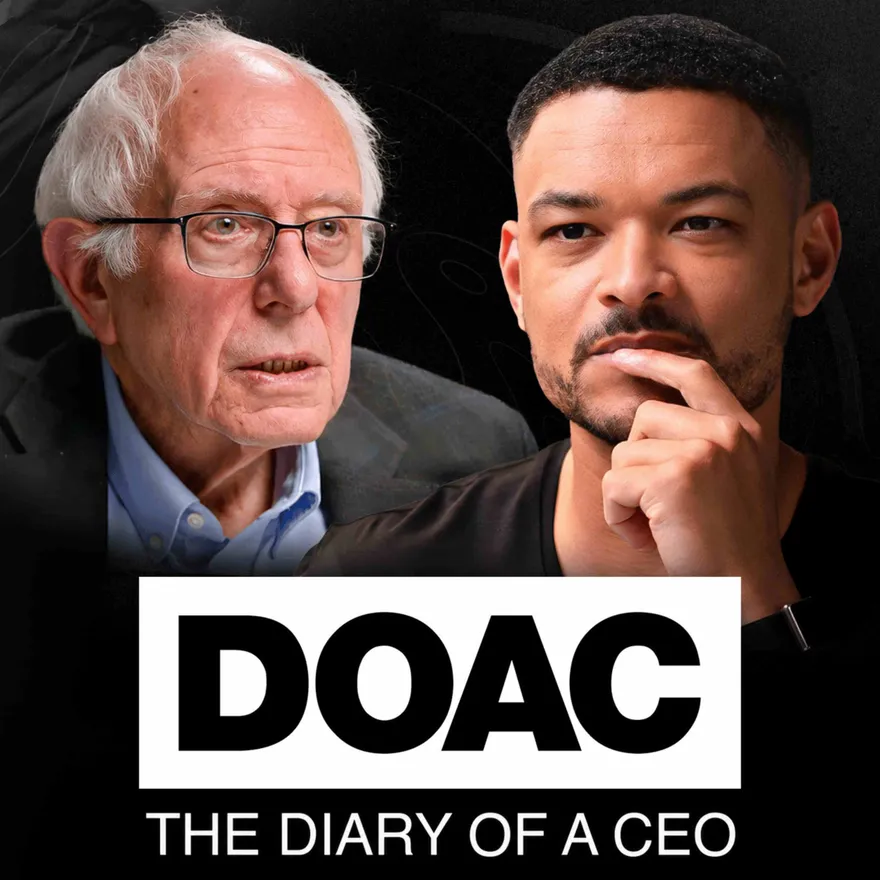

This is a preview of the Shortform summary of the Nov 19, 2026 episode of the The Diary Of A CEO with Steven Bartlett
Sign up for Shortform to access the whole episode summary along with additional materials like counterarguments and context.
1-Page Summary
Economic Inequality and Wealth Redistribution Strategies
Bernie Sanders and Steven Bartlett discuss the widening gap between the wealthiest Americans and everyone else, exploring how systemic economic shifts have concentrated wealth at the top while working families struggle.
Wealth Transfer From Workers to Billionaires Due To Economic Rigging
Sanders references Rand Corporation research showing that $80 million has transferred from the bottom 90% of Americans to the top 1% over the last five decades. Despite technological advancement, workers haven't benefited—instead, two-income households have become necessary while 60% of Americans live paycheck to paycheck. Elon Musk now holds more wealth than the bottom 53% of American households combined. Chamath Palihapitiya acknowledges this asymmetry, noting that asset owners consistently benefit while wage earners face diminishing support.
Billionaire Wealth Tax Could Fund Social Programs and Benefit Workers Over the Elite
To address this disparity, Sanders proposes a 5% annual tax on America's roughly 2,000 billionaires, generating approximately $400 billion annually. These funds could eliminate childhood poverty, provide universal childcare, offer tuition-free college, and construct seven million affordable housing units. Sanders points out that many billionaires, like Jeff Bezos, pay lower tax rates than truck drivers by exploiting loopholes and borrowing against equity to access tax-free wealth. Implementing this vision would require closing these loopholes and confronting resistance from the wealthy elite.
Boosting Minimum Wage, Cutting Military Spending Enhance Quality of Life
Beyond taxing the wealthy, Sanders advocates raising the federal minimum wage from $7.25 to $20 per hour. He also challenges spending over $1 trillion annually on the military, suggesting that redirecting even a portion of these funds toward domestic programs would significantly improve working families' lives and create a fairer allocation of national wealth.
Healthcare Reform and Medicare For All
Sanders lays out fundamental issues in the American healthcare system and contrasts the profit-driven U.S. approach with universal systems in other major countries.
American Healthcare Prioritizes Profits Over Wellbeing
Sanders explains that the U.S. spends twice as much per capita on healthcare as any other nation while leaving 90 million people uninsured or underinsured. This results in 60,000 unnecessary deaths annually and 500,000 bankruptcies. Americans pay the highest prescription drug prices in the world, and over 1,500 pharmaceutical lobbyists in Washington—three for every member of Congress—work to block substantive reform. According to Sanders, the system is designed to enrich insurance and drug companies rather than provide accessible care.
Medicare For All Ensures Healthcare As a Human Right, Easing Financial Stress From Medical Crises
Sanders argues that healthcare should be a human right, proposing a four-year transition to Medicare for All. The first year would lower the Medicare age to 55, cover all children, and expand benefits to include dental, hearing, and vision care. Subsequent years would gradually achieve universal coverage. Sanders maintains this would restore public faith in government, though achieving it requires confronting entrenched corporate interests that fiercely resist such reforms.
Campaign Finance Corruption and Money in Politics
Sanders and Bartlett discuss the pervasive influence of money in American politics, party control by wealthy elites, media complicity, and the need for grassroots political revolution.
Wealthy Few Control Democratic & Republican Parties, Prioritize Power Over Families
Sanders underscores that both parties function as top-down structures controlled by a small number of wealthy donors rather than grassroots citizens. These individuals decide who runs for office and what issues are prioritized. Massive contributions to campaigns and super PACs—such as Elon Musk's $400 million donation—are perfectly legal, enabling the wealthy to purchase political influence. Donors not only fund campaigns but often help write legislation. Corporate media, owned by affluent individuals, gatekeeps public discourse, limiting debate on income inequality and healthcare reform. Bartlett adds that media narratives are often dictated from the top, shaping or suppressing stories based on owners' interests.
Campaign Finance Corruption Perverts Democracy, Needing Reform
Sanders highlights the contradiction that while $100 million super PAC contributions are legal, even a $5 direct bribe is illegal. This disparity allows wealthy interests to dominate politics and marginalize working families' voices. To counteract oligarchic control, Sanders advocates for a political revolution where grassroots activists and working-class candidates run for office and shape policy, citing successful examples in places like New York City.
Transforming Money-Politics Ties to Combat Campaign Finance Corruption
Sanders argues that the Democratic Party's strategy of modest reforms, like closing tax loopholes, fails to challenge oligarchic control's root causes. True reform must create mechanisms for public accountability, particularly in sectors like AI where private decisions have vast societal impacts. Political leaders must challenge big money interests and pass legislation that improves ordinary Americans' lives to restore faith in democratic institutions.
Artificial Intelligence Development and Existential Risks
AI and Robotics: Billionaire-Driven Development vs. Democratic Societal Consideration
Sanders highlights that AI development is largely driven by billionaires like Elon Musk, Jeff Bezos, and Larry Ellison, who pursue AI primarily to amass wealth and power. Bezos is assembling a $100 billion fund to automate factories, replacing human labor with robots. Meanwhile, Congress and governmental bodies are failing to keep pace with AI's challenges, leaving decisions about society's trajectory to a handful of private actors rather than democratic processes.
AI-induced Job Displacement Will Harm Workers Without Government Action
CEOs of leading AI firms warn of millions of job losses, though specifics remain unknown. Sanders emphasizes the looming threat to the six to seven million Americans employed as drivers, noting autonomous trucks already operating in Texas. Bartlett observes that automation now targets professions previously protected by minimum wage laws, and robots' relentless productivity intensifies competitive displacement.
AI Threatens Dignity, Privacy, and Survival Beyond Economic Concerns
Beyond jobs, Sanders warns that AI enables mass surveillance, compromising freedom and privacy rights. He foresees increased reliance on AI chatbots eroding human connection skills and undermining youth mental health. In warfare, AI shifts conflict to remote operations, lowering barriers to launching violent conflicts. Sanders also references warnings from AI researchers like Geoffrey Hinton about superintelligent systems becoming uncontrollable, producing catastrophic consequences comparable to nuclear weapons.
Government Must Implement AI Regulation: Bans, Pauses, and Public Ownership to Protect Workers and Humanity
Sanders asserts that government action is essential, advocating for a permanent ban on superintelligent AI development and an immediate pause on advanced AI until safeguards are established. He urges international agreements similar to Cold War-era nuclear treaties. Sanders proposes 50% public ownership of AI company boards, placing worker and public representatives on governing boards to ensure AI deployment prioritizes societal interests over business ambitions.
Democratic Party Strategy and Future Political Leadership
Democrats Prioritized Defeating Trump Over Transformative Policies to Aid Working Families and Restore Faith in Democracy
Sanders states that while the 2020 election focused on preventing authoritarianism, the Democratic Party has prioritized defeating Trump rather than implementing transformative policies. Persistent challenges remain, including billionaire control, a broken healthcare system, and unresolved issues around AI and climate change.
Democratic Establishment Stopped Bernie Sanders' Nomination By Backing Alternatives, Media Bias, and Mobilizing Political Machines Despite Grassroots Support
Sanders recalls how state governors, mayors, and party leaders rarely backed his campaign, with only one U.S. Senator supporting him. Corporate media, owned by wealthy individuals opposed to his messaging, provided minimal and often unsympathetic coverage. He argues that the Democratic establishment prefers maintaining the status quo over confronting big money interests, diverging from grassroots progressive movements.
Democratic Strategy Must Shift From Establishment Candidates To Grassroots Movements Elevating Leaders Committed To Bold Working-Class Advocacy and Confronting Oligarchy
Sanders insists the party must shift toward leaders who authentically represent working families, pointing to younger progressives like Alexandria Ocasio-Cortez as examples. He believes the party needs leaders who will fight boldly for comprehensive agendas including healthcare, housing, and economic equality, rather than incremental changes. This requires a political revolution that shifts party power from wealthy donors to grassroots movements.
To Succeed Electorally, Focus On Policy Differences Over Personality, With Voters Assessing Candidates on Key Issues Facing America
Sanders urges moving away from personality-focused elections toward policy-centered campaigns addressing healthcare, education, economic inequality, AI, and foreign policy. He contends that campaign messaging must highlight tangible improvements for working families, warning that when government fails to respond to citizens' needs, people lose faith in democracy, fueling authoritarian politics. Sanders confirms he won't seek the presidency again due to age, but will support candidates who stand with the working class and pursue transformative change over incremental adjustments.
1-Page Summary
Additional Materials
Counterarguments
- The claim that $80 million has transferred from the bottom 90% to the top 1% over five decades appears to be a significant understatement; most research, including the RAND study, estimates the figure in the trillions, suggesting a possible error or misstatement in the text.
- While wealth inequality has increased, some economists argue that technological advancement and globalization have also raised living standards and reduced absolute poverty, even if relative inequality has grown.
- Critics of a billionaire wealth tax argue that such taxes are difficult to enforce, may encourage capital flight or tax avoidance, and could reduce investment and innovation.
- Some studies suggest that raising the federal minimum wage to $20 per hour could lead to job losses, increased automation, or higher prices, particularly in regions with lower costs of living.
- The U.S. spends more on healthcare per capita than other countries, but some analysts attribute this to higher utilization of advanced medical technology, higher provider salaries, and administrative costs, not solely to profit motives.
- Opponents of Medicare for All argue that single-payer systems can lead to longer wait times, rationing of care, and reduced innovation, and that Americans may prefer choice in healthcare providers and plans.
- While campaign finance laws allow large super PAC contributions, the Supreme Court has ruled that political spending is a form of protected speech under the First Amendment, complicating efforts to restrict such contributions.
- Some political scientists argue that both parties are influenced by a variety of interest groups, not just wealthy donors, and that grassroots movements have achieved significant policy changes within the existing system.
- Critics of public ownership of AI company boards contend that government involvement could stifle innovation, slow decision-making, and politicize technological development.
- Some experts believe that fears of superintelligent AI are speculative and that current regulatory focus should be on more immediate, tangible risks such as bias, privacy, and job displacement.
- The Democratic Party's focus on defeating Trump in 2020 is defended by some as a necessary response to perceived threats to democratic norms, rather than a neglect of policy priorities.
- Media coverage is influenced by a range of factors, including audience demand and journalistic standards, not solely by ownership interests.
- Some argue that incremental reforms, while imperfect, are more politically feasible and sustainable than sweeping revolutionary changes.
Actionables
- you can track and compare the percentage of your spending that goes to local worker-owned businesses versus large corporations, then set a monthly goal to shift more purchases to organizations that share profits with employees, helping to counteract wealth concentration and support fairer economic distribution.
- a practical way to challenge media gatekeeping is to regularly share concise, fact-checked summaries of underreported economic and healthcare issues on your personal social media, tagging local representatives and journalists to increase visibility and encourage broader public discussion.
- you can create a simple log to record every time you interact with AI-driven services (like chatbots or automated customer support), then use this log to write a letter to your elected officials describing your experiences and concerns, advocating for stronger public oversight and representation in AI governance.
Get access to the context and additional materials
Economic Inequality and Wealth Redistribution Strategies
A wide and persistent chasm exists between the wealthiest Americans and everyone else, fueled by systemic economic shifts and policy choices that disproportionately benefit the elite. Economic rigging, stagnant worker benefits, and the accelerating wealth of billionaires all contribute to increased inequality, while legislative and redistributive strategies such as a billionaire tax, raising the minimum wage, and rethinking national priorities are offered as solutions to rebalance society.
Wealth Transfer From Workers to Billionaires Due To Economic Rigging
According to Bernie Sanders, referencing research from the Rand Corporation, the last five decades have seen a staggering transfer of wealth—an estimated $80 million—from the bottom 90% of Americans to the top 1%. This is not a recent development under any single administration, but a long-term, accelerating trend in which the rich grow richer while working families either stagnate or see their fortunes decline.
Despite dramatic technological advancement, these gains have not flowed to workers. Instead, the requirement for two incomes per household is now commonplace, in stark contrast to prior generations where a single working-class earner, such as a paint salesman in Sanders' own family history, could support an entire family. Sanders notes that economic growth and technological progress should improve life for everyone, yet in reality, these have often served to make the rich richer, not lift up ordinary people.
Today, 60% of Americans live paycheck to paycheck despite the United States being the richest country in the world. The nation also has the highest rate of childhood poverty in the developed world, with 20% of seniors surviving on only $15,000 a year or less. This leaves younger generations poised to inherit a lower standard of living than their parents. Anxiety about job prospects, home ownership, and economic stability is pervasive, particularly as AI and other new technologies threaten to displace traditional sources of employment. Elon Musk, for instance, now has more wealth than the bottom 53% of American households combined—a clear marker of extreme concentration.
Chamath Palihapitiya underscores this asymmetry, acknowledging that asset owners—an elite minority—have consistently benefited, regardless of economic cycles, while wage earners face diminishing economic support and opportunity.
Billionaire Wealth Tax Could Fund Social Programs and Benefit Workers Over the Elite
To address these disparities, Sanders proposes a 5% annual tax on America’s roughly 2,000 billionaires. This tax would generate approximately $400 billion annually or $4 trillion over a decade. With these funds, landmark social investments could be made: eliminating childhood poverty, providing universal and free childcare, awarding a $3,000 stipend to all working-class individuals earning under $150,000, offering tuition-free public college and university education, and constructing seven million units of affordable housing.
This plan targets the vast accumulation of elite wealth and redirects it toward the working majority. Sanders points out that many billionaires pay lower effective tax rates than truck drivers or nurses. Figures like Jeff Bezos often report modest annual salaries but borrow against their equity to access tax-free wealth, exploiting loopholes to avoid taxes that ordinary Americans cannot evade.
Implemen ...
Here’s what you’ll find in our full summary
Economic Inequality and Wealth Redistribution Strategies
Additional Materials
Clarifications
- "Economic rigging" refers to policies and systems that unfairly favor the wealthy, such as tax loopholes, deregulation, and corporate influence on legislation. It often involves manipulating rules to concentrate wealth and power at the top while limiting opportunities for workers. Examples include lobbying for lower taxes on capital gains and weakening labor protections. This creates an uneven playing field where economic gains disproportionately benefit the elite.
- The Rand Corporation is a nonprofit global policy think tank that conducts research and analysis to inform public policy decisions. It is known for rigorous, data-driven studies on economic, social, and security issues. Policymakers and experts often rely on Rand's findings to understand complex problems and develop solutions. Its reputation for impartiality and thoroughness makes its research influential in debates like economic inequality.
- Billionaires often earn most of their wealth through investments, which are taxed at lower capital gains rates than regular income. They can also borrow money against their assets without triggering taxable events, avoiding income tax. Many deductions, loopholes, and tax shelters reduce their taxable income significantly. In contrast, workers pay taxes directly on their wages, which are fully subject to income and payroll taxes.
- Borrowing against equity means taking out loans using the value of owned assets, like stocks or property, as collateral. These loans are not considered income, so they are not taxed when received. Wealthy individuals can use this method to access cash without selling assets and triggering capital gains taxes. This strategy allows them to maintain or grow their wealth while minimizing tax payments.
- A billionaire wealth tax is an annual tax on the net worth of ultra-wealthy individuals, targeting assets like stocks, real estate, and business holdings. It requires accurate valuation of diverse and sometimes illiquid assets, which can be complex and contentious. Implementation involves new tax laws, enhanced IRS enforcement, and measures to prevent tax avoidance or relocation to low-tax areas. Such taxes aim to reduce wealth concentration and fund public services but face political and legal challenges.
- Rising costs of housing, healthcare, and education have outpaced wage growth, making a single income insufficient for many families. Globalization and technological changes have suppressed wage increases for middle- and lower-income workers. Declines in union power have weakened workers' bargaining ability for higher pay. Additionally, inflation and economic instability have increased financial pressures on households.
- "Starvation wages" refer to pay so low that workers cannot afford basic living expenses like food, housing, and healthcare. These wages trap individuals in poverty despite full-time employment. They contribute to economic insecurity and limit social mobility. The term highlights the gap between earnings and the actual cost of living.
- The U.S. military budget is the largest in the world, often exceeding the combined military spending of several other countries. It funds personnel, equipment, operations, research, and foreign military aid. This spending competes with domestic programs for federal funds, influencing priorities like education, healthcare, and infrastructure. Critics argue that reducing military expenditures could free resources to improve social services and economic support for citizens.
- Tax loopholes are legal gaps that allow wealthy individuals to reduce their tax bills by exploiting complex rules. Closing these loopholes requires detailed legislative changes and strong enforcement to prevent new avoidance strategies. Wealthy individuals may use tactics like shifting assets offshore or reclassifying income to evade taxes. Governments face challenges in tracking t ...
Counterarguments
- Some economists argue that wealth taxes, such as a 5% annual tax on billionaires, may be difficult to implement effectively due to challenges in accurately valuing assets, potential capital flight, and administrative complexity.
- Critics contend that high wealth or income taxes could discourage investment, entrepreneurship, and innovation, potentially slowing economic growth and job creation.
- Historical evidence from countries that have implemented wealth taxes (such as France and Sweden) shows that many eventually repealed them due to limited revenue generation and unintended economic consequences.
- Opponents of raising the federal minimum wage to $20 per hour argue that it could lead to job losses, increased automation, or higher prices for consumers, particularly affecting small businesses and low-margin industries.
- Some analysts suggest that economic inequality is partly a result of globalization and technological change, which have increased returns to capital and high-skilled labor, rather than solely due to policy choices favoring the elite.
- There is debate over the effectiveness of large-scale government spending on social programs, with some pointing to i ...

Get access to the context and additional materials
Healthcare Reform and Medicare For All
Bernie Sanders lays out the fundamental issues in the American healthcare system and how Medicare for All can solve them, describing a clear contrast between the profit-driven U.S. approach and the universal systems in other major countries.
American Healthcare Prioritizes Profits Over Wellbeing
Sanders explains that “everybody in America knows that the current healthcare system is broken.” The U.S. spends twice as much per capita on healthcare as any other nation, yet leaves 90 million people uninsured or underinsured. This broken system results in 60,000 unnecessary deaths annually, simply because people cannot afford to see a doctor, and causes 500,000 bankruptcies each year, often striking families already struggling with serious illnesses like cancer.
Americans “pay the highest prices in the world for prescription drugs”—Sanders has taken people to Canada where the same drugs cost one-tenth the price. One reason for this is the power of pharmaceutical lobbyists: there are over 1,500 in Washington, DC, three for every single member of Congress. These lobbyists, alongside the interests of insurance companies and Wall Street, work vigorously to block any substantive reform.
According to Sanders, the system is functioning precisely as designed—to make insurance and drug companies wealthy, not to provide accessible care. The industry hands out large sums to protect its interests, creating massive barriers to any health reform that would threaten profits.
Medicare For all Ensures Healthcare As a Human Right, Easing Financial Stress From Medical Crises
Sanders argues that healthcare should be a human right, not a privilege—personal experience with his mother’s access to free, quality care in a time of family hardship, and his encounters with countless Americans facing impossible choices between getting treatment or facing financial ruin, fuel his advocacy.
The Medicare for All proposal is straightforward: implement a four-year transition. In the first year, lower the Medicare age from 65 to 55, cover all children, and expand benefits to include dental, hearing, and vi ...
Here’s what you’ll find in our full summary
Healthcare Reform and Medicare For All
Additional Materials
Clarifications
- Medicare is a federal health insurance program primarily for people aged 65 and older, as well as some younger individuals with disabilities. It is divided into parts covering hospital care (Part A), medical services (Part B), and prescription drugs (Part D), with optional private plans (Part C or Medicare Advantage). Beneficiaries typically pay premiums, deductibles, and co-pays, meaning it is not fully free. Medicare helps reduce healthcare costs for seniors but does not provide universal coverage for all Americans.
- Being "uninsured" means a person has no health insurance coverage at all, so they must pay full medical costs out of pocket. "Underinsured" refers to having insurance that does not adequately cover medical expenses, leading to high out-of-pocket costs or limited access to necessary care. Both situations can cause people to delay or avoid treatment due to cost. This increases financial risk and worsens health outcomes.
- Pharmaceutical lobbyists are professionals hired by drug companies to influence lawmakers and government officials. They provide information, draft legislation, and campaign contributions to shape policies favorable to the industry. Their goal is to protect profits by preventing regulations that could lower drug prices or increase competition. This influence often results in laws that benefit pharmaceutical companies over consumers.
- Insurance companies, pharmaceutical companies, and Wall Street investors profit from the current healthcare system by charging high prices and limiting coverage. They use lobbying and political donations to influence lawmakers and block reforms that would reduce their profits. Wall Street firms invest heavily in these companies, benefiting financially from their continued growth and market dominance. This creates a powerful alliance that resists changes like Medicare for All, which would reduce their control and earnings.
- Prescription drug prices are higher in the U.S. because the government does not regulate or negotiate prices directly, unlike many other countries. Pharmaceutical companies set prices based on what the market will bear, often charging more to cover research costs and maximize profits. Other countries use centralized healthcare systems to negotiate lower prices and limit patent protections, reducing costs. Additionally, marketing and administrative expenses in the U.S. contribute to higher drug prices.
- Lowering the Medicare eligibility age gradually expands access to government-funded healthcare to younger populations. This phased approach helps manage costs and system capacity while increasing coverage step-by-step. It also allows time for healthcare providers and insurers to adjust to the new system. Ultimately, it aims to achieve universal coverage by including all age groups over time.
- Dental, hearing, and vision care are often excluded from standard health insurance, leading many to forgo necessary treatments. Neglecting these areas can cause serious health problems, such as infections, hearing loss, and vision impairment, which affect overall wellbeing. Including them in coverage ensures comprehensive care, preventing complications and reducing long-term costs. This inclusion promotes equity by making essential health services accessible to all.
- High healthcare costs can prevent people from seeking timely medical care, worsening their conditions. When treatment is unaffordable, illnesses may become severe or fatal, leading to unnecessary deaths. Medical bills can accumulate quickly, overwhelming personal finances and causing bankruptcy. Many families face this financial strain despite insurance, due to high deductibles, copays, and uncovered services.
- A "human right" is a basic entitlement that every person should have simply by being human, such as access to food, shelter, and healthcare. A "privilege" is a special benefit granted only to some people, often based on f ...
Counterarguments
- Some analyses suggest that the higher per capita healthcare spending in the U.S. is partly due to higher incomes, greater use of advanced medical technology, and higher rates of certain chronic conditions, not solely profit motives.
- While the U.S. has a higher uninsured rate than other developed countries, the majority of Americans do have health insurance, and many value the choice and flexibility offered by private plans.
- Critics of Medicare for All argue that transitioning to a single-payer system could lead to increased wait times for care, as seen in some countries with universal healthcare.
- Some studies indicate that government-run healthcare systems in other countries can face challenges such as rationing of care, limited access to certain treatments, and budget constraints.
- Opponents of Medicare for All raise concerns about the potential tax increases required to fund universal coverage and the overall cost to taxpayers.
- There is debate over whether public opinion polls accurately reflect support for Medicare for All when respondents are informed about potential trade-offs, such as higher taxes or changes to existing ...
Get access to the context and additional materials
Campaign Finance Corruption and Money in Politics
Bernie Sanders and Steven Bartlett discuss the pervasive influence of money in American politics, the control of party structures by a wealthy elite, the complicity of corporate media, and the urgent need for a grassroots political revolution to restore democracy.
Wealthy Few Control Democratic & Republican Parties, Prioritize Power Over Families
Parties Are Top-down Structures Dominated by Wealthy Donors, Not Grassroots Citizens
Bernie Sanders underscores that both the Democratic and Republican parties function as top-down structures, controlled not by millions of engaged grassroots citizens, but by a small number—hundreds or thousands—of wealthy donors. Sanders asserts this dominance has persisted for decades, especially since the Supreme Court's Citizens United decision. These wealthy individuals and families decide who gets to run for office and what issues are prioritized, resulting in a lack of true democracy within either party.
Campaign Contributions and Super Pacs Enable the Wealthy to Legally Purchase Political Access and Influence Officials' Priorities and Votes Through Unlimited Donations
Sanders points to the legal mechanisms that allow wealthy donors to control politics: massive, often unlimited contributions can be made to campaigns and super PACs. For instance, contributions of $100 million or even $400 million (as Elon Musk did) are perfectly legal. In contrast, it's illegal to offer just $5 for a vote, even though both mechanisms corrupt the political process. Wealthy donors use their financial power to gain access to politicians, influence legislative priorities, and effectively buy political outcomes. Sanders illustrates how donors not only provide campaign funding but also often help write legislation, offering their own provisions to lawmakers whose staff may be less equipped for the task—all within the bounds of the law.
Corporate Media, Owned by Wealthy Individuals, Gatekeep Public Discourse, Limit Debate on Income Inequality and Healthcare Reform
The influence of wealth extends to the media, which is increasingly owned and controlled by affluent individuals. Sanders criticizes the corporate media for gatekeeping public discourse, noting that advertising revenue from powerful industries like pharmaceuticals and insurance discourages networks from critically examining subjects such as the failures of the American healthcare system. As a result, critical issues like income inequality and healthcare reform are rarely discussed on major networks like ABC, CBS, NBC, or Fox. Steven Bartlett adds a personal account of how media narratives can be dictated from the top, as directives for coverage come from owners or CEOs, shaping or suppressing stories based on their interests. Sanders welcomes the rise of independent internet media and podcasts, which are beginning to open up public debate on previously ignored issues.
Campaign Finance Corruption Perverts Democracy, Needing Reform
Legal to Contribute $100 Million To Super Pac, but $5 for a Vote Is Illegal; Wealth Controls Politics, Marginalizing Working Families' Voices
Sanders calls attention to the contradiction in campaign finance laws: while massive campaign contributions are legal, even the smallest direct bribe is illegal. This disparity allows the wealthy to shape the political landscape and marginalize the voices of working families. As a result, wealthy interests, rather than the needs of ordinary people, dominate the priorities and decisions of elected officials.
Lobbyists and Wealthy Interests Undermine Democracy By Influencing Legislation
Lobbyists further undermine democracy by using their resources not just to lobby legislators, but to directly write legislative language to serve their corporate interests. Sanders describes how corporations employ experts who draft specific provisions in bills, which lawmakers may then adopt, reinforcing the power of wealth over democratic institutions.
Political Revolution: Shifting Party Control From Elites To Grassroots Movements With Working-Class Candidates Shaping Policy
To counteract the oligarchic control of politics, Sanders advocates for a political revolution in which grassroots activists ...
Here’s what you’ll find in our full summary
Campaign Finance Corruption and Money in Politics
Additional Materials
Counterarguments
- While wealthy donors do play a significant role in campaign finance, many candidates—especially at local and state levels—have successfully run grassroots campaigns funded by small donors, indicating that large-scale donor control is not absolute.
- The influence of money in politics is not unique to the United States; many democracies grapple with similar issues, and the U.S. has implemented disclosure requirements and campaign finance laws to increase transparency.
- Super PACs and large donations are legal forms of political participation protected by the Supreme Court as free speech, and some argue that restricting them could infringe on First Amendment rights.
- Corporate media is not monolithic; there are examples of investigative journalism and critical reporting on powerful interests, including coverage of income inequality and healthcare reform, in mainstream outlets.
- The rise of independent media and social platforms has diversified the sources of information available to the public, reducing the gatekeeping power of traditional media.
- Lobbyists can provide valuable expertise and information to lawmakers, especially on complex issues, and not all lobbying is inherently corrupt or undemocratic.
- Incremental reforms, while limited, have historically led to meaningful changes ove ...
Actionables
- you can track and publicly share the sources of political donations for your local representatives using free online databases, making it easier for your community to see who funds their campaigns and encouraging more transparent conversations about political influence
- By regularly checking public records and posting simple summaries on neighborhood forums or social media, you help neighbors understand which donors or industries are backing your elected officials, making it harder for big money to hide its influence.
- a practical way to reduce the influence of wealthy donors is to organize small recurring donations with friends or family to support grassroots candidates, then collectively email the candidate to let them know your group expects regular updates on their policy positions
- Pooling even modest monthly contributions and communicating your expectations as a group can help shift candidates’ attention toward ordinary voters and away from large donors, while also building a sense of shared accountability.
- you can monitor and report biased ...
Get access to the context and additional materials
Artificial Intelligence Development and Existential Risks
Ai and Robotics: Billionaire-Driven Development vs. Democratic Societal Consideration
Bernie Sanders highlights that artificial intelligence and robotics development is largely propelled by wealthy entrepreneurs like Elon Musk, Jeff Bezos, Larry Ellison, and Sam Walton. These billionaires, instead of prioritizing collective human advancement, chiefly pursue AI to amass greater wealth and power. Bezos, for instance, is assembling a $100 billion fund to automate factories, which will accelerate the replacement of human labor with robots. Elon Musk, according to Sanders, wields vast influence over technology and politics, pouring significant money into U.S. elections and right-wing parties worldwide, often expressing unacceptable and racist views. These leaders may be smart and aggressive in business, yet their intentions for humanity’s broad welfare remain highly suspect.
Amid this rapid AI push, Sanders is critical of Congress and other governmental bodies for failing to keep pace with the challenges posed by AI. Committees tasked with overseeing employment, privacy, warfare, and the future of humanity are largely disengaged from the profound transformations underway. Decisions about the societal trajectory of AI are thus left to a handful of private actors rather than debated in public or shaped by democratic processes.
Ai-induced Job Displacement Will Harm Workers Without Government Action
CEOs of leading AI firms, such as Anthropic, warn of the disappearance of millions of jobs, but specifics regarding number and timeline remain unknown, feeding uncertainty for workers and policymakers. Sanders underscores the looming threat to transportation workers, referencing autonomous 18-wheeler trucks already operating in Texas and projecting dire consequences for the six to seven million Americans employed as drivers—Uber, cab, and bus drivers among them. He also notes serious risks facing entry-level and minimum wage jobs, which are vital stepping stones for young people and recent graduates.
Bartlett observes that automation is now directly targeting professions previously protected by minimum wage and labor rights, rendering such protections insufficient. Robots, unlike human workers, don’t need pay, breaks, or rest, and can operate 24/7. Sanders confirms that robots’ relentless productivity only improves, intensifying competitive displacement. Livestreamed demonstrations illustrate robots outpacing humans in factory settings, raising alarms over the future of work and society’s ability to safeguard economic dignity.
Ai Threatens Dignity, Privacy, and Survival Beyond Economic Concerns
Beyond jobs, Sanders warns that AI expands mass surveillance abilities, enabling monitoring of every call, text, email, and website—compromising freedom and privacy rights. He foresees a future where personal movements and associations are fully trackable, threatening core democratic liberties.
He also points to social consequences among youth. Increased reliance on AI chatbots for companionship may erode human connection skills, making young people anxious about basic interactions and undermining mental health. Bartlett connects this trend to delayed relationships and rising psychological challenges.
On warfare, Sanders notes that AI shifts conflict from human engagement to remote button-pressing, lowering the direct cost of military operations. When leaders don’t face the prospect of young soldiers dying, the barriers to launching violent conflicts diminish, increasing risks of adventurism and escalation.
Finally, Sanders references warnings from AI researchers like Geoffrey Hinton, who see a real chance of AI surpassing human intelligence. Such ...
Here’s what you’ll find in our full summary
Artificial Intelligence Development and Existential Risks
Additional Materials
Clarifications
- Bernie Sanders is a U.S. Senator known for advocating progressive policies focused on economic equality and workers' rights. He often critiques corporate power and promotes government intervention to protect public interests. His relevance to AI stems from his concern about its social and economic impacts on workers and democracy. Sanders uses his platform to call for regulation and public oversight of AI development.
- Billionaires like Elon Musk and Jeff Bezos have vast financial resources enabling them to fund large-scale AI research and development. Their companies often lead in creating advanced AI technologies that shape industry standards and public use. Their influence extends to political lobbying, affecting regulations and policies around AI. This concentration of power raises concerns about whose interests AI development ultimately serves.
- Anthropic is an AI research company focused on developing safe and reliable artificial intelligence systems. It aims to create AI that aligns with human values and minimizes risks. The company is known for working on advanced AI models and safety protocols. Anthropic's warnings about job displacement reflect concerns from within the AI industry itself.
- Autonomous 18-wheeler trucks are large freight vehicles equipped with AI and sensors to drive themselves without human drivers. In Texas, companies have tested these trucks on highways to transport goods more efficiently and reduce labor costs. These trucks use technologies like radar, cameras, and GPS to navigate roads and traffic. Their deployment signals a shift toward automation in long-haul trucking, impacting millions of driving jobs.
- Minimum wage laws set the lowest legal pay workers can receive, ensuring a basic income floor. Labor rights include protections like safe working conditions, limits on work hours, and the right to unionize. These protections aim to prevent exploitation and improve job quality. However, automation can bypass these rules since robots do not require wages or breaks.
- AI chatbots use algorithms to simulate human conversation by processing language patterns and generating responses. They provide instant, non-judgmental interaction, which can feel comforting but lacks genuine emotional understanding. Overreliance on chatbots may reduce real-life social practice, weakening communication skills and increasing feelings of isolation. This can contribute to anxiety and depression, especially in young people still developing social abilities.
- AI-driven mass surveillance uses advanced algorithms to analyze vast amounts of data from cameras, phones, and online activity in real time. It can identify individuals through facial recognition, track movements, and predict behaviors by linking disparate data points. These systems often operate continuously and autonomously, far beyond human monitoring capacity. This technology enables unprecedented monitoring scope and detail, raising significant privacy and civil liberty concerns.
- Superintelligent AI refers to machines that surpass human intelligence in all cognitive tasks. Such AI could independently improve itself rapidly, leading to unpredictable and uncontrollable outcomes. Its decisions might conflict with human values or survival if not properly aligned. This potential loss of control creates existential risks, threatening humanity's future.
- Cold War-era nuclear treaties were agreements between superpowers to limit the development and stockpiling of nuclear weapons, reducing the risk of catastrophic war. These treaties involved verification measures and mutual inspections to ensure compliance. The comparison suggests AI regulation needs similar international cooperation and enforceable rules to prevent dangerous competition. Like nuclear arms, unchecked AI development could pose global existential risks requiring collective control.
- Public ownership of company boards means the government or public representatives hold seats on the board of directors, sharing decision-making power with private owners. This aims to ensure company actions align with public interests, such as worker rights and societal welfare, not just profits. In practice, public board members would review and approve major policies, investments, and strategies, providing oversight and accountability. This model is rare but c ...
Counterarguments
- While wealthy entrepreneurs play a significant role in AI development, many advancements in AI also come from academic institutions, open-source communities, and government-funded research, which contribute to collective human welfare.
- Automation and robotics have historically led to the creation of new industries and job categories, potentially offsetting some job losses caused by technological displacement.
- AI and automation can improve workplace safety by taking over dangerous or repetitive tasks, reducing workplace injuries and fatalities.
- Increased productivity from automation can lower production costs, potentially resulting in lower prices for consumers and increased access to goods and services.
- Surveillance concerns are not unique to AI; existing laws and regulations regarding privacy can be updated and enforced to address new technological capabilities.
- AI-driven efficiencies in sectors like healthcare, logistics, and energy can contribute to societal benefits such as improved medical diagnostics, reduced waste, and lower carbon emissions.
- The development of autonomous vehicles could reduce traffic accidents and fatalities, which are largely caused by human error.
- International cooperation on AI regulation is already underway through organizations like the OECD and the United Nations, suggesting ...
Get access to the context and additional materials
Democratic Party Strategy and Future Political Leadership
Democrats Prioritized Defeating Trump Over Transformative Policies to Aid Working Families and Restore Faith in Democracy
Bernie Sanders states that the 2020 election was fundamentally about whether democracy in the United States would survive, or whether the country would succumb to authoritarianism as embodied by Donald Trump, whom Sanders describes as a pathological liar and narcissist. Even with Democratic victories in recent midterms, Sanders expresses deep concern that the party has focused on defeating Trump rather than implementing transformative policies that truly serve working families and restore faith in democracy. He notes the persistent presence of a handful of billionaires and a broken healthcare system where tens of thousands die unnecessarily each year due to lack of access, along with the unresolved challenges of AI and climate change.
Democratic Establishment Stopped Bernie Sanders' Nomination By Backing Alternatives, Media Bias, and Mobilizing Political Machines Despite Grassroots Support
Lack of Support For Sanders: Only one Senator Backed Him as Party Leaders, Governors, and Mayors Withheld Support and Establishment Opposed His Nomination
Sanders recalls running for the presidency and describes how state governors, mayors, and established party leaders seldom backed his campaign, despite clear grassroots enthusiasm. He notes that he was supported by just one U.S. Senator, Jeff Merkley, with virtually no establishment endorsement.
Wealthy-Owned Media Biased Coverage, Minimizing Sanders' Campaign and Favoring Establishment-Preferred Candidates, Showing Media Gatekeeping's Influence
Sanders highlights the role of corporate media, which he describes as largely owned by wealthy individuals opposed to messaging critical of billionaire interests or the pharmaceutical and insurance industries. He notes that the mainstream media coverage of his campaign and his policy positions—such as healthcare reform—was minimal and often unsympathetic, citing the lack of substantial network programming on why the American healthcare system is broken. He asserts that media bias acts as a form of gatekeeping, favoring establishment candidates and minimizing progressive campaigns.
Democratic Party Prefers Status Quo Over Confronting Big Money, Diverging From Grassroots Progressives
Sanders argues that the Democratic Party establishment prefers to maintain the status quo rather than confront big money and powerful interests. He says this priority diverges sharply from the aims of grassroots progressive movements, which seek comprehensive change that would directly benefit working families.
Democratic Strategy Must Shift From Establishment Candidates To Grassroots Movements Elevating Leaders Committed To Bold Working-Class Advocacy and Confronting Oligarchy
Sanders insists the future success of the party depends on shifting away from establishment candidates and embracing leaders who authentically represent working families and are unafraid to confront billionaire and corporate interests.
Young Progressives Win by Authentic Representation of Working Families Despite Establishment Opposition
Sanders points to younger progressives such as Alexandria Ocasio-Cortez as examples of candidates who have succeeded through authentic grassroots campaigning and standing up for working people, even when facing opposition from the establishment.
Leaders Must Boldly Confront Billionaires and Corporate Interests, Committing To Comprehensive Healthcare, Housing, Education, and Economic Equality Over Incremental Changes
He believes that the party needs leaders who will not merely "tinker around the edges," but will fight boldly for a comprehensive agenda, including healthcare for all, affordable housing, quality education, and economic equality. Incremental changes are not sufficient; instead, decisive and ambitious action is required to address America’s pressing challenges.
Political Revolution Shifts Power From Wealthy Donors to Grassroots Movements, Fostering Working-Class Candidates and Citizen-Led Party Direction
Sanders emphasizes the necessity of a political revolution that empowers ordinary citizens over wealthy donors. He advocates for shifting party power to grassroots movements that can elevate working-class candidates ...
Here’s what you’ll find in our full summary
Democratic Party Strategy and Future Political Leadership
Additional Materials
Counterarguments
- The Democratic Party’s focus on defeating Trump in 2020 can be seen as a necessary and urgent response to what many perceived as an existential threat to democratic norms, rather than a neglect of policy ambitions.
- Incremental policy changes have historically led to significant long-term progress in areas like healthcare, civil rights, and economic policy; demanding only sweeping reforms may risk legislative gridlock and missed opportunities for achievable improvements.
- The lack of establishment support for Bernie Sanders may reflect concerns about his electability in a general election, given the U.S. electorate’s ideological diversity, rather than solely a resistance to progressive policies.
- Media coverage is influenced by audience interest, newsworthiness, and editorial judgment, not just ownership or bias; Sanders did receive substantial media attention, especially during primary surges.
- The Democratic Party is a broad coalition, and maintaining unity often requires compromise between progressive and moderate factions to win national elections.
- Some voters and party leaders believe that focusing exclusively on working-class issues may alienate other important constituencies, such as suburban voters, professionals, and minority groups with diverse priorities.
- The assertion that the party avoids confronting big money overlooks recent Democratic efforts to regulate campaign finance, tax the wealthy, and expand socia ...
Actionables
- You can track and compare how your local elected officials vote on key issues like healthcare, education, and economic inequality, then share a simple, nonpartisan scorecard with friends and neighbors to encourage policy-focused voting.
- Create a spreadsheet or use a notebook to record votes and public statements from your representatives on major issues. Summarize your findings in a clear, easy-to-read format and distribute it through email, group chats, or printed handouts to help others make informed choices based on policy rather than personality.
- A practical way to support grassroots candidates is to set up a recurring micro-donation (even just $1 or $2) to a candidate or cause that prioritizes working families and challenges big money interests, then invite a friend to do the same and discuss your choices together.
- This approach builds collective action and keeps you engaged with candidates who align with bold, transformative agendas. Sharing your reasoning with a friend can spark conversations about policy priorities and expand support for grassroots movements.
- You can wri ...
Get access to the context and additional materials


Create Summaries for anything on the web
Download the Shortform Chrome extension for your browser
