

Will Ukraine Survive? President Zelenskyy On The Battle For Kiev & Putin's Next Move
In this episode of The Diary Of A CEO, Steven Bartlett speaks with Ukrainian President Volodymyr Zelenskyy about the ongoing war with Russia. Zelenskyy shares his path from entertainment to the presidency, explaining how his unconventional background shaped his leadership during Ukraine's greatest crisis. He discusses the opening days of Russia's 2022 invasion, detailing his decision to remain in Kyiv, the strategic battle for Hostomel Airport, and Russia's miscalculations that prevented the capital's fall.
The conversation also covers Putin's motivations rooted in Soviet nostalgia, the psychological toll of war on Zelenskyy and the Ukrainian people, and the atrocities witnessed in liberated territories like Bucha. Zelenskyy addresses the current state of the conflict, diplomatic pressures for territorial compromise, and his insistence that genuine peace requires justice, security guarantees, and accountability for war crimes rather than simply freezing the conflict along current lines.
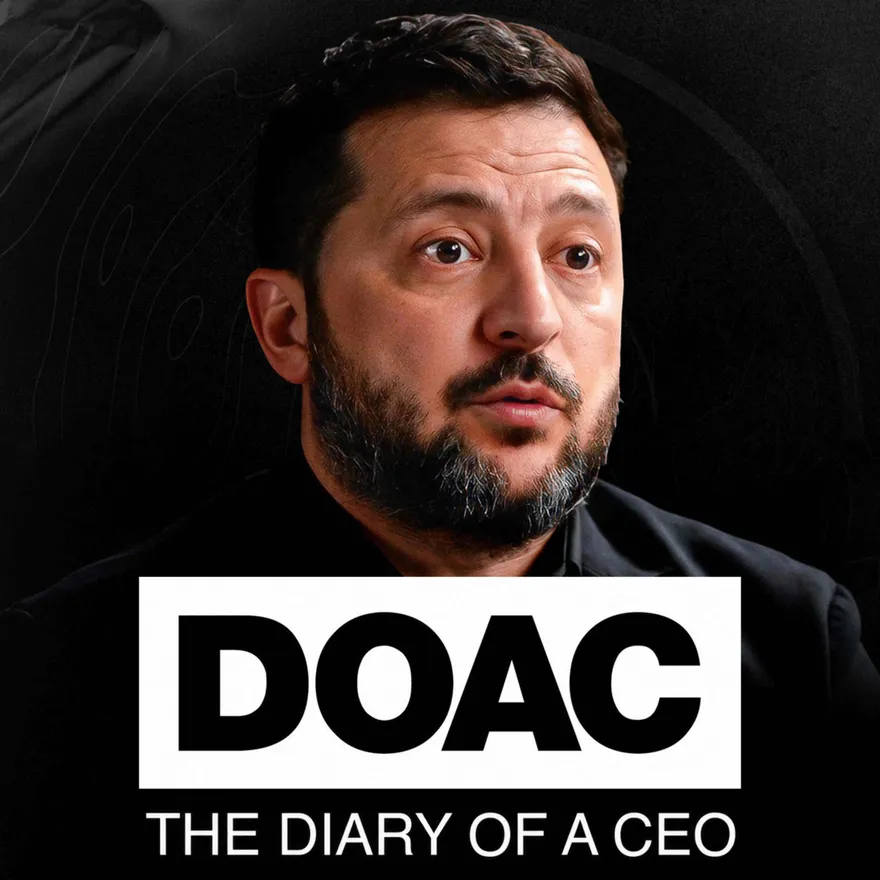

This is a preview of the Shortform summary of the Oct 22, 2026 episode of the The Diary Of A CEO with Steven Bartlett
Sign up for Shortform to access the whole episode summary along with additional materials like counterarguments and context.
1-Page Summary
Zelenskyy's Personal Journey: From Entertainment to Politics
Volodymyr Zelenskyy's path to the Ukrainian presidency is unusual, shaped by growing up in both the Soviet Union and independent Ukraine. Born in Soviet-controlled Ukraine, Zelenskyy experienced the restrictive "fish tank" of Soviet life before witnessing the emergence of Ukrainian national identity after independence. He credits his parents—particularly his professor father—with instilling values of education, honesty, and integrity that would later guide his political career.
Before entering politics, Zelenskyy built a career in entertainment and satire. His most notable role was in the TV series "Servant of the People," where he played a history teacher who unexpectedly becomes president of Ukraine. The show resonated with Ukrainians disillusioned by political instability, and its central message—that an honest, ordinary citizen could lead—proved prophetic.
Russia's 2014 occupation of Crimea and Donbas became a turning point for Zelenskyy, shifting his focus from entertainment to activism. In 2019, he registered "Servant of the People" as a real political party and won the presidency, reflecting the nation's desire for a leader without political baggage who could communicate authentically with citizens.
The Russian Invasion and Military Defense of Ukraine
On February 24, 2022, Russia launched a full-scale invasion of Ukraine with between 150,000 and 200,000 troops, aiming to capture Kyiv within three days. Russian forces carried limited rations and even parade uniforms, expecting swift victory. The invasion came from multiple directions—north via Belarus, and from the east and south—with the goal of encircling Kyiv, seizing strategic assets, and forcing the government to flee.
Zelenskyy's decision to stay in Kyiv proved crucial. Despite offers of evacuation from President Biden and European leaders, he famously responded, "I need ammunition, not a ride." His visible presence in the capital countered Russian disinformation and motivated Ukrainian soldiers and citizens. Ukraine's army rapidly expanded from 200,000 to 800,000 as volunteers mobilized, while civilians aided defense efforts by burning Russian vehicles and destroying infrastructure.
The Battle of Hostomel Airport became a decisive turning point. Russian paratroopers initially captured this crucial airfield, hoping to establish an air bridge for reinforcements. Ukrainian forces launched repeated counterattacks, destroyed the runway, and shot down Russian helicopters. Both Zelenskyy and military analysts agree that if Russia had controlled Hostomel, Kyiv would likely have fallen within days.
Russia's most significant miscalculation was underestimating the logistical and manpower needs for urban occupation. Zelenskyy notes that holding Kyiv would have required three to four hundred thousand troops—far more than Russia deployed. The relative ease of the 2014 Crimea occupation had inflated Russian confidence, leading to catastrophic miscalculation in 2022.
Once Russia's offensive stalled, Ukrainian counterattacks forced a full retreat from Kyiv and surrounding regions. The failure to take Kyiv fundamentally extended the war, and Russia shifted focus to a prolonged eastern offensive in Donbas.
Historical Context and Putin's Motivations
Vladimir Putin, a former KGB officer, has openly called the Soviet Union's collapse "the 20th century's greatest tragedy," revealing his nostalgia for lost Soviet power. Ukraine holds unique strategic value in Putin's imperial vision. The Soviet Union regarded Ukraine as a "forge of talent," producing leading scientists and engineers. Ukraine also housed key manufacturing facilities for rockets and nuclear weapons, making it vital for any Russian attempt to reassert regional dominance.
Putin's practical pursuit of restoration began with Crimea in 2014. Russian forces—disguised "little green men" wearing unmarked uniforms—took control with minimal resistance. Ukrainian leadership admits that failing to resist militarily emboldened Putin and set the stage for the 2022 full-scale invasion.
Putin's ideology denies Ukraine's legitimacy as a nation, claiming it's merely an artificial Soviet construct created by Bolshevik Russia. He frames Russian aggression as "liberation" from Nazi influence, despite Ukraine's profound suffering under Nazi occupation during World War II. By branding Ukraine as fiction, Putin seeks to recast conquest as restoring Russian dominion rather than invasion.
Putin exploited language and ethnic divides to justify intervention, claiming to protect Russian-speaking Ukrainians from oppression despite no evidence of discrimination. In reality, Ukrainian society is multilingual and multiethnic, with Russian speakers, Ukrainians, and others living peacefully together. Putin's insistence on the need for "protection" cynically weaponized linguistic diversity to provide rationale for invasion.
The Human and Psychological Toll of War
For nearly five years of war, Zelenskyy has willingly abandoned normal sleep, maintaining nightly communications with air defense operators and military commanders. In the earliest days of invasion, he survived on just 15 minutes of sleep at a time. Despite the severe psychological toll, he views this sacrifice as necessary responsibility, stating, "I have this trait... to pull yourself together when, you know, shock... you realize that you need to act right now."
Visiting Bucha after its liberation became a defining trauma for Zelenskyy. He witnessed mass graves containing around 500 people—men, women, children—many tortured before execution. Russian forces engaged in systematic cruelty: hunting civilians for sport, looting, sexual violence, and torture. Elderly survivors who lived through both WWII and Russian occupation told Zelenskyy that even the Nazis "never treated people like that."
Before Bucha, Zelenskyy believed in forgiveness. Witnessing such atrocities transformed that belief into hatred and a sense that certain acts cannot be forgiven. These experiences left psychological wounds that, by his own account, "will never fully heal."
Another acute burden is presenting Ukraine's highest military honor posthumously to parents who lost children in service. Zelenskyy describes these moments: "I cease to exist... it's not pain, it's something terrible." Many parents request only a simple embrace, valuing human connection over formal recognition.
The war's impact extends to Ukrainian children, many of whom have never known life without sirens, bomb shelters, and shelling. Zelenskyy describes this as "horrifying," a national trauma requiring decades of psychological recovery even after the conflict ends.
Zelenskyy's wife, Alina, serves as his emotional anchor, providing stability through constant danger. Yet he admits that years of war have made them strangers at times, the habit of focusing on work leaving him emotionally distant even when family is near. The brutality and losses of war have made clear that "everything is secondary. These people right here, that's what matters most," though wartime demands continue to hinder his ability to prioritize family presence.
State of War and Path to Peace
Russian forces currently occupy between 18 and 19 percent of Ukrainian territory, concentrating control on Crimea, the Azov Sea coast—including Mariupol and Berdyansk—and significant portions of Donetsk and Luhansk. Russia now targets eastern cities like Sloviansk, Kramatorsk, and Drushkiivka for access to Ukraine's industrial heartland. While Russian forces hold territory mainly in the south and east, they also launch frequent missile and drone strikes across Ukraine, targeting energy infrastructure and causing widespread power outages.
Despite enormous pressure, Ukrainian forces retain control of significant territories, including Kherson (the only regional capital Russia captured, which Ukraine has since liberated), Zaporizhia, and Mykolaiv. However, these areas endure ongoing Russian shelling. Zelenskyy warns that fortified positions in eastern Ukraine are vital; losing them risks exposing the industrial heartland and enabling Russian access to major population centers.
Recent diplomatic pressure, especially from former President Trump, urges Ukraine to agree to a ceasefire and possible territorial compromise. Trump blames Ukraine for U.S. diesel price hikes, alleging that Ukrainian attacks on Russian energy infrastructure contribute to higher prices. Zelenskyy refutes this, explaining that Russian diesel exports are so limited they do not impact U.S. prices, and Ukraine's strikes are direct responses to Russian attacks destroying Ukraine's electricity grid.
Polling shows 76% of Ukrainians oppose elections under current conditions and prefer continued resistance over territorial compromise. Yet Trump advocates for a change in Ukrainian leadership as a bargaining chip. Zelenskyy's primary demand is for more air defense systems to protect cities and infrastructure, emphasizing defense needs over concessions.
Zelenskyy insists that genuine peace must include justice for war crimes, security guarantees (ideally through NATO), and clear accountability for Russian aggression—not simply freezing the conflict along current frontlines. He calls the ceasefire itself a profound compromise and emphasizes that real peace requires justice for victims, including trials for those responsible for atrocities. Zelenskyy explains that it is impossible to simply forgive without justice: "That hatred isn't going anywhere. It takes time and justice... It's just totally impossible to simply forgive."
Zelenskyy acknowledges that Trump could pressure Putin to negotiate but doubts his willingness. Although Congress voted for significant sanctions against Russia, Trump has not fully enforced them. Zelenskyy hints at potential undisclosed deals or "special relationships" between Trump and Putin, urging that only by confronting Putin with the same pressure Trump uses with Ukraine can meaningful progress be made.
Sustained Western support remains essential for Ukraine's victory. Zelenskyy observes that "time is on Ukraine's side," as Ukrainian resistance, fueled by popular determination, stands in contrast to the exhaustion of the Russian military. While Ukraine is open to discussing security guarantees, such talks are meaningful only when they include restoration of territorial integrity and a path to justice. Zelenskyy's final message to Americans is one of gratitude for support, accompanied by a plea: choose justice and peace over energy arrangements with aggressor states, emphasizing Ukraine's determination to end the war only through a just settlement with accountability for Russian crimes, secure borders, and respect for the Ukrainian people's will.
1-Page Summary
Additional Materials
Counterarguments
- While Zelenskyy's outsider status and entertainment background appealed to voters, critics argue that his lack of political experience contributed to early missteps in governance and communication, particularly in managing Ukraine's complex bureaucracy and anti-corruption reforms.
- Some analysts contend that the rapid expansion of Ukraine's military and reliance on civilian volunteers, while effective in the short term, has led to challenges in training, coordination, and long-term sustainability.
- There is debate among historians and political scientists about the extent to which Putin's motivations are driven by Soviet nostalgia versus pragmatic security concerns regarding NATO expansion and Western influence near Russia's borders.
- While the atrocities in Bucha and elsewhere are well-documented, some international observers caution against generalizing the actions of all Russian soldiers or equating them with Nazi crimes, emphasizing the importance of individual accountability and due process.
- The assertion that Ukrainian society is entirely harmonious and free of ethnic or linguistic tensions is challenged by some scholars who note that regional differences and identity debates have existed in Ukraine for decades, though these have been largely overshadowed by the war.
- Some Western policymakers and analysts argue that a negotiated settlement, even if it involves temporary territorial compromise, may be necessary to prevent further loss of life and economic devastation, given the current military stalemate.
- Critics of Zelenskyy's leadership have raised concerns about media freedom and political pluralism during wartime, citing restrictions on opposition parties and press as potential threats to democratic norms, even if justified by security needs.
- While Western support is crucial for Ukraine, some argue that continued escalation and provision of advanced weaponry risk prolonging the conflict and increasing the likelihood of broader regional instability.
- There are differing views within Ukraine and among its allies about the feasibility and desirability of NATO membership as a security guarantee, given the alliance's reluctance to directly confront Russia militarily.
- Some economists and energy experts dispute the direct impact of the Ukraine war on global energy prices, noting that multiple factors—including OPEC decisions, global demand, and supply chain disruptions—also play significant roles.
Actionables
- you can strengthen your own sense of integrity and honesty in daily decisions by keeping a simple journal where you record one situation each day where you chose to act honestly, even if it was inconvenient, and reflect on how it shaped your relationships or self-perception.
- a practical way to support justice and accountability in your community is to volunteer for or donate to local organizations that document and address injustices, such as legal aid clinics or groups supporting victims of violence, mirroring the insistence on justice before forgiveness.
- you can foster resilience and emotional support in your family or friend group by setting up a regular check-in (such as a weekly call or message) where everyone shares one challenge and one thing they’re grateful for, helping to build mutual support during difficult times.
Get access to the context and additional materials
Zelenskyy's Personal Journey: From Entertainment to Politics
Early Post-Soviet Ukraine Shaped His Values and Worldview Through Soviet and Independent Experiences
Zelenskyy's Soviet Union Birth and Ukraine Upbringing Shape Unique Perspective on Freedom and Identity
Volodymyr Zelenskyy grows up straddling two eras: he is born in the Soviet Union when Ukraine is still a Soviet republic, and comes of age in an independent Ukraine. He describes his generation as one that experienced both the restrictions of life under a controlled empire and the emergence of national identity when Ukraine gained its independence. Growing up in post-Soviet Ukraine, he observes the stark difference between the oppressive, gray environment of the Soviet "fish tank" and the vibrant possibilities of an open society. Zelenskyy sees the fall of the Soviet Union as a natural consequence of people’s desire to be free and to shape their own identities, languages, and cultures.
Values of Education, Honesty, and Integrity Instilled by Parents
Zelenskyy is raised in Kryvyi Rih, in an academic but ordinary family who, like many academics in Soviet times, do not have wealth but do have strong principles. He credits his father, an honest man and professor, and his loving mother for instilling in him traditional values: the importance of education, honesty, integrity, and receiving the right upbringing. He expresses gratitude for the love and values passed on by his parents, believing those three gifts to be foundational.
Entertainment and Satire Career Pathway to Political Messaging Understanding
From Comedy to Politics: Script Writer and Actor Turned Political Communicator
Zelenskyy’s career in entertainment forms his unique pathway to politics. Initially, he gains fame as a creator, writer, and actor in television and satire, not as a political figure.
His Film Roles and Voice Acting, Like Playing a History Teacher Turned President In Servant of the People, Created an Uncanny Parallel to His Actual Political Trajectory
One of his most notable roles is in the satirical TV series “Servant of the People,” where he plays a school history teacher who unexpectedly becomes the president of Ukraine. The premise of an ordinary person with no political background taking the highest office becomes a source of inspiration and curiosity—especially since, at that time, Zelenskyy himself has no plans for political office. The uncanny overlap of fiction and reality eventually unfolds as his actual political career takes off.
Show About Ordinary Person Becoming President Resonated With Ukrainians During Political Instability and Disillusionment
“Servant of the People” resonates with Ukrainians, who are living through a period of political instability and disillusionment with traditional politics. The show’s central message—that an honest, unconnected citizen can lead—is widely popular and paves the way for the launch of a real political movement.
Motivated by Russia's 2014 Crimea Occupation, He Transitioned From Entertainment To Activism and Governance
Crimea and Donbas Occupation Shifted His Priorities
The Russian occupation of Crimea and Donbas in 2014 becomes a turning point for Zelenskyy. The events deeply affect him, stirring a sense that something has fundamentally changed in Ukraine. What wa ...
Here’s what you’ll find in our full summary
Zelenskyy's Personal Journey: From Entertainment to Politics
Additional Materials
Counterarguments
- While Zelenskyy’s experience straddling the Soviet and post-Soviet eras is unique, many Ukrainians of his generation share similar backgrounds, so his perspective may not be as singular as portrayed.
- The fall of the Soviet Union was influenced by complex political, economic, and international factors, not solely by a universal desire for freedom and self-determination.
- Emphasizing Zelenskyy’s academic family background and values does not necessarily distinguish him from many other Ukrainian leaders or citizens who also value education and integrity.
- Transitioning from entertainment to politics can be seen as lacking relevant experience in governance, policy, or public administration.
- The popularity of “Servant of the People” may reflect public disillusionment with traditional politicians, but it does not guarantee that skills in satire and acting translate into effective political leadership.
- Registering a political party based on a television show could be criticized as blurring the lines between entertainment and serious governance, potentially trivializing political processes.
- Zelenskyy’s outsider status and lack of political bagg ...
Actionables
- you can reflect on your own upbringing by writing a short letter to your parents or guardians, thanking them for specific values or lessons they taught you, then identify one value you want to pass on or strengthen in your daily life, such as honesty or curiosity, and set a simple weekly goal to practice it (like telling the truth in a difficult situation or learning something new each week).
- a practical way to explore your sense of identity and freedom is to create a personal timeline that marks key moments when you felt most free or most restricted, then use this timeline to set a small, actionable intention for the coming month—such as speaking up in a group, learning a new language phrase, or celebrating a cultural tradition that matters to you.
- you can ...
Get access to the context and additional materials
The Russian Invasion and Military Defense of Ukraine
On February 24, 2022, Russia launched a full-scale invasion of Ukraine, aiming for a swift victory by quickly capturing the capital, Kyiv. Ukrainian president Volodymyr Zelenskyy recalls the outbreak of war as missiles rained down in the early morning hours, sparking widespread chaos, terror, and disbelief as families fled and children screamed.
Russia's 200,000 Troop Invasion on Feb 24, 2022, Aimed to Capture Kyiv In Three Days
Russian Planners Underestimated Ukrainian Resistance, Bringing Limited Rations and Parade Uniforms, Confident in Rapid Victory
Intelligence briefings and satellite imagery from late 2021 had already indicated Russia’s buildup near the Ukrainian border. By the time of the invasion, reports estimate that Russia deployed between 150,000 and 200,000 troops—nearly equal to the size of Ukraine’s active military at the time. Russian planners presumed Ukraine would quickly fall. Captured Russian assault units carried only three to ten days of combat rations and even included parade uniforms, confident they would stage a victory spectacle in Kyiv within days. Russian state media inadvertently released a preemptive declaration of victory on the third day of the invasion.
Invasion From North, East, and South With Rapid Advance Toward Capital
The invasion came from multiple directions. Troops entered from the north via Belarus, exploiting the lack of strong Ukrainian forces near the capital. Simultaneous attacks also targeted eastern and southern regions, including Donetsk, Luhansk, Kharkiv, and Mariupol, leveraging the concentration of Ukraine’s main military units in the east to hold back separatists and Russian troops.
Russian Strategy: Encircle Kyiv, Seize Airports and Tv Towers, Force Government to Flee, Induce Nationwide Capitulation
Russia’s plan was to rapidly advance toward Kyiv—occupying outlying towns, seizing strategic assets like airports and TV towers, and encircling the city to cut off food and water. They expected the Ukrainian government would flee, allowing them to install a puppet regime and claim swift victory. Zelenskyy notes that Putin regarded Kyiv as fundamentally Russian, believing that a display of overwhelming force would induce mass surrender and the government’s escape.
Ukraine's Resistance Halted Russia's Conquest Objective
Zelenskyy's Choice to Stay In Kyiv Was Crucial, Motivating Soldiers and Countering Abandonment Narratives
Despite the encirclement, offers for evacuation from President Biden and European leaders, and relentless Russian pressure, Zelenskyy refused to abandon Kyiv. He famously responded, “I need ammunition, not a ride.” He remained in a bunker within his office, constantly communicating with world leaders, organizing defense strategies, and most critically, making a point to appear publicly and visibly in the capital to counter Russian disinformation claiming he had already fled. Zelenskyy’s choice was, by his own admission, both a constitutional duty and a moral one, crucially motivating soldiers and citizens, who drew strength from the knowledge that their president stood with them.
Ukrainian Forces Grow From 200,000 to 800,000, Degrade Russian Capabilities Despite Initial Disadvantage
Ukraine’s army rapidly swelled as hundreds of thousands of volunteers mobilized, expanding from 200,000 to 800,000. Citizens fortified the defense, burning Russian vehicles, fighting street by street, and improvising to stall the Russian advance. Zelenskyy describes this as crisis management at unprecedented speed, making tactical decisions and inspiring both the military and civilian defenders. As resistance stiffened, Ukrainian forces succeeded in holding key positions and steadily degraded Russian units, eventually forcing a withdrawal from the Kyiv region.
Citizens Aided Defense, Burning Russian Vehicles and Wrecking Hostomel Airport Runway to Block Troop Landings
Civilians not only aided soldiers but directly contributed to pivotal defensive actions, such as burning Russian armored vehicles and destroying infrastructure to hinder the Russian military, particularly near Kyiv.
Battle of Hostomel: Turning Point Preventing Russian Occupation of Kyiv
Russian Paratroopers Capture Airport; Ukrainian Forces Counterattack Multiple Times
One of the most decisive battles unfolded at Hostomel Airport. Russian paratroopers initially captured this crucial airfield in hopes of establishing an air bridge for rapid reinforcement.
Ukrainians Destroyed Runway, Shot Down Helicopters to Block Russian Logistics
Ukrainian National Guard units and special forces launched repeated counterattacks, and defenders deliberately destroyed the runway to prevent its use by Russian transport planes. Air defense units succeeded in shooting down several Russian helicopters, cutting the Russians off from vital supply lines.
If Russia Had Controlled Hostomel, They Likely Would Have Overwhelmed Kyiv's Defenses and Captured the Capital Within Their Planned Timeframe
Both Zelenskyy and milit ...
Here’s what you’ll find in our full summary
The Russian Invasion and Military Defense of Ukraine
Additional Materials
Counterarguments
- While Russian planners underestimated Ukrainian resistance, some analysts argue that Western intelligence also overestimated Russia’s initial capabilities and underestimated the potential for logistical failures, suggesting that both sides misjudged the situation.
- The claim that Russia brought only parade uniforms and limited rations has been questioned by some military analysts, who note that while there were logistical shortcomings, not all Russian units were so ill-prepared.
- The assertion that control of Hostomel Airport would have guaranteed the fall of Kyiv is debated; some military experts argue that urban warfare and the scale of Ukrainian resistance could still have prevented a rapid Russian victory, even with the airport secured.
- The narrative emphasizes Zelenskyy’s personal decision to stay in Kyiv as pivotal, but some critics note that Ukrainian institutional resilience and pre-existing military planning also played significant roles in the defense.
- The estimate that Russia would have needed three to four hundred thousand troops to occupy Kyiv is based on general urban warfare doctrine, but some military historians argue that occupation requirements can vary widely depending on local c ...
Actionables
- you can prepare for unexpected challenges by creating a personal contingency plan for your daily life, such as mapping out alternative routes for your commute, identifying backup childcare options, or listing essential supplies to keep on hand, so you’re ready to adapt quickly if your usual routines are disrupted.
- a practical way to strengthen your resolve in difficult situations is to write a short statement about a value or goal you refuse to abandon, keep it visible (like on your phone lock screen), and refer to it when facing pressure to give up or compromise, reinforcing your commitment much like leaders who stay put during crises.
- you can prac ...
Get access to the context and additional materials
Historical Context and Putin's Motivations
Putin Aims to Reverse Soviet Collapse By Restoring Imperial Control
Vladimir Putin, a former KGB intelligence officer and a staunchly Soviet-minded leader, has openly lamented the fall of the Soviet Union, calling it “the 20th century’s greatest tragedy.” This nostalgia for lost Soviet power drives his imperial ambitions, which focus on reversing what he perceives as a historic wrong and restoring Russian control over former Soviet territories.
Putin Called the Soviet Union's Collapse "the 20th Century's Greatest Tragedy," Showing His Nostalgia for Soviet-Era Power and Territorial Dominion
Putin’s public statements reveal deep grief over the Soviet Union’s breakup. He envisions his leadership as an opportunity to restore Russia’s former status and territorial reach, directly shaping his foreign policy, particularly regarding Ukraine.
Ukraine as a "Forge of Talent" Essential to Russian Imperial Ambitions
Ukraine holds a unique place in Putin’s vision. The Soviet Union regarded Ukraine as a “forge of talent,” producing leading scientists, engineers, intellectuals, and administrators who helped staff the Soviet bureaucracy and intelligentsia. Many Soviet-era institutions and ministries were run by Ukrainians, highlighting Ukraine’s role as the intellectual core of the former Soviet Union.
Ukraine's Strategic Value to Russia: Manufacturing, Rockets, Nuclear Assets Post-Soviet Breakup
Beyond human capital, Ukraine’s strategic value was—and remains—immense. It housed key manufacturing facilities, especially for rockets and even nuclear weapons, although Ukraine surrendered its nuclear arsenal after independence. Ukraine’s industrial might and technical expertise make it a vital component for any Russian project to reassert regional dominance.
2014 Crimea: Russia's Stealthy Imperial Restoration Attempt Avoiding Direct Military Conflict
Crimea Captured by Russian Forces Using "Little Green Men" Operatives
Putin began his practical pursuit of restoration in 2014 with Crimea. Russian forces—disguised and unacknowledged, dubbed “little green men”—took control of the peninsula. These operatives wore unmarked uniforms, creating plausible deniability for Russia and confusing both local populations and international observers.
Ukraine's 2014 Crimea Loss Signaled Weakness To Putin, Encouraging Larger Military Operations and Full-Scale Invasion
At the time, Ukraine offered little organized military resistance. Russian denial and ambiguous tactics prevented a rapid and unified Ukrainian or international response. In hindsight, Ukrainian leadership admits that failing to resist the Crimea annexation militarily emboldened Putin, fostering his belief that further land grabs—even targeting Kyiv—might be just as easy. This sense of impunity directly set the stage for Russia’s subsequent full-scale invasion.
Undeclared Crimea Operation Enabled Diplomatic Ambiguity For Russia
Russia’s refusal to openly declare involvement in Crimea’s occupation enabled diplomatic ambiguity. Russia denied that its soldiers were in fact operating on Ukrainian soil, muddying international response and avoiding immediate, direct conflict.
Putin's Ideology Denies Ukraine's Legitimacy, Viewing It As an Artificial Soviet Construct Without Genuine Statehood
Putin's False Claim: Bolshevik Russia Created Modern Ukraine
Putin argues that modern Ukraine is a creation of Bolshevik, communist Russia—asserting that Ukraine sprang into existence only after the 1917 revolution and dismissing centuries of prior Ukrainian history. He thus denies Ukraine’s long-standing, independent cultural and political traditions, despite evidence of Ukrainian statehood and civilization stretching back to Kievan Rus.
Ideological Framework Rationalizes Russian Aggression as "Liberation" From Nazi Influence, Despite Ukraine's WWII Experience
To justify aggression, Putin frames Russia’s actions as “liberating” Ukraine from fascist or Nazi influences—an assertion that deeply contradicts historical reality. Ukraine’s population, far from embodying fascism, suffered profoundly under Nazi occupation during World War II and contributed enormous sacrifices to the defeat of Nazi Germany.
Putin Frames Ukraine as Fiction to Justify Conquest As Restoring ...
Here’s what you’ll find in our full summary
Historical Context and Putin's Motivations
Additional Materials
Counterarguments
- While Putin has expressed nostalgia for the Soviet Union, some analysts argue that his actions are driven more by pragmatic security concerns and geopolitical calculations than purely by imperial nostalgia.
- Russia’s concerns about NATO expansion and Western influence near its borders are cited by some as significant motivators for its actions in Ukraine, rather than solely a desire to restore imperial control.
- The historical relationship between Russia and Ukraine is complex, with periods of both cooperation and conflict; some Russian perspectives emphasize shared cultural and historical ties rather than denying Ukrainian identity outright.
- Some Russian officials and commentators argue that the annexation of Crimea reflected the will of the majority of its population, as indicated by the controversial 2014 referendum, though this is widely disputed internationally.
- The issue of language and identity in Ukraine has been a source of political tension at times, with some Russian speakers expressing concerns about language polic ...
Actionables
- you can practice spotting and questioning narratives that oversimplify complex histories by reading news stories about international conflicts and jotting down any claims that frame entire nations or groups as artificial or illegitimate, then researching at least one alternative perspective for each claim to build a habit of critical analysis.
- a practical way to understand the impact of language and identity manipulation is to keep a week-long journal noting when you see language, ethnicity, or cultural differences used as justification for exclusion or conflict in everyday life (such as in workplace dynamics, local politics, or media), and reflect on how these narratives could be challenged or reframed to promote coexistence.
- you can str ...

Get access to the context and additional materials
The Human and Psychological Toll of War
Zelenskyy's Sacrifice: Sleep Deprivation and Communication With Military, International Leaders
Zelenskyy Has Forgone Normal Sleep For Five Years of War, Maintaining Nightly Communications With Air Defense Operators and Commanders About Tactics and Resources
For nearly five years of ongoing war, President Volodymyr Zelenskyy has willingly abandoned the idea of normal sleep, accepting it as part of his responsibility as a wartime leader. He often reminds himself, “I’ll be honest, I don’t sleep. It’s a huge terrifying pain that I wouldn’t wish on anyone.” Throughout this time, nightly communications with air defense operators and military commanders have become routine, with Zelenskyy receiving updates and engaging in tactical discussions on Ukraine’s security and resources. In the earliest days of the Russian invasion, he recounts surviving on just 15 minutes of sleep at a time, describing a cycle of urgent coordination and response.
Sleep Reduced To Fragments, Enabling 24/7 Crisis Response
Zelenskyy’s rest is reduced to irregular fragments, barely enough to sustain basic function but essential to stay available and responsive to crises around the clock. Even as the war entered its later stages, longer sleep remained elusive and, by his own words, nearly unheard of. Despite the severe psychological toll, he views the sacrifice of sleep as a necessary responsibility, stating, “I have this trait... to pull yourself together when, you know, shock. People around you are in shock... you realize that you need to act right now. Just act.” The effects of sleeplessness linger, becoming an accepted but draining part of his daily existence.
Witnessing Atrocities in Bucha Left Lasting Emotional Scars On Zelenskyy Post-War
Zelenskyy Found 500 Tortured Victims, Including Children, In Bucha Mass Graves, With Evidence of Systematic Torture, Mutilation, and Execution
Visiting Bucha after its liberation became a defining trauma for Zelenskyy. He personally witnessed the aftermath: “Dead bodies lying everywhere. Kids, adults, elderly people, chopped meat, butchered them, hands tied, tortured, and then buried in pits.” He details finding mass graves containing around 500 people—men, women, children, animals—many tortured before execution.
Zelenskyy: Russian Forces Committing Worse Atrocities Than Nazi Occupation—Hunting Civilians, Looting, Sexual Violence, and Torture Before Burial
Zelenskyy recounts evidence of systemic cruelty. Russian forces engaged in “hunting sprees,” shooting civilians and animals for sport, looting homes, carrying out sexual violence, and burying victims in mass graves. In conversations with survivors, including elderly residents who lived through both WWII and the Russian occupation, he heard that the Nazis, as occupiers, “never treated people like that.”
Industrial-Scale Cruelty Transformed Zelenskyy's Philosophical Opposition to War Into Hatred, Eliminating Forgiveness and Creating Psychological Scars That Will Never Fully Heal
Before Bucha, Zelenskyy believed in forgiveness and the fallibility of humankind. Witnessing such atrocities transformed that belief into hatred and a sense that certain acts cannot be forgiven. These experiences scarred him deeply, leaving psychological wounds that, by his own account, “will never fully heal.” He emphasizes the impossibility of compromise or forgiveness for such evil, especially when outsiders suggest negotiation or gas trade with those responsible.
Presenting Posthumous Honors To Parents Who Lost Children In Military Service Devastates Zelenskyy Emotionally
Zelenskyy Realizes No Award Compensates For Loss While Honoring Grieving Parents With Ukraine's Highest Award
Another acute psychological burden for Zelenskyy is presenting Ukraine’s highest military honor posthumously to parents who have lost their sons or daughters in service. In these moments, Zelenskyy says, “I cease to exist... it’s not pain, it’s something terrible.” He meets parents who have lost soldiers, aware that no medal or recognition can replace their child.
Grieving Parents Prefer Embraces Over Honors, Valuing Connection Over Recognition
Many parents request only a simple embrace. Zelenskyy notes, “You give an award to a father... he just quietly says to you, can we hug?” For them, a human connection means more than any formal honor.
Distinction in Grief: Parents Who Lost Soldier Children vs. Peacetime Atrocity Victims, as Witnessed by Zelenskyy
He distinguishes between parents who lose children in military service—expected, though never truly prepared for—and those who lose loved ones to atrocity as civilians, whose grief is compounded by the senselessness of violence.
Ukrainian Children's Loss of Normal Childhood Represents National Trauma For Millions Who Never Knew Peace
Ukrainian Children Growing Up Amid Warfare and Disruption
The war’s impact is vividly felt among Ukrainian children. Zelenskyy points out that many have never known a life without sirens, bomb shelters, and shelling. “There are children, a lot of them among the fallen as well, who never lived in peace... Their childhood passed during war.”
Many Ukrainian Children Face Childhoods Altered by Constant Stress From Air Raid Sirens, Missile Threats, and Military Operations
Every night, families descend into bomb shelters and return only when alarms cease. Some children die, and all live with enduring fear and disruption. Zelenskyy describes this as “horrifying,” a national trauma for an entire generation robbed of normal childhood.
Generational Scarring of Ukrainian Youth Needs Decades of Psychological Recovery After Conflict Concludes
He recognizes that this trauma will not fade quickly, predicting that “generational scarr ...
Here’s what you’ll find in our full summary
The Human and Psychological Toll of War
Additional Materials
Counterarguments
- While Zelenskyy’s sleep deprivation is portrayed as a sacrifice, some leadership experts argue that chronic lack of rest can impair decision-making and may not be the most effective way to lead during prolonged crises.
- The depiction of atrocities in Bucha is based on Zelenskyy’s account; independent investigations are ongoing, and while evidence of war crimes exists, the full scope and comparative severity to other historical atrocities may be subject to further verification and debate.
- The assertion that Russian forces committed acts “worse than Nazi occupation” is a subjective comparison; some historians caution against direct equivalence between different historical atrocities due to differing contexts and scales.
- The narrative centers on Zelenskyy’s personal psychological toll, but does not address the experiences or perspectives of other Ukrainian leaders, soldiers, or civilians who may have different coping mechanisms or responses.
- The focus on Ukrainian children’s trauma is valid, but similar psychological impacts on children in other conflict zones globally are not discussed, which could provide a broader context for understanding war’s effects on youth.
- While the text emphasizes the impossibility of forgivene ...
Actionables
- you can create a nightly check-in ritual with loved ones to foster emotional connection and reassurance, especially during stressful times. For example, send a simple message or make a brief call each night to share how you’re feeling and ask about their day, reinforcing bonds and providing mutual support even when life feels overwhelming.
- a practical way to support children or young people in your life is to set up a “peaceful moments” routine that helps them decompress from daily stress. This could be as simple as reading together, drawing, or listening to calming music for a few minutes each day, helping them reclaim a sense of normalcy and emotional safety.
- you can prioritize me ...
Get access to the context and additional materials
State of War and Path to Peace
Russia Holds 18-19% of Ukraine, Focusing On Eastern and Southern Areas, While Continuing Missile and Drone Attacks Nationwide
Russian forces currently occupy between 18 and 19 percent of Ukrainian territory, concentrating their control on Crimea, the coastal areas along the Azov Sea—including Mariupol and Berdyansk—and significant portions of the Donetsk and Luhansk regions in the east. This occupation forms a discontinuous but strategically vital zone, stretching from the Crimean peninsula through eastern Ukraine and cutting Ukraine off from access to the Black Sea in key areas. The Russians hold several critical cities and ports, essentially turning the Azov into an "inland sea" under their control. Areas like Kerch further restrict Ukraine's maritime access.
Russian-Controlled Areas: Crimea, Parts of Donetsk and Luhansk Regions, and Azov Sea Coast, Forming a Discontinuous Occupation Zone
Crimea was annexed in 2014. Since the 2022 invasion, Russia has also claimed major cities along the Azov coast—Mariupol and Berdyansk—and extended into Donetsk and Luhansk, establishing a continuous occupation through these regions. However, they failed to maintain Kherson, which Ukraine has since liberated.
Russia Targets Eastern Cities Sloviansk, Kramatorsk, Drushkiivka For Access to Ukraine's Industrial Heartland
Russia's military objectives now target the eastern industrial belt for further expansion. Cities such as Sloviansk, Kramatorsk, and Drushkiivka are under constant threat, as their seizure would provide access into the Dnipropetrovsk region and key industrial centers like Kryvyi Rih and Nikopol. The area represents the "economy of our country," according to Zelenskyy, and its loss would expose additional industrial hubs and major population centers to Russian control.
Missile and Drone Attacks Target Energy Infrastructure, Causing Power Outages and Civilian Casualties
While Russian forces hold territory mainly in the south and east, they also launch frequent missile and drone strikes across Ukraine. Cities from Lutsk in the west to Kyiv and the central regions routinely suffer attacks, leading to civilian casualties and destroying critical energy infrastructure. Zhitomir faces constant shelling; fewer strikes reach the far west, but nearly all regions remain at risk. These attacks cause widespread power outages, further deteriorating daily life for Ukrainians and aiming to degrade Ukraine’s defense and resilience.
Ukrainian Military Holds Key Territories Under Russian Pressure, With Uncertain Security Guarantees and Defense Capacity
Despite enormous pressure, the Ukrainian military retains control of significant territories, including Kherson, Zaporizhia, Mykolaiv, and nearby industrial cities. These areas, though liberated or held by Ukraine, continue to endure Russian shelling and sabotage aimed at undermining their defensive capacity.
Ukraine Liberated Kherson, the Only Regional Capital Captured In the Invasion, Though It Remains Damaged by Artillery Strikes Across the Dnipro
Ukrainian forces successfully reclaimed Kherson, the only regional capital Russia captured since 2022. However, Kherson remains divided by the Dnipro River, with Russian forces entrenched on the east bank shelling the city regularly.
Zaporizhia, Mykolaev, and Nearby Industrial Cities Stay Under Ukrainian Control but Endure Ongoing Russian Military Pressure and Infrastructure Destruction to Degrade Defense Capability
Other key cities like Zaporizhia and Mykolaiv remain under Ukrainian control, but they are constant Russian targets. Maintaining control over these industrial and population centers is vital, as surrendering them would jeopardize Ukraine's capacity to produce and protect, while giving Russia a gateway to further advances.
Fortified Defenses in Eastern Ukraine Are Vital; Their Loss Risks Exposing Industrial Heartland and Enabling Russian Access to Population Centers
Zelenskyy warns that fortified positions in eastern Ukraine are absolutely vital. Losing them risks exposing the nation’s industrial heartland and could allow Russia a path toward controlling larger Ukrainian areas, including major cities and economic zones.
Trump Administration Push For Ceasefire and Territorial Compromise Conflicts With Ukrainian Demands For Justice, Security Guarantees, and Compensation
Recent diplomatic pressure, especially from former President Trump, urges Ukraine to agree to a ceasefire and possible territorial compromise. Trump has blamed Ukraine for rising diesel prices in the U.S., linking them to energy attacks and disregarding the minimal impact of Russian diesel exports on global prices. He’s also pushing for a change in Ukrainian leadership as part of a deal with Russia, and pressure on Ukraine to accept concessions remains high.
Trump Blames Ukraine For U.S. Diesel Price Hikes, Alleging Energy Attacks and Misrepresenting Minimal Impact of Russian Diesel Exports
Trump claims that attacks on Russian energy infrastructure contribute to higher diesel prices in the U.S. Zelenskyy refutes this, explaining that Russian diesel exports are so limited they do not impact U.S. prices. Ukraine’s limited strikes on Russian energy assets are in direct response to Russian attacks destroying Ukraine’s electricity grid, leaving millions without power, not to influence global energy prices.
Trump's Push for New Ukrainian Leadership and Territorial Concessions Opposes Polling Showing 76% of Ukrainians Prefer Resistance Over Compromise and Oppose Elections
Polling shows that 76% of Ukrainians oppose elections under current conditions and prefer continued resistance over any form of territorial compromise. Despite this, Trump advocates for a change in Ukrainian leadership as a bargaining chip for settlement with Russia—an idea that is deeply unpopular and discordant with Ukrainian public opinion.
Zelenskyy Seeks Air Defense Missiles Over Concessions, Emphasizing Energy Infrastructure Defense Over Ceasefire Talks Trump Deems Non-negotiable With Putin
Zelenskyy’s primary demand is for more air defense systems to protect Ukrainian cities and energy infrastructure. Rather than ask for any concession or agreeing to a ceasefire on Russia’s terms, Zelenskyy requests necessary defensive resources, not handouts. He notes U.S. and European reluctance to provide air defense systems such as Patriot missiles, even as vital supplies go to other regions. Zelenskyy also stresses that while talks of ceasefire keep emerging, actual security guarantees for Ukraine’s territorial integrity remain elusive.
Zelenskyy's Peace Needs Justice, Security Guarantees, and Accountability, Not Military Stalemate or Territorial Compromise
Zelenskyy insists that a ceasefire is already a major concession and that genuine peace must include justice for war crimes, security guarantees (ideally through NATO), and clear accountability for Russian aggression—not simply freezing the conflict along current frontlines or allowing Russia to hold onto gains.
Zelenskyy Insists Ceasefire Alone Is Major Ukrainian Concession; Settlement Must Prosecute War Criminals and Ensure Justice
Zelenskyy calls the ceasefire itself a profound compromise given the death and suffering endured by Ukrainians. He emphasizes that real peace requires justice for victims, including trials for those responsible for torture and atrocity. Without some form of accountability and justice, lasting peace is impossible and vengeance or renewed fighting remain likely outcomes.
Ukraine's Pursuit of Nato Membership Stems From Deterring Putin's Ambitions
Ukraine’s push for NATO membership remains a core demand, motivated both by a need for deterrence against further Russian aggression and the inadequacy of lesser security guarantees.
Hatred From Russian Atrocities Creates Psychological Barriers to Forgiveness, Which Zelenskyy Argues CanNot Be Overcome by Political Pressure, Making Justice Mechanisms Essential for Genuine Peace, N ...
Here’s what you’ll find in our full summary
State of War and Path to Peace
Additional Materials
Counterarguments
- Some analysts argue that a negotiated ceasefire, even if imperfect, could save lives and prevent further destruction, and that insisting on full territorial restoration may prolong suffering without guaranteeing a better outcome.
- There is debate over whether NATO membership for Ukraine would deter Russian aggression or risk escalating the conflict further, potentially drawing NATO countries directly into war.
- Critics contend that prioritizing justice and war crimes prosecutions before peace may delay conflict resolution, as historically, some peace processes have required sequencing justice after cessation of hostilities.
- Some Western policymakers believe that continued military support for Ukraine without clear conditions or a diplomatic track could lead to a protracted stalemate with high costs for both Ukraine and its allies.
- While Ukrainian public opinion strongly opposes territorial compromise, some international observers suggest that public sentiment can shift over time, especially if the war drags on and costs mount.
- There are arguments that energy market fluctuations are influenced by multiple global factors, not solely by the war in Ukraine or Russian energy exports, and attributing price changes to a single cause may oversimplify the issue.
- Some suggest that calls for leadership chang ...
Actionables
- you can track and compare news coverage from multiple international sources to spot misinformation and bias about conflicts, then share a short, clear summary with friends or family to help them understand the realities behind headlines and political statements
- By regularly checking news from Ukrainian, Russian, American, and European outlets, you’ll notice how narratives differ. Summarize key differences in a few sentences and send them to your group chats or social media, helping others see through misleading claims or oversimplifications.
- a practical way to support justice and accountability is to write a brief, personalized message to your elected officials urging them to prioritize war crimes investigations and transparent sanctions enforcement, referencing recent events or news
- Use official contact forms or email to express why justice for atrocities and consistent sanctions matter to you as a constituent. Mention specific recent attacks or policy delays, and ask for updates on what your representative is doing to support accountability.
- you can ...
Get access to the context and additional materials


Create Summaries for anything on the web
Download the Shortform Chrome extension for your browser
