

President Zelenskyy: Peace Is A Huge Compromise, The Horrific Atrocities Of Russian War Crimes!
In this episode of The Diary Of A CEO with Steven Bartlett, Ukrainian President Volodymyr Zelenskyy discusses Russia's full-scale invasion of Ukraine and its ongoing consequences. Zelenskyy explains how Russia's strategic miscalculations led to failed early offensives, including the critical battle at Hostomel Airport, and describes the atrocities Ukrainian forces discovered in liberated territories like Bucha. He reflects on his unexpected transformation from entertainment career to wartime leadership, and the personal toll of constant crisis management and witnessing civilian suffering.
The conversation covers the geopolitical context of Russia's imperial ambitions, the challenges of international diplomacy, and the obstacles to achieving meaningful peace. Zelenskyy addresses current territorial realities, pressures from international leaders including Donald Trump, and his position on what constitutes a just resolution to the conflict. Throughout, he emphasizes the necessity of accountability for war crimes and the importance of security guarantees for Ukraine's future.
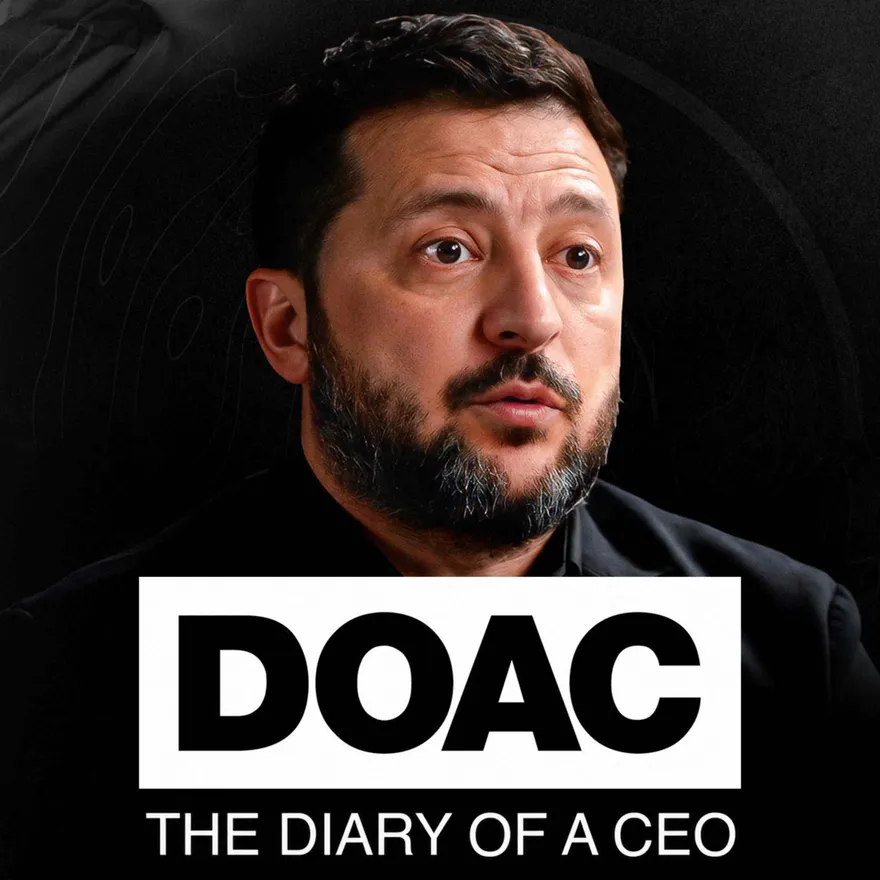

This is a preview of the Shortform summary of the Oct 22, 2026 episode of the The Diary Of A CEO with Steven Bartlett
Sign up for Shortform to access the whole episode summary along with additional materials like counterarguments and context.
1-Page Summary
The Russian Invasion and Ukraine's Military Defense
Russia's Strategic Miscalculation of Ukrainian Resistance
When Russia launched its full-scale invasion on February 24, 2022, Vladimir Putin and his command expected the Ukrainian government to collapse within three days. Russian assault units carried only three to ten days of combat rations and even brought dress uniforms for a victory parade, while state media prematurely released a declaration of victory. Putin's core misjudgment stemmed from seeing Ukraine as merely an extension of Russia and refusing to recognize its independent identity.
He assumed President Volodymyr Zelenskyy would flee, expecting this would demoralize Ukrainian defenders and cause rapid governmental collapse. However, Zelenskyy decisively rejected evacuation offers from Western allies—famously responding to U.S. President Joe Biden, "I need ammunition, not a ride." His choice to remain in Kyiv, working from a bunker while regularly appearing on the streets, became a powerful symbol of resistance that inspired the Ukrainian military and citizens to stand and fight.
The Siege of Kyiv and Failed Northern Offensive
Russia committed between 150,000 and 200,000 troops to its assault, nearly equivalent to Ukraine's entire active-duty military. The Russians advanced from multiple directions, including a major thrust from Belarus toward Kyiv. Ukrainian forces were heavily concentrated in the Donbas region due to ongoing fighting with Russian-backed separatists, leaving Kyiv less protected.
The infamous 64-kilometer military convoy that advanced toward Kyiv intended to encircle the capital and force surrender through siege tactics. Russia also rapidly occupied key infrastructure, including the Chernobyl nuclear plant. Despite being caught off-balance, Ukrainians mobilized quickly, with civilians joining regular troops to form a spirited resistance that slowed the Russian advance.
Battle For Hostomel Airport: Pivotal Moment
One of the most critical battles took place at Hostomel Airport, where Russian paratroopers attempted to seize the airport to use it as a landing zone for reinforcements. Ukrainian National Guard units, supported by army and special forces, counterattacked. To deny the airfield to Russia, Ukrainian defenders destroyed the runway themselves and shot down Russian transport helicopters, preventing Russia from landing the large airborne force required to assault the capital.
Ukrainian Strategic Victories and Russian Withdrawal
In response to the invasion, Ukraine undertook nationwide mobilization, swelling from 200,000 to 800,000 personnel within weeks. This surge enabled Ukraine to hold key defensive lines and mount successful counteroffensives. Russia, meanwhile, faced severe troop shortfalls and couldn't maintain control over both captured towns and supply lines, leading to overextension and mounting losses. Gradually, Ukrainian forces broke the siege and liberated Kyiv and surrounding regions. The failure to capture Kyiv marked a decisive turning point, shifting the conflict's epicenter to eastern Ukraine.
War Crimes, Atrocities, and the Humanitarian Crisis
Mass Graves and Systematic Torture in Occupied Territories
During the liberation of Bucha, Zelenskyy recounts the discovery of mass graves containing around 500 victims. Ukrainian forces found bodies of adults, children, and the elderly, many with their hands tied, showing clear signs of torture and execution. Bodies were scattered throughout yards and streets, evidence of brutal treatment by Russian occupying forces. Zelenskyy describes widespread sexual violence, executions, and civilians hunted like animals—Russian soldiers fired at people fleeing from military vehicles.
Looting accompanied these atrocities, with Russians ransacking homes and stealing belongings while committing acts of violence. Zelenskyy emphasizes that this was genocide, widely recognized as such. Upon liberation, he immediately visited Bucha and ensured that journalists from across the world could witness the devastation firsthand, refusing to allow any evidence to be disturbed before they arrived.
The Psychological Impact of Discovering Atrocities
Zelenskyy's personal experience in Bucha marked a profound transformation. Seeing bodies of civilians left in the open was a turning point that altered his understanding of the war. He notes how a survivor who lived through the Nazi occupation in World War II claimed even the fascists had not inflicted such torture.
For Zelenskyy, witnessing the aftermath made forgiveness inconceivable. He describes a visceral hatred and anguish within himself and among Ukrainians—what had seemed like a military conflict was revealed as a campaign of genocide. Seeing the tortured bodies of children and adults permanently changed his view and ignited enduring hatred among survivors.
Obstacles to Reconciliation and Justice
Zelenskyy asserts that genuine peace is impossible without accountability. He rejects external calls for compromise that overlook Russian atrocities, insisting that no one can demand victims or bereaved families forgive such crimes. Justice, Zelenskyy maintains, is an absolute necessity—not only legal justice through trials and punishment, but also moral solace for families. Without this, he warns, the hatred and trauma will remain, and cycles of violence may endure.
Zelenskyy's Personal Journey and Transformation
Career Path From Entertainment to Political Leadership
Volodymyr Zelenskyy was born in Soviet-era Ukraine to an academic family and grew up straddling two worlds: first the Soviet Union, then independent Ukraine. At 17, he became interested in comedy, joining a group that allowed him to explore writing and acting until age 26, when he founded his own media company. His creative career included winning Ukraine's "Dancing with the Stars" at age 28 and voicing Paddington Bear in Ukrainian-language films.
The Satirical Prediction of His Political Future
Between ages 34 and 37, Zelenskyy starred in the satirical TV series "Servant of the People," playing a history teacher who unexpectedly becomes president. The premise—an ordinary person rising to the presidency—resonated with Ukrainians experiencing instability and dissatisfaction with government corruption. The show's popularity, combined with his political satire work and growing frustration in society, led him to form a real political party also called "Servant of the People."
Catalysts for Political Engagement and Presidential Ambition
The annexation of Crimea and occupation of Donbas marked a turning point for Zelenskyy, prompting him to step away from his business ties in Belarus, Kazakhstan, and Russia. These events caused feelings of betrayal and motivated him toward political engagement. Disillusionment with Russia and witnessing government dysfunction pushed him to establish a political party. His resolve was rooted in patriotism and a belief that Ukraine required new leadership capable of responding to escalating geopolitical threats. In 2018, four years after Crimea's annexation, he announced his candidacy for president.
Irreversible Personal Transformation Through War
Since becoming president and especially after the war's escalation, Zelenskyy has not slept normally for five years, spending nights with air defense operators coordinating critical operations. The pressures of leadership made him reevaluate his priorities, placing greater value on family and personal connections than during his entertainment career. Witnessing torture victims, meeting bereaved parents, and bearing responsibility for millions have deeply and permanently changed his personality and worldview, altering his capacity for forgiveness.
The Emotional and Psychological Toll of Wartime Leadership
Perpetual Sleep Deprivation and Constant Crisis Management
Since the war's onset, Zelenskyy has functioned under constant strain, forgoing normal sleep entirely. In the early days, he managed only about fifteen minutes of rest. Nightly, he communicates with military personnel, especially air defense operators, coordinating critical defense logistics in real time. He describes a constant barrage of calls with global leaders, urgent decisions, and logistics management, rarely with breaks. The burden of so many lives depending on his vigilance prevents even the possibility of genuine rest.
The Weight Of Witnessing Parental Grief
Zelenskyy recounts harrowing experiences, such as when a missile struck a playground, killing children and adults in an instant. One of his most difficult duties is presenting Hero of Ukraine medals to parents who have lost children in combat. He describes these encounters as moments of psychological death—witnessing the collapse of parents' ability to function as whole human beings. Such meetings reveal the immense suffering endured by bereaved parents.
The Challenge Of Maintaining Humanity Amid Atrocity
Zelenskyy reflects on his changed outlook regarding violence and forgiveness. Before the war, he had never wanted to kill anyone and usually believed in people's capacity for mistakes and forgiveness. But evidence of systematic evil caused a fundamental shift in his character. He admits to feeling a desire for revenge—a response conflicting with his presidential duty to remain diplomatic. This struggle illustrates the psychological battle of balancing trauma, the impulse for retribution, and the demands of diplomacy.
Family Relationships Strained by Wartime Demands
The war has profoundly altered Zelenskyy's relationship with his family. Though he longs to be present with his wife and children, the demands of leadership make true presence elusive. He confesses that he misses them constantly, even when they're right next to him. His wife, Alina, remains a source of support and stability, and their relationship is grounded in mutual love, respect, and interest. The war has forced all Ukrainian children, including his daughter, to mature rapidly, and Zelenskyy tries to set an example by striving for strength while not hiding his pain.
Geopolitics, Peace Negotiations, and International Relations
Historical Context Explaining Russian Imperial Ambitions
The Soviet Union, once an empire comprising today's independent states, ultimately collapsed because people yearned for freedom. Vladimir Putin, a former KGB officer, consistently calls the USSR's collapse the greatest geopolitical tragedy of the twentieth century. His ambition has been to revive an empire reminiscent of the Soviet Union, and within it, Ukraine was central—second only to Russia. Putin's historical narrative disregards Ukraine's deeper lineage, focusing instead on a Soviet-centric view signaling that the future means a return to Soviet greatness.
Russia's Strategy of Linguistic Division and Creeping Occupation
Russia's modern aggression began with the occupation of Crimea in 2014, justified by the pretext of protecting Russian-speaking Ukrainians. The occupation was carried out stealthily with unmarked soldiers, and Ukraine offered little military resistance. Language has been central to Russia's strategy, exploited to stir division within Ukraine and justify intervention, while its true goal remains territorial conquest.
Missed Opportunity to Stop Russian Expansion In 2014
Zelenskyy reflects that Ukraine's failure to resist the 2014 Crimea occupation marked the real inception of the war and proved a critical mistake. Had Ukraine fought back then, it could have signaled to Russia that conquest would come at unacceptable costs, potentially deterring the 2022 invasion. Instead, Crimea's easy seizure emboldened Putin.
Biden Administration's Pre-invasion Warnings and Delayed Support
By October 2021, US intelligence had identified Russia's preparations for invasion and issued public warnings. Despite these clear signals, the Biden administration withheld weapons and imposed no sanctions before the invasion, instead promising post-invasion support. Zelenskyy describes this hesitation as a strategic error, arguing that preemptive sanctions and arms could have undercut Putin's belief in a weak Western response.
Current Territorial Control and Russian Demands
Russia now occupies 18–19% of Ukraine, including Crimea and parts of the Donbas region. Missiles and drones continue targeting Ukraine's energy infrastructure and civilians. Putin seeks to secure vital industrial cities in the east, which would grant Russia control over Ukraine's heavy industry and severely diminish Ukrainian sovereignty.
Trump's Controversial Energy Deal and Pressure on Zelenskyy
Recently, Donald Trump brokered a diesel export deal with Russia and pressured Ukraine to halt attacks on Russian energy infrastructure, justifying this as necessary to contain US diesel prices. Zelenskyy criticizes Trump's narrative as false, emphasizing that diesel prices are unaffected by Russian export volumes. He calls it wrong for Trump to misrepresent Russian aggression and pin responsibility for price hikes and war on him for domestic political reasons.
Obstacles To Achieving a Just Peace Agreement
The possibility of a ceasefire currently equates to Ukrainian compromise, territory loss, and no justice for Russian atrocities. Ukraine's position remains vulnerable without NATO's protection. Any peace agreement that doesn't address the return of sovereign territory, provide justice for war crimes, or eliminate the nuclear threat is destined to fail. Zelenskyy emphasizes the importance of meaningful security guarantees and an end to impunity for Russia's actions.
The Path Forward and International Pressure
Zelenskyy believes Trump could force Putin into negotiations by enacting strong sanctions, but hints at a special relationship between them preventing this leverage from being used. As Putin continues refusing ceasefire, Zelenskyy asks for advanced air defense missiles to protect Ukraine's vital infrastructure, pointing out the inconsistency of Western allies who readily supply military aid to other regions while hesitating to equip Ukraine's defenses. He concludes that only transparent societies can outlast conflict with authoritarian regimes, asserting that time and truth favor those willing to defend their freedoms.
1-Page Summary
Additional Materials
Counterarguments
- Some analysts argue that Russia’s initial invasion plan was more complex than simply expecting a three-day collapse, and that logistical and intelligence failures, rather than just misjudgment of Ukrainian identity, contributed to Russian setbacks.
- While Zelenskyy’s decision to stay in Kyiv was inspirational, some critics note that Ukrainian resistance was also shaped by years of military reform and training since 2014, not solely by leadership symbolism.
- The scale of Russian atrocities in Bucha and elsewhere is widely documented, but some international investigations are ongoing, and not all governments or organizations have officially labeled these acts as genocide.
- The assertion that peace is impossible without full accountability and justice is contested by some conflict resolution experts, who argue that negotiated settlements sometimes require compromise and phased approaches to justice.
- Some observers contend that the 2014 Ukrainian government was unprepared militarily and politically to resist Crimea’s annexation, and that immediate resistance could have resulted in even greater loss of life or territorial loss.
- The Biden administration has stated that pre-invasion arms deliveries and sanctions risked escalating the conflict or providing a pretext for invasion, reflecting a different strategic calculation rather than simple hesitation.
- The effectiveness of Western military aid is debated, with some arguing that the scale and speed of support for Ukraine has been unprecedented compared to other conflicts.
- Not all experts agree that transparent societies always have an advantage over authoritarian regimes in enduring conflict; historical examples show mixed outcomes.
- Some economists and energy analysts dispute the direct link between Ukrainian attacks on Russian energy infrastructure and global diesel prices, suggesting multiple factors influence energy markets.
- The characterization of Trump’s energy deal and pressure on Ukraine is subject to political debate, with some supporters arguing it was intended to stabilize global markets rather than undermine Ukraine.
Actionables
- you can strengthen your own resilience and adaptability by setting up a personal "crisis simulation day" where you intentionally disrupt your routine (such as limiting access to conveniences, changing your schedule, or taking on unexpected tasks) to practice staying calm, making decisions under pressure, and finding creative solutions, mirroring how individuals and groups must adapt quickly in times of upheaval.
- a practical way to support justice and accountability in your community is to document and report any local injustices or abuses you witness (such as workplace discrimination, public harassment, or unfair treatment), keeping detailed records and sharing them with appropriate organizations or authorities, reinforcing the principle that truth and transparency are essential for lasting peace.
- you can foster a deeper sense of national or community identity by learning about and sharing stories of resilience, cultural heritage, and local heroes with friends or family, perhaps by creating a simple digital scrapbook or timeline, which helps reinforce the value of independent identity and collective memory in the face of external pressures.
Get access to the context and additional materials
The Russian Invasion and Ukraine's Military Defense
Russia's Strategic Miscalculation of Ukrainian Resistance
At the onset of its full-scale invasion on February 24, 2022, Russia gravely underestimated the resolve of Ukraine and its leaders. Vladimir Putin and his command believed the Ukrainian government would collapse within three days, expecting Kyiv to fall quickly. Captured Russian assault units carried only three to ten days of combat rations and even brought dress uniforms for a planned victory parade, highlighting their confidence in a swift and effortless occupation. Russian state media prematurely released a pre-written declaration of victory by the third day, further reflecting the expectation of an easy conquest.
Putin’s core misjudgment stemmed from seeing Ukraine as a mere extension of Russia and refusing to recognize its independent identity and the determination of its people. He assumed President Volodymyr Zelenskyy would flee upon invasion, anticipating that this would demoralize Ukrainian defenders and civilians, causing a rapid governmental collapse. However, Zelenskyy decisively rejected evacuation offers from Western allies—famously responding to U.S. President Joe Biden, “I need ammunition, not a ride.” Zelenskyy’s choice to remain in Kyiv, working from a bunker beneath his office while regularly appearing on the streets and addressing the nation, became a powerful symbol of resistance. His determination inspired the Ukrainian military and citizens to stand and fight for their capital, shaking Russian confidence and invalidating the Kremlin’s assumptions.
The Siege of Kyiv and Failed Northern Offensive
Russia committed between 150,000 and 200,000 troops to its lightning assault, nearly equivalent to Ukraine’s entire active-duty military at the time—putting defenders at a significant disadvantage. The Russians advanced from multiple directions, including a major thrust from Belarus toward Kyiv, catching Ukraine’s thinly manned northern defenses off guard. Ukrainian forces were heavily concentrated in the east, the Donbas region, due to ongoing fighting with Russian-backed separatists and the regular Russian army, leaving Kyiv less protected.
A dramatic element of the siege was the infamous 64-kilometer (40-mile) military convoy that snaked toward Kyiv. The convoy’s intent was to encircle the capital, cut off supplies, and force a surrender through blockade and siege tactics. Russia also rapidly occupied key towns and infrastructure along the approach, including the Chernobyl nuclear plant, hoping to isolate Kyiv and cripple Ukrainian resistance.
Despite being caught off-balance, Ukrainians mobilized quickly. Civilians joined regular troops, forming a spirited resistance that slowed and disrupted the Russian advance. Urban populations resorted to desperate measures, attacking Russian armor in city streets, while Ukrainian forces strove to maintain communications and critical supplies to the capital’s besieged residents.
Battle For Hostomel Airport: Pivotal Moment
One of the most critical battles in the defense of Kyiv took place at Hostomel Airport. Russian paratroopers attempted to seize the airport, intending to use it as a landing zone to bring in reinforcements for a decisive push into the city. The Ukrainians understood that control of Hostomel was vital for logistics and could tip the scales in favor of Russian firepower.
As intense fighting broke out, Ukrainian National Guard units, supported by army and special forces, counterattacked. To deny the airfield to Russia, Ukrainian defenders destroyed the runway themselves and successfully shot down Russian transport helicopters. This prevented Russia from landing the large airborne force required t ...
Here’s what you’ll find in our full summary
The Russian Invasion and Ukraine's Military Defense
Additional Materials
Clarifications
- The Donbas region, in eastern Ukraine, has been a center of conflict since 2014 when pro-Russian separatists declared independence from Ukraine. This led to a war between Ukrainian forces and separatist militias backed by Russia. The area is economically important due to its industrial base and coal mines. Control over Donbas has been a major point of tension and violence before the 2022 invasion.
- Hostomel Airport is a key logistical hub near Kyiv, enabling rapid deployment of troops and heavy equipment by air. Controlling it allows an invading force to bypass ground defenses and establish a secure supply line close to the capital. Its capture facilitates large-scale airborne reinforcements and sustained military operations. Losing the airport denies the attacker a critical foothold for launching further assaults.
- The Ukrainian National Guard is a paramilitary force under the Ministry of Internal Affairs, responsible for internal security, public order, and supporting the military in combat. Special forces are elite military units trained for high-risk operations, including reconnaissance, sabotage, and direct action behind enemy lines. Both played crucial roles in frontline combat and strategic missions during the invasion. Their coordination enhanced Ukraine’s defensive and counteroffensive capabilities.
- The Chernobyl nuclear plant is located near the border between Ukraine and Belarus, making it a strategic gateway for forces advancing toward Kyiv from the north. Controlling the plant allowed Russia to secure a critical route and prevent Ukrainian forces from using it as a defensive position. Additionally, the site’s infrastructure could be used for logistics and communications. Its capture also had psychological and symbolic significance due to the 1986 nuclear disaster.
- A 64-kilometer military convoy is exceptionally long, indicating a massive concentration of troops, vehicles, and supplies stretched over a vast distance. Such length complicates coordination, communication, and movement, making the convoy vulnerable to attacks and logistical delays. It also signals the scale of the operation and the challenges in maintaining supply lines and momentum. The convoy's size can cause traffic jams and slow progress, reducing the effectiveness of the offensive.
- Cutting off supplies means preventing food, weapons, and reinforcements from reaching the enemy, weakening their ability to fight. Siege tactics involve surrounding a location to isolate it, forcing defenders to surrender due to lack of resources. This strategy aims to exhaust the enemy without direct assault, reducing attacker casualties. Historically, sieges can last weeks or months, severely impacting civilian populations inside.
- Active-duty military size varies by country but typically ranges from tens of thousands to several hundred thousand personnel. Ukraine's active-duty force before 2022 was around 200,000, which is moderate compared to larger nations. Russia's military is much larger, with over a million active personnel, making its initial deployment of 150,000-200,000 troops significant but not its full strength. Troop numbers directly impact operational capacity, logistics, and the ability to hold or advance territory.
- Kyiv is Ukraine’s political, cultural, and economic center, housing key government institutions and foreign embassies. Its capture would have symbolized the collapse of Ukrainian sovereignty and control. Historically, Kyiv is a symbol of Ukrainian national identity and statehood dating back over a millennium. Defending Kyiv was crucial to maintaining Ukraine’s independence and morale.
- Russian-backed separatists are armed groups in eastern Ukraine's Donbas region who oppose the Ukrainian government. They declared independence in 2014, leading to ongoing conflict known as the War in Donbas. Russia has provided them with military, financial, and political support, though it denies direct involvement. This conflict has caused thousands of deaths and destabilized the region.
- Maintaining supply lines involves transporting food, ammunition, fuel, and medical supplies from bases to frontline troops. Long or exposed supply routes are vulnerable to enemy attacks, causing delays or shortages. Poor logistics can stall offensives and weaken troop morale and effectiveness. Efficient supply chains are crucial for sustaining prolonged military operations.
- Mobilization is the process of preparing and organizing a country's military forces for active duty during a conflict. It involves calling up reservists—trained soldiers who are not in active service but can be quickly deployed when needed. Reserves increase by activating these individuals, often including recent veterans and those with prior military training. This rapid expansion boosts the military's size and readiness to respond to threats.
- ...
Counterarguments
- While Russia did underestimate Ukrainian resistance, some analysts argue that Western intelligence also overestimated Russia’s military capabilities and the likelihood of a swift Russian victory, suggesting that miscalculations were not unique to the Kremlin.
- The narrative of Russian troops carrying dress uniforms and limited rations has been questioned by some military analysts, who note that such claims are difficult to verify independently and may be influenced by wartime propaganda from both sides.
- Although Zelenskyy’s decision to stay in Kyiv was symbolically important, Ukraine’s successful defense also relied heavily on pre-existing military reforms, Western intelligence sharing, and significant foreign military aid, not solely on leadership resolve.
- The rapid mobilization of Ukrainian forces was facilitated in part by prior experience with conflict since 2014 and the existence of territorial defense units, rather than being a purely spontaneous response to the invasion.
- Russia’s initial troop numbers, while large, were spread across multiple fronts and objectives, which may have diluted their effectiveness and contributed to logist ...
Get access to the context and additional materials
War Crimes, Atrocities, and the Humanitarian Crisis
Mass Graves and Systematic Torture in Occupied Territories
During the liberation of Bucha, President Volodymyr Zelenskyy recounts the discovery of mass graves containing around 500 victims. Ukrainian forces found dead bodies of adults, children, and the elderly, many with their hands tied, showing clear signs of torture and execution. These bodies were discovered not only in mass graves but also scattered throughout yards and the streets, evidence of the brutal treatment inflicted by Russian occupying forces. Zelenskyy describes widespread sexual violence, executions, and civilians hunted like animals—Russian soldiers fired at people fleeing from military vehicles, engaging in horrific “hunting sprees.” Civilians, including children and the elderly, were tortured, murdered, and dumped into pits or buried in private yards.
Looting accompanied these atrocities; Russians ransacked homes, stealing appliances and personal belongings while committing acts of violence. Zelenskyy emphasizes that this was more than war—it was genocide, widely recognized as such. Upon liberation, Zelenskyy immediately visited Bucha, ensuring that journalists from across the world could witness the devastation firsthand. He refused to allow any evidence to be disturbed before the journalists arrived, determined to counter Russian denials and claims of staged events with irrefutable proof for the global community.
The Psychological Impact of Discovering Atrocities
Zelenskyy’s personal experience in Bucha marked a profound transformation. Seeing bodies of civilians left in the open was a turning point, altering his understanding of the war. He notes how a survivor, an elderly man who lived through the Nazi occupation in World War II, claimed even the fascists had not inflicted such torture—highlighting the unprecedented brutality of Russian actions.
For Zelenskyy, witnessing the aftermath of the atrocities made forgiveness inconceivable. He describes a visceral hatred and anguish within himself and among Ukrainians, something new and irreconcilable. What had seemed like a military conflict was revealed as a campaign of genocide against his people. Zelenskyy says seeing the tortured bodies of children and adults, and understanding the scale of the violence, permanently changed his view and ignited a widespread, enduring hatred among survivors.
Obstacles to Reconciliation and Justi ...
Here’s what you’ll find in our full summary
War Crimes, Atrocities, and the Humanitarian Crisis
Additional Materials
Counterarguments
- Independent verification of the scale and specifics of atrocities in Bucha is ongoing, and some international investigations are still collecting evidence to establish the full facts.
- The Russian government has denied responsibility for the atrocities in Bucha and has claimed that some evidence was staged or manipulated, though these claims are widely disputed by international observers.
- Some international voices argue that, while accountability is crucial, dialogue and negotiation remain necessary to end the conflict and prevent further loss of life, even if justice is pursued in parallel.
- The legal definition of "genocide" is subject to international legal standards and requires specific intent to destroy, in whole or in p ...
Actionables
- you can keep a personal justice journal to document instances where you see or hear about injustice, reflect on your emotional responses, and brainstorm ways you would want accountability or justice to be pursued in those situations, helping you clarify your own boundaries around forgiveness and justice in your daily life.
- a practical way to reinforce the importance of accountability is to set a personal standard of not overlooking or excusing harmful behavior in your immediate environment, such as at work or among friends, by calmly naming the behavior and expressing why accountability matters to you, even in small, everyday situations.
- you can create a private ri ...
Get access to the context and additional materials
Zelenskyy's Personal Journey and Transformation
Career Path From Entertainment to Political Leadership
Zelenskyy's Soviet-Era Birth and Ukrainian Independence Journey
Volodymyr Zelenskyy is born in Krivirich to an academic, not well-off family in Soviet-era Ukraine. He grows up straddling two worlds: first the Soviet Union, then an independent Ukraine. He describes himself as part of a generation that lived through fundamental change, moving from a society of gray ambiguities under the USSR to the clearer national identity of modern Ukraine. Zelenskyy values the education, upbringing, and love he receives from his parents, considering them crucial to his development.
Worked As Scriptwriter and Actor in Comedy From Seventeen to Twenty-Six, Showing Creative Talent and Media Interest
At 17, Zelenskyy becomes interested in comedy, joining a group that allows him to explore writing and acting until age 26. He states that his main joy is working as a scriptwriter, with acting being a secondary, but enjoyable, pursuit. At 26, he founds his own media company, which expands his presence in Ukrainian entertainment.
Zelenskyy, an Entertainer, Won Ukraine's Dancing With the Stars and Voiced Paddington Bear in Ukrainian Films
Zelenskyy’s creative career leads him to win Ukraine’s “Dancing with the Stars” at age 28 and to voice Paddington Bear in the Ukrainian-language films, a role he finds meaningful even after becoming president. His entertainment background is diverse and establishes him as a familiar figure in Ukrainian popular culture.
The Satirical Prediction of His Political Future
Zelenskyy Starred As a History Teacher Turned President In "Servant of the People" Between Thirty-Four and Thirty-Seven
Between ages 34 and 37, Zelenskyy stars in the satirical TV series "Servant of the People," in which he plays a history teacher who unexpectedly becomes president. The character is an ordinary person without a political background, thrust into leadership.
Premise: An Ordinary Person's Rise to Presidency Resonated With Ukrainians Facing Instability and Corruption
The premise—an unremarkable teacher rising to the presidency—resonates with Ukrainians experiencing instability and dissatisfaction with government corruption and dysfunction. Zelenskyy recognizes that this idea is timely and relevant, and it quickly becomes a success with broad appeal.
Zelenskyy’s Path: From Fictional President to Ukraine's Leader Amid Post-Crimea Societal Shifts
The mood in Ukraine after Russia’s annexation of Crimea and occupation of Donbas shifts national consciousness, changing Zelenskyy’s own outlook. Amid this climate, the popularity of the show, his political satire work, and growing frustration in society lead him to form a real political party, also called "Servant of the People." While some believe his political turn is carefully planned, Zelenskyy describes it as a confluence of his own desire for societal change and a national mood demanding new leadership.
Catalysts for Political Engagement and Presidential Ambition
Crimea's Annexation and Donbas Occupation Shifted Zelenskyy's Focus From Entertainment to Politics
The occupation of Crimea and Donbas marks a turning point for Zelenskyy, prompting him to step away from his business ties in Belarus, Kazakhstan, and Russia. The events cause feelings of betrayal and motivate him toward political engagement.
Betrayal by Russia, Government Dysfunction Prompted Zelenskyy to Form a Political Party Named After His Tv Show
Disillusionment with Russia and witnessing government dysfunction push Zelenskyy to establish a political party drawing from the name and spirit of the TV show. He frames this decision as a response to what he perceives as the urgent needs of Ukrainian society rather ...
Here’s what you’ll find in our full summary
Zelenskyy's Personal Journey and Transformation
Additional Materials
Counterarguments
- While Zelenskyy's rise from entertainment to politics is often portrayed as a story of outsider authenticity, critics argue that his campaign and presidency have relied heavily on sophisticated media strategies and political consultants, suggesting a more calculated approach than the narrative of spontaneous civic duty.
- Some observers contend that Zelenskyy's lack of prior political experience has led to missteps in governance, particularly in areas such as judicial reform and anti-corruption efforts, where progress has been slower or more limited than initially promised.
- Although Zelenskyy’s entertainment background contributed to his public recognition, detractors claim that celebrity status alone does not necessarily translate into effective political leadership or policy expertise.
- The formation of the "Servant of the People" party, while inspired by popular demand for change, has faced criticism for lacking a clear ideological platform and for relying on Zelenskyy’s personal brand rather than established political principles.
- Zelenskyy’s disengagement from business ties in Russia ...
Actionables
- you can reflect on your own upbringing and identify specific values or lessons from your family and early environment that have shaped your character, then write a short letter to yourself outlining how you want to use those lessons to guide your decisions during times of uncertainty or transition.
- a practical way to explore your creative side and expand your influence is to set aside one hour each week to try a new creative activity—like writing a short comedic sketch, recording a voiceover for a favorite character, or making a short video—then share it with a small group of friends or family for feedback, focusing on building confidence and public recognition in a low-stakes environment.
- you can strengthen your sense ...
Get access to the context and additional materials
The Emotional and Psychological Toll of Wartime Leadership
Volodymyr Zelenskyy’s account of his experience as a wartime president reveals deep emotional and psychological burdens, characterized by relentless exhaustion, sorrow, and profound changes in his relationships and outlook.
Perpetual Sleep Deprivation and Constant Crisis Management
Since the onset of war, Zelenskyy has functioned under constant strain, forgoing normal sleep entirely. In the early days of the invasion, he managed only about fifteen minutes of rest—“The first few days, I didn't sleep at all. The first few days we just worked, I was sleeping about, yeah, 15 minutes...my entire job was communication.” Since then, disrupted sleep has remained the norm for him. Nightly, he communicates with military personnel, especially air defense operators, using modern technology to coordinate critical defense logistics in real time. “Every night we talk...we text back and forth what’s needed right now. Let’s pull some over from another region. So it’s an active discussion, which obviously, well, doesn’t let you sleep.”
Zelenskyy describes a constant barrage of calls with global leaders, urgent decisions, and logistics management—rarely with breaks, often working through the night and waking world leaders as needed to facilitate support and weapons delivery. “I was just running around the office...dozens of calls with leaders every single day...” He notes that the burden of so many lives depending on his vigilance prevents even the possibility of genuine rest and recovery. This sense of responsibility keeps him laser-focused, with no room for fear—only the imperative to act, lead, and draw conclusions in the face of crisis.
The Weight Of Witnessing Parental Grief
Zelenskyy recounts harrowing experiences, such as when a missile struck a playground, killing children and adults in an instant. He describes the pain of parents witnessing such tragedies, sometimes seeing their children perish through the window, and the tradition of bringing toys for the killed children. “My pain can’t even, it’s not even 10% of the parents’ pain. It’s terrifying, just terrifying. A missile that cut short the life of a child who had seen nothing yet. Imagine.”
One of the most difficult duties for Zelenskyy is presenting the Hero of Ukraine medals to parents who have lost children in combat. He describes these encounters as moments of psychological death—witnessing the collapse of parents’ ability to function as whole human beings. “That feeling, you know, well, how I cease to exist in that moment. I’m just, well, it’s not pain, it’s something terrible. I look at these people, at their eyes, at what they say. Many of them say something. And there are people who just ask for a hug.” Such meetings reveal the immense suffering endured by bereaved parents, who, for a time, are “gone as people anymore” and must struggle to survive unimaginable loss.
The Challenge Of Maintaining Humanity Amid Atrocity
Zelenskyy reflects on his changed outlook regarding violence and forgiveness. Before the war, he had never wanted to kill anyone and usually believed in people’s capacity for mistakes and forgiveness. But evidence of systematic evil, such as mass torture and murder of civilians, caused a fundamental shift in his character. “This is about something else, evil like that, you know, a devil like that...did that to people like chopped meat, butchered them. I mean, that's what it looks like. And you just can't fathom how that's possible.” He admits to feeling a desire for revenge—a response conflicting with his presidential duty to remain diplomatic. “You want to find these people who aren't human...you just want to kill them. I had never wanted to kill a single human being...And you have to be president and you have to calm down and be more...diplomatic.” This struggle illustrates the psychological battle of balancing trauma, the impulse for retribution, and the demands of diplomacy.
Family Relatio ...
Here’s what you’ll find in our full summary
The Emotional and Psychological Toll of Wartime Leadership
Additional Materials
Counterarguments
- While Zelenskyy’s personal account highlights immense burdens, some critics argue that such narratives can be used to garner international sympathy and support, potentially overshadowing the experiences of ordinary Ukrainians who face similar or greater hardships without the resources or support available to a head of state.
- The focus on Zelenskyy’s exhaustion and sacrifice may risk personalizing the war effort excessively, potentially diverting attention from collective leadership, institutional resilience, and the contributions of other Ukrainian officials and citizens.
- Some observers note that leaders in wartime historically have faced similar psychological and emotional challenges, suggesting that Zelenskyy’s experience, while significant, is not unique and should be contextualized within broader patterns of wartime leadership.
- Emphasizing the psychological toll on Zelenskyy could unintentionally minimize or overshadow the suffering of frontline soldiers, civilians, and bereaved families who endure direct violence and loss.
- The narrative of relentless work and sleep deprivation, while illustrating dedication, could be critiqued as unsustainable and potentially detrimental to effective decision-making, raising questions about the importance of delegating responsibilities and ma ...
Actionables
- you can schedule a weekly “family presence hour” where you put away all devices and distractions, focusing entirely on being emotionally and physically present with loved ones, even if it’s just for a short time, to reinforce the irreplaceable value of those relationships and counteract the pull of external demands.
- a practical way to process and balance difficult emotions is to keep a private “dual-response journal” where you write two entries for each challenging event: one expressing your raw, unfiltered emotional reaction (such as anger or grief), and another outlining how you would respond if you were in a leadership or diplomatic role, helping you practice self-awareness and emotional regulation.
- you can create ...
Get access to the context and additional materials
Geopolitics, Peace Negotiations, and International Relations
Historical Context Explaining Russian Imperial Ambitions
The Soviet Union, once an empire comprising today’s independent states, ruled by autocracy, tyranny, and an iron curtain of information control. Empires such as the Soviet Union ultimately collapse because people yearn for freedom and compare their constrained lives to the liberties and opportunities in the West. After the Soviet Union fell apart, its former states—most notably Ukraine—embraced independence and self-determination.
Vladimir Putin, a former KGB officer and self-described product of the Soviet system, consistently calls the USSR’s collapse the greatest geopolitical tragedy of the twentieth century. Putin’s ambition has been to revive an empire reminiscent of the Soviet Union, asserting that the United States is to blame for its fall and seeing global geopolitics as a continuation of the US-USSR rivalry.
Within the Soviet Union, Ukraine was central—second only to Russia—contributing critical intellectual and industrial resources, from scientists and engineers to the largest rocket manufacturing facilities and former nuclear arsenals. Ukraine’s heritage traces back over a millennium to Kievan Rus, a birthplace of European civilization renowned for advanced culture and art, predating the rise of Russia. Putin’s historical narrative disregards this deeper Ukrainian lineage, focusing instead on a Soviet-centric view beginning with the October Revolution of 1917, a signal to Russians that the future—as Putin defines it—means a return to Soviet greatness.
Russia's Strategy of Linguistic Division and Creeping Occupation
Russia’s modern aggression began with the occupation of Crimea in 2014, justified by the pretext of protecting Russian-speaking Ukrainians. Crimea itself is a multi-ethnic peninsula, with a history of the deportation and suppression of indigenous Crimean Tatars. The 2014 occupation was carried out stealthily with “little green men”—unmarked soldiers—allowing Russia to seize territory before international pressure could mount, and Ukraine offered little military resistance due to inadequate directives from its leadership.
Language has been central to Russia’s strategy, exploited to stir division within Ukraine and justify intervention. Russia falsely claims the mantle of protector of Russian-speaking citizens, aiming to fracture Ukrainian society and legitimize its military ambitions, while its true goal remains territorial conquest.
Missed Opportunity to Stop Russian Expansion In 2014
President Volodymyr Zelenskyy reflects that Ukraine’s failure to resist the 2014 Crimea occupation marked the real inception of the war and proved a critical mistake. Had Ukraine fought back then, it could have signaled to Russia that conquest would come at unacceptable costs, potentially deterring the full-scale 2022 invasion. Instead, Crimea’s easy seizure emboldened Putin, accelerating Russia’s aggressive expansion.
Biden Administration's Pre-invasion Warnings and Delayed Support
By October 2021, US intelligence had identified Russia’s preparations for a multi-front invasion, briefing American leadership and NATO allies. Public warnings were issued, satellite imagery revealed Russian troop build-ups, and the possibility of invasion was discussed at a Biden-Putin summit. Despite these clear signals, the Biden administration withheld weapons and imposed no sanctions before the invasion, instead promising post-invasion support. Zelenskyy describes this hesitation as a strategic error, arguing that preemptive sanctions and arms could have undercut Putin’s belief in a weak and uncertain Western response.
Zelenskyy and European leaders urged preemptive support, but the Americans insisted on acting only after an invasion was underway. This approach, he says, undermined unity and projected indecision, which only strengthened Putin’s resolve.
Current Territorial Control and Russian Demands
Russia now occupies 18–19% of Ukraine, including Crimea, most of Donetsk and Luhansk, and parts of Zaporizhia and Kherson. Missiles and drones continue targeting Ukraine’s energy infrastructure, civilians, and military, putting pressure on Ukraine to surrender more eastern territory.
Putin seeks to secure vital industrial cities: Donetsk, Luhansk, Sloviansk, Kramatorsk, Dnipropetrovsk, and crucial economic hubs like Nikopol and Krevirich. The industrial east, if surrendered, would grant Russia control over Ukraine’s heavy industry and severely diminish Ukrainian sovereignty and resilience.
Trump's Controversial Energy Deal and Pressure on Zelenskyy
Recently, Donald Trump brokered a diesel export deal with Russia and pressured Ukraine to halt attacks on Russian energy infrastructure, justifying this as necessary to contain US diesel prices. The rationale is baseless ...
Here’s what you’ll find in our full summary
Geopolitics, Peace Negotiations, and International Relations
Additional Materials
Counterarguments
- The characterization of the Soviet Union as solely autocratic and tyrannical overlooks periods of reform, social mobility, and achievements in education, science, and healthcare that some citizens valued.
- Not all former Soviet states have fully embraced Western-style democracy or self-determination; some have maintained close ties with Russia or developed their own forms of governance.
- Putin’s view of the USSR’s collapse as a tragedy is shared by some Russians who experienced economic hardship and instability in the 1990s, suggesting his perspective is not uniquely autocratic.
- The historical narrative of Kievan Rus is contested, with both Russian and Ukrainian historians claiming cultural and political lineage, making the issue complex rather than one-sided.
- Russia’s justification for intervention based on protecting Russian-speaking populations, while widely criticized, is not unique in international relations; other countries have cited protection of ethnic kin as a rationale for intervention.
- The lack of Ukrainian military resistance in Crimea in 2014 was influenced by a range of factors, including the desire to avoid bloodshed and the unpreparedness of the Ukrainian military, not solely leadership failure.
- Some analysts argue that preemptive Western military support or sanctions before the 2022 invasion could have been perceived by Russia as escalatory, potentially provoking rather than deterring conflict.
- The effectiveness of sanctions and military aid as deterrents is debated; there is no consensus that earlier action would ...
Actionables
- you can practice resisting misinformation and propaganda by setting a weekly challenge to identify and fact-check one misleading or manipulative news story, meme, or social media post, then share your findings with a friend or family member to encourage open dialogue and critical thinking.
- a practical way to support transparent and resilient communities is to join or start a small, informal group chat with neighbors or friends where you regularly share verified local news, discuss community issues, and brainstorm ways to help each other during crises, fostering trust and collective problem-solving.
- you can strengthen your understanding of historica ...

Get access to the context and additional materials


Create Summaries for anything on the web
Download the Shortform Chrome extension for your browser
