

World’s Biggest Bitcoin Holder: I Made $15 BILLION With ChatGPT | Michael Saylor
In this episode of The Diary Of A CEO, Michael Saylor discusses Bitcoin's role as digital capital and shares how he used AI to generate $15 billion for MicroStrategy by inventing new financial instruments. Saylor explains Bitcoin's advantages over traditional currencies, MicroStrategy's strategy of holding Bitcoin as a treasury asset, and his views on wealth-building through scarce capital assets rather than consumable investments.
The conversation also covers AI's transformative impact on business and employment, the importance of timing breakthrough innovations by understanding technology S-curves, and foundational principles for building sustainable success. Saylor emphasizes focused execution over scattered ventures, the value of long-term thinking, and living with conviction around a clear mission. Throughout, he offers practical guidance for entrepreneurs and young adults on leveraging emerging technologies and building wealth in a digital economy.
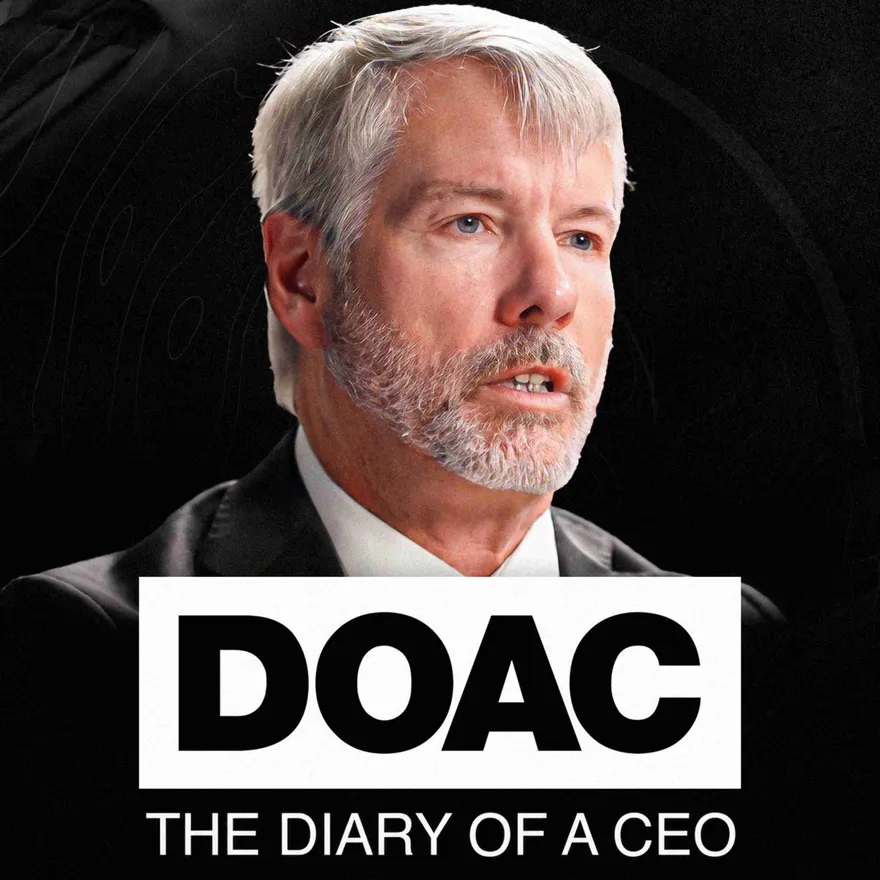

This is a preview of the Shortform summary of the Aug 6, 2026 episode of the The Diary Of A CEO with Steven Bartlett
Sign up for Shortform to access the whole episode summary along with additional materials like counterarguments and context.
1-Page Summary
Bitcoin and Digital Capital
Michael Saylor discusses Bitcoin's advantages as digital capital, emphasizing its superiority over traditional money and MicroStrategy's pioneering approach to treating Bitcoin as a core financial asset.
Bitcoin As Superior Money and Store of Value
Saylor highlights Bitcoin's key advantage: it can be transferred instantly without permission, unlike physical cash which is vulnerable to confiscation at borders. He critiques fiat currencies, noting the US dollar loses about 7% of its value annually, halving purchasing power every 35 years, while most fiat currencies collapse even faster with an average lifespan of 29-30 years. Bitcoin, by contrast, has appreciated about 33% annually and has outperformed gold by 12% and the S&P 500 by 18% annually over the past six years.
Banks restrict money access through regulatory controls, but Bitcoin functions as a bearer asset—controlled directly via encrypted private keys with no government or bank intervention. Saylor explains that Bitcoin's design empowers individual ownership through encryption, making it impossible for powerful entities to seize.
Digital Sovereignty and Economic Empowerment
Permissioned money requires approval from multiple banks and state entities, but Bitcoin enables unrestricted peer-to-peer transactions. In nations with weak currencies that collapse due to inflation, Bitcoin offers a stable, global alternative. Saylor notes Bitcoin is ideal for people in unstable regions or war zones since it's borderless, transportable as information, and immune to physical confiscation.
MicroStrategy's Bitcoin Strategy and Financial Innovation
MicroStrategy serves as a corporate case study for treating Bitcoin as a treasury asset. Since discovering Bitcoin in 2020, the company has grown from $1 billion to a peak of $125 billion, raising approximately $65 billion through equity and convertible debt to acquire Bitcoin. Saylor asserts the company remains overcollateralized—even if Bitcoin dropped to $5,000 per coin, assets would cover obligations. He describes selling Bitcoin to prove liquidity and demonstrate that as long as Bitcoin appreciates at least 3.2% annually, the company can meet obligations indefinitely.
AI and Technology Disruption
AI As a Revolutionary Problem-Solving Tool
Saylor recounts using AI to generate $15 billion for MicroStrategy by inventing Bitcoin-backed STRK convertible preferred stock. After exhausting traditional borrowing options, he turned to AI to design a new class of preferred stock—the first of its kind backed by Bitcoin. This led to a $2.5 billion IPO, the largest of the year, eventually raising $10.5 billion with these instruments and $4 billion from other sources.
Saylor describes using AI to design financial instruments with novel properties, like variable dividend preferred stocks that maintain price stability through dynamically adjusted monthly dividend rates—something never done before. Bartlett points out that only 2% of households currently have an AI subscription, highlighting an enormous opportunity for entrepreneurs.
Transformation of Work and Employment
AI will automate knowledge work, fundamentally changing fields like law, contract writing, and creative labor. Saylor predicts self-driving cars will soon surpass human safety, and robots will handle cooking, cleaning, and garbage removal. This transition will usher in an era of abundance with robots producing goods efficiently and affordably.
Saylor notes that displacement is inevitable, but argues societies must foster free markets and entrepreneurial environments to rapidly create new job opportunities. In nations with fewer regulatory barriers, innovation will generate thousands of new business types and provide employment for displaced workers.
AI Integration Into Existing Businesses
Saylor emphasizes entrepreneurs must adopt AI to thrive, leveraging it to create or enhance products at a fraction of traditional costs. Business leaders should question how AI can upgrade content, marketing, or distribution. For example, AI-powered translation enables podcasts to localize content in multiple languages, reaching otherwise inaccessible markets. Bartlett highlights that providing high-quality, native-language content creates a competitive edge.
Saylor and Bartlett's podcast exemplifies this: after two years, translation technologies advanced enough that Spanish view duration surpassed English, propelling global popularity. Saylor insists entrepreneurs must embrace AI and innovate, or risk obsolescence.
Wealth-Building Strategies
Michael Saylor outlines a wealth-building philosophy centered on scarce capital assets and optimized investment strategies.
Capital Assets Versus Consumable Investments
Saylor emphasizes true wealth is created by acquiring capital assets that cannot be produced infinitely—gold, S&P 500 shares, and Bitcoin with its limited supply of 21 million. He warns against investing in non-capital assets like soybeans, crude oil, or cotton, which can be mass-produced and are unreliable for building wealth.
He cautions about residential real estate, especially with significant property taxes. In regions like Florida with 2% annual taxes, this equals the purchase price over 36 years. Adding maintenance, insurance, and mortgage rates often makes home ownership inefficient for wealth storage.
Comparing Investment Options for Average People
Saylor notes the S&P 500 has historically returned 10% annually over a century, but the dollar has lost 7% annually, meaning real returns are 2-3% after currency loss. Comparing recent annual returns: gold at 12%, S&P 500 at 15%, Nasdaq at 18%, and Bitcoin at 33%. Keeping savings in money market accounts returns only 1.5% post-tax, losing 5-6% in real wealth yearly due to inflation.
Bitcoin As the Optimal Asset for Diverse Populations
For those in stable economies, Saylor recommends diversification between the S&P 500 for steady growth and Bitcoin for potentially volatile but high returns. Bitcoin's borderless, seizure-resistant attributes are especially critical for people in countries with unstable currencies.
Saylor advises young people to first invest in themselves by subscribing to AI tools, spending $20-200 monthly to build skills. When asked for a specific recommendation for a 25-year-old, Saylor advocates buying and holding Bitcoin, asserting it offers double the performance of the S&P 500 and demands less expertise than stock picking or real estate.
Long-Term Thinking as Competitive Advantage
Saylor cites Elon Musk's strategic sequencing—using success from one business to launch another—as a model for compound growth. He offers Amazon Prime as a classic example: Amazon invested a decade into unprofitable shipping to build an unrivaled network, eventually generating $12 billion annually in subscription revenue valued at $250 billion. Saylor warns that business failures often stem from lack of focus—entrepreneurs launching unrelated ventures dilute stability and fail to compound core strengths. True breakthroughs generally require consistent commitment over 4-10 years.
Foundational Life Principles
Michael Saylor and Steven Bartlett outline core rules for young adults aiming to build resilient, mission-driven lives.
The Ten Core Rules for Young Adults
Bartlett observes young people often lose focus by chasing newly successful opportunities. Saylor emphasizes attempting too many things dilutes energy and causes business failure. They urge commitment to one primary business or goal.
Saylor stresses time's non-renewable nature and warns against taking on projects simply because you can, noting maintenance obligations are almost always underestimated. Both advocate for deliberate mental cultivation through reading and education, and Saylor advises training your body, noting physical weakness undermines perseverance.
Mental Independence and Relationship Curation
Saylor urges independent thinking, cautioning that everyone will attempt to shape your beliefs. He asserts that if you surround yourself with positive, talented people, you become the best version of yourself, while spending time with negative people hinders progress.
Saylor recommends curating your physical environment, making it happy and functional. Keeping promises is essential for building trust—those who honor commitments gain advocates who can mean the difference between success and failure.
Character and Mission-Driven Living
Saylor points out that optimism and productivity attract others, helping build a supportive community. Having a mission to improve the world provides daily motivation and fulfillment. Saylor encourages "upgrading the world," stressing that waking to a purpose is energizing.
Saylor concludes by advocating for living with conviction. He lives his gospel of digital empowerment, promoting Bitcoin as "digital money" that cannot be taken away. He believes deeply communicating your philosophy attracts allies and creates movements.
Finding Breakthrough Opportunities
Michael Saylor and Steven Bartlett discuss how understanding technology cycles, timing innovation, and focused execution lead to breakthrough opportunities.
Understanding Technology S-Curves
Technological progress follows an S-curve: slow initial development, exponential growth where progress doubles roughly every three years, then plateau with diminishing returns. Saylor cautions against studying fields at the stagnant end of their S-curve where no significant progress may occur for a century.
The aviation industry exemplifies this: major breakthroughs occurred from 1903 to 1966, but after that, advancements slowed dramatically. The Boeing 737 achieved only a 15% efficiency gain after decades. Similarly, the smartphone industry has stagnated since the iPhone 6. In contrast, semiconductors and artificial intelligence remain on rapid growth trajectories with continuing breakthroughs.
Timing Breakthrough Innovations
Locating the moment when new technology has just become commercially viable is key to outsized success. The optimum window to act is only 12-24 months—too early leads to failure, too late forfeits first-mover advantage.
Saylor illustrates this with MicroStrategy, which exploited a window blending digital capital, credit instruments, and treasury models that wasn't possible a decade earlier. The result is a business twenty times larger than its nearest competitor. Success stories like Facebook, WhatsApp, and Mr. Beast display how moving decisively at the S-curve inflection point establishes lasting leads.
First-Mover Advantage Through Commitment
Seizing breakthrough opportunities demands wholehearted focus. Creating something that appears magical requires identifying the right moment and having courage to build unprecedented products. Advantage compounds over time—being even one year ahead gives market leaders a nearly insurmountable head start.
Saylor says success requires declaring intent, focusing without distraction, and continually making your winner "twice as good" rather than diluting focus across unrelated ventures. This sustained improvement ensures dominance.
Avoiding Pitfalls and Building Sustainable Foundations
Failure most often follows from distraction and unfocused expansion. Saylor warns founders often start multiple ventures after initial success; each receives less energy and delivers mediocre results. Growth built on unrelated expansion creates instability, while sustainable progress comes from extending the initial foundation—building on loyal customers, existing distribution, or accumulated assets.
To secure enduring success, businesses must commit to being the single best provider, resisting the urge to spread thinly across multiple ventures. The core lesson: identify and commit to breakthrough opportunities at their moment of maximum potential, focus relentlessly on extending your advantage, and avoid distractions that cause promising ventures to stall.
1-Page Summary
Additional Materials
Clarifications
- A bearer asset is one where ownership is determined by possession rather than registration. Bitcoin ownership is controlled through private cryptographic keys, which are secret codes that prove control over specific bitcoins. These keys allow the holder to transfer bitcoins without needing approval from any third party. Losing the private key means losing access to the bitcoins permanently.
- Fiat currencies lose value primarily due to inflation, which is the general increase in prices over time. Inflation reduces the amount of goods and services one unit of currency can buy, decreasing its purchasing power. Central banks often increase the money supply to stimulate the economy, which can cause inflation if done excessively. Purchasing power halving means that after a certain period, the same amount of money buys only half as much as before.
- MicroStrategy raising $65 billion through equity and convertible debt means it sold shares and issued debt that can convert into shares to fund Bitcoin purchases. This large capital raise shows strong investor confidence and provides liquidity without selling existing Bitcoin holdings. Convertible debt offers flexibility by allowing debt to convert into equity, reducing immediate cash repayment pressure. Such financing enables MicroStrategy to scale Bitcoin acquisition aggressively while managing financial risk.
- A company is "overcollateralized" when the value of its pledged assets exceeds the amount of its debt or obligations. This provides a safety margin, reducing the risk for lenders or investors. If Bitcoin's price drops, the value of the collateral falls, but overcollateralization means the assets still cover the company's liabilities. This protects the company from default even during significant price declines.
- Bitcoin-backed convertible preferred stock is a financial instrument where the preferred shares are secured by Bitcoin holdings, providing investors with added asset backing. Convertible preferred stock grants holders the option to convert their shares into common stock, typically at a predetermined rate. This structure combines the stability of preferred dividends with potential equity upside, while Bitcoin backing adds a unique collateral layer. It innovatively merges cryptocurrency assets with traditional corporate finance to raise capital.
- AI analyzes vast financial data and market conditions to model optimal dividend rates that balance investor returns and price stability. It uses algorithms to adjust dividends monthly based on real-time performance metrics and market volatility. This dynamic approach helps maintain the preferred stock’s value by preventing large price swings. Such AI-driven customization is difficult to achieve manually due to complexity and speed requirements.
- Only a small percentage of households currently use AI subscription services, indicating that AI tools are still underutilized by the general public. This low adoption presents a significant opportunity for entrepreneurs to create new products and services that leverage AI capabilities. Early adopters can gain competitive advantages by integrating AI to improve efficiency, innovation, and market reach. As AI becomes more accessible, businesses that fail to adopt it risk falling behind.
- AI automation transforms knowledge work by performing tasks like data analysis, legal research, and contract drafting faster and with fewer errors. It reduces the need for routine cognitive labor, shifting human roles toward oversight, creativity, and complex decision-making. Sectors such as law, finance, marketing, and content creation will see significant job restructuring, with some roles diminishing and new ones emerging. This shift demands workers adapt by acquiring skills complementary to AI capabilities.
- Residential real estate often incurs ongoing costs like property taxes, maintenance, insurance, and mortgage interest, which reduce net returns. These expenses can accumulate to a significant portion of the property's value over time, eroding wealth. Unlike capital assets that appreciate or generate income, real estate can be a financial drain if costs outweigh gains. Additionally, real estate is less liquid, making it harder to quickly convert into cash without potential loss.
- Nominal returns are the percentage gains on an investment without adjusting for inflation or currency value changes. Real returns account for inflation or currency depreciation, showing the actual increase in purchasing power. Currency depreciation reduces the real value of investment returns when measured in that currency. Thus, even high nominal returns can result in low or negative real returns if inflation or depreciation is significant.
- Diversification means spreading investments across different assets to reduce risk. The S&P 500 represents a broad range of large U.S. companies, offering steady growth tied to the economy. Bitcoin is a digital asset with high volatility but potential for significant returns and acts independently of traditional markets. Combining both balances stability with growth potential, protecting against downturns in either asset class.
- Investing in oneself through AI tool subscriptions means using advanced software to enhance skills and productivity. These tools can automate tasks, provide insights, and improve learning efficiency. Regular use builds expertise, making individuals more competitive in the job market. This approach leverages technology to accelerate personal and professional growth.
- Technological progress often starts slowly as new ideas are developed and tested. Once a breakthrough occurs, improvements accelerate rapidly during the growth phase. Eventually, progress slows as the technology matures and approaches its practical limits. This pattern forms an S-shaped curve when progress is graphed over time.
- The 12-24 month window after a technology becomes commercially viable is critical because it represents the early phase when market demand starts to grow but competition is still limited. Acting within this period allows companies to establish brand recognition, secure key partnerships, and refine their products before rivals catch up. Missing this window often means losing first-mover advantages, making it harder to gain market share later. Rapid execution during this time maximizes the chance of long-term dominance.
- First-mover advantage means being the first to enter a new market or adopt a new technology, gaining early customer loyalty and brand recognition. This early lead allows a company to set industry standards and build barriers that make it harder for competitors to catch up. Over time, these advantages grow as the company improves its products, expands its network, and benefits from economies of scale. Compounding means that small initial gains multiply, creating a dominant market position that strengthens continuously.
- Unfocused expansion divides leadership attention and resources, weakening execution quality across all ventures. Launching unrelated businesses often prevents building on existing strengths, customer bases, or brand reputation. This fragmentation increases operational complexity and risk, reducing overall efficiency and growth potential. Sustainable growth relies on deepening core competencies and leveraging established assets.
- Mental independence means thinking critically and making decisions based on your own values, not external pressures. Relationship curation involves intentionally choosing to spend time with positive, supportive people who encourage growth. Both foster resilience by reducing negative influences and reinforcing constructive habits. This creates a strong foundation for sustained personal and professional success.
- Living with conviction means firmly believing in your values and acting consistently according to them, which builds trust and authenticity. Deeply communicating your philosophy helps others understand your purpose and vision, inspiring shared commitment. This shared belief attracts like-minded individuals, forming a community united by common goals. Over time, such communities can grow into movements that drive social or cultural change.
- The S-curve describes how technology improves slowly at first, then rapidly, before leveling off as it matures. Aviation saw rapid innovation early on but slowed after the 1960s due to physical and engineering limits. Smartphones experienced fast growth until around the iPhone 6, after which new features became incremental. Semiconductors and AI continue rapid advancement because they rely on software and miniaturization, which still have room to grow.
- Equity represents ownership shares in a company, giving shareholders a claim on assets and profits. Convertible debt is a loan that can be converted into equity, usually at a later date or specific event. An IPO (Initial Public Offering) is when a company first sells its shares to the public on a stock exchange. Preferred stock is a type of ownership with priority for dividends and assets but usually without voting rights; dividends are regular payments to shareholders from profits. Overcollateralization means having more assets pledged as security than the amount of debt owed, reducing lender risk.
Counterarguments
- Bitcoin transactions, while often fast, can experience delays and high fees during network congestion, and are not always instant or costless.
- Bitcoin’s price history is highly volatile, with significant drawdowns (e.g., over 80% declines), making it a risky store of value compared to traditional assets.
- The 33% annualized return for Bitcoin is based on a short, recent time frame and may not be sustainable; past performance does not guarantee future results.
- Bitcoin’s bearer asset nature means loss or theft of private keys results in irreversible loss of funds, which can be a significant risk for individuals.
- While Bitcoin is resistant to government seizure, governments can and have restricted access to exchanges, mining, and use of cryptocurrencies through regulation.
- Bitcoin’s borderless nature is limited by internet access and technical literacy, which are not universal, especially in unstable or war-torn regions.
- MicroStrategy’s aggressive Bitcoin strategy exposes the company and its shareholders to extreme volatility and concentration risk.
- MicroStrategy’s overcollateralization claim depends on Bitcoin’s market liquidity and price stability, which are not guaranteed in crisis scenarios.
- The assertion that Bitcoin only needs to appreciate 3.2% annually for MicroStrategy to meet obligations ignores the possibility of prolonged bear markets or liquidity crunches.
- AI-generated financial instruments may introduce new risks, including regulatory uncertainty and unforeseen market behaviors.
- The claim that only 2% of households subscribe to AI tools may not account for widespread indirect AI use through mainstream products and services.
- AI automation may not create new jobs at the same pace as it displaces existing ones, potentially leading to increased unemployment or underemployment.
- The idea that fewer regulatory barriers always foster innovation overlooks the potential for consumer harm, fraud, and systemic risk in unregulated environments.
- Not all entrepreneurs or businesses can successfully adopt AI due to resource constraints, data limitations, or lack of expertise.
- Bitcoin’s capped supply does not guarantee price appreciation; demand is also a critical factor, and regulatory or technological changes could impact demand.
- Gold and S&P 500 shares have centuries-long track records, while Bitcoin’s history is relatively short and untested through multiple economic cycles.
- Real estate, despite taxes and maintenance, has historically been a significant source of wealth for many individuals and offers utility beyond investment returns.
- The S&P 500’s real returns may be understated if dividends and reinvestment are not fully accounted for.
- Money market accounts, while low-yielding, offer liquidity and principal protection not available with volatile assets like Bitcoin.
- Diversification is generally considered prudent; concentrating wealth in a single volatile asset like Bitcoin increases risk.
- The recommendation for young people to buy and hold Bitcoin may not suit all risk profiles or financial situations.
- Long-term focus is important, but some successful entrepreneurs have built multiple ventures in parallel or pivoted strategically.
- Physical fitness and mental cultivation are valuable, but not universally accessible due to health, socioeconomic, or cultural factors.
- The S-curve model of technology adoption is a generalization and may not apply uniformly across all industries or innovations.
- First-mover advantage is not always decisive; later entrants can and have overtaken pioneers by improving on their models (e.g., Google after Yahoo, Facebook after MySpace).
- Focusing exclusively on a single venture can lead to missed opportunities or vulnerability if market conditions change.
- Regulatory, legal, and ethical considerations can limit the adoption or success of both Bitcoin and AI-driven innovations.

Get access to the context and additional materials
Bitcoin and Digital Capital
Michael Saylor extensively details the advantages of Bitcoin as a form of digital capital, superior money, a vehicle for digital sovereignty, and describes his company MicroStrategy’s pioneering strategy in treating Bitcoin as a core financial asset.
Bitcoin As Superior Money and Store of Value
Saylor emphasizes that physical cash is vulnerable to confiscation, especially across borders—"You walk through an airport with a stack of currency, and they just take it." In contrast, transferring Bitcoin requires no permission, and millions of dollars can be moved digitally, instantly, from anywhere to anywhere without the risk of government seizure or border restrictions.
He critiques fiat currencies, noting that the US dollar, considered the strongest fiat, has historically lost about 7% of its value annually, cutting its purchasing power in half roughly every 35 years. Most fiat currencies collapse even faster, with an average lifespan of 29 to 30 years. Saylor points out that during a century, even the best fiat will erode a person’s wealth, while weak currencies in developing countries collapse much sooner.
Bitcoin, on the other hand, has appreciated about 33% annually, as per Saylor’s estimates, making it superior for long-term wealth preservation. Further, Bitcoin has outperformed traditional capital assets, increasing in value by 12% more than gold and 18% more than the S&P 500 annually over the past six years.
Banks, he argues, restrict access to money through regulatory controls and government oversight. Large withdrawals might even trigger a Treasury report or a government visit. Bitcoin functions as a bearer asset—you control it directly, either via an encrypted private key or a physical device, with no bank or government able to intervene in your ownership or transfers.
Digital Sovereignty and Economic Empowerment
Saylor highlights that Bitcoin’s design empowers individual ownership. By securing digital money through private encryption, neither powerful corporations nor governments can seize it. He explains, "You encrypt the money, put it in cyberspace, protect it with a private key—now you can actually own something, and someone more powerful can't take it away from you."
Permissioned money, such as international wires, often requires the approval of numerous banks and state entities. Bitcoin allows for unrestricted peer-to-peer transactions, circumventing these limitations. For example, someone in Africa can sell a truck to another person in exchange for Bitcoin—no banks or regulatory intermediaries required.
In nations where weak currencies collapse due to inflation—such as many in Africa and South America—people lose most or all of their wealth in a decade or less. Bitcoin offers a stable, global alternative that stands up against hyperinflation and government mismanagement.
Saylor goes further to say that Bitcoin is the ideal asset for people living in unstable regions or war zones. It is borderless, can be transported as information, and is immune to physical confiscation or devaluation by troubled states.
MicroStrategy's Bitcoin Strategy and Financial Innovation
MicroStrategy serves as a corporate case study for treating Bitcoin as a core treasury asse ...
Here’s what you’ll find in our full summary
Bitcoin and Digital Capital
Additional Materials
Clarifications
- A bearer asset is something that grants ownership to whoever physically holds it, without needing registration or intermediaries. In Bitcoin, ownership is controlled by private keys—secret cryptographic codes that prove you have the right to spend the coins. These keys can be stored digitally or on physical devices like hardware wallets, which keep them secure from hacking. Losing the private key means losing access to the Bitcoin, as no one else can recover it for you.
- Permissioned money requires approval from banks or authorities to move funds, often involving delays and restrictions. Bitcoin’s permissionless transactions allow anyone to send or receive funds directly without intermediaries or approvals. This removes barriers like censorship, limits on transfer amounts, and geographic restrictions. It also enhances privacy and control over one’s own money.
- Equity offerings involve selling shares of the company to investors, raising capital without incurring debt. Convertible debt is a loan that can later be converted into company shares, combining features of debt and equity. These methods provide funds for investments like Bitcoin purchases while managing financial risk and ownership dilution. They allow MicroStrategy to access large sums without immediately increasing debt burden.
- A financial structure is "overcollateralized" when the value of the assets backing a loan or obligation exceeds the amount owed. This provides extra security to lenders or investors, reducing their risk. If asset values drop, the collateral still covers the debt, preventing default. Overcollateralization is common in secured loans and structured finance.
- The "doom loop" narrative suggests that if MicroStrategy sold Bitcoin, it would signal a lack of confidence, causing panic and a sharp price drop. This could force the company to sell more Bitcoin to cover losses, creating a self-reinforcing downward spiral. Selling Bitcoin was seen as risky because it might undermine market trust and the company’s financial stability. MicroStrategy disproved this by selling Bitcoin without triggering such negative effects.
- Bitcoin’s higher annual appreciation means its value grows faster over time compared to gold and the S&P 500. For example, a $1,000 investment in Bitcoin would multiply more quickly than the same amount in gold or stocks over several years. This compounding effect leads to significantly larger wealth accumulation with Bitcoin. However, Bitcoin’s price is more volatile, meaning its value can fluctuate widely in short periods.
- Transferring physical cash across borders often requires declaration and is subject to limits and seizure by customs or law enforcement if suspected of illegal activity. Carrying large amounts of cash poses risks of theft, loss, or confiscation without recourse. Bitcoin transfers occur digitally on a decentralized network, requiring only internet access and a private key, with no physical handling or border checks. However, Bitcoin transactions depend on network security and user key management, with risks including hacking or loss of access to private keys.
- Digital sovereignty means individuals fully control their digital assets without relying on intermediaries. Encryption secures Bitcoin by converting ownership data into a code only accessible with a private key. Without this key, no one—including governments or hackers—can access or seize the Bitcoin. This cryptographic protection ensures true personal ownership and control over digital money.
- Fiat currencies lose value over time mainly due to inflation, which occurs when governments print more money than the economy's growth, reducing purchasing power. Central banks often increase money supply to stimulate economies, but excessive printi ...
Counterarguments
- Bitcoin transfers, while resistant to censorship, are not entirely immune to seizure; authorities can and have compelled individuals or exchanges to surrender private keys or freeze assets.
- Bitcoin’s price history is highly volatile, with significant drawdowns (e.g., over 70% declines), making it a risky store of value compared to traditional assets like the US dollar or gold.
- The 33% annual appreciation cited for Bitcoin is based on a relatively short and exceptional period; past performance does not guarantee future returns, and such growth rates are unlikely to be sustained indefinitely.
- Bitcoin’s outperformance of gold and the S&P 500 is not consistent across all timeframes and depends heavily on the chosen period of comparison.
- Bitcoin transactions are not always instant or low-cost; network congestion can lead to high fees and slow confirmation times.
- Bitcoin ownership and security require technical knowledge; loss of private keys results in permanent loss of funds, which is not the case with bank accounts.
- Regulatory risks remain significant for Bitcoin, as governments can impose restrictions on exchanges, usage, or convertibility, impacting liquidity and accessibility.
- Bitcoin’s energy consumption and environmental impact are widely criticized, especially compared to traditional payment systems.
- In practice, Bitcoin adoption in regions with weak currencies is limited by internet access, technological literacy, and local regul ...


Get access to the context and additional materials
Ai and Technology Disruption
Ai As a Revolutionary Problem-Solving Tool
Michael Saylor recounts using AI to generate $15 billion for Microstrategy by inventing a Bitcoin-backed STRK convertible preferred stock. After exhausting traditional borrowing and issuing more convertible bonds than any other company, Saylor faced a new challenge: creating a scalable credit instrument to buy more Bitcoin. He turned to AI for a solution, asking it to help design a new class of preferred stock—something that merged features of both equity and debt but had previously never been conceived.
AI enabled Saylor to engineer the STRK convertible preferred, the first of its kind to be backed by Bitcoin. The innovation extended to financial engineering, digital asset structuring, and navigating securities law. Following the AI’s guidance, Microstrategy brought the preferred stock to market, launching a $2.5 billion IPO—the largest of the year. Subsequent offerings brought the total raised to $10.5 billion with these instruments and $4 billion from other sources, resulting in approximately $15 billion in new credit.
Building on this, Saylor describes using AI to design financial instruments with novel properties, like variable dividend preferred stocks that stay stable in price (around $100). The dividend rate is dynamically adjusted monthly to maintain stability—something no one had previously done, not because it was prohibited but because it hadn’t been considered or there was no pressing need until now.
Despite the scale of these AI-driven breakthroughs, Steven Bartlett points out that only 2% of households currently have an AI subscription, highlighting an enormous opportunity for entrepreneurs to leverage these tools before they become mainstream.
Transformation of Work and Employment
AI’s scope goes far beyond finance. Saylor asserts that AI will automate knowledge work, fundamentally changing law, contract writing, book authorship, poetry, and labor markets. For example, one can instruct AI to write a novel or script with custom specifications, rendering traditional creative and analytical roles—like surgeons, lawyers, accountants, and drivers—susceptible to replacement. Saylor stresses that future value will be found in crafting new questions for AI to answer, not performing tasks AI can replicate.
Saylor predicts self-driving cars will soon surpass human safety, and that robots will handle cooking, cleaning, and even garbage removal. Smart appliances and devices will minimize mistakes—burnt food or dangerous traffic accidents will become distant memories, thanks to embedded AI. The standard for most documents, research, and products will be flawless, with any imperfection viewed as laziness rather than limitation.
This transition will also usher in an era of abundance, with robots producing goods and services efficiently and affordably. As with past technology-driven disruptions, new job categories will emerge—podcasting, social media businesses, and whole industries that did not exist a few decades ago. Saylor notes that displacement is inevitable, but argues the solution is not to resist change: instead, societies must foster free markets and liberal, entrepreneurial environments to rapidly create job opportunities and minimize social upheaval. In nations with fewer regulatory barriers, entrepreneurial innovation will generate thousands of new types of businesses, cultivate new value, and provide employment for displaced workers.
Ai Integration Int ...
Here’s what you’ll find in our full summary
Ai and Technology Disruption
Additional Materials
Clarifications
- A Bitcoin-backed STRK convertible preferred stock is a financial instrument that combines features of equity and debt, secured by Bitcoin assets. It pays dividends like preferred stock but can convert into common stock under certain conditions. The Bitcoin backing provides additional security and value, linking the stock’s worth to the cryptocurrency’s performance. This structure allows raising capital while leveraging digital assets as collateral.
- Convertible preferred stock is a type of preferred stock that can be converted into a predetermined number of common shares. Unlike regular stock, it typically pays fixed dividends and has priority over common stock in asset claims. Unlike bonds, it represents equity, not debt, and may not have a maturity date or fixed interest payments. This hybrid nature offers both income stability and potential for capital appreciation.
- A scalable credit instrument is a financial tool designed to raise large amounts of capital efficiently and repeatedly. It must be adaptable to growing funding needs without losing value or market appeal. In this context, it allows Microstrategy to continuously secure funds to buy Bitcoin. Scalability ensures the instrument can support expanding investment strategies over time.
- AI can analyze vast amounts of financial data and legal regulations quickly to identify viable structures for new financial products. It can simulate how different instrument features affect risk, return, and compliance with laws. AI also helps draft legal documents by ensuring they meet regulatory requirements and flagging potential issues. This reduces human error and accelerates the creation of innovative, legally sound financial instruments.
- An IPO (Initial Public Offering) is when a private company offers its shares to the public for the first time to raise capital. It allows the company to access a large pool of investors and increase its financial resources for growth. The process involves regulatory approval, setting a share price, and listing on a stock exchange. Launching an IPO also increases a company’s visibility and credibility in the market.
- Variable dividend preferred stocks pay dividends that change based on specific criteria, unlike fixed dividends. By adjusting the dividend rate monthly, the stock’s price is kept near a target value (e.g., $100) because higher dividends attract buyers when the price falls, and lower dividends reduce selling pressure when the price rises. This mechanism balances supply and demand, stabilizing the stock price. It’s a form of financial engineering to reduce price volatility while providing income to investors.
- Dynamically adjusting dividends to maintain price stability is novel because traditional preferred stocks pay fixed dividends regardless of market conditions. This approach uses real-time financial data to tweak payouts, preventing price fluctuations caused by supply and demand imbalances. It creates a more predictable investment, reducing risk for shareholders and attracting stability-focused investors. Such mechanisms require advanced algorithms and continuous monitoring, which were not feasible before AI and modern computing.
- AI subscriptions refer to paid access to AI-powered tools or platforms, often used by individuals or businesses for tasks like content creation, automation, or data analysis. A 2% subscription rate indicates early-stage adoption, meaning most people have yet to integrate AI into daily workflows. Low adoption suggests significant growth potential as awareness, affordability, and usability improve. Entrepreneurs can capitalize on this gap by developing accessible AI solutions before widespread market saturation.
- AI automates knowledge work by processing and analyzing large amounts of data faster than humans. It can generate written content, draft legal documents, analyze financial reports, and perform data entry. AI models use natural language processing to understand and create text, replacing tasks like contract writing and report generation. It also supports decision-making by identifying patterns and insights that inform professional judgments.
- Crafting new questions for AI means designing unique, complex problems that AI has not yet solved. This requires creativity and deep understanding, as AI excels at executing tasks but depends on human insight to identify valuable challenges. Future value comes from guiding AI toward innovative solutions that open new opportunities or markets. Essentially, humans add value by framing the right problems for AI to tackle.
- Self-driving cars use sensors, cameras, and AI to navigate without human input. As of 2021, they were in advanced testing phases but not widely deployed commercially. Safety improvements depend on extensive real-world data and regulatory approval. Full autonomy remains a work in progress, with gradual rollout expected over years.
- Robots equipped with AI can perform household tasks like cooking, cleaning, and garbage removal by using sensors and programmed routines to operate efficiently. AI minimizes human error by continuously learning from data and adjusting actions to avoid mistakes, such as overcooking food or causing accidents. Smart devices use AI to predict and prevent errors before they happen, improving safety and convenience. This automation reduces the need for human intervention, making daily chores more reliable and less time-consuming.
- AI-embedded smart appliances use artificial intelligence to learn user preferences and optimize their functions automatically. They can anticipate needs, adjust settings for efficiency, and prevent errors like overcooking or energy waste. These devices connect to the internet and other smart systems, enabling seamless home automation and remote control. Their impact includes increased convenience, safety, and energy savings in everyday tasks.
- An "era of abundance" refers to a period when goods and services become plentiful and inexpensive due to advanced automation and AI. This happens because AI-driven machines can produce at high speed with minimal human labor and lower costs. As a result, scarcity diminishes, making essential products and services widely accessible. Historically, technological advances have repeatedly shifted economies from scarcity to abund ...
Counterarguments
- The claim that AI "invented" the Bitcoin-backed STRK convertible preferred stock may overstate AI's role; such financial engineering typically requires significant human expertise, judgment, and regulatory navigation, with AI serving as a tool rather than the primary inventor.
- The assertion that dynamically adjusted dividends for price stability were "previously unconsidered" may not be entirely accurate, as financial markets have a long history of experimenting with various mechanisms to stabilize asset prices.
- The low adoption rate of AI subscriptions (2% of households) does not necessarily indicate untapped entrepreneurial opportunity; barriers such as cost, digital literacy, privacy concerns, and lack of perceived value may limit broader adoption.
- The prediction that AI will automate most knowledge work and creative roles may underestimate the complexity of human judgment, creativity, and the social aspects of many professions, which are not easily replicated by AI.
- The idea that future value will come solely from crafting new questions for AI may overlook the continued importance of human skills in implementation, interpretation, and ethical decision-making.
- The expectation that self-driving cars and robots will soon eliminate most human error and make certain jobs obsolete may be overly optimistic, given ongoing technical, regulatory, and ethical challenges in real-world deployment.
- The notion that AI-driven automation will create an era of abundance does not address potential issues of wealth inequality, job displacement ...
Get access to the context and additional materials
Wealth-Building Strategies
Michael Saylor outlines a philosophy of wealth-building centered on scarce, capital assets, optimized investment strategies for ordinary people, and the advantage of long-term, focused commitment.
Capital Assets Versus Consumable Investments
Wealth Is Built By Investing In Scarce Assets Like Gold, Top 500 Company Shares, or One of 21 Million Bitcoin
Saylor emphasizes that true wealth is created by acquiring capital assets—things that cannot be produced infinitely by robots, factories, or artificial intelligence. He names gold, shares of the S&P 500 (the 500 most desirable companies in the world), and Bitcoin (with its strictly limited supply of 21 million) as prime examples. According to Saylor, these assets retain scarcity, making them winners for wealth preservation and growth.
Consumables Like Soybeans, Crude Oil, Cotton, and Factory Goods Don't Build Wealth Due to Unlimited Supply
Saylor warns against investing family wealth in non-capital assets such as soybeans, crude oil, or cotton. These are commodities or goods that can be mass-produced by machines or easily increased in supply, making them ineffective stores of value and unreliable for building wealth over time.
Real Estate's 2% Annual Taxes Equal Purchase Price in 36 Years and Add Maintenance Costs, Making It Inefficient for Wealth Storage
He cautions about residential real estate, especially in regions with significant property taxes (like 2% annually in Florida). Over 36 years, this tax equals the full purchase price. Adding maintenance costs, insurance, and potentially high mortgage rates often makes home ownership a burdensome and inefficient store of value. Saylor acknowledges that commercial real estate can be a good strategy if the investor has business competence, as expenses may be passed to tenants, but he notes that all forms of real estate investment require significant expertise.
Comparing Investment Options for Average People
S&P 500 Gains 10% Yearly Over 100 Years; US Dollar Loses 7% Annually, Yielding 2-3% Real Return After Debasement
For average investors, Saylor points out that the S&P 500 has historically returned about 10% per year over a century. However, the US dollar has lost around 7% of its value annually due to inflation and debasement, meaning real returns are 2-3% after accounting for currency loss.
Annual Returns: Gold 12%, S&P 500 15%, Nasdaq 18%, Bitcoin 33% For Varied Risk Tolerance
Comparing recent annual returns, Saylor cites gold at 12%, the S&P 500 at 15%, the Nasdaq at 18%, and Bitcoin dramatically higher at 33%. He notes that the typical “safe” approach—keeping savings in money market accounts—returns only about 1.5% post-tax, leaving savers losing 5-6% in real wealth every year due to inflation.
Wealth Is Generated if Real Estate Rental Income Covers Expenses and the Asset Appreciates 7% Annually Without Active Management
In real estate, Saylor says real wealth is built if rental income reliably covers expenses (taxes, insurance, maintenance) and the property appreciates at approximately 7% per year—ideally with little need for active, hands-on management or business expertise. Otherwise, real estate can become a drag on wealth growth.
Wealth Loses 5-6% Yearly Post-Tax/Inflation; Bitcoin/Index Funds Beat Cash Savings
Saylor concludes that because holding cash or low-yield accounts leads to persistent losses after taxes and inflation, superior options for most include index funds like the S&P 500 or Bitcoin which have historically produced far greater returns after accounting for currency debasement and inflation.
Bitcoin As the Optimal Asset for Diverse Populations
Wealthy Citizens: S&P 500 for Diversification, Bitcoin For Volatile High Returns
For those in stable economies, Saylor recommends diversification between assets like the S&P 500 for steady growth and Bitcoin for potentially volatile but high returns.
Bitcoin Is Essential for Residents of Countries With Unstable Currencies Because It Cannot Be Seized or Devalued by Government Policy
He emphasizes that Bitcoin’s borderless, seizure-resistant, and inflation-proof attributes are especially critical for people in countries suffering from unstable currencies or authoritarian financial policies. Unlike Western capital markets or gold (which are often inaccessible), Bitcoin offers a universal store of value not subject to local government interference or debasement.
Young People Should Spend $20-200 Monthly On AI Subscriptions to Build Skills Before Investing In Long-Term Assets
Saylor advises young people to first invest in themselves by subscribing to AI tools or educational platforms, spending $20 to $200 per month to build valuable skills. After acquiring these skills, they ca ...
Here’s what you’ll find in our full summary
Wealth-Building Strategies
Additional Materials
Clarifications
- Scarce capital assets are limited in quantity by nature or design, making them valuable over time. Robots, factories, or AI can mass-produce goods but cannot create more of these finite assets. For example, gold is physically limited in the Earth's crust, and Bitcoin has a fixed maximum supply coded into its protocol. This scarcity preserves value because supply cannot be increased to meet demand artificially.
- Bitcoin's supply is capped at 21 million coins by its underlying code, ensuring no more can be created beyond this limit. This fixed supply mimics scarce resources like gold, preventing inflation caused by unlimited issuance. Scarcity increases demand and helps preserve value over time. Unlike fiat currencies, Bitcoin's supply cannot be manipulated by governments or central banks.
- Capital assets are items that hold value over time because they are limited in supply and cannot be easily reproduced. Consumable investments or commodities are goods that are used up or produced in large quantities, causing their value to fluctuate with supply and demand. Capital assets tend to preserve or increase wealth, while consumables often do not retain value long-term. This distinction affects how reliably each can build or store wealth.
- Property taxes are ongoing costs that reduce the net return on real estate investments. Over decades, these taxes can equal the original purchase price, effectively doubling the amount spent without increasing asset value. Unlike one-time purchase costs, taxes are recurring and unavoidable, eroding wealth accumulation. This continuous expense makes real estate less efficient compared to assets without such carrying costs.
- "Passing expenses to tenants" means landlords include costs like property taxes, maintenance, and insurance in the rent tenants pay. This shifts financial responsibility from the landlord to the tenants. It helps landlords reduce their out-of-pocket expenses. This practice is common in commercial leases, often called "triple net leases."
- Inflation occurs when the general price level of goods and services rises, reducing the purchasing power of money. Currency debasement happens when a government increases the money supply, often by printing more currency, which lowers its value. Together, these factors mean each dollar buys fewer goods over time. This gradual loss of value is why the US dollar loses value annually.
- Nominal returns are the percentage gains on an investment without adjusting for inflation or taxes. Real returns show the actual increase in purchasing power after subtracting inflation and taxes from nominal returns. Inflation reduces the value of money over time, so ignoring it can overstate investment gains. Taxes further reduce the amount of profit an investor keeps, lowering the effective return.
- Gold is considered a low-risk, stable asset that preserves value during economic uncertainty but offers modest returns. The S&P 500 represents a diversified portfolio of large U.S. companies, balancing moderate risk with steady growth over time. The Nasdaq is more volatile, heavily weighted toward technology stocks, offering higher potential returns but greater price swings. Bitcoin is highly volatile and speculative, with potential for large gains or losses, influenced by market sentiment and regulatory changes.
- Money market accounts typically invest in short-term, low-risk debt instruments, which offer lower interest rates compared to stocks or other higher-risk assets. Inflation reduces the purchasing power of money over time, meaning that even if your account balance grows nominally, the actual value of that money buys less. When the interest earned is less than the inflation rate, your real wealth decreases despite nominal gains. Thus, low yields combined with inflation result in a net loss of wealth in real terms.
- Real estate rental income generates wealth without active management when rental payments consistently cover all expenses, including taxes, insurance, and maintenance. This requires stable tenants and a property in good condition to minimize unexpected costs. Professional property management can help maintain this balance by handling tenant issues and upkeep. Passive income grows if the property also appreciates in value over time.
- Bitcoin is "borderless" because it operates on a global digital network without reliance on any single country or bank. It is "seizure-resistant" since ownership is controlled by private cryptographic keys, making it difficult for authorities to confiscate without access to those keys. Bitcoin's supply is fixed by its protocol, preventing governments from inflating or devaluing it through monetary policy. Transactions are verified by decentralized computers worldwide, ensuring transparency and resistance to censorship.
- Residents of countries with unstable currencies often face rapid inflation, which erodes the value of their money quickly. Governments may impose capital controls, limiting access to foreign currencies or restricting money transfers. Bitcoin operates on a decentralized network, making it resistant to g ...
Counterarguments
- The assertion that only scarce capital assets build wealth overlooks the fact that many individuals have built significant wealth through entrepreneurship, intellectual property, or businesses that do not fit the "scarce asset" definition.
- Gold’s long-term real return has often lagged behind equities and sometimes even inflation, and its price can be volatile and influenced by factors unrelated to scarcity.
- The S&P 500’s historical returns are not guaranteed in the future; past performance does not ensure future results, and there have been multi-decade periods of stagnation or decline in real terms.
- Bitcoin’s high historical returns are accompanied by extreme volatility and risk, including regulatory uncertainty, technological vulnerabilities, and the possibility of permanent loss due to user error or hacking.
- Commodities like soybeans, oil, and cotton can be effective stores of value or sources of wealth in certain economic environments, and commodity investing is a legitimate diversification strategy for some portfolios.
- Real estate, even with taxes and maintenance, has historically been a primary vehicle for wealth accumulation for many households, especially due to leverage, tax advantages, and forced savings through mortgage payments.
- Property taxes and maintenance costs vary widely by location, and in some regions, real estate can be a highly efficient store of value and source of income.
- Money market accounts and cash holdings serve important purposes for liquidity, emergency funds, and risk management, even if they do not maximize long-term returns.
- Not all individuals have access to or comfort with investing in index funds or Bitcoin, and risk tolerance, financial goals, and personal circumstances should guide asset allocation.
- Bitcoin is not universally immune to government interference; some countries have banned or heavily restricted its use, and its legal status remains uncertain in many jurisdictions.
- Bitcoin’s volatility and lack of consumer protections make it a risk ...
Get access to the context and additional materials
Foundational Life Principles
Michael Saylor and Steven Bartlett outline core rules and mindsets for young adults aiming to build a resilient, mission-driven, and fulfilling life. Their advice covers how to focus energy, cultivate independence, maintain positive relationships, and center life around a meaningful mission.
The ten Core Rules for Young Adults
Focus Your Energy On a Primary Goal or Business Rather Than Scattering Efforts on Opportunities Like "Grabbing Branches."
Steven Bartlett observes that young people often lose focus by chasing whatever seems newly successful, shifting their attention from one opportunity—like the CBD business—to the next without sustained progress. Michael Saylor emphasizes that attempting to do too many things dilutes energy and is a primary cause of business failure. Instead, they urge young adults to avoid grabbing at every “branch,” and commit deeply to one primary business or goal.
Guard Your Time; It Is Non-renewable, Unlike Projects Which Often Consume More Time Than They Are Worth
Saylor stresses the non-renewable nature of time and warns not to take on projects simply because you can. Maintenance obligations are almost always underestimated, making some projects more costly in time and effort than their worth.
Develop Your Mind Through Reading, Education, and Culture; Intellect Determines Your Achievements and Understanding
Both advocate for deliberate mental cultivation. Saylor suggests, “focus your mind, guard your time and train your mind.” Learning core skills like literacy and numeracy, as well as developing a cultural foundation through education and reading, are key for greater achievement and understanding.
Train Your Body; Weakness Hinders Success, While Physical Discipline Builds Resilience
Saylor advises young adults to train their bodies, noting that physical weakness undermines the perseverance required for survival and success. Physical discipline builds the resilience needed for long-term endeavors.
Mental Independence and Relationship Curation
Resist Social Pressure; Question if It's Right Despite Fame and Wealth
Saylor urges independent thinking, cautioning that everyone, including the rich and famous, will attempt to shape what you believe and do. He reminds young adults that even if “everybody that I know and famous, rich, and beautiful people tell me it's right, doesn’t make it right.” Genuine success stems from thinking for oneself.
Curate Friends Carefully; You Become the Average of Those Around You, and Negativity Drags Down Potential
Who you keep company with is crucial. Saylor asserts that if you surround yourself with positive, talented, and inspirational people, you become the best version of yourself. Conversely, spending time with negative or unsuccessful people will pull you down or hinder your progress.
Create a Happy, Functional Space; You Weren't Meant to Suffer In Dark, Ugly Places
Saylor recommends curating your physical environment, making it happy and functional for living and working. There is no obligation to remain in dark, drab, or ugly situations; a positive space lifts your potential.
Honor Promises; Trusted People Become Advocates
Keeping promises is essential for building trust. Saylor notes th ...
Here’s what you’ll find in our full summary
Foundational Life Principles
Additional Materials
Counterarguments
- Focusing exclusively on a single goal or business can limit exposure to diverse experiences and opportunities, potentially causing missed chances for innovation or adaptability.
- Some successful entrepreneurs and professionals have achieved success by pursuing multiple ventures or interests simultaneously, suggesting that a diversified approach can also be effective.
- The value of time versus projects is context-dependent; some projects, even if time-consuming, can lead to significant personal growth or unexpected opportunities.
- Not all physical or intellectual weaknesses are within an individual's control, and equating weakness with failure may overlook the achievements of those who succeed despite limitations.
- The idea that you become the average of your friends may oversimplify the complex influences on personal development and can discourage meaningful relationships with people from diverse backgrounds.
- Creating a positive physical environment is not always feasible for everyone due to financial, social, or geographic constraints.
- Honoring every promise may not always be possible or advisable if circumstances change or if keeping a promise would cause ha ...
Actionables
- You can set a weekly “focus checkpoint” where you review all your current projects and commitments, then actively choose one to pause or drop for the next week, freeing up time and energy for your main goal; for example, if you’re juggling a side hustle, a new hobby, and a fitness plan, decide which one can wait and put it on hold, then track how much more progress you make on your primary goal.
- A practical way to strengthen independent thinking is to keep a “contrarian journal” where, once a week, you write down a popular opinion you’ve encountered and then challenge yourself to argue the opposite side, helping you practice resisting social pressure and clarifying your own beliefs.
- You can create a “ ...

Get access to the context and additional materials
Finding Breakthrough Opportunities
Michael Saylor and Steven Bartlett discuss how understanding technology cycles, timing innovation, and committing to focused execution can lead to breakthrough opportunities, while warning against the common pitfalls that undermine sustainable success.
Understanding Technology S-Curves
Technological progress typically follows an S-curve: initial development is slow, followed by a period of exponential growth during which progress doubles roughly every three years, eventually plateauing into stagnation as the returns diminish. Saylor cautions that a frequent mistake—especially among young people—is studying or investing in fields that are already at the stagnant end of their S-curve, where diminishing returns mean no significant progress may occur for a century.
A clear example is the aviation industry: major breakthroughs in flight technology occurred from 1903 to 1966, but after that, advancements slowed dramatically. The Boeing 737, introduced in the 1970s, remains dominant, achieving only a 15% efficiency gain after decades. Similarly, the smartphone industry has seen stagnation since the iPhone 6; early versions improved rapidly, but since then, hardware changes have produced only incremental gains. Bartlett notes his own iPhone’s form factor has not significantly changed, and features like battery life or the need for new input methods signal the end of its current S-curve.
In contrast, semiconductors and artificial intelligence remain on a rapid growth trajectory, with continuing breakthroughs. Saylor notes that profound advances in computer science in recent decades are due to the underlying technology not yet reaching its limits.
Timing Breakthrough Innovations
Locating the “magic” point on a technology S-curve—when a new technology has just become commercially viable—is key to achieving outsized success. Geniuses or first-mover companies who recognize and seize this moment can push the platform to achieve 95% of its potential within a decade, extracting most of its value before diminishing returns set in.
The optimum window to act is narrow—only 12 to 24 months. Acting too early can lead to failure; waiting too long forfeits the first-mover advantage. Saylor illustrates this with Microstrategy, which became the first company to blend digital capital (Bitcoin), digital credit instruments, and a digital treasury model. They exploited a window that simply was not possible a decade earlier, and the result is a business now twenty times larger than its nearest bitcoin-focused competitor and fifty times larger than others that followed.
Success stories such as Led Zeppelin leveraging electric guitars, Facebook’s launch during the web expansion by Mark Zuckerberg, WhatsApp’s early dominance of mobile apps, Mr. Beast harnessing YouTube, and Avicii utilizing digital sampling all display how individuals and companies can maximize new technology platforms and establish lasting leads by moving decisively at the S-curve inflection point.
First-Mover Advantage Through Commitment
Seizing breakthrough opportunities demands wholehearted focus and resolve. Creating something that appears magical—so novel it would seem impossible to the previous generation—requires both identifying the right moment and having the courage to build unprecedented products. Saylor suggests, if you produce something so new that your parents would call it “magic,” you’re on the right track.
The hallmark of sustained success is perseverance through adversity and a willingness to recalibrate after setbacks. Advantage compounds over time: being even one year ahead at the moment of opportunity can give market leaders a nearly insurmountable head start, with their early lead continually widening as they double down on progress.
The difference-maker is depth of commitment. Saylor says, once you find an extraordinary opportunity, success requires declaring ...
Here’s what you’ll find in our full summary
Finding Breakthrough Opportunities
Additional Materials
Clarifications
- A technology S-curve models how innovations develop over time, starting with slow progress as new ideas are tested. During exponential growth, improvements accelerate rapidly as knowledge and adoption increase. Eventually, progress slows as the technology matures and further gains become harder to achieve. This pattern reflects the natural limits of a technology’s potential before a new breakthrough or replacement emerges.
- "Diminishing returns" in technology means that as more effort or resources are invested, the improvements or benefits gained become smaller and harder to achieve. Early stages of a technology often yield big breakthroughs, but over time, each new advancement requires disproportionately more work for less impact. This leads to slower progress and less noticeable innovation. Eventually, the technology reaches a point where further development offers minimal practical value.
- The Boeing 737 is used as an example because it has been in continuous production since the 1970s with only incremental improvements. Its design and technology have largely remained the same, reflecting limited innovation in commercial jetliners. This contrasts with earlier periods of rapid advancement in aviation technology. The slow pace of change illustrates the plateau phase of the aviation S-curve.
- The iPhone 6, released in 2014, marked a shift from rapid hardware innovation to incremental improvements in smartphones. Before it, each new model introduced significant design or performance changes, driving consumer excitement. After the iPhone 6, innovations slowed, focusing more on software updates and minor hardware tweaks. This slowdown signals the smartphone industry reaching maturity on its technology S-curve.
- Digital capital refers to assets like cryptocurrencies that hold value electronically. Digital credit instruments are blockchain-based financial tools enabling borrowing, lending, or credit transactions without traditional banks. A digital treasury model uses these digital assets and instruments to manage a company's funds and investments efficiently. Microstrategy adopted this approach by integrating Bitcoin and related financial strategies into its corporate finance operations.
- First-mover advantage means being the first to enter a new market or adopt a new technology, allowing a company to set standards and build strong brand recognition before competitors arrive. Timing is critical because entering too early can mean the technology isn’t ready or accepted, causing failure, while entering too late means competitors have already captured most of the market. The 12 to 24 month window represents the brief period when a technology becomes viable and demand starts to grow rapidly, maximizing potential gains. Acting within this window lets companies secure key resources, customers, and market share that are hard to overtake later.
- These companies and individuals capitalized on emerging technologies at their critical growth phase, the S-curve inflection point. They leveraged new platforms—electric guitars, social media, mobile messaging, YouTube, and digital music tools—to create unique value before competitors. Their success came from recognizing and acting within a narrow window when the technology became commercially viable. This timing allowed them to establish dominant market positions and lasting influence.
- Creating products that seem "magical" to a previous generation means developing technology or solutions so advanced and novel that they defy the understanding or expectations of people from an earlier era. This often involves breakthroughs that radically change how problems are solved or tasks are performed, appearing almost like science fiction to those unfamiliar with current innovations. Such products typically leverage new scientific principles or digital capabilities that were previously unavailable or unimaginable. The "magic" metaphor highlights the transformative impact and the leap in progress compared to past technologies.
- Iterative improvement means making small, continuous enhancements to a product, which compounds over time into significant progress. Focusing on one product allows deeper expertise, better resource allocation, and faster problem-solving. Spreading efforts across multiple ventures dilutes attention and slows overal ...
Counterarguments
- The S-curve model is a useful generalization, but not all technological progress fits neatly into this pattern; some fields experience multiple overlapping S-curves or unexpected resurgences.
- Incremental improvements in "stagnant" industries (like aviation or smartphones) can still yield significant societal or economic value, even if they lack headline-grabbing breakthroughs.
- Focusing solely on first-mover advantage overlooks the success of "fast followers" who often refine and surpass the innovations of early entrants (e.g., Google after Yahoo, Facebook after MySpace).
- The emphasis on narrow focus and avoiding unrelated expansion may not suit all business contexts; some conglomerates and diversified companies (e.g., Samsung, Berkshire Hathaway) have thrived through broad portfolios.
- The idea that only new, "magical" products lead to lasting success discounts the importance of operational excellence, customer service, and incremental innovation in building enduring business ...


Get access to the context and additional materials


Create Summaries for anything on the web
Download the Shortform Chrome extension for your browser
