

Michael Saylor: He Asked AI To Build Something That Never Existed. Here’s What Happened! | Michael Saylor
In this episode of The Diary Of A CEO, Michael Saylor and Steven Bartlett discuss Bitcoin's role as a superior store of value compared to traditional assets, AI's transformative economic impact, and strategic principles for business success. Saylor argues that Bitcoin's scarcity, portability, and growth potential make it ideal for long-term wealth preservation, while exploring how AI and robotics are reshaping labor markets and consumer economics.
The conversation covers Saylor's S-curve theory for identifying optimal timing in technology ventures, emphasizing the importance of entering markets during early growth phases rather than mature stages. Saylor and Bartlett also discuss building durable competitive advantages through focused long-term strategy and the personal development principles necessary for success, including physical training, independent thinking, relationship building, and maintaining a mission beyond wealth accumulation. The episode offers perspectives on navigating technological shifts and building lasting value in both business and personal development.
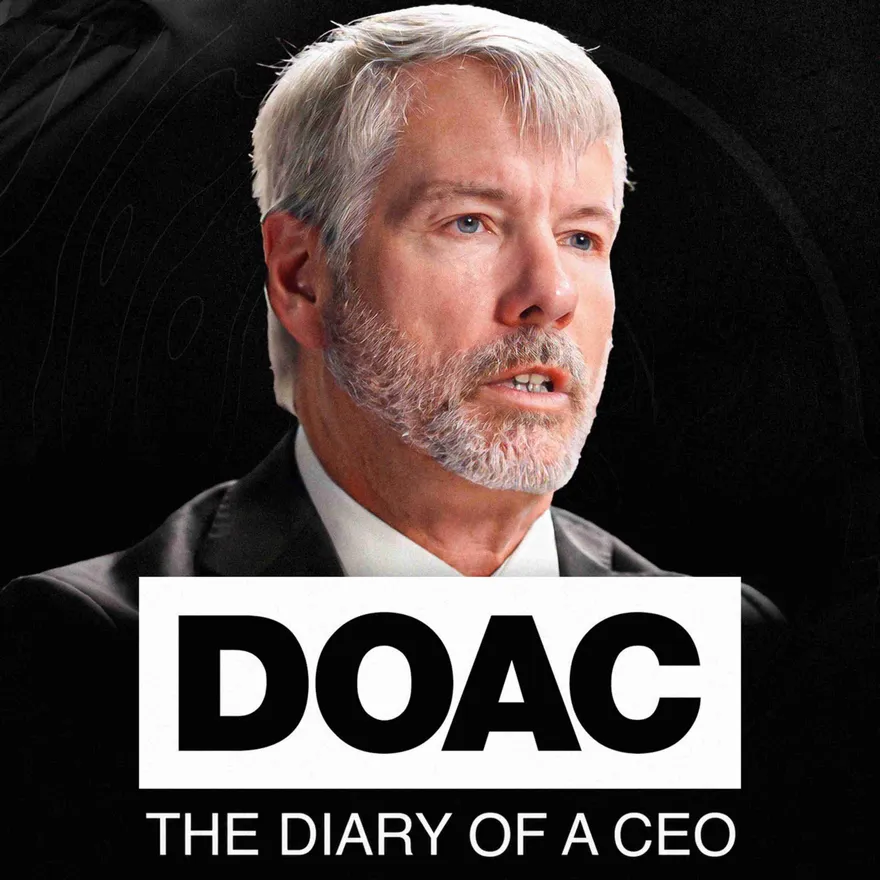

This is a preview of the Shortform summary of the Aug 6, 2026 episode of the The Diary Of A CEO with Steven Bartlett
Sign up for Shortform to access the whole episode summary along with additional materials like counterarguments and context.
1-Page Summary
Bitcoin as Superior Digital Capital
In this conversation, Michael Saylor and Steven Bartlett explore Bitcoin's transformational role in capital storage, AI's economic impact, strategic business timing, and principles for personal success.
Bitcoin's Advantages Over Traditional Assets
Saylor argues that Bitcoin surpasses fiat currency, gold, real estate, and stocks as a long-term store of value. Unlike fiat money, which requires approval from multiple institutions for international transfers and can be confiscated at borders, Bitcoin offers sovereignty and portability—a million dollars can be encrypted on a chip, written on paper, or even memorized. This empowers individuals with weaker political standing to possess and move wealth without government interference.
Fiat currencies consistently lose purchasing power through inflation. Saylor notes the U.S. dollar has lost about 7% annually over the past century, halving in value every ten years. Weaker currencies in Africa and Latin America lose 14% or more per year, often collapsing within 30 years. While real estate—like Miami Beach land rising from $10,000 to $10 million per acre over a century—has performed better than cash, it remains geographically locked, illiquid, and burdened by taxes and maintenance.
Comparing Bitcoin to other assets, Saylor states that gold returns about 12% annually and the S&P 500 yields 10–15%, while Bitcoin has grown at approximately 33% per year and is expected to appreciate 20–30% annually for decades. He recommends Bitcoin for long-term investors who won't need funds for at least four years, emphasizing that its scarcity, portability, and growth make it ideal for passive wealth accumulation without specialized expertise.
MicroStrategy exemplifies Bitcoin's potential as digital capital. The company has raised $65 billion to hold 847,000 Bitcoin, the largest public holding outside Satoshi Nakamoto. Saylor used AI to design STRK, a variable-dividend preferred stock backed by Bitcoin that trades stably at $100 per share. By selling Bitcoin at $59,000–$60,000, MicroStrategy proved it could execute controlled sales without crashing the market, demonstrating the liquidity and viability of Bitcoin-backed financial innovation.
AI, Robotics, and Economic Transformation
Saylor identifies 2023 as a turning point when AI began working at transformative scale. AI systems now write documents, draft contracts, compose creative works, and generate research—tasks previously requiring human expertise. This capability is accelerating rapidly, with AI getting "smarter every week." The next frontier is integrating AI into physical robots, which Saylor envisions people leasing for as little as $200 monthly to perform domestic tasks like cooking, cleaning, and driving.
Bartlett cites Elon Musk's forecast that AI and robotics will make consumer goods abundant and cheap, potentially rendering money less relevant. Saylor agrees, noting that luxuries of past monarchs—clean water, climate control, safe childbirth—are now basics for the global middle class. As AI and robotics scale, utilities and core goods will approach zero marginal cost. However, both note that humans remain "status-oriented animals": scarce, desirable goods like private jets and large homes will always exist beyond the majority's reach, ensuring money doesn't disappear entirely.
Regarding labor displacement, Saylor recalls that technology has always created new professions—accountants, lawyers, podcasters, influencers—unimaginable in previous generations. He argues for free market policies to minimize economic pain during AI's disruptive transition, contrasting entrepreneurial societies like the U.S., which foster rapid innovation, with restrictive economies like Cuba or North Korea that stifle opportunity and adaptation.
S-Curve Theory for Business Timing
Saylor describes the S-curve theory as essential for understanding technological advancement and entrepreneurial timing. Technologies follow a predictable pattern: slow progress, breakthrough, exponential improvement, then plateau as they approach limits.
He cites aviation's evolution from the Wright Brothers' 1903 success to the moon landing in 66 years—a period where performance doubled every three years. However, by the mid-1970s, innovation plateaued; the Boeing 737 and 747 haven't fundamentally changed in decades, with passenger planes becoming only 15% more efficient over 50 years. Bartlett uses the iPhone as a modern example: versions 1 through 6 jumped from 5 to 90 on a utility scale, but later iterations plateaued at 91–95. Launching an iPhone competitor now is futile because the product has reached stagnation.
Saylor insists that outsized success requires avoiding mature, plateaued technologies and instead betting on innovations beginning their S-curve ascent. He advises against entering stagnant disciplines and recommends identifying technologies just hitting commercial viability. A window of 12 to 24 months often exists where zero-to-one innovation is possible—too early and the market isn't ready; too late and competitors have seized opportunities. Early commitment provides enduring advantages in distribution, customer loyalty, and network effects. Saylor notes his company was first to combine digital capital, Bitcoin, and a digital treasury model, allowing them to grow twenty to fifty times larger than any competitor.
Saylor encourages students and entrepreneurs to focus on areas poised for explosive growth. AI is experiencing exponential growth and optimal for building enhanced products. Digital assets including Bitcoin are at an early, promising stage for financial, governance, and identity applications. Next-generation interfaces like smart glasses, neural implants, and wearable AI represent an inflection point for founders, offering "magic" transformations in digital interaction.
Long-Term Business Strategy and Competitive Advantage
Saylor emphasizes that successful businesses grow by extending existing strengths—customer relationships, distribution, technical expertise—into adjacent offerings. He uses Coca-Cola's distribution network as an example: adding another drink leverages existing channels rather than inventing something disconnected. This organic model, resembling a chambered nautilus shell, builds each new chamber on the previous structure for stability. Expanding in unrelated directions dilutes capabilities and causes instability.
Bartlett notes many young entrepreneurs lack patience, rapidly jumping between ventures without committing long enough to realize momentum. In contrast, Saylor insists building dominant market positions typically requires four to ten years. He illustrates with Amazon Prime: Amazon endured years of losses building Prime's value before raising fees once the service became indispensable. With 100 million members paying $20 monthly, Amazon generated $12 billion in annual cash flow and a $250 billion valuation. Founders who remain focused and deeply invest in expertise and loyalty develop durable advantages. Saylor observes that 99% of founders drop out early, leaving the committed 1% to eventually inherit the market.
Exceptional businesses emerge when founders spot technological shifts and commit fully as value becomes proven. Saylor references Elon Musk's vertical integration approach: building proprietary rockets, batteries, and satellites ensured long-term dominance. Rather than outsourcing, Musk's companies stack advantages—cost-effective launches, satellite deployment, battery technology—each reinforcing the other to create durable market power. Lasting value and leadership, they conclude, are earned by building ever-stronger foundations, persisting through setbacks, and leveraging technology when shifts create new possibilities.
Personal Development Rules for Success
Bartlett and Saylor outline foundational lessons for young adults to thrive amid constant change. Saylor asserts that development starts with fundamentals—reading, writing, and math—building a foundation for lifelong learning. He insists on training the body because physical weakness undermines mental performance and resilience. He warns that "everybody in the world wants to program you" with their beliefs, urging independent thought and questioning received wisdom.
They emphasize that success depends deeply on relationships and character. Saylor asserts, "You become who you surround yourself with," noting that positive, ambitious people foster excellence while cynics and underachievers sap ambition. Keeping promises builds reliability and trust; broken ones harm relationships. Since no one is entirely self-sufficient, Saylor says, "We all need each other"—relationships are essential support structures as important as competence.
A clear mission transcending personal wealth is vital. Saylor's mission centers on digital empowerment and Bitcoin as economic liberation. He argues that a higher calling sustains drive and fulfillment beyond monetary rewards. He advises, "Stay cheerful and constructive," emphasizing that optimism during setbacks builds resilience and makes one a better leader. Having a mission to "upgrade the world" creates lasting legacy and purpose far exceeding wealth accumulation.
Saylor recommends deep reading of comprehensive histories and statistics for wisdom and decision-making. After years in business, he read Will Durant's entire "Story of Civilization," learning that most problems and solutions have precedents, which reduces arrogance about one's unique circumstances. He stresses mastering statistics and probability, citing Taleb's "Fooled By Randomness" and "The Black Swan," to distinguish meaningful patterns from noise. This intuitive judgment is something modern AI cannot provide, making human statistical literacy indispensable. Saylor adds that history and statistics are most valuable after gaining life experience, as adults better appreciate nuance and contextualize lessons for improved leadership.
1-Page Summary
Additional Materials
Clarifications
- Bitcoin as "digital capital" means it functions as a form of wealth stored and transferred electronically without physical form. Unlike traditional capital like cash or real estate, it is decentralized, not controlled by any government or institution. Its value comes from cryptographic scarcity and network consensus rather than physical assets or legal backing. This allows for instant, borderless transactions and ownership that is secure and censorship-resistant.
- MicroStrategy's large Bitcoin holding signals strong institutional confidence in Bitcoin as a store of value. Their ability to raise $65 billion for Bitcoin purchases shows significant capital commitment and market influence. Selling Bitcoin in large amounts without crashing prices demonstrates market liquidity and maturity. This sets a precedent for other companies considering Bitcoin as a treasury asset.
- A variable-dividend preferred stock is a type of preferred share that pays dividends fluctuating based on a specific asset or performance metric. In MicroStrategy's case, the dividends are linked to the value or income generated by their Bitcoin holdings. This structure allows investors to receive returns tied directly to Bitcoin's performance without owning Bitcoin itself. It creates a financial product combining traditional equity features with exposure to digital assets.
- Scarcity in Bitcoin means there is a fixed maximum supply of 21 million coins, making it impossible to create more beyond that limit. This limited supply contrasts with fiat currencies, which can be printed endlessly, causing inflation. Scarcity drives demand and value, as fewer available units increase Bitcoin's worth over time. It also creates digital scarcity, similar to rare physical assets, enhancing Bitcoin's appeal as a store of value.
- The S-curve theory describes how new technologies develop slowly at first, then rapidly improve during a breakthrough phase, before growth slows as the technology matures. Early progress is often incremental and experimental, with limited commercial success. The rapid growth phase sees exponential improvements and widespread adoption. Finally, the technology reaches physical or practical limits, causing performance gains to plateau.
- "Zero-to-one innovation" refers to creating something entirely new rather than improving existing products. The timing window is crucial because entering too early means the market or technology isn't ready, while entering too late means competitors have already established dominance. This window typically lasts 12 to 24 months when a technology reaches commercial viability but before widespread adoption. Acting within this period allows innovators to secure lasting advantages like customer loyalty and network effects.
- Network effects occur when a product or service becomes more valuable as more people use it. This creates a positive feedback loop, attracting even more users and making it harder for competitors to catch up. Companies with strong network effects gain a competitive advantage by building large, loyal user bases that increase switching costs. Examples include social media platforms and payment networks, where user participation directly enhances value.
- Vertical integration means a company controls multiple stages of its supply chain, from production to distribution, reducing reliance on outside suppliers. This control lowers costs, improves quality, and speeds innovation by aligning all parts of the process. "Stacking advantages" refers to building multiple strengths that reinforce each other, creating a competitive moat. Together, these strategies make a business harder to compete with and more resilient to market changes.
- AI and robotics reduce production costs by automating tasks, making goods cheaper to produce. "Zero marginal cost" means producing one more unit costs almost nothing, enabling mass abundance. This shifts economies from scarcity-based to abundance-based models. It challenges traditional pricing and value concepts tied to limited resources.
- Free market policies promote competition and innovation by allowing businesses to operate with minimal government interference. They enable rapid adaptation to new technologies by encouraging entrepreneurship and investment. Such policies help workers transition by creating new job opportunities in emerging industries. In contrast, restrictive economies limit these dynamics, slowing technological progress and economic adjustment.
- Nassim Nicholas Taleb's books highlight how humans often misinterpret chance and randomness in life and markets. "Fooled By Randomness" explains how people mistake luck for skill, leading to false conclusions. "The Black Swan" describes rare, unpredictable events with massive impact that standard models fail to predict. Understanding these concepts helps improve decision-making by recognizing uncertainty and avoiding overconfidence.
- Mastering statistics and probability helps individuals recognize true patterns and avoid being misled by random events. This skill enables better judgment in uncertain situations where data can be noisy or incomplete. Unlike AI, humans can apply contextual understanding and experience to interpret statistical information wisely. Therefore, statistical literacy enhances decision-making by combining data analysis with real-world insight.
- Elon Musk's approach involves controlling key parts of his companies' supply chains and technologies rather than relying on outside suppliers. This vertical integration reduces costs, improves quality, and speeds innovation. For example, SpaceX builds its own rockets and Starlink satellites, while Tesla develops its own batteries. This strategy creates competitive advantages that are hard for rivals to replicate.
- The chambered nautilus shell grows by adding new chambers sequentially, each larger and built upon the previous one. In business, this symbolizes expanding by building on existing strengths and resources rather than starting unrelated ventures. This approach ensures stability and sustainable growth, as each new step reinforces the foundation. Diverging into unrelated areas risks weakening the core business and causing instability.
- A digital treasury model refers to managing a company's financial assets primarily in digital forms, such as cryptocurrencies like Bitcoin, rather than traditional cash or securities. It leverages blockchain technology for transparency, security, and efficiency in asset management. This model allows companies to hold, transfer, and utilize digital assets as part of their core financial strategy. It represents a shift from conventional treasury practices to embracing digital capital for long-term value preservation and growth.
- AI and robotics can drastically lower production costs by automating tasks, making goods and services cheaper and more abundant. When essentials become nearly free, traditional money as a medium of exchange for these goods may lose importance. However, money still retains value for scarce, luxury items and services that require human creativity or status signaling. This shift could transform economic systems but not eliminate money entirely.
- Fiat currency is government-issued money not backed by a physical commodity but by trust in the issuing authority. Other asset classes like gold or real estate have intrinsic or tangible value independent of government decree. Fiat currency's value can be affected by inflation and monetary policy, while assets like gold often serve as hedges against inflation. Stocks represent ownership in companies and derive value from business performance, differing fundamentally from fiat money's role as a medium of exchange.
- Inflation is the rate at which the general level of prices for goods and services rises, reducing purchasing power. Historical inflation rates show how much a currency's value declines over time, often measured annually. For example, a 7% annual inflation means prices roughly double every ten years, halving the currency's value. Persistent inflation erodes savings and income, making long-term capital preservation challenging with fiat money.
- Passive wealth accumulation means growing your money steadily over time without actively managing investments or making frequent decisions. It relies on assets that naturally increase in value or generate income, like Bitcoin's scarcity-driven appreciation. This approach suits people who lack deep financial knowledge or time to trade actively. It reduces risk from emotional or uninformed choices by holding long-term.
- Customer loyalty means customers repeatedly choose a brand, providing steady revenue and reducing marketing costs. Distribution channels are the pathways products take to reach customers, such as stores or online platforms. Strong channels ensure wide product availability and convenience, boosting sales. Together, they create competitive advantages that are hard for rivals to replicate.
Counterarguments
- Bitcoin's historical returns are highly volatile and past performance does not guarantee future results; its price has experienced significant crashes and prolonged bear markets.
- Bitcoin's long-term appreciation projections (20–30% annually for decades) are speculative and not supported by consensus among financial experts.
- Bitcoin's scarcity is enforced by code, but its value depends on continued demand and network security, both of which are not guaranteed.
- Bitcoin is not immune to government intervention; several countries have banned or heavily restricted its use, and regulatory risks remain significant.
- Bitcoin transactions, while borderless, are not always private or untraceable; blockchain analysis can reveal transaction histories, and exchanges often require identity verification.
- Bitcoin's energy consumption is substantial, raising environmental concerns compared to traditional financial systems and other digital assets.
- Bitcoin is not as liquid as fiat currency for everyday transactions; its use as a medium of exchange remains limited.
- Real estate, stocks, and gold have intrinsic or utility value (shelter, productive assets, industrial use), whereas Bitcoin's value is primarily speculative and based on collective belief.
- The S&P 500 and other diversified stock indices have historically provided strong, inflation-beating returns with lower volatility than Bitcoin.
- MicroStrategy's Bitcoin strategy exposes the company and its shareholders to significant concentration risk and volatility.
- AI's economic impact, while transformative, also raises concerns about job displacement, inequality, and ethical risks that are not fully addressed by free market adaptation alone.
- The abundance of consumer goods through AI and robotics does not guarantee equitable access or address broader social and economic disparities.
- Technological progress does not always create enough new professions to offset job losses, especially in the short to medium term.
- S-curve theory is a useful framework but does not account for unpredictable disruptions, regulatory changes, or market saturation that can alter technological adoption.
- Focusing only on emerging technologies can be risky; mature industries can still offer innovation, stability, and reliable returns.
- Vertical integration and stacking technological advantages require significant capital and expertise, which are not accessible to most entrepreneurs.
- Building dominant market positions is not solely a function of patience and focus; external factors such as market timing, competition, and luck play major roles.
- Not all successful businesses are built on adjacent expansion; some thrive through diversification or disruptive innovation in unrelated fields.
- Personal development advice emphasizing fundamentals and relationships is valuable, but individual circumstances, systemic barriers, and access to resources also significantly influence outcomes.
- Mastery of statistics and history is beneficial, but not sufficient alone for effective leadership or decision-making; emotional intelligence, adaptability, and domain expertise are also critical.

Get access to the context and additional materials
Bitcoin and Digital Capital as Superior Long-Term Stores
Michael Saylor argues that Bitcoin represents a transformational development in capital, surpassing not only fiat money but also gold, real estate, and stocks as a store of value.
Bitcoin Provides Sovereignty and Portability Over Fiat and Physical Assets
Saylor highlights that fiat currency is permissioned and subject to government controls, especially in cross-border scenarios. Moving money internationally through banks can involve up to seven different institutions, each of which must approve the transfer. Physical cash is also problematic—if you walk through an airport carrying currency, it can be confiscated without recourse. The same issue arises with gold or other tangible assets; moving a million dollars’ worth of gold, for example, is impractical and risky in the face of government resistance.
In contrast, Bitcoin offers sovereignty and portability. A million dollars in Bitcoin can be encrypted on a chip or stored as a private key—written on paper, transferred via a simple message, or even committed to memory. This digital nature allows Bitcoin to be sent anywhere in the world, instantly and without the need for approval from intermediaries or governments. Saylor emphasizes that this aspect uniquely empowers individuals and groups with weaker political or economic standing: with a private key, anyone can possess and move substantial wealth beyond the reach of confiscation.
During periods of currency collapse or political instability, Bitcoin’s borderless design further stands out. Unlike physical or permissioned assets, it remains accessible and transferable, making it highly resilient amidst economic turmoil.
Fiat Currencies Lose Purchasing Power Over Time, Eroding Wealth For Savers
Saylor warns that fiat currencies, even the strongest like the U.S. dollar, consistently lose purchasing power due to inflation and monetary expansion. He points out that over the past century, the U.S. dollar has lost about 7% of its value annually, effectively halving in real terms every ten years. This gradual but persistent debasement erodes the savings of individuals who rely on traditional cash or money market instruments, which typically yield returns far below the real inflation rate.
The situation is even worse with weaker national currencies. In many countries—especially across Africa and Latin America—currencies lose 14% or more in value each year, leading to complete collapse or hyperinflation within an average of 29 or 30 years. Saylor asserts that storing wealth in most fiat currencies guarantees significant losses either within a decade (for the weakest currencies) or a generation.
Real estate, particularly commercial property, has been a better option historically. Saylor cites the example of Miami Beach land rising from $10,000 to $10 million per acre over 100 years—a thousandfold price increase reflecting the dollar’s debasement. While real estate carries risks, maintenance, and tax burdens, it performs much better than cash and benefits from inflation. However, real estate is geographically locked, illiquid, and incurs ongoing expenses, making it difficult to manage or transport compared to digital assets. Commercial property is more attractive than residential, as rents can offset some costs, but it still demands business acumen and active oversight.
Bitcoin Outperforms Stocks, Gold, Real Estate Over Time
When compared to other capital assets, Bitcoin's performance is dramatic. Saylor states that while gold has provided a steady return of about 12% annually and the S&P 500 yields 10–15%, Bitcoin has grown at a rate of approximately 33% per year over its history and is expected to appreciate between 20–30% annually for decades. Non-reproducible assets like Bitcoin (capped at 21 million units), major company shares, and gold retain value over long periods, unlike commodities and consumables that can be produced infinitely by factories or AI.
Capital assets suitable for long-term wealth preservation should be finite, non-reproducible, and broadly desirable—criteria perfectly matched by Bitcoin. Saylor recommends Bitcoin especially for long-term investors who don't need access to their funds for at least four years, and ideally ten. For others more risk averse, Bitcoin should form a meaningful part of a diversified portfolio, alongside real estate, equities, and gold, rather th ...
Here’s what you’ll find in our full summary
Bitcoin and Digital Capital as Superior Long-Term Stores
Additional Materials
Clarifications
- "Permissioned" fiat currency means governments and banks control who can send, receive, or access the money. These controls include regulations, anti-money laundering checks, and limits on cross-border transfers. Banks act as gatekeepers, requiring approval for transactions, which can delay or block transfers. This system restricts financial freedom and can be used to enforce political or economic policies.
- Transporting physical cash internationally often requires declaring large amounts to customs to avoid legal issues and potential confiscation. Carrying significant sums can attract scrutiny from authorities due to anti-money laundering laws. Gold shipments face strict regulations, high insurance costs, and risk theft or seizure during transit. Both cash and gold lack the ease of instant, permissionless transfer that digital assets provide.
- A private key is a secret alphanumeric code that proves ownership of a specific amount of Bitcoin. It allows the owner to authorize transactions and transfer Bitcoin to others securely. Losing the private key means losing access to the Bitcoin it controls, as no central authority can recover it. The private key must be kept confidential to prevent theft or unauthorized use.
- "Borderless design" means Bitcoin operates on a global network without reliance on any single country or government. Transactions can be sent and received anywhere in the world without geographic restrictions or intermediaries. This design protects users from local political or economic disruptions that might block or seize assets. It enables seamless, censorship-resistant transfer of value across borders.
- Inflation is the rate at which the general level of prices for goods and services rises, reducing the purchasing power of money. Historically, the U.S. dollar has experienced an average inflation rate of about 3% per year, meaning prices roughly double every 24 years. This gradual increase means that the same amount of dollars buys fewer goods over time. Central banks often target moderate inflation to encourage spending and investment, but persistent inflation erodes savings if returns do not keep pace.
- Hyperinflation occurs when a country's currency rapidly loses value, causing prices to skyrocket uncontrollably. It often results from excessive money printing by governments trying to pay debts or finance spending. This erodes public trust in the currency, leading people to abandon it for more stable alternatives. Currency collapse happens when the money becomes nearly worthless, disrupting the economy and causing severe hardship.
- Commercial real estate involves properties used for business purposes, such as offices, retail stores, and warehouses, while residential real estate includes homes, apartments, and condos for living. Commercial properties typically generate income through leases with businesses, often resulting in longer lease terms and higher rental yields. Residential properties usually have shorter lease terms and may require more hands-on management due to tenant turnover. Additionally, commercial real estate often demands more specialized knowledge and higher initial investment compared to residential real estate.
- Bitcoin’s capped supply of 21 million units means no more than 21 million bitcoins will ever exist. This fixed limit prevents inflation caused by creating new coins, unlike fiat currencies. Scarcity from this cap can increase demand and value over time. It also ensures Bitcoin’s supply is predictable and transparent.
- Non-reproducible assets cannot be artificially created or increased in supply, which limits inflation and preserves scarcity. Scarcity drives demand and helps maintain or increase an asset's value over time. In contrast, assets that can be reproduced or printed in unlimited quantities tend to lose value due to oversupply. This scarcity is crucial for long-term wealth preservation.
- Bitcoin's expected annual appreciation rates are based on its historical price growth and scarcity, with a capped supply of 21 million coins driving demand. Gold's return is steadier due to its long-standing role as a store of value but lacks Bitcoin's growth potential. Stocks' returns depend on company performance and economic conditions, typically yielding moderate growth with dividends. Bitcoin's higher volatility means its returns can be more dramatic but also riskier over short periods.
- A diversified investment portfolio spreads money across different asset types to reduce risk. This approach helps protect against losses if one asset class underperforms. Bitcoin adds diversification because its price movements often differ from traditional assets like stocks or real estate. Including Bitcoin can improve potential returns while balancing overall portfolio risk.
- Equity financing involves raising capital by selling shares of ownership in a company to investors. Convertible bonds are debt instruments that can be converted into a predetermined number of the company's shares, combining features of both debt and equity. They pay interest like regular bonds but offer potential upside if the company's stock price rises. This allows companies to attract investors seeking both inc ...
Counterarguments
- Bitcoin’s historical returns are based on a relatively short and volatile period; past performance does not guarantee future results, and future appreciation rates may not match historical averages.
- Bitcoin’s price is highly volatile, experiencing significant drawdowns (e.g., over 80% declines), which can be unsuitable for risk-averse investors or those needing liquidity.
- Bitcoin’s value is not backed by physical assets or cash flows, unlike real estate (rents), stocks (dividends), or bonds (interest), making its intrinsic value more speculative.
- Regulatory risks remain significant; governments can restrict or ban Bitcoin usage, exchanges, or mining, as seen in countries like China and India.
- Bitcoin transactions, while borderless, are not always instant or low-cost, especially during periods of network congestion when fees and confirmation times can spike.
- The security of Bitcoin holdings depends on the user’s ability to safeguard private keys; loss or theft of keys results in irreversible loss of funds.
- Bitcoin’s energy consumption is substantial, raising environmental concerns and potential for regulatory crackdowns or negative public perception.
- Bitcoin is not immune to confiscation; authorities can compel individuals or exchanges to surrender assets, and centralized exchanges can be hacked or seized.
- Bitcoin adoption and acceptance as a medium of exchange or collateral remain limited compared to fiat, gold, or real estate.
- Real estate and stocks provide utility (shelter, productive assets, divi ...

Get access to the context and additional materials
Ai, Robotics, and Economic Shift to Abundance and Automation
The rapid progress in artificial intelligence (AI) and robotics is fundamentally transforming economies, moving society toward greater abundance in goods and services, and reshaping the value of labor, money, and social status. Michael Saylor and Steven Bartlett discuss how 2023 marked a key turning point for AI capability, and what it means for consumption, work, and economic organization.
Ai Breakthroughs In 2023 Enable Cognitive Tasks Previously Requiring Human Expertise
Michael Saylor points out that, in 2023, AI began to work at a transformative scale, making the “digital transformation of intelligence” obvious. AI systems now can write documents, draft contracts, compose poems, scripts, and even books, just by receiving prompts that detail the desired characters, locations, and style. AI is also capable of generating perfect research, supporting or automating professional work once reserved for experts.
The improvement in AI is accelerating rapidly, with Saylor noting that AI systems get “smarter every week.” Voice assistants like ChatGPT and Grok increasingly resemble highly knowledgeable companions. Crucially, this acceleration signals an early phase of exponential growth: what AI can do this year is far less than what it will be able to do just a few years from now.
The next frontier is integrating AI into physical robots. Saylor envisions people soon leasing household or professional robots for as little as $200 a month, performing nearly all domestic tasks—cooking, cleaning, trash, and driving. Self-driving cars and intelligent appliances are just the beginning, as AI-powered manufacturing, logistics, and service robots scale to billions worldwide.
Ai and Robotics to Make Consumer Goods Cheaper and Abundant
Steven Bartlett cites Elon Musk’s forecast that as AI and robotics meet almost all human needs, the relevance of money declines. AI and robots will mass-produce goods and services at a rate far outstripping any growth in money supply, eliminating inflation.
For everyday people, this means utilities and core consumer goods—from clean water and electricity to food, clothing, healthcare, and transportation—will approach zero marginal cost, as has already occurred with basics like water and electricity in developed economies. Saylor illustrates this with historical context: luxuries of past monarchs like Henry VIII—clean water, climate control, x-rays, safe childbirth—are now basics for the global middle class. Appliances, food, and beverages such as endless Coca-Cola and Hershey’s bars are provided inexpensively and universally.
Technology always turns luxuries into necessities, and this transformation will only accelerate as AI and robotics scale. The utilitarian baseline soars, with “perfect products” becoming commonplace and unintelligent, breakable appliances giving way to near-faultless AI-powered systems. Luxuries of today become the standard of tomorrow.
Yet, both Saylor and Bartlett note, not all value is eliminated from wealth. Humans remain “status-oriented animals”: there will always be scarce, highly desirable goods (like private jets, large homes, trophy assets) out of reach for the majority. Even if everyone receives universal health care, some will prefer private care; if housing is universal, some will want exclusivity and size. Saylor asserts, “money’s not going away,” because there will ...
Here’s what you’ll find in our full summary
Ai, Robotics, and Economic Shift to Abundance and Automation
Additional Materials
Clarifications
- The "digital transformation of intelligence" refers to the shift where human cognitive tasks are increasingly performed by digital systems like AI. It involves encoding knowledge, reasoning, and decision-making into software that can learn and improve autonomously. This transformation changes how information is created, processed, and applied across industries. It enables machines to augment or replace human intellectual work at scale.
- Exponential growth means AI capabilities increase by multiplying over time, not just adding steadily. This leads to rapid, accelerating improvements where each advance builds on the last. Small early gains quickly become massive leaps in performance and complexity. It contrasts with linear growth, which is slow and constant.
- AI systems perform complex cognitive tasks by analyzing vast amounts of data to learn patterns in language and knowledge. They use models called neural networks, which mimic brain structures to process and generate human-like text. These models are trained on diverse examples, enabling them to predict and create coherent, contextually relevant content. This allows AI to draft contracts or compose creative works by following learned rules and styles without human intervention.
- Zero marginal cost means producing one more unit of a good or service costs almost nothing. This happens when technology and automation reduce labor and material expenses to near zero. It allows companies to supply large quantities without increasing total costs significantly. As a result, prices can drop dramatically, making goods and services widely accessible.
- Historically, many goods and services once available only to the wealthy or elite have become widely accessible due to technological advances and economic growth. For example, clean water was once a luxury for royalty but is now a basic public utility in most developed countries. Climate control, like heating and air conditioning, was rare and expensive but is now common in homes and workplaces. Medical technologies such as x-rays, once cutting-edge and exclusive, are now standard in healthcare worldwide.
- When AI and robotics produce goods faster than the money supply grows, prices tend to fall because more products are available relative to money. This can lead to deflation, where money gains purchasing power over time. Traditional economic models assume money supply growth matches production growth to keep prices stable. If production outpaces money, the value of money increases, making goods cheaper and potentially reducing the role of money as a scarcity-based measure of value.
- Money serves as a medium of exchange, a store of value, and a unit of account, facilitating trade and economic calculation. Even with abundant goods, money remains necessary to allocate scarce resources, such as exclusive or luxury items. It also functions as a social signal of wealth and status, reflecting access to non-abundant goods or services. Thus, money adapts rather than disappears in economies of abundance.
- Humans seek social recognition and respect, often through visible symbols of wealth or achievement. This drives demand for exclusive or scarce goods that signal higher status. Economic behavior is influenced by this desire, as people spend to differentiate themselves socially. Status competition can sustain markets for luxury and unique products despite overall abundance.
- Technological revolutions automate routine tasks, making some jobs obsolete. However, they also create new industries and roles requiring different skills. Historically, displaced workers often transition to emerging sectors, though this shift can take time and cause short-term hardship. Education and retraining are crucial to help workers adapt to new job demands.
- Free market policies allow businesses to operate with minimal government interference, encouraging competition and inno ...
Counterarguments
- The claim that AI will make core goods and services approach zero marginal cost overlooks persistent resource constraints, supply chain complexities, and environmental impacts that may prevent true abundance for all.
- Historical examples show that technological progress does not always lead to widespread prosperity; inequality can increase if gains are unevenly distributed, as seen during previous industrial revolutions.
- The assertion that free market policies are always optimal for adaptation ignores evidence that social safety nets, worker retraining programs, and regulation can mitigate negative impacts of automation and support more equitable transitions.
- The idea that AI will always create new jobs to replace those lost is contested; some economists warn of a potential net loss of employment or a mismatch between new job requirements and displaced workers’ skills.
- The prediction that inflation will be eliminated by AI-driven abundance does not account for inflationary pressures in sectors less susceptible to automation, such as housing, land, and certain services.
- The assumption that deregulation universally fosters innovation overlooks cases where lack of o ...
Get access to the context and additional materials
S-Curve Theory in Business and Career Timing
Michael Saylor describes the S-curve theory as essential for understanding technological advancement, career choices, and entrepreneurial timing. The S-curve illustrates how innovations progress through a predictable pattern—slow at first, then rapidly accelerating, and finally plateauing as they approach their physical or conceptual limits.
Technologies and Industries Follow S-Curve Growth Where Progress Hits Diminishing Returns and Stagnation
Saylor explains that technology typically evolves according to the S-curve: a long phase of little progress, followed by a breakthrough, a period of exponential improvement, and then diminishing returns leading to stagnation.
Slow Start, Breakthrough, Exponential Improvement, Plateau
He cites the example of human flight. For a thousand years, flight was impossible despite immense effort. Then, the Wright Brothers' success in 1903 triggered exponential improvements—within 66 years, aviation progressed from 20 mph flights to jets, unmanned rockets, manned rockets, and eventually the moon landing. This period of doubling performance every three years defined the S-curve’s steep ascent.
Aviation: From Wright Brothers' 1903 Success to 1970s' Diminishing Returns in Flight Speed and Space Travel
However, in the mid-1970s, innovation plateaued. Airplane models like the Boeing 737 and 747 haven’t fundamentally changed in decades; over 50 years, passenger planes became only about 15% more efficient. The industry hit the S-curve’s flat top—diminishing returns, with little real progress since. The same model applies to fields where breakthroughs stop and improvements dwindle.
Iphone's Modern S-Curve: Versions 1-6 Jumped From 5 to 90 On Utility Scale; Later Iterations Plateau at 91-95
Steven Bartlett uses the iPhone as a modern example. The first iPhone lacked basic features, but rapid updates through versions 1 to 6 or 7 brought enormous utility improvements. Saylor quantifies this by suggesting utility leapt from 5 to 90 on a 100-point scale. After iPhone 6, newer models saw minimal gains, plateauing at 91–95. Saylor notes that at this stage, launching an iPhone competitor is futile because the product is already at the stagnation phase of its S-curve.
Strategic Success Requires Early S-Curve Tech Identification and Pre-adoption Commitment
Saylor insists that to achieve outsized success, individuals and businesses should avoid mature, plateaued technologies and instead bet on innovations just beginning their S-curve ascent. Entering a field after it’s matured is a poor investment, as limited progress is possible and opportunities for transformation are scarce.
Studying Mature Fields With Limited Progress Is a Poor Investment
He advises against entering disciplines or industries that have stalled at the top of their S-curves, as seen with certain traditional engineering specialties or aspects of physics like fusion technology where progress has stagnated for decades.
Optimal Entry: Launch Business as Tech Becomes Viable Before Mainstream Adoption
Instead, Saylor recommends identifying technologies that are just hitting commercial viability. Entrepreneurial success often depends on launching businesses during the early, steep phase of the S-curve—just before mainstream adoption. A window of 12 to 24 months often exists, he explains, where zero-to-one innovation is possible. If a company is too early, the market isn’t ready; too late, and competitors have already seized the best opportunities.
Early S-Curve Technology Adoption Provides Enduring Advantages in Distribution, Loyalty, and Resources
By committing to a technology early in the S-curve, companies can achieve long-term advantages in distribution, customer loyalty, and network effects. Saylor highlights his own company’s success, noting they were the first to combine digital capital, Bitcoin, and a digital treasury model—a combination not possible earlier or later. This early move allowed them to grow to twenty to fifty times the size of any competitor.
Emerging S-Curves in Ai, Digital Assets, and Neural Interfaces: Promising Areas For Entrepreneurship and Careers
Saylor encourag ...
Here’s what you’ll find in our full summary
S-Curve Theory in Business and Career Timing
Additional Materials
Clarifications
- The S-curve theory models growth as three phases: initial slow progress due to experimentation, rapid improvement as understanding and adoption increase, and eventual slowdown as limits are reached. It reflects how resources, knowledge, and market saturation affect innovation speed. The curve’s shape helps predict when a technology or product will mature and when returns on investment diminish. Recognizing these phases guides strategic timing for investment and development.
- The Wright Brothers' 1903 flight was the first controlled, powered, and sustained heavier-than-air human flight. It marked the transition from theoretical attempts to practical aviation. This breakthrough enabled rapid technological advancements in aircraft design and performance. It set the foundation for the modern aerospace industry.
- Utility on a 100-point scale measures a product's overall usefulness, combining features, performance, user experience, and value. It reflects how well the product meets user needs and solves problems compared to alternatives. This scale is subjective and often based on expert or market assessments. Higher scores indicate greater effectiveness and satisfaction.
- "Zero-to-one innovation" means creating something entirely new rather than improving existing products. The 12 to 24-month window is critical because it represents the early phase when a technology becomes viable but before competitors saturate the market. Acting within this period allows innovators to establish leadership and capture key resources. Missing this window often means facing entrenched competitors and limited growth potential.
- Aviation innovation plateaued in the 1970s mainly due to physical and economic limits. Jet engine efficiency improvements became marginal, constrained by thermodynamics and materials technology. Regulatory and safety standards also limited radical design changes. Additionally, market demand stabilized, reducing incentives for breakthrough speed or capacity increases.
- Digital capital refers to assets held in digital form, such as cryptocurrencies or tokenized investments, that can be used for transactions or value storage. A digital treasury model is a corporate strategy where a company holds and manages digital assets like Bitcoin as part of its reserves instead of traditional cash or bonds. This approach leverages Bitcoin’s potential for long-term value appreciation and diversification. By adopting this model early, companies can gain financial advantages and signal innovation leadership.
- Network effects occur when a product or service becomes more valuable as more people use it. Early adopters help build a larger user base, attracting even more users and creating a positive feedback loop. This growing network can create barriers for later competitors, as users prefer platforms with more participants. Thus, early entry can secure a dominant market position through these expanding connections.
- Prompting AI means giving clear, specific instructions or questions to an AI system to get useful and accurate responses. It requires understanding how the AI interprets language and tailoring inputs to guide its output effectively. This skill is valuable because it enables users to unlock AI’s full potential for creative problem-solving and innovation. Mastering prompting helps create new applications and solutions that AI alone cannot generate without human direction.
- Digital assets are digital representations of value or rights stored on a blockchain, a decentralized and secure digital ledger. Blockchain technology ensures transparency, immutability, and trust without a central authority by recording transactions in linked blocks. Practically, this enables secure peer-to-peer transfers, programmable contracts (smart contracts), and new forms of ownership like NFTs. These features disrupt traditional finance, governance, and identity systems by reducing intermediaries and increasing efficiency.
- Next-generation interfaces like smart glasses and neural implants enable direct interaction between humans and digital systems without traditional screens or keyboards. Smart glasses overlay digital information onto the real world, enhancing perception and productivity through augmented reality. Neural implants connect ...
Counterarguments
- The S-curve model, while useful, can oversimplify technological progress, which may not always follow a predictable pattern; some innovations experience multiple waves of advancement or unexpected breakthroughs after apparent stagnation.
- Mature industries can still offer significant opportunities for incremental innovation, efficiency gains, or business model disruption, even if core technology appears plateaued.
- Entering a mature market is not always futile; established markets can provide stability, large customer bases, and opportunities for differentiation through service, branding, or niche targeting.
- The focus on early adoption and rapid growth may undervalue the importance of execution, operational excellence, and long-term sustainability, which are critical for enduring business success.
- Not all individuals or organizations have the resources, risk tolerance, or expertise to successfully identify and capitalize on early-stage technologies.
- The window for optimal entry into emerging technologies is often unclear and can be much longer or shorter than suggested, depending on market dynamics and external factors.
- Some fields that appear stagnant, such as fusion physics, may still ...


Get access to the context and additional materials
Long-Term Business, Competitive Advantage, and Growth Strategies
Business growth, long-term dominance, and sustainable success are driven by commitment, strategic leveraging of existing strengths, and embracing innovation at the right moment. Michael Saylor and Steven Bartlett discuss how foundational focus, patience, and exploiting shifts in technology distinguish lasting businesses from those that rapidly dilute or collapse.
Build On Competitive Advantages for Sustainable Growth
Saylor emphasizes that successful businesses grow naturally by extending their existing strengths—customer relationships, distribution channels, or technical expertise—into adjacent offerings. He uses Coca-Cola as an example: with an established network delivering drinks to tens of thousands of restaurants, the natural extension is adding another drink to their palette, leveraging existing distribution rather than inventing something disconnected.
This organic model resembles the chambered nautilus shell or Fibonacci sequence, where each new chamber builds on the previous structure for stability. Expanding in unrelated directions—starting a business outside your area of expertise simply because you own both—causes instability and dilutes capabilities. Saylor points to the restaurant chain example: success with a single restaurant doesn’t guarantee success at scale, especially if expansion is unfocused. Overconfidence leads founders to overextend into unrelated ventures, undermining their initial advantage. Dilutive distractions—trying to make many things a little better rather than focusing on doubling down on the core successful offering—are labeled as a principal cause of failure.
Bartlett notes that many young entrepreneurs lack patience, rapidly jumping between ventures, never committing long enough to realize upward momentum. In contrast, successful growth comes from long-term foundational decisions, not from swinging between trendy ventures.
Requires 4-10 Years for Dominant Market Position and Sustainable Competitive Moats
Saylor insists that building dominant market positions and strong competitive moats typically requires four to ten years. He illustrates this with Amazon Prime: Amazon endured years of losses while building Prime’s foundational value—free and fast shipping—before raising membership fees as the service became indispensable. With 100 million Prime members paying $20/month, Amazon generated $12 billion in annual cash flow, resulting in a $250 billion valuation. The years-long persistence built a moat competitors couldn’t cross overnight.
Founders who remain focused on a core mission, continue refining their main product, and deeply invest in expertise and customer loyalty are the ones who develop durable advantages. Saylor observes that 99% of founders drop out early, eager for a quick exit or discouraged by slow progress, leaving the committed 1% to eventually inherit the market. He and Bartlett agree that persistence and conviction are rare yet crucial competitive drivers; overnight success is a myth—outcomes compounding over years give lasting advantage.
Bartlett compares common founder impatience—abandoning projects within a year for new trends—to founders like Saylor, who dedicate decades to compounding advantages and become “long-termists” in a short-term-focused world. Saylor’s experience at MicroStrategy, spanning nearly four decades, exemplifies rare long- ...
Here’s what you’ll find in our full summary
Long-Term Business, Competitive Advantage, and Growth Strategies
Additional Materials
Clarifications
- The chambered nautilus shell grows by adding new chambers in a spiral pattern, each larger and built upon the previous one, symbolizing steady, structured growth. The Fibonacci sequence is a series of numbers where each number is the sum of the two before it, often appearing in natural growth patterns. Together, they illustrate how businesses should expand incrementally, building on existing strengths for stability. This metaphor warns against erratic or unrelated expansions that weaken the overall structure.
- A "competitive moat" refers to a company's ability to maintain an advantage over competitors that protects its market share and profitability. It can be created through factors like brand strength, patents, cost advantages, or network effects. The term is metaphorical, likening business protection to a moat around a castle. Strong moats make it difficult for rivals to erode a company's position.
- Amazon Prime is a subscription service offering benefits like free, fast shipping and exclusive content, encouraging customer loyalty. Its recurring revenue model provides predictable cash flow, reducing reliance on one-time sales. Prime members tend to spend more on Amazon, increasing overall sales and profitability. This steady income and customer retention significantly boost Amazon’s market valuation.
- MicroStrategy is a business intelligence company that began buying large amounts of Bitcoin as a corporate treasury strategy starting in 2020. This move was significant because it was one of the first major publicly traded companies to adopt Bitcoin as a primary reserve asset, signaling confidence in cryptocurrency's long-term value. The pivot demonstrated how embracing emerging technology can create a competitive advantage and attract investor interest. It also highlighted a shift from traditional cash holdings to digital assets in corporate finance.
- Vertical integration means a company controls multiple stages of its production or supply chain instead of relying on outside suppliers. Elon Musk’s companies, like SpaceX and Tesla, build key components themselves—rockets, batteries, satellites—reducing dependence on external vendors. This control lowers costs, improves quality, and speeds innovation. It also creates barriers for competitors who must rely on third parties.
- The "S-curve" describes how new technologies are adopted over time, starting slowly, then rapidly accelerating, and finally leveling off as the market saturates. Early adoption is cautious and slow due to uncertainty and high costs. Once the technology proves valuable and accessible, adoption speeds up dramatically. Eventually, growth slows as most potential users have adopted the innovation.
- "Dilutive distractions" refer to efforts that spread a company's resources and focus too thinly across many unrelated projects. This weakens the core business by diverting attention and investment away from its main strengths. Such distractions reduce overall effectiveness and slow growth by preventing deep expertise and market dominance. Avoiding them helps maintain a clear strategic direction and maximizes competitive advantage.
- The statistic that "99% of founders drop out early" refers to the high failure rate of ...
Counterarguments
- Focusing exclusively on existing strengths and adjacent markets can lead to missed opportunities for disruptive innovation, as some of the most successful companies (e.g., Apple, Google) have entered entirely new markets.
- Overemphasis on patience and long-term commitment may cause businesses to persist with failing strategies, leading to sunk cost fallacies and missed chances to pivot or exit.
- The assertion that most founders drop out due to impatience overlooks other factors such as lack of resources, market fit, or external circumstances beyond their control.
- Vertical integration can increase operational complexity and risk, and is not always the optimal strategy for every business or industry.
- The idea that short-term strategies inherently produce fragility ignores cases where rapid iteration and adaptation to market feedback have led to significant success (e.g., many startups in the tech sector).
- Building dominant market posit ...


Get access to the context and additional materials
Personal Development and Success Rules for a Rapidly Changing World
Steven Bartlett and Michael Saylor outline foundational lessons that empower young adults to thrive in a world of constant change. Their advice highlights how discipline, relationships, mission, and wisdom from history underpin lasting achievement and resilience.
Foundation For Success: Discipline Mind, Body, and Character Before Financial Goals
Bartlett emphasizes the importance of “focusing your energy and not chasing every good idea” and “guard your time” as the starting principles for young adults. Saylor reinforces this, stating the need to focus and train both mind and body before pursuing wealth.
Foundation in Literacy and Lifelong Learning
Saylor asserts that true development starts with learning the fundamentals—reading, writing, and math. Building a strong educational foundation equips individuals with a cultured base and a habit of lifelong learning, enabling intelligent adaptation to changing circumstances.
Physical Health and Strength Are Crucial for Success, as Weakness Undermines Cognitive Performance and Resilience
“Train your body,” Saylor insists, because physical weakness undermines one’s ability to survive and perform under pressure. Physical health and strength are prerequisites for mental acuity and resilience in the face of adversity.
Cultivating Independent Thought Over Accepting Others' Beliefs and Values
Saylor warns that “everybody in the world wants to program you” with their beliefs, urging the importance of independent thought. He stresses the need to question received wisdom, even from successful or influential figures, and to develop the presence of mind to decide for oneself what is right.
Success Relies On Relationships, Reputation, and Character Over Intelligence, Talent, or Luck
Bartlett and Saylor jointly emphasize that personal and professional success is deeply rooted in who one surrounds themselves with and how one treats others.
Being Around Positive, Talented, and Ambitious People Fosters Excellence, While Being Near Cynical, Failing, or Envious Individuals Undermines Ambition
Saylor asserts, “You become who you surround yourself with.” Being around positive, ambitious people brings out one’s best. In contrast, proximity to cynics and underachievers can sap ambition and progress.
Promises Kept Build Reliability; Broken Ones Harm Relationships
Saylor notes the critical role of reliability: keeping promises builds trust and leads to meaningful investments and support from others. Conversely, unkept promises can destroy opportunities and erode relationships.
Success Requires Support: Value Relationships as Much as Competence
No one is powerful enough to be entirely self-sufficient. Saylor says, “We all need each other.” Relationships are essential support structures; success depends as much on fostering goodwill and reliability as on developing technical competence.
Long-Term Mission For World Improvement Provides Purpose, Resilience, and Motivation
A clear mission or long-term goal transcending personal wealth is vital, both for motivation and for cultivating a meaningful life.
A Clear Mission, Like Digital Empowerment or Better Technology, Gives Life Meaning and Sustains Motivation Even as Profit or Status Fluctuates
Saylor’s own mission centers on digital empowerment and the spread of Bitcoin as a tool of economic liberation. He argues that a higher calling—whether digital innovation or technological progress—helps sustain drive and fulfillment beyond monetary or status rewards.
Cheerfulness and Optimism During Setbacks Build Resilience
He advises, “Stay cheerful and constructive,” emphasizing that optimism is attractive and invaluable, especially during hard times. Maintaining a positive outlook makes one a better partner and leader—even setbacks become opportunities for growth.
Upgrading the World Through Work Creates a Lasting Legacy and Fulfillment Beyond Wealth Accumulation
Saylor observes that having a mission to “upgrade the world” creates a sense of legacy and purpose. Daily progress on such a mission nourishes satisfaction and contribution, far exceeding the fulfillment gained from wealth alone.
History and Statistics Offer Wisdom and Decision-Making Frameworks Beyond Ai's Reach
Saylor recommends deep reading and analysis of comprehensive histories an ...
Here’s what you’ll find in our full summary
Personal Development and Success Rules for a Rapidly Changing World
Additional Materials
Counterarguments
- Focusing exclusively on discipline and self-improvement may overlook the impact of systemic barriers (such as socioeconomic status, discrimination, or lack of access to resources) that can limit opportunities regardless of personal effort.
- Emphasizing physical health as a prerequisite for cognitive performance and resilience may unintentionally marginalize individuals with chronic illnesses or disabilities who can still achieve high levels of success and resilience.
- The idea that relationships and character outweigh intelligence, talent, or luck may understate the significant role that innate ability and chance play in many success stories.
- Encouraging independent thought and skepticism toward received wisdom is valuable, but it can also lead to excessive contrarianism or disregard for expert consensus, which may not always be beneficial.
- The assertion that surrounding oneself only with positive, ambitious people fosters excellence may discourage engagement with diverse perspectives, including those who are critical or struggling, which can also provide valuable insights and empathy.
- Suggesting that keeping promises is always possible may not account for situations where circumstances change beyond one’s control, making it impossible or unwise to fulfill certain commitments.
- The focus on having a long-term mission or world-impr ...
Actionables
- you can set a weekly “energy audit” by tracking where your time and attention go each day, then use a simple color code (green for energizing, yellow for neutral, red for draining) to visually spot and cut out activities or commitments that don’t align with your top priorities.
- a practical way to strengthen both mind and body is to pair a daily 10-minute physical routine (like brisk walking or bodyweight exercises) with a 10-minute mental challenge (such as solving a logic puzzle or summarizing a news article in your own words), building discipline and cognitive sharpness together.
- you can create a “relat ...

Get access to the context and additional materials

 1-Page Summary
- Bitcoin and Digital Capital as Superior Long-Term Stores
- Ai, Robotics, and Economic Shift to Abundance and Automation
- S-Curve Theory in Business and Career Timing
- Long-Term Business, Competitive Advantage, and Growth Strategies
- Personal Development and Success Rules for a Rapidly Changing World
Create Summaries for anything on the web
Download the Shortform Chrome extension for your browser
