

Vice President JD Vance: No One Saw This Coming, The Ceasefire Is Real!
In this episode of The Diary Of A CEO with Steven Bartlett, Vice President JD Vance discusses his path from a troubled childhood marked by his mother's addiction and unstable home life to his current role in national leadership. He examines how his grandmother's influence shaped him, how early trauma affected his adult relationships, and how adversity informed his political perspective.
Vance explains his transformation from Trump critic to vice president, detailing his shift in views on American institutions and governance. The conversation covers US foreign policy toward Iran and Israel, immigration, faith and meaning, and concerns about AI's impact on economic inequality and social stability. Throughout, Vance connects personal experiences to broader questions about leadership, institutional reform, and maintaining social cohesion in the face of technological and economic change.
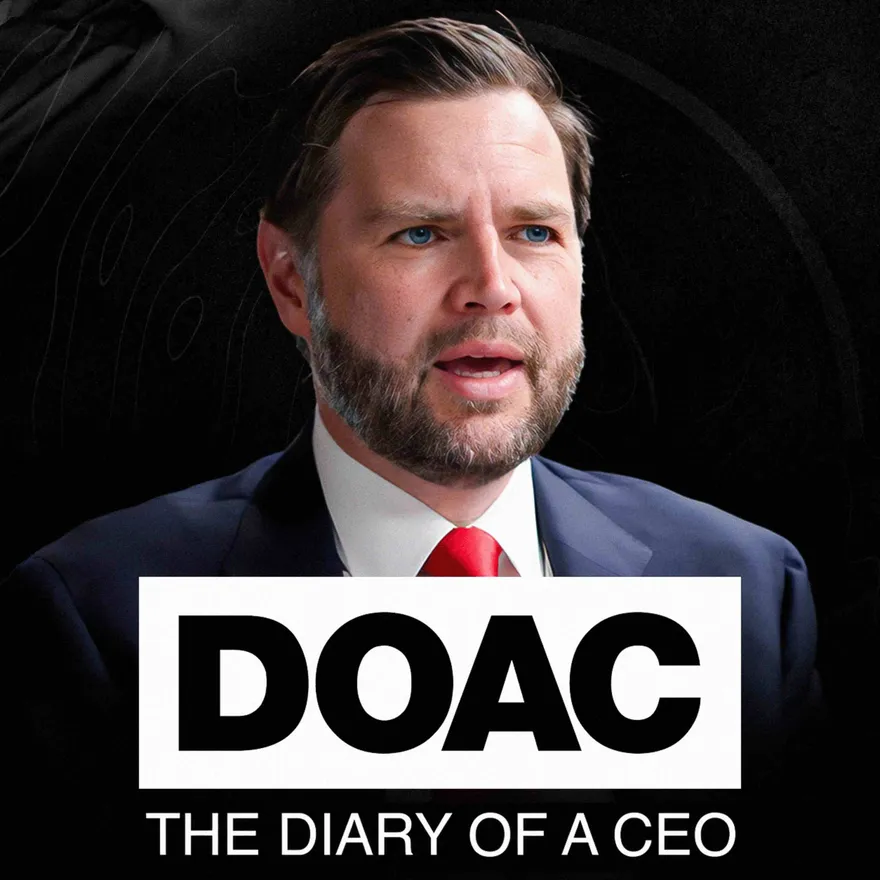

This is a preview of the Shortform summary of the Jun 18, 2026 episode of the The Diary Of A CEO with Steven Bartlett
Sign up for Shortform to access the whole episode summary along with additional materials like counterarguments and context.
1-Page Summary
JD Vance: From Chaos to Political Leadership
In this episode, JD Vance discusses his journey from a tumultuous childhood to becoming Vice President, exploring themes of trauma, political transformation, foreign policy, faith, and AI's societal impact.
Personal Background and Life Journey
Vance's childhood was marked by his mother's severe drug addiction, which devastated the family financially and emotionally. A revolving door of father figures—including his adoptive father Robert Hamill, who disappeared from his life by age twelve—made it nearly impossible for Vance to form secure attachments, leaving him with a persistent fear of abandonment.
Amidst this chaos, Vance's grandmother, Mamaw, emerged as his stabilizing force. He credits her as the person who truly raised him, providing discipline and fierce tough love. When Vance kept company with a troubled boy, Mamaw threatened to run the boy over with her car, demonstrating unwavering commitment that protected Vance from a destructive path. He emphasizes he would not be alive or successful without her.
This trauma manifested in Vance's adult relationships through an avoidant attachment style. He struggled with emotional intimacy in his early marriage, often threatening breakups during arguments and finding rational conversation difficult amid conflict. His wife's stable, middle-class upbringing provided a model for healthier relationship dynamics, helping Vance break cycles of avoidance and chaos.
Despite these scars, Vance believes his adversity fostered deep empathy and a charitable view of human nature. He interprets disagreements as errors rather than character failings and distinguishes between policy differences and personal animosity, approaching conflict with humility and understanding.
Political Philosophy and Evolution
Vance's transformation from Trump critic to loyal vice president is dramatic. In 2016, he privately called Trump "either a cynical asshole or America's Hitler" and publicly compared Trump's appeal to "cultural heroin," arguing Trump offered simple solutions to complex problems and ignored credible military leaders.
Vance's perspective shifted by watching Trump govern rather than through insider knowledge. Contrary to his expectations, he witnessed what he felt was a successful presidency and concluded that American institutions were deeply flawed, not fundamentally sound as he'd believed. He now admits his earlier criticism was arrogant, particularly regarding Trump's lack of military endorsements—given America hadn't won a war in thirty years, Trump's break with military consensus was actually a strength.
Vance came to view American institutions as "sclerotic and broken," arguing that Trump was necessary for breaking through this inertia. He characterizes his orientation as "radical pragmatism," prioritizing practical results over ideology. After developing a personal relationship with Trump, Vance found him warm, generous, and "super smart"—possessing extraordinary social intuition that media coverage fails to capture.
US Foreign Policy and International Relations
Vance details the Trump administration's Iran strategy, emphasizing how the US degraded Iran's military through strikes while proving military action and diplomacy could coexist. Unlike the Iraq War, which exploited patriotism under false pretenses, the Iran operation had clear, narrowly defined objectives that honored the government's social contract with its people.
The current US-Iran-IAEA agreement requires Iran to destroy enriched nuclear material and allow long-term inspections in exchange for sanctions relief, offering economic reintegration as an incentive for non-proliferation compliance.
On US-Israel relations, Vance clarifies that while the countries are close allies, they have distinct geographies and security concerns that sometimes diverge. He stresses alliances require frank dialogue, citing Trump's blunt criticism of Netanyahu when Israeli actions undermined American interests. Israeli concerns over Iran surpass US worries, requiring policy recalibration to ensure American interests come first.
Regarding immigration, Vance advocates for firm border control to ensure cohesion while differentiating between criticizing policies and blaming migrants. His anger targets political leaders who incentivize rule-breaking, not people seeking better lives. He critiques how divisive rhetoric stokes violence and discrimination against minority communities.
On the Iraq War, Vance remains angry at Bush for exploiting patriotism to justify a non-existential war, arguing leaders should only tap into patriotic sentiment when truly necessary. This breach of trust has long-term consequences, reducing young Americans' willingness to serve and eroding essential national bonds.
Faith, Meaning, and Morality
Vance grew up in a conservative evangelical household but adopted a staunchly atheistic worldview in his twenties, dismissing believers as superstitious. Despite achieving outward success—graduating from Yale Law School and building a prestigious legal career—he recognized an emptiness in his life. His fixation on accomplishments had not made him happy or good; he cared more about achievements than being a decent partner.
Seeking role models, Vance noticed that people he admired most were often Christians whose faith motivated strength of character. He began seeing "rays of sunshine" in Christian ideas, prompting a reevaluation of Christianity's relevance.
Vance argues the Christian worldview offers a framework for social harmony that pure rationalism lacks. He cites Pope Leo XIII's encyclical emphasizing coexistence between capital and labor, noting that institutional Christianity historically served as a check on the powerful. The decline of this influence has weakened protections for ordinary citizens.
Vance recounts mystical experiences, including a light bulb exploding after his grandmother's death and a glass shattering during a conversation about the Pope, which hint at reality extending beyond materialism. While maintaining healthy skepticism, he acknowledges these experiences inspire intellectual humility about rationalism's limits.
His journey from atheism to Christianity deepened gradually, culminating in adult baptism. His commitment now demands integrating faith into daily life through church attendance and spiritual formation, viewing transformation as an ongoing process requiring sustained effort.
AI, Economic Inequality, and Social Harmony
Vance contends that AI is unlikely to cause mass unemployment, drawing parallels to the Industrial Revolution when jobs changed but overall employment increased. However, he warns AI will deepen wealth concentration among a handful of companies, with productivity gains not translating to average worker prosperity. This relative poverty risks social discord, even if consumer comforts improve.
Rather than wealth redistribution through taxation, Vance advocates for pre-distribution—giving workers genuine collective bargaining power and equity in transformative technologies. He references Pope Leo XIII's encyclical arguing that social harmony requires enabling workers to negotiate for fairer compensation. This approach is more stable than top-down redistribution and prevents dependency while addressing root power imbalances.
Vance notes that extreme wealth gaps following the Industrial Revolution produced fascism and communism across Europe, warning similar instability could arise if AI-generated wealth creates large gaps and excludes the many from ownership and participation.
Beyond economics, Vance flags AI's surveillance capabilities, warning against pervasive monitoring and social credit scoring—what he terms "fundamentally a communist technology" in its capacity for top-down control. He stresses AI's cultural impact, drawing on how Hollywood once engaged religious leaders to shape content reflecting shared sensibilities. Only by ensuring multiple stakeholders, including community representatives, have a voice in AI's economic and cultural direction can society avoid power consolidation and social fragmentation.
1-Page Summary
Additional Materials
Counterarguments
- While Vance credits his grandmother's tough love for his success, some psychologists argue that such harsh discipline can have negative long-term effects on emotional development and mental health.
- The narrative that adversity necessarily fosters empathy and charitable views is contested; trauma can also lead to distrust, cynicism, or perpetuation of harmful behaviors.
- Vance’s shift from Trump critic to supporter may be seen by some as political opportunism rather than genuine ideological evolution.
- The claim that American institutions are "sclerotic and broken" is debated; others argue that institutional checks and balances are essential for democracy and that disruption can undermine stability.
- The assertion that Trump’s break with military consensus was a strength overlooks concerns about undermining expert advice and the risks of politicizing military decisions.
- Vance’s praise for the Trump administration’s Iran strategy is disputed by critics who argue that the approach increased regional instability and risked escalation.
- The effectiveness and enforceability of the US-Iran-IAEA agreement are questioned by some experts who point to ongoing challenges in verification and compliance.
- The emphasis on prioritizing American interests over those of allies like Israel can be criticized for potentially weakening important strategic partnerships.
- Some argue that strict border control policies can harm asylum seekers and refugees, and that a more compassionate approach is needed.
- Vance’s distinction between criticizing immigration policy and blaming migrants is not always reflected in political rhetoric or policy outcomes, which can still negatively impact immigrant communities.
- The idea that the Iraq War’s exploitation of patriotism was unique is challenged by historians who note that patriotic sentiment has been used to justify various US military interventions.
- The view that Christianity is necessary for social harmony is contested by secularists and adherents of other faiths who argue that ethical societies can be built on non-religious or pluralistic foundations.
- Vance’s skepticism of wealth redistribution through taxation is challenged by economists who argue that progressive taxation is an effective tool for reducing inequality.
- The claim that AI will not cause mass unemployment is debated; some labor economists warn that automation could displace significant numbers of workers, especially in certain sectors.
- The historical analogy between AI-driven inequality and the rise of fascism or communism is questioned by some scholars who argue that contemporary social and political contexts are significantly different.
- Concerns about AI surveillance are shared by many, but some argue that regulatory frameworks and technological safeguards can mitigate these risks without rejecting the technology outright.
Actionables
- you can strengthen your empathy and reduce personal animosity in disagreements by keeping a private journal where you write down the possible life experiences and motivations behind the views of people you disagree with, especially after heated conversations, to practice separating policy or opinion differences from personal judgments.
- a practical way to build social harmony and check powerful interests in your community is to regularly attend local public meetings (like city council or school board sessions) and ask questions about how decisions affect ordinary people, then share summaries with neighbors to encourage collective awareness and accountability.
- you can prepare for AI-driven economic changes by joining or forming a small online group with coworkers or friends to research and discuss ways to negotiate for shared benefits (like profit-sharing or equity) in your workplace, even if informally, and draft a simple list of priorities to present to your employer or organization.
Get access to the context and additional materials
Personal Background and Life Journey
JD Vance’s life story is shaped by childhood chaos, family instability, and the redemptive presence of his grandmother, which not only influenced his personality but also his adult relationships and worldview.
Childhood Chaos and Family Instability Shaped Personality Traits
Vance’s youth was marked by turmoil caused by his mother’s severe struggle with drug addiction, cycling from prescription drugs to heroin. This addiction devastated the family, depleting finances to the point of nearly bankrupting his grandparents, who desperately tried to help her. After the passing of Vance’s grandfather, his mother’s addiction only worsened, leading to escalating instability in the home.
Central to Vance’s childhood malaise was the “revolving door” of father figures. He describes being adopted by Robert Hamill at around age five or six, who became his legal father and was a steady presence for a few years before disappearing from his life by age twelve. His sister, Lindsay, had a different father, his mother’s first husband; Vance’s biological father was the second, and Hamill the third. After Hamill’s exit, the turnover in his mother’s relationships intensified, introducing new men like Matt into the home, only for them to vanish just as Vance began to form attachments. Living with his mother and Matt at age fourteen became defined by chaos, arguing, and violence. This constant instability made it nearly impossible for Vance to form secure attachments, leaving him with a lingering fear that anyone he cared for would eventually abandon him.
Grandmother Served As Stabilizing Force and Moral Anchor
Amidst this chaos, Vance’s grandmother, Mamaw, emerged as his steadfast anchor. Vance credits her as the person who truly raised him and rescued him from the destructive patterns consuming his family. Citing a lesson from a child psychologist, he notes that successful children from traumatic backgrounds usually have one consistent stabilizing person in their lives; for Vance, this was his grandmother.
Mamaw provided shelter, safety, and discipline, often acting with fierce tough love. When Vance was twelve or thirteen and keeping the company of a boy who would later face jail time, Mamaw sternly warned that she would run the boy over with her car if Vance continued their association—telling him that “no one will ever find out about it.” This demonstration of unwavering commitment and discipline was a necessary intervention, motivated by care, which protected Vance from following a destructive path.
Vance repeatedly emphasizes that he would not be alive or successful without his grandmother, describing her as both a mother and father figure whose sheer willpower kept him “on the straight and narrow.” He acknowledges without her guidance, he may have succumbed to a much darker trajectory.
Trauma-Based Attachment Style Affected Adult Intimate Relationships
The impact of Vance’s childhood trauma is evident in his adult relationships, particularly in his avoidant attachment style. He describes a deep-seated mistrust of outsiders and the sense that the world is fundamentally unstable and could “fall apart” at any moment. In his early marriage, he struggled with emotional intimacy and stability, ...
Here’s what you’ll find in our full summary
Personal Background and Life Journey
Additional Materials
Counterarguments
- While Vance credits his grandmother as the primary stabilizing force, some critics argue that focusing on individual resilience can obscure the need for broader systemic solutions to family instability and poverty.
- The narrative centers on personal responsibility and agency, but critics might point out that not all children in similar circumstances have access to a supportive figure like Mamaw, making Vance’s story less universally applicable.
- Vance’s avoidance of therapy in favor of self-reliance could be seen as dismissive of the benefits that professional mental health support can provide, especially for those with trauma backgrounds.
- Emphasizing empathy and charitable views of human nature as a result of adversity may overlook the fact that trauma can also lead to negative outcomes such as cynicism, distrust, or perpetuation of harmful behaviors in some individuals.
- The p ...
Actionables
- you can create a personal stability map by listing people, routines, and places that make you feel safe, then intentionally schedule regular time with these anchors to reinforce a sense of security and predictability in your daily life; for example, you might set a weekly call with a supportive friend or designate a favorite park as your go-to spot when you need calm.
- a practical way to foster empathy and reduce snap judgments is to keep a “mistake journal” where you briefly note times when others’ actions upset you, then challenge yourself to write at least one possible positive or neutral explanation for their behavior, helping you build a habit of assuming the best in people.
- you can strengthen emotional connecti ...

Get access to the context and additional materials
Political Philosophy and Evolution
Trump Critic to Loyal VP: Confronting Misjudgments
In 2016, Vance Compared Trump to "Cultural Heroin" and Privately Called Him "Either a Cynical Asshole or America's Hitler."
In 2016, J.D. Vance’s assessment of Donald Trump was unequivocally negative. In a private message to a roommate, Vance referred to Trump as “either a cynical asshole or America’s Hitler.” In The Atlantic, Vance criticized Trump for exploiting the struggling working class and compared his appeal to “cultural heroin,” arguing that Trump offered simple solutions to complex problems, such as promising to bring jobs back by punishing companies and propose ending addiction crises by building walls. He was particularly critical of Trump’s disregard for the opinions of credible military leaders, noting that no such leaders had endorsed Trump’s plans.
Vance's Perspective Shift Came From Watching Trump's Presidency, Not Insider Info, Showing Trump Wasn't the Disaster Vance Expected and Highlighting Deeper Issues in American Institutions
Vance describes his journey from fierce critic to loyal vice president as “crazy.” He explains that his negative expectations were shaped by the prevailing wisdom of 2016, but watching Trump govern changed his mind. Contrary to his belief that Trump would fail as president, Vance witnessed what he felt was a successful presidency. He says the real shift came from observing Trump’s actions and the performance of America’s institutions, not from privileged insider knowledge. This observation led Vance to conclude that America’s institutions were not fundamentally sound as he’d believed; instead, they were deeply flawed.
Vance Admits Past Criticism Was Arrogant, Misalignment With Military Experts in 2016 Was Good Since America Hadn't Won a War In 30 Years
Vance admits that some of his prior criticisms now embarrass him. In particular, he retracts his earlier assumption that Trump’s lack of military endorsements was a weakness. In retrospect, Vance argues, military leadership’s poor track record—highlighted by the fact that America had not won a war in thirty years—meant that Trump’s break with the military consensus was actually a strength. He acknowledges arrogance in his past belief that major American experts and institutions were almost always right, conceding that it was healthy and even necessary to be misaligned with them in many instances.
Core Belief That Broken Institutions Required Unconventional Disruption
Vance Viewed America's Institutions As Sclerotic and Out of Touch
Vance ultimately came to view American institutions as “sclerotic and broken.” He argues that by 2016 these entities were out of touch and resistant to change, and that Trump was a necessary instrument for breaking through this inertia.
Trump's Unconventional Approach Recognizing Failing Old Protocols
He emphasizes Trump’s non-conventional approach, citing actions and policies previously thought unimaginable—such as the peace deal with Iran—as made possible by Trump’s willingness to reject orthodoxy. Vance believes that things that were unimaginable before Trump are now on the table because of this break from established patterns.
Vance's "Radical Pragmatism": Policy Over Ideology
Vance characterizes his orientation and Trump’s leadership as “radical pragmatism," prioritizing what works in practice over strict allegiance to any ideology. For Vance, success comes from policy results, not simply following existing protocols or expert consens ...
Here’s what you’ll find in our full summary
Political Philosophy and Evolution
Additional Materials
Counterarguments
- Vance’s shift from fierce critic to loyal supporter could be interpreted as political opportunism rather than a genuine change of heart, especially given the timing of his rise within the Republican Party.
- The claim that Trump’s lack of military endorsements was a strength because of the military’s track record overlooks the complexity of military decision-making and the value of experienced leadership in national security.
- While Vance argues that American institutions are deeply flawed, others contend that institutions provide necessary checks and balances and that undermining them can threaten democratic norms.
- The assertion that Trump’s unconventional approach led to unprecedented policy successes is debated; critics point to policy failures, reversals, and international instability during his administration.
- Vance’s description of Trump as highly intelligent and well-read is contested by many who cite Trump’s public statements, reading habits, and approach to briefings as evidence to the contrary.
- The portrayal of Trump’s warmth and generosity in private settings does not negate or excuse his public behavior, rhetoric, or policies that many have found divisive or harmful.
- The idea that “radical pragmatism” is preferable to ideology or expert consensus can be criticized for potentially disregarding established knowledge, ethical considerations, ...
Actionables
- you can challenge your own assumptions about institutions by picking one area of public life (like education, healthcare, or local government) and tracking a recent policy or decision, then writing down both the official reasoning and your own alternative solutions, focusing on what unconventional or outsider ideas might work better and why
- (for example, if your city changes recycling rules, note the stated reasons, then brainstorm and document at least two unexpected ways to address the same issue, such as community-led initiatives or tech-free solutions)
- a practical way to test the value of expert consensus versus outsider perspectives is to follow a current event or debate, deliberately seek out both mainstream and fringe viewpoints, and keep a journal where you rate the persuasiveness and practicality of each, noting when unconventional ideas seem more effective or realistic
- (for instance, during a major news story, compare the advice of established experts with that of independent commentators, and reflect on which ideas you’d actually try if you were in charge)
- you can experiment with radical pragmatism in your daily decisi ...

Get access to the context and additional materials
Us Foreign Policy and International Relations
This discussion between JD Vance and Steven Bartlett explores key themes in US foreign policy—especially pragmatism in international deals, the nature of alliances, immigration, and lessons from the Iraq War—while highlighting the importance of trust, clarity, and realism.
Iran Nuclear Deal as Pragmatic Alternative to Conflict Cycles
Trump Strategy: Degraded Iran's Military Through Strikes, Proved Military Action and Diplomacy Coexist
Vance details the Trump administration’s strategy with Iran, emphasizing how geography, such as control of the Strait of Hormuz, gave Iran significant leverage over global oil markets. However, through coordinated action, US-led coalitions were able to increase the flow of oil despite Iranian threats, weakening that leverage. Vance explains that under Trump, the US focused on a narrowly defined military objective: degrading Iran’s conventional military power, rather than pursuing regime change or open-ended occupation. This military success allowed the US to negotiate from a position of strength.
Unlike the Iraq War, Which Exploited Patriotism Under False Threat Pretenses, the Iran Operation Had Clear Objectives, Honoring the Government's Social Contract With Its People
Vance notes Trump’s approach contrasted sharply with the Bush administration’s Iraq War, which was marketed to the American public using patriotism and analogies to World War II. He criticizes the Iraq War for abusing national trust and failing to maintain a justified social contract, arguing that military force should only be used when truly necessary, not for wars of choice. In the Iran case, Vance asserts that objectives were clear, narrowly defined, and limited to degrading military capabilities, thereby avoiding the pitfalls of the Iraq conflict.
Us-iran-Iaea Deal: Destroy Enriched Nuclear Material, Sanctions Relief For Iran's Non-proliferation Commitment
Vance outlines the current US-Iran-IAEA agreement: Iran will give up its enriched nuclear material, allow a long-term inspections regime, and collaborate with the US and the International Atomic Energy Agency to destroy the material. In exchange, the US will lift extensive economic sanctions, offering Iran reintegration into the global economy if it upholds non-proliferation commitments. This agreement is in a term sheet stage: principles are agreed upon, but detailed verification mechanisms are still being negotiated. The aim is both permanent cessation of hostilities and ensuring Iran will never become a nuclear power, with economic integration as the incentive for compliance.
Us-israel Relationship Requires Clarity About Power and Interests
Despite Being Allies, the U.S. and Israel Have Distinct Geographies, Security Concerns, and Sometimes Diverging Objectives
Vance clarifies that while the US and Israel are fundamentally close allies with shared interests, they are different countries with distinct geographies and security needs. While both nations aligned on reducing Iran’s military power, Israel sees threats from Iran as more existential—their geographic proximity and historical anxieties drive a heightened threat perception compared to the US, which has at times been more concerned with other forms of terrorism.
Us Must Clearly Communicate When Israeli Actions Undermine American Interests, as Shown by Trump's Netanyahu Criticism
The conversation covers Trump’s blunt conversation with Prime Minister Netanyahu following Israeli military actions. Vance points out that alliances require frank dialogue and admits to moments when US and Israeli interests do not perfectly align—sometimes requiring the US to express displeasure or challenge Israeli government decisions when they potentially undermine American objectives.
Israeli Concerns Over Iran's Power Surpass U.S. Worries, Showing Ally Relationships Need Recalibration
He further stresses that Israel’s fear of Iran long predates similar US concerns. Even in periods of tight alignment, Israel’s priorities can diverge, requiring the US to recalibrate its approach and ensure policy is set in pursuit of American—not just allied—interests, particularly in complicated regional dynamics.
Immigration Policy Must Balance Security With Humanitarian Realities
Firm Border Control Ensures Cohesion Without Demonizing Migrants
Vance positions the US as a nation that, like any household, requires rules of admission for stability and cohesion. He acknowledges most immigrants are good people seeking opportunity but believes uncontrolled or rapid immigration can destabilize communities by changing their character too quickly.
Vance Differentiates Between Criticizing Immigration Policies and Blaming Migrants, Suggesting Anger Should Target Political Leaders Incentivizing Rule-Breaking, Not Those Seeking Better Lives
He clarifies his criticism is directed at political leaders who create systems that incentivize illegal m ...
Here’s what you’ll find in our full summary
Us Foreign Policy and International Relations
Additional Materials
Counterarguments
- The Trump administration’s targeted strikes on Iran, while avoiding regime change, risked escalation and did not address underlying causes of conflict, potentially leading to cycles of retaliation rather than long-term stability.
- Increased oil flow despite Iranian threats was also influenced by global market dynamics and actions by other oil-producing countries, not solely US-led efforts.
- Combining military action and diplomacy can undermine trust in negotiations, as adversaries may perceive diplomatic overtures as insincere or coercive.
- The Iraq War’s lack of clear objectives is widely criticized, but some argue that initial intelligence assessments were shared by multiple countries and not solely a product of US government manipulation.
- The assertion that military force should only be used when truly necessary is subjective; some policymakers argue that preemptive or preventive actions can be justified to avert greater future threats.
- The US-Iran-IAEA deal’s effectiveness is debated, as critics argue that verification mechanisms may be insufficient and that Iran could resume nuclear activities if political conditions change.
- Economic incentives may not be sufficient to ensure Iran’s long-term compliance, given internal political dynamics and regional rivalries.
- While the US and Israel have diverging interests, some argue that strong alignment is necessary to deter common adversaries and maintain regional stability.
- Israel’s perception of existential threat from Iran is sometimes viewed as disproportionate by critics, who argue that diplomatic engagement could reduce tensions.
- Clear and frank communication between allies can strain relationships and reduce cooperation on other strategic issues.
- Calls for recalibrating alliances may undermine trust and predictability in international partnerships.
- Firm border control policies can inadvertently harm asylum seekers and refugees fle ...
Actionables
- you can track and reflect on how news about international conflicts or alliances influences your own trust in government decisions by keeping a simple journal, noting when you feel your trust increase or decrease and what triggered it, helping you recognize patterns and become more discerning about political messaging.
- a practical way to support national unity and reduce divisive rhetoric is to challenge yourself to reframe conversations about immigration or foreign policy in your daily life, focusing on policies and leadership decisions rather than blaming or stereotyping groups of people.
- you can strengthen your understand ...
Get access to the context and additional materials
Faith, Meaning, and Morality
Journey From Atheism to Faith Required Recognizing Emptiness
JD Vance grew up in a conservative evangelical household where religion was more often practiced at home than in church. Although he initially embraced the beliefs of his family, as a young adult he found that faith no longer seemed relevant to his life. In his twenties, Vance adopted a staunchly rationalist and atheistic worldview, dismissing believers as superstitious "bumpkins" and feeling intellectually superior because of his college education. He developed a sense of pride in his credentials, placing more value on worldly achievements than on genuine connection or moral goodness.
Despite achieving outward success—graduating from Yale Law School, building a prestigious legal career, and having a loving relationship—Vance recognized an emptiness in his life. He realized that his fixation on accomplishments and rationalism had not made him happy or good; he cared more about his achievements than about being a decent partner, frequently acting selfishly and emotionally detachably in his relationship. This personal reckoning led him to acknowledge that ambition and rationalism alone did not foster virtue or fulfillment.
Seeking role models, Vance noticed that the people he truly admired and who exhibited strength of character were often Christians whose faith motivated them to treat others well and withstand adversity. He began to see "rays of sunshine" in Christian ideas and the lived faith of those around him, prompting a reevaluation of Christianity’s relevance and profundity in a way he never considered as a teenager.
Christian Framework Offers Social Harmony Beyond Pure Rationalism
Vance argues that the Christian worldview offers a framework for social harmony and moral obligations that pure rationalism lacks. He cites Pope Leo XIII’s encyclical, which emphasized the need for coexistence between capital and labor and advocated collective bargaining—a Christian underpinning supporting workers’ dignity and rights. This approach contrasts with the Marxist view, which denied the possibility of such harmony. Vance believes that adopting a Christian-informed model of social harmony, particularly in an age of rapid technological change, is crucial to prevent the powerful from exploiting the less privileged.
He notes that historically, institutional Christianity served as a check on the powerful, urging influential figures and industries to consider community input. For example, Hollywood studios in the mid-20th century regularly consulted religious leaders before distributing content, ensuring some degree of moral consideration. According to Vance, the decline of institutional Christianity has weakened this societal check and eroded protections for ordinary citizens against powerful interests.
Mystical Experiences Hint Reality Extends Beyond Materialism
Vance recounts personal experiences that hint at the mysterious aspects of reality. After his grandmother’s death, he and his sister witnessed a light bulb explode following a moment of emotional intensity, interpreting it as a sign from their late family member. In another incident, during a conversation about the Pope with a journalist, a glass fell and shattered in an inexplicable manner, leaving both participants unsettled.
He remains open to the ...
Here’s what you’ll find in our full summary
Faith, Meaning, and Morality
Additional Materials
Counterarguments
- Many people find meaning, moral goodness, and fulfillment without religious faith, relying on secular philosophies, humanism, or community engagement.
- Rationalism and atheism do not inherently lead to emotional detachment or selfishness; numerous atheists and rationalists demonstrate strong moral character and deep personal connections.
- The sense of emptiness or lack of virtue described by Vance is a subjective experience and not universal among non-believers.
- Social harmony and moral obligations can be grounded in secular ethical frameworks, such as Kantian ethics, utilitarianism, or virtue ethics, without recourse to religious doctrine.
- Historical examples exist where institutional Christianity failed to act as a check on power or was complicit in abuses, such as during periods of colonialism or in support of authoritarian regimes.
- The decline of institutional Christianity does not necessarily correlate with a decline in societal morality or protections for ordinary citizens; some secular societies maintain high levels of social trust and welfare.
- Mystical or unexplained experiences can often be accounted for by psychological or natural phenomena, and interpreting them as supernatural is not the only re ...
Actionables
- you can set aside a weekly time to reflect on how your daily actions align with your values and relationships, then write down one small change to make next week that prioritizes connection or moral goodness over personal achievement (for example, choosing to listen more attentively to a friend or family member instead of multitasking during conversations).
- a practical way to explore the impact of faith-inspired character is to identify someone in your life or community who demonstrates resilience and kindness, then observe and note specific behaviors you can try out yourself in challenging situations (such as responding to criticism with patience or offering help to someone in need with ...
Get access to the context and additional materials
Ai, Economic Inequality, and Social Harmony
JD Vance analyzes the impact of artificial intelligence (AI) on work, wealth, and society, drawing comparisons to historical precedents, emphasizing the dangers of wealth concentration, and advocating for worker power and broad social participation in the age of AI.
Ai Unlikely to Cause Unemployment, but Wealth Concentration Poses Dangers
Vance contends that, based on the precedent set by the Industrial Revolution, AI is unlikely to cause mass unemployment. During the Industrial Revolution, although jobs changed and some were lost, the overall number of people working increased. Vance argues the same foundational transformation will occur with AI—some jobs will disappear, others will emerge, and workers will need to adapt and retrain.
Despite skepticism about technological unemployment, Vance highlights a significant parallel to previous eras: the accumulation of wealth by a few. During past industrial transformations, a lot of manufacturing job growth actually occurred, just not in America, and the result was that the rich became far richer. He foresees AI deepening this productivity divide, with productivity and wealth concentrating among a handful of companies and their owners, while average workers face stagnating wages and relative poverty. Vance warns that giving people consumer comforts does not offset the societal discontent created when the wealthy pull far ahead, risking social discord.
Worker Power as Pre-distribution: An Alternative to Wealth Redistribution
Vance distinguishes between redistribution and pre-distribution as approaches to address inequality. He argues that simply taxing AI-driven profits and redistributing wealth will be insufficient and politically unsustainable in the long term. Such top-down redistribution can lead to dependency and fails to address the root power imbalances. Instead, he advocates for pre-distribution—giving workers genuine collective bargaining power and equity in transformative technologies.
Vance references the origins of collective bargaining in Christian social thought, specifically Pope Leo XIII’s encyclical which argued that social harmony required enabling workers to negotiate for fairer compensation and respect. This labor voice, rooted in Christian ideas, gives all societal members a seat at the table. He believes enabling collective bargaining is a more stable foundation for social harmony than simply redistributing income after the fact. If only a few accumulate trillions in AI-driven wealth and workers have no negotiating power, the resulting political protection for the wealthy will prevent meaningful redistribution.
Inequality-Driven Instability Produced Fascism and Communism
Vance notes that extreme wealth gaps following the Industrial Revolution created the conditions for fascism and communism across Europe, while Britain and America escaped such revolutions in part by finding more democratic solutions to economic transformation. He warns that similar instability could arise if AI-generated wealth again leads to large gaps and relative deprivation. The risks for extremism and social breakdown increase when the many are excluded from ownership, bargaining power, and participation in AI governanc ...
Here’s what you’ll find in our full summary
Ai, Economic Inequality, and Social Harmony
Additional Materials
Clarifications
- Pre-distribution focuses on shaping the initial distribution of income and wealth by empowering workers and improving labor market conditions before government intervention. It aims to prevent inequality by strengthening worker rights, wages, and access to opportunities. Redistribution, in contrast, involves taxing wealth or income after it is earned and reallocating it through social programs. Pre-distribution seeks to address root causes of inequality, while redistribution addresses its symptoms.
- Pope Leo XIII’s encyclical Rerum Novarum (1891) addressed the rights and conditions of workers during the Industrial Revolution. It emphasized the dignity of labor, the right to form labor unions, and the need for just wages. The document sought to balance the interests of capital and labor to promote social harmony. It laid the foundation for modern Catholic social teaching on economic justice and workers' rights.
- Collective bargaining is the process where workers negotiate with employers for better wages and conditions. Its roots in Christian social thought trace back to Pope Leo XIII’s 1891 encyclical Rerum Novarum, which supported workers' rights to form unions and seek fair treatment. This document emphasized social justice and the moral duty of employers to respect laborers. It influenced labor movements by framing worker rights as essential to social harmony and ethical governance.
- Extreme wealth gaps in Europe after the Industrial Revolution created widespread poverty and social frustration among workers. This economic inequality undermined trust in existing political systems and fueled radical ideologies promising change. Fascism and communism gained support by blaming elites and proposing alternative social orders to address perceived injustices. These movements exploited economic despair to mobilize mass political action and challenge established governments.
- Britain and America avoided revolutionary instability by gradually expanding political rights and labor protections, allowing workers to participate in decision-making. They implemented reforms like labor unions, minimum wages, and social safety nets to reduce economic grievances. These democratic economic solutions helped integrate workers into the system rather than exclude them. This approach contrasted with more radical upheavals seen in other countries lacking such reforms.
- Describing AI as "fundamentally a communist technology" refers to its potential for centralized, top-down control similar to authoritarian regimes. AI enables extensive surveillance and data collection, allowing authorities to monitor and regulate individual behavior closely. This can lead to social credit systems where access to services depends on compliance with government rules. Such control contrasts with decentralized, democratic governance, raising concerns about privacy and freedom.
- In the 1950s and 1960s, Hollywood studios worked with religious and community leaders to ensure films aligned with prevailing moral and social values. This collaboration helped avoid content that might offend or provoke public backlash, maintaining broad audience appeal. The Motion Picture Production Code, also known as the Hays Code, enforced guidelines influenced by these groups to regulate film content. This system provided a form of public input and cultural consensus without direct government censorship.
- Social credit scoring is a system that evaluates individuals' behavior and trustworthiness using data from various sources. AI can analyze vast amounts of personal information to assign scores that affect access to services, loans, or employment. This creates a form of social control by rewarding or punishing behavi ...
Counterarguments
- Historical analogies between the Industrial Revolution and AI may not fully account for the unprecedented speed and scale of AI-driven automation, which could outpace workers' ability to retrain and adapt.
- Some economists argue that technological unemployment is a real risk with AI, especially for middle-skill and knowledge-based jobs, unlike previous industrial shifts that primarily affected manual labor.
- Wealth concentration is not an inevitable outcome of AI; policy interventions, antitrust enforcement, and open-source AI initiatives could help distribute benefits more broadly.
- Consumer comforts and rising living standards have historically contributed to social stability, even amid rising inequality, as seen in several advanced economies.
- Redistribution through progressive taxation and social welfare programs has been effective in reducing inequality in many countries and can be politically sustainable with public support.
- Pre-distribution mechanisms such as collective bargaining may be less effective in sectors where AI automates tasks to the extent that traditional labor roles are diminished or eliminated.
- The roots of collective bargaining and labor rights are not exclusively Christian; they also stem from secular, socialist, and other religious traditions.
- Political protection for the wealthy is not absolute; democratic institutions and public advocacy have historically led to significant redistributive reforms.
- The link between wealth gaps and the rise of fascism or communism is debated among historians, with multiple contributing factors beyond economic inequality.
- Britain and America also experienced significant social unrest and labor conflict during industrialization, challenging the notion that they "esc ...
Get access to the context and additional materials


Create Summaries for anything on the web
Download the Shortform Chrome extension for your browser
