

Rachel Maddow on why the DOJ is on the brink of collapse
In this episode of NPR's Book of the Day, Rachel Maddow examines the history and current state of the U.S. Department of Justice, tracing its origins to the Reconstruction era rather than the nation's founding. Maddow discusses how the DOJ's mission has shifted dramatically throughout history—from enforcing civil rights protections for formerly enslaved people to serving powerful economic interests against labor movements—demonstrating that the department has never operated independently from its political leadership.
Maddow argues that the DOJ now faces a crisis that threatens its ability to function, particularly following significant personnel losses and institutional weakening in recent years. She emphasizes the department's role as a cornerstone of American democracy, shaping everything from constitutional free speech protections to permissible political organization. The conversation with host Michel Martin explores how congressional oversight and principled leadership selection are essential to ensuring the DOJ serves justice rather than partisan interests.
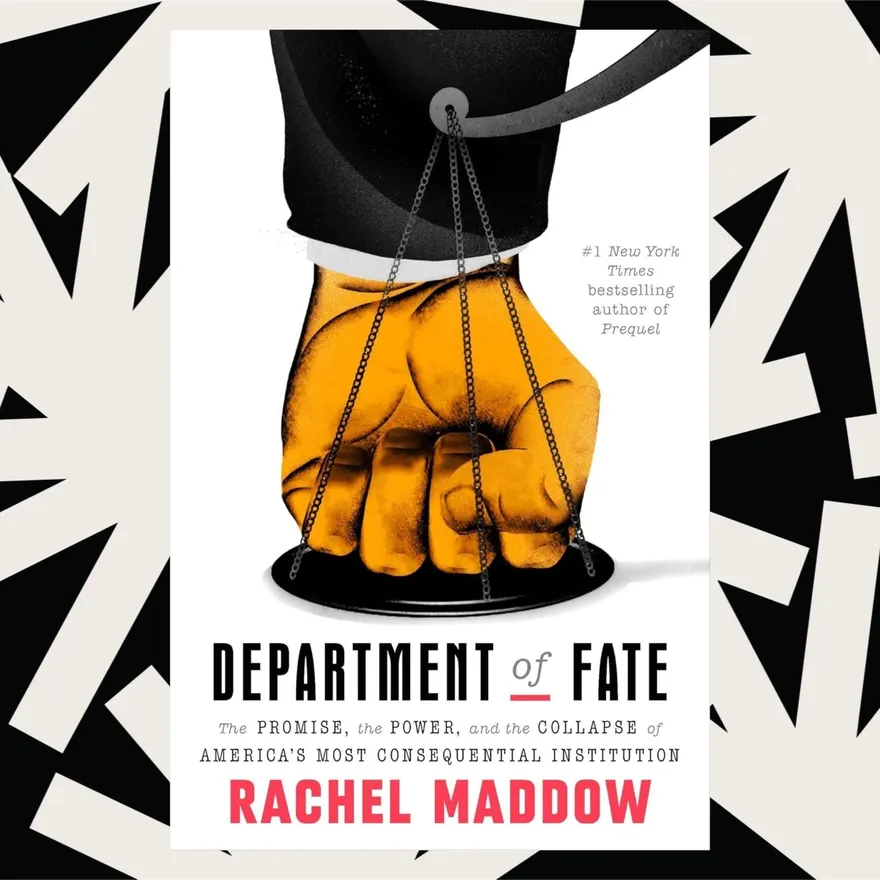

This is a preview of the Shortform summary of the Nov 23, 2026 episode of the NPR's Book of the Day
Sign up for Shortform to access the whole episode summary along with additional materials like counterarguments and context.
1-Page Summary
Post-Civil War DOJ: Justice and Corruption History
The U.S. Department of Justice was created during Reconstruction, not by the founding fathers, with a mission shaped by the post-Civil War political landscape and its evolving relationship with power.
DOJ Emerged During Reconstruction to Enforce Constitutional Authority
President Grant's administration established the DOJ to enforce new constitutional amendments guaranteeing civil rights for formerly enslaved people. The first Attorney General, Amos Ackerman—a former Confederate officer and slaveholder—took these amendments seriously and deployed federal authority to battle Ku Klux Klan terror in the South. Despite achieving significant successes, Ackerman was ousted as Washington lost interest in his civil rights crusade, and his legacy within the DOJ was abandoned.
DOJ Weaponized to Favor Powerful Economic Interests
The department's mission shifted dramatically under Attorney General Richard Olney, who turned the Sherman Antitrust Act against labor organizing rather than constraining corporate monopolies. Olney merged DOJ power with railroad barons, deployed federal troops and hired mercenaries to break strikes, demonstrating how the department could be repurposed to serve powerful economic interests at the expense of workers' rights.
Justice Department Lacks Political Independence
Rachel Maddow argues that expecting DOJ independence from elected officials and their appointees is naive. The department has never operated apart from its political leadership, with its direction inevitably steered by those in power.
Congressional Oversight and Principled Leadership Ensure Justice Over Political Vendettas
Maddow and Michel Martin emphasize that Congress must select DOJ leaders who prioritize constitutional justice over partisanship. The department's quality depends on whether officials are ideological extremists or truly committed to upholding justice. Congressional oversight and principled leader selection are vital to keeping the DOJ oriented toward justice rather than corruption.
DOJ Weakened Under Recent Administrations
Maddow reflects on the DOJ's severe institutional decline, particularly during and after the Trump administration, with thousands of employees lost and functions diminished.
Trump Administration's Approach: Continuation of Historical Politicization
While investigating whether the Trump-era DOJ was uniquely destructive, Maddow concludes that Attorney General Bill Barr's actions fit into a longer history of politicization. However, the deliberate personnel cuts and capture of leadership under Trump rendered the institution deeply ineffective, representing a strategic dismantling that threatens the department's ability to fulfill its constitutional responsibilities.
DOJ: America's Key Institution for Democracy's Survival
Maddow highlights the Justice Department as uniquely consequential for safeguarding democracy. The DOJ shapes politics by defining which activities are protected under constitutional free speech and what political organization is permissible. She contends the department now stands at the brink of collapse and insists that a constitutional republic cannot exist without a functioning DOJ. In her newest book, Maddow outlines specific recommendations for rebuilding the institution, seeing the current crisis as an urgent opportunity to refound this cornerstone of American democracy.
1-Page Summary
Additional Materials
Counterarguments
- While the DOJ was created during Reconstruction, some of its functions—such as the role of the Attorney General—date back to the founding era, suggesting a longer institutional lineage than implied.
- The DOJ's enforcement of civil rights during Reconstruction was limited and inconsistent, and federal efforts were often undermined by local resistance and lack of sustained political will, indicating that its impact was not uniformly positive or effective.
- The use of the Sherman Antitrust Act against labor unions reflected prevailing legal interpretations of the time, which often viewed labor organizing as a restraint of trade; this was not solely a DOJ initiative but also reflected broader judicial and legislative attitudes.
- The assertion that the DOJ has never operated independently may overlook periods where Attorneys General or DOJ officials resisted political pressure and acted with significant autonomy, such as during the Watergate scandal.
- Congressional oversight and the selection of principled leaders, while important, do not guarantee DOJ independence or integrity, as political pressures and partisanship can still influence oversight processes and appointments.
- The decline in DOJ staffing and functions during the Trump administration may also be attributed to broader trends in federal workforce reductions and budgetary constraints, not solely to deliberate sabotage.
- The DOJ's role in safeguarding democracy is significant, but other institutions—such as the judiciary, Congress, and the press—also play crucial roles in upholding constitutional governance.
- The characterization of the DOJ as being at the "brink of collapse" may be seen as overstated, as the department continues to function and pursue major cases, despite challenges.
- Recommendations for rebuilding the DOJ are subject to debate, and some may argue that reforms should focus on limiting federal power or increasing transparency, rather than simply restoring previous norms.
Actionables
- you can track and compare news stories about the justice department from multiple sources to spot political influence or bias, helping you recognize when the department’s actions may be shaped by those in power rather than by independent justice; for example, keep a simple journal noting how different outlets report on DOJ decisions, and look for patterns in language or focus that suggest political motivations.
- a practical way to support the integrity of justice institutions is to contact your elected representatives with specific requests for transparent DOJ oversight and the appointment of leaders with proven records of upholding constitutional rights; you might use online tools to send concise, personalized messages asking for regular public updates on DOJ activities and for the vetting of nominees based on their commitment to civil rights.
- you can create a personal timeline or infographic that traces major shifts in the justice department’s mission and leadership, using publicly available information, to better understand how political changes have affected its priorities; this visual can help you and others quickly grasp the importance of nonpartisan leadership and the risks of politicization.

Get access to the context and additional materials
Post-Civil War Doj: Justice and Corruption History
The U.S. Department of Justice (DOJ) was not an institution envisioned by the founding fathers, but rather an invention of the post-Civil War era during Reconstruction. This context shaped both the department’s early mission and its evolving relationship with justice and power.
Doj Emerged During Reconstruction to Enforce Constitutional Authority, Not By Founding Fathers
After the Civil War, President Grant’s administration saw the need for a federal institution capable of enforcing the new constitutional amendments that guaranteed civil rights for formerly enslaved people. Amos Ackerman became the first Attorney General under this new DOJ. Ackerman, a Southerner who was himself a former slaveholder and Confederate officer, took these amendments at face value. He made it the DOJ’s mission to deploy federal authority in the South, particularly to battle the Ku Klux Klan’s campaign of terror against Black citizens and the reconstruction governments.
Ackerman led the DOJ’s efforts to quash Klan violence and enforce civil rights, achieving significant successes. However, he did not fail in his mission—rather, he was abandoned by his colleagues and the Grant administration. As fatigue with continuing Klan outrages set in, Washington lost interest and support for Ackerman’s crusade faltered. With political will dissipating, Ackerman was ousted from his position and his civil rights legacy within the DOJ was forsaken.
Doj Weaponized by Political Appointees to Favor Powerful Economic Interests Over Public Good
The DOJ’s mission shifted notably in subsequent decades with new leadership and evolving national priorities. Attorney General Richard Olney stands as a stark example of the department’s turn from public good to the interests of powerful corporate actors. Olney took the Sherman Antitrust Act—a law intended to constrain big business—and devised strategies to use ...
Here’s what you’ll find in our full summary
Post-Civil War Doj: Justice and Corruption History
Additional Materials
Counterarguments
- While the DOJ was formally established during Reconstruction, the concept of a federal legal officer (the Attorney General) dates back to the Judiciary Act of 1789, indicating some continuity with earlier federal legal functions.
- Amos Ackerman was not the first Attorney General of the United States; he was the 31st, but he was the first to serve after the DOJ’s formal creation in 1870.
- The DOJ’s enforcement of civil rights during Reconstruction, though significant, was limited in scope and duration, and some historians argue that its impact was constrained by broader political and social forces beyond the department’s control.
- The use of the Sherman Antitrust Act against labor unions was upheld by the Supreme Court in cases such as In re Debs (1895), reflecting broader legal and societal attitudes of the era rather than solely the actions of Atto ...
Actionables
- you can track how local or national institutions respond to civil rights or labor issues by keeping a simple journal of news stories, noting whether actions seem to support public welfare or powerful interests, and reflecting on patterns over time
- (for example, jot down headlines about protests, lawsuits, or government interventions, and write a sentence about who benefits from each action; after a month, review your notes to see if you notice any trends or shifts in priorities).
- a practical way to understand how institutions can shift their missions is to compare the stated mission of a government agency or corporation with recent actions or news, then write a short summary of any differences you notice
- (for example, look up the mission statement of a federal agency, read a few recent news articles about their activities, and write a paragraph about whether their actions align with their mission or seem to serve other interests).
- you can create a personal checklist to evaluate organiz ...

Get access to the context and additional materials
Justice Department Lacks Political Independence
Rachel Maddow and others argue that it is naive to think the Justice Department (DOJ) has ever been independent from the control of elected officials and their appointed leadership. The DOJ’s direction and autonomy are deeply connected to political forces, and history shows that true political independence for the department has never existed.
Expecting Doj Autonomy From Elected Officials and Appointees Is Naive
Maddow stresses that it is unrealistic to claim the DOJ operates apart from its “political masters” and appointed leaders. Political leaders inevitably steer the department toward their objectives, whether those objectives support constitutional principles or cater to partisan interests. As a result, the DOJ’s so-called independence relies heavily on the ideology and moral character of those appointed to lead it, not on structural protections or traditions.
Congressional Oversight and Principled, Non-ideological Leader Selection Ensure the Doj Serves Justice Instead Of Political Vendettas or Corruption
Maddow and Michel Martin emphasize that Congress plays a crucial role in ensuring the DOJ serves justice rather than political vendettas or co ...
Here’s what you’ll find in our full summary
Justice Department Lacks Political Independence
Additional Materials
Counterarguments
- While the DOJ is influenced by political appointees, there are longstanding norms, internal policies, and professional standards within the department that help insulate career prosecutors and agents from direct political interference in individual cases.
- Structural protections such as the Inspector General, Office of Professional Responsibility, and whistleblower statutes provide mechanisms to detect and address improper political influence.
- There are historical examples—such as the Watergate investigation or the prosecution of public corruption cases under administrations of both parties—where the DOJ has acted contrary to the interests of the sitting administration, suggesting some degree of functional independence.
- The Senate confirmation process for DOJ leaders is designed to provide a check on extreme partisanship and encourage the selection of qualified, reputable candidates.
- The assertion that the DOJ’s independence depends solely on the character of its leaders may under ...
Actionables
- You can track and compare the public statements and actions of DOJ leaders with the political priorities of the presidents who appointed them to spot patterns of alignment or divergence. Keep a simple journal or spreadsheet where you note major DOJ decisions, then look up and record the stated goals or platforms of the current administration; over time, you'll see how closely DOJ actions reflect political influence.
- A practical way to encourage principled leadership is to write concise, respectful letters to your congressional representatives urging them to prioritize candidates for DOJ roles who have demonstrated a commitment to fairness and constitutional values, rather than partisan loyalty. In your letter, reference specific qualities or past actions you value, and ask your representatives to publicly explain their criteria for supporting nominees.
- You can create a pe ...
Get access to the context and additional materials
Doj Weakened Under Recent Administrations
Rachel Maddow reflects on the severe institutional decline of the Department of Justice (DOJ) over recent years, emphasizing how the department has lost much of its strength and capacity during and after the Trump administration.
Doj Deteriorates: Thousands of Employees Lost, Functions Diminished
Maddow admits she miscalculated the direction the DOJ would take if Donald Trump secured a second presidential term. At the end of Trump’s first term, with Bill Barr as attorney general, she witnessed the DOJ losing thousands of employees and becoming “incredibly diminished.” Contrary to her original belief that a second Trump term would lead to the DOJ becoming a larger, more powerful force—tripling its headcount and budget—she saw instead a systematic hollowing out. This loss of personnel and capability now threatens the DOJ’s ability to fulfill its core constitutional responsibilities. Maddow describes the department as “effectively gone,” arguing that a constitutional republic cannot persist without a functioning Department of Justice, and calls for the institution to be refounded.
Trump Administration's Justice Dept. Approach: A Continuation of Historical Politicization Rather Than Novel Abuse
Reflecting on Bill Barr’s tenure, Maddow points to the direct manipulation of the DOJ to advance President Trump’s false election fraud claims as a mark of ...
Here’s what you’ll find in our full summary
Doj Weakened Under Recent Administrations
Additional Materials
Counterarguments
- While the DOJ did experience staff reductions, some argue that federal agencies periodically undergo workforce changes due to budgetary constraints, retirements, or efficiency initiatives, not solely due to political motives.
- The assertion that the DOJ is "effectively gone" may be overstated, as the department continues to function, prosecute cases, and fulfill its core responsibilities, albeit with challenges.
- The politicization of the DOJ has historical precedent across multiple administrations, both Democratic and Republican, suggesting that recent events are part of a broader, longstanding pattern rather than a unique or unprecedented decline.
- Some observers contend that concerns about the DOJ's capacity are exaggerated and that the institution retains significant institutional resilience and legal authority.
- The call for "refounding" the DOJ is a ...
Actionables
- you can track and compare the number of DOJ-related news stories over time to spot patterns in institutional activity and effectiveness, helping you recognize when the department appears to be functioning robustly or showing signs of decline
- By setting up a simple spreadsheet or using a news aggregator, note the frequency and nature of DOJ actions reported each month. For example, count how often you see stories about DOJ prosecutions, civil rights enforcement, or public statements, and watch for sudden drops or shifts in focus.
- a practical way to support institutional resilience is to write to your elected officials urging them to prioritize DOJ funding and oversight, emphasizing the importance of a strong, independent justice system
- Draft a short, specific message explaining why DOJ capacity matters for democracy and ask your representatives to back measures that restore staffing and protect the department from political interference.
- you can create a personal ...
Get access to the context and additional materials
Doj: America's Key Institution For Democracy's Survival
Rachel Maddow highlights the Justice Department (DOJ) as a uniquely consequential part of the American government, vital for safeguarding democracy and constitutional rights. She argues that the DOJ has set, and continues to set, the course of the nation regarding political rights, as well as shaping the boundaries of free speech and political association.
Doj Shapes Politics, Defines Constitutional Rights Boundaries
Maddow asserts that the DOJ determines which political activities are protected under constitutional free speech guarantees and which are impermissible. The DOJ's judgments define what political organization and activism are allowed, drawing lines around what is out of bounds versus what is permissible. Through these decisions, the DOJ sets parameters for U.S. political freedom and shapes citizenship rights to an extent unmatched by any other government institution.
Justice Department Collapse Threatens Democracy, Urgent Reconstruction Needed
Maddow contends that the DOJ now stands at the brink of collapse and argues that its effective functioning is essential for the survival of a constitutional republic. She insists, "I don' ...
Here’s what you’ll find in our full summary
Doj: America's Key Institution For Democracy's Survival
Additional Materials
Counterarguments
- Some critics argue that the DOJ is not the sole or even primary institution responsible for safeguarding democracy; other branches of government, such as Congress and the judiciary, as well as a free press and civil society, play equally vital roles.
- The assertion that the DOJ shapes citizenship rights more than any other institution may overlook the significant influence of the Supreme Court, which has the final say on constitutional interpretation.
- There is debate over whether the DOJ should have broad discretion in determining the boundaries of free speech and political association, as these are ultimately constitutional questions often settled by the courts.
- Some observers contend that concerns about the DOJ being "on the brink of collapse" may be overstated, and that institutional resilience and historical precedent suggest the department can recover from p ...
Actionables
- You can track and reflect on your own experiences with political rights and free speech by keeping a simple weekly journal, noting any situations where you felt your rights were supported or limited, and identifying patterns or concerns that might signal broader issues with institutional protections. For example, jot down when you attend a public meeting, sign a petition, or express a political opinion online, and note any obstacles or support you encounter.
- A practical way to understand the boundaries of permissible political activity is to review recent local news stories about protests, rallies, or political gatherings, then write a short summary of how authorities responded and whether those actions seemed to align with constitutional principles. This helps you recognize real-world examples of how political freedoms are protected or restricted in your community.
- You can create a personal checklist of constitutio ...
Get access to the context and additional materials


Create Summaries for anything on the web
Download the Shortform Chrome extension for your browser
