

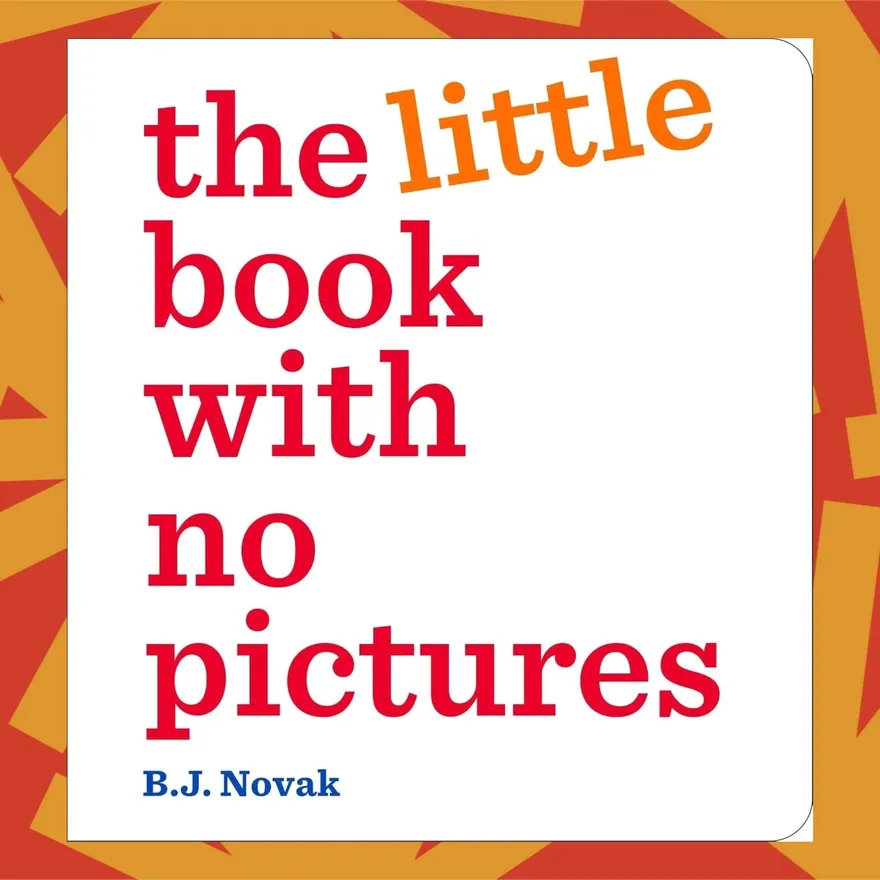
B.J. Novak on 'The Little Book with No Pictures' and making kids laugh
In this episode of NPR's Book of the Day, Michel Martin speaks with B.J. Novak about his children's book that eliminates illustrations entirely, forcing adults to perform silly words and sounds while children direct the experience. Novak explains how removing pictures shifts focus to language itself, transforming words into visual art objects and making reading an interactive performance that gives children a sense of control and agency.
The conversation explores Novak's creative process, including how he tests material with children and adapts his concept for different age groups. Martin and Novak discuss the role of silliness and rules in creating memorable reading experiences, the educational value of connecting language with sensory experience, and the importance of unmediated, screen-free moments between caregivers and children. Novak reflects on how shared reading builds connection and celebrates the fleeting wonder of early childhood.

This is a preview of the Shortform summary of the Nov 3, 2026 episode of the NPR's Book of the Day
Sign up for Shortform to access the whole episode summary along with additional materials like counterarguments and context.
1-Page Summary
Innovation: "Book Without Pictures" Puts Reader In Control
Redefining Children's Literature By Removing Illustrations
BJ Novak's "The Book With No Pictures" radically reimagines children's literature by eliminating visual illustrations entirely. While Michel Martin notes critics described it as "conceptually radical," Novak observes that children experience it simply as fun and rebellion—the real thrill comes from watching adults say ridiculous words. The absence of pictures shifts entertainment to the vocal performance of parents and caregivers, who must read aloud exactly what appears on the page, no matter how silly.
Reader Directs Experience, Granting Children Agency
Novak emphasizes the fundamental rule: "Everything the words say, the person reading the book has to say. No matter what." This puts children in control, allowing them to watch adults perform exaggerated storytelling with prompts like "BLORK!" This sense of agency is a major source of the book's appeal.
Words as Artistic and Entertainment Focus
Novak describes how "the words are meant to look like fascinating art objects," citing examples like "boof" or "bonk." These non-standard words in bold typography prompt curiosity and excitement. The book transforms reading into an interactive experience, demonstrating that words alone—when delivered with creativity—can captivate children's imagination.
Creative Process: Inspiration and Board Book Development
Testing With Children to Observe What Entertains
Novak crafts his book by focusing on what entertains toddlers and empowers adults to be playful. He assembles a prototype and reads it directly to children to test its effect, observing their reactions before approaching publishers.
Resisting Quick Sequels and Recognizing Market Gap
Novak resists producing quick sequels, noticing that children generally preferred the original book and its unique charm. However, when people asked if his book suited babies, he realized the original was designed for toddlers and preschoolers, leaving very young children out. This inspired him to adapt the concept for younger audiences.
Board Book Version Tailored For Young Children
The board book version retains the playful spirit while adjusting format and complexity. Novak made it intentionally compact and suitable for a child's lap during intimate reading moments, describing it as cozier and sweeter with fewer words per page, optimizing it for brief, tactile experiences that captivate very little kids.
Engaging Through Silliness, Rules, and Playfulness
Novak and Martin explore how books like "The Book With No Pictures" use silliness and rules to create memorable experiences for both kids and adults.
Tension in Entertainment: Rules vs. Silliness
Novak introduces the core concept: "Here is how books work. Everything the words say, the person reading the book has to say. No matter what." This structure sets up a playful contract where adults must follow absurd written words. Novak notes that "the rules are to be very silly and the rules are sort of a kid's dream book of rules." This interplay creates a space where kids feel reassured by predictability but delight in seeing adults disrupt expectations.
Adult Silliness Fosters Connection
When Martin asks whether the enjoyment comes from delighting kids or giving adults permission to be silly, Novak responds, "Oh, I think there's a lot of both." The books enable adults to embrace silliness, making reading fun rather than a chore. This shared activity becomes an interactive game, building humor and secure connection through playfulness.
Age-Appropriate Engagement
Children's engagement with books evolves as they grow. Toddlers respond strongly to repetitive sounds and rhythms, while older children move toward appreciating cleverness and humor. This developmental trajectory underscores how book preferences grow more sophisticated while never outgrowing shared silly moments.
Books' Educational Value: Connecting Language and Art
Books play a vital role in early learning by helping children associate language with visual art and sensory experience.
Books Connect Symbols to Sounds
Removing traditional illustrations encourages children to focus on word-shapes and sounds, paying attention to letter contours and how they correspond to sounds. This pairing of printed symbols with spoken sounds establishes the primary foundation of literacy.
Language as Artistic and Sensory Experience
Novak describes how presenting words as fascinating art objects makes language visually stimulating. Words in bold, creative typography become more than letter sequences—they become visually intriguing objects. Playful word sounds generate delight and curiosity, transforming reading into a sensory experience that fosters positive language associations.
Predictable Patterns Build Confidence
Books with repetitive structures allow children to anticipate what comes next, building confidence and encouraging active participation. Children eagerly collaborate by making sounds with the reader at key moments, turning language into a shared artistic event that reinforces learning and deepens relationships.
Childhood Sweetness: Preserving Moments in Device-Heavy Modernity
Novak highlights the irreplaceable value of sharing direct, unmediated experiences with children through books in an age dominated by screens.
Books Offer Direct Experiences Free From Screens
Books provide a haven from fragmented digital attention. When reading with a child, both caregiver and child engage in focused, interactive moments without notifications or algorithm-curated content, fostering genuine connection and presence.
Celebrating Childhood Wonder
Novak idealizes the developmental phase when children see the world with openness and unskeptical curiosity. He describes reading as helping children understand that "a word on a page makes a certain sound, that sometimes that sound is serious, sometimes that word is silly," preserving the fleeting sweetness of childhood discovery.
Shaping Connection Through Playful Moments
Novak's books are rooted in his desire to celebrate the special connection he shares with his niece and nephew. Watching them "form the world" as he reads aloud fills him with awe. Books foster shared experiences and meaningful memories, helping shape children's worlds, language, and sense of connectedness to others.
1-Page Summary
Additional Materials
Counterarguments
- Removing illustrations may limit accessibility for children who are visual learners or those with limited language skills, as pictures often aid comprehension and engagement.
- The book's reliance on adult vocal performance could disadvantage children whose caregivers are less comfortable with expressive reading or have language barriers.
- The absence of visual elements may reduce appeal for children who are not yet developmentally ready to focus solely on text and sound.
- The novelty of adults saying silly words may wear off with repeated readings, potentially reducing the book's long-term engagement compared to illustrated books with more narrative depth.
- The book's humor and interactivity depend heavily on adult participation, which may not be consistent across all households or reading environments.
- By focusing on wordplay and silliness, the book may offer less opportunity for visual storytelling, emotional nuance, or cultural representation that illustrations can provide.
- The approach may not suit children with certain learning differences, such as those on the autism spectrum, who might benefit from visual cues and structure.
- The book's format may not translate well to group reading settings, such as classrooms, where managing collective engagement without visual aids can be challenging.
- Some parents or educators may prefer traditional picture books for their proven role in developing visual literacy and storytelling skills.
- The emphasis on rules and silliness may not appeal to all children, particularly those who prefer narrative-driven or visually rich stories.
Actionables
- you can create your own silly-word reading ritual by writing a short, nonsense-filled script or poem on a blank page and reading it aloud with exaggerated voices, letting your child direct when to speed up, slow down, or repeat favorite parts—this gives your child agency and makes reading interactive even without a published book.
- a practical way to turn words into playful art is to handwrite or print out simple, bold words in different colors and shapes on index cards, then let your child arrange them into funny sentences or patterns on the floor, encouraging tactile exploration and curiosity about language.
- you can build a screen-free bedtime tradition by setting aside five minutes each night to invent a collaborative story using only spoken words and sound effects, alternating lines with your child and celebrating every silly or surprising twist, which fosters connection and keeps reading moments fresh and engaging.
Get access to the context and additional materials
Innovation: "Book Without Pictures" Puts Reader In Control, Emphasizing Words and Sounds
Book Redefines Children's Literature By Removing Illustrations
BJ Novak's "The Book With No Pictures" radically reimagines children’s literature by stripping away what’s long been considered the genre’s essential element: visual illustrations. As Michel Martin points out, the New York Times described the book as "conceptually radical" for removing visuals entirely. Yet, Novak observes that while critics see it as formal innovation, children encounter it not as a cerebral experiment but as sheer fun and rebellion. The real thrill for young readers is not in theoretical complexity, but in witnessing adults say ridiculous words, making the reading experience unexpectedly entertaining. The absence of pictures shifts the entertainment value to the vocal and often physical performance of parents and caregivers, who must read aloud exactly what appears on the page—no matter how silly.
Reader Directs Experience, Granting Children Agency and Satisfaction
Novak emphasizes a fundamental rule: "Everything the words say, the person reading the book has to say. No matter what." This conceit puts children in control, allowing them to watch adults perform exaggerated and comical storytelling, responding directly to prompts like "BLORK!" The clear rules of the experience invite joyful norm-breaking and encourage silliness, giving children the power to influence the interaction. This sense of agency and satisfaction is a major source of the book's appeal; as Novak states, to a child it's simply fun to make "mom or dad say these words that are ridiculous."
Words as the Artistic and Entertainment Focus, Transforming Symbols Into Memorable Experiences
Non-standard Words as Art Objects Captivate Children's Curiosity
Novak describes his playful intentions: "The words are meant to look like fascinating art objects," citing examples like "boof" or "bonk." These non-standard words are present ...
Here’s what you’ll find in our full summary
Innovation: "Book Without Pictures" Puts Reader In Control, Emphasizing Words and Sounds
Additional Materials
Counterarguments
- Removing illustrations may limit accessibility for pre-literate children or those who rely on visual cues to understand stories.
- Visual storytelling is a critical component of early childhood development, helping children interpret emotions, actions, and context; its absence could reduce opportunities for visual literacy.
- Not all children may find the lack of pictures engaging, especially those who are visual learners or have limited attention spans.
- The book’s humor and appeal depend heavily on the adult reader’s willingness and ability to perform; less expressive readers may not deliver the intended experience.
- The novelty of making adults say silly words may wear off with repeated readings, potentially reducing the book’s long-term appeal compared to richly illustrated books.
- Some parents or educators may prefer books that combine both visual and ...
Actionables
- you can create your own silly-word reading game by writing a list of made-up, playful words on slips of paper and taking turns with a child to read them aloud in the silliest voices possible, letting the child decide the reading order and performance style to boost their sense of control and fun
- This turns reading into a shared performance, encourages playful language exploration, and gives children agency over the experience. For example, let the child instruct you to read "zibblewump" in a whisper or "flonkadoo" while hopping on one foot.
- a practical way to make storytime more interactive is to use blank sheets of paper and bold markers to invent your own "typography art" words together, then arrange them in a sequence and perform a dramatic reading, focusing on how the words look and sound rather than telling a story
- This lets children experiment with how words can be visually exciting and aurally entertaining, even without illustrations. For instance, write "SPLOOSH" in giant letters and "plink" in tiny ones, then act out each word's sound and energy.
- you can invite children to invent rules for readi ...
Get access to the context and additional materials
Creative Process: Novak's Inspiration and Reason For Developing a Children's Board Book Version
Novak Tested the Book With Children to Observe What Entertained Toddlers and Empowered Adults to Be Playful
Children's Book Inspiration: Kids' Laughter and Adults' Silliness
BJ Novak crafts his children’s book by focusing on what entertains toddlers and empowers adults to be playful. He assembles a prototype version using printing, glue-sticks, and paper-clips before even approaching a publisher. Novak reads the prototype directly to children to test the book’s effect, observing their reactions to make sure it inspires laughter and playfulness in both the kids and the adults reading aloud. When the test works—when it successfully entertains its audience—he decides to take it to publishers, confident that he has proven the concept in real life.
Novak Resisted Rushing a Sequel, Fearing It Would Dilute the Original Book's Magic and Children's "Read It Again Forever" Sentiment
Novak resists the temptation to quickly produce sequels to his successful book. He notices that although he wrote some successful follow-ups, children generally preferred the original book, loving its unique charm and often demanding to "read it again forever." This recognition of what genuinely delights children informs Novak’s creative choices and ensures he doesn’t dilute the special nature of the first book.
He also recognizes a market gap when people ask if his book is suitable for babies. The original book is intended for toddlers and preschoolers, not babies, and Novak realizes that little kids, especially newborns and very young toddlers, are left out because his book doesn't work well for that age group. This observation inspires him to adapt his concept specifically for younger children.
Board Book Version Tailored For Young ...
Here’s what you’ll find in our full summary
Creative Process: Novak's Inspiration and Reason For Developing a Children's Board Book Version
Additional Materials
Counterarguments
- While Novak’s approach of testing the book with children is commendable, relying solely on immediate laughter and playfulness may overlook other important aspects of early childhood literature, such as fostering empathy, language development, or introducing diverse perspectives.
- The decision to avoid sequels to preserve the original book’s charm could be seen as limiting, as sequels can offer opportunities for further creative exploration and continued engagement with readers.
- Focusing on what entertains toddlers and empowers adults might inadvertently prioritize adult enjoyment over the developmental needs or interests of children.
- Adapting the book for younger children by simplifying content and format may result in a product that is less stimulating or engaging for some babies, as not all infants respond to the sa ...
Actionables
- you can create a playful reading routine by letting your child choose a favorite silly word or sound to repeat together during storytime, making the experience interactive and memorable for both of you
- Let your child pick a word or sound before you start reading, and whenever it appears (or at a chosen moment), pause and say it together in funny voices. This encourages laughter, participation, and strengthens your bond.
- a practical way to tailor books for very young children is to use sticky notes or removable labels to simplify pages in existing picture books, covering up complex text or adding your own simple, silly phrases
- Choose a book your child enjoys but finds too complex, and use sticky notes to replace longer sentences with short, playful lines or sounds. This makes the book more accessible and engaging for toddlers or babies.
- you can foster c ...
Get access to the context and additional materials
Engaging Children and Adults Through Silliness, Rules, and Playfulness
BJ Novak and Michel Martin explore how children’s books, specifically those like Novak’s "The Book With No Pictures," use silliness and rules to create playful, memorable experiences for both kids and adults. The dynamics of reading aloud open opportunities for shared humor, learning, and attachment.
Tension in Entertainment: Rules vs. Silliness
BJ Novak introduces the core concept: "Here is how books work. Everything the words say, the person reading the book has to say. No matter what. That’s the deal. That’s the rule." This structure sets up a playful contract in which the adult reader must follow the written words, even if they are absurd or nonsensical, like "BLORK!" Parents and caregivers must read exactly what’s on the page, but the content and tone encourage them to make silly sounds and exaggerated performances. Novak notes that "the rules are to be very silly and the rules are sort of a kid’s dream book of rules." This interplay—following structured rules that lead to chaos and laughter—creates a space where kids feel reassured by the predictability but delight in seeing adults disrupt expectations. As adults stick to the "rules," children are entertained both by the structure and by how that structure gives rise to unexpected hilarity.
Adult Silliness Fosters Children's Humor and Secure Attachment
Michel Martin raises the question of whether the enjoyment comes more from delighting kids or giving adults permission to be silly. Novak responds, "Oh, I think there’s a lot of both." The books enable adults to embrace silliness, making reading time fun rather than a chore. This shared activity becomes an interactive game, turning both child and adult into full participants in the entertainment. When adults are silly, children see that it’s safe and fun to break out of seriousness, building both humor and a sense of secure connection th ...
Here’s what you’ll find in our full summary
Engaging Children and Adults Through Silliness, Rules, and Playfulness
Additional Materials
Counterarguments
- Some educators and parents may argue that an overemphasis on silliness and absurdity in children’s books could detract from opportunities to introduce more complex narratives, vocabulary, or moral lessons.
- The strict rule that adults must read every word as written may limit opportunities for spontaneous discussion, personalization, or adaptation to a child’s specific needs or sensitivities.
- Not all children respond positively to chaotic or silly humor; some may prefer stories with clear narratives, relatable characters, or calming content, especially those who are neurodivergent or easily overstimulated.
- The focus on adult participation and performance may be challenging for caregivers who are uncomfortable with being silly, have li ...
Actionables
- you can create a silly reading rule jar to add playful unpredictability to storytime by writing simple, funny rules on slips of paper (like read in a robot voice, swap every "the" with "banana," or clap after each sentence), drawing one before reading, and following it strictly throughout the book, making each session a unique blend of structure and chaos.
- a practical way to nurture humor and attachment is to invent a recurring nonsense word or phrase together with your child that must be inserted at specific points during any book you read, turning the act of following this shared rule into an inside joke that evolves as your child grows.
- you can encourage childre ...
Get access to the context and additional materials
Books' Educational Value: Connecting Language and Art for Meaningful Early Learning
Books play a vital role in early learning by helping children associate language with both visual art and sensory experience, deepening their understanding and enjoyment of literacy.
Books Connect Symbols to Sounds
Removing Illustrations Helps Children Focus On Word-Shapes and Sounds
When children's books remove traditional illustrations, children pay more attention to the shapes and styles of words themselves. This approach encourages young readers to tune into the visual form of language—the contours of letters, the uniqueness of word-shapes, and how they correspond to specific sounds.
Pairing Of Symbols With Sounds Creates Literacy Foundation
This pairing of printed symbols with their corresponding spoken sounds establishes the primary foundation of literacy. Through repeated interaction, children develop the ability to decode words by recognizing patterns in both the letter formations and their associated sounds.
Language as Artistic and Sensory Experience
Words Become Visually Interesting Objects, Encouraging Children to Notice Typography, Spacing, and Shape as Aesthetic Elements
BJ Novak describes how presenting words as fascinating art objects makes language visually stimulating for children. Words set in bold, creative typography or dramatically spaced invite children to notice and appreciate their visual presentation. A word like "boof" in large print becomes more than a sequence of letters—it becomes a visually intriguing object.
Playful Word Sounds Generate Sensory Pleasure and Curiosity, Promoting a Positive Language Association
Playful and unusual word sounds generate delight and curiosity in young readers, transforming reading into a sensory experience. This enjoyment fosters a positive association with language and encourages further exploration and learning.
Predictable Patterns an ...
Here’s what you’ll find in our full summary
Books' Educational Value: Connecting Language and Art for Meaningful Early Learning
Additional Materials
Counterarguments
- Removing illustrations from children's books may disadvantage visual learners or children who rely on images to aid comprehension and engagement.
- Illustrations can provide important context clues, especially for early or struggling readers, supporting understanding of new vocabulary and story elements.
- Focusing primarily on word shapes and typography might distract from developing broader comprehension skills, such as narrative understanding and empathy.
- The absence of illustrations could reduce enjoyment for some children, potentially making reading less appealing and limiting motivation.
- Predictable and repetitive structures, while confidence-building, may limit exposure to more complex language and narrative forms, potentially slowing language development over time.
- Not all children respond positively to playful or unusual word sounds; some may find them confusing or overwhelming, espe ...
Actionables
- You can turn everyday objects into word art by labeling them with handwritten words in playful shapes and colors, helping children connect language to their environment and making word recognition a multisensory experience; for example, write "door" in tall, narrow letters on the door or "lamp" in a spiral around the lamp base.
- A practical way to encourage focus on word forms is to create a simple word scavenger hunt, where children search for specific letter patterns or word shapes around the house or in books, then draw or trace them on paper, reinforcing visual recognition and pattern anticipation.
- Yo ...
Get access to the context and additional materials
Childhood Sweetness: Preserving Moments Without Cynicism in Device-Heavy Modernity
In an age dominated by screens and algorithms, BJ Novak highlights the irreplaceable value of sharing direct, unmediated experiences with children, especially through books.
Books Offer Direct Experiences For Children With Language and Connection, Free From Screens and Algorithms
Books provide a haven from the fragmented attention encouraged by modern digital life. When reading a book with a child, both the caregiver and the child engage in focused, interactive moments without the interference of notifications or algorithm-curated content. This experience enables children to learn through real-time interaction and observation, instead of consuming content optimized for clicks or engagement. Books become spaces where children and caregivers can concentrate on each other, fostering genuine connection and presence.
Books Celebrate Childhood Wonder and Innocence
Novak idealizes the unique developmental phase when children see the world with openness, novelty, and genuine, unskeptical curiosity. He describes reading as helping children understand that "a word on a page makes a certain sound, that sometimes that sound is serious, sometimes that word is silly." Books offer an opportunity to capture and celebrate the magic found in the symbols-to-sounds-to-meaning process, preserving the fleeting sweetness of childhood discovery and learning.
Sharing Playful Moments With Young Children Shapes Their World, ...
Here’s what you’ll find in our full summary
Childhood Sweetness: Preserving Moments Without Cynicism in Device-Heavy Modernity
Additional Materials
Counterarguments
- While books offer valuable experiences, digital media can also foster learning, creativity, and connection when used thoughtfully and in moderation.
- Interactive digital content, such as educational apps or e-books, can engage children in ways that traditional books may not, catering to diverse learning styles and needs.
- For some families, access to physical books may be limited due to economic or logistical reasons, making digital resources a more practical or inclusive option.
- The idealization of childhood innocence and "sweetness" may overlook the resilience and complexity of children, who can benefit from exposure to a range of experiences, including those mediated by technology.
- Shared screen time, such as co-viewing educational programs or playing interactive games together, can also create meaningful moments of connection between caregivers and childre ...
Actionables
- you can create a weekly “book adventure night” where you and your child pick a random object or word from your surroundings, then together find or invent a story around it using physical books, encouraging curiosity and language play beyond the page
- this turns reading into an interactive, imaginative experience that celebrates discovery and helps children connect words, sounds, and meanings in a playful, memorable way
- a practical way to foster genuine connection is to keep a shared “reading memory journal” where after each reading session, you and your child draw or write a favorite moment or new word learned, building a tangible record of your unique experiences together
- this helps preserve the sweetness of childhood discovery and creates a keepsake that reinforces the value of your shared ...
Get access to the context and additional materials

 1-Page Summary
- Innovation: "Book Without Pictures" Puts Reader In Control, Emphasizing Words and Sounds
- Creative Process: Novak's Inspiration and Reason For Developing a Children's Board Book Version
- Engaging Children and Adults Through Silliness, Rules, and Playfulness
- Books' Educational Value: Connecting Language and Art for Meaningful Early Learning
- Childhood Sweetness: Preserving Moments Without Cynicism in Device-Heavy Modernity
Create Summaries for anything on the web
Download the Shortform Chrome extension for your browser
