

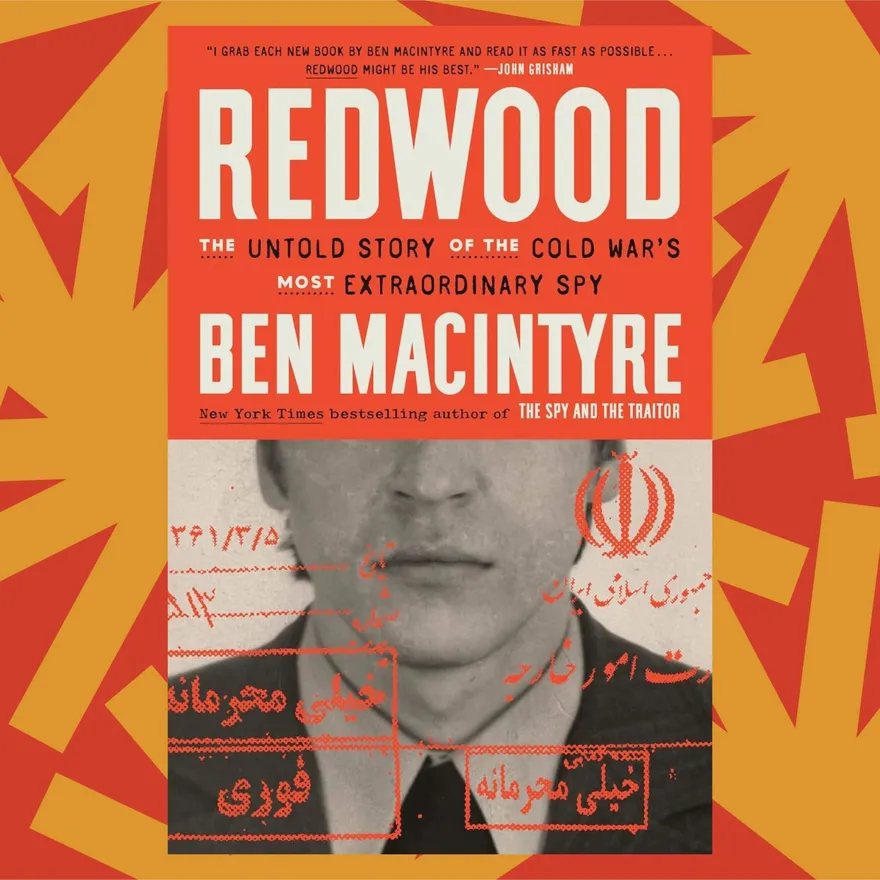
'Redwood' is a true tale of a KGB agent who offered to spy for Britain
In this episode of NPR's Book of the Day, Scott Simon and Ben McIntyre discuss the true story of Vladimir Kuzichkin, a senior KGB officer who defected to Britain in 1986. Kuzichkin's motivation was personal rather than ideological—he sought Western medical treatment for a condition he believed was threatening his marriage. His defection exposed Soviet plans to install a communist government in post-Shah Iran, a move that would have shifted the balance of the Cold War.
The conversation explores how intelligence sharing between MI6 and the CIA led to mass arrests and executions of Iranian communists, thwarting the Soviet plot but creating moral complications that all parties kept secret for decades. McIntyre traces how this episode shaped modern Iran, explaining how the Revolutionary Guards who suppressed the 1981 communist threat became the regime's current leadership and established patterns of authoritarian control that continue today.

This is a preview of the Shortform summary of the Sep 29, 2026 episode of the NPR's Book of the Day
Sign up for Shortform to access the whole episode summary along with additional materials like counterarguments and context.
1-Page Summary
A KGB Spy's Unlikely Defection
Vladimir Kuzichkin was a senior KGB intelligence officer managing Soviet operations in Iran when he walked into the British Embassy in Tehran to defect. He controlled the movement of guns, money, and intelligence to Iran's Communist Party, which the Soviets planned to install in power—with the backing of the Red Army. But Kuzichkin's motivation wasn't ideological. He suffered from erectile dysfunction and believed only Western medicine could cure him and save his marriage. After escaping to Britain in 1986, MI6 helped him establish a new identity as an acupuncturist. Among his clients was actor Alec Guinness, who was filming a spy thriller while unknowingly receiving treatment from a real former KGB officer.
Soviet Ambitions in Post-Shah Iran
Scott Simon and Ben McIntyre discuss how the Cold War rivalry over Iran continued a centuries-old imperial competition. During the "Great Game," Victorian Britain and Tsarist Russia had vied for influence in Iran, a dynamic that evolved into the Cold War standoff between the capitalist West and communist Soviet Union. The Shah had served as a bulwark against Soviet expansion, but his 1979 overthrow created a vulnerability. McIntyre explains that the Soviets began planning to install the Iranian Communist Party to replace Ayatollah Khomeini's Islamist government, similar to their intervention in Afghanistan. If successful, Soviet control of Iranian oil fields and the Strait of Hormuz would have been a decisive Cold War victory. McIntyre asserts that the United States had contingency plans that included nuclear options to prevent such a scenario.
Intelligence Sharing and Mass Executions
After Kuzichkin's defection, MI6 briefed the CIA on the Soviet-backed coup plot. Under CIA Director Bill Casey, the agencies took the extraordinary step of informing Iran's Islamic Revolutionary Guard Corps about the communist conspiracy, despite hostile post-hostage crisis relations. The disclosure had devastating consequences: Iranian authorities arrested approximately 8,000 Tudeh Party members within two months, executing roughly 4,000 and imprisoning the rest. Every party involved had reasons to maintain secrecy for decades due to the moral complexity and human toll. MI6 later used this case in its ethics curriculum to teach recruits about the difficult choices in intelligence work.
Legacy of 1981 in Modern Iran
McIntyre explains that the young Revolutionary Guards who suppressed the communists in 1981 became the regime's senior leaders decades later. The first Israeli airstrike in February 2026 eliminated two key figures—Supreme Leader Ali Khamenei and defense minister Ali Shamkhani—both deeply involved in the 1981 crackdown. McIntyre emphasizes that the regime's determination to suppress dissent traces directly to this period, when the Ayatollah consolidated power by eliminating communist opposition. This crackdown established authoritarian patterns that continue to define Iranian governance and shapes the regime's approach to foreign powers and regional relations, offering crucial context for understanding contemporary Middle Eastern geopolitics.
1-Page Summary
Additional Materials
Counterarguments
- The narrative emphasizes Kuzichkin's personal health issues as his primary motivation for defection, but it is possible that other factors, such as fear for personal safety or disillusionment with the Soviet system, also played a role and are underrepresented in the account.
- The text presents the Soviet plan to install the Iranian Communist Party as a near certainty, but historical evidence suggests that Soviet influence in post-revolutionary Iran was limited and the success of such a plan was far from guaranteed.
- The assertion that Soviet control of Iranian oil fields and the Strait of Hormuz would have been a decisive Cold War victory may overstate the likelihood and feasibility of such control, given the complex internal dynamics of Iran and regional resistance.
- The account attributes the mass executions of Tudeh Party members primarily to Western intelligence disclosures, but the Iranian regime had already demonstrated a willingness to suppress opposition groups independently.
- The text links the 1981 crackdown directly to the persistence of authoritarian governance in Iran, but authoritarian tendencies in Iranian politics predate 1981 and have multiple historical and cultural roots.
- The claim that understanding the 1981 events is "crucial" for comprehending contemporary Middle Eastern geopolitics may be overstated, as many other factors and events have shaped the region's current dynamics.
Actionables
- you can practice evaluating complex moral choices by writing out a recent decision you made, then listing all the possible unintended consequences for each option, including who might be affected and how, to build awareness of the ripple effects of your actions.
- a practical way to understand how power vacuums and rapid regime changes affect everyday life is to track news stories about sudden leadership changes in any country, then jot down how those shifts impact ordinary citizens, local businesses, and international relations over the following weeks.
- you can strengthen your ability to spot long-term patterns in current events by creating a simple timeline that connects major historical events to present-day headlines, noting how past decisions or crises continue to shape policies, leadership styles, or conflicts today.
Get access to the context and additional materials
Kgb Spy's Motivation For Defection to Britain
Soviet Intelligence Officer Vladimir Kuzichkin Accessed Classified Plans For Iran
Vladimir Kuzichkin was a major in the KGB and a senior intelligence officer deeply involved in Soviet operations in Iran. He walked into the British Embassy in Tehran and offered to spy for Britain. Kuzichkin was the linchpin in a Soviet conspiracy to help the Iranian Communist Party—known as the party of the masses—take over power from the Ayatollah and his Islamist group. He directly controlled the movement of guns, money, and intelligence to the Communist group, which positioned him to know the most sensitive plans. The Soviets intended not only for the Iranian Communist Party to seize power but also to invite the Red Army into Iran to support the new regime after the takeover.
Kuzichkin Betrayed the Soviet Union Over Health Concerns, Not Ideology
Kuzichkin's decision to betray the Soviet Union was not born of ideological disagreement but of a desperate personal need. He suffered from erectile dysfunction and was convinced that only Western medicine could cure it. His marital happiness was in jeopardy—he adored his wife and feared losing her due to his condition. Kuzichkin's belief in the superiority of Western medicine and science mirrored a common faith among Soviet citizens, who saw the West as possessing extraordinary medical capabilities. His desire to save his marriage and address his health led him to take the extraordinary step of approaching Britain.
Kuzichkin's Escape to Britain: New Identity and Profession
With British Intelligence Support, He Retra ...
Here’s what you’ll find in our full summary
Kgb Spy's Motivation For Defection to Britain
Additional Materials
Counterarguments
- The narrative emphasizes Kuzichkin's personal health concerns as the sole motivation for his defection, but it is possible that other factors, such as fear for personal safety, dissatisfaction with the Soviet system, or professional disillusionment, also played a role, even if not explicitly stated in the text.
- The portrayal of Western medicine as universally superior to Soviet medicine reflects a common perception but may oversimplify the complexities and advancements present in Soviet medical science during that era.
- The text presents Kuzichkin's actions as driven entirely by personal motives, potentially downplaying the broader context of Cold War ...
Actionables
- you can explore how personal motivations influence major life decisions by keeping a week-long journal where you note daily choices and the underlying reasons, then reflect on whether practical needs or beliefs drive your actions most often
- For example, track decisions like changing a routine, making a purchase, or seeking help, and honestly record if comfort, health, relationships, or values were the main motivators.
- a practical way to examine perceptions of expertise is to compare your trust in local versus foreign products or services by choosing one area (like healthcare, technology, or food) and intentionally trying both options, then noting your expectations and satisfaction
- For instance, try a local remedy and an imported supplement for a minor health issue, and reflect on which you expected to work better and why.
- you can tes ...
Get access to the context and additional materials
Soviet Threat and Potential Control Over Iran
At the height of the Cold War, just two years after Ayatollah Khomeini had ousted the Western-supported Shah of Iran, the Soviet Union saw a critical opportunity to expand its influence in the region. The political vacuum left by the Shah's departure made Iran vulnerable to outside manipulation, and Moscow looked to exploit this instability for its strategic gain.
Western-Soviet Rivalry Over Iran as Continued Historical Imperial Competition
Britain and Russia Vied For Influence in Iran During the Great Game
Scott Simon and Ben McIntyre discuss the long history of imperial rivalry in Iran, tracing it back to the "Great Game" when Victorian Britain and Tsarist Russia had competed for power and influence in Iran for nearly two centuries. This struggle was deeply rooted in the dynamics of empire, with both nations viewing Iran as a key strategic prize.
Cold War: Capitalist West vs. Communist Soviet Union, US and Britain Oppose Soviet Expansion
By the Cold War era, the earlier British-Russian competition had evolved into a standoff between the capitalist West, led by the United States and Britain, and the communist Soviet Union. The Shah of Iran served as a central pillar of Western interests in the region, acting as a bulwark against the spread of communism. Under the Shah, America and Britain held dominant roles in Iran, successfully limiting Soviet influence.
Iran's Shah's Fall Created Vulnerability Moscow Exploited
Shah's Overthrow Removed Iran's Anti-Communist Barrier To Soviet Influence
With the fall of the Shah, this anti-communist barrier was removed, leaving Iran exposed to new political possibilities. The 1979 revolution, which brought Ayatollah Khomeini and an Islamist government to power, created an opening for potential Soviet intervention. The loss of the Shah as an ally disrupted the established balance and invited Soviet ambitions.
Soviets Aimed to Install a Moscow-Aligned Communist Government In a Vital Region
Ben McIntyre explains that the Soviets began planning to set up the Iranian Communist Party with the goal of taking over from the Ayatollah and his Islamist group. This plan included inviting the Red Army to support a communist takeover in Iran, following a strategy similar to the Soviet intervention in Afghanistan just beforehand. The Soviets saw Iran as the next possible domino to fall in their favor, seeking decisive regional influence.
Soviet Control of Iran: A Decisive Cold War Victory With Far-reaching Cons ...
Here’s what you’ll find in our full summary
Soviet Threat and Potential Control Over Iran
Additional Materials
Counterarguments
- While the Soviet Union had interests in expanding its influence, there is limited concrete evidence that Moscow had a realistic or imminent plan to install a communist government in Iran after the 1979 revolution, especially given the deep ideological differences between the Soviet Union and the new Islamic Republic.
- The Islamic Republic under Ayatollah Khomeini was strongly anti-communist and repressed leftist groups, including the Iranian Communist Party (Tudeh), making a Soviet-aligned takeover highly unlikely.
- The Soviet intervention in Afghanistan was met with fierce resistance and became a costly quagmire, which likely made Soviet leaders cautious about direct intervention in another large, unstable, and ideologically hostile neighbor like Iran.
- The narrative that Soviet control of Iranian oil and the Strait of Hormuz would have automatically resulted in a decisive Cold War victory may overstate the Soviet Union’s ability to exploit such resources, given the logistical, polit ...
Actionables
- you can map out the power dynamics in your own workplace or community by identifying who holds influence, who competes for it, and how shifts in leadership or alliances create opportunities or risks, just as global powers vied for control over Iran; for example, notice how a manager’s departure changes team alliances or how new hires shift group priorities.
- a practical way to understand the impact of strategic resources is to track how access to key assets (like information, contacts, or tools) affects your ability to negotiate or influence outcomes in your daily life, mirroring how control over oil and trade routes shaped international leverage; for instance, observe how having exclusive data at work or being the only one with a needed skill changes your bargaining power.
- you can experiment with contingency plann ...



Get access to the context and additional materials
Intelligence and Morality: Informing Iran On Plots and Casualties
British Intel's Sharing of Kuzichkin's Revelations Led To Controversial US Decision on Soviet Threat
After Kuzichkin defected, MI6 decided to brief the CIA on the revelations, particularly the risk of a Soviet-backed coup in Iran. Under CIA Director Bill Casey, the Americans authorized a bold and risky approach: to thwart possible Soviet intervention, they would inform the Iranian revolutionary leadership about the plans of the communist Tudeh Party. Despite the post-hostage crisis era, when the US and Iran had no diplomatic relations and relations were intensely hostile, a secret meeting was arranged. In this meeting, MI6 and the CIA handed over a comprehensive intelligence trove concerning the possible coup to the Islamic Revolutionary Guard Corps. This action was partly motivated by the hope of averting a major Cold War catastrophe and perhaps opening a fragile channel of conversation with Iran.
Soviet-Backed Communist Plans' Disclosure Brought Severe Consequences for Iranian Communist Party
The disclosure of the communist conspiracy had devastating consequences for the Iranian Communist Party. Within two months, Iranian authorities arrested approximately 8,000 Tudeh Party members. Around half of those detained—roughly 4,000 people—were executed, the rest imprisoned, following the intelligence provided by the West to Iran's Islamic leadership. The exact death toll remains unknown, but it was enormous, and the episode marked ...
Here’s what you’ll find in our full summary
Intelligence and Morality: Informing Iran On Plots and Casualties
Additional Materials
Counterarguments
- The decision by MI6 and the CIA to share intelligence with the Iranian regime directly enabled a mass crackdown and executions, raising questions about whether the prevention of a potential Soviet-backed coup justified the resulting human rights abuses.
- The intelligence agencies' actions prioritized geopolitical strategy over the safety and rights of thousands of individuals, suggesting a utilitarian approach that may be ethically questionable.
- The hope of opening a communication channel with Iran was not realized in any meaningful or lasting way, indicating that the secondary diplomatic objective failed.
- The secrecy maintained by all parties for decades could be seen as an attempt to avoid accounta ...
Actionables
- you can practice making tough decisions by writing out a recent dilemma you faced, listing all possible consequences for each choice (including unintended ones), and reflecting on which values or priorities influenced your final decision, to better understand the weight and ripple effects of your actions.
- a practical way to build your own ethical awareness is to keep a private journal where you record situations where you had to choose between loyalty to a group and your personal sense of right and wrong, then revisit these entries monthly to notice patterns and consider how you might handle similar situations differently in the future.
- you can s ...
Get access to the context and additional materials
1981's Impact: Shaping the Iranian Regime Today
The events of 1981 remain fundamental in shaping the structure, leadership, and tactics of the Iranian regime. The suppression of Communist groups by the Revolutionary Guards had profound consequences that extend to the present, deeply influencing Iran’s political climate and approach to dissent.
Revolutionary Guards From 1981 Communist Crackdown Became Iran's Future Leaders
Octogenarians From Communist Suppression Shaped Iranian Regime By 2026
Ben McIntyre explains that the young Revolutionary Guards who forcefully clamped down on the Communists in 1981 ascended to become the senior leaders of the Iranian regime decades later. By 2026, the same individuals who were fervent revolutionaries in 1981 had become the regime’s octogenarian stalwarts, shaping policies and maintaining control at the highest levels of government.
Strikes on Iran Eliminate Key Figures: Khamenei, Shamkhani, Pivotal in 1981 Communist Suppression
McIntyre notes that the first Israeli airstrike in February took out two critical figures: Ali Khamenei, the Supreme Leader, and Ali Shamkhani, his defense minister. Both men were deeply involved in suppressing the communists in 1981 and subsequently played pivotal roles in the regime, highlighting the continuity of leadership from that formative period through contemporary Iranian governance.
Iranian Regime's Cold War-era Tactics For Suppressing Dissent
Ayatollah's Pursuit of Control By Eliminating Communist Opposition Shaped Iranian Governance Patterns
McIntyre emphasizes that the regime’s absolute determination to suppress internal dissent traces directly to 1981, when the Ayatollah sought to consolidate power by eliminating the communist opposition. This period set long-lasting precedents for how Iranian authorities respond to challenges, establishing authoritarian patterns that continue to define the regime’s approach to control.
Regime's Internal Crackdown Traced To 1981 Soviet-Backed Communist Threat
The suppression of the Soviet-backed communists in 1981 solidified a regime mindset that prioritizes neutralizing opposition. The crackdown during the Cold War period became a blueprint for internal security policies, shaping how the Irania ...
Here’s what you’ll find in our full summary
1981's Impact: Shaping the Iranian Regime Today
Additional Materials
Counterarguments
- While the 1981 suppression of Communist groups was significant, other factors—such as the Iran-Iraq War, economic pressures, and evolving religious ideology—also played major roles in shaping the Iranian regime’s structure and tactics.
- Leadership continuity from 1981 to 2026 may be overstated; generational change, internal factionalism, and the influence of technocrats and clerics have also affected Iran’s political landscape.
- The targeting of Khamenei and Shamkhani in Israeli airstrikes, while notable, does not necessarily prove a direct line of leadership or policy continuity from 1981, as the regime has experienced shifts in priorities and personnel over time.
- Authoritarian governance patterns in Iran have roots predating 1981, including monarchical and clerical traditions, and are not solely a product of the crackdown on communists.
- The regime’s approach to internal security has been shaped by a variety of threats and experiences, not just the S ...
Actionables
- you can map out the leadership history of any organization you belong to (like a workplace, club, or community group) to spot how early power struggles or decisions still shape who leads and how decisions get made today; this helps you recognize patterns of authority and influence that persist over time.
- a practical way to understand how past crackdowns or conflicts shape current group behavior is to keep a journal tracking how your group responds to dissent or new ideas, then compare those responses to any known past incidents where opposition was handled forcefully or decisively.
- you can experiment with pred ...
Get access to the context and additional materials


Create Summaries for anything on the web
Download the Shortform Chrome extension for your browser
