

New music books take on Paul Simon's 'Graceland' and the history of music and prison
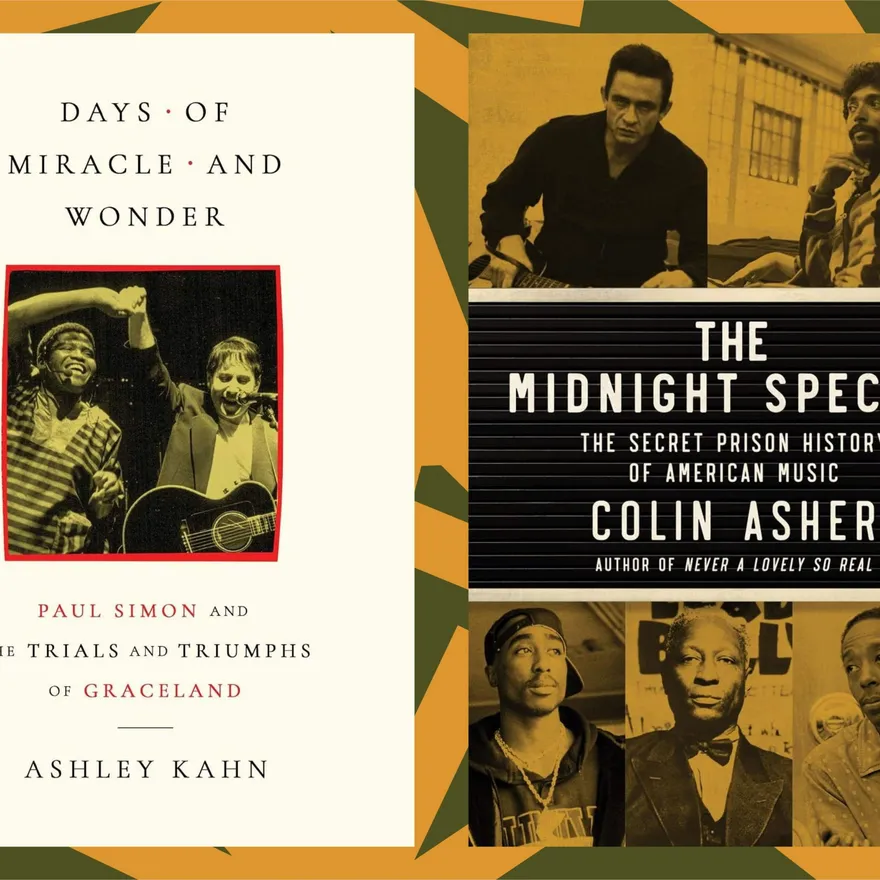
In this episode of NPR's Book of the Day, hosts explore two new music books examining Paul Simon's Graceland album and the relationship between American music and the prison system. The discussion covers how Simon reinvented his career in the mid-1980s by incorporating South African musical traditions, though his decision to record in apartheid South Africa sparked controversy despite his efforts to spotlight local artists.
The episode also examines how incarceration has shaped American musical genres from blues and jazz to hip-hop and country. The conversation highlights stark racial disparities in how musicians navigate the justice system, contrasting Johnny Cash's ability to profit from prison imagery with the obstacles faced by Black musicians who encountered law enforcement. Through these two books, the episode traces how artists across generations have managed their public personas around themes of crime and incarceration, revealing the complex intersection of creativity and America's history of mass incarceration.

This is a preview of the Shortform summary of the Sep 4, 2026 episode of the NPR's Book of the Day
Sign up for Shortform to access the whole episode summary along with additional materials like counterarguments and context.
1-Page Summary
Musical Innovation and Career Reinvention
Paul Simon's Graceland Transformed His Approach
In the mid-1980s, Paul Simon needed reinvention after his album Hearts and Bones underperformed commercially. Ashley Kahn notes that Simon discovered a bootleg cassette of South African accordion music that sparked a new creative direction. Graceland marked a radical shift in Simon's songwriting—he began with rhythm tracks rather than lyrics, letting the music guide the song's evolution. A Martínez cites "You Can Call Me Al" as an example of this new method, which originated from a loose studio jam that developed organically.
Simon traveled to South Africa to record with the original artists who inspired him, notably collaborating with Ladysmith Black Mambazo. Their work together produced "Homeless," showcasing the group's iconic Zulu harmonies to a global audience. Kahn and Martínez highlight that at an age when many pop stars fade into the "oldies" circuit, Simon produced vital, innovative music that introduced South African traditions to worldwide audiences, cementing Graceland as his signature album.
The Intersection of Music and Social/Political Context
Apartheid Politics Complicated Graceland's Reception
When Graceland was released, a UN resolution demanded musicians honor a cultural boycott of South Africa's apartheid government. Despite this, Simon traveled to South Africa and recorded with local artists. While he spotlighted South African musicians, he received criticism for not including explicit anti-apartheid messages and was accused of profiting from the culture amid widespread suffering. Instead of embedding political commentary in lyrics, Simon and his collaborators addressed apartheid through action—each night on tour, they sang "Nkosi Sikelele Lili Africa," the anthem of the anti-apartheid movement, making a collective political statement.
Mass Incarceration Shaped American Musical Genres
Colin Asher notes that American music, from blues and jazz to hip-hop and country, has been deeply shaped by the country's justice system for over a century. He describes two contradictory American impulses: immense creativity producing vibrant music, and repression marked by criminalization and incarceration. Prison experiences have long influenced musicians like Lead Belly, whose song "Midnight Special" draws directly from incarceration, using the metaphor of a train's headlight as a symbol of hope within confinement.
Racial Disparities In How Musicians Navigate Legal Systems
The experiences of Johnny Cash and Black jazz musicians highlight stark racial disparities in the justice system. Cash built his persona around prison themes and performed in prisons, yet never served more than a night in jail. Asher notes that Cash received grace from the justice system that was rarely granted to Black musicians facing similar or lesser infractions. While Cash profited from singing about incarceration, Black musicians like Elmo Hope faced police harassment that directly hindered their careers and ability to perform.
Because of disproportionate scrutiny, Black jazz musicians consciously avoided the criminal imagery that earlier blues musicians embraced. They crafted an intellectual and artistic presentation to protect their careers, concealing criminal records that would only enhance systemic disadvantages. While white artists could capitalize on an outlaw mystique, Black musicians had to distance themselves from such associations to sustain their livelihoods.
Prison's Role in Music History and Genre Development
Colin Asher's book, The Midnight Special, explores how policing and incarceration have shaped American music from Southern prison farms to modern mass incarceration. Lead Belly's prison experiences became inseparable from his artistic legacy, marking the historical transition from slavery to prison as a tool of social control. Conversely, jazz musicians concealed police encounters to protect their genre's intellectual credibility, creating a historical gap where important experiences were obscured.
Some artists, like Ike White, spent entire careers creating music within California prisons. Asher describes the vibrant musical cultures that develop inside prisons, where artists find ways to express themselves despite institutional constraints. The book's final section centers on Tupac Shakur, whose life was defined by the criminal justice system from conception—his mother was a Black Panther being tried in court when he was conceived. Growing up during mass incarceration, Tupac's generation faced an omnipresent relationship with policing that was fundamentally different from earlier musicians.
Artist Self-Mythology and Public Persona Management
Andrew Limbong and Don Gonyea discuss how musicians strategically use or reject criminal associations in crafting their public personas. Limbong explains that some artists leverage associations with crime to present themselves as cool or dangerous, while others distance themselves from criminal connections to protect legitimacy. However, structural racism means White and Black musicians face dramatically different consequences for similar histories.
White musicians like Johnny Cash could celebrate incarcerated populations and advocate prison reform while maintaining mainstream success and avoiding legal repercussions. By contrast, Black musicians often face higher risks when their careers intersect with incarceration—without exceptional talent or careful strategy, criminal associations can damage their careers. Gonyea observes that the outlaw archetype is deeply embedded in American music history, and Asher's analysis shows that American music culture persistently returns to prison narratives, highlighting the complex relationship between celebration of creativity and the reality of repressive policies and mass incarceration.
1-Page Summary
Additional Materials
Counterarguments
- Some critics argue that Paul Simon's use of South African music on Graceland constitutes cultural appropriation, as he benefited from local traditions without fully addressing the power dynamics or ensuring equitable recognition and compensation for all collaborators.
- While Graceland popularized South African music, some South African musicians and activists felt that Simon's project overshadowed local voices and did not sufficiently foreground the political realities of apartheid.
- The absence of explicit anti-apartheid lyrics in Graceland has been criticized as a missed opportunity to use Simon's platform for direct political advocacy, especially given the context of the cultural boycott.
- Some scholars and musicians contend that the focus on Simon's innovation in Graceland can inadvertently minimize the creative agency and contributions of the South African artists involved.
- The narrative that Simon "introduced" South African music to the world can be challenged, as South African musicians had already achieved international recognition prior to Graceland, albeit on a smaller scale.
- The portrayal of Johnny Cash as uniquely privileged in his ability to capitalize on prison themes may overlook the complexities of his personal struggles with addiction and the ways in which his advocacy for prison reform was sometimes met with skepticism or resistance.
- While mass incarceration has shaped American music, some genres and artists have developed largely outside of direct engagement with the justice system, suggesting a more nuanced relationship between music and incarceration than a universal or defining influence.
- The assertion that Black musicians universally avoided criminal imagery to protect their careers may not account for notable exceptions in blues, hip-hop, and other genres where outlaw themes have been embraced and celebrated by Black artists.
- The idea that the outlaw archetype is central to all American music genres may overstate its influence, as many artists and genres focus on themes unrelated to crime or incarceration.
Actionables
- you can experiment with starting your own creative projects by focusing first on rhythm or mood, letting the structure and message emerge organically from the initial vibe rather than planning everything in advance; for example, play a favorite instrumental track and improvise lyrics, poetry, or even a story based on the feelings it evokes, noticing how your ideas shift when you let the music lead.
- a practical way to explore the impact of justice systems on creativity is to listen to music from different genres while reading short biographies of the artists, then jot down how their personal experiences with law enforcement or incarceration might have shaped the themes or emotions in their work; this helps you recognize patterns of resilience, adaptation, or self-censorship across backgrounds.
- you can reflect on how public perception shapes opportunity by writing a brief personal statement or social media post that frames a challenging experience in either a positive or negative light, then observe how friends or followers respond; this gives insight into how narrative framing can influence support, credibility, or stigma, mirroring how artists manage their public personas.


Get access to the context and additional materials
Musical Innovation and Career Reinvention
Paul Simon's Career Needed Change in the 1980s
In the mid-1980s, Paul Simon faced a pivotal moment in his career. Ashley Kahn notes that Simon’s prior album, Hearts and Bones, underperformed commercially despite critical acclaim. This lackluster reception left Simon in need of reinvention, both artistically and commercially. Change arrived in an unexpected way when Simon discovered a bootleg cassette titled Gum Boots, Accordion Jive, Volume 2, featuring South African accordion music. A tune by accordionist Johnson Makalali especially inspired Simon, sparking what would become a new creative direction.
Graceland Represented a Shift In Simon's Approach
Simon's Rhythm-First Method Departs 90 Degrees From Tradition
Ashley Kahn explains that Graceland marked a 90-degree shift in Simon’s songwriting approach. Traditionally, Simon would begin building songs from lyrics; with Graceland, he started with rhythm tracks, letting the music guide the song’s evolution. This process was directly influenced by the infectious rhythms on that South African cassette.
"Call Me Al: New Approach From Studio Jam"
A Martínez cites "You Can Call Me Al" as a prime example of Simon’s new method. The song originated from a loose studio jam with no clear shape. Rather than imposing a structure early, Simon allowed the music to develop organically, later adding lyrics inspired by a dinner party where he was mistakenly called "Al." The DNA of the South African cassette can be heard across the album, including in "Gumboots" and other tracks.
Collaboration With South African Artists Revitalized Simon's Career
Determined to capture the essence of the music that inspired him, Simon decided not to recreate these sounds with New York studio musicians but to record with the original South African artists themselves. Paul Simon traveled and worked directly with these musicians, notably recording with Ladysmith Black Mambazo. Although initially intimidated by their powerful Zulu choral harmonies, his long-time love of vocal harmony, doo-wop, and gospel drew him into productive collaborations.
Their defining collaboration produced "Homeless," a song that showcased Ladysmith Black Mambazo’s iconic harmonies and brought their sound to a global stage. Simon’s willingness to work with such intimidating vocal traditions underscores his deep commitment to creative exploration. As the relationship deepened, Ladysmith Black Mambazo performed w ...
Here’s what you’ll find in our full summary
Musical Innovation and Career Reinvention
Additional Materials
Counterarguments
- Some critics and musicians have argued that Paul Simon’s decision to record Graceland in South Africa during the apartheid era violated the United Nations cultural boycott, raising ethical concerns about the project’s timing and context.
- While Graceland popularized South African music internationally, some have pointed out that the album’s commercial success disproportionately benefited Simon, with South African collaborators receiving less recognition and financial reward.
- The album’s approach has been critiqued as a form of cultural appropriation, with Simon drawing heavily from South African musical traditions without fully addressing the political struggles faced by the musicians and their communities.
- Some music historians note that South African artists had been producing innovative music for decades prior to Gra ...
Actionables
- you can refresh your creative process by starting with unfamiliar rhythms or sounds from a genre you don’t usually listen to, letting the music or mood guide your next steps before adding your usual elements—try using a playlist of global music as a backdrop while brainstorming or working on a project, and see how it shifts your approach.
- a practical way to foster authentic collaboration is to invite someone from a different background or culture to share their creative process with you, then try co-creating something small together, like a playlist, a recipe, or a short story, focusing on blending your styles rather than sticking to your com ...
Get access to the context and additional materials
The Intersection of Music and Social/Political Context
Music and politics often intertwine, shaping both artistic expression and societal perception. The Graceland project and the influence of incarceration on American genres demonstrate how deeply political and social realities are embedded in musical history.
Apartheid Politics Complicated the Graceland Project
When "Graceland" was released, the United States and other countries were imposing sanctions on South Africa’s apartheid government. At the same time, a United Nations resolution was in effect, demanding that musicians honor a cultural boycott to support the anti-apartheid movement. Despite this, Paul Simon traveled to South Africa and recorded the album with local artists. While Simon did shine a spotlight on South African musicians, he received criticism for not including explicit anti-apartheid messages in his songs and was accused of profiting from South African culture amid widespread suffering. This failure to state a direct anti-apartheid stance became one of the most pointed criticisms he faced as the album gained international attention.
Artists Addressed Politics Through Actions Not Explicit Lyrics
Graceland Tour Evenings: Musicians Sing Anti-Apartheid Anthem "Nkosi Sikelele Lili Africa"
Instead of embedding overt political commentary within the album’s lyrics, Simon and his South African collaborators addressed apartheid through their actions on stage. Each night at the end of the Graceland tour performances, the entire group of musicians—South Africans and Simon—would come to the front of the stage to sing "Nkosi Sikkele Lili Africa," the anthem of the anti-apartheid movement. This collective musical gesture and performance conveyed solidarity with the anti-apartheid struggle, using their shared voices to make a political statement that transcended lyrical declarations.
Mass Incarceration Shaped American Musical Genres
Colin Asher notes that American music, from blues and jazz to hip-hop and country, has been deeply shaped by the country’s justice system for more than a century. The lineage of these genres traces back to southern prison farms and continues through the era of modern mass incarceration. He describes two contradictory impulses within American society: one of immense creativity that produces vibrant, expressive music, and ...
Here’s what you’ll find in our full summary
The Intersection of Music and Social/Political Context
Additional Materials
Clarifications
- Apartheid was a system of institutionalized racial segregation and discrimination enforced by the South African government from 1948 to the early 1990s. It legally separated people by race, privileging the white minority while oppressing Black South Africans and other non-white groups. The regime controlled where people could live, work, and go to school, and it denied basic political rights to the majority population. International opposition, including sanctions and cultural boycotts, aimed to pressure South Africa to end apartheid.
- The United Nations cultural boycott against apartheid was a global effort to isolate South Africa culturally to pressure its government to end racial segregation. It urged artists, athletes, and cultural institutions worldwide to avoid collaboration with South African counterparts. The boycott aimed to weaken the apartheid regime by cutting off international cultural exchanges and reducing its legitimacy. This was part of broader sanctions and diplomatic efforts to dismantle apartheid.
- Paul Simon’s decision was controversial because it broke the international cultural boycott against apartheid South Africa. The boycott aimed to isolate the apartheid regime to pressure it to end racial segregation and oppression. Many believed that engaging with South African artists without explicit condemnation of apartheid could be seen as endorsing or ignoring the regime’s injustices. Critics feared Simon’s project might undermine global anti-apartheid efforts by normalizing cultural exchange.
- "Nkosi Sikelele Afrika" is a hymn originally composed in 1897 that became a powerful symbol of African unity and resistance against oppression. It was adopted as an anthem by the African National Congress and other liberation movements during apartheid. The song's lyrics are a prayer for blessing, protection, and freedom for Africa and its people. Today, it forms part of the national anthems of several African countries, including South Africa.
- Southern prison farms were places where incarcerated African Americans worked under harsh conditions after the Civil War, often forced into labor resembling slavery. The songs and musical styles developed there, such as work songs and field hollers, laid the foundation for blues and later genres. These musical forms expressed pain, resistance, and hope, influencing the emotional depth and themes of American music. This connection highlights how systemic oppression shaped cultural creativity.
- Modern mass incarceration in the United States refers to the extremely high imprisonment rates that began rising sharply in the 1970s and continue today. The U.S. holds the largest prison population in the world, with millions incarcerated in prisons and jails. This scale results from policies like the War on Drugs and tough sentencing laws that disproportionately affect minority communities. The system has significant social and economic impacts, including disrupting families and communities.
- Lea ...
Counterarguments
- Some critics argue that the Graceland project, while politically controversial, also provided significant international exposure and career opportunities for South African musicians who might otherwise have remained marginalized under apartheid.
- The effectiveness of cultural boycotts is debated; some believe that engagement and collaboration can foster cross-cultural understanding and solidarity more effectively than isolation.
- Not all artists believe that explicit political messaging is necessary or effective in music; some argue that artistic expression can be powerful and meaningful without overt political statements.
- The accusation that Paul Simon profited from South African culture overlooks the collaborative nature of the project and the agency of the South African musicians involved, many of whom have spoken positively about their participation.
- The influence of incarceration on American music, while significant, is only one of many factors shaping genres like blues, jazz, hip-hop, and country; migration, ...
Get access to the context and additional materials
Racial Disparities In how Musicians Navigate Legal/Criminal Systems
The experiences of Johnny Cash and Black jazz musicians like Elmo Hope highlight stark racial disparities in how musicians navigate the legal and criminal justice systems. The justice system’s favor toward white musicians created significant differences in career outcomes and shaped how Black musicians managed their public identities.
Justice System Favored White Musicians Over Black Musicians
Johnny Cash: A Prisoner's Hero Without a Substantial Sentence
Johnny Cash built his public persona around prison themes, famously performing in prisons and becoming a hero to incarcerated people. Despite this reputation and his openness about questionable behavior and addiction, Cash never served more than a night in jail. His image as an outlaw was not rooted in actual prison experience.
Cash Received Grace and Humanity From the Criminal Justice System, Opportunities Often Denied To His Black Counterparts Facing Similar or Lesser Infractions
Colin Asher notes that while Cash made mistakes and engaged in behaviors similar to Black peers, he was met with grace and humanity by the justice system—a generosity rarely granted to Black musicians, even for lesser infractions.
Treatment Disparities Created Different Career Outcomes for Black and White Artists
Johnny Cash Profited From Policing Themes, While Black Jazz Musicians Like Elmo Hope Faced Career Setbacks Due to Police Harassment and Records
Cash profited greatly—making millions—by singing about policing and incarceration while facing few direct consequences from the justice system. In contrast, Black musicians like Elmo Hope were repeatedly harassed by police. This interference was not only personal but also professional, directly impacting their ability to work and earn a living.
Police Interference Hindered Elmo Hope's Public Performances and Career Development
Asher emphasizes that if Elmo Hope had been allowed to perform without interference, his career could have been much more prolific, with more live performances and recordings. This is true for many Black jazz musicians whose careers were curtailed by police harassment and criminal records.
Black Musicians Avoid Criminal ...
Here’s what you’ll find in our full summary
Racial Disparities In how Musicians Navigate Legal/Criminal Systems
Additional Materials
Counterarguments
- While Johnny Cash’s public persona was built around prison themes, his actual brushes with the law were generally for misdemeanors and minor offenses, which may not have warranted significant jail time regardless of race.
- Some Black jazz musicians, such as Lead Belly, did embrace outlaw or criminal imagery and still achieved recognition, suggesting that the relationship between criminal associations and career outcomes was complex and not solely determined by race.
- The music industry’s commercial interests and audience preferences also played a role in shaping which personas were marketable, potentially influencing the success of outlaw imagery for white artists more than legal system disparities alone.
- There were Black musicians who managed to achieve significant success and acclaim despite legal ...
Actionables
- you can review the biographies and public images of your favorite musicians or artists, then write a short reflection on how their race may have influenced their treatment by authorities and the media, helping you recognize patterns of privilege or bias in cultural narratives.
- a practical way to support fairness in the arts is to choose to attend performances or purchase music from artists who have historically faced systemic barriers, making a conscious effort to diversify your listening habits and share these artists with friends.
- you can keep a simple journal noting any me ...


Get access to the context and additional materials
Prison's Role in Music History and Genre Development
Colin Asher’s book, The Midnight Special, explores how policing and incarceration have shaped American music, from the era of Southern prison farms to modern mass incarceration. The history reveals how prison has influenced artists’ identities, the music they create, and the development of entire genres.
Prison As Defining or Hidden Identity For Artists
Lead Belly's Prison Experiences Shaped His Persona and Legacy
Lead Belly, born in 1889, spent significant time in Southern prison farms, where he performed and absorbed musical influences. His experiences in prison became inseparable from his artistic legacy, both shaping his persona and demonstrating the historical transition from the age of slavery to the era when prison, particularly in the South, replaced slavery as a tool of social control. Lead Belly’s time inside profoundly marked his music and his public image, and his association with incarceration is a pattern many later artists have confronted.
Jazz Musicians Concealed Police and Prison Encounters to Protect Their Genre's Intellectual Credibility, Creating a Historical Gap Where Important Experiences Were Obscured
With the advent of modern jazz, musicians actively distanced their genre from the criminalized image attached to blues artists like Lead Belly. Jazz was positioned as an intellectual and sophisticated art form—one of America’s greatest cultural achievements. This involved concealing criminal records and any encounters with police or prison, which preserved jazz’s reception as a “genius” endeavor. However, this deliberate hiding created a historical absence, leaving much suffering and adversity unacknowledged and obscuring the challenges that shaped some musicians’ lives.
Some Artists Spent Careers Creating Music Within Institutions
Ike White: Obscure Musician Who Composed and Performed In California Prison
Ike White exemplifies artists whose entire musical careers took place behind bars. Incarcerated in California at the end of his teenage years, White spent most of his creative life within the prison system. His story uncovers a lesser-known, but rich, tradition of music made inside institutions.
Musical Cultures in Prisons Show Creative Expression and Genre Development in Limited Environments
Asher describes the vibrant musical cultures that can develop inside prisons. Within the constraints of incarceration, artists find ways to express themselves and contribute to genre evolution. These institutional environments, despite their limitations, foster both creativity and innovation among incarcerated musicians.
Modern Hip-hop Artists Emerged From a Justice-Omnipresent Context
From Conceptio ...
Here’s what you’ll find in our full summary
Prison's Role in Music History and Genre Development
Additional Materials
Counterarguments
- While incarceration has influenced some artists and genres, many significant developments in American music occurred outside the context of policing or prison, driven by cultural exchange, technological innovation, and artistic experimentation.
- The narrative that prison replaced slavery as a tool of social control in the South is debated among historians, with some arguing that the relationship is more complex and not all aspects of incarceration can be directly equated with slavery.
- Not all jazz musicians concealed their encounters with law enforcement; some were open about their struggles, and the genre’s intellectual reputation was also shaped by factors such as musical complexity and critical advocacy, not solely by distancing from criminal associations.
- The focus on incarceration risks overshadowing other important influences on artists’ identities and music, such as migration, economic hardship, community, and personal relat ...
Actionables
- you can listen to music created by currently or formerly incarcerated artists and reflect on how their experiences with the justice system shape the sound, lyrics, and emotion, then write a short journal entry about how this awareness changes your perception of the music and the artist’s identity.
- a practical way to recognize hidden histories in music is to research the backgrounds of your favorite musicians and note any gaps or silences in their biographies, then consider how these omissions might relate to broader patterns of concealment or stigma around incarceration.
- you can create a personal playlist ...

Get access to the context and additional materials
Artist Self-Mythology and Public Persona Management
Andrew Limbong and Don Gonyea discuss how musicians strategically use or reject criminal associations in crafting their public personas. This management of self-mythology can determine career trajectory and cultural impact, shaped significantly by the artist's race and broader societal context.
Musicians Use or Reject Criminal Associations For Image
Artists Thrive By Embracing Outlaw Personas or Distancing From Crime For Credibility
Andrew Limbong explains that, as author Colin Asher points out in his book, some artists have the luxury of leveraging associations with prison or crime as a way to present themselves as cool or dangerous. For these musicians, embracing an outlaw persona can enhance credibility, deepen their myth, and even be seen as essential to their public identity. Conversely, other musicians may feel compelled to distance themselves from any criminal connections to protect their legitimacy or avoid alienating their audience.
Unequal Choice: Structural Racism Means White and Black Musicians Face Different Consequences for Their Criminal History
However, Limbong notes that not all musicians have equal power over how these narratives play out. Structural racism means that career consequences for criminal associations or incarceration are distributed unequally, with White and Black musicians facing dramatically different outcomes for similar histories.
Musician's Race and Context Affect Prison Narratives
White Musicians Like Johnny Cash Could Celebrate Incarcerated Populations and Advocate Prison Reform While Maintaining a Mainstream Career and Avoiding Legal Consequences
The case of White musicians such as Johnny Cash is emblematic. Limbong and Gonyea note that Cash could openly celebrate incarcerated populations, perform in prisons, and advocate for prison reform in his music, all while maintaining mainstream success and avoiding legal repercussions or social stigma that might damage his career.
Black Musicians Face Risks Where Jail or Police Issues Can Harm Careers Without Exceptional Talent, Strategic Protection, or Avoiding Outlaw Imagery
By contrast, Black musicians often face higher risks when their careers intersect with incarceration or encounters with law enforcement. Without exceptional talent, careful strategy, or avoidance of outlaw imagery, Black artists can see their careers wither after public criminal associations. The implications of racism within the music industry and wider society mean that their ...
Here’s what you’ll find in our full summary
Artist Self-Mythology and Public Persona Management
Additional Materials
Counterarguments
- While structural racism undeniably affects outcomes, some White musicians have also faced significant backlash or career damage due to criminal associations, suggesting that consequences are not always strictly divided along racial lines.
- The effectiveness of embracing or rejecting outlaw personas can depend more on genre conventions, audience expectations, and individual circumstances than solely on race.
- Not all Black musicians who reference incarceration or criminality in their music experience negative career impacts; some have achieved mainstream success by authentically engaging with these themes.
- The persistence of outlaw archetypes in music may reflect broader societal fascination with rebellion and transgression, rather than being solely a commentary on race or criminal justice.
- Some artists, regardless of r ...
Actionables
- you can analyze the public personas of your favorite musicians by making a simple chart that tracks how they reference crime, prison, or outlaw themes in their lyrics, interviews, and social media, then reflect on how these choices might affect their image and career differently based on their background
- Create two columns: one for artists who embrace outlaw imagery and one for those who avoid it. Note any patterns in audience reactions, media coverage, or career outcomes, especially considering race and genre. This helps you recognize how cultural narratives and structural biases shape public perception.
- a practical way to understand the impact of prison narratives in music is to listen to songs across genres that mention incarceration, then write a short reflection on how each song portrays prison life and what emotions or myths it creates
- As you listen, jot down whether the song romanticizes, criticizes, or simply describes prison, and consider how this shapes your own views about incarceration and those affected by it. This activity helps you see the gap between creative storytelling and real-life consequences.
- yo ...


Get access to the context and additional materials


Create Summaries for anything on the web
Download the Shortform Chrome extension for your browser
