

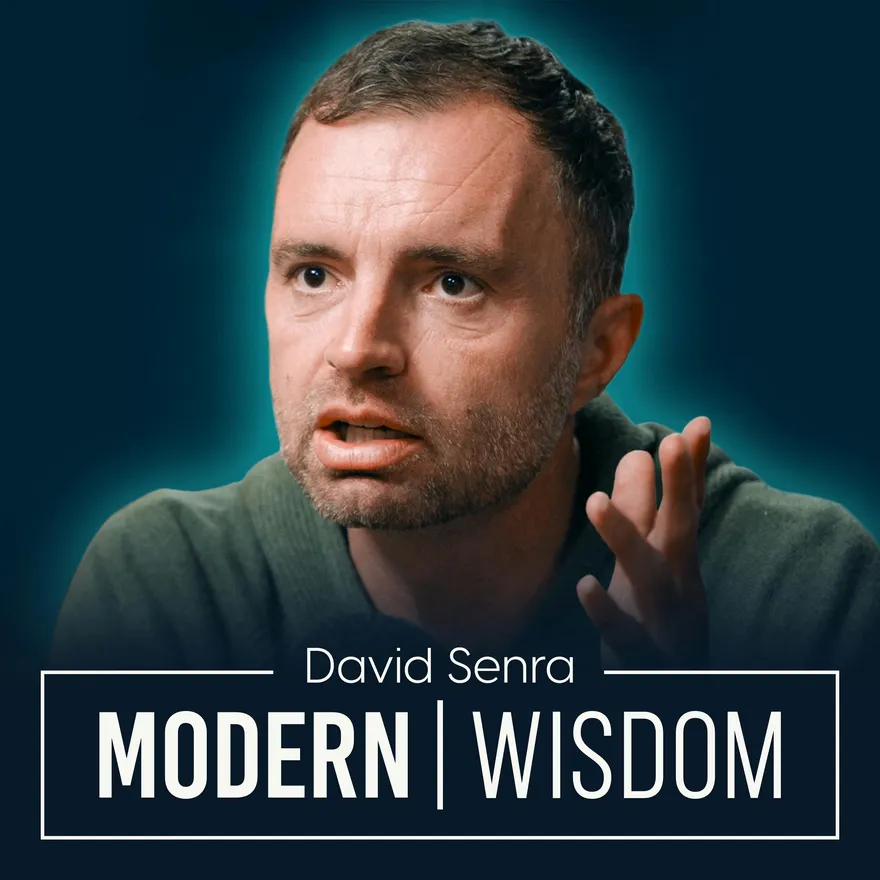
14 Patterns Behind the World’s Greatest Minds - David Senra - #1126
In this episode of Modern Wisdom, Chris Williamson and David Senra examine the patterns and paradoxes that define highly successful people. Drawing from biographies of entrepreneurs, artists, and industry leaders, they explore how internal resistance persists even at the highest levels of achievement, why adversity often creates exceptional drive, and how self-belief typically precedes any external validation.
Beyond individual traits, the conversation emphasizes that relationships fundamentally shape life quality and success. Williamson and Senra discuss the importance of curating a small circle of high-quality connections, the dangers of seeking fulfillment through external validation rather than internal standards, and why focused excellence on one thing typically trumps diverse pursuits. The episode offers perspective on how wisdom often consists of avoiding problems rather than solving them, and why protecting your attention and energy is essential for sustained creative and professional fulfillment.

This is a preview of the Shortform summary of the Jul 20, 2026 episode of the Modern Wisdom
Sign up for Shortform to access the whole episode summary along with additional materials like counterarguments and context.
1-Page Summary
The Psychology and Traits of Highly Successful People
Chris Williamson and David Senra discuss what separates highly successful people from others, revealing surprising paradoxes and recurring patterns in their motivations, relationships, and work habits.
Internal Resistance Persists Despite Achievement
Even legendary producer Rick Rubin faces significant internal resistance, describing himself as a "lazy workaholic" who must force himself to work. He never wakes up excited for studio sessions and finds the daily grind more burden than pleasure. Senra observes that high achievers become addicted not to routine labor, but to the thrill of solving difficult problems and achieving breakthroughs after repeated failures.
Adversity Creates Exceptional Drive
The "chip on the shoulder"—a deep urge to prove oneself—frequently motivates the successful. Growing up without privilege breeds powerful work ethic and persistence. Adam, founder of AppLovin, intentionally hires people with something to prove, like his right-hand man Raf, once a homeless high school dropout who's now the company's second-largest shareholder. This drive to escape unfavorable circumstances and refuse to accept them as destiny provides lasting fuel for exceptional achievement.
Self-Belief Precedes Evidence
Highly successful people display unwavering self-belief before external validation arrives. Senra references how Kanye West practiced acceptance speeches before releasing music, and Conor McGregor filmed a documentary while still unknown, convinced he'd become champion. This mindset transforms perceived limitations into skills to develop. Tobi Lütke rewired his internal monologue about public speaking through positive affirmations until anxiety disappeared, reflecting a growth mindset that views abilities as improvable through intentional effort.
Deep Knowledge Enables Creative Problem-Solving
Peak performers maintain wide and deep familiarity with their field's history. Rubin keeps a vast library and habitually references musical history for inspiration, drawing connections across time. This encyclopedic knowledge creates an internal library of patterns and solutions, enabling intuitive problem-solving and quick adaptation when facing novel challenges.
Hunger for Feedback Fuels Improvement
Exceptionally successful people actively seek constructive feedback. Michael Jordan sought useful critique to reach his goals, and Steve Jobs valued board members who challenged him. Senra emphasizes that high performers treat critique as an opportunity to improve. Williamson adds that they hold strong opinions loosely, demonstrating willingness to update their worldview when new evidence arises.
The Critical Importance of Relationships and Community
Williamson and Senra underscore that consciously curating who you allow into your life shapes your trajectory, health, and potential for happiness.
Relationships Define Life Quality
Senra repeats the maxim: "Your life is your relationships." The people you surround yourself with shape your narrative, beliefs, behaviors, aspirations, and mental state. Low-quality relationships cause unnecessary drama and deplete energy. Williamson uses the concept of "sofa friends" versus "treadmill friends"—the former leave you drained while the latter energize you. He argues that most people who think they're introverts might just have unsatisfying friends. Both advocate ruthlessly editing your social circle, focusing energy on a small, high-quality group rather than maintaining hundreds of shallow ties.
Discernment in Choosing Close Relationships
Senra describes advice from successful people: only let genuinely good people into your life—those who are unselfish and supportive rather than opportunistic. He advocates a somewhat "paranoid" approach to choosing close friends, business partners, or spouses, as many people drawn to success may be motivated by self-interest. True character is revealed by selfless behavior, not by what someone can get from you. Connecting with established, successful individuals provides invaluable knowledge and guidance that can profoundly shape one's life.
Romantic Relationships Require Different Approach
The traits that drive business achievement—single-mindedness, relentless drive, unwillingness to compromise—are double-edged in personal relationships. Williamson notes that hypervigilance may make you reliable in business but often leaves you absent or problematic at home. Senra cautions against approaching romantic relationships with hyper-rational optimization, advising instead to prioritize that your partner is genuinely good and cares for your well-being. He warns that the wrong romantic partner can destroy anyone's life, regardless of other successes.
Relationships Outweigh Achievement
Ultimately, fulfillment and life satisfaction stem from relationships, not accolades. Senra admits that despite once believing he required no one, he realized loneliness stemmed from having many low-quality people around him. High-quality connections became his "drug of choice." He acknowledges that true connection may require sacrificing some professional gains, but doing so leads to a life genuinely worth living.
Intrinsic vs. Extrinsic Motivation
Williamson and Senra explore the dangers of seeking fulfillment through external validation versus internal standards.
Internal Standards Drive Quality and Fulfillment
Creating work to please audiences, algorithms, or critics often leads to products the creator doesn't enjoy, representing a fundamental failure regardless of commercial success. Senra contrasts two outcomes: gaining success by betraying your values versus having less public success but true self-expression. He concludes that people with less external achievement but more personal resonance are often happier. Williamson references Joe Hudson's idea that a true billion-dollar idea is something you wouldn't sell for any price—a measure of intrinsic value. Senra highlights Rubin's "house on the mountain" test: if you decorated a remote home only you would see, would you still do your best? The answer reveals your true motivations.
Peer Respect Provides Lasting Satisfaction
Williamson argues that admiration from worthy peers is more addicting and lasting than fame or wealth, recalling Eminem's sentiment that he'd be miserable with money but no respect. Peer respect is especially valuable because insiders possess the highest standards. When George Lucas, Steven Spielberg, and filmmaker peers shared ideas, each gained without others losing—collaboration raised everyone's work. Success and excellence are not identical: popularity can follow mediocre work, but excellence demands sustained dedication to mastery.
Personal Pride Shields Against External Metrics
Senra emphasizes building an "internal scorecard," striving for work one can be proud of regardless of market whims. He discusses James Dyson, who refused to sell his company for $60–80 billion, viewing it as a family heirloom rather than a commodity. These stories illustrate that creation driven by internal standards provides stable foundation whether or not recognition follows. However, success brings temptation to compromise on the quality that built your reputation. Dedication to incremental improvement prevents this "megalomania."
Wisdom Through Prevention
Williamson and Senra explore how wisdom consists in avoiding problems rather than solving them after they occur.
Avoiding Problems Beats Solving Them
Wise people avoid problems rather than seeking to solve them after occurrence. Senra adds that accumulating wisdom means recognizing and avoiding failure patterns. He recounts Charlie Munger's advice: if you live long enough, bad things will inevitably happen. Munger's own life included personal tragedies entirely outside his control. The key is to eliminate preventable suffering so that when unavoidable challenges arise, you have capacity and resilience to meet them.
Great People and Meaningful Work Prevent Problems
Senra discusses Munger's core strategy: surround yourself with a handful of truly great people and commit to meaningful work. High-quality relationships offer support and stability, while toxic people bring drama and complications. Meaningful work is another pillar of prevention—by committing to work you care about, you limit distractions and reduce unnecessary complications. Changing your environment and relationships resolves issues more effectively than self-improvement alone. A prevention mindset compounds positively over time, buffering you against misfortune and freeing resources to overcome unavoidable obstacles.
Simplicity, Focus, and Avoiding Distraction
Focused Excellence Trumps Diverse Pursuits
Exceptional success often lies in simplicity and deep focus. Todd Graves' Raising Cane's exemplifies this: for 30 years, the restaurant has offered little more than chicken fingers, coleslaw, Texas toast, and fries—resisting calls for menu expansion. This relentless commitment to one thing, done exceptionally well, allowed the chain to outclass competitors through quality depth rather than breadth. Charlie Munger's maxim holds true: "winning systems go ridiculously far by minimizing or maximizing one or a few variables." Elon Musk's SpaceX and Shopify likewise succeed by maintaining clarity of focus.
Distractions Disguise Themselves as Opportunities
With success come invitations to events, collaborations, and meetings—each seemingly worthwhile. Yet Daniel Ek advises Senra that these are distractions in disguise. Ek's constant reminder—"stay away from the circus"—embodies the imperative to prioritize fulfilling work over fleeting opportunities. Senra finds the most meaningful relationships are forged through work itself, while "the circus" requires leaving core work behind for superficial activities.
Childlike Focus Fuels Excellence
True mastery flows from relentless attention to one's core pursuit. For Graves, the organizing principle is to keep doing chicken fingers better and better, always seeking improvements. This deep satisfaction with the craft supersedes the need for external validation or monetary reward. Graves maintains decades-long refusal to sell the business—valued at over $20 billion—because he believes his life's purpose is to excel at making chicken fingers. James Dyson similarly rebuffs multi-billion dollar offers, insisting his business is a family heirloom where the work itself is the reward.
Protect Your Attention and Energy
Sustaining excellence requires fiercely protecting attention and emotional energy. Senra describes how maintaining a close circle preserves energy for key work and real relationships. He advocates engaging selectively to improve depth and quality of interactions, favoring relationships that energize rather than drain. By carefully curating where time and energy flow, one maintains the vitality needed for sustained creative and professional fulfillment.
1-Page Summary
Additional Materials
Clarifications
- Internal resistance is the mental and emotional struggle that makes starting or continuing work difficult, even for successful people. It often stems from fear of failure, perfectionism, or discomfort with uncertainty. This resistance persists because motivation fluctuates and effort requires overcoming ingrained habits or doubts. Success does not eliminate these internal barriers; it often coexists with them.
- Rick Rubin calls himself a "lazy workaholic" because he experiences internal resistance to starting work despite being highly productive. This paradox means he doesn't feel motivated by excitement but pushes through discipline and commitment. His drive comes from the satisfaction of solving complex problems, not from enjoying routine tasks. This reflects a common pattern where passion lies in breakthroughs, not in the daily effort itself.
- The phrase "chip on the shoulder" originates from a 19th-century practice where someone would place a wood chip on their shoulder, daring others to knock it off as a way to provoke a fight. It now means carrying a persistent sense of grievance or inferiority that fuels a desire to prove oneself. This attitude often drives people to work harder to overcome perceived slights or disadvantages. It can motivate exceptional effort but may also cause defensiveness or conflict.
- Hiring people "with something to prove" means selecting individuals motivated by past hardships or setbacks, driving them to work harder and achieve more. Such employees often possess resilience, determination, and a strong desire to succeed, which can benefit the company culture and performance. Raf's story exemplifies this: overcoming homelessness and dropping out of high school, he channeled his drive into becoming a key shareholder at AppLovin. This approach leverages personal adversity as a source of sustained motivation and commitment.
- Practicing acceptance speeches or filming documentaries before success is a form of mental rehearsal that builds confidence and solidifies a future identity. It helps individuals visualize their goals as already achieved, reinforcing belief in their eventual success. This technique leverages the brain's ability to prepare for real experiences through imagined scenarios. It also reduces anxiety by familiarizing the person with potential future situations.
- A growth mindset is the belief that abilities and intelligence can be developed through effort and learning. Positive affirmations are repeated statements that challenge negative self-talk and reinforce confidence. Over time, these affirmations reshape neural pathways, altering how one thinks about their capabilities. This process helps reduce anxiety and promotes a more resilient, adaptive mindset.
- Having encyclopedic knowledge means deeply understanding a field's history, key concepts, and past solutions. This broad and detailed knowledge allows quick recognition of patterns and connections others might miss. It helps generate creative solutions by applying lessons learned from diverse experiences. Experts can adapt more easily to new challenges because they see problems in a wider context.
- "Sofa friends" are those who leave you feeling emotionally drained or exhausted after interactions, similar to how sitting on a sofa might imply passivity or low energy. "Treadmill friends" energize and motivate you, much like running on a treadmill boosts physical activity and vitality. The distinction highlights the impact friends have on your emotional state and overall well-being. Choosing "treadmill friends" supports personal growth and happiness.
- Being "somewhat paranoid" means maintaining cautious skepticism about others' intentions to protect yourself from potential harm or exploitation. It encourages careful observation and verification before fully trusting someone. This mindset helps identify hidden motives and avoid relationships that could be damaging. It is not about distrust of everyone, but prudent discernment in forming close bonds.
- Hyper-rational optimization in romantic relationships means treating love like a business deal, focusing solely on logical benefits and efficiency. This approach overlooks emotional needs, spontaneity, and vulnerability essential for deep connection. It can create unrealistic expectations and reduce empathy, harming intimacy. Successful relationships require balancing reason with emotional warmth and trust.
- The phrase "your life is your relationships" means that the quality and nature of your connections with others fundamentally shape your overall well-being and happiness. Human beings are social creatures whose mental, emotional, and even physical health depend heavily on meaningful interactions. Positive relationships provide support, purpose, and a sense of belonging, while negative ones can cause stress and drain energy. Therefore, investing in nurturing healthy relationships is crucial for a fulfilling life.
- The "house on the mountain" test is a metaphor used by Rick Rubin to assess true motivation. It asks whether you would still create your best work if no one else could see it, like decorating a remote house only you visit. This reveals if your drive comes from internal passion rather than external validation. Passing this test indicates intrinsic motivation and authentic commitment to quality.
- Success often refers to achieving goals or gaining recognition, which can be measured by wealth, fame, or status. Popularity is about being well-liked or widely known, sometimes regardless of the quality of one's work. Excellence means consistently producing work of the highest quality, driven by mastery and dedication rather than external approval. Excellence may not always lead to popularity or conventional success but represents true skill and integrity in a field.
- An "internal scorecard" is a personal system of values and standards used to judge your own actions and achievements. It focuses on self-approval rather than external validation like awards or public recognition. This mindset helps maintain motivation and satisfaction even when outside feedback is negative or absent. It encourages consistent effort aligned with personal integrity and growth.
- Megalomania refers to an obsession with power, control, or grandiosity that can distort judgment. In success, it may cause individuals to prioritize ego over the quality of their work. This often leads to reckless decisions and a decline in standards. Avoiding megalomania helps maintain integrity and consistent excellence.
- Charlie Munger, vice chairman of Berkshire Hathaway, emphasizes that true wisdom lies in preventing problems rather than fixing them after they occur. He advocates learning from others' mistakes to avoid common pitfalls and reduce unnecessary suffering. Munger believes that accumulating knowledge and experience helps recognize failure patterns early. This proactive approach conserves resources and builds resilience for inevitable challenges.
- Surrounding yourself with a few exceptional people means choosing trusted individuals who inspire, challenge, and support you consistently. These relationships provide reliable advice, diverse perspectives, and emotional stability, which help you avoid mistakes and grow. Quality over quantity matters because deep connections foster trust and meaningful collaboration. This strategy reduces distractions and builds a strong foundation for personal and professional success.
- The principle means focusing intensely on a small number of key factors that drive success, rather than spreading effort across many areas. By optimizing these critical variables, systems become more efficient and effective. This approach reduces complexity and increases the likelihood of consistent, repeatable results. It is often used in business, engineering, and strategy to achieve superior performance.
- The metaphor "stay away from the circus" refers to avoiding chaotic, distracting, and superficial situations that divert attention from meaningful work. A circus is noisy, busy, and full of spectacle, symbolizing events or activities that seem appealing but lack real value. By steering clear of these distractions, one preserves focus and energy for important goals. This advice encourages prioritizing depth and substance over fleeting excitement.
- Refusing to sell a business as valuing it like a "family heirloom" means seeing the company as a legacy to preserve and nurture across generations. This perspective prioritizes long-term stewardship and personal attachment over immediate financial gain. It reflects a commitment to maintaining the business's values, culture, and quality. Such owners often focus on sustainable growth and purpose rather than maximizing short-term profits.
- Intrinsic motivation arises from internal desires like personal satisfaction or passion, driving creativity for its own sake. Extrinsic motivation depends on external rewards such as money, fame, or approval, which can shift focus away from genuine expression. Creative work fueled by intrinsic motivation tends to be more authentic and fulfilling, while extrinsic motivation may lead to compromises in quality or originality. Balancing both can be challenging but is crucial for sustained creative success.
- "Childlike focus" refers to the pure, undistracted concentration often seen in children deeply engaged in play or learning. This kind of focus is characterized by curiosity, enthusiasm, and a single-minded commitment to the task without concern for external rewards. True mastery demands maintaining this intense, joyful attention over long periods, allowing deep skill development and innovation. It contrasts with adult tendencies toward distraction, multitasking, or seeking quick results.
- Selective engagement means consciously choosing where to invest your time and emotional energy to avoid burnout. It involves prioritizing interactions and activities that align with your goals and values. This approach helps maintain focus and prevents distraction from less meaningful demands. By limiting exposure to draining situations, you preserve mental clarity and motivation.
Counterarguments
- Persistent internal resistance is not universal among highly successful people; some report genuine enjoyment and intrinsic motivation in their work.
- Addiction to solving difficult problems may lead to burnout or neglect of important but less stimulating tasks.
- Adversity is not a prerequisite for exceptional achievement; many successful individuals come from privileged backgrounds.
- Hiring people solely because they have "something to prove" can introduce instability or unhealthy competition within organizations.
- Unwavering self-belief before external validation can sometimes result in overconfidence or blind spots, leading to poor decisions.
- Positive affirmations and growth mindset approaches are not universally effective and may not address deeper psychological barriers.
- Deep knowledge of a field is valuable, but excessive focus on history can stifle innovation or lead to conformity.
- Actively seeking feedback can be counterproductive if it leads to overreliance on others' opinions or constant self-doubt.
- Holding strong opinions loosely may be interpreted as lack of conviction or indecisiveness in some contexts.
- The quality of relationships is important, but individual fulfillment can also be found through solitary pursuits or personal achievements.
- Editing social circles too ruthlessly may result in isolation or loss of diverse perspectives.
- Discernment in relationships can become excessive, leading to distrust or missed opportunities for meaningful connections.
- Connecting only with established, successful individuals may reinforce elitism and limit exposure to fresh ideas.
- Traits that drive business success can be adapted for healthy romantic relationships with self-awareness and communication.
- Sacrificing professional gains for relationships is not always necessary; some individuals successfully balance both.
- Creating work for external audiences can lead to valuable feedback, commercial viability, and broader impact.
- Peer respect is subjective and may not always align with personal values or societal benefit.
- Building an internal scorecard may lead to self-absorption or disregard for constructive external input.
- Avoiding problems entirely is unrealistic; learning from mistakes and failures is also a critical component of wisdom.
- Changing environment and relationships is not always feasible or effective for everyone; self-improvement can be equally important.
- Simplicity and focus may limit opportunities for growth, diversification, or adaptation to changing circumstances.
- Refusing to sell a successful business may prevent beneficial partnerships, expansion, or personal growth.
- Fiercely protecting attention and energy can result in missed opportunities or excessive rigidity.
- Selective engagement may inadvertently exclude valuable or serendipitous connections.
Get access to the context and additional materials
The Psychology and Traits of Highly Successful People
The psychology of highly successful people reveals paradoxes, deep motivations, and practices that set them apart. Insights gleaned from conversations about legendary producer Rick Rubin, entrepreneurs, and public figures uncover recurring themes of internal resistance, personal drive, growth mindset, and a relentless commitment to learning and improvement.
Paradox: Driven Creators Facing Internal Resistance Despite Achievements
Rick Rubin exemplifies that even the most accomplished creatives encounter significant internal resistance. Despite his legendary status, Rubin describes himself as a "lazy workaholic" who must actively force himself to create. He reveals a distinction between enjoying the act of creation and enduring the prolonged execution phase—the daily grind of studio work is more burden than pleasure. Rubin never wakes up excited for work and must make himself engage, emphasizing that even top performers confront resistance and that much of the work is a struggle, not a joy.
This dynamic highlights how high achievers often become addicted not to the routine labor, but to the magical pivot point of solving difficult problems and achieving breakthroughs. David Senra observes that creators are driven by the thrill of experimentation and failure, seeking that singular successful tweak after many failures, which becomes the addictive reward in their craft.
Chips Fuel Exceptional Performance and Sustained Effort
A recurring motivator among the successful is "the chip on the shoulder"—a deep urge to prove oneself, often originating from humble or adverse beginnings. Growing up without privilege breeds a powerful work ethic and persistence, as demonstrated by stories of people like Senra’s own grandfather, who escaped Cuba with no resources and reshaped his family’s trajectory through sacrifice and determination.
Entrepreneurs frequently seek out such driven individuals. For example, Adam, founder of AppLovin, intentionally hires people who have something to prove—those who have encountered setbacks or were overlooked. His right-hand man Raf was once a homeless high school dropout living in the office; now, he’s the company’s second-largest shareholder. These environments reward hunger, resilience, and unconventional thinking, showing that being born into unfavorable circumstances often produces the fire needed for exceptional achievement.
The drive to escape one's original circumstances and the refusal to accept them as destiny is a hallmark of successful figures. This chip provides lasting fuel, with individuals leveraging setbacks or even dismissals by others as motivational energy, determined to outwork and outperform those who doubted them.
Self-Belief Often Precedes Evidence Of Achieving Extraordinary Goals
Highly successful people consistently display self-belief well before external validation arrives. David Senra references how icons like Kanye West practiced acceptance speeches and disregarded doubters before releasing any music, and how Conor McGregor had a documentary crew film his life while still an unknown, convinced he would one day become the champion.
This mindset, where belief precedes ability, extends to transforming perceived limitations into skills to be developed. Kanye West admitted he was initially poor at making beats and rapping, but instead of accepting these limits, he taught himself and improved. Shopify’s Tobi Lütke rewired his internal monologue about public speaking, repeating positive affirmations until the anxiety disappeared and competence emerged. This reflects a growth mindset—viewing skills and abilities as improvable through intentional effort rather than fixed traits.
This faith in a future not yet realized, and the conviction to pursue it, allows high performers to reject their current realities and visualize radically improved destinies, fueling their relentless self-improvement.
Successful People Maintain Broad Knowledge In Their Field to Solve Novel Problems Creatively
A crucial but often overlooked trait among peak performers is their wide and deep familiarity with the history of their field. Rick Rubin, for example, keeps a vast lib ...
Here’s what you’ll find in our full summary
The Psychology and Traits of Highly Successful People
Additional Materials
Clarifications
- Internal resistance refers to the mental and emotional barriers that hinder starting or continuing creative work. It often appears as procrastination, self-doubt, or fear of failure. This resistance is a natural part of the creative process, stemming from the vulnerability and uncertainty involved. Overcoming it requires discipline and persistence despite discomfort.
- The phrase "chip on the shoulder" originates from a 19th-century practice where someone would place a wood chip on their shoulder, daring others to knock it off as a way to provoke a fight. It now means carrying a sense of grievance or a strong desire to prove oneself due to past slights or disadvantages. This attitude often fuels motivation and determination to succeed. It reflects a mindset of using perceived injustices as a driving force.
- Rick Rubin is a highly influential music producer known for shaping the sound of multiple genres, including hip-hop, rock, and pop. He co-founded Def Jam Recordings, which launched the careers of iconic artists like Run-DMC and Beastie Boys. Rubin is credited with revitalizing the careers of established musicians such as Johnny Cash and Red Hot Chili Peppers. His minimalist production style and ability to bring out authentic performances have earned him legendary status in the music industry.
- David Senra is a commentator and analyst known for insights into creativity and success psychology. His observations often highlight the emotional and motivational struggles behind achievement. He provides real-world examples that illustrate abstract psychological concepts. Senra’s perspectives help bridge theory and practical understanding of high performance.
- Adam Foroughi is the founder of AppLovin, a successful mobile technology company. Raf, his right-hand man, overcame extreme hardship, including homelessness and dropping out of high school, before joining AppLovin. Their story exemplifies how individuals with difficult backgrounds can achieve exceptional success through resilience and opportunity. It highlights the value of hiring driven people who have "something to prove."
- Kanye West practiced giving acceptance speeches before his music was successful to mentally prepare and reinforce his confidence. Conor McGregor documented his life early on, showing his strong belief in becoming a champion despite being unknown. Both used visualization and self-affirmation to build confidence ahead of external achievements. This approach helps transform ambition into focused effort and resilience.
- A growth mindset is the belief that abilities and intelligence can be developed through effort and learning. Psychologist Carol Dweck popularized this concept, contrasting it with a fixed mindset, where people see traits as innate and unchangeable. This mindset encourages embracing challenges, persisting through setbacks, and valuing effort as a path to mastery. It is linked to greater motivation, resilience, and achievement in various domains.
- Maintaining broad knowledge of a field’s history helps individuals recognize patterns and avoid repeating past mistakes. It provides a rich source of ideas and inspiration by showing how problems were solved before. This deep understanding enables creative combinations of old concepts in new ways. It also builds intuition for what approaches are likely to succeed or fail.
- Constructive feedback provides specific, actionable insights that help individuals identify areas for improvement. It encourages self-awareness by highlighting blind spots ...
Counterarguments
- The narrative may overemphasize adversity and the "chip on the shoulder" as essential for success, overlooking examples of highly successful individuals from privileged backgrounds.
- Not all successful people experience significant internal resistance or dislike the routine aspects of their work; some genuinely enjoy the process.
- The focus on self-belief preceding evidence may underplay the importance of external support, mentorship, and collaborative environments in achieving success.
- The idea that encyclopedic knowledge of a field is necessary for creative breakthroughs may not apply universally; some innovators succeed through outsider perspectives or by breaking with tradition.
- The emphasis on feedback and critique as universally embraced by high achievers may not account for those who suc ...



Get access to the context and additional materials
The Critical Importance of Relationships and Community
Chris Williamson and David Senra underscore the foundational importance of relationships to personal fulfillment, growth, and well-being. Their discussion emphasizes how consciously curating who you allow into your life shapes your trajectory, health, and potential for happiness.
Curating Your Relationships Shapes Your Trajectory, Health, and Fulfillment
Williamson and Senra explore how the people around you can define the quality and direction of your life. Williamson describes the experience of outgrowing former friends but not yet finding new ones—the “messy middle”—noting that few are born into supportive environments for rapid growth. Others may resist change, making your evolution personally disruptive for them, thus creating friction, drama, or even active discouragement as you try to move forward.
Influential Relationships: Poor Choices Harm Beliefs, Behaviors, Aspirations, and Mental State
Senra repeats the maxim: “Your life is your relationships.” The people you surround yourself with shape your narrative, beliefs, behaviors, and ultimately your aspirations and mental state. He notes that low-quality relationships cause unnecessary drama and can deplete your energy, dragging you down with their own limitations and negativity.
Sofa vs. Treadmill Friends: Energizing Vs. Depleting Relationships
Williamson uses the concept of “sofa friends” and “treadmill friends” to illustrate how relationships affect your energy. Sofa friends leave you drained and seeking rest, while treadmill friends energize you, making you want to be more productive and alive. Most people who think they’re introverts, Williamson argues, might just have unsatisfying friends—highlighting that the right relationships can make socializing highly rewarding.
Senra echoes that it’s crucial to notice whether relationships are energizing or uncomfortable. He advocates ruthlessly editing your social circle, choosing to focus energy on a small, high-quality group rather than maintaining hundreds of shallow ties. Consulting trusted friends when assessing new connections adds an extra layer of discernment and safety.
Prudent Removal of Low-quality Ties and Investment in High-Quality Friendships Prevents Problems Before They Develop
Both agree that removing low-quality ties and fiercely investing in high-quality relationships proactively protects against future problems, mental distress, and stagnation. Senra prefers a small circle of trusted people, having learned to cut out those who drain energy or fail to align with his values.
Identifying and Cultivating Rare High-Quality Individuals
Williamson and Senra stress that genuine, good people are rare and must be chosen with discernment. Senra describes the advice he has received from some of the most successful people: let only genuinely good people into your life, with “good” defined as being unselfish and supportive rather than opportunistic.
Be Discerning: Only Allow Genuinely Good People Into Your Life
Senra describes the need for a somewhat “paranoid” approach to choosing close friends, business partners, or spouses. Many people who are drawn to your orbit—especially if you have status or success—may be motivated by self-interest. Therefore, it is critical to ensure that the people you allow close are truly looking out for your best interests.
True Character Revealed by Selfless Behavior
He reiterates that true character is shown not by what someone can get from you, but by what they give. Good people act selflessly, and observing their behavior in different contexts—including around people you trust—can reveal their real character.
Gain Knowledge and Guidance By Connecting With Successful People
Senra finds that connecting with established, successful individuals—like Jimmy Iovine, who has succeeded for decades and worked with legendary musicians—provides invaluable knowledge and guidance. Close friendships with those who have wisdom and a history of success enrich one’s own perspective and can profoundly shape the course of a life.
Romantic Relationships Need a Different Approach Than Rational Business Optimization
Williamson and Senra examine why highly successful people often struggle in their romantic lives. The very traits that drive achievement in business—single-mindedness, relentless drive, unwillingness to compromise, and constant pursuit of improvement—are double-edged in personal relationships.
Successful People Struggle In Relationships Due to Their Relentless Drive, Refusal to Compromise, Hypervigilance, and Constant Optimization
Williamson notes that traits like attention to detail and hypervigilance may make you reliable in business, but often leave you absent or problematic at home. The desire never to quit can even lead some, like Navy SEAL Andy Stumpf, to remain in unsuitable relationships much longer than they should.
Senra references a consultant who observed that the “expansive personality” required for business success—always wanting more—does not translate well to romantic stability. The expectation to limit this expansion in one’s relationship life contradicts the drive for growth elsewhere.
Criteria for a Partner: Prioritize Goodness and Best Interests Over Optimizing Traits and Goals
Senra cautions against approaching romanti ...
Here’s what you’ll find in our full summary
The Critical Importance of Relationships and Community
Additional Materials
Counterarguments
- While relationships are important, some individuals find deep fulfillment and meaning through solitary pursuits, creative work, or spiritual practices independent of close personal relationships.
- The emphasis on "ruthlessly" editing social circles may discourage tolerance, forgiveness, or the development of empathy for imperfect but well-meaning people.
- Not all low-energy or "sofa" friends are inherently negative; some relationships provide comfort, stability, or support in ways that are not always energizing but still valuable.
- The idea that professional success and meaningful relationships are mutually exclusive or require trade-offs may not hold true for everyone; some people successfully balance both.
- The assertion that "life is your relationships" may overlook cultural, philosophical, or individual differences in what constitutes a meaningful life.
- Prioritizing only "high-quality" or "successful" individuals could lead to elitism or undervaluing relationships with people who are less accomplished but still offer kindness, loyalty, or unique perspectives.
- The focus on removing "negative influences" may ignore the potential for personal growth through overcoming challenges within difficult relationships.
- Some p ...
Actionables
- you can create a weekly energy audit by listing everyone you interact with and rating how you feel after each interaction to spot patterns and decide who to spend more or less time with; for example, after each social event or call, jot down a quick note about your mood and energy, then review your notes at the end of the week to identify which relationships consistently uplift or drain you.
- a practical way to test for genuine character is to invite acquaintances to participate in small acts of kindness or group volunteering and observe who shows up and how they treat others, especially those who can’t offer them anything in return; for instance, organize a casual group clean-up or help a neighbor move, and notice who is supportive and selfless.
- you can set up a monthly “relationship check-i ...


Get access to the context and additional materials
Intrinsic vs. Extrinsic Motivation
David Senra and Chris Williamson explore the dangers and rewards of seeking fulfillment through internal standards versus relying on external validation. Their discussion centers on how creators define success, the importance of self-direction, respect from peers, and the necessity of personal pride over popular metrics.
Quality and Fulfillment Depend On Internal Standards or External Validation
Creating work to please audiences, algorithms, critics, or to fit market demand often leads to a product the creator doesn't enjoy, representing a fundamental failure regardless of commercial success. Senra warns against consuming whatever algorithms present on social platforms, comparing it to feeding your body unhealthy food—what you put in your mind shapes your outcomes. Williamson echoes this with the analogy that his podcast is "spirulina for your soul in a sea of fast food for your amygdala," emphasizing the need for intentionality in what one consumes and produces.
Senra reflects that work is a source of meaning, and fulfillment comes from genuinely appreciating what you produce. He contrasts two possible life outcomes: one where you gain success by betraying your values and one where you have less public success but true self-expression. He concludes that people with less external achievement but more personal resonance are often happier than those who gain fame and fortune through compromise. Williamson warns of chasing success for its own sake, as it can bring a hollow feeling when it isn't tied to personal values.
Creating for applause or external validation, Williamson says, risks empty achievement. He references Joe Hudson’s daughter’s realization that a true billion-dollar idea is something you wouldn’t sell, no matter the price—a measure of intrinsic value. Senra highlights Rick Rubin’s “house on the mountain” test: if you decorated a remote home that only you would see, would you still do your best? Your answer reveals your true motivations. Senra urges applying this principle to life and work, ensuring the “internal scorecard” remains your north star rather than popular metrics.
Evaluating the worth of your work before chasing metrics matters; Williamson and Senra suggest a simple rule: would you consume your own content? If the answer isn’t quick and affirmative, don’t share it.
Respect From Peers Provides Lasting Satisfaction Over Money or Popularity From Mediocre Work
Williamson argues that admiration from worthy peers is more addicting and lasting than fame or wealth. He recalls Eminem's sentiment that he’d be miserable with money but no respect. Eminem valued peer status and excellence over sales or popularity—a stance Senra extends to his admiration for skill set and mastery.
Peer respect is especially valuable within one's field because, as Senra and Williamson agree, insiders possess the highest standards and taste. Senra gives examples from the podcast industry, showing how sharing ideas with respected peers leads to positive-sum outcomes, not zero-sum competition. When George Lucas, Steven Spielberg, and their filmmaker peers shared ideas, each gained without the others losing—collaboration raised everyone’s work.
Similarly, feedback and ideas exchanged among friends, as between Senra, John Coogan, and Rob Moore, show how collective improvement and mutual respect breed satisfaction that neither money nor mass popularity can replace.
Success and excellence are not identical: popularity (success) can follow mediocre work, but excellence demands sustained dedication and the pursuit of mastery, usually recognized most by discerning peers.
Personal Pride in Work Shields Against External Metrics
Senra emphasizes building an "internal scorecard," striving for work one can be proud of regardless of market whims or audience trends. He discusses James Dyson, who ref ...
Here’s what you’ll find in our full summary
Intrinsic vs. Extrinsic Motivation
Additional Materials
Clarifications
- Algorithms on social platforms prioritize content that maximizes engagement, often favoring sensational or emotionally charged material. Consuming such content repeatedly can shape your thoughts, emotions, and beliefs in ways that may not align with your true values or well-being. Just as unhealthy food harms physical health, low-quality or manipulative content can negatively affect mental health and decision-making. Being mindful of what you consume helps maintain a healthier, more authentic mental state.
- Joe Hudson is an entrepreneur known for founding the company Plated. His daughter's insight highlights that a truly valuable idea is one so meaningful to its creator that they would never sell it, regardless of the money offered. This perspective emphasizes intrinsic value over financial gain. It suggests that genuine innovation is tied to personal conviction, not just profit.
- Rick Rubin’s “house on the mountain” test asks if you would still create your best work if no one else ever saw it. It highlights the importance of intrinsic motivation over external approval. This test reveals whether your creative drive comes from personal passion or the desire for recognition. It encourages creators to prioritize internal satisfaction above public metrics.
- An "internal scorecard" is a personal set of standards and values used to judge one's own work and success. It prioritizes self-assessment over external approval, focusing on authenticity and personal fulfillment. This concept encourages creators to measure achievement by their own criteria rather than popular metrics or public opinion. It helps maintain motivation and integrity, especially when external validation is lacking or misleading.
- Eminem, a famous rapper, has expressed that having money without respect feels empty and unsatisfying. This highlights the idea that peer admiration and genuine recognition matter more than financial success alone. In the discussion, his sentiment supports the argument that respect from skilled peers provides deeper, lasting fulfillment than popularity or wealth. It underscores the value of intrinsic motivation and meaningful achievement over external rewards.
- George Lucas and Steven Spielberg are renowned filmmakers who often collaborated and shared creative ideas. Their cooperation helped each improve their films, benefiting both without taking away from the other’s success. This kind of collaboration is called positive-sum because it creates value for all parties involved. It contrasts with zero-sum thinking, where one person's gain is another's loss.
- Success measured by popularity often depends on trends, marketing, or mass appeal rather than quality. Excellence requires consistent skill, effort, and mastery recognized by knowledgeable peers. Popular works can gain fame despite lacking depth or innovation. True excellence usually leads to lasting respect, not just ...
Counterarguments
- External validation and market feedback can provide valuable information about the relevance and impact of creative work, helping creators improve and reach wider audiences.
- Financial success and popularity can enable creators to sustain their work, access better resources, and have a greater positive influence.
- Creating with some consideration for audience preferences does not necessarily compromise artistic integrity and can foster meaningful connections with others.
- Peer respect, while valuable, can sometimes reinforce conformity or discourage innovation if the peer group is insular or resistant to new ideas.
- Internal standards are not inherently superior; they can be misguided or disconnected from broader societal needs or ethical considerations.
- The pursuit of excellence as defined by discerning peers may not align with the needs or tastes of the general public, potentially limiting the accessibility or impact of creative work.
- Personal pride and intrinsic motivation, while fulfill ...
Get access to the context and additional materials
Wisdom Through Prevention
Chris Williamson and David Senra explore the philosophy that wisdom consists not in solving problems but in avoiding them altogether. Drawing inspiration from Charlie Munger’s approach to decision-making and personal history, they illustrate how cultivating preventative habits leads to a more manageable and meaningful life.
Avoiding Problems Beats Solving Them Later
Williamson emphasizes that wise people avoid problems rather than seek to solve them after they occur. Senra adds that accumulating wisdom means recognizing and avoiding failure patterns, not just honing skills to recover after a misstep. Both agree that avoidable suffering often arises from keeping the wrong people close or making thoughtless decisions—such as compromising one’s well-being for social obligations or tolerating individuals who drain energy and joy.
Senra recounts Munger’s advice: if you live long enough, bad things will inevitably happen. Munger’s own life included personal tragedies, like the illness and death of his young son, circumstances entirely outside his control. The key, according to Munger, is to eliminate preventable suffering so that when unavoidable challenges arise, you have the capacity and resilience to meet them.
Great People and Meaningful Work: The Best Prevention Strategy
Senra further discusses Munger’s core strategy for a life with fewer avoidable problems: focus on surrounding yourself with a handful of truly great people and commit to meaningful work. High-quality relationships—usually limited to just a few genuine friends or allies—offer support, love, and stability. Conversely, toxic people can be “like rat poison,” bringing drama, negativity, and complications that drag others down. It is far better to avoid such people than to hope you can reform them.
Meaningful work is another pillar of prevention. By identifying and staying committed to work you care about and find valuable, you limit distractions and reduce the likelihood of unnecessary complications. Both anchors—great people and purposeful work—eliminate many under-your-control problems and allow you to devote your energy to the unavoidable issues life will still present.
Changing your environment and relationships, Senra and Williamson argue, resolves issues more effectively than self-improvement alone. Most people are not born into environments that support rapid change and growth; seeking ou ...
Here’s what you’ll find in our full summary
Wisdom Through Prevention
Additional Materials
Clarifications
- Charlie Munger is an American investor, businessman, and vice chairman of Berkshire Hathaway, known for his partnership with Warren Buffett. His philosophy emphasizes rational decision-making, multidisciplinary thinking, and avoiding mistakes rather than just solving problems. Munger advocates for mental models and preventative strategies to improve life and investment outcomes. His ideas are influential in finance and personal development for promoting long-term wisdom and resilience.
- Preventative habits are consistent actions taken to avoid problems before they arise. They involve foresight and discipline to recognize potential risks and steer clear of them. In wisdom, these habits reduce unnecessary suffering and conserve mental and emotional energy. Examples include setting boundaries, choosing supportive relationships, and prioritizing meaningful work.
- "Failure patterns" are recurring behaviors or decisions that consistently lead to negative outcomes. Recognizing them involves reflecting on past mistakes to identify common causes or triggers. Awareness of these patterns helps you avoid repeating the same errors. This proactive insight supports wiser choices and prevents avoidable problems.
- Avoidable suffering refers to pain or problems that result from choices or situations you can control or change, such as toxic relationships or poor decisions. Unavoidable challenges are difficulties that occur due to external factors beyond your control, like illness or natural disasters. Wisdom lies in minimizing avoidable suffering to conserve energy and resilience for facing unavoidable challenges. This distinction helps prioritize prevention over reaction.
- Toxic people are compared to "rat poison" because they harm your well-being gradually and invisibly, much like poison harms a rat over time. Their negativity and harmful behaviors can drain your energy and damage your mental health. Unlike immediate threats, their impact accumulates subtly, making it hard to notice until significant damage is done. Avoiding them prevents this slow, destructive effect on your life.
- Meaningful work is activity that aligns with your values and provides a sense of purpose or contribution. It often involves tasks that feel important, engaging, and fulfilling rather than just a paycheck. To identify it, reflect on what activities make you feel energized, proud, or motivated over time. Consider how your work impacts others or supports your personal growth and well-being.
- Changing environment or relationships means altering external factors like the people you interact with and the settings you spend time in. Self-improvement focuses on internal changes such as developing skills, habits, or mindset. While self-improvement relies on personal effort, changing your environment can create conditions that naturally support growth and reduce negative influences. Together, they complement each other, but changing your environment can sometimes lead to faster or more sustainable progress.
- A supportive circle consists of people who encourage your growth, provide honest feedback, and share your values. To find one, seek communities or groups aligned with your interests and goals, such as clubs, pr ...
Counterarguments
- Avoidance can sometimes lead to missed opportunities for growth, as facing and solving problems often builds resilience, skills, and confidence.
- Not all problems are foreseeable or preventable; overemphasizing prevention may foster anxiety or excessive caution, limiting spontaneity and adaptability.
- Some relationships that seem "toxic" may be complex or situational, and cutting people off rather than addressing issues can lead to isolation or missed chances for reconciliation and understanding.
- Focusing solely on meaningful work and supportive relationships may overlook the value of engaging with diverse perspectives and challenging environments, which can foster creativity and innovation.
- Self-improvement and personal responsibility can be powerful tools for change, and relying primarily on external changes (environment, relationships) may underplay the importance of intern ...


Get access to the context and additional materials
Simplicity, Focus, and Avoiding Distraction
Focused Excellence Trumps Diverse Pursuits
The path to exceptional success often lies in simplicity and deep focus rather than in chasing numerous opportunities. Todd Graves’ vision for Raising Cane’s encapsulates this principle: inspired by In-N-Out’s focus on cheeseburgers, he built a chicken finger empire on a hyper-simple menu. For 30 years, Raising Cane’s has offered little more than three, four, or six chicken fingers, coleslaw, Texas toast, and fries—resisting calls for expansion or new menu items. When customers suggested a chicken finger sandwich, Graves simply placed the fingers between two pieces of bread, refusing to dilute the core offering. This relentless commitment to one thing, done exceptionally well, allowed Raising Cane’s to outclass competitors through depth of quality rather than menu breadth.
Charlie Munger’s maxim that “winning systems in business go ridiculously far by minimizing or maximizing one or a few variables” rings true in these examples. Elon Musk’s SpaceX likewise continually simplifies processes and focuses efforts, even in the context of rocket science, to maximize chances of success. Shopify too has succeeded by maintaining clarity around its focus. Each demonstrates that expanding offerings or chasing every market opportunity serves only to fragment attention and diminish excellence.
Circus Disguises Distractions as Opportunities, Undermining Excellence
With success, increased visibility naturally leads to invitations—to events, collaborations, social gatherings, and meetings—each seemingly a worthwhile opportunity. Yet, as Daniel Ek advises David Senra, these are distractions in disguise. Senra describes how, following the swift ascension of his Founders Podcast, he faced a period of disorientation fueled by “the circus.” Ek’s constant reminder—“stay away from the circus”—embodies the imperative to prioritize fulfilling work, not fleeting social or business opportunities. Senra finds the most meaningful relationships are those forged through work itself, while the “circus” is what happens when one must actually leave their core work behind to participate in superficial activities. Chris Williamson echoes that reducing distractions and embracing simplicity enables deeper focus and more decisive, high-quality results.
Childlike Focus on Core Activity Fuels Excellence and Fulfillment
True mastery flows from relentless attention to one’s core pursuit and a refusal to become complacent. For Graves, the organizing principle is to keep doing chicken fingers, better and better, always seeking small improvements. This deep satisfaction with the craft itself supersedes the need for external validation or even immense monetary reward. Graves maintains decades-long refusal to sell the business—valued at over $20 billion and with offers repeatedly turned down—because he believes h ...
Here’s what you’ll find in our full summary
Simplicity, Focus, and Avoiding Distraction
Additional Materials
Clarifications
- Todd Graves is the founder of Raising Cane’s, a fast-food chain specializing in chicken fingers. Raising Cane’s is significant for its focused menu and rapid growth, becoming a major player in the fast-food industry. The brand is known for quality and simplicity, differentiating itself from competitors with a limited but perfected offering. Its success demonstrates the power of specialization in a crowded market.
- In-N-Out Burger is a popular fast-food chain known for its simple menu centered mainly on cheeseburgers, fries, and shakes. It has built a strong brand by focusing on quality and consistency rather than menu variety. This minimalist approach has helped it maintain a loyal customer base and operational efficiency. Todd Graves modeled Raising Cane’s similarly by focusing on a single core product.
- Charlie Munger is the longtime business partner of Warren Buffett and vice chairman of Berkshire Hathaway. He is known for his sharp investment insights and emphasis on rational decision-making. Munger advocates focusing on a few key factors to achieve success rather than spreading efforts thin. His ideas influence many entrepreneurs and investors seeking disciplined, effective strategies.
- The concept means focusing intensely on a small number of key factors that drive success, rather than spreading effort across many areas. By optimizing these critical variables, a business can achieve superior performance and efficiency. This approach reduces complexity and helps maintain clarity in decision-making. It contrasts with trying to do too many things at once, which can dilute effectiveness.
- Elon Musk is the founder and CEO of SpaceX, a private aerospace company focused on reducing space transportation costs. SpaceX simplifies processes by designing reusable rockets, streamlining manufacturing, and integrating vertical production steps in-house. This approach reduces complexity, cost, and turnaround time for launches. Musk’s leadership emphasizes iterative testing and rapid innovation to focus efforts on core engineering challenges.
- Shopify is an e-commerce platform that enables individuals and businesses to create online stores easily. It maintains focus by concentrating on providing tools and services that simplify online selling, rather than diversifying into unrelated markets. This clarity allows Shopify to continuously improve its core offerings and support merchants effectively. By avoiding distractions, Shopify sustains growth through deep expertise in e-commerce solutions.
- Daniel Ek is the co-founder and CEO of Spotify, a leading music streaming service. David Senra is a podcaster and entrepreneur known for the Founders Podcast, which explores startup and business insights. Ek’s advice to Senra about avoiding "the circus" reflects the challenge of staying focused amid distractions that come with success. Their interaction highlights the importance of prioritizing meaningful work over superficial social or business engagements.
- “The circus” refers to the distracting whirlwind of social events, meetings, and superficial opportunities that arise with success. It pulls focus away from meaningful work and core priorities. Daniel Ek uses it as a metaphor for activities that consume time and energy without contributing to real progress. Avoiding “the circus” means prioritizing deep work and genuine relationships over fleeting distractions.
- Chris Williamson is a podcaster and author known for exploring topics on productivity, focus, and personal development. He gained recognition through his podcast "Modern Wisdom," where he interviews experts on optimizing mental performance and lifestyle. His authority comes from synthesizing research and practical advice to help listeners improve focus and decision-making. Williamson emphasizes simplicity and reducing distractions to enhance productivity.
- James Dyson is a British inventor and entrepreneur known for revolutionizing vacuum cleaner technology with his bagless design. He built Dyson Ltd. into ...
Counterarguments
- While simplicity and focus can drive success, diversification can provide resilience against market shifts, as seen in companies like Amazon or Samsung that thrive by offering a wide range of products and services.
- Some businesses succeed precisely because they adapt and expand their offerings in response to changing customer preferences, rather than maintaining a narrow focus.
- A hyper-simple menu or product line may limit growth potential or alienate customers seeking variety, potentially capping market share.
- Not all distractions are detrimental; serendipitous opportunities or unexpected collaborations can lead to innovation and breakthroughs.
- Networking and attending events outside one’s core work can foster valuable relationships, partnerships, and insights that would not arise from insular focus alone.
- The pursuit of mastery in a single area may lead to stagnation or burnout if not balanced with exploration and renewal.
- Financial rewards and external validation can be legitimate motivators and may enable further investment in o ...


Get access to the context and additional materials


Create Summaries for anything on the web
Download the Shortform Chrome extension for your browser
