

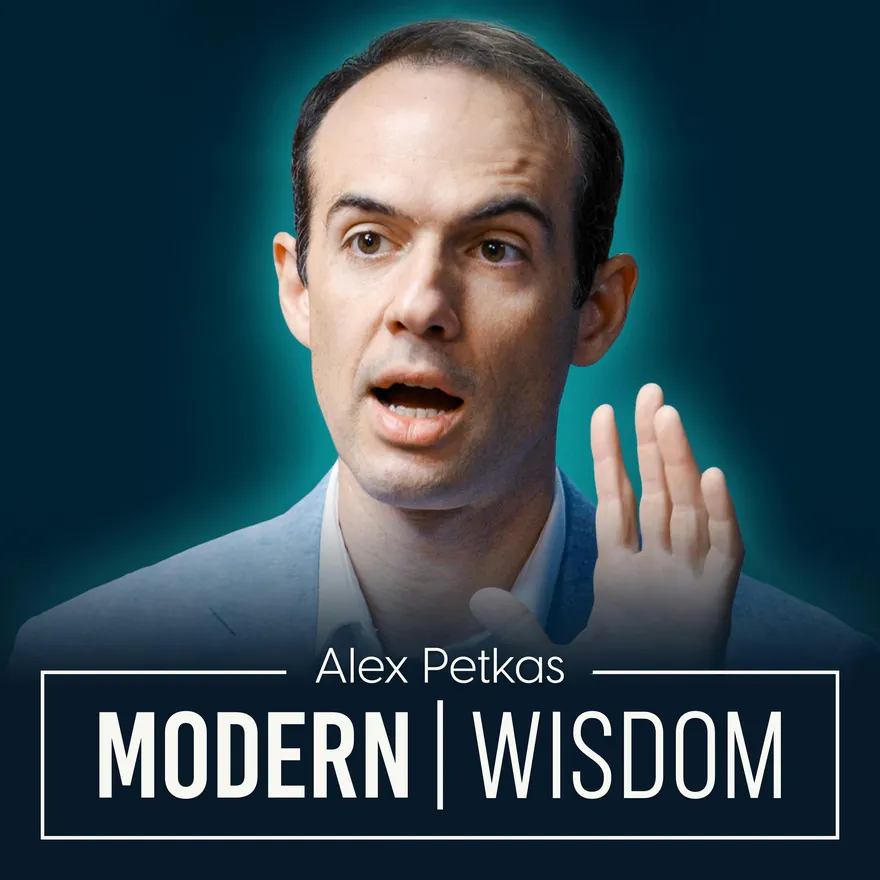
The True Story Of The Odyssey (and why it matters) - Alex Petkas - #1125
In this episode of Modern Wisdom, Alex Petkas explores Homer's Odyssey, examining its plot, characters, and philosophical themes. Petkas walks through Odysseus's ten-year journey home after the Trojan War, highlighting how the hero relies on craft and cunning rather than brute strength to overcome obstacles. The conversation covers the parallel journey of Odysseus's son Telemachus, Penelope's clever strategies to delay remarriage, and the violent restoration of order in Ithaca through the slaughter of the suitors.
Beyond the narrative, Petkas and host Chris Williamson discuss the epic's central themes: the tension between civilization and barbarism, the nature of heroic virtue, divine justice, loyalty, and the prioritization of family over glory. They also explore Homer's historical context as an oral poet, the role of epic poetry in preserving moral knowledge, and the Odyssey's relevance to modern audiences grappling with information overload and shifting cultural values around heroism and storytelling.

This is a preview of the Shortform summary of the Jul 18, 2026 episode of the Modern Wisdom
Sign up for Shortform to access the whole episode summary along with additional materials like counterarguments and context.
1-Page Summary
The Odyssey: Plot, Characters, and Major Events
The "Odyssey" follows Odysseus's struggle to return home and reclaim his place in Ithaca after the Trojan War, weaving together themes of homecoming, justice, and civilization's restoration through craft and cunning rather than brute strength.
Ten-year Journey Reveals Odysseus As a Hero of Craft, Not Strength
The tale opens with Odysseus marooned on Calypso's island for eight years after drawing Poseidon's wrath by blinding the Cyclops Polyphemus. Though Calypso offers immortality and comfort, Odysseus yearns only for home. When the gods compel her to release him, she gives him tools to build his own raft, forcing him to leverage his craft for escape. After enduring storms, he washes up on the Phaeacians' shore, where he charms the princess and queen through eloquent supplication. At their feast, he recounts his adventures: narrowly escaping the lotus eaters, blinding Polyphemus with trickery and wine while claiming his name was "Nobody," encountering the enchantress Circe who transformed his men into pigs, and journeying to the Underworld to seek Tiresias. Despite warnings, his men killed Helios' sacred cattle, resulting in Zeus destroying their ship—Odysseus alone survived. These events underscore that his survival hinges on adaptability, wit, and resilience rather than brute force.
Telemachus's Journey Enables His Father's Return
While Odysseus faces gods and monsters, Ithaca languishes under disorder. His twenty-year-old son Telemachus, who has never met his father, is powerless before 108 suitors who consume the estate's wealth and seek to marry Penelope. Athena urges Telemachus to confront the suitors and journey to Nestor and Menelaus for news. This quest serves as both a rite of passage and a way to gain wisdom and confidence, contrasting well-ordered households with the chaos at home.
Suitors' Violation of Hospitality Justifies Their Slaughter
The suitors' transgressions are profound: they bypass proper marriage protocols, squander household resources, mistreat servants, and abuse guests. Their feasting is godless, without prayers or sacrifices. When Odysseus, disguised as a beggar, enters the hall, the ringleader Antinous hurls a stool at him—an egregious violation of Greek social and religious norms that reflects Ithacan society's degeneration and justifies the bloody fate awaiting them.
Penelope Uses Trickery to Delay Marriage While Maintaining Agency
Penelope, renowned for loyalty and cleverness, faces immense pressure to choose a new husband. She devises a ruse, claiming she must finish weaving a shroud for Odysseus's father while secretly unraveling each night's work. When a maid betrays her, she devises another test: whoever can string Odysseus's great bow and shoot an arrow through twelve axe-heads will win her hand—a feat only possible for Odysseus himself.
Odysseus Executes the Suitors' Slaughter With Crafty Precision
Reunited with Telemachus, Odysseus disguises himself as a beggar to survey the palace and plan revenge. He directs his son to hide weapons, secure disloyal women, and bar the doors. At the contest, Odysseus alone succeeds in bending the bow and shooting through the axe-heads. Taking up the bow—an emblem of guile and mastery—he commences the slaughter, beginning with Antinous. With Telemachus and two loyal herdsmen, they exact vengeance on all 108 suitors in calculated fashion. Maidservants who allied with the suitors are hanged.
Reconciliation and Order Over Endless Revenge Cycles
As news spreads, the suitors' families arm themselves for vengeance, threatening endless bloodshed. Athena descends as a deus ex machina, commanding peace and representing higher justice. The poem's conclusion stresses not only the restoration of rightful rule but also the importance of settling quarrels to enable civilization's return and avert endless retaliation.
Central Themes and Philosophy
Opposition Between Civilization and Barbarism Structures the Narrative
Alex Petkas explains that the Odyssey is fundamentally structured by tension between civilization and barbarism, with Odysseus embodying order, craft, and humanity against wild nature and brute force. The suitors represent violence and chaos—a primordial barbarism that must be overcome for order's restoration.
Cyclopes Live In Isolation, Rejecting Laws
The Cyclopes exemplify barbarism, living in familial isolation while rejecting communal laws and disdaining the gods. Petkas notes that their lack of social order renders them vulnerable—they have no "cultural antibodies of moderation" and cannot unite against threats, as Chris Williamson observes. The Cyclops expects only brute force, leaving him susceptible to Odysseus's cunning: the "Nobody" trick, strategic wine, and the crafted stake demonstrate rational craft's victory over brute strength.
Odysseus's Use of Technology and Craft
Odysseus's construction of a seaworthy boat using materials on Calypso's island exemplifies civilization and technology confronting chaos. Aided by Athena—goddess of craft and civilization—Odysseus faces Poseidon's wild forces: storms, savage creatures, and perilous seas, consistently standing on the side of order, culture, and humanity.
Heroic Virtue in the Odyssey: Endurance, Cunning, Restraint Over Martial Glory
Petkas notes that Odysseus's heroism is defined by psychological discipline—he routinely suppresses impulses for immediate revenge, enduring emotional turmoil as he previously endured the Cyclops's brutality. The bow, seen as dishonorable in the Iliad because it avoids direct confrontation, becomes a just instrument in Odysseus's hands as he dispenses justice against the suitors, demonstrating that morality is shaped by context. His epithets—"many-turned" (polytropos), "much-crafted," and "much-enduring"—underscore his defining virtues: cunning, adaptability, and perseverance over brute force.
Divine Justice Punishes the Guilty and Rewards the Virtuous
The gods embody a justice system that rewards virtue and punishes wrongdoing through moral logic rather than random cruelty. When Odysseus's men disregard Tiresias's warning and eat the sacred cattle, they perish, demonstrating that divine justice enforces moral limits. Aegisthus's murder and adultery invite divine punishment, while Odysseus and Penelope's faithfulness earns them divine assistance. Zeus explicitly states that mortals suffer not from divine cruelty but from their own choices and moral failings.
Loyalty: Marital Fidelity and Household Obligation at the Core
Marital fidelity and household loyalty are central to the Odyssey's moral architecture. Penelope, besieged by suitors and uncertain of Odysseus's fate, becomes the epic's moral exemplar through her intelligence and unwavering loyalty. Petkas notes that Agamemnon, in Hades, marvels at Penelope's faithfulness, which contributes as much to Odysseus's renown as his own exploits—their glory is intertwined. The swineherd Eumaeus further reinforces this theme through his devotion despite twenty years of deprivation. Athena urges Telemachus to become dangerous and use violence to defend household honor, affirming that loyalty sometimes demands aggression.
Poem Suggests Family Legacy and Happiness Over Glory
The encounter with Achilles's ghost challenges Homeric values by suggesting that happiness and family matter more than undying glory. Achilles expresses regret over his choice of glorious death, saying he would rather be a living servant than a renowned but deceased king. Even in death, he concerns himself with familial affairs, underscoring the narrative's prioritization of legacy and relationships over martial fame. Odysseus faces several temptations to forsake his mortal identity, especially when Calypso promises immortality and the Phaeacian princess offers marriage. He rejects both, declaring that he misses his homeland, wife, and child, choosing home and family over paradise and comfort.
Women's Complex Roles: Agents of Power and Moral Instruction
Women in the Odyssey are not mere temptresses but possessors of agency, power, and moral direction. Circe, Calypso, and the Phaeacian princess each wield power over Odysseus's fate—Circe must be appeased with an oath, Calypso's immortality must be refused tactfully, and the princess helps only after respectful navigation of her family's power. Penelope's subtlety, intelligence, and loyalty arguably surpass Odysseus's own qualities. Her devising of the bow contest cleverly stalls the suitors, and her virtue stands out as it is maintained without divine assistance, suggesting heroic virtue beyond traditional male-dominated definitions. Penelope's desirability is amplified by mimetic desire—the suitors value her primarily because she is Odysseus's wife. In the underworld, women—mothers, matriarchs, and queens—come forward first to recount the histories of their sons, brothers, and husbands, narratively preserving the fabric of civilized life and becoming custodians of civilization's collective memory.
Homer, Oral Poetry, and Historical Context
The Greeks Acquired Writing From the Phoenicians
In the eighth century BC, the Greeks adopted writing from the Phoenicians, enabling them to record their language and narrative traditions for the first time. Out of this new literacy emerged the Iliad and the Odyssey, traditionally attributed to Homer, a figure often imagined as a blind bard. Homer's epics blend mythological elements with historical events, specifically the Trojan War believed to have occurred around 1200 BC—almost 400 years before Homer's lifetime. The Greeks regarded these epics as historical fiction, grounding myth in events they accepted as real. Writing allowed the Greeks to capture extensive oral traditions from Indo-European cultures, and Homer's artistry lies in distilling thousands of years of oral storytelling traditions into refined culminations capturing layers of symbolic and cultural meaning.
Blind Bard Mirrors Homer
In the Odyssey, Homer introduces Demodocus, a blind bard performing in the Phaeacian court whose narration of the Trojan Horse moves Odysseus to tears, demonstrating bardic storytelling's profound emotional power. Demodocus's blindness is said to be compensated by the gods with deeper insight into the universe's mysteries and human suffering, reflecting the traditional view of Homer himself—a poet who, though deprived of sight, possesses unique visionary gifts. The character led later Greeks to associate Homer with blindness, constructing a narrative about the poet's life using textual clues, serving as meta-commentary on the poet's role and the bard's unique status.
Oral Cultures Excel In Memory and Verbal Skills
Before writing's spread, oral societies relied on astonishing feats of memorization to preserve and transmit knowledge. Written records diminished these skills as the cognitive burden could be "offloaded" onto text. The shift from oral to written culture brought gains—record keeping, scientific inquiry, bureaucracy—but witnessed the erosion of memorization skills and the intimacy oral storytelling provided. Because Homer's works straddle the line between oral and literate paradigms, they offer unique anthropological insights into pre-literate cultures.
Epic Poets as Moral Pillars and Cultural Conservators
Epic poets were not mere entertainers but served as moral authorities. This is exemplified when Agamemnon leaves a bard with Clytemnestra to recount stories upholding female virtue, reflecting the poet's role as upholder of moral standards. The suitors' disregard for the bard and neglect of prayers are depicted as markers of moral disorder. In oral cultures, poets had the critical responsibility of preserving and transmitting collective moral knowledge across generations.
Modern Cultural Implications
Long-Form Storytelling Counters Information Overload and Decision Fatigue
Chris Williamson and Alex Petkas discuss how contemporary audiences are overwhelmed by information abundance, moving from "information sparse to information dense." Williamson observes that people face exhaustion from constantly processing algorithm-driven streams that simulate importance, leading to decision fatigue. He likens voracious information consumption to overeating—both are now too abundant to metabolize properly. Petkas points out that these streams are constructed to appear vital by algorithmic curation, creating psychological burden. They draw an analogy to the mythic sirens, who tempt listeners with promises of ultimate knowledge—Odysseus, bound to the mast, risks everything for their song. The island, littered with bones, exemplifies the danger of endless curiosity and consumption—knowledge without goal leads to stagnation and ruin. In contrast, engaging with long-form, coherent narratives lets audiences process experiences within archetypal frameworks designed for understanding and reflection. Williamson says he feels "salved after getting in touch with something that's got a bit more firm foundation," allowing people to slow down and find clarity amid continuous inputs.
Entertainment now Favors Flawed Over Virtuous Heroes
Williamson notes that modern entertainment now favors protagonists with hidden flaws or moral complexity, sometimes reinterpreting villains as heroes. He expresses longing for classic hero narratives: "It would be cool to just see what an uncomplicated virtuous hero that's flawed and overcomes his flaws would look like." Petkas references Emily Wilson's translation describing Odysseus as "a complicated man," suggesting "many turned" better captures him—archetypally heroic and full of human limitations. The Odyssey presents a hero with virtues and flaws, inviting debate about his actions as the ancient Greeks themselves did.
Poem's Clarity on Civilization vs. Barbarism
The conversation points out that while there is debate about Odysseus as a character, Homer's value system remains clear. Petkas says, "I don't think that Homer questions Odysseus's values, which are civilization over barbarism, order over chaos, patriarchy over anarchy." The narrative portrays the absence of good men and resulting chaos, remedied only by justice and order's restoration. Rather than descending into relativism, the Odyssey allows meaningful moral exploration because it maintains overarching clarity, affirming that striving for justice and betterment is worthwhile.
The Odyssey: Emphasizing Family and Stability Over Glory
Odysseus's journey is ultimately a choice for home over endless glory. Williamson and Petkas see this aligning with modern shifts toward valuing family, stability, and work-life balance over perpetual hustle. The Odyssey suggests that permanence and meaning come through homecoming, family protection, and passing on values—heroic narratives resonating with the human desire for rootedness.
Odyssey Shows Storytelling Can Embrace Multiple Perspectives
The Odyssey demonstrates how stories can provide multiple perspectives—Odysseus, Telemachus, Penelope, the gods, magical beings—allowing audiences with different backgrounds to find relevance without denying that some choices and characters are better than others. Petkas compares Homer to modern filmmakers with wide audiences, ensuring different listeners can debate Odysseus's actions. Importantly, the poem offers interpretive complexity and moral coherence, providing an alternative to both binary authoritarian tales and relativistic narratives that never pass judgment. As Petkas puts it, Homer's job is "to help you get charmed, get disengaged," allowing the audience to reflect and decide, not just consume, making the epic perpetually fresh and meaningful across generations.
1-Page Summary
Additional Materials
Counterarguments
- The emphasis on Odysseus’s cunning and craft over brute strength can be challenged by noting that physical prowess and violence still play a significant role in his success, especially in the slaughter of the suitors.
- The justification of the suitors’ slaughter as a restoration of justice can be questioned, as the act is extremely violent and raises ethical concerns about proportionality and due process, even by ancient standards.
- The portrayal of Penelope’s agency, while notable, is still constrained by the patriarchal context of the epic, as her primary virtue is defined by loyalty and chastity rather than independent action.
- The opposition between civilization and barbarism is presented in binary terms, which can be criticized as oversimplifying complex societies and reinforcing ethnocentric or exclusionary views.
- The narrative’s valorization of loyalty and household obligation can be seen as reinforcing traditional gender roles and social hierarchies, potentially limiting alternative forms of virtue or family structure.
- The poem’s resolution through divine intervention (Athena’s peace) could be viewed as undermining human agency and the possibility of sustainable, human-driven reconciliation.
- The claim that the Odyssey maintains a clear value system without relativism can be challenged by the poem’s own ambiguities and the morally questionable actions of its hero, which invite debate rather than clear-cut moral conclusions.
- The assertion that the Odyssey aligns with modern values of work-life balance and rootedness may be anachronistic, as the epic’s context and priorities differ significantly from contemporary concerns.
- While the Odyssey features multiple perspectives, the narrative ultimately privileges Odysseus’s viewpoint and authority, potentially marginalizing other voices, especially those of women and the lower classes.
- The idea that epic poets served as moral authorities may overlook the entertainment and political functions of oral poetry, which could include satire, subversion, or reinforcement of elite interests.
Actionables
- You can strengthen your own sense of home and belonging by creating a small ritual that marks your return each day, such as lighting a candle, playing a favorite song, or writing a single sentence about what makes your space feel safe and restorative, reinforcing the value of homecoming and stability.
- A practical way to cultivate resilience and adaptability is to set a weekly challenge where you intentionally solve a minor problem in your life using only resources already at hand, encouraging creative thinking and resourcefulness over brute force or spending.
- You can clarify your personal values and boundaries by listing situations where you feel your hospitality, time, or resources are being taken for granted, then drafting a simple, polite script to use when you need to assert those boundaries, mirroring the restoration of order and justice in your own environment.


Get access to the context and additional materials
The Odyssey: Plot, Characters, and Major Events
The "Odyssey" unfolds over the long period after the Trojan War, as Odysseus struggles to return home and reclaim his place in Ithaca. This epic is as much about his craft and cunning as it is about physical strength, weaving together themes of homecoming, justice, and civilization’s restoration.
Ten-year Journey Reveals Odysseus As a Hero of Craft, Not Strength
The tale opens nearly twenty years after Odysseus departed for Troy. He is marooned on Calypso’s island, having drawn the wrath of Poseidon after blinding the Cyclops Polyphemus—Poseidon's son. For eight years, Odysseus remains Calypso’s reluctant guest: she offers him comfort, immortality, and agelessness, but he yearns only for home. Hermes, sent by Zeus and Athena—Odysseus’s divine protectress—compels Calypso to release him. Rather than simply sending him off, Calypso hands him an axe and an auger and tells him to build his own raft, forcing him to leverage his own craft to secure his escape.
Odysseus braves the sea alone on his raft, enduring Poseidon's storms. Eventually, battered and naked, he washes up on the Phaeacians' shore—a moment symbolizing death and rebirth. He quickly charms the Phaeacian princess Nausicaa and the queen Arete, whose aid he secures through respectful and eloquent supplication. At the subsequent feast, Odysseus’s prowess in athletics and his emotional response to a bard’s song about Troy arouse the king’s curiosity. Only then does Odysseus reveal his identity and recount his adventures in books 9–12, captivating his hosts with tales of his trials.
His journey home was marked by danger and temptation. He narrowly escaped the land of the lotus eaters, whose intoxicating fruit made his men forget their desire for home. On the island of the Cyclopes, Odysseus blinded Polyphemus with trickery and wine, escaping by giving his name as “Nobody” and clinging to the undersides of sheep. Later, Odysseus encountered the enchantress Circe, who transformed his men into pigs—until Hermes, with a divine herb, enabled him to resist her magic and win her favor.
Odysseus continued to the Underworld to seek Tiresias, who warned him to avoid Helios’ sacred cattle. Despite this, Odysseus’s men, desperate with hunger, killed and ate the forbidden cattle. Helios demanded vengeance, and Zeus destroyed their ship—with Odysseus alone surviving, eventually landing on Calypso’s island where the story began. These events underscore that Odysseus’s survival hinges not on brute force but on adaptability, wit, and resilience.
Telemachus's Journey Enables His Father's Return, Highlighting Disorder At Home
While Odysseus faces monsters and gods, Ithaca languishes under disorder. His son, Telemachus, is twenty and has never met his father. He is powerless before 108 suitors who consume the estate’s wealth and seek to marry Penelope, Odysseus’s steadfast wife. The house, deprived of rightful leadership and proper order, is in a state of near-anarchy. Telemachus exists in a liminal space, dominated by these interlopers and unable to assert himself.
Athena, in disguise, visits Telemachus and urges him to confront the suitors and embark on a quest to Nestor and Menelaus—Odysseus’s old allies—for news of his father. On this journey, Telemachus earns the respect of his father’s peers through acts of piety, tact, and restraint, contrasting the well-ordered, god-fearing households of others with the chaos at home. This travel serves both as a rite of passage and a way to gain wisdom and confidence.
Telemachus narrowly escapes an ambush set by the suitors upon his return and ultimately assists Odysseus with the plan for vengeance in Ithaca, a pivotal step in reclaiming order, honor, and family legacy.
Suitors' Violation of Hospitality Justifies Their Slaughter
The suitors’ transgressions are profound. They not only bypass Penelope’s father to formally request her hand but also squander the household’s resources, mistreat servants, and abuse guests. Their feasting is godless; they neither pray nor perform sacrifices. Even when Athena herself arrives in disguise, they fail to offer hospitality—an egregious violation of Greek social and religious norms.
Antinous, their ringleader, epitomizes the group’s arrogance and disrespect. When Odysseus, disguised as a beggar, enters the hall to assess the scene, Antinous hurls a stool at him. This act of violence and lack of reverence reflects the utter degeneration of Ithacan society under the suitors’ rule. Their communal guilt and disdain for the gods and household order justify the bloody fate that awaits them.
Penelope Uses Trickery to Delay Marriage While Remaining Faithful and Maintaining Agency During Odysseus's Absence
Penelope, renowned for her loyalty and cleverness, faces immense pressure to choose a new husband. She devises a ruse to delay the decision by claiming she must finish weaving a shroud for Laertes, Od ...
Here’s what you’ll find in our full summary
The Odyssey: Plot, Characters, and Major Events
Additional Materials
Counterarguments
- While Odysseus is celebrated for his cunning, some critics argue that his actions—such as excessive pride (hubris) and deceit—also bring suffering upon himself and his men, complicating the notion of him as an unequivocal hero.
- The narrative often attributes Odysseus’s success to divine intervention (e.g., Athena’s constant aid), which challenges the idea that his survival is solely due to his own craft and resilience.
- The slaughter of all 108 suitors, including those who may not have been equally culpable, can be seen as excessively brutal and raises questions about the morality of Odysseus’s vengeance.
- Penelope’s agency is limited by the patriarchal context of the epic; her cleverness is primarily exercised within the constraints imposed by male authority and societal expectations.
- The restoration of order in Ithaca is achieved through violence and the reestablishment of patriarchal rule, which some modern readers may view as ...
Actionables
- you can set aside a weekly “resource audit” time to review how you use your time, money, and energy at home, identifying any waste or misuse and making small adjustments to restore order and efficiency, just as Ithaca needed restoration after disorder.
- a practical way to strengthen adaptability and resilience is to keep a “challenge log” where you briefly note daily obstacles and brainstorm at least one creative, non-obvious solution for each, focusing on wit and flexibility rather than force.
- you can create a persona ...
Get access to the context and additional materials
Central Themes and Philosophy
Opposition Between Civilization and Barbarism Structures the Narrative, With Odysseus Symbolizing Order, Craft, and Humanity Against Wild Nature and Brute Force
The Odyssey is fundamentally structured by a tension between civilization and barbarism, with Odysseus as the emblem of order, craft, and humanity battling the disruptive forces of wild nature and brute strength. Alex Petkas explains that the suitors embody violence and chaos, representing a primordial barbarism that must be overcome for order to be restored. This polarity runs throughout the epic: the Greeks view the world in binaries such as civilization versus barbarism, cooked versus raw, or man versus monster.
Cyclopes Live In Isolation, Rejecting Laws for Individual Autonomy, Making Them Vulnerable to Cunning and Strategy
The Cyclopes exemplify the barbaric end of this spectrum. They live in familial isolation, reject communal laws, and disdain the gods, believing every man should be a law unto his own wife and children. Their lack of social order or coordination, according to Petkas, renders them vulnerable. As Chris Williamson notes, their society lacks "cultural antibodies of moderation" and cannot unite against threats. The Cyclops' expectation of only brute force—rather than craft—leaves him susceptible to Odysseus’s cunning. Odysseus’s ultimate escape from the Cyclops through deception (the “Nobody” trick, strategic wine, and the crafted stake) highlights the victory of rational craft over brute strength.
Odysseus's Use of Technology and Craft to Overcome Poseidon's Storms and Monsters
Odysseus’s construction of a seaworthy boat using materials on Calypso’s island, aided by Athena’s patronage, is emblematic of civilization and technology confronting chaos. Athena, goddess of craft and civilization, equips Odysseus to face the wild forces of Poseidon—storms, savage creatures, and perilous seas. Thus, Odysseus consistently stands on the side of order, culture, and humanity.
Heroic Virtue in the Odyssey: Endurance, Cunning, Restraint Over Martial Glory
Odysseus Suppresses Impulses, Emphasizing Psychological Discipline In Heroism
Odysseus’s heroism is defined by psychological discipline—he routinely suppresses impulses for immediate revenge or satisfaction. Petkas notes that Odysseus, like when witnessing the disloyal maids, invokes restraint and patience, enduring emotional turmoil as he previously endured the Cyclops’s brutality. His journey requires endurance, strategy, and self-control more than physical might.
Bow's Transformation: From Dishonorable to Just, Circumstances Shape Morality
The use of the bow, a weapon seen as dishonorable in the Iliad because it avoids direct confrontation, becomes a just instrument in Odysseus’s hands as he dispenses justice against the suitors. This transformation demonstrates that morality in the epic is shaped by context: what is dubious in open battle can become honorable when reclaiming one’s house and order.
Odysseus's Epithets: "Many-Turned," "Much-Crafted," "Much-Enduring"—Master of Deception, Strategy, and Perseverance Over Physical Prowess
The epithets used for Odysseus—“many-turned” (polytropos), “much-crafted,” and “much-enduring”—underscore his defining virtues: cunning, adaptability, and perseverance. Rather than distinguishing himself through brute force, Odysseus excels as a strategist and trickster, mastering deception to survive overwhelming odds. Petkas highlights that these traits would be lost if Odysseus accepted Calypso’s offer and abandoned his quest.
Divine Justice Punishes the Guilty and Rewards the Virtuous, Ensuring Moral Conduct Leads To Restoration, Not Endless Suffering
Tiresias Warns Of Hardship if Odysseus's Men Eat the Sacred Cattle; They Disobey and Perish, Showing Divine Justice Enforces Moral Limits
The gods, particularly Zeus and Athena, embody a justice system that rewards virtue and punishes wrongdoing—not random cruelty, but moral logic. Tiresias warns Odysseus that his men will suffer if they eat the sacred cattle; their disregard for this warning leads to their destruction, demonstrating that divine justice enforces moral limits.
Agamemnon and Aegisthus' Infidelity Invites Punishment; Odysseus and Penelope's Faithfulness Earns Divine Aid
Aegisthus’s murder of his cousin and adultery with Agamemnon’s wife invites divine punishment, adhering to the theme that sins bring their own retribution. By contrast, Odysseus and Penelope’s enduring faithfulness earns them divine assistance and a restored household.
Zeus Ensures Mortals' Suffering Is Due to Their Own Choices, Not Divine Cruelty
Zeus is explicit in the poem: mortals suffer not because the gods are cruel, but because of their own choices and moral failings. Restoration of moral order, not endless torment, is the aim of divine interventions in mortal lives.
Loyalty: Marital Fidelity and Household Obligation at the Core of the Epic
Penelope's Faithfulness Under Pressure From Suitors and Uncertainty About Odysseus's Return Establishes Her As the Moral Exemplar and Foundation of Odysseus's Heroic Identity
Marital fidelity and loyalty to the household are central to the Odyssey’s moral architecture. Penelope, besieged by suitors and uncertain of Odysseus’s fate, becomes the epic’s moral exemplar through her intelligence, virtue, and unwavering loyalty. Agamemnon, in Hades, marvels at Penelope’s faithfulness, which contributes as much to Odysseus’s renown as his own exploits. Petkas notes that their glory is intertwined: Odysseus could not have become the greatest of the Achaeans without Penelope’s clever and constant support.
Eumaeus' Loyalty: A Swineherd's Devotion to Odysseus After 20 Years
The loyalty of Odysseus’s swineherd Eumaeus further reinforces this theme. Despite being a slave and deprived by the suitors, Eumaeus hosts Odysseus (in disguise) with generosity and devotion, upholding the order and virtue of the Odyssean household during its darkest years.
Athena Urges Telemachus to Become Dangerous and Use Violence to Defend His Household's Honor, Teaching That Loyalty Demands Aggression In Protecting Loved Ones
Athena urges Telemachus to emulate Orestes, avenger of his father Agamemnon, and to use violence if necessary to defend household honor. This instruction affirms that loyalty sometimes demands danger and aggression to protect those one loves.
Poem Suggests Family Legacy and Happiness Over Glory
Achilles' Ghost Regrets Choosing Glory Over Life, Preferring to Be a Living Slave Than a Dead King
The encounter with the ghost of Achilles in Hades challenges Homeric values by suggesting that happiness and family matter more than undying glory. Achilles expresses regret over his choice of a glorious death, saying he would rather be a living servant than a renowned but deceased king.
Achilles Prioritizes Family and Revenge Over Fame
Even in death, Achilles concerns ...
Here’s what you’ll find in our full summary
Central Themes and Philosophy
Additional Materials
Counterarguments
- The binary opposition between civilization and barbarism in the Odyssey can be seen as an oversimplification; the poem itself sometimes blurs these boundaries, as some "barbaric" characters (like Nausicaa's people) display hospitality and order, while "civilized" Greeks can act violently or unjustly.
- The depiction of the Cyclopes as wholly barbaric overlooks the fact that their society, while different, is not entirely without order or familial bonds; their autonomy could be interpreted as an alternative social structure rather than pure chaos.
- The valorization of cunning and deception as heroic virtues in Odysseus can be criticized for promoting morally ambiguous behavior, as his trickery often involves lying and manipulation, which are not universally seen as positive traits.
- The idea that divine justice in the Odyssey is always fair and restorative is challenged by episodes where innocent characters suffer due to the whims or grudges of the gods (e.g., Odysseus’s prolonged suffering due to Poseidon’s anger).
- The emphasis on marital fidelity and household loyalty as the moral core of the Odyssey can be critiqued for reinforcing patriarchal values, especially since Odysseus is not held to the same standards of fidelity as Penelope.
- The claim that Penelope’s intelligence and fidelity surpass Odysseus’s qualities may be overstated, as her actions are often constrained by her social position and lack of agency compared to Odysseus.
- The portrayal of women as primarily agents of temptation or moral instruction risks reducing their roles to functions in the male hero’s journey, rather than recognizing t ...
Actionables
- you can strengthen your household’s sense of order and loyalty by creating a simple family or household charter that lists shared values, responsibilities, and rituals, then review it together monthly to reinforce unity and purpose
- (For example, agree on a few core principles like honesty, mutual support, and respect, assign rotating roles for chores or decision-making, and set a recurring time to revisit and update the charter as a group.)
- a practical way to cultivate cunning and adaptability is to set up a weekly “problem swap” with a friend or family member, where you each describe a current challenge and brainstorm creative, non-obvious solutions for each other
- (For instance, if you’re struggling with a work deadline, your partner might suggest an unconventional time-management trick or a way to delegate tasks, while you help them find a clever workaround for a household issue.)
- you can honor and preserve your ...
Get access to the context and additional materials
Homer, Oral Poetry, and Historical Context
The Greeks Acquired Writing From the Phoenicians and Created the First Literary Works, the Odyssey and the Iliad
In the eighth century BC, the Greeks adopted writing from the Phoenicians, making significant modifications to suit their linguistic needs. This innovation enabled them, for the first time, to record their language and narrative traditions in written form. Out of this new era of literacy emerged two of the greatest works of literature, the Iliad and the Odyssey, traditionally attributed to Homer, a figure often imagined as a blind bard living in this period.
Homer Composed These Epics In the Eighth Century Bc, Blending Mythology and Historical Events From the Trojan War 400 Years Earlier
Homer’s epics are not mere works of fiction; instead, they blend mythological elements with historical events, specifically the Trojan War, which was believed by the Greeks to have occurred around 1200 BC—almost 400 years before Homer's lifetime. The Greeks regarded these epics as a form of historical fiction, grounding myth in events they widely accepted as real, even if not in every narrative detail presented by Homer.
Writing Enabled Greeks to Preserve Oral Traditions From Indo-European Cultures
The adoption of writing allowed the Greeks to capture and conserve the extensive oral traditions that stemmed from Indo-European cultures. Greek, as part of the Indo-European language family, shares deep thematic and structural influences with other epic traditions, such as those preserved in Sanskrit’s Mahabharata.
Homer Distilled Millennia of Oral Storytelling Traditions: Refining Material Evolved Over Generations
The artistry of Homer lies in his distillation of thousands of years of oral storytelling traditions. The tales of the Trojan War and Greek heroes had circulated and evolved for centuries before being crystallized in written form. Homer's compositions thus represent a refined culmination, capturing layers of symbolic and cultural meaning that had accrued over countless generations.
Blind Bard Mirrors Homer, Suggesting Odyssey As Meta-Commentary on Poet's Societal Role
Demodocus, the Blind Bard, Performs In Book Eight; Odysseus Weeps At the Trojan Horse Tale, Showing Bardic Narration's Power
In the Odyssey, Homer introduces Demodocus, a blind bard performing in the court of the Phaeacians. His narration of the Trojan Horse episode moves Odysseus to tears, demonstrating the profound emotional power and cultural authority of bardic storytelling.
Blindness as Deeper Vision: Homer’s Poetic Insight Beyond Physical Limitations
Demodocus’s blindness is said to be compensated by the gods with deeper insight into the mysteries of the universe and the nature of human suffering. This motif reflects the traditional view of Homer himself—a poet who, though deprived of sight, possesses a unique visionary gift.
Inference of Homer's Blindness From Demodocus's Character Created a Tradition About the Poet's Life Based On Textual Evidence
The character of Demodocus has led later Greeks to associate Homer with blindness, constructing a narrative about the poet’s life using textual clues. This literary self-insertion serves as a meta-commentary on the poet’s role and the unique status of the bard within society.
Oral Cultures Excel In Memory and Verbal Skills Before Writing Dominates
Oral Societies Develop Near-Perfect Recall That Fades With Written Records Availability
Before the spread of writing, oral societies relied on astonishing feats of memorization and verbal dexterity to preserve and transmit knowledge. The introduction of written records diminished these skills, as the cognitive burden of memory could be "offloaded" onto text.
Shift From Oral To Written: Gains Records, Science, Bureaucracy; Loses Memorization, Story Intimacy
The shift from oral to written culture brought major gains—such as record keeping, scientific inquiry, a ...
Here’s what you’ll find in our full summary
Homer, Oral Poetry, and Historical Context
Additional Materials
Counterarguments
- The attribution of the Iliad and the Odyssey to a single author named Homer is debated among scholars; some argue these epics are the product of multiple poets and generations of oral tradition rather than a single individual.
- The dating of the composition of the Iliad and the Odyssey to the eighth century BC is not universally agreed upon; some evidence suggests parts of the poems may have been composed or modified later.
- The extent to which the Iliad and the Odyssey reflect actual historical events from the Trojan War is uncertain; archaeological and historical evidence for the Trojan War is inconclusive, and many scholars view the epics primarily as myth rather than historical fiction.
- The idea that writing immediately enabled the preservation of oral traditions may be overstated; oral performance and transmission continued to play a significant role in Greek culture for centuries after the introduction of writing.
- While Greek epic shares similarities with other Indo-European traditions, direct influence or borrowing from texts like the Mahabharata is not established; similarities may arise from shared cultural heritage rather than direct contact.
- The motif of the blind bard as a symbol of poetic insight is a literary trope found in various cultures and may not reflect historical reality about Homer or ancient poets.
- The claim that oral societies had "near-perfect recall" is likely exaggerated; while oral cultures ...
Actionables
- you can strengthen your memory and storytelling skills by memorizing and retelling a short family story or local legend to friends or family without notes, focusing on vivid details and emotional impact to recreate the intimacy of oral storytelling and test your recall.
- a practical way to explore the symbolic power of blindness and insight is to listen to or recite a poem or story with your eyes closed, then reflect on how removing visual input changes your understanding, emotional response, or imagination.
- you can experiment with blending myth a ...


Get access to the context and additional materials
Modern Cultural Implications
Long-Form Storytelling Counters Information Overload and Decision Fatigue
Chris Williamson and Alex Petkas discuss how contemporary audiences are overwhelmed by the sheer abundance of information available, moving society from a state of "information sparse to information dense." Williamson observes that people face exhaustion from constantly processing algorithm-driven streams that simulate importance, leading to decision fatigue: “There is a fatigue, an exhaustion that a lot of people have.” Even accomplished leaders, he notes, long for simple choices rather than constant overthinking: “Can you just fucking tell me what I want, please?”
Williamson details how modern life feels saturated with action items and contradictory data, producing a state where people no longer know what they’re supposed to do and become apathetic. He likens voracious information consumption to overeating—both are now too abundant to metabolize in the way they could have been centuries ago. Petkas points out that these streams of information are constructed to appear vital by algorithmic curation, which creates the psychological burden of feeling everything is actionable or urgent.
They draw an analogy to the mythic sirens, who tempt listeners with promises of ultimate knowledge. Odysseus, bound to the mast and compelled by curiosity, risks everything for the sirens' song of secret truths. The island, littered with the bones of those who gave in, exemplifies the danger of endless curiosity and consumption for its own sake—knowledge without goal leads to stagnation and ruin.
In contrast, engaging with a long-form, coherent narrative—like listening to ancient stories—lets audiences process experiences within an archetypal framework designed for understanding, reflection, and integration, rather than defaulting to reactive, unreflective consumption. Stories offer a reprieve: “If you’re not careful, people are gonna find escapes that are way more destructive than just being able to relinquish, [and] listen to an awesome historian tell a story… I’ve had a bit of a reprieve, isn’t that nice?” Williamson says he feels “salved after getting in touch with something that’s got a bit more firm foundation.” This archetypal structure allows people to slow down, reflect, and find clarity amid the chaos of continuous inputs.
Entertainment now Favors Flawed Over Virtuous Heroes
Chris Williamson notes that modern films and television now favor protagonists with hidden flaws or moral complexity. Rather than simply virtuous heroes, today’s stories often stress a hero’s need for some form of redemption, sometimes so deeply that it creates an environment where even the villains are reinterpreted as heroes—such as the antiheroes of "Suicide Squad" or Marvel’s Loki. These ambiguous figures create cultural commentary and debate, with audiences sometimes left without clear answers or moral satisfaction.
Williamson sees risk in this trend, saying, "It would be cool to just see what an uncomplicated virtuous hero that’s flawed and overcomes his flaws would look like. Like just follow me the fucking hero’s journey, please." He expresses longing for classic hero narratives rather than constant asterisks: "I don’t want to have to be an asterisk after every hero of good."
Petkas references Emily Wilson’s translation of The Odyssey describing Odysseus as “a complicated man.” Petkas suggests that "complicated" might not quite capture Odysseus, who is best described as “many turned,” being both attractive to the divine and the greatest among Greek heroes—archetypally heroic and full of human limitations. The Odyssey presents a hero with virtues and flaws, inviting debate about his actions and nature, as did the ancient Greeks themselves.
Poem's Clarity on Civilization vs. Barbarism and Order vs. Chaos in a Relativistic Culture
The Odyssey Prefers Civilization, Justice, and Order Over Their Opposites
The conversation points out that while there is debate about Odysseus as a character, Homer’s value system remains clear: The Odyssey privileges civilization over barbarism and order over chaos. Petkas says, "I don’t think that Homer questions Odysseus’s values, which are civilization over barbarism, order over chaos, patriarchy over anarchy. That doesn’t seem complicated." The narrative portrays the absence of good men and the resulting rise of chaos and violence, remedied only by the restoration of justice and order.
Moral Clarity Enables Meaningful Exploration of Complexity
Rather than descending into relativism, The Odyssey allows fo ...
Here’s what you’ll find in our full summary
Modern Cultural Implications
Additional Materials
Clarifications
- Algorithm-driven streams refer to digital content feeds, like social media or news apps, where computer programs select and order information based on user behavior and preferences. These algorithms analyze data such as clicks, likes, and watch time to predict what will keep users engaged. This curation creates a personalized, continuous flow of content designed to capture attention and encourage prolonged consumption. As a result, users often receive information that feels urgent or important, even if it is not objectively so.
- Decision fatigue refers to the deteriorating quality of decisions made by an individual after a long session of decision-making. It occurs because the brain's ability to make choices weakens with overuse, leading to impulsive or avoidant behaviors. Psychologically, it can cause stress, reduced self-control, and mental exhaustion. Managing decision fatigue often involves simplifying choices or limiting decisions to preserve mental energy.
- In Greek mythology, the Sirens are creatures whose enchanting songs lure sailors to their deaths on rocky shores. Odysseus, forewarned about the danger, orders his men to plug their ears with beeswax and has himself tied to the mast of his ship. This way, he can hear the Sirens' song without being able to steer the ship toward them. His restraint symbolizes resisting temptation through self-discipline and foresight.
- An "archetypal framework" in storytelling refers to universal patterns and symbols that recur across cultures and time. These include common character types like heroes, mentors, and villains, as well as narrative structures such as the hero’s journey. This framework helps audiences instinctively understand and connect with the story’s deeper meanings. It provides a shared language for exploring human experiences and emotions.
- Antiheroes are central characters who lack traditional heroic qualities like morality or idealism but still engage the audience’s sympathy. "Suicide Squad" features villains forced into heroic acts, blurring lines between good and evil. Marvel’s Loki is a trickster god whose motives shift, making him both antagonist and sympathetic figure. These characters challenge simple moral judgments, reflecting complex human nature.
- The "hero’s journey" is a common storytelling framework identified by Joseph Campbell. It describes a hero who leaves their ordinary world, faces challenges and trials, gains new knowledge or power, and returns transformed. This structure often includes stages like the call to adventure, crossing the threshold, ordeal, and return with a boon. It serves as a universal pattern for many myths, legends, and modern stories.
- Emily Wilson is the first woman to publish a complete English translation of The Odyssey, released in 2017. Her translation is praised for its clear, contemporary language and fresh perspective on the ancient text. Wilson’s work highlights the complexity of Odysseus’s character and challenges traditional interpretations. This makes her translation influential in modern discussions about the poem’s themes and characters.
- "Civilization over barbarism" means valuing structured societies with laws and culture instead of chaotic, violent, or uncivilized behavior. "Order over chaos" emphasizes stability, rules, and predictability rather than disorder and confusion. "Patriarchy over anarchy" refers to a social system where authority, often male-led, maintains hierarchy and governance, contrasting with a lack of government or lawlessness. These value systems reflect a preference for stability, hierarchy, and social cohesion as foundations for a functioning society.
- Moral relativism is the belief that right and wrong vary between cultures or individuals, with no absolute standards. Moral clarity means having clear, consistent principles that define good and bad behavior across situations. Stories with moral clarity guide audiences toward shared values and judgments. Relativism can lead to indecision or the idea that all viewpoints are equally valid, making firm judgment difficult.
- The Odyssey is ...
Counterarguments
- The assertion that long-form storytelling is inherently superior for processing information may overlook the value and accessibility of short-form content, which can efficiently convey key ideas to time-constrained audiences.
- The analogy between information consumption and overeating may be overstated; individuals can develop digital literacy and filtering skills to manage information intake effectively.
- The claim that algorithmic curation universally increases stress and fatigue does not account for users who find personalization helpful in discovering relevant content and reducing irrelevant noise.
- The preference for classic, virtuous heroes may ignore the appeal and psychological realism of morally complex characters, who can foster empathy and nuanced understanding of human nature.
- The idea that modern entertainment’s focus on flawed heroes risks losing moral clarity may underestimate audiences’ ability to discern and debate ethical issues within complex narratives.
- The portrayal of The Odyssey’s value system as unambiguously privileging civilization, order, and patriarchy may be critiqued for overlooking the problematic aspects of these values, such as exclusion or oppression inherent in ancient hierarchies.
- The emphasis on family and stability over glory in The Odyssey may not resonate with all modern audiences, particularly those who value individual achievement, exploration, or non-traditional family structures.
- The claim that Th ...
Get access to the context and additional materials


Create Summaries for anything on the web
Download the Shortform Chrome extension for your browser
