

#1067 - Cal Newport - The collapse of modern attention (and how to get it back)
In this Modern Wisdom episode, Cal Newport examines the state of human attention in today's workplace, where knowledge workers face interruptions every few minutes due to communication tools like email and Slack. Newport discusses how this "hyperactive hive mind" approach affects work quality and explains practical strategies for managing workload and team communication, including implementing scheduled check-ins and tracking deep work hours.
The conversation also explores AI's impact on knowledge work, particularly in fields like legal advice and journalism, while addressing concerns about "work slop" - low-quality content produced by AI tools. Newport emphasizes the importance of developing cognitive skills through activities like reading physical books and explains why maintaining the ability to focus and think deeply provides a competitive advantage in an AI-integrated workplace.


This is a preview of the Shortform summary of the Mar 5, 2026 episode of the Modern Wisdom
Sign up for Shortform to access the whole episode summary along with additional materials like counterarguments and context.
1-Page Summary
Distraction and Lack of Focus in Modern Work
In a discussion between Chris Williamson and Cal Newport, they explore how modern work culture impacts concentration and productivity. Newport points to a Microsoft study showing knowledge workers are interrupted every two to three minutes, primarily by communication tools like email and Slack. This "hyperactive hive mind" approach to work severely hampers focused work and quality output.
The conversation then turns to AI's impact on work quality. Newport introduces the concept of "work slop," referring to the low-quality, often error-filled content produced by AI tools. He expresses concern that over-reliance on AI might further diminish human cognitive abilities and capacity for deep work.
Workload and Communication Strategies for Deep Work
Newport advocates for explicit workload management systems to combat constant interruptions. He suggests limiting concurrent tasks and implementing a central "to-do" system for unassigned work. To improve communication, he recommends replacing constant messaging with scheduled check-ins and office hours, along with daily stand-up meetings to coordinate team tasks.
Drawing from his experience at MIT, Newport emphasizes the importance of tracking deep work hours and sharing successful outcomes with peers, creating a culture that values focused effort and quality results.
Impact of AI on Work and Focus
Newport discusses AI's immediate impact on knowledge work, particularly in legal advice, graphic design, and customer service sectors. While acknowledging AI's utility, both hosts warn against overreliance, citing examples of AI-generated errors in legal briefs and journalism.
Regarding quantum computing's role in AI, Newport cautions against the hype, explaining that quantum computers face significant technical challenges before they can meaningfully impact AI development.
Importance of Developing Cognitive Skills
Newport compares regular reading to physical exercise, emphasizing its role in developing complex reasoning abilities. He and Williamson discuss how physical books offer a different experience from digital reading, fostering deeper understanding and nuanced thinking.
Newport argues that deep work skills provide a competitive advantage in the knowledge economy, especially as AI becomes more prevalent. He emphasizes that focus and deep thinking are learnable skills, similar to building physical strength through consistent training.
1-Page Summary
Additional Materials
Counterarguments
- The frequency of interruptions may vary widely depending on the industry, company culture, and individual roles; some workers may experience fewer interruptions or have developed effective strategies to manage them.
- The "hyperactive hive mind" approach might be beneficial for certain types of collaborative work that require rapid iteration and feedback, and not all work requires deep focus.
- AI tools can also produce high-quality content and improve productivity when used appropriately, and the quality of AI-generated content is likely to improve over time.
- Humans have the ability to adapt and enhance their cognitive abilities in conjunction with AI tools, rather than being diminished by them.
- Explicit workload management systems may not be suitable for all types of work or all workers, and some may find them too rigid or constraining.
- Scheduled check-ins and office hours may not be practical for global teams working across different time zones, and constant messaging can be necessary for timely communication.
- The impact of AI on knowledge work sectors can be positive, increasing efficiency and allowing human workers to focus on more complex tasks that AI cannot handle.
- Quantum computing, despite its current challenges, has the potential to revolutionize various fields, including AI, and dismissing its future impact may be premature.
- Digital reading has its own advantages, such as accessibility and convenience, and can also support deep understanding and nuanced thinking when used effectively.
- Deep work skills are valuable, but collaboration and the ability to multitask are also important in the modern knowledge economy.
- The development of focus and deep thinking skills may not be as straightforward as physical training, and different individuals may require different approaches to cultivate these skills.
Actionables
- You can create a "focus playlist" with instrumental music or ambient sounds that signal your brain it's time to engage in deep work, helping to minimize distractions from communication tools.
- Start by selecting music or sounds that are calming and lack lyrics, as they are less likely to distract you. Use this playlist exclusively when you need to concentrate, which will help create a Pavlovian response in your brain, associating these sounds with focused work time. Over time, just starting the playlist will help cue your mind to enter a state of deep concentration.
- Develop a personal "communication charter" that outlines specific times you'll check emails and messages, and share it with your colleagues to set expectations.
- Draft a simple document that specifies when you will be available for communication and when you are focusing on deep work. For example, you might decide to check emails only at 11 AM and 4 PM each day. Inform your colleagues of this schedule so they know when to expect responses. This can help reduce the frequency of interruptions and encourage others to respect your deep work time.
- Engage in a weekly "analog hour" where you read a physical book or engage in a non-digital activity that requires complex reasoning, like strategic board games or puzzles.
- Choose a time each week to disconnect from all digital devices and spend an hour with a physical book or a mentally stimulating activity that doesn't involve a screen. This practice can enhance your cognitive skills and provide a restful break from the digital world, promoting deeper understanding and nuanced thinking similar to the benefits of reading physical books.



Get access to the context and additional materials
Distraction and Lack of Focus in Modern Work
Chris Williamson and Cal Newport discuss the detrimental effects of modern work culture on employees’ ability to concentrate and produce deep, quality work.
Modern Work Culture Prioritizes Speed and Output Over Quality and Depth
Williamson and Newport note that unlike athletes, whose performance is easily measured, many people work in environments where their contributions are diffuse and hard to quantify. This ambiguity makes it difficult to understand how lifestyle factors, such as disrupted sleep, might affect one's performance.
Email, Slack, and Tools Cause "Hyperactive Hive Mind," Hindering Deep Work Through Constant Task-Switching and Interruptions
Newport brings attention to a Microsoft study that shows knowledge workers are hindered by constant interruptions, primarily due to frequent switching to communication tools like email and Slack. This constant task switching, described as a "hyperactive hive mind," leads to context switching every two or three minutes and is identified as an unproductive way to work. Newport criticizes the shift toward ad hoc, unscheduled messaging that these tools promote, which he says leads to distraction and makes it challenging to engage in focused, valuable work. The hosts lament that modern work life often emphasizes responsiveness and multitasking over the quality of silent, focused work. Distractions, such as smartphones, further decrease people's comfort with concentration.
Research Shows Workers Switch Tasks and Tools Every two Minutes, Hampering Focus and Quality Work
Newport cites a report showing workers turn to communication tools approximately every two minutes, disrupting focus and productivity. The report mentions that people only tend to turn to core productivity tools like Word or PowerPoint more on the weekends, implying the deferral of focused work. Newport and Williamson are concerned that the frequent context switching is exhausting and the coordination activities, such as quick responses on Slack or numerous meetings, provide no actual economic value by themselves.
The "Workslop" Issue - AI-generated Content Worsening Shallow, Low-quality Work
Newport introduces the term "work slop" to describe the negative impact AI-generated work products have on the quality of output.
AI Tools Often Produce Low-quality Work
Williamson and Newport discuss instances where AI tools, like ...
Here’s what you’ll find in our full summary
Distraction and Lack of Focus in Modern Work
Additional Materials
Counterarguments
- Modern work culture also values innovation and adaptability, which can sometimes require speed and the ability to multitask.
- Some roles and industries may benefit from the agility and rapid communication enabled by tools like email and Slack.
- Task-switching is not inherently unproductive; it can sometimes lead to creative problem-solving and innovation.
- The use of communication tools can enhance collaboration and team cohesion, which is also valuable in the workplace.
- Not all AI-generated content is low-quality; some AI tools can produce work that meets or exceeds human standards in certain contexts.
- AI tools can augment human capabilities and free up time for workers to engage in more complex, deep work tasks.
- Proper training and guidelines can help workers use AI tools effectively without diminishing their cognitive ...
Actionables
- You can establish a "deep work" schedule by blocking off uninterrupted time in your calendar for focused tasks. During these periods, turn off notifications and inform colleagues that you're in a deep work session to minimize interruptions. For example, you might set aside two hours in the morning when you're most alert for complex tasks that require concentration.
- Create a personal "communication charter" to define when and how you'll use communication tools. This might include setting specific times to check emails and messages, using auto-responders to manage expectations for your response times, and choosing more deliberate communication methods, like scheduled calls for complex discussions, instead of relying on ad hoc messaging.
- Experiment with analog tools for c ...

Get access to the context and additional materials
Workload and Communication Strategies for Deep Work
Cal Newport examines strategies to manage workloads and improve communication in order to facilitate deep work—a concentrated, distraction-free form of work critical for solving complex problems.
Implementing Explicit Workload Tracking and Management Systems
Limiting Concurrent Tasks to Prevent Overload
Newport stresses the importance of managing workload to mitigate the impact of communication interruptions, suggesting limits or transparency on the number of ongoing tasks. He draws a clear line to the negative impact when adding more things to one's workload beyond a certain point, as the value does not increase indefinitely and might even begin to decrease. He advocates for a strategy of saying no to many things to optimize reward and output.
Central "To-do" System for Unassigned Tasks and Projects
Newport suggests establishing an explicit workload tracking and management system to oversee what everyone is working on, emphasizing the implementation of an ideal Work in Progress (WIP) limit to prevent productivity from dropping. He also discusses that by default, tasks should go to a team plate rather than becoming the sole responsibility of an individual, recommending that individuals should work on only three tasks at a time and pull in an additional task only when one is completed.
Establishing Protocols and Norms Around Communication and Collaboration
Banning Constant Messaging for Scheduled Check-Ins and Office Hours
Newport criticizes the "hyperactive hive mind" communication style that necessitates constant inbox checking, and suggests we must change how inboxes are used. He proposes eliminating the "hyperactive hive mind" by moving any issue that requires more than a simple message response to real-time, face-to-face discussions, rather than digital communication platforms. To prevent an explosion of meetings, Newport recommends instituting scheduled daily office hours where all necessary communication can occur, significantly reducing email overload.
Protocols to Reduce Unscheduled Communication in Collaborative Work
He supports this approach with stand-up meetings each morning within teams to coordinate tasks and needs, replacing the chaotic unfolding of tasks that would typically happen over Slack or email. Chris Williamson hinted at a solution involving not utilizing Slack before 1 p.m. to permit uninterrupted focus on work. The idea is to encourage precise, scheduled communication instead of succumbin ...
Here’s what you’ll find in our full summary
Workload and Communication Strategies for Deep Work
Additional Materials
Counterarguments
- Limiting concurrent tasks might not be suitable for all types of work or industries, where multitasking or rapid task switching is necessary.
- Saying no to many tasks could potentially lead to missed opportunities or the perception of uncooperativeness in collaborative environments.
- A central "To-do" system might not account for the dynamic nature of certain jobs where priorities shift frequently and rapidly.
- A strict Work in Progress (WIP) limit might not be flexible enough to accommodate urgent tasks that arise unexpectedly.
- The recommendation to work on only three tasks at a time may not consider individual differences in work style and capacity.
- Scheduled daily office hours might not align with the varying schedules and time zones of a global or remote workforce.
- Real-time, face-to-face discussions are not always feasible in remote or distributed teams and might exclude team members who cannot be physically present.
- Daily stand-up meetings could become redundant or time-consuming if not managed efficiently.
- Avoiding the use of communication tools like Slack before a certain time might not be practical for teams that operate across different time zones.
- Encouraging precise, scheduled communication could lead to delay ...
Actionables
- You can create a visual task board in your living space using sticky notes to physically limit your work in progress. Designate a wall or board where you place sticky notes for each task you're currently working on, with a maximum of three at any time. When you complete a task, remove its note and only then add a new one. This tangible system makes it harder to overload yourself and keeps your focus on the most important tasks.
- Develop a personal policy for communication blackouts during your peak productivity hours. Decide on a 3-4 hour window each day when you turn off notifications and inform your contacts that you won't be available during this time. For example, you might choose 9 a.m. to 1 p.m. as your blackout period for deep work. This helps establish boundaries and ensures you have uninterrupted time for complex ...
Get access to the context and additional materials
Impact of AI on Work and Focus
The integration of artificial intelligence (AI) tools into the workspace is shaking up established industries and workflows, and while their limitations suggest caution, the rapid advancements in technology demand close attention to potential consequences for jobs and task execution.
AI Tools Like Language Models Have Limitations but Will Impact Knowledge Work
Narrow AI Disrupts Industries, Causing Job Losses and Changes
Cal Newport discusses the impact of AI, emphasizing that AI will first affect sectors well-suited to what current AI tools can do, with legal advice, graphic design, and customer service highlighted as vulnerable. This is supported by the "SaaSpocalypse," where software service companies are seeing a drop in stock prices, indicating market anticipation of AI disrupting industries, potentially leading to job losses and industry changes.
AI Automation Risks Worsening Task Execution
Chris Williamson admires AI tools like ChatGPT but warns against overreliance, citing its limitations, like inapplicability to case law. Cal Newport and others believe that while AI can streamline knowledge work, it can also risk task accuracy. One alarming example is the sanctioned lawyer who used ChatGPT to draft a court brief, leading to submission errors. Newport himself experienced ChatGPT's limitations when it generated an incorrect quote for his New Yorker essay. As AI changes the method of programming, transforming complex cognitive tasks into management of 'code agents,' there's debate over the trust placed in AI-produced outcomes.
Quantum Computing's Role in AI Remains Unproven Despite "Quantum AI" Hype
Despite intrigue and the burgeoning field of Quantum AI, or QAI, Newport suggests that quantum computing plays a minimal to nonexistent role in AI currently, describing quantum computing as neither a panacea for AI challenges nor a high-speed version of traditional computing. Problems must be cast in physics terms to be solved quantumly, limiting applicability.
Quantum Computers Aren't a Panacea for AI Challenges
Newport ...
Here’s what you’ll find in our full summary
Impact of AI on Work and Focus
Additional Materials
Clarifications
- The term "SaaSpocalypse" refers to a sharp decline in the stock prices of Software as a Service (SaaS) companies. This drop reflects investor concerns about AI automating tasks these companies support, potentially reducing demand for their services. It signals market anticipation of disruption in the software industry due to AI advancements. The term combines "SaaS" and "apocalypse" to emphasize the severity of the impact.
- Narrow AI refers to artificial intelligence designed to perform a specific task or a limited range of tasks, unlike general AI which aims to perform any intellectual task a human can. It operates under predefined rules and data, lacking true understanding or consciousness. Examples include language translation tools or recommendation systems. Narrow AI excels in specialized applications but cannot generalize knowledge across different domains.
- "Code agents" are autonomous AI programs that can write, test, and modify code with minimal human input. They shift programming from manual coding to overseeing and managing these AI-driven agents. This approach allows developers to focus on higher-level design and problem-solving rather than detailed syntax. It represents a move toward treating programming as directing intelligent collaborators rather than writing every line of code.
- AI tools like ChatGPT generate responses based on patterns in large datasets but lack true understanding of complex legal principles. They cannot interpret nuanced case law or apply jurisdiction-specific rules accurately. Their training data may be outdated or incomplete, leading to errors in specialized contexts. Human expertise is essential to verify and contextualize AI-generated legal information.
- Qubits are the basic units of information in quantum computing, analogous to bits in classical computing. Unlike bits, which are either 0 or 1, qubits can exist in multiple states simultaneously due to superposition. This property allows quantum computers to process complex calculations more efficiently than classical computers for certain problems. However, qubits are highly sensitive to errors and require precise control, making scaling quantum computers challenging.
- Quantum computing relies on quantum bits (qubits) that operate using principles of quantum mechanics, such as superposition and entanglement. To leverage these quantum effects, problems must be translated into mathematical formulations compatible with quantum physics. This often means expressing problems as quantum algorithms or Hamiltonians that describe energy states in physical systems. Classical problems not naturally expressed this way are difficult to solve efficiently on quantum computers.
- Quantum computers use quantum bits, or qubits, which can represent multiple states simultaneously, unlike classical bits. Scaling means increasing the number of qubits while maintaining their quantum properties, which is difficult due to qubit fragility. Errors occur because qubits are highly sensitive to environmental noise and interference, causing loss of information. Managing these errors requires complex error correction techniques that are currently resource-intensive and not fully developed.
- "Hype migratio ...
Counterarguments
- AI tools may not necessarily lead to job losses but could instead transform jobs, requiring workers to adapt and reskill.
- The impact of AI on industries like legal advice, graphic design, and customer service could enhance productivity and create new opportunities rather than simply displacing jobs.
- The "SaaSpocalypse" might reflect market corrections or other economic factors, not solely the anticipation of AI disruption.
- Properly implemented AI can improve task execution and accuracy by reducing human error and increasing efficiency.
- The sanctioned lawyer's misuse of ChatGPT may reflect a lack of understanding or misuse of the tool rather than an inherent limitation of AI.
- AI-generated code agents could lead to more reliable and consistent outcomes if they are well-designed and properly supervised.
- Quantum computing, while in its infancy, has the potential to solve certain types of problems much faster than classical computers, which could eventually revolutionize AI.
- The challenges of scaling quantum computers and managing error rates are areas of active research, and breakthroughs could occur soone ...
Get access to the context and additional materials
Importance of Developing Cognitive Skills: Deep Work and Focus
The conversation with Cal Newport and Chris Williamson provides an insightful look at the pressing need for enhanced cognitive skills in an era where Artificial Intelligence (AI) and digital distractions are omnipresent.
Reading Physical Books Fosters Advanced Thought Patterns
Newport compares regular reading to the cognitive equivalent of physical exercise, recommending a daily page count as a baseline to ensure cognitive systems are being used. He discusses the profound impacts of reading on brain development, especially through the complex process Mary Ann Wolf calls "deep reading," which fosters deeper understanding and complex reasoning.
Williamson and Newport explore the differences between reading on physical mediums like books and Kindles, which offer a tangibly different experience from rapidly skimming through web pages. They argue that reading well-crafted long-form content allows the brain to foster intricate patterns of understanding. Newport posits that the nuance found in substantial readings aids in grasping that truths are often not black and white but riddled with gradients and complexity.
Deep Work Fosters Expertise and High-Quality Output
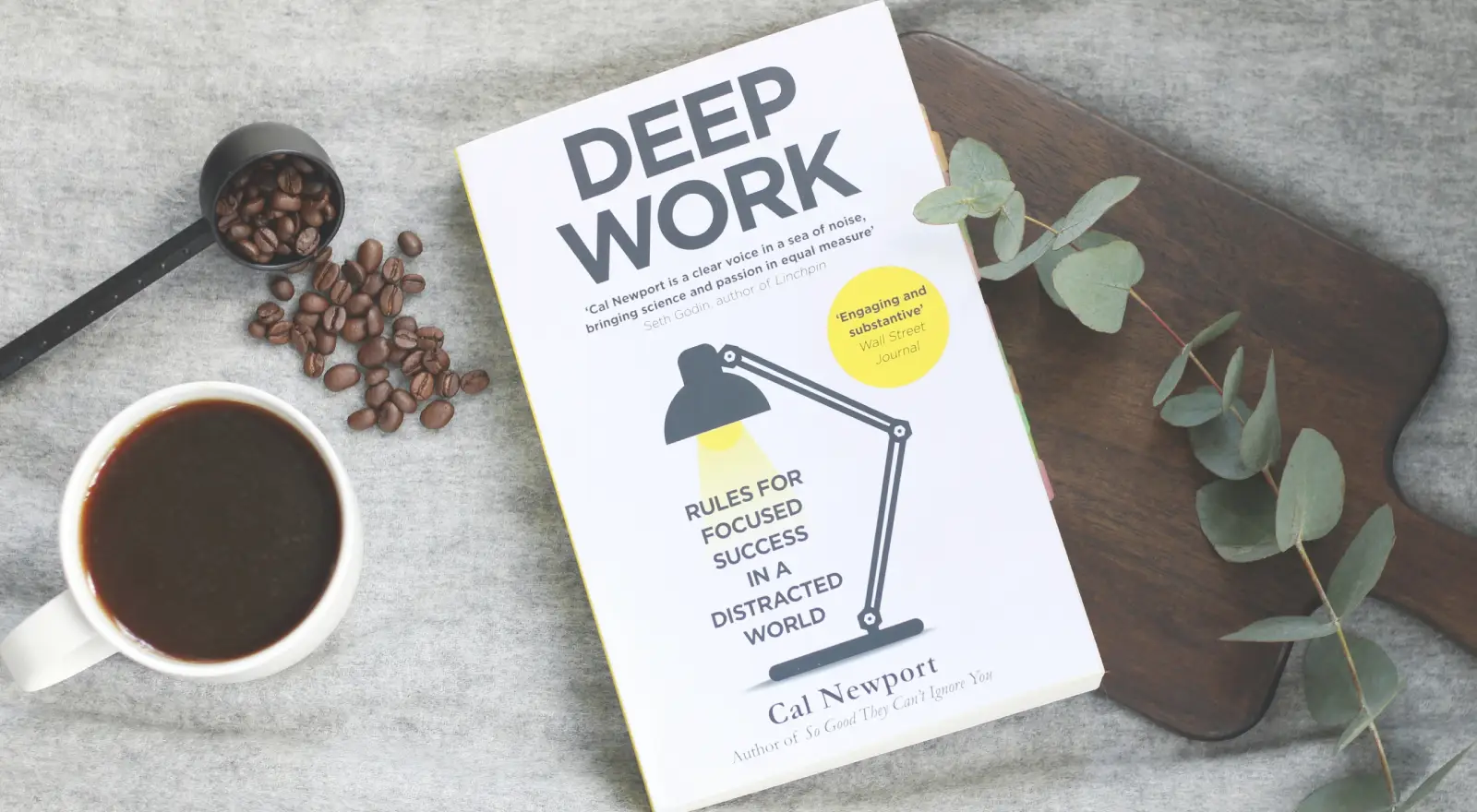
Newport suggests that the knowledge economy gives an advantage to those skilled in deep work and that such cognitive skills can be developed. He clarifies that deep work is where the brain fully engages in processing complex information without distractions, thus leading to high-quality outputs and expertise.
Williamson and Newport caution that superficial digital consumption can foster polarized and conspiratorial thinking, making it more crucial to engage meaningfully with content to cultivate deep work habits. With Williamson expressing that he's been consuming shorter reads which may lack the depth of full-length books, this presents an argument for the need to develop the skill of deep work further.
Focus and Deep Thinking Is a Learnable Skill
Newport indicates that becoming comfortable with cognitive strain is like an athlete training their body—a sign of growing strength. By associating knowledge work with increased cognitive demands, Newport urges the embracing of such discomfort as it signifies the development of cognitive capabilities. He contends that deriving value in the knowledge economy hinges on an individual's ability to master and apply hard skills with intense concentration.
Williamson touches on the challenge of transitioning to deep work amidst constant distractions, suggesting that focus is an indispensable, yet trainable, skill. He implies that one’s ability to concentrate intensely and engage in deep thinking develops ...
Here’s what you’ll find in our full summary
Importance of Developing Cognitive Skills: Deep Work and Focus
Additional Materials
Counterarguments
- While reading physical books may foster advanced thought patterns, digital mediums offer accessibility and convenience that can encourage more frequent reading habits.
- Deep reading is beneficial, but diverse reading habits, including skimming, can also be valuable for different purposes, such as quickly acquiring information or staying informed.
- The emphasis on deep work may overlook the importance of rest, relaxation, and a balanced approach to productivity that includes both focused and unfocused time.
- Deep work is not the only path to expertise; collaborative and iterative work, which may involve interruptions and interactions, can also lead to high-quality output.
- The assertion that superficial digital consumption fosters polarized thinking does not account for the individual's responsibility in critical thinking and discernment of information.
- The idea that cognitive discomfort is a sign of growing strength may not consider individual differences in learning styles and the potential for cognitive overload or burnout.
- The focus on intense concentration may not acknowledge the value of a diverse range of cognitive skills, including creativity and adaptability, which can also be crucial in the knowledge economy.
- The argument that AI cannot replicate certain human cognitive skills may be too absolute, as AI continues to advance and potentially take on more complex task ...
Actionables
- Create a "deep work" playlist with instrumental music to enhance focus during reading or complex tasks. Music without lyrics can reduce cognitive load, allowing you to immerse yourself in deep work more effectively. For example, you might compile a playlist of classical or ambient music that you reserve only for times when you need to concentrate deeply, thereby creating a sound environment conducive to cognitive engagement.
- Schedule weekly "brain workouts" with progressively challenging reading material. Just as you would increase weights at the gym, start with articles or books that require a moderate level of concentration and gradually move to denser, more complex texts. Track your progress by reflecting on your understanding of the material and the ease with which you can discuss the concepts.
- Use a browser extension that limits time on ...
Get access to the context and additional materials


Create Summaries for anything on the web
Download the Shortform Chrome extension for your browser
