

#497 – Biggest Mysteries in Physics: Antimatter, Dark Energy & ToE – Don Lincoln
In this episode of the Lex Fridman Podcast, Don Lincoln explores the history of unification in physics and the major unsolved mysteries that continue to puzzle scientists. Lincoln traces how physics has progressed from Newton's unification of terrestrial and celestial gravity through Maxwell's electromagnetic theory and Einstein's relativity to the modern Standard Model, which successfully unified three of the four fundamental forces but left gravity conspicuously separate.
The conversation addresses three profound mysteries confronting contemporary physics: dark matter, which constitutes most of the universe's mass yet remains invisible; dark energy, which drives the universe's accelerating expansion; and the matter-antimatter asymmetry that explains why our universe contains predominantly matter. Lincoln also discusses the role of particle accelerators in discovering new physics, the challenges of developing a theory of everything, and the competing approaches of string theory and loop quantum gravity in attempting to unify quantum mechanics with general relativity.


This is a preview of the Shortform summary of the May 29, 2026 episode of the Lex Fridman Podcast
Sign up for Shortform to access the whole episode summary along with additional materials like counterarguments and context.
1-Page Summary
The History of Unification in Physics
Physics has progressed through centuries of unifying seemingly disparate phenomena under common principles, from Newton's gravity to the modern Standard Model.
Newton Unified Gravity
Before Newton, people believed terrestrial gravity—objects falling on Earth—and celestial motion were governed by separate laws. Isaac Newton's revolutionary insight was that the moon continuously "falls" toward Earth but misses due to its sideways velocity, thus orbiting. This realization united earthly and cosmic phenomena under one universal law of gravitation, showing that all matter follows the same principles.
Maxwell Unified Electricity and Magnetism
In the early 1800s, electricity and magnetism appeared separate. James Clerk Maxwell's equations in the 1860s revealed they were intertwined aspects of electromagnetism. When physicists applied calculus to his equations, they discovered that oscillating electric and magnetic fields propagate as waves traveling at the speed of light—revealing light itself as an electromagnetic phenomenon. Electromagnetism now governs everything from atomic bonds to modern technology like the internet and broadcasting.
Einstein's Relativity Unified Space, Time, and Gravity
Albert Einstein challenged Newton's universal time, demonstrating that observers in motion experience time differently while the speed of light remains constant—a premise validated through particle physics experiments. This led to spacetime as a unified fabric. Einstein extended this insight by framing gravity not as a force but as mass curving spacetime itself. General relativity has been confirmed through numerous experiments, including the simultaneous detection of gravitational waves and light from merging neutron stars.
The Standard Model Unifies Forces, Except Gravity
By the twentieth century, four fundamental forces were known: gravity, electromagnetism, the strong nuclear force, and the weak nuclear force. Sheldon Glashow, Abdus Salam, and Steven Weinberg showed that at high energies, electromagnetic and weak forces merge into the electroweak force. The puzzle of why weak force carriers have mass while photons don't was solved by the Higgs field—particles interacting with it gain mass. The 2012 discovery of the Higgs boson completed the Standard Model, but gravity remains separate, leaving the ultimate unified theory elusive.
Current Major Mysteries in Physics
Modern physics faces profound unsolved mysteries about the universe's composition and structure.
Dark Matter
Dark matter constitutes five times more mass than ordinary matter yet remains invisible, revealing itself only through gravitational effects. Fritz Zwicky and later Vera Rubin found that galaxies spin too fast to be held together by visible matter alone. Three observations support dark matter: galaxies rotate too quickly, galaxy clusters move faster than visible mass allows, and gravitational lensing is stronger than expected. The Bullet Cluster provides compelling evidence—when two galaxy clusters collided, gravitational lensing showed most mass traveled with galaxies, not gas, suggesting gravitationally-interacting dark matter. The Dragonfly galaxies DF2 and DF4, which rotate normally without apparent dark matter, prove dark matter can be stripped from galaxies, confirming it as a distinct, removable substance.
Despite gravitational evidence, dark matter's nature remains unknown. The leading hypothesis is WIMPs (weakly interacting massive particles), searched for through direct detection, indirect detection via gamma rays, and collider experiments—all without definitive results. The possible mass range spans from far lighter than electrons to asteroid-sized objects, leaving dark matter one of physics' greatest unsolved challenges.
Dark Energy
Dark energy, comprising 68% of the universe's energy, drives its accelerating expansion. Late 1990s supernova observations revealed the universe's expansion is speeding up, contradicting expectations of gravitational slowing. The prevailing model treats dark energy as constant energy density inherent to space itself—as the universe expands, total dark energy increases while matter density thins. Einstein originally introduced the cosmological constant for a static universe but abandoned it when Hubble discovered cosmic expansion; the 1998 acceleration discovery revived it as dark energy.
A major crisis arises because quantum field theory predicts vacuum energy 10^120 times larger than observed dark energy—physics' "worst prediction." Debate continues whether dark energy is a spacetime property, an unknown quantum field, or evidence that space itself is quantized. Though assumed constant, preliminary hints suggest dark energy density may change over time, potentially revealing new physics.
Matter-Antimatter Asymmetry
The Big Bang should have created equal amounts of matter and antimatter, yet the observable universe contains almost exclusively matter. For every billion antimatter particles, there were a billion and one matter particles; the pairs annihilated, leaving a tiny matter excess forming all stars and planets. The asymmetry mechanism remains unknown—either an initial universe condition or quantum process differences. Fermilab's leptogenesis hypothesis suggests neutrino oscillations differ between matter and antimatter, potentially explaining the imbalance, with current experiments measuring possible rate differences.
Particle Accelerators: Discovering Particles and Testing Theories
Particle accelerators create and analyze subatomic particles by converting collision energy into matter-antimatter pairs, following Einstein's E=mc². Don Lincoln describes how the Tevatron at Fermilab collided particles at 120 GeV, while the LHC operates at seven times higher energy with 100 times more collision events per second—making it roughly 700 times more productive. Higher energies create heavier particles, turning once-rare discoveries into routine observations.
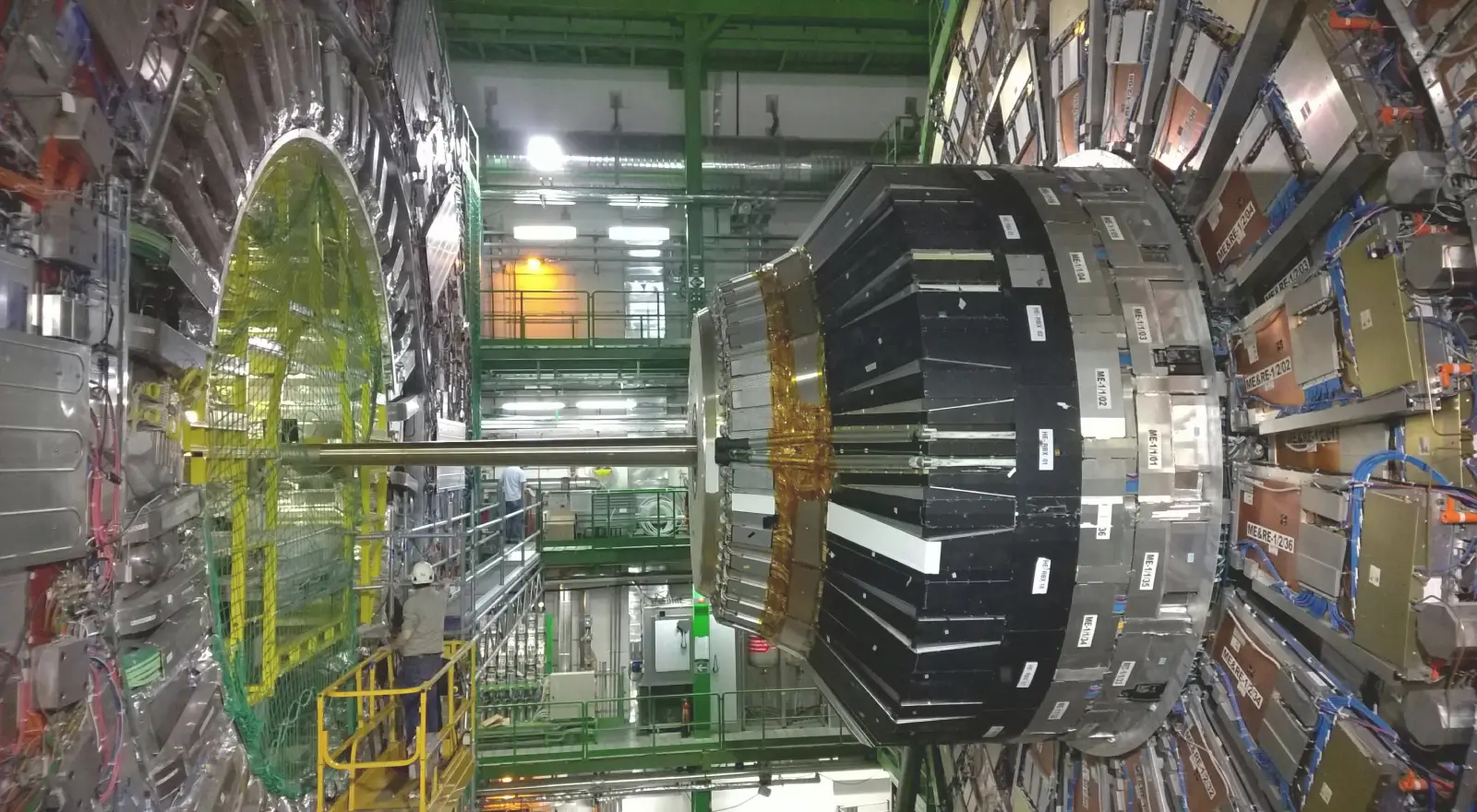
The CMS detector at CERN weighs 14,000 tons and captures 40 million collision images per second. Trigger systems filter this down to 1,000 recorded events per second, identifying unusual signatures indicating potential new physics. Graduate students then analyze filtered data seeking rare theoretical signatures—finding a dozen viable candidates amid trillions of routine events can represent a Nobel Prize-worthy discovery.
The Higgs boson search exemplifies how accelerators validate theories. First predicted in 1964, both Fermilab and CERN searched for decades. Fermilab narrowed the possible mass to 120-145 GeV by closure, but the LHC's superior capabilities led to the July 4, 2012 discovery announcement. Years of further measurements confirmed the particle exhibited correct decay rates, zero spin, and validated the Standard Model's final piece.
Theories of Everything and Challenges of Quantum Gravity
The search for a theory of everything unifying all fundamental forces remains a major challenge, with gravity stubbornly resisting integration with quantum physics.
Grand Unified Theory and String Theory
Grand Unified Theory aims to merge the electroweak and strong forces at energies 10^15 times higher than current accelerators, relying on indirect tests through rare particle decays. String theory proposes particles are tiny vibrating strings at the Planck length, with different vibrations yielding different particle types. Originally developed for the strong force, string theory gained prominence when it predicted massless spin-two particles corresponding to gravitons, offering potential gravity unification through extra compactified dimensions.
However, string theory faces a predictivity crisis with 10^500 possible solutions, making unique predictions difficult. Despite decades of development since the 1980s, it lacks confirmed experimental validation, leading many physicists to question the speculative approach.
Loop Quantum Gravity and Fundamental Challenges
Loop quantum gravity suggests space is discrete at the Planck scale rather than continuous, quantizing gravity without seeking force unification. Unlike string theory's comprehensive ambitions, LQG focuses exclusively on gravity's quantum nature. When gamma-ray bursts arrived simultaneously across frequencies, ruling out a key LQG prediction, theorists revised the theory—but it still lags behind in testable predictions at accessible energies.
A central barrier is the enormous energy gap: the Planck scale sits 10^15 times beyond today's accelerators. Don Lincoln uses an analogy—just as ancient humans in East Africa couldn't predict oceans or mountains from their surroundings, we may similarly misrepresent realities at untested energy extremes. Progress likely depends on discovering new physics at accessible scales, with dark matter and dark energy potentially offering crucial clues. Many pragmatic physicists now advocate exploring these near-term unknowns over theoretical extrapolations.
Ultimately, a theory of everything requires experimental confirmation to move from mathematical hypothesis to accepted science. History shows nature repeatedly surprises theorists at higher energies, underscoring the vital role of experiment. Falsifiability distinguishes science from philosophical speculation, presenting young researchers with a choice between speculative theoretical projects and experimentally tractable questions.
1-Page Summary
Additional Materials
Clarifications
- The moon is constantly pulled toward Earth by gravity, causing it to "fall" inward. However, it also moves sideways fast enough that as it falls, the Earth's surface curves away beneath it. This balance between falling and moving sideways creates a stable orbit. Without this sideways velocity, the moon would crash into Earth.
- Maxwell's equations are a set of four mathematical formulas describing how electric and magnetic fields are generated and altered by each other and by charges and currents. They showed that changing electric fields produce magnetic fields and vice versa, linking the two phenomena into one unified force: electromagnetism. This unification explained how light is an electromagnetic wave, traveling through space without needing a medium. Maxwell's work laid the foundation for modern technologies like radio, radar, and wireless communication.
- Changing electric fields create magnetic fields, and changing magnetic fields create electric fields. This continuous interplay allows the fields to sustain each other and move through space as waves. The speed of these waves is determined by the properties of the vacuum, matching the speed of light. Thus, light is an electromagnetic wave formed by these oscillating fields.
- Spacetime is a four-dimensional framework combining the three dimensions of space with time as the fourth dimension. Events are described by both their position in space and their moment in time, inseparably linked. This concept replaces the idea of absolute, universal time with time that varies depending on the observer's motion. Curvature of spacetime by mass and energy explains gravity as objects following curved paths, not forces acting at a distance.
- Gravity as curvature of spacetime means massive objects bend the fabric of space and time around them. Objects move along paths called geodesics, which appear curved due to this bending, not because of a force pulling them. This explains why planets orbit stars and why objects fall— they follow the straightest possible paths in curved spacetime. Thus, gravity is geometry affecting motion, not a traditional force acting at a distance.
- The four fundamental forces govern all interactions in the universe. Gravity attracts masses over long distances and shapes cosmic structures. Electromagnetism acts between charged particles, enabling electricity, magnetism, and light. The strong force binds protons and neutrons in atomic nuclei, while the weak force causes certain types of radioactive decay and neutrino interactions.
- The electroweak force is a single force that combines electromagnetism and the weak nuclear force at very high energies, such as those shortly after the Big Bang. At lower energies, this force "breaks" into two distinct forces due to a process called spontaneous symmetry breaking, caused by the Higgs field. This explains why the weak force has massive carriers (W and Z bosons) while the electromagnetic force has a massless photon. The unification was confirmed experimentally by observing interactions that behave identically under electroweak theory.
- The Higgs field is an invisible energy field present throughout the universe. Particles gain mass by interacting with this field; the stronger the interaction, the heavier the particle. Without the Higgs field, particles would move at the speed of light and not form atoms. The Higgs boson is a particle associated with disturbances in this field, confirming its existence.
- Dark matter does not emit, absorb, or reflect light, making it invisible to telescopes. Gravitational lensing occurs when massive objects bend light from background sources, revealing mass distribution regardless of visibility. The Bullet Cluster is two colliding galaxy clusters where visible matter (hot gas) and dark matter (inferred from lensing) separate, proving dark matter interacts mainly through gravity. This separation rules out alternative gravity theories and confirms dark matter as a distinct substance.
- Galaxies DF2 and DF4 are unusual because they appear to contain little or no dark matter, unlike typical galaxies. Their existence challenges the idea that dark matter is always tightly bound to galaxies. Studying them helps scientists understand how dark matter can be separated from normal matter. This separation supports the view that dark matter is a distinct substance, not just an effect of gravity or modified physics.
- WIMPs (Weakly Interacting Massive Particles) are hypothetical particles that interact through gravity and the weak nuclear force but rarely with normal matter, making them hard to detect. Direct detection involves sensitive underground detectors searching for rare collisions between WIMPs and atomic nuclei. Indirect detection looks for signals like gamma rays or neutrinos produced when WIMPs annihilate or decay in space. Collider experiments attempt to create WIMPs by smashing particles at high energies and observing missing energy and momentum that indicate invisible particles.
- Dark energy acts like a repulsive force counteracting gravity on cosmic scales, causing space itself to expand faster over time. It is often modeled as a property of empty space, exerting a constant negative pressure that drives acceleration. Unlike matter or radiation, dark energy does not clump or dilute as the universe grows, making its effects dominant in the large-scale structure. Understanding its origin challenges current physics, as it may relate to vacuum energy or unknown fundamental fields.
- The cosmological constant was introduced by Einstein in 1917 to allow a static universe, counteracting gravity's pull. After Hubble discovered cosmic expansion in 1929, Einstein discarded it, calling it his "biggest blunder." In modern cosmology, it represents a constant energy density filling space, driving accelerated expansion. It mathematically appears as a term in Einstein's field equations of general relativity.
- Quantum field theory predicts vacuum energy by summing zero-point energies of all quantum fields, resulting in an enormous value. This theoretical vacuum energy acts like a cosmological constant, influencing the universe's expansion. However, the observed dark energy density is about 10^120 times smaller, creating a huge mismatch known as the cosmological constant problem. Resolving this discrepancy is a major unsolved issue in theoretical physics.
- Matter-antimatter asymmetry refers to the observed dominance of matter over antimatter in the universe, despite theories predicting equal amounts at the Big Bang. Leptogenesis is a proposed mechanism where an imbalance in leptons (such as neutrinos) early in the universe leads to the matter excess. This process involves CP violation, meaning particles and antiparticles behave differently, allowing more matter to survive. Experiments study neutrino oscillations to detect these differences and test leptogenesis.
- Particle accelerators speed up particles to near light speed, increasing their kinetic energy. When these high-energy particles collide, the energy in the collision can transform into new particles, including matter-antimatter pairs. This process follows Einstein’s equation E=mc², where energy (E) converts into mass (m) with c² as the conversion factor. The created particles exist briefly before decaying or interacting, allowing physicists to study fundamental forces and particles.
- The Large Hadron Collider (LHC) is the world's largest and most powerful particle accelerator, spanning a 27-kilometer underground ring near Geneva. It accelerates protons to near light speed before colliding them to recreate conditions just after the Big Bang. The CMS detector is one of several massive instruments surrounding collision points, designed to track and identify particles produced in these high-energy collisions. It uses layers of sensors and magnets to measure particle trajectories, energies, and types with extreme precision.
- The Higgs boson discovery confirmed the existence of the Higgs field, which gives mass to fundamental particles. Without this mechanism, particles like electrons and quarks would be massless, preventing the formation of atoms and matter as we know it. It validated a key part of the Standard Model that explained why some particles have mass while others, like photons, do not. This discovery also demonstrated the power of particle accelerators to test deep theoretical predictions.
- Grand Unified Theory (GUT) seeks to combine the strong, weak, and electromagnetic forces into a single force at extremely high energies, simplifying the fundamental interactions. Its main challenge is that the required energy scale is far beyond current experimental reach, making direct tests impossible. String theory attempts to describe all particles and forces, including gravity, as vibrations of tiny strings, providing a framework for unification and quantum gravity. However, its vast number of possible solutions and lack of unique, testable predictions hinder its acceptance as a definitive theory.
- String theory proposes that the fundamental particles are not points but tiny loops or segments of energy vibrating at different frequencies. The Planck length (~1.6 x 10^-35 meters) is the scale at which these strings exist, far smaller than atoms or subatomic particles. Extra compactified dimensions are additional spatial dimensions beyond the familiar three, curled up so tightly they are undetectable at everyday scales. These hidden dimensions influence string vibrations, determining particle properties like mass and charge.
- String theory's equations allow an enormous number of mathematically consistent solutions, each describing a different possible universe with distinct physical laws. This vast "landscape" of about 10^500 solutions makes it difficult to predict which one corresponds to our actual universe. Without a way to select or test among these solutions, string theory struggles to make unique, testable predictions. This lack of predictive power is called the predictivity crisis.
- Loop quantum gravity (LQG) proposes that space is made of tiny, indivisible units called "quantum loops," forming a granular structure rather than a smooth continuum. These loops create a network called a "spin network," which defines the geometry of space at the smallest scales. The Planck scale (~10^-35 meters) is the size at which these discrete units become relevant, far smaller than atoms or particles. LQG aims to describe gravity using quantum mechanics without requiring extra dimensions or unifying other forces.
- The Planck scale refers to the energy level around 10^19 giga-electronvolts (GeV), where quantum effects of gravity become significant. Current accelerators reach energies up to about 10^4 GeV, far below this scale. Achieving Planck-scale energies would require particle collisions with energies billions of times greater than today's most powerful machines. This vast gap makes direct experimental access to Planck-scale physics currently impossible.
- The analogy highlights how limited data restricts understanding of complex systems. Just as ancient humans could not infer distant oceans or mountains from their immediate surroundings, physicists today cannot fully grasp high-energy physics beyond current experimental reach. This emphasizes the challenge of predicting phenomena at scales far beyond accessible energies. It suggests humility and the need for new experimental insights to advance knowledge.
- Experimental falsifiability means a scientific theory must make predictions that can be tested and potentially proven wrong by experiments. This criterion ensures theories remain grounded in observable reality rather than pure speculation. Without falsifiability, a theory cannot be reliably evaluated or improved through evidence. It is essential for distinguishing science from non-scientific ideas.
Counterarguments
- While Newton's law unified terrestrial and celestial gravity, it was later superseded by Einstein's general relativity, which provides a more accurate description of gravity, especially in strong gravitational fields or at high velocities.
- Maxwell's unification of electricity and magnetism is a major achievement, but it does not account for the weak and strong nuclear forces, which are fundamental to particle interactions.
- The Standard Model, though successful, does not explain several phenomena such as neutrino masses, the hierarchy problem, or the nature of dark matter and dark energy.
- The evidence for dark matter is strong, but alternative theories such as Modified Newtonian Dynamics (MOND) attempt to explain galactic rotation curves without invoking unseen matter, though these alternatives face challenges with certain observations like the Bullet Cluster.
- The identification of dark energy as a cosmological constant is a model-dependent interpretation; other models, such as quintessence or modified gravity theories, offer alternative explanations for cosmic acceleration.
- The matter-antimatter asymmetry problem remains unresolved, and current hypotheses like leptogenesis are still unconfirmed and face experimental challenges.
- Particle accelerators are powerful tools, but their increasing cost and complexity raise questions about the sustainability and practicality of ever-larger machines for future discoveries.
- String theory and loop quantum gravity, while mathematically rich, have not produced experimentally testable predictions, leading some physicists to question their scientific status.
- The analogy comparing our current knowledge to ancient humans' limited geography is illustrative but not a rigorous argument; scientific progress often comes from unexpected directions, not just from pushing to higher energies.
- The focus on experimentally accessible unknowns is pragmatic, but some argue that theoretical work, even if currently untestable, is essential for guiding future experiments and understanding.


Get access to the context and additional materials
The History of Unification in Physics
Physics has progressed through a centuries-long quest to show that the diverse phenomena in the universe are connected by unified principles. This history is marked by a succession of profound unifications, starting from gravity and culminating in the modern Standard Model of particle physics.
Newton Unified Gravity, Demonstrating That Celestial and Terrestrial Phenomena Are Governed by Identical Principles
Pre-newtonian View: Disconnected Earthly Gravity and Celestial Movements
In the 1650s, people observed gravity as the force causing objects to fall on Earth, such as when someone trips. Separately, they observed the stars and planets moving across the night sky, a motion thought to be governed by different, “celestial” laws. Terrestrial gravity and celestial motion were believed to be unrelated phenomena.
Newton's Insight: Moon Falls Toward Earth but Misses due to Motion, Revealing Terrestrial and Celestial Gravity As the Same Force
Isaac Newton realized that these seemingly unrelated occurrences were aspects of a single phenomenon: gravity. He considered that the moon is "falling" toward Earth, but because of its sideways velocity, it continually misses, thus staying in orbit. Newton’s law of universal gravitation united the movement of heavenly bodies and everyday experiences of falling objects under one physical law.
Gravity Unites Everyday Experiences With Cosmic Phenomena
By proposing that gravity governed both the heavens and the Earth, Newton showed that all matter—whether a falling apple or an orbiting planet—was ruled by the same principles. Gravity thereby connected human experience with the cosmic motions overhead.
Maxwell Unified Electricity and Magnetism: Changing Electric Fields Produce Magnetic Fields and Vice Versa, Propagating At Light Speed
Electricity and Magnetism Initially Seemed Separate, With Electricity Involving Sparks and Lightning While Magnetism Involved Magnets and Their Properties
In the early 1800s, electricity—with its sparks, shocks, and lightning—and magnetism, which involved the attraction between iron and magnets, appeared to be separate domains. Early scientists believed these forces had nothing in common.
Maxwell's Equations Reveal Electricity and Magnetism as Aspects of a Unified Force, Connected Mathematically With one Side for Electrical and the Other for Magnetic Phenomena
Throughout the nineteenth century, experiments showed that electric currents could generate magnetic fields and vice versa. In the 1860s, James Clerk Maxwell synthesized these results into a set of mathematical equations—Maxwell’s equations—showing that electricity and magnetism are intertwined aspects of a single force: electromagnetism. The equations contain terms corresponding to electrical and magnetic phenomena, mathematically describing their mutual interplay.
Speed of Light Emerges From Maxwell's Equations As Velocity of Electromagnetic Wave Propagation, Evidencing Light As Electromagnetic Phenomenon
By applying calculus to Maxwell’s equations, physicists discovered that oscillating electric and magnetic fields propagate as waves traveling at the speed of light. Thus, light itself emerged as an electromagnetic wave, uniting optics with electricity and magnetism.
Electromagnetism Explains Electricity, Magnetism, Atomic Bonds, and Chemistry, Enabling Modern Technology Like the Internet and Broadcasting
Electromagnetism governs a vast range of phenomena, from household electricity and magnetism to the binding of atoms in chemistry. Its principles underpin much of today’s technology, such as the internet, radio, computers, and modern broadcasting. The understanding and control of electromagnetism transformed society, fueling a technological revolution.
Special Relativity Unifies Spacetime; Observers in Motion Experience Time Differently, Light Speed Constant
Before Einstein, Newton's Physics Treated Time as Universal, but Einstein Corrected This
Newtonian mechanics viewed time as universal, flowing at the same rate for everyone everywhere. Albert Einstein challenged this notion, demonstrating that different observers, moving at different velocities, can experience time differently.
Einstein's Premises: Universal Laws and Constant Light Speed Impact Time Perception
Einstein based his special relativity on two premises: (1) the laws of nature are the same for all observers, and (2) everyone measures the speed of light to be the same, regardless of their motion. The second assumption, radical for its time, led directly to the strange and surprising consequences of special relativity.
Premise: Constant Speed of Light Validated Through Particle Physics With Rapidly Moving Particles Decaying Into Photons Showing the Same Speed As Those From Stationary Sources
The constancy of the speed of light has been experimentally confirmed, notably through particle physics experiments. When subatomic particles decay into photons—whether at rest or moving at near-light speed—the resulting light is always measured at the same universal speed. These precision experiments validate Einstein’s key assumption.
Resolving Gravity-Light Conflict Through Spacetime Geometry
Einstein’s insights paved the way for a new conception: space and time are not separate, but unified as spacetime, which itself can bend and stretch. This foundational shift enabled later advances in understanding gravity.
Einstein's Relativity Unified Gravity With Spacetime, Showing Massive Objects Curve Spacetime, With Gravity Arising From This Curvature
Acceleration and Gravity Feel Identical; He Conceptualized Gravity As the Curvature of Spacetime
Einstein realized that acceleration and gravity are equivalent in their effects. He extended the unification of special relativity by framing gravity not as a force but as the manifestation of mass curving spacetime.
Relativity Portrays Space-Time As Dynamic, Bending and Curving With Mass and Energy
In general relativity, spacetime is dynamic: it warps and bends in response to mass and energy. Massive bodies like Earth or the Sun create depressions in spacetime, and what we perceive as gravitational attraction is actually the motion of objects following curved paths through this warped geometry.
Framework of General Relativity Describes Gravity
General relativity precisely describes these effects and has been validated by numerous experimental measurements—including the observation of gravitational waves from merging neutron stars. The simultaneous detection of light and gravitational waves fro ...
Here’s what you’ll find in our full summary
The History of Unification in Physics
Additional Materials
Clarifications
- Spacetime combines the three dimensions of space with the one dimension of time into a single four-dimensional framework. Events are described by both where and when they occur, not separately by space and time. Massive objects cause spacetime to curve, and this curvature affects the paths objects take, which we perceive as gravity. This bending means that time can pass at different rates depending on the strength of gravity or relative motion.
- The equivalence principle means that being in a closed box accelerating through space feels the same as standing still in a gravitational field. For example, if you drop an object inside the box, it will fall to the floor whether the box is accelerating upward or sitting on Earth. This principle implies gravity is not a force but an effect of curved spacetime causing objects to follow curved paths. It is a key idea that led Einstein to develop general relativity.
- The moon moves forward fast enough that as it falls toward Earth, the surface curves away beneath it. This creates a continuous free-fall around Earth, called an orbit. Gravity pulls the moon inward, but its sideways motion prevents it from crashing down. This balance keeps the moon circling Earth instead of hitting it.
- Maxwell’s equations are four mathematical formulas that describe how electric and magnetic fields are generated and altered by each other and by charges and currents. They show that a changing electric field creates a magnetic field, and a changing magnetic field creates an electric field, linking the two phenomena. These equations predict electromagnetic waves, which travel through space at the speed of light. This mathematical framework unifies electricity and magnetism into a single electromagnetic force.
- A changing electric field creates a magnetic field because the variation in electric charge distribution induces a circular magnetic effect around it. Conversely, a changing magnetic field induces an electric field by causing charges to move, generating an electric current. This mutual generation is described by Faraday's law of induction and Maxwell's addition to Ampère's law. Together, these changing fields sustain electromagnetic waves that propagate through space.
- Maxwell’s equations predicted that changing electric and magnetic fields create waves traveling at a fixed speed. This speed matched the measured speed of light, revealing light as an electromagnetic wave. Before this, light’s nature and speed were unexplained by existing physics. This discovery linked optics with electromagnetism, unifying two previously separate fields.
- Special relativity’s constancy of light speed means light travels at the same speed in a vacuum for all observers, regardless of their motion. This defies everyday experience where speeds usually add up (like a moving car’s speed plus a thrown ball’s speed). It implies time and space must adjust—time can slow down and lengths contract—to keep light speed constant. These adjustments lead to effects like time dilation and length contraction, which have been experimentally confirmed.
- Quantum fields exist everywhere, even in a vacuum, and they constantly fluctuate due to inherent quantum uncertainty. These fluctuations cause temporary appearances of particle-antiparticle pairs called virtual particles, which cannot be directly observed but influence measurable forces. Virtual particles mediate interactions between real particles, acting as force carriers in quantum field theory. Their effects are evident in phenomena like the Casimir effect and subtle shifts in particle properties.
- The Casimir effect arises because quantum fields in empty space have fluctuating energy, creating virtual particles that pop in and out of existence. When two metal plates are placed very close together, they restrict the wavelengths of these fluctuations between them compared to outside. This imbalance in vacuum energy produces a measurable force pushing the plates together. Thus, the Casimir effect provides direct evidence of vacuum fluctuations and virtual particles predicted by quantum field theory.
- The Higgs field is a quantum field that fills all space and interacts with certain particles, slowing them down and giving them mass. Particles that interact strongly with the Higgs field gain more mass, while those that interact weakly or not at all remain light or massless. The photon does not interact with the Higgs field, so it stays massless and can travel at the speed of light. This interaction explains why some force-carrying particles have mass and others do not.
- The electroweak unification shows that electromagnetism and the weak nuclear force are different aspects of a single force at high energies. This means that at extremely high temperatures, such as those just after the Big Bang, these forces behave identically. The unification is described by a mathematical framework combining their symmetries into one gau ...
Counterarguments
- The narrative of unification in physics can sometimes overstate the degree of unity achieved; for example, the Standard Model does not unify all forces, and gravity remains fundamentally separate.
- Newton’s law of universal gravitation, while unifying celestial and terrestrial gravity, is now known to be an approximation that breaks down at very high masses, speeds, or in strong gravitational fields, where general relativity is required.
- Maxwell’s unification of electricity and magnetism, though profound, does not include the strong and weak nuclear forces, and thus is not a complete unification of all known forces.
- The Standard Model, while successful, leaves many questions unanswered, such as the nature of dark matter, dark energy, and the hierarchy problem.
- The Higgs mechanism explains how some particles acquire mass, but it does not explain the origin of the Higgs field itself or why the Higgs boson has the mass it does.
- Quantum field theory’s concept of virtual particles is a mathematical tool within perturbation theory and does not necessarily imply that virtual particles are “real” in the same sense as observable particles.
- The Casimir effect can also be explained without invoking virtual particles, for exampl ...
Get access to the context and additional materials
Current Major Mysteries in Physics
Modern physics faces a set of profound, unsolved mysteries that shape our understanding of the universe. Central among these are the nature of dark matter, the enigma of dark energy, and the question of why the observable universe is dominated by matter rather than antimatter. Each mystery raises further questions about the very fabric of reality and exposes significant gaps in human knowledge.
Dark Matter, Five Times the Mass of Ordinary Matter, Is Undetected yet Manifests Through Gravitational Effects on Galaxies, Clusters, and the Cosmos's Large-Scale Structure
Dark matter constitutes about five times more mass than ordinary matter in the universe, yet it remains invisible, undetectable by ordinary means, and only reveals itself through gravitational effects.
Galaxy Rotation Suggests Gravity Anomaly or Unseen Matter
The story of dark matter begins with astronomical measurements that do not agree with predictions from Newtonian gravity or Einstein’s relativity. In the 1930s, Fritz Zwicky, and later in the 1970s, Vera Rubin investigated galaxy rotations. Rubin’s method used high school physics: calculating how fast stars should orbit based on observable matter. The result consistently showed that galaxies spin much too fast to be held together by visible matter alone. According to the laws of gravity, galaxies moving that quickly should fling themselves apart, but observationally, they remain intact. This discrepancy led to the proposal of dark matter—either the laws of gravity are incomplete, or there is much more mass present than can be seen.
Clusters Exceed Gravitational Predictions; Galaxies Are Lensed Beyond Visible Matter's Explanation
Three main reasons support the need for a new component in the cosmic matter budget: galaxies spin too fast, galaxy clusters move more rapidly than the mass of visible matter would allow, and gravitational lensing (the bending of light by gravity) around massive structures is stronger than visible matter can explain. For instance, in clusters of galaxies, if dark matter were absent, hot gas clouds would have a specific gravitational signature. However, observations reveal distortions aligned with galaxies themselves, supporting the presence of additional mass.
Bullet Cluster Observations: Evidence for Dark Matter's Existence
The Bullet Cluster provides some of the most compelling evidence for dark matter. This cosmic collision of two galaxy clusters separates visible matter (mainly hot gas) from galaxies themselves. As they pass through each other, the gas clouds collide and stop, heating up in the process, while galaxies largely pass unaffected. Crucially, gravitational lensing shows that most of the cluster’s mass travels with the galaxies, not the gas, suggesting a form of matter interacts only gravitationally: dark matter. This observation counters modified gravity theories and favors dark matter’s actual existence.
Dragonfly Galaxies Df2 and Df4 Rotate With No Apparent Dark Matter, Proving Dark Matter Exists as Galaxies Can Be Stripped Of It, Meaning It Is Removable
Recent discoveries like the Dragonfly galaxies DF2 and DF4 further support dark matter’s reality. These galaxies rotate exactly as predicted by Newton’s laws, without the need to invoke extra gravity. Remarkably, they appear to be almost entirely free of dark matter. Their existence shows that dark matter can be stripped from galaxies, reinforcing the idea that dark matter is a distinct substance that can vary between galaxies. These cases undercut the hypothesis that the anomaly is solely due to modified gravity.
Dark Matter Wimp Candidates: No Confirmed Detection Despite Direct, Indirect, and Collider Searches
Despite abundant gravitational evidence, the nature of dark matter remains elusive. The leading hypothesis is that it consists of particles called WIMPs (weakly interacting massive particles). Scientists deploy three main search strategies:
- Direct detection: Devices, often placed deep underground, attempt to observe dark matter passing through Earth—so far without definitive results.
- Indirect detection: Astronomers search for signals such as gamma rays from the annihilation of dark matter and ant-dark matter, particularly at galactic centers. Background signals like neutron stars make conclusive identification challenging.
- Collider searches: Experiments like those at the Large Hadron Collider smash particles together, hoping that unseen momentum in the aftermath marks the creation of dark matter, but this can be mimicked by neutrinos and requires precise accounting.
Neutrinos, which are weakly interacting and have mass, do not fit the bill due to insufficient mass to account for dark matter’s effects.
Dark Matter Mass: Electron to Asteroid, Beyond Current Searches
Attempts to detect dark matter have systematically ruled out various candidates, including compact objects like black holes and rogue planets. The remaining possible mass range for dark matter is vast: from far lighter than electrons to as heavy as asteroids. Direct astronomical searches, such as microlensing—which seeks momentary brightening of distant stars by passing dark objects—set a lower sensitivity around a third of the Moon’s mass. For extremely light candidates, technological limits further constrain detection. Consequently, despite experiments growing millions of times more sensitive over recent decades, the true nature and mass of dark matter remain one of physics’ unsolved challenges.
Dark Energy, 68% of the Universe's Energy, Accelerates Its Expansion and Remains a Profound Mystery
Dark energy, accounting for roughly 68% of the energy in the universe, is the force driving its accelerating expansion, a result first revealed by the study of distant supernovae in the late 1990s.
Universe's Accelerating Expansion Revealed by 1990s Supernovae Observations
Astronomers expected the universe’s expansion (from the Big Bang) to slow down over time due to gravitational attraction. However, supernova observations demonstrated that the expansion is not just continuing, but speeding up. This repulsive force defies gravitational expectations and is dubbed "dark energy."
Dark Energy as Constant Space Energy Density; Increases as Universe Expands, While Matter Density Decreases
The prevailing model assumes dark energy is the energy inherent to space itself—a constant density per unit volume. As the universe expands, more space means more total dark energy, whereas the density of ordinary and dark matter thins. This implies that as the universe grows, dark energy becomes ever more dominant.
Einstein’s Cosmological Constant, Initially Proposed to Prevent Universal Collapse and Abandoned After Hubble's Expansion Discovery, Reentered Physics in 1998 to Explain Accelerating Expansion
Einstein originally introduced the cosmological constant to prevent his equations from predicting the universe would collapse, envisioning a static cosmos. When Hubble discovered the universe was expanding, Einstein dropped the constant. In 1998, evidence for accelerating cosmic expansion revived the cosmological constant as a central concept—now understood as dark energy.
Vacuum Energy Predicted 10¹²⁰ Times Larger Than Dark Energy, Indicating Fundamental Understanding Gaps
A significant crisis in physics arises because quantum field theory predicts the vacuum energy density should be astronomically high—about 10¹²⁰ times larger than what is observed as dark energy. This vast mismatch, called the "worst prediction in physics," highlights a deep gap in understanding the relationship between quantum fields and gravity.
Dark Energy Might Represent a Property of Spacetime, a Quantum Field in Space, or Quantized Space With New Energy-Carrying Quanta Appearing
There is debate about whether dark energy is:
- a property intrinsic to ...
Here’s what you’ll find in our full summary
Current Major Mysteries in Physics
Additional Materials
Clarifications
- Gravitational lensing occurs when massive objects bend the path of light from distant sources, acting like a cosmic magnifying glass. This bending distorts and magnifies the images of background galaxies, revealing the presence of mass that cannot be seen directly. By analyzing the shape and degree of lensing, scientists can map the distribution of both visible and invisible matter. This method provides strong evidence for dark matter because the lensing effects often exceed what visible matter alone can produce.
- Stars orbit a galaxy's center due to gravity from the galaxy's mass. According to Newtonian physics, stars farther from the center should orbit more slowly because less mass is enclosed within their orbit. Observations show stars maintain high speeds even far out, implying more mass exists than visible matter accounts for. This discrepancy suggests either unseen mass (dark matter) or a need to revise gravity laws.
- The Bullet Cluster is a pair of colliding galaxy clusters whose visible matter (hot gas) and gravitational mass are spatially separated. This separation shows that most mass does not interact electromagnetically, only gravitationally, matching dark matter predictions. It challenges modified gravity theories, which cannot easily explain this offset. Thus, the Bullet Cluster provides direct empirical evidence for dark matter as a distinct substance.
- WIMPs are hypothetical particles that interact through gravity and the weak nuclear force but not electromagnetism, making them invisible to light. They are massive enough to account for the gravitational effects attributed to dark matter. Their weak interaction means they rarely collide with ordinary matter, explaining why they are hard to detect. WIMPs naturally arise in theories extending the Standard Model of particle physics, such as supersymmetry.
- Direct detection looks for dark matter particles hitting detectors on Earth, causing tiny, rare signals. Indirect detection searches for byproducts like light or particles from dark matter annihilations or decays in space. Collider searches create high-energy particle collisions to produce dark matter, inferred from missing energy and momentum. Each method targets different ways dark matter might interact or reveal itself.
- Neutrinos have very small masses, much less than what would be needed to account for the total dark matter mass. They move at nearly the speed of light, making them "hot dark matter," which cannot form the large-scale structures observed in the universe. Dark matter must be "cold" or "warm" to clump and help form galaxies and clusters. Therefore, neutrinos' properties do not match the gravitational effects attributed to dark matter.
- The cosmological constant is a term Einstein added to his equations to allow a static universe by counteracting gravity’s pull. It represents a uniform energy density filling space, exerting a repulsive force that affects the universe’s expansion. When reintroduced to explain accelerating expansion, it became associated with dark energy. Its value determines whether the universe expands forever, slows, or collapses.
- Quantum field theory calculates vacuum energy by summing zero-point energies of all quantum fields, predicting an enormous value. This theoretical vacuum energy should curve spacetime drastically, but observations show a tiny, positive dark energy instead. The huge mismatch—about 10¹²⁰ times difference—indicates a fundamental flaw or missing element in our understanding of quantum fields and gravity. Resolving this discrepancy is a major challenge in theoretical physics.
- Space being quantized means that space is not infinitely smooth but made up of tiny, discrete units or "chunks." Each "quantum of space" is the smallest possible unit of space, similar to how matter is made of atoms. This concept arises in some quantum gravity theories attempting to unify quantum mechanics and general relativity. It implies that space itself has a fundamental granular structure at extremely small scales, like pixels in a digital image.
- When matter and antimatter particles meet, they annihilate each other, converting their mass into energy, typically photons. This process means that if equal amounts existed, they would have mostly destroyed each other after the Big Bang. The tiny excess of matter—about one part in a billion—survived because some unknown process favored matter slightly. This leftover matter is what forms all the structures in the universe today.
- Baryogenesis is the theoretical process in the early universe that created an imbalance between matter and antimatter. CP violation refers to phenomena ...
Counterarguments
- Some physicists argue that the observed galaxy rotation curves and gravitational lensing effects could be explained by modifications to the laws of gravity (such as MOND or TeVeS) rather than invoking unseen dark matter, though these theories face challenges with certain observations like the Bullet Cluster.
- The interpretation of the Bullet Cluster as definitive evidence for dark matter is questioned by some researchers who point out that alternative gravity models have not been entirely ruled out and that the data can be subject to different modeling assumptions.
- The existence of galaxies like DF2 and DF4 without apparent dark matter is sometimes interpreted as a challenge to the universality of the dark matter hypothesis, suggesting that our understanding of galaxy formation and dynamics may be incomplete.
- The lack of direct detection of dark matter particles after decades of increasingly sensitive experiments has led some in the scientific community to question whether the particle dark matter paradigm is correct or whether alternative explanations should be more seriously considered.
- The cosmological constant problem (the discrepancy between quantum field theory predictions and observed dark energy) has led some theorists to question whether our current theoretical frameworks are fundamentally flawed or incomplete.
- Some cosmologists propose that the observed acceleration of the universe’s expansion could be due to large-scale inhomogeneities or back ...

Get access to the context and additional materials
Particle Accelerators: Discovering Particles and Testing Theories
Particle accelerators are at the forefront of unraveling the universe’s deepest mysteries, enabling physicists to create, detect, and analyze subatomic particles. By colliding particles at immense energies, accelerators not only confirm long-standing theoretical predictions but also open doors to new discoveries.
Accelerators Create Particles, Testing Theoretical Predictions
Don Lincoln describes how accelerators work by smashing protons and antiprotons together at near light speed. According to Einstein’s equation (E=mc^2), the kinetic energy from these high-speed collisions is converted into mass, allowing the formation of both matter and antimatter particles based on the laws of physics.
Collision Converts Kinetic Energy To Matter-Antimatter Pairs
When two particles hit each other head-on, their combined energy is concentrated into a tiny volume, creating new particles that always appear as a matter-antimatter pair to balance the “accounting” nature requires. For example, electrons and their antimatter counterparts, positrons, can be created if the collision energy meets the necessary threshold. Matter and antimatter can also annihilate, converting their mass back to energy.
Tevatron: 120 GeV Proton-Antiproton Collisions; LHC: 7x Energy, 100x Collision Events per Second
The Tevatron at Fermilab operated by colliding protons and antiprotons at about 120 GeV. By contrast, the Large Hadron Collider (LHC) at CERN operates at approximately seven times higher energy and provides about 100 times more collision events per second. These advances mean the LHC probes deeper and creates particles the Tevatron could not.
Higher Collision Energies Create Heavier Particles, and Greater Collision Frequency Provides Larger Statistical Samples, Making the LHC 700 Times More Productive Than the Tevatron
More energy allows the production of heavier, less common particles. Higher collision rates exponentially increase the dataset, making particles like top quarks routine at the LHC, even though Fermilab needed up to a year to identify only a handful. In practical terms, the LHC is roughly 700 times more productive than the Tevatron, turning once-rare discoveries into common background as new searches continue.
Antimatter Production Efficiency: Fermilab Produces one Antimatter Proton per 100,000 Protons, Yielding one Nanogram Annually As the Leading Facility
Despite this efficiency, antimatter production is limited. While Fermilab was operational, about 100,000 protons needed to be smashed to produce a single antiproton. Over 12–24 hours, (10^{12}) antiprotons could be collected, but a gram of antimatter would require (10^{23}) antiprotons, so annual production was about one nanogram—the best in the world. At that rate, creating a macroscopic amount would take billions of years.
Detectors Measure Particle Properties, While Triggers Filter Billions of Events to Find Rare Collisions
Huge detectors equipped with sophisticated electronics are required to observe, filter, and interpret the incredible number of events caused by beam collisions.
CMS Detector: 70 Feet Long, 50 Feet High, 14,000 Tons, Captures 40 Million Collision Images/Second With Extraordinary Resolution
The CMS detector at CERN, one of the LHC’s two major detectors, is 70 feet long, 50 feet high, and weighs 14,000 tons. It operates at an extraordinary pace, effectively functioning as a high-speed camera taking 40 million snapshots per second to capture the traces left by the fleeting, often exotic particles birthed in collisions.
Trigger Systems Use Electronics and Processors to Reduce 40 Million Events per Second To 1,000 By Identifying Unusual Energy Distributions or Other Signatures Indicating Potential New Physics
Given that most of these collisions simply replicate known physics and are “boring,” trigger systems are employed. Fast electronics first filter events down to about 100,000 per second, picking out those with telltale energy signatures. Processor farms further refine this to about 1,000 events per second that are recorded for analysis—only the most interesting, potentially novel interactions make the cut for further study.
Particle Beams Resemble Strands of Spaghetti In Micrometer Diameter, Colliding Occasionally Like Bees, Mostly Passing Cleanly
The particle beams themselves are extremely thin—much thinner than spaghetti—and elongated. When two beams cross, they behave more like swarms of bees passing through each other, with only the occasional collision producing the fireworks detectors seek.
Graduate Analysis Seeks Rare Theoretical Signatures in Collision Data; Confirming Twelve New Particle Events Is a Major Discovery Amid Trillions of Known Interactions
After recording, graduate students and physicists analyze the filtered data, looking for signatures of rare p ...
Here’s what you’ll find in our full summary
Particle Accelerators: Discovering Particles and Testing Theories
Additional Materials
Clarifications
- Protons are positively charged particles found in atomic nuclei, while antiprotons are their exact opposites with negative charge. Colliding them releases energy that can create new particles, revealing fundamental physics. Using both matter and antimatter maximizes collision energy and particle production. This helps scientists study rare particles and forces not otherwise observable.
- Einstein’s equation (E=mc^2) shows that energy (E) and mass (m) are interchangeable, linked by the speed of light squared (c²). In particle collisions, the kinetic energy of fast-moving particles converts into mass, creating new particles. This principle allows accelerators to produce particles heavier than the originals by supplying enough collision energy. It underpins how matter and antimatter pairs emerge from pure energy in high-energy collisions.
- Matter-antimatter pairs are particles that have the same mass but opposite electric charge and quantum properties. They must be created together to conserve fundamental quantities like electric charge and energy. This paired creation ensures the total charge and other quantum numbers remain balanced, preserving physical laws. When they meet, they annihilate, converting back into energy.
- GeV stands for giga-electronvolt, a unit of energy used in particle physics. One electronvolt (eV) is the energy gained by an electron when it moves through an electric potential difference of one volt. A GeV equals one billion (10^9) electronvolts. This unit conveniently measures the high energies involved in particle collisions and the masses of subatomic particles via Einstein’s equation (E=mc^2).
- The Tevatron and LHC are both particle accelerators but differ mainly in energy and collision rate. Higher energy collisions at the LHC allow creation of heavier, rarer particles that the Tevatron cannot produce. More frequent collisions increase the chances of observing rare events, improving statistical confidence in discoveries. This combination makes the LHC far more effective for exploring new physics.
- Top quarks are the heaviest known fundamental particles in the Standard Model of particle physics. Their large mass means they decay very quickly, providing unique insights into particle interactions and the Higgs mechanism. Producing top quarks requires extremely high collision energies, making their observation a benchmark for accelerator performance. Studying top quarks helps test and refine theoretical models of fundamental forces.
- Antimatter production requires enormous energy because each antiproton must be created in high-energy collisions, making it extremely inefficient. One nanogram of antimatter contains roughly (6 \times 10^{14}) antiprotons, an immense quantity given current technology. Storing antimatter is also challenging, as it annihilates instantly upon contact with normal matter, requiring sophisticated magnetic traps. This rarity and difficulty make even nanogram-scale antimatter production a significant scientific achievement.
- Detectors like CMS use layers of specialized sensors to track particles' paths, measure their energy, and identify their types. When particles from collisions pass through these sensors, they leave signals that are digitally recorded. These signals are combined to create a detailed "image" or map of the collision event, showing particle trajectories and interactions. This allows physicists to reconstruct what happened during the collision and study the particles produced.
- Trigger systems use real-time data analysis to quickly decide which collision events might contain interesting or rare physics phenomena. They apply predefined criteria based on energy patterns, particle types, or event shapes to discard common, uninformative collisions. This selective process drastically reduces data volume, enabling manageable storage and detailed offline analysis. Without triggers, the sheer amount of data would overwhelm computing resources and delay discoveries.
- Particle beams are made of countless individual particles packed into very narrow, elongated bunches. Despite their density, the particles are still separated by vast empty space at the microscopic scale. This means most particles pass by each other without interacting, like bees flying through a swarm. Collisions occur only when particles happen to align perfectly within these tiny cross-sections.
- After collisions, detectors record vast amounts of data representing particle interactions. Physicists use complex algorithms and statistical methods to sift through this data, identifying patterns that m ...
Counterarguments
- While particle accelerators have enabled significant discoveries, their extremely high cost and resource requirements raise questions about cost-effectiveness compared to other scientific research avenues.
- The practical applications of many particles discovered in accelerators, such as the Higgs boson or top quark, remain limited outside of fundamental physics, leading some to question the broader societal impact of such research.
- The production of antimatter in accelerators is so inefficient and limited that it currently has no practical use for energy production or propulsion, despite popular speculation.
- The vast majority of collision events in accelerators reproduce already known physics, and only a minuscule fraction yield new insights, which some critics argue is an inefficient approach to discovery.
- The focus on large-scale accelerator experiments can divert funding and attention from smaller-scale or alternative research in physics that might also yield impo ...
Get access to the context and additional materials
Theories of Everything and Challenges of Quantum Gravity
The search for a theory of everything (TOE)—a unified description of the fundamental forces of nature—remains one of physics’ greatest challenges. While advances have unified some forces, major obstacles—especially incorporating gravity with quantum physics—remain.
Gut Merges Strong Nuclear and Electroweak Forces, a Step Toward a Theory of Everything With Gravity
Forces: Gravity, Electromagnetism, Weak and Strong Nuclear—an Incomplete Physics Picture, With Electromagnetism and Weak Unified As Electroweak
Physics identifies four fundamental subatomic forces: gravity, electromagnetism, the strong nuclear force, and the weak nuclear force. The electromagnetic and weak forces have been successfully unified into the electroweak force through electroweak symmetry breaking, representing a major milestone, but gravity remains fundamentally different and stubbornly resists unification.
Unified Theory: Electroweak and Strong Forces Merge At Energy Scales 10^15 Times Higher Than Current Accelerators
Grand Unified Theory (GUT) aims to merge the electroweak force with the strong force into a single theory at extremely high energies—about 10^15 times greater than those available in current particle accelerators. This grand unification, if achieved, would be a significant step toward a universal framework. However, gravity’s integration into such a theory remains unresolved.
High Unification Energy Scale Relies On Indirect Tests Through Rare Particle Decay or Subtle Predictions at Accessible Energies
Because present technology cannot reach these extreme energies, physicists rely on indirect evidence, such as looking for rare particle decays or subtle deviations from standard model predictions at accessible energy scales. Despite this strategy, fast progress remains elusive, and direct confirmation is currently out of reach.
String Theory: Particles Are Tiny Vibrating Strings at the Planck Length, Unifying Gravity With Other Forces; Different Vibrations Yield Different Particle Types
String theory proposes that all particles are tiny vibrating strings, whose different vibrational modes manifest as various particle types. These strings operate at the Planck length, far beyond reach of today’s experiments. While string theory originally targeted the strong force, it gained new relevance when it predicted massless spin-two particles—interpreted as gravitons—providing a potential mechanism to unify gravity with other forces.
String Theory Developed As Strong Force Theory but Gained Prominence For Predicting Massless Spin-Two Particles, Corresponding To Gravitons, Offering Potential Gravity Unification
Despite initial focus on the strong force (in competition with quantum chromodynamics, QCD), the recognition that string theory implied graviton-like particles elevated it to a candidate for unification, drawing intense excitement within the theoretical community.
Extra Compactified Dimensions Explain Weak Gravity
String theory’s framework requires extra, compactified dimensions—beyond the familiar three spatial dimensions—which can help explain why gravity appears so weak compared to other forces.
String Theory's Predictivity Crisis: Experimental Validation Could Constrain 10^500 Solutions
However, string theory faces a predictivity crisis. The theory allows for a huge “landscape” of possible solutions (as many as 10^500 different universes), making it difficult to extract unique, testable predictions about our universe. Experimental measurements could, in principle, rule out most alternatives if suitable tests are devised, but this has not yet happened.
Theory Lacks Confirmed Predictions Despite Decades of Development and Measurement
Despite decades of development and prominence since the 1980s, string theory remains a collection of approximate solutions to approximate equations, still lacking definitive experimental validation or unique, confirmed predictions. Many physicists now question how long to pursue such a speculative endeavor with no guarantee of fruition.
Loop Quantum Gravity Suggests Discrete Spacetime at the Planck Scale, Quantizing Gravity Without Force Unification
Loop quantum gravity (LQG) presents a contrasting approach to quantum gravity. Rather than seeking unification, it focuses on the quantization of space itself. Unlike Einstein’s general relativity, which treats space as a continuous fabric, LQG suggests space may be discrete at Planck-scale distances, similar to how matter is made of atoms.
Loop Quantum Gravity vs. String Theory: Approaches to Gravity and Quantum Mechanics
Unlike string theory, LQG does not seek to explain the other three fundamental forces, focusing exclusively on gravity’s quantum nature. The comparison: string theory aspires to an all-encompassing TOE, while LQG is content with quantizing gravity alone.
Simultaneous Arrival of Gamma-Ray Bursts Leads To Theoretical Modifications
Previously, LQG predicted that photons of different frequencies would travel at slightly different speeds—testable by the arrival times of gamma-ray bursts from far-off cosmic explosions. The observation that all wavelengths arrived simultaneously ruled out this prediction. In response, theorists revised LQG to remove this feature, keeping the theory alive but highlighting the need for continued adaptation as data improves.
Loop Quantum Gravity Lags Behind String Theory In Making Testable Predictions at Current Energy Scales
Despite its conceptual clarity, LQG, like string theory, has failed so far to provide testable predictions at currently accessible energies. Its development is ongoing, but it remains disconnected from experimental confirmation.
Challenges of Unifying Forces Arise From the Gap Between Testable Energies and the Planck Scale
Energy Gap Between Current Accelerators and Planck Scale With Quantum Gravity Spans 10–15 Orders of Magnitude, Exceeding Proven Extrapolation Distances in Past Physics Breakthroughs
A central barrier is the enormous energy gap: the Planck scale, relevant for quantum gravity, is about 10^15 times higher than energies attainable with today’s most powerful accelerators. Even the best experiments probe nowhere near the quantum gravity domain.
Historical Analogies Show That Predicting Phenomena 10^ ...
Here’s what you’ll find in our full summary
Theories of Everything and Challenges of Quantum Gravity
Additional Materials
Clarifications
- Electroweak symmetry breaking is a process where the unified electroweak force splits into the electromagnetic and weak forces at low energies. This occurs because the Higgs field acquires a nonzero value everywhere, giving mass to the W and Z bosons (carriers of the weak force) while leaving the photon (carrier of electromagnetism) massless. Before this breaking, the electromagnetic and weak forces behave as a single force with symmetrical properties. The discovery of the Higgs boson in 2012 confirmed this mechanism experimentally.
- Grand Unified Theory (GUT) is a framework that combines the strong, weak, and electromagnetic forces into a single force. It requires extremely high energy scales because these forces behave distinctly at low energies but are predicted to merge at energies far beyond current experimental reach. At such high energies, the differences between forces vanish, revealing their unified nature. Achieving these conditions experimentally is challenging due to technological and energy limitations.
- "Energy scales 10^15 times higher than current accelerators" means the energies needed to unify forces are a quadrillion times greater than what our most powerful machines can produce. Particle accelerators smash particles together to study fundamental forces, but they have practical limits on achievable energy. Theoretical predictions about unification occur at these extreme energies, far beyond experimental reach. This vast gap makes direct testing and confirmation of such theories currently impossible.
- Rare particle decays are unusual transformations of particles that occur very infrequently, revealing effects of new physics beyond the Standard Model. Subtle deviations refer to small differences between observed experimental results and the precise predictions made by the Standard Model. Detecting these anomalies can hint at the presence of forces or particles predicted by theories like Grand Unified Theories. Because direct high-energy tests are impossible, these indirect signals provide crucial clues about physics at unreachable energy scales.
- In string theory, particles are not point-like dots but tiny loops or segments of energy called "strings." These strings vibrate at specific frequencies, and each vibration pattern corresponds to a different particle type, much like different musical notes from a guitar string. The Planck length (~1.6 x 10^-35 meters) is the incredibly small scale at which these strings exist, far smaller than atoms or subatomic particles. This scale is where quantum effects of gravity become significant, making string theory a candidate for unifying all forces.
- Massless spin-two particles are hypothetical quantum particles with no mass and a specific type of intrinsic angular momentum called spin two. In quantum field theory, the graviton is the proposed massless spin-two particle that mediates the force of gravity, analogous to how photons mediate electromagnetism. Their existence would allow gravity to be described within the framework of quantum mechanics, enabling unification with other forces. Detecting gravitons would provide direct evidence for a quantum theory of gravity.
- Extra compactified dimensions are additional spatial dimensions beyond the familiar three, curled up so tightly they are imperceptible at human scales. Gravity can spread into these extra dimensions, diluting its apparent strength in our observable three-dimensional space. This spreading makes gravity seem much weaker compared to other forces confined to three dimensions. The concept helps reconcile gravity’s weakness without altering its fundamental nature.
- String theory’s "predictivity crisis" arises because it allows an enormous number of mathematically consistent solutions, each describing a different possible universe with distinct physical laws. The figure "10^500" estimates how many such solutions exist, representing a vast "landscape" of potential realities. This abundance makes it difficult to identify which solution corresponds to our actual universe, hindering unique, testable predictions. Without a way to narrow down or select among these solutions, the theory struggles to provide definitive experimental guidance.
- String theory models fundamental particles as tiny vibrating strings and aims to unify all forces, including gravity, within a single framework. Loop quantum gravity focuses solely on quantizing spacetime itself, treating space as composed of discrete units without unifying other forces. String theory requires extra spatial dimensions, while LQG works within the familiar four-dimensional spacetime. Their mathematical foundations and goals differ: string theory is a broad unification attempt, LQG is a focused quantum description of gravity.
- Loop Quantum Gravity proposes that space is made up of tiny, indivisible units called "quanta," similar to how matter is made of atoms. These quanta form a network-like structure, often described as a "spin network," which defines the geometry of space at the smallest scales. This means spacetime is not smooth and continuous but has a granular structure at the Planck length (~10^-35 meters). This discreteness prevents the infinite values that arise in classical gravity theories when trying to combine with quantum mechanics.
- Gamma-ray bursts are extremely energetic explosions in distant galaxies, emitting photons across a wide range of energies. In some quantum gravity theories like early LQG, high-energy photons were predicted to travel at slightly different speeds than low-energy ones. By precisely measuring the arrival times of photons from these bursts, scientists can test if such speed differences exist. The simultaneous arrival of all photon energies challenge ...
Counterarguments
- While gravity resists unification with the other forces, some approaches (such as certain versions of supergravity or emergent gravity models) suggest alternative routes to unification that do not rely solely on string theory or GUT frameworks.
- The assertion that string theory lacks any testable predictions is debated; some argue that string theory has inspired testable ideas in cosmology and particle physics, even if not uniquely tied to string theory itself.
- The focus on falsifiability as the sole criterion for scientific validity is contested by some philosophers of science, who argue that explanatory power, coherence with existing theories, and heuristic value also play important roles in theory assessment.
- The claim that LQG and string theory have not produced testable predictions at accessible energies overlooks ongoing efforts to connect these theories to observable phenomena, such as black hole entropy calculations or potential cosmological signatures.
- The analogy comparing the extrapolation to the Planck scale with ancient humans predicting distant landscapes may underestimate the power of mathematical consistency and indirect evidence in guiding theoretical physics.
- Some physicists argue that pursuing speculative high-energy theories i ...
Get access to the context and additional materials


Create Summaries for anything on the web
Download the Shortform Chrome extension for your browser
