

Elizabeth Holmes' Husband Billy Evans: The Trial, Prison & Nathan Fielder's Documentary
In this episode of the All-In podcast, Billy Evans—husband of convicted Theranos founder Elizabeth Holmes—shares his perspective on their relationship, her legal case, and the media narrative surrounding her conviction. Evans discusses how he met Holmes, their life together during her trial, and the reality of her current imprisonment at a federal facility in Texas, where she is serving over 11 years for investor fraud.
Evans challenges the portrayal of Holmes as a calculated deceiver, arguing that media focus on her appearance and mannerisms reflects gender bias. He details his disagreements with her sentencing, explains why he believes her silence during the controversy was a strategic mistake, and describes a new documentary that attempts to show Holmes beyond the Theranos story. The episode also covers Evans's new diagnostic technology venture and addresses comparisons between his company and Theranos.
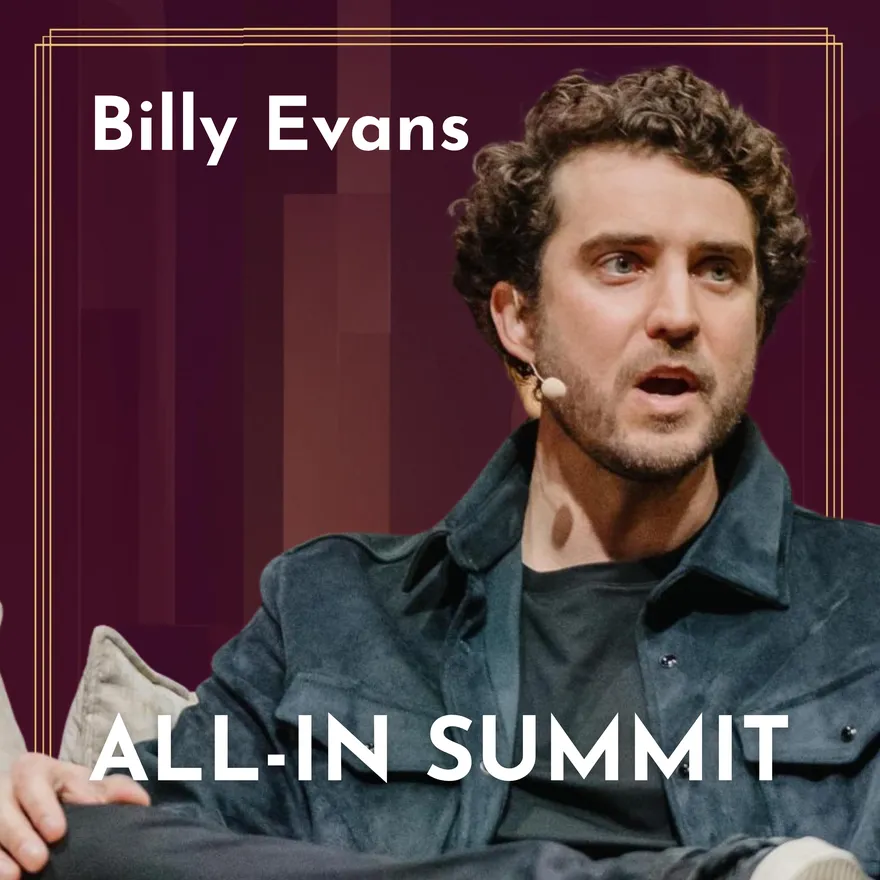

This is a preview of the Shortform summary of the Oct 15, 2026 episode of the All-In with Chamath, Jason, Sacks & Friedberg
Sign up for Shortform to access the whole episode summary along with additional materials like counterarguments and context.
1-Page Summary
Billy Evans and Elizabeth Holmes: A Relationship Born From Controversy
Billy Evans met Elizabeth Holmes at a Fleet Week party in San Francisco on October 7, 2017, where he spent hours in conversation with someone he initially knew only as "Elizabeth." He was surprised to discover she was the controversial Theranos CEO, finding it difficult to reconcile the person he was talking to with the negative media narrative surrounding her. Their offices were just two doors apart on Page Mill Road, which facilitated their growing friendship over the next six months. The relationship turned romantic just three weeks before Elizabeth's indictment, with Billy meeting her parents on that traumatic night.
The couple spent eight months traveling the country in an RV to escape media scrutiny, hiking during the day and working at night while being constantly photographed and criticized for their public appearances. Their son was born on July 10th, just before Elizabeth's trial began, with trial days starting at 4:30 a.m. as Elizabeth pumped breast milk and prepared for court. Their daughter was born after Elizabeth's sentencing. Billy now manages his business, raises both children alone, and ensures they visit Elizabeth weekly in prison, with explanations about her absence adjusted to each child's developmental level.
The Legal Case: Investor Fraud Conviction and Disputed Sentencing
Elizabeth Holmes was acquitted on all patient fraud counts related to the 12.5 million tests Theranos conducted, but was convicted of defrauding three investors and conspiracy to commit fraud. This conspiracy conviction gave the judge authority to consider aggravating factors that expanded her sentencing beyond the base fraud charges. She received 135 months (11.25 years) in prison, with restitution set at $435 million—70% of any commissary money is deducted toward this debt.
Billy Evans contends that the government inflated both the loss amount and victim count by including investors not directly connected to her conviction, increasing the sentence from a possible 4.5-5 years to over 11 years. He notes that less than $100 million of losses involve the three investors from her conviction, while the larger figure aggregates the 10 biggest Theranos investors, including Rupert Murdoch. Recently, Elizabeth received a one-year sentence reduction following changes to sentencing guidelines, during which even the government admitted no evidence showed the wealthy investors experienced actual financial hardship.
Throughout her case, Elizabeth rigidly followed the judge's instruction to litigate in court rather than through media, never publicly defending herself despite extensive negative coverage. Billy and David Friedberg regard this silence as a significant strategic error.
Media Narrative Versus Elizabeth's Character
Billy Evans strongly disagrees with media portrayals depicting Elizabeth as a calculated deceiver, arguing that focus on her black turtleneck, deep voice, and presentation is deeply sexist. He points out that a male entrepreneur with similar traits would be praised for storytelling ability and conviction, while Elizabeth is painted as manipulative. Billy describes his personal experience of Elizabeth as someone with genuine belief in her mission, exceptional listening skills, childlike wonder about the world, and idealistic values shaped by parents devoted to public service.
He emphasizes that Theranos ran 12.5 million patient tests with hundreds of employees working over 16 years on a difficult diagnostic problem—not a calculated fraud by one person. Billy explains that revenue shortfalls resulted from Walgreens defaulting on contracts after adverse press, not fabricated numbers. He notes that nearly everyone who meets Elizabeth in person—including his initially skeptical friends and family—changes their perception after spending time with her in ordinary settings.
Prison Life and Family Separation
Elizabeth has served 1,205 days at Bryan Federal Prison in Texas, a minimum-security facility housing 800 women. Billy describes every day as "incredibly painful," with only about 30 women receiving visitors most weekends among 800 inmates. Visits are marked by distressing separations, with children often crying and screaming for their mothers. The 70% restitution deduction from commissary funds makes it difficult for Elizabeth to afford basics beyond what the prison provides, though she manages to buy items like nuts and trail mix.
President Trump's First Step Act allows Elizabeth to earn up to 16 days off her sentence for every 30 days in recidivism-reduction programs, potentially enabling transfer to a halfway house as early as the second quarter of next year. Communication is heavily monitored, with Billy and Elizabeth mindful not to violate rules during calls. The separation makes it nearly impossible for Elizabeth to maintain her role in their children's development.
The Documentary and Billy's New Venture
Billy Evans explains that the documentary "You Can See Everything" aims to show Elizabeth as she really is, filmed during a period when she couldn't address the Theranos case due to legal restrictions. The project focuses on her personal life in authentic environments rather than orchestrated settings, hoping viewers can make up their own minds. However, Billy worries the editing may reinforce existing stereotypes rather than reveal her true character. The documentary has been in production for three years, with Billy questioning whether the dramatic trailer's dark tone serves commercial interests by maintaining a negative portrayal.
Separately, Billy is building Hemanthes, a photonics diagnostic technology company using Raman spectroscopy—shining lasers through biological samples to reveal chemical composition through color-shifted scattered light. Drawing on his expertise from Luminar, where he worked on LIDAR systems, Billy aims to miniaturize expensive laboratory equipment into affordable, accessible diagnostic devices that generate comprehensive datasets for AI analysis. He's frustrated by media characterizations of Hemanthes as "Theranos 2.0," emphasizing that his company uses established, transparent scientific techniques rather than proprietary claims, focusing on accuracy and enabling real scientific progress.
1-Page Summary
Additional Materials
Clarifications
- Fleet Week is an annual event in several U.S. cities, notably San Francisco, celebrating the U.S. Navy, Marine Corps, and Coast Guard. It features ship tours, air shows, and military demonstrations, attracting large crowds and prominent social gatherings. Parties during Fleet Week are notable for networking among business, military, and social elites. Such events often serve as informal venues for high-profile meetings and introductions.
- Elizabeth Holmes is the founder and former CEO of Theranos, a health technology company. Theranos claimed to have developed a revolutionary blood-testing device requiring only a few drops of blood. Investigations revealed the technology was unreliable and inaccurate, leading to accusations of fraud. Holmes was charged with deceiving investors and patients about the capabilities of Theranos' technology.
- An indictment is a formal charge issued by a grand jury accusing someone of a crime, allowing the case to proceed to trial. "Conspiracy to commit fraud" means an agreement between two or more people to intentionally deceive others for financial or personal gain. It involves planning and coordinating illegal actions, even if the fraud itself is not completed. Conviction on conspiracy charges can lead to penalties similar to those for the actual fraud.
- Walgreens was a major retail partner for Theranos, planning to offer its blood testing services in their stores. The partnership was critical for Theranos to scale and gain credibility in the healthcare market. However, Walgreens terminated the contract after concerns about test accuracy and regulatory issues arose. This loss of a key partner significantly damaged Theranos' revenue and reputation.
- "Acquitted" means a person is found not guilty of a charge in court. "Convicted" means the person is found guilty of a crime. "Restitution" is money ordered by the court to compensate victims for their losses. "Sentencing guidelines" are rules judges use to decide the length and severity of a punishment.
- The First Step Act is a U.S. federal law passed in 2018 aimed at criminal justice reform. It allows eligible inmates to earn time credits for participating in programs that reduce recidivism, such as education or vocational training. These credits can shorten prison sentences or lead to earlier transfer to less restrictive facilities like halfway houses. The law also includes provisions to improve prison conditions and reduce mandatory minimum sentences for certain offenses.
- Commissary funds are money inmates use to buy personal items not provided by the prison, like snacks or toiletries. A 70% deduction means most of the money inmates receive is taken to pay off debts or fines. This significantly limits their ability to purchase extras, affecting comfort and well-being. It also restricts their financial independence while incarcerated.
- Raman spectroscopy is a technique that uses laser light to interact with molecules, causing them to scatter light at different wavelengths. This scattered light provides a unique "fingerprint" that reveals the chemical composition of a sample. In diagnostics, it allows for non-invasive, rapid analysis of biological materials like blood or tissue. This helps detect diseases by identifying molecular changes without needing complex lab procedures.
- LIDAR (Light Detection and Ranging) systems use laser light to measure distances by timing how long it takes for the light to reflect off objects and return. They create detailed 3D maps and are widely used in autonomous vehicles, surveying, and environmental monitoring. Photonics is the science of generating, controlling, and detecting light, which underpins LIDAR technology. Billy's experience with LIDAR involves manipulating light precisely, a skill transferable to developing photonics-based diagnostic tools.
- Elizabeth Holmes founded Theranos, a health technology company claiming revolutionary blood-testing devices. Investigations revealed the technology did not work as promised, leading to fraud charges. Media coverage often focused on her appearance and demeanor, sparking debates about gender bias. Critics argue this overshadowed deeper issues of corporate ethics and scientific validity.
- Recidivism-reduction programs are designed to help inmates avoid reoffending after release by addressing underlying issues like substance abuse, education, or job skills. Participation often includes counseling, vocational training, or behavioral therapy. Successful completion can earn inmates sentence reductions or privileges. These programs aim to improve reintegration into society and reduce repeat crimes.
- Rupert Murdoch was one of the largest investors in Theranos, contributing significant capital that raised the company's valuation. His involvement lent credibility and attracted further investment, amplifying the impact of the fraud allegations. Although not directly implicated in the conviction, his financial loss was included in the government's calculation of total investor losses. This aggregation influenced the severity of Elizabeth Holmes' sentencing by inflating the perceived scale of the fraud.
- The documentary "You Can See Everything" aims to present Elizabeth Holmes' personal side beyond media portrayals. Documentaries can shape public opinion by selective editing, potentially reinforcing stereotypes or biases. The film's dark trailer may emphasize drama to attract viewers, possibly skewing perception. Such projects often balance storytelling with commercial interests, affecting objectivity.
- "Theranos 2.0" refers to a label critics use to suggest Billy's company might repeat Theranos's history of overpromising and underdelivering in medical diagnostics. Theranos was infamous for claiming revolutionary blood-testing technology that was later proven unreliable and deceptive. This label is controversial because it implies distrust and skepticism toward Billy's legitimate scientific approach. Billy rejects it, emphasizing transparency and established technology in his work.
- Incarceration often limits physical contact and communication between inmates and their families due to strict visitation rules and monitored calls. Emotional strain arises from separation, especially affecting children who may struggle to understand a parent's absence. Financial burdens increase as families cover travel and commissary costs, while inmates face restricted access to resources. Maintaining relationships requires consistent effort and adaptation to prison regulations and emotional challenges.
Counterarguments
- While Billy Evans emphasizes the personal hardships faced by his family, critics might argue that the focus on personal suffering can distract from the broader impact of Theranos’s actions on investors, employees, and the healthcare industry.
- The assertion that media criticism of Elizabeth Holmes is primarily sexist overlooks the fact that many criticisms are based on documented actions, legal findings, and business practices, not just her presentation or gender.
- The claim that Theranos was not a calculated fraud by one person does not negate the findings of the court, which convicted Holmes of conspiracy and investor fraud, indicating significant personal responsibility.
- The argument that revenue shortfalls were due to Walgreens defaulting on contracts does not address the documented evidence of misrepresentation to investors and partners about the capabilities of Theranos technology.
- The fact that Holmes was acquitted of patient fraud does not mean there were no negative consequences for patients; inaccurate test results were reported, which could have affected patient care.
- The government’s calculation of loss and victim count, while disputed by Evans, followed established legal procedures for sentencing in fraud cases, which often consider broader financial harm and potential victims.
- The documentary’s intent to show Holmes’s “true character” may be seen as an attempt to rehabilitate her public image, which some may view as minimizing the seriousness of her actions and their consequences.
- Media comparisons of Hemanthes to Theranos, while frustrating to Evans, are not unfounded given the similarities in business models (diagnostic technology startups) and Holmes’s involvement in Theranos, which naturally invites scrutiny and skepticism.
- The argument that Holmes’s silence during the trial was a strategic error does not address the possibility that public statements could have further complicated her legal situation or been used against her in court.
- While Billy Evans describes positive personal qualities in Holmes, these do not negate the legal findings of fraud and conspiracy.


Get access to the context and additional materials
Billy and Elizabeth's Personal Relationship and Family Life
Controversial Meeting Sparked Unexpected Connection
Billy Met Elizabeth At a Fleet Week Party in San Francisco and Had a Meaningful Conversation
Billy Evans first meets Elizabeth Holmes at a Fleet Week party on the rooftop of a venture capitalist's house in San Francisco on October 7, 2017. He attends the party reluctantly and expects to stay briefly but ends up spending several hours in conversation with Elizabeth, which creates an immediate and deep connection. He remembers her as just "Elizabeth" at first, noting her floppy hat, dark sunglasses, and a bandaid on her face from a scratch by her Husky puppy.
Billy Realized Elizabeth, the Controversial Theranos CEO, and Had to Reconcile Her With the Negative Narrative
During their conversation, they discover that their offices are just two doors apart on Page Mill Road, an unexpected proximity that adds to their immediate connection. Only then does Billy realize he’s speaking to Elizabeth Holmes, the infamous CEO of Theranos, who is surrounded by scandal and negative media attention at the time. Despite knowing the harsh public narrative, Billy finds it challenging to reconcile the person in front of him with the reputation that precedes her, stating that his experience of her was completely different from what he had absorbed from media coverage.
Proximity on Page Mill Road Facilitated Their Connection
Their adjacent offices on Page Mill Road provide context for ongoing interactions, paving the way for their friendship to grow.
Rapid Transition From Friendship to Romance During Legal Stress
Billy and Elizabeth Were Friends for Six Months Before Dating Three Weeks Before Her Indictment
After meeting, Billy and Elizabeth spend six months as friends, often walking their dogs together and developing a close bond. Their relationship transitions into romance only three weeks before Elizabeth's indictment. Billy describes the experience as intense, with the rapid shift from friendship to romance occurring under the stress of impending legal action.
Legal Team's Assurances Shattered by Elizabeth's Indictment
Elizabeth's legal team initially assures her she will not be indicted, but this changes abruptly. The suddenness of the indictment is a shock to both, as Billy is unfamiliar with legal proceedings and finds the experience overwhelming.
Billy Met Elizabeth's Parents On Her Indictment Night, Marking a Traumatic Introduction
The night of Elizabeth's indictment is also when Billy meets her parents for the first time, under the stressful and traumatic circumstances of legal crisis.
Couple Retreated From Society to Avoid Media Scrutiny and Public Judgment
Traveling Country in RV: Night Work, Day Hiking to Avoid Surveillance With Husky
Seeking escape from relentless media attention in San Francisco, Billy and Elizabeth spend eight months traveling the United States in an off-road RV, accompanied by their Husky, Balto. They stay at trailer parks and national forests, hiking during the day and working at night to avoid surveillance and enjoy privacy.
Media Criticism of Appearance and Social Activities
The couple faces constant scrutiny, with people taking photos at restaurants and media outlets publishing critical articles about their public appearances and social activities. Every decision and outing is criticized and judged, making ordinary life uncomfortable and isolating.
Couple Withdrew From Public to Protect Emotional Well-Being During Trial Preparation
Preparing for trial consumes much of their time, with late nights spent reviewing legal documents and little understanding of how Elizabeth’s story was being told by the outside world. The withdrawal from public life is as much about protecting their emotional well-being as about hiding from judgment.
Pregnancy and Birth During Trial Creates Emotional Complexity
Son Born July 10th, Daughter Born Post-Elizabeth's Sentencing
Their son, Wills, is born July 10th, just months before Elizabeth’s federal trial begins. Their daughter is born after Elizabeth’s sentencing.
Strict Trial Protocols: Elizabeth's 4:30 Am Wake-Up and Breast Milk Pumping
Trial days involve waking at 4:30 a.m. to ...
Here’s what you’ll find in our full summary
Billy and Elizabeth's Personal Relationship and Family Life
Additional Materials
Counterarguments
- The narrative emphasizes Billy's struggle to reconcile Elizabeth's real personality with her public image, but it does not address the seriousness of the allegations and evidence against her, which were substantiated in court.
- The portrayal of media scrutiny and public judgment as unfair or excessive omits the fact that Elizabeth Holmes was a high-profile figure involved in a major corporate fraud case, making public interest and scrutiny inevitable.
- The text frames the couple's withdrawal from public life as a necessity for emotional well-being, but it could also be interpreted as an attempt to avoid accountability or public questioning.
- The account of Billy's challenges as a single parent and his respect for single mothers, while valid, d ...
Actionables
- you can strengthen relationships by scheduling regular, low-pressure walks or shared activities with acquaintances or colleagues, using these moments to build trust and understanding outside of formal settings; for example, invite a coworker for a weekly dog walk or coffee stroll to foster deeper connections over time.
- a practical way to manage overwhelming public scrutiny or judgment is to create a personal “quiet zone” routine, such as designating certain hours each day to unplug from social media and news, focusing instead on hobbies, nature walks, or journaling to protect your emotional well-being.
- you can prepare for unexpected ...
Get access to the context and additional materials
The Theranos Legal Case and Conviction
Elizabeth Convicted On Investor Fraud, Acquitted On Patient Fraud
Elizabeth Holmes oversaw Theranos as it conducted about 12.5 million patient tests over 18 months. The government brought forward four patient cases, alleging fraud with inaccurate results. However, the jury acquitted Elizabeth on all patient fraud counts, as there was insufficient evidence to prove deliberate fraud related to test results. In contrast, she was found guilty of defrauding three investors through financial misrepresentation and was convicted of conspiracy with her partner to commit this fraud.
The conspiracy conviction was significant, as it gave the judge authority to go beyond the base sentencing for fraud. It enabled the inclusion of further aggravating factors during sentencing, expanding the scope beyond what the fraud charges alone would permit.
Disputed Financial Calculations and More Victim Investors In Sentencing
Elizabeth Holmes was sentenced to 135 months (11 and a quarter years) in prison for investor fraud. Sentencing guidelines considered many aggravating factors, such as the amount of financial loss and the number of alleged victims. Restitution was determined based on $435 million in losses, of which 70% of any commissary money sent to Elizabeth is deducted to repay victims, making it difficult for her to purchase items while incarcerated.
The government increased the reported loss and victim count by adding more investors—many of whom were never directly linked to the specific counts on which Holmes was convicted. According to Billy Evans, less than $100 million of the losses involve the three investors connected to her conviction; the larger $435 million figure comes from aggregating the 10 biggest Theranos investors, including Rupert Murdoch, to increase sentencing guidelines and escalation. These additions elevated Holmes’ sentence from a possible 4.5–5 years to over 11 years because they changed both the loss calculation and the classification to "fraud of 10 or more victims."
Elizabeth Followed the Judge's Order to Litigate In Court, Preventing Her From Publicly Defending Herself During the Case
Throughout her trial, Elizabeth Holmes rigidly followed the judge’s instruction that the case be litigated exclusively in court rather than through the media. Billy Evans emphasizes that despite negative media, books, movies, and podcasts, Holmes refrained f ...
Here’s what you’ll find in our full summary
The Theranos Legal Case and Conviction
Additional Materials
Counterarguments
- The acquittal on patient fraud counts does not necessarily mean that Theranos tests were accurate or that patients were not harmed; it only reflects the jury's finding of insufficient evidence of deliberate fraud by Holmes personally.
- The fact that Holmes was convicted of investor fraud but not patient fraud may indicate a disparity in how white-collar crimes affecting wealthy investors versus ordinary patients are prosecuted and penalized.
- The use of aggregated losses and victim counts in sentencing, while legally permissible, is a standard practice in federal fraud cases and is not unique to Holmes; this approach is intended to reflect the broader impact of fraudulent schemes.
- The assertion that Holmes strictly followed the judge’s instruction to avoid public comment does not preclude the possibility that her silence was also a legal strategy to avoid self-incrimination or further legal complications.
- The lack of evidence of "actual financial hardship" for wealthy investors does not negate the fact that fraud occurred and that financial ...
Actionables
- you can track and document any agreements or financial commitments you make, noting the specific parties involved and the exact terms, so you have clear records if disputes arise about responsibility or loss calculations
- Keep a simple spreadsheet or notebook where you log who you made agreements with, what was promised, and any changes over time. This helps you avoid confusion if someone later tries to expand the scope of your responsibility or claim larger losses than you agreed to.
- a practical way to avoid misunderstandings is to clarify with others how you’ll communicate about problems or accusations, and agree on whether to address issues privately, publicly, or both
- Before entering into any partnership or group project, discuss and write down how you’ll handle negative information or accusations—will you respond publicly, keep things private, or use a mix? This prevents confusion and helps everyone know what to expect if things go wrong.
- you can ...
Get access to the context and additional materials
Media Narrative Versus Elizabeth's True Character
Media Portrays Elizabeth As Deceptive; Billy Disagrees
Extensive media portrayals have consistently depicted Elizabeth Holmes as a fraudster who knowingly deceived people for personal gain. Much attention has focused on her black turtleneck, deep voice, and careful public presentation, suggesting that these were calculated manipulations designed to win others’ trust. David Friedberg references the prevailing notion that Elizabeth’s apparent character “performance” was the origin of her supposed manipulation and fraud.
Billy Evans, however, strongly disagrees and argues that much of this focus is deeply sexist. He finds it outrageous that people attribute Holmes' ability to raise money to her “big blue eyes” or deep voice, stating that similar traits in a male entrepreneur would be lauded as storytelling ability and conviction. “Any guy that did that, people would say, wow, what an incredible ability to tell a story,” Billy explains, but when it comes to Elizabeth, the media paints her actions as deceitful. He believes that this double standard unfairly vilifies her and reflects broader gender biases rather than an objective assessment of her actions or intentions.
Billy's Experience of Elizabeth Contradicts Public Characterization, Revealing Genuine Belief and Idealistic Values
Billy’s personal experience with Elizabeth stands in contrast to her public image of manipulation. He describes Elizabeth as someone who believes deeply in her mission, whose most media-litigated traits actually stem from earnest conviction rather than personal trickery. Evans highlights her exceptional ability to listen and make others feel truly understood, noting that she is “incredible” at making people feel seen and heard.
He also speaks to her curiosity and “childlike wonder” about the world, marveling at ordinary things like airplanes overhead with a sense of awe others might consider naïve. Elizabeth’s upbringing further shaped this idealism: raised by government workers devoted to public service, she grew up in a family where the central dinner conversation was about alleviating suffering and helping others. Billy asserts that understanding a person’s parents and early environment is crucial to understanding who they are—Elizabeth’s parents, who remain close to Billy’s own family, are depicted as genuinely idealistic.
Theranos Faced Complex Operational Challenges, Not Just Fraud
Billy emphasizes that the story of Theranos was not a calculated fraud orchestrated by one person but a massive, collective effort. The company ran around 12.5 million blood tests on patients in just 18 months, approaching the scale of the third-largest U.S. lab at the time. He notes that over 16 years, hundreds of employees worked tirelessly to solve a profoundly difficult diagnostic problem.
Addressing claims of fraudulent revenue projections, Billy explains that Theranos’s revenue loss was due to Walgreens defaulting o ...
Here’s what you’ll find in our full summary
Media Narrative Versus Elizabeth's True Character
Additional Materials
Counterarguments
- Multiple independent investigations, including those by the Wall Street Journal and federal prosecutors, found substantial evidence that Elizabeth Holmes knowingly misrepresented the capabilities and accuracy of Theranos’s technology to investors, partners, and patients.
- Holmes was convicted in a court of law on several counts of fraud and conspiracy, indicating that a jury found beyond a reasonable doubt that she intentionally deceived stakeholders.
- The focus on Holmes’s public persona (e.g., black turtleneck, deep voice) was often discussed in the context of her own deliberate branding choices, which she used to cultivate a specific image similar to Steve Jobs.
- Criticism of Holmes’s actions is not limited to her gender; male entrepreneurs such as Adam Neumann (WeWork) and Trevor Milton (Nikola) have also faced intense scrutiny and legal consequences for misleading investors.
- The scale of Theranos’s operations and the number of blood tests performed do not negate the fact that many tests were unreliable or inaccurate, potentially putting patients at risk.
- Operational challenges and business setbacks do not excuse or justify making false claims about a product’s capabilities, especially in the healthcare sector where patient safety is at stake.
- The breakdown of the Walgreens partnership follow ...
Actionables
- You can challenge your own assumptions about people in the news by writing down your first impressions of a public figure, then researching alternative perspectives or lesser-known facts about them to see how your view shifts. For example, after reading a headline about a controversial CEO, look for interviews, personal stories, or background information that highlight different sides of their character or motivations.
- A practical way to notice and counteract gender bias in media is to keep a simple tally for a week of how often appearance, voice, or mannerisms are mentioned in coverage of men versus women, then reflect on how these details shape your perceptions. For instance, note if articles about male leaders focus on their ideas while those about women mention clothing or tone, and consider how this influences your judgments.
- You can practice forming your own opinions abou ...
Get access to the context and additional materials
Life Managing Imprisonment and the Federal Prison System
Elizabeth Is at Bryan Federal Prison in Texas, Housing 800 Women
Elizabeth has served 1,205 days at Bryan Federal Prison, a minimum-security "camp" in Texas housing 800 women. Despite the facility's reputation, the experience is marked by immense hardship. Billy Evans, Elizabeth’s partner, describes arriving and hugging her goodbye as one of the hardest moments of his life. He says every day since has been “incredibly painful,” and notes that many families are similarly unprepared for the realities of federal prison, even when paying consultants for guidance. Most weekends, only about 30 women receive visitors among the 800 inmates, and visits are scenes of distressing separation, with children often crying and screaming for their mothers.
Emotional Toll: Distressing Separations Affect Children During Visits
Billy underscores the emotional toll the experience takes on families and especially on children. The sight of children leaving visits in tears leaves a lasting impression; kids are forced to say difficult goodbyes, and their farewells are often filled with anguish. This separation deeply affects the families, with mothers unable to maintain their roles in their children's daily lives.
Federal Prison Limits Finances via Restitution Deductions
A significant challenge for Elizabeth and her family is the restriction on finances due to the federal restitution obligation. Of any money sent to Elizabeth for the commissary, 70% is automatically deducted to go toward the $435 million she owes in restitution for her financial crimes. As a result, Elizabeth struggles to afford essentials beyond what the prison provides, making everyday life inside even more difficult.
Despite this financial hardship, Elizabeth manages to purchase vending machine items like nuts and trail mix, which Billy jokingly describes as her eating them “like a squirrel.” These treats are minor comforts in an otherwise restrictive environment.
Federal Sentencing & Early Release Can Reduce Elizabeth's Prison Time
Billy explains that President Trump’s First Step Act allows incarcerated people like Elizabeth to earn up to 16 days off their sentence for every 30 days they spend in recidivism-reduction programs. This legislation has offered Elizabeth hope for earlier release. Based on current calculations, she may be transferred to a halfway house as early as the second quarter of next year.
Understanding the federal prison “calculator” is complex. It involves several phases: the original sentence; the actual time spent wi ...
Here’s what you’ll find in our full summary
Life Managing Imprisonment and the Federal Prison System
Additional Materials
Clarifications
- A minimum-security "camp" is a federal prison facility with the lowest level of security, often without fences or armed guards. It typically houses non-violent offenders and those nearing release. Inmates have more freedom of movement and access to work programs compared to higher-security prisons. These camps focus on rehabilitation and preparing inmates for reintegration into society.
- Consultants are professionals hired to help families understand and navigate the federal prison system. They provide advice on visitation rules, communication protocols, and managing finances like commissary funds. Consultants may also offer emotional support strategies and guidance on legal or procedural matters. Their goal is to prepare families for the challenges of incarceration, though outcomes can still be difficult.
- Restitution is a court-ordered payment from a prisoner to compensate victims for financial losses caused by the prisoner's crimes. The government enforces these payments by deducting a portion of any money the inmate receives, such as commissary funds. The 70% deduction ensures steady repayment toward the large restitution debt. This system prioritizes victim compensation over inmate spending inside prison.
- Restitution is a court-ordered payment from a defendant to compensate victims for financial losses caused by the defendant’s crimes. The $435 million amount represents the total financial harm Elizabeth was found responsible for in her case. This large sum is deducted from any money she receives to repay victims over time. Restitution aims to make victims whole, not to punish the defendant beyond the prison sentence.
- The First Step Act is a federal law aimed at reforming the criminal justice system by promoting rehabilitation and reducing recidivism. It allows inmates to earn "good time credits" by participating in approved programs that reduce the likelihood of reoffending. These credits can shorten their prison sentences, encouraging positive behavior and skill development. The Act also improves prison conditions and expands early release options like halfway houses and home confinement.
- A halfway house is a residential facility that helps inmates transition from prison back to the community. It provides supervision, support, and resources like job training and counseling. Inmates typically stay there for a portion of their sentence after leaving prison but before full release. This step aims to reduce recidivism by easing reintegration challenges.
- The federal prison "calculator" estimates how much time an inmate serves in different custody phases based on their sentence and earned credits. Time is divided into three main parts: incarceration in prison, placement in a halfway house (a transitional residential facility), and home confinement (house arrest with electronic monitoring). The calculator factors in earned good conduct time and program participation credits to reduce prison time. Each phase has specific eligibility rules and durations se ...
Counterarguments
- While the emotional hardship of prison is significant, the primary purpose of incarceration is to serve as a consequence for criminal actions and to protect society, not to provide comfort to inmates or their families.
- The restitution deductions, though financially burdensome, are intended to compensate victims of financial crimes and hold offenders accountable for the harm caused.
- Limited visitation and communication restrictions are standard security measures in correctional facilities to maintain order and prevent illicit activities.
- The First Step Act and similar reforms demonstrate that the federal system does provide mechanisms for sentence reduction and rehabilitation, offering hope and incentives for positive behavior.
- The challenges of explaining incarceration to children, while difficult, are a consequence of the parent's actions and n ...

Get access to the context and additional materials
The Documentary and Billy's Current Business Venture
Documentary "You Can See Everything" Reveals Elizabeth Beyond Media Narratives
Billy Evans describes the motivation behind the documentary "You Can See Everything" as an opportunity for the public to see Elizabeth Holmes as she really is, outside of media portrayals or the context of her legal case. Due to Elizabeth's 11-year sentence and prohibition from public communication, the documentary was filmed during a period when she could not address the Theranos case, so it focuses on her personal life, not relitigating the trial. Billy emphasizes that his intention was to show Elizabeth in authentic environments—going on hikes, spending time with friends, helping others—rather than in orchestrated settings. He shares that people close to him, who initially doubted his relationship with Elizabeth, changed their opinions after meeting her and seeing her natural demeanor. For Billy, the project aims to let others meet Elizabeth in a similar way through the film, giving viewers space to make up their own minds.
Billy voices concern that the editing choices in the documentary may reinforce existing stereotypes about her, rather than revealing her true character, especially given the tough period during which she became a mother and prepared to report to prison. He hopes the documentary will let the audience experience her story in a more nuanced and personal light.
Documentary Delayed, In Production For Three Years
The documentary has been in production for three years, far longer than initially planned. This delay, according to Billy, has fueled his anxiety regarding how Elizabeth will ultimately be portrayed and whether the documentary will achieve its intended goal. He points out that the dramatic trailer—with dark music and intense editing—supports the established media narrative of Elizabeth as a manipulative narcissist, rather than presenting a more humanizing or balanced view.
Billy and David Friedberg discuss the possibility that such dramatic marketing is driven by commercial considerations, with Billy questioning whether media financially benefit from maintaining a negative portrayal of Elizabeth. He openly wonders if the final documentary will contradict the sinister tone of the trailer or simply reinforce established prejudices.
Billy Is Building Hemanthes, a Photonics Diagnostic Technology Company
Parallel to the documentary project, Billy Evans is leading a technology venture unrelated to Elizabeth Holmes or Theranos. Drawing on his expertise from his time at Luminar, where he helped build LIDAR systems for autonomous vehicles, Billy is now building Hemanthes—a company specializing in photonics and diagnostic technology. Hemanthes uses Raman spectroscopy, a well-known scientific technique in which lasers are shone through biological samples; the resulting scattered light shifts in color, revealing information about the sample's chemical composition. While this technique is standard in advanced research labs, the equipment is currently too expensive—often costing millions of dollars—and too complex and large for routine medical use.
Billy's company is striving to miniaturize this costly and complicated laboratory technol ...
Here’s what you’ll find in our full summary
The Documentary and Billy's Current Business Venture
Additional Materials
Counterarguments
- While the documentary aims to present Elizabeth Holmes in a more personal and authentic light, it may risk minimizing or distracting from the serious consequences of her actions and the impact on Theranos investors, patients, and employees.
- Focusing on Holmes’s personal life and positive traits could be seen as an attempt to rehabilitate her public image without addressing the underlying issues that led to her conviction.
- The concern about the documentary’s editing reinforcing stereotypes may overlook the fact that public skepticism is rooted in well-documented legal findings and not just media narratives.
- The suggestion that negative portrayals of Holmes are primarily driven by commercial interests may understate the role of legitimate public interest in accountability for high-profile fraud cases.
- The claim that people changed their opinions after meeting Holmes personally does not necessarily address or negate the broader ethical and legal concerns raised by her actions at Theranos.
- Drawing a sharp distinction between Hemanthes and Theranos may be valid in terms of technology and approach, but public scrutiny is understandable given the history and the potential for simila ...
Actionables
- you can challenge your own assumptions about people in the news by privately writing a list of your first impressions, then seeking out unfiltered, everyday accounts or interviews that show them in ordinary settings, and noting any shifts in your perspective
- For example, after reading headlines about a public figure, look for candid photos, casual conversations, or community stories about them, and reflect on how these details change your view compared to the media narrative.
- a practical way to spot sensationalism in media is to compare the tone and content of trailers, headlines, or promotional materials with the actual content, then jot down specific differences and consider how marketing choices shape your expectations
- For instance, after watching a dramatic trailer, watch the full documentary or read the full article, and list moments where the real story feels more nuanced or balanced than the preview suggested.
- ...
Get access to the context and additional materials


Create Summaries for anything on the web
Download the Shortform Chrome extension for your browser
