

Rahm Emanuel: Trump's Foreign Policy, China, Europe's Decline, Immigration & DSA vs Democrats
In this episode of All-In with Chamath, Jason, Sacks & Friedberg, former U.S. Ambassador to Japan Rahm Emanuel discusses America's strategic challenges and opportunities on multiple fronts. Emanuel analyzes the intensifying competition with China, covering economic dependency, manufacturing capacity, and regional flashpoints including Taiwan and the South China Sea. He argues for strengthening alliances across the Indo-Pacific and building economic blocs to counter Chinese influence.
The conversation also examines U.S. foreign policy more broadly, including Europe's vulnerabilities, Middle Eastern dynamics, and the decline of American soft power. On domestic policy, Emanuel and the hosts discuss fiscal reform, tax code overhaul, and the education system's critical role in national competitiveness—from early childhood through community college modernization. The episode concludes with immigration policy discussions that balance border security with attracting global talent through point-based systems and university pathways.
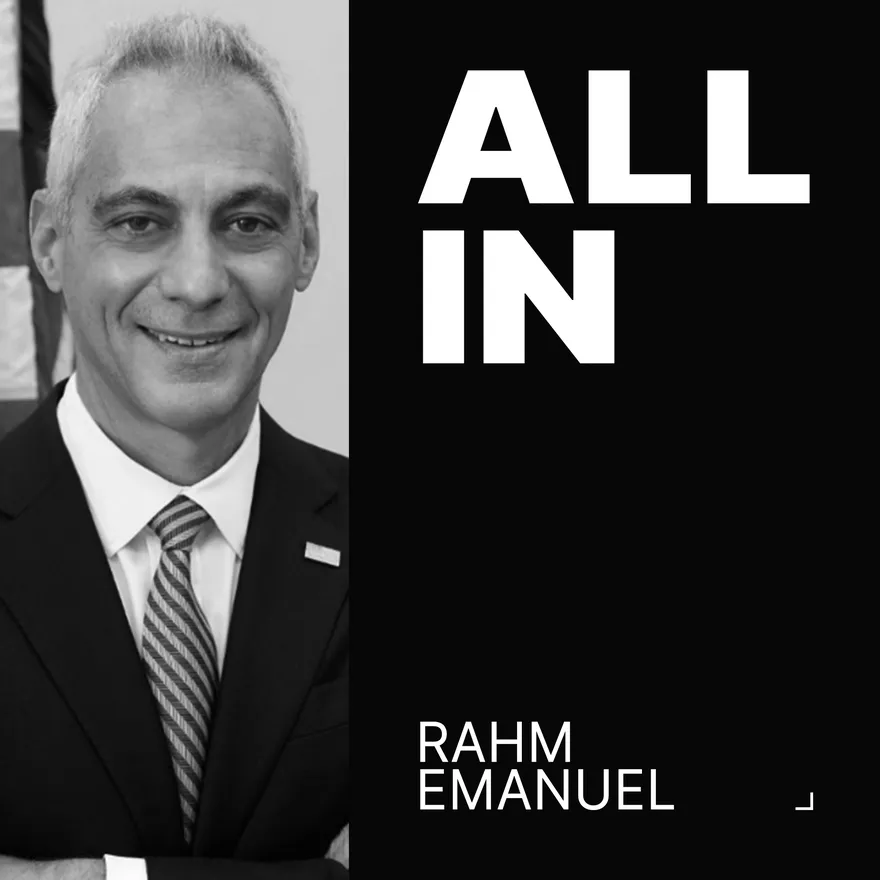

This is a preview of the Shortform summary of the Aug 13, 2026 episode of the All-In with Chamath, Jason, Sacks & Friedberg
Sign up for Shortform to access the whole episode summary along with additional materials like counterarguments and context.
1-Page Summary
China Competition and Indo-Pacific Strategy
Rahm Emanuel and David Friedberg discuss the intensifying competition between the United States and China, focusing on economic strategy, technological rivalry, and flashpoints in the Indo-Pacific region.
Economic Dependency and Strategic Vulnerability
Emanuel explains that China's economic strategy aims to make other countries dependent on its market while remaining independent itself. This approach gives China maximum flexibility and leaves nations like the U.S. vulnerable to leverage. He criticizes the "win-win" narrative as shortsighted, noting that China's most disruptive export is actually its domestic economic dysfunction—overcapacity in steel, autos, and manufacturing that destabilizes global markets.
Manufacturing and Technological Competition
China's weak COVID-19 vaccine response sparked a strategic shift, with massive investments in life sciences to challenge U.S. dominance within five years. Friedberg notes China now boasts 20 times the U.S. manufacturing capacity and is on track to produce eight terawatts of electricity compared to America's one to two terawatts. Emanuel and Friedberg argue that the U.S. has become vulnerable by allowing its manufacturing sector to atrophy while over-relying on knowledge industries—a position now threatened by AI commoditization.
Research and Development Investment Crisis
Despite proven returns from research funding, Emanuel criticizes proposals for 40% NIH budget cuts, warning that America's "crown jewels"—the NIH, NSF, DARPA, and leading universities—face existential threats from budgetary neglect that undermine scientific leadership.
Alliance Building and Economic Bloc Strategy
Emanuel urges forming an economic bloc with allies including Australia, Japan, South Korea, Taiwan, the EU, and Latin American partners. This united front would prevent China from isolating individual nations and coordinate responses to Chinese market manipulation more effectively than unilateral tariffs.
Taiwan and South China Sea Threats
Emanuel details three Chinese strategies toward Taiwan: economic quarantine, rapid 96-hour invasion, or incremental island occupation. He advocates doubling U.S. military resources in the Philippines and clarifying that while the U.S. maintains strategic ambiguity politically, it will resist unilateral changes to the status quo through force.
Regional Alliance Strengthening
Japan is central to the U.S. Indo-Pacific strategy. Emanuel highlights Japan's unprecedented declaration that a Taiwan crisis represents a Japanese national security threat, marking a new level of commitment. Trilateral coordination among the U.S., Japan, and South Korea, along with the Quad (U.S., Japan, India, Australia), strengthens regional unity against Chinese and North Korean threats.
US Foreign Policy and International Alliances
Emanuel and Friedberg analyze challenges in U.S. foreign policy, particularly around declining soft power, European vulnerability, Middle Eastern dynamics, and presidential leadership style.
Cultural Attraction and Soft Power Decline
American soft power—cultural attraction rooted in democratic values, education, and technology—has weakened significantly under the Trump administration. Emanuel argues this decline damages America's effectiveness in political and economic statecraft, stating, "Now that America's brand under Trump is in the toilet, that actually hurts America and its political power, its economic statecraft, and its military capabilities."
National Security Tool Integration
Emanuel breaks down America's national security toolkit into four integrated tools: military power, political persuasion, economic statecraft, and cultural attraction. He insists that military dominance alone is inadequate and that only the United States can bring adversaries to the table—an ability stemming from global respect, not force alone.
European Challenges and Opportunities
Europe faces vulnerabilities from flawed energy policies and increased dependence on Russian energy, leading to manufacturing job losses to China. However, Emanuel argues these vulnerabilities present opportunities for U.S.-European collaboration. He emphasizes that a strong European bloc benefits the U.S. by sharing security burdens and resisting coercion, while American antagonism toward European leaders weakens the Western alliance.
Middle East Strategic Architecture
Emanuel highlights Iran's systematic defeat after decades of proxy network investment. Hamas has been degraded, Hezbollah cornered, and Damascus lost to Iranian influence. The new India-Middle East-Europe economic corridor draws the Gulf closer to the U.S., fostering economic integration and reducing Iranian influence while enhancing regional stability.
Presidential Style and Strategic Coherence
Emanuel criticizes the president's tendency to "punch down" at middle-power leaders while "kissing up" to autocrats like Putin and Xi, reflecting personal insecurity that undermines American credibility. He asserts, "There is no strategy to this. This is all his insecurities," concluding that the absence of strategic coherence weakens international influence.
Domestic Economic Policy and Fiscal Reform
Friedberg and Emanuel discuss mounting fiscal challenges, emphasizing the need for discipline, equity, and long-term growth strategies.
Fiscal Crisis and Government Spending
Friedberg highlights the stark gap: the U.S. spends $7 trillion annually while collecting only $5 trillion in revenue, creating a $2 trillion deficit. With national debt at $40 trillion and 5% interest rates, servicing the debt costs roughly $2 trillion yearly. Emanuel adds that the U.S. moved from surplus to deficit through reckless choices like funding wars while cutting taxes. He proposes redirecting wasteful spending, such as $38 billion on detention centers, toward modernizing community colleges—critical to economic infrastructure and workforce development.
Tax Code Reform and Wealth Creation
Emanuel argues the current tax code rewards wealth preservation over creation, calling it an "abomination" that hinders entrepreneurship. He criticizes the step-up basis loophole that allows wealthy individuals to avoid taxes when passing assets to heirs. Emanuel calls for comprehensive reform incentivizing wealth creation and closing loopholes.
Revenue and Spending Balance
Both agree that solving the fiscal crisis requires action on spending and revenues—cuts alone won't suffice, especially as AI risks concentrating wealth further. Emanuel insists the U.S. must control federal spending for five years while making difficult choices about priorities.
Growth-Oriented Fiscal Framework
Emanuel identifies five pillars for sustainable growth: comprehensive education and training, immigration reform, energy modernization, doubled research funding (suggesting a 10% tax on predictive markets and sports gaming to fund NIH, NSF, and DARPA), and tax code reform. He urges capping overall federal spending while making targeted investments in research, education, and infrastructure to drive productivity and competitiveness.
Education and Workforce Development
Emanuel and Friedberg outline comprehensive education reforms addressing critical challenges from early childhood through higher education.
K-12 Transformation and Early Foundation
Emanuel highlights that half of American children cannot read at grade level, calling this the fundamental crisis. He emphasizes that universal free pre-kindergarten and full-day kindergarten are critical foundations, while elementary education must focus on fundamentals, teacher training, and accountability. Emanuel states, "You know when kids drop out of college, David? Third grade. That's when they start dropping out," stressing that successful reform requires daily attention over 20 years.
High School Reimagining and College Preparation
Emanuel proposes revamping high school curriculum to focus on college and career pathways rather than just diplomas. He advocates for all students to graduate with college credit through dual enrollment with community colleges and requires graduates to present post-secondary acceptance letters. He also pioneered making community college free for students with B averages.
Community College Modernization
Emanuel underscores community colleges as the economic backbone of mid-sized cities, yet underfunded and outdated. He proposes redirecting $8 billion from ICE detention funding to modernize 1,200 community colleges, making career and technical training accessible. He notes critical workforce shortages in skilled trades and argues for tuition-free pathways in high-demand fields.
Higher Education Cost Control and Access
Friedberg points out that unlimited federal student loans enable colleges to raise tuition unchecked, with administrative staff jumping from 10% to 60% over 30 years. Emanuel advocates limiting foreign students to 20% (charging full tuition to subsidize American education), offering free college for families earning under $200,000, capping tuition increases at inflation for others, and streamlining federal compliance costs.
Education as National Competitiveness Imperative
Both stress that America's economic future depends on an educational system producing skilled, literate workers. Emanuel insists education reform must be a 20-year commitment, citing academic gains in Louisiana and Mississippi, and that the system should provide real pathways to both college and high-wage skilled trade jobs.
Immigration Policy
Emanuel and Jason Calacanis present comprehensive immigration policy discussions balancing strong borders with robust legal immigration and reforms to attract global talent.
Legal and Illegal Balance
Emanuel emphasizes that the U.S. is both a nation of laws and immigrants, requiring strict border enforcement while preserving legal pathways. He criticizes Democrats for proposing free healthcare for illegal border crossers, arguing this alienated moderates and undermined border control credibility. Emanuel supports the Dignity Act, with 23 Republican and 23 Democratic co-sponsors, as a true compromise advancing both border enforcement and legal immigration solutions.
Attracting Global Talent
Emanuel and Calacanis stress legal immigration's importance for national prosperity, noting that many top entrepreneurs either immigrated or are children of immigrants. They recall Trump's failure to follow through on automatic green cards for U.S. degree holders, calling it "foolish" as these individuals are often recruited by competing economies. Emanuel warns that China actively recruits U.S.-trained scientists who left because of restrictive policies.
Point-Based Immigration System
Emanuel points to Canada and Denmark as models using point-based systems screening for education, language ability, and economic potential. These systems balance immigrant integration, economic dynamism, and social cohesion while prioritizing skills and contributions.
Border Control and Order
Emanuel and Calacanis agree that Americans oppose border chaos. Emanuel stresses that controlling the border signals that law-breaking isn't rewarded, building public confidence in competence and rule of law. He emphasizes substantial investment in border security, employment enforcement, and modernized processing to restore order.
University and Skills Pipeline
Emanuel advocates allowing universities to admit more international students paying full tuition to fund scholarships for Americans. He proposes expedited visas for international graduates, viewing the university system and student visa program as powerful tools for maintaining U.S. global influence and competitiveness, lamenting historical underinvestment in these advantages.
1-Page Summary
Additional Materials
Counterarguments
- The assertion that China seeks to make other countries dependent while remaining independent oversimplifies complex global economic interdependencies; many countries, including the U.S., also pursue strategies to maximize their own leverage and resilience.
- Overcapacity in Chinese manufacturing has at times resulted in lower prices for global consumers and has supported infrastructure development in developing countries.
- While China is investing heavily in life sciences, the U.S. maintains significant advantages in research, innovation, and global partnerships that are not easily replicated.
- The claim that China has 20 times the U.S. manufacturing capacity may not account for differences in quality, technological sophistication, and value-added production.
- AI commoditization threatens knowledge industries globally, not just in the U.S.; other advanced economies face similar challenges.
- Cutting research funding is controversial, but some argue that current spending levels are inefficient or that private sector R&D can compensate for some reductions in public funding.
- Forming large economic blocs can be difficult due to divergent interests among allies, and may provoke retaliatory measures or trade fragmentation.
- The U.S. policy of strategic ambiguity regarding Taiwan has helped maintain peace for decades; doubling military resources in the region could escalate tensions and provoke an arms race.
- Japan’s increased involvement in Taiwan security could strain its relations with China and complicate regional diplomacy.
- The decline in American soft power is debated; some argue that U.S. cultural and technological influence remains strong globally despite political fluctuations.
- Military power remains a significant factor in international relations; some adversaries may only respond to credible deterrence rather than persuasion or soft power.
- Europe’s energy dependence on Russia is being actively addressed through diversification and renewable investments; manufacturing job losses are influenced by multiple factors, not just China.
- U.S. criticism of European leaders is not unique to recent administrations and does not always result in weakened alliances.
- Iran retains significant influence in parts of the Middle East, and proxy conflicts remain unresolved in several areas.
- The president’s diplomatic style is subjective and may be interpreted differently by various observers; some argue that engagement with autocrats can yield pragmatic results.
- The U.S. fiscal crisis is driven by both spending and revenue issues; some argue that economic growth can help reduce debt burdens over time.
- Redirecting funds from detention centers to education is a policy choice that may face opposition from those prioritizing border security.
- The step-up basis and other tax provisions have defenders who argue they prevent double taxation and support family-owned businesses.
- Comprehensive tax reform is politically challenging and may have unintended economic consequences.
- Capping federal spending could limit the government’s ability to respond to economic downturns or emergencies.
- Universal pre-K and full-day kindergarten are expensive and their long-term benefits are debated among education researchers.
- Mandating post-secondary acceptance letters for high school graduation may disadvantage students in underserved communities.
- Limiting foreign students could reduce university revenues and diminish the diversity and global competitiveness of U.S. higher education.
- Tuition-free college for families earning under $200,000 may be fiscally unsustainable or divert resources from other priorities.
- Strict border enforcement can conflict with humanitarian obligations and the need for asylum protections.
- Proposals like the Dignity Act face political hurdles and may not satisfy either immigration restrictionists or advocates for broader reform.
- Point-based immigration systems can overlook humanitarian needs and family reunification priorities.
- Expanding international student admissions may be seen as prioritizing revenue over educational mission or domestic student access.
- The U.S. university system continues to attract top global talent despite policy challenges, indicating enduring strengths.
Actionables
- you can track your own household or workplace spending and investments to identify areas where shifting funds toward education, skills training, or technology upgrades could boost long-term productivity and resilience, such as reallocating entertainment or luxury expenses to online courses or certifications in high-demand fields.
- a practical way to support economic and educational resilience is to join or start a small peer group that regularly shares resources and tips for navigating workforce changes, such as AI-driven job shifts or new immigration opportunities, helping each other find scholarships, training programs, or job openings in skilled trades and tech.
- you can write to your local school board or community college leadership suggesting specific, low-cost improvements—like after-school reading clubs, career pathway info sessions, or partnerships with local businesses for internships—that directly address literacy gaps and workforce shortages without requiring major policy changes or new legislation.
Get access to the context and additional materials
China Competition and Indo-Pacific Strategy
The current geopolitical landscape is shaped by intensifying competition between the United States and China, with a significant focus on economic dependency, technological rivalry, research investment, alliance strategy, and escalating flashpoints in the Indo-Pacific, particularly around Taiwan and the South China Sea.
Economic Dependency and Strategic Vulnerability
China's economic strategy is explicit and calculated: Rahm Emanuel explains that China seeks to make other countries dependent on its vast market, while itself remaining independent from theirs. For example, China positions itself to ensure that if the U.S. ceases soybean exports, China can quickly source them from Brazil or Argentina. This duplicity guarantees China maximum flexibility with minimal constraints and leaves other nations, particularly the U.S., vulnerable to leverage.
The U.S. has, at times, bought into the rhetoric of a "win-win" relationship with China, ignoring Beijing's core objective of gaining leverage without constraints. Emanuel labels this approach as shortsighted and notes that the so-called "win-win" narrative is a façade for China to gain economic and strategic dominance.
Furthermore, Emanuel states that China's most disruptive export is not manufactured goods, but its domestic economic dysfunction. Chinese economic mismanagement leads to global destabilization, affecting industry sectors worldwide. China’s industrial overcapacity, described in terms of steel, autos, and manufacturing, creates a ripple effect—depressing profits globally, increasing WTO disputes, and driving instability as China seeks to export excess capacity and economic chaos rather than reform.
Manufacturing and Technological Competition
China’s weaknesses during the COVID-19 pandemic—specifically its inability to produce a high-efficacy vaccine as rapidly as the U.S.—sparked a strategic shift. While the U.S. developed highly effective vaccines within about a year, China's version took longer and was less effective, leading even Chinese officials to prefer Western vaccines. Recognizing this gap, China massively increased investment in life sciences research and development to ensure it would not fall behind again, aiming to challenge U.S. dominance in this field within five years.
The U.S., meanwhile, missed a key opportunity to leverage its vaccine success for greater influence in the developing world, failing to use its edge for diplomatic, economic, or cultural gains.
Technologically, China now boasts enormous manufacturing power—20 times the U.S. manufacturing square footage, much of it automated—and a robust, surging energy production capacity. David Friedberg notes China is on track to produce eight terawatts of electricity, compared to the United States’ one to two terawatt potential.
Today, China is aggressively investing in artificial intelligence, manufacturing, and software. U.S. dominance in software and knowledge industries is increasingly threatened as China begins to eliminate America’s advantage in knowledge services and intellectual property. Emanuel and Friedberg argue that for thirty years, the U.S. has become vulnerable by allowing its manufacturing sector to atrophy while over-relying on its position as a knowledge and service economy—a position now imperiled by the rapid commoditization of AI.
Research and Development Investment Crisis
Despite proven returns from research funding—such as the NIH's pivotal role in developing a pancreatic drug that may help address other cancers—the U.S. faces a research investment crisis. Emanuel criticizes repeated proposals for drastic NIH budget cuts (up to 40%) under the Trump administration, noting that such reductions threaten America’s scientific leadership and innovation pipeline.
America's "crown jewels"—the NIH, NSF, DARPA, national labs, and leading universities—face existential threats from budgetary neglect and political attacks, despite being sources of competitiveness and scientific breakthroughs. Emanuel warns that "you’re not going to cut NIH in your way to American leadership" and that these institutions need safeguarding to maintain the U.S. edge.
Alliance Building and Economic Bloc Strategy
Emanuel urges a collective approach to China through alliance building. He recommends aggregating U.S. alliances with Australia, Japan, South Korea, Taiwan, the EU, and friends in Latin America into an economic bloc. This united front would prevent China's strategy of isolating individual nations and instead "isolate the isolator."
By forming such a bloc, the U.S. and its allies could coordinate economic strategies, organize research and manufacturing capabilities, and confront Chinese market manipulation more effectively than through unilateral actions like tariffs or piecemeal trade warfare. The bloc would bolster collective economic and security strength and ensure American leadership within a coordinated international framework.
Taiwan and South China Sea Threats
China's regional ambitions manifest most clearly in its posture toward Taiwan and the South China Sea. Emanuel details three Chinese strategies: economically quarantining Taiwan, undertakin ...
Here’s what you’ll find in our full summary
China Competition and Indo-Pacific Strategy
Additional Materials
Counterarguments
- The characterization of China’s economic strategy as uniquely manipulative overlooks that many countries, including the U.S., also pursue policies to maximize their own leverage and minimize dependency.
- The assertion that the U.S. has “mistakenly” embraced a “win-win” narrative with China does not account for the significant economic benefits and global stability that have resulted from U.S.-China trade and cooperation over the past decades.
- Industrial overcapacity and economic dysfunction are not unique to China; other major economies have also experienced similar issues, and global market instability often has multiple causes.
- The U.S. did provide significant vaccine aid and support to many countries during the COVID-19 pandemic, and its efforts were recognized by international organizations and recipient nations.
- While China’s manufacturing capacity is larger, the U.S. retains significant advantages in high-value manufacturing, innovation, and advanced technology sectors.
- The decline in U.S. manufacturing is partly due to market forces, automation, and global economic trends, not solely policy decisions or competition with China.
- Proposed NIH budget cuts have not always been enacted, and U.S. research institutions continue to receive substantial funding compared to most other countries.
- The formation of a large economic bloc to counter China faces practical ...
Actionables
- you can diversify your personal tech and consumer product choices by intentionally seeking out alternatives from multiple countries, reducing your own dependency on any single nation’s supply chain and supporting a more resilient global market; for example, when shopping for electronics, compare options from Japanese, South Korean, European, and American brands rather than defaulting to one country’s products.
- a practical way to support scientific research and innovation is to regularly donate small amounts to public research institutions or university foundations, and share their breakthroughs on your social media to raise awareness and encourage others to value and protect these organizations.
- you can strengthen intern ...
Get access to the context and additional materials
Us Foreign Policy and International Alliances
Rahm Emanuel and David Friedberg analyze the contemporary challenges and shifts in U.S. foreign policy, particularly around the decline of soft power, integration of security tools, European vulnerability, Middle Eastern dynamics, and the consequences of presidential leadership style.
Cultural Attraction and Soft Power Decline
American foreign policy traditionally leverages soft power—its cultural attraction, rooted in democratic values, world-class education, technology, and the “American brand”—as key assets in its global strategy. Emanuel argues that this soft power has weakened significantly under the Trump administration, damaging not only America’s image but also its effectiveness in political and economic statecraft. He stresses that cultural attraction is vital alongside military, political, and economic power, and that eroding U.S. prestige diminishes all four.
Emanuel separates the Obama-era approach, characterized by presenting American cultural assets around the world, from the Trump administration’s decline in global popularity. Under Obama, U.S. popularity acted as a political asset that facilitated diplomatic efforts. Emanuel says the decline is not due to over-exporting culture, but from active harm to the brand, reducing Washington’s ability to mediate and influence major global events. He states, “Now that America’s brand under Trump is in the toilet, that actually hurts America and its political power, its economic statecraft, and its military capabilities.”
National Security Tool Integration
Emanuel breaks down America’s national security toolkit into four tools: military power, political persuasion, economic statecraft, and cultural attraction. He insists that U.S. military dominance alone is inadequate without integration with political, economic, and cultural strengths. Only the United States, he says, can bring adversaries like Russia and Ukraine to the table—an ability stemming from global respect, not brute force alone.
America’s assets such as universities, research labs, and technology innovation are central to economic statecraft but are being targeted aggressively by rivals like China. Emanuel mentions that current challenges, such as the theft or competition in tech and research, are economic statecraft issues that directly affect national security. He warns that U.S. strategic interests can only be secured by delivering an integrated approach—military, political, economic, and cultural—not by reliance on military strength alone.
European Challenges and Opportunities
Europe faces major vulnerabilities due to flawed energy policies and the resulting increased dependence on Russian energy. Emanuel recounts warnings about these dependencies and identifies the resulting loss in manufacturing jobs to China as a significant threat. However, these vulnerabilities also present opportunities for American partnership. For example, U.S.-European collaboration can counteract Chinese pressure and create new opportunities.
European unity is further tested as American antagonism toward European leaders weakens the Western alliance, precisely when China and Russia are attempting to divide it. Emanuel argues for American partnership over rivalry, observing that a strong European bloc benefits the U.S. by sharing security burdens and providing a more robust resistance to coercion. This robust partnership strengthens the alliance and dissents pressures from rivals that try to weaken the transatlantic alliance.
Middle East Strategic Architecture
Emanuel highlights a dramatic shift in the Middle East’s power structure. Iran’s decades-long investment in its proxy network—the so-called “octopu ...
Here’s what you’ll find in our full summary
Us Foreign Policy and International Alliances
Additional Materials
Clarifications
- Soft power is the ability to influence others through attraction and persuasion rather than coercion or payment. It relies on cultural appeal, values, and policies that others admire and want to emulate. Unlike military power, which uses force, or economic power, which uses financial incentives or sanctions, soft power shapes preferences and builds goodwill. This influence helps create alliances and cooperation without direct pressure.
- The Trump administration harmed the "American brand" by adopting nationalist and isolationist policies that alienated allies and undermined global cooperation. Its rhetoric often included harsh criticism of traditional partners and international institutions, reducing trust and goodwill. Controversial actions, such as withdrawing from climate agreements and trade deals, signaled unpredictability and unreliability. These moves diminished America's image as a leader committed to shared values and global stability.
- Economic statecraft refers to the use of economic tools like trade policies, sanctions, and investment to influence other countries' behavior. It leverages economic power to achieve foreign policy goals without military force. This approach can shape global alliances, deter adversaries, and promote national interests. Effective economic statecraft requires coordination with political, military, and cultural strategies.
- American universities and research labs drive innovation by developing advanced technologies critical for military and economic strength. They train skilled scientists and engineers who contribute to national security through breakthroughs in cybersecurity, AI, and biotechnology. Protecting these institutions from espionage and intellectual property theft is vital to maintaining U.S. technological superiority. Innovation in technology also supports economic competitiveness, which underpins the country’s global influence and security.
- China targets American technology and research through cyber espionage, intellectual property theft, and recruiting scientists. These actions aim to accelerate China’s own technological development and military capabilities. U.S. companies and universities face risks of data breaches and loss of competitive advantage. This undermines U.S. economic strength and national security by eroding innovation leadership.
- Europe's flawed energy policies largely stem from overreliance on Russian natural gas, which supplies about 40% of its gas needs. This dependence gives Russia significant leverage to influence European politics and energy prices. Efforts to diversify energy sources have been slow, leaving Europe vulnerable to supply disruptions. Additionally, insufficient investment in renewable energy and infrastructure has hindered Europe's energy independence.
- Manufacturing job losses in Europe to China result from companies relocating production to China due to lower labor costs and large-scale manufacturing capacity. This shift weakens European industrial bases, reducing economic resilience and increasing dependency on foreign supply chains. It also diminishes Europe's bargaining power in global trade and technology competition. Consequently, these losses create economic vulnerabilities that adversaries can exploit politically and strategically.
- The Western alliance primarily consists of the U.S. and European countries united by shared democratic values and security interests, especially through NATO. American antagonism, such as criticism or lack of support toward European leaders, creates mistrust and weakens cooperation. This division makes it easier for rivals like China and Russia to exploit disagreements and undermine collective security. Strong U.S.-European relations are essential to present a united front against global threats.
- Iran’s "octopus" proxy network refers to its extensive system of allied militant groups and political actors across the Middle East. These proxies, such as Hezbollah in Lebanon and various militias in Iraq and Syria, extend Iran’s influence without direct military engagement. The network allows Iran to project power, destabilize adversaries, and counter U.S. and Israeli interests regionally. It operates through funding, training, and supplying weapons to these groups.
- Hamas is a Palestinian Islamist group controlling Gaza, often in conflict with Israel and backed by Iran. Hezbollah is a Lebanese Shiite militant and political organization, heavily supported by Iran and Syria, influencing Lebanon’s politics and regional conflicts. Syria, under Bashar al-Assad, remains aligned with Iran and Russia, recovering from civil war but still unstable. Iraq is working to reduce militia influence, balancing relations with the U.S. and Iran while striving for internal stability.
- The "23-state economic corridor" refers to a large trade and infrastructure network connecting India, Middle Eastern countries, and Europe to enhance economic integration and cooperation. It aims to facilitate smoother movement of goods, energy, and investments across these regions, boosting regional development and stability. This corridor helps reduce reliance on rival powers like Iran and China by strengthening ties with the U.S. and its allies. It represents a strategic effort to create a more interconnected and economically aligned zone spanning three continents.
- Jordan and Egypt have historically signed peace t ...
Counterarguments
- The decline in U.S. soft power and global popularity is not solely attributable to the Trump administration; long-term trends, including unpopular military interventions and domestic issues, have also contributed to shifts in global perceptions of the U.S.
- The effectiveness of soft power is difficult to measure, and some critics argue that hard power (military and economic leverage) remains the primary driver of international outcomes, regardless of cultural attraction.
- The assertion that the Obama administration universally enhanced U.S. popularity is contested; some allies and adversaries criticized Obama-era policies, such as drone strikes and intervention in Libya, which also affected America’s image abroad.
- The claim that Iran’s proxy network in the Middle East has been “systematically defeated” is debated; groups like Hezbollah and various militias retain significant influence and operational capacity in the region.
- The idea that the new India-Middle East-Europe economic corridor will decisively shift Gulf states away from Iran and China is uncertain, as these states often pursue multi-vector foreign policies and maintain economic ties with multiple powers.
- The characterization of the current administration’s foreign policy as lacking coherence is subjective; some analysts argue that prioritizing transactional relationships and burden-sharing reflects a deliberate, if unconventional, s ...
Get access to the context and additional materials
Domestic Economic Policy and Fiscal Reform
The United States faces mounting fiscal challenges that demand a sweeping approach to economic policy and fiscal reform. Policymakers David Friedberg and Rahm Emanuel discuss both the severity of the present crisis and a set of solutions that emphasize discipline, equity, and long-term growth.
Fiscal Crisis and Government Spending
U.S. $2T Deficit: $7T Spending, $5T Revenue, Unsustainable Path
David Friedberg highlights the yawning gap between federal spending and revenues: the U.S. currently spends $7 trillion per year while only collecting $5 trillion in revenue, leading to a $2 trillion annual deficit.
National Debt of $40 Trillion and High Interest Rates Demand Restructuring of Government Priorities and Revenue Sources for Economic Viability
The nation’s debt stands at $40 trillion. With interest rates at 5% for 30-year treasuries, this translates into roughly $2 trillion per year just to service the debt. Friedberg stresses that continuing on this path is unsustainable and will jeopardize the financial future of coming generations, necessitating a fundamental restructuring of government priorities and approaches to raising revenue. Rahm Emanuel adds that the U.S. moved from a surplus to this record deficit due to reckless fiscal choices, such as funding wars while simultaneously cutting taxes.
Government Spending on Failed Initiatives Like Detention Centers Is a Wasteful Expense That Could Be Redirected To Economic Infrastructure and Workforce Development
Emanuel calls out wasteful expenditures like spending $38 billion on detention centers, which he characterizes as politically driven and unwanted. Instead, he proposes redirecting much of these funds toward modernizing the country's 1,200 community colleges, describing them as critical to economic infrastructure and local workforce development.
Tax Code Reform and Wealth Creation
Tax Code Favors Wealth Preservation Over Wealth Creation, Hindering Entrepreneurship
Emanuel argues that the current U.S. tax code is designed to reward wealth preservation rather than the creation of new wealth, which he calls an "abomination" detrimental to economic freedom and growth. The system, he says, encourages individuals to focus energy on preserving and passing down wealth instead of investing in entrepreneurial endeavors and wealth generation.
Step-Up Basis Enables Wealthy to Avoid Taxes, Creating Inequality
A major loophole, according to Emanuel, is the step-up in basis, which allows wealthy individuals to avoid taxes entirely when passing assets to their heirs, leading to greater inequality while most Americans live paycheck to paycheck.
Reform Tax Policy to Incentivize Wealth Creation Over Preservation
Emanuel calls for comprehensive tax reform, explicitly advocating for a code that incentivizes wealth creation and entrepreneurship while closing loopholes like the step-up basis that disproportionately benefit the wealthy.
Revenue and Spending Balance
Tackling Fiscal Crisis Needs Spending and Revenue Fixes; Cuts Alone Won't Suffice Amidst Ai-driven Wealth Concentration
Both Friedberg and Emanuel agree that solving the fiscal crisis will require action on both government spending and revenues. Emanuel points out that simply cutting spending is neither politically viable nor sufficient, especially as technology and AI risk driving an even greater concentration of wealth at the top.
Difficult Spending Choices Needed For Economic Growth and Opportunity
Emanuel insists the U.S. must control federal spending for the next five years, preventing growth in the overall budget, and must also make difficult decisions about spending priorities. Modernizing educational institutions and research funding are emphasized as foundational to future American competitiveness.
Growth-Oriented Fiscal Framework
Five Pillars Supporting Economic Growth: Education, Immigration Reform, Energy ...
Here’s what you’ll find in our full summary
Domestic Economic Policy and Fiscal Reform
Additional Materials
Counterarguments
- While the U.S. deficit and debt levels are high, some economists argue that as long as the economy grows faster than the interest rate on debt, the debt burden can remain manageable.
- Government spending on detention centers, while criticized as wasteful by some, is defended by others as necessary for border security and law enforcement.
- The step-up basis is intended to prevent double taxation on inherited assets, and some argue that eliminating it could disproportionately affect small businesses and family farms.
- Critics of capping federal spending warn that such measures could lead to underinvestment in essential services and social safety nets, potentially harming vulnerable populations.
- Some analysts contend that focusing on deficit reduction during periods of economic uncertainty can slow growth and recovery, advocating instead for countercyclical fiscal policy.
- There is debate over whether the U.S. tax code truly discourages entrepreneurship, as many provisions (such as capital gains treatment and business deductions) are designed to incentivize investment and risk-taking.
- The effectiveness of redirecting funds from detention centers to community colleges is debated, as the impact of such reallocations depends on implementation and broader policy context.
- Some argu ...
Actionables
- you can track your own annual spending and income for a month, then simulate a personal “balanced budget” by identifying areas where you can redirect small, recurring expenses toward investments in your own skills or local community improvement, mirroring the idea of prioritizing high-impact spending
- For example, if you notice you spend $20 a month on unused subscriptions, redirect that money to an online course or a donation to a local workforce development program.
- a practical way to support fairer tax policy is to write a short, personalized letter to your local representatives advocating for closing tax loopholes that benefit only the wealthy and for policies that encourage entrepreneurship and broad-based economic growth
- You can mention how these changes could help level the playing field for new business owners and increase opportunities in your community.
- you can encourage ...
Get access to the context and additional materials
Education and Workforce Development
Education and workforce development in America require a holistic, long-term approach that begins with foundational skills in early education, continues with high expectations and pathways in high school, and demands modernization and access in higher and post-secondary education. Rahm Emanuel and David Friedberg outline a set of reforms to address critical challenges facing the system.
K-12 Transformation and Early Foundation
Half of American Children Can't Read At Grade Level: A Crisis Preceding Higher Education Cost Concerns
Rahm Emanuel highlights the urgent, fundamental problem that half of American children cannot read at grade level. He stresses that concerns about college costs are secondary to this literacy crisis. Emanuel states, "You want to get to college? Revamp what goes on in not only the elementary years, but the high school years. You know when kids drop out of college, David? Third grade. That's when they start dropping out." Emanuel underscores that the U.S. cannot compete internationally, especially with countries like China, if half of its students are not proficient readers.
Universal Free Pre-k and Full-Day Kindergarten Critical for Long-Term Academic and Economic Outcomes
Emanuel maintains that universal free pre-kindergarten and full-day kindergarten are critical foundations for children's long-term academic and economic success. Early childhood education sets the stage for academic achievement, better economic opportunities, and future national competitiveness.
Essential Elementary Education: Focus On Fundamentals, Teacher Training, Accountability, and Resources For Grade-Level Competency
Emanuel emphasizes the importance of fundamentals in elementary education. He calls for universal accountability for teachers, parents, principals, and schools. He advocates for consistent, ongoing teacher training—"reboot the entire teacher training program starting in our colleges"—and for providing teachers with the knowledge and support needed to help students achieve grade-level competency. Emanuel insists that successful education reform requires daily attention over a 20-year period, not just quick fixes, citing improvements in reading and math scores in states like Mississippi and Louisiana as evidence.
High School Reimagining and College Preparation
Focus High School Curriculum on College and Career Pathways, Not Diplomas, With College Credit Graduation
Emanuel proposes a fundamental revamp of high school curriculum. Rather than simply aiming for a diploma, he believes the focus should be on preparing students for both college and career pathways. He sets a goal for all students to graduate with college credit, achieved through dual credit and dual enrollment with local community colleges.
Graduates Must Present Post-Secondary Acceptance Upon High School Exit
Emanuel established in his district, and advocates for national adoption, a policy requiring high school graduates to present a letter of acceptance from a college, community college, vocational program, or military branch before receiving their diploma. Every graduating student must demonstrate a plan for what comes next after high school.
Free Community College For B+ Students: Incentivizing Struggling Students & Enabling High School College Credits
He also pioneered making community college free for students with a B average, incentivizing academic achievement and ensuring that earning college credits in high school is meaningful and accessible to more students.
Community College Modernization
Community Colleges: Economic Backbone of Mid-sized Cities, yet Underfunded and Needing Modernization
Emanuel underscores the critical role of community colleges as the economic backbone of mid-sized American cities such as La Crosse, Wisconsin, and Spartanburg, South Carolina. Yet, these 1,200 colleges remain underfunded and their facilities and curricula outdated.
Redirect $8b From Ice Detention to Modernize 1,200 Community Colleges, Making Career and Technical Training Accessible to Working-Class Americans
Emanuel proposes redirecting $8 billion from ICE detention center funding to modernize community colleges across the country. This investment targets facilities, curricula, and alignment with local industry needs, making relevant career and technical training available to working-class Americans.
Tuition-Free Pathways in High-Demand Skilled Trades at Community Colleges Needed
He notes critical workforce shortages in skilled trades such as electricians, pipe fitters, and plumbers, which are essential for industries from data centers to shipbuilding. Emanuel argues for tuition-free pathways in these high-demand trades through community colleges, aligning education with real economic needs.
Higher Education Cost Control and Access
Education Costs Rise Due to Administrative Bloat and Unrestricted Federal Loans, Fueling Tuition Hikes Irrespective of Quality or Outcomes
David Friedberg points out that the massively increased federal support for higher education has led to soaring administrative staff and unchecked tuition costs. He cites administrative staff levels jumping from 10% to 60% over 30 years. Unlimited acce ...
Here’s what you’ll find in our full summary
Education and Workforce Development
Additional Materials
Counterarguments
- Focusing primarily on literacy rates as the root of all educational and economic challenges may overlook other critical factors such as poverty, health, and community support that also significantly impact student outcomes.
- Universal free pre-kindergarten and full-day kindergarten, while beneficial, may not be feasible in all regions due to funding constraints, teacher shortages, or differing local priorities.
- Mandating universal accountability for teachers, parents, principals, and schools can lead to excessive standardized testing and administrative burdens, potentially narrowing curricula and stifling teacher creativity.
- Requiring high school graduates to present post-secondary acceptance letters before receiving diplomas could disproportionately disadvantage students from marginalized backgrounds or those facing personal or financial barriers.
- Making community college free only for B+ students may unintentionally exclude students who struggle academically due to circumstances beyond their control, such as learning disabilities or unstable home environments.
- Redirecting $8 billion from ICE detention funding to community colleges is a politically contentious proposal and may not be realistic given competing federal priorities and legislative hurdles.
- Limiting foreign student enrollment to 20% and charging full tuition could reduce campus diversity, international collaboration, and the global competitiveness of Ameri ...
Actionables
- You can help strengthen early literacy in your community by volunteering to read aloud to children at local libraries or after-school programs, focusing on fun, interactive storytelling that encourages kids to ask questions and talk about the story, which builds comprehension and vocabulary.
- A practical way to support high school students’ career and college readiness is to offer informal “career conversation” sessions where you share your own educational and work experiences, invite friends or family from different fields to join, and answer students’ questions about various career paths, college choices, or skilled trades.
- You can advocate ...

Get access to the context and additional materials
Immigration Policy
Rahm Emanuel and Jason Calacanis present a comprehensive discussion about American immigration policy, the need for balance between strong borders and robust legal immigration, and reforms that could ensure the U.S. attracts global talent while maintaining order at the border.
Legal and Illegal Balance
American Immigration Policy Must Honor Both Principles: Enforce Strong Borders While Maintaining Legal Immigration Paths
Rahm Emanuel emphasizes that the United States is both a nation of laws and a nation of immigrants. He insists any viable immigration strategy must honor both values: strictly enforcing borders and immigration laws while preserving legal pathways for newcomers.
Democratic Party Hurt Credibility By Proposing Free Healthcare For Illegal Border Crossers While Families Struggle, Alienating Moderates and Undermining Border Control
Emanuel criticizes his party for losing credibility by proposing free healthcare for illegal border crossers during the 2020 Democratic debates. He argues that such measures alienate moderates, undermine the value system of working Americans struggling to afford healthcare, and signal a loss of border control.
The Dignity Act: A Bipartisan Compromise on Immigration改革 and Enforcement
Emanuel supports the Dignity Act, which has 23 Republican and 23 Democratic co-sponsors in the House. He sees it as a true compromise, neither perfectly aligned to any one person’s ideals but critically important for achieving strong border enforcement and legal immigration solutions. He urges moving past rhetoric and focusing on real solutions that restore order and attract the best and brightest to the U.S. The Dignity Act is praised for both upholding border enforcement and advancing legal pathways—an approach Emanuel argues is essential to resolving social and political divides.
Attracting Global Talent
Streamlined Immigration Pathways Needed to Recruit Top Talent, as Many Leading U.S. Entrepreneurs Are Immigrants or Their Children
Emanuel and Calacanis stress the importance of legal immigration for national prosperity, especially in technology and entrepreneurship. They note that many top entrepreneurs either immigrated to the U.S. or are children of immigrants. Calacanis points out that restricting immigration leads to negative impacts on American innovation, particularly in Silicon Valley.
Trump's Immigration Restrictions Harmed U.S. Tech Competitiveness
Both speakers recall President Trump’s failure to follow through on the promise that every immigrant with a U.S. degree would automatically receive a green card—a policy that would have kept highly skilled graduates in the country. Instead, skilled immigrants have been pushed out, which Emanuel calls “foolish,” particularly as these individuals are often lured by competing economies.
China Recruits Global Talent; U.S. Must Reverse Policies Deterring Skilled Immigration and Enhance Education Opportunities
Emanuel highlights that many scientists leading China’s life sciences sectors were U.S.-trained but left because U.S. policies forced them out. He warns that China is actively recruiting global talent, which should spur the U.S. to reverse restrictive immigration policies and leverage its educational system as a magnet for future leaders.
Point-Based Immigration System
Canada and Denmark Offer Superior Models For US Immigration Policy, Balancing Immigration, Social Cohesion, Vibrant Economies, and Labor Market Dynamism
Emanuel points to Canada and Denmark as models. Both countries use point-based systems to screen immigrants for education, language ability, and economic potential. Canada now attracts talent that historically would have chosen America, partly because of U.S. dysfunction.
Skilled Immigration System: Focus On Education, Language, and Economic Contribution
The Canadian and Danish systems are praised for balancing immigrant integration, economic dynamism, and social cohesion. They prioritize applicants based on skills, economic contributions, and ability to assimilate.
Language and Cultural Integration as Immigration Policy
Calacanis brings up Japan’s emphasis on language and assimilation as a prerequisite for employment and citizenship, using it as a contrast to approach. Emanuel acknowledges Japan but argues that Canada and Denmark provide better analogues for combining open, high-skilled immigration with cultural integration.
Border Control and Order
Americans Oppose Chaotic Border; Immigration Policy Must Reflect Lawfulness and Control
Emanuel and Calacanis agree that Americans are deeply opposed to chaos on the border, whether it is lax openness or harsh enforcement that traumatizes communities. Emanuel stresses that controlling the border sends a signal that law-breaking is not rewarded.
Demonstrating Government C ...
Here’s what you’ll find in our full summary
Immigration Policy
Additional Materials
Counterarguments
- Strict border enforcement and increased immigration controls can lead to human rights violations, family separations, and humanitarian crises, as seen in past U.S. border policies.
- Providing healthcare to undocumented immigrants can be justified on public health grounds, as denying care may increase the spread of communicable diseases and burden emergency services.
- Bipartisan compromises like the Dignity Act may not address root causes of migration, such as violence and poverty in home countries, and may still leave millions in legal limbo.
- Emphasizing legal immigration pathways without addressing the lengthy and complex nature of current processes overlooks the barriers many face in accessing these routes.
- The focus on attracting high-skilled immigrants may neglect the essential contributions of low-skilled workers in sectors like agriculture, construction, and caregiving.
- Point-based immigration systems, such as those in Canada and Denmark, can disadvantage refugees, family reunification applicants, and those without advanced education or language skills.
- Prioritizing assimilation and language proficiency can be criticized for pressuring immigrants to abandon their cultural identities, potentially undermining multiculturalism.
- Increased international student recruitment may lead to the commodification of education and reduce access for domestic students if universities prioritize higher-paying foreign applicants.
- Expedited visas for international graduates co ...
Actionables
- You can support legal immigration and border order by writing a short, clear letter to your local representatives, expressing your support for policies that combine strong border enforcement with expanded legal immigration opportunities, and sharing why you believe this balance benefits your community and the country.
- A practical way to encourage global talent retention is to connect with international students or recent graduates in your area through online forums or local meetups, offering to help them practice conversational English or learn about local customs, which supports their integration and increases their chances of contributing to the economy.
- You can help foster economic ...
Get access to the context and additional materials


Create Summaries for anything on the web
Download the Shortform Chrome extension for your browser
