

The $1/Hour Worker: Four Robotics CEOs on Humanoids at Home, China's Threat, and the End of Dangerous Jobs
In this episode of the All-In podcast, four robotics CEOs discuss the current state of industrial robotics deployment, focusing on how four-legged and humanoid robots are now working in hazardous environments and commercial settings. The conversation covers the practical applications of quadrupedal robots like Boston Dynamics' Spot, which handle dangerous inspection work in oil, gas, and chemical plants, operating autonomously in extreme conditions that would be life-threatening for humans.
The episode also examines the transition of humanoid robots into warehouse logistics, with examples like Agility Robotics' Digit reducing operational labor costs dramatically while working alongside humans. The CEOs address the technical advantages of different robot designs, the economics of deployment compared to human labor, and the safety standards being developed for robots operating in shared spaces with people.
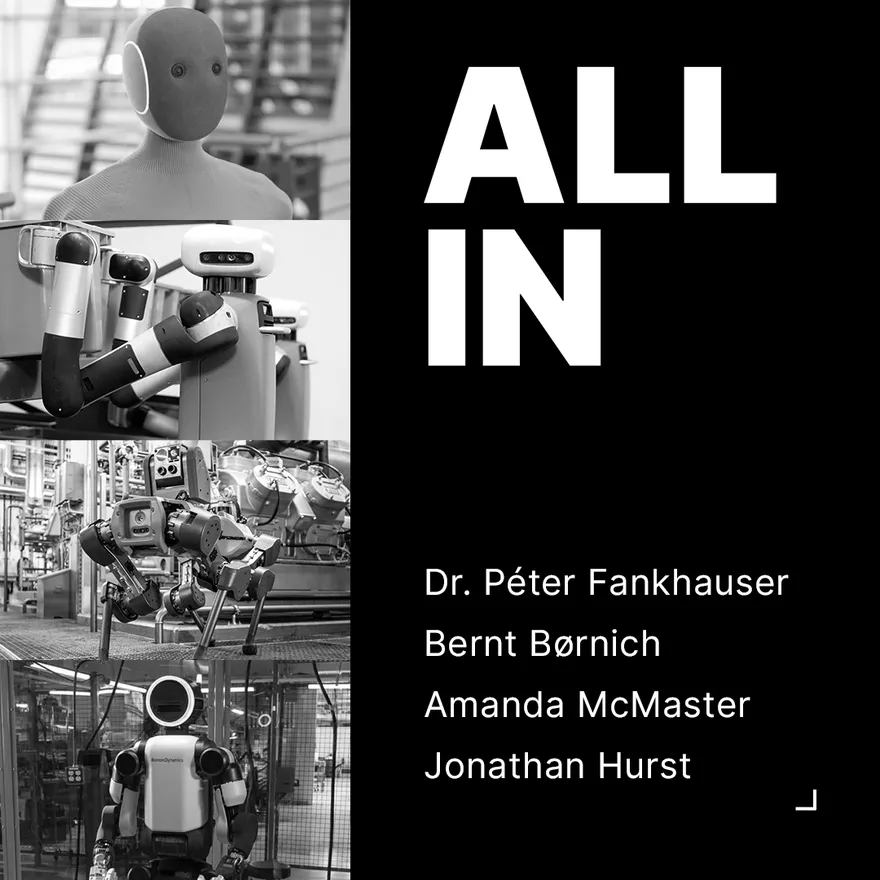

This is a preview of the Shortform summary of the Jul 28, 2026 episode of the All-In with Chamath, Jason, Sacks & Friedberg
Sign up for Shortform to access the whole episode summary along with additional materials like counterarguments and context.
1-Page Summary
Real-World Industrial Deployment of Robotics
Industrial robotics has moved beyond research labs into practical deployment in hazardous environments, with four-legged and humanoid robots now handling inspection, maintenance, and logistics tasks.
Four-Legged Robots Excel In Hazardous Infrastructure Inspection
Four-legged robots have become the industry standard for dangerous inspection work. Péter Fankhauser describes how their quadrupedal robots operate reliably in extreme temperatures from -20 to +60 °C and in explosive atmospheres at oil, gas, and chemical plants. These robots navigate conditions that are life-threatening for humans—slippery surfaces, toxic gases, and unstable terrain—with specialized spark-proof models designed to prevent ignition in methane-rich environments.
The quadrupedal design offers superior stability compared to humanoid robots, which are more prone to falls in these settings. Equipped with thermal cameras, microphones, gas detectors, and AI analytics, these robots perform "superhuman" tasks like detecting micro gas leaks and acoustic anomalies. Running up to 40 missions daily, they collect critical real-time data while minimizing human risk exposure.
Boston Dynamics' Spot Achieves Commercial Traction
Boston Dynamics' Spot exemplifies commercial adoption, with deployment to over 500 customers across 46 countries, making it the most widely used autonomous quadruped robot. Spot handles industrial inspection, gauge reading, and perimeter monitoring, augmenting rather than replacing human workers. Early fault detection prevents losses that can reach millions daily, offering immediate ROI—particularly when downtime costs hundreds of thousands per hour.
Priced between $100,000 and $300,000, Spot's capital cost is comparable to a luxury vehicle. However, with a five-year lifespan and up to 8,000 annual labor hours, operational costs drop to around $1 per hour compared to $40 for human labor.
Humanoid Robots Transitioning to Warehouse Logistics
Agility Robotics' Digit is now seeing meaningful deployment in logistics, operating up to 20 hours daily and reducing labor costs from $20–$40 per hour to approximately $1 per hour. Digit v5 represents a safety milestone as the first humanoid robot capable of working without physical barriers alongside humans in warehouses.
Humanoids excel at versatile, multi-purpose tasks requiring dexterity—picking totes, palletizing, and handling bins. New applications are emerging in retail, hospitals, construction, and last-mile delivery, including doorstep package drop-off tested with major automakers.
Designing for Safety and Compliance
Safety is fundamental to deploying robots alongside humans. Amazon and Agility Robotics built comprehensive safety architecture into their robots from the ground up, establishing new industry standards for shared spaces. Boston Dynamics' Spot achieves over 3,000 hours mean time between human interventions, operating autonomously for 90-minute cycles with self-docking charging stations.
Industrial robotics—both quadrupedal and humanoid—are now vital assets in infrastructure inspection, preventive maintenance, and logistics, driven by superior capability in hazardous environments, swift financial returns, and rigorous safety standards.
1-Page Summary
Additional Materials
Clarifications
- Quadrupedal robots have a lower center of gravity, enhancing balance on uneven or slippery surfaces. Their four legs provide multiple points of contact, reducing the risk of falling compared to two-legged humanoids. They can distribute weight more evenly, allowing safer navigation over unstable terrain. Additionally, their simpler leg mechanics often result in greater reliability and easier maintenance in harsh conditions.
- "Spark-proof" means designed to prevent any sparks that could ignite flammable gases. In methane-rich environments, even a small spark can cause explosions. Robots must avoid creating sparks from electrical components or mechanical friction. This safety feature protects both the robot and surrounding facilities.
- "Mean time between human interventions" (MTBHI) measures the average operational time a robot functions autonomously before needing human help. It indicates the robot's reliability and ability to perform tasks without errors or stoppages. A higher MTBHI means fewer disruptions, enhancing productivity and reducing labor costs. This metric is crucial for assessing the efficiency of robots in continuous, real-world industrial use.
- Self-docking charging stations allow robots to autonomously return and connect to a power source without human help. They use sensors and navigation systems to locate the station precisely. Once docked, the robot recharges its batteries to maintain continuous operation. This automation reduces downtime and increases efficiency in robotic workflows.
- Thermal cameras detect heat patterns to identify overheating equipment or hidden faults. Microphones capture sound anomalies like unusual vibrations or leaks that indicate mechanical issues. Gas detectors sense hazardous or leaking gases to prevent explosions and ensure safety. Together, these sensors provide comprehensive data for early problem detection in dangerous environments.
- Early fault detection means identifying equipment problems or malfunctions at the initial stage before they worsen. This allows maintenance teams to fix issues promptly, avoiding unexpected breakdowns. Preventing breakdowns reduces costly downtime and expensive emergency repairs. It also helps maintain continuous production and safety in industrial operations.
- Operational costs for robots include purchase price amortized over their lifespan, maintenance, energy, and software expenses. Human labor costs factor in wages, benefits, training, and downtime. Comparing costs involves dividing total expenses by productive hours to get an hourly rate. Robots often have higher upfront costs but lower ongoing hourly costs due to continuous operation and no benefits.
- Last-mile delivery refers to the final step of the delivery process where goods are transported from a local distribution center to the customer's doorstep. It is often the most complex and costly part of logistics due to factors like traffic, route optimization, and customer availability. Efficient last-mile delivery improves customer satisfaction by ensuring faster and more reliable service. Robotics in this area can automate package handling and reduce labor costs while increasing delivery speed.
- Physical barriers in robot safety are fences, cages, or guardrails that separate robots from humans to prevent accidental contact. Their absence means robots can work directly alongside people without restricted zones, increasing flexibility and efficiency. Achieving safe operation without barriers requires advanced sensors, real-time monitoring, and responsive control systems to detect and avoid collisions. This capability marks a significant advancement in human-robot collaboration.
- AI analytics processes data collected by robots' sensors to identify patterns and anomalies that humans might miss. It enables real-time decision-making, such as detecting early signs of equipment failure or hazardous conditions. Machine learning models improve over time by learning from historical data, enhancing inspection accuracy. This reduces downtime and maintenance costs by enabling predictive maintenance rather than reactive repairs.
- Operating robots in explosive atmospheres requires specialized designs to prevent sparks or heat that could ignite flammable gases, ensuring safety in volatile environments. Extreme temperatures challenge robot components like batteries and sensors, necessitating robust materials and thermal management to maintain functionality. Failure to address these conditions risks equipment damage, mission failure, or catastrophic accidents. Thus, robots must meet strict certifications and use protective technologies to operate reliably and safely.
- Perimeter monitoring in industrial settings involves continuously observing the boundaries of a facility to detect unauthorized access or security breaches. It uses sensors, cameras, or robots to patrol and identify potential threats or hazards. This helps protect valuable assets, ensure safety, and prevent theft or sabotage. Automated perimeter monitoring reduces the need for human guards and provides real-time alerts.
- Return on investment (ROI) measures the financial gain from an investment relative to its cost. In robotics, ROI evaluates how quickly the savings or profits from using robots offset their purchase and operating expenses. High ROI means the robot pays for itself quickly through reduced labor costs, fewer errors, or less downtime. Companies use ROI to justify spending on expensive technology by showing long-term economic benefits.
- "Picking totes" means selecting and retrieving containers holding products, a task requiring precise hand movements. "Palletizing" involves stacking goods onto pallets in organized layers for storage or shipping. "Handling bins" refers to managing smaller containers used to sort and transport items within warehouses. These tasks demand dexterity and adaptability, making humanoid robots well-suited for them.
- Augmenting human workers means robots assist humans by handling repetitive or dangerous tasks, allowing humans to focus on complex or decision-based work. This collaboration improves overall productivity and safety without eliminating jobs. Robots provide tools that enhance human capabilities rather than fully substituting them. The goal is a complementary partnership, not total automation.
Counterarguments
- The high upfront cost of robots like Boston Dynamics' Spot ($100,000 to $300,000) may be prohibitive for small and medium-sized enterprises, limiting widespread adoption.
- While robots can reduce human risk exposure, they may introduce new safety risks, such as unexpected malfunctions or cybersecurity vulnerabilities, especially when operating autonomously in hazardous environments.
- The claim that robots "augment rather than replace" human workers may not hold true in all cases, as increased automation can lead to job displacement, particularly for lower-skilled labor.
- Maintenance, repair, and technical support for advanced robots require specialized skills, potentially creating new workforce challenges and costs.
- The operational cost comparison ($1 per hour for robots vs. $40 for human labor) may not account for all indirect costs, such as integration, training, software updates, and downtime due to technical issues.
- Robots' ability to perform "superhuman" tasks is limited by current sensor and AI technology, which may not always match human intuition or adaptability in complex, unpredictable scenarios.
- The environmental impact of manufacturing, operating, and disposing of industrial robots is not addressed and could offset some of the claimed benefits.
- Regulatory and compliance frameworks for deploying robots in shared human environments are still evolving and may pose barriers to rapid or widespread deployment.

Get access to the context and additional materials
Real-World Industrial Deployment of Robotics
Industrial robotics is rapidly evolving from research and pilot phases to robust, impactful deployment in hazardous environments, with four-legged and humanoid robots now playing a pivotal role in inspection, maintenance, and logistics.
Four-Legged Robots Excel In Hazardous Infrastructure Inspection Due to Superior Mobility, Stability, and Navigation in Extreme Environments
Four-legged robots have emerged as the industry standard for inspection tasks in dangerous and complex settings. Péter Fankhauser describes the capabilities of their quadrupedal robots, which can function reliably in extreme temperatures ranging from -20 to +60 °C and in explosive atmospheres present in oil, gas, and chemical plants. These robots are engineered to operate where human exposure is life-threatening—slippery floors, rain, snow, grass, and sites with toxic or explosive gases. Specifically, a specialized model is spark-proof, crucial for environments with airborne methane where even minor ignition risks must be eliminated.
Quadrupedal design is based on nature's template for optimal ground mobility. With a broad, stable footprint and the ability to climb stairs or traverse rough, unstable terrain, four-legged robots outperform humanoids in stability and navigation. Humanoid robots, in contrast, are less robust in these settings and prone to falls, posing additional safety hazards.
In industrial use, these inspection robots are packed with high-end sensors—thermal cameras, microphones, gas concentration detectors, and AI-driven analytics. They accomplish “superhuman” tasks: detecting micro gas leaks, measuring heat from equipment, and picking up acoustic anomalies that human senses would miss. Frequent missions, often up to 40 per day, collect real-time, critical data, especially during high-risk periods like electric furnace operation, ensuring timely detection and minimizing human risk.
Mobile Robots Like Boston Dynamics' Spot Achieve Commercial Traction In Industrial Inspection and Preventive Maintenance, Becoming the Most Deployed Autonomous Quadruped Platform Globally
Boston Dynamics’ Spot exemplifies the commercial adoption of four-legged robotics in industry. Deployed to over 500 customers across 46 countries, Spot is now the most widely used mobile autonomous quadruped robot. Its primary applications are industrial inspection—reading gauges, recording vibrations, and monitoring perimeter security—augmenting human labor rather than replacing it. Employees are freed to focus on knowledge-based tasks, while robots handle hazardous or tedious rounds.
Robots such as Spot directly enable early detection of faults, like air or gas leaks, which can result in millions in daily losses if unaddressed. The return on investment is immediate: each hour saved by proactive robot monitoring pays for their cost, particularly since downtime in industrial plants can quickly escalate to hundreds of thousands of dollars per hour.
Spot’s capital expenditure model ranges from $100,000 for a base unit to $300,000 with integrations and services, placing it in the price category of a luxury vehicle. However, with a lifespan exceeding five years and the ability to log tens of thousands of labor hours (up to 8,000 annually), capital costs are justified by the significant operational value and labor cost compression—as little as $1 per operational robot hour compared to up to $40 per hour for human labor.
Humanoid Robots Transitioning From Research to Warehouse Logistics
The humanoid form factor is now seeing meaningful deployment, especially in logistics. Agility Robotics' Digit operates up to 20 hours daily over a five-year period, delivering 40,000 labor hours and reducing task labor costs from $20–$40 per hour to around $1 per hour. With fast-charging capabilities, Digit v5 achieves a safety milestone as the first humanoid robot capable of working outside isolated cells, without physical barriers, making it increasingly viable to deploy humanoids directly alon ...
Here’s what you’ll find in our full summary
Real-World Industrial Deployment of Robotics
Additional Materials
Clarifications
- Quadrupedal robots have four points of contact with the ground, providing a wider base and better balance than two-legged humanoids. Their gait allows continuous stability, as at least two legs remain on the ground during movement, reducing fall risk. They can adapt more easily to uneven or slippery surfaces by adjusting each leg independently. This design mimics animals like dogs, which excel in rough terrain navigation.
- A "spark-proof" design prevents electrical or mechanical sparks that could ignite flammable gases or dust in explosive environments. This is critical in industries like oil and gas, where even a tiny spark can cause catastrophic explosions. Such designs use special materials and construction techniques to eliminate ignition sources. Ensuring spark-proof operation protects both human workers and equipment from severe accidents.
- Thermal cameras detect heat patterns, revealing overheating equipment or leaks invisible to the naked eye. Microphones pick up sound anomalies like unusual vibrations or gas leaks by detecting changes in acoustic signals. Gas concentration detectors measure specific hazardous gases' levels, ensuring safety by identifying leaks or dangerous atmospheres. These sensors feed data to AI systems for real-time analysis and early fault detection.
- Mean time between human interventions (MTBHI) measures the average operational time a robot functions autonomously before needing human help for troubleshooting or maintenance. A higher MTBHI indicates greater reliability and less downtime, which is critical for continuous industrial operations. It reflects the robot’s ability to perform tasks without frequent disruptions, improving efficiency and reducing labor costs. MTBHI is a key metric for assessing the practical usability and robustness of robotic systems in real-world environments.
- Downtime in industrial plants means production stops, causing lost revenue and wasted resources. It can also lead to contract penalties and damage to customer relationships. Robots help by continuously monitoring equipment to detect issues early, preventing unexpected failures. This proactive maintenance reduces unplanned downtime and its associated high costs.
- Operational lifespan refers to the total time a robot can function effectively before needing replacement or major overhaul. Usage metrics like 8,000 operational hours annually indicate how many hours per year the robot is actively working. High operational hours reflect continuous or near-continuous deployment, maximizing return on investment. These metrics help assess durability, maintenance needs, and cost-efficiency of robotic systems.
- "Outside isolated cells" means robots operate in open spaces where humans also work, rather than being confined to separate, protected areas. Physical barriers traditionally prevent accidents by keeping robots and people apart. Removing these barriers allows robots to collaborate more closely with humans, increasing efficiency and flexibility. This requires advanced safety systems to detect and avoid collisions in real time.
- AI-driven analytics process sensor data collected by robots to identify patterns and anomalies that humans might miss. They enable real-time decision-making by automatically detecting issues like gas leaks or equipment faults. This reduces the need for constant human monitoring and speeds up response times. Ultimately, AI enhances the accuracy and efficiency of robotic inspections in complex environments.
- Capital expenditure (CapEx) refers to the upfront cost to purchase and install a robot, including hardware and integration expenses. It contrasts with operational expenditure (OpEx), which covers ongoing costs like maintenance and energy. ROI (Return on Investment) measures how quickly the robot's cost is recovered through savings or increased productivity. A favorable ROI means the robot pays for itself by reducing labor costs or preventing costly downtime.
- Deploying humanoid robots alongside humans requires advanced sensors and algorithms to detect and predict human movements, preventing collisions. Robots must have reliable balance and fall-prevention systems to avoid accidents in dynamic environments. Safety protocols include emergency stop functions and compliant actuators that reduce injury risk upon contact. Regulatory compliance demands rigorous testing and certification to ensure robots operate safely in shared spaces.
- Dynamic balance in humanoid robots refers to their ability to maintain stability while moving or performing tasks that involve shifting weight. It involves real-time adjustments to posture and foot placement to prevent falling during walking, turning, or manipulating objects. This capability mimics human balance, allowing robots to operate safely in complex, unpredictable environments. Achieving dynamic balance requires advanced sensors, control algorithms, and actuators w ...
Counterarguments
- While four-legged robots offer superior mobility in certain hazardous environments, their high upfront and maintenance costs may be prohibitive for smaller companies or industries with lower margins.
- The claim that quadrupedal robots are the "industry standard" for inspection may not reflect all sectors, as many industries still rely on traditional remote sensors, drones, or human inspectors due to cost, regulatory, or operational constraints.
- The operational reliability of robots in extreme environments is impressive, but their performance can still be affected by unexpected variables such as electromagnetic interference, unstructured debris, or rapidly changing conditions.
- Although quadrupedal robots are spark-proof and designed for explosive atmospheres, regulatory approval and site-specific safety certifications can be lengthy and complex, potentially delaying deployment.
- The assertion that humanoid robots are less robust in hazardous environments may overlook ongoing advancements in balance, perception, and fall mitigation technologies for bipedal robots.
- Advanced sensors and AI analytics on inspection robots can generate large volumes of data, but integrating this data into existing plant management systems and ensuring actionable insights remains a challenge for many organizations.
- The immediate return on investment for robots like Spot may not materialize in all cases, especially if deployment requires significant customization, integration, or workforce retraining.
- Labor cost savings from robots do not account for ...
Get access to the context and additional materials


Create Summaries for anything on the web
Download the Shortform Chrome extension for your browser
