

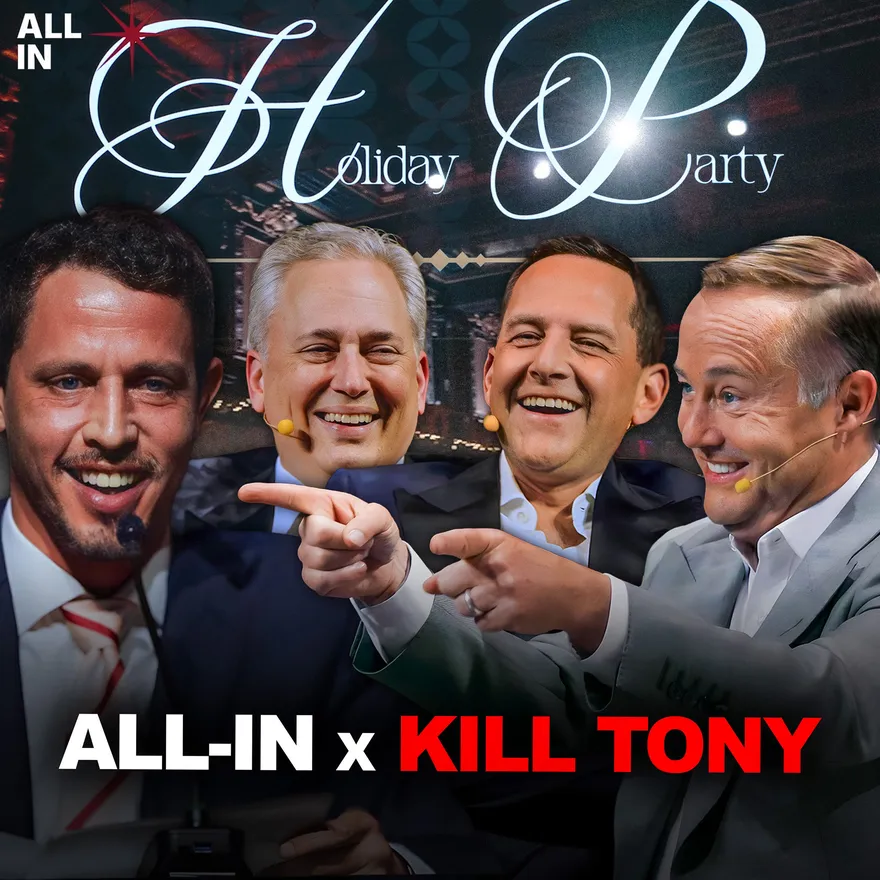
All-In x Kill Tony: A Hilarious Holiday Special
In this special episode of All-In, comedian Tony Hinchcliffe joins the hosts to discuss the business side of comedy and his journey with his show "Kill Tony." From sleeping on couches to selling out Madison Square Garden, Hinchcliffe shares insights about independent content creation, his Netflix deal, and YouTube success, while explaining how major studios approach risk in comedy.
The episode features an exchange of roasts between Hinchcliffe and the All-In hosts, with both sides trading humorous jabs about wealth and personality quirks. The conversation also touches on comedy's role in addressing political topics, with Hinchcliffe explaining his approach to political material and the hosts discussing current challenges to free speech in comedy, particularly in Europe.

This is a preview of the Shortform summary of the Dec 24, 2025 episode of the All-In with Chamath, Jason, Sacks & Friedberg
Sign up for Shortform to access the whole episode summary along with additional materials like counterarguments and context.
1-Page Summary
Comedy, Entertainment, and the Business of Comedy
Tony Hinchcliffe discusses the evolution of his successful comedy show "Kill Tony," which grew from observing open mic nights to selling out Madison Square Garden. Hinchcliffe reveals that while major studios remain risk-averse, independent creators are finding success in comedy, noting his own Netflix deal and the show's popularity on YouTube.
Personal Histories and Backgrounds
Hinchcliffe shares his humble beginnings in comedy, including sleeping in his car and renting a couch for $400 monthly while working multiple jobs. These experiences, he explains, were crucial in shaping his comedy career and the success of his show.
Roasting and Insulting the All In Podcast Hosts
The episode features a lively exchange of roasts between Hinchcliffe and the All In hosts. Hinchcliffe playfully mocks the hosts' wealth and personalities, while the hosts respond with their own humorous jabs. David Friedberg, David Sacks, and Jason Calacanis engage in friendly banter, demonstrating their comfort with self-deprecation and ability to both give and receive comedic criticism.
Political and Controversial Topics in Comedy
Hinchcliffe advocates for comedians to challenge all political sides rather than just "punching up," sharing his approach of incorporating pro-Trump jokes to counter what he sees as liberal bias in comedy. The hosts express concern about growing speech restrictions, particularly in Europe, with David Friedberg pointing out arrests and fines for speech-based crimes. They praise Hinchcliffe's commitment to pushing comedic boundaries in this challenging environment.
1-Page Summary
Additional Materials
Clarifications
- "Kill Tony" is a live comedy show where aspiring comedians perform one-minute sets. After their brief performance, Tony Hinchcliffe and a panel of professional comedians provide immediate feedback and roast the performers. The show combines stand-up, interviews, and spontaneous humor, creating an interactive and unpredictable experience. It originated as a small open mic event and grew into a popular, widely viewed series.
- Open mic nights are events where amateur and professional comedians perform short sets in front of a live audience. They serve as a testing ground for new material and a way to gain stage experience. Many famous comedians started their careers by performing at open mics. These events are crucial for networking and honing comedic skills.
- "Punching up" in comedy means making jokes about people or groups who have more power, status, or privilege than the comedian. It is often seen as a way to challenge authority or social norms without targeting vulnerable individuals. This approach is contrasted with "punching down," which involves mocking those with less power and is generally viewed as mean-spirited. Comedians use "punching up" to promote social critique while avoiding harm to marginalized groups.
- David Friedberg is an entrepreneur and investor known for his work in technology and agriculture. David Sacks is a tech entrepreneur and investor, formerly COO of PayPal and founder of several startups. Jason Calacanis is an angel investor, entrepreneur, and podcaster focused on tech startups. Together, they co-host the All In podcast, discussing business, technology, and current events.
- In recent years, many comedians have been criticized for predominantly targeting conservative figures, especially former President Donald Trump, which some perceive as a liberal bias. "Pro-Trump jokes" refer to humor that either supports Trump or mocks his critics, challenging this trend. This approach aims to balance political satire by including perspectives that resonate with conservative audiences. The debate reflects broader cultural conflicts over free speech and political correctness in comedy.
- In Europe, "speech-based crimes" often refer to laws against hate speech, Holocaust denial, or incitement to violence. Countries like Germany and France have strict regulations that can lead to fines or imprisonment for such offenses. These laws aim to prevent discrimination and protect public order but are sometimes criticized for limiting free expression. Enforcement varies by country and case specifics.
- Selling out Madison Square Garden (MSG) is a major achievement because MSG is one of the largest and most famous venues in the world, located in New York City. It seats around 20,000 people, so filling it indicates massive popularity and commercial success. For a comedy show, this level of attendance is rare and signals mainstream recognition. It often marks a milestone that elevates a comedian's career to a new level of prominence.
- Major studios typically control large budgets and distribution channels but often avoid risky or controversial content to protect investments. Independent creators have more freedom to experiment and address niche or edgy topics, attracting dedicated audiences online. Digital platforms like YouTube and streaming services enable independents to reach viewers directly without studio gatekeeping. This shift allows innovative comedy to thrive outside traditional industry constraints.
Counterarguments
- While Tony Hinchcliffe's "Kill Tony" show has been successful, not all independent creators are able to replicate this level of success on platforms like Netflix and YouTube due to market saturation and discoverability challenges.
- The assertion that major studios are risk-averse might overlook the fact that they often have to balance potential backlash and financial risks with the desire to produce innovative content.
- Hinchcliffe's personal struggles are indeed a testament to his dedication, but it's important to acknowledge that not everyone who faces similar hardships in the entertainment industry is able to achieve the same level of success.
- The playful roasting on the All In podcast, while in good spirit, might not be everyone's preferred form of humor, and some audiences might find it off-putting or unprofessional.
- Advocating for challenging all political sides in comedy is a valid approach, but it's also important to consider the impact and social responsibility of humor, especially when it touches on sensitive issues.
- Incorporating pro-Trump jokes as a counter to liberal bias can be seen as a way to balance perspectives, but it could also alienate or offend part of the audience depending on the content of the jokes and the context in which they are delivered.
- Concerns about speech restrictions in Europe are valid, but it's also worth considering that different cultures and legal systems have varying thresholds for what constitutes hate speech or harmful rhetoric, and these laws are often in place to protect marginalized groups.
- Praising a comedian for pushing boundaries is subjective, as some may argue that certain boundaries exist for a reason and should be respected, especially if crossing them can lead to harm or the perpetuation of negative stereotypes.
Get access to the context and additional materials
Comedy, Entertainment, and the Business of Comedy
An exploration into the world of comedy with Tony Hinchcliffe’s "Kill Tony" show illustrates the changing landscape of entertainment and the challenges and opportunities creators face.
Tony Hinchcliffe's Rise With "Kill Tony" Comedy Show
Tony Hinchcliffe shares his journey from open mic nights to hosting one of the most popular comedy podcasts, underscoring the intersection of entertainment and entrepreneurship.
Hinchcliffe On Developing "Kill Tony" By Observing and Mocking Open Mic Comedians
Hinchcliffe recounts how he gave comedians performance tips and shared laughs at open mic nights. This experience and the humor found in whispered comments among his friends became the inspiration for the "Kill Tony" podcast, designed to showcase the fun in that environment.
Hinchcliffe On "Kill Tony's" Growth, Including Sold-Out Msg Shows
The show’s popularity soared as Hinchcliffe discusses "Kill Tony’s" performances at Madison Square Garden, revealing its substantial growth. He describes "Kill Tony" as a phenomenon, especially in Austin, Texas, where demand for tickets surged.
Hinchcliffe: Studios Risk-Averse, Indie Creators Succeed In Comedy
Hinchcliffe indicates the show's success beyond traditional industry paths as it ranks high on YouTube and announces a four-special deal on Netflix. Howie Mandel’s use of "Kill Tony" episodes as a talent scout tool further emphasizes its impact.
Hinchcliffe criticizes major studios for being risk-averse and reminisces about edgier past movies like "The Hangover." He shares his project that's secured independent financing, suggesting a movement towards more creative freedom.
Podcast Hosts Explore Entertainment Industry Challenges and Opportunities
The hosts discuss the dynamic nature of the comedy and podcast scene, which presents a balance between creative liberty and the scrutiny of increasing censorship.
Hosts Acknowledge Evolving Comedy and Podcast Scene: More Freedom for Edgy Content Alongside Increased Censorship
David Friedberg and David Sac ...
Here’s what you’ll find in our full summary
Comedy, Entertainment, and the Business of Comedy
Additional Materials
Counterarguments
- While "Kill Tony" has been successful, its style of humor, which often involves mocking open mic comedians, may not appeal to everyone and could be seen as discouraging to aspiring comedians.
- The show's success at venues like Madison Square Garden is impressive, but it doesn't necessarily reflect the broader success of the podcast or its impact on the comedy industry as a whole.
- Securing a deal with Netflix is a significant achievement, but it's important to note that not all content on streaming platforms achieves the same level of viewership or cultural impact.
- The use of "Kill Tony" by Howie Mandel as a scouting tool is an endorsement, but it's just one example and may not represent widespread industry adoption.
- The claim that major studios are risk-averse could be countered by pointing out that studios often have to balance potential profits against the risk of controversy, which is a standard business practice.
- The idea that independent creators have more creative freedom can be true, but they also face challenges such as limited resources and distribution compared to major studios.
- The balance between creative freedom and censorship is com ...
Actionables
- You can start a local talent showcase by partnering with a neighborhood venue, inviting aspiring performers to share their work in a supportive environment. By doing this, you create a platform for undiscovered talent, similar to how "Kill Tony" provides opportunities for comedians. For example, reach out to coffee shops or community centers interested in hosting weekly or monthly events, and use social media to invite local artists and performers.
- Develop a YouTube channel or social media page dedicated to highlighting and reviewing independent content creators. This can be a space where you share your thoughts on new projects, similar to how Howie Mandel scouts talent on "Kill Tony." For instance, create a series where you feature and discuss the work of up-and-coming creators, offering them exposure and your audience a curated selection of fresh content.
- Organize a crowdfunding campaign to sup ...
Get access to the context and additional materials
Personal Histories and Backgrounds of the Speakers
In this intimate glimpse into the journeys of successful individuals, we learn about the hardships and sacrifices they faced on their way to success, including comedian Hinchcliffe's struggles and the All In hosts' business and entrepreneurial experiences.
Hinchcliffe Reflects On Comedy Career Struggles and Sacrifices
Hinchcliffe opens up about the arduous path that led to his current accolades in the comedy world.
Hinchcliffe Endures Hardships, Sleeps In His Car, and Juggles Multiple Jobs To Hone Comedy Skills
Hinchcliffe shares a glimpse into his past where he rented a couch in a living room for $400 a month—a price that was a struggle to meet even while working grueling hours between phone jobs and his duties at the Comedy Store. The struggle to afford rent led him to downgrade to sleeping on a beanbag for $300 and eventually in the backseat of his car parked behind the Comedy Store.
Hinchcliffe on Experiences Shaping His C ...
Here’s what you’ll find in our full summary
Personal Histories and Backgrounds of the Speakers
Additional Materials
Clarifications
- Hinchcliffe is a comedian known for his sharp wit and relatable humor. He gained recognition through performances at notable comedy venues like the Comedy Store. His significance comes from overcoming personal hardships to achieve success in a competitive industry. He is respected for his authentic storytelling and perseverance.
- The Comedy Store is a famous comedy club in Los Angeles known for launching many comedians' careers. It serves as a key venue where comedians perform, network, and gain exposure. Many aspiring comedians work there or perform regularly to develop their skills. Its reputation makes it a crucial stepping stone in the comedy industry.
- "Phone jobs" typically refer to work done over the phone, such as customer service, telemarketing, or sales calls. These jobs often require long hours of speaking with customers or clients. They are usually entry-level positions that provide flexible income but can be stressful and low-paying. Such jobs are common for people supporting themselves while pursuing other careers.
- In some expensive cities, affordable housing is scarce, so people rent unconventional spaces like couches or beanbags in shared rooms. This arrangement is often informal and cheaper than renting a full apartment. It reflects financial hardship and the need ...
Get access to the context and additional materials
Roasting and Insulting the All In Podcast Hosts
During a recent episode, the All In podcast transforms into a comedy club as Tony Hinchcliffe, David Sacks, and other hosts roast each other, mocking their wealth, personal experiences, and business ventures.
Hinchcliffe Roasts All in Hosts, Mocking Their Wealth, Personalities, and Ventures
Tony Hinchcliffe opens with a greeting that mocks the hosts as "goddamn nerds." He crudely describes San Francisco, where the hosts are likely based, and sarcastically comments about the city's issues. Hinchcliffe jokes about the audience paying to watch billionaires talk to each other, highlighting the hosts' wealth, and pokes fun at how billionaires pretend to like their kids.
Hinchcliffe Uses Humor to Mock Hosts' Backgrounds, Net Worth, and Arrogance
Hinchcliffe makes fun of J. Cal's net worth, calling him the "broke-ass bitch" of the group and jokes about the possibility of him having to be an Uber driver. He also teases that no one dreams of joining weekly Zoom calls with a billion dollars in the bank. David Sacks receives flattery from Hinchcliffe before a humorous transition into a roast, while David Friedberg gets mocked for being the third wheel of the podcast.
Hosts Accept Hinchcliffe's Biting Insults With Humor
The hosts show their amusement at Hinchcliffe's roast, with remarks like "Awesome" and "Oh my god. Man, that was easier than I thought" suggesting they took the insults in stride. Hinchcliffe and the other hosts receive the playful mockery with laughter and humor, indicating a welcoming atmosphere for the comedic insults.
All In Hosts Engage In Friendly Roasting
The camaraderie and trust among the hosts are evident as they humorously tease each other’s quirks and habits.
Hosts Humorously Tease Each Other's Quirks, Habits, and Flaws, Showing Camaraderie a ...
Here’s what you’ll find in our full summary
Roasting and Insulting the All In Podcast Hosts
Additional Materials
Clarifications
- Tony Hinchcliffe is a comedian known for his sharp, often edgy humor and roasting style. He is not a regular host of the All In podcast but was invited as a guest for this special comedic episode. His role was to provide humorous, biting commentary on the hosts, fitting his reputation as a professional roaster. This adds a unique entertainment element distinct from the podcast's usual business and tech discussions.
- Tony Hinchcliffe is a comedian known for his sharp, often edgy humor. David Sacks is a tech entrepreneur and investor, formerly COO of PayPal. Jason Calacanis is an angel investor and entrepreneur, recognized for his work in tech startups and media. Chamath Palihapitiya is a venture capitalist and former Facebook executive, known for his outspoken views on technology and investing. David Friedberg is a tech entrepreneur focused on climate and agriculture innovation. J. Cal refers to Jason Calacanis, often nicknamed in casual contexts.
- San Francisco is a major hub for technology and venture capital, where many wealthy entrepreneurs and investors live and work. The All In podcast hosts are connected to this tech and investment community, making the city relevant to their backgrounds. The city's cultural and economic environment often influences the topics and humor in their discussions. References to San Francisco highlight the hosts' ties to this influential and affluent region.
- The term "GMO" typically stands for "genetically modified organism" in scientific contexts. In this comedic setting, David Friedberg repurposes "GMO" as a playful acronym meaning "gay man, obviously." This joke relies on the audience recognizing the original meaning and the unexpected twist. It reflects the casual, irreverent humor common in roast-style banter.
- J. Cal refers to Jason Calacanis, a well-known entrepreneur and investor. The "broke-ass bitch" joke is ironic because he is actually wealthy, making the insult humorous by contrast. The Uber driver joke plays on the idea of him losing his wealth and having to take a regular job, which is unlikely given his success. This type of humor is common in roasts, where exaggeration and irony are used for comedic effect.
- "Seriously Pissed at Chamath" is likely an inside joke or recurring phrase among the podcast hosts. It humorously exaggerates frustration with Chamath Palihapitiya, a well-known venture capitalist and one of the hosts. The phrase plays on the dynamic and teasing nature of their interactions. It reflects the casual, comedic tone of their conversations rather than actual anger.
- The All In podcast is a show where successful entrepreneurs and investors discuss technology, business, and current events. It typically features in-depth conversations and analysis rather than comedy. The audience mainly consists of tech enthusiasts, investors, and professionals interested in startups and market trends. The roasting episode is a special, humorous deviation from their usual serious tone.
- The All In podcast hosts have a long-standing friendship and professional relationship, often collaborating on business ventures and discussions. Their history includes shared experiences in tech and investing, fostering mutual respect and trust. This foundation allows them to engage in playful roasting without offense, as they understand each other's personalities and boundaries. Such dynamics are common in close-knit groups where humor strengthens bonds.
- Some jokes about billionaires pretending to like their kids stem from stereotypes that wealthy individuals prioritize money and power over family relationships. This humor plays on the idea that billionaires may be emotionally distant or neglectful despite their wealth. It also reflects public skepticism about the authenticity of wealthy people's personal lives. Such jokes exaggerate these traits for comedic effect.
- The "weekly Zoom calls" refer to regular virtual meetings the All In podcast hosts have to discuss business, inv ...
Get access to the context and additional materials
Political and Controversial Topics in Comedy
Tony Hinchcliffe and several hosts navigate the complex waters of political satire, free speech, and the evolving landscape of comedy in the face of censorship and media bias.
Hinchcliffe Tackles Political and Controversial Topics in Comedy
During discussions, Tony Hinchcliffe emphasizes the importance of comedians challenging all political sides instead of merely "punching up" or making fun of those in power. He finds humor in going against the grain and scrutinizing the status quo.
Hinchcliffe: Comedians Should Challenge all Political Sides, Not Just "Punch Up"
Elaborating on his approach, Hinchcliffe jokes about a variety of political figures and situations, including satirizing the criticism Elon Musk faces from the left. He aligns himself as a centrist who leans to the right and compares notes with J. Cal, who despite being a liberal, also finds himself at odds with that same political faction.
Hinchcliffe Shares Pro-trump Jokes to Counter Liberal Bias In Comedy
Hinchcliffe uniquely incorporates pro-Trump jokes into his act as a means of countering what he perceives as a liberal bias pervasive in comedy. By joking about Trump’s autograph or his blunt comments on Somalia, Hinchcliffe believes that presenting this contrarian view is inherently amusing due to its rarity and directness.
Hosts Discuss Comedians' Challenges With Free Speech and Censorship
As Hinchcliffe and the hosts delve into the subject of free speech, they express concerns about growing restrictions and the potential chilling effect these may have on comedy, particularly noting the controversial climate in Europe.
Hosts Worry About Growing Speech Restrictions in Europe and the Chilling Effect on Comedy
The conversation turns to speech suppression in Europe, signaling trepidation that these restrict ...
Here’s what you’ll find in our full summary
Political and Controversial Topics in Comedy
Additional Materials
Clarifications
- "Punching up" in comedy means making jokes about people or groups who have more power, influence, or privilege. It is seen as a way to challenge authority and highlight social inequalities. Comedians who "punch up" aim to avoid targeting marginalized or less powerful groups. This concept is often contrasted with "punching down," which can be viewed as mean-spirited or harmful.
- Tony Hinchcliffe is a stand-up comedian and writer known for his sharp, often provocative humor. He gained prominence through his work on comedy roasts and his podcast, where he discusses comedy and culture. Hinchcliffe is recognized for pushing boundaries and addressing controversial topics. His style challenges conventional norms in comedy, making him a notable figure in the industry.
- Elon Musk is often criticized by the political left for his views on labor practices, environmental policies, and his influence on social media platforms. Left-leaning critics argue that Musk's business practices sometimes prioritize profit over workers' rights and environmental concerns. Additionally, his acquisition of Twitter sparked debates about content moderation and free speech, with some fearing it could enable misinformation. These issues contribute to the left's scrutiny of Musk as a powerful and controversial figure.
- "Liberal bias" in comedy refers to the perception that comedians predominantly express progressive or left-leaning political views. This can lead to jokes that favor liberal perspectives while criticizing conservative ones more harshly or frequently. Critics argue this limits the diversity of viewpoints and may alienate audiences with different beliefs. The implication is that comedy might become less balanced and less reflective of a broad range of political opinions.
- Pro-Trump jokes are considered contrarian because mainstream comedy often leans liberal, frequently criticizing Trump and his policies. This creates a cultural environment where jokes supporting or humanizing Trump are less common. Comedians who include pro-Trump humor challenge the dominant narrative and appeal to audiences who feel underrepresented. Such jokes stand out due to their rarity and the political polarization surrounding Trump.
- In Europe, speech restrictions often involve laws against hate speech, Holocaust denial, and incitement to violence. Governments may impose fines or criminal charges for content deemed offensive or harmful to public order. These laws vary by country but generally aim to balance free expression with protecting social harmony. Critics argue such rules can be overly broad, leading to self-censorship among comedians and artists.
- In the UK and Germany, laws against hate speech and extremist content are strictly enforced to prevent social harm. These countries criminalize speech that incites violence, hatred, or discrimination against protected groups. Authorities have increased monitoring and penalties, including fines and arrests, for violations. This approach aims to balance free expression with protecting public order and minority rights.
- David Friedberg is an entrepreneur and investor known for his work in technology and data-driven companies. He is not ...
Counterarguments
- While Hinchcliffe emphasizes challenging all political sides, some might argue that comedy with a focus on social justice can be more impactful when it "punches up" to challenge power structures and societal inequities.
- Opposing the status quo can be valuable, but it's also important to consider the potential harm or reinforcement of negative stereotypes that can come from certain types of contrarian humor.
- Identifying as a centrist and critiquing both sides may not always equate to a balanced perspective; some might argue that it can lead to false equivalency between different political ideologies and their associated issues.
- Incorporating pro-Trump jokes, or any politically charged material, must be done with care to avoid alienating or offending audiences, and the humor should ideally foster understanding rather than division.
- The rarity and directness of contrarian political views in comedy might be amusing to some, but others may find that it oversimplifies complex issues or reinforces harmful biases.
- Concerns about speech restrictions in Europe are valid, but it's also worth considering that different cultures have different standards for free speech and that some regulations may be in place to prevent hate speech and protect vulnerable groups.
- The fear of European speech suppression trends spreading to the United States may not take into account the strong free speech protections enshrined in the U.S. Constitution, particularl ...
Get access to the context and additional materials


Create Summaries for anything on the web
Download the Shortform Chrome extension for your browser
