

Disney: The Renaissance and the Empire
In this episode of Acquired, the hosts trace Disney's transformation from a theatrical-and-parks company into a global media empire built on strategic acquisitions and an evolving business model. The discussion covers Disney's original "flywheel" of animated films, consumer products, and theme parks, and how ESPN's cable affiliate fees became the company's primary profit engine—funding major acquisitions like Pixar, Marvel, Lucasfilm, and 21st Century Fox under Bob Iger's leadership.
The episode also examines Disney's pivot to streaming with Disney Plus, a strategic necessity driven by cord-cutting and Netflix's disruption of traditional distribution. This shift brought operational challenges, including content overproduction, brand dilution, and billions in losses before achieving profitability. As traditional revenue sources like box office and home video declined, Disney has increasingly relied on theme parks—which now generate 60% of operating income—while facing questions about its ability to create new franchises and sustain its legacy IP in a fragmented entertainment landscape.
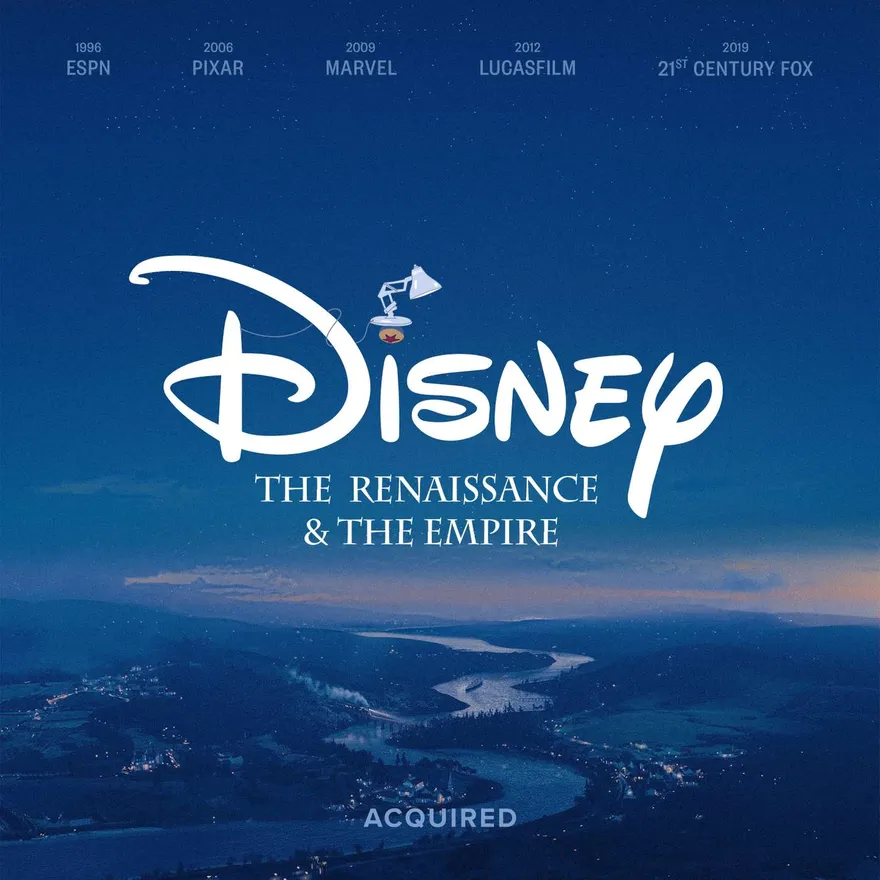

This is a preview of the Shortform summary of the Aug 9, 2026 episode of the Acquired
Sign up for Shortform to access the whole episode summary along with additional materials like counterarguments and context.
1-Page Summary
Disney's Business Model Evolution: From Theatrical-Parks-Cable to Streaming
Disney's business model has transformed radically across decades, leveraging its intellectual property flywheel in new ways. The evolution reveals both the strengths and vulnerabilities of corporate synergy on a global scale.
The Original Disney Flywheel: Theatrical Releases, Consumer Products, and Cable Networks
For much of the 20th century, Disney's business model was built around what insiders call the "flywheel"—a self-reinforcing cycle. Animated films introduced beloved characters that became the engine for consumer products, theme park attractions, and theatrical re-releases. As Ben Gilbert describes, Roy E. Disney ensured every part of the company fed back into this virtuous cycle.
The introduction of home video in the mid-1980s proved transformative. The 1985 VHS release of "Pinocchio" at $29.95 sold out immediately, and home video became a billion-dollar business and the second largest profit center after theme parks. Hits like "The Lion King" sold 32 million VHS tapes, generating hundreds of millions in near-pure cash due to low incremental production costs.
The 1990s saw Disney expand into retail with Disney Stores in malls, creating synergy between films at home, toys at the mall, and trips to the parks. According to David Rosenthal, this pushed Disney merchandise sales over $50 billion annually by 2015, with the parks and Broadway divisions thriving alongside.
ESPN Became Disney's Major Profit Engine
Disney's 1995 acquisition of Capital Cities/ABC provided control of ESPN, which pioneered the affiliate fee model by extracting per-subscriber payments from cable operators. As Ben Gilbert and David Rosenthal explain, ESPN's affiliate fees escalated from less than $1 to $9.42 per subscriber per month—the highest in the industry.
By the 2000s, cable generated roughly half of Disney's profits at its peak and up to 60% of operating income, helping finance expansions in resorts, parks, and film productions. However, in the 2010s, tech companies entered the bidding for sports rights, driving up costs for ESPN and challenging its pricing power. Social media also eroded ESPN's near-monopoly on highlights and analysis.
The Disney Renaissance: Creative Leadership Revitalizes Animation
The early 1980s were a dark era for Disney Animation. When Roy E. Disney, Michael Eisner, Frank Wells, and Jeffrey Katzenberg took charge in 1984, they sought to rekindle Walt's spirit by emphasizing strong story concepts over star power.
The masterstroke was integrating Broadway musical structure into animated films. Katzenberg recruited lyricist Howard Ashman and composer Alan Menken, whose understanding of musical theater gave rise to iconic "I want" songs that rooted the lead character's emotional journey at the film's core. "The Lion King" musical has grossed over $11 billion since 1997, making it the highest-grossing musical of all time.
Disney also invested heavily in technology, most notably in CAPS (Computer Animated Production System), developed in partnership with Pixar. CAPS made animation both cheaper and visually richer, underpinning the explosion in groundbreaking animation throughout the 1990s.
Pixar's 2006 Acquisition Solved Creative Bankruptcy
By the mid-2000s, Disney Animation was floundering while Pixar soared. Bob Iger's first act as CEO was to call Steve Jobs and propose purchasing Pixar outright for $7.4 billion in stock, letting Pixar leadership take over Disney Animation.
John Lasseter and Ed Catmull's culture of rigorous peer feedback and egoless collaboration completely re-energized Disney's animation division. The acquisition was as much philosophical as operational, with subsequent hits like "Frozen" and "Moana" following the "Pixar blueprint" of constant iteration. As Steve Jobs toasted Bob Iger in his final years, "We saved two companies."
Acquisitions of Marvel and Lucasfilm Extended the IP Strategy
Bob Iger's acquisition spree continued with Marvel in 2009 for $4 billion. Under Kevin Feige, Marvel Studios built the Marvel Cinematic Universe (MCU), achieving an interconnected franchise of more than 37 films. Together, the MCU has generated nearly $32 billion at the box office by 2025.
Disney repeated the formula in 2012, acquiring Lucasfilm for $4 billion. While the initial promise was vast, the Star Wars sequel trilogy ran aground due to a lack of unified vision between films, illustrating the complexities of managing legacy IP.
Importantly, both purchases were financed from the predictable excess cash flow generated by ESPN and the cable networks. ESPN's "contractually guaranteed" billions made these bets low operational risk.
The Fox Acquisition: $71.3 Billion for Entertainment Assets
Disney's acquisition of 21st Century Fox's entertainment and international assets in 2019 was a landmark $71.3 billion deal. Ben Gilbert and David Rosenthal highlight that the assets brought key IP including the X-Men, Fantastic Four, Deadpool, and Avatar franchises, which hold far greater synergy within Disney than they did for Fox.
A critical piece was Fox's one-third stake in Hulu, which—combined with Disney's existing share—gave Disney controlling interest. This allowed Disney to operate Hulu as a general entertainment platform, strategically keeping it separate from the family-focused Disney+ brand.
Disney paid down a significant portion through divestitures of non-core assets, reducing the effective price to around $44 billion. However, the India business underperformed expectations, and by 2024, Disney merged these assets with Reliance at a discount.
One driving motivation was Disney's pivot toward direct-to-consumer streaming. With the deep library acquired from Fox, Disney rapidly built up Disney+, which debuted the month after the deal closed in April 2019.
Bob Iger's CEO Tenure: Transformation and Growth
Under Iger, Disney's market capitalization quintupled from about $50 billion in 2005 to a peak of $360 billion in early 2021. Annual revenue nearly tripled from $31 billion in 2005 to $94 billion, while net income surged from $2.5 billion to $12.4 billion—making Disney five times more profitable over the same timeframe.
ESPN's robust cash flow enabled Disney to pursue ambitious deals and maintain operational flexibility. These strategic acquisitions fueled Disney's transformation into a multifaceted global media leader, capable of continually renewing its IP and adapting to industry shifts.
Disney Plus Streaming Strategy: Necessity and Challenges
The Contradictory Move Into Streaming
In August 2015, Disney stunned investors with news that ESPN had experienced subscriber losses, triggering panic and signaling the acceleration of cord-cutting. Disney's stock dropped 10 percent immediately. For decades, Disney had relied on cash from cable bundle affiliate fees, and this shift threatened the core business.
By 2015, Netflix was aggressively reshaping consumer habits. Disney had licensed content to Netflix for hundreds of millions a year in pure profit, but this meant Netflix's algorithm—not Disney—decided whether families discovered Disney movies. This loss of control forced Disney to reconsider its distribution model.
Disney's entire historical identity centered on premium, scarce, family-focused content. However, streaming required a "firehose" of content to continuously satisfy subscribers, fundamentally at odds with Disney's legacy curation model.
Disney Plus's Pandemic-Fueled Growth
Disney Plus launched in November 2019 with a $6.99 introductory price. The COVID-19 pandemic transformed those prospects; with global lockdowns, Disney Plus hit 100 million subscribers in just 16 months, far exceeding the stated goal of 60 to 90 million subscribers within five years.
The irresistible price rapidly built a user base, but masked the underlying economics: Disney was losing billions annually on content costs, technology, marketing, and customer acquisition.
Streaming's Operational Challenges
To achieve Netflix-level scale, Disney Plus had to appeal broadly—adopting a "kitchen sink" model with diverse content. This stood in direct opposition to Disney's traditional scarcity and brand discipline, threatening to dilute Disney's premium aura.
The traditional system—where theatrical releases, re-releases, and home video harvested repeated sales—is shattered. Now, once a film debuts on Disney Plus, there's rarely a meaningful second payday, fundamentally reducing long-term revenues.
Overproduction Compromises Quality
To satiate the insatiable streaming cycle, Disney dramatically increased output from Pixar, Star Wars, and Marvel. Spinoffs and series proliferated, often stretching these brands thin and introducing entries questioned for their diminished quality.
Shows like Obi-Wan on Disney Plus altered foundational narratives, reducing the mythic stature of beloved characters. Marvel's post-2021 output struggled as streaming pressures forced expansion beyond natural story arcs.
The Path to Profitability
Disney Plus faced substantial losses of $13 billion before achieving profitability. To mitigate losses, Disney resorted to aggressive bundling—packaging Disney Plus with ESPN+ and Hulu for $13.99 per month. This strategy reduced churn and increased average revenue per user.
However, ESPN+ was intentionally limited in content because Disney needed to protect lucrative cable affiliate fees. Ultimately, Disney Plus's path to profitability demanded raising prices, introducing ad-supported tiers, and tightening content budgets.
Decline of Traditional Profit Engines
Box Office Revenue Declined
The box office once functioned as Hollywood's primary profit generator. This began to break down during the 2010s as streaming services, video games, and social media fragmented public attention. Theatrical attendance has shifted from a reliable weekly habit to an occasional event.
Recent animated movies make $200–$500 million worldwide, forcing Disney to lean more heavily on streaming and consumer products. The old model curated scarce, eventized content monthly; the streaming era demands continuous releases.
Home Video Became Obsolete
Beginning in the 1980s, home video provided Disney with a lucrative secondary exploitation window. The release of "Finding Nemo" on DVD sold 65 million copies and grossed $2 billion—an indicator of home video's peak.
As streaming took hold, this crucial value extraction step disappeared. Consumers shifted from buying physical movies toward streaming subscriptions, moving from high-margin one-time transactions to lower-margin recurring revenue.
ESPN's Affiliate Fee Model Declined
Cord-cutting and the acceleration of consumers abandoning traditional pay-TV packages have undermined ESPN's model. Tech firms like Amazon have entered sports bidding wars, increasing costs for ESPN. Crucially, the value dynamic has shifted: sports leagues now capture more value themselves, with rights holders even gaining equity stakes.
Despite these changes, ESPN's immense cash flow has served as the financial backbone for Disney's ambitions. Even as ESPN's cable business began to decline, its contribution of roughly $3 billion in annual operating income remained critical.
Profitability Restored but Facing Headwinds
Disney Restored Profitability Through Cost Management and Strategy Shifts
After suffering a severe pandemic dip, Disney has staged a remarkable recovery. The company is approaching all-time high net income in 2024–2025, attributed to stringent cost management, increased park prices, and a more stable streaming operation. As Ben Gilbert observes, from 2005 to 2025, revenue tripled from $31 billion to $94 billion, but net income quintupled from $2.5 billion to $12.4 billion.
Disney's strategy now hinges on maximizing revenue per user through advertising tiers, bundle offerings, and markedly increased theme park and cruise prices. Despite criticisms, inelastic demand allows these price increases to drive per-guest spending up roughly 5% annually.
Theme Parks Drive 60% of Operating Income
By the mid-2020s, parks and cruises account for almost 60% of company operating income, an inversion from prior decades where media and cable led profit. Total attendance is below its 2019 peak, yet per-visit spending continues to rise.
Disney is committing $60 billion in capital expenditures to global parks and cruises over the next decade. As box office and streaming margins decline, parks provide stable, reliable profits.
Streaming Status and Challenges
With Disney Plus registering 132 million subscribers, plus 64 million on Hulu and 24 million on ESPN Plus, Disney cemented itself as the second-largest streaming player. Despite subscriber strength, Disney streaming generates half the revenue of Netflix and only recently turned profitable, earning about $1 billion last year. Disney strategically chooses higher quality content and brand protection, accepting that it won't match Netflix's streaming margins.
Uncertain Future for New Franchises
A core concern for Disney's future is the absence of major new franchises. Since 2016's Moana and Zootopia, all major hits have relied on legacy IP. Signs of audience fatigue are mounting, with lackluster response to recent Star Wars and Marvel releases, threatening to erode the value of core brands.
Looking ahead, the elevation of Josh D'Amato—head of parks and experiences—to Disney CEO in 2026 signals a clear commitment to parks-driven profitability. This transition acknowledges Disney's evolved reality: its brand, parks, and experiences—not just its movie pipeline—lie at the heart of its profit and future strategy.
1-Page Summary
Additional Materials
Clarifications
- Disney's "intellectual property flywheel" refers to a self-reinforcing cycle where characters and stories from films generate revenue through multiple channels like merchandise, theme parks, and media. Each successful product or experience boosts the popularity and value of the original intellectual property, fueling further content creation and consumer engagement. This cycle amplifies Disney's brand strength and financial returns by leveraging the same IP across diverse platforms. It creates a sustainable growth engine by continuously expanding the reach and monetization of its creative assets.
- The affiliate fee model involves cable networks charging cable and satellite providers a fixed fee per subscriber to carry their channel. ESPN was one of the first to successfully demand high affiliate fees due to its exclusive sports content, creating a steady, predictable revenue stream. This model shifted power from cable operators to content owners, enabling networks like ESPN to generate massive cash flow independent of advertising. It fundamentally changed how cable television was monetized, making affiliate fees a major profit driver for networks.
- The Computer Animated Production System (CAPS) was a digital ink and paint system developed by Disney and Pixar in the late 1980s. It replaced traditional hand-painted cels with computer coloring, allowing for more consistent colors and complex visual effects. CAPS enabled smoother animation, richer backgrounds, and easier integration of 2D and 3D elements. This technology significantly reduced production time and costs while enhancing the visual quality of Disney's animated films.
- Pixar introduced a culture of open, honest peer feedback that prioritized story quality over hierarchy. This collaborative environment encouraged constant iteration and refinement of ideas. Operationally, Pixar emphasized creative risk-taking and technological innovation, influencing Disney Animation's processes. The acquisition aligned Disney Animation with Pixar's successful creative philosophy, reversing its prior decline.
- The Marvel Cinematic Universe (MCU) is a shared universe where multiple superhero films and TV shows interconnect through common characters, storylines, and settings. It is structured in phases, each containing a series of movies and series that build toward larger crossover events. This approach creates a continuous narrative that encourages audiences to follow multiple titles for a complete experience. The MCU's success lies in its careful planning, character development, and blending of individual stories into a cohesive whole.
- Hulu serves as Disney's platform for general entertainment, including more mature and diverse content that doesn't fit Disney+'s family-friendly brand. Keeping Hulu separate protects Disney+'s image while capturing a broader audience across different demographics. This separation allows Disney to compete with other streaming services by offering varied content without diluting Disney+'s core identity. Controlling Hulu also provides Disney strategic flexibility in pricing, advertising, and content distribution.
- The 21st Century Fox acquisition was a massive $71.3 billion deal that expanded Disney's content library and streaming capabilities. To manage this cost, Disney sold off non-essential assets, effectively lowering the net price to about $44 billion. The India business underperformed financially, leading Disney to merge it with Reliance Industries, a major Indian conglomerate, at a reduced valuation. This partnership aimed to strengthen Disney's presence in the competitive Indian market by leveraging Reliance's local expertise and infrastructure.
- Disney's traditional model focused on releasing a limited number of high-quality, eventized films that created anticipation and long-term value through repeated sales. This scarcity made each release feel special and allowed Disney to maximize revenue from multiple windows like theaters, home video, and merchandise. In contrast, the streaming "firehose" strategy demands a constant, large volume of content to keep subscribers engaged and reduce churn. This approach prioritizes quantity and frequent new releases over exclusivity and long-term monetization of individual titles.
- Disney+ incurred billions in losses because launching and maintaining a streaming service requires massive upfront investments in content creation, technology infrastructure, and marketing to attract and retain subscribers. High-quality original programming and licensing costs are expensive and must be produced continuously to compete. Additionally, subscriber acquisition costs and offering low introductory prices reduce immediate profitability. The shift from one-time purchases to subscription revenue also means slower, recurring income rather than large upfront payments.
- Cord-cutting refers to consumers canceling traditional cable subscriptions in favor of streaming services, reducing ESPN's subscriber base. This decline weakens ESPN's leverage to charge high affiliate fees to cable providers. Simultaneously, competition from tech companies bidding for sports rights inflates costs, squeezing ESPN's profitability. Sports leagues increasingly seek direct revenue and equity stakes, diminishing ESPN's control and revenue share.
- Home video sales involved customers buying physical copies of movies, generating large one-time profits with minimal ongoing costs. Streaming subscriptions provide continuous, smaller payments from many users but require constant investment in new content and technology. This model spreads revenue over time, reducing per-unit profit compared to upfront sales. Additionally, streaming faces higher expenses for customer acquisition and platform maintenance.
- Bundling combines multiple streaming services into one subscription package at a discounted price, encouraging customers to subscribe to all rather than individually. This increases customer retention by making it less likely subscribers will cancel one service without losing access to others. It also raises average revenue per user by selling more content collectively. For Disney, bundling helps offset losses from individual platforms and strengthens its competitive position against rivals.
- Overproduction in streaming means creating more shows and movies than the audience can consistently engage with. This pressure leads to rushed storytelling and less creative oversight, harming overall quality. It can fatigue viewers, reducing enthusiasm for established franchises. Ultimately, this weakens brand reputation and subscriber retention.
- Josh D'Amato's appointment as Disney CEO marks a strategic shift emphasizing parks and experiences over media content. His background in parks signals a focus on maximizing profitability from physical assets rather than streaming or film production. This reflects Disney's recognition that theme parks now generate the majority of operating income. The move suggests future investments and innovation will prioritize in-person guest experiences.
- Market capitalization is the total value of a company's outstanding shares, reflecting investor confidence and company size. Operating income measures profit from core business operations, indicating efficiency before interest and taxes. High market capitalization and growing operating income generally signal strong financial health and growth potential. These metrics help assess Disney's ability to invest, expand, and withstand market challenges.
Counterarguments
- The shift to streaming has not fully compensated for the loss of high-margin revenue from home video and cable, and Disney+ remains less profitable than legacy businesses, raising questions about the long-term sustainability of the streaming-first model.
- The "flywheel" synergy model, while effective in the 20th century, has shown diminishing returns in the digital era, as consumer attention is more fragmented and brand loyalty is harder to maintain.
- Disney's aggressive acquisition strategy has increased debt and integration complexity, and not all acquired IP (e.g., Star Wars post-2012) has delivered consistent creative or financial success.
- The overreliance on legacy IP and sequels has led to creative stagnation and audience fatigue, as evidenced by declining box office and mixed critical reception for recent franchise entries.
- The rapid expansion of streaming content has sometimes compromised quality, undermining Disney's reputation for premium, carefully curated entertainment.
- Disney's increased focus on parks and experiences as primary profit drivers makes the company more vulnerable to macroeconomic downturns, travel disruptions, and changing consumer leisure preferences.
- The significant increase in park prices and per-guest spending has led to criticism that Disney is becoming less accessible to middle-class families, potentially eroding its broad appeal.
- The dual streaming platform strategy (Disney+ and Hulu) can create brand confusion and operational inefficiencies compared to competitors with a single, unified platform.
- Disney's international streaming expansion has faced challenges, such as underperformance in India, indicating that global growth is not guaranteed or uniformly profitable.
- The decline of ESPN's affiliate fee model and increased competition for sports rights threaten a historically crucial profit engine, with no clear replacement of similar scale and reliability.
- The focus on maximizing revenue per user through price increases and bundling may not be sustainable if consumer price sensitivity increases or if competitors offer more attractive alternatives.
- The lack of major new franchises since 2016 suggests potential difficulties in developing original IP that resonates at the scale of past successes.


Get access to the context and additional materials
Disney's Business Model: From Theatrical-Parks-Cable to Streaming-Dominant Strategy
Disney’s business model has transformed radically over the decades, with each era leveraging its formidable intellectual property (IP) flywheel in new ways. From animated classics fueling merchandise and parks, to the cash gusher of ESPN-led cable, and finally, a pivot towards streaming and franchise acquisition, Disney’s evolution reveals the strengths—and vulnerabilities—of corporate synergy on a global scale.
Disney Thrived For Decades on a Cycle of Theatrical Releases, Consumer Products, and Cable Networks Generating Predictable Revenue
Original Disney Flywheel: Beloved Animated Characters Drive Merchandise, Park Attractions, and Re-releases, Recycling IP Across Generations Through Theatrical Releases
For much of the 20th century, Disney's business model was built around what insiders call the "flywheel"—a self-reinforcing cycle. Animated films introduced compelling, universally appealing characters and stories that made a lasting emotional impact on audiences. These characters—Mickey, Cinderella, Simba, and many more—became the engine for Disney consumer products, theme park attractions, and theatrical re-releases. As Ben Gilbert describes, Roy E. Disney was the keeper of Walt's original vision, making sure that every part of the company fed back into this virtuous cycle.
Every generation experienced Disney as new: films were re-released from the “Disney vault” to theaters every seven years, driving fresh demand not only at box offices but also at retail and theme parks. A child's affection for a Disney character grew into demand for stuffed toys, Halloween costumes, songs, and later, trips to Disneyland or Walt Disney World. This created multi-generational loyalty—and a predictable revenue stream that could be recycled again and again.
Disney VHS Releases Proved Home Video Profitability, Boosting Theatrical Re-releases
The introduction of home video in the mid-1980s was transformative. Initially controversial within Disney (many executives feared cheap VHS markets would cannibalize theater audiences), the release of “Pinocchio” on VHS in 1985 at a steep $29.95 per tape sold out immediately and proved the profitability of home video. Releasing “Cinderella” on VHS after its scheduled theatrical re-release brought in combined box office and home video revenues of $200 million. Home video became a billion-dollar business and the second largest profit center after theme parks, fundamentally strengthening the flywheel.
Hits like “Aladdin” (30 million VHS tapes sold) and “The Lion King” (32 million, the best-selling VHS of all time) generated hundreds of millions in near-pure cash for Disney, due to low incremental production costs and high retail leverage. This success justified ever-greater investments in animation, helping to guarantee reliable returns on every new classic added to the vault.
Disney Stores Boost Sales During 1990s Renaissance
In tandem with home video, the 1990s saw Disney expand into retail with a surge of Disney Stores in malls. Children could now immerse themselves in Disney-branded environments and parents could easily purchase themed merchandise after repeated home viewings. This synergy—films at home, toys at the mall, trips to the parks—meant the flywheel was “soaring again,” according to David Rosenthal, pushing Disney merchandise sales over $50 billion annually by 2015. “Frozen” alone sold over three million Elsa and Anna dresses in its first year. The parks and Broadway divisions also thrived, with “The Lion King” musical grossing over $11 billion since 1997, making it the highest-grossing entertainment property ever in a single medium.
ESPN Acquisition in 1995 Became Disney's Major Profit Engine
ESPN Pioneered the Affiliate Fee Model By Securing Per-subscriber Payments From Cable Operators
Disney’s 1995 acquisition of Capital Cities/ABC provided not just a broadcast network, but control of ESPN—then an emerging force in cable television. ESPN pioneered the affiliate fee model, extracting per-subscriber payments from cable operators in exchange for exclusive, must-have sports content. As Ben Gilbert and David Rosenthal explain, this pricing power allowed ESPN to escalate its affiliate fees from less than $1 to $9.42 per subscriber per month over time—the highest in the industry. Sports fans considered ESPN essential, giving Disney tremendous leverage over cable providers.
By the 2000s, ESPN's Affiliate Fees Helped Disney Invest In Theme Park Expansion, Film Production, and Streaming, With Cable Networks Generating Up to 60% of Disney's Operating Income During Peak Years
With ESPN as the lynchpin, cable became a nearly “autopilot” moneymaker, generating roughly half of Disney’s profits at its peak and up to 60% of operating income, helping finance expansions in resorts, hotels, parks, and new film and TV productions. Revenue grew from $32 billion to $52 billion between 2005 and 2015, with market capitalization quadrupling to $200 billion in that decade.
ESPN's Relationship With Sports Leagues Evolved As NFL and NBA Extract Higher Fees By Bidding Rights to Tech and Media, Challenging ESPN's Pricing Power
In the 2010s, the landscape shifted as tech companies entered the bidding for sports rights, driving up the cost for ESPN and challenging its pricing power. Sports leagues realized their content was the true point of leverage, extracting ever-higher licensing fees—Monday Night Football rights alone escalated from $1.1 billion in 2006 to $2.7 billion per year by 2021. Furthermore, social media eroded ESPN’s near-monopoly on highlights and analysis, pushing excess profits toward the leagues themselves.
Disney Renaissance: Leadership's Creative Philosophy Revitalizes Animation With Musicals, Innovation, and Character-Driven Narratives
Eisner and Wells' 1984 Arrival: Emphasis on Strong Story Concepts Over Star Power Matches Disney's Philosophy Despite Skepticism
The early 1980s were a dark era for Disney Animation. As the company neared creative and financial bankruptcy, Roy E. Disney and new chief architect Michael Eisner, joined by Frank Wells and Jeffrey Katzenberg, took charge and sought to rekindle Walt’s spirit. Eisner’s Hollywood background emphasized strong story concepts over expensive star power, mirroring Walt’s own emphasis on story as the foundation. This period saw the return of innovation and debate over what makes a great film, instilling new creative confidence.
Broadway Structure in Animated Films
The masterstroke of the Disney Renaissance was integrating Broadway musical structure into animated films. Katzenberg recruited lyricist Howard Ashman and composer Alan Menken, whose understanding of musical theater gave rise to iconic “I want” songs (like “Part of Your World” in "The Little Mermaid"), rooting the lead character’s emotional journey at the film’s core and elevating the art form to new heights. Broadway adaptations of "Beauty and the Beast" and "The Lion King" became runaway successes, with the latter now the highest-grossing musical of all time.
Pixar's Origin: Disney's Tech Investments in CAPS Lowered Costs, Expanded Creativity, Sustaining Hand-Drawn Animation in the 1990s
Disney invested heavily in technology to support its creative renaissance, most notably in the CAPS (Computer Animated Production System), which digitized much of the labor-intensive inking, painting, and multi-plane camera work. Developed in partnership with the then-little-known Pixar, CAPS made animation both cheaper and visually richer—underpinning the explosion in groundbreaking animation throughout the 1990s, including hybrid 3D/2D shots in “Beauty and the Beast.”
Pixar's 2006 Acquisition by Disney Solved Creative Bankruptcy and Revived Animation Division
Steve Jobs' Leadership at Pixar Fostered a Creative Haven For Storytelling and Collaboration
Pixar itself had become the industry’s creative utopia, founded by Ed Catmull, John Lasseter, and Steve Jobs. Jobs’ willingness to keep Pixar artist-driven and resistant to corporate interference created an intensely collaborative, iterative environment—the “Pixar Way”—which eventually became the gold standard for animated filmmaking.
Lasseter and Catmull's Move to LA: Leadership Philosophy and Culture Revive Disney Animation
By the mid-2000s, Disney Animation was floundering while Pixar soared; Bob Iger’s ...
Here’s what you’ll find in our full summary
Disney's Business Model: From Theatrical-Parks-Cable to Streaming-Dominant Strategy
Additional Materials
Counterarguments
- Disney’s reliance on recycling existing IP and established characters may have stifled original storytelling and innovation, leading to a creative conservatism that prioritizes proven franchises over new ideas.
- The “Disney vault” strategy, while effective for generating demand, has been criticized for artificially restricting access to content and manipulating consumer behavior.
- The profitability of home video and merchandise was heavily dependent on the unique market conditions of the 1980s and 1990s, which may not be replicable in the digital era.
- Disney’s aggressive expansion into retail with Disney Stores ultimately faced setbacks, with many stores closing in the 2000s and 2010s due to changing retail landscapes and consumer habits.
- ESPN’s affiliate fee model contributed to the rising cost of cable for consumers, fueling broader dissatisfaction with the cable bundle and accelerating cord-cutting trends.
- The acquisition-driven strategy (Pixar, Marvel, Lucasfilm) has made Disney increasingly dependent on a handful of mega-franchises, potentially exposing the company to greater risk if audience tastes shift or franchise fatigue sets in.
- Disney’s management of acquired IP, such as the Star Wars sequel trilogy, has faced criticism for inconsistent creative direction and perceived prioritization of ...
Actionables
- you can create a personal “character flywheel” by identifying a few favorite fictional or historical characters and using them as inspiration for themed routines, decor, or small collectibles that reinforce positive habits or moods across different areas of your life (like using a character’s quote as a phone background, a themed mug for morning coffee, and a playlist inspired by their story for workouts), building a sense of continuity and motivation.
- a practical way to refresh your interests and keep hobbies exciting is to set a recurring schedule (such as every six months) to revisit and re-experience old favorites—books, movies, games, or activities—while adding a new twist each time, like inviting a friend, trying a related recipe, or exploring fan communities, which can help generate renewed enthusiasm an ...
Get access to the context and additional materials
Acquisitions as Engines of IP Growth and Renewal
Disney’s strategy of acquiring valuable content libraries and entertainment assets under CEO Bob Iger transformed the company into a diversified media powerhouse capable of leveraging intellectual property (IP) across multiple platforms.
Disney Acquired Fox's Entertainment and International Assets For $71.3 Billion In 2019
Fox Acquisition Brought Valuable IP Including X-Men, Fantastic Four, and Avatar; Hulu Control Allows Disney to Separate General Entertainment Streaming
Disney’s acquisition of 21st Century Fox’s entertainment and international assets in 2019 was a landmark $71.3 billion deal. Initially announced as a $52 billion all-stock transaction in December 2017, the price rose by $19 billion after a competing bid from Comcast. The assets acquired excluded Fox News, Fox Sports, and the Fox Broadcast Network, focusing instead on the vast library and general entertainment assets. At the time, Disney’s total market cap was around $170 billion, making this acquisition around 40% of the company’s value—a far larger deal than the prior transformative purchases of Pixar, Marvel, and Lucasfilm combined.
The Fox acquisition brought Disney key IP including the X-Men, Fantastic Four, Deadpool, Wolverine, and Avatar franchises. Ben Gilbert and David Rosenthal highlight that these properties hold far greater synergy and long-term value within Disney than they did for Fox, especially when integrated into Disney’s expansive merchandising, theatrical, and theme park operations. For example, Avatar now has themed lands in Disney parks, and Wolverine and Deadpool have brought major box office success.
A critical piece of the acquisition was Fox’s one-third stake in Hulu, which—combined with Disney’s existing share—gave Disney a controlling interest. This allowed Disney to operate Hulu as a general entertainment platform, strategically keeping it separate from the family-focused Disney+ brand.
Disney was able to pay down a significant portion of the purchase price through divestitures of non-core assets: its sale of Fox’s regional sports networks and its stake in the British pay TV operator Sky brought back approximately $29 billion, reducing the effective price of the retained Fox assets to around $44 billion.
Expansion Into India Underperformed; Merged With Reliance at a Discount
A notable element of the Fox deal was its portfolio of Indian content and distribution properties. Acquiring these assets was central to Bob Iger’s global expansion strategy. However, the India business underperformed expectations. By 2024, Disney merged these assets with Reliance, realizing only a fraction of the original acquisition’s estimated value, underscoring the risks and volatility of international media markets.
Fox Acquisition Shifted Strategy to Streaming as Disney Leveraged Content Libraries For Direct-To-consumer Platforms
One of the driving motivations behind the Fox acquisition was Disney’s pivot toward direct-to-consumer streaming. With the deep library acquired from Fox, Disney was able to rapidly build up Disney+, which debuted the month after the deal closed in April 2019. Bob Iger directed all Disney creative studios—including animation, live action, Pixar, Lucasfilm, and Marvel—to develop new content for the streaming platform. The company’s expanded library also enhanced the appeal and scale of Hulu, allowing Disney to offer both genre-focused (Disney+) and broad entertainment (Hulu) streaming options without diluting the Disney brand.
Fox, by contrast, retained properties focused on first-run value such as news and sports, avoiding the heavy investment needed to compete in streaming. Disney’s strategy focused on acquiring library content with long-term rewatchability and monetizing it repeatedly through its platforms.
Bob Iger's CEO Tenure (2005-2020, 2022-2024): Acquisition Strategy, Premium Content, Technology, Global Expansion
Initial Success Peaked At $360 Billion In Early 2021, Reflecting Investor Enthusiasm For Disney's Market Capitalization As a Diversified Media Giant Controlling Valuable Intellectual Property Franchises Across Multiple Mediums
Appointed CEO in 2005, Bob Iger was quick to recognize Disney’s limitations in revitalizing its animation business. He orchestrated the landmark Pixar acquisition, bringing in technical expertise, creative leadership, and ...
Here’s what you’ll find in our full summary
Acquisitions as Engines of IP Growth and Renewal
Additional Materials
Counterarguments
- Disney’s aggressive acquisition strategy has led to concerns about reduced competition and media consolidation, potentially limiting diversity of content and viewpoints in the entertainment industry.
- The high cost of the Fox acquisition ($71.3 billion) placed significant financial pressure on Disney, contributing to increased debt and necessitating cost-cutting measures, including layoffs and restructuring.
- Not all acquired assets have performed as expected; for example, the expansion into India underperformed, resulting in a merger with Reliance at a discount and highlighting the risks of international expansion.
- The integration of large, diverse companies and IPs can create cultural and operational challenges, sometimes leading to inefficiencies or creative conflicts within Disney.
- The focus on leveraging existing IP for sequels, reboots, and franchise extensions has drawn criticism for stifling original storytelling and creativity within Disney’s studios.
- Disney’s pivot to streaming has required substantial ongoing investment, and the profitability of streaming platforms like Disney+ and Hulu remains uncertain amid intense competition and shifting consumer habits.
- ESPN, once a reliable profit engi ...
Actionables
- you can identify your own personal or professional strengths (your “IP”) and brainstorm at least three new ways to use them across different areas of your life, such as using a hobby skill to help at work, volunteering, or creating content for social media, to maximize their value like a diversified media company would
- For example, if you’re good at storytelling, try using that skill to improve presentations at work, entertain friends, and create engaging posts online.
- a practical way to manage risk when making big decisions is to list all the assets or commitments involved, then research and plan how you could sell, delegate, or repurpose any that don’t fit your long-term goals, just as companies divest non-core assets to fund growth
- For instance, if you’re considering a major purchase or career move, write down what you might need to let go of and how you could turn those into resources for your new direction.
- you can boost your long-term value by focusing on building or co ...
Get access to the context and additional materials
Disney Plus Streaming Strategy: Necessity, Challenges, Tradeoffs
Disney's path into streaming with Disney Plus highlights the brutal tradeoffs, strategic imperatives, and enduring tensions as it seeks to reinvent itself for a new media landscape. Today, Disney’s streaming business remains deeply complex, marked by enormous ambition, operational growing pains, and sometimes contradictory impacts on its storied brand and core business.
Disney's 2015 Streaming Strategy: A Necessary yet Contradictory Move Affecting the Core Business Model
ESPN's 2015 Announcement of Subscriber Losses Triggered Panic, Signaling Accelerating Cord-Cutting and the Decline of Disney's Cable Bundle Model
In August 2015, Disney stunned investors with news that ESPN had experienced modest subscriber losses. This was the first time the gold standard of cable bundles faced a material decline, triggering a panic across the media industry and signaling the acceleration of cord-cutting. Disney’s stock dropped 10 percent immediately, and the ripple effects hit other legacy media companies. For decades, Disney’s core business had relied on cash from cable bundle affiliate fees, especially from ESPN, which had always delivered relentless growth and reliable profitability.
Licensing Content Indefinitely to Netflix Surrenders Control Over Discoverability and Customer Relationships
By 2015, Netflix was aggressively reshaping consumer habits. Disney had licensed content to Netflix for hundreds of millions a year in pure profit, but this meant Netflix’s algorithm—not Disney—decided whether families discovered Disney movies. With cable TV eroding and direct customer data lacking, Disney was reliant on third-party platforms for distribution and had little insight into its own audience beyond park visitors. This loss of control and future relationships forced Disney to reconsider its distribution model.
Tension Between Disney's Premium Content Strategy and Streaming's Need for Continuous Content
Disney’s entire historical identity centered on premium, scarce, family-focused content. The theatrical model emphasized high-impact, infrequent releases, benefiting from repeated purchase windows and a global, curated reach. However, streaming required a “firehose” of content to continuously satisfy subscribers and minimize churn, fundamentally at odds with Disney’s legacy curation model. The trade-off was stark: maintain prestige and scarcity, or go broad to “feed the beast” and compete with Netflix’s expansive catalog.
Disney Plus's Timely Launch Boosted by Pandemic-Demanded Home Entertainment
Disney Quickly Surpasses 60-90 Million Subscriber Projection, Reaching 100 Million In 16 Months, Fueled by Pandemic Home Entertainment Demand and Low Interest Rates Boosting Tech Stocks
Disney Plus launched in November 2019, armed with mass-market ambitions and a $6.99 introductory price. Disney’s stated goal was 60 to 90 million subscribers within five years. The COVID-19 pandemic transformed those prospects almost overnight; with global lockdowns, Disney Plus hit 100 million subscribers in just 16 months. The timing—paired with low interest rates that pushed tech stocks to new highs—supercharged Disney’s valuation, even as theme parks and theatrical revenues went to zero.
Initial $6.99 Disney Plus Masked Billions Lost Annually to Acquire, Retain Subscribers
The irresistible price rapidly built a user base, but masked the underlying economics: Disney was losing billions annually on content costs, technology, marketing, and customer acquisition/retention. There was no “second exploitation window” as before with theatrical or home video, so the recurring streaming model became an expensive treadmill.
Streaming Demands Distinct Operations, Causing Ongoing Friction and Confusion Within Disney
A Successful Streaming Service Must Be a "Kitchen Sink" Offering With Diverse Content for Broad Audiences, Contradicting Disney's Historical Positioning as a Premium, Family-Safe Content Purveyor Benefiting From Scarcity and Quality Curation
To achieve Netflix-level scale, Disney Plus had to appeal broadly—adopting a “kitchen sink” model with enough diverse content for all segments. This stood in direct opposition to Disney’s traditional scarcity and brand discipline. Broadening the catalog threatened to dilute Disney’s premium aura and operational focus on quality.
Disney Bears Marketing Costs to Manage Unprecedented Streaming Churn Rates
Operating a streaming service demanded perpetual marketing to acquire and reacquire churn-prone subscribers, a stark contrast to the affiliate-driven cable era where cable operators handled the churn, customer service, and billing.
Collapse of Theatrical Window Economics Forces Content Simultaneously Onto Streaming Platforms, Eliminating Scarcity That Drove Repeated Purchases
The traditional system—where theatrical releases, re-releases, and home video harvested repeated sales from the same title—is shattered. Now, once a film debuts on Disney Plus, there’s rarely a meaningful second payday, fundamentally reducing long-term revenues and eroding premium content value.
Disney's Overproduction For Disney Plus Compromises High-Quality Content Promise
Order for Creative Studios to Produce Disney Plus Content Led To Star Wars, Marvel, and Pixar Spinoffs, Some Lower in Quality Than Core Releases
To satiate the insatiable streaming cycle, Disney dramatically increased output from crown jewels like Pixar, Star Wars, and Marvel. Spinoffs and series proliferated, often stretching these brands thin and introducing entries questioned for their diminished quality and lack of creative necessity.
How Star Wars Streaming Shows Diminish Mythic Power By Altering Core Narratives
Shows like Obi-Wan on Disney Plus altered found ...
Here’s what you’ll find in our full summary
Disney Plus Streaming Strategy: Necessity, Challenges, Tradeoffs
Additional Materials
Counterarguments
- While Disney’s streaming strategy involved significant tradeoffs, it also allowed the company to build direct relationships with consumers and gather valuable data, which can be leveraged for future growth and personalization in ways not possible under the cable model.
- The rapid subscriber growth of Disney Plus, while partly driven by the pandemic, also reflected the strength and global appeal of Disney’s intellectual property, suggesting that the service’s success was not solely circumstantial.
- The shift to a “kitchen sink” content model has enabled Disney to reach new demographics and international markets, expanding its audience beyond traditional family-focused segments.
- Increased content production for Disney Plus has provided opportunities for creative experimentation and the development of new talent, which could benefit Disney’s long-term creative pipeline.
- The introduction of ad-supported tiers and price increases aligns Disney Plus with broader industry trends and consumer expectations, rather than being a sign of failure or desperation.
- Some Star Wars and Marvel streaming series have been critically acclaimed and commercially successful, indicating that expansion into streaming can enhance, rather than dilute, franchise value when executed well.
- The bundling of Disney Plus with ESPN+ and Hulu offers consumers greater value and convenience, and has become a standard i ...
Actionables
- you can review your own media subscriptions and create a simple spreadsheet to track which services you use most, how often you watch, and what content you actually value, then adjust your subscriptions quarterly to avoid paying for unused or low-value services and to focus on platforms that align with your interests and viewing habits.
- a practical way to understand the impact of content oversupply and brand dilution is to set a personal rule to only start a new show or movie after finishing or intentionally dropping another, then reflect monthly on whether this approach increases your enjoyment and helps you appreciate higher-quality content. ...
Get access to the context and additional materials
Decline of Profit Engines: Box Office, Home Video, Espn Fees
Disney's traditional financial engines—box office, home video, and ESPN’s affiliate model—once drove massive profits and underpinned the company's dominance. However, shifting consumer habits, new technology, and changes in content distribution have steadily eroded these pillars, forcing Disney to adapt to new, less lucrative business models.
Box Office Revenue, a Century-Long Cultural and Profit Driver For Hollywood, Declined In the 2010s as Entertainment Options Grew and Attendance Became Selective
The box office once functioned as Hollywood’s primary profit generator and cemented movie-going as a weekly cultural ritual. This began to break down during the 2010s as streaming services, video games, and social media fragmented public attention. Theatrical attendance has shifted from a reliable weekly habit to an occasional event, making revenues far less predictable.
Animated films, which once routinely generated $700 million or more globally, now see reduced returns. Recent animated movies make $200–$500 million worldwide, forcing Disney to lean more heavily on streaming and consumer products or park revenue to make up the gaps. Unlike franchises like "The Lion King" or "Frozen," which defined release windows through scarcity, Disney must now drive constant engagement rather than rely on a few blockbuster releases. The old model curated scarce, eventized content monthly; the streaming era demands continuous and abundant releases to keep subscriptions active.
Home Video, Emerging In the 1980s As a Profitable Second Exploitation Window For Disney via Vhs and Dvd, Became Obsolete With Streaming's Rise
Beginning in the 1980s, home video provided Disney with a lucrative secondary exploitation window. VHS and DVD releases allowed families to purchase and own Disney films, generating massive profits. The release of "Finding Nemo" on DVD, for example, sold 65 million copies and grossed $2 billion—an indicator of home video’s peak.
This era enabled Disney to resell its library in waves, intentionally creating scarcity through strategies like the “Disney Vault.” However, as streaming took hold, this crucial value extraction step disappeared. Consumers shifted from buying physical movies toward streaming subscriptions, moving from high-margin one-time transactions to lower-margin recurring revenue. All films became perpetually available, eliminating scarcity and the incentives that drove periodic large-scale purchases and lucrative re-releases.
Home video’s obsolescence meant the end of massive, repeat windfalls. Instead, Disney has to manage its library as a never-ending stream of available content in a vastly more competitive field, surrendering much of the pricing power and customer urgency that once defined the home video era.
Espn's Affiliate Fee Model Declined as Cord-Cutting Accelerated and Sports Rights Holders Captured More Value
For years, ESPN was Disney's most valuable financial engine, generating billions in annual operating income by charging cable systems high affiliate fees for every U.S. household. Cord-cutting and the acceleration of consumers abandoning traditional pay-TV packages, however, have undermined this model.
Subscriber losses and escalating fees have become unbalanced by 2023–2024. Meanwhile, tech firms like Amazon have entered the sports bidding wars, leveraging their ability to monetize consumers through multiple products and subscriptions. This allows them to outbid traditional networks for rights, increasing the cost for ESPN as they try to retain their status in sports broadcasting.
Crucially, the value dynamic has shifted: sports leagues, like the NFL and NBA, n ...
Here’s what you’ll find in our full summary
Decline of Profit Engines: Box Office, Home Video, Espn Fees
Additional Materials
Clarifications
- Affiliate fees are payments that cable and satellite TV providers make to channels like ESPN to carry their content. These fees are charged per subscriber, meaning the channel earns money based on how many households receive it. This model guarantees steady revenue for networks regardless of actual viewership. It also allows networks to invest in expensive programming, such as live sports.
- The “Disney Vault” was a marketing strategy where Disney limited the availability of its classic films by periodically releasing them for purchase and then withdrawing them from the market. This created artificial scarcity, increasing demand and allowing Disney to re-release films at premium prices. It also helped maintain the films’ value over time by preventing market saturation. The strategy was key to maximizing profits from home video sales before streaming made all titles continuously accessible.
- Sports leagues can gain equity stakes in networks through strategic partnerships or investment deals where the league buys shares or is granted ownership as part of broadcast rights agreements. This aligns the league’s financial interests with the network’s success and gives the league influence over content and distribution. It also allows leagues to capture more revenue directly rather than relying solely on licensing fees. Such arrangements help leagues benefit from the network’s profits and control over sports media.
- Economic rents refer to profits earned beyond the normal expected return due to exclusive control or scarcity of a resource. In sports rights, leagues earn economic rents by controlling valuable content that networks must pay premium fees to access. Networks traditionally captured these rents by charging high affiliate fees to viewers for broadcasting rights. Now, leagues and rights holders increasingly capture these rents directly, reducing networks' profit margins.
- Disney’s acquisitions of Pixar, Marvel, Lucasfilm, and Fox significantly expanded its content library and intellectual property portfolio, enabling new revenue streams from films, merchandise, and theme parks. These deals also strengthened Disney’s competitive position in the streaming era by providing exclusive, high-demand content for Disney+. The scale of these purchases—totaling nearly $90 billion—reflects Disney’s strategy to invest heavily in franchises with long-term global appeal. This approach helped offset declines in traditional revenue sources by focusing on franchise-driven growth.
- High-margin one-time transactions generate large profits from a single purchase, like buying a DVD. Lower-margin recurring revenue earns smaller profits repeatedly over time, such as monthly streaming subscriptions. One-time sales create immediate, significant cash inflows, while recurring revenue provides steady but thinner income streams. Businesses often prefer high margins for quick gains but value recurring revenue for long-term stability.
- Scarcity in traditional content distribution meant limiting availability to create high demand and urgency, encouraging consumers to buy or watch during specific windows. For example, Disney’s “Vault” strategy restricted home video sales to certain periods, making releases feel special and collectible. Streaming removes scarcity by offering constant, unlimited access to content, reducing urgency to purchase or watch immediately. This shift lowers the ability to charge premium prices or generate spikes in revenue tied to limited availability.
- An "exploitation window" refers to a specific time period when a film is released through a particular channel to generate revenue. After theatrical release, home video was the next window where studios sold movies on VHS or DVD. Each window is designed to maximize profits before moving to the next distribution method. This staged release strategy helped studios control availability and pricing.
- Cord-cutting refers to consumers canceling traditional cable or satellite TV subscriptions in favor of internet-based s ...
Counterarguments
- While box office and home video revenues have declined, Disney’s theme parks and consumer products divisions have remained strong profit centers, partially offsetting losses from traditional media.
- The shift to streaming, though less lucrative per transaction, provides Disney with valuable direct-to-consumer data and recurring revenue streams, which can be leveraged for long-term growth and customer engagement.
- The decline in box office and home video is an industry-wide trend, not unique to Disney, and the company’s early investment in streaming (Disney+) positioned it better than some competitors to adapt to changing consumer habits.
- Animated films’ lower box office returns may be partially offset by their performance on streaming platforms, where they can drive subscriptions and engagement over a longer period.
- The loss of scarcity in content distribution is counterbalanced by the ability to reach global audiences instantly, potentially increasing total viewership and brand exposure.
- ESPN’s affiliate fee model decline is partially mitigated by Disney’s efforts to launch direc ...
Get access to the context and additional materials
Disney: Profitability Restored but Facing Headwinds
Despite Challenges, Disney Restored Profitability To Near All-time Highs In 2024-2025 Through Cost Management, Park Price Hikes, and Streaming Stabilization
After suffering a severe dip due to the pandemic, forced park closures, and massive streaming investments, Disney has staged a remarkable recovery. The company is approaching all-time high net income in 2024–2025, attributed to stringent cost management, increased park prices, and a more stable streaming operation. As Ben Gilbert observes, even after accelerating the demise of its older, profitable businesses, Disney is nearly back to its previous heights. Net income has outpaced revenue growth over two decades; from 2005 to 2025, revenue tripled from $31 billion to $94 billion, but net income quintupled from $2.5 billion to $12.4 billion. The company is positioned to potentially break its net income record by 2026.
Record Operating Income Achieved Via Efficiency, Margin Expansion, and Brand Leverage Despite Economic Pressures
Cost efficiency and a shift toward margin expansion enabled record levels of operating income, achieved even amidst ongoing economic pressures and modest overall revenue growth. Margin focus is prioritized, with the company comfortable with 3–5% annual growth rather than chasing rapid expansion.
Disney's Strategy Shift: Implementing Advertising Tiers, Price Bundles, and Raising Theme Park Fees to Focus On Revenue per User and Margin Expansion
Disney’s strategy now hinges on maximizing revenue per user through several avenues. The company has implemented advertising tiers and bundle offerings for its streaming platforms, and has markedly increased theme park and cruise prices. Ticket price hikes began decades ago under Eisner and Wells, with current management continuing the trend. Despite criticisms of “nickel-and-diming,” inelastic demand allows these price increases to drive per-guest spending up roughly 5% annually for decades.
2025 Operating Income Near All-time Highs, Despite Modest 3-5% Revenue Growth, Reflects Disney's Shift to High-Margin Focus
Operating income is predicted to reach near-record highs by 2025, despite only 3–5% overall revenue growth, signaling a strategic move toward high-margin segments.
Theme Parks Drive 60% of Disney's Operating Income By Mid-2020s, Despite 40% Revenue Contribution, Inverting Historical Model
The role of parks in Disney's financial engine has fundamentally shifted. By the mid-2020s, parks and cruises account for almost 60% of company operating income, an inversion from prior decades where media and cable led profit.
Disney Park Profitability: Inelastic Demand and Rising Prices Increase Per-guest Spending By 5% Annually, Despite Plateaued or Declined Attendance
Total attendance is below its 2019 peak, with 145 million annual visitors post-pandemic versus 157 million pre-pandemic. Yet, per-visit spending continues to rise, contributing more heavily to profits than ever before. Sustained inelastic demand allows Disney to increase prices without major declines in attendance.
Capital Investment Illustrates Parks As Stable and Profitable Versus Theatrical and Streaming
Disney is doubling down on physical experiences, committing $60 billion in capital expenditures to global parks and cruises over the next decade—half earmarked for domestic parks in Florida and Anaheim. As box office and streaming margins decline, parks provide stable, reliable profits, justifying large-scale investment.
Disney's Parks-Driven Profitability Highlights Its Focus On Monetizing Brand Power Through Physical Experiences, Merging Intellectual Property With Hospitality and Merchandise
Parks can’t scale infinitely due to space constraints, but Disney leverages its IP for immersive land and attraction expansions, cruises, and hospitality. The aim is to monetize deep brand affinity via premium physical experiences fused with merchandise and storytelling—something no competitor can replicate at scale.
Disney's Second-Largest Streaming Status Posed Investment and Exit Challenges
Disney Plus' 132 Million Subscribers, 40% of Netflix's Base, Ensured the Platform's Legitimacy, Preventing Disney's Invisibility Amid Netflix's Dominance
With Disney Plus registering 132 million subscribers (plus 64 million on Hulu and 24 million on ESPN Plus), Disney cemented itself as the second-largest streaming player, forestalling irrelevance in a Netflix-dominated landscape.
Lower Streaming Profitability Reflects Netflix's Scale With 325m Subscribers and Disney's Strategic Choice For Quality Content and Brand Protection, Accepting Reduced Profits
Despite subscriber strength, Disney streaming generates half the revenue of Netflix and only recently turned profitable, earning about $1 billion last year across all platforms. Operating income remains much lower than Netflix, which leverages scale for much higher streaming profitabil ...
Here’s what you’ll find in our full summary
Disney: Profitability Restored but Facing Headwinds
Additional Materials
Clarifications
- Net income is the profit remaining after all expenses, taxes, and costs are deducted from total revenue. Revenue measures total sales or income before any costs are subtracted. Net income growing faster than revenue indicates improved efficiency, cost control, or higher profit margins. This means Disney earned more profit from each dollar of revenue over time.
- Margin expansion means increasing the difference between revenue and costs, resulting in higher profitability per dollar earned. Margin focus refers to prioritizing strategies that improve this profitability rather than just growing total sales. Companies achieve this by cutting costs, raising prices, or shifting to higher-margin products. This approach leads to more efficient and sustainable profit growth.
- Inelastic demand means customers continue buying a product even when prices rise because they see it as essential or have few alternatives. For Disney parks, loyal fans and unique experiences make visitors less sensitive to price hikes. This allows Disney to increase ticket prices without significantly lowering attendance. As a result, revenue per guest grows despite stable or slightly declining visitor numbers.
- Michael Eisner was Disney's CEO from 1984 to 2005, and during his tenure, he focused on expanding and improving Disney's theme parks, which included gradually increasing ticket prices to boost revenue. Eisner's successor, Bob Iger, continued this strategy, emphasizing premium experiences and price hikes to capitalize on strong demand. Jeffrey Katzenberg and Frank Wells, key executives in the 1980s and 1990s, supported park expansion and operational improvements that justified higher prices. This long-term approach established a pattern of steady price increases that Disney has maintained for decades.
- Operating income is the profit a company makes from its core business activities, excluding taxes and interest. Net income is the total profit after all expenses, including taxes, interest, and non-operating items, are deducted. Operating income shows how well the company’s main operations perform, while net income reflects overall profitability. Net income is often called the "bottom line" because it appears at the bottom of the income statement.
- Disney Plus focuses on family-friendly and franchise content like Marvel and Star Wars. Hulu offers a broader range of TV shows, movies, and original series, often targeting adult audiences. ESPN Plus specializes in live sports and related programming. Bundling these platforms allows Disney to reach diverse viewers while maximizing subscriber revenue.
- Netflix's 325 million subscribers represent the largest global streaming audience, giving it significant scale advantages in content investment and revenue. Disney's 132 million subscribers, while substantial, are less than half of Netflix's, limiting Disney's ability to match Netflix's economies of scale. This subscriber gap affects Disney's streaming profitability and market influence. Disney compensates by focusing on high-quality, brand-protective content rather than sheer volume.
- "IP franchisification" refers to the process of turning intellectual properties (IP) like characters or stories into ongoing series or franchises through sequels, spin-offs, and merchandise. This strategy aims to maximize revenue by repeatedly exploiting popular content rather than creating new original stories. It can lead to audience fatigue as fans grow tired of repetitive or overused themes. For Disney, this means relying heavily on established brands, which risks diminishing creative innovation and long-term audience engagement.
- Josh D’Amato has a background in managing Disney’s theme parks and experiences, focusing on maximizing profitability through physical attractions and guest spending. His promotion to CEO reflects Disney’s strategic shift toward prioritizing parks and experiences over content creation. This leadership change signals a stronger emphasis on operational efficiency and revenue growth from Disney’s hospitality and merchandise sectors. D’Amato’s expertise aligns with the company’s move to leverage its brand through immersive, high-margin physical experiences.
- Capital expenditures (capex) are funds used by a company to acquire or upgrade physical assets like buildings and equipment. Disney’s $60 billion investment signals a long-term commitment to enhancing and expanding its parks and cruises, which generate stable, high-margin profits. This spending supports new attractions and infrastructure, driving future attendance and per-guest spending growth. Large capex also reflects confidence in parks as a core, resilient business amid challenges in streaming and theatrical markets.
- Historically, Disney's media and cable divisions generated the majority of its profits due to high-margin content distribution. Over time, rising costs and competition reduced media profitability, while parks and cruises grew more lucrative through steady price increases and inelastic demand. This shift means parks now cont ...
Counterarguments
- The strategy of raising theme park and cruise prices, while profitable in the short term, has led to increased public criticism and perceptions of Disney as unaffordable or exclusionary, potentially harming long-term brand goodwill.
- Reliance on inelastic demand for parks may not be sustainable indefinitely, as economic downturns or shifts in consumer preferences could eventually impact attendance and spending.
- The focus on maximizing revenue per user through price hikes and bundling may alienate price-sensitive customers and reduce accessibility for middle- and lower-income families.
- Disney’s heavy investment in parks and physical experiences exposes the company to risks from future pandemics, natural disasters, or geopolitical instability that could disrupt travel and attendance.
- The lack of new blockbuster franchises since 2016 raises concerns about Disney’s creative pipeline and long-term ability to generate fresh intellectual property that resonates with new generations.
- Audience fatigue with established franchises, as seen with recent Star Wars and Marvel releases, suggests diminishing returns from the “IP franchisification” model and potential erosion of core brand value.
- Disney’s streaming platforms, while large in subscriber numbers, still lag behind Netflix in profitability and may struggle to achieve comparable ...
Get access to the context and additional materials

 1-Page Summary
- Disney's Business Model: From Theatrical-Parks-Cable to Streaming-Dominant Strategy
- Acquisitions as Engines of IP Growth and Renewal
- Disney Plus Streaming Strategy: Necessity, Challenges, Tradeoffs
- Decline of Profit Engines: Box Office, Home Video, Espn Fees
- Disney: Profitability Restored but Facing Headwinds
Create Summaries for anything on the web
Download the Shortform Chrome extension for your browser
