

Vanguard
In this episode of Acquired, the hosts explore how Jack Bogle founded Vanguard and revolutionized investing through the introduction of low-cost index funds. The episode traces Bogle's journey from his firing at Wellington Management through his creation of Vanguard's unique mutual ownership structure—where investors own the management company itself, eliminating the profit motive and driving costs to near zero. This structural innovation enabled Vanguard to pioneer retail index investing and ultimately transfer an estimated $1 trillion from Wall Street to individual investors through fee compression.
The discussion also covers the competitive dynamics between Vanguard, Fidelity, and BlackRock, examining how each firm has adapted its strategy in response to the passive investing revolution. Additionally, the episode addresses growing concerns about index fund dominance, including questions about price discovery, concentrated voting power in corporate governance, and systemic risk as passive funds approach 50% of market capitalization.
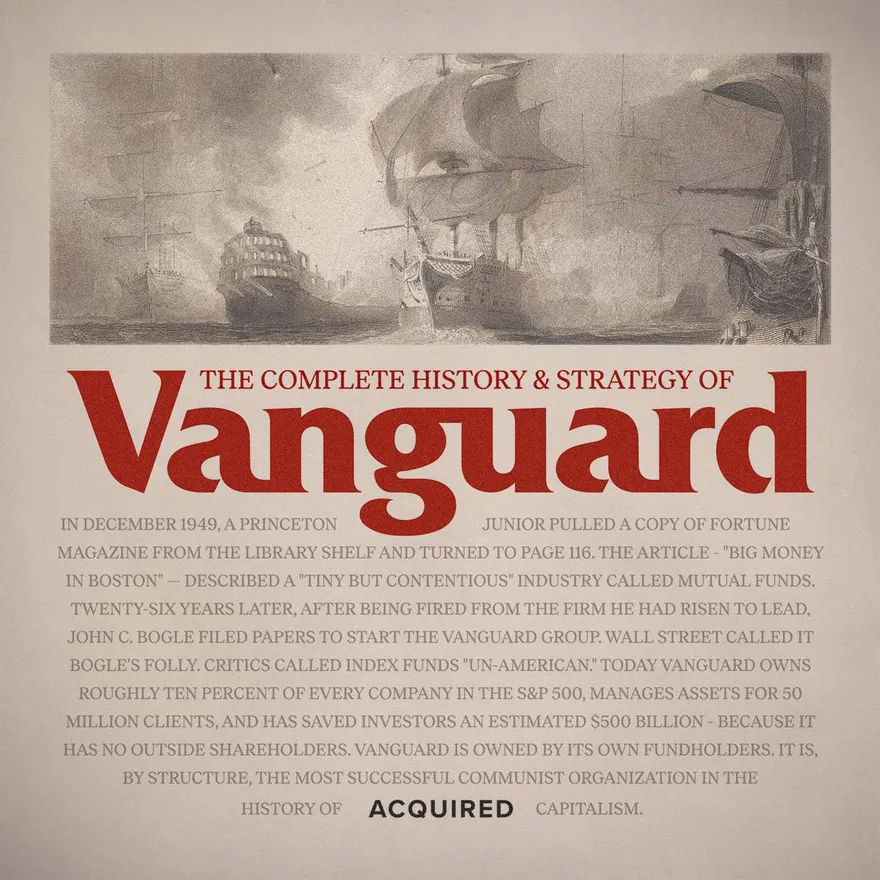

This is a preview of the Shortform summary of the May 17, 2026 episode of the Acquired
Sign up for Shortform to access the whole episode summary along with additional materials like counterarguments and context.
1-Page Summary
Vanguard's Founding, Bogle's Vision, Mutual Ownership Model
Jack Bogle's Personal Journey and Crisis of Conscience
Jack Bogle's early life was marked by hardship—growing up in poverty during the Great Depression after his father abandoned the family. This instilled in him a deep sense of obligation to make meaningful use of his opportunities. His Princeton senior thesis on mutual funds caught the eye of Walter Morgan, founder of Wellington Management, who hired Bogle straight out of college. Bogle thrived at Wellington, rising to CEO by age 35.
However, the 1960s "go-go years" changed everything. Wellington merged with the riskier I-Vest fund, and the gamble backfired in the 1970s oil crisis—I-Vest suffered a 65% drawdown and Wellington's assets plummeted from $2 billion to $480 million. As losses mounted, Bogle experienced a crisis of conscience, questioning the morality of managers collecting fees while investors lost money. In a "Jerry Maguire moment," he advocated for mutualizing the funds to operate at-cost for client benefit. This advocacy led to his firing as CEO of Wellington Management in January 1974, though he remained chairman of the funds.
The Mutualization Strategy and Legal Maneuvering
After being fired, Bogle authored a 250-page report arguing that the funds should create their own investor-owned management company operating at cost. The board voted by the slimmest of margins to implement his plan in limited fashion, creating Vanguard in 1974. However, Vanguard was precluded from offering investment advisory services or marketing, which remained with Wellington.
Bogle identified a loophole: he could launch a new type of fund that didn't require active management—an index fund. With board approval, Vanguard introduced the first retail S&P 500 index fund, sidestepping restrictions and laying the groundwork for the passive investing revolution. The industry largely derided this "lunatic fringe" idea, but Bogle moved forward, knowing the mutual structure would not create personal wealth on the scale of other Wall Street founders.
The Mutual Ownership Structure and Its Incentive Alignment
Vanguard's resulting structure is unique: as an investor in a Vanguard fund, a client becomes an owner of the management company itself. There are no external shareholders, no founder equity, and no incentive to maximize profits. Instead, profits flow back to clients through lower fees. This customer-ownership model means Vanguard is structurally incentivized to reduce costs wherever possible.
Bogle's famous dictum is that "strategy follows structure"—Vanguard's incentives force it to lower costs, allowing it to undercut competitors and accumulate trillions in assets while remaining loyal to its founding mission. At his death, Bogle's estate was worth $80 million—a fraction of what owners of competing asset managers amassed, leaving an estimated $40–100 billion in potential personal wealth "on the table." Yet this wealth was never lost; it accrued to American investors in the form of lower fees and higher net returns.
Rise of Low-cost Index Funds
The Academic Foundation and Historical Context
The intellectual foundation for low-cost index funds traces back to Paul Samuelson, who in 1974 found no systematic evidence that active fund managers could consistently beat the market. He urged the creation of a fund that "apes the whole market" with minimal fees. Despite this logic, conventional wisdom held that successful investing required skillful, active managers. Indexes had existed as market benchmarks since the 1800s, but it took nearly a century to reconceptualize them as investable products rather than simply comparison tools.
First Retail Index Fund: Launch and Struggles
In 1976, Vanguard launched the Index Investment Trust (now the Vanguard 500 Index Fund), aiming to raise $150 million but only managing $11.3 million. With so little capital, the fund couldn't buy full share lots of all 500 S&P companies, instead investing in 280 stocks. The sales pitch was counterintuitive—inviting people to settle for average market returns seemed unambitious. It took six years to reach $100 million and another six to pass $1 billion, a slow, persistent slog rather than instant disruption.
The Mathematical Case for Low-cost Index Investing
Bogle recognized that investors, as a group, make up the market; therefore, actively trying to beat it is a zero-sum game after accounting for fees. Data consistently demonstrated that, after fees, most active managers underperform the market over the long run. Bogle found that the S&P 500 Index would outperform half of all active managers in a given year and more than 78% across a decade. The impact of fees is striking: over 40 years, a 1% annual fee reduces the end balance from $1.5 million to $1 million—siphoning away one third of gains.
Scaling and the Role of Business Lines
For years, passive indexing was too small to generate meaningful profits. Vanguard survived thanks to income from money market and fixed income funds, and the actively managed Windsor Fund, which contributed the bulk of profits. As the 1980s ended, growing assets and falling fee levels led to accelerating momentum. By the mid-1990s, advancing computer technology allowed Vanguard to track and own almost all U.S. stocks.
Today, Vanguard oversees $12 trillion in assets, 84% of which are passive index funds. Over the last decade, 84% of Vanguard funds have outperformed their active peers. Scale and declining marginal costs per new customer have created high barriers for competitors and ensured the continued dominance of low-cost index investing.
Vanguard Effect: Fee Compression and Wealth Transfer
The Mechanism of Forced Competition and Industry Transformation
Vanguard's average ETF and mutual fund expense ratio now sits at just 0.07%, with some offerings as low as 0.03%. In contrast, the industry average remains at 44 basis points. Yet every competitor—Fidelity, BlackRock, State Street—has been forced to launch their own passive index funds with similarly razor-thin margins to stem client outflows, often offering low-fee index funds as loss leaders.
Ben Gilbert cites research estimating that Vanguard's relentless cost-cutting has shifted approximately $1 trillion from asset managers to investors: $500 billion directly through Vanguard and another $500 billion via competitor fee cuts. Jack Bogle stands credited with a trillion-dollar wealth transfer out of Wall Street's coffers and into individual investors' pockets.
Warren Buffett's Endorsement and the Philanthropist Framing
Warren Buffett publicly endorsed Bogle's model, declaring that minimal-fee index funds are the best way for most investors to own common stocks. In Berkshire's 2016 letter, Buffett wrote that if a statue is ever erected "to honor the person who has done the most for American investors, the hands-down choice should be Jack Bogle." Morgan Housel framed Bogle as "an undercover philanthropist," with his transfer of wealth to American investors topping even the world's greatest conventional philanthropists.
Financial Crisis Validates Index Model
The 2008 financial crisis became a pivotal moment. The collapse of active managers disproved the notion that Wall Street's best would protect investors in bear markets. As Morningstar's John Rekenthaler wrote, "active managers had long promised that when a bear market finally arrived, they would outperform Vanguard's fully invested index funds. It did and they did not."
Buffett's famous bet began in 2007: he wagered that the Vanguard 500 Index Fund would beat any portfolio of hedge funds over a decade. The S&P 500 returned 126% net of fees, while the hedge fund basket managed just 36%. This validated the low-cost index model in practice. In the aftermath, Vanguard's market share doubled overnight, and by September 2010, Vanguard surpassed Fidelity to become the world's largest mutual fund manager.
Competitive Dynamics: Fidelity, Blackrock, and Strategic Adaptation
Fidelity's Pivot Toward Adjacent Businesses and Technology
Fidelity positioned itself as a premier brokerage and benefits platform, focusing on profiting from 401(k) management, retail trading, and advisory services rather than competing head-on with Vanguard over fund management fees. This strategy is deliberate—Fidelity treats its low-cost index funds as loss leaders while generating significant profits from 401(k) plans and brokerage relationships. Many customers first become Fidelity clients through their employer's 401(k) and often open personal brokerage accounts, sometimes investing in Vanguard funds.
During the pandemic, the contrast between platforms became stark. Vanguard's service and technology faltered under increased demand, exposing weaknesses in its mutual-owned operating model. Fidelity, by contrast, doubled down on technology and service, earning a reputation as a superior product experience.
Blackrock's Dominance Through the Ishares Etf Platform
Blackrock's rise to ETF dominance is rooted in its strategic 2009 acquisition of iShares from Barclays during the financial crisis. This positioned Blackrock as the world's largest asset manager. Through iShares, Blackrock now manages 1,400 ETFs with $3.3 trillion in assets—outpacing all competitors. The ETF market continues to grow at a rate of 30% annually, and Blackrock is accelerating its dominance.
The Etf Rejection: Jack Bogle's Strategic Mistake
In 1992, Nathan Most proposed exchange-traded funds to Bogle, but Bogle rejected the idea, fearing ETFs would encourage speculation and excessive trading. This proved costly for Vanguard's competitive standing. Rather than partnering with Most, who then created the first ETF with State Street, Vanguard watched as competitors captured the ETF market's early growth. Vanguard only launched its ETF lineup in 2001, well after Bogle had retired, entering as an also-ran. While Vanguard now ranks as number two in ETF assets, it has never regained the top spot.
Systemic Concerns and Criticisms of Index Fund Dominance
The Price Discovery Problem and Free-Rider Concern
Critics worry that excessive passive investing misprices assets because passive investors do not participate in active price discovery. However, Gilbert counters that even if 95% of the market is passive, prices are set by the marginal trader. Only a small group of traders is necessary to ensure accurate pricing because arbitrage opportunities become so large and profitable that active managers will always be incentivized to participate.
Corporate Governance and Voting Concentration Risks
The three largest passive index fund firms—Vanguard, BlackRock, and State Street—now own between 20% and 40% of the voting shares in most large American public corporations. This centralizes voting decisions within just a handful of institutions, fundamentally transforming corporate governance. Shareholder votes, which should ideally reflect distinct investor priorities, can become swayed by broad ESG movements or societal sentiment as interpreted by these firms.
Scale and Systemic Risk Implications
With passive assets projected to reach 50% of market capitalization in the next 10–20 years, more attention is being paid to resulting systemic risks. If one of these passive giants faced an operational failure leading to mass liquidations or redemptions, the effect could destabilize financial markets. Vanguard, for example, historically raised its already-low fees during financial crises to cover fixed costs.
Absence of a Vanguard Effect in Private Markets
While Vanguard's low-cost model has dramatically reduced fees in public markets—pushing typical expense ratios from 1.5–2% down to as little as 0.07%—this "Vanguard effect" has not reached private equity or venture capital. Fee compression is absent, and these markets continue to charge the traditional "2 and 20." This difference arises from structural contrasts: in private markets, access is limited and the asset must "pick" the investor, making the business fundamentally about scarce relationships and proprietary deals rather than commodity products.
1-Page Summary
Additional Materials
Counterarguments
- While Vanguard’s mutual ownership structure is praised for aligning incentives with investors, it can also result in slower innovation, bureaucratic inertia, and weaker customer service, as evidenced by technology and service issues during periods of high demand.
- The claim that passive investing is always superior overlooks that some active managers do outperform the market over certain periods, and indexing may not be optimal for all investors, especially in less efficient markets or for those with unique tax or liquidity needs.
- The concentration of voting power among a few large index fund providers raises legitimate concerns about corporate governance, as these firms may not always represent the diverse interests of their underlying investors.
- The assertion that price discovery remains efficient even with high passive market share is debated; some academics and practitioners argue that if passive investing becomes too dominant, market efficiency and liquidity could be impaired.
- Vanguard’s fee increases during financial crises, though rare, demonstrate that even mutual ownership structures are not immune to raising costs when under financial stress.
- The “Vanguard effect” has not extended to private markets, suggesting that the benefits of fee compression are not universal and depend on market structure and competition.
- Bogle’s rejection of ETFs, while principled, arguably limited Vanguard’s early growth in a rapidly expanding segment, allowing competitors to capture significant market share.
- The focus on low fees may lead some investors to overlook other important factors such as fund tracking error, tax efficiency, or the quality of customer service.
- The narrative that Bogle’s model is purely philanthropic may understate the business advantages and market power Vanguard has accrued as a result of its scale and structure.
- While index funds have outperformed most active managers over long periods, there is still a role for active management in price discovery, market efficiency, and in less liquid or emerging markets.
Actionables
- you can review your investment account statements and calculate the total annual fees you pay, then set a calendar reminder to check and compare these fees every year, switching to lower-cost options if available to maximize your long-term returns
- (for example, if you notice your mutual fund charges a 1% fee, look for alternatives with lower fees and track how much more you keep over time by making the switch).
- a practical way to align your investments with your values is to research how your fund managers vote on shareholder issues and send them a short email or message expressing your preferences on topics like executive pay or environmental policies
- (for instance, if you care about climate action, ask your fund manager how they vote on related proposals and request more transparency or specific voting actions).
- you can set up a simple spreadsheet to track how much of your portfolio is in passive versus active funds, then experiment by gradually increasing your passive allocation and monitoring performance and peace of mind over a year
- (for example, start with 20% in index funds, increase to 40% after six months, and note any changes in returns, fees, and how much time you spend managing your investments).


Get access to the context and additional materials
Vanguard's Founding, Bogle's Vision, Mutual Ownership Model
Jack Bogle's Personal Journey and Crisis of Conscience
Jack Bogle's life is shaped early by hardship. Growing up in poverty during the Great Depression after his father abandoned the family, Bogle and his brothers are forced to work multiple jobs while attending school. This experience instills in Jack a deep sense of obligation to make meaningful use of his educational opportunities.
As graduation from Princeton approaches, Bogle sets his sights on the emerging fund management industry. His senior thesis, focused on mutual funds, catches the eye of Walter Morgan, a Princeton alum and founder of Wellington Management in Philadelphia. Morgan hires Bogle straight out of college, becoming a father figure to Jack. Wellington Fund, at that time, is known for pioneering balanced investing, maintaining a conservative reputation with $150 million in assets, putting it among the industry's top funds.
Bogle thrives at Wellington, rising from Morgan's assistant to eventually become president and, at age 35, CEO. However, the postwar mutual fund industry changes in the late 1960s, entering the "go-go years" of speculative investing. The Wellington Fund merges with I-Vest, a riskier fund, and shifts its style to chase higher returns. This gamble backfires with the 1970s oil crisis: I-Vest suffers a 65% drawdown in one year and is shuttered, while Wellington's assets plummet from $2 billion to $480 million as investors flee.
As losses mount, Bogle experiences a crisis of conscience. He voices discomfort with the traditional fund management model—while investors incur losses, managers continue to collect fees. He questions the morality of profiting while providing poor service, declaring in a speech to the firm that perhaps they should mutualize the funds, dissolve the management company, and operate at-cost entirely for client benefit. This "Jerry Maguire moment" is met with resistance from partners and public shareholders, particularly since management companies, like Wellington, enjoy lucrative economics.
After years of internal struggle, increasing philosophical divides, and persistent advocacy from Bogle, the board finally acts: in January 1974, Bogle is fired as CEO of Wellington Management. Still, he remains chairman of the funds under Wellington's umbrella—a separate governing structure.
The Mutualization Strategy and Legal Maneuvering
Upon being fired from the management company, Bogle convenes the fund boards, leveraging his remaining authority. He authors a 250-page report for the board, arguing that the industry’s traditional management structure no longer serves fund holders' best interests and that the funds should assert control over their own destiny. He proposes that the funds create a new, wholly investor-owned management company to handle administration, hire their own staff, and operate at cost—eliminating external management company profits.
The board, recognizing its fiduciary duty to investors rather than to management company shareholders, ultimately votes by the slimmest of margins to empower Bogle to implement his plan in a limited fashion. In 1974, this leads to the creation of a new subsidiary for fund administration—Vanguard. However, the compromise precludes Vanguard from offering investment advisory services or marketing, which remain with Wellington Management.
Bogle, careful in his reading of the legal mandates, identifies a loophole: he can launch a new type of fund that doesn't require active management—an index fund. With board approval, Vanguard introduces the first retail S&P 500 index fund, sidestepping restrictions and laying the groundwork for the revolution in passive investing. This structure is met with skepticism from the industry—Forbes derides the infighting, and competitors warn Bogle against mutualization—but the experiment moves forward.
Bogle is clear-eyed about the economic implications for himself. He acknowledges that a mutual structure will not create personal wealth on the scale of other Wall Street founders, but he believes it is his best (and last) chance to serve investors and redeem his career. The model is viewed as "lunatic fringe" at the time, with no industry or regulatory push for such change. Implementing it requires a rare combination of Bogle's idealism, personal circumstances, and dogged determination.
The Mutual Ownership Structure and Its Incentive Alignment
Vanguard’s resulting structure is unique: as an investor in a Vanguard fund, a client becomes an owner of the management company itself. There are no external shareholders, no founder equity, and no incentive to maximize profits. Instead, profits flow directly back to clients through lower fees.
This customer-ownership model means Van ...
Here’s what you’ll find in our full summary
Vanguard's Founding, Bogle's Vision, Mutual Ownership Model
Additional Materials
Counterarguments
- While Vanguard’s mutual ownership model is credited with lowering fees, critics argue that the rise of index funds and fee compression was an industry-wide trend that would have occurred regardless of Vanguard’s structure.
- Some industry observers note that even as a mutual, Vanguard has grown so large that it wields significant market power, raising concerns about concentration and potential systemic risks.
- The mutual ownership structure does not guarantee perfect alignment with all investors’ interests; for example, some have argued that Vanguard’s focus on cost minimization may come at the expense of customer service or innovation.
- Although Bogle’s personal wealth was modest compared to other asset management founders, $80 million is still a substantial sum, and his compensation was not insignificant.
- Critics have pointed out that the mutual structure can make it difficult for Vanguard to raise capital for expansion or innovation compared to publicly traded firms.
- Some argue that the proliferation of index funds, led by Vanguard, has contributed to market distortions and reduc ...
Actionables
- you can set up a personal spending or investing account where you intentionally cap your own fees or costs, then track and redirect any “saved” money (what you would have paid in higher fees elsewhere) to a cause or goal that benefits others, such as a family member’s education fund or a local charity, mirroring the idea of passing on profits to others rather than maximizing your own gain.
- a practical way to align your interests with those you serve is to create a simple feedback system for any group or club you’re part of, letting members vote on how shared resources are used or how group fees are set, so decisions directly reflect the majority’s benefit rather than a leader’s preference.
- you can experiment with ...

Get access to the context and additional materials
Rise of Low-cost Index Funds
The Academic Foundation and Historical Context
The intellectual foundation for low-cost index funds traces back to Nobel Prize-winning economist Paul Samuelson. In 1974, Samuelson published research in the Journal of Portfolio Management analyzing mutual fund market returns and found no systematic evidence that active fund managers could consistently beat the market. Samuelson urged the creation of a fund that "apes the whole market," with minimal fees, no load, and very low turnover—essentially advocating for an index fund before one existed for the retail investor.
Despite Samuelson's logic, conventional wisdom at the time adamantly held that successful investing relied on skillful, active managers who could outperform the market through stock selection. The idea of settling for "average" market returns was contrary to the prevailing American ethos of exceptionalism and personal achievement. Indexes like the S&P 500 or Dow Jones had existed as market benchmarks dating back to the 1800s for measurement purposes, but it took nearly a century to reconceptualize these benchmarks as investable products targeted at everyday investors, rather than simply as comparison tools for evaluating fund performance.
Before Vanguard, institutional efforts to create an index fund—such as Wells Fargo's attempt for the Samsonite pension plan—had failed due to the technical and operational barriers of replicating an index like the S&P 500 in real time. Tracking so many stocks accurately required sophisticated software and automation, which did not exist at scale. To buy a precisely weighted basket of S&P 500 companies on your own required millions of dollars, further impeding the democratization of index-based investing.
First Retail Index Fund: Launch and Struggles
In 1976, Vanguard, under Jack Bogle, launched the first retail index product: the Index Investment Trust (now the Vanguard 500 Index Fund, ticker VFIAX). The fund aimed to raise $150 million at launch but only managed $11.3 million—less than one-fifteenth of its target. Initial management fees were still relatively high, around 0.65%, and with so little capital, the fund couldn't buy full share lots of all 500 S&P companies. Instead, it invested in 280 stocks, heavily weighting the 200 largest and selecting another 80 to attempt a representative sample, requiring a surprising amount of judgment and manual effort. Remarkably, the person who oversaw this work did so part-time, working nights and weekends while supporting her husband’s furniture business by day.
The fund faced not just underwhelming inflows but also frequent redemptions and market downturns, which drained assets further. In fact, it was only kept afloat by merging in the Exeter fund, a legacy Wellington actively-managed fund, in late 1977 to achieve the necessary scale for survival. The sales pitch was counterintuitive to most investors—inviting people to settle for average market returns, which seemed unambitious, especially compared to the promises made by proponents of active management. Skeptics among competitors, such as Fidelity’s Ned Johnson, openly doubted the appetite for merely average results. It took six years for the fund to reach $100 million and another six years to pass $1 billion, marking a slow, persistent slog rather than a moment of instant disruption.
The Mathematical Case for Low-cost Index Investing
Active Investors Cannot Outperform Market After Fees
The breakthrough insight was that investors, as a group, make up the market; therefore, the market’s aggregate performance is the average return. If everyone is the market, actively trying to beat it is a zero-sum game—one person’s gain is another’s loss—especially after accounting for management fees and transaction costs. Samuelson put it starkly: “We investors as a group not only don’t get what we pay for, we get precisely what we don’t pay for.” Data consistently demonstrated that, after fees, most active managers underperform the market over the long run.
Index Funds Offer Top-tier Performance: Beat Half of Active Managers and 78% Over a Decade Through Cost Advantage
Jack Bogle ran the numbers and found that the S&P 500 Index, even with minimal fees, would outperform half of all active managers in a given year and more than 78% across a decade. Cost structure was the decisive advantage. Over time, investors who simply held the market at the lowest cost would outperform the majority of peers pursuing more expensive or complicated strategies.
Investor Fees: $1 Million vs. $1.5 Million After 40 Years
The impact of fees is striking: over 40 years, a 1% annual fee on $100,000 invested at 7% reduces the end balance from $1.5 million to $1 million—siphoning away one third of gains. That half-million dollar difference could define educational opportunities, retirement security, and overall financial independence. The behavioral edge also plays a role; index fund investors are less likely to panic trade or attempt fruitless timing, allowing compounding to work undisturbed.
Scaling and the Role of Business Lines
Vanguard 500 Fund: Took 6 Years For $100m, 12 Years for $1b
The road to sc ...
Here’s what you’ll find in our full summary
Rise of Low-cost Index Funds
Additional Materials
Clarifications
- Active fund managers select specific stocks aiming to outperform the overall market by using research and judgment. Index funds simply replicate a market index, holding all or a representative sample of its stocks, matching market returns. Active management involves higher fees and trading costs, which can erode gains over time. Because most active managers fail to consistently beat the market after costs, low-cost index funds often deliver better net returns.
- A "load" is a sales charge or commission paid when buying or selling mutual fund shares, reducing the investor's initial investment or proceeds. "Turnover" refers to how frequently assets within the fund are bought and sold, with high turnover often leading to higher transaction costs and tax liabilities. "Management fees" are ongoing charges paid to the fund manager for operating the fund, expressed as a percentage of assets under management. Lower fees and turnover generally help improve net returns for investors.
- An index like the S&P 500 or Dow Jones is a statistical measure that tracks the performance of a specific group of stocks, representing a segment of the overall market. It functions as a benchmark by providing a standard against which investors and fund managers can compare the returns of their portfolios. The S&P 500 includes 500 large U.S. companies weighted by market capitalization, reflecting the broader market's health. The Dow Jones tracks 30 large, publicly-owned companies, weighted by stock price, offering a narrower but historically significant market snapshot.
- Replicating an index in real time requires continuously buying and selling hundreds of stocks to match the index’s exact composition and weightings. This demands advanced computer systems to process large volumes of market data and execute trades instantly. Without automation, manual adjustments are slow, error-prone, and costly. Early technology lacked the speed and accuracy needed for precise, real-time index tracking.
- Buying full share lots means purchasing whole units of a stock, which is necessary to accurately replicate an index's composition. Capital constraints limit the ability to buy all stocks in exact proportions, forcing funds to hold fewer stocks or partial samples. This can lead to tracking error, where the fund's performance deviates from the index. Large capital allows precise replication, reducing tracking error and improving fund accuracy.
- Merging funds combines assets from two or more investment funds into one, increasing the total capital managed. This larger scale reduces per-investor costs by spreading fixed expenses over more assets, improving operational efficiency. It also enhances the fund’s ability to replicate an index accurately and attract more investors. Ultimately, merging helps struggling funds survive and grow by achieving economies of scale.
- A "zero-sum game" means that one investor's gain comes at another's loss, so total gains and losses balance out. Before fees, the market's average return reflects this balance among all investors. Fees reduce the total returns available, so after fees, the group as a whole earns less than the market's gross return. This makes it mathematically impossible for most active managers to outperform the market net of fees.
- The claim that index funds outperform 78% of active managers over a decade is based on empirical studies comparing fund returns net of fees. These studies analyze large samples of actively managed funds and benchmark them against index fund returns tracking the same market. The outperformance is largely due to lower fees and reduced transaction costs in index funds. This statistical advantage persists because active managers' gains are offset by others' losses, making consistent outperformance rare.
- Investment fees reduce the amount of money that stays invested and compounds over time. Even a small annual fee, like 1%, significantly lowers the final value due to compounding effects. This means investors pay fees not just on their initial amount but also on the gains accumulated each year. Over decades, this fee drag can cost hundreds of thousands of dollars in lost growth.
- Panic selling occurs when investors sell assets impulsively during market downturns, often locking in losses. Market timing is the attempt to predict market movements to buy low and sell high, which is extremely difficult to do consistently. Behavioral finance shows these actions often harm returns due to emotional decision-making and missed growth periods. Index fund investors tend to avoid these pitfalls by holding steady through market fluctuations.
- A basis point is one hundredth of a percentage point (0.01%), used to measure fees or interest rates precisely. For example, 68 basis points equal 0.68%. Lower fees mean more of an investor’s money stays invested, compounding over time to increase returns. Even small fee ...
Counterarguments
- Index funds, by design, are forced to buy and hold all stocks in the index regardless of valuation or fundamentals, which can lead to overexposure to overvalued sectors or companies during bubbles.
- The rise of passive investing may contribute to market inefficiencies, as fewer active managers are left to analyze and price individual securities, potentially allowing mispricings to persist longer.
- Index funds are not immune to market downturns; they guarantee average market returns, which can include significant losses during bear markets.
- The dominance of a few large index fund providers, such as Vanguard, BlackRock, and State Street, raises concerns about concentration of ownership and potential influence over corporate governance.
- Some investors may prefer active management for specific goals, such as risk management, tax efficiency, or exposure to niche markets not well represented in broad indexes.
- Historical outperformance of index funds over active managers is partly due to the high fees and poor performance of many active funds; some active managers do outperform net of fees, especially in less efficient markets.
- The behavior ...

Get access to the context and additional materials
Vanguard Effect: Fee Compression and Wealth Transfer
The Mechanism of Forced Competition and Industry Transformation
Vanguard’s launch of low-cost index funds proved these investments could be operated at minimal cost, igniting a transformation across asset management. The firm’s average ETF and mutual fund expense ratio now sits at just 0.07%, with some offerings such as VLO dropping as low as 0.03%. In contrast, the industry average for mutual funds and ETFs is still 44 basis points, about six and a half times more than Vanguard's average. Yet, the so-called “Vanguard effect” means that every competitor—Fidelity, BlackRock, State Street, Capital Group, and others—has been forced to launch their own passive index funds with similarly razor-thin margins to stem client outflows, despite the absence of structural incentives to compress fees. These firms, traditionally motivated to preserve their profitability, now often offer low-fee index funds as loss leaders or at break-even, aiming to retain customers for ancillary, higher-margin products.
This disruption commoditized what had for decades sold itself as unique and differentiated. As a result, investors today can buy an S&P 500 index fund from nearly any provider at minimal cost, something unthinkable before Vanguard’s existence proof. The “Vanguard Effect” encompasses this sweeping industry fee reduction, which applies not just to passive but to active public managers whose fees have also come under pressure.
Ben Gilbert cites research from The Bogle Effect that estimates Vanguard’s relentless cost-cutting and industry-wide pressure has shifted approximately $1 trillion from asset managers to investors: $500 billion directly through Vanguard and another $500 billion via competitor fee cuts. Jack Bogle and Vanguard stand credited with a trillion-dollar wealth transfer out of Wall Street’s coffers and into individual investors’ pockets through savings on fees and trading costs.
Warren Buffett's Endorsement and the Philanthropist Framing
Warren Buffett himself publicly endorsed Bogle’s model, declaring in the 1996 Berkshire annual letter that minimal-fee index funds are the best way for most investors to own common stocks: “Those following this path are sure to beat the net results delivered by the great majority of investment professionals.” Despite Berkshire Hathaway’s own exceptional returns—far outpacing even the strong performance of the S&P 500—Buffett consistently advocated low-cost index investing for regular Americans.
In Berkshire’s 2016 letter, Buffett wrote that if a statue is ever erected “to honor the person who has done the most for American investors, the hands-down choice should be Jack Bogle.” He lauded Bogle for enabling millions to achieve better returns on their savings than they otherwise could, calling him “a hero to them and to me.”
Morgan Housel framed Bogle as “an undercover philanthropist,” channeling estimates of $500 billion to $1 trillion transferred to American investors as topping even the world’s greatest conventional philanthropists. Bogle’s personal estate was widely reported at around $80 million at his death, paltry compared to the $40–50 billion amassed by the Johnson family of Fidelity or Larry Fink’s $1.5 billion from BlackRock, underscoring Bogle’s dedication to benefiting society rather than enriching himself from Vanguard’s $5 trillion in assets.
Financial Crisis Validates Index Model
The 2008 financial crisis became a pivotal moment. While passive index funds did not avoid the severe market downturn, the collapse of active managers—mutual funds, hedge funds, private equity, alternatives—disproved the notion that Wall Street’s best and brightest would protect investors in bear ...
Here’s what you’ll find in our full summary
Vanguard Effect: Fee Compression and Wealth Transfer
Additional Materials
Clarifications
- An ETF (Exchange-Traded Fund) is a type of investment fund traded on stock exchanges, allowing investors to buy and sell shares throughout the trading day at market prices. A mutual fund pools money from many investors to buy a diversified portfolio of assets, but shares are bought or sold only at the end of the trading day at the fund’s net asset value (NAV). ETFs generally offer more trading flexibility and often lower expense ratios, while mutual funds may provide easier automatic investment options and sometimes active management. Both aim to diversify risk by holding a variety of securities within one fund.
- An expense ratio is the annual fee that a fund charges its investors to cover operating costs. It is expressed as a percentage of the fund’s assets under management. Lower expense ratios mean investors keep more of their returns, making it crucial for long-term growth. High fees can significantly erode investment gains over time.
- A basis point is a unit of measure equal to one hundredth of one percent (0.01%). It is commonly used in finance to describe changes in interest rates or fees. For example, 44 basis points equal 0.44%, and 7 basis points equal 0.07%. Using basis points helps avoid confusion when discussing small percentage changes.
- Passive index funds aim to replicate the performance of a specific market index by holding the same securities in the same proportions, without frequent buying or selling. Active management involves professional managers making decisions to buy, sell, or hold securities to outperform the market or a benchmark index. Passive funds typically have lower fees due to less trading and research costs, while active funds charge higher fees for the expertise and effort involved. Studies show active managers often fail to consistently beat passive index funds after fees.
- Competitors offer low-fee funds as "loss leaders" to attract and retain customers by providing a valuable service at little or no profit. This strategy helps keep clients within their ecosystem, increasing the chance they will buy other, higher-margin products like actively managed funds or advisory services. Offering break-even products prevents losing market share to Vanguard’s low-cost funds. It’s a trade-off where firms accept minimal or no profit on some products to maintain overall profitability.
- The S&P 500 index tracks the stock performance of 500 large U.S. companies, representing about 80% of the U.S. equity market. It serves as a benchmark for the overall health and trends of the U.S. stock market. Investors use it to gauge market performance and compare individual investment returns. Its broad diversification makes it a popular choice for index funds.
- Jack Bogle founded Vanguard and pioneered the first low-cost index mutual fund in 1975. He revolutionized investing by promoting broad market exposure with minimal fees, challenging the high-cost active management model. Bogle emphasized investor returns over firm profits, prioritizing transparency and cost efficiency. His approach democratized investing, making it accessible and affordable for everyday people.
- Fee compression refers to the ongoing reduction in the fees that asset managers can charge for their investment products. It forces managers to lower prices to stay competitive, often squeezing their profit margins. For investors, fee compression means paying less for investment management, increasing their net returns. This dynamic shifts more wealth from managers to investors over time.
- Active management compensation often includes management fees based on assets under management and performance fees tied to investment returns. This structure incentivizes managers to grow assets and generate high returns but can encourage risk-taking or short-term trading. Fees remain high regardless of performance, creating a conflict between manager profit and investor outcomes. Additionally, performance fees can lead to volatility in manager income and misalignment with long-term investor interests.
- The 2008 financial crisis exposed weaknesses in active management, as many actively managed funds failed to protect investors from losses. Hedge funds and private equity, often relying on complex strategies, suffered significant declines and liquidity issues. Passive index funds, while not immune to losses, maintained stable, transparent portfolios tracking broad markets. This contrast led investors to favor low-cost index funds for their reliability and cost efficiency during market turmoil.
- Warren Buffett's 2007 bet challenged hedge funds to outperform a low-cost S&P 500 index fund over ten years. He chose the Vanguard 500 Index Fund to represent passive investing, while hedge funds were selected by Ted Seides. The bet highlighted the difficulty hedge funds have in beating simple, low-fee index funds after fees. Buffett's victory underscored the value of low-cost passive investing over expensive active management.
- Market share in mutual funds refers to the portion of total investment dollars flowing into mutual funds that a particular company manages. It indicates how much of the new money investors are putting into funds controlled by that company compared to competitors. A higher market share means more investors are choosing that company's funds over others. This metric reflects a firm's popularity and influence in the mutual fund industry.
- Cash inflows refer specifically to new money investors put into a fund during a period. They differ from total investment flows, which also include money leaving the fund (outflows). Net inflows equal inflows minus outflows, showing the actual growth or shrinkage of assets. Cash inflows indicate investor demand and fund popularity.
- Ancillary, higher-margin products are additional financial services or investment options that asset managers offer beyond low-cost index funds. These can include ...
Counterarguments
- The widespread adoption of low-cost index funds has contributed to increased market concentration, with a few large asset managers (including Vanguard, BlackRock, and State Street) controlling significant portions of major public companies, raising concerns about corporate governance and potential conflicts of interest.
- The commoditization of investment products may reduce incentives for innovation and research in active management, potentially limiting the development of new investment strategies or products.
- Index funds, by design, are fully exposed to market downturns and do not provide downside protection, which may not suit all investors’ risk profiles or objectives.
- The shift toward passive investing can lead to reduced price discovery in markets, as fewer active managers are analyzing and trading individual securities based on fundamentals.
- While low fees benefit investors, some critics argue that the focus on cost alone may cause investors to overlook other important factors such as fund structure, tracking error, or the quality of customer service.
- The success of index funds is largely dependent on the continued efficiency and stability of financial mark ...

Get access to the context and additional materials
Competitive Dynamics: Fidelity, Blackrock, and Strategic Adaptation
Fidelity's Pivot Toward Adjacent Businesses and Technology
Fidelity has positioned itself not just as a fund manager but as a premier brokerage and benefits platform. Its business model focuses on profiting from 401(k) management, retail trading, and advisory services. Rather than competing head-on with Vanguard over fund management fees, Fidelity uses its robust presence in the corporate 401(k) sector and brokerage services to anchor customer relationships. Many customers, like Ben Gilbert, first become Fidelity clients through their employer's 401(k) and then remain for years, often opening personal brokerage accounts. Notably, these accounts commonly invest in Vanguard funds, demonstrating that Fidelity is content to serve as a distribution and service platform for competitor products as well.
This strategy is deliberate; Fidelity treats its low-cost index funds as loss leaders while generating significant profits from management fees associated with 401(k) plans and the various ways it can monetize retail brokerage relationships. Cross-selling is fundamental—by leveraging initial access through workplace retirement accounts, Fidelity encourages clients to open additional products, sometimes investing their personal brokerage assets in Vanguard’s own offerings. The company’s operational focus shifted well before the pandemic, recognizing that it did not need to challenge Vanguard directly in fund management, but could instead dominate through superior technology, customer service, and a broader set of financial products.
During the pandemic, the contrast between Fidelity’s and Vanguard’s customer platforms became stark. Vanguard’s service and technology faltered under increased demand, with reports of customer service delays, lost fund transfers, and failed trades. This exposed inherent weaknesses in Vanguard's mutual-owned operating model, which tends to restrict reinvestment in technology and customer experience in order to keep costs low. Fidelity, by contrast, doubled down on technology and service, investing more heavily in their brokerage and workplace benefits platforms—ultimately earning a reputation as a superior product experience, even for customers who prefer to own Vanguard funds.
Blackrock's Dominance Through the Ishares Etf Platform
Blackrock’s rise to ETF dominance is rooted in its strategic 2009 acquisition of iShares from Barclays during the financial crisis. Barclays, needing to shore up capital, sold iShares to Blackrock, a move that proved to be a landmark victory. iShares had quickly become the leader in ETF issuance, and post-acquisition, Blackrock solidified its control over the ETF space. This acquisition positioned Blackrock as the world’s largest asset manager, with a far more global and institutional client base than Vanguard, whose customers are over 90% in the U.S.
ETFs, which trade like stocks, have broad appeal for retail investors. Unlike traditional mutual funds, ETFs offer features such as immediate pricing, lower tax impact from other shareholders’ actions, and the flexibility to trade throughout the day. Vanguard’s founder, Jack Bogle, was a vocal skeptic of ETFs, fearing they would encourage harmful speculation and short-term trading, in contrast to his principle of long-term investing.
Despite these concerns, Blackrock has come to dominate the fast-growing ETF market. Through iShares, Blackrock now manages 1,400 ETFs with $3.3 trillion in assets—outpacing all competitors. While Vanguard remains the leader in mutual funds and has a strong ETF business, it cannot match Blackrock’s scale or breadth in this rapidly expanding sector. The ETF market continues to grow at a rate of 30% annually, outpacing the flat growth of mutual funds, and Blackrock is accelerating its dominance, particularly as ETFs become the new preferred vehicle for both institutional and retail investors.
The Etf Rejection: Jack Bogle's Strategic Mistake
The dominance of ETFs today is rooted in a pivotal de ...
Here’s what you’ll find in our full summary
Competitive Dynamics: Fidelity, Blackrock, and Strategic Adaptation
Additional Materials
Counterarguments
- Fidelity’s reliance on cross-selling and monetizing retail brokerage relationships may expose customers to unnecessary or overly complex financial products, potentially leading to conflicts of interest.
- Treating index funds as loss leaders could result in underinvestment in fund management quality or innovation, potentially impacting long-term investor outcomes.
- While Fidelity’s technology and service investments are highlighted, some customers and industry observers have noted that its platforms can still be confusing or overwhelming for less experienced investors.
- The assertion that Vanguard’s mutual-owned model inherently limits reinvestment in technology may overlook the fact that mutual ownership can also align incentives with investors and reduce profit-driven conflicts.
- Blackrock’s dominance in ETFs is partly due to its aggressive marketing and distribution, which some critics argue may encourage short-term trading behaviors that do not always benefit retail investors.
- The rapid growth of ETFs, while beneficial for liquidity and access, has also raised concerns about market volatility and the potential for systemic risks, which are not addressed in the text.
- Jack Bogle’s skepticism of ETFs, while seen as a strategic mistake in hindsight, was rooted in a pr ...
Actionables
- you can map out your financial relationships by listing every account you have (401(k), brokerage, bank, etc.) and noting which companies provide each service, then identify opportunities to consolidate or diversify based on which firms offer the best technology, service, or product mix for your needs—this helps you benefit from platforms that excel in areas like customer service or tech, rather than sticking with a provider out of habit.
- a practical way to take advantage of cross-platform investment access is to open a small brokerage account at a firm you don’t currently use, then compare the user experience, available products (like ETFs and mutual funds), and customer support over a few months—this hands-on experiment lets you see which platform best fits your investing style and ...

Get access to the context and additional materials
Systemic Concerns and Criticisms of Index Fund Dominance
The Price Discovery Problem and Free-Rider Concern
Critics worry that excessive passive investing misprices assets because passive investors do not participate in active price discovery. Ben Gilbert summarizes this concern: if everyone relies on index investing, there will not be enough traders actually setting the price of stocks through buying and selling. However, Gilbert counters this argument by explaining that even if 95% of the market is passive, prices are set by the marginal trader. Only a small group of traders is necessary to ensure accurate pricing because arbitrage opportunities become so large and profitable that active managers will always be incentivized to participate until an equilibrium is reached.
Another criticism is that passive investors are “free riders,” benefiting from the price discovery created by active managers without paying for it. David Rosenthal acknowledges this but argues that it is an efficient market outcome and does not require correction. Active managers, motivated by profit, will set prices, and passive investors can benefit from that without undermining the market’s functioning.
Corporate Governance and Voting Concentration Risks
A separate issue with the rise of index funds is the concentration of voting power among a few giant fund providers. The three largest passive index fund firms—Vanguard, BlackRock, and State Street—now own between 20% and 40% of the voting shares in most large American public corporations. This centralizes voting decisions within just a handful of institutions, fundamentally transforming corporate governance.
This concentration risk means corporate governance increasingly resembles a public election, with issues sometimes shaped more by the court of public opinion and societal or political pressures than by economic analysis. Shareholder votes, which should ideally reflect distinct investor priorities, can become swayed by broad ESG (Environmental, Social, and Governance) movements or societal sentiment as interpreted by these firms. The decision-making process varies: some funds allow rare cases of direct holder voting, but most offer broad voting guidelines or default options, leaving enormous influence with fund managers.
There are also long-term concerns about collusion potential. With ownership so heavily centralized, there might be incentives for CEOs or fund managers to tacitly agree not to compete aggressively to maximize collective profits, though the hosts believe this scenario is far-fetched compared to real-world corporate dynamics.
Scale and Systemic Risk Implications
With passive assets projected to reach 50% of market capitalization in the next 10–20 years, more attention is being paid to the resulting systemic risks. Asset management is becoming highly concentrated in massive index fund firms. If one of these passive giants faced an operational failure or capital crisis leading to mass liquidations or redemptions, the effect could destabilize financial markets.
Vanguard, for example, historically raised its already-low fees during financial crises to cover fixed costs since it has to meet obligations like payroll even when asset values shrink. Unlike some firms with more flexible structures, Vanguard’s mutual ownership model puts it under pressure to raise revenue from customers during market downturns, as seen in the 2008 financial crisis.
Absenc ...
Here’s what you’ll find in our full summary
Systemic Concerns and Criticisms of Index Fund Dominance
Additional Materials
Clarifications
- Price discovery is the process by which markets determine the fair value of an asset through the interactions of buyers and sellers. Active investors analyze information and trade based on their insights, helping to adjust prices to reflect new data. Passive investors simply buy or sell based on a fixed index, not influencing prices directly. Therefore, active trading is essential for continuously updating prices to reflect true market conditions.
- The "marginal trader" is the investor whose buying or selling decisions directly influence a stock's current price. This trader acts on new information or arbitrage opportunities, pushing prices toward their true value. Even if most investors are passive, the marginal trader's actions ensure prices reflect available information. Thus, price discovery depends on this small group actively trading at the margin.
- "Free riders" in financial markets are investors who benefit from the price information generated by others without actively contributing to it. Active investors analyze companies and trade stocks, helping to set accurate prices through their decisions. Passive investors, like those in index funds, rely on these prices without incurring the costs of research or trading. This dynamic raises concerns about whether enough active investors will remain to maintain efficient markets.
- ESG movements promote corporate practices that prioritize environmental protection, social responsibility, and strong governance. Shareholders increasingly use voting power to push companies toward sustainable and ethical behavior aligned with ESG principles. Large index fund managers often influence these votes by setting guidelines that reflect ESG priorities. This can shift corporate decisions beyond pure financial considerations to include broader societal impacts.
- When a few large index fund firms hold significant voting shares, they effectively control many corporate decisions. This can reduce the diversity of viewpoints in board elections and policy choices, potentially sidelining smaller shareholders' interests. These firms may prioritize broad strategies or social goals over individual company performance. Their voting power can also influence executive compensation and corporate strategy on a large scale.
- Shareholder voting guidelines are pre-set instructions that fund managers use to vote on behalf of investors who do not vote directly. Default voting options mean votes are cast automatically according to these guidelines unless investors specify otherwise. This system streamlines decision-making but concentrates influence in fund managers’ hands. It can limit individual investors’ direct control over corporate governance choices.
- When a few large fund managers own significant shares in many companies, they gain substantial influence over corporate decisions. This influence could theoretically allow CEOs and fund managers to avoid aggressive competition, preserving profits collectively rather than competing fiercely. Such tacit collusion might reduce market dynamism and harm shareholders by limiting innovation or cost-cutting. However, legal regulations and market forces generally discourage explicit collusion, making this scenario unlikely.
- Systemic risk in financial markets refers to the potential for a failure in one part of the financial system to trigger widespread instability or collapse across the entire market. It arises when interconnected institutions or assets are so large or linked that their distress can cause a chain reaction. In asset management, systemic risk can occur if major fund managers face simultaneous large-scale redemptions, forcing rapid asset sales that depress prices market-wide. This risk threatens overall financial stability, not just individual investors or firms.
- Vanguard is owned by its funds, which in turn are owned by the investors, creating a mutual structure without external shareholders. This means Vanguard operates "at cost," returning profits to investors through lower fees rather than distributing them as dividends. During downturns, fixed costs like salaries remain, so Vanguard may raise fees to cover these expenses since it cannot rely on external capital. This contrasts with publicly traded firms that can raise funds or cut dividends to manage costs.
- The "Vanguard effect" refers to how Vanguard's introduction of very low-cost index funds pressured other fund managers to reduce their fees to stay competitive. This fee compression benefits investors by lowering the cost of investing in public markets. It also forces active managers ...
Counterarguments
- Empirical studies have shown that, despite the growth of passive investing, market efficiency and price discovery have not significantly deteriorated; active management still plays a substantial role in setting prices.
- The proportion of passive ownership is often overstated because many index funds are not strictly passive in their voting or engagement practices.
- The free-rider problem is not unique to passive investing; all investors, including active ones, benefit from the collective actions of others in the market.
- Concentration of voting power is not exclusive to index funds; historically, large active managers and institutional investors have also held significant influence over corporate governance.
- Some index fund providers have begun to offer pass-through voting or more granular voting options to individual investors, mitigating concerns about centralized decision-making.
- There is limited evidence of actual collusion or anti-competitive behavior resulting from index fund ownership concentration.
- Systemic risk from index fund concentration is debated; some research suggests that passive funds may be less prone to panic selling than active funds during market downturns.
- The lack of f ...
Get access to the context and additional materials


Create Summaries for anything on the web
Download the Shortform Chrome extension for your browser
