

PDF Summary:The Master Guides: Business Innovation, by Shortform
Book Summary: Learn the key points in minutes.
Below is a preview of the Shortform book summary of The Master Guides: Business Innovation by Shortform. Read the full comprehensive summary at Shortform.
1-Page PDF Summary of The Master Guides: Business Innovation
Innovative products and services can reshape markets and propel companies from obscurity to wild success. However, most innovation projects fail: Many don't even make it to market and of those that do, the majority never generate the exponential growth and massive profits their developers were hoping for. There’s no shortage of renowned business consultants and other experts who’ve sought to understand why so many innovation projects fail and to devise a recipe for success.
In Shortform’s Master Guide to business innovation, we’ll synthesize the best answers from books by seven best-selling authors, giving you the key principles for implementing innovative ideas that deliver real value to your customers and your company. We'll look at how these experts define innovation as well as their advice on how to prevent your innovations from failing, including assessing whether your projects are innovative enough, navigating market dynamics, and managing the unique challenges of innovative ventures.
(continued)...
- Consider the needs of non-customers. Ask yourself why some people don’t buy your current product or products in your industry. Can you develop a new offering to solve the problem that’s keeping them away?
Then, to help you visualize whether a new product idea provides unique value, Kim and Mauborgne introduce the blue ocean strategy chart. On the horizontal axis, you list the attributes of your product that your customers care about. The vertical axis represents how much each attribute is present in a product. You plot the value of each characteristic on the graph as a point, and connect the points to create a strategy curve, both for your product (or prospective new offering) and its leading alternatives. The result might look something like this:
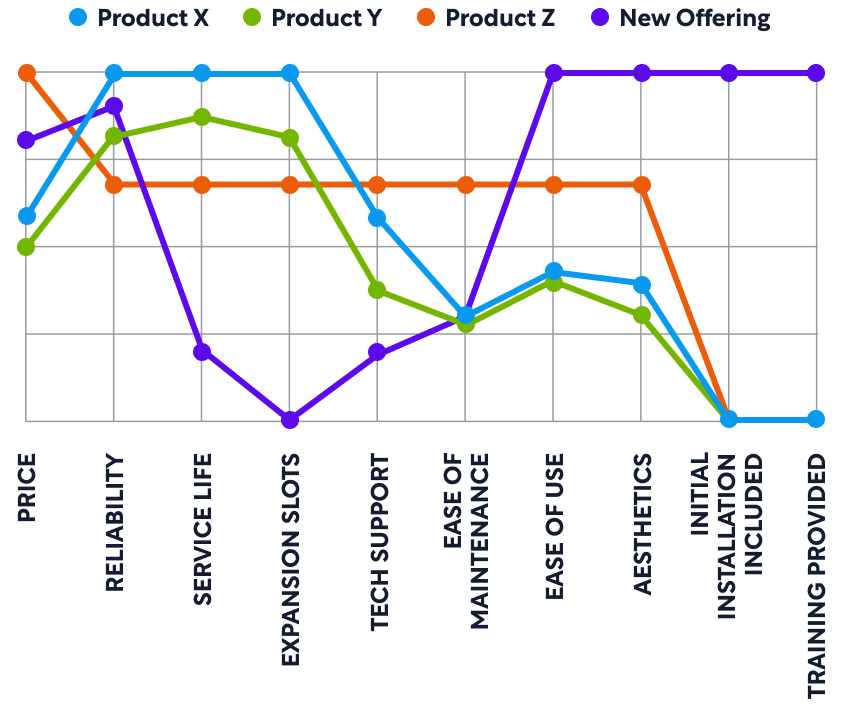
Kim and Mauborgne point out that if your product’s path closely follows another product (like Product X and Product Y in our example graph) then you’re not providing unique value. You want your strategy curve to diverge significantly from every other company’s.
While they both offer unique insights, there are many similarities between Blue Ocean Strategy and the innovation strategy presented in the Ten Types of Innovation. Both emphasize breadth of innovation across a variety of factors as the key to creating an adequately differentiated (or sufficiently innovative) product. There is also considerable overlap in the factors that they consider. For example, Kim and Mauborgne’s advice to identify complementary products mirrors Keeley et al.’s advice to consider interfacing product innovations.
Zero to One
In Zero to One, Peter Thiel echoes Kim and Mauborgne’s assertion that innovation is the key to avoiding direct competition, which is the key to growth and profit. He argues that first-of-a-kind products create de facto monopolies, which are not only good for your company, but also have the potential to benefit society. Thiel says you need five things to successfully launch a disruptive innovation startup:
- Revolutionary technology or opportunity: Making an incremental improvement to an existing technology is generally not a great opportunity. You need a breakthrough that provides fundamentally new capabilities, or, at the very least, increases existing capabilities by a factor of 10. You also need to be the only one pursuing it. Otherwise, competition will consume all your profits.
- Strategic timing: Even if you’re the first to invent a revolutionary technology, there needs to be widespread interest in solving a problem that the technology can solve for it to be a commercial success.
- A great team: For an innovative business venture to succeed, you need managers and employees who are motivated and unified by the venture’s unique mission. Thiel advises that you choose people whose technical and interpersonal skills complement each other, establish clearly defined roles and responsibilities, and don’t overpay your CEO.
- Effective distribution: Planning how to market and distribute your product is an integral part of designing it. For your venture to be viable, the cost of acquiring a customer (through advertising or other means) must be less than the total profits you’ll make from that customer—ideally no more than 30% of it.
- Enduring value: You need to be the first to introduce your product in order to build a monopoly that will generate long-term profits, but moving first is just a means to an end, not an end in itself. Your product must be something that people will still want to buy in years to come and that’s difficult for other companies to copy.
The idea that innovation projects must be truly innovative to succeed features prominently in Thiel’s criteria for a successful venture, since he stipulates that your product must use revolutionary technology and provide enduring value. But by stipulating that you also need a great team and effective distribution, he also highlights the importance of sound business practices for innovation projects. This is something that most authors at least touch on, and some see business management errors as the primary reason innovation projects fail, as we’ll discuss more fully in the next section.
That said, other authors, such as Keeley, identify even these areas of business management as opportunities for innovation: For example, a unique distribution method that makes your product easier to buy and a unique team structure that gives your company a competitive edge meet Keeley’s definitions of distribution innovation and organizational innovation, respectively.
2. Problematic Market Dynamics
Some experts have sought to explain why so many innovation projects fail by examining market mechanisms that work against innovators. Geoffrey Moore’s Crossing the Chasm and Clayton Christensen’s The Innovator’s Dilemma offer two such explanations.
Crossing the Chasm
Moore primarily addresses the challenges that would face a small startup company that has already made some kind of technological breakthrough and is looking to turn its breakthrough into a commercially viable product. He notes that this is hard to do because of the psychographics (the combination of psychology and demographics that determines customers’ purchasing behavior) of mainstream market customers.
Moore explains that as a new technology matures, different psychographic categories of customers adopt it at different stages of maturity and for different reasons. When you introduce an innovative technology, your first customers buy it either because they just love to try out new technology or they hope to gain a strategic advantage for their own business by adopting the technology early. These customers make up what Moore calls the “early market,” and they only represent about a sixth of the total market population.
The mainstream market (the other five-sixths of your potential customers) is made up of people who are more risk-averse. They prefer to buy products only from companies who’ve established their credibility as market leaders. They typically won’t buy a new product until they see other people using it and benefiting from it. And they generally don’t count your early-market customers as credible reviewers—they want to see other mainstream customers vouching for it before they buy. So mainstream customers won’t buy your product until other mainstream customers have already bought it and found it useful.
Moore calls this catch-22 the “chasm” between the early market and the mainstream market. Many innovative products enjoy brief success in the early market, but once the early market is saturated, sales stagnate or drop off. They end up failing because they can’t get past the chasm and break into the mainstream market.
Getting Past the Chasm
How can you get an innovative product past the chasm and into the mainstream market? Moore’s strategy consists of focusing your effort on becoming the market leader in a very specific niche of the mainstream market. You do this by rolling out a version of your product that’s exquisitely tailored to the needs of that particular niche.
This works because a small but enthusiastic market can amplify your marketing. Word of mouth spreads quickly through a niche market: If just a few customers are impressed with your product, everyone will hear about it (whereas in a large market, their voices can get lost in the crowd). This makes it possible to build a reputation for your product and start attracting other mainstream customers: When the niche market saturates, you’ve established your credibility and you can roll out other versions to appeal to other niches. In this way, you can take over the mainstream market one sector at a time.
The Innovator’s Dilemma
While Moore aims his advice at small startups (though his strategy for crossing the chasm is applicable to any company introducing an innovative product), Christensen primarily addresses established companies.
He observes that large companies often struggle with developing innovative products, especially disruptive innovations, despite the fact that they have more resources than startups do. He argues that this is because established companies, operating in large markets and needing large volumes of sales to survive, generally focus on pleasing their existing customers. They don’t seek out alternative customers and smaller markets because these groups are initially too small to provide the volume of sales they need. But disruptive innovations almost always start out in small markets, appealing to different customers than tried-and-true products do. Thus larger companies, which aren’t incentivized to pursue small markets, end up missing or ignoring opportunities that smaller companies more readily pick up on.
Christensen’s observations corroborate Moore’s, since both an early market and a niche mainstream market are small. And the fact that existing customers Christensen describes are rarely interested in disruptive innovations reflects the same risk-averse mentality in mainstream customers that Moore discusses.
Christensen also notes another reason established companies struggle with innovation: In most cases, producing a disruptive innovation requires a complete set of production tools and a new network of suppliers and distributors. This comes naturally to a startup, but it’s hard for an established company to justify the cost of retooling its production lines and overhauling its network of suppliers.
Resolving the Dilemma
Given the obstacles to innovation that large companies face, Christensen recommends that you manage every innovation project as a small startup, even if it’s wholly owned by a large company. You can do this either by creating a spin-off organization within the company or by acquiring an existing startup.
Either way, Christensen stresses that the new organization must have adequate autonomy to explore and develop disruptive innovations. It will struggle if it has to compete for resources with the company’s other projects, including those focused on sustaining innovations. It may also need to develop supply chains and operating procedures that are incompatible with those of the parent company.
Christensen also stresses the importance of budgeting for multiple attempts at marketing the disruptive innovation. You may have to explore several different applications or niche markets before you find one where the product takes off. This is because disruptive innovations create new markets, and markets that don’t exist yet are impossible to accurately forecast.
3. Inadequate or Inappropriate Project Management
Finally, some experts argue that the primary reason innovation projects fail is that they aren’t managed correctly. Innovation projects present unique challenges when it comes to project management. After all, innovation involves overturning conventions and doing things that have never been done before. How can you plan, schedule, budget, and manage tasks that don’t follow conventions or past precedents? In this section, we’ll discuss how different authors recommend managing innovation projects.
The Lean Startup
In The Lean Startup, Eric Ries points out that the biggest challenge in managing an innovation project (especially one that takes the form of a new startup company) is the uncertainty involved in doing something new. His strategy for overcoming this challenge is basically an adaptation of the scientific method, which he uses to gather data that eliminates uncertainties as efficiently as possible.
First, formulate a hypothesis. What do you believe about your product or your customers that’s vital to your business? Then, build the minimal product necessary to test your hypothesis. Observe the behavior of your prototype or of users who interact with it. Then analyze the data and reflect—how far off was your hypothesis? What do you need to change about your strategy? Should you actually change your entire direction? Based on your conclusions, update your hypothesis or create a new one and repeat the process.
The faster you move through this loop, the faster you’ll learn and the sooner you’ll have enough information to plan and achieve success. (And the less likely the project will be to fail due to financial backers pulling out because they’re not seeing their investment pay off.)
Minimum Viable Products
Ries discusses several types of MVPs (Minimum Viable Products or prototypes) that you can use to test your hypotheses as quickly as possible.
- Landing page MVP: Create a web page describing the features of the product, before a product actually exists. Track clicks and attempted downloads to gauge how much users want it.
- Video MVP: Make a video simulating what the product does. Even without using the actual product, watching the video will give enough info for viewers to decide whether they want the product shown.
- Concierge MVP: Instead of building processes that scale, run manual processes dependent on special white-glove treatment. Often the founders themselves deliver the service. This accelerates learning and allows quick iteration on the product.
- Wizard of Oz MVP: If you plan to build fancy automated technology, try to test it with a human behind the scenes. The human performs the service that the technology does, and the user is none the wiser.
Applying Knowledge to Maneuver for Success
Ries also describes a number of corrective maneuvers, or “pivots” that you may want to make as you learn more about what your customers want by testing iterative hypotheses.
- Zoom-in pivot: Customers like a specific feature of your product. You can pivot so your product now focuses entirely on delivering this feature.
- Customer need pivot: You know your customers well, and the problem you’re solving for them is not very important. You might pivot to target a new customer need, which may entail an entirely new product.
- Business architecture pivot: You might pivot to change between two types of businesses: high margin and low volume, or low margin and high volume. This roughly correlates to a business-to-business (B2B) model, or a business-to-consumer (B2C) model.
- Technology pivot: You’re trying to solve the right problem for the right market, but can do it better (improve performance, reduce cost, or both) by using different technology in your product.
101 Design Methods
In 101 Design Methods, Vijay Kumar argues the first step to building a company that can consistently innovate successfully is to believe that it’s possible to plan and manage innovation projects. If you don’t believe that, you’ll probably end up either shying away from innovation projects entirely or letting them run without enough structure to make them successful.
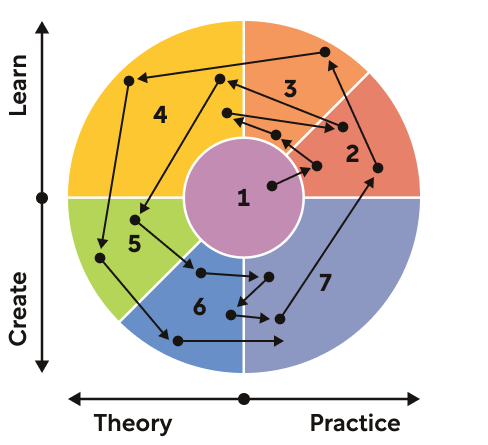
His approach to managing innovation consists of breaking down the innovation process into seven standard tasks that you can plan, schedule, and manage without sacrificing the flexibility that you need on innovation projects:
- Get a clear view of the big picture. Establish the general direction and goals of the project.
- Research your operating environment. Identify your unknowns and plan out how to get the information you need.
- Research your stakeholders. Make sure you understand their motivations and pain points.
- Distill the information you gathered in tasks 2 and 3 into broadly applicable principles that can guide your decision-making.
- Brainstorm ideas that could make up parts of the solution. Relating this to the authors’ 10 types of innovation, each idea would probably be a way to implement one of the 10 types.
- Determine the combination of ideas from task 5 that gives you the best complete solution. This is where you would combine several types of innovation as the authors recommend.
- Create a detailed plan for implementing the final solution, including things like budgets, timelines, and marketing tactics.
While the seven tasks follow a logical progression, understand that sometimes you have to revisit earlier tasks later in the project or cycle through multiple iterations of the whole sequence. As your team completes each task, take stock of the project and decide which task you need to do next. Then plan out how you’ll do the next task (including applicable schedules, budgets, and so forth).
Kumar suggests you keep track of where your project has been and where it’s going using a graphic map that shows the seven tasks and charts your path through them. The map also shows a pair of axes indicating how the focus of the different tasks varies from theoretical to practical and from learning about what already exists to creating new things. Here’s an adaptation of Kumar’s innovation task map, showing a project where you revisited task 2 after first doing task 4, revisited task 6 after first doing task 7, and end up doing two iterations of the full sequence of tasks:
It’s worth noting that while Kumar’s approach to innovation project management is different from Ries’s, the two are not mutually exclusive. On the contrary, Kumar strongly recommends using prototypes for learning and evaluation purposes during tasks 5, 6, and 7. Furthermore, his discussion of prototyping parallels Ries’s description of MVPs in his emphasis on building only what you need for the task and prototyping your solutions as early as possible.
Want to learn the rest of The Master Guides: Business Innovation in 21 minutes?
Unlock the full book summary of The Master Guides: Business Innovation by signing up for Shortform .
Shortform summaries help you learn 10x faster by:
- Being 100% comprehensive: you learn the most important points in the book
- Cutting out the fluff: you don't spend your time wondering what the author's point is.
- Interactive exercises: apply the book's ideas to your own life with our educators' guidance.
Here's a preview of the rest of Shortform's The Master Guides: Business Innovation PDF summary: