

PDF Summary:TED Talks Storytelling, by Akash Karia
Book Summary: Learn the key points in minutes.
Below is a preview of the Shortform book summary of TED Talks Storytelling by Akash Karia. Read the full comprehensive summary at Shortform.
1-Page PDF Summary of TED Talks Storytelling
Imagine giving a dull speech to an unengaged audience. Their shoulders sag and their eyes are glassy. Some sneak glances at their phones, and others whisper to their neighbors or clamp their mouths shut to hide their yawns. Next, picture the opposite: Audience members perched on the edges of their seats, faces bright, and eyes locked on your every pause, gesture, and word. What’s the one thing you can do to ensure that any speech you give results in this second scenario?
In TED Talks Storytelling, public speaking coach Akash Karia insists that storytelling is the key. In this guide, we’ll share his techniques for starting every speech with a captivating story: You’ll learn how to choose a story, tell it well, and leave your audience with a memorable message. We’ll also explore the brain science behind various storytelling techniques and supplement Karia’s insights with advice from other experts.
(continued)...
(Shortform example: Continuing the earlier example, your speech might describe how shortly after the grant proposal rejections, a new issue came along: One of your organization’s clients faced a crisis in her personal life. However, your team did an excellent job rallying to provide support for her. This was the turning point, and the lesson you came away with was this: Your team had many strengths—and they needed to be reminded of those strengths to regain their confidence so they’d have renewed motivation to examine their work for improvement.)
Element 3: The Transformation
Finally, Karia explains that following the turning point, one or more characters must overcome the conflict by applying the positive lesson. As a result, a positive transformation occurs: either the character changes or their situation changes. This transformation shows that following the lesson had positive consequences—and it demonstrates that if the speech’s audience applies the same lesson in their lives, they, too, will experience success.
(Shortform example: In your speech to nonprofit leaders, you could describe how you shared your reflections on your team’s handling of the crisis at a meeting. Recognizing their strengths significantly improved morale on the team, and you continued facilitating weekly meetings to continue this reflection on the team’s strengths and areas of growth. As a result, you and your team underwent a transformation: The team became more cohesive, and they identified several concrete goals for improving the agency. You began to feel confident that the team could meet those goals, and you continued using a “strengths-based approach” to motivate their progress.)
Elements to Include in—or Leave Out of—Your Speech
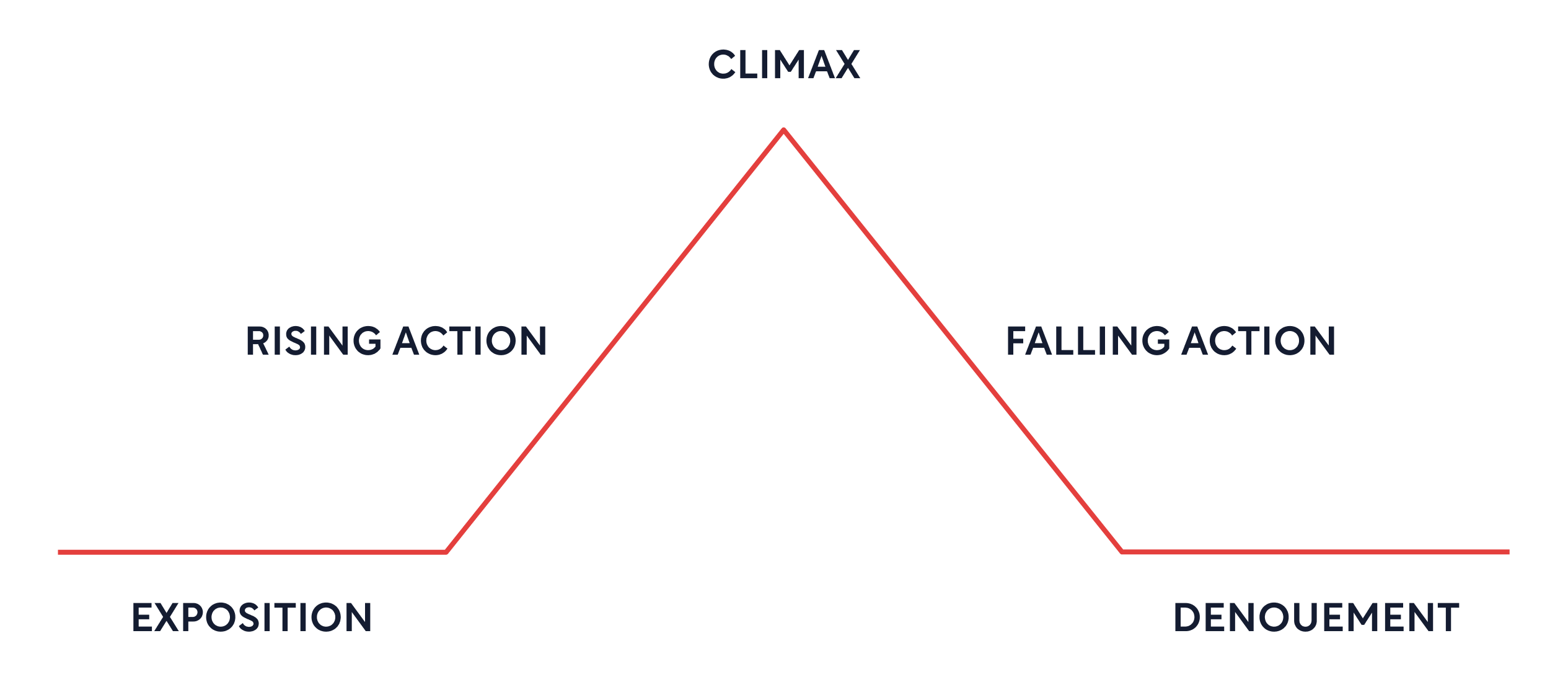
The three elements that Karia describes are included in Freytag’s Pyramid, writer Gustav Freytag’s well-known model for narrative structure. It depicts a story’s structure as a pyramid divided into five sequential stages:
The exposition is the beginning of the story (the bottom left corner of the pyramid). It’s when you introduce the listener or reader to the setting, characters, and problem.
The rising action is when you intensify the story’s problem, such as by making it increasingly unclear which of the two forces or values will win. This stage is represented by the pyramid’s rising edge. (While Karia doesn’t explicitly recommend including rising action in your speech’s story, doing so could arguably make your story even more engaging.)
The climax is the turning point—the pyramid’s peak—where the problem either starts to be solved or it becomes clear it won’t be solved. (Karia specifically recommends telling stories in which the problem does get solved, since such stories leave readers with an inspiring lesson they can apply in their own lives.)
During the falling action, a story approaches its conclusion, and it’s represented by the pyramid’s descending edge. Freytag specifies that particularly successful stories build suspense during the falling action by introducing the possibility that the conclusion will be unexpected. (Adding this type of falling action to your speech may make it even more exciting for listeners.)
The denouement is the final stage of the story (the bottom right of the pyramid). The problem is either resolved or left unresolved. (Karia would likely say that the denouement is when it becomes clear that the character or characters have undergone a positive transformation.)
However, you may not need to follow Karia’s three-element model or Freytag’s five-stage Pyramid to deliver an engaging speech that leaves your audience with a positive lesson. Another option is to tell a brief parable. Even a parable that lacks some or most of the above elements can be effective.
For example, David Foster Wallace’s “This Is Water” speech—which Time magazine ranks among its top 10 commencement speeches—begins with a parable about fish. Two young fish pass by an older fish who greets them and asks them how the water is. After the fish part ways, one of the young fish turns to the other and asks what water is.
Wallace uses this parable to convey one of his main positive lessons for graduates: that you should aspire to become aware of the invisible “water” that surrounds you—the beliefs and biases that shape your reality—so you can challenge your default way of thinking. Even though his story lacks a clear problem, turning point, and solution, it’s still a memorable and engaging way to convey the lesson.
Step 2: Tell Your Story in an Engaging Way
After you’ve decided what story to tell—one from your life that has a lesson—it’s time to figure out how to tell it. We’ve organized Karia’s insights on this into six tips.
Tip 1: Start Your Speech With the Story
First, Karia contends that you should start your speech with the story. He explains that if you don’t capture your audience’s attention in the first 30 seconds of your speech, they’ll pay little attention to the rest of it. Because stories are naturally engaging, they’re the best way to grab your audience’s attention within that window. Listeners often expect speeches to be dull and straightforward, so beginning with an engaging story will also set your speech apart.
(Shortform note: Starting your speech with a story may not be enough to grab your audience’s attention in the first 30 seconds. According to one communication expert, you need to deliver your speech naturally in that first half minute. Avoid memorizing the words of your speech, as this can result in a scripted, dry delivery. Instead, make your speech more conversational and engaging by memorizing the ideas you plan to discuss. For example, memorize your story’s problem, turning point, and transformation, while trusting that your knowledge of the story’s other details will bring it to life when you’re in front of your audience.)
Tip 2: Include Sensory Details
Karia says that you can make your story particularly compelling by including sensory details—ones that appeal to the five senses. Doing so helps your listeners imagine the story, which makes it more interesting and memorable.
(Shortform note: An alternative to including sensory details in verbal form is enhancing your presentation with actual sensory details, such as video, images, or props. In Talk Like TED, communication coach Carmine Gallo cites research suggesting that multisensory experiences (such as listening and looking) are more memorable than single-sense experiences (such as only listening). For example, if you’re making a sales pitch, consider playing a video of customers’ verbal testimonials or passing around a physical model of your product while describing its features.)
Tip 3: Include Specific Details
In addition to enriching your story with sensory details, include details that are highly specific. Karia explains that this makes your story more believable. For example, say you’re describing an experience in which you were lost in the woods. Make it vivid and believable by describing your pounding heart and the seemingly endless tangle of trees.
(Shortform note: In Unleash the Power of Storytelling, speechwriter Rob Biesenbach agrees that sensory details enhance your story—but he warns that you should use detail judiciously. Extraneous details detract from your message and mute the impact of your story. It’s wise to set the scene of your story with a specific time or place, but it would be unnecessary—and distracting—to include specific details, numbers, and proper names. For instance, listeners probably wouldn’t need to know the name of the forest where you got lost.)
Tip 4: Use Dialogue
If your story includes a conversation between characters, Karia says you should represent those conversations using dialogue rather than narration. In other words, speak as your characters instead of summarizing what they said. One reason is that dialogue gives you an opportunity to change your vocal quality, such as by altering the volume or pitch of your voice to represent a character’s tone and personality. This vocal variety makes your speech more engaging.
(Shortform note: If your story doesn’t include conversations between characters, or if you worry your poor acting skills could distract from rather than reinforce your speech’s lesson, you can still use vocal variety to engage your audience. In addition to varying your volume and pitch, you can make your story more captivating by alternating between a fast and slow pace, emphasizing important words, and occasionally pausing to add drama.)
Tip 5: State the Lesson
As we’ve discussed, the story you share should have a lesson. However, don’t leave it up to your listeners to infer the lesson of your story. Instead, end your story by stating the lesson directly and concisely. This ensures that your listeners walk away with the message you intended to deliver.
(Shortform note: If your speech is about persuading your audience members to do something, it may not be enough to simply end your story or speech with a lesson. Instead, consider following writing expert Barbara Minto’s advice to conclude with a call to action: Identify a specific action you’d like your listeners to take, and describe why it’s important. For example, if you want your audience to support a local food bank, don’t just conclude by saying hunger is a serious problem that needs solving. Instead, ask audience members to donate canned goods, volunteer an hour of their time, or donate money before they leave.)
Tip 6: Analyze the Words of Master Speakers
So far, we’ve covered five of Karia’s tips for telling your story in a compelling way—however, these aren’t the only tips out there. He recommends listening to speeches that feature stories, analyzing the techniques those speakers use, and noting the effect those techniques have on you. He explains that this is an effective way to learn new techniques for storytelling.
(Shortform note: Where can you find speeches to analyze? The TED Archive is a good starting place, as it shares a collection of every TED Talk that’s been given since 1984. Consider sorting their archive by popularity so you can begin with speeches that are well-known for their effectiveness. Additionally, consider analyzing some of the top speeches that have shaped history—talks that have stood the test of time.)
Want to learn the rest of TED Talks Storytelling in 21 minutes?
Unlock the full book summary of TED Talks Storytelling by signing up for Shortform .
Shortform summaries help you learn 10x faster by:
- Being 100% comprehensive: you learn the most important points in the book
- Cutting out the fluff: you don't spend your time wondering what the author's point is.
- Interactive exercises: apply the book's ideas to your own life with our educators' guidance.
Here's a preview of the rest of Shortform's TED Talks Storytelling PDF summary: