Headway promises to help you absorb key ideas from bestselling nonfiction books in just 15 minutes a day. The best Headway app review is one that arises from real experience with the platform’s core purpose in mind. To see whether it delivers on its promise, I spent seven days testing the app as my primary learning tool.
I read summaries, listened to audio versions, experimented with the app’s learning features, and compared several summaries against books I’d already read. What I found was an app that’s relatively good at making learning feel easy and accessible—but one that sometimes struggles to provide the depth and understanding that many nonfiction readers are ultimately looking for. Continue reading my honest Headway app review to discover why that is.
Table of Contents
Headway App Review: Pros and Cons
| Pros | Cons |
| Clean, modern interface | Summaries often oversimplify complex books |
| Easy to use for beginners | Limited depth and context |
| Strong audiobook support | Many nuanced ideas are condensed or omitted |
| Personalized recommendations | Learning tools focus more on engagement than comprehension |
| Effective habit-building features | Limited opportunities for deeper exploration |
| Offline access | Serious readers may outgrow the platform quickly |
How I Tested Headway Day by Day
To review the Headway app, I needed to test the app myself and dedicate plenty of time to it. Since Headway offers a seven-day free trial, I spent a full week testing the app to evaluate both its content and overall learning experience.
Day 1: Setup and Onboarding
I created an account, completed the onboarding questionnaire, and explored Headway’s recommendations system. I wanted to see whether the app could accurately identify my interests and suggest relevant books.
Day 2: Reading Text Summaries
I read several summaries across psychology, business, and productivity categories. My goal was to evaluate readability, depth, and whether key concepts felt complete.
Day 3: Testing Audio Summaries
I listened to multiple audio versions while commuting and exercising. This helped me assess narration quality, pacing, and information retention.
Day 4: Comparing Summaries to Source Material
I compared selected Headway summaries with books I’d previously read. I looked for missing context, omitted examples, and whether major arguments were accurately represented.
Day 5: Exploring Learning Features
I tested flashcards, insights, streaks, achievements, and other engagement tools designed to reinforce learning.
Day 6: Long-Term Retention Test
I revisited book summaries I had read earlier in the week to see how much information I actually remembered without reviewing.
Day 7: Daily Use Evaluation
On the final day of my Headway review, I used the app as a typical subscriber might: opening it for a quick learning session and consuming recommended content.
Headway’s Summaries
I read four book guides across different categories to test Headway’s summaries:
- The Mountain Is You—Self-Growth
- I Am Malala—Biography
- How Brands Grow—Business
- Attached—Relationships
Content Quality
The library size is relatively small compared to other book summary apps, with about 2,500+ titles. Each summary is available in six languages: English, Spanish, German, French, Italian, and Portuguese.
After reading summaries across four categories, I came away with mixed feelings about Headway’s content quality. On one hand, the summaries are approachable. They move quickly, avoid jargon, and make it easy to grasp the central idea of a book in a matter of minutes. If your goal is simply to understand what a book is about before deciding whether to read it, Headway does a good job.
Where I started to notice limitations was when I compared summaries to books I had already read, such as The Mountain Is You by Brianna Wiest. Headway’s summaries frequently felt as though they were focused on delivering conclusions rather than explaining how authors arrived at those conclusions. This isn’t very helpful for self-help books, where readers often use them as a guide to reach their best self. Personally, if I’m going to trust an author’s word that a framework will improve my self-confidence or relationships, I want to know if and why that framework will actually work. Supporting evidence, case studies, and nuanced arguments were often condensed or removed entirely.
In books that rely heavily on storytelling or detailed examples, such as I Am Malala, this wasn’t a major issue. In books built around complex frameworks or layered arguments, however, the missing context sometimes made the summaries feel incomplete. By the end of my testing, I often felt as though I had learned the highlights of a book rather than truly understood it.
Accuracy
In terms of factual accuracy, I rarely encountered information that seemed outright wrong. Headway generally succeeds at capturing the core message and major takeaways of a book. Readers looking for a quick overview can feel reasonably confident that they’re getting an accurate representation of the author’s main points.
That said, compression creates its own form of inaccuracy. As I said before, certain ideas lost important qualifications or context during the editing process. The summaries typically preserved the destination but not always the journey.
As a result, some frameworks appeared more universally applicable than the authors intended, while certain counterarguments and limitations disappeared altogether. I wouldn’t describe these summaries as misleading, but I do think readers should recognize that brevity inevitably comes with tradeoffs.
Retention and Learning
This was the area I was most interested in evaluating during my test. Headway positions itself as a tool for learning, not just consuming content, so I wanted to see how much information I actually remembered after several days of use. To test this, I revisited summaries I had completed earlier in the week and tried recalling key concepts without reviewing them first.
My experience was that Headway made information easy to consume but not necessarily easy to retain. Immediately after finishing a summary, I usually felt as though I understood the book’s main ideas. A few days later, however, I often found that I remembered individual insights rather than the larger framework connecting those insights together. I suspect this is partly because many summaries remove the stories, examples, and detailed explanations that help concepts stick in long-term memory. For someone with such a busy work life, I would prefer a tool that could help me retain information, not just another thing I’ll forget on top of everything else on my to-do list.
The app’s flashcards and review tools certainly help reinforce learning, but they often focus on isolated facts and takeaways rather than deeper comprehension. By the end of the week, I felt more exposed to ideas than educated by them, which is an important distinction for readers whose primary goal is genuine learning.
Are you looking for comprehensive guides to the above books I tested? Shortform has you covered:
Key Features of the App
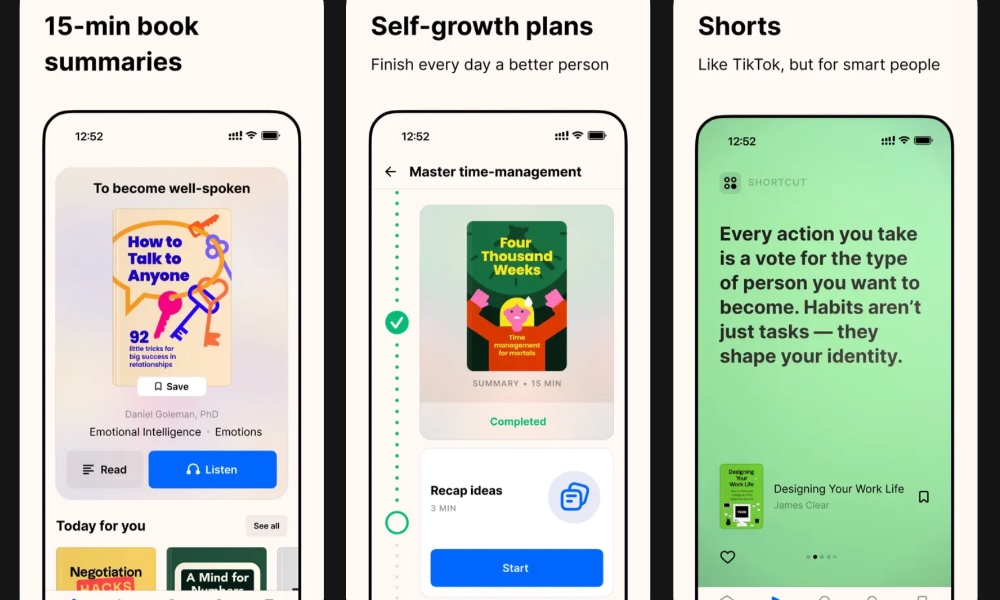
Headway offers several key features for subscribers. Let’s dig into the biggest ones and see if they’re worth your money.
15-Minute Book Summaries
The 15-minute book summaries are Headway’s core feature and the primary reason most people subscribe. The summaries are concise and approachable. For busy professionals, they provide a fast introduction to popular nonfiction books.
The downside is that the 15-minute format often prioritizes brevity over depth. Many books simply contain more complexity than can be meaningfully captured in such a short format.
Audio Summaries
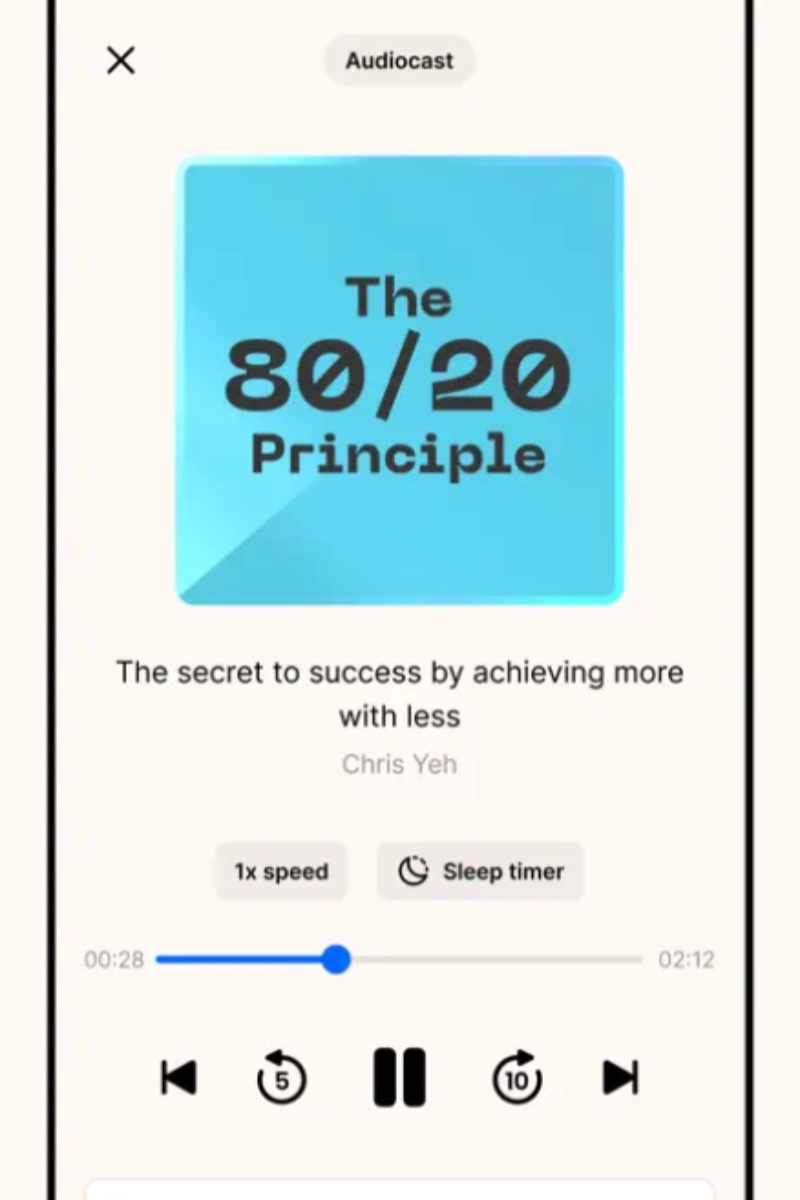
The audio experience is what should be expected of any app that you pay for: polished and convenient. Narration quality is generally strong, and listening while commuting or exercising works well.
Shorts
Inspired by TikTok and Instagram Reels, Headway’s Shorts feature delivers bite-sized lessons that can be consumed in just a few minutes. I found them useful for discovering new ideas and filling spare moments throughout the day.
However, because they’re even shorter than the app’s standard summaries, they often sacrifice context and nuance. They’re best viewed as introductions to concepts rather than deep learning experiences.
Growth Plan and Personalized Recommendations
The Growth Plan feature creates personalized reading recommendations based on your interests and goals. During onboarding, Headway asks what areas you’d like to improve and then suggests books and content accordingly.
I appreciated how thorough the setup process was, though it was very long. About halfway through, I wanted to skip over the process entirely and jump straight into the app, but there’s no option for that. The feature also felt more like a recommendation engine than a structured learning plan. It’s helpful for discovering books—but less effective for developing expertise in a subject.
Gamification and Habit Building
Streaks, achievements, challenges, and progress tracking are central parts of the Headway experience. These features are effective at encouraging regular app usage. The question is whether they encourage learning or simply engagement.
At times, the experience feels designed to maximize consistency and completion rather than comprehension. It was also very overwhelming to use the app sometimes because there was so much emphasis on completing streaks and reaching daily goals.
Visual Learning Tools
Headway incorporates illustrations, visual cards, and infographic-style content throughout the app. These visuals make summaries more engaging and can help communicate simple concepts quickly. However, they are less effective for explaining complex frameworks that require detailed discussion.
Offline Access and Cross-Platform Support
Headway performs well here. Offline downloads are easy to use, and the experience remains consistent across devices. This is a practical feature that frequent travelers and commuters will appreciate.
User Experience and Interface
At first glance, Headway’s interface is modern, polished, and visually appealing. The app uses bright colors, large graphics, achievement badges, daily challenges, personalized recommendations, and progress trackers to create an engaging experience. During my first few days of testing, however, I found that the sheer number of elements competing for my attention could feel overwhelming.
Rather than directing me toward a single book or learning path, the home screen often presented multiple calls to action at once. I was encouraged to start a challenge, continue a streak, explore recommended titles, complete a daily goal, and review insights I had previously saved. While these features are clearly intended to increase engagement, they occasionally make the experience feel more like navigating a content-consumption platform than focusing on a book.
I also found that the visual design sometimes emphasized engagement over learning. Because there are so many prompts encouraging users to consume additional content (such as bite-sized videos in Shorts), it can be easy to move quickly from one summary to another without spending much time reflecting on what you’ve already read. Readers who enjoy highly gamified experiences might appreciate this approach, but those looking for a more focused and distraction-free learning environment might not enjoy the busy interface.
Pricing
One thing I didn’t particularly enjoy was that you have to go through the entire onboarding process before the subscription plans and prices are available. This is a big turn-off for anyone who wants to make a decision before committing.
Headway’s pricing:
- Free plan: Includes access to one book summary per day
- Monthly plan: $12.99/month
- Quarterly plan: $29.99 every three months (~$10/month)
- Annual plan: $89.99/year (~$7.50/month)
Headway vs. Shortform: Which Book Summary App Is Better?
Shortform is one of Headway’s biggest competitors that offers nonfiction book guides, podcast guides, and articles. After spending a week testing Headway and comparing it to my experience with other book summary platforms, I found that the two apps serve different audiences. One prioritizes speed, convenience, and habit-building, while the other prioritizes comprehension, critical thinking, and long-term learning.
If your goal is to discover new books, collect useful insights, and build a daily reading habit, you’ll probably prefer Headway. The app is optimized for speed, convenience, and accessibility. It’s easy to use and easy to stick with.
If your goal is to truly understand books and ideas, you’ll probably prefer Shortform. The app approaches the concept of book summaries very differently. Rather than condensing books into quick takeaways, it provides comprehensive guides that include detailed explanations, concrete examples, practical exercises, and insightful commentary. On top of a simple, yet attractive interface, the experience creates a much deeper understanding of the material.
For casual readers, Headway might be enough. For serious learners, professionals, students, and lifelong readers who want more than surface-level knowledge, Shortform is likely the better investment.
In sum, the fundamental difference between the two apps can be demonstrated by the primary questions they each answer:
- Headway: “What are the book’s main ideas?”
- Shortform: “Why do the book’s ideas matter, how do they work, and how can I apply them?”
👉 Check out our full comparison guide between Headway and Shortform.
Final Verdict
After spending a week with Headway, I understand why the app has become so popular. It’s polished, easy to use, and genuinely succeeds at making nonfiction ideas more accessible.
At the same time, my testing repeatedly revealed the same limitation: depth. This is really the crux of my Headway app review. The more complex the book, the more noticeable the tradeoffs became. Headway works at helping users consume information quickly, but I was often left wanting more context, more explanation, and more opportunities to engage with the material beyond its surface-level takeaways. If your goal is to deeply understand and apply the concepts found in great nonfiction books, you’ll likely find the app limiting over time.
👉 Want to test Shortform for yourself? Sign up for a five-day free trial.

KD
Many thanks for your Headway analysis / review .
BUM