
Psychological validation is making someone feel genuinely seen and accepted. It’s one of the most powerful tools in human connection, but many people use the word without fully understanding what it entails.
Drawing primarily on the work of Stanford clinical psychologist Dr. Caroline Fleck, I unpack the precise meaning of validation and why sincerity could be a necessary ingredient. Read on to learn what the word has meant over the centuries and how psychologists use it today.
Table of Contents
The Meaning of Psychological Validation
You’ve probably heard of validation, but do you know what it actually means? What is validation in a psychological context? Dr. Caroline Fleck is an Adjunct Clinical Instructor at Stanford University and a clinical psychologist with expertise in this area. In her 2025 book Validation, she defines validation as a way of responding to people that makes them feel seen and accepted. When you validate someone, you’re doing at least one of three things:
- being fully present for them
- legitimizing something about their experience
- offering support
I personally feel validated when someone assures me that I’m not imagining things—and that I’m not alone. That can be simple, but it’s powerful.
I’m a word nerd, so I was interested in understanding the term better. I’ve read about psychological validation in several of our book guides here at Shortform, but Dr. Fleck is the first one to provide a specific definition. She writes that we bandy the word about in popular culture but rarely define it precisely. As a result, most people don’t understand what psychological validation is or how powerful it can be.
The Definition of Validation Has Evolved
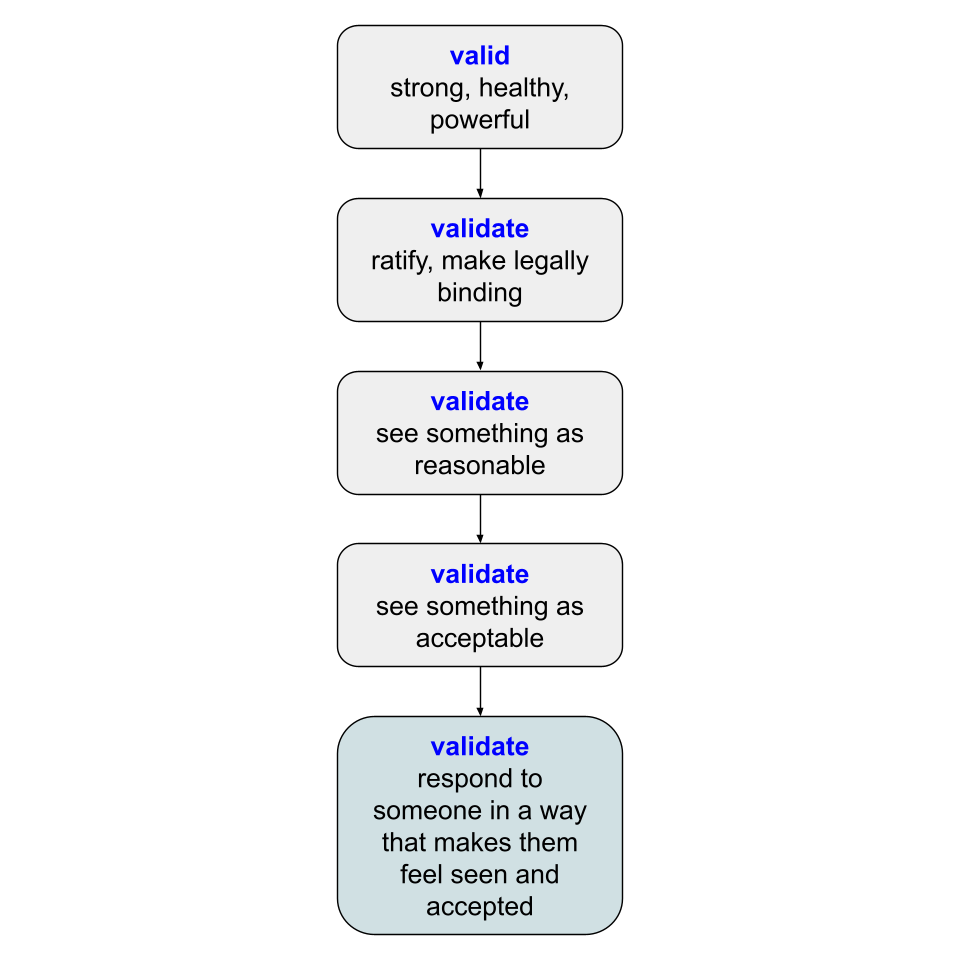
Dictionaries don’t define words; they identify the way people use words. The meaning of validation has evolved over the years; it’s a victim of what linguists call semantic drift. This is when a word with a specific meaning becomes popular and gets used in ways that don’t reflect that meaning. Some note that we often say things are “valid” to indicate that we see them as acceptable, but validating something used to mean that we see it as reasonable. This isn’t the first time we’ve changed the way we use the verb “validate.” When the word first came about in medieval times, it meant to ratify or to make legally binding. Before that, the root word “valid” (adjective) simply meant strong, healthy, or powerful.
What Validation Isn’t: Manipulation
Dr. Fleck argues that, by definition, psychological validation is genuine. She contends that insincere efforts aren’t validation; they’re manipulation. If you merely pretend to be present for, legitimize, or support someone, they’ll probably pick up on the pretense, and they won’t feel seen or accepted; they won’t be validated. Even if they do fall for disingenuous validation that’s intended to gain their compliance or approval, they won’t be validated—they’ll be manipulated. According to Fleck, this distinction means that you can’t validate things you don’t truly see the validity in.
(Shortform note: Can people really tell when validation is insincere? In my experience and observation, sometimes this happens only in hindsight. Research shows that we pick up on deception only about half the time, which suggests that we all could be vulnerable to manipulation by way of disingenuous validation. In fact, insincere validation might be one of the most powerful tools of manipulation since it encourages people to open up and be vulnerable. In The 48 Laws of Power, Robert Greene asserts this is a reliable way to gain power over them.)
Explore Psychological Validation Further
Whether you’re navigating a difficult conversation at work, supporting a loved one through hardship, or simply trying to be a better communicator, understanding what psychological validation is can improve the way you relate to others. I hope that, like me, you now have a better understanding of what psychological validation is. To learn why it’s important and how to put it into practice, I encourage you to check out Shortform’s guide to Dr. Fleck’s book Validation.
