 1
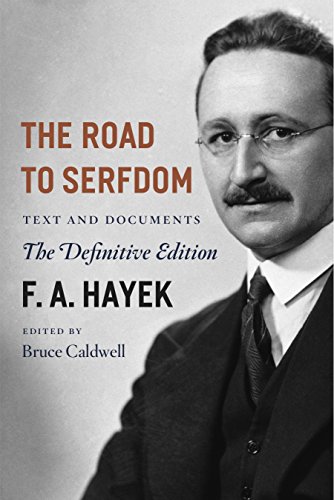
1The Road to Serfdom: Text and Documents--The Definitive Edition
First published by the University of Chicago Press on September 18, 1944, The Road to Serfdom garnered immediate, widespread attention. The first printing of 2,000 copies was exhausted instantly, and within six months more than 30,000 books were sold. In April 1945, Reader’s Digest published a condensed version of the book, and soon thereafter the Book-of-the-Month Club distributed this edition to more than 600,000 readers. A perennial best seller, the book has sold 400,000 copies in the United States alone and has been translated into more than twenty languages, along the way becoming one of the most important and influential books of the century.
With this new edition, The Road to Serfdom takes its place in the series The Collected Works of F. A. Hayek. The volume includes a foreword by series editor and leading Hayek scholar Bruce Caldwell explaining the book's origins and publishing history and assessing common misinterpretations of Hayek's thought. Caldwell has also standardized and corrected Hayek's references and added helpful new explanatory notes. Supplemented with an appendix of related materials ranging from prepublication reports on the initial manuscript to forewords to earlier editions by John Chamberlain, Milton Friedman, and Hayek himself, this new edition of The Road to Serfdom will be the definitive version of Hayek's enduring masterwork.


This book convincingly demonstrated what was already intuitive to me: namely, the utter futility, the illusion of government planning as a mechanism for uplifting those less fortunate. [source]

@bdmarotta No, The Road to Serfdom by Hayek is the best book on modern evil [source]

The Road to Serfdom is a very polemical book. It was published in 1944. It’s a warning not exactly about Communism, but about the coming of statism in the West, about the ways that some of the governing élites that Hayek saw, especially in Britain, thought about governing. The book is really mostly about Britain. He talks about the dangers of central planning, of the attempt to take over the economic life of a society and to try and control it from the centre. It’s a book that is properly understood as a libertarian book, but it’s not libertarian in the way that a lot of contemporary libertarians would define themselves. It is a very, very sceptical book, and a very modest book. In a way, Hayek argues for limited government because he has a very limited view of human nature and human knowledge. I think he would call himself a Whig. I think he actually did call himself a Whig, when he was asked whether he was a libertarian or a conservative. It’s a book that shows that at its best, the libertarian strain of conservatism is a form of scepticism rather than of utopianism. [source]