We've ranked the best wildlife books using expert recommendations, sales data, and millions of reader ratings. At Shortform, we know books. Our book guides are the best in the world. Learn why.
Cover unavailable
1
The Elephant Whisperer: My Life with the Herd in the African Wild
Lawrence Anthony
5.0
Lawrence Anthony devoted his life to animal conservation, protecting the world's endangered species. Then he was asked to accept a herd of "rogue" wild elephants on his Thula Thula game reserve in Zululand. His common sense told him to refuse, but he was the herd's last chance of survival: they would be killed if he wouldn't take them.
In order to save their lives, Anthony took them in. In the years that followed he became a part of their family. And as he battled to create a bond with the elephants, he came to realize that they had a great deal to teach him about life, loyalty, and freedom.
The Elephant Whisperer is a heartwarming, exciting, funny, and sometimes sad memoir of Anthony's experiences with these huge yet sympathetic creatures. Set against the background of life on an African game reserve, with unforgettable characters and exotic wildlife, Anthony's unrelenting efforts at animal protection and his remarkable connection with nature will inspire animal lovers and adventurous souls everywhere.
…
Cover unavailable
2
The Hidden Life of Trees: What They Feel, How They Communicate – Discoveries from a Secret World
In The Hidden Life of Trees, Peter Wohlleben shares his deep love of woods and forests and explains the amazing processes of life, death, and regeneration he has observed in the woodland and the amazing scientific processes behind the wonders of which we are blissfully unaware. Much like human families, tree parents live together with their children, communicate with them, and support them as they grow, sharing nutrients with those who are sick or struggling and creating an ecosystem that mitigates the impact of extremes of heat and cold for the whole group. As a result of such interactions, trees in a family or community are protected and can live to be very old. In contrast, solitary trees, like street kids, have a tough time of it and in most cases die much earlier than those in a group.
Drawing on groundbreaking new discoveries, Wohlleben presents the science behind the secret and previously unknown life of trees and their communication abilities; he describes how these discoveries have informed his own practices in the forest around him. As he says, a happy forest is a healthy forest, and he believes that eco-friendly practices not only are economically sustainable but also benefit the health of our planet and the mental and physical health of all who live on Earth.
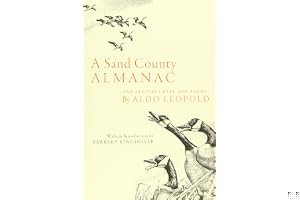
First published in 1949, A Sand County Almanac combines some of the finest nature writing since Thoreau with an outspoken and highly ethical regard for America's relationship to the land.
Written with an unparalleled understanding of the ways of nature, the book includes a section on the monthly changes of the Wisconsin countryside; another part that gathers informal pieces written by Leopold over a forty-year period as he traveled through the woodlands of Wisconsin, Iowa, Arizona, Sonora, Oregon, Manitoba, and elsewhere; and a final section in which Leopold addresses the philosophical issues involved in wildlife conservation. As the forerunner of such important books as Annie Dillard's Pilgrim at Tinker Creek, Edward Abbey's Desert Solitaire, and Robert Finch's The Primal Place, this classic work remains as relevant today as it was sixty-five years ago.
…
Recommended by Isabella Tree, Mark Boyle, and Mike Phillips.
Isabella Tree
Leopold wrote that one of the penalties of an ecological education is that one lives alone in a world of wounds. To me, that rings painfully true. [source]
Trevor Noah’s unlikely path from apartheid South Africa to the desk of The Daily Show began with a criminal act: his birth. Trevor was born to a white Swiss father and a black Xhosa mother at a time when such a union was punishable by five years in prison. Living proof of his parents’ indiscretion, Trevor was kept mostly indoors for the earliest years of his life, bound by the extreme and often absurd measures his mother took to hide him from a government that could, at any moment, steal him away. Finally liberated by the end of South Africa’s tyrannical white rule, Trevor and his mother set forth on a grand adventure, living openly and freely and embracing the opportunities won by a centuries-long struggle.
…
Recommended by Bill Gates, Heather Zynczak, Irina Nica, and 3 others.
As a longtime fan of The Daily Show, I loved reading this memoir about how its host honed his outsider approach to comedy over a lifetime of never quite fitting in. Born to a black South African mother and a white Swiss father in apartheid South Africa, he entered the world as a biracial child in a country where mixed race relationships were forbidden. Much of Noah’s story of growing up in South Africa is tragic. Yet, as anyone who watches his nightly monologues knows, his moving stories will often leave you laughing. [source]
Heather Zynczak
So excited for our latest speaker announcement for #PSLIVE19! Trevor Noah! I am a huge @TheDailyShow fan! And his book -Born a Crime -and life story are amazing. Can't wait! Join us! https://t.co/N6ykJq7TOy https://t.co/r0dIx5RFVI [source]
Irina Nica
I also pay attention to any book recommendations my friends post on Facebook. I started reading Trevor Noah’s Born a Crime after I saw Radu Marcusu, CEO of Upswing, recommending it. He swore by it that is was funny -- and it was! Until the last chapter. I remember listening to the audiobook on a train and crying my eyes out. So yeah. That happened. [source]
Cover unavailable
5
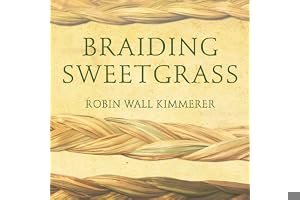
Braiding Sweetgrass: Indigenous Wisdom, Scientific Knowledge, and the Teachings of Plants
As a botanist, Robin Wall Kimmerer has been trained to ask questions of nature with the tools of science. As a member of the Citizen Potawatomi Nation, she embraces the notion that plants and animals are our oldest teachers. In Braiding Sweetgrass, Kimmerer brings these lenses of knowledge together to show that the awakening of a wider ecological consciousness requires the acknowledgment and celebration of our reciprocal relationship with the rest of the living world. For only when we can hear the languages of other beings are we capable of understanding the generosity of the earth, and learning to give our own gifts in return.
…
Recommended by Oliver Sacks Fdn. and Sarah Taber.
Oliver Sacks Fdn.
As a writer, Oliver Sacks found gardens essential to the creative process. Check out our year-end newsletter, devoted to some beautiful books by botanist-writers that would make great gifts for all your plant-loving friends. https://t.co/2U8iEv4L1x https://t.co/IK1cgIMJhE [source]
Sarah Taber
Yeah that's because most of those books are actually just sanctimonious classists pretending they're trying to fix problems. That's why they're depressing If you want a book that's actually about moving forward, "Braiding Sweetgrass" is FANTASTIC. https://t.co/Drr1tmwhSs [source]
Cover unavailable
6
Never Cry Wolf: The Amazing True Story of Life Among Arctic Wolves
Farley Mowat
4.7
More than a half-century ago the naturalist Farley Mowat was sent to investigate why wolves were killing arctic caribou. Mowat's account of the summer he lived in the frozen tundra alone—studying the wolf population and developing a deep affection for the wolves (who were of no threat to caribou or man)—is today celebrated as a classic of nature writing, at once a tale of remarkable adventures and indelible record of myths and magic of wolves.
At Walden Pond, Henry David Thoreau reflected on simpler living in the natural world. By removing himself from the distractions of materialism, Thoreau hoped to not only improve his spiritual life but also gain a better understanding of society through solitary introspection.
In Walden, Thoreau condenses his two-year, two-month, two-day stay into a single year, using the four seasons to symbolize human development—a cycle of life shared by both nature and man. A celebration of personal renewal through self-reliance, independence, and simplicity, composed for all of us living in “quiet desperation,” Walden is eternal.
…
Recommended by Emma Watson, Donna Dickenson, Emily Thomas, and 5 others.
Donna Dickenson
He discusses how the original ideals that America was founded on were being compromised, and how massive industrial interests were starting to dominate. [source]
Emily Thomas
The beginning is hard going. Once you get past that, then suddenly you’re into these beautiful and inspiring descriptions of nature. [source]
Joan Boixados
In case you were deceived and expected me to name Walden by Henry David Thoreau, you should read it too if you haven’t, it obviously is the inspiration to Walden Two. :) [source]
Over the last half-billion years, there have been five mass extinctions, when the diversity of life on earth suddenly and dramatically contracted. Scientists around the world are currently monitoring the sixth extinction, predicted to be the most devastating extinction event since the asteroid impact that wiped out the dinosaurs. This time around, the cataclysm is us.
In prose that is at once frank, entertaining, and deeply informed, The New Yorker writer Elizabeth Kolbert tells us why and how human beings have altered life on the planet in a way no species has before. Interweaving research in half a dozen disciplines, descriptions of the fascinating species that have already been lost, and the history of extinction as a concept, Kolbert provides a moving and comprehensive account of the disappearances occurring before our very eyes. She shows that the sixth extinction is likely to be mankind's most lasting legacy, compelling us to rethink the fundamental question of what it means to be human.
The president also released a list of his summer favorites back in 2015: All That Is, James Salter The Sixth Extinction, Elizabeth Kolbert The Lowland, Jhumpa Lahiri Between the World and Me, Ta-Nehisi Coates Washington: A Life, Ron Chernow All the Light We Cannot See, Anthony Doerr [source]
The Sixth Extinction: An Unnatural History, by Elizabeth Kolbert. Climate change is a big problem—one of the biggest we’ll face this century—but it’s not the only environmental concern on the horizon. Humans are putting down massive amounts of pavement, moving species around the planet, over-fishing and acidifying the oceans, changing the chemical composition of rivers, and more. Natural scientists posit that there have been five extinction events in the Earth’s history (think of the asteroid that wiped out the dinosaurs), and Kolbert makes a compelling case that human activity is leading to the sixth. Unlike a lot of people who write about the environment, Kolbert doesn’t resort to hype. She just lays out the facts and wraps them in memorable anecdotes. It’s a sobering but engaging and informative read. [source]
"In his autobiography, Walmart's founder expounds on the principles of discount retailing and discusses his core values of frugality and a bias for action — a willingness to try a lot of things and make many mistakes. Bezos included both in Amazon's corporate values," Brad Stone writes. [source]
Cover unavailable
9
I Contain Multitudes: The Microbes Within Us and a Grander View of Life
Every animal, whether human, squid, or wasp, is home to millions of bacteria and other microbes. Many people think of microbes as germs to be eradicated, but those that live with us—the microbiome—build our bodies, protect our health, shape our identities, and grant us incredible abilities. In this astonishing book, Ed Yong takes us on a grand tour through our microbial partners, and introduces us to the scientists on the front lines of discovery.
Yong, whose humor is as evident as his erudition, prompts us to look at ourselves and our animal companions in a new light—less as individuals and more as the interconnected, interdependent multitudes we assuredly are. The microbes in our bodies are part of our immune systems and protect us from disease. Those in cows and termites digest the plants they eat. In the deep oceans, mysterious creatures without mouths or guts depend on microbes for all their energy. Bacteria provide squids with invisibility cloaks, help beetles to bring down forests, and allow worms to cause diseases that afflict millions of people.
I Contain Multitudes is the story of these extraordinary partnerships, between the creatures we are familiar with and those we are not. It reveals how we humans are disrupting these partnerships and how we might manipulate them for our own good. It will change both our view of nature and our sense of where we belong in it.
Helped me see microorganisms in a whole new light. [source]
Cover unavailable
10
Last Chance to See
Douglas Adams, Mark Carwardine
4.6
"Very funny and moving...The glimpses of rare fauna seem to have enlarged [Adams'] thinking, enlivened his world; and so might the animals do for us all, if we were to help them live." THE WASHINGTON POST BOOK WORLD Join bestselling author Douglas Adams and zooligist Mark Carwardine as they take off around the world in search of exotic, endangered creatures. Hilarious and poignant--as only Douglas Adams can be--LAST CHANCE TO SEE is an entertaining and arresting odyssey through the Earth's magnificent wildlife galaxy.
…
Recommended by Beth Shapiro, Gaia Vince, and Mark Lynas.
Beth Shapiro
He describes in this book not only the beauty of these animals, but the human landscape they live in and what a disastrous time he has getting to these locations. [source]
Gaia Vince
This is a book obviously for readers but it’s also a book for writers of science to understand how to capture the imagination of readers. [source]
Mark Lynas
For me, Last Chance to See is a real eye-opener, with the idea that you can take a depressing subject – species on the verge of extinction – and present it in a way which is so engaging, so funny and so humane. [source]
Cover unavailable
11
Watership Down
Richard Adams
4.6
Set in England's Downs, a once idyllic rural landscape, this stirring tale of adventure, courage and survival follows a band of very special creatures on their flight from the intrusion of man and the certain destruction of their home. Led by a stouthearted pair of friends, they journey forth from their native Sandleford Warren through the harrowing trials posed by predators and adversaries, to a mysterious promised land and a more perfect society.
…
Recommended by Jennifer Gunter, M G Leonard, Philip Reeve, and 1 others.
@SuetheLibrarian I suppose if you only have one great book in you Watership Down is knocking it out of the park! [source]
M G Leonard
My view of the countryside changed forever after reading the book. [source]
Philip Reeve
Watership Down is one of the most famous animal adventures ever written. It is a far stranger book than many people expect. [source]
Cover unavailable
12
My Family and Other Animals (Corfu Trilogy #1)
Gerald Durrell
4.6
When the unconventional Durrell family can no longer endure the damp, gray English climate, they do what any sensible family would do: sell their house and relocate to the sunny Greek isle of Corfu. My Family and Other Animals was intended to embrace the natural history of the island but ended up as a delightful account of Durrell's family's experiences, from the many eccentric hangers-on to the ceaseless procession of puppies, toads, scorpions, geckoes, ladybugs, glowworms, octopuses, bats, and butterflies into their home.
…
Recommended by M G Leonard.
M G Leonard
It’s a real work of genius and needs to be kept on every child’s bedside table. [source]
Cover unavailable
13
Cry of the Kalahari
Mark James Owens
4.6
“A remarkable story beautifully told…Among such classics as Goodall’s In the Shadow of Man and Fossey’s Gorillas in the Mist.”—Chicago Tribune
Carrying little more than a change of clothes and a pair of binoculars, two young Americans, Mark and Delia Owens, caught a plane to Africa, bought a thirdhand Land Rover, and drove deep into the Kalahari Desert. There they lived for seven years, in an unexplored area with no roads, no people, and no source of water for thousands of square miles. In this vast wilderness the Owenses began their zoology research, working along animals that had never before been exposed to humans.
An international bestseller, Cry of the Kalahari is the story of the Owenses’s life with lions, brown hyenas, jackals, giraffes, and the many other creatures they came to know. It is also a gripping account of how they survived the dangers of living in one of the last and largest pristine areas on Earth.
…
Cover unavailable
14
Man-Eaters of Kumaon
Jim Corbett
4.5
Jim Corbett was every inch a hero, something like a "sahib" Davy Crockett: expert in the ways of the jungle, fearless in the pursuit of man-eating big cats, and above all a crack shot. Brought up on a hill-station in north-west India, he killed his first leopard before he was nine and went on to achieve a legendary reputation as a hunter. Corbett was also an author of great renown. His books on the man-eating tigers he once tracked are not only established classics, but have by themselves created almost a separate literary genre. Man Eaters of Kumaon is the best known of Corbett's books, one which offers ten fascinating and spine-tingling tales of pursuing and shooting tigers in the Indian Himalayas during the early years of this century. The stories also offer first-hand information about the exotic flora, fauna, and village life in this obscure and treacherous region of India, making it as interesting a travelogue as it is a compelling look at a bygone era of big-game hunting.
…
Cover unavailable
15
Born Free: A Lioness of Two Worlds (Story of Elsa, #1)
Joy Adamson, George Page
4.5
There have been many accounts of the return to the wild of tame animals, but since its original publication in 1960, when The New York Times hailed it as a "fascinating and remarkable book," Born Free has stood alone in its power to move us.
Joy Adamson's story of a lion cub in transition between the captivity in which she is raised and the fearsome wild to which she is returned captures the abilities of both humans and animals to cross the seemingly unbridgeable gap between their radically different worlds. Especially now, at a time when the sanctity of the wild and its inhabitants is increasingly threatened by human development and natural disaster, Adamson's remarkable tale is an idyll, and a model, to return to again and again.
Illustrated with the same beautiful, evocative photographs that first enchanted the world forty years ago and updated with a new introduction by George Page, former host and executive editor of the PBS series Nature and author of Inside the Animal Mind, this anniversary edition introduces to a new generation one of the most heartwarming associations between man and animal.
…
Recommended by Karen Paolillo.
Karen Paolillo
I want everyone to read about how Elsa the lioness not only returned to her own world, but in that world where she was a lioness she still had room for her human adoptive parents. [source]
Cover unavailable
16
The Purpose Driven Life: What on Earth Am I Here For?
Two new bonus chapters on the most common barriers to living a purpose driven life.
Access to an online community where you can discuss your journey to purpose, get feedback, and receive support.
“Movie stars and political leaders aren’t the only ones turning to Rick Warren for spiritual guidance. Millions of people—from NBA and LPGA players to corporate executives to high school students to prison inmates—meet regularly to discuss The Purpose Driven Life.” ~ TIME
“The Purpose Driven Life is at the epicenter of a spiritual shockwave taking root across America in unlikely places like college campuses and offices. It’s more than a book; it has become a movement.” ~ ABC NEWS
…
Recommended by John C. Maxwell, Lilian Ong, Robert Katai, and 2 others.
Lilian Ong
I gained clarity and a different perspective of living a life with purpose. I learned that how we are “wired” or our S.H.A.P.E can help us find the purpose of our life. [source]
Robert Katai
I have 2 books that resonate with me and my work. The first one is a book written by Rick Warren called “The Purpose-Driven Life” and the second one is “Purple Cow” by Seth Godin. These are the books that I can read over and over again, because they always remind me what’s my purpose in this life, in my daily job and what I can do with my projects and work to create a purple cow effect. [source]
Theresa Evanoff
Here are some of my favourites around purpose, positive habits, positive thinking, and business goals. I’m a firm believer that subject expertise can be learned, but character-building traits, like perseverance and purposefulness, must be honed. “Purpose Driven Life”, Rick Warren “Start with Why” by Simon Sinek “The 7 Habits of Highly Effective People”, Stephen Covey "The Magic of Thinking Big", David J. Schwartz "The Power of Positive Thinking" by Norman Vincent Peale "The Hard Thing About Hard Things" by Ben Horowitz “Good to Great”, Jim Collins “Doing Good Well”, Willie Cheng [source]
Cover unavailable
17
The Last Rhinos: My Battle to Save One of the World's Greatest Creatures
Lawrence Anthony, Graham Spence
4.5
When Lawrence Anthony learned that the northern white rhino, living in the war-ravaged Congo, was on the very brink of extinction, he knew he had to act. If the world lost the sub-species, it would be the largest land mammal since the woolly mammoth to go extinct. In "The Last Rhinos," Anthony recounts his attempts to save these animals.
The demand for rhino horns in the Far East has turned poaching into a dangerous black market that threatens the lives of not just these rare beasts, but also the rangers who protect them.
The northern white rhino's last refuge was in an area controlled by the infamous Lord's Resistance Army, one of the most vicious rebel groups in the world. In the face of unmoving government bureaucracy, Anthony made a perilous journey deep into the jungle to try to find and convince them to help save the rhino.
Rachel Carson’s Silent Spring was first published in three serialized excerpts in the New Yorker in June of 1962. The book appeared in September of that year and the outcry that followed its publication forced the banning of DDT and spurred revolutionary changes in the laws affecting our air, land, and water. Carson’s passionate concern for the future of our planet reverberated powerfully throughout the world, and her eloquent book was instrumental in launching the environmental movement. It is without question one of the landmark books of the twentieth century.
I’d start with Silent Spring by Rachel Carson, which looked at how pesticide use was harming, and in some cases killing, animals and humans, and really was the first book of its kind to illustrate this environmental destruction. I’ve been so involved in the environment for years and years and that has been a great guideline – it was really the awakening, if you will, to the environmental movement and to the progress we’ve made over the last quarter century or more. [source]
Cover unavailable
19
The Tiger: A True Story of Vengeance and Survival
John Vaillant
4.4
It’s December 1997, and a man-eating tiger is on the prowl outside a remote village in Russia’s Far East. The tiger isn’t just killing people, it’s annihilating them, and a team of men and their dogs must hunt it on foot through the forest in the brutal cold. As the trackers sift through the gruesome remains of the victims, they discover that these attacks aren’t random: the tiger is apparently engaged in a vendetta. Injured, starving, and extremely dangerous, the tiger must be found before it strikes again.
As he re-creates these extraordinary events, John Vaillant gives us an unforgettable portrait of this spectacularly beautiful and mysterious region. We meet the native tribes who for centuries have worshipped and lived alongside tigers, even sharing their kills with them. We witness the arrival of Russian settlers in the nineteenth and early twentieth centuries, soldiers and hunters who greatly diminished the tiger populations. And we come to know their descendants, who, crushed by poverty, have turned to poaching and further upset the natural balance of the region.
This ancient, tenuous relationship between man and predator is at the very heart of this remarkable book. Throughout we encounter surprising theories of how humans and tigers may have evolved to coexist, how we may have developed as scavengers rather than hunters, and how early Homo sapiens may have fit seamlessly into the tiger’s ecosystem. Above all, we come to understand the endangered Siberian tiger, a highly intelligent super-predator that can grow to ten feet long, weigh more than six hundred pounds, and range daily over vast territories of forest and mountain.
Beautifully written and deeply informative, The Tiger circles around three main characters: Vladimir Markov, a poacher killed by the tiger; Yuri Trush, the lead tracker; and the tiger himself. It is an absolutely gripping tale of man and nature that leads inexorably to a final showdown in a clearing deep in the taiga.
Holy shit, this book is good. Just holy shit. Even if it was just the main narrative–the chase to kill a man-eating Tiger in Siberia in post-communist Russia–it would be worth reading, but it is so much more than that. The author explains the Russian psyche, the psyche of man vs predator, the psyches of primitive peoples and animals, in such a masterful way that you’re shocked to find 1) that he knows this, and 2) that he fit it all into this readable and relatively short book. You may have heard about the story on the internet a while back: a tiger starts killing people in Russia and a team is sent to kill it (Russia is so fucked up, they already have a team for this). At one point, the tiger is cornered and leaps to attack the team leader…and in mid-air the soldier’s rifle goes into the tigers open jaws and down his throat all the way to the stock, killing the tiger at the last possible second. The autopsy later revealed that the tiger had been shot something like a dozen times during its life and lived. The story is very similar to that of the Tsavo maneaters, which was turned into the underrated Val Kilmer movie The Ghost and the Darkness. There are all sorts of well-selected threads from evolutionary psychology and biology in this book and it makes the book a self-educator’s dream. You can pick and choose which ones you want to follow next–trusting safely that the author has pointed you in an interesting and valuable direction. But that’s just the meta-stuff that is a bonus with this book, and it’s worth pointing out only because the rest of the book is just so fucking interesting and exciting. [source]
Sometimes nature strikes back, and in this book you really do root for the animal. [source]
Cover unavailable
20
Chomp
Carl Hiaasen
4.4
An alternate cover for this ASIN can be found here.
Wahoo Cray lives in a zoo. His father is an animal wrangler, so he's grown up with all manner of gators, snakes, parrots, rats, monkeys, snappers, and more in his backyard. The critters he can handle. His father is the unpredictable one.
When his dad takes a job with a reality TV show called "Expedition Survival!", Wahoo figures he'll have to do a bit of wrangling himself—to keep his dad from killing Derek Badger, the show's boneheaded star, before the shoot is over. But the job keeps getting more complicated. Derek Badger seems to actually believe his PR and insists on using wild animals for his stunts. And Wahoo's acquired a shadow named Tuna—a girl who's sporting a shiner courtesy of her old man and needs a place to hide out.
They've only been on location in the Everglades for a day before Derek gets bitten by a bat and goes missing in a storm. Search parties head out and promptly get lost themselves. And then Tuna's dad shows up with a gun . . .
It's anyone's guess who will actually survive "Expedition Survival". . . .
…
Cover unavailable
21
H Is for Hawk
Helen MacDonald
4.4
Winner of the 2014 Samuel Johnson Prize, New York Times Bestseller, Named the Amazon Best Book of the Month for March 2015, #1 Bestseller in the UK, H IS FOR HAWK by Helen Macdonald. Magnificent, splendid memoirs woven with nature and a healing process of grief from the bereavement of her beloved father. In Korean. Annotation copyright Tsai Fong Books, Inc. Distributed by Tsai Fong Books, Inc.
Recommended by Barack Obama, Gail Kelly, Diana Kimball, and 1 others.
Just like us, the president enjoys a good beach read while relaxing in the sun. In 2016, he released his list of summer vacation books: Barbarian Days: A Surfing Life, William Finnegan H Is for Hawk, Helen Macdonald The Girl on the Train, Paula Hawkins Seveneves, Neal Stephenson The Underground Railroad, Colson Whitehead [source]
Nick Pyenson
H is for Hawk feels like the definitive statement on hawks for the modern times, and I think its success has a lot to do with how well Macdonald tied her inquiry into the life of a hawk with her own personal experience and journey. [source]
Cover unavailable
22
The Animal Dialogues: Uncommon Encounters in the Wild
Craig Childs
4.4
From one of the finest nature writers at work in America today; a lyrical, dramatic, illuminating tour of the hidden domain of wild animals.
Whether recalling the experience of being chased through the Grand Canyon by a bighorn sheep, swimming with sharks off the coast of British Columbia, watching a peregrine falcon perform acrobatic stunts at 200 miles per hour, or engaging in a tense face-off with a mountain lion near a desert waterhole, Craig Childs captures the moment so vividly that he puts the reader in his boots.
Each of the forty brief, compelling narratives in The Animal Dialogues focuses on the author's own encounter with a particular species and is replete with astonishing facts about the species' behavior, habitat, breeding, and lifespan. But the glory of each essay lies in Childs's ability to portray the sometimes brutal beauty of the wilderness, to capture the individual essence of wild creatures, to transport the reader beyond the human realm and deep inside the animal kingdom.
…
Cover unavailable
23
Elephant Dawn: The Inspirational Story of Thirteen Years Living with Elephants in the African Wilderness
Sharon Pincot
4.3
Cover unavailable
24
Gorillas in the Mist
Dian Fossey
4.3
One of the most important books ever written about our connection to the natural world, Gorillas in the Mist is the riveting account of Dian Fossey's thirteen years in a remote African rain forest with the greatest of the great apes. Fossey's extraordinary efforts to ensure the future of the rain forest and its remaining mountain gorillas are captured in her own words and in candid photographs of this fascinating endangered species. As only she could, Fossey combined her personal adventure story with groundbreaking scientific reporting in an unforgettable portrait of one of our closest primate relatives. Although Fossey's work ended tragically in her murder, Gorillas in the Mist remains an invaluable testament to one of the longest-running field studies of primates and reveals her undying passion for her subject.
…
Cover unavailable
25
National Geographic Field Guide to the Birds of North America
Jon L. Dunn
4.3
This fully revised edition of the best-selling North American bird field guide is the most up-to-date guide on the market. Perfect for beginning to advanced birders, it is the only book organized to match the latest American Ornithological Society taxonomy.
With more than 2.75 million copies in print, this perennial bestseller is the most frequently updated of all North American bird field guides. Filled with hand-painted illustrations from top nature artists (including the ever-popular hummingbird), this latest edition is poised to become an instant must-have for every serious birder in the United States and Canada. The 7th edition includes 37 new species for a total of 1,023 species; 16 new pages allow for 250 fresh illustrations; 80 new maps; and 350 map revisions. With taxonomy revised to reflect the radical new American Ornithological Society taxonomy established in 2016, the addition of standardized banding codes, and text completely vetted by birding experts, this new edition will top of the list of birding field guides for years to come.
…
Cover unavailable
26
The Song of the Dodo: Island Biogeography in an Age of Extinctions
David Quammen
4.3
David Quammen's book, The Song of the Dodo, is a brilliant, stirring work, breathtaking in its scope, far-reaching in its message -- a crucial book in precarious times, which radically alters the way in which we understand the natural world and our place in that world. It's also a book full of entertainment and wonders. In The Song of the Dodo, we follow Quammen's keen intellect through the ideas, theories, and experiments of prominent naturalists of the last two centuries. We trail after him as he travels the world, tracking the subject of island biogeography, which encompasses nothing less than the study of the origin and extinction of all species. Why is this island idea so important? Because islands are where species most commonly go extinct -- and because, as Quammen points out, we live in an age when all of Earth's landscapes are being chopped into island-like fragments by human activity. Through his eyes, we glimpse the nature of evolution and extinction, and in so doing come to understand the monumental diversity of our planet, and the importance of preserving its wild landscapes, animals, and plants. We also meet some fascinating human characters. By the book's end we are wiser, and more deeply concerned, but Quammen leaves us with a message of excitement and hope.
…
Recommended by Isabella Tree, Sean B Carroll, and TC Boyle.
Isabella Tree
Quammen’s wondrous peregrination of islands takes us on a journey of evolutions and extinctions in order to illustrate how like islands our continents have become. [source]
Sean B Carroll
The book covers the role that islands have played in our thinking about how nature works. [source]
A brilliant journalist who can tell scientific stories with the kind of panache you’d expect from a novelist. [source]
Cover unavailable
27
Wilding
Isabella Tree, Eric Schlosser
4.3
For many years Isabella Tree and Charlie Burrell struggled to make a go as farmers, doing everything they could to make the heavy clay soils of their farm at Knepp in West Sussex as productive as possible, while rarely succeeding in making a profit. By 2000, facing bankruptcy, the couple decided they would try something new. They would hand their 3,500 acres, farmed for centuries, even millennia, back to nature. They would let it go wild.
This was no simple matter. What form did the land have before it took on the form that human beings have given it? The answer to that question was controversial and required real, and fascinating, research. And then the land had once been open to whole hosts of animals that had since been prevented from running wild, if not killed off or made extinct. These had been a crucial actor in the landscape and its ecology, and how were they, or their likes, to be reintroduced into it? And finally there were the neighbors, often appalled at the sight of once-tidy fields now running riot with what they considered dangerous weeds.
The experiment however, was a success. With minimal human intervention, and with herds of free-roaming animals stimulating new habitats, Knepp is now full of new life. Rare species such as turtle doves, peregrine falcons, and purple emperor butterflies breed there. The fabled English nightingale, heard less and less in modern times, sings again.
The Knepp project has become a leading light for conservation in the UK, demonstrating how letting nature take its course can revive both the land and wildlife, reversing the cataclysmic declines in biodiversity that challenge Britain and the world. The story of rewilding Knepp points the way to a wilder, richer future—a countryside that benefits farming, nature, and us. Wilding is an inspiring story of hope.
Wilding is about an extraordinary experiment at the 3,500-acre Knepp Wildland Project, and an example of what can happen when we learn to do the hardest thing of all: nothing. [source]
Cover unavailable
28
Of Wolves and Men
Barry H. Lopez
4.3
Originally published in 1978, this classic exploration of humanity’s complex relationship with and understanding of wolves returns with a new afterword by the author.
Humankind's relationship with the wolf is the sum of a spectrum of responses ranging from fear to admiration and affection. Lopez’s classic, careful study has won praise from a wide range of reviewers and improved the way books on wild animals are written. Of Wolves and Men explores the uneasy interaction between wolves and civilization over the centuries, and the wolf's prominence in our thoughts about wild creatures. Drawing upon an impressive array of literature, history, science, and mythology as well as extensive personal experience with captive and free-ranging wolves, Lopez argues for the wolf's preservation and immerses the reader in its sensory world, creating a compelling portrait of the wolf both as a real animal and as imagined by different kinds of men. A scientist might perceive the wolf as defined by research data, while an Eskimo hunter sees a family provider much like himself. For many Native Americans the wolf is also a spiritual symbol, a respected animal that can strengthen the individual and the community. With irresistible charm and elegance, Of Wolves and Men celebrates careful scientific fieldwork, dispels folklore that has enabled the Western mind to demonize wolves, explains myths, and honors indigenous traditions, allowing us to understand how this remarkable animal has become so prominent for so long in the human heart.
Offers fascinating insights into the depths of understanding which civilised peoples have lost and what, if we were wise, we might attempt to regain. [source]
Cover unavailable
29
The Eye of the Elephant: An Epic Adventure in the African Wilderness
Delia Owens
4.3
After being expelled from Botswana for writing their controversial bestseller Cry of the Kalahari, Mark and Delia Owens set off on a journey across Africa, searching for a new Eden. They found it in Zambia, but elephant poachers soon had them fighting for their lives when they tried to stop the slaughter. 16 pages of photos, half in color.
Cover unavailable
30
The Snow Leopard
Peter Matthiessen
4.3
When Matthiessen went to Nepal to study the Himalayan blue sheep and, possibly, to glimpse the rare and beautiful snow leopard, he undertook his five-week trek as winter snows were sweeping into the high passes. This is a radiant and deeply moving account of a "true pilgrimage, a journey of the heart."
Recommended by Nick Pyenson.
Nick Pyenson
The book stands apart and it remains fresh because of the ways that Matthiessen weaves his exploration of the outer world with his own inner one. [source]
Cover unavailable
31
The Genius of Birds
Jennifer Ackerman
4.3
Birds are astonishingly intelligent creatures. According to revolutionary new research, some birds rival primates and even humans in their remarkable forms of intelligence.
In The Genius of Birds, acclaimed author Jennifer Ackerman explores the newly discovered brilliance of birds. As she travels around the world to the most cutting-edge frontiers of research--the distant laboratories of Barbados and New Caledonia, the great tit communities of the United Kingdom and the bowerbird habitats of Australia, the ravaged mid-Atlantic coast after Hurricane Sandy and the warming mountains of central Virginia and the western states--Ackerman not only tells the story of the recently uncovered genius of birds but also delves deeply into the latest findings about the bird brain itself that are shifting our view of what it means to be intelligent.
Consider, as Ackerman does, the Clark's nutcracker, a bird that can hide as many as 30,000 seeds over dozens of square miles and remember several months later where it put them, or the mockingbirds and thrashers, species that can store 200 to 2,000 different songs in a brain a thousand times smaller than ours.
But beyond highlighting how birds use their unique genius in technical ways, Ackerman points out the impressive social smarts of birds. They deceive and manipulate. They eavesdrop. They give gifts. They kiss to console one another. They blackmail their parents. They alert one another to danger. They summon witnesses to the death of a peer. They may even grieve.
This elegant scientific investigation and travelogue weaves personal anecdotes with fascinating science. Ackerman delivers an extraordinary story that will both give readers a new appreciation for the exceptional talents of birds and let them discover what birds can reveal about our changing world. Richly informative and beautifully written, The Genius of Birds celebrates the triumphs of these surprising and fiercely intelligent creatures. From the Hardcover edition.
…
Cover unavailable
32
The Sibley Guide to Birds
David Allen Sibley
4.3
The entire birding world, from expert ornithologists to backyard enthusiasts, has been waiting for Sibley's work to be made available in a field-usable form. Containing the renowned artist's superbly lucid and comprehensive text, this guide features more than 6,500 of his detailed paintings. Full color.
Cover unavailable
33
The Overstory
Richard Powers
4.3
The Overstory is a sweeping, impassioned work of activism and resistance that is also a stunning evocation of - and paean to - the natural world. From the roots to the crown and back to the seeds, Richard Powers’s twelfth novel unfolds in concentric rings of interlocking fables that range from antebellum New York to the late twentieth-century Timber Wars of the Pacific Northwest and beyond. There is a world alongside ours—vast, slow, interconnected, resourceful, magnificently inventive, and almost invisible to us. This is the story of a handful of people who learn how to see that world and who are drawn up into its unfolding catastrophe.
Feels at the beginning like a series of short stories, each of which has some important thing about a tree or a kind of tree in it, but also holds some human character. You’d be a very strange person if you came away from this book not caring about what’s happening to the trees. [source]
Martha Kearney
@omrgriffiths @BBCPM @RobGMacfarlane Great idea. Loved that book. [source]
Sarah Dry
I had the experience of having the revelation that the author clearly hoped a reader would have, which is that what appears to be a book about distinct individuals—almost a book of short stories— turns out to be something more complex, in which all the characters are linked through time and space. [source]
Cover unavailable
34
Whatever You Do, Don't Run: True Tales of a Botswana Safari Guide
Peter Allison
4.3
A hilarious, highly original collection of essays based on the Botswana truism: “only food runs!”
In the tradition of Bill Bryson, a new writer brings us the lively adventures and biting wit of an African safari guide. Peter Allison gives us the guide’s-eye view of living in the bush, confronting the world’s fiercest terrain of wild animals and, most challenging of all, managing herds of gaping tourists. Passionate for the animals of the Kalahari, Allison works as a top safari guide in the wildlife-rich Okavango Delta. As he serves the whims of his wealthy clients, he often has to stop the impulse to run as far away from them as he can, as these tourists are sometimes more dangerous than a pride of lions.
No one could make up these outrageous-but-true tales: the young woman who rejected the recommended safari-friendly khaki to wear a more “fashionable” hot pink ensemble; the lost tourist who happened to be drunk, half-naked, and a member of the British royal family; establishing a real friendship with the continent’s most vicious animal; the Japanese tourist who requested a repeat performance of Allison’s being charged by a lion so he could videotape it; and spending a crazy night in the wild after blowing a tire on a tour bus, revealing that Allison has as much good-natured scorn for himself.
The author’s humor is exceeded only by his love and respect for the animals, and his goal is to limit any negative exposure to humans by planning trips that are minimally invasive—unfortunately it doesn’t always work out that way!
Peter Allison is originally from Sydney, Australia. His safaris have been featured in National Geographic, Conde Nast Traveler, and on television programs such as Jack Hanna's Animal Adventures. He travels frequently to speaking appearances, and splits most of his time between Botswana, Sydney, and San Francisco.
…
Cover unavailable
35
Wesley the Owl: The Remarkable Love Story of an Owl and His Girl
Stacey O'Brien
4.3
When biologist Stacey O'Brien first met a four-day-old baby barn owl with nerve damage in one wing, she knew he had no hope of surviving on his own in the wild, so gave him a permanent home living with her. This is the funny, poignant story of their two decades together.
On Valentine's Day 1985, biologist Stacey O'Brien first met a four-day-old baby barn owl -- a fateful encounter that would turn into an astonishing 19-year saga. With nerve damage in one wing, the owlet's ability to fly was forever compromised, and he had no hope of surviving on his own in the wild. O'Brien, a young assistant in the owl laboratory at Caltech, was immediately smitten, promising to care for the helpless owlet and give him a permanent home. Wesley the Owl is the funny, poignant story of their dramatic two decades together.
With both a tender heart and a scientist's eye, O'Brien studied Wesley's strange habits intensively and first-hand -- and provided a mice-only diet that required her to buy the rodents in bulk (28,000 over the owl's lifetime). As Wesley grew, she snapped photos of him at every stage like any proud parent, recording his life from a helpless ball of fuzz to a playful, clumsy adolescent to a gorgeous, gold-and-white, macho adult owl with a heart-shaped face and an outsize personality that belied his 18-inch stature. Stacey and Wesley's bond deepened as she discovered Wesley's individual personality, subtle emotions, and playful nature that could also turn fiercely loyal and protective -- though she could have done without Wesley's driving away her would-be human suitors!
O'Brien also brings us inside the prestigious research community, a kind of scientific Hogwarts where resident owls sometimes flew freely from office to office and eccentric, brilliant scientists were extraordinarily committed to studying and helping animals; all of them were changed by the animal they loved. As O'Brien gets close to Wesley, she makes important discoveries about owl behavior, intelligence, and communication, coining the term "The Way of the Owl" to describe his inclinations: he did not tolerate lies, held her to her promises, and provided unconditional love, though he was not beyond an occasional sulk. When O'Brien develops her own life-threatening illness, the biologist who saved the life of a helpless baby bird is herself rescued from death by the insistent love and courage of this wild animal.
Enhanced by wonderful photos, Wesley the Owl is a thoroughly engaging, heartwarming, often funny story of a complex, emotional, non-human being capable of reason, play, and, most important, love and loyalty. It is sure to be cherished by animal lovers everywhere.
…
Cover unavailable
36
Babylon's Ark: The Incredible Wartime Rescue of the Baghdad Zoo
Lawrence Anthony, Graham Spence
4.3
When the Iraq war began, conservationist Lawrence Anthony could think of only one thing: the fate of the Baghdad Zoo, located in the city center and caught in the war's crossfire. Once Anthony entered Baghdad he discovered that full-scale combat and uncontrolled looting had killed nearly all the animals of the zoo.
But not all of them. U.S. soldiers had taken the time to help care for the remaining animals, and the zoo's staff had returned to work in spite of the constant firefights. Together the Americans and Iraqis had managed to keep alive the animals that had survived the invasion.
Babylon's Ark chronicles the zoo's transformation from bombed-out rubble to peaceful park. Along the way, Anthony recounts hair-raising efforts to save a pride of the dictator's lions, close a deplorable black-market zoo, and rescue Saddam's Arabian horses. His unique ground-level experience makes Babylon's Ark an uplifting story of both sides working together for the sake of innocent animals caught in the war's crossfire.

…
Cover unavailable
37
A Primate's Memoir: A Neuroscientist's Unconventional Life Among the Baboons
Robert M. Sapolsky
4.3
In the tradition of Jane Goodall and Dian Fossey, Robert Sapolsky, a foremost science writer and recipient of a MacArthur Genius Grant, tells the mesmerizing story of his twenty-one years in remote Kenya with a troop of Savannah baboons.
“I had never planned to become a savanna baboon when I grew up; instead, I had always assumed I would become a mountain gorilla,” writes Robert Sapolsky in this witty and riveting chronicle of a scientist’s coming-of-age in remote Africa.
An exhilarating account of Sapolsky’s twenty-one-year study of a troop of rambunctious baboons in Kenya, A Primate’s Memoir interweaves serious scientific observations with wry commentary about the challenges and pleasures of living in the wilds of the Serengeti — for man and beast alike. Over two decades, Sapolsky survives culinary atrocities, gunpoint encounters, and a surreal kidnapping, while witnessing the encroachment of the tourist mentality on the farthest vestiges of unspoiled Africa. As he conducts unprecedented physiological research on wild primates, he becomes evermore enamored of his subjects — unique and compelling characters in their own right — and he returns to them summer after summer, until tragedy finally prevents him.
By turns hilarious and poignant, A Primate’s Memoir is a magnum opus from one of our foremost science writers.
…
Recommended by Nick Pyenson.
Nick Pyenson
Sapolsky’s book is my favourite in the modern scientist-author canon.He places you in his shoes, and shows you how his ensemble cast of baboons (generations of them, actually) have personality, agency, and succumb to the same foibles that we do. [source]
Cover unavailable
38
A Walk in the Woods: Rediscovering America on the Appalachian Trail
Bill Bryson
4.3
The Appalachian Trail stretches from Georgia to Maine and covers some of the most breathtaking terrain in America—majestic mountains, silent forests, sparking lakes. If you’re going to take a hike, it’s probably the place to go. And Bill Bryson is surely the most entertaining guide you’ll find. He introduces us to the history and ecology of the trail and to some of the other hardy (or just foolhardy) folks he meets along the way—and a couple of bears. Already a classic, A Walk in the Woods will make you long for the great outdoors (or at least a comfortable chair to sit and read in).
…
Cover unavailable
39
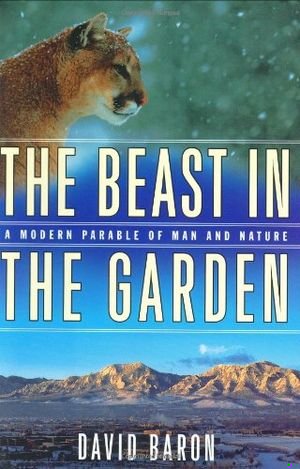
Where the Wild Things Were: Life, Death, and Ecological Wreckage in a Land of Vanishing Predators
William Stolzenburg
4.2
A provocative look at how the disappearance of the world's great predators has upset the delicate balance of the environment, and what their disappearance portends for the future, by an acclaimed science journalist.
It wasn't so long ago that wolves and great cats, monstrous fish and flying raptors ruled the peak of nature's food pyramid. Not so anymore. All but exterminated, these predators of the not-too-distant past have been reduced to minor players of the modern era. And what of it? Wildlife journalist William Stolzenburg follows in the wake of nature's topmost carnivores, and finds chaos in their absence. From the brazen mobs of deer and marauding raccoons of backyard America to streamsides of Yellowstone National Park crushed by massive herds of elk; from urchin-scoured reefs in the North Pacific to ant-devoured islands in Venezuela, Stolzenburg leads a startling tour through bizarre, impoverished landscapes of pest and plague. For anyone who has seldom given thought to the meat-eating beasts so recently missing from the web of life, here is a world of reason to think again.
…
Cover unavailable
40
White Fang
Jack London and K. A. Applegate
4.2
White Fang is part dog and part wolf, and the lone survivor of his family. In his lonely world, he soon learns to follow the harsh law of the North--kill or be killed. But nothing in White Fang's life can prepare him for the cruel owner who turns him into a vicious killer. Will White Fang ever know the kindness of a gentle master?
Cover unavailable
41
When Elephants Weep: The Emotional Lives of Animals
Jeffrey Moussaieff Masson, Susan McCarthy
4.2
This national bestseller exploring the complex emotional lives of animals was hailed as "a masterpiece" by Elizabeth Marshall Thomas and as "marvelous" by Jane Goodall.
The popularity of When Elephants Weep has swept the nation, as author Jeffrey Masson appeared on Dateline NBC, Good Morning America, and was profiled in People for his ground-breaking and fascinating study. Not since Darwin's The Expression of Emotions in Man and Animals has a book so thoroughly and effectively explored the full range of emotions that exist throughout the animal kingdom.
From dancing squirrels to bashful gorillas to spiteful killer whales, Masson and coauthor Susan McCarthy bring forth fascinating anecdotes and illuminating insights that offer powerful proof of the existence of animal emotion. Chapters on love, joy, anger, fear, shame, compassion, and loneliness are framed by a provocative re-evaluation of how we treat animals, from hunting and eating them to scientific experimentation. Forming a complete and compelling picture of the inner lives of animals, When Elephants Weep assures that we will never look at animals in the same way again.
…
Cover unavailable
42
In the Shadow of Man
Jane Goodall, Hugo van Lawick, Stephen Jay Gould
4.2
This best-selling classic tells the story of one of world's greatest scientific adventuresses. Jane Goodall was a young secretarial school graduate when the legendary Louis Leakey chose her to undertake a landmark study of chimpanzees in the world. This paperback edition contains 80 photographs and in introduction by Stephen Jay Gould.
Cover unavailable
43
The Soul of an Octopus: A Surprising Exploration Into the Wonder of Consciousness
Sy Montgomery
4.2
In pursuit of the wild, solitary, predatory octopus, popular naturalist Sy Montgomery has practiced true immersion journalism. From New England aquarium tanks to the reefs of French Polynesia and the Gulf of Mexico, she has befriended octopuses with strikingly different personalities—gentle Athena, assertive Octavia, curious Kali, and joyful Karma. Each creature shows her cleverness in myriad ways: escaping enclosures like an orangutan; jetting water to bounce balls; and endlessly tricking companions with multiple “sleights of hand” to get food.
Scientists have only recently accepted the intelligence of dogs, birds, and chimpanzees but now are watching octopuses solve problems and are trying to decipher the meaning of the animal’s color-changing techniques. With her “joyful passion for these intelligent and fascinating creatures” (Library Journal Editors’ Spring Pick), Montgomery chronicles the growing appreciation of this mollusk as she tells a unique love story. By turns funny, entertaining, touching, and profound, The Soul of an Octopus reveals what octopuses can teach us about the meeting of two very different minds.
…
Cover unavailable
44
Beyond Words: What Animals Think and Feel
Carl Safina
4.2
I wanted to know what they were experiencing, and why to us they feel so compelling, and so-close. This time I allowed myself to ask them the question that for a scientist was forbidden fruit: Who are you?
Weaving decades of field observations with exciting new discoveries about the brain, Carl Safina's landmark book offers an intimate view of animal behavior to challenge the fixed boundary between humans and nonhuman animals. In Beyond Words, readers travel to Amboseli National Park in the threatened landscape of Kenya and witness struggling elephant families work out how to survive poaching and drought, then to Yellowstone National Park to observe wolves sort out the aftermath of one pack's personal tragedy, and finally plunge into the astonishingly peaceful society of killer whales living in the crystalline waters of the Pacific Northwest.
Beyond Words brings forth powerful and illuminating insight into the unique personalities of animals through extraordinary stories of animal joy, grief, jealousy, anger, and love. The similarity between human and nonhuman consciousness, self-awareness, and empathy calls us to re-evaluate how we interact with animals. Wise, passionate, and eye-opening at every turn, Beyond Words is ultimately a graceful examination of humanity's place in the world.
In this unique book, David Attenborough has undertaken nothing less than a history of nature, from the emergence of tiny one-celled organisms in the primeval slime more than 3,000 million years ago to apelike but upright man, equally well adapted to life in the rain forest of New Guinea and the glass canyons of a modern metropolis. Told through an examination of animal and plant life today - with occasional juxtapositions of extinct fossil forms to reveal the origin of living creatures - "Life on Earth" is an astonishing pageant of life, with a cast of characters drawn from the whole range of living animals the world over. Attenborough's perceptive, dynamic approach to the evolution of some four million species of living organisms that populate the planet is to trace the most significant thread in the history of each major group. He then proceeds to explain from the evidence of living representatives and fossil remains why certain animals adapted and survived, evolved to more complex and "higher" forms of life, while others, by some inherent limitation imposed by their physiology or structure, failed and became extinct. "Life on Earth" is a book of wonders. A model of clarity and ease as a guide, Attenborough takes the reader around the world with him into jungles where orchids have petals that "impersonate" wasps to attract pollinating insects; to Australia, where honeypot ants force feed nectar to workers of a special caste, then hang them up by their forelegs like living storage jars; to remote mountains in Japan where little monkeys called macaques have learned to combat the winter snows by bathing in hot volcanic springs.
…
Recommended by David Bainbridge.
David Bainbridge
I don’t think the book has been bettered since, and that’s because it just seems to be the most interesting way to talk about life, through a narrative. [source]
Cover unavailable
46
Winter World: The Ingenuity of Animal Survival
Bernd Heinrich
4.2
From award-winning writer and biologist Bernd Heinrich, an intimate, accessible and eloquent illumination of animal survival in Winter.
From flying squirrels to grizzly bears, torpid turtles to insects with antifreeze, the animal kingdom relies on some staggering evolutionary innovations to survive winter. Unlike their human counterparts, who must alter their environment to accommodate our physical limitations, animals are adaptable to an amazing range of conditions--i.e., radical changes in a creature's physiology take place to match the demands of the environment. Winter provides an especially remarkable situation, because of how drastically it affects the most elemental component of all life: water.
Examining everything from food sources in the extremely barren winter landscape to the chemical composition that allows certain creatures to survive, Heinrich's Winter World awakens the largely undiscovered mysteries by which nature sustains herself through the harsh, cruel exigencies of winters
…
Cover unavailable
47
American Wolf
Nate Blakeslee
4.2
ISBN moved from this edition The enthralling story of the rise and reign of O-Six, the celebrated Yellowstone wolf, and the people who loved or feared her
Before men ruled the earth, there were wolves. Once abundant in North America, these majestic creatures were hunted to near extinction in the lower 48 states by the 1920s. But in recent decades, conservationists have brought wolves back to the Rockies, igniting a battle over the very soul of the West.
With novelistic detail, Nate Blakeslee tells the gripping story of one of these wolves, O-Six, a charismatic alpha female named for the year of her birth. Uncommonly powerful, with gray fur and faint black ovals around each eye, O-Six is a kind and merciful leader, a fiercely intelligent fighter, and a doting mother. She is beloved by wolf watchers, particularly renowned naturalist Rick McIntyre, and becomes something of a social media star, with followers around the world.
But as she raises her pups and protects her pack, O-Six is challenged on all fronts: by hunters, who compete with wolves for the elk they both prize; by cattle ranchers who are losing livestock and have the ear of politicians; and by other Yellowstone wolves who are vying for control of the park’s stunningly beautiful Lamar Valley.
These forces collide in American Wolf, a riveting multigenerational saga of hardship and triumph that tells a larger story about the ongoing cultural clash in the West—between those fighting for a vanishing way of life and those committed to restoring one of the country’s most iconic landscapes.
…
Cover unavailable
48
An Elephant in My Kitchen: What the Herd Taught Me about Love, Courage and Survival
Françoise Malby-Anthony
4.2
A heart-warming sequel to the international bestseller The Elephant Whisperer, by Lawrence Anthony's wife.
A chic Parisienne, Françoise never expected to find herself living on a South African game reserve. But then she fell in love with conservationist Lawrence Anthony and everything changed. After Lawrence’s death, Françoise faced the daunting responsibility of running Thula Thula without him. Poachers attacked their rhinos, their security team wouldn’t take orders from a woman and the authorities were threatening to cull their beloved elephant family. On top of that, the herd’s feisty new matriarch Frankie didn’t like her.
In this heart-warming and moving book, Françoise describes how she fought to protect the herd and to make her dream of building a wildlife rescue center a reality. She found herself caring for a lost baby elephant who turned up at her house, and offering refuge to traumatized orphaned rhinos, and a hippo called Charlie who was scared of water. As she learned to trust herself, she discovered she’d had Frankie wrong all along.
Filled with extraordinary animals and the humans who dedicate their lives to saving them, An Elephant in My Kitchen is a captivating and gripping read.
…
Cover unavailable
49
Are We Smart Enough to Know How Smart Animals Are?
Frans de Waal
4.2
What separates your mind from an animal’s? Maybe you think it’s your ability to design tools, your sense of self, or your grasp of past and future—all traits that have helped us define ourselves as the planet’s preeminent species. But in recent decades, these claims have eroded, or even been disproven outright, by a revolution in the study of animal cognition. Take the way octopuses use coconut shells as tools; elephants that classify humans by age, gender, and language; or Ayumu, the young male chimpanzee at Kyoto University whose flash memory puts that of humans to shame. Based on research involving crows, dolphins, parrots, sheep, wasps, bats, whales, and of course chimpanzees and bonobos, Frans de Waal explores both the scope and the depth of animal intelligence. He offers a firsthand account of how science has stood traditional behaviorism on its head by revealing how smart animals really are, and how we’ve underestimated their abilities for too long.
People often assume a cognitive ladder, from lower to higher forms, with our own intelligence at the top. But what if it is more like a bush, with cognition taking different forms that are often incomparable to ours? Would you presume yourself dumber than a squirrel because you’re less adept at recalling the locations of hundreds of buried acorns? Or would you judge your perception of your surroundings as more sophisticated than that of a echolocating bat? De Waal reviews the rise and fall of the mechanistic view of animals and opens our minds to the idea that animal minds are far more intricate and complex than we have assumed. De Waal’s landmark work will convince you to rethink everything you thought you knew about animal—and human—intelligence.
…
Cover unavailable
50
Feral: Rewilding the Land, the Sea, and Human Life
George Monbiot
4.2
To be an environmentalist early in the twenty-first century is always to be defending, arguing, acknowledging the hurdles we face in our efforts to protect wild places and fight climate change. But let’s be honest: hedging has never inspired anyone.
So what if we stopped hedging? What if we grounded our efforts to solve environmental problems in hope instead, and let nature make our case for us? That’s what George Monbiot does in Feral, a lyrical, unabashedly romantic vision of how, by inviting nature back into our lives, we can simultaneously cure our “ecological boredom” and begin repairing centuries of environmental damage. Monbiot takes readers on an enchanting journey around the world to explore ecosystems that have been “rewilded”: freed from human intervention and allowed—in some cases for the first time in millennia—to resume their natural ecological processes. We share his awe, and wonder, as he kayaks among dolphins and seabirds off the coast of Wales and wanders the forests of Eastern Europe, where lynx and wolf packs are reclaiming their ancient hunting grounds. Through his eyes, we see environmental success—and begin to envision a future world where humans and nature are no longer separate and antagonistic, but are together part of a single, healing world.
Monbiot’s commitment is fierce, his passion infectious, his writing compelling. Readers willing to leave the confines of civilization and join him on his bewitching journey will emerge changed—and ready to change our world for the better.
…
Recommended by Amy Liptrot and Isabella Tree.
Amy Liptrot
This is a bold and radical book, which changed the way I look at the countryside. [source]
Isabella Tree
Monbiot pushed the boundaries of what rewilding should mean. [source]
Cover unavailable
51
The Beak of the Finch: A Story of Evolution in Our Time
Jonathan Weiner
4.2
Winner of the Pulitzer Prize Winner of the Los Angeles Times Book Prize
On a desert island in the heart of the Galapagos archipelago, where Darwin received his first inklings of the theory of evolution, two scientists, Peter and Rosemary Grant, have spent twenty years proving that Darwin did not know the strength of his own theory. For among the finches of Daphne Major, natural selection is neither rare nor slow: it is taking place by the hour, and we can watch.
In this dramatic story of groundbreaking scientific research, Jonathan Weiner follows these scientists as they watch Darwin's finches and come up with a new understanding of life itself. The Beak of the Finch is an elegantly written and compelling masterpiece of theory and explication in the tradition of Stephen Jay Gould.
With a new preface.
…
Cover unavailable
52
The Wilderness Family: At Home with Africa's Wildlife
Kobie Kruger
4.2
Everyone warned Kobie Krüger that being the wife of a game warden at a remote ranger station in South Africa's largest national park would be an arduous move. The heat was unbearable, malaria would be a constant danger, her husband would have to be away for long stretches, there were no schools or nearby doctors for their three daughters, and of course the area teemed with wild animals. Yet for Kobie and her family, the seventeen years at South Africa's Kruger National Park were the most magical of their lives. Now, in The Wilderness Family, Kobie recounts the enchanting adventures and extraordinary encounters they experienced in this vast reserve where wildlife has right of way.
Kobie and her husband Kobus were overwhelmed by the beauty of the Mahlangeni ranger station when they arrived with their little girls in the autumn of 1980. Golden sunshine glowed in the lush garden where fruit bats hung in the sausage trees; hippos basked in the glittering waters of the Letaba River; storks and herons perched along the shore. Kobie felt she had found heaven on earth--until she awoke that first night to find a python slithering silently across her bedroom floor. It was the perfect introduction to the wonders and terrors that awaited her.
As the Krügers settled in, they became accustomed to living in the midst of ravishing splendor and daily surprises. A honey badger they nursed back to health rampaged affectionately through the house. Sneaky hyenas stole blankets and cook pots. Ordinarily placid elephants grew foul-tempered and violent in the summer heat. And one terrible day, the shadow of tragedy fell across the family when a lion attacked Kobus in the bush and nearly killed him.
But nothing prepared the Krügers for the adventure of raising an orphaned lion cub. The cub was only a few days old and on the verge of death when they found him alone. Leo, as the girls promptly named the cub, survived on loads of love and bottles of fat-enriched milk, and soon became an affectionate, rambunctious member of the family. At the heart of the book, Kobie recounts the unique bond that each of the Krügers forged with Leo and their sometimes hilarious endeavor to teach him to become a "real" lion and live with his own kind in the wild.
Writing with deep affection and luminous prose, Kobie Krüger captures here the mystery of untamed Africa--its fathomless skies, soulful landscapes, and most of all, its astonishing array of animals. By turns funny and heart-breaking, engaging and suspenseful, The Wilderness Family is an unforgettable memoir of a woman, her family, and the amazing game reserve they called home for seventeen incredible years.
…
Cover unavailable
53
Collins Bird Guide
Lars Svensson
4.2
Following on from its hugely successful launch in 1999, Collins Bird Guide – the ultimate reference book for bird enthusiasts – now enters its second edition.
With expanded text and additional colour illustrations, the second edition of the hugely successful Collins Bird Guide is a must for every birdwatcher.
The book provides all the information needed to identify any species at any time of the year, covering size, habitat, range, identification and voice. Accompanying every species entry is a distribution map and illustrations showing the species in all the major plumages (male, female, immature, in flight, at rest, feeding: whatever is important).
In addition, each group of birds includes an introduction which covers the major problems involved in identifying or observing them: how to organise a sea watching trip, how to separate birds of prey in flight, which duck hybrids can be confused with which main species. These and many other common birdwatching questions are answered.
The combination of definitive text, up-to-date distribution maps and superb illustrations, all in a single volume, makes this book the ultimate field guide, essential on every bookshelf and birdwatching trip.
…
Cover unavailable
54
Into the Wild
Jon Krakauer
4.1
Librarian's Note: An alternate cover edition can be found here
In April, 1992, a young man from a well-to-do family hitchhiked to Alaska and walked alone into the wilderness north of Mt. McKinley. His name was Christopher Johnson McCandless. He had given $25,000 in savings to charity, abandoned his car and most of his possessions, burned all the cash in his wallet, and invented a new life for himself. Four months later, a party of moose hunters found his decomposed body. How McCandless came to die is the unforgettable story of Into the Wild.
Immediately after graduating from college in 1991, McCandless had roamed through the West and Southwest on a vision quest like those made by his heroes Jack London and John Muir. In the Mojave Desert he abandoned his car, stripped it of its license plates, and burned all of his cash. He would give himself a new name, Alexander Supertramp, and, unencumbered by money and belongings, he would be free to wallow in the raw, unfiltered experiences that nature presented. Craving a blank spot on the map, McCandless simply threw away the maps. Leaving behind his desperate parents and sister, he vanished into the wild.
…
Recommended by Holger Seim.
Holger Seim
When it comes to adventure stories, Into the Wild. [source]
Cover unavailable
55
Gathering Moss: A Natural and Cultural History of Mosses
Robin Wall Kimmerer
4.1
Living at the limits of our ordinary perception, mosses are a common but largely unnoticed element of the natural world. Gathering Moss is a beautifully written mix of science and personal reflection that invites readers to explore and learn from the elegantly simple lives of mosses.Robin Wall Kimmerer's book is not an identification guide, nor is it a scientific treatise. Rather, it is a series of linked personal essays that will lead general readers and scientists alike to an understanding of how mosses live and how their lives are intertwined with the lives of countless other beings, from salmon and hummingbirds to redwoods and rednecks. Kimmerer clearly and artfully explains the biology of mosses, while at the same time reflecting on what these fascinating organisms have to teach us.
Drawing on her diverse experiences as a scientist, mother, teacher, and writer of Native American heritage, Kimmerer explains the stories of mosses in scientific terms as well as in the framework of indigenous ways of knowing. In her book, the natural history and cultural relationships of mosses become a powerful metaphor for ways of living in the world.
Gathering Moss will appeal to a wide range of readers, from bryologists to those interested in natural history and the environment, Native Americans, and contemporary nature and science writing.
…
Recommended by Caspar Henderson.
Caspar Henderson
She writes vividly about what it’s like to walk across moss in bare feet and to notice it for the first time and to notice the incredible world within moss and the creatures that live within it. [source]
Cover unavailable
56
Spillover: Animal Infections and the Next Human Pandemic
David Quammen
4.1
“Science writing as detective story at its best.” —Jennifer Ouellette, Scientific American
A New York Times Notable Book of the Year, a Scientific American Best Book of the Year, and a Finalist for the National Book Critics Circle Award.
Ebola, SARS, Hendra, AIDS, and countless other deadly viruses all have one thing in common: the bugs that transmit these diseases all originate in wild animals and pass to humans by a process called spillover. In this gripping account, David Quammen takes the reader along on this astonishing quest to learn how, where from, and why these diseases emerge and asks the terrifying question: What might the next big one be?
…
Recommended by Kaleigh Rogers.
Kaleigh Rogers
@rachsyme Spillover is a fantastic book though. I'd also recommend Pandemic and/or The Fever by @soniashah [source]
Cover unavailable
57
How to Be a Good Creature: A Memoir in Thirteen Animals
Sy Montgomery
4.1
National Book Award finalist Sy Montgomery reflects on the personalities and quirks of 13 animals--her friends--who have profoundly affected her in this stunning, poetic, and life-affirming memoir featuring illustrations by Rebecca Green.
Understanding someone who belongs to another species can be transformative. No one knows this better than author, naturalist, and adventurer Sy Montgomery. To research her books, Sy has traveled the world and encountered some of the planet's rarest and most beautiful animals. From tarantulas to tigers, Sy's life continually intersects with and is informed by the creatures she meets.
This restorative memoir reflects on the personalities and quirks of thirteen animals--Sy's friends--and the truths revealed by their grace. It also explores vast themes: the otherness and sameness of people and animals; the various ways we learn to love and become empathetic; how we find our passion; how we create our families; coping with loss and despair; gratitude; forgiveness; and most of all, how to be a good creature in the world.
…
Recommended by Alvin Lindsay.
Alvin Lindsay
The 1 #book you MUST read to understand how to build a powerful personal #brand on the web today > https://t.co/uLzyBw429W #makeyourownlane https://t.co/s6qUc1gvUT [source]
Cover unavailable
58
The Peregrine
J. A. Baker, Robert Macfarlane
4.1
From autumn to spring, J.A. Baker set out to track the daily comings and goings of a pair of peregrine falcons across the flat fen lands of eastern England. He followed the birds obsessively, observing them in the air and on the ground, in pursuit of their prey, making a kill, eating, and at rest, activities he describes with an extraordinary fusion of precision and poetry. And as he continued his mysterious private quest, his sense of human self slowly dissolved, to be replaced with the alien and implacable consciousness of a hawk.
It is this extraordinary metamorphosis, magical and terrifying, that these beautifully written pages record.
…
Recommended by Jeremy Mynott, Robert Macfarlane, and William Fiennes.
Jeremy Mynott
It’s the story of this pursuit of the bird and how he came to feel a kind of affinity with it, and how he uses the bird as a symbol for the things he feels, or wants to feel, about the natural world. [source]
Baker turned his bulging set of ornithological field journals into a 120-page prose poem. It’s astonishingly energy-filled. [source]
William Fiennes
It’s hard to imagine a greater contrast with U and I, although it was written by another Baker. My book The Snow Geese had a lot to do with birds and the non-human world around us, but I didn’t read this book until I’d finished. I wish I’d read it earlier than I did. The way he describes the world outside him, particularly birds, is so electric. It avoids all the traps of rhapsody and the sort of nature writing that Evelyn Waugh satirises in Scoop. You remember William Boot the protagonist of Scoop? He writes a nature column that’s a terrible, sub-poetic kind of purple-word haze. But The Peregrine is far removed from that. [source]
Cover unavailable
59
Ring of Bright Water
Gavin Maxwell, John Lister-Kaye
4.1
Hailed a masterpiece when it was first published, the story of Gavin Maxwell’s life with otters on the remote west coast of Scotland remains one of the most lyrical, moving descriptions of a man’s relationship with the natural world.
Recommended by Amy Liptrot and Will Travers.
Amy Liptrot
He’s sort of alone, in the natural world, which is very appealing [source]
Will Travers
@ElandPublishing @gallimaufrey777 @OnlyInGuides My Mum and Dad were in Ring of Bright Water. Special, book, film, memories. Best W [source]
Cover unavailable
60
North American Wildlife: An Illustrated Guide to 2,000 Plants and Animals
Editors of Reader's Digest
4.1
North American Wildlife is a valuable reference guide to the most common and conspicuous wild plants and animals in North America.
Birds and butterflies, ferns and frogs, mushrooms and mantra rays, seashells and salamanders---this 576 page book includes more than 2,000 plants and animals of all types. Spanning the land from Florida to the Northwest Territories, it embraces field forest, pond, and prairie—all the natural communities that make our North American flora and fauna so splendidly diverse.
North American Wildlife is both a valuable at-home reference and an extraordinarily usable guide to the most common and conspicuous wild plants and animals of our continent. Specially planned for quick and easy identification, it far surpasses other guides in so many ways.
…
Cover unavailable
61
Secrets of the Savanna: Twenty-three Years in the African Wilderness Unraveling the Mysteries of Elephants and People
Mark Owens
4.1
"VIVIDLY WRITTEN. . .THEIR STORY IS THRILLING - THE KIND OF TALE THAT WILD-ANIMAL LOVERS WON'T EASILY FORGET." –'PEOPLE'
In this riveting real-life adventure, Mark and Delia Owens tell the dramatic story of their last years in Africa, fighting to save elephants, villagers, and - in the end - themselves. The award-winning zoologists and pioneering conservationists describe their work in the remote and ruggedly beautiful Luangwa Valley, in northeastern Zambia. There they studied the mysteries of the elephant population's recovery after poaching, discovering remarkable similarities between humans and elephants. A young elephant named Gift provided the clue to help them crack the animals' secret of survival. A stirring portrait of life in Africa, 'SECRETS OF THE SAVANNA' is a remarkable record of the Owenses's unique passions.
A Lion Called Christian: The True Story of the Remarkable Bond Between Two Friends and a Lion
Anthony Bourke, John Rendall, George Adamson
4.1
In 2008 an extraordinary two-minute film clip appeared on YouTube and immediately became an international phenomenon. It captures the moving reunion of two young men and their pet lion Christian, after they had left him in Africa with Born Free’s George Adamson to introduce him into his rightful home in the wild.
A Lion Called Christian tells the remarkable story of how Anthony “Ace” Bourke and John Rendall, visitors to London from Australia in 1969, bought the boisterous lion cub in the pet department of Harrods. For several months, the three of them shared a flat above a furniture shop on London’s King’s Road, where the charismatic and intelligent Christian quickly became a local celebrity, cruising the streets in the back of a Bentley, popping in for lunch at a local restaurant, even posing for a fashion advertisement. But the lion cub was growing up—fast—and soon even the walled church garden where he went for exercise wasn’t large enough for him. How could Ace and John avoid having to send Christian to a zoo for the rest of his life? A coincidental meeting with English actors Virginia McKenna and Bill Travers, stars of the hit film Born Free, led to Christian being flown to Kenya and placed under the expert care of “the father of lions” George Adamson. Incredibly, when Ace and John returned to Kenya to see Christian a year later, they received a loving welcome from their lion, who was by then fully integrated into Africa and a life with other lions.
Originally published in 1971, and now fully revised and updated with more than 50 photographs of Christian from cuddly cub in London to magnificent lion in Africa, A Lion Called Christian is a touching and uplifting true story of an indelible human-animal bond. It is is destined to become one of the great classics of animal literature.
…
Cover unavailable
63
Four Fish: The Future of the Last Wild Food
Paul Greenberg
4.1
In Four Fish, award-winning writer and lifelong fisherman Paul Greenberg takes us on a culinary journey, exploring the history of the fish that dominate our menus — salmon, sea bass, cod, and tuna — and investigating where each stands at this critical moment in time.
He visits Norwegian megafarms that use genetic techniques once pioneered on sheep to grow millions of pounds of salmon a year. He travels to the ancestral river of the Yupik Eskimos to see the only Fair Trade–certified fishing company in the world. He makes clear how PCBs and mercury find their way into seafood; discovers how Mediterranean sea bass went global; challenges the author of Cod to taste the difference between a farmed and a wild cod; and almost sinks to the bottom of the South Pacific while searching for an alternative to endangered bluefin tuna.
Fish, Greenberg reveals, are the last truly wild food — for now. By examining the forces that get fish to our dinner tables, he shows how we can start to heal the oceans and fight for a world where healthy and sustainable seafood is the rule rather than the exception.
…
Recommended by Barry Estabrook and Helen Scales.
Barry Estabrook
This book is totally unbiased and very serious at looking for solutions to the global fisheries problem. He picks four iconic fish to use as examples to serve for the whole spectrum. So there is tuna, salmon, cod and sea bass. He doesn’t condemn fish farming outright but he explores ways to do it so that we continue to fish in what is the last wild place where we get our food. [source]
Helen Scales
Greenberg brings Roberts’s story bang up to date. He answers questions about what we eat today and how that is affecting the ocean. He picks four fish, which in the western world at least are the main species we eat. Those are tuna, salmon, cod and sea bass. It is a fascinating story about how we got hooked on those four species, which he tells from his perspective as an avid angler. [source]
Cover unavailable
64
Love, Life, and Elephants: An African Love Story
Daphne Sheldrick
4.1
"Astonishing...You may be tempted after the last page to sell all your possessions and join [Sheldrick's] cause."—The Boston Globe The first person to successfully raise newborn elephants, Dame Daphne Sheldrick has saved countless African animals from certain death. In this indelible and deeply heartfelt memoir, Daphne tells of her remarkable career as a conservationist and introduces us to a whole host of orphans—including Bushy, a liquid-eyed antelope, and the majestic elephant Eleanor. Yet she also shares the incredible human story of her relationship with David Sheldrick, the famous Tsavo National Park warden whose death inspired the David Sheldrick Wildlife Trust and the orphans' nursery, where Daphne works to this day. From her tireless campaign to preserve Kenya's wildlife to the astonishing creatures she befriended along the way, Love, Life, and Elephants is alive with compassion and humor, providing rare insight into the life of one of the world's most fascinating women.
…
Cover unavailable
65
Soul of a Lion: One Woman's Quest to Rescue Africa's Wildlife Refugees
Barbara Bennett, Marieta Van Der Merwe
4.1
For animal lovers, nature enthusiasts, and the vast readership for gripping true-life stories, this African saga is a must-read adventure. It chronicles the unique Harnas Wildlife Foundation in Namibia, where Marieta van der Merwe and her family, former wealthy cattle farmers, have sold land to buy and care for embattled wildlife. We meet Sam, the "AIDS" lion infected by mistake at a vet clinic. Boerjke, a baboon with epilepsy and Down syndrome. Savanna, the one-eyed lioness. And Marieta van der Merwe herself, the inspiring proprietor of Harnas who shares her home with needy wild animals. Survivor of an early life fraught with personal tragedy in the African Bush, she now devotes herself as care-giver and ambassador for wildlife and wildland. Told with insight, humor, and thrilling immediacy by author and Harnas volunteer Barbara Bennett, this story will captivate readers of all ages.
…
Cover unavailable
66
National Geographic Field Guide to the Birds of North America
National Geographic Society
4.1
National Geographic Field Guide to the Birds of North America continues to be the most sought-after, the most authoritative, and the easiest to access field guide to birds on the market. Now in its 4th Edition, revisions include 250 updated range maps, and new classification information National Geographic is reissuing the Field Guide to the Birds of North America in the 4th edition, focusing on its accuracy and easy use in the field. This is the ultimate birders field guide - sturdy, easy to carry and use, and featuring the most complete information among bird guides. It features all species known to breed in North America, including those that are regular visitors to our continent or that drop in occasionally - more than 800 in all. The edition is lavishly illustrated with specially commissioned full-colour illustrations, plus newly updated range maps and detailed descriptions. A superb new index allows birders in the field to quickly identify a species.
…
Cover unavailable
67
The Lost Words
Macfarlane
4.1
From Acorn to Weasel: a gorgeous, hand-illustrated, large-format spellbook celebrating the magic and wonder of the natural world
All over the country, there are words disappearing from children's lives. Words like Dandelion, Otter, Bramble, Acorn and Lark represent the natural world of childhood, a rich landscape of discovery and imagination that is fading from children's minds.
The Lost Words stands against the disappearance of wild childhood. It is a joyful celebration of the poetry of nature words and the living glory of our distinctive, British countryside. With acrostic spell-poems by peerless wordsmith Robert Macfarlane and hand-painted illustrations by Jackie Morris, this enchanting book captures the irreplaceable magic of language and nature for all ages.
…
Recommended by Zoe Greaves.
Zoe Greaves
The illustrations are utterly breathtaking. Jackie Morris is an illustrator that I just find astonishing—she’s got to be one of the most brilliant artists working in children’s books at the moment. [source]
Cover unavailable
68
Animals: A Visual Encyclopedia
DK
4.1
Following in the footsteps of DK's bestselling adult title Animal, which sold in excess of 2 million copies, Animals: A Visual Encyclopedia reveals the wonders of the animal kingdom to a younger readership. Structured by animal group with separate entries for every notable type of animal, from ants and aardvarks to wasps and wallabies Fact files provide key information on behavior, distribution, diet, and conservation issues Action photography reveals wild animals interacting in their native habitats and puts natural behavior in context Highlights animals most likely to fire the imagination of young minds: the deadliest, the largest, the friendliest, the fastest, and the downright strangest Supports the Common Core State Standards.
…
Cover unavailable
69
The Fascinating Animal Book for Kids: 500 Wild Facts!
Ginjer Clarke
4.1
Cover unavailable
70
The Photo Ark: One Man's Quest to Document the World's Animals
Joel Sartore
4.1
This lush book of photography represents National Geographic's Photo Ark, a major cross-platform initiative and lifelong project by photographer Joel Sartore to make portraits of the world's animals--especially those that are endangered. His powerful message, conveyed with humor, compassion, and art: to know these animals is to save them.
Sartore intends to photograph every animal in captivity in the world. He is circling the globe, visiting zoos and wildlife rescue centers to create studio portraits of 12,000 species, with an emphasis on those facing extinction. He has photographed more than 6,000 already and now, thanks to a multi-year partnership with National Geographic, he may reach his goal. This book showcases his animal portraits: from tiny to mammoth, from the Florida grasshopper sparrow to the greater one-horned rhinoceros. Paired with the eloquent prose of veteran wildlife writer Douglas Chadwick, this book presents a thought-provoking argument for saving all the species of our planet.
…
Cover unavailable
71
The Sibley Field Guide to Birds of Eastern North America: Second Edition
David Allen Sibley
4.1
Flexibound
Now completely revised and updated--the indispensable resource for all birders seeking an authoritative guide to the birds of the East in a portable format they will want to carry into the field.
Compact and comprehensive, this guide features 650 bird species, plus regional populations, found east of the Rocky Mountains. Entries include stunningly accurate illustrations--more than 4,601 in total--with descriptive captions pointing out the most important field marks. Each entry has been updated to include the most current information concerning frequency, nesting, behavior, food and feeding, voice description, and key identification features. Here too are more than 601 updated maps drawn from information contributed by 110 regional experts across the continent, and showing winter, summer, year-round, migration, and rare ranges.
NEW AND IMPROVED:
• Updated habitat, description, behavior, and conservation text for each species account and all family pages (drawn from the second edition of The Sibley Guide to Birds and tailored for the specific region).
• All illustrations, including new and revised illustrations of species and regional forms, are taken from the rescanned and meticulously color-corrected second printing of the second edition of the Sibley Guide.
• New design reflects the layout of The Sibley Guide to Birds, Second Edition. All species accounts are now presented in columns, rather than stacked, allowing for better comparison and more illustrations and text for each species.
• Current taxonomic order and up-to-date common names.
• All maps revised to reflect the most current range information.
• More species and rarities included.
…
Cover unavailable
72
The Sound of a Wild Snail Eating
Elisabeth Tova Bailey
4.1
In a work that beautifully demonstrates the rewards of closely observing nature, Elisabeth Bailey shares an inspiring and intimate story of her uncommon encounter with a Neohelix albolabris —a common woodland snail.
While an illness keeps her bedridden, Bailey watches a wild snail that has taken up residence on her nightstand. As a result, she discovers the solace and sense of wonder that this mysterious creature brings and comes to a greater understanding of her own confined place in the world.
Intrigued by the snail’s molluscan anatomy, cryptic defenses, clear decision making, hydraulic locomotion, and mysterious courtship activities, Bailey becomes an astute and amused observer, providing a candid and engaging look into the curious life of this underappreciated small animal.
Told with wit and grace, The Sound of a Wild Snail Eating is a remarkable journey of survival and resilience, showing us how a small part of the natural world illuminates our own human existence and provides an appreciation of what it means to be fully alive.
This is the autobiographical story of a woman who gets ill with a mysterious virus that totally incapacitates her for years. Somebody brings her a violet in a pot which has a snail on it, and she becomes fascinated with this snail. And she starts to learn everything about snails, which are not what you would have as the usual household pet. It is an engaging story of snails, which is surprising. This is also an example of a book that you would want to have in your library, because it is such a handsome book and nicely illustrated. It is a beautiful little book which is written with a real gentleness and is very enjoyable to read. [source]
Cover unavailable
73
Wildlife Anatomy: The Curious Lives & Features of Wild Animals around the World
Julia Rothman
4.1
Cover unavailable
74
The Call of the Wild
Jack London
4.1
First published in 1903, The Call of the Wild is regarded as Jack London's masterpiece. Based on London's experiences as a gold prospector in the Canadian wilderness and his ideas about nature and the struggle for existence, The Call of the Wild is a tale about unbreakable spirit and the fight for survival in the frozen Alaskan Klondike.
Cover unavailable
75
National Geographic Field Guide to the Birds of Eastern North America
Jon L. Dunn, Jonathan Alderfer
4.1
New enthusiasts are flocking in record numbers to the fascinating pastime of birding. National Geographic has been meeting their need for clear and accurate information for 25 years with our million-selling Field Guide to the Birds of North America. Now, to better serve the expanding market, we’ve customized our field-guide format to offer unique coverage for birders east or west of the Rocky Mountains. These new volumes deliver in-depth information on every bird officially recorded in the specified area, with illustrated accounts of the different plumages and life stages, along with hundreds of color-coded range maps.
Unique features set these guides apart from the competition and promise to win a new generation of readers: A full-color visual index, printed on the inside covers, makes the content accessible visually —a real boon to beginning and intermediate birders. Annotated artwork highlights birds’ key physical features, making identification easier. Thumb-tabs help readers find information fast. Durable covers stand up to outdoor use, with integrated quick-reference flaps that double as place-markers.Field Guide to the Birds of Eastern North America details 619 species and contains 560 new range maps, plus illustrated accounts for 85 casual and accidental birds and an appendix listing 70 rarities.
From the host of the Travel Channel’s “The Wild Within.”
A hunt for the American buffalo—an adventurous, fascinating examination of an animal that has haunted the American imagination.
In 2005, Steven Rinella won a lottery permit to hunt for a wild buffalo, or American bison, in the Alaskan wilderness. Despite the odds—there’s only a 2 percent chance of drawing the permit, and fewer than 20 percent of those hunters are successful—Rinella managed to kill a buffalo on a snow-covered mountainside and then raft the meat back to civilization while being trailed by grizzly bears and suffering from hypothermia. Throughout these adventures, Rinella found himself contemplating his own place among the 14,000 years’ worth of buffalo hunters in North America, as well as the buffalo’s place in the American experience. At the time of the Revolutionary War, North America was home to approximately 40 million buffalo, the largest herd of big mammals on the planet, but by the mid-1890s only a few hundred remained. Now that the buffalo is on the verge of a dramatic ecological recovery across the West, Americans are faced with the challenge of how, and if, we can dare to share our land with a beast that is the embodiment of the American wilderness.
American Buffalo is a narrative tale of Rinella’s hunt. But beyond that, it is the story of the many ways in which the buffalo has shaped our national identity. Rinella takes us across the continent in search of the buffalo’s past, present, and future: to the Bering Land Bridge, where scientists search for buffalo bones amid artifacts of the New World’s earliest human inhabitants; to buffalo jumps where Native Americans once ran buffalo over cliffs by the thousands; to the Detroit Carbon works, a “bone charcoal” plant that made fortunes in the late 1800s by turning millions of tons of buffalo bones into bone meal, black dye, and fine china; and even to an abattoir turned fashion mecca in Manhattan’s Meatpacking District, where a depressed buffalo named Black Diamond met his fate after serving as the model for the American nickel.
Rinella’s erudition and exuberance, combined with his gift for storytelling, make him the perfect guide for a book that combines outdoor adventure with a quirky blend of facts and observations about history, biology, and the natural world. Both a captivating narrative and a book of environmental and historical significance, American Buffalo tells us as much about ourselves as Americans as it does about the creature who perhaps best of all embodies the American ethos.
…
Cover unavailable
77
Spying on Whales: The Past, Present, and Future of Earth's Most Awesome Creatures
Nick Pyenson
4.1
The Smithsonian's star paleontologist takes us to the ends of the earth and to the cutting edge of whale research
Whales are among the largest, most intelligent, deepest diving species to have ever lived on our planet. They evolved from land-roaming, dog-like creatures into animals that move like fish, breathe like us, can grow to 300,000 pounds, live 200 years and roam entire ocean basins. Whales fill us with terror, awe, and affection--yet we know hardly anything about them, and they only enter our awareness when they die, struck by a ship or stranded in the surf. Why did it take whales over 50 million years to evolve to such big sizes, and how do they eat enough to stay that big? How did their ancestors return from land to the sea? Why do they beach themselves? What do their lives tell us about our oceans, and evolution as a whole? Importantly, in the sweepstakes of human-driven habitat and climate change, will whales survive?
Nick Pyenson's research has given us the answers to some of our biggest questions about whales. Nick's rich storytelling takes us to the cool halls deep inside the Smithsonian's priceless fossil collection, to the frigid fishing decks on Antarctic whaling stations, and to the blazing hot desert of Chile where scientists race against time to document the largest fossil whalebone site on earth. Spying on Whales is science writing at its best: an author who is an incredible, passionate writer, at the forefront of his field, on a topic that invokes deep fascination.
…
Recommended by Dan Vergano and Tom Flowers.
Dan Vergano
Review science book mailbag: The Penguin Book of Outer Space Exploration - Ed. by John Logsdon Fwd. by Bill Nye Spying On Whales: the Past, Present, and Future of earth's Most awesome Creatures by Nick Pyenson [source]
Tom Flowers
Check out this new book on Amazon: Spying on Whales: The Past, Present, and Future of Earth's Most Awesome Creatures, by Nick Pyenson https://t.co/6ROYo8GH1N via @amazon [source]
Cover unavailable
78
Wildlife of Star Wars
Terryl Whitlatch and Bob Carrau
4.1
Now in paperback, this deluxe field guide offers a unique look at the creatures that populate the Star Wars galaxy. Packed with hundreds of detailed and colorful illustrations of exotic entities in a wide array of habitats—from the ice fields of Hoth and the pastures of Naboo to the concrete jungle of Coruscant—this entertaining and comprehensive classic also provides information on the mating habits, feeding patterns, and defense mechanisms of these incredible beasts.
…
Cover unavailable
79
All Creatures Great and Small (All Creatures Great and Small, #1)
James Herriot
4.1
The classic multimillion copy bestseller
Delve into the magical, unforgettable world of James Herriot, the world's most beloved veterinarian, and his menagerie of heartwarming, funny, and tragic animal patients.
For over forty years, generations of readers have thrilled to Herriot's marvelous tales, deep love of life, and extraordinary storytelling abilities. For decades, Herriot roamed the remote, beautiful Yorkshire Dales, treating every patient that came his way from smallest to largest, and observing animals and humans alike with his keen, loving eye.
In All Creatures Great and Small, we meet the young Herriot as he takes up his calling and discovers that the realities of veterinary practice in rural Yorkshire are very different from the sterile setting of veterinary school. Some visits are heart-wrenchingly difficult, such as one to an old man in the village whose very ill dog is his only friend and companion, some are lighthearted and fun, such as Herriot's periodic visits to the overfed and pampered Pekinese Tricki Woo who throws parties and has his own stationery, and yet others are inspirational and enlightening, such as Herriot's recollections of poor farmers who will scrape their meager earnings together to be able to get proper care for their working animals. From seeing to his patients in the depths of winter on the remotest homesteads to dealing with uncooperative owners and critically ill animals, Herriot discovers the wondrous variety and never-ending challenges of veterinary practice as his humor, compassion, and love of the animal world shine forth.
James Herriot's memoirs have sold 80 million copies worldwide, and continue to delight and entertain readers of all ages.
…
Cover unavailable
80
The Temple Tiger and More Man-Eaters of Kumaon
Jim Corbett, Raymond Sheppard
4.1
The last of Colonel Jim Corbett's books on his unique and enthralling hunting experiences in India, this volume concludes the narrative of his adventures with tigers begun in the famous Man-Eaters of Kumaon. These stories maintain, perhaps even supercede, the high standard of the earlier classic collection. Corbett saves his best story of all for the long concluding chapter in this volume, describing, in The Talla Des Man-Eater, how he embarked on what he feared might be a fatal last test of skill and endurance. As always, he writes with an acute awareness of all jungle sights and sounds, choosing words charged with a great love of humanity, birds, and animals. His calm and straightforward modesty heightens the excitement and suspense of these experiences, in which he continuously risks his life to free the Indian tarai of dangerous man-eaters.
…
Cover unavailable
81
Hope for Animals and Their World: How Endangered Species Are Being Rescued from the Brink
Jane Goodall, Gail Hudson, Thane Maynard
4.1
From world-renowned scientist Jane Goodall, as seen in the new National Geographic documentary Jane, comes an inspiring message about the future of the animal kingdom.
With the insatiable curiosity and conversational prose that have made her a bestselling author, Goodall - along with Cincinnati Zoo Director Thane Maynard - shares fascinating survival stories about the American Crocodile, the California Condor, the Black-Footed Ferret, and more; all formerly endangered species and species once on the verge of extinction whose populations are now being regenerated.
Interweaving her own first-hand experiences in the field with the compelling research of premier scientists, Goodall illuminates the heroic efforts of dedicated environmentalists and the truly critical need to protect the habitats of these beloved species. At once a celebration of the animal kingdom and a passionate call to arms, Hope For Animals Their World presents an uplifting, hopeful message for the future of animal-human coexistence.
Praise for Hope For Animals Their World "Goodall's intimate writing style and sense of wonder pull the reader into each account...The mix of personal and scientific makes for a compelling read."-Booklist
"These accounts of conservation success are inspirational."-Publishers Weekly
…
Cover unavailable
82
National Wildlife Federation(r) Attracting Birds, Butterflies, and Other Backyard Wildlife, Expanded Second Edition
David Mizejewski
4.1
From renowned National Wildlife Federation naturalist and TV host David Mizejewski comes a new book to show you how to create a magical ecosystem right in your backyard! Invite beautiful songbirds, colorful butterflies, buzzing bees and other fascinating wildlife by nurturing a wildlife habitat garden. With more than 200 high-quality photographs, lists of the best native plants to support wildlife and 17 gardening projects the whole family can enjoy, from building bird houses to creating garden ponds, Attracting Birds, Butterflies, and Other Backyard Wildlife, Expanded Second Edition is a must-have resource for nature enthusiasts, gardeners, and animal lovers.
…
Cover unavailable
83
Desert Solitaire
Edward Abbey
4.1
First published in 1968, Desert Solitaire is one of Edward Abbey’s most critically acclaimed works and marks his first foray into the world of nonfiction writing. Written while Abbey was working as a ranger at Arches National Park outside of Moab, Utah, Desert Solitaire is a rare view of one man’s quest to experience nature in its purest form.
Through prose that is by turns passionate and poetic, Abbey reflects on the condition of our remaining wilderness and the future of a civilization that cannot reconcile itself to living in the natural world as well as his own internal struggle with morality. As the world continues its rapid development, Abbey’s cry to maintain the natural beauty of the West remains just as relevant today as when this book was written.
Abbey is full of passion, fury and contempt – a fiery fighter to shake up the sometimes over-tranquil atmosphere of nature writing. [source]
Cover unavailable
84
Wild Life
Cynthia DeFelice
4.1
Erik is preparing for his first-ever hunting trip when he learns that his parents are being deployed to Iraq. A few days later, Erik is shipped off to North Dakota to live with Big Darrell and Oma, grandparents he barely knows. When Erik rescues a dog that's been stuck by a porcupine, Big Darrell says Erik can't keep him. But Erik has already named her Quill and can't bear to give her up. He decides to run away, taking the dog and a shotgun, certain that they can make it on their own out on the prairie.
In this story of adventure and survival, Erik learns about the challenges and satisfactions of living off the land, the power of family secrets, and the pain of losing what you love.
…
Cover unavailable
85
The Jim Corbett Omnibus.
Jim Corbett
4.1
Jim Corbett's riveting accounts of shikar in the Himalayan foothills have kept generations of readers enthralled. The Jim Corbett Omnibus includes three enduring tales of Corbett's encounters with man-eaters.
Man-eaters of Kumaon contains fascinating stories of tracking and shooting of man-eaters in the Indian Himalayas during the early years of the last century. The stories in The Temple Tiger display Corbett's acute awareness of sights, sounds, and life in the Indian forests, as well as his love for the human beings living in the hunting terrain. Finally, perhaps the most exciting of all of Corbett's jungle tales, The Man-eating Leopard of Rudraprayag is a gripping narrative of a notorious leopard which spread terror in the hills of the colonial United Provinces.
Dramatic yet reflective, Corbett's writings are coloured by his deep concern and sympathy for the natural world as well as the local people and their traditions and customs. This vividly illustrated collection will appeal equally to Corbett lovers and to those concerned with the environment and wildlife.
Table Of Contents Man-eaters of Kumaon Author's Note The Champawat Man-eaters Robin The Chowgarh Tigers The Bachelor of Powalgarh The Mohan Man-eater The Fish of My Dream The Kanda Man-eater The Pipal Pani Tiger The Thak Man-eater Just Tigers The Temple Tiger and More Man-eaters of Kumaon The Temple Tiger The Muktesar Man-eater The Panar Man-eater The Chuka Man-eater The Talla Des Man-eater Epilogue The Man-eating Leopard of Rudraprayag The Pilgrim Road The Man-eater Terror Arrival Investigation The First Kill Locating the Leopard The Second Kill Preparations Magic A Near Escape The Gin-trap The Hunters Hunted Retreat Fishing Interlude Death of a Goat Cyanide Poisoning Touch and Go A Lesson in Caution A Wild Boar Hunt Vigil on a Pine-tree My Night of Terror Leopard Fights Leopard A Shot in the Dark Epilogue
…
Cover unavailable
86
100 Heartbeats: A Journey to Meet Our Planet's Endangered Animals and the Heroes Working to Save Them
Jeff Corwin
4.0
It’s no secret that our planet—and the delicate web of ecosystems that comprise it—is in crisis. Environmental threats such as climate change, pollution, habitat loss, and land degradation threaten the survival of thousands of plant and animal species each day. In 100 Heartbeats, conservationist and television host Jeff Corwin provides an urgent, palpable portrait of the wildlife that is suffering in silence and teetering on the brink of extinction. From the forests slipping away beneath the stealthy paws of the Florida panther, to the giant panda’s plight to climb ever higher in the mountains of China in search of sustenance, to the brutal poaching tactics that have devastated Africa’s rhinoceros and elephant populations, Corwin takes readers on a global tour to witness firsthand the critical state of our natural world. Along the way, he shares inspiring stories of battles being waged and won in defense of the earth’s most threatened creatures by the conservationists on the front lines. These stories of hope and progress underscore an important message: Our own survival, as well as that of the world’s wildlife, is in our hands. The race to save the planet’s most endangered wildlife is under way. Every heartbeat matters.
…
Cover unavailable
87
The Beast in the Garden: A Modern Parable of Man and Nature
David Baron
4.0
When, in the late 1980s, residents of Boulder, Colorado, suddenly began to see mountain lions in their yards, it became clear that the cats had repopulated the land after decades of persecution. Here, in a riveting environmental fable that recalls Peter Benchley's thriller Jaws, journalist David Baron traces the history of the mountain lion and chronicles Boulder's effort to coexist with its new neighbors. A parable for our times, The Beast in the Garden is a scientific detective story and a real-life drama, a tragic tale of the struggle between two highly evolved predators: man and beast.
They were looking, horrified, at this corpse when they heard a growl from the nearby bushes. [source]
Cover unavailable
88
Raising Hare: A Memoir
Chloe Dalton
4.0
Cover unavailable
89
The Man-Eating Leopard of Rudraprayag
Jim Corbett, Raymond Sheppard
4.0
Most of Jim Corbett's books contain collections of stories that recount adventures tracking and shooting man-eaters in the Indian Himalaya. This volume, however, consists of a single story, often considered the most exciting of all Corbett's jungle tales. He gives a carefully-detailed account of a notorious leopard that terrorized life in the hills of the colonial United Provinces. This story represents Corbett's most sustained and unique effort.
…
Cover unavailable
90
The Invention of Nature: Alexander von Humboldt's New World
Andrea Wulf
4.0
The acclaimed author of Founding Gardeners reveals the forgotten life of Alexander von Humboldt, the visionary German naturalist whose ideas changed the way we see the natural world—and in the process created modern environmentalism.
Alexander von Humboldt (1769 – 1859) was an intrepid explorer and the most famous scientist of his age. In North America, his name still graces four counties, thirteen towns, a river, parks, bays, lakes, and mountains. His restless life was packed with adventure and discovery, whether he was climbing the highest volcanoes in the world or racing through anthrax-infected Siberia or translating his research into bestselling publications that changed science and thinking. Among Humboldt’s most revolutionary ideas was a radical vision of nature, that it is a complex and interconnected global force that does not exist for the use of humankind alone.
Now Andrea Wulf brings the man and his achievements back into focus: his daring expeditions and investigation of wild environments around the world and his discoveries of similarities between climate and vegetation zones on different continents. She also discusses his prediction of human-induced climate change, his remarkable ability to fashion poetic narrative out of scientific observation, and his relationships with iconic figures such as Simón Bolívar and Thomas Jefferson. Wulf examines how Humboldt’s writings inspired other naturalists and poets such as Darwin, Wordsworth, and Goethe, and she makes the compelling case that it was Humboldt’s influence that led John Muir to his ideas of natural preservation and that shaped Thoreau’s Walden.
With this brilliantly researched and compellingly written book, Andrea Wulf shows the myriad fundamental ways in which Humboldt created our understanding of the natural world, and she champions a renewed interest in this vital and lost player in environmental history and science.
…
Cover unavailable
91
Birds, Beasts and Relatives (Corfu Trilogy #2)
Gerald Durrell
4.0
Part coming-of-age autobiography and part nature guide, Gerald Durrell's dazzling sequel to My Family and Other Animals is based on his boyhood on Corfu, from 1933 to 1939. Originally published in 1969 but long out of print, Birds, Beasts and Relatives is filled with charming observations, amusing anecdotes, boyhood memories, and childlike wonder.
Cover unavailable
92
The Kenneth Anderson Omnibus: Volume 1: Tales from the Indian Jungle, Man-Eaters and Jungle Killers, The Call of the Man-Eater
Kenneth Anderson
4.0
Reprint of three well-loved books, on experiences in Indian jungles, interaction with tigers and leopards, perspectives on wild animals. Beautifully written and informative.
Cover unavailable
93
Peterson Field Guide To Birds Of Eastern & Central North America, Seventh Ed. (Peterson Field Guides)
Roger Tory Peterson
4.0
Cover unavailable
94
A Zoo in My Luggage
Gerald Durrell
4.0
Fans of Gerald Durrell’s timeless classic My Family and Other Animals will love this hilarious tale, which finds him as an adult still charmed by his beloved animals. A Zoo in My Luggage begins with an account of Durrell’s third trip to the British Cameroons in West Africa, during which he and his wife capture animals to start their own zoo. Returning to England with a few additions to their family—Cholmondeley the chimpanzee, Bug-eye the bush baby, and others—they have nowhere to put them as they haven’t yet secured a place for their zoo. Durrell’s account of how he manages his menagerie in all sorts of places throughout England while finding a permanent home for the animals provides as much adventure as capturing them. For animal lovers of all ages, A Zoo in My Luggage is the romping true story of the boy who grew up to make a Noah’s Ark of his own.
…
Cover unavailable
95
Zamba: The True Story of the Greatest Lion That Ever Lived
Ralph Helfer
4.0
One day, Ralph Helfer, a celebrated animal behaviorist, received a surprising phone call. His close friends had found a young lion near death by the Zambezi River in Zambia and had rescued him and brought him back to the States. Ralph had often spoken of wanting to raise a lion from a young age -- he had been developing a philosophy of training animals based on love instead of fear, which he termed "affection training." Weeks later, Zamba, then a two-month-old cub, arrived. As Helfer peeked into Zamba's box, he saw a small lion cub tilt his head, wait a single beat, then amble right into his arms. Hugging Helfer's neck with his soft paws, Zamba collapsed on his chest, got comfortable, and fell asleep, their faces touching. They didn't move for the next two hours. Zamba was home.
For the next eighteen years, Zamba would appear in many motion pictures, on television, and in the pages of magazines. Along with Helfer's other famous animal actors -- including Modoc the circus elephant and Gentle Ben the bear -- Zamba proved Helfer's theories resoundingly correct, and affection training revolutionized the way animals are trained and treated in the motion picture industry. Through both happy and tough times the bond between Helfer and Zamba developed into the most important of their lives, and Zamba is now enshrined in Helfer's heart and the memories of moviegoers everywhere as the greatest lion that ever lived. With stories that range from the hilarious to the incredibly sad and poignant, Zamba will give any Lion King fan a new hero and touch every animal lover's heart.
…
Cover unavailable
96
Stokes Beginner's Guide to Birds: Eastern Region
Donald Stokes and Lillian Stokes
4.0
From America's foremost authorities on birds, this pocket-size, brilliantly colorful, simple-to-use guide is an ideal introduction to the birds of the Eastern United States. Is that butterfly outside your window a Monarch or a Giant Swallowtail? What's the best kind of feeder for attracting birds to your backyard? This pocket-size, brilliantly colorful, simple-to-use guide is an ideal introduction to the birds of the Eastern United States. It contains dozens of full-color photographs that enable readers of all ages to identify the most common species; range maps; tips on attracting and observing birds; information on habitat needs, life cycle, food preferences; and much more. Special features include: Coverage of 100 speices Unique organization by birds' plumage colors User-friendly color tab index for quick reference Brilliant full-color photographs of each species, plus separate images of male and female when plumage differs Useful tips for attracting birds Information on voice, habitat, nest, eggs, incubation time, population trends, behavior, birdhouse and feeder preferences, and much more
…
Cover unavailable
97
The Garden of the Gods (Corfu Trilogy #3)
Gerald Malcolm Durrell
4.0
The third volume in the 'Corfu Trilogy' continues the accounts of the young Gerald Durrell during the years that he and his family lived in Corfu before the Second World War. While the animals of Corfu are young Gerald's focus, it is the antics of his family and their array of friends and acquaintances that are the centrepiece of the humorous account.
Cover unavailable
98
Woman in the Mists: The Story of Dian Fossey and the Mountain Gorillas of Africa
Farley Mowat
4.0
Deep in the volcano country of central Africa live some of the rarest, most intriguing animals on earth -- the mountain gorillas. Here, in the mist-shrouded forests, Dian Fossey courageously dedicated her life to studying them. Here she patiently waited until the luminous-eyed gorillas accepted her presence, hugged her, and loved her...while she fought for their survival against poachers, callous researchers, zoo collectors, and local bureaucrats. And here, surrounded by these enemies, she died, mysteriously and brutally murdered.
Now, one of the world's most respected naturalist writers draws for the first time ever on Dian Fossey's personal writings to reveal the true story of a magnificent obsession...one woman's enormous empathy for a highly intelligent, desperately endangered animal -- and how it ruled her life, her work, and her heart.
…
Recommended by Karen Paolillo.
Karen Paolillo
The writer never met Dian Fossey in the flesh but he saw who she really was and his book is the best of any written about her. [source]
Cover unavailable
99
The Daily Coyote: Story of Love, Survival, and Trust In the Wilds of Wyoming
Shreve Stockton
4.0
A lavishly illustrated journal based on the author's experiences of raising an orphaned coyote documents the first year of their relationship, during which the author, the pup, and her cat shared an unusual life in a Wyoming log cabin.
Cover unavailable
100
The Life of Mammals
David Attenborough
4.0
Of marsupials, mice and men. Evolution, and Sir David Attenborough's 23-year sequence of books and BBC television 'Life' films, have culminated in the mammals and the explosion of awareness and intelligence. In the very short period of 100 million years - a mere blink in evolutionary time - the first mammals have arrived at world dominance.
This came largely from hair and milk. Insulation and central heating made them adaptable to any surroundings. Care of the young led to learning and bigger brains. Otters, camels, lions, foxes and sheep, moles underground, whales at sea, bats in the air, polar bears, antelope, squirrels, mice, monkeys and man have exploited every habitat and every food source - the basis of this new narrative.
David Attenborough has also evolved. In his 50 years of planning, writing and making television programmes of the first quality, he has constantly deepened his and our understanding of life on earth. This new book and its accompanying series of remarkable films in many ways crown his work. Vision, enthusiasm and the ability to share knowledge in an enthralling way - the gifts of an outstanding teacher.