We've ranked the best wave books using expert recommendations, sales data, and millions of reader ratings. At Shortform, we know books. Our book guides are the best in the world. Learn why.
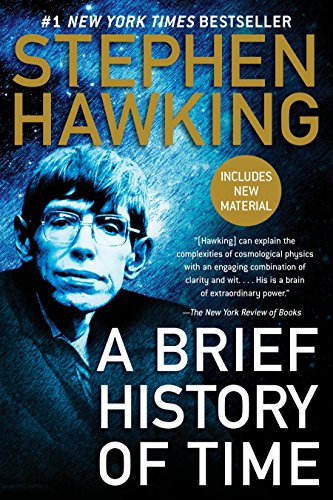
In the ten years since its publication in 1988, Stephen Hawking's classic work has become a landmark volume in scientific writing, with more than nine million copies in forty languages sold worldwide. That edition was on the cutting edge of what was then known about the origins and nature of the universe. But the intervening years have seen extraordinary advances in the technology of observing both the micro- and the macrocosmic worlds. These observations have confirmed many of Professor Hawking's theoretical predictions in the first edition of his book, including the recent discoveries of the Cosmic Background Explorer satellite (COBE), which probed back in time to within 300,000 years of the universe's beginning and revealed wrinkles in the fabric of space-time that he had projected. Eager to bring to his original text the new knowledge revealed by these observations, as well as his own recent research, Professor Hawking has prepared a new introduction to the book, written an entirely new chapter on wormholes and time travel, and updated the chapters throughout.

…
Recommended by Richard Branson, Adam Hart-Davis, Anurag Ramdasan, and 2 others.
Today is World Book Day, a wonderful opportunity to address this #ChallengeRichard sent in by Mike Gonzalez of New Jersey: Make a list of your top 65 books to read in a lifetime. [source]
Adam Hart-Davis
When Stephen Hawking wrote A Brief History of Time..his publisher told him that every equation he left in would halve the number of readers [source]
Anurag Ramdasan
My first intro into the world of physics and this got me completely hooked!
Cover unavailable
2
"Surely You're Joking, Mr. Feynman!": Adventures of a Curious Character
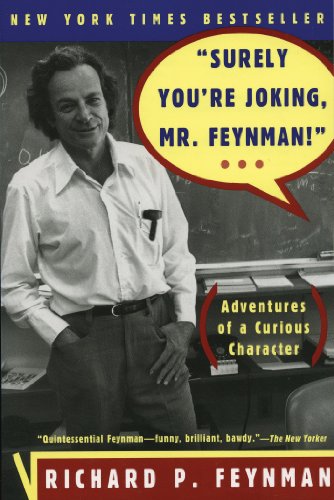
A series of anecdotes, such as are included in Surely You're Joking, Mr Feynman, shouldn't by rights add up to an autobiography, but that's just one of the many pieces of received wisdom that Nobel Prize-winning physicist Richard Feynman (1918-88) cheerfully ignores in this engagingly eccentric book. Fiercely independent (read the chapter entitled "Judging Books by Their Covers"), intolerant of stupidity even when it comes packaged as high intellectualism (check out "Is Electricity Fire?"), unafraid to offend (see "You Just Ask Them?"), Feynman informs by entertaining. It's possible to enjoy Surely You're Joking, Mr Feynman, a bestseller ever since its initial publication in 1985, simply as a bunch of hilarious yarns with the author as know-it-all hero. At some point, however, attentive readers realise that underneath all the merriment simmers a running commentary on what constitutes authentic knowledge: learning by understanding, not by rote; refusal to give up on seemingly insoluble problems, and total disrespect for fancy ideas that have no grounding in the real world. Feynman himself had all these qualities in spades, and they come through with vigour and verve in his no-bull prose. No wonder his students--and readers around the world--adored him. --Wendy Smith
Brin told the Academy of Achievement: "Aside from making really big contributions in his own field, he was pretty broad-minded. I remember he had an excerpt where he was explaining how he really wanted to be a Leonardo da Vinci, an artist and a scientist. I found that pretty inspiring. I think that leads to having a fulfilling life." [source]
Learn about the inner mindset and external state of someone who was absolutely brilliant. [source]
Cover unavailable
3
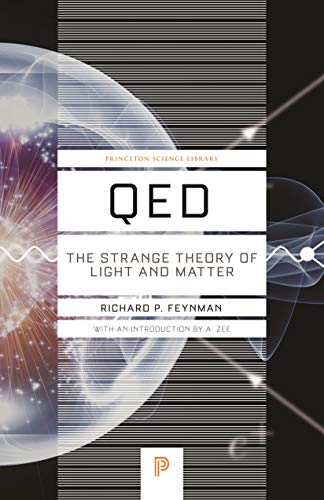
QED: The Strange Theory of Light & Matter: Alix G. Mautner Memorial Lectures
Richard P. Feynman
4.8
Famous the world over for the creative brilliance of his insights into the physical world, Nobel Prize-winning physicist Richard Feynman also possessed an extraordinary talent for explaining difficult concepts to the nonscientist. QED--the edited version of four lectures on quantum electrodynamics that Feynman gave to the general public at UCLA as part of the Alix G. Mautner Memorial Lecture series--is perhaps the best example of his ability to communicate both the substance and the spirit of science to the layperson.
The focus, as the title suggests, is quantum electrodynamics (QED), the part of the quantum theory of fields that describes the interactions of the quanta of the electromagnetic field-light, X rays, gamma rays--with matter and those of charged particles with one another. By extending the formalism developed by Dirac in 1933, which related quantum and classical descriptions of the motion of particles, Feynman revolutionized the quantum mechanical understanding of the nature of particles and waves. And, by incorporating his own readily visualizable formulation of quantum mechanics, Feynman created a diagrammatic version of QED that made calculations much simpler and also provided visual insights into the mechanisms of quantum electrodynamic processes.
In this book, using everyday language, spatial concepts, visualizations, and his renowned "Feynman diagrams" instead of advanced mathematics, Feynman successfully provides a definitive introduction to QED for a lay readership without any distortion of the basic science. Characterized by Feynman's famously original clarity and humor, this popular book on QED has not been equaled since its publication.
…
Recommended by Larry Page, Marcus Chown, and Ryan Shea.
Marcus Chown
When Feynman was at Cal Tech, this wealthy couple who’d grown up in the same New York neighbourhood as he had said, Look, you’ve won this Nobel Prize, now explain to ordinary people what for. And Feynman said, No, it’s too complicated. But eventually he did this series of public lectures, and that was the book. It’s a tiny book and in it he describes the whole of quantum electrodynamics without a single equation. [source]
Ryan Shea
@jaltma @AriannaSimpson Incredible book. Perhaps my favorite physics book. [source]
Cover unavailable
4
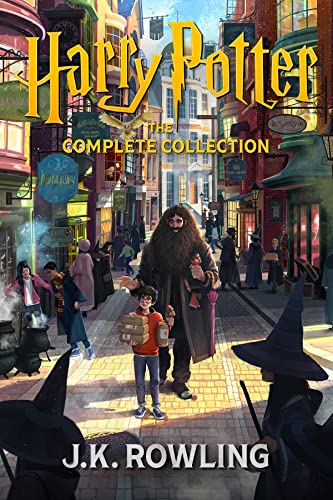
Harry Potter Boxset (Harry Potter, #1-7)
J. K. Rowling and Mary GrandPré
4.7
Now for the first time ever, J.K. Rowling’s seven bestselling Harry Potter books are available in a stunning paperback boxed set! The Harry Potter series has been hailed as “one for the ages” by Stephen King and “a spellbinding saga’ by USA Today. And most recently, The New York Times called Harry Potter and the Deathly Hallows the “fastest selling book in history.” This is the ultimate Harry Potter collection for Harry Potter fans of all ages!
As a devoted reader, the president has been linked to a lengthy list of novels and poetry collections over the years — he admits he enjoys a thriller. [source]
Adam Lawrence
I hate reading. I always have. Except for Harry Potter and To Kill A Mockingbird, which I've read dozens of times. [source]
Benjamin Kwan
I used to read more fiction when I was a lot younger just like any young boy. And of course the favourite book that teens my generation love would be Harry Potter! It just gives us an avenue to be part of that fantasy world that we have always dreamt of. [source]
Cover unavailable
5
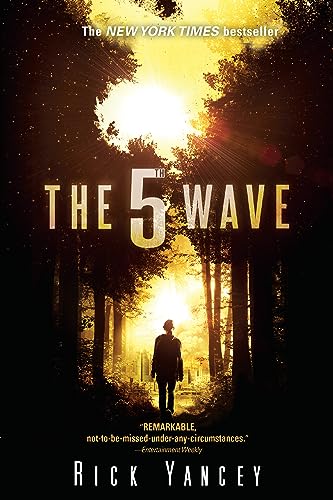
The 5th Wave (The 5th Wave, #1)
Rick Yancey
4.7
After the 1st wave, only darkness remains. After the 2nd, only the lucky escape. And after the 3rd, only the unlucky survive. After the 4th wave, only one rule applies: trust no one.
Now, it's the dawn of the 5th wave, and on a lonely stretch of highway, Cassie runs from Them. The beings who only look human, who roam the countryside killing anyone they see. Who have scattered Earth's last survivors. To stay alone is to stay alive, Cassie believes, until she meets Evan Walker. Beguiling and mysterious, Evan Walker may be Cassie's only hope for rescuing her brother-or even saving herself. But Cassie must choose: between trust and despair, between defiance and surrender, between life and death. To give up or to get up.
…
Cover unavailable
6
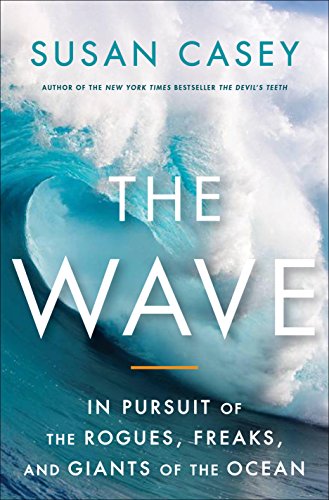
The Wave: In Pursuit of the Rogues, Freaks, and Giants of the Ocean
Susan Casey
4.7
From Susan Casey, bestselling author of The Devil’s Teeth, an astonishing book about colossal, ship-swallowing rogue waves and the surfers who seek them out.
For centuries, mariners have spun tales of gargantuan waves, 100-feet high or taller. Until recently scientists dismissed these stories—waves that high would seem to violate the laws of physics. But in the past few decades, as a startling number of ships vanished and new evidence has emerged, oceanographers realized something scary was brewing in the planet’s waters. They found their proof in February 2000, when a British research vessel was trapped in a vortex of impossibly mammoth waves in the North Sea—including several that approached 100 feet.
As scientists scramble to understand this phenomenon, others view the giant waves as the ultimate challenge. These are extreme surfers who fly around the world trying to ride the ocean’s most destructive monsters. The pioneer of extreme surfing is the legendary Laird Hamilton, who, with a group of friends in Hawaii, figured out how to board suicidally large waves of 70 and 80 feet. Casey follows this unique tribe of people as they seek to conquer the holy grail of their sport, a 100-foot wave.
In this mesmerizing account, the exploits of Hamilton and his fellow surfers are juxtaposed against scientists’ urgent efforts to understand the destructive powers of waves—from the tsunami that wiped out 250,000 people in the Pacific in 2004 to the 1,740-foot-wave that recently leveled part of the Alaskan coast.
Like Jon Krakauer’s Into Thin Air, The Wave brilliantly portrays human beings confronting nature at its most ferocious.
…
Cover unavailable
7
Wave
Sonali Deraniyagala
4.6
On the morning of December 26, 2004, on the southern coast of Sri Lanka, Sonali Deraniyagala lost her parents, her husband, and her two young sons in the tsunami she miraculously survived. In this brave and searingly frank memoir, she describes those first horrifying moments and her long journey since. She has written an engrossing, unsentimental, beautifully poised account: as she struggles through the first months following the tragedy, furiously clenched against a reality that she cannot face and cannot deny; and then, over the ensuing years, as she emerges reluctantly, slowly allowing her memory to take her back through the rich and joyous life she’s mourning, from her family’s home in London, to the birth of her children, to the year she met her English husband at Cambridge, to her childhood in Colombo; all the while learning the difficult balance between the almost unbearable reminders of her loss and the need to keep her family, somehow, still alive within her.
…
Cover unavailable
8
The Feynman Lectures on Physics
Richard P. Feynman
4.6
The legendary introduction to physics from the subject's greatest teacher "The whole thing was basically an experiment," Richard Feynman said late in his career, looking back on the origins of his lectures. The experiment turned out to be hugely successful, spawning a book that has remained a definitive introduction to physics for decades. Ranging from the most basic principles of Newtonian physics through such formidable theories as general relativity and quantum mechanics, Feynman's lectures stand as a monument of clear exposition and deep insight. Now, we are reintroducing the printed books to the trade, fully corrected, for the first time ever, and in collaboration with Caltech. Timeless and collectible, the lectures are essential reading, not just for students of physics but for anyone seeking an introduction to the field from the inimitable Feynman.
You don't have to take a course to learn physics. If you're hardcore, read the Feynman book and do the problems. [source]
David Bainbridge
I think that he is one of the most intelligent people to live in the 20th century. Yet at the same time, surprisingly, he is an amazingly good teacher. This is quite an unusual combination. [source]
Cover unavailable
9
Gravitation
Charles W. Misner, Kip S. Thorne, John Archibald Wheeler, David I. Kaiser
4.5
First published in 1973, Gravitation is a landmark graduate-level textbook that presents Einstein's general theory of relativity and offers a rigorous, full-year course on the physics of gravitation. Upon publication, Science called it "a pedagogic masterpiece," and it has since become a classic, considered essential reading for every serious student and researcher in the field of relativity. This authoritative text has shaped the research of generations of physicists and astronomers, and the book continues to influence the way experts think about the subject.
With an emphasis on geometric interpretation, this masterful and comprehensive book introduces the theory of relativity; describes physical applications, from stars to black holes and gravitational waves; and portrays the field's frontiers. The book also offers a unique, alternating, two-track pathway through the subject. Material focusing on basic physical ideas is designated as Track 1 and formulates an appropriate one-semester graduate-level course. The remaining Track 2 material provides a wealth of advanced topics instructors can draw on for a two-semester course, with Track 1 sections serving as prerequisites.
This must-have reference for students and scholars of relativity includes a new preface by David Kaiser, reflecting on the history of the book's publication and reception, and a new introduction by Charles Misner and Kip Thorne, discussing exciting developments in the field since the book's original publication.
The book teaches students to: Grasp the laws of physics in flat and curved spacetime Predict orders of magnitude Calculate using the principal tools of modern geometry Understand Einstein's geometric framework for physics Explore applications, including neutron stars, Schwarzschild and Kerr black holes, gravitational collapse, gravitational waves, cosmology, and so much more
…
Recommended by Eric Weinstein, Kirk Borne, and Seamus Blackley.
Eric Weinstein recommended this book on Twitter. [source]
Kirk Borne
#Gravity is the only one of the four fundamental forces of #Physics that doesn’t (yet) have a quantum explanation — learn how our understanding of Gravity has evolved, from Newton’s great insight to Einstein’s: https://t.co/DZJz9OJ9Lv 👇See this gravitationally heavy 3-kg book👇 https://t.co/9whUOUJqxi [source]
Seamus Blackley
A couple things saved me. One of them I found the other day, slipped into my all time favorite physics book. It was a simple note from my dad, still in it’s envelope. It said that he believed in me, and that things would work out. https://t.co/z48r12w6m6 [source]
Cover unavailable
10
Reality Is Not What It Seems: The Journey to Quantum Gravity
Carlo Rovelli, Simon Carnell, Erica Segre
4.5
“The man who makes physics sexy . . . the scientist they’re calling the next Stephen Hawking.” —The Times Magazine
From the New York Times–bestselling author of Seven Brief Lessons on Physics, a closer look at the mind-bending nature of the universe.
What are time and space made of? Where does matter come from? And what exactly is reality? Theoretical physicist Carlo Rovelli has spent his whole life exploring these questions and pushing the boundaries of what we know. Here he explains how our image of the world has changed over the last few dozen centuries.
In elegant and accessible prose, Rovelli takes us on a wondrous journey from Aristotle to Albert Einstein, from Michael Faraday to the Higgs boson, and from classical physics to his own work in quantum gravity. As he shows us how the idea of reality has evolved over time, Rovelli offers readers a deeper understanding of the theories he introduced so concisely in Seven Brief Lessons on Physics. His evocative explanations invite us to imagine, beyond our ever-changing idea of reality, a whole new world that has yet to be discovered.
…
Recommended by Caspar Henderson.
Caspar Henderson
He’s got a good, simple style, and he has a great capability to explain. [source]
Cover unavailable
11
The Infinite Sea (The 5th Wave, #2)
Rick Yance
4.4
How do you rid the Earth of seven billion humans? Rid the humans of their humanity.
Surviving the first four waves was nearly impossible. Now Cassie Sullivan finds herself in a new world, a world in which the fundamental trust that binds us together is gone. As the 5th Wave rolls across the landscape, Cassie, Ben, and Ringer are forced to confront the Others’ ultimate goal: the extermination of the human race.
Cassie and her friends haven’t seen the depths to which the Others will sink, nor have the Others seen the heights to which humanity will rise, in the ultimate battle between life and death, hope and despair, love and hate.
…
Cover unavailable
12
The Wave
Todd Strasser
4.4
The Wave is based on a true incident that occurred in a high school history class in Palo Alto, California, in 1969.
The powerful forces of group pressure that pervaded many historic movements such as Nazism are recreated in the classroom when history teacher Burt Ross introduces a "new" system to his students. And before long The Wave, with its rules of "strength through discipline, community, and action", sweeps from the classroom through the entire school. And as most of the students join the movement, Laurie Saunders and David Collins recognize the frightening momentum of The Wave and realize they must stop it before it's too late.
…
Cover unavailable
13
Why Does E=mc²? (And Why Should We Care?)
Brian Cox, Jeff Forshaw
4.4
The most accessible, entertaining, and enlightening explanation of the best-known physics equation in the world, as rendered by two of today’s leading scientists.
Professor Brian Cox and Professor Jeff Forshaw go on a journey to the frontier of 21st century science to consider the real meaning behind the iconic sequence of symbols that make up Einstein’s most famous equation, E=mc2. Breaking down the symbols themselves, they pose a series of questions: What is energy? What is mass? What has the speed of light got to do with energy and mass? In answering these questions, they take us to the site of one of the largest scientific experiments ever conducted. Lying beneath the city of Geneva, straddling the Franco-Swiss boarder, is a 27 km particle accelerator, known as the Large Hadron Collider. Using this gigantic machine—which can recreate conditions in the early Universe fractions of a second after the Big Bang—Cox and Forshaw will describe the current theory behind the origin of mass.
Alongside questions of energy and mass, they will consider the third, and perhaps, most intriguing element of the equation: 'c' - or the speed of light. Why is it that the speed of light is the exchange rate? Answering this question is at the heart of the investigation as the authors demonstrate how, in order to truly understand why E=mc2, we first must understand why we must move forward in time and not backwards and how objects in our 3-dimensional world actually move in 4-dimensional space-time. In other words, how the very fabric of our world is constructed. A collaboration between two of the youngest professors in the UK, Why Does E=mc2? promises to be one of the most exciting and accessible explanations of the theory of relativity in recent years.
…
Recommended by Phil Plait and Philip Plait.
Phil Plait
“Why Does E=mc^2” is a *great* book. It’s short, well-written, and makes it a lot easier to understand just why the speed of light is what it is. https://t.co/nfuYjouX0r [source]
Philip Plait
This book, written by Brian Cox and Jeff Forshaw, is wonderful. Brian, who is a friend of mine, is a physicist in England. By exploring the equation “energy equals mass times the speed of light squared”, this book helps you to understand why the universe is what it is. [source]
Cover unavailable
14
The Three Waves of Volunteers and the New Earth
Dolores Cannon
4.3
This is a fascinating narrative that reveals the cosmic forces that have been in play over the past 66 years. Help has come from the outside to preserve the human race.
In 1945 when the atomic bombs, our "protectors" and "watchers" in outer space saw that Earth was on a collision course with disaster. The prime directive of non-interference prevented them from taking any action, but then they came up with a brilliant plan to save Earth and assist her in her ascension. They couldn't interfere from the "outside," but maybe they could influence from the "inside." So the call went out for volunteers to come and help. "Earth is in trouble - who wants to volunteer?"
Dolores Cannon, through her hypnosis work has discovered three waves of these volunteers. Some have come direct from the "Source" and have never lived in any type of physical body before. Others have lived as space beings on other planets or other dimensions. Because all memory is erased upon entry to the Earth dimension, they do not remember their assignment. Thus these beautiful souls have a difficult time adjusting to our chaotic world. These souls have a vital role to play as they help all of the rest of us ascend to the New Earth.
…
Cover unavailable
15
The First Three Minutes: A Modern View of the Origin of the Universe
Steven Weinberg
4.3
A Nobel Prize-winning physicist explains what happened at the very beginning of the universe, and how we know, in this popular science classic.
Our universe has been growing for nearly 14 billion years. But almost everything about it, from the elements that forged stars, planets, and lifeforms, to the fundamental forces of physics, can be traced back to what happened in just the first three minutes of its life.
In this book, Nobel Laureate Steven Weinberg describes in wonderful detail what happened in these first three minutes. It is an exhilarating journey that begins with the Planck Epoch - the earliest period of time in the history of the universe - and goes through Einstein's Theory of Relativity, the Hubble Red Shift, and the detection of the Cosmic Microwave Background. These incredible discoveries all form the foundation for what we now understand as the "standard model" of the origin of the universe. The First Three Minutes examines not only what this model looks like, but also tells the exciting story of the bold thinkers who put it together.
Clearly and accessibly written, The First Three Minutes is a modern-day classic, an unsurpassed explanation of where it is we really come from.
…
Recommended by Dan Hooper, David Goldberg, and Tim Radford.
Dan Hooper
Steve Weinberg is arguably the most brilliant physicist of the last many decades. He’s an absolute luminary. He also happens to be a really good writer and communicator. I’ve liked all of the books of his I’ve read, but I picked The First Three Minutes because it is the classic book about the Big Bang and the first three minutes of our universe’s history. [source]
David Goldberg
Another one that has to be on any list like this is The First Three Minutes by Steven Weinberg, a Nobel Prize-winner. It’s a relatively slim volume, in which he describes what happened in the first three minutes of the Big Bang, as it was known and understood back then 1977. We’ve learned a fair amount since then and some of the details in his original version are a little off, but the basic picture is still incredibly accurate. It’s just a really great description of the beginning of the universe, and almost every book on cosmology will include some variants of Weinberg’s description because he walks through it in such a clear way. [source]
Tim Radford
Not only is it the beginning of the universe, it’s the beginning of books about the universe. [source]
Cover unavailable
16
Faraday, Maxwell, and the Electromagnetic Field: How Two Men Revolutionized Physics
Nancy Forbes and Basil Mahon
4.3
The story of two brilliant nineteenth-century scientists who discovered the electromagnetic field, laying the groundwork for the amazing technological and theoretical breakthroughs of the twentieth century.
Two of the boldest and most creative scientists of all time were Michael Faraday (1791-1867) and James Clerk Maxwell (1831-1879). This is the story of how these two men - separated in age by forty years - discovered the existence of the electromagnetic field and devised a radically new theory which overturned the strictly mechanical view of the world that had prevailed since Newton's time.
The authors, veteran science writers with special expertise in physics and engineering, have created a lively narrative that interweaves rich biographical detail from each man's life with clear explanations of their scientific accomplishments. Faraday was an autodidact, who overcame class prejudice and a lack of mathematical training to become renowned for his acute powers of experimental observation, technological skills, and prodigious scientific imagination. James Clerk Maxwell was highly regarded as one of the most brilliant mathematical physicists of the age. He made an enormous number of advances in his own right. But when he translated Faraday's ideas into mathematical language, thus creating field theory, this unified framework of electricity, magnetism and light became the basis for much of later, 20th-century physics.
Faraday's and Maxwell's collaborative efforts gave rise to many of the technological innovations we take for granted today - from electric power generation to television, and much more. Told with panache, warmth, and clarity, this captivating story of their greatest work - in which each played an equal part - and their inspiring lives will bring new appreciation to these giants of science.
It's a combination of scientific biography and explanation of the physics, particularly relating to electricity. It's just the best book of its kind I have ever read, and I just hugely enjoyed it. Couldn't put it down. It was a fabulous human achievement. And neither of the writers is a physicist. [source]
Cover unavailable
17
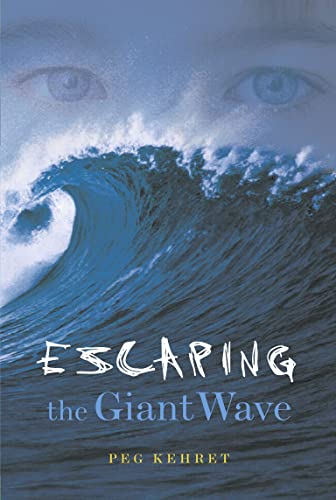
Escaping the Giant Wave
Peg Kehret
4.3
When an earthquake hits on their family vacation, can Kyle and his sister survive the following tsunami?
The Worst Vacation Ever!
Thirteen-year-old Kyle thought spending a vacation on the Oregon coast with his family would be great. He’d never flown before, and he’s never seen the Pacific Ocean.
One evening Kyle is left in charge of his younger sister, BeeBee, while his parents attend an adults-only Salesman of the Year dinner on an elegant yacht.
Then the earthquake comes—starting a fire in their hotel! As Kyle and BeeBee fight their way out through smoke and flame, Kyle remembers the sign at the beach that said after an earthquake everyone should go uphill and inland, as far from the ocean as possible. Giant tsunami waves—three or four stories high—can ride in from the sea and engulf anyone who doesn’t escape fast enough.
Kyle and BeeBee flee uphill as a tsunami crashes over the beach, the hotel, and the town. The giant wave charges straight up the hillside and through the woods where the children are running for their lives. The perfect vacation has become a nightmare! Somehow Kyle and BeeBee have to outwit nature’s fury and save themselves from tsunami terror.
…
Cover unavailable
18
Madness, Rack, and Honey: Collected Lectures
Mary Ruefle
4.3
This is one of the wisest books I've read in years... —New York Times Book Review
No writer I know of comes close to even trying to articulate the weird magic of poetry as Ruefle does. She acknowledges and celebrates in the odd mystery and mysticism of the act—the fact that poetry must both guard and reveal, hint at and pull back... Also, and maybe most crucially, Ruefle’s work is never once stuffy or overdone: she writes this stuff with a level of seriousness-as-play that’s vital and welcome, that doesn’t make writing poetry sound anything but wild, strange, life-enlargening fun. -The Kenyon Review
Profound, unpredictable, charming, and outright funny...These informal talks have far more staying power and verve than most of their kind. Readers may come away dazzled, as well as amused... —Publishers Weekly
This is a book not just for poets but for anyone interested in the human heart, the inner-life, the breath exhaling a completion of an idea that will make you feel changed in some way. This is a desert island book. —Matthew Dickman
The accomplished poet is humorous and self-deprecating in this collection of illuminating essays on poetry, aesthetics and literature... —San Francisco Examiner
Over the course of fifteen years, Mary Ruefle delivered a lecture every six months to a group of poetry graduate students. Collected here for the first time, these lectures include "Poetry and the Moon," "Someone Reading a Book Is a Sign of Order in the World," and "Lectures I Will Never Give." Intellectually virtuosic, instructive, and experiential, Madness, Rack, and Honey resists definition, demanding instead an utter—and utterly pleasurable—immersion. Finalist for the 2012 National Book Critics Circle Award.
Mary Ruefle has published more than a dozen books of poetry, prose, and erasures. She lives in Vermont.
…
Cover unavailable
19
Bluets
Maggie Nelson
4.3
Suppose I were to begin by saying that I had fallen in love with a color...
A lyrical, philosophical, and often explicit exploration of personal suffering and the limitations of vision and love, as refracted through the color blue. With Bluets, Maggie Nelson has entered the pantheon of brilliant lyric essayists.
Maggie Nelson is the author of numerous books of poetry and nonfiction, including Something Bright, Then Holes (Soft Skull Press, 2007) and Women, the New York School, and Other True Abstractions (University of Iowa Press, 2007). She lives in Los Angeles and teaches at the California Institute of the Arts.
…
Cover unavailable
20
The Darkest Minds Series Boxed Set
Alexandra Bracken
4.3
All four novels in the New York Times best-selling Darkest Minds series--The Darkest Minds, Never Fade, In the Afterlight, and Through the Dark--are now available in one thrilling paperback boxed set. With gorgeous, fresh designs and exclusive bonus short stories from the perspectives of fan-favorite characters Liam, Vida, and Clancy, this collection will delight loyal fans and new readers alike, just in time for the major motion picture starring Amandla Stenberg and Mandy Moore. Praise for the Darkest Minds series: "Meet your next dystopian obsession."--Entertainment Weekly
"Haunting... Bracken creates a gripping and terrifying dystopian world."--Kirkus Reviews "Heart-wrenching but completely riveting, this novel pulls no punches."--BCCB
"A riveting, emotional read that kept me on edge!"--New York Times best-selling author Melissa Marr
…
Cover unavailable
21
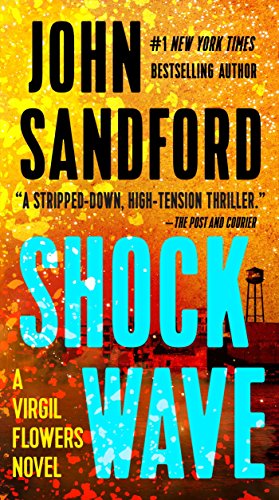
Shock Wave (Virgil Flowers, #5)
John Sandfor
4.3
The thrilling new Virgil Flowers novel from the #1 New York Times–bestselling author.
Talk about risky business.
The superstore chain PyeMart has its sights set on a Minnesota river town, but two very angry groups want to stop it: the local merchants fearing for their businesses, and the environmentalists predicting ecological disaster. The protests don't seem to be slowing the project down, though, until someone decides to take matters into his own hands.
The first bomb goes off on the top floor of PyeMart's headquarters. The second one explodes at the construction site itself. The blasts are meant to inflict maximum damage—and they do.
Who's behind the bombs and how far will they go? It's Virgil Flowers's job to find out . . . before more people get killed.
…
Cover unavailable
22
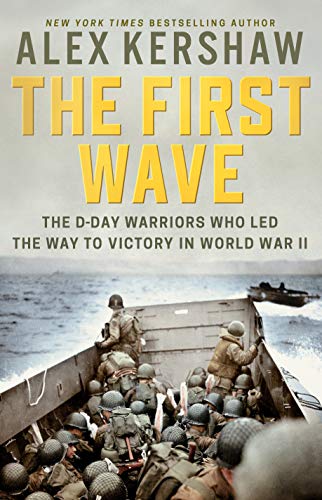
The First Wave: The D-Day Warriors Who Led the Way to Victory in World War II
Alex Kershaw
4.2
The New York Times bestselling author of The Liberator and Avenue of Spies returns with a thrilling, action-heavy account of D-Day combat.
Beginning in the predawn darkness of June 6, 1944, The First Wave follows ten men attempting to carry out D-Day's most critical missions. Their actions would determine the fate of the invasion of Hitler's Fortress Europe.
The ten make a charismatic, unforgettable cast. They include the first American paratrooper to touch down on Normandy soil; the only British soldier that day to earn a Victoria Cross; the Canadian brothers who led their decimated troops onto Juno Beach under withering fire; the colonel who faced the powerful 150-mm guns of the Merville Battery; as well as a French commando who helped destroy German strongholds on Sword Beach. This book will give authentic voice to the invaders' enemies--the German-enlisted men and officers tasked with destroying the Allies as they hit the beaches.
The result is an utterly immersive, adrenaline-driven drama, an epic of close combat and extraordinary heroism. It is the capstone Alex Kershaw's remarkable career, built on his close friendships with D-Day survivors and his intimate understanding of the Normandy battlefield. For the seventy-fifth anniversary, here is a fresh take on World War II's longest day.
…
Cover unavailable
23
The Last Star (The 5th Wave, #3)
Rick Yancey
4.2
The enemy is Other. The enemy is us.
They’re down here, they’re up there, they’re nowhere. They want the Earth, they want us to have it. They came to wipe us out, they came to save us.
But beneath these riddles lies one truth: Cassie has been betrayed. So has Ringer. Zombie. Nugget. And all 7.5 billion people who used to live on our planet. Betrayed first by the Others, and now by ourselves.
In these last days, Earth’s remaining survivors will need to decide what’s more important: saving themselves…or saving what makes us human.
…
Cover unavailable
24
The Field: The Quest for the Secret Force of the Universe
Lynne McTaggart
4.2
Science has recently begun to prove what ancient myth and religion have always espoused: There may be such a thing as a life force.
Lynne McTaggart, indefatigable investigative journalist, reveals a radical new biological paradigm -- that on our most fundamental level, the human mind and body are not distinct and separate from their environment but a packet of pulsating power constantly interacting with this vast energy sea.
The Field is a highly readable scientific detective story that offers a stunning picture of an interconnected universe and a new scientific theory that makes sense of supernatural phenomena. Original, well researched, and well documented by distinguished sources, The Field is a book of hope and inspiration for today's world.
…
Cover unavailable
25
Rescuing Ladybugs: Inspirational Encounters with Animals That Changed the World
Jennifer Skiff
4.2
Most children delight in interacting with ladybugs, butterflies, even ants. At a petting zoo, they marvel at goats, cows, and chickens. They often go on to lock eyes with a dog, cat, or hamster. Rescuing Ladybugs is about those moments with animals when we feel a connection. In 1997 the author came face to face with a bear imprisoned in a cage, confined by a straightjacket. What could she do? She subsequently led a campaign to build the first bear sanctuary in Laos. Her experience is far from unique, as the compelling stories here show. From Jaguars in Brazil and Mantas in the Maldives to chickens, rabbits, and pigs at home, humans are moved to rescue animals. As Skiff shows, each and every way we experience connection with our fellow creatures, and give voice to the voiceless, adds to our own well-being. The life force of animals, she reveals, can help one find one's own.
…
Cover unavailable
26
The Feynman Lectures on Physics Vol 3
Richard P. Feynman, Robert B. Leighton, Matthew Sands
4.2
This revised edition of Feynman's legendary lectures includes extensive corrections Feynman and his colleagues received and Caltech approved, making this the definitive edition of "The Feynman Lectures on Physics." For all readers interested in physics.
Cover unavailable
27
Hyperspace: A Scientific Odyssey Through Parallel Universes, Time Warps, and the Tenth Dimension
Michio Kaku
4.2
Cover unavailable
28
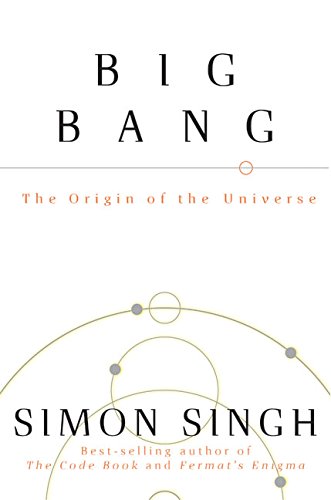
Big Bang: The Origin of the Universe
Simon Singh
4.2
A half century ago, a shocking Washington Post headline claimed that the world began in five cataclysmic minutes rather than having existed for all time; a skeptical scientist dubbed the maverick theory the Big Bang. In this amazingly comprehensible history of the universe, Simon Singh decodes the mystery behind the Big Bang theory, lading us through the development of one of the most extraordinary, important, and awe-inspiring theories in science.
…
Cover unavailable
29
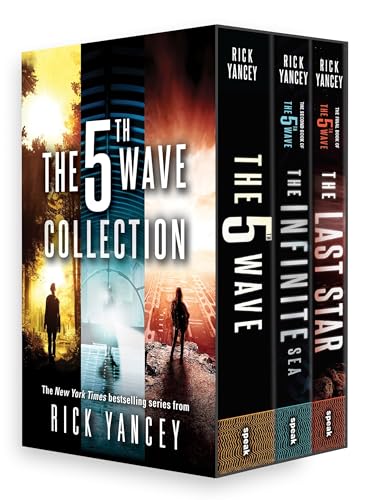
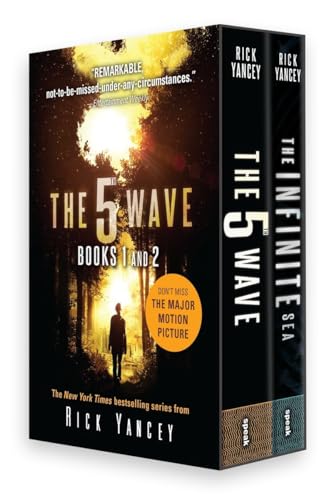
The 5th Wave Collection
Rick Yancey
4.2
Rick Yancey's entire blockbuster bestselling 5th Wave series is now available in a boxed set--great for binge-reading!
In The 5th Wave, Cassie finds herself in a world devastated by alien attack, desperate to save herself and find her lost brother. As the onslaught from the Others--the beings that look human and kill anyone they see--continues, Cassie's mission is to stay alone and stay alive. But then she meets Evan Walker, who may be Cassie's only hope for rescuing her brother--or even saving herself. Cassie must choose: between trust and despair, between defiance and surrender, between life and death.
In The Infinite Sea, the heart-stopping action continues as the situation gets even worse for Cassie and the rest of Earth's remaining human survivors. No one knows the depths to which the Others will sink, nor can they imagine the heights to which the human spirit can reach as they face the ultimate test.
In The Last Star, Earth's remaining survivors will need to decide what's more important: saving themselves . . . or saving what makes them human. The final book in this epic series will leave you awestruck.
Included in this Collection: The 5th Wave, The Infinite Sea, The Last Star
"Wildly entertaining . . . I couldn't turn the pages fast enough."--Justin Cronin, The New York Times Book Review
"A modern sci-fi masterpiece."--USA Today
…
Cover unavailable
30
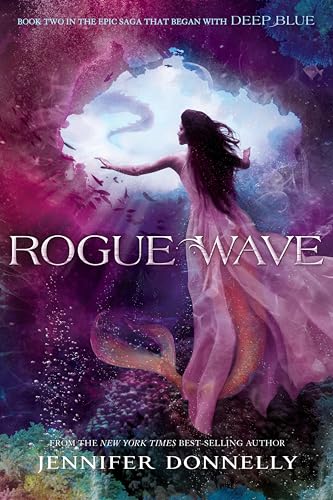
Rogue Wave (Waterfire Saga, #2)
Jennifer Donnelly
4.2
Serafina, Neela, Ling, Ava, Becca, and Astrid, six mermaids from realms scattered throughout the seas and freshwaters, were summoned by the leader of the river witches to learn an incredible truth: the mermaids are direct descendants of the Six Who Ruled-powerful mages who once governed the lost empire of Atlantis. The ancient evil that destroyed Atlantis is stirring again, and only the mermaids can defeat it. To do so, they need to find magical talismans that belonged to the Six.
Serafina believes her talisman was buried with an old shipwreck. While researching its location, she is almost discovered by a death rider patrol led by someone familiar. . . . The pain of seeing him turned traitor is devastating.
Neela travels to Matali to warn her parents of the grave threat facing their world. But they find her story outlandish; a sign that she needs to be confined to her chamber for rest and recovery. She escapes and travels to Kandina, where her talisman is in the possession of fearsome razormouth dragons.
As they hunt for their talismans, both Serafina and Neela find reserves of courage and cunning they didn't know they possessed. They face down danger and death, only to endure a game-changing betrayal, as shocking as a rogue wave.
…
Cover unavailable
31
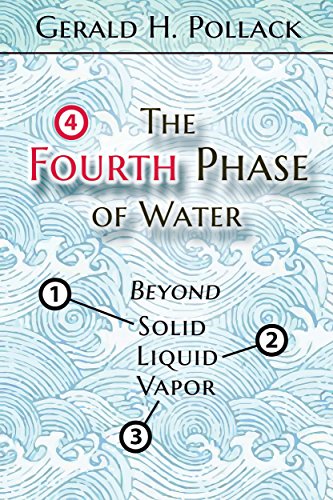
The Fourth Phase of Water: Beyond Solid, Liquid, and Vapor
Gerald H. Pollack
4.2
World renowned scientist, Dr. Gerald Pollack, takes us on a fantastic voyage through water, showing us a hidden universe teeming with physical activity - providing simple explanations for common everyday phenomena, which you have inevitably seen but not really understood.
For instance, have you ever wondered. . .
How do clouds made up of dense water droplets manage to float in the sky? Why don't your joints squeak as they rub together? Why do you sink in dry sand, but not in wet sand? How does capillary action manage to raise water up a 100 foot tree? Why does warm water freeze quicker than cool water?
Pollack uses a recent and fundamental scientific finding - EZ water - to help explain these and many other head-scratchers.
When touching most surfaces, water transforms itself into so-called EZ (Exclusion Zone) water, also known as structured water or fourth phase water. EZ water, whose formula is H3O2, differs dramatically from H2O. And, there is a lot of it, everywhere.
This award-winning book provides ample evidence for the existence of EZ water. Pollack writes in a clear, eloquent style.
PLEASE NOTE: If you chose to purchase this title in the Audible format, the accompanying PDF will be available in your Audible Library along with the audio.
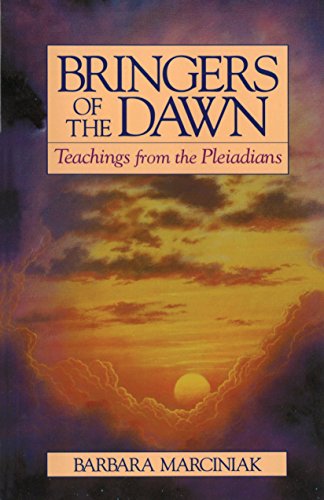
Bringers of the Dawn: Teachings from the Pleiadians
Barbara Marciniak
4.2
Compiled from more than four hundred hours of channeling by Barbara Marciniak, Bringers of the Dawn imparts to us the wisdom of the Pleiadians, a group of enlightened beings who have come to Earth to help us discover how to reach a new stage of evolution.
Master storytellers and humorists, they advise us to become media free, to work in teams, and to eliminate the words "should" and "try" from our vocabularies. We learn how to go beyond fear, how the original human was a magnificent being with twelve strands of DNA and twelve chakra centers, and who our "gods" are.
Startling, intense, intelligent, and controversial, these teachings offer essential reading for anyone questioning their existence on this planet and the direction of our collective conscious--and unconscious.
By remembering that we are Family of Light, that we share an ancient ancestry with the universe around us, we become "bringers of the dawn," consciously creating a new reality, a new Earth.
…
Cover unavailable
33
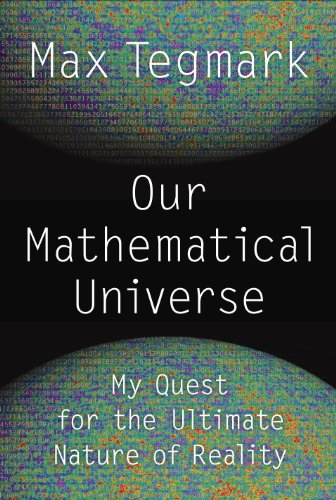
Our Mathematical Universe: My Quest for the Ultimate Nature of Reality
Max Tegmark
4.2
Our Mathematical Universe is a journey to explore the mysteries uncovered by cosmology and to discover the nature of reality. Our Big Bang, our distant future, parallel worlds, the sub-atomic and intergalactic - none of them are what they seem. But there is a way to understand this immense strangeness - mathematics. Seeking an answer to the fundamental puzzle of why our universe seems so mathematical, Tegmark proposes a radical idea: that our physical world not only is described by mathematics, but that it is mathematics. This may offer answers to our deepest questions: How large is reality? What is everything made of? Why is our universe the way it is?
Table of Contents Preface
1 What Is Reality? Not What It Seems • What’s the Ultimate Question? • The Journey Begins
Part One: Zooming Out
2 Our Place in Space Cosmic Questions • How Big Is Space? • The Size of Earth • Distance to the Moon • Distance to the Sun and the Planets • Distance to the Stars • Distance to the Galaxies • What Is Space?
3 Our Place in Time Where Did Our Solar System Come From? • Where Did the Galaxies Come From? • Where Did the Mysterious Microwaves Come From? • Where Did the Atoms Come From?
4 Our Universe by Numbers Wanted: Precision Cosmology • Precision Microwave-Background Fluctuations • Precision Galaxy Clustering • The Ultimate Map of Our Universe • Where Did Our Big Bang Come From?
5 Our Cosmic Origins What’s Wrong with Our Big Bang? • How Inflation Works • The Gift That Keeps on Giving • Eternal Inflation
6 Welcome to the Multiverse The Level I Multiverse • The Level II Multiverse • Multiverse Halftime Roundup
Part Two: Zooming In
7 Cosmic Legos Atomic Legos • Nuclear Legos • Particle-Physics Legos • Mathematical Legos • Photon Legos • Above the Law? • Quanta and Rainbows • Making Waves • Quantum Weirdness • The Collapse of Consensus • The Weirdness Can’t Be Confined • Quantum Confusion
8 The Level III Multiverse The Level III Multiverse • The Illusion of Randomness • Quantum Censorship • The Joys of Getting Scooped • Why Your Brain Isn’t a Quantum Computer • Subject, Object and Environment • Quantum Suicide • Quantum Immortality? • Multiverses Unified • Shifting Views: Many Worlds or Many Words?
Part Three: Stepping Back
9 Internal Reality, External Reality and Consensus Reality External Reality and Internal Reality • The Truth, the Whole Truth and Nothing but the Truth • Consensus Reality • Physics: Linking External to Consensus Reality
10 Physical Reality and Mathematical Reality Math, Math Everywhere! • The Mathematical Universe Hypothesis • What Is a Mathematical Structure?
11 Is Time an Illusion? How Can Physical Reality Be Mathematical? • What Are You? • Where Are You? (And What Do You Perceive?) • When Are You?
12 The Level IV Multiverse Why I Believe in the Level IV Multiverse • Exploring the Level IV Multiverse: What’s Out There? • Implications of the Level IV Multiverse • Are We Living in a Simulation? • Relation Between the MUH, the Level IV Multiverse and Other Hypotheses •Testing the Level IV Multiverse
13 Life, Our Universe and Everything How Big Is Our Physical Reality? • The Future of Physics • The Future of Our Universe—How Will It End? • The Future of Life •The Future of You—Are You Insignificant?
Acknowledgments Suggestions for Further Reading Index
On Mark Cuban's list of books to read in 2018. [source]
Cover unavailable
34
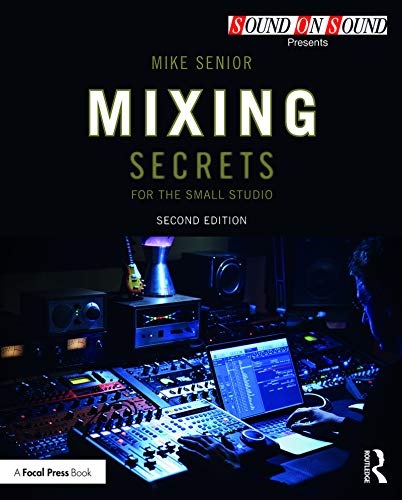
Mixing Secrets for the Small Studio
Mike Senior
4.2
Discover how to achieve release-quality mixes even in the smallest studios by applying power-user techniques from the world's most successful producers.
Mixing Secrets For The Small Studio is a down-to-earth primer for small-studio enthusiasts who want chart-ready sonics in a hurry. Drawing on the back-room strategies of more than 100 famous names, this entertaining guide leads you step-by-step through the entire mixing process. On the way, you'll unravel the mysteries of every type of mix processing, from simple EQ and compression through to advanced spectral dynamics and 'fairy dust' effects. User-friendly explanations introduce technical concepts on a strictly need-to-know basis, while chapter summaries and assignments are perfect for school and college use.
* Learn the subtle editing, arrangement, and monitoring tactics which give industry insiders their competitive edge, and master the psychological tricks which protect you from all the biggest rookie mistakes.
* Find out where you don't need to spend money, as well as how to make a limited budget really count.
* Pick up tricks and tips from leading-edge engineers working on today's multi-platinum hits, including Michael Brauer, Serban Ghenea, the Lord-Alge brothers, Tony Maserati, Manny Marroquin, Dave 'Hard Drive' Pensado, Jack Joseph Puig, Mark 'Spike' Stent, Phil Tan, Andy Wallace, and many, many more...
Mike Senior is a professional engineer who has worked with Wet Wet Wet, The Charlatans, Reef, Therapy, and Nigel Kennedy. He specialises in adapting the techniques of top producers for those working on a budget. Since 2007 he has transformed dozens of amateur productions for Sound On Sound magazine's popular 'Mix Rescue' column, proving time and again that you can achieve commercial-grade results with affordable gear -- once you know how!
…
Cover unavailable
35
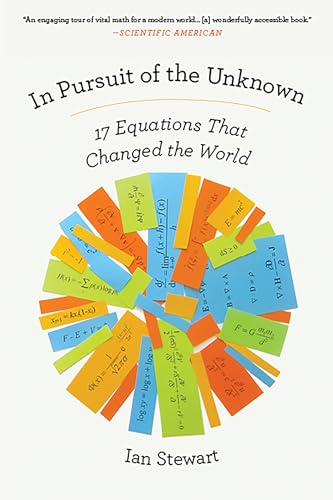
In Pursuit of the Unknown: 17 Equations That Changed the World
Ian Stewart
4.2
In In Pursuit of the Unknown, celebrated mathematician Ian Stewart uses a handful of mathematical equations to explore the vitally important connections between math and human progress. We often overlook the historical link between mathematics and technological advances, says Stewart—but this connection is integral to any complete understanding of human history.Equations are modeled on the patterns we find in the world around us, says Stewart, and it is through equations that we are able to make sense of, and in turn influence, our world. Stewart locates the origins of each equation he presents—from Pythagoras's Theorem to Newton's Law of Gravity to Einstein's Theory of Relativity—within a particular historical moment, elucidating the development of mathematical and philosophical thought necessary for each equation's discovery. None of these equations emerged in a vacuum, Stewart shows; each drew, in some way, on past equations and the thinking of the day. In turn, all of these equations paved the way for major developments in mathematics, science, philosophy, and technology. Without logarithms (invented in the early 17th century by John Napier and improved by Henry Briggs), scientists would not have been able to calculate the movement of the planets, and mathematicians would not have been able to develop fractal geometry. The Wave Equation is one of the most important equations in physics, and is crucial for engineers studying the vibrations in vehicles and the response of buildings to earthquakes. And the equation at the heart of Information Theory, devised by Claude Shannon, is the basis of digital communication today.
An approachable and informative guide to the equations upon which nearly every aspect of scientific and mathematical understanding depends, In Pursuit of the Unknown is also a reminder that equations have profoundly influenced our thinking and continue to make possible many of the advances that we take for granted.
…
Recommended by Ante Shoda and Nick Higham.
Ante Shoda
This is written by a professor of mathematics from the United Kingdom, and it describes a number of mathematical breakthroughs and their consequences related to engineering and the practical usage of mathematics in machines and other things that we use every day. It’s a great introduction to the underlying principles of engineering. [source]
Nick Higham
He is a brilliant writer and one of the most famous people in the world for popularising mathematics. [source]
Cover unavailable
36
Experiments in Electronics Fundamentals and Electric Circuits Fundamentals: To Accompany Floyd, Electronics Fundamentals and Electric Circuit Fundamentals
David Buchla
4.2
Cover unavailable
37
My Private Property
Mary Ruefle
4.2
Author of Madness, Rack, and Honey ("One of the wisest books I've read in years," according to the New York Times) and Trances of the Blast, Mary Ruefle continues to be one of the most dazzling poets in America. My Private Property, comprised of short prose pieces, is a brilliant and charming display of her humor, deep imagination, mindfulness, and play in a finely crafted edition.
Personalia
When I was young, a fortune-teller told me that an old woman who wanted to die had accidentally become lodged in my body. Slowly, over time, and taking great care in following esoteric instructions, including lavender baths and the ritual burial of keys in the backyard, I rid myself of her presence. Now I am an old woman who wants to die and lodged inside me is a young woman dying to live; I work on her.
Mary Ruefle is the author of Trances of the Blast; Madness, Rack, and Honey: Collected Lectures, a finalist for the 2013 National Book Critics Circle Award in criticism; and Selected Poems, winner of the William Carlos Williams Award. She has published ten other books of poetry, a book of prose (The Most of It), and a comic book, Go Home and Go to Bed!; she is also an erasure artist whose treatments of nineteenth-century texts have been exhibited in museums and galleries as well as published in the book A Little White Shadow. Ruefle is the recipient of numerous honors, including an Award in Literature from the American Academy of Arts and Letters, a Guggenheim fellowship, a National Endowment for the Arts fellowship, and a Whiting Award. She lives in Bennington, Vermont and teaches in the MFA program at Vermont College.
…
Cover unavailable
38
World Radio TV Handbook 2020: The Directory of Global Broadcasting
WRTH Editors
4.2
Cover unavailable
39
Waves of Mercy (Waves of Mercy, #1)
Lynn Austin
4.2
Geesje de Jonge crossed the ocean at age seventeen with her parents and a small group of immigrants from the Netherlands to settle in the Michigan wilderness. Fifty years later, in 1897, she's asked to write a memoir of her early experiences as the town celebrates its anniversary. Reluctant at first, she soon uncovers memories and emotions hidden all these years, including the story of her one true love.
At the nearby Hotel Ottawa Resort on the shore of Lake Michigan, twenty-three-year-old Anna Nicholson is trying to ease the pain of a broken engagement to a wealthy Chicago banker. But her time of introspection is disturbed after a violent storm aboard a steamship stirs up memories of a childhood nightmare. As more memories and dreams surface, Anna begins to question who she is and whether she wants to return to her wealthy life in Chicago. When she befriends a young seminary student who is working at the hotel for the summer, she finds herself asking him all the questions that have been troubling her.
Neither Geesje nor Anna, who are different in every possible way, can foresee the life-altering surprises awaiting them before the summer ends.
…
Cover unavailable
40
You Good Thing
Dara Wier
4.2
"This anti-elegy, both reverent and funny, anticipates the funny reverence that Wier finds, makes up, and sustains throughout her decades of subsequent writing."—Jacket Magazine
Dara Wier's loose sonnets insist on a living language in the face of death, cycling and vibrant as the water that runs through them.
. . . Assigned to Adventure said the motto on our buttons. The last thing we knew Before we left with our satchels concerned how love withdraws Moving backward taking with it everything, our names, this way.
Dara Wier directs the MFA program at University of Massachusetts, Amherst. This is her ninth book, and first new collection of poetry since 2006.
…
Cover unavailable
41
When the Waves Came
Michael Larson
4.2
Cover unavailable
42
Nobody's Boy
Hector Malot and John B. Gruell
4.2
A compelling story in which orphaned Remi gets hired out to a traveling street entertainer when his foster parents fall on hard times. Going from village to village with its act, ‘nobody’s boy’ has numerous adventures until his boss also falls on hard times and perishes, homeless and destitute. Remi’s life includes a number of surprising twists and turns, leading to a climax and a very happy conclusion when he is reunited with his family.
…
Cover unavailable
43
Of Mongrelitude
Julian Talamantez Brolaski
4.2
Of Mongrelitude is a colloquy on the mongrel body, texual and actual, sexual, specieal, and racial. Composed in a hybrid style, it makes the argument that everything can and does come into ‘englyssh’: ancient and invented languages, european and indigenous, tongues not yet named. All of this ‘made up as medicine’, as ceremony for all creatures, as literal song.
Julian T. Brolaski is the author of Advice for Lovers (City Lights 2012), gowanus atropolis (Ugly Duckling Presse 2011), and co-editor of NO GENDER: Reflections on the Life & Work of kari edwards (Litmus Press / Belladonna Books 2009). Julian lives in Oakland, and is the lead singer and rhythm guitarist in the country band The Western Skyline.
…
Cover unavailable
44
Principles of Quantum Mechanics
Ramamurti Shankar
4.2
Reviews from the First Edition:
"An excellent text ... The postulates of quantum mechanics and the mathematical underpinnings are discussed in a clear, succinct manner." (American Scientist)
"No matter how gently one introduces students to the concept of Dirac's bras and kets, many are turned off. Shankar attacks the problem head-on in the first chapter, and in a very informal style suggests that there is nothing to be frightened of." (Physics Bulletin)
Reviews of the Second Edition:
"This massive text of 700 and odd pages has indeed an excellent get-up, is very verbal and expressive, and has extensively worked out calculational details---all just right for a first course. The style is conversational, more like a corridor talk or lecture notes, though arranged as a text. ... It would be particularly useful to beginning students and those in allied areas like quantum chemistry." (Mathematical Reviews)
R. Shankar has introduced major additions and updated key presentations in this second edition of Principles of Quantum Mechanics. New features of this innovative text include an entirely rewritten mathematical introduction, a discussion of Time-reversal invariance, and extensive coverage of a variety of path integrals and their applications. Additional highlights include:
- Clear, accessible treatment of underlying mathematics
- A review of Newtonian, Lagrangian, and Hamiltonian mechanics
- Student understanding of quantum theory is enhanced by separate treatment of mathematical theorems and physical postulates
- Unsurpassed coverage of path integrals and their relevance in contemporary physics
The requisite text for advanced undergraduate- and graduate-level students, Principles of Quantum Mechanics, Second Edition is fully referenced and is supported by many exercises and solutions. The book's self-contained chapters also make it suitable for independent study as well as for courses in applied disciplines.
Eric Weinstein recommended this book on Twitter. [source]
Cover unavailable
45
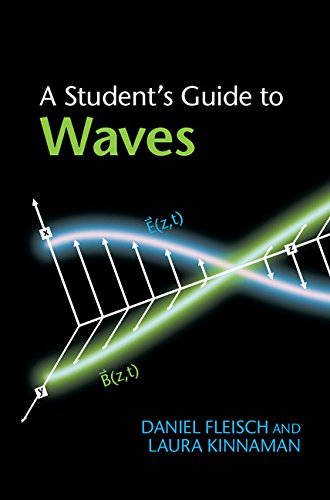
A Student's Guide to Waves
Daniel Fleisch
4.2
Waves are an important topic in the fields of mechanics, electromagnetism, and quantum theory, but many students struggle with the mathematical aspects. Written to complement course textbooks, this book focuses on the topics that students find most difficult. Retaining the highly popular approach used in Fleisch's other Student's Guides, the book uses plain language to explain fundamental ideas in a simple and clear way. Exercises and fully-worked examples help readers test their understanding of the concepts, making this an ideal book for undergraduates in physics and engineering trying to get to grips with this challenging subject. The book is supported by a suite of online resources available at www.cambridge.org/9781107643260. These include interactive solutions for every exercise and problem in the text and a series of video podcasts in which the authors explain the important concepts of every section of the book.
…
Cover unavailable
46
My Inventions: The Autobiography of Nikola Tesla
Nikola Tesla
4.1
This important title is the autobiography of Nikola Tesla. Nikola Tesla appropriately titled his work on his life, My Inventions, as he was one of the most important inventors and scientists in history. The book touches on his life and career, his first inventions, discovering the magnetic field, tesla coil and transformer and the manifying transmitter. There is also a chapter on the art of teleautomatics. This book should be read by anybody interested in the life of this important inventor and scientist and his important discoveries which have revolutionized the world.
I didn't read actually very many general business books, but I like biographies and autobiographies, I think those are pretty helpful. Actually, a lot of them aren't really business. … I think it's also worth reading books on scientists and engineers. Tesla, obviously. [source]
Cover unavailable
47
Ghost Wave: The True Story of the Biggest Wave on Earth and the Men Who Challenged It
Chris Dixon
4.1
Rising from the depths of the Pacific lies a fabled island, now submerged just below the surface of the ocean. Rumors and warnings about Cortes Bank abound, but among big wave surfers, this legendary rock is famous for one simple (and massive) reason: this is the home of the biggest rideable wave on the face of the earth. In this dramatic work of narrative non-fiction, journalist Chris Dixon unlocks the secrets of Cortes Bank and pulls readers into the harrowing world of big wave surfing and high seas adventure above the most enigmatic and dangerous rock in the sea. The true story of this Everest of the sea will thrill anyone with an abiding curiosity of—and respect for—mother ocean.
…
Cover unavailable
48
The Ankh, The: African Origin of Electromagnetism
Nur Ankh Amen
4.1
Cover unavailable
49
The Character of Physical Law
Richard Feynman
4.1
In the Messenger Lectures, originally delivered at Cornell University & recorded for TV by the BBC, Feynman offers an overview of selected physical laws & gathers their common features into one broad principle of invariance. He maintains at the outset that the importance of a physical law isn't "how clever we are to have found it out, but...how clever nature is to pay attention to it" & tends his discussions toward a final exposition of the elegance & simplicity of all scientific laws. Rather than an essay on the most significant achievements in modern science, The Character of Physical Law is a statement of what is most remarkable in nature. His enlightened approach, wit & enthusiasm make this a memorable exposition of the scientist's craft. The Law of Gravitation is the principal example. Relating the details of its discovery & stressing its mathematical character, he uses it to demonstrate the essential interaction of mathematics & physics. He views mathematics as the key to any system of scientific laws, suggesting that if it were possible to fill out the structure of scientific theory completely, the result would be an integrated set of axioms. The principles of conservation, symmetry & time-irreversibility are then considered in relation to developments in classical & modern physics. In his final lecture he develops his own analysis of the process & future of scientific discovery. Like any set of oral reflections, The Character of Physical Law has value as a demonstration of a mind in action. The reader is particularly lucky in Feynman. One of the most eminent & imaginative modern physicists, he was Professor of Theoretical Physics at the California Institute of Technology until his death in 1988. He's best known for work on the quantum theory of the electromagnetic field, as well as for later research in the field of low-temperature physics. In 1954 he received the Albert Einstein Award for an "outstanding contribution to knowledge in mathematical & physical sciences"; in 1965 he was appointed to Foreign Membership in the Royal Society & was awarded the Nobel Prize.
…
Cover unavailable
50
Face of the Wave
Jordan Ford
4.1
She was out cold. He was her lifeline. Will their unlikely connection survive the shocking truth? Skylar's memory fractured when she fell from the pier. After waking from a coma, the high school troublemaker has no clue if someone pushed her or she jumped. Surrounded by confusion, she discovers the kind voice that protected her unconscious moments belongs to a boy who's nowhere near her type...
Jed watched over the elitist Skylar when nobody else seemed to care. As a chubby black kid from the wrong side of town, he's completely shocked when the beautiful rich girl actually wants to spend time with him. But in a world where popularity is paramount, Jed's feelings could get him in serious trouble.
As they sift through the wreckage of her fragmented memory, Skylar and Jed discover an undeniable attraction.
Will uncovering the truth of the past rip them apart or give their unlikely romance a fighting chance?
Face of the Wave is the third book in the captivating Ryder Bay YA contemporary romance series. If you like sand and surf, star-crossed lovers, and a dash of dark tension, then you'll adore Jordan Ford's compelling novel.
Buy Face of the Wave to open your eyes to love today!
…
Cover unavailable
51
Electromagnetism
Paul Lorrain, Dale R. Corson
4.1
An abbreviated version of the more advanced Electromagnetic Fields and Waves, the second edition of Lorrain and Corson's Electromagnetism and Applications is a text for applications-oriented, one-semester courses covering all the essentials of electromagnetism - from Coulomb's Law to Maxwell's Equations. Many features of the longer work appear in this version, including: problems from the current literature; worked examples and chapter summaries; and true perspective drawings. This edition benefits from a general streamlining including revised and updated chapters on induced electric fields and simplified coverage of alternating currents.
…
Cover unavailable
52
Structure and Interpretation of Classical Mechanics
Gerald Jay Sussman
4.1
We now know that there is much more to classical mechanics than previously suspected. Derivations of the equations of motion, the focus of traditional presentations of mechanics, are just the beginning. This innovative textbook, now in its second edition, concentrates on developing general methods for studying the behavior of classical systems, whether or not they have a symbolic solution. It focuses on the phenomenon of motion and makes extensive use of computer simulation in its explorations of the topic. It weaves recent discoveries in nonlinear dynamics throughout the text, rather than presenting them as an afterthought. Explorations of phenomena such as the transition to chaos, nonlinear resonances, and resonance overlap to help the student develop appropriate analytic tools for understanding. The book uses computation to constrain notation, to capture and formalize methods, and for simulation and symbolic analysis. The requirement that the computer be able to interpret any expression provides the student with strict and immediate feedback about whether an expression is correctly formulated.
This second edition has been updated throughout, with revisions that reflect insights gained by the authors from using the text every year at MIT. In addition, because of substantial software improvements, this edition provides algebraic proofs of more generality than those in the previous edition; this improvement permeates the new edition.
…
Cover unavailable
53
The Universal One
Walter Russell
4.1
A “must” for the serious student of Russell science and philosophy, The Universal One is Walter Russell’s first expression of his new Cosmogony explaining the Mind-centered electromagnetic universe.
Russell later revised some of the content of The Universal One in The Secret of Light and A New Concept of the Universe. Students of the Russell science should be aware of the historic sequence of Walter Russell’s books of science, and note the various changes in details which Walter Russell himself made.
Nikola Tesla told Walter Russell to hide his cosmogony from the world for a thousand years. Though a century or more ahead of its time, The Universal One, uniting spiritual Cause and scientifically observable Effect in a seamless whole, is now appealing to the many people—scientists and laymen alike—who are examining the nature of science and consciousness.
In this 1926 historic volume, Walter Russell first reveals the possibility of transmutation of the elements. This is a universe of Mind, a finite universe, limited as to cause, and to the effect of cause. A finite universe, in which the effects of cause are limited, must also be limited as to cause; so when that measurable cause is known, then can man comprehend and measure all effects. The effects of cause are complex and mystify man, but cause itself is simple.
The universe is a multiplicity of changing effects of but One unchanging cause. All things are universal. Nothing is which is not universal. Nothing is of itself alone. Man and Mind and all creating things are universal. No man can say: ‘I alone am I.’ There is but One universe, One Mind, One force, One substance. When man knows this in measurable exactness then will he have no limitations within those which are universal.” — Walter Russell, from The Prelude to The Universal One.
Part I: Creation; The Life Principle; Mind, The One Universal Substance; Thinking Mind; The Process of Thinking; Thinking Registered in Matter; Concerning Appearances; The Sex Principle; Sex Opposites of Light; The Reproductive Principle; Energy Transmission; A Finite Universe; A Dimensionless Universe; Concerning Dimension; The Formula of Locked Potentials; Universal Oneness; Omnipresence; Omnipotence; Omniscience.
Part II: Dynamics of Mind & Light Units of Matter; Electricity and Magnetism; New Concepts of Electricity and Magnetism; Electricity; The Elements of Matter; The Octave Cycle of the Elements of Matter; The Instability and the Illusion of Stability of Matter; The Universal Pulse; Concerning Energy; Electro-Magnetic Pressure; Attraction and Repulsion; Gravitation and Radiation; Expressions of Gravitation and Radiation – Universal Direction; Universal Mathematics & Ratios; Charging & Discharging Poles; The Wave; Time; Temperature; Color; Universal Mechanics; Rotation; Revolution; Crystallization; Plane and Ecliptic; Ionization; Valence; Tone; Conclusion; New Laws and Principles.
The Universal One Contains numerous charts and diagrams.The Universal One is both an historic and present/future treasure illuminating questions about universal cosmogony and philosophical considerations of the nature of the universe.
…
Cover unavailable
54
Gauge Fields, Knots and Gravity
John Baez, Javier P Muniain
4.1
This is an introduction to the basic tools of mathematics needed to understand the relation between knot theory and quantum gravity. The book begins with a rapid course on manifolds and differential forms, emphasizing how these provide a proper language for formulating Maxwell's equations on arbitrary spacetimes. The authors then introduce vector bundles, connections and curvature in order to generalize Maxwell theory to the Yang-Mills equations. The relation of gauge theory to the newly discovered knot invariants such as the Jones polynomial is sketched. Riemannian geometry is then introduced in order to describe Einstein's equations of general relativity and show how an attempt to quantize gravity leads to interesting applications of knot theory.
…
Cover unavailable
55
Quantum Enigma: Physics Encounters Consciousness
Bruce Rosenblum, Fred Kuttner
4.1
The most successful theory in all of science - and the basis of one third of our economy - says the strangest things about the world and about us. Can you believe that physical reality is created by our observation of it? Physicists were forced to this conclusion, the quantum enigma, by what they observed in their laboratories. Trying to understand the atom, physicists built quantum mechanics and found, to their embarrassment, that their theory intimately connects consciousness with the physical world. Quantum Enigma explores what that implies and why some founders of the theory became the foremost objectors to it. Schrodinger showed that it absurdly allowed a cat to be in a superposition simultaneously dead and alive. Einstein derided the theory's spooky interactions. With Bell's Theorem, we now know Schrodinger's superpositions and Einstein's spooky interactions indeed exist. Authors Bruce Rosenblum and Fred Kuttner explain all of this in non-technical terms with help from some fanciful stories and bits about the theory's developers. They present the quantum mystery honestly, with an emphasis on what is and what is not speculation. the authors open the closet and examine the skeleton, theirs is a controversial book. Quantum Enigma's description of the experimental quantum facts, and the quantum theory explaining them, is undisputed. Interpreting what it all means, however, is controversial. Every interpretation of quantum physics encounters consciousness. Rosenblum and Kuttner therefore turn to exploring consciousness itself - and encounter quantum physics. Free will and anthropic principles become crucial issues, and the connection of consciousness with the cosmos suggested by some leading quantum cosmologists is mind-blowing. Readers are brought to a boundary where the particular expertise of physicists is no longer a sure guide. They will find, instead, the facts and hints provided by quantum mechanics and the ability to speculate for themselves.
…
Cover unavailable
56
1988-89: The New Wave Punk Rock Explosion
Caroline Coon
4.1
'1988: the New Wave Punk Rock Explosion' by Caroline Coon is her inside 'as it happened' story of punk, with musicians and fans speeking for themselves. Caroline Coon managed The Clash from 1978 to 1980, through the UK Sort It Out tour and the USA Pearl Harbour tour.
Cover unavailable
57
Thin Kimono
Michael Earl Craig
4.1
"I like being in the world of Craig's poems. Anything can happen, and probably will, and it will affect me in small or large ways that I couldn't have imagined. The precision of their imagery keeps me reeling with delight."—James Tate
Thin Kimono continues Michael Earl Craig's singular breed of brilliant absurdist poetry, utterly and masterfully slanting the realities of daily existence.
Michael Earl Craig is the author of two previous collections of poetry: Yes, Master (Fence Books, 2006) and Can You Relax in My House (Fence Books, 2002). He lives in Livingston, Montana, where he is a certified journeyman farrier.
…
Cover unavailable
58
The Body Electric: Electromagnetism and the Foundation of Life
Robert Becker
4.1
"In this landmark book, Robert O. Becker, M.D., a pioneer in the field of bioelectric science, presents a fascinating look at the role electricity plays in healing, challenging the traditional mechanistic model of the body. Colorful and controversial, this is a tale of engrossing research, scientific and medical politics, and breakthrough discoveries that offer new possibilities for fighting disease and harnessing the body's healing powers.
…
Cover unavailable
59
Hattie Big Sky (Hattie, #1)
Kirby Larson
4.1
After inheriting her uncle's homesteading claim in Montana, 16-year-old orphan Hattie Brooks travels from Iowa in 1917 to make a home for herself and encounters some unexpected problems related to the war being fought in Europe.
Cover unavailable
60
In Waves
AJ Dungo
4.1
In this graphic novel, surfer and illustrator AJ Dungo remembers his late partner and the shared love of surfing that endured throughout their time together.
Dungo explores the beauty and complexity of his relationship with his partner as they face her prolonged battle with cancer. With his passion for surfing uniting many narratives, he intertwines his own story with those of some of the great heroes of surf.
…
Cover unavailable
61
The Cycle of Cosmic Catastrophes: How a Stone-Age Comet Changed the Course of World Culture
Richard Firestone
4.1
Newly discovered scientific proof validating the legends and myths of ancient floods, fires, and weather extremes
• Presents new scientific evidence revealing the cause of the end of the last ice age and the cycles of geological events and species extinctions that followed
• Connects physical data to the dramatic earth changes recounted in oral traditions around the world
• Describes the impending danger from a continuing cycle of catastrophes and extinctions
There are a number of puzzling mysteries in the history of Earth that have yet to be satisfactorily explained by mainstream science: the extinction of the dinosaurs, the vanishing of ancient Indian tribes, the formation of the mysterious Carolina Bays, the disappearance of the mammoths, the sudden ending of the last Ice Age, and the cause of huge underwater landslides that sent massive tsunamis racing across the oceans millennia ago. Eyewitness accounts of these events are chronicled in rich oral traditions handed down through generations of native peoples. The authors’ recent scientific discoveries link all these events to a single cause.
In The Cycle of Cosmic Catastrophes Richard Firestone, Allen West, and Simon Warwick-Smith present new scientific evidence about a series of prehistoric cosmic events that explains why the last Ice Age ended so abruptly. Their findings validate the ubiquitous legends and myths of floods, fires, and weather extremes passed down by our ancestors and show how these legendary events relate to each other. Their findings also support the idea that we are entering a thousand-year cycle of increasing danger and possibly a new cycle of extinctions.
…
Cover unavailable
62
The Art of Fielding
ChadHarbach
4.1
At Westish College, a small school on the shore of Lake Michigan, baseball star Henry Skrimshander seems destined for big league stardom. But when a routine throw goes disastrously off course, the fates of five people are upended.
Henry's fight against self-doubt threatens to ruin his future. College president Guert Affenlight, a longtime bachelor, has fallen unexpectedly and helplessly in love. Owen Dunne, Henry's gay roommate and teammate, becomes caught up in a dangerous affair. Mike Schwartz, the Harpooners' team captain and Henry's best friend, realizes he has guided Henry's career at the expense of his own. And Pella Affenlight, Guert's daughter, returns to Westish after escaping an ill-fated marriage, determined to start a new life.
As the season counts down to its climactic final game, these five are forced to confront their deepest hopes, anxieties, and secrets. In the process they forge new bonds, and help one another find their true paths. Written with boundless intelligence and filled with the tenderness of youth, The Art of Fielding is an expansive, warmhearted novel about ambition and its limits, about family and friendship and love, and about commitment - to oneself and to others.
…
Recommended by Julia Enthoven and Leo Babauta.
Julia Enthoven
For non-business, I’ve loved so many different books that it’s hard to pick a favorite. Recently, I’ve enjoyed The Art of Fielding and Americanah, and I love classics like A Farewell to Arms and Lord of the Flies. [source]
Cover unavailable
63
Dancing Wu Li Masters: An Overview of the New Physics (Perennial Classics)
Gary Zukav
4.1
Gary Zukav has written "the Bible" for those who are curious about the mind-expanding discoveries of advanced physics, but who have no scientific background. Like a Wu Li Master who would teach us wonder for the falling petal before speaking of gravity, Zukav writes in beautifully clear language—with no mathematical equations—opening our minds to the exciting new theories that are beginning to embrace the ultimate nature of our universe...Quantum mechanics, relativity, and beyond to the Einstein-Podolsky-Rosen effect and Bell's theorem.
At an Esalen Institute meeting in 1976, tai chi master Al Huang said that the Chinese word for physics is Wu Li, "patterns of organic energy." Journalist Gary Zukav and the others present developed the idea of physics as the dance of the Wu Li Masters--the teachers of physical essence. Zukav explains the concept further: The Wu Li Master dances with his student. The Wu Li Master does not teach, but the student learns. The Wu Li Master always begins at the center, the heart of the matter.... This book deals not with knowledge, which is always past tense anyway, but with imagination, which is physics come alive, which is Wu Li.... Most people believe that physicists are explaining the world. Some physicists even believe that, but the Wu Li Masters know that they are only dancing with it. The "new physics" of Zukav's 1979 book comprises quantum theory, particle physics, and relativity. Even as these theories age they haven't percolated all that far into the collective consciousness; they're too far removed from mundane human experience not to need introduction. The Dancing Wu Li Masters remains an engaging, accessible way to meet the most profound and mind-altering insights of 20th-century science. --Mary Ellen Curtin
…
Cover unavailable
64
Atomic Spectra and Atomic Structure
G Herzberg
4.1
Cover unavailable
65
Quantum Mechanics: Concepts and Applications
Nouredine Zettili
4.1
Quantum Mechanics: Concepts and Applications provides a clear, balanced and modern introduction to the subject. Written with the student's background and ability in mind the book takes an innovative approach to quantum mechanics by combining the essential elements of the theory with the practical applications: it is therefore both a textbook and a problem solving book in one self-contained volume. Carefully structured, the book starts with the experimental basis of quantum mechanics and then discusses its mathematical tools. Subsequent chapters cover the formal foundations of the subject, the exact solutions of the Schrodinger equation for one and three dimensional potentials, time-independent and time-dependent approximation methods, and finally, the theory of scattering. The text is richly illustrated throughout with many worked examples and numerous problems with step-by-step solutions designed to help the reader master the machinery of quantum mechanics. The new edition has been completely updated and a solutions manual is available on request.
Suitable for senior undergradutate courses and graduate courses.
…
Cover unavailable
66
All Our Waves Are Water: Stumbling Toward Enlightenment and the Perfect Ride
Jaimal Yogis
4.1
In this meditative memoir—a compelling fusion of Barbarian Days and the journals of Thomas Merton—the author of Saltwater Buddha reflects on his "failing toward enlightenment," his continued search to find meaning and a greater understanding of grace in the world’s oceans as well as everyday life.
Born to a family of seekers, Jaimal Yogis left home at sixteen to surf in Hawaii and join a monastery—an adventure he chronicled in Saltwater Buddha. Now, in his early twenties, his heart is broken and he’s lost his way. Hitting the road again, he lands in a monastery in Dharamsala, where he meets Sonam, a displaced Tibetan.
To help his friend, Jaimal makes a cockamamie attempt to reunite him with his family in Tibet by way of America. Though he does not succeed, witnessing Sonam’s spirit in the face of failure offers Jaimal a deeper understanding of faith. When the two friends part, he cannot fathom the unlikely circumstances that will reunite them.
All Our Waves Are Water follows Jaimal’s trek from the Himalayas to Indonesia; to a Franciscan Friary in New York City to the dusty streets of Jerusalem; and finally to San Francisco’s Ocean Beach. Along his journey, Jaimal prays and surfs; mourning a lost love and seeking something that keeps eluding him.
The poet Rumi wrote, "We are not a drop in the ocean. We are the ocean in a drop." All Our Waves Are Water is Jaimal’s "attempt to understand the ocean in a drop, to find that one moon shining in the water everywhere"—to find the mystery that unites us.
…
Cover unavailable
67
The 5th Wave Box Set (The 5th Wave #1-2)
Rick Yancey
4.1
Rick Yancey's blockbuster bestsellers "The 5th Wave" and its sequel "The Infinite Sea" aren ow available in a boxed set just in time for the release of the major motion picture of "The 5th Wave."
In "The 5th Wave," Cassie finds herself in a world devastated by alien attack, desperate to save herself and find her lost brother. As the onslaught from the Others the beings that look human and kill anyone they see continues, Cassie's mission is to stay alone and stay alive. But then she meets Evan Walker, who may be Cassie's only hope for rescuing her brother--or even saving herself. Cassie must choose: between trust and despair, between defiance and surrender, between life and death.
In "The Infinite Sea", the heart-stopping action continues as the situation gets even worse for Cassie and the rest of Earth's remaining human survivors. No one knows the depths to which the Others will sink, nor can they imagine the heights to which the human spirit can reach as they face the ultimate test.
Included in this Collection: "The 5th Wave," "The Infinite Sea"
…
Cover unavailable
68
Dunce
Mary Ruefle
4.1
Through her many projects across numerous genres, Mary Ruefle has proven herself a singular artist, drawing many fans from around the world to her unique vision. With Dunce she returns to the practice that has always been at her core: the making of poems. With her startlingly fresh sensibility, she enraptures us in poem after poem by the intensity of her attention, with the imaginative flourishes of her being-in-the-world, which is always deep with mysteries, unexpected appearances, and abiding yearning.
…
Cover unavailable
69
The Big Wave
Pearl S Buck
4.1
Kino lives on a farm on the side of a mountain in Japan. His friend, Jiya, lives in a fishing village below. Everyone, including Kino and Jiya, has heard of the big wave. No one suspects it will wipe out the whole village and Jiya's family, too. As Jiya struggles to overcome his sorrow, he understands it is in the presence of danger that one learns to be brave, and to appreciate how wonderful life can be.
The famous story of a Japanese boy who must face life after escaping the tidal wave destruction of his family and village.
…
Cover unavailable
70
Something I Expected to Be Different
Joshua Beckman
4.1
Of Beckman’s follow-up collection to his APR-Honickman award winning first book, Tomaz Salamun writes: "There are no similarities with Apollinaire or Ginsberg, except with what they were doing to Time while they were young." The contemplative poems of this collection unfurl in startling and beautiful new ways.
Cover unavailable
71
Animal
Dorothea Lasky
4.1
The third book in Wave’s Bagley Wright Lecture Series presenting the vibrant and generous poetics of Dorothea Lasky.
Constellating four central topics—ghosts, colors, animals, and bees—in highly attuned prose, Dorothea Lasky explores the powers and complexities of the lyric, “metaphysical I,” which she exposes as one of the central expressions of human wildness. In deceptively simple language carrying profound insights directly to readers—with a sense that is at once bold and subtle—Lasky serves as an encouraging guide through the startling, sometimes dangerous, always exhilarating landscapes of feral poetic imagination.
…
Cover unavailable
72
Atomic Physics
Max Born
4.1
First published in English in 1935, this classic treatment is well known to students and teachers of physics around the world. Since its original publication, Professor Born (Nobel laureate, 1954) continually updated the book to incorporate new developments in all branches of physics, particularly in the field of elementary particles. For this eighth edition he also wrote a new chapter on the quantum theory of solids. Contents include: Kinetic theory of gases Elementary particles Spin of the electron and Paul's principle The nuclear atom Wave-corpuscles Atomic structure and spectral lines Quantum statistics Molecular structure Quantum theory of solids Nuclear physics Over 40 helpful appendixes, dealing with the mean square deviation, theory of relativity, electron theory, the Compton effect, Hamiltonian theory and action variables, atomic form factor, meson theory, van der Waals forces, and other topics supplement the main text. A bibliography and numerous figures and graphs further enhance the usefulness of Atomic Physics, which retains its value as a broad treatment of basic physics from the special perspective of a towering figure in the field.
…
Cover unavailable
73
The Shore
Chris Nealon
4.0
Cover unavailable
74
Op-Amps and Linear Integrated Circuits
Ramakant A. Gayakwad
4.0
This text presents the basic principles of op-amps and integrated circuits, with a very practical approach. It provides the latest available information, while retaining its blend of theory and practice within a straightforward presentation.
Cover unavailable
75
Over Nine Waves
Marie Heaney
4.0
Journalist Marie Heaney skillfully revives the glory of ancient Irish storytelling in this comprehensive volume from the great pre-Christian sequences to the more recent tales of the three patron saints Patrick, Brigid, and Colmcille.
Cover unavailable
76
Classical Mechanics
John R. Taylor
4.0
John Taylor has brought to his new book, Classical Mechanics, all of the clarity and insight that made his introduction to Error Analysis a best-selling text.
Cover unavailable
77
Ariel Makes Waves (Disney Princess Beginnings, #3)
Liz Marsham
4.0
Disney Princess Ariel and two of her sisters are swept out to sea by an enormous wave in this all-new story! Lost and with no clue how to get home, the young girls encounter many new things. The little mermaid is fascinated by her first trip to the surface and a human shipwreck! But can Ariel’s quick thinking help them find a way home or will they be lost forever?
Cover unavailable
78
The Others
Matthew Rohrer
4.0
A gripping, eerie, and hilarious novel-in-verse from poet Matthew Rohrer. In a Russian-doll of fictional episodes, we follow a midlevel publishing assistant over the course of a day as he encounters ghost stories, science fiction adventures, Victorian hashish eating, and robot bigfoots. Rohrer mesmerizes with wildly imaginative tales and resonant verse in this compelling love letter to storytelling.
this night they all seemed asleep for a while the stark shadows held me only my mind moved
wildly behind my eyes until I heard a tiny song coming from the driver song of a bandit’s broken heart, song of his betrayal I slept and dreamed I was awake
Matthew Rohrer is the author of Surrounded by Friends (Wave Books, 2015), Destroyer and Preserver (Wave Books, 2011), A Plate of Chicken (Ugly Duckling Presse, 2009), Rise Up (Wave Books, 2007) and A Green Light (Verse Press, 2004), which was shortlisted for the 2005 Griffin Poetry Prize. He is also the author of Satellite (Verse Press, 2001), and co-author, with Joshua Beckman, of Nice Hat. Thanks. (Verse Press, 2002), and the audio CD Adventures While Preaching the Gospel of Beauty. He has appeared on NPR’s All Things Considered and The Next Big Thing. His first book, A Hummock in the Malookas was selected for the National Poetry Series by Mary Oliver in 1994. He lives in Brooklyn, New York, and teaches at NYU.
…
Cover unavailable
79
The Wave at Hanging Rock
Gregg Dunnett
4.0
What if the best friend you had growing up turned out to be a psychopath? Might just a little of it rub off on you?
JESSE is just twelve years old when his dad dies and his mum moves him from the Sunshine Coast in Australia, to a village in Wales where it never stops raining. And that’s where his luck really runs out.
He’s stuck with a grieving mother, classmates who won’t accept him, and worst of all - no-one to go surfing with. Until he meets John. Cool, handsome, confident. He’s head boy at the nearby private school, and a keen surfer. Jesse is so keen to make friends he barely notices the little things that aren’t quite right. Will Jesse realise what he’s getting close to before it’s too late?
NATALIE is beautiful, newly qualified as a clinical psychologist and recently married to the perfect man. But her charmed life is torn apart when her husband goes missing in mysterious circumstances. Can she discover what happened to him? And can she keep her own dark secret hidden while doing so?
The Wave at Hanging Rock is a powerful and intelligent thriller where that will grip you from the first line, and keep you guessing till the very last page.
…
Cover unavailable
80
How to Teach Quantum Physics to Your Dog
Chad Orzel
4.0
When physics professor Chad Orzel went to the pound to adopt a dog, he never imagined Emmy. She wasn’t just a friendly mutt who needed a home. Soon she was trying to use the strange ideas of quantum mechanics for the really important things in her life: chasing critters, getting treats, and going for walks. She peppered Chad with questions: Could she use quantum tunneling to get through the neighbor’s fence and chase bunnies? What about quantum teleportation to catch squirrels before they climb out of reach? Where are all the universes in which Chad drops steak on the floor?
With great humor and clarity, Chad Orzel explains to Emmy, and to human readers, just what quantum mechanics is and how it works—and why, although you can’t use it to catch squirrels or eat steak, it’s still bizarre, amazing, and important to every dog and human.
…
Cover unavailable
81
The Most of It
Mary Ruefle
4.0
“[Mary] Ruefle . . . brings us an often unnerving, but always fresh and exhilarating view of our common experience of the world.”—Charles Simic
Fans of Lydia Davis and Miranda July will delight in this short prose from a beloved and cutting-edge poet. Here are thirty stories that deliver the soft touch and the sucker punch with stunning aplomb. Ducks, physicists, detectives, and The New York Timesall make appearances.
From “The Dart and the Drill”:
I do not believe that when my brother pierced my skull with a succession of darts thrown from across our paneled rec room on the night of November 18th in my sixth year on earth, he was trying to transcend the notions of time and space as contained and protected by the human skull. But who can fathom the complexities of the human brain? Ten years later—this would have been in 1967—the New York Times reported a twenty-four year old man, who held an honor degree in law, died in the process of using a dentist’s drill on his own skull, positioned an inch above his right ear, in an attempt to prove that time and space could be conquered . . .
Mary Ruefle’s poems and prose have appeared in Harper’s Magazine, The Best American Poetry, and The Next American Essay. Her many awards include NEA and Guggenheim fellowships. She is a frequent visiting professor at the University of Iowa, and she lives and teaches in Vermont.
…
Cover unavailable
82
Introduction to Classical Mechanics
David Morin
4.0
This textbook covers all the standard introductory topics in classical mechanics, including Newton's laws, oscillations, energy, momentum, angular momentum, planetary motion, and special relativity. It also explores more advanced topics, such as normal modes, the Lagrangian method, gyroscopic motion, fictitious forces, 4-vectors, and general relativity. It contains more than 250 problems with detailed solutions so students can easily check their understanding of the topic. There are also over 350 unworked exercises which are ideal for homework assignments. Password protected solutions are available to instructors at www.cambridge.org/9780521876223. The vast number of problems alone makes it an ideal supplementary text for all levels of undergraduate physics courses in classical mechanics. Remarks are scattered throughout the text, discussing issues that are often glossed over in other textbooks, and it is thoroughly illustrated with more than 600 figures to help demonstrate key concepts.
…
Cover unavailable
83
An Introduction to Mechanics
Daniel Kleppner
4.0
In the years since it was first published in 1973 by McGraw-Hill, this classic introductory textbook has established itself as one of the best-known and most highly regarded descriptions of Newtonian mechanics. Intended for undergraduate students with foundation skills in mathematics and a deep interest in physics, it systematically lays out the principles of mechanics: vectors, Newton's laws, momentum, energy, rotational motion, angular momentum and noninertial systems, and includes chapters on central force motion, the harmonic oscillator, and relativity. Numerous worked examples demonstrate how the principles can be applied to a wide range of physical situations, and more than 600 figures illustrate methods for approaching physical problems. The book also contains over 200 challenging problems to help the student develop a strong understanding of the subject. Password-protected solutions are available for instructors at www.cambridge.org/9780521198219.
…
Cover unavailable
84
Your Time Has Come
Joshua Beckman
4.0
Award-winning poet Joshua Beckman returns with 150 extraordinary short lyrics which build a kind of meta-narrative throughout this haunting and powerful book. This new collection showcases Beckman’s ability, even within the confines of a few brief lines, to suggest and sustain emotions, landscapes, humor and desire.
Cover unavailable
85
Beyond Einstein: The Cosmic Quest for the Theory of the Universe
Michio Kaku, Jennifer Trainer Thompson
4.0
Beyond Einstein takes readers on an exciting excursion into the discoveries that have led scientists to the brightest new prospect in theoretical physics today -- superstring theory. What is superstring theory and why is it important? This revolutionary breakthrough may well be the fulfillment of Albert Einstein's lifelong dream of a Theory of Everything, uniting the laws of physics into a single description explaining all the known forces in the universe. Co-authored by one of the leading pioneers in superstrings, Michio Kaku, and completely revised and updated with the newest groundbreaking research, the book approaches scientific questions with the excitement of a detective story, offering a fascinating look at the new science that may make the impossible possible.
…
Cover unavailable
86
Black Wave: How Networks and Governance Shaped Japan's 3/11 Disasters
Daniel P. Aldrich
4.0
Despite the devastation caused by the magnitude 9.0 earthquake and 60-foot tsunami that struck Japan in 2011, some 96% of those living and working in the most disaster-stricken region of Tōhoku made it through. Smaller earthquakes and tsunamis have killed far more people in nearby China and India. What accounts for the exceptionally high survival rate? And why is it that some towns and cities in the Tōhoku region have built back more quickly than others?
Black Wave illuminates two critical factors that had a direct influence on why survival rates varied so much across the Tōhoku region following the 3/11 disasters and why the rebuilding process has also not moved in lockstep across the region. Individuals and communities with stronger networks and better governance, Daniel P. Aldrich shows, had higher survival rates and accelerated recoveries. Less-connected communities with fewer such ties faced harder recovery processes and lower survival rates. Beyond the individual and neighborhood levels of survival and recovery, the rebuilding process has varied greatly, as some towns and cities have sought to work independently on rebuilding plans, ignoring recommendations from the national government and moving quickly to institute their own visions, while others have followed the guidelines offered by Tokyo-based bureaucrats for economic development and rebuilding.
…
Cover unavailable
87
Project: Soul Catcher: Secrets of Cyber and Cybernetic Warfare Revealed
Robert Duncan
4.0
Volume 2 details the CIA's practices of interrogation and cybernetic mind control in their pursuit to weaponize neuropsychology. It covers the art of bio-communication war. Human beings are complex machines but their inner workings have been deciphered. Mind control and brainwashing have been perfected in the last 60 years. Hacking computers and hacking into individual minds are similar. The 21st century will be known as the age of spiritual machines and soulless men.
…
Cover unavailable
88
String Theory, Volume 1: An Introduction to the Bosonic String (Cambridge Monographs on Mathematical Physics)
Joseph Polchinski
4.0
String theory has advanced rapidly over the last 15 years and is increasingly seen as the best, and perhaps only, route to the complete unification of the four fundamental forces--the so-called theory of everything. This text provides, in two volumes, a thoroughly modern and comprehensive introduction to strings and superstrings, and brings the reader up to date on the latest developments in string duality, M-theory, D-branes, and the application of string theory to black hole quantum mechanics. The author is one of the world's top string theorists, and is also known as a clear and cogent writer. The two volumes are written at a level appropriate to graduate students in physics. This is the first major textbook on strings since the two volume work of Green, Schwartz and Witten 10 years ago (which sold extraordinarily well, reprinting within a month of publication). The main market for the book is theoretical physicists, particle physicists, astrophysicists, cosmologists and applied mathematicians. However, this is an accessible book on one of the most fundamental questions in physics by a top researcher. It has all the ingredients to be a best seller.
…
Recommended by Steven Gubser.
Steven Gubser
Polchinki’s book stands as a very different achievement. It’s something which he spent years writing and refining, so it’s this gorgeously edited and refined book. He also retains an impressive website where he’s caught all the errors in the equations, and corrected them. It is a work of tremendous care and detail, but it doesn’t quite have that quality of Green, Schwarz, Witten of being the instant classic. It’s more the considered classic. [source]
Cover unavailable
89
Shake
Joshua Beckman
4.0
Cover unavailable
90
The Light Course: Ten Lectures on Physics (Foundations of Waldorf Education, 22)
Rudolf Steiner, Raoul Cansino
4.0
"Now the time has actually arrived when ... we have a subconscious glimmering of the impossibility of the modern approach to nature and some sense that things have to change." - Rudolf SteinerRudolf Steiner's course on light, which includes explorations of color, sound, mass, electricity and magnetism, presages the dawn of a new world view in the natural sciences that will stand our notion of the physical world on its head.This "first course" in natural science, given to the teachers of the new Stuttgart Waldorf School as an inspiration for developing the physics curriculum, is based on Goethe's phenomenological approach to the study of nature. Acknowledging that modern physicists had come to regard Goethe's ideas on physics as a "kind of nonsense," Steiner contrasts the traditional scientific approach, which treats phenomena as evidence of "natural laws," with Goethean science, which rejects the idea of an abstract law behind natural phenomena and instead seeks to be a "rational description of nature." Steiner then corrects the mechanistic reductionism practiced by scientific positivists, emphasizing instead the validity of human experience and pointing toward a revolution in scientific paradigms that would reclaim ground for the subject-the human being-in the study of nature.
…
Cover unavailable
91
Names of the Lion
Ibn Khalawayh, David Larsen
4.0
An English translation of the late tenth century Arabic lexicographer Ibn Khalawayh’s list of names of lions. This unique collection engages an ancient scholarly practice of documenting with precision and clarity. Larsen's lively introduction, notes, and the 400 epithets are an engrossing work of cultural studies.
David Larsen’s graduate studies in Comparative Literature ran parallel to years of activity in the San Francisco Bay Area’s experimental poetry community, culminating in a verse collection The Thorn. During the 2011 uprising in Egypt he was a Fulbright Scholar based in Cairo. David Larsen has taught at U. C. Berkeley, Yale and Ohio State, and is currently a Clinical Professor of Liberal Studies at NYU.
…
Cover unavailable
92
Physics of Solitons
Thierry Dauxois
4.0
The basic properties of solitons are introduced here using examples from macroscopic physics (e.g. blood pressure pulses and fibre optical communications). The book then presents the main theoretical methods before discussing applications from solid state or atomic physics such as dislocations, excitations in spin chains, conducting polymers, ferroelectrics and Bose-Einstein condensates. Examples are also taken from biological physics and include energy transfer in proteins and DNA fluctuations. Throughout the book the authors emphasize a new approach to modelling nonlinearities in physics.
…
Cover unavailable
93
Classical Mechanics
Herbert Goldstein, Charles P. Poole Jr., John L. Safko
4.0
For 30 years, this book has been the acknowledged standard in advanced classical mechanics courses. This classic book enables readers to make connections between classical and modern physics -- an indispensable part of a physicist's education. In this new edition, Beams Medal winner Charles Poole and John Safko have updated the book to include the latest topics, applications, and notation to reflect today's physics curriculum.
…
Cover unavailable
94
The Great Wave: Price Revolutions and the Rhythm of History
David Hackett Fischer
4.0
David Hackett Fischer, one of our most prominent historians, has garnered a reputation for making history come alive--even stories as familiar as Paul Revere's ride, or as complicated as the assimilation of British culture in North America.
Now, in The Great Wave, Fischer has done it again, marshaling an astonishing array of historical facts in lucid and compelling prose to outline a history of prices--"the history of change," as Fischer puts it--covering the dazzling sweep of Western history from the medieval glory of Chartres to the modern day.
Going far beyond the economic data, Fischer writes a powerful history of the people of the Western world: the economic patterns they lived in, and the politics, culture, and society that they created as a result. As he did in Albion's Seed and Paul Revere's Ride, two of the most talked-about history books in recent years, Fischer combines extensive research and meticulous scholarship with wonderfully evocative writing to create a book for scholars and general readers alike.
Records of prices are more abundant than any other quantifiable data, and span the entire range of history, from tables of medieval grain prices to the overabundance of modern statistics. Fischer studies this wealth of data, creating a narrative that encompasses all of Western culture.
He describes four waves of price revolutions, each beginning in a period of equilibrium: the High Middle Ages, the Renaissance, the Enlightenment, and finally the Victorian Age. Each revolution is marked by continuing inflation, a widening gap between rich and poor, increasing instability, and finally a crisis at the crest of the wave that is characterized by demographic contraction, social and political upheaval, and economic collapse.
The most violent of these climaxes was the catastrophic fourteenth century, in which war, famine, and the Black Death devastated the continent--the only time in Europe's history that the population actually declined.
Fischer also brilliantly illuminates how these long economic waves are closely intertwined with social and political events, affecting the very mindset of the people caught in them. The long periods of equilibrium are marked by cultural and intellectual movements--such as the Renaissance, the Enlightenment, and the Victorian Age-- based on a belief in order and harmony and in the triumph of progress and reason. By contrast, the years of price revolution created a melancholy culture of despair.
Fischer suggests that we are living now in the last stages of a price revolution that has been building since the turn of the century. The destabilizing price surges and declines and the diminished expectations the United States has suffered in recent years--and the famines and wars of other areas of the globe--are typical of the crest of a price revolution.
He does not attempt to predict what will happen, noting that "uncertainty about the future is an inexorable fact of our condition." Rather, he ends with a brilliant analysis of where we might go from here and what our choices are now. This book is essential reading for anyone concerned about the state of the world today.
…
Cover unavailable
95
Nick and Tesla's High-Voltage Danger Lab: A Mystery with Electromagnets, Burglar Alarms, and Other Gadgets You Can Build Yourself
Bob Pflugfelder, Steve Hockensmith
4.0
Nick and Tesla are bright 11-year-old siblings with a knack for science, electronics, and getting into trouble. When their parents mysteriously vanish, they’re sent to live with their Uncle Newt, a brilliant inventor who engineers top-secret gadgets for a classified government agency. It’s not long before Nick and Tesla are embarking on adventures of their own—engineering all kinds of outrageous MacGyverish contraptions to save their skin: 9-volt burglar alarms, electromagnets, mobile tracking devices, and more. Readers are invited to join in the fun as each story contains instructions and blueprints for five different projects.
In Nick and Tesla’s High-Voltage Danger Lab, we meet the characters and learn how to make everything from rocket launchers to soda-powered vehicles. Learning about science has never been so dangerous—or so much fun!
…
Cover unavailable
96
Idiot's Guides: Quantum Physics
Marc Humphrey, Paul V. Pancella, et al.
4.0
Quantum physics explores the behavior of matter and energy at the molecular, atomic, nuclear, and even smaller levels. Idiot's Guides: Quantum Physics makes this very complex topic easy to understand. It skips the complicated math and dives right into all the concepts, paradoxes, thought experiments, and implications that make quantum mechacs so fascinating to armchair science buffs. Topics covered include:
- Quantum vs. classical physics - A look at the smallest known particles - How the tiniest particles behave both as particles and waves - The famous double-slit experiment - Quantum wave function - The Heisenberg Uncertainty Principle - How particles can be in multiple places at once - Quantum entanglement - The Schrodinger's cat thought experiment - Competing interpretations of quantum physics - The Copenhagen interpretation and need for an observer - The role of consciousness in quantum theory - The Many Worlds interpretation and parallel universes - Building a quantum computer - Quantum gravity and the search for a theory of everything
…
Cover unavailable
97
Applied Mathematical Methods in Theoretical Physics
Michio Masujima
4.0
Cover unavailable
98
Tides: The Science and Spirit of the Ocean
Jonathan White, Peter Matthiessen
4.0
In Tides: The Science and Spirit of the Ocean, writer, sailor, and surfer Jonathan White takes readers across the globe to discover the science and spirit of ocean tides. In the Arctic, White shimmies under the ice with an Inuit elder to hunt for mussels in the dark cavities left behind at low tide; in China, he races the Silver Dragon, a twenty-five-foot tidal bore that crashes eighty miles up the Qiantang River; in France, he interviews the monks that live in the tide-wrapped monastery of Mont Saint-Michel; in Chile and Scotland, he investigates the growth of tidal power generation; and in Panama and Venice, he delves into how the threat of sea level rise is changing human culture—the very old and very new. Tides combines lyrical prose, colorful adventure travel, and provocative scientific inquiry into the elemental, mysterious paradox that keeps our planet’s waters in constant motion. Photographs, scientific figures, line drawings, and sixteen color photos dramatically illustrate this engaging, expert tour of the tides.
…
Cover unavailable
99
Science and the Akashic Field: An Integral Theory of Everything
Ervin Laszlo
4.0
Presents the unifying world-concept long sought by scientists, mystics, and sages: an Integral Theory of Everything
• Explains how modern science has rediscovered the Akashic Field of perennial philosophy
• New edition updates ongoing scientific studies, presents new research inspired by the first edition, and includes new case studies and a section on animal telepathy
Mystics and sages have long maintained that there exists an interconnecting cosmic field at the roots of reality that conserves and conveys information, a field known as the Akashic record. Recent discoveries in vacuum physics show that this Akashic Field is real and has its equivalent in science’s zero-point field that underlies space itself. This field consists of a subtle sea of fluctuating energies from which all things arise: atoms and galaxies, stars and planets, living beings, and even consciousness. This zero-point Akashic Field is the constant and enduring memory of the universe. It holds the record of all that has happened on Earth and in the cosmos and relates it to all that is yet to happen.
In Science and the Akashic Field, philosopher and scientist Ervin Laszlo conveys the essential element of this information field in language that is accessible and clear. From the world of science he confirms our deepest intuitions of the oneness of creation in the Integral Theory of Everything. We discover that, as philosopher William James stated, “We are like islands in the sea, separate on the surface but connected in the deep.”
…
Cover unavailable
100
Modern Quantum Mechanics
J. J. Sakurai
4.0
Revised edition includes discussions of fundamental topics and newer developments such as neutron interferometer experiments, Feynman path integrals, correlation measurements, and Bell's inequality. DLC: Quantum theory.