We've ranked the best walking books using expert recommendations, sales data, and millions of reader ratings. At Shortform, we know books. Our book guides are the best in the world. Learn why.
Cover unavailable
1
Wild: From Lost to Found on the Pacific Crest Trail
Cheryl Strayed
5.0
An alternate cover for this ISBN can be found here.
At twenty-two, Cheryl Strayed thought she had lost everything. In the wake of her mother’s death, her family scattered and her own marriage was soon destroyed. Four years later, with nothing more to lose, she made the most impulsive decision of her life. With no experience or training, driven only by blind will, she would hike more than a thousand miles of the Pacific Crest Trail from the Mojave Desert through California and Oregon to Washington State — and she would do it alone. Told with suspense and style, sparkling with warmth and humor, Wild powerfully captures the terrors and pleasures of one young woman forging ahead against all odds on a journey that maddened, strengthened, and ultimately healed her.
I found the narrative honest and riveting. The author used the journey through the hiking trail to work out her problems. [source]
Cover unavailable
2
A Walk in the Woods: Rediscovering America on the Appalachian Trail
Bill Bryson
4.8
The Appalachian Trail stretches from Georgia to Maine and covers some of the most breathtaking terrain in America—majestic mountains, silent forests, sparking lakes. If you’re going to take a hike, it’s probably the place to go. And Bill Bryson is surely the most entertaining guide you’ll find. He introduces us to the history and ecology of the trail and to some of the other hardy (or just foolhardy) folks he meets along the way—and a couple of bears. Already a classic, A Walk in the Woods will make you long for the great outdoors (or at least a comfortable chair to sit and read in).
…
Cover unavailable
3
Wanderlust: A History of Walking
Rebecca Solnit
4.8
This volume provides a history of walking, exploring the relationship between thinking and walking and between walking and culture. The author argues for the preservation of the time and space in which to walk in an ever more car-dependent and accelerated world.
Recommended by Thom and Beth Atkinson.
Thom and Beth Atkinson
She says that ‘to trace even an imaginary route is to trace the spirit or thought of what passed there before’. [source]
Cover unavailable
4
Walking
Henry David Thoreau
4.8
"In wildness is the preservation of the world," -- A lecture by Thoreau which became one of the seminal works of the early environmental movement.
Cover unavailable
5
The Old Ways: A Journey on Foot
Robert Macfarlane
4.8
Cover unavailable
6
A Time of Gifts
Patrick Leigh Fermor, Jan Morris
4.7
In 1933, at the age of 18, Patrick Leigh Fermor set out on an extraordinary journey by foot - from the Hook of Holland to Constantinople. A Time of Gifts is the first volume in a trilogy recounting the trip, and takes the reader with him as far as Hungary. It is a book of compelling glimpses - not only of the events which were curdling Europe at that time, but also of its resplendent domes and monasteries, its great rivers, the sun on the Bavarian snow, the storks and frogs, the hospitable burgomasters who welcomed him, and that world's grandeurs and courtesies. His powers of recollection have astonishing sweep and verve, and the scope is majestic. First published to enormous acclaim, it confirmed Fermor's reputation as the greatest living travel writer, and has, together with its sequel Between the Woods and the Water (the third volume is famously yet to be published), been a perennial seller for 25 years.
This is the first volume of his journey in 1933-34 from the Hook of Holland, as he called it, to what he insisted on calling Constantinople (Istanbul). It was to be in three volumes. This one takes him beyond Vienna. The second volume, Between the Woods and the Water, takes him through Hungary to the Balkans. The third volume was going to get him across Romania to Istanbul, but he never wrote it. There is a very modified version of it, which will probably be published – people are so longing to see this third volume that even an outline of it will suffice. But it’s not finished by his standards, which were very exacting. [source]
Quentin Hardy
@parul_sehgal @DwightGarner @jenszalai Excellent list. "This Boy's Life" pairs well with "The Duke of Deception," brother Geoffrey Wolff's boyhood with their con man father. Also "A Time of Gifts" is a memoir as well as a great travel book, particularly when the way it came about becomes part of the tale. [source]
Cover unavailable
7
The Unlikely Pilgrimage of Harold Fry (Harold Fry, #1)
Rachel Joyce
4.7
Meet Harold Fry, recently retired. He lives in a small English village with his wife, Maureen, who seems irritated by almost everything he does, even down to how he butters his toast. Little differentiates one day from the next. Then one morning the mail arrives, and within the stack of quotidian minutiae is a letter addressed to Harold in a shaky scrawl from a woman he hasn't seen or heard from in twenty years. Queenie Hennessy is in hospice and is writing to say goodbye.
Harold pens a quick reply and, leaving Maureen to her chores, heads to the corner mailbox. But then, as happens in the very best works of fiction, Harold has a chance encounter, one that convinces him that he absolutely must deliver his message to Queenie in person. And thus begins the unlikely pilgrimage. Harold Fry is determined to walk six hundred miles from Kingsbridge to the hospice in Berwick-upon-Tweed because, he believes, as long as he walks, Queenie Hennessey will live.
Still in his yachting shoes and light coat, Harold embarks on his urgent quest across the countryside. Along the way he meets one character after another, each of whom unlocks his long-dormant spirit and sense of promise. Memories of his first dance with Maureen, his wedding day, his joy in fatherhood, come rushing back to him - allowing him to also reconcile the losses and the regrets. As for Maureen, she finds herself missing Harold for the first time in years.
And then there is the unfinished business with Queenie Hennessy.
…
Cover unavailable
8
The Road
Cormac McCarthy
4.7
A searing, postapocalyptic novel destined to become Cormac McCarthy’s masterpiece.
A father and his son walk alone through burned America. Nothing moves in the ravaged landscape save the ash on the wind. It is cold enough to crack stones, and when the snow falls it is gray. The sky is dark. Their destination is the coast, although they don’t know what, if anything, awaits them there. They have nothing; just a pistol to defend themselves against the lawless bands that stalk the road, the clothes they are wearing, a cart of scavenged food—and each other.
The Road is the profoundly moving story of a journey. It boldly imagines a future in which no hope remains, but in which the father and his son, “each the other’s world entire,” are sustained by love. Awesome in the totality of its vision, it is an unflinching meditation on the worst and the best that we are capable of: ultimate destructiveness, desperate tenacity, and the tenderness that keeps two people alive in the face of total devastation. (front flap)
It's got everything that's grabbing the headlines in America right now. It's about race and class, the economy, culture, immigration and the danger of the us-versus-them mentality. And underneath it all, pumps the heart and soul of family love, the pursuit of happiness, and what home really means. [source]
This is possibly the most important environmental book ever written. It is a thought-experiment that imagines the world without a biosphere. That is the fundamental thought-experiment at the heart of environmentalism. All the horrors of that story arise from the disappearance of the biosphere, leaving people without any means of feeding themselves and without any means of survival. They are thrown into a brutal and fatal competition where the only thing left to eat is each other. [source]
Greg Garrett
There is no creature that has been transformed by leaking chemicals or radioactive satellites. But, on the other hand, there are human beings who consume other humans and that informs the major conflicts of the book. So, you’ve got a post-apocalyptic setting and you’ve got ethical quandaries for the main characters. There’s the sense of menace that permeates the zombie apocalypse. It’s not bad enough that they’re going to kill you, they’re also going to eat you. What I love about this story is its literary quality. We tend to think of the zombie apocalypse as a low-culture, pulp phenomenon. [source]
At Walden Pond, Henry David Thoreau reflected on simpler living in the natural world. By removing himself from the distractions of materialism, Thoreau hoped to not only improve his spiritual life but also gain a better understanding of society through solitary introspection.
In Walden, Thoreau condenses his two-year, two-month, two-day stay into a single year, using the four seasons to symbolize human development—a cycle of life shared by both nature and man. A celebration of personal renewal through self-reliance, independence, and simplicity, composed for all of us living in “quiet desperation,” Walden is eternal.
…
Recommended by Emma Watson, Donna Dickenson, Emily Thomas, and 5 others.
Donna Dickenson
He discusses how the original ideals that America was founded on were being compromised, and how massive industrial interests were starting to dominate. [source]
Emily Thomas
The beginning is hard going. Once you get past that, then suddenly you’re into these beautiful and inspiring descriptions of nature. [source]
Joan Boixados
In case you were deceived and expected me to name Walden by Henry David Thoreau, you should read it too if you haven’t, it obviously is the inspiration to Walden Two. :) [source]
Cover unavailable
10
The Rings of Saturn
W. G. Sebald, Michael Hulse
4.5
The Rings of Saturn — with its curious archive of photographs — records a walking tour along the east coast of England. A few of the things which cross the path and mind of its narrator (who both is and is not Sebald) are lonely eccentrics, Sir Thomas Browne's skull, a matchstick model of the Temple of Jerusalem, recession-hit seaside towns, wooded hills, Joseph Conrad, Rembrandt's "Anatomy Lesson," the natural history of the herring, the massive bombings of WWII, the dowager empress Tzu Hsi, and the silk industry in Norwich.
…
Recommended by Bronwyn Law-Viljoen and Nicholas Shakespeare.
Bronwyn Law-Viljoen
Sebald is interesting because he published all of his books with photographs in them, and this one is interesting because it’s kind a Wordsworthian walking trip. [source]
Nicholas Shakespeare
Of all those liberated by Chatwin’s trampling of fence-posts, none stands higher than W. G. Sebald. [source]
Cover unavailable
11
The Living Mountain: A Celebration of the Cairngorm Mountains of Scotland
Nan Shepherd, Robert Macfarlane
4.5
In this masterpiece of nature writing, Nan Shepherd describes her journeys into the Cairngorm mountains of Scotland. There she encounters a world that can be breathtakingly beautiful at times and shockingly harsh at others. Her intense, poetic prose explores and records the rocks, rivers, creatures and hidden aspects of this remarkable landscape.
Shepherd spent a lifetime in search of the 'essential nature' of the Cairngorms; her quest led her to write this classic meditation on the magnificence of mountains, and on our imaginative relationship with the wild world around us. Composed during the Second World War, the manuscript of The Living Mountain lay untouched for more than thirty years before it was finally published.
This slim work of nature writing, an account of gentle and repeated interaction with those same mountains in all seasons, requires total immersion. [source]
This book is a geo-philosophical meditation on the Cairngorm landscape in particular, but more generally on how mind and place interpenetrate, as Shepherd puts it. It’s a sensual and, well, erotic text. Shepherd talks about tasting the landscape, and describes walking barefoot, sleeping out. It’s the record of a long-term and full-body immersion in a place. [source]
Cover unavailable
12
Walking: One Step at a Time
Erling Kagge and Becky L. Crook
4.5
A lyrical account of an activity that is essential for our sanity, equilibrium, and well-being, from the author of Silence ("A book to be handled and savored." --The Wall Street Journal)
Placing one foot in front of the other, embarking on the journey of discovery, and experiencing the joy of exploration--these activities are intrinsic to our nature. Our ancestors traveled long distances on foot, gaining new experiences and learning from them. But as universal as walking is, each of us will experience it differently. For Erling Kagge, it is the gateway to the questions that fascinate him--Why do we walk? Where do we walk from? What is our destination?--and in this book he invites us to investigate them along with him.
Language reflects the idea that life is one single walk; the word "journey" comes from the distance we travel in the course of a day. Walking for Kagge is a natural accompaniment to creativity: the occasion for the unspoken dialogue of thinking. Walking is also the antidote to the speed at which we conduct our lives, to our insistence on rushing, on doing everything in a precipitous manner--walking is among the most radical things we can do.
…
Cover unavailable
13
The Salt Path: A Memoir
Raynor Winn
4.5
Just days after Raynor learns that Moth, her husband of 32 years is terminally ill, their home and livelihood is taken away. With nothing left and little time, they make the brave and impulsive decision to walk the 630 miles of the sea-swept South West Coast Path, from Somerset to Dorset, via Devon and Cornwall.
They have almost no money for food or shelter and must carry only the essentials for survival on their backs as they live wild in the ancient, weathered landscape of cliffs, sea and sky. Yet through every step, every encounter, and every test along the way, their walk becomes a remarkable journey.
The Salt Path is an honest and life-affirming true story of coming to terms with grief and the healing power of the natural world. Ultimately, it is a portrayal of home, and how it can be lost, rebuilt, and rediscovered in the most unexpected ways.
…
Cover unavailable
14
The Hobbit
J. R. R. Tolkien
4.5
Bilbo Baggins is a hobbit who enjoys a comfortable, unambitious life, rarely traveling any farther than his pantry or cellar. But his contentment is disturbed when the wizard Gandalf and a company of dwarves arrive on his doorstep one day to whisk him away on an adventure. They have launched a plot to raid the treasure hoard guarded by Smaug the Magnificent, a large and very dangerous dragon. Bilbo reluctantly joins their quest, unaware that on his journey to the Lonely Mountain he will encounter both a magic ring and a frightening creature known as Gollum. (back cover)
Today is World Book Day, a wonderful opportunity to address this #ChallengeRichard sent in by Mike Gonzalez of New Jersey: Make a list of your top 65 books to read in a lifetime. [source]
First up, The Hobbit, or There and Back Again, by JRR Tolkien. But you knew I was going to say that. This one book, which was published in 1937, defined so many variables for the fantasy tradition that are still in place today. Tolkien’s extraordinary achievement was to recover the epic landscapes of Anglo-Saxon myth, bring them back to life, and then to take us through them on foot, so we could see the details up close, at human scale. The Hobbit is both mythic and relatable at the same time – The New Yorker writer Adam Gopnik recently called it “an arranged marriage between the Elder Edda and The Wind in the Willows”, and I think that’s entirely fair. Though I would give more credit to the bass register of Tolkien’s imagination, its abyssal depths. Mole never delved as deep as the Mines of Moria. [source]
Cover unavailable
15
Grandma Gatewood's Walk: The Inspiring Story of the Woman Who Saved the Appalachian Trail
Ben Montgomery
4.5
Winner of the 2014 National Outdoor Book Awards for History/Biography
Emma Gatewood told her family she was going on a walk and left her small Ohio hometown with a change of clothes and less than two hundred dollars. The next anybody heard from her, this genteel, farm-reared, 67-year-old great-grandmother had walked 800 miles along the 2,050-mile Appalachian Trail. And in September 1955, having survived a rattlesnake strike, two hurricanes, and a run-in with gangsters from Harlem, she stood atop Maine’s Mount Katahdin. There she sang the first verse of “America, the Beautiful” and proclaimed, “I said I’ll do it, and I’ve done it.”
Grandma Gatewood, as the reporters called her, became the first woman to hike the entire Appalachian Trail alone, as well as the first person—man or woman—to walk it twice and three times. Gatewood became a hiking celebrity and appeared on TV and in the pages of Sports Illustrated. The public attention she brought to the little-known footpath was unprecedented. Her vocal criticism of the lousy, difficult stretches led to bolstered maintenance, and very likely saved the trail from extinction.
Author Ben Montgomery was given unprecedented access to Gatewood’s own diaries, trail journals, and correspondence, and interviewed surviving family members and those she met along her hike, all to answer the question so many asked: Why did she do it? The story of Grandma Gatewood will inspire readers of all ages by illustrating the full power of human spirit and determination. Even those who know of Gatewood don’t know the full story—a story of triumph from pain, rebellion from brutality, hope from suffering.
…
Cover unavailable
16
Between the Woods and the Water
Patrick Leigh Fermor, Jan Morris
4.4
Continuing the epic foot journey across Europe begun in A Time of Gifts
The journey that Patrick Leigh Fermor set out on in 1933—to cross Europe on foot with an emergency allowance of one pound a day—proved so rich in experiences that when much later he sat down to describe them, they overflowed into more than one volume. Undertaken as the storms of war gathered, and providing a background for the events that were beginning to unfold in Central Europe, Leigh Fermor’s still-unfinished account of his journey has established itself as a modern classic. Between the Woods and the Water, the second volume of a projected three, has garnered as many prizes as its celebrated predecessor, A Time of Gifts.
The opening of the book finds Leigh Fermor crossing the Danube—at the very moment where his first volume left off. A detour to the luminous splendors of Prague is followed by a trip downriver to Budapest, passage on horseback across the Great Hungarian Plain, and a crossing of the Romanian border into Transylvania. Remote castles, mountain villages, monasteries and towering ranges that are the haunt of bears, wolves, eagles, gypsies, and a variety of sects are all savored in the approach to the Iron Gates, the division between the Carpathian mountains and the Balkans, where, for now, the story ends.
…
Cover unavailable
17
Into Thin Air: A Personal Account of the Mt. Everest Disaster
Jon Krakauer
4.4
When Jon Krakauer reached the summit of Mt. Everest in the early afternoon of May 10, 1996, he hadn't slept in fifty-seven hours and was reeling from the brain-altering effects of oxygen depletion. As he turned to begin his long, dangerous descent from 29,028 feet, twenty other climbers were still pushing doggedly toward the top. No one had noticed that the sky had begun to fill with clouds. Six hours later and 3,000 feet lower, in 70-knot winds and blinding snow, Krakauer collapsed in his tent, freezing, hallucinating from exhaustion and hypoxia, but safe. The following morning, he learned that six of his fellow climbers hadn't made it back to their camp and were desperately struggling for their lives. When the storm finally passed, five of them would be dead, and the sixth so horribly frostbitten that his right hand would have to be amputated.
Into Thin Air is the definitive account of the deadliest season in the history of Everest by the acclaimed journalist and author of the bestseller Into the Wild. On assignment for Outside Magazine to report on the growing commercialization of the mountain, Krakauer, an accomplished climber, went to the Himalayas as a client of Rob Hall, the most respected high-altitude guide in the world. A rangy, thirty-five-year-old New Zealander, Hall had summited Everest four times between 1990 and 1995 and had led thirty-nine climbers to the top. Ascending the mountain in close proximity to Hall's team was a guided expedition led by Scott Fischer, a forty-year-old American with legendary strength and drive who had climbed the peak without supplemental oxygen in 1994. But neither Hall nor Fischer survived the rogue storm that struck in May 1996.
Krakauer examines what it is about Everest that has compelled so many people -- including himself -- to throw caution to the wind, ignore the concerns of loved ones, and willingly subject themselves to such risk, hardship, and expense. Written with emotional clarity and supported by his unimpeachable reporting, Krakauer's eyewitness account of what happened on the roof of the world is a singular achievement.
Into the Wild is available on audio, read by actor Campbell Scott.
…
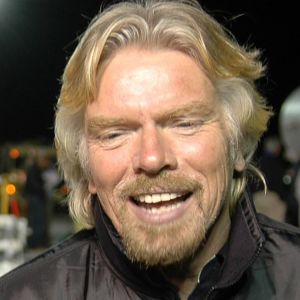
Recommended by Richard Branson, Cristina Riesen, Fabrice Grinda, and 2 others.
Today is World Book Day, a wonderful opportunity to address this #ChallengeRichard sent in by Mike Gonzalez of New Jersey: Make a list of your top 65 books to read in a lifetime. [source]
Cristina Riesen
First, a word on career paths. In time, I realised that career paths are like one-way streets. Magic happens in unexplored territories. Plus life is how you choose to live every moment, every day. So today, rather than building a career, I prefer to make lateral moves in life, working with great people and being part of ambitious projects impacting the world. There are a few books that got me here: … Jon Krakauer "Into Thin Air". [source]
Fabrice Grinda
I have lots of books to recommend, but they are not related to my career path. The only one that is remotely related is Peter Thiel’s Zero to One. That said here are books I would recommend. [source]
Cover unavailable
18
The Long Walk
Stephen King
4.4
On the first day of May, 100 teenage boys meet for a race known as "The Long Walk." If you break the rules, you get three warnings. If you exceed your limit, what happens is absolutely terrifying.
Cover unavailable
19
The Walking Dead, Compendium 1
Robert Kirkman, Charlie Adlard, et al.
4.4
Introducing the first eight volumes of the fan-favorite, New York Times Best Seller series collected into one massive paperback collection.
In a world ruled by the dead, we are forced to finally start living. With The Walking Dead #1-48, this compendium features more than one thousand pages chronicling the start of Robert Kirkman's Eisner Award-winning story of zombie horror, from Rick Grimes waking up alone in a hospital, his band of survivors seeking refuge on an isolated farm and the controversial introduction of Woodbury despot, The Governor.
…
Cover unavailable
20
A Philosophy of Walking
Frederic Gros, Clifford Harper, John Howe
4.4
In A Philosophy of Walking, a bestseller in France, leading thinker Frédéric Gros charts the many different ways we get from A to B — the pilgrimage, the promenade, the protest march, the nature ramble — and reveals what they say about us.
Gros draws attention to other thinkers who also saw walking as something central to their practice. On his travels he ponders Thoreau’s eager seclusion in Walden Woods; the reason Rimbaud walked in a fury, while Nerval rambled to cure his melancholy. He shows us how Rousseau walked in order to think, while Nietzsche wandered the mountainside to write. In contrast, Kant marched through his hometown every day, exactly at the same hour, to escape the compulsion of thought. Brilliant and erudite, A Philosophy of Walking is an entertaining and insightful manifesto for putting one foot in front of the other.
Twenty-five years ago, a disillusioned young man set out on a walk across America. This is the book he wrote about that journey -- a classic account of the reawakening of his faith in himself and his country.
"I started out searching for myself and my country," Peter Jenkins writes, "and found both." In this timeless classic, Jenkins describes how disillusionment with society in the 1970s drove him out onto the road on a walk across America. His experiences remain as sharp and telling today as they were twenty-five years ago -- from the timeless secrets of life, learned from a mountain-dwelling hermit, to the stir he caused by staying with a black family in North Carolina, to his hours of intense labor in Southern mills. Many, many miles later, he learned lessons about his country and himself that resonate to this day -- and will inspire a new generation to get out, hit the road and explore.
…
Cover unavailable
22
The Wild Places
Robert Macfarlane
4.3
"An eloquent (and compulsively readable) reminder that, though we're laying waste the world, nature still holds sway over much of the earth's surface." Bill McKibben
Are there any genuinely wild places left in Britain and Ireland? That is the question that Robert Macfarlane poses to himself as he embarks on a series of breathtaking journeys through some of the archipelago's most remarkable landscapes. He climbs, walks, and swims by day and spends his nights sleeping on cliff-tops and in ancient meadows and wildwoods. With elegance and passion he entwines history, memory, and landscape in a bewitching evocation of wildness and its vital importance. A unique travelogue that will intrigue readers of natural history and adventure, The Wild Places solidifies Macfarlane's reputation as a young writer to watch.
…
Cover unavailable
23
On Trails: An Exploration
Robert Moor
4.3
In 2009, while thru-hiking the Appalachian Trail, Robert Moor began to wonder about the paths that lie beneath our feet: How do they form? Why do some improve over time while others fade? What makes us follow or strike off on our own?
Over the course of the next seven years, Moor traveled the globe, exploring trails of all kinds, from the miniscule to the massive. He learned the tricks of master trail-builders, hunted down long-lost Cherokee trails, and traced the origins of our road networks and the Internet. In each chapter, Moor interweaves his adventures with findings from science, history, philosophy, and nature writing—combining the nomadic joys of Peter Matthiessen with the eclectic wisdom of Lewis Hyde’s The Gift.
Throughout, Moor reveals how this single topic—the oft-overlooked trail—sheds new light on a wealth of age-old questions: How does order emerge out of chaos? How did animals first crawl forth from the seas and spread across continents? How has humanity’s relationship with nature and technology shaped world around us? And, ultimately, how does each of us pick a path through life?
Moor has the essayist’s gift for making new connections, the adventurer’s love for paths untaken, and the philosopher’s knack for asking big questions. With a breathtaking arc that spans from the dawn of animal life to the digital era, On Trails is a book that makes us see our world, our history, our species, and our ways of life anew.
…
Cover unavailable
24
Churchill: Walking with Destiny
Andrew Roberts
4.3
A NEW YORK TIMES BESTSELLER
“Unarguably the best single-volume biography of Churchill . . . A brilliant feat of storytelling, monumental in scope, yet put together with tenderness for a man who had always believed that he would be Britain’s savior.” —Wall Street Journal
In this landmark biography of Winston Churchill based on extensive new material, the true genius of the man, statesman and leader can finally be fully seen and understood by the bestselling, award-winning author of Napoleon and The Storm of War.
When we seek an example of unalloyed courage, the man who comes to mind is Winston Churchill: the visionary leader, immune from the consensus of the day, who stood firmly for his beliefs when everyone doubted him. But how did young Winston become Churchill? What gave him the strength to take on the superior force of Nazi Germany when bombs rained on London and so many others had caved? In The Storm of War, Andrew Roberts gave us a tantalizing glimpse of Churchill the war leader. Now, at last, we have the full and definitive biography, as personally revealing as it is compulsively readable, about one of the great leaders of all time.
Roberts was granted exclusive access to extensive new material: the transcripts of war cabinet meetings-- the equivalent of the Nixon and JFK tapes--diaries, letters, unpublished memoirs, and detailed notes taken by the king after their bi-weekly meetings. Having read every one of Churchill's letters--including deeply personal ones that Churchill's son Randolph had previously chosen to withhold--and spoken to more than one hundred people who knew or worked with him, Roberts identifies the hidden forces fueling Churchill's drive. Churchill put his faith in the British Empire and fought as hard to preserve it as he did to defend London. Having started his career in India and South Africa, he understood better than most idealists how hard it can be to pacify reluctant people far from home. We think of Churchill as a hero of the age of mechanized warfare, but Roberts's masterwork reveals that he has as much to teach us about the challenges we face today--and the fundamental values of courage, tenacity, leadership, and moral conviction.
…
Recommended by Robert Benzie.
Robert Benzie
Best book I have read this year. https://t.co/Vv3GlB426d [source]
Cover unavailable
25
Walkable City: How Downtown Can Save America, One Step at a Time
Jeff Speck
4.3
Jeff Speck has dedicated his career to determining what makes cities thrive. And he has boiled it down to one key factor: walkability. The very idea of a modern metropolis evokes visions of bustling sidewalks, vital mass transit, and a vibrant, pedestrian-friendly urban core. But in the typical American city, the car is still king, and downtown is a place that's easy to drive to but often not worth arriving at. Making walkability happen is relatively easy and cheap; seeing exactly what needs to be done is the trick. In this essential new book, Speck reveals the invisible workings of the city, how simple decisions have cascading effects, and how we can all make the right choices for our communities. Bursting with sharp observations and real-world examples, giving key insight into what urban planners actually do and how places can and do change, Walkable City lays out a practical, necessary, and eminently achievable vision of how to make our normal American cities great again.
…
Cover unavailable
26
A Field Guide to Getting Lost
Rebecca Solnit
4.3
Whether she is contemplating the history of walking as a cultural and political experience over the past two hundred years (Wanderlust), or using the life of photographer Eadweard Muybridge as a lens to discuss the transformations of space and time in late nineteenth-century America (River of Shadows), Rebecca Solnit has emerged as an inventive and original writer whose mind is daring in the connections it makes. A Field Guide to Getting Lost draws on emblematic moments and relationships in Solnit's own life to explore the issues of wandering, being lost, and the uses of the unknown. The result is a distinctive, stimulating, and poignant voyage of discovery.
…
Cover unavailable
27
Of Walking in Ice: Munich-Paris, 11/23 to 12/14, 1974
Werner Herzog
4.3
In the winter of 1974, filmmaker Werner Herzog made a three week solo journey from Munich to Paris on foot to visit his ailing friend, film critic and historian Lotte Eisner. During this monumental odyssey through a seemingly endless blizzard, Herzog documented everything he saw and felt with intense sincerity. This diary is dotted with rants about the extreme cold and utter loneliness, poetic descriptions of the snowy countryside, along with personal philosophizing. What is most remarkable is that the reading of this book flows with the experience of watching his films: through this walk we witness how his images are born. Although he received a literary award for it, this introspective masterpiece has lingered out of print since 1979. Beautifully designed and emotionally impressive, Of Walking in Ice is the first in a color-coded series of remarkable yet long-forgotten titles being republished by Free Association.
…
Cover unavailable
28
The Lost Art of Walking: The History, Science, and Literature of Pedestrianism
Geoff Nicholson
4.3
Cover unavailable
29
Walking Home: A Poet's Journey
Simon Armitage and Sue Armitage Simon, Roberts
4.3
In summer 2010 Simon Armitage decided to walk the Pennine Way. The challenging 256-mile route is usually approached from south to north, from Edale in the Peak District to Kirk Yetholm, the other side of the Scottish border. He resolved to tackle it the other way round: through beautiful and bleak terrain, across lonely fells and into the howling wind, he would be walking home, towards the Yorkshire village where he was born.
Travelling as a 'modern troubadour' without a penny in his pocket, he stopped along the way to give poetry readings in village halls, churches, pubs and living rooms. His audiences varied from the passionate to the indifferent, and his readings were accompanied by the clacking of pool balls, the drumming of rain and the bleating of sheep.
Walking Home describes this extraordinary, yet ordinary, journey. It's a story about Britain's remote and overlooked interior - the wildness of its landscape and the generosity of the locals who sustained him on his journey. It's about facing emotional and physical challenges, and sometimes overcoming them. It's nature writing, but with people at its heart. Contemplative, moving and droll, it is a unique narrative from one of our most beloved writers.
…
Cover unavailable
30
The Songlines
Bruce Chatwin
4.3
In this extraordinary book, Bruce Chatwin has adapted a literary form common until the eighteenth century though rare in ours; a story of ideas in which two companions, traveling and talking together, explore the hopes and dreams that animate both them and the people they encounter. Set in almost uninhabitable regions of Central Australia, The Songlines asks and tries to answer these questions: Why is man the most restless, dissatisfied of animals? Why do wandering people conceive the world as perfect whereas sedentary ones always try to change it? Why have the great teachers—Christ or the Buddha—recommended the Road as the way. to salvation? Do we agree with Pascal that all man's troubles stem from his inability to sit quietly in a room?
We do not often ask these questions today for we commonly assume that living in a house is normal and that the wandering life is aberrant. But for more than twenty years Chatwin has mulled over the possibility that the reverse might be the case.
Pre-colonial Australia was the last landmass on earth peopled not by herdsmen, farmers, or city dwellers, but by hunter-gatherers. Their labyrinths of invisible pathways across the continent are known to us as Songlines or Dreaming Tracks, but to the Aboriginals as the tracks of their ancestors—the Way of the Law. Along these "roads" they travel in order to perform all those activities that are distinctively human—song, dance, marriage, exchange of ideas, and arrangements of territorial boundaries by agreement rather than force.
In Chatwin's search for the Songlines, Arkady is an ideal friend and guide: Australian by birth, the son of a Cossack exile, with all the strength and warmth of his inheritance. Whether hunting kangaroo from a Land Cruiser, talking to the diminutive Rolf in his book-crammed trailer, buying drinks for a bigoted policeman (and would-be writer), cheering as Arkady's true love declares herself (part of The Songlines is a romantic comedy), Chatwin turns this almost implausible picaresque adventure into something approaching the scale of a Greek tragedy.
The life of the Aboriginals stands in vivid contrast, of course, to the prevailing cultures of our time. And The Songlines presents unforgettable details about the kinds of disputes we know all too well from less traumatic confrontations: over sacred lands invaded by railroads, mines, and construction sites, over the laws and rights of a poor people versus a wealthy invasive one. To Chatwin these are but recent, local examples of an eternal basic distinction between settlers and wanderers. His book, devoted to the latter, is a brilliant evocation of this profound optimism: that man is by nature not a bellicose aggressor but a pacific, song-creating, adaptive species whose destiny is to quest for the truth.
…
Cover unavailable
31
Underland
Robert Macfarlane
4.2
From the best-selling, award-winning author of Landmarks and The Old Ways, a haunting voyage into the planet’s past and future.
Hailed as "the great nature writer of this generation" (Wall Street Journal), Robert Macfarlane is the celebrated author of books about the intersections of the human and the natural realms. In Underland, he delivers his masterpiece: an epic exploration of the Earth’s underworlds as they exist in myth, literature, memory, and the land itself.
In this highly anticipated sequel to his international bestseller The Old Ways, Macfarlane takes us on an extraordinary journey into our relationship with darkness, burial, and what lies beneath the surface of both place and mind. Traveling through “deep time”—the dizzying expanses of geologic time that stretch away from the present—he moves from the birth of the universe to a post-human future, from the prehistoric art of Norwegian sea caves to the blue depths of the Greenland ice cap, from Bronze Age funeral chambers to the catacomb labyrinth below Paris, and from the underground fungal networks through which trees communicate to a deep-sunk “hiding place” where nuclear waste will be stored for 100,000 years to come. Woven through Macfarlane’s own travels are the unforgettable stories of descents into the underland made across history by explorers, artists, cavers, divers, mourners, dreamers, and murderers, all of whom have been drawn for different reasons to seek what Cormac McCarthy calls “the awful darkness within the world.”
Global in its geography and written with great lyricism and power, Underland speaks powerfully to our present moment. Taking a deep-time view of our planet, Macfarlane here asks a vital and unsettling question: “Are we being good ancestors to the future Earth?” Underland marks a new turn in Macfarlane’s long-term mapping of the relations of landscape and the human heart. From its remarkable opening pages to its deeply moving conclusion, it is a journey into wonder, loss, fear, and hope. At once ancient and urgent, this is a book that will change the way you see the world.
…
Recommended by Alastair Humphreys, Cal Flyn, and Jonathan Green.
Alastair Humphreys
The cleverest and nicest man in the world of travel writing has just published a brilliant new book which you should definitely buy. And so has @robgmacfarlane... 😂 https://t.co/7tWMRoB08W https://t.co/2UmUfDUqpt [source]
Cal Flyn
Having climbed the highest heights in his debut Mountains of the Mind, Macfarlane now dives down to the lowest of the lows. He goes caving in limestone caverns deep underground, rattles through salt mines under the sea in carts and stumbles across (literal) underground subcultures in the Paris catacombs, all interwoven with learned digressions into geological epochs and classical conceptions of the underworld. What can I say? Macfarlane is the most remarkable writer. [source]
Jonathan Green
@mmbrenn yes the best book i read last year without question. beautiful. harrowing. [source]
Cover unavailable
32
The Eastern Fells
A. Wainwright
4.2
The original Pictorial Guide to the Eastern Fells of Lakeland - freshly reproduced from Wainwright's original pages.
Cover unavailable
33
Desert Solitaire
Edward Abbey
4.2
First published in 1968, Desert Solitaire is one of Edward Abbey’s most critically acclaimed works and marks his first foray into the world of nonfiction writing. Written while Abbey was working as a ranger at Arches National Park outside of Moab, Utah, Desert Solitaire is a rare view of one man’s quest to experience nature in its purest form.
Through prose that is by turns passionate and poetic, Abbey reflects on the condition of our remaining wilderness and the future of a civilization that cannot reconcile itself to living in the natural world as well as his own internal struggle with morality. As the world continues its rapid development, Abbey’s cry to maintain the natural beauty of the West remains just as relevant today as when this book was written.
Abbey is full of passion, fury and contempt – a fiery fighter to shake up the sometimes over-tranquil atmosphere of nature writing. [source]
Cover unavailable
34
The Western Fells
A. Wainwright
4.2
The original Pictorial Guide to the Western Fells of Lakeland - freshly reproduced from Wainwright's original pages.
Cover unavailable
35
The Two Towers (The Lord of the Rings, #2)
J. R. R. Tolkien
4.2
The Fellowship was scattered. Some were bracing hopelessly for war against the ancient evil of Sauron. Some were contending with the treachery of the wizard Saruman. Only Frodo and Sam were left to take the accursed Ring of Power to be destroyed in Mordor–the dark Kingdom where Sauron was supreme. Their guide was Gollum, deceitful and lust-filled, slave to the corruption of the Ring. Thus continues the magnificent, bestselling tale of adventure begun in The Fellowship of the Ring, which reaches its soul-stirring climax in The Return of the King.
…
Cover unavailable
36
The Lost Art of Reading Nature's Signs: Use Outdoor Clues to Find Your Way, Predict the Weather, Locate Water, Track Animals—and Other Forgotten Skills
Tristan Gooley
4.2
Turn Every Walk into a Game of Detection
When writer and navigator Tristan Gooley journeys outside, he sees a natural world filled with clues. The roots of a tree indicate the sun’s direction; the Big Dipper tells the time; a passing butterfly hints at the weather; a sand dune reveals prevailing wind; the scent of cinnamon suggests altitude; a budding flower points south. To help you understand nature as he does, Gooley shares more than 850 tips for forecasting, tracking, and more, gathered from decades spent walking the landscape around his home and around the world. Whether you’re walking in the country or city, along a coastline, or by night, this is the ultimate resource on what the land, sun, moon, stars, plants, animals, and clouds can reveal—if you only know how to look!
…
Cover unavailable
37
Fugitives and Refugees: A Walk in Portland, Oregon
Chuck Palahniuk
4.2
Want to know where Chuck Palahniuk's tonsils currently reside? Been looking for a naked mannequin to hide in your kitchen cabinets? Curious about Chuck's debut in an MTV music video? What goes on at the Scum Center? How do you get to the Apocalypse Café?
In the closest thing he may ever write to an autobiography, Chuck Palahniuk provides answers to all these questions and more as he takes you through the streets, sewers, and local haunts of Portland, Oregon.
According to Katherine Dunn, author of the cult classic Geek Love, Portland is the home of America's " fugitives and refugees." Get to know these folks, the " most cracked of the crackpots, "as Palahniuk calls them, and come along with him on an adventure through the parts of Portland you might not otherwise believe actually exist. No other travel guide will give you this kind of access to " a little history, a little legend, and a lot of friendly, sincere, fascinating people who maybe should've kept their mouths shut."
Here are strange personal museums, weird annual events, and ghost stories. Tour the tunnels under downtown Portland. Visit swingers' sex clubs, gay and straight. See Frances Gabe's famous 1940s Self-Cleaning House. Look into strange local customs like the I-Tit-a-Rod Race and the Santa Rampage. Learn how to talk like a local in a quick vocabulary lesson. Get to know, I mean really get to know, the animals at the Portland zoo.
Oh, the list goes on and on.
…
Cover unavailable
38
Into the Wild
Jon Krakauer
4.2
Librarian's Note: An alternate cover edition can be found here
In April, 1992, a young man from a well-to-do family hitchhiked to Alaska and walked alone into the wilderness north of Mt. McKinley. His name was Christopher Johnson McCandless. He had given $25,000 in savings to charity, abandoned his car and most of his possessions, burned all the cash in his wallet, and invented a new life for himself. Four months later, a party of moose hunters found his decomposed body. How McCandless came to die is the unforgettable story of Into the Wild.
Immediately after graduating from college in 1991, McCandless had roamed through the West and Southwest on a vision quest like those made by his heroes Jack London and John Muir. In the Mojave Desert he abandoned his car, stripped it of its license plates, and burned all of his cash. He would give himself a new name, Alexander Supertramp, and, unencumbered by money and belongings, he would be free to wallow in the raw, unfiltered experiences that nature presented. Craving a blank spot on the map, McCandless simply threw away the maps. Leaving behind his desperate parents and sister, he vanished into the wild.
…
Recommended by Holger Seim.
Holger Seim
When it comes to adventure stories, Into the Wild. [source]
Cover unavailable
39
The Broken Road: From the Iron Gates to Mount Athos
Patrick Leigh FERMOR
4.2
In the winter of 1933 eighteen-year-old Patrick (“Paddy”) Leigh Fermor set out to walk across Europe, starting in Holland and ending in Constantinople, a trip that took him the better part of a year. Decades later, when he was well over fifty, Leigh Fermor told the story of that life-changing journey in A Time of Gifts and Between the Woods and the Water, two books now celebrated as among the most vivid, absorbing, delightful, and beautifully-written travel books of all time.
The Broken Road is the long and avidly awaited account of the final leg of his youthful adventure that Leigh Fermor promised but was unable to finish before his death in 2011. Assembled from Leigh Fermor’s manuscripts by his prize-winning biographer Artemis Cooper and the travel writer Colin Thubron, this is perhaps the most personal of all Leigh Fermor’s books, catching up with young Paddy in the fall of 1934 and following him through Bulgaria and Rumania to the coast of the Black Sea. Days and nights on the road, spectacular landscapes and uncanny cities, friendships lost and found, leading the high life in Bucharest or camping out with fishermen and shepherds: in the The Broken Road such incidents and escapades are described with all the linguistic bravura, odd and astonishing learning, and overflowing exuberance that Leigh Fermor is famous for, but also with a melancholy awareness of the passage of time, especially when he meditates on the scarred history of the Balkans or on his troubled relations with his father. The book ends, perfectly, with Paddy’s diary from the winter of 1934, when he had reached Greece, the country he would fall in love with and fight for: across the space of three quarters of century we can still hear the ringing voice of an irrepressible young man embarking on a life of adventure.
…
Cover unavailable
40
The Northern Fells
A. Wainwright
4.2
The original Pictorial Guide to the Northern Fells of Lakeland - freshly reproduced from Wainwright's original pages.
Cover unavailable
41
The Central Fells
A. Wainwright
4.2
The original Pictorial Guide to the Central Fells of Lakeland - freshly reproduced from Wainwright's original pages.
Cover unavailable
42
Lillian Boxfish Takes a Walk
Kathleen Rooney
4.2
It’s the last day of 1984, and 85-year-old Lillian Boxfish is about to take a walk.
As she traverses a grittier Manhattan, a city anxious after an attack by a still-at-large subway vigilante, she encounters bartenders, bodega clerks, chauffeurs, security guards, bohemians, criminals, children, parents, and parents-to-be—in surprising moments of generosity and grace. While she strolls, Lillian recalls a long and eventful life that included a brief reign as the highest-paid advertising woman in America—a career cut short by marriage, motherhood, divorce, and a breakdown.
A love letter to city life—however shiny or sleazy—Lillian Boxfish Takes a Walk by Kathleen Rooney paints a portrait of a remarkable woman across the canvas of a changing America: from the Jazz Age to the onset of the AIDS epidemic; the Great Depression to the birth of hip-hop.
…
Cover unavailable
43
Mountains of the Mind: Adventures in Reaching the Summit
Robert Macfarlane
4.2
Combining accounts of legendary mountain ascents with vivid descriptions of his own forays into wild, high landscapes, Robert McFarlane reveals how the mystery of the world’s highest places has came to grip the Western imagination—and perennially draws legions of adventurers up the most perilous slopes. His story begins three centuries ago, when mountains were feared as the forbidding abodes of dragons and other mysterious beasts. In the mid-1700s the attentions of both science and poetry sparked a passion for mountains; Jean-Jacques Rousseau and Lord Byron extolled the sublime experiences to be had on high; and by 1924 the death on Mt Everest of an Englishman named George Mallory came to symbolize the heroic ideals of his day. Macfarlane also reflects on fear, risk, and the shattering beauty of ice and snow, the competition and contemplation of the climb, and the strange alternate reality of high altitude, magically enveloping us in the allure of mountains at every level.
…
Recommended by Sara Maitland.
Cover unavailable
44
Stop Walking on Eggshells: taking your life back when someone you care about has borderline personality disorder
Paul T. T. Mason MS and Randi Kreger
4.2
Do you feel manipulated, controlled, or lied to? Are you the focus of intense, violent, and irrational rages? Do you feel you are 'walking on eggshells' to avoid the next confrontation?
If the answer is 'yes,' someone you care about may have borderline personality disorder (BPD). Stop Walking on Eggshells has already helped nearly half a million people with friends and family members suffering from BPD understand this destructive disorder, set boundaries, and help their loved ones stop relying on dangerous BPD behaviors. This fully revised edition has been updated with the very latest BPD research and includes coping and communication skills you can use to stabilize your relationship with the BPD sufferer in your life.
This compassionate guide will enable you to: * Make sense out of the chaos * Stand up for yourself and assert your needs * Defuse arguments and conflicts * Protect yourself and others from violent behavior
…
Cover unavailable
45
The Southern Fells
A. Wainwright
4.2
The original Pictorial Guide to the Southern Fells of Lakeland - freshly reproduced from Wainwright's original pages.
Cover unavailable
46
How to Walk (Mindfulness Essentials, #4)
Thich Nhat Hanh, Jason DeAntonis
4.2
How to Walk is the fourth title in Parallax’s popular Mindfulness Essentials Series of how-to titles by Zen Master Thich Nhat Hanh, introducing beginners and reminding seasoned practitioners of the essentials of mindfulness practice. Slow, concentrated walking while focusing on in- and out-breaths allows for a unique opportunity to be in the present. There is no need to arrive somewhere—each step is the arrival to concentration, joy, insight, and the momentary enlightenment of aliveness. When your foot touches the Earth with awareness, you make yourself alive and the Earth real, and you forget for one minute the searching, rushing, and longing that rob our daily lives of awareness and cause us to “sleepwalk” through life.
Thich Nhat Hanh shares amusing stories of the impact mindful walking has on both the walker and those who notice him, and shows how mindful walking can be a technique for diminishing depression, recapturing wonder, and expressing gratitude. Pocket-sized, with original two color illustrations by Jason DeAntonis, How to Walk is a unique gift for all ages, sharing a simple practice that can have a profound effect on practitioners.
Scientific studies indicate that meditation contributes tremendously to well-being, general health, and longevity. How to Walk is a unique gift for those who want a comprehensive yet simple guide to understanding the many benefits of walking meditation, along with meditative poems to recite silently while walking. Appropriate for those practicing in any spiritual tradition, How to Walk will benefit both seasoned practitioners and those new to meditation.
…
Cover unavailable
47
Let the Great World Spin
Colum McCann
4.2
NATIONAL BOOK AWARD WINNER • Colum McCann’s beloved novel inspired by Philippe Petit’s daring high-wire stunt, which is also depicted in the film The Walk starring Joseph Gordon-Levitt
In the dawning light of a late-summer morning, the people of lower Manhattan stand hushed, staring up in disbelief at the Twin Towers. It is August 1974, and a mysterious tightrope walker is running, dancing, leaping between the towers, suspended a quarter mile above the ground. In the streets below, a slew of ordinary lives become extraordinary in bestselling novelist Colum McCann’s stunningly intricate portrait of a city and its people. Let the Great World Spin is the critically acclaimed author’s most ambitious novel yet: a dazzlingly rich vision of the pain, loveliness, mystery, and promise of New York City in the 1970s.
Corrigan, a radical young Irish monk, struggles with his own demons as he lives among the prostitutes in the middle of the burning Bronx. A group of mothers gather in a Park Avenue apartment to mourn their sons who died in Vietnam, only to discover just how much divides them even in grief. A young artist finds herself at the scene of a hit-and-run that sends her own life careening sideways. Tillie, a thirty-eight-year-old grandmother, turns tricks alongside her teenage daughter, determined not only to take care of her family but to prove her own worth. Elegantly weaving together these and other seemingly disparate lives, McCann’s powerful allegory comes alive in the unforgettable voices of the city’s people, unexpectedly drawn together by hope, beauty, and the “artistic crime of the century.”
A sweeping and radical social novel, Let the Great World Spincaptures the spirit of America in a time of transition, extraordinary promise, and, in hindsight, heartbreaking innocence. Hailed as a “fiercely original talent” (San Francisco Chronicle), award-winning novelist McCann has delivered a triumphantly American masterpiece that awakens in us a sense of what the novel can achieve, confront, and even heal.
Praise for Let the Great World Spin
“This is a gorgeous book, multilayered and deeply felt, and it’s a damned lot of fun to read, too. Leave it to an Irishman to write one of the greatest-ever novels about New York. There’s so much passion and humor and pure lifeforce on every page of Let the Great World Spin that you’ll find yourself giddy, dizzy, overwhelmed.”—Dave Eggers
“Stunning . . . [an] elegiac glimpse of hope . . . It’s a novel rooted firmly in time and place. It vividly captures New York at its worst and best. But it transcends all that. In the end, it’s a novel about families—the ones we’re born into and the ones we make for ourselves.”—USA Today
“The first great 9/11 novel . . . We are all dancing on the wire of history, and even on solid ground we breathe the thinnest of air.”—Esquire
“Mesmerizing . . . a Joycean look at the lives of New Yorkers changed by a single act on a single day . . . Colum McCann’s marvelously rich novel . . . weaves a portrait of a city and a moment, dizzyingly satisfying to read and difficult to put down.”—The Seattle Times
“Vibrantly whole . . . With a series of spare, gorgeously wrought vignettes, Colum McCann brings 1970s New York to life. . . . And as always, McCann’s heart-stoppingly simple descriptions wow.”—Entertainment Weekly
“An act of pure bravado, dizzying proof that to keep your balance you need to know how to fall.”—O: The Oprah Magazine
From the Hardcover edition.
…
Recommended by Esi Edugyan.
Esi Edugyan
I have read it a few times now, and I’m still trying to puzzle out how he fit those strands together so beautifully. It is a miracle of a novel. [source]
Cover unavailable
48
The Places in Between
Rory Stewart
4.2
In January 2002 Rory Stewart walked across Afghanistan-surviving by his wits, his knowledge of Persian dialects and Muslim customs, and the kindness of strangers. By day he passed through mountains covered in nine feet of snow, hamlets burned and emptied by the Taliban, and communities thriving amid the remains of medieval civilizations. By night he slept on villagers' floors, shared their meals, and listened to their stories of the recent and ancient past. Along the way Stewart met heroes and rogues, tribal elders and teenage soldiers, Taliban commanders and foreign-aid workers. He was also adopted by an unexpected companion-a retired fighting mastiff he named Babur in honor of Afghanistan's first Mughal emperor, in whose footsteps the pair was following. Through these encounters--by turns touching, confounding, surprising, and funny--Stewart makes tangible the forces of tradition, ideology, and allegiance that shape life in the map's countless places in between.
…
Cover unavailable
49
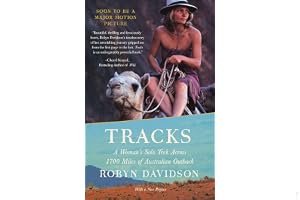
Tracks: A Woman's Solo Trek Across 1700 Miles of Australian Outback
Robyn Davidson
4.2
NOW A MAJOR MOTION PICTURE
Robyn Davidson's opens the memoir of her perilous journey across 1,700 miles of hostile Australian desert to the sea with only four camels and a dog for company with the following words: “I experienced that sinking feeling you get when you know you have conned yourself into doing something difficult and there's no going back."
Enduring sweltering heat, fending off poisonous snakes and lecherous men, chasing her camels when they get skittish and nursing them when they are injured, Davidson emerges as an extraordinarily courageous heroine driven by a love of Australia's landscape, an empathy for its indigenous people, and a willingness to cast away the trappings of her former identity. Tracks is the compelling, candid story of her odyssey of discovery and transformation.
“An unforgettably powerful book.”—Cheryl Strayed, author of Wild
Now with a new postscript by Robyn Davidson.
…
Recommended by Alastair Humphreys.
Alastair Humphreys
Tracks is just fantastically well written. [source]
Cover unavailable
50
The Road to Grace (The Walk, #3)
Richard Paul Evans
4.1
From one of America’s most beloved storytellers comes the inspiring third installment of the bestselling series, The Walk, the ongoing story of one man’s unrelenting search for hope.
Join one of America’s beloved storytellers on a walk like no other: one man’s unrelenting search for hope.
Reeling from the sudden loss of his wife, his home, and his business, Alan Christoffersen, a once-successful advertising executive, has left everything he knew behind and set off on an extraordinary cross-country journey. Carrying only a backpack, he is walking from Seattle to Key West, the farthest destination on his map.
Now almost halfway through his trek, Alan sets out to walk the nearly 1,000 miles between South Dakota and St. Louis, but it’s the people he meets along the way who give the journey its true meaning: a mysterious woman who follows Alan’s walk for close to a hundred miles, the ghost hunter searching graveyards for his wife, and the elderly Polish man who gives Alan a ride and shares a story that Alan will never forget.
Full of hard-won wisdom and truth, The Road to Grace is a compelling and inspiring novel about hope, healing, grace, and the meaning of life.
…
Cover unavailable
51
Ulysses
James Joyce
4.1
Loosely based on the Odyssey, this landmark of modern literature follows ordinary Dubliners in 1904. Capturing a single day in the life of Dubliner Leopold Bloom, his friends Buck Mulligan and Stephen Dedalus, his wife Molly, and a scintillating cast of supporting characters, Joyce pushes Celtic lyricism and vulgarity to splendid extremes. Captivating experimental techniques range from interior monologues to exuberant wordplay and earthy humor. A major achievement in 20th century literature.
…
Recommended by Andi Dumitrescu, Charles Fernyhough, Debbie Millman, and 4 others.
Andi Dumitrescu
If I had to make a more rational choice, I’d go with Ulises or The Master and Margareta, but I think that choice is a bit snobbish. [source]
Charles Fernyhough
The archetypal stream of consciousness novel. Joyce didn’t invent the technique, but he makes it flourish in the most extraordinary way. [source]
Debbie Millman
I also really love a line from this book, which is 'The longest way around is the shortest way home.' [source]
Cover unavailable
52
The North Western Fells
A. Wainwright
4.1
The original Pictorial Guide to the North Western Fells of Lakeland - freshly reproduced from Wainwright's original pages.
Cover unavailable
53
As I Walked Out One Midsummer Morning
Laurie Lee
4.1
"I was nineteen years old, still soft at the edges, but with a confident belief in good fortune. I carried a small rolled-up tent, a violin in a blanket, a change of clothes, a tin of treacle biscuits, and some cheese. I was excited, vain-glorious, knowing I had far to go; but not, as yet, how far." Despite this romantic and optimistic opening, what Lee finds is the most primitive and feudal country in Europe, a peninsula untouched by the modern world, a land of labor without dignity, a church devoid of compassion, and a country ripe for revolutionary change.
There is humor, love, and adolescent awakening, but beneath is a foreboding sense of a savage future, a premonition that a war will come. For Lee, 1936 was the end of innocence, when "it was being learned again that men needed more than courage, anger, slogans, convictions, or even a just cause when they went to war." Thus Lee becomes entangled in the passionate, violent, and bloody struggle that was the Spanish Civil War.
…
Recommended by Alastair Humphreys and Jason Webster.
Alastair Humphreys
Reading Laurie Lee was suddenly a very different perspective on adventure, because he was just a normal young guy. He was not very tough. He wasn’t very fit. He didn’t claim to be trying to do anything extraordinary. He was just out in the world, living vividly and being curious and I loved that, mostly because it sounded like me. Ever since I read As I Walked Out One Midsummer Morning I thought I wanted to go and do the trip myself. [source]
Jason Webster
The best book in terms of engaging with this dreamy and poetic truth at the heart of Spain. [source]
Cover unavailable
54
Flâneuse: Women Walk the City in Paris, New York, Tokyo, Venice and London
Lauren Elkin
4.1
'Flâneuse [flanne-euhze], noun, from the French. Feminine form of flâneur [flanne-euhr], an idler, a dawdling observer, usually found in cities.
That is an imaginary definition.'
If the word flâneur conjures up visions of Baudelaire, boulevards and bohemia – then what exactly is a flâneuse?
In this gloriously provocative and celebratory book, Lauren Elkin defines her as ‘a determined resourceful woman keenly attuned to the creative potential of the city, and the liberating possibilities of a good walk’. Part cultural meander, part memoir, Flâneuse traces the relationship between the city and creativity through a journey that begins in New York and moves us to Paris, via Venice, Tokyo and London, exploring along the way the paths taken by the flâneuses who have lived and walked in those cities.
From nineteenth-century novelist George Sand to artist Sophie Calle, from war correspondent Martha Gellhorn to film-maker Agnes Varda, Flâneuse considers what is at stake when a certain kind of light-footed woman encounters the city and changes her life, one step at a time.
…
Cover unavailable
55
The Far Eastern Fells
A. Wainwright
4.1
The original Pictorial Guide to the Far Eastern Fells of Lakeland - freshly reproduced from Wainwright's original pages.
Cover unavailable
56
The Walking Dead, Compendium 4
Robert Kirkman
4.1
Just in time for the new season of The Walking Dead on AMC, the fan-favorite, New York Times bestseller series returns with its FOURTH massive paperback collection! With over 1,000 pages, this volume contains the next chapter of ROBERT KIRKMAN and CHARLIE ADLARD's Eisner Award-winning continuing story of survival horror.
From the Whisperers to the Commonwealth, Rick Grimes meets new allies and enemies to the way to reclaiming the world from the dead. Wars are started, and dear friends fall...
Collects THE WALKING DEAD #149-193.
…
Cover unavailable
57
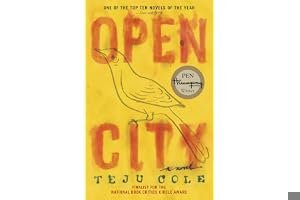
Open City
Teju Cole
4.1
Along the streets of Manhattan, a young Nigerian doctor doing his residency wanders aimlessly. The walks meet a need for Julius: they are a release from the tightly regulated mental environment of work, and they give him the opportunity to process his relationships, his recent breakup with his girlfriend, his present, his past.
But it is not only a physical landscape he covers; Julius crisscrosses social territory as well, encountering people from different cultures and classes who will provide insight on his journey—which takes him to Brussels, to the Nigeria of his youth, and into the most unrecognizable facets of his own soul.
…
Recommended by Amy Waldman, Leo Hollis, and Robert Eaglestone.
Amy Waldman
It’s about a solitary narrator who goes on walks through New York. 9/11 keeps resurfacing, indirectly and almost allusively, in really interesting ways. [source]
Leo Hollis
It’s a series of walks around New York, and is one of the most powerful books on living in a city that I’ve read in a long time. [source]
Robert Eaglestone
In the novel, migration is closely related to the theme of looking in the city, and of blindness. [source]
Cover unavailable
58
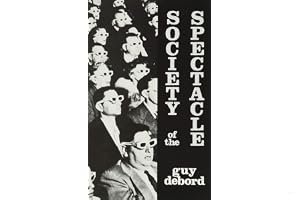
The Society of the Spectacle
Guy Debord, Donald Nicholson-Smith
4.1
Few works of political and cultural theory have been as enduringly provocative as Guy Debord's The Society of the Spectacle. From its publication amid the social upheavals of the 1960s up to the present, the volatile theses of this book have decisively transformed debates on the shape of modernity, capitalism and everyday life in the late twentieth century. Now finally available in a superb English translation approved by the author, Debord's text remains as crucial as ever for understanding the contemporary effects of power, which are increasingly inseparable from the new virtual worlds of our rapidly changing image/information culture.
…
Recommended by Dave Elitch and Sanja Zepan.
Dave Elitch
Dave Elitch recommended this book on the podcast "The Tim Ferriss Show". [source]
Sanja Zepan
The most dramatic change was definitely when I read Guy Debord's The Society of Spectacle in high school. That book made me go study communicology and media, instead of everything else I wanted to study back then. It really cemented my university application. [source]
Cover unavailable
59
Walking Meditation
Thich Nhat Hanh, Nguyen Anh-Huong
4.1
Cover unavailable
60
To the River: A Journey Beneath the Surface
Olivia Laing
4.1
To the River is the story of the Ouse, the Sussex river in which Virginia Woolf drowned in 1941. One midsummer week over sixty years later, Olivia Laing walked Woolf's river from source to sea. The result is a passionate investigation into how history resides in a landscape - and how ghosts never quite leave the places they love. Along the way, Laing explores the roles rivers play in human lives, tracing their intricate flow through literature and mythology alike. To the River excavates all sorts of stories from the Ouse's marshy banks, from the brutal Barons' War of the thirteenth century to the 'Dinosaur Hunters', the nineteenth-century amateur naturalists who first cracked the fossil code. Central among these ghosts is, of course, Virginia Woolf herself: her life, her writing and her watery death. Woolf is the most constant companion on Laing's journey, and To the River can be read in part as a biography of this extraordinary English writer, refracted back through the river she loved. But other writers float through these pages too - among them Iris Murdoch, Shakespeare, Homer and Kenneth Grahame, author of the riverside classic The Wind in the Willows. The result is a wonderfully discursive read - which interweaves biography, history, nature writing and memoir, driven by Laing's deep understanding of science and cultural history. It's a beautiful, lyrical work that marks the arrival of a major new writer.
…
Cover unavailable
61
Move Your DNA: Restore Your Health Through Natural Movement, 2nd Edition
Katy Bowman
4.1
Humorous, fascinating, and science?based, the bestselling first edition of Move Your DNA has been updated and expanded to include a comprehensive three-level exercise program. In layperson-friendly terms Move Your DNA addresses the vast quantities of disease we are suffering from, identifying our lack of movement as the primary cause. Readers can use the corrective exercises and lifestyle changes Katy Bowman has created to help each of us transition to healthy, naturally moving bodies. Move Your DNA explains the science behind our need for natural movementright down to the cellular level. It examines the differences between the movements in a typical hunter-gatherers life and the movements in our own. It shows the many problems with using exercise like movement vitamins instead of addressing the deeper issue of our poor movement diet. Best of all, Move Your DNA contains the corrective exercises, habit modifications, and simple lifestyle changes we need to make in order to slowly mobilize our body to decrease pain and uncover our naturally healthy, reflex-driven selves. From couch potatoes to professional athletes, new parents to seniors, readers will love Bowmans humorous, passionate, and science-based guide to restoring your body and reclaiming your life.
…
Cover unavailable
62
The Walking Dead, Compendium 3
Robert Kirkman and Charlie Adlard
4.1
How many hours are in a day when you don't spend half of them watching television? When is the last time any of us REALLY worked to get something that we wanted? How long has it been since any of us really needed something that we wanted?
The world we knew is gone.
The world of commerce and frivolous necessity has been replaced by a world of survival and responsibility.
An epidemic of apocalyptic proportions has swept the globe causing the dead to rise and feed on the living. In a matter of months society has crumbled - no government, no grocery stores, no mail delivery, no cable TV.
In a world ruled by the dead, we are forced to finally start living.
Collects issues #97-144 of the acclaimed zombie hit!
…
Cover unavailable
63
Tai Chi Walking for Weight Loss: A Beginner-Friendly 28-Day Program with 10-Minute Daily Walking to Burn Fat Naturally, Enhance Mobility, and Reconnect with Your Body
Tirezahe Betukote
4.1
Transform Your Body in Just 10 Minutes a Day—No Gym, No Stress, No OverwhelmAre you tired of intense workouts that leave you exhausted, discouraged, or simply too busy to stay consistent?“Tai Chi Walking for Weight Loss” offers a refreshingly simple, gentle, and effective alternative—designed especially for beginners, busy individuals, and anyone seeking a sustainable path to better health.A Smarter Way to Lose Weight—NaturallyThis book introduces a unique Tai Chi-inspired walking method that combines mindful movement, breath control, and low-impact exercise to help your body burn fat efficiently—without strain or burnout.With just 10 minutes a day, you can begin to:Boost metabolism naturallyImprove circulation and energy levelsReduce stress-related weight gainSupport long-term fat loss without extreme dietingYour 28-Day Guided TransformationInside, you’ll find a structured 28-day program that removes guesswork and builds momentum step by step.Each day includes:Easy-to-follow walking routinesGentle Tai Chi principles adapted for beginnersBreathing techniques to enhance fat burningMind-body awareness practices for lasting resultsNo prior experience needed. No complicated routines. Just simple, consistent progress.Designed for Real LifeWhether you’re a busy parent, working professional, or someone restarting your fitness journey, this program fits seamlessly into your daily routine.Perfect for:Beginners with no fitness backgroundPeople who dislike high-intensity workoutsThose recovering mobility or rebuilding strengthAnyone seeking a calm, mindful approach to weight lossMore Than Weight Loss—A Full-Body ResetBeyond shedding pounds, this method helps you:Enhance balance and mobilityReduce joint stiffness and physical tensionImprove posture and body awarenessReconnect with your body in a meaningful, sustainable wayWhy This Book WorksUnlike traditional fitness programs that rely on intensity and discipline alone, this approach focuses on consistency, ease, and mind-body harmony—the key to lasting transformation.You won’t just lose weight.You’ll build a healthier relationship with movement.Start Your Journey TodayIf you’re ready to:Feel lighter without extreme workoutsMove with more ease and confidenceCreate a daily habit that actually sticksThen this book is your perfect starting point.
…
Cover unavailable
64
The Road to Little Dribbling: Adventures of an American in Britain
Bill Bryson
4.1
The hilarious and loving sequel to a hilarious and loving classic of travel writing: Notes from a Small Island, Bill Bryson’s valentine to his adopted country of England
In 1995 Bill Bryson got into his car and took a weeks-long farewell motoring trip about England before moving his family back to the United States. The book about that trip, Notes from a Small Island, is uproarious and endlessly endearing, one of the most acute and affectionate portrayals of England in all its glorious eccentricity ever written. Two decades later, he set out again to rediscover that country, and the result is The Road to Little Dribbling. Nothing is funnier than Bill Bryson on the road—prepare for the total joy and multiple episodes of unseemly laughter.
…
Cover unavailable
65
The Walking Dead, Vol. 1: Days Gone Bye
Robert Kirkman
4.1
Collects issues #1-6.
Rick Grimes is not prepared for this. A couple months ago he was a small town cop who had never fired a shot and only ever saw one dead body. Separated from his family he must now sort through the death and confusion to try and find his wife and son.
Cover unavailable
66
The Walking Dead, Compendium 2
Robert Kirkman, Sina Grace, et al.
4.1
Returning with the second eight volumes of the fan-favorite, New York Times bestseller series, The Walking Dead, collected into one massive paperback collection!
This is the perfect collection for any fan of the Emmy Award-winning television series on AMC: over one-thousand pages chronicling the next chapter of Robert Kirkman's Eisner Award-winning continuing story of survival horror - beginning with Rick Grimes' struggle to survive after the prison raid, to the group's finding short solace in The Community, and the devastation that follows. In a world ruled by the dead, we are finally forced to finally start living. Collects The Walking Dead #49-96.
…
Cover unavailable
67
Walking the Himalayas
Levison Wood
4.1
Following his trek along the length of the Nile River, explorer Levison Wood takes on his greatest challenge yet-navigating the treacherous foothills of the Himalayas, the world's highest mountain range.
Praised by Bear Grylls, Levison Wood has been called "the toughest man on TV" (The Times UK). Now, following in the footsteps of the great explorers, Levison recounts the beauty and danger he found along the Silk Road route of Afghanistan, the Line of Control between Pakistan and India, the disputed territories of Kashmir and the earth-quake ravaged lands of Nepal. Over the course of six months, Wood and his trusted guides trek 1,700 gruelling miles across the roof of the world.
Packed with action and emotion, Walking the Himalayas is the story of one intrepid man's travels in a world poised on the edge of tremendous change.
…
Cover unavailable
68
Rain: Four Walks in English Weather
Melissa Harrison
4.1
An evocative meditation on the English landscape in wet weather by the acclaimed novelist and nature writer, Melissa Harrison.
Whenever rain falls, our countryside changes. Fields, farms, hills and hedgerows appear altered, the wildlife behaves differently, and over time the terrain itself is transformed.
In Rain, Melissa Harrison explores our relationship with the weather as she follows the course of four rain showers, in four seasons, across Wicken Fen, Shropshire, the Darent Valley and Dartmoor.
Blending these expeditions with reading, research, memory and imagination, she reveals how rain is not just an essential element of the world around us, but a key part of our own identity too.
…
Cover unavailable
69
The Walking Dead Compendium 15th Anniversary Box Set
Robert Kirkman, Charlie Adlard, et al.
4.1
This deluxe boxset includes COMPENDIUMS 1, 2 and 3--with new covers exclusive to this set--collecting the first 144 issue of the New York Times bestselling survival horror series.
This limited set also includes an exclusive, EXPANDED HERE'S NEGAN trade paperback, which now includes the previously uncollected origins of Michonne, Tyrese, the Governor and Morgan.
With over 3,300 pages of walkers, Saviors and a barbwire bat named Lucille, it's the most complete collection of THE WALKING DEAD ever assembled--just in time for WALKING DEAD DAY!
…
Cover unavailable
70
Walking from East to West: God in the Shadows
Ravi Zacharias and R. S. B. Sawyer
4.1
For more than three decades, apologist Ravi Zacharias has shared bits and pieces of his personal life and experience. In Walking from East to West, now in softcover, Zacharias invites you to follow him on a journey through his life: to see and smell the neighborhood in India where he grew up, to feel a mother’s love and the consternation of a harsh father … and the lure of a rebellious soul. In a crisis experience, Zacharias exchanged pantheism for monotheism, and meaninglessness for true fulfillment in Christ. He has traveled from the East to the West, and then back again to answer skeptics’ penetrating questions about the meaning of life and the existence of a God who is there for his children. Zacharias invites you to follow him on this journey through his life and into the lives of others, and to see how he has become more convinced with each year that Jesus Christ is the one who came to give you life to the fullest.
…
Cover unavailable
71
The Last Englishman
Keith Foskett
4.1
Alternate cover edition for ISBN 978-1480169111 For previous cover edition see here
Shortlisted for Outdoor Book of the Year by The Great Outdoors Magazine
The second book from award winning writer Keith Foskett The Pacific Crest Trail stretches some 2,650 miles from the Mexican border to Canada. It meanders through the scorching deserts of California, the dramatic Sierra Nevada, the volcanic landscape of Oregon and the vast forest of Washington. Every year around 300 hikers attempt to walk its entirety. Four in ten give up in the first month alone and only two will reach Canada. Extremes of heat and cold, the toughness and roughness of the trail and encounters with an assortment of potentially deadly creatures stretch walkers to their absolute limits. It’s a lesson Keith Foskett soon learns the hard way, having to deal with blisters and other physical ailments, as well as his inherent phobia of snakes, spiders, bears, getting dirty and camping in the woods after dark. With the harsh winter looming, he enters into a desperate race against time, facing a dangerous, physical and very real threat to become the last Englishman to complete the greatest long distance walking trail on Earth.
'Telling the true story of a seven-month PCT hike from Mexico to Canada, crossing wild desert and mountain and meeting everything from eccentric hikers to rattlesnakes along the way. Easy to read and at times laugh-out-loud funny, it will make you want to pack your rucksack and go. – Rosie Fuller (Adventure Travel magazine).
…
Cover unavailable
72
Practice of the Wild
Gary Snyder
4.0
Gary Snyder has been a major cultural force in America for five decades. Future readers will come to see this book as one of the central texts on wilderness and the interaction of nature and culture. The nine essays in The Practice of the Wild reveal why Snyder has gone on to become one of America's cultural leaders, comprehending things about our world before they were ever discussed in public. With thoughts ranging from political and spiritual matters to those regarding the environment and the art of becoming native to this continent, this collection of essays, first published in 1990, reflect the mature centerpiece of the author's work and thought.
…
Cover unavailable
73
The Simple Six: The Easy Way to Get in Shape and Stay in Shape for the Rest of your Life
Clinton Dobbins
4.0
Cover unavailable
74
God Wants You Well: What the Bible Really Says about Walking in Divine Health
Andrew Wommack
4.0
Cover unavailable
75
Walking the Nile
Levison Wood
4.0
A major Channel 4 series and a Sunday Times bestseller His journey is 4,250 miles long. He is walking every step of the way, camping in the wild, foraging for food, fending for himself against multiple dangers. He is passing through rainforest, savannah, swamp, desert and lush delta oasis. He will cross seven, very different countries. No one has ever made this journey on foot. In this detailed, thoughtful, inspiring and dramatic book, recounting Levison Wood's walk the length of the Nile, he will uncover the history of the Nile, yet through the people he meets and who will help him with his journey, he will come face to face with the great story of a modern Africa emerging out of the past. Exploration and Africa are two of his great passions - they drive him on and motivate his inquisitiveness and resolution not to fail, yet the challenges of the terrain, the climate, the animals, the people and his own psychological resolution will throw at him are immense. The dangers are very real, but so is the motivation for this ex-army officer. If he can overcome the mental and physical challenges, he will be walking into history...
…
Cover unavailable
76
The Long Walk: The True Story of a Trek to Freedom
Slavomir Rawicz
4.0
The harrowing true tale of seven escaped Soviet prisoners who desperately marched out of Siberia through China, the Gobi Desert, Tibet, and over the Himalayas to British India.
Cover unavailable
77
Walking and Mapping: Artists as Cartographers
Karen O'Rourke
4.0
An exploration of walking and mapping as both form and content in art projects using old and new technologies, shoe leather and GPS.
From Guy Debord in the early 1950s to Richard Long, Janet Cardiff, and Esther Polak more recently, contemporary artists have returned again and again to the walking motif. Today, the convergence of global networks, online databases, and new tools for mobile mapping coincides with a resurgence of interest in walking as an art form. In Walking and Mapping, Karen O'Rourke explores a series of walking/mapping projects by contemporary artists. She offers close readings of these projects--many of which she was able to experience firsthand--and situates them in relation to landmark works from the past half-century. Together, they form a new entity, a dynamic whole greater than the sum of its parts. By alternating close study of selected projects with a broader view of their place in a bigger picture, Walking and Mapping itself maps a complex phenomenon.
…
Cover unavailable
78
The Odd Woman and the City: A Memoir
Vivian Gornick
4.0
A memoir of self-discovery and the dilemma of connection in our time, The Odd Woman and the City explores the rhythms, chance encounters, and ever-changing friendships of urban life that forge the sensibility of a fiercely independent woman who has lived out her conflicts, not her fantasies, in a city (New York) that has done the same. Running steadily through the book is Vivian Gornick's exchange of more than twenty years with Leonard, a gay man who is sophisticated about his own unhappiness, whose friendship has "shed more light on the mysterious nature of ordinary human relations than has any other intimacy" she has known. The exchange between Gornick and Leonard acts as a Greek chorus to the main action of the narrator's continual engagement on the street with grocers, derelicts, and doormen; people on the bus, cross-dressers on the corner, and acquaintances by the handful. In Leonard she sees herself reflected plain; out on the street she makes sense of what she sees.
Written as a narrative collage that includes meditative pieces on the making of a modern feminist, the role of the flaneur in urban literature, and the evolution of friendship over the past two centuries, The Odd Woman and the City beautifully bookends Gornick's acclaimed Fierce Attachments, in which we first encountered her rich relationship with the ultimate metropolis.
…
Cover unavailable
79
The Borderline Personality Disorder Workbook: An Integrative Program to Understand and Manage Your BPD
Daniel J. Fox PhD
4.0
Introducing a breakthrough, integrative approach to managing your borderline personality disorder (BPD).
If you’ve been diagnosed with BPD you may feel a number of emotions—including shock, shame, sadness, abandonment, emptiness, or even anger. Even worse, you may be tempted to research your diagnosis online, only to find doomsday scenarios and terrible prognoses everywhere you click. Take a deep breath. You can get through this—and this workbook will help guide you.
Despite what you may have read or been told, BPD is not the worst thing that can happen to you. Like many mental health issues, it manifests on a spectrum, and while some people may encounter extreme symptoms and consequences on one end, others may be less affected on the other. What do you all have in common? You likely experience difficulty balancing your emotions, thoughts, and behaviors. And you may even have trouble seeing yourself clearly—continuously switching from the hero to the villain of the story you’ve written about your life. So, how can you make sense of it all and start on the road to healing?
Rather than utilizing a one-size-fits-all treatment, this groundbreaking and comprehensive workbook meets you where you are on your therapeutic journey, and provides an integrative approach to treating BPD drawing on evidence-based dialectical behavior therapy (DBT), acceptance and commitment therapy (ACT), cognitive behavioral therapy (CBT), and interpersonal therapy. With this compassionate workbook, you’ll gain a greater understanding of your BPD, uncover your own emotional triggers, and discover your own personal motivators for positive change.
Your BPD has determined how you see and live your life, but it doesn’t have to define you forever. With this workbook as your guide, you’ll be ready to face your diagnosis head-on, and take those important first steps toward lasting wellness.
…
Cover unavailable
80
A Walking Life: Reclaiming Our Health and Our Freedom One Step at a Time
Antonia Malchik
4.0
For readers of On Trails, this is an incisive, utterly engaging exploration of walking: how it is fundamental to our being human, how we've designed it out of our lives, and how it is essential that we reembrace it. "I'm going for a walk." How often has this phrase been uttered by someone with a heart full of anger or sorrow? Or as an invitation, a precursor to a declaration of love? Our species and its predecessors have been bipedal walkers for at least six million years; by now, we take this seemingly arbitrary motion for granted. Yet how many of us still really walk in our everyday lives? Driven by a combination of a car-centric culture and an insatiable thirst for productivity and efficiency, we're spending more time sedentary and alone than we ever have before. If bipedal walking is truly what makes our species human, as paleoanthropologists claim, what does it mean that we are designing walking right out of our lives? Antonia Malchik asks essential questions at the center of humanity's evolution and social structures: Who gets to walk, and where? How did we lose the right to walk, and what implications does that have for the strength of our communities, the future of democracy, and the pervasive loneliness of individual lives? The loss of walking as an individual and a community act has the potential to destroy our deepest spiritual connections, our democratic society, our neighborhoods, and our freedom. But we can change the course of our mobility. And we need to. Delving into a wealth of science, history, and anecdote -- from our deepest origins as hominins to our first steps as babies, to universal design and social infrastructure, A Walking Life shows exactly how walking is essential, how deeply reliant our brains and bodies are on this simple pedestrian act -- and how we can reclaim it.
…
Cover unavailable
81
Walking the Old Road: A People's History of Chippewa City and the Grand Marais Anishinaabe
Staci Lola Drouillard
4.0
The story of a once vibrant, now vanished off-reservation Ojibwe village—and a vital chapter of the history of the North Shore
“We do this because telling where you are from is just as important as your name. It helps tie us together and gives us a strong and solid place to speak from. It is my hope that the stories of Chippewa City will be heard, shared, and remembered, and that the story of Chippewa City and the Grand Marais Chippewa will continue to grow. By being a part of the living narrative, Bimaadizi Aadizookaan, together we can create a new story about what was, what is, and, ultimately, what will be.” —from the Prologue At the turn of the nineteenth century, one mile east of Grand Marais, Minnesota, you would have found Chippewa City, a village that as many as 200 Anishinaabe families called home. Today you will find only Highway 61, private lakeshore property, and the one remaining village building: St. Francis Xavier Church. In Walking the Old Road, Staci Lola Drouillard guides readers through the story of that lost community, reclaiming for history the Ojibwe voices that have for so long, and so unceremoniously, been silenced.
Blending memoir, oral history, and narrative, Walking the Old Road reaches back to a time when Chippewa City, then called Nishkwakwansing (at the edge of the forest), was home to generations of Ojibwe ancestors. Drouillard, whose own family once lived in Chippewa City, draws on memories, family history, historical analysis, and testimony passed from one generation to the next to conduct us through the ages of early European contact, government land allotment, family relocation, and assimilation.
Documenting a story too often told by non-Natives, whether historians or travelers, archaeologists or settlers, Walking the Old Road gives an authentic voice to the Native American history of the North Shore. This history, infused with a powerful sense of place, connects the Ojibwe of today with the traditions of their ancestors and their descendants, recreating the narrative of Chippewa City as it was—and is and forever will be—lived.
…
Cover unavailable
82
The Walk West: A Walk Across America 2
Peter Jenkins, Barbara Jenkins
4.0
Cover unavailable
83
Sidewalk Flowers
JonArno Lawson, Sydney Smith
4.0
In this wordless picture book, a little girl collects wildflowers while her distracted father pays her little attention. Each flower becomes a gift, and whether the gift is noticed or ignored, both giver and recipient are transformed by their encounter. "Written" by award-winning poet JonArno Lawson and brought to life by illustrator Sydney Smith, Sidewalk Flowers is an ode to the importance of small things, small people, and small gestures.
…
Cover unavailable
84
The Walking Drum
Louis L'Amour
4.0
Here is an historic adventure of extraordinary power waiting to sweep you away to exotic lands as one of the most popular writers of our time conquers new storytelling worlds. Louis L'Amour has been best known for his ability to capture the spirit and drama of the authentic American West. Now he guides his readers to an even more distant frontier -- the enthralling lands of the 12th century. At the center of "The Walking Drum" is Kerbouchard, one of L'Amour's greatest heroes. Warrior, lover, scholar, Kerbouchard is a daring seeker of knowledge and fortune bound on a journey of enormous challenge, danger and revenge. Across the Europe, the Russian steppes and through the Byzantine wonder of Constantinople, gateway to Asia, Kerbouchard is thrust into the heart of the treacheries, passions, violence and dazzling wonders of a magnificent time. From castle to slave gallery, from sword-racked battlefields to a princess's secret chamber, and ultimately, to the impregnable fortress of the Valley of Assassins, "The Walking Drum" is a powerful adventure of an ancient world you will find every bit as riveting as Louis L'Amour's stories of the American West.
…
Recommended by Marvin Liao.
Marvin Liao
Partner/500 Startups
I'd say it was back during my teenage years at High School, feeling very down when my grandfather passed away & overall just feeling VERY lost direction wise in life. I retreated to my books & the ones that still stick with me are Louis L’Amour's "The Education of a Wandering Man" & his Medieval adventure "The Walking Drum". They entranced me & helped me to get my spirits back up. [source]
Cover unavailable
85
Chasing Sunsets (Angels Walking, #2)
Karen Kingsbury
4.0
From #1 New York Times bestselling author Karen Kingsbury comes the second novel in the Angels Walking series about divine intervention and second chances—the dramatic story of a woman desperate to find deeper meaning in her life.
Growing up in a comfortable home, Mary Catherine wanted for nothing. Though she loves her wealthy parents, their lifestyle never appealed to her. Instead, Mary Catherine pursues meaning through charity work, giving away a part of herself but never giving away her heart.
Mary Catherine lives in Los Angeles with her roommate, Sami, and volunteers at a local youth center with coach Tyler Ames and LA Dodger Marcus Dillinger. Despite Mary Catherine’s intention to stay single, she finds herself drawing close to Marcus, and their budding romance offers an exciting life she never dreamed of. That is, until she receives devastating news from her doctor. News that alters her future and forces her to make a rash decision.
Inspirational and moving, Chasing Sunsets is the story of one woman’s deep longings of the soul, and the sacrifices she’s willing to make in search of healing.
…
Cover unavailable
86
Walking to Listen: 4,000 Miles Across America, One Story at a Time
Andrew Forsthoefel
4.0
Life is fast, and I've found it's easy to confuse the miraculous for the mundane, so I'm slowing down, way down, in order to give my full presence to the extraordinary that infuses each moment and resides in every one of us.
At 23, Andrew Forsthoefel headed out the back door of his home in Chadds Ford, Pennsylvania, with a backpack, an audio recorder, his copies of Whitman and Rilke, and a sign that read "Walking to Listen." He had just graduated from Middlebury College and was ready to begin his adult life, but he didn't know how. So he decided to take a cross-country quest for guidance, one where everyone he met would be his guide.
In the year that followed, he faced an Appalachian winter and a Mojave summer. He met beasts inside: fear, loneliness, doubt. But he also encountered incredible kindness from strangers. Thousands shared their stories with him, sometimes confiding their prejudices, too. Often he didn't know how to respond. How to find unity in diversity? How to stay connected, even as fear works to tear us apart? He listened for answers to these questions, and to the existential questions every human must face, and began to find that the answer might be in listening itself.
Ultimately, it's the stories of others living all along the roads of America that carry this journey and sing out in a hopeful, heartfelt book about how a life is made, and how our nation defines itself on the most human level.
…
Cover unavailable
87
Landmarks
Robert Macfarlane
4.0
'Enormously pleasurable, deeply moving. A bid to save our rich hoard of landscape language, and a blow struck for the power of a deep creative relationship to place' Financial Times
Landmarks is Robert Macfarlane's joyous meditation on words, landscape and the relationship between the two.
Words are grained into our landscapes, and landscapes are grained into our words. Landmarks is about the power of language to shape our sense of place. It is a field guide to the literature of nature, and a glossary containing thousands of remarkable words used in England, Scotland, Ireland and Wales to describe land, nature and weather.
Travelling from Cumbria to the Cairngorms, and exploring the landscapes of Roger Deakin, J. A. Baker, Nan Shepherd and others, Robert Macfarlane shows that language, well used, is a keen way of knowing landscape, and a vital means of coming to love it.
'Thoughtful and lyrical writing . . . It's gorgeous' Independent on Sunday
'His writing has a confidence and enjoyment, a passionate purpose . . . he celebrates our vast, but evaporating, vocabulary for the landscape' Daily Telegraph
'A book that ought to be read by policymakers, educators, armchair environmentalists and active conservationists the world over' Guardian
'What is remarkable about these words is how precise they are, and how deeply local. They feel as if they somehow grew out of the land itself. A delight' Sunday Times
'Few books give such a sense of enchantment; it is a book to give to many, and to return to repeatedly' Independent
SHORTLISTED FOR THE SAMUEL JOHNSON PRIZE
SHORTLISTED FOR THE WAINWRIGHT PRIZE
…
Cover unavailable
88
Rebirth: A Fable of Love, Forgiveness, and Following Your Heart
Kamal Ravikant
4.0
Inspired by the author's own pilgrimage of walking the legendary Camino de Santiago across Spain comes Rebirth, a novel of reconciliation and forgiveness.
After losing his estranged father, Amit wanders across Europe and embarks on the five-hundred and fifty mile Camino de Santiago to reconcile his inner conflict. It is on this path that he begins reflecting on relationships and forgiveness, to find answers we all seek. As Amit runs from his life, it soon becomes clear that it's impossible to run from himself. It is a universal pilgrimage, and a teaching-tale about love, forgiveness, and facing our fears.
Told in the traditions of Paulo Coelho and Mitch Albom, the story gets to the heart of some of life's most enlightening lessons about family, devotion, and ambition.
If you need an injection of wanderlust in your life, this debut novel by my friend Kamal Ravikant is your medicine. It motivated me to keep writing. [source]
There is a line in this book: If you're on the road, you're a pilgrim. This is a beautiful book for anyone who ever has or ever will make a journey--inward or outwards. [source]
Cover unavailable
89
Walking with God: A Journey Through the Bible (Revised)
Tim Gray and Jeff Cavins
4.0
The Bible plays a vital role in the life of the Catholic Church. In fact, we are called to immerse ourselves daily in the Scriptures. But many of us get lost when we actually dive into the Bible, and our time spent can be more frustrating than fruitful. We are reading a collection of writings drafted by an ancient people, in an ancient culture. But Scripture is nothing less than the Living Word of God, and it is meant just as much for us as for those who lived thousands of years ago.
In Walking with God, Dr. Tim Gray and Jeff Cavins unpack the central story woven throughout Scripture and present it in an easy-to-read, concise manner. Gray and Cavins take you on a journey through the “narrative” books of the Bible—the ones that tell the story—and present a panoramic view of God’s glorious plan of salvation. Their expert commentary dives deep into the mysteries of Scripture, unlocking its riches and showing how these inspired words are meant for you today.
Enter into the Scriptures with Walking with God. Witness the fascinating story of our faith unfold, and see how you, at this moment in your life, fit into God’s plan for all of humanity.
…
Cover unavailable
90
Walking with God through Pain and Suffering
Timothy Keller
4.0
From the New York Times bestselling author of The Songs of Jesus Timothy Keller comes the definitive Christian book on why bad things happen and how we should respond to them.
The question of why God would allow pain and suffering in the world has vexed believers and nonbelievers for millennia. Timothy Keller, whose books have sold millions of copies to both religious and secular readers, takes on this enduring issue and shows that there is meaning and reason behind our pain and suffering, making a forceful and ground-breaking case that this essential part of the human experience can be overcome only by understanding our relationship with God.
As the pastor of Redeemer Presbyterian Church in Manhattan, Timothy Keller is known for his unique insights into religion and culture. Keller's series of books has guided countless readers in their spiritual journeys. Walking with God through Pain and Suffering uses biblical wisdom and personal stories of overcoming adversity to bring a much-needed, fresh viewpoint to this important issue.
…
Cover unavailable
91
Father, Son and the Pennine Way: 5 days, 90 miles - what could possibly go wrong?
Mark Richard
4.0
Cover unavailable
92
Wilderness Essays
John Muir
4.0
Cover unavailable
93
The Munros
Donald J. Bennet, Rab Anderson
4.0
Cover unavailable
94
Street Haunting
Virginia Woolf
4.0
Six short stories and / or essays, extracted from The Crowded Dance of Modern Life (1993) and Selected Short Stories (1993).
Cover unavailable
95
On Looking: Eleven Walks with Expert Eyes
Alexandra Horowitz
4.0
Cover unavailable
96
The Arcades Project
Walter Benjamin, Howard Eiland, Kevin McLaughlin
4.0
"To great writers," Walter Benjamin once wrote, "finished works weigh lighter than those fragments on which they labor their entire lives." Conceived in Paris in 1927 and still in progress when Benjamin fled the Occupation in 1940, The Arcades Project (in German, Das Passagen-Werk) is a monumental ruin, meticulously constructed over the course of thirteen years--"the theater," as Benjamin called it, "of all my struggles and all my ideas."
Focusing on the arcades of nineteenth-century Paris-glass-roofed rows of shops that were early centers of consumerism--Benjamin presents a montage of quotations from, and reflections on, hundreds of published sources, arranging them in thirty-six categories with descriptive rubrics such as "Fashion," "Boredom," "Dream City," "Photography," "Catacombs," "Advertising," "Prostitution," "Baudelaire," and "Theory of Progress." His central preoccupation is what he calls the commodification of things--a process in which he locates the decisive shift to the modern age.
The Arcades Project is Benjamin's effort to represent and to critique the bourgeois experience of nineteenth-century history, and, in so doing, to liberate the suppressed "true history" that underlay the ideological mask. In the bustling, cluttered arcades, street and interior merge and historical time is broken up into kaleidoscopic distractions and displays of ephemera. Here, at a distance from what is normally meant by "progress," Benjamin finds the lost time(s) embedded in the spaces of things.
…
Cover unavailable
97
Walk On!: A Guide for Babies of All Ages
Marla Frazee
4.0
Trying something new is never easy. Like walking, for instance. But aren't you sick of sitting on your bottom day in and day out? Hasn't lying around all the time become a little bit boring? This handy guide, both practical and inspirational, is here to help. With useful tips, common pitfalls, and Marla Frazee's adorable illustrations, this book is perfect for anyone--from a baby to a graduate to a grown-up--who's about to take a scary first step.
…
Cover unavailable
98
Walking the Woods and the Water: In Patrick Leigh Fermor's footsteps from the Hook of Holland to the Golden Horn
Nick Hunt
4.0
In December 1933, an eighteen-year-old Patrick Leigh Fermor set out in a pair of hobnailed boots to chance and charm his way across Europe, 'like a tramp, a pilgrim or a wandering scholar,' on foot from the Hook of Holland to Constantinople. The books he later wrote about this walk, A Time of Gifts (1977), Between the Woods and the Water (1986) and the posthumous The Broken Road (2013), are a half-remembered, half-reimagined journey through cultures now extinct, landscapes irrevocably altered by the traumas of the twentieth century. The brilliant bubble of his writing captures a prelapsarian world of moccasin-shod peasants and castle-dwelling aristocrats, preserved in perfect clarity. But war, political terror and brutal social change lay on the horizon. That bubble was about to burst, and the raw light of the modern world soon to come flooding in. On 9th December 2011, Nick Hunt caught the ferry to the Hook of Holland to follow in his footsteps. Using Fermor's books as his only travel guide he spent seven months walking his route through Holland, Germany, Austria, Slovakia, Hungary, Romania, Bulgaria and Turkey, to discover for himself what remained of hospitality, kindness to strangers, freedom, wildness, adventure, the mysterious, the unknown, the deeper currents of myth and story that still flow beneath Europe's surface. I'd been walking for two hundred and twenty days. With the twists and turns the road had taken it was impossible to say how far; two and a half thousand miles was my rough guess. I'd passed through eight countries and three seasons, followed two major rivers and dozens of minor ones, and crossed three mountain ranges, one of them twice. I'd picked up fragments of seven languages, and met more people than I could remember. I'd walked through three books: two real, one imagined. I'd worn one pair of boots.
…
Cover unavailable
99
Invisible Cities
Italo Calvino
4.0
"Kublai Khan does not necessarily believe everything Marco Polo says when he describes the cities visited on his expeditions, but the emperor of the Tartars does continue listening to the young Venetian with greater attention and curiosity than he shows any other messenger or explorer of his." So begins Italo Calvino's compilation of fragmentary urban images. As Marco tells the khan about Armilla, which "has nothing that makes it seem a city, except the water pipes that rise vertically where the houses should be and spread out horizontally where the floors should be," the spider-web city of Octavia, and other marvelous burgs, it may be that he is creating them all out of his imagination, or perhaps he is recreating fine details of his native Venice over and over again, or perhaps he is simply recounting some of the myriad possible forms a city might take.
Oh God. Well, officially it’s Marco Polo describing the cities of his travels to Kublai Khan. It’s been opined that every city he describes is a version of Venice, but I think that doesn’t really work. They seem to me to be marvellous imaginative fantasies, which sometimes reproduce states of mind. There are 40 or so cities described, all entirely imaginary I think, and that’s what’s so magical about them. But there are passages that are suggestive of something, and nearly always of the way memory works. It’s a very hard book to describe, because the cities are never just a description of a place. They all mirror states of mind and being. [source]
James Meek
It has different layers. The set-up is that Kublai Khan has conquered this vast empire; an empire so large that he, sitting at the centre of it, cannot know all the many parts of it. He can’t visit them, he can’t see them, and if he goes to one part all the other parts have changed. So he sits there at the centre of his empire and Marco Polo travels around and visits the various cities and comes back and describes them to Kublai Khan. [source]
Cover unavailable
100
Angels Walking (Angels Walking, #1)
Karen Kingsbury
4.0
From#1 New York Times bestselling author Karen Kingsbury comes the first in a brand-new series about second chances—a dramatic story about a washed up baseball player, the love he left behind, and the miracles that might save them both.
When former national baseball star Tyler Ames suffers a career-ending injury, all he can think about is putting his life back together the way it was before. He has lost everyone he loves on his way to the big leagues. Then just when things seem to be turning around, Tyler hits rock bottom. Across the country, Tyler’s one true love Sami Dawson has moved on.
A series of small miracles leads Tyler to a maintenance job at a retirement home and a friendship with Virginia Hutcheson, an old woman with Alzheimer’s who strangely might have the answers he so desperately seeks.
A team of Angels Walking take on the mission to restore hope for Tyler, Sami, and Virginia. Can such small and seemingly insignificant actions of the unseen bring healing and redemption? And can the words of a stranger rekindle lost love? Every journey begins with a step.


 1
1