We've ranked the best mayan books using expert recommendations, sales data, and millions of reader ratings. At Shortform, we know books. Our book guides are the best in the world. Learn why.
Cover unavailable
1
Popol Vuh
Dennis Tedlock
5.0
Popol Vuh, the Quiché Mayan book of creation, is not only the most important text in the native languages of the Americas, it is also an extraordinary document of the human imagination. It begins with the deeds of Mayan gods in the darkness of a primeval sea and ends with the radiant splendor of the Mayan lords who founded the Quiché kingdom in the Guatemalan highlands. Originally written in Mayan hieroglyphs, it was transcribed into the Roman alphabet in the sixteenth century. This new edition of Dennis Tedlock's unabridged, widely praised translation includes new notes and commentary, newly translated passages, newly deciphered hieroglyphs, and over forty new illustrations.
…
Cover unavailable
2
Collapse: How Societies Choose to Fail or Succeed
Jared Diamond
5.0
In Jared Diamond’s follow-up to the Pulitzer-Prize winning Guns, Germs and Steel, the author explores how climate change, the population explosion and political discord create the conditions for the collapse of civilization
Environmental damage, climate change, globalization, rapid population growth, and unwise political choices were all factors in the demise of societies around the world, but some found solutions and persisted. As in Guns, Germs, and Steel, Diamond traces the fundamental pattern of catastrophe, and weaves an all-encompassing global thesis through a series of fascinating historical-cultural narratives. Collapse moves from the Polynesian cultures on Easter Island to the flourishing American civilizations of the Anasazi and the Maya and finally to the doomed Viking colony on Greenland. Similar problems face us today and have already brought disaster to Rwanda and Haiti, even as China and Australia are trying to cope in innovative ways. Despite our own society’s apparently inexhaustible wealth and unrivaled political power, ominous warning signs have begun to emerge even in ecologically robust areas like Montana.
Brilliant, illuminating, and immensely absorbing, Collapse is destined to take its place as one of the essential books of our time, raising the urgent question: How can our world best avoid committing ecological suicide?
…
Recommended by Bill Gates, Daniel Headrick, David Pilling, and 3 others.
I found this to be an interesting follow-up to the excellent Guns, Germs, and Steel. It examines the downfall of some of history's greatest civilizations. [source]
Daniel Headrick
I found Jared Diamond’s book Collapse more valuable in influencing my own thinking, because it shows the importance of culture in determining how humans deal with environmental threats. …….The author investigates the successes and failures of a number of civilisations which had reached a crisis point, and looks at why some succeeded and others hadn’t. [source]
David Pilling
This is a warning that societies can do this. We, as a human society, could do this if we’re not careful. If we stretch the earth beyond its planetary limits, we could ruin the soil, we could ruin the ocean, we could ruin the air, and we could drain the ocean of fish. He sees evidence all around that we’re doing precisely that. He sees a limit to technology to solve our problems. [source]
Cover unavailable
3
The Maya (Ancient Peoples & Places)
Michael D. Coe
4.8
Professor Coe incorporates the latest ideas and research in a fast-changing field. Spectacular tomb discoveries at the city of Copan reveal some of the early artistic and architectural splendours at this major site. New finds here and elsewhere entail a complete reinterpretation of the relationship between the warrior-kings of the classic Maya lowlands and Teotihuacan, the greatest city of pre-Conquest America. Continuing epigraphic breakthroughs - decipherments of Maya inscriptions - demonstrate vividly the shifting power blocs among the competing Maya city-states.
…
Cover unavailable
4
1491: New Revelations of the Americas Before Columbus
Charles C. Mann
4.7
In this groundbreaking work of science, history, and archaeology, Charles C. Mann radically alters our understanding of the Americas before the arrival of Columbus in 1492.
Contrary to what so many Americans learn in school, the pre-Columbian Indians were not sparsely settled in a pristine wilderness; rather, there were huge numbers of Indians who actively molded and influenced the land around them. The astonishing Aztec capital of Tenochtitlan had running water and immaculately clean streets, and was larger than any contemporary European city. Mexican cultures created corn in a specialized breeding process that it has been called man’s first feat of genetic engineering. Indeed, Indians were not living lightly on the land but were landscaping and manipulating their world in ways that we are only now beginning to understand. Challenging and surprising, this a transformative new look at a rich and fascinating world we only thought we knew.
…
Recommended by Adam Conover, Colin Calloway, and Scott Keyes.
@TheBaltimoreSon @CharlesCMann Sure it! A total revolution in my understanding of history, all in one book. Amazing stuff. [source]
Colin Calloway
The book provides a huge hemispheric overview. [source]
Scott Keyes
It’s one of those books that takes everything you thought you knew about the history of European colonialists and indigenous groups in the Americas and turns it on its head. Just a fascinating deep-dive into early American history that questions a lot of dogma we were taught in school. [source]
Cover unavailable
5
Jungle of Stone: The Extraordinary Journey of John L. Stephens and Frederick Catherwood, and the Discovery of the Lost Civilization of the Maya
William Carlsen
4.7
New York Times Bestseller (Expeditions)
“Thrilling. … A captivating history of two men who dramatically changed their contemporaries’ view of the past.” — Kirkus (starred review)
"[An] adventure tale that make[s] Indiana Jones seem tame.” — Library Journal
In 1839, rumors of extraordinary yet baffling stone ruins buried within the unmapped jungles of Central America reached two of the world’s most intrepid travelers. Seized by the reports, American diplomat John Lloyd Stephens and British artist Frederick Catherwood—both already celebrated for their adventures in Egypt, the Holy Land, Greece, and Rome—sailed together out of New York Harbor on an expedition into the forbidding rainforests of present-day Honduras, Guatemala, and Mexico. What they found would upend the West’s understanding of human history.
In the tradition of Lost City of Z and In the Kingdom of Ice, former San Francisco Chronicle journalist and Pulitzer Prize finalist William Carlsen reveals the remarkable story of the discovery of the ancient Maya. Enduring disease, war, and the torments of nature and terrain, Stephens and Catherwood meticulously uncovered and documented the remains of an astonishing civilization that had flourished in the Americas at the same time as classic Greece and Rome—and had been its rival in art, architecture, and power. Their masterful book about the experience, written by Stephens and illustrated by Catherwood, became a sensation, hailed by Edgar Allan Poe as “perhaps the most interesting book of travel ever published” and recognized today as the birth of American archaeology. Most important, Stephens and Catherwood were the first to grasp the significance of the Maya remains, understanding that their antiquity and sophistication overturned the West’s assumptions about the development of civilization.
By the time of the flowering of classical Greece (400 b.c.), the Maya were already constructing pyramids and temples around central plazas. Within a few hundred years the structures took on a monumental scale that required millions of man-hours of labor, and technical and organizational expertise. Over the next millennium, dozens of city-states evolved, each governed by powerful lords, some with populations larger than any city in Europe at the time, and connected by road-like causeways of crushed stone. The Maya developed a cohesive, unified cosmology, an array of common gods, a creation story, and a shared artistic and architectural vision. They created stucco and stone monuments and bas reliefs, sculpting figures and hieroglyphs with refined artistic skill. At their peak, an estimated ten million people occupied the Maya’s heartland on the Yucatan Peninsula, a region where only half a million now live. And yet by the time the Spanish reached the “New World,” the Maya had all but disappeared; they would remain a mystery for the next three hundred years.
Today, the tables are turned: the Maya are justly famous, if sometimes misunderstood, while Stephens and Catherwood have been nearly forgotten. Based on Carlsen’s rigorous research and his own 1,500-mile journey throughout the Yucatan and Central America, Jungle of Stone is equally a thrilling adventure narrative and a revelatory work of history that corrects our understanding of Stephens, Catherwood, and the Maya themselves.
…
Cover unavailable
6
Matilda
Roald Dahl
4.6
Matilda is a little girl who is far too good to be true. At age five-and-a-half she's knocking off double-digit multiplication problems and blitz-reading Dickens. Even more remarkably, her classmates love her even though she's a super-nerd and the teacher's pet. But everything is not perfect in Matilda's world. For starters she has two of the most idiotic, self-centered parents who ever lived. Then there's the large, busty nightmare of a school principal, Miss ("The") Trunchbull, a former hammer-throwing champion who flings children at will and is approximately as sympathetic as a bulldozer. Fortunately for Matilda, she has the inner resources to deal with such annoyances: astonishing intelligence, saintly patience, and an innate predilection for revenge.
She warms up with some practical jokes aimed at her hapless parents, but the true test comes when she rallies in defense of her teacher, the sweet Miss Honey, against the diabolical Trunchbull. There is never any doubt that Matilda will carry the day. Even so, this wonderful story is far from predictable. Roald Dahl, while keeping the plot moving imaginatively, also has an unerring ear for emotional truth. The reader cares about Matilda because in addition to all her other gifts, she has real feelings.
The classic story of Matilda who gets magical powers from reading books. [source]
Cover unavailable
7
A Forest of Kings: The Untold Story of the Ancient Maya
David Freidel, Linda Schele
4.5
Recent interpretation of Maya hieroglyphs has given the 1st written history of the New World as it existed before the European invasion. In this book, two of the 1st central figures in the effort to decode the glyphs, Linda Schele & David Freidel, detail this history. A Forest of Kings is the story of Maya kingship, from the beginning of its institution & the 1st great pyramid builders 2000 years ago to the decline of Maya civilization & its destruction by the Spanish. Here the great rulers of pre-Columbian civilization come to life again with the decipherment of their writing. At its height, Maya civilization flourished under great kings like Shield-Jaguar, who ruled for over 60 years, expanding his kingdom & building some of the most impressive works of architecture in the ancient world. Long placed on a mist-shrouded pedestal as austere, peaceful stargazers, Maya elites are now known to have been the rulers of populous, aggressive city-states. Hailed as "a Rosetta stone of Maya civilization" (Brian M. Fagan, author of People of the Earth), A Forest of Kings is "a must for interested readers," says Evon Vogt, Harvard anthropology professor.
…
Cover unavailable
8
Fingerprints of the Gods: The Evidence of Earth's Lost Civilization
Graham Hancock
4.5
Could the story of mankind be far older than we have previously believed? Using tools as varied as archaeo-astronomy, geology, and computer analysis of ancient myths, Graham Hancock presents a compelling case to suggest that it is. In Fingerprints of the Gods, Hancock embarks on a worldwide quest to put together all the pieces of the vast and fascinating jigsaw of mankind’s hidden past. In ancient monuments as far apart as Egypt’s Great Sphinx, the strange Andean ruins of Tihuanaco, and Mexico’s awe-inspiring Temples of the Sun and Moon, he reveals not only the clear fingerprints of an as-yet-unidentified civilization of remote antiquity, but also startling evidence of its vast sophistication, technological advancement, and evolved scientific knowledge. A record-breaking number one bestseller in Britain, Fingerprints of the Gods contains the makings of an intellectual revolution, a dramatic and irreversible change in the way that we understand our past—and so our future. And Fingerprints of the Gods tells us something more. As we recover the truth about prehistory, and discover the real meaning of ancient myths and monuments, it becomes apparent that a warning has been handed down to us, a warning of terrible cataclysm that afflicts the Earth in great cycles at irregular intervals of time—a cataclysm that may be about to recur.
…
Cover unavailable
9
They Came Before Columbus: The African Presence in Ancient America
Ivan Van Sertima
4.5
They Came Before Columbus reveals a compelling, dramatic, and superbly detailed documentation of the presence and legacy of Africans in ancient America. Examining navigation and shipbuilding; cultural analogies between Native Americans and Africans; the transportation of plants, animals, and textiles between the continents; and the diaries, journals, and oral accounts of the explorers themselves, Ivan Van Sertima builds a pyramid of evidence to support his claim of an African presence in the New World centuries before Columbus. Combining impressive scholarship with a novelist’s gift for storytelling, Van Sertima re-creates some of the most powerful scenes of human history: the launching of the great ships of Mali in 1310 (two hundred master boats and two hundred supply boats), the sea expedition of the Mandingo king in 1311, and many others. In They Came Before Columbus, we see clearly the unmistakable face and handprint of black Africans in pre-Columbian America, and their overwhelming impact on the civilizations they encountered.
…
Cover unavailable
10
Changes (The Dresden Files, #12)
Jim Butcher
4.4
Long ago, Susan Rodriguez was Harry Dresden's lover-until she was attacked by his enemies, leaving her torn between her own humanity and the bloodlust of the vampiric Red Court. Susan then disappeared to South America, where she could fight both her savage gift and those who cursed her with it.
Now Arianna Ortega, Duchess of the Red Court, has discovered a secret Susan has long kept, and she plans to use it-against Harry. To prevail this time, he may have no choice but to embrace the raging fury of his own untapped dark power. Because Harry's not fighting to save the world...
He's fighting to save his child.
…
Cover unavailable
11
An Illustrated Dictionary of the Gods and Symbols of Ancient Mexico and the Maya
Mary Ellen Miller
4.4
The myths and beliefs of the great Precolumbian civilizations of Mesoamerica have baffled and fascinated outsiders ever since the Spanish Conquest. Yet, until now, no single-volume introduction has existed to act as a guide to this labyrinthine symbolic world. In The Gods and Symbols of Ancient Mexico and the Maya nearly 300 entries, from accession to yoke, describe the main gods and symbols of the Olmecs, Zapotecs, Maya, Teotihuacanos, Mixtecs, Toltecs, and Aztecs. Topics range from jaguar and jester gods to reptile eye and rubber, from creation accounts and sacred places to ritual practices such as bloodletting, confession, dance, and pilgrimage. Two introductory essays provide succinct accounts of Mesoamerican history and religion, while a substantial bibliographical survey directs the reader to original sources and recent discussions. Dictionary entries are illustrated with photographs and specially commissioned line drawings. This authoritative work serves as a standard reference for students, scholars, and travelers.
…
Cover unavailable
12
The Twilight Saga Breaking Dawn Part 1: The Official Illustrated Movie Companion (The Twilight Saga: The Official Illustrated Movie Companion, #4)
Stephenie Meyer
4.4
A companion to the film, illustrated with full color photos.
Cover unavailable
13
Reading the Maya Glyphs
Michael D. Coe
4.3
Decipherment of Maya hieroglyphic writing has progressed to the point where most Maya written texts—whether inscribed on monuments, written in the codices, or painted or incised on ceramics—can now be read with confidence.
In this practical guide, first published in 2001, Michael D. Coe, the noted Mayanist, and Mark Van Stone, an accomplished calligrapher, have made the difficult, often mysterious script accessible to the nonspecialist. They decipher real Maya texts, and the transcriptions include a picture of the glyph, the pronunciation, the Maya words in Roman type, and the translation into English. For the second edition, the authors have taken the latest research and breakthroughs into account, adding glyphs, updating captions, and reinterpreting or expanding upon earlier decipherments.
After an introductory discussion of Maya culture and history and the nature of the Maya script, the authors introduce the glyphs in a series of chapters that elaborate on topics such as the intricate calendar, warfare, royal lives and rituals, politics, dynastic names, ceramics, relationships, and the supernatural world. The book includes illustrations of historic texts, a syllabary, a lexicon, and translation exercises.
…
Cover unavailable
14
The Mayan Factor: Path Beyond Technology
Jose Arguelles
4.3
Visionary historian Arguelles unravels the harmonic code of the ancient Maya providing valuable keys to understanding the next twenty years of human evolution.
Cover unavailable
15
Mexico: From the Olmecs to the Aztecs
Michael D. Coe
4.3
Mexico arrives in its eighth edition with a new look and the most recent discoveries. This is the story of the pre-Spanish people of Mexico, who, with their neighbors the Maya, formed some of the most complex societies north of the Andes. Revised and expanded, the book is updated with the latest developments and findings in the field and current terminology.
The new edition includes expanded coverage of Oaxaca, particularly Monte Alba´n, one of the earliest cities in Mesoamerica and the center of the Zapotec civilization. Recent research on the Olmecs and the legacy of the Maya offer a wider and more cohesive narrative of Mexico’s history. And a fully revised epilogue discusses the survival of indigenous populations in Mexico from the arrival of the Spanish through to the present day.
Mexico has long been recognized as the most readable and authoritative introduction to the region’s ancient civilizations. Featuring up-to-date research and, for the first time, full-color illustrations throughout, this book brings to life the vibrant ancient art and architecture of Mesoamerica.
…
Cover unavailable
16
The Storm Runner (The Storm Runner, #1)
J.C. Cervantes
4.3
Zane has always enjoyed exploring the dormant volcano near his home in New Mexico, even though hiking it is challenging. He'd much rather hang out there with his dog, Rosie, than go to middle school, where kids call him Sir Limps a Lot, McGimpster, or Uno — for his one good leg. What Zane doesn't know is that the volcano is a gateway to another world and he is at the center of a powerful prophecy.
A new girl at school, Brooks, informs him that he's destined to release an evil god from the ancient Maya relic he is imprisoned in — unless she can find and remove it first. Together they return to the volcano, where all kinds of crazy happens. Brooks turns into a hawk, a demon attacks them in a cave, and Rosie gives her all while trying to protect Zane. When Zane decides to save his dog no matter the cost, he is thrust into an adventure full of surprising discoveries, dangerous secrets, and an all-out war between the gods, one of whom happens to be his father. To survive, Zane will have to become the Storm Runner. But how can he run when he can't even walk well without a cane?
Feisty heroes, tricky gods, murderous demons, and spirited giants are just some of the pleasures that await in this fresh and funny take on Maya mythology, as rich and delicious as a mug of authentic hot chocolate.
…
Cover unavailable
17
Rainbow Weaver: Tejedora del Arcoiris
Linda Elovitz Marshall, Elisa Chavarri
4.3
A young Mayan girl isn't allowed to use her mother's thread to weave, so with a little ingenuity she discovers how to repurpose plastic bags to create colorful weavings. Based on an actual recycling movement in Guatemala.
Cover unavailable
18
Civilizations Map by Map: From Ancient Empires to Forgotten Cultures (DK History Map by Map)
DK
4.3
Witness the rise and fall of ancient empires and forgotten cultures—and their epic stories—with this unique map-led history.From Mesopotamia’s thriving trade hubs to the spectacular cities of the Inca, such as Machu Picchu, Civilizations Map By Map charts the rise and fall of more than 90 pioneering early societies. A combination of specially commissioned storytelling maps and contemporary examples offer a window into the pivotal events, key innovations, cultural cornerstones, and enduring legacies of these ancient worlds.Travel through 6,000 years of history—from the first recorded war between Elam and Sumer, through Alexander the Great’s conquests across three continents, to the rapid expansion of the Aztec Empire. Discover the birth of writing, the calendar, coinage, and urban planning, along with the spread of early scientific knowledge, and religious, philosophical, and political ideas. Marvel at colossal Olmec stone heads, the exquisite gold artifacts of ancient Korea’s Silla Kingdom, the rock-hewn churches of the Zagwe dynasty, and many more artistic and architectural triumphs.Written and authenticated by a panel of expert historians, Civilizations Map By Map uncovers the incredible stories of our shared past, one map at a time.
…
Cover unavailable
19
Breaking the Maya Code
Michael D. Coe
4.3
Among the more exciting advances to be described are: the discovery of the specific Maya language and sophisticated grammar used by the ancient scribes on stone monuments and painted vases; archaeological explorations of tombs and buildings of the ancient founders of the great city of Copan, whose very existence had been predicted by epigraphers through glyphic decipherment; the realization that many small city-states were dominated by two rival giants, Tikal and Calakmul, through a potent combination of military conquest, diplomacy, and royal marriages.
…
Cover unavailable
20
The Conquest Of Mexico
Hugh Thomas
4.3
Hugh Thomas' account of the collapse of Montezuma's great Aztec empire under the onslaughts of Cortes' conquistadors is one of the great historical works of our times. A thrilling and sweeping narrative, it also bristles with moral and political issues. After setting out from Spain - against explicit instructions - in 1519, some 500 conquistadors destroyed their ships and fought their way towards the capital of the greatest empire of the New World. When they finally reached Tenochtitlan, the huge city on lake Texcoco, they were given a courtly welcome by Montezuma, who believed them to be gods. Their later abduction of the emperor, their withdrawl and the final destruction of the city make the Conquest one of the most enthralling and tragic episodes in world history.
…
Recommended by Hugh Thomson.
Hugh Thomson
This came out just at the time that I was making a film in Mexico and following the Spanish conquistador Hernando Cortes’s route from Veracruz to Mexico City (as it is now – then it was Tenochtitlán, the Aztec capital). Cortes reached Tenochtitlán in 1519. I used this book as my bible for retracing his route. Thomas makes clear what an achievement it was, first to dismantle his boats when he arrived and then to advance into this huge and powerful empire, knowing that the Aztecs practised human sacrifice. I mean, whatever you think of the Spaniards and the Conquest, they were undeniably brave. Thomas is good at using Aztec sources, chronicles and stories to show how it seemed from their side. [source]
Cover unavailable
21
The History of the Mayan Ball League
Matthew Hanlo
4.3
This is the story of the first professional sports league. The intrigue, the drama, the scantily-clad girls holding placards, the beheadings! Follow the Mayan Ball League from its inception as a roughly played pick-up game to the marketing megalith it became to the unsightly end at the hands of the owners and players, whose greed cost them their livelihood, in some cases literally.
The Mayan Ball League enjoyed a long, sweeping history full of characters and athletes and promoters who will shock and amaze you. After all, it was so popular, in its day, it was simply known as “The Ball Game.”
…
Cover unavailable
22
Ancient Secrets of a Master Healer: A Western Skeptic, An Eastern Master, And Life’s Greatest Secrets
Clint G. Rogers
4.3
Discover Ancient Secrets that Can Change Your Life! Join a skeptical university researcher from the USA as he travels to the Himalayas and uncovers secrets from an ancient healing lineage that began with Lord Buddha's physician. For thousands of years, the greatest healers in the Himalayas have been refining a potent healing science for the treatment of physical ailments, psychological disorders, and spiritual challenges. The most effective natural healing methods were recorded on ancient scrolls. Now, in this breakthrough, real-life account, many of these healing secrets are revealed by the author's encounters with legendary master healer Dr. Naram.
The secrets in this book can change your life forever.
…
Cover unavailable
23
The Blood of Kings: Dynasty and Ritual in Maya Art
Linda Schele, Mary Ellen Miller, Justin Kerr, Michael D. Coe, Emily J. Sano
4.3
A comprehensive guide to the Maya which reveals kingship rites, ritual warfare, with a vast array of color plates and drawings.
Cover unavailable
24
Grandeza / Greatness (Spanish Edition)
Andrés Manuel López Obrador
4.3
Cover unavailable
25
The Lost City of the Monkey God: A True Story
Douglas Preston
4.3
NAMED A NEW YORK TIMES NOTABLE BOOK OF 2017#1 New York Times and #1 Wall Street Journal bestseller! A Best Book of 2017 from the Boston Globe One of the 12 Best Books of the Year from National Geographic Included in Lithub's Ultimate Best Books of 2017 List A Favorite Science Book of 2017 from Science News
A five-hundred-year-old legend. An ancient curse. A stunning medical mystery. And a pioneering journey into the unknown heart of the world's densest jungle.
Since the days of conquistador Hernán Cortés, rumors have circulated about a lost city of immense wealth hidden somewhere in the Honduran interior, called the White City or the Lost City of the Monkey God. Indigenous tribes speak of ancestors who fled there to escape the Spanish invaders, and they warn that anyone who enters this sacred city will fall ill and die. In 1940, swashbuckling journalist Theodore Morde returned from the rainforest with hundreds of artifacts and an electrifying story of having found the Lost City of the Monkey God-but then committed suicide without revealing its location.
Three quarters of a century later, bestselling author Doug Preston joined a team of scientists on a groundbreaking new quest. In 2012 he climbed aboard a rickety, single-engine plane carrying the machine that would change everything: lidar, a highly advanced, classified technology that could map the terrain under the densest rainforest canopy. In an unexplored valley ringed by steep mountains, that flight revealed the unmistakable image of a sprawling metropolis, tantalizing evidence of not just an undiscovered city but an enigmatic, lost civilization.
Venturing into this raw, treacherous, but breathtakingly beautiful wilderness to confirm the discovery, Preston and the team battled torrential rains, quickmud, disease-carrying insects, jaguars, and deadly snakes. But it wasn't until they returned that tragedy struck: Preston and others found they had contracted in the ruins a horrifying, sometimes lethal-and incurable-disease.
Suspenseful and shocking, filled with colorful history, hair-raising adventure, and dramatic twists of fortune, THE LOST CITY OF THE MONKEY GOD is the absolutely true, eyewitness account of one of the great discoveries of the twenty-first century.
…
Cover unavailable
26
Night Demon (Night, #2)
Matthew Meye
4.3
Deep within the Yucatan jungle a demon has awakened...
Gretchen Finch's job would be much easier if she weren't alone in the jungle with a brilliant recluse whose every glance sets her on fire. But the more she focuses on her work, the closer she gets to unlocking the mysteries of a terrible creature - the Night Demon - that threatens the world as she knows it. Though her scientific mind tells her it's impossible, she's beginning to believe the ancient Mayan tales as the sinister jungle comes alive around her.
Lukas Smith has spent hundreds of years searching for answers to his immortal Night Walker nature. As a series of ancient glyphs become clear, he's about to find out more than he'd ever hoped, but the more he learns, the more his fate intertwines with the Night Demon, and the harder it becomes to hide his immortal secret from the beautiful, intelligent Gretchen.
Together, they must find a way to stop the inexplicable violence and mass destruction surging across the earth before the Night Demon destroys more than just mankind.
…
Cover unavailable
27
Time Untime (Dark-Hunter #21; Hellchaser, #4; Were-Hunter, #7)
Sherrilyn Kenyon
4.3
THE MAYANS AREN'T THE ONLY ONES WITH A 2012 PROPHECY...
Long before recorded history, there was a Keetoowah warrior so feared that everyone trembled before his wrath. Only a brutal betrayal by the one closest to him could defeat him. But not even death was the end of a man so strong.
The Time Untime approaches...
Kateri Avani has been plagued her entire life with dreams she doesn't understand. Images of places she's never been and of a man she's never seen. Her quest for answers has driven her to Las Vegas, where she hopes to finally silence the demons in her mind.
What she never anticipates is coming face-to-face with the warrior who has haunted her her entire life. One who belongs to a world the scientist in her refuses to believe is real.
Ren Waya came back from the dead to keep the prophecy he began from coming true and ending the world. For thousands of years, he has fought the same evil that once possessed him. But now that evil has found the one person he can't fight. The one person who, against his will, holds the most sacred part of him
His heart.
But if he doesn't kill Kateri, the deadliest of evils will reemerge and destroy everyone else on the planet. It was a sacrifice he made once.
Will he be able to make it again?
…
Cover unavailable
28
The Fire Keeper (The Storm Runner #2)
J.C. Cervantes, Irvin Rodriguez
4.3
Zane Obispo's new life on a beautiful secluded tropical island, complete with his family and closest friends, should be perfect. But he can't control his newfound fire skills yet (inherited from his father, the Maya god Hurakan); there's a painful rift between him and his dog ever since she became a hell hound; and he doesn't know what to do with his feelings for Brooks. One day he discovers that by writing the book about his misadventures with the Maya gods, he unintentionally put other godborn children at risk. Unless Zane can find the godborns before the gods do, they will be killed. To make matters worse, Zane learns that Hurakan is scheduled to be executed. Zane knows he must rescue him, no matter the cost. Can he accomplish both tasks without the gods detecting him, or will he end up a permanent resident of the underworld? In this cleverly plotted sequel to The Storm Runner, the gang is back together again with spirited new characters, sneaky gods, unlikely alliances, and secrets darker than Zane could ever have imagined. Secrets that will change him forever.
…
Cover unavailable
29
Maya Cosmos
David Freidel, Linda Schele, Joy Parker
4.2
A Masterful blend of archaeology, anthropology, astronomy, and lively personal reportage, Maya Comos tells a constellation of stories, from the historical to the mythological, and envokes the awesome power of one of the richest civilizations ever to grace the earth.
Cover unavailable
30
The Mayan Secrets (Fargo Adventure, #5)
Clive Cussler, Thomas Perry, Scott Brick
4.2
Husband-and-wife team Sam and Remi Fargo are in Mexico, when they come upon a remarkable discovery—the skeleton of a man clutching an ancient sealed pot, and within the pot, a Mayan book, larger than anyone has ever seen. The book contains astonishing information about the Mayans, about their cities, and about mankind itself. The secrets are so powerful that some people would do anything to possess them—as the Fargos are about to find out.
Before their adventure is done, many men and women will die for that book—and Sam and Remi may just be among them.
…
Cover unavailable
31
2000 Years of Mayan Literature
Dennis Tedlock
4.2
Mayan literature is among the oldest in the world, spanning an astonishing two millennia from deep pre-Columbian antiquity to the present day. Here, for the first time, is a fully illustrated survey, from the earliest hieroglyphic inscriptions to the works of later writers using the Roman alphabet. Dennis Tedlock--ethnographer, linguist, poet, and award-winning author--draws on decades of living and working among the Maya to assemble this groundbreaking book, which is the first to treat ancient Mayan texts as literature. Tedlock considers the texts chronologically. He establishes that women were among the ancient writers and challenges the idea that Mayan rulers claimed the status of gods. "2000 Years of Mayan Literature " expands our understanding and appreciation not only of Mayan literature but of indigenous American literature in its entirety.
…
Cover unavailable
32
Ethnobotany of Mexico: Interactions of People and Plants in Mesoamerica
Rafael Lira, Alejandro Casas, José Blancas
4.2
This book reviews the history, current state of knowledge, and different research approaches and techniques of studies on interactions between humans and plants in an important area of agriculture and ongoing plant domestication: Mesoamerica. Leading scholars and key research groups in Mexico discuss essential topics as well as contributions from international research groups that have conducted studies on ethnobotany and domestication of plants in the region. Such a convocation will produce an interesting discussion about future investigation and conservation of regional human cultures, genetic resources, and cultural and ecological processes that are critical for global sustainability.
…
Cover unavailable
33
James Baldwin. Steve Schapiro. The Fire Next Time
James Baldwin
4.2
Cover unavailable
34
The Alien Stone
Miranda Bridge
4.2
The story begins in the mid-19th century, just after the American Civil War, in Farnham, England. The chief character, Professor Margrave, is an important academic deeply involved in archaeology and the significance of ancient monuments. An old friend, Edward Buchanan – adventurer, ex-soldier and wealthy rancher who had lived overseas for many years – arrives at his house with a rough drawing of writing on a stone plinth known as a stele. He had discovered this stone during his travels in Central America.
The Professor, who had spent most of his academic life studying and endeavouring to interpret the meaning of inscriptions on ancient buildings and ruins, recognises that the writing is of immense significance and launches a search for further examples. The pair enlist the help of Archie Scott, a young American veteran of the Civil War. The Professor also brings his personal assistant of many years, Jim Cross, a former seafarer with an extraordinary talent for getting things done.
Their search leads to a series of journeys and adventures in Central and South America, set against a background of real historical events and characters. The Professor and his companions experience unexplainable events that seem in some way to be triggered by emanations from the stones. Margrave’s party become embroiled in civil strife and a major regional war. They are involved in battles along the great river and even court intrigues while in pursuit of the meaning of the ancient writings. They discover not only writings of an alien origin, but also the existence of a strange species of humans headed by the sinister Dr. Bonpland, who seem destined to become dominant in South America.
…
Cover unavailable
35
The Codex Borgia: A Full-Color Restoration of the Ancient Mexican Manuscript
Gisele Díaz
4.2
First publication of remarkable repainting of outstanding Mexican codex — priceless original is in Vatican Library — thought to have originated in the Cholula area, ca. AD 1400. 76 large full-color plates show an astounding array of gods, kings, warriors, mythical creatures, and abstract designs. A work of rare power and beauty. Introduction.
Cover unavailable
36
Dictionary of Maya Hieroglyphs
John Montgomery
4.2
This authoritative work is the first visual dictionary of Maya glyphs published since the script's complete deciphering, offering a much-needed, comprehensive catalogue of 1100 secured glyphs. Each entry includes the illustrated glyph, its phonetic transcription, Mayan equivalent, part of speech, and meaning. About the Author John Montgomery was an illustrator, epigrapher, writer, and PhD candidate in the field of Pre-Columbian Art at the University of New Mexico. He taught art history at the South-western Indian Polytechnic Institute in Albuquerque. A long and varied experience in Central America first inspired his interest in the ancient Maya. His glyphic illustrations are based on a lifetime of involvement with Maya glyph decipherment.
…
Cover unavailable
37
The Shadow Crosser (The Storm Runner #3)
J.C. Cervantes
4.2
Best-selling author Rick Riordan presents the epic finale to the Storm Runner trilogy, written by J.C. Cervantes, a tale of mystery, magic, and mayhem featuring gods from both Maya and Aztec mythology. Zane Obispo has been looking forward to his training at the Shaman Institute for Higher Order Magic, and not only because it means he'll be reunited with his best friend, Brooks. Anything would be better than how he has spent the last three months: searching for the remaining godborns with a nasty demon who can sniff them out (literally). But when Zane tracks down the last kid on his list, he's in for a surprise: the "one" is actually a pair of twins, and they're trying to prevent a mysterious object from falling into the wrong hands. After a shocking betrayal, Zane finds himself at SHIHOM sooner than expected. Even more shocking is the news that the Maya gods have gone missing. The bat god, Camazotz, and Ixkik' (aka Blood Moon) have taken them out of commission . . . and the godborns are their next target. The only thing the villains need now? The object that the twins possess. Zane knows the godborns aren't strong enough yet to stand up to Zotz, Ixkik', and their army. There might be a way to save the gods, but it involves locating a magical calendar that can see across time and space . . . not to mention traveling more than thirty years into the past. In The Shadow Crosser, Zane and his friends embark on their most treacherous mission yet--a mission that, with one blunder, could change history as we know it, and worse, destroy the universe.
…
Cover unavailable
38
Mesoamerican Mythology: A Captivating Guide to Maya Mythology, Aztec Mythology, Inca Mythology, and Central American Myths
Matt Clayton
4.2
If you're looking for a captivating collection of Inca Myths, then keep reading...
This book includes four captivating manuscripts:
Maya Mythology: Captivating Maya Myths of Gods, Goddesses and Legendary Creatures Aztec Mythology: Captivating Aztec Myths of Gods, Goddesses, and Legendary Creatures Inca Mythology: Captivating Inca Myths of Gods, Goddesses, and Legendary Creatures Central American Mythology: Captivating Myths of Gods, Goddesses, and Legendary Creatures of Ancient Mexico and Central America
In the first part of this book, you'll find the following Maya myths and topics covered
Two Creation Myths The Downfall of Seven Macaw The Boyhood Deeds of Hunahpu and Xbalanque Ballgames in Xibalba The Deaths and Resurrections of Hunahpu and Xbalanque The Man Who Became a Buzzard How the Sun and Moon Became Man and Wife Rabbit Gets His Drink And many more! In the second part of this book, you'll find the following Aztec myths and topics covered
The Legend of the Suns The Deeds of Mixcoatl The Origin of Maize and the Creation of Pulque The Fall of Xochiquetzal The Fate of Souls Huitzilopochtli and the Founding of Tenochtitlan Huemac Plays the Ball Game And many more! In the third part of this book, you'll find the following Inca myths and topics covered
Stories of the Gods Inca Political Myths Five Andean Folktales and an Inca Play And much, much more! In the fourth part of this book, you'll find the following Central American myths and topics covered
Olocupinele Creates the World (Dule/Cuna, Panama) Watakame' and the Great Flood (Wix�ritari/Huichol, Mexico) Yomomuli and the Talking Tree (Yoeme/Yaqui, Mexico) How the Sea Was Made (Cab�car, Costa Rica) Mother Scorpion's Country (Miskito, Nicaragua) The Childhood of the Sun and the Moon (qne-a tnya-e/Chatino, Mexico) The Invisible Hunters (Miskito, Nicaragua) The King of the Peccaries (Bribri, Costa Rica) How Opossum Stole Fire (Mazatec, Mexico) Uncle Rabbit and Uncle Tiger (Nicaragua) And much, much more! So if you want to learn more about these four mythologies, click "buy now"!
…
Cover unavailable
39
Havana Storm (Dirk Pitt, #23)
Clive Cussler, Dirk Cussler
4.2
Dirk Pitt returns, in the thrilling new novel from the grand master of adventure and #1 New York Times–bestselling author.
While investigating a toxic outbreak in the Caribbean Sea that may ultimately threaten the United States, Pitt unwittingly becomes involved in something even more dangerous—a post-Castro power struggle for the control of Cuba. Meanwhile, Pitt’s children, marine engineer Dirk and oceanographer Summer, are on an investigation of their own, chasing an Aztec stone that may reveal the whereabouts of a vast historical Aztec treasure. The problem is, that stone was believed to have been destroyed on the battleship Maine in Havana Harbor in 1898, which brings them both to Cuba as well—and squarely into harm’s way. The three of them have been in desperate situations before . . . but perhaps never quite as dire as the one facing them now.
…
Cover unavailable
40
Sun God Seeks…Surrogate? (Accidentally Yours, #3)
Mimi Jean Pamfiloff
4.2
A Deal from Heaven
Living in New York City, Penelope Trudeau has seen a lot of weird stuff-but nothing like the insane redhead who accosts her with a wild proposition. Penelope will get a million dollars if she has a baby with the strange woman's brother. With her mother dying from a mysterious disease, Penelope can use the money. Yet the terrified waitress is adamant that her womb and eggs are not for sale . . . until she meets her intended mate. He's impressively built, gorgeous, and red-hot, literally. He's a freaking immortal Sun God.
For thousands of years, Kinich (Nick to his friends) didn't believe in fraternizing with humans, so procreating with them is definitely a no-no. But after one sizzling encounter with the beautiful, passionate Penelope, Nick begins to think he was wrong . . . until he realizes meeting Penelope was just another one of his crazy sister's schemes at manipulation. But now that he has Penelope in his life, he can't let her go. Especially because doing so means throwing her into the hands of his dangerous enemies.
Approx. 90,000 words.
The Accidentally Yours Series BOOK 1: Accidentally in Love with...a God? BOOK 2: Accidentally Married to...a Vampire? BOOK 3: Sun God Seeks...Surrogate? BOOK 3.5: Accidentally...Evil? (a Novella) BOOK 4: Vampires Need Not...Apply? BOOK 4.5: Accidentally...Cimil? (a Novella) (Coming in January 2014) BOOK 5: Accidentally...Over? (Coming in August 2014)
…
Cover unavailable
41
Stolen Continents: 500 Years of Conquest and Resistance in the Americas
Ronald Wright
4.2
Powerful and passionate, Stolen Continents is a history of the Americas unlike any other. This incisive single-volume report tells the stories of the conquest and survival of five great American cultures — Aztec, Maya, Inca, Cherokee, and Iroquois. Through their eloquent words, we relive their strange, tragic experiences — including, in a new epilogue, incidents that bring us up to the twenty-first century.
…
Cover unavailable
42
The Mayan Red Queen: Tz'aakb'u Ahau of Palenque (Mists of Palenque #3)
Leonide Marti
4.2
The ancient Maya city of Lakam Ha has a new, young ruler, K'inich Janaab Pakal. His mother and prior ruler, Sak K’uk, has selected his wife, the next queen. Lalak is a shy and homely young woman from a nearby city who relates better to animals than people. She is chosen as Pakal’s wife because of her pristine lineage to B’aakal dynasty founders ̶ but also because she is no beauty.
Arriving at Lakam Ha, she is overwhelmed by its sophisticated, complex society and expectations of the royal court. Her mother-in-law, Sak K’uk, is critical and hostile, resenting any intrusion between herself and her son. She chose Lalak to avoid being displaced in Pakal’s affections, and does everything she can to keep it this way. The official name she confers on Lalak exposes her view of the girl as a breeder of future rulers: Tz’aabk’u Ahau, the Accumulator of Lords who sets the royal succession.
Lalak struggles to learn her new role and prove her worth, facing challenges in her relationship with Pakal, for he is enamored of a beautiful woman banished from Lakam Ha by his mother. Pakal’s esthetic tastes and love of beauty affect his view of his homely wife. Lalak, however, is fated to play a pivotal role in Pakal’s mission to restore the spiritual portal to the Triad Gods that was destroyed in a devastating attack by archenemy Kan. Through learning sexual alchemy, Lalak brings the immense creative force of sacred union to rebuild the portal, but first Pakal must come to view his wife in a new light.
In modern times, ten years after the discovery of the Red Queen's tomb, archeologist Francesca is studying new research about this mysterious royal woman in Mérida, Mexico. She teams up with British linguist Charlie to decipher an ancient manuscript left by her deceased grandmother. It provides clues about her grandmother's secrets that propel them into exploring her family history in a remote Maya village.
…
Cover unavailable
43
Serpent (NUMA Files, #1)
Clive Cussler
4.1
On the bottom of the icy sea off Nantucket lies the battered remains of the Italian luxury liner, Andrea Doria. But few know that within its bowels rests a priceless pre-Columbian antiquity—a treasure that now holds the key to a puzzle that is costing people their lives. For Kurt Austin, the leader of a courageous National Underwater Marine Agency (NUMA) exploration team, the killing begins when he makes a daring rescue of a beautiful marine archaeologist. The target of a powerful Texas industrialist named Halcon, Nina Kirov was attacked off the coast of Morocco after her discovery of a carved stone head that may prove Christopher Columbus was not the first European to discover America.
Soon Kurt and Nina embark on a deadly mission to uncover Halcon's masterful plan—an insidious scheme that would have him carve out a new nation from the southwest United States and Mexico, and ride to power on a wave of death and destruction. With Austin's elite NUMA crew attacking the murderous conspiracy from different sides, an extraordinary truth emerges; that Columbus may have made a fifth, unknown voyage to America in search of a magnificent treasure. And that the silent, steel hull of the Andrea Doria not only holds the answer to what the explorer may have found—but the fate of the United States itself.
…
Cover unavailable
44
Courtly Art of the Ancient Maya
Simon Martin, Kathleen Berrin, Mary Miller
4.1
This well illustrated book, written by Mary Miller and Simon Martin, sheds new light on royal life at the court of the ancient Maya.
Cover unavailable
45
The Four Heavens: A New History of the Ancient Maya (Unearthing the Past)
David Stuart
4.1
“An extraordinary recovery of a lost world.”—Peter Brown, author of The World of Late AntiquityFrom the world-leading expert on the Maya, a monumental history of a flourishing civilization across three millenniaThe Four Heavens brings to life the cultural and visual splendor of the ancient Maya, drawing on the oldest indigenous texts of the Americas and the latest archaeological discoveries to present an entirely new history of this spectacular civilization. Renowned historian and archaeologist David Stuart, who has made groundbreaking contributions to the decipherment of Maya hieroglyphics, shows how there was no single rise and fall of the Maya but a series of births and collapses over a breathtaking span of nearly three millennia.Maya history was seemingly lost forever when the first Europeans encountered the great ruins of ancient cities in what is today Mexico and Central America. Today, with the recent decipherment of their ancient writings, the story of the Maya can now be told from their perspective. Stuart traces the rapid emergence of permanent settlements in the rainforest, which gave rise to monumental architecture and a flourishing urbanism and ushered in the Classic period of Maya civilization beginning in the mid-second century CE. He reveals a world of majestic royal courts tightly bound together by marriages, shifting alliances, and warfare, much of it driven by the ambitions of two major dynasties, the Kanuls and Mutuls. Stuart describes how the long-standing rivalry between these two great houses shaped the fates of the surrounding kingdoms and may have set the stage for “the Great Rupture” of the ninth century, when the royal courts buckled under the weight of internal strife, social unrest, and environmental crisis, transforming Maya civilization yet again.With stunning illustrations, including many of Stuart’s own drawings and images, The Four Heavens is a work of momentous historical sweep, one that paints an unforgettable portrait of the Maya and the richly complex social, political, and cosmological worlds in which they lived.Available in Spanish from our partners at Grupo Planeta
…
Cover unavailable
46
Chronicle of the Maya Kings and Queens: Deciphering the Dynasties of the Ancient Maya
Simon Martin
4.1
‘An instant classic recognizable to specialists as an innovative contribution, and to general readers as a gripping account of a disappeared world’ – The Times Higher Education Supplement
‘Beautifully designed and illustrated … a handy guide to the latest in Maya written history’ – American Archaeology
‘Offers rich details of the Mayan culture, politics and economics … Replete with informative sidebars, timelines, site maps and sketches, this text serves as the ideal reference on Maya archaeology’ – Science News
The only comprehensive, kingdom-by-kingdom history of the ancient Maya, this Chronicle has now been revised and updated to include coverage of the most recent discoveries, from previously unknown rulers and new glyphic readings to expanded coverage of diplomacy and warfare.
Simon Martin is a Research Specialist at the University of Pennsylvania Museum. For the past fourteen years he has been conducting epigraphic fieldwork at Calakmul, Mexico. Nikolai Grube is a professor of anthropology of the Americas at the University of Bonn. He has been closely associated with several archaeological projects in the Maya area and is director of the excavation of Uxul in Campeche, Mexico.
With 366 illustrations, 86 in color.
…
Cover unavailable
47
Ambivalent Conquests: Maya and Spaniard in Yucatan, 1517-1570
Inga Clendinnen
4.1
Cover unavailable
48
The Eye of Heaven (Fargo Adventure, #6)
Clive Cussler, Russell Blake
4.1
Baffin Island: Husband-and-wife team Sami and Remi Fargo are on a climate-control expedition in the Arctic, when to their astonishment they discover a Viking ship in the ice, perfectly preserved—and filled with pre–Columbian artifacts from Mexico.
How can that be? As they plunge into their research, tantalizing clues about a link between the Vikings and the legendary Toltec feathered serpent god Quetzalcoatl—and a fabled object known as the Eye of Heaven—begin to emerge. But so do many dangerous people. Soon the Fargos find themselves on the run through jungles, temples, and secret tombs, caught between treasure hunters, crime cartels, and those with a far more personal motivation for stopping them. At the end of the road will be the solution to a thousand-year-old mystery—or death.
…
Cover unavailable
49
Night Child (Night, #3)
Lee Chil
4.1
A psychic gift…
Muriah La Deaux’s latest job requires her to locate an ancient codex detailing a prophecy of an immortal birth. But before she can deliver it, her client is brutally murdered. Now a man with chaos in his eyes wants the codex she’s hiding.
An immortal child…
Issa is one of the original Night Walkers, a proud protector of the mortal world. Now, when the survival of his entire race rests on protecting an unborn child, Issa is the only immortal strong enough to protect Muriah on a risky mission—locate the lost scrolls that will trap their foe—but his tenuous grasp on his sanity is slipping.
The ultimate sacrifice…
Muriah’s headstrong spirit awakens feelings in Issa that are best left buried. But as the battle between love and chaos ensues, sacrifices must be made.
…
Cover unavailable
50
Secrets of the Talking Jaguar
Martin Prechtel
4.1
Twenty-five years ago, a young musician and painter named Martin Prechtel wandered through the brilliant landscapes of Mexico and Guatemala. Arriving at Santiago Atitlan, a Tzutujil Mayan village on the breathtaking shores of Lake Atitlan, Prechtel met Nicolas Chiviliu Tacaxoy--perhaps the most famous shaman in Tzutujil history--who believed Prechtel was the new student he had asked the gods to provide. For the next thirteen years, Prechtel studied the ancient Tzutujil culture and became a village chief and a famous shaman in his own right.In Secrets of the Talking Jaguar, Prechtel brings to vivid life the sights, sounds, scents, and colors of Santiago Atitlan: its magical personalities, its beauty, its material poverty and spiritual richness, its eight-hundred-year-old rituals juxtaposed with quintessential small-town gossip. The story of his education is a tale filled with enchantment, danger, passion, and hope.
…
Cover unavailable
51
In the Language of Kings: An Anthology of Mesoamerican Literature, Pre-Columbian to the Present
Miguel Leon-Portilla, Earl Shorris
4.1
From new interpretations of the glyphic writings of the Maya through the poetic response to events in modern Chiapas, here is a history of Mexico and Central America from the Indian point of view. In these pages the reader will encounter, often in new translations, the deeply affecting Aztec poems, the horrific battles of conquest, and the thoughtful philosophy of the Mayan "bible," the Popol Vuh. Full, clear introductions make this extraordinary material accessible to all readers. In the Language of Kings is a gemstone of cultural strength for those who trace their ancestry to Mesoamerica, as well as an essential resource for historians and anthropologists. Above all, it is literature: intimate, grand, painful, proud, and finally renascent in the new awakening of the original peoples of Mesoamerica. "[A] magnum opus of Mesoamerican literature...achieve[s] nothing less than the human and divine."—Bomb
…
Cover unavailable
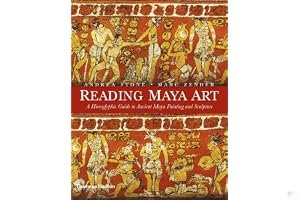
52
Reading Maya Art: A Hieroglyphic Guide to Ancient Maya Painting and Sculpture
Andrea Stone
4.1
The art of the ancient Maya may be considered their most singular cultural achievement. Yet despite a surge of popular interest in these remarkable people, few are fully aware of the richness of their artistic legacy, unique in all of pre-Columbian America. Maya art is a rare combination of linear elegance and naturalism blended with dazzling symbolic complexity. Decorated objects, ranging from painted vases and carved jade and shell ornaments to towering stone monuments and building facades, bear the traces of a symbol system that, while fascinating, can make an understanding of these images elusive to the uninitiated.
Presented here for the first time is a compendium of one hundred hieroglyphs that are also the building blocks of ancient Maya painting and sculpture. Organized thematically, the symbols touch on many facets of the Maya world, from the natural environment—animals, plants, the heavens—to the mental landscape of gods, myths, and rituals. Using hundreds of line drawings and photographs, Andrea Stone and Marc Zender show how to identify these signs, understand their meaning, and appreciate the novel ways they appear in art. In addition to providing a basic introduction, the authors also offer many new and exciting interpretations.
…
Cover unavailable
53
Accidentally Married to...a Vampire? (Accidentally Yours, #2)
Mimi Jean Pamfilof
4.1
THE DETERMINED VAMPIRE: Niccolo DiConti has faithfully served as leader of Her Majesty’s army for over a millennium, but he’d rather sunbathe in the Sahara than spend another grueling day under his demented queen’s command. However, no one has ever left her side and lived to tell. So when a powerful goddess prophesies he will meet his salvation—a human woman he must turn into a vampire with her consent—he eagerly rises to the challenge. After all, how hard could it be to seduce a human female into taking the immortal plunge? Harder than he thinks. Because his mate won’t be born for another three centuries, and when he wakes up in the goddess’ tomb, not only is his life a mess, but his destined female isn’t about to settle for a coldhearted vampire. Can he win her over before it’s too late? Not if his enemies have anything to do with it.
AN UNWILLING BRIDE: On the night Helena Strauss meets the fierce, devastatingly handsome vampire who saves her life in the jungles of Mexico, she knows her world will be forever changed. Because an attraction this mind blowing only comes along once in a lifetime—or existence. And when he claims she is his one true mate, destined to be his for all eternity, it’s a fairytale come true. So what if her knight in shining armor is a vampire? Nobody’s perfect. But discovering the powerful, overbearing immortal doesn’t “do love”? Deal breaker. Helena will flee and set out to accomplish the impossible…sever the otherworldly bond between them. And it turns out, Helena is just the leverage Niccolo’s enemies need to break the mighty warrior and wipe out his people.
…
Cover unavailable
54
Accidentally...Evil? (Accidentally Yours, #3.5)
Mimi Jean Pamfilof
4.1
Backlum Chaam, the God of Male Virility, wasn't always such a bad guy. Before his heart turned black and his biggest goal in life became destroying mankind, he was just like any god. Compassionate, loyal, and dedicated. So where did it all go wrong? Sometimes broken hearts don't heal...
Word count: 35,000.
Cover unavailable
55
Pre-Columbian America: Ritual Arts of the New World
Skira
4.1
Cover unavailable
56
Native American Book of Knowledge (Native People Native Ways Series, Vol 1)
White Deer of Autumn, Shonto Begay
4.1
Cover unavailable
57
Historia de México: Una guía fascinante de la historia de México y la Revolución Mexicana (Spanish Edition)
Captivating History
4.1
Cover unavailable
58
The Codex
Douglas Preston
4.1
"Greetings from the dead," declares Maxwell Broadbent on the videotape he left behind after his mysterious disappearance. A notorious treasure hunter and tomb robber, Broadbent accumulated over a half a billion dollars' worth of priceless art, gems, and artifacts before vanishing---along with his entire collection---from his mansion in New Mexico.
At first, robbery is suspected, but the truth proves far stranger: As a final challenge to his three sons, Broadbent has buried himself and his treasure somewhere in the world, hidden away like an ancient Egyptian pharaoh. If the sons wish to claim their fabulous inheritance, they must find their father's carefully concealed tomb.
The race is on, but the three brothers are not the only ones competing for the treasure. This secret is so astounding it cannot be kept quiet for long. With half a billion dollars at stake, as well as an ancient Mayan codex that may hold a cure for cancer and other deadly diseases, others soon join the hunt---and some of them will stop at nothing to claim the grave goods.
The bestselling coauthor of such page-turning thrillers as Relic and The Cabinet of Curiosities, Douglas Preston now spins an unforgettable tale of greed, adventure, and betrayal in The Codex.
…
Cover unavailable
59
Green Wars: Conservation and Decolonization in the Maya Forest
Megan Ybarra
4.1
Global conservation efforts are celebrated for saving Guatemala’s Maya Forest. This book reveals that the process of protecting lands has been one of racialized dispossession for the Indigenous peoples who live there. Through careful ethnography and archival research, Megan Ybarra shows how conservation efforts have turned Q’eqchi’ Mayas into immigrants on their own land, and how this is part of a larger national effort to make Indigenous peoples into neoliberal citizens. Even as Q’eqchi’s participate in conservation, Green Wars amplifies their call for material decolonization by recognizing the relationship between Indigenous peoples and the land itself.
…
Cover unavailable
60
Mesoamerican History: A Captivating Guide to Four Ancient Civilizations that Existed in Mexico – The Olmec, Zapotec, Maya and Aztec Civilization
Captivating History
4.1
Cover unavailable
61
History of Mexico: A Captivating Guide to Mexican History, Starting from the Rise of Tenochtitlan through Maximilian's Empire to the Mexican Revolution and the Zapatista Indigenous Uprising
Captivating History
4.1
Before the modern country was born in 1821, the territory that today comprises 32 states and few small islands was inhabited by ancient dynasties and kingdoms of warriors, astronomers, priests, temples for human sacrifice, and, surprisingly, some of the largest cities in the world. It is estimated that the sacred city of Chichen Itza, in the Yucatan Peninsula, was larger than Paris at its height of splendor.
This fascinating journey through Mexico’s history, from its amazing pre-Hispanic past to the end of the 20th century, will reveal more surprises than the reader can imagine. In the words of the self-proclaimed Mexican singer Chavela Vargas, “Mexico has magic. I looked for that magic, and I found it there.”
In History of Mexico: A Captivating Guide to Mexican History, Starting from the Rise of Tenochtitlan through Maximilian's Empire to the Mexican Revolution and the Zapatista Indigenous Uprising, you will discover topics such as The Era of Empires The Spanish-Aztec War and New Spain The Birth of a Nation “From the Halls of Montezuma…” The Big Division “The Most Beautiful Empire in the World” In the Times of Don Porfirio The Mexican Revolution The Cristeros The Second World War and the Mexican Miracle End of Century Pangs And much, much more!
…
Cover unavailable
62
Gods of Jade and Shadow
Silvia Moreno-Garcia
4.1
The Mayan God of Death sends a young woman on a harrowing, life-changing journey in this dark fairy tale inspired by Mexican folklore, for readers of The Song of Achilles and Uprooted.
Here we shall begin to tell a story: a tale of a throne lost, of monsters and magic. A tale of gods and of the shadow realm. But this, our story, it begins in our world, in the land of mortals.
It begins with a woman. For this story, it is her story. It begins with her.
The Jazz Age is in full swing, but Casiopea Tun is too busy cleaning the floors of her wealthy grandfather's house to listen to any fast tunes. Nevertheless, she dreams of a life far from her dusty, small town in southern Mexico. A life she can call her own.
Yet this new life seems as distant as the stars, until the day she finds a curious wooden box in her grandfather's room. She opens it--and accidentally frees the spirit of the Mayan God of Death, who requests her help in recovering his throne from his treacherous brother. Failure will mean Casiopea's demise, but success could make her dreams come true.
In the company of the strangely alluring god and armed with her wits, Casiopea begins an adventure that will take her on a cross-country odyssey, from the jungles of Yucatán to the bright lights of Mexico City--and deep into the darkness of the Mayan underworld.
Mixing the excitement of the Roaring Twenties with Prehispanic mythology, Gods of Jade and Shadow is a vivid, wildly imaginative historical fantasy.
…
Cover unavailable
63
The Ancient Maya
Robert J. Sharer
4.1
This book traces the evolution of Maya civilization through the Pre-Columbian era, a span of some 2,500 years from the origins of complex society within Mesoamerica to the end of the Pre-Columbian world with the Spanish Conquest in the 16th century. The sixth edition presents new archaeological evidence and historical studies and offers the most extensive revisions of this classic work to date. The result is the most thorough and incisive study of the origins and development of ancient Maya civilization ever published.
…
Cover unavailable
64
The Lost Cities of the Mayas: The Life, Art, and Discoveries of Frederick Catherwood
Fabio Bourbon
4.1
This lavishly illustrated volume recounts the adventurous life of Frederick Catherwood, the 19th-century English artist who discovered lost Mayan cities in the jungles of Central America and the Yucatan plateau. In 1839 Catherwood and his American companion, John Lloyd Stephans, were the first Westerners to view the immense terraces, fabulous temples, and elaborate palaces that had been inexplicably abandoned ten centuries earlier. Superbly illustrated by Catherwood, Stephen's lively travel diaries recounting their extraordinary archaeological discoveries were published in 1841 and 1843. Using these journals and his own extensive research, the author, Fabio Bourbon, has pieced together Catherwood's fascinating biography, which until now has been shrouded in mystery.Illustrating this handsome, large-format book are more than 200 engravings made from Catherwood's original drawings. Also reproduced is Catherwood's Views of Ancient Monuments in Central America, Chiapas and Yucatan -- a rare color portfolio considered to be his best work. Catherwood's other adventures are also described -- his first trips to Europe and Egypt, his later expeditions to Central America, and finally his experiences in California. This intriguing book about an intrepid adventurer/artist will appeal to anyone interested in exploration, architecture, and archaeology.
…
Cover unavailable
65
I, Rigoberta Menchú: An Indian Woman in Guatemala
Rigoberta Menchú, Elisabeth Burgos-Debray, Ann Wright
4.1
Cover unavailable
66
Warlords of Ancient Mexico: How the Mayans and Aztecs Ruled for More Than a Thousand Years
Peter G. Tsouras
4.1
Learn the unbelievable true history of the great warrior tribes of Mexico.
More than thirteen centuries of incredible spellbinding history are detailed in this intriguing study of the rulers and warriors of Mexico. Dozens of these charismatic leaders of nations and armies are brought to life by the deep research and entertaining storytelling of Peter Tsouras.
Tsouras introduces the reader to the colossal personalities of the period: Smoking Frog, the Mexican Machiavelli, the Poet Warlord, the Lion of Anahuac, and others . . . all of them warlords who shaped one of the most significant regions in world history, men who influenced the civilization of half a continent.
The warlords of Mexico, for all their fascinating lives and momentous acts, have been largely ignored by writers and historians, but here that disappointing record is put right by a range of detailed biographies that entertain as they inform. Students of the area, historians working in American history, and long-term visitors and tourists to the region will gain a much clearer understanding of the background history of these territories and the men who formed and reformed them.
Lavishly illustrated with dozens of photographs and color paintings, Warlords of Ancient Mexico is essential reading for anyone interested in this tumultuous, endlessly captivating period of Central American history.
Skyhorse Publishing, as well as our Arcade imprint, are proud to publish a broad range of books for readers interested in history--books about World War II, the Third Reich, Hitler and his henchmen, the JFK assassination, conspiracies, the American Civil War, the American Revolution, gladiators, Vikings, ancient Rome, medieval times, the old West, and much more. While not every title we publish becomes a New York Times bestseller or a national bestseller, we are committed to books on subjects that are sometimes overlooked and to authors whose work might not otherwise find a home.
…
Cover unavailable
67
Maya to Aztec: Ancient Mesoamerica Revealed
Edwin Barnhart and The Great Course
4.1
Cover unavailable
68
Accidentally in Love with...a God? (Accidentally Yours, #1)
Mimi Jean Pamfilof
4.1
Twenty-two-year-old Emma Keane has a secret friend. He’s powerful, mysterious, and devastatingly handsome. In her dreams, anyway.
In real life, he’s an enigma. Maybe just a teensie jealous. Definitely overbearing. He’s also a voice only she can hear.
So who or what is he? He won’t say. But if she wants to be free, to be normal, Emma will have to trek to the jungles once ruled by the Mayans and find the forgotten ruin holding the answers.
However, the ruthless deity she’s about to unknowingly unleash on the modern world might not be so easily extracted from her life. Bottom line, he’s got enemies, and now, so does she.
…
Cover unavailable
69
How to Read Maya Hieroglyphs
John Montgomery
4.1
This comprehensive guide to deciphering Maya hieroglyphs contains a complete outline of the writing, presenting individual signs and their meanings, the script's grammatical structure and content, and explanations of the sophisticated Maya calendrical and mathematical systems.
Cover unavailable
70
The Princess Joke Book: ( Full Color Illustrations )
Adir Levy, Ganit Levy, et al.
4.1
A book which is printed using a specific child's name.Beautifully illustrated.
Cover unavailable
71
Jake Ransom and the Skull King's Shadow
James Rollins
4.1
When a mysterious envelope arrives for Jake Ransom, he and his older sister, Kady, are plunged into a gripping chain of events. An artifact found by their parents—on the expedition from which they never returned—leads Jake and Kady to a strange world inhabited by a peculiar mix of long-lost civilizations, a world that may hold the key to their parents' disappearance.
But even as they enter the gate to this extraordinary place, savage grackyls soar across the sky, diving to attack. Jake's new friends, the pretty Mayan girl Marika and the Roman Pindor, say the grackyls were created by an evil alchemist—the Skull King. And as Jake struggles to find a way home, it becomes obvious that what the Skull King wants most is Jake and Kady—dead or alive.
…
Cover unavailable
72
A Little White Lie
Jennifer Lynn Barne
4.1
Cover unavailable
73
Mexico: A 500-Year History
Paul Gillingham
4.0
From acclaimed and prizewinning historian Paul Gillingham, the rich and fascinating history of one of the world’s most diverse, politically groundbreaking, and influential of countriesFrom its outset, “Mexico was more profoundly, globally hybrid than anywhere else in the prior history of the world,” writes Paul Gillingham at the beginning of this masterful work of scholarship and narration. Over the ensuing five centuries, Mexicans have prefigured and shaped the course of human lives across the globe. Mexico begins in 1511 with the dramatic shipwreck of two Spanish sailors near the Yucatán Peninsula. Ten years later Hernán Cortés led an army of European adventurers and indigenous rebels to seize the legendary island city of Tenochtitlán, the largest in the Americas and the center of Montezuma’s empire. The capture of the future Mexico City was, more than an extraordinary military event, the collision of two long-separated worlds, radically different in everything from biota to urban planning. Spaniards discovered tomatoes, chocolate, and a city larger and more sophisticated than anything they had ever seen. Mexicans discovered horses, wheels, and new lethal germs, sparking a cataclysmic century of disease that wiped out much of the preexisting population and led to a unique recombination of European and indigenous cultures. Mexico’s independence from the Spanish Empire in 1821 led to a calamitous mid-century war with the United States and then one of the first great social revolutions that brought peace for Mexicans throughout many of the global horrors of the twentieth century, before the country itself slipped into the violence of the cartels and a refugee crisis in the 2000s. Through it all, Mexico set new standards for inclusivity, for progressive social policies, for artistic expression, for adroitly balancing dictatorship and democracy. While racial divides endured, so too did indigenous peoples, who enjoyed rights unthinkable for native peoples in the United States. Mexico was among the first countries to abolish slavery in 1829, and since then Mexicans have elected North America’s first Black president, Vicente Guerrero; the region’s only indigenous president, Benito Juárez; and its only woman president, Claudia Sheinbaum. As elegantly written as it is powerful in scope, rich in character and anecdote, Mexico uses the latest research to dazzling effect, showing how often America’s southern neighbor has been a dynamic and vital shaper of world affairs.
…
Cover unavailable
74
The Book of Chilam Balam of Chumayel: Literature of the Yucatan Mayans; the Religion, Calendar and Legends of the Maya Civili
Ralph L Roys
4.0
Cover unavailable
75
Rain Player
David Wisniewski
4.0
The ancient Mayan belief that the future was divinely decreed and could not be changed is the basis for this original tale of a boy who must defeat the Rain God in a ball game to save his people from disaster. Mayan art and architecture were the inspiration for the spectacular cut-paper artwork.
Cover unavailable
76
Curses! (Gideon Oliver, #5)
Aaron J. Elkins
4.0
Mayan ruins in the Yucatan...a secret room in a tomb...an ancient skeleton. To Gideon Oliver, anthropologist, this archaeological find is paradise on earth. He and his wife, Julie, have joined his old mentor, Abe Goldstein, at Tlaloc, Mexico, to make sure there are no dirty doings at the dig. Five years before scandal rocked the site when a colleageue ran off with a priceless relic. Now Abe suspects something illegal is again going on. The discovery of a Mayan curse protecting the ruins suddenly make Tlaloc seem closer to hell than heaven. But the mysteries waiting inside the sone temples are too tempting to let mere words scare away the famous "skeleton detective." Only when the curse seems to be coming true and Gideon has a modern murder to solve does evil stop being academic...and death in the Yucatan seems imminently real.
…
Cover unavailable
77
Dawnkeepers (The Nightkeepers, #2)
Jessica Andersen
4.0
The countdown to the end of days has begun—and Only the Nightkeepers can stop the annihilation of all mankind...
View our feature on Jessica Andersen’s Dawnkeepers.
Though a Nightkeeper, Nate Blackhawk refuses to allow others to control his fate. The gods have even tried to influence his love life, sending him visions of Alexis Gray, a sleek blonde who is everything he’s ever wanted in a woman.
The two warriors can’t deny their attraction. But a frightening vision leads Nate to distance himself in spite of the intense passion he feels. Thrown together once more, they must reassemble seven Mayan artifacts that hold the key to preventing the end of the world…
…
Cover unavailable
78
Mysteries of the Mexican Pyramids
Peter Tompkins, Hugh Harleston Jr.
4.0
Probes the history, origins, and purpose of the pyramids in the Valley of Mexico, Yucatan, and Central America, with emphasis on the Pyramid of the Sun and the Pyramid of the Moon near Mexico City. Recounts the history of these structures from their first sighting by Cortes as rubble-covered mounds through four centuries of efforts to solve the mystery of their existence.
Cover unavailable
79
Fiery Pool: The Maya and the Mythic Sea
Daniel Finamore, Stephen Houston
4.0
Maya art and hieroglyphs constitute one of the world’s most fascinating, visually striking, and complex systems of expression. Most scholarly interpretations of Maya art and culture have emphasized that this ancient civilization was oriented toward inland centers and preoccupied with the blood of royal lineage and ritual sacrifice. Drawing on recent archaeological discoveries and developments in deciphering Maya glyphs, this groundbreaking volume presents a revisionist reading that shifts the emphasis of interpretation to the mythic power of the sea as the basis of a larger, deeper cultural narrative and history for the Maya.
Surrounded by the sea in all directions, the Maya viewed water as a source of both life and danger. Through the artworks presented—including acknowledged masterpieces and many never before exhibited in the United States—readers will gain a new appreciation for water’s influence on Maya cosmology, its role in their interpretation of the supernatural, as well as its impact on Maya cross-cultural contacts, trading practices, and power dynamics. Essays by prominent scholars provide an interdisciplinary context for understanding Maya art as well as new interpretations of traditional iconography and symbolism.
Accompanying a monumental exhibition comprising almost 100 artworks ranging from carved stone monuments to delicate jade sculptures, this compelling, richly illustrated publication will fundamentally transform the interpretation of Maya art.
…
Cover unavailable
80
Stellar Wind
Catherine Barber
4.0
2012 is not the end of the world; it is the end of an era and it is the fifth time that Humanity will experience it. When one cycle ends, another begins. Stellar Wind 2012 is a fiction novel that includes the Mayan prophecies entwined in an epic adventure. The difference with Stellar Wind 2012 and the film 2012 is HOPE!
Cover unavailable
81
Serpent of Light: Beyond 2012: The Movement of the Earth's Kundalini and the Rise of the Female Light
Drunvalo Melchizedek
4.0
Every 13,000 years on Earth a sacred and secret event takes place that changes everything. Mother Earth's Kundalini energy emerges from its resting place in the planet's core and moves like a snake across the surface of our world. Once at home in ancient Lemuria, it moved to Atlantis, then to the Himalayan mountains of India and Tibet, and with every relocation changed our idea of what spiritual means. And gender. And heart.This time, with much difficulty, the "Serpent of Light" has moved to the Andes Mountains of Chile and Peru. Multidimensional, multidisciplined and multilived, for the first time in this book, Drunvalo begins to tell his stories of 35 years spent in service to Mother Earth. Follow him around the world as he follows the guidance of Ascended Masters, his two spheres of light, and his own inner growing knowledge. His story is a living string of ceremonies to help heal hearts, align energies, right ancient imbalances, and balance the living Earth's Unity Consciousness Gridin short to increase our awareness of the indivisibility of life in the universe. We are allrocks and people and interdimensional beingsone!" Life may seem to be business as usual, but it is not. We are changing fast ...Remember this for life is going to present stranger things to you in your lifetime, and they all have meaning and purpose ...Only Mother Earth and ancient Maya know what's going to happen." from Serpent of Light. *black and white photographs included
…
Cover unavailable
82
The River of No Return (Jaguar Stones, #3)
J&P Voelkel
4.0
A hurricane is brewing in the jungles of the Maya, and the ancient Death Lords are on the warpath. Across the world in Venice, Italy, hanging out with his blogger friend Nasty (Anastasia) Smith-Jones and eating Pizza Gelato, Max Murphy thinks he is safe from their clutches. But when a rogue octopus pulls him off his gondola and tries to drag him down to the underworld, Max realizes that the Death Lords have not finished with him yet.
Soon Max is back in Central America and reunited with the only ones who can help him in his battle—Lola, the mysterious Maya girl, and the howler monkeys Lord 6-Dog and Lady Coco. Once again it’s up to the four of them to save the world as they fight off mutant cave spiders, zombie warriors, and, of course, the twelve villainous Death Lords. With the hurricane about to hit land, Max and Lola embark on a one-way journey to danger down the blighted Monkey River. They take shelter in a subterranean hotel, only to stumble upon Death Lord central. Torn between rescuing themselves and rescuing one of the last wild jaguars of the Monkey River region, Max and Lola find themselves drawn into an ever more bizarre series of tests, culminating in a terrifying ballgame that they can never win.
The River of No Return is filled with the same outrageous humor, heart-stopping action, and fascinating details of Maya culture that fans of the Jaguar Stones series have come to love. Readers will be intrigued as secrets are revealed about their favorite characters while Max and Lola try to stop the world from ending . . . at least for now.
…
Cover unavailable
83
Adult Coloring Book: Coloring Book For Adults Featuring 30 Beautiful Mayan And Aztec Cultural Art
Morgana Skye
4.0
Both Aztec and Mayan art offer a visual feast of fascinating pieces that draw the person viewing them into their story. It's all in the details, whether ornate or simplistic. Through looking at these pieces and admiring them, people are able to get a sense of how each piece of art tells its own unique and alluring story, whether it's dark and tragic or celebratory in nature. This type of exciting emotional connection is the inspiration behind this coloring book and through our own abilities to tell and learn stories, as adults we have the opportunity to link an amazing and interesting past-that of the Aztec and Mayan cultures-with our busy and chaotic lives in the present. Many adults today are looking for a connection to something grounded, which usually comes from the elements of the world around us. This is where people can draw inspiration from, just as the Mayan and Aztec civilizations did so long ago. And they flourished for over 650 years as a result. Artisans and members of the community alike drew strength, hope, and understanding from everything around them. When they looked up to the skies they saw infinity. If their eyes went to the ground, they saw the fertile soil that lent to their livelihoods, and even when they looked straight ahead they saw others who inspired and motivated them. Adults can be their own artist for inspiration through coloring and there is no lovelier way to experience that then through the beautiful and alluring art of coloring Mayan and Aztec inspired art designs. By allowing your adult mind to have the amazing and wonderful experience of coloring from the heart of the child that still exists in a person, they can gain so much. May your experiences with color inspire you, clear the mind, and help take you on a journey into the place in your heart and soul where contentment can be found and tranquility achieved. All humans have this inner creativity that can be unleashed when they open up their eyes and hearts to the world of coloring. Submerse yourself into these pages and enjoy. SCROLL UP AND CLICK BUY TO ORDER YOURS TODAY!
…
Cover unavailable
84
Spellfire (Nightkeepers,#8)
Jessica Andersen
4.0
Imprisoned and tortured by the demoness who tricked him into betraying the Nightkeepers and the woman he loves, Rabbit must endure excruciating pain to protect the diminished Skywatch army as the end-time approaches. Although an ancient prophecy says his unique powers are key to winning the final battle in the doomsday war, he hasn’t just lost his credibility—he’s lost his magic.
Myrinne is far from the woman Rabbit once knew—she’s got magic now, and despite emotional scars, she’s strong enough to help the Nightkeepers. And yet she’s not prepared to handle the fiercely driven man he’s become or the new, dangerous feelings that spark between them.
With the barrier ready to fall and a xombi outbreak in the human world, Rabbit and Myrinne must forge a new partnership amid dangerous instability and the threat of an undead army. In the end, it will be up to Rabbit to master his ferocious magic—or all will be lost. For him, for the woman he doesn’t have the right to love anymore, and for the fate of the world…
…
Cover unavailable
85
The Book of Destiny: Unlocking the Secrets of the Ancient Mayans and the Prophecy of 2012
Carlos Barrios and Lisa Carter
4.0
“Face to face with the schism caused by rational and scientific thought, Carlos Barrios undertakes an authentic and passionate search, bringing us close to the Cosmovision of one of the most ancient and wise people of our continent.” — Nobel Laureate Ernesto Sabato
James Redfield’s The Celestine Prophecy and the writings of Nostradamus meet Don Miguel Ruiz’s The Four Agreements and the work of Carolyn Myss (Anatomy of the Spirit, Sacred Contracts) in The Book of Destiny: Unlocking the Secrets of the Ancient Mayans and the Prophecy of 2012. A contemporary Mayan Priest and Shaman reveals the genius of the ancient Mayan calendar and its accompanying horoscope, and examines in depth the ancient 2012 prophecy that many believe will forever change the world as we know it. The Book of Destiny is the most complete and authentic book on the secrets of the ancient Mayan culture and what it means for readers today.
…
Cover unavailable
86
Mayan Ouroboros: The Cosmic Cycles Come Full Circle: the True Positive Mayan Prophecy is Revealed
Drunvalo Melchizedek
4.0
Cover unavailable
87
Catastrophe: An Investigation into the Origins of Modern Civilization
David Keys
4.0
Cover unavailable
88
Mystery in Mayan Mexico (Eddie Red Undercover #2)
Marcia Wells, Marcos Calo
4.0
Now that he has become the NYPD’s youngest crime-solving hero, Eddie Red and his best friend Jonah are ready to relax on a family vacation to Mexico. But when Eddie’s father is falsely accused of stealing, what they find is another complex mystery. Can Eddie – with his artistic talent and photographic memory – and Jonah uncover clues and catch the real crook in time? "Fast-paced, funny, and a sure pleaser for Cam Jansen Grads" (Kirkus), the Eddie Red series stars a hero worth rooting for.
…
Cover unavailable
89
Against the Grain: A Deep History of the Earliest States
James C. Scott
4.0
An Economist Best History Book 2017
“History as it should be written.”—Barry Cunliffe, Guardian
“Scott hits the nail squarely on the head by exposing the staggering price our ancestors paid for civilization and political order.”—Walter Scheidel, Financial Times
Why did humans abandon hunting and gathering for sedentary communities dependent on livestock and cereal grains, and governed by precursors of today’s states? Most people believe that plant and animal domestication allowed humans, finally, to settle down and form agricultural villages, towns, and states, which made possible civilization, law, public order, and a presumably secure way of living. But archaeological and historical evidence challenges this narrative. The first agrarian states, says James C. Scott, were born of accumulations of domestications: first fire, then plants, livestock, subjects of the state, captives, and finally women in the patriarchal family—all of which can be viewed as a way of gaining control over reproduction.
Scott explores why we avoided sedentism and plow agriculture, the advantages of mobile subsistence, the unforeseeable disease epidemics arising from crowding plants, animals, and grain, and why all early states are based on millets and cereal grains and unfree labor. He also discusses the “barbarians” who long evaded state control, as a way of understanding continuing tension between states and nonsubject peoples.
…
Cover unavailable
90
The Maya: Voices in Stone
David Stuart, Ana Luisa Cueva, et al.
4.0
A gorgeously produced volume of over 500 pages, The Maya: Voices in Stone is a breathtaking visual appraisal of the enormous diversity of Mayan culture, buttressed by contributions from the leading contemporary scholars of classical Mayan culture, and covering Mayan art, writing, religion, rituals, social structures, government, architecture, warfare and geopolitical landscape. Objects found at various archaeological sites help to reconstruct the Maya's customs, tracing the New World's greatest civilization of antiquity through the classical period until the Spanish conquest and subsequent colonialism. With over 300 images, this is both a groundbreaking work of scholarship--archaeological, historical, sociological and anthropological--as well as a gorgeously illustrated sourcebook for the general reader. It also includes a Mayan area map, chronological chart, index, list of further reading, as well as various infographics throughout. An indispensable book for anyone approaching the rich, complex world of the ancient Maya and their artistic accomplishments, political organization, scientific advancement and many other aspects of this great civilization, it offers a new image of a living, vibrant people--with glories and miseries alike--that contrasts sharply with the idealized image of the Maya established by scholars in the first half of the 20th century. Alongside the magnificent sculpture and architecture, astounding scientific knowledge and sophisticated religion, we now also encounter the Mayan lust for power, conflict, war, social injustice, hunger and destruction. The Maya: Voices in Stone presents a fresh vision of the extraordinary Pre-Hispanic civilization.
…
Cover unavailable
91
Lords of Creation: The Origins of Sacred Maya Kingship
Virginia Fields
4.0
Published in conjunction with an exhibition that opened at the Los Angeles County Museum of Art in September 2005, the catalogue uses art works to trace the development of the dominant cosmology of Mesoamerica from the Olmecs through the Maya Early Classic period. Most of the 152 figures are color photographs. Distributed outside the Museum by Anti
Cover unavailable
92
Messages from the Gods: A Guide to the Useful Plants of Belize
Michael J. Balick, Rosita Arvigo
4.0
Despite its small size, Belize is one of the most ecologically and culturally diverse nations in Central America. Over 3,400 species of plants can be found here, within a diversity of ecological habitats. Because of this, Belize is paradise for ecotourists, hosting over 900,000 visitors annually, who enjoy the natural habitat and friendly people of this nation. Many of the plants of Belize have a long history of being "useful," with properties that have served traditional herbal healers of the region as well as those who use plants as food, forage, fiber, ornament, in construction and ritual, along with many other purposes.
With Messages from the Gods: A Guide to the Useful Plants of Belize, Drs. Michael Balick and Rosita Arvigo give us the definitive resource on the many species of plants in Belize and their folklore, as well as the natural history of the region and a detailed discussion of "bush" uses of plants, including for traditional healing and life in the forest, past and present. Both Balick and Arvigo bring important perspectives to the project, Balick as ethnobotanical scientist from The New York Botanical Garden, and Arvigo as a former apprentice to a Belizean healer and an experienced physician. The book has been decades in the making, a culmination of a biodiversity research project that The New York Botanical Garden and international and local collaborators have had in motion since 1987. Drs. Balick, Arvigo and their colleagues have collected and identified thousands of plants from the region, and have worked extensively with hundreds of Belizean people, many of them herbal healers and bushmasters, to record uses for many of the species. This collaboration with local plant experts has produced a fascinating discussion of the intersection of herbal medicine and spiritual belief in the area, and these interviews are used to compliment and contextualize the numerous species accounts presented. The book is both a cultural study and a specialized field guide; information is provided on many different native and introduced plants in Belize and their traditional and contemporary uses including as food, medicine, fiber, in spiritual practices and many other purposes.
Richly illustrated with over 600 images and photographs, Messages from the Gods: A Guide to The Useful Plants of Belize will serve as the primary reference and guide to the ethnobotany of Belize for many years to come.
…
Cover unavailable
93
The Order of Days: The Maya World and the Truth About 2012
David Stuart
4.0
The world's foremost expert on Maya culture looks at 2012 hysteria and explains the truth about what the Maya meant and what we want to believe.
Apocalypse 2012: An Investigation into Civilizations End. The World Cataclysm in 2012. 2012: The return of Quetzalcoatl. According to many of these alarmingly titled books, the ancient Maya not only had a keen insight into the mystical workings of our planet and the cosmos, but they were also able to predict that the world will end in the year 2012.
David Stuart, the foremost scholar of the Maya and recipient of numerous awards for his work, takes a hard look at the frenzy over 2012 and offers a fascination (and accurate) trip through Mayan culture and belief. Stuart shows how the idea that the "end of the Mayan calendar," which supposedly heralds the end of our own existence, says far more about our culture than about the ancient Maya. The Order of Days explores how the real intellectual achievement of ancient Maya timekeeping and worldview is far more impressive and remarkable than any of the popular, and often outrageous, claims about this advanced civilization.
As someone who has studied the Maya for nearly all of his life and who specializes in reading their ancient texts, Stuart sees the 2012 hubbub as the most recent in a long chain of related ideas about Mesoamericans, the Maya in particular, that depicts them as somehow oddball, not "of this world," or as having some strong mystical link to other realms.
Because the year 2012 has no prominent role in anything the ancient Maya ever actually wrote, Stuart takes a wider look at the Maya concepts of time and their underlying philosophy as we can best understand them. The ancient Maya, Stuart contends, were worthy of study and admiration not because they were strange but because they were altogether human, and they developed a compelling vision of time unlike any other civilization before or since.
…
Cover unavailable
94
The Serpent and the Jaguar: Living in Sacred Time
Birgitte Rasine
4.0
Everything we do and the way we think is based on a linear conception of time. Our very ideas of life, success, and happiness are tied to a non-cyclical, non-organic paradigm that often works against our own nature and potential. The Maya live in a different world—close to nature, close to their children and their elders, and close to time: the sacred and the secular. It may seem we could not be further removed from the Mayan way of life, but there is a road built centuries ago we can still access. It’s called the Tzolk’in, the sacred ritual calendar the Maya have used since ancient times to guide their personal and spiritual paths.
For the first time, The Serpent and the Jaguar brings you the Tzolk’in and all of its 260 days interpreted in the context of modern life and modern challenges. This book will help you redefine your relationship with sacred, cyclical time in the face of our demanding, stressful schedules operating on linear time.
Inside:
• The full set of the 260 Energies of the Day of the Tzolk'in • Detailed descriptions of the 20 trecenas and their ruling day signs • Detailed descriptions of the 13 numbers • Introductory sections on the Mayan Calendar, the day signs, trecenas, and the numbers • A guide to living with sacred time • Mayan Calendar tables to calculate dates offline • Original day sign illustrations by New Zealand painter and artist Maree Gifkins (along with the traditional Maya day sign and number glyphs)
…
Cover unavailable
95
Aztec Mythology: Captivating Aztec Myths of Gods, Goddesses, and Legendary Creatures
Matt Clayton
4.0
Cover unavailable
96
Moche Portraits from Ancient Peru
Christopher B. Donnan
4.0
Of all the ancient civilizations that flourished in the Americas, only one perfected true portraiture of living people and produced it in quantity—the Moche who inhabited the north coast of Peru between approximately AD 100 and 800. Using the medium of three-dimensional ceramic vessels that could have contained liquid, Moche artisans typically formed the heads of the individuals they wished to portray, though sometimes they presented full figures with realistic portrait faces. Depicting an astonishing range of physical types, these portraits now allow us to meet Moche people who lived more than 1,500 years ago and to sense the nuances of their individual personalities.
This pathfinding book presents the first wide-ranging, systematic study of the Moche portraits. Drawing on more than 900 examples from museums and private collections around the world (some 300 of which are illustrated here in full color) Christopher Donnan documents how the portrait tradition evolved, how the portraits were produced and distributed, who they portrayed, why they were made, and how they were used in Moche society. His analysis is supported by extensive archaeological evidence, which provides the context for portraits found in Moche tombs and midden deposits, as well as useful information for identifying the headdresses and ornaments worn by the individuals portrayed.
…
Cover unavailable
97
Popol Vuh
Victor Montejo, Luis Garay, et al.
4.0
The Mayans have long fascinated modern readers with their complex written language, sophisticated mathematics, and advanced astronomy. In Guatemala in 1558, a young Mayan K’iche’ man transcribed what he called a sacred book that “we can no longer see.” This was the Popul Vuh, the Mayans' written account of the creation of the universe, the gods and demi-gods who occupied that universe, and the story of how man was created by them. Furthermore, it traced, generation by generation, the lineage of the Mayan lords down to their imprisonment and torture by the Spanish invaders. Considered the Mayan bible, the Popol Vuh appears here in an authoritative, gorgeously illustrated version by noted Maya anthropologist Victor Montejo, who has captured all the drama and excitement of one of the world’s great creation stories.
…
Cover unavailable
98
A New Beginning: Celebrating the Spring Equinox
Wendy Pfeffer, Linda Bleck
4.0
The spring equinox signals the time of year when the days are getting longer, the growing season has begun, and animals give birth to their young. With accessible, lyrical prose and vibrant illustrations, this book explains the science behind spring and shows how the annual arebirtha of Earth has been celebrated by various cultures throughout the ages and the world. Teachers will appreciate the simple science, the multicultural history, and the hands-on activities in this book. Parents and librarians will enjoy sharing it with children at Easter and Passover time.
…
Cover unavailable
99
The Code of Kings: The Language of Seven Sacred Maya Temples and Tombs
Linda Schele
4.0
This unique and extraordinary guide to seven major sites of Maya civilization highlights the pioneering work of two great scholars of ancient America. For readers at every level -- from the casual tourist to the serious student -- The Code of Kings relies on Linda Schele and Peter Mathews's revolutionary work in the decipherment of the hieroglyphs that cover the surfaces of Maya ruins to give us a far clearer picture of Maya culture than we have ever had. Richly illustrated with line art and the incomparable photography of Justin Kerr and Macduff Everton, The Code of Kings is a landmark contribution to our understanding of the Maya and a phenomenal guided tour of seven of the most awesome and magical spots on Earth.
…
Cover unavailable
100
Silence on the Mountain: Stories of Terror, Betrayal, and Forgetting in Guatemala
Daniel Wilkinson
4.0
new in paperback Silence on the Mountain is a virtuoso work of reporting and a masterfully plotted narrative tracing the history of Guatemala’s thirty-six-year internal war, a conflict that claimed the lives of some 200,000 people, the vast majority of whom died (or were “disappeared”) at the hands of the U.S.-backed military government. Written by Daniel Wilkinson, a young human rights worker, the story begins in 1993, when the author decides to investigate the arson of a coffee plantation’s manor house by a band of guerrillas. The questions surrounding this incident soon broaden into a complex mystery whose solution requires Wilkinson to dig up the largely unwritten history of the country’s recent civil war, following its roots back to a land reform movement that was derailed by a U.S.-sponsored military coup in 1954 and to the origins of a plantation system that put Guatemala’s Mayan Indians to work picking coffee beans for the American and European markets. Decades of terror-inspired fear have led the Guatemalans to adopt a survival strategy of silence so complete that it verges on collective amnesia. The author’s great triumph is that he finds a way for people to tell their stories, and it is through these stories—dramatic, intimate, heartbreaking—that we are shown the anatomy of a thwarted revolution that has relevance not only to Guatemala but also to countless places around the world where terror has been used as a political tool.


 1
1