1100 Best JavaScript Books of All Time
We've ranked the best javascript books using expert recommendations, sales data, and millions of reader ratings. At Shortform, we know books. Our book guides are the best in the world. Learn why.
1
2JavaScript: The Good Parts
Considered the JavaScript expert by many people in the development community, author Douglas Crockford identifies the abundance of good ideas that make JavaScript an outstanding object-oriented programming language-ideas such as functions, loose typing, dynamic objects, and an expressive object literal notation. Unfortunately, these good ideas are mixed in with bad and downright awful ideas, like a programming model based on global variables.
When Java applets failed, JavaScript became the language of the Web by default, making its popularity almost completely independent of its qualities as a programming language. In JavaScript: The Good Parts, Crockford finally digs through the steaming pile of good intentions and blunders to give you a detailed look at all the genuinely elegant parts of JavaScript, including:
Syntax
Objects
Functions
Inheritance
Arrays
Regular expressions
Methods
Style
Beautiful features
The real beauty? As you move ahead with the subset of JavaScript that this book presents, you'll also sidestep the need to unlearn all the bad parts. Of course, if you want to find out more about the bad parts and how to use them badly, simply consult any other JavaScript book.
With JavaScript: The Good Parts, you'll discover a beautiful, elegant, lightweight and highly expressive language that lets you create effective code, whether you're managing object libraries or just trying to get Ajax to run fast. If you develop sites or applications for the Web, this book is an absolute must.
I’m actually a self-taught programmer, so these books have really helped me with practical skills that I could put to use & yield results. The return on investment for these kinds of books is off the charts for me! [source]
3Eloquent Javascript: A Modern Introduction to Programming
Eloquent JavaScript dives into the JavaScript language to show programmers how to write elegant, effective JavaScript code. Like any good programming book, Eloquent JavaScript begins with fundamentals--variables, control structures, functions, and data structures--then moves on to complex topics like object-oriented programming and regular expressions. This third edition introduces new features covering the 2017 version of JavaScript, such as class notation, arrow functions, iterators, async functions, template strings, and black scope. Author Marijn Haverbeke keeps the friendly tone and easy-to-follow explanations that made the original a hit, and he adds new exercises for readers to test their skills. Eloquent JavaScript will have readers fluent in the language of the web in no time, eloquently.
Secrets of the JavaScript Ninja
JavaScript Patterns
Written by JavaScript expert Stoyan Stefanov -- Senior Yahoo! Technical and architect of YSlow 2.0, the web page performance optimization tool -- JavaScript Patterns includes practical advice for implementing each pattern discussed, along with several hands-on examples. You'll also learn about anti-patterns: common programming approaches that cause more problems than they solve.
Explore useful habits for writing high-quality JavaScript code, such as avoiding globals, using single var declarations, and more
Learn why literal notation patterns are simpler alternatives to constructor functions
Discover different ways to define a function in JavaScript
Create objects that go beyond the basic patterns of using object literals and constructor functions
Learn the options available for code reuse and inheritance in JavaScript
Study sample JavaScript approaches to common design patterns such as Singleton, Factory, Decorator, and more
Examine patterns that apply specifically to the client-side browser environment
You Don't Know JS: Scope and Closures (You Don't Know JS, #2)
Like other books in the "You Don't Know JS" series, Scope and Closures dives into trickier parts of the language that many JavaScript programmers simply avoid. Armed with this knowledge, you can achieve true JavaScript mastery.
Learn about scope, a set of rules to help JavaScript engines locate variables in your code
Go deeper into nested scope, a series of containers for variables and functions
Explore function- and block-based scope, "hoisting", and the patterns and benefits of scope-based hiding
Discover how to use closures for synchronous and asynchronous tasks, including the creation of JavaScript libraries
7Effective JavaScript: 68 Specific Ways to Harness the Power of JavaScript
You Don't Know JS: this & Object Prototypes
Like other books in the "You Don't Know JS" series, this and Object Prototypes dives into trickier parts of the language that many JavaScript programmers simply avoid. Armed with this knowledge, you can become a true JavaScript master.
With this book you will:
Explore how the this binding points to objects based on how the function is called
Look into the nature of JS objects and why you'd need to point to them
Learn how developers use the mixin pattern to fake classes in JS
Examine how JS's prototype mechanism forms links between objects
Learn how to move from class/inheritance design to behavior delegation
Understand how the OLOO (objects-linked-to-other-objects) coding style naturally implements behavior delegation
You Don't Know JS: Up & Going
It’s easy to learn parts of JavaScript, but much harder to learn it completely—or even sufficiently—whether you’re new to the language or have used it for years. With the "You Don’t Know JS" book series, you’ll get a more complete understanding of JavaScript, including trickier parts of the language that many experienced JavaScript programmers simply avoid.
The series’ first book, Up & Going, provides the necessary background for those of you with limited programming experience. By learning the basic building blocks of programming, as well as JavaScript’s core mechanisms, you’ll be prepared to dive into the other, more in-depth books in the series—and be well on your way toward true JavaScript.
With this book you will:
Learn the essential programming building blocks, including operators, types, variables, conditionals, loops, and functions Become familiar with JavaScript's core mechanisms such as values, function closures, this, and prototypes Get an overview of other books in the series—and learn why it’s important to understand all parts of JavaScript
10JavaScript and jQuery: Interactive Front-End Web Development
This full-color book adopts a visual approach to teaching JavaScript & jQuery, showing you how to make web pages more interactive and interfaces more intuitive through the use of inspiring code examples, infographics, and photography. The content assumes no previous programming experience, other than knowing how to create a basic web page in HTML & CSS. You'll learn how to achieve techniques seen on many popular websites (such as adding animation, tabbed panels, content sliders, form validation, interactive galleries, and sorting data)..Introduces core programming concepts in JavaScript and jQueryUses clear descriptions, inspiring examples, and easy-to-follow diagramsTeaches you how to create scripts from scratch, and understand the thousands of JavaScripts, JavaScript APIs, and jQuery plugins that are available on the webDemonstrates the latest practices in progressive enhancement, cross-browser compatibility, and when you may be better off using CSS3
If you're looking to create more enriching web experiences and express your creativity through code, then this is the book for you.This book is also available as part of a set in hardcover - Web Design with HTML, CSS, JavaScript and jQuery, 9781119038634 - and in softcover - Web Design with HTML, CSS, JavaScript and jQuery, 9781118907443.
Head First JavaScript Programming: A Brain-Friendly Guide
This brain-friendly guide teaches you everything from JavaScript language fundamentals to advanced topics, including objects, functions, and the browser's document object model. You won't just be reading--you'll be playing games, solving puzzles, pondering mysteries, and interacting with JavaScript in ways you never imagined. And you'll write real code, lots of it, so you can start building your own web applications. Prepare to open your mind as you learn (and nail) key topics including: The inner details of JavaScriptHow JavaScript works with the browserThe secrets of JavaScript typesUsing arraysThe power of functionsHow to work with objectsMaking use of prototypesUnderstanding closuresWriting and testing applications
What's so special about this book?
We think your time is too valuable to waste struggling with new concepts. Using the latest research in cognitive science and learning theory to craft a multi-sensory learning experience, "Head First JavaScript Programming" uses a visually rich format designed for the way your brain works, not a text-heavy approach that puts you to sleep.
Object-Oriented JavaScript
You Don't Know JS: ES6 & Beyond
Like other books in this series, You Don't Know JS: ES6 & Beyond dives into trickier parts of the language that many JavaScript programmers either avoid or know nothing about. Armed with this knowledge, you can achieve true JavaScript mastery.
With this book, you will:
Learn new ES6 syntax that eases the pain points of common programming idioms
Organize code with iterators, generators, modules, and classes
Express async flow control with Promises combined with generators
Use collections to work more efficiently with data in structured ways
Leverage new API helpers, including Array, Object, Math, Number, and String
Extend your program's capabilities through meta programming
Preview features likely coming to JS beyond ES6
14Web Design with Html, Css, JavaScript and Jquery Set
HTML & CSS covers structure, text, links, images, tables, forms, useful options, adding style with CSS, fonts, colors, thinking in boxes, styling lists and tables, layouts, grids, and even SEO, Google analytics, ftp, and HTML5. JavaScript & jQuery offers an excellent combined introduction to these two technologies using a clear and simple visual approach using diagrams, infographics, and photographs.
A handy two-book set that uniquely combines related technologies Highly visual format and accessible language makes these books highly effective learning tools Perfect for beginning web designers and front-end developers
You Don't Know JS: Async & Performance
Like other books in this series, You Don't Know JS: Async & Performance dives into trickier parts of the language that many JavaScript programmers simply avoid. Armed with this knowledge, you can become a true JavaScript master.
With this book you will:
Explore old and new JavaScript methods for handling asynchronous programming
Understand how callbacks let third parties control your program's execution
Address the "inversion of control" issue with JavaScript Promises
Use generators to express async flow in a sequential, synchronous-looking fashion
Tackle program-level performance with Web Workers, SIMD, and asm.js
Learn valuable resources and techniques for benchmarking and tuning your expressions and statements
16Learning PHP, MySQL & JavaScript: With jQuery, CSS & HTML5 (Learning PHP, MYSQL, Javascript, CSS & HTML5)
Build interactive, data-driven websites with the potent combination of open source technologies and web standards, even if you have only basic HTML knowledge. In this update to this popular hands-on guide, you’ll tackle dynamic web programming with the latest versions of today’s core technologies: PHP, MySQL, JavaScript, CSS, HTML5, and key jQuery libraries.
Web designers will learn how to use these technologies together and pick up valuable web programming practices along the way—including how to optimize websites for mobile devices. At the end of the book, you’ll put everything together to build a fully functional social networking site suitable for both desktop and mobile browsers.
Explore MySQL, from database structure to complex queries Use the MySQLi extension, PHP’s improved MySQL interface Create dynamic PHP web pages that tailor themselves to the user Manage cookies and sessions and maintain a high level of security Enhance the JavaScript language with jQuery and jQuery mobile libraries Use Ajax calls for background browser-server communication Style your web pages by acquiring CSS2 and CSS3 skills Implement HTML5 features, including geolocation, audio, video, and the canvas element Reformat your websites into mobile web appsHigh Performance JavaScript
If you're like most developers, you rely heavily on JavaScript to build interactive and quick-responding web applications. The problem is that all of those lines of JavaScript code can slow down your apps. This book reveals techniques and strategies to help you eliminate performance bottlenecks during development. You'll learn how to improve execution time, downloading, interaction with the DOM, page life cycle, and more.
Yahoo! frontend engineer Nicholas C. Zakas and five other JavaScript experts -- Ross Harmes, Julien Lecomte, Steven Levithan, Stoyan Stefanov, and Matt Sweeney -- demonstrate optimal ways to load code onto a page, and offer programming tips to help your JavaScript run as efficiently and quickly as possible. You'll learn the best practices to build and deploy your files to a production environment, and tools that can help you find problems once your site goes live.
Identify problem code and use faster alternatives to accomplish the same task Improve scripts by learning how JavaScript stores and accesses data Implement JavaScript code so that it doesn't slow down interaction with the DOM Use optimization techniques to improve runtime performance Learn ways to ensure the UI is responsive at all times Achieve faster client-server communication Use a build system to minify files, and HTTP compression to deliver them to the browserProfessional JavaScript for Web Developers
Professional JavaScript for Web Developers (ISBN: 0764579088) Professional Ajax 2nd edition (ISBN: 0470109491) Professional Web 2.0 Programming (ISBN: 0470087889) Professional Rich Internet Applications: Ajax and Beyond (ISBN: 0470082801)
19A Smarter Way to Learn JavaScript: The new approach that uses technology to cut your effort in half
"Damn, this program is ridiculously good. The author needs to sign up to run this country's education program."-Matthew Highland
"This is the most incredible learning experience I have ever had. Amazing!!" -Jon W. Christophersen
"If you're thinking of learning how to program in JavaScript, I promise, this is the ONLY way to go." -L. Phillips
"Mark's exercises are worth more than the $300 class I took. Love this program." -Michelle Schackel
"A truly innovative way to learn JavaScript" -William Burbank
"A powerful new, interactive teaching machine." -W. Green
..".lays things out in a way that anyone can understand." -Dr. Robert Valli
..".the companion website gives you a chance to practice it so that it sticks in your head for good." -Alan Forbes, developer and coding guru
"Not only am I learning JavaScript incredibly fast, I am enjoying it." -Justin A. Roether
"Finally! -exactly what I need to learn effectively." -Samantha Lim
"I've used it to complement what I learnt at Codeacademy."-Alexandre Bobeda
"We have now implemented this as one of the prerequisites before being accepted to the coding camp." -Douglas Paul Burns
"Great book for anyone wanting to start out programming."-Dane Cameron, software engineer
"Does a fantastic job of breaking down the process of learning a complicated subject." -Mitesh Dabhi, web designer and developer
"This is a fun book. It actually does makes learning JavaScript quite painless." -Amazon Customer
"If You're Too Dumb for a "For Dummies" book..."-C. Christopher Akin, IT professional
"A pretty cool way to learn a new language." -J. Oborn, web developer
"Best tool I've found." -Laine Gebhardt
"Clear, lively, and never dry." -Chandra K. Clarke
"My hand to God, this book never induced an afternoon nap, or even made me sleepy." -Jeremy Costa
"Simplifies the complicated." -Olu Odebunmi
"Strikes a perfect balance between learning, practicing and feedback." -Jeff Santos
"JavaScript made easy." -Clark Anderson
"Better than Codeacademy." -Callum Makkai
Become fluent in all the JavaScript fundamentals, in half the time.Display alert messages to the userGather information through promptsManipulate variablesBuild statementsDo mathUse operatorsConcatenate textRun routines based on conditionsCompare valuesWork with arraysRun automated routinesDisplay custom elements on the webpageGenerate random numbersManipulate decimalsRound numbersCreate loopsUse functionsFind the current date and timeMeasure time intervalsCreate a timerRespond to the user's actionsSwap imagesControl colors on the webpageChange any element on the webpageImprovise new HTML markup on the flyUse the webpage DOM structureInsert commentsSituate scripts effectivelyCreate and change objectsAutomate object creationControl the browser's actions
20Learning Javascript Design Patterns
You Don't Know JS: Types & Grammar
The type system in JavaScript is subject to several misconceptions. Many developers believe that JavaScript has no types, but that's not the case. JavaScript uses a number of types behind the scenes, and has a sophisticated system of implicit and explicit coercion between the various types. This book gives you the complete story.
Like other books in this series, "You Don't Know JS: Types & Grammar" dives into trickier parts of the language that many JavaScript programmers simply avoid. Armed with this knowledge, you can achieve true JavaScript mastery.
Functional JavaScript: Introducing Functional Programming with Underscore.js
Written by Michael Fogus—a core contributor to Clojure and ClojureScript, and author of The Joy of Clojure (Manning)—this book is packed with not only the how of functional programming, but also the why. Each topic illustrated with pointed examples. You’ll also get a thorough reference to the Underscore.js library and its idioms, including:
Closures
Applicative programming
Laziness
Immutability
Higher-order functions
Purity
Combinators
Currying and partial application
Maintainable JavaScript
When you write code in a team setting, will other developers be able to understand what you did? Did you organize your code in such a way that it's easy to adapt and extend? Will your code survive once you're gone? Maintainable JavaScript doesn't just recommend a set of guidelines, it examines guidelines being used and recommended by others in the industry, so you get a feel for what's common in well-run JavaScript projects.
Save a copy of this book now. It's the only resource that focus solely on JavaScript conventions.
Javascript Allongé
by Reginald Braithwaite
JavaScript Allongé solves two important problems for the ambitious JavaScript programmer. First, JavaScript Allongé gives you the tools to deal with JavaScript bugs, hitches, edge cases, and other potential pitfalls.
There are plenty of good directions for how to write JavaScript programs. If you follow them without alteration or deviation, you will be satisfied. Unfortunately, software is a complex thing, full of interactions and side-effects. Two perfectly reasonable pieces of advice when taken separately may conflict with each other when taken together. An approach may seem sound at the outset of a project, but need to be revised when new requirements are discovered.
When you “leave the path” of the directions, you discover their limitations. In order to solve the problems that occur at the edges, in order to adapt and deal with changes, in order to refactor and rewrite as needed, you need to understand the underlying principles of the JavaScript programming language in detail.
You need to understand why the directions work so that you can understand how to modify them to work properly at or beyond their original limitations. That’s where JavaScript Allongé comes in.
JavaScript Allongé is a book about programming with functions, because JavaScript is a programming language built on flexible and powerful functions. JavaScript Allongé begins at the beginning, with values and expressions, and builds from there to discuss types, identity, functions, closures, scopes, and many more subjects up to working with classes and instances. In each case, JavaScript Allongé takes care to explain exactly how things work so that when you encounter a problem, you’ll know exactly what is happening and how to fix it.
Second, JavaScript Allongé provides recipes for using functions to write software that is simpler, cleaner, and less complicated than alternative approaches that are object-centric or code-centric. JavaScript idioms like function combinators and decorators leverage JavaScript’s power to make code easier to read, modify, debug and refactor, thus avoiding problems before they happen.
JavaScript Allongé teaches you how to handle complex code, and it also teaches you how to simplify code without dumbing it down. As a result, JavaScript Allongé is a rich read releasing many of JavaScript’s subtleties, much like the Café Allongé beloved by coffee enthusiasts everywhere.
License: CC BY-SA 3.0
If you have remotely any interest in functional programming, then you will love this book. I love thinking about how to use these concepts in fn'al components too (pure fns, currying, partial application, unary). Please go and read it! https://t.co/IjALZ4aFSz [source]
Speaking JavaScript
Async JavaScript
With Async JavaScript, you'll learn about:
Event scheduling
The PubSub pattern
Promises and Deferred objects
Flow control with Async.js
Recipes for common async scenarios
Multi-threading with Web Workers
AltJS languages
and more, with examples tailored to jQuery and Node.js.
Object-Oriented JavaScript
Learning React: Functional Web Development with React and Redux
Developed by Facebook, and used by companies including Netflix, Walmart, and The New York Times for large parts of their web interfaces, React is quickly growing in use. By learning how to build React components with this hands-on guide, you'll fully understand how useful React can be in your organization.
Learn key functional programming concepts with JavaScript
Peek under the hood to understand how React runs in the browser
Create application presentation layers by mounting and composing React components
Use component trees to manage data and reduce the time you spend debugging applications
Explore React's component lifecycle and use it to load data and improve UI performance
Use a routing solution for browser history, bookmarks, and other features of single-page applications
Learn how to structure React applications with servers in mind
jQuery in Action
jQuery in Action, like jQuery itself, is a concise tool designed to make you a more efficient and effective web developer. In a short 300 pages, this book introduces you to the jQuery programming model and guides you through the major features and techniques you'll need to be productive immediately. The book anchors each new concept in the tasks you'll tackle in day-to-day web development and offers unique lab pages where you immediately put your jQuery knowledge to work.
There are dozens of JavaScript libraries available now, with major companies like Google, Yahoo and AOL open-sourcing their in-house tools. This book shows you how jQuery stacks up against other libraries and helps you navigate interaction with other tools and frameworks.
jQuery in Action offers a rich investigation of the up-and-coming jQuery library for client-side JavaScript. This book covers all major features and capabilities in a manner focused on getting the reader up and running with jQuery from the very first sections. Web Developers reading this book will gain a deep understanding of how to use jQuery to simplify their pages and lives, as well as learn the philosophy behind writing jQuery-enhanced pages.
JavaScript & jQuery The Missing Manual
The important stuff you need to know: Pull back the curtain on JavaScript. Learn how to build a basic program with this language. Get up to speed on jQuery. Quickly assemble JavaScript programs that work well on multiple web browsers.Transform your user interface. Learn jQuery UI, the JavaScript library for interface features like design themes and controls.Make your pages interactive. Create JavaScript events that react to visitor actions.Use animations and effects. Build drop-down navigation menus, pop-ups, automated slideshows, and more.Collect data with web forms. Create easy-to-use forms that ensure more accurate visitor responses.Practice with living examples. Get step-by-step tutorials for web projects you can build yourself.
31Learning Web Design: A Beginner's Guide to Html, Css, Javascript, and Web Graphics
Each chapter provides exercises to help you learn various techniques and short quizzes to make sure you understand key concepts.
This thoroughly revised edition is ideal for students and professionals of all backgrounds and skill levels. It is simple and clear enough for beginners, yet thorough enough to be a useful reference for experienced developers keeping their skills up to date.
Build HTML pages with text, links, images, tables, and forms
Use style sheets (CSS) for colors, backgrounds, formatting text, page layout, and even simple animation effects
Learn how JavaScript works and why the language is so important in web design
Create and optimize web images so they'll download as quickly as possible
NEW! Use CSS Flexbox and Grid for sophisticated and flexible page layout
NEW! Learn the ins and outs of Responsive Web Design to make web pages look great on all devices
NEW! Become familiar with the command line, Git, and other tools in the modern web developer's toolkit
NEW! Get to know the super-powers of SVG graphics
Pro JavaScript Design Patterns
With Pro JavaScript Design Patterns, you'll start with the basics of objectoriented programming in JavaScript applicable to design patterns, including making JavaScript more expressive, inheritance, encapsulation, information hiding, and more. With that covered, you can kickstart your JavaScript development in the second part of the book, where you'll find detail on how to implement and take advantage of several design patterns in JavaScript, including composites, decorators, facades, adapters, and many more.
Each chapter is packed with realworld examples of how the design patterns are best used and expert advice on writing better code, as well as what to watch out for. Along the way you'll discover how to create your own libraries and APIs for even more efficient coding.Master the basics of objectoriented programming in JavaScript, as they apply to design patterns Apply design patterns to your kickstart your JavaScript development Work through several realworld examples What you'll learn How to apply objectoriented programming techniques in JavaScript How to take advantage of inheritance, interfaces, and encapsulation and information hiding to kickstart your JavaScript development How to implement several design patterns in your JavaScript projects, including factory, facade, bridge, composite, adapter, decorator, flyweight, proxy, command, observer, and chain of responsibility How to make your code easier to manage in a team environment, as well as on your own How to create your own libraries and APIs Who this book is for
This book will be an invaluable learning tool for any experienced JavaScript developer. Table of Contents Expressive JavaScript Interfaces Encapsulation and Information Hiding Inheritance The Singleton Pattern Chaining The Factory Pattern The Bridge Pattern The Composite Pattern The Facade Pattern The Adapter Pattern The Decorator Pattern The Flyweight Pattern The Proxy Pattern The Observer Pattern The Command Pattern The Chain of Responsibility Pattern
JavaScript Web Applications
Throughout the book, you'll work with real-world example applications to help you grasp the concepts involved. Learn how to create JavaScript applications that offer a more responsive and improved experience.
Use the Model-View-Controller (MVC) pattern, and learn how to manage dependencies inside your application
Get an introduction to templating and data binding
Learn about loading remote data, Ajax, and cross-domain requests
Create realtime applications with WebSockets and Node.js
Accept dropped files and upload data with progress indicators
Use major frameworks and libraries, including jQuery, Spine, and Backbone
Write tests and use the console to debug your applications
Get deployment best practices, such as caching and minification
JavaScript Pocket Reference
The first 9 chapters document the latest version (ECMAScript 5) of the core JavaScript language, covering:
Types, values, and variables
Operators, expressions, and statements
Objects and arrays
Functions and classes
The next 5 chapters document the fundamental APIs for using JavaScript with HTML5 and explain how to:
Interact with web browser windows
Script HTML documents and document elements
Modify and apply CSS styles and classes
Respond to user input events
Communicate with web servers
Store data locally on the user's computer
This book is a perfect companion to jQuery Pocket Reference.
If Hemingway Wrote JavaScript
The best authors are those who obsess about language--and the same goes for JavaScript developers. To master either craft, you must experiment with language to develop your own style, your own idioms, and your own expressions. To that end, If Hemingway Wrote JavaScript playfully bridges the worlds of programming and literature for the literary geek in all of us.
Featuring original artwork by Miran Lipovaca.
36High Performance Browser Networking
Author Ilya Grigorik, a web performance engineer at Google, demonstrates performance optimization best practices for TCP, UDP, and TLS protocols, and explains unique wireless and mobile network optimization requirements. You’ll then dive into performance characteristics of technologies such as HTTP 2.0, client-side network scripting with XHR, real-time streaming with SSE and WebSocket, and P2P communication with WebRTC.
Deliver superlative TCP, UDP, and TLS performance
Speed up network performance over 3G/4G mobile networks
Develop fast and energy-efficient mobile applications
Address bottlenecks in HTTP 1.x and other browser protocols
Plan for and deliver the best HTTP 2.0 performance
Enable efficient real-time streaming in the browser
Create efficient peer-to-peer videoconferencing and low-latency applications with real-time WebRTC transports
37Dom Scripting: Web Design with JavaScript and the Document Object Model
Node.js in Action
Node.js in Action is an example-driven tutorial that starts at square one and guides you through all the features, techniques, and concepts you'll need to build production-quality Node applications. You'll start by learning how to set up your Node development environment, including loading the community-created extensions. Next, you'll run several simple demonstration programs where you'll learn the basics of a few common types of Node applications. Then you'll dive into asynchronous programming, a model Node leverages to lessen application bottlenecks.
About this Book
JavaScript on the server? You bet. Node.js is a JavaScript server capable of supporting scalable, high-performance web applications. Using asynchronous I/O, the server can do more than one thing at a time, a key requirement for real-time apps like chat, games, and live statistics. And since it's JavaScript, you use the same language end to end.
Node.js in Action shows you how to build production-quality applications. Clear introductions of key concepts and example-by-example coverage take you from setup to deployment. You'll dive into asynchronous programming, data storage, and output templating, and interact with the filesystem to create non-HTTP applications like TCP/IP servers and command-line tools. Perfect for a web developer transitioning from Rails, Django, or PHP. Requires basic knowledge of JavaScript. No prior experience with Node.js needed.
Purchase of the print book includes a free eBook in PDF, Kindle, and ePub formats from Manning Publications.
What's Inside
Set up Node and extensions Grok asynchronous programming and the event loop Examples including microblogging, IM, games, and more
About the Authors
As skilled practitioners, expert teachers and trainers, and contributors to the core framework, authors Mike Cantelon, Marc Harter, T.J. Holowaychuk, and Nathan Rajlich represent the best of the Node.js development community.
Table of Contents
PART 1 NODE FUNDAMENTALS Welcome to Node.js Building a multiroom chat application Node programming fundamentals PART 2 WEB APPLICATION DEVELOPMENT WITH NODE Building Node web applications Storing Node application data Connect Connect's built-in middleware Express Advanced Express Testing Node applications Web application templating PART 3 GOING FURTHER WITH NODE Deploying Node applications and maintaining uptime Beyond web servers The Node ecosystem
jQuery: Novice to Ninja
Topics covered include: - Scrolling, Resizing and Animating Webpage elements - Backgrounds, Slideshows, and Crossfaders - Menus, Tabs, and Panels - Buttons, Fields, and Controls - Lists, Trees, and Tables - Frames, Windows, and Dialogs - Adding interactivity with Ajax - Using the jQuery User Interface Themeroller - Writing your own jQuery plug-ins
All code used to create each solution is available for download and guaranteed to be simple, efficient and cross-browser compatible.
Node.js Design Patterns - Second Edition
Node.js is a massively popular software platform that lets you use JavaScript to easily create scalable server-side applications. It allows you to create efficient code, enabling a more sustainable way of writing software made of only one language across the full stack, along with extreme levels of reusability, pragmatism, simplicity, and collaboration. Node.js is revolutionizing the web and the way people and companies create their software.
In this book, we will take you on a journey across various ideas and components, and the challenges you would commonly encounter while designing and developing software using the Node.js platform. You will also discover the "Node.js way" of dealing with design and coding decisions.
The book kicks off by exploring the basics of Node.js describing it's asynchronous single-threaded architecture and the main design patterns. It then shows you how to master the asynchronous control flow patterns,and the stream component and it culminates into a detailed list of Node.js implementations of the most common design patterns as well as some specific design patterns that are exclusive to the Node.js world.Lastly, it dives into more advanced concepts such as Universal Javascript, and scalability' and it's meant to conclude the journey by giving the reader all the necessary concepts to be able to build an enterprise grade application using Node.js.
41The Road to Learn React: Your Journey to Master Plain Yet Pragmatic React.Js
Professor Frisby's Mostly Adequate Guide to Functional Programming
You likely use it every day at work.
This makes it possible to practice and apply your acquired knowledge each day on real world programs rather than pet projects on nights and weekends in an esoteric FP language.
We don't have to learn everything up front to start writing programs.
In a pure functional language, you cannot log a variable or read a DOM node without using monads. Here we can cheat a little as we learn to purify our codebase. It's also easier to get started in this language since it's mixed paradigm and you can fall back on your current practices while there are gaps in your knowledge.
The language is fully capable of writing top notch functional code.
We have all the features we need to mimic a language like Scala or Haskell with the help of a tiny library or two. Object-oriented programming currently dominates the industry, but it's clearly awkward in JavaScript. It's akin to camping off of a highway or tap dancing in galoshes. We have to bind all over the place lest this change out from under us, we don't have classes[^Yet], we have various work arounds for the quirky behavior when the new keyword is forgotten, private members are only available via closures. To a lot of us, FP feels more natural anyways.
That said, typed functional languages will, without a doubt, be the best place to code in the style presented by this book. JavaScript will be our means of learning a paradigm, where you apply it is up to you. Luckily, the interfaces are mathematical and, as such, ubiquitous. You'll find yourself at home with swiftz, scalaz, haskell, purescript, and other mathematically inclined environments.
Pro JavaScript Techniques
Expert web developer and author John Resig concentrates on fundamental, vital topics--what modern JavaScripting is (and isnt), the current state of browser support, and pitfalls to be wary of. The book is organized into four sections:
Modern JavaScript development using JavaScript the object-oriented way, creating reusable code, plus testing and debugging DOM scripting updating content and styles, plus events, and effect and event libraries How Ajax works, overcoming problems, and using libraries to speed up development of Ajax applications The future of JavaScript looking at cutting edge topics like JSON, HTML5, and more
All concepts are backed up by real-world examples and case studies, and John provides numerous reusable functions and classes to save you time in your development. There are also up-to-date reference appendixes for the DOM, events, browser support (including IE7), and frameworks, so you can look up specific details quickly and easily.
Functional-Light JavaScript: Pragmatic, Balanced FP in JavaScript
AngularJS
Guided by two engineers who worked on AngularJS at Google, you’ll walk through the framework’s key features, and then build a working AngularJS app—from layout to testing, compiling, and debugging. You’ll learn how AngularJS helps reduce the complexity of your web app.
Dive deep into Angular’s building blocks and learn how they work together
Gain maximum flexibility by separating logic, data, and presentation responsibilities with MVC
Assemble your full app in the browser, using client-side templates
Use AngularJS directives to extend HTML with declarative syntax
Communicate with the server and implement simple caching with the $http service
Use dependency injection to improve refactoring, testability, and multiple environment design
Get code samples for common problems you face in most web apps
JavaScript Enlightenment
Libraries and frameworks help you build web applications quickly and efficiently, but when things go wrong or performance becomes an issue, knowing how and why they work is critical. If you're ready to go under the hood and get your hands dirty with JavaScript internals, this is your book. Get a short and digestible summary of ECMA-262, Edition 3, backed by real code you can run instantly Examine the creation of JavaScript objects Learn complex values, primitive values, scope, and inheritance Understand the importance of the head object Work with string, number, and Boolean objects and values Discover how to use the null value and the built-in math object Get into the details--beyond Mozilla's reference guide for JavaScript 1.5
Node.Js the Right Way: Practical, Server-Side JavaScript That Scales
JavaScript is the backbone of the modern web, powering nearly every web app's user interface. Node.js is JavaScript for the server. This book shows you how to develop small, fast, low-profile, useful, networked applications. You'll write asynchronous, non-blocking code using Node's style and patterns. You'll cluster and load balance your services with Node core features and third-party tools. You'll work with many protocols, creating RESTful web services, TCP socket clients and servers, and more.
This short book packs a hefty dose of Node.js. You'll test your code's functionality and performance under load. You'll learn important aspects of Node development--from its architecture and core, to its ecosystem of third-party modules. You'll discover how Node pairs a server-side event loop with a JavaScript runtime to produce screaming fast, non-blocking concurrency. Through a series of practical programming domains, you'll use the latest available ECMAScript Harmony features and harness key Node classes such as EventEmitter and Stream. Throughout the book, you'll develop real programs that are small, fast, low-profile, and useful.
Get ready to join a smart community that's rapidly advancing the state of the art in web development.
What You Need:
Latest stable release of Node.js, this book was written with 0.12.x in mind. The 0MQ (ZeroMQ) library, version 3.2 or higher.
Testable JavaScript
From methods to reduce code complexity to unit testing, code coverage, debugging, and automation, you’ll learn a holistic approach for writing JavaScript code that you and your colleagues can easily fix and maintain going forward. Testing JavaScript code is complicated. This book helps you simply the process considerably.
Get an overview of Agile, test-driven development, and behavior-driven development
Use patterns from static languages and standards-based JavaScript to reduce code complexity
Learn the advantages of event-based architectures, including modularity, loose coupling, and reusability
Explore tools for writing and running unit tests at the functional and application level
Generate code coverage to measure the scope and effectiveness of your tests
Conduct integration, performance, and load testing, using Selenium or CasperJS
Use tools for in-browser, Node.js, mobile, and production debugging
Understand what, when, and how to automate your development processes
Functional Programming in JavaScript
About the technology
As web developers build increasingly complex applications in JavaScript, the code base for these projects can become exponentially larger and harder to maintain. The result? Application performance suffers, and readability and extensibility are severely compromised. For applications like these, Functional Programming provides a saner approach, allowing you to write elegant, readable code that raises the level of abstraction while being less prone to errors. Although not a "pure" functional language, JavaScript's native functional capabilities unlock access to proven functional programming techniques and practices.
What's inside
Foundations of functional programming and design
Explore JavaScript's functional programming capabilities and the functional library ecosystem
Create more reliable code by embracing immutability
Learn to write code that's easier to reason about
Separate core logic from program structure to write extensible code
Adopt a new approach to error handling and testing
Apply functional programming to solve real-world problems
About the reader
Readers need to be comfortable with JavaScript programming and object-oriented design. No previous experience with functional programming is required.
About the author
Luis Atencio is a Staff Software Engineer for Citrix Systems in Ft. Lauderdale, FL. He develops and architects applications leveraging Java, PHP, and JavaScript platforms. Luis is very involved in the community and has presented at local meet-ups. He blogs about software engineering at luisatencio.net and writes articles for PHP magazines and DZone. Follow Luis on twitter at @luijar.
50Head First Design Patterns
At any given moment, somewhere in the world someone struggles with the same software design problems you have. You know you don't want to reinvent the wheel (or worse, a flat tire), so you look to Design Patterns--the lessons learned by those who've faced the same problems. With Design Patterns, you get to take advantage of the best practices and experience of others, so that you can spend your time on...something else. Something more challenging. Something more complex. Something more fun.
You want to learn about the patterns that matter--why to use them, when to use them, how to use them (and when NOT to use them). But you don't just want to see how patterns look in a book, you want to know how they look "in the wild". In their native environment. In other words, in real world applications. You also want to learn how patterns are used in the Java API, and how to exploit Java's built-in pattern support in your own code.
You want to learn the real OO design principles and why everything your boss told you about inheritance might be wrong (and what to do instead). You want to learn how those principles will help the next time you're up a creek without a design pattern.
Most importantly, you want to learn the "secret language" of Design Patterns so that you can hold your own with your co-worker (and impress cocktail party guests) when he casually mentions his stunningly clever use of Command, Facade, Proxy, and Factory in between sips of a martini. You'll easily counter with your deep understanding of why Singleton isn't as simple as it sounds, how the Factory is so often misunderstood, or on the real relationship between Decorator, Facade and Adapter.
With Head First Design Patterns, you'll avoid the embarrassment of thinking Decorator is something from the "Trading Spaces" show. Best of all, in a way that won't put you to sleep! We think your time is too important (and too short) to spend it struggling with academic texts.
If you've read a Head First book, you know what to expect--a visually rich format designed for the way your brain works. Using the latest research in neurobiology, cognitive science, and learning theory, Head First Design Patterns will load patterns into your brain in a way that sticks. In a way that lets you put them to work immediately. In a way that makes you better at solving software design problems, and better at speaking the language of patterns with others on your team.
51JavaScript for Kids: A Playful Introduction to Programming
52Cracking the Coding Interview: 189 Programming Questions and Solutions
Cracking the Coding Interview, 6th Edition is here to help you through this process, teaching you what you need to know and enabling you to perform at your very best. I've coached and interviewed hundreds of software engineers. The result is this book.
Learn how to uncover the hints and hidden details in a question, discover how to break down a problem into manageable chunks, develop techniques to unstick yourself when stuck, learn (or re-learn) core computer science concepts, and practice on 189 interview questions and solutions.
These interview questions are real; they are not pulled out of computer science textbooks. They reflect what's truly being asked at the top companies, so that you can be as prepared as possible. WHAT'S INSIDE?
• 189 programming interview questions, ranging from the basics to the trickiest algorithm problems.
• A walk-through of how to derive each solution, so that you can learn how to get there yourself.
• Hints on how to solve each of the 189 questions, just like what you would get in a real interview.
• Five proven strategies to tackle algorithm questions, so that you can solve questions you haven't seen.
• Extensive coverage of essential topics, such as big O time, data structures, and core algorithms.
• A behind the scenes look at how top companies like Google and Facebook hire developers.
• Techniques to prepare for and ace the soft side of the interview: behavioral questions.
• For interviewers and companies: details on what makes a good interview question and hiring process.
Programming JavaScript Applications: Robust Web Architecture With Node, HTML5, and Modern JS Libraries
JavaScript has become one of the most widely used—and essential—programming languages for the Web, on both the client-side and server-side. In the real world, JavaScript applications are fragile, and when you change them things often break. Author Eric Elliott shows you how to add features without creating bugs or negatively impacting the rest of your code during the course of building a large JavaScript application.
Examine the anatomy of a modern JavaScript application
Learn best practices for code organization, modularity, and reuse
Apply Model-View-Controller architectures to client-side web development
Delve into client-side (browser) and server-side (Node) approaches
Use Node to design and program RESTful APIs
Learn the processes teams use to build, test, deploy, and scale large JavaScript applications
Expand your application’s reach through platform targets and internationalization
54HTML and CSS: Design and Build Websites
• Introduces HTML and CSS in a way that makes them accessible to everyone—hobbyists, students, and professionals—and it’s full-color throughout
• Utilizes information graphics and lifestyle photography to explain the topics in a simple way that is engaging
• Boasts a unique structure that allows you to progress through the chapters from beginning to end or just dip into topics of particular interest at your leisure
This educational book is one that you will enjoy picking up, reading, then referring back to. It will make you wish other technical topics were presented in such a simple, attractive and engaging way!
Information Architecture for the World Wide Web: Designing Large-Scale Web Sites
Information Architecture for the World Wide Web, 2nd Edition, shows you how to blend aesthetics and mechanics for distinctive, cohesive web sites that work. Most books on web development concentrate on either the graphics or the technical issues of a site. This book focuses on the framework that holds the two together.
This edition contains more than 75% new material. You'll find updated chapters on organization, labeling, navigation, and searching; and a new chapter on thesauri, controlled vocabularies and metadata will help you understand the interconnectedness of these systems. The authors have expanded the methodology chapters to include a more interdisciplinary collection of tools and techniques. They've also complemented the top-down strategies of the first edition with bottom-up approaches that enable distributed, emergent solutions.
A whole new section addresses the opportunities and challenges of practicing information architecture, while another section discusses how that work impacts and is influenced by the broader organizational context. New case studies provide models for creating enterprise intranet portals and online communities. Finally, you'll find pointers to a wealth of essential information architecture resources, many of which did not exist a few years ago.
By applying the principles outlined in this completely updated classic, you'll build web sites and intranets that are easier to navigate and appealing to your users, as well as scalable and simple to maintain. Information Architecture for the World Wide Web, 2nd Edition is a treasure trove of ideas and practical advice for anyone involved in building or maintaining a large, complex web site or intranet.
Understanding Ecmascript 6: The Definitive Guide for JavaScript Developers
You'll learn:
-How ECMAScript 6 class syntax relates to more familiar JavaScript concepts
-What makes iterators and generators useful
-How arrow functions differ from regular functions
-Ways to store data with sets, maps, and more
-The power of inheritance
-How to improve asynchronous programming with promises
-How modules change the way you organize code
Whether you're a web developer or a Node.js developer, you'll find Understanding ECMAScript 6 indispensable on your journey from ECMAScript 5 to ECMAScript 6.
The Little Book on CoffeeScript
Written by Alex MacCaw, author of JavaScript Web Applications (O’Reilly), with contributions from CoffeeScript creator Jeremy Ashkenas, this book quickly teaches you best practices for using this language—not just on the client side, but for server-side applications as well. It’s time to take a ride with the little language that could.
Discover how CoffeeScript’s syntax differs from JavaScript
Learn about features such as array comprehensions, destructuring assignments, and classes
Explore CoffeeScript idioms and compare them to their JavaScript counterparts
Compile CoffeeScript files in static sites with the Cake build system
Use CommonJS modules to structure and deploy CoffeeScript client-side applications
Examine JavaScript’s bad parts—including features CoffeeScript was able to fix
Test-Driven JavaScript Development
Using real-life examples driven by unit tests, Johansen shows how to use TDD to gain greater confidence in your code base, so you can fearlessly refactor and build more robust, maintainable, and reliable JavaScript code at lower cost. Throughout, he addresses crucial issues ranging from code design to performance optimization, offering realistic solutions for developers, QA specialists, and testers.
Coverage includes
- Understanding automated testing and TDD
- Building effective automated testing workflows
- Testing code for both browsers and servers (using Node.js)
- Using TDD to build cleaner APIs, better modularized code, and more robust software
- Writing testable code
- Using test stubs and mocks to test units in isolation
- Continuously improving code through refactoring
- Walking through the construction and automated testing of fully functional software
The accompanying Web site, tddjs.com, contains all of the book's code listings and additional resources.
jQuery Cookbook: Solutions & Examples for jQuery Developers
Ideal for newcomers and JavaScript veterans alike, jQuery Cookbook starts with the basics and then moves to practical use cases with tested solutions to common web development hurdles. You also get recipes on advanced topics, such as methods for applying jQuery to large projects.
Solve problems involving events, effects, dimensions, forms, themes, and user interface elements
Learn how to enhance your forms, and how to position and reposition elements on a page
Make the most of jQuery's event management system, including custom events and custom event data
Create UI elements-such as tabs, accordions, and modals-from scratch
Optimize your code to eliminate bottlenecks and ensure peak performance
Learn how to test your jQuery applications
The book's contributors include:
Cody Lindley
James Padolsey
Ralph Whitbeck
Jonathan Sharp
Michael Geary and Scott González
Rebecca Murphey
Remy Sharp
Ariel Flesler
Brian Cherne
Jörn Zaefferer
Mike Hostetler
Nathan Smith
Richard D. Worth
Maggie Wachs, Scott Jehl, Todd Parker, and Patty Toland
Rob Burns
High Performance Web Sites
The rules in High Performance Web Sites explain how you can optimize the performance of the Ajax, CSS, JavaScript, Flash, and images that you've already built into your site -- adjustments that are critical for any rich web application. Other sources of information pay a lot of attention to tuning web servers, databases, and hardware, but the bulk of display time is taken up on the browser side and by the communication between server and browser. High Performance Web Sites covers every aspect of that process.
Each performance rule is supported by specific examples, and code snippets are available on the book's companion web site. The rules include how to:
Make Fewer HTTP Requests
Use a Content Delivery Network
Add an Expires Header
Gzip Components
Put Stylesheets at the Top
Put Scripts at the Bottom
Avoid CSS Expressions
Make JavaScript and CSS External
Reduce DNS Lookups
Minify JavaScript
Avoid Redirects
Remove Duplicates Scripts
Configure ETags
Make Ajax Cacheable
If you're building pages for high traffic destinations and want to optimize the experience of users visiting your site, this book is indispensable.
"If everyone would implement just 20% of Steve's guidelines, the Web would be a dramatically better place. Between this book and Steve's YSlow extension, there's really no excuse for having a sluggish web site anymore."
-Joe Hewitt, Developer of Firebug debugger and Mozilla's DOM Inspector
"Steve Souders has done a fantastic job of distilling a massive, semi-arcane art down to a set of concise, actionable, pragmatic engineering steps that will change the world of web performance."
-Eric Lawrence, Developer of the Fiddler Web Debugger, Microsoft Corporation
Javascript Grammar
62Head First Java
The fact is your brain craves novelty. It's constantly searching, scanning, waiting for something unusual to happen. After all, that's the way it was built to help you stay alive. It takes all the routine, ordinary, dull stuff and filters it to the background so it won't interfere with your brain's real work--recording things that matter. How does your brain know what matters? It's like the creators of the Head First approach say, suppose you're out for a hike and a tiger jumps in front of you, what happens in your brain? Neurons fire. Emotions crank up. Chemicals surge.
That's how your brain knows.
And that's how your brain will learn Java. Head First Java combines puzzles, strong visuals, mysteries, and soul-searching interviews with famous Java objects to engage you in many different ways. It's fast, it's fun, and it's effective. And, despite its playful appearance, Head First Java is serious stuff: a complete introduction to object-oriented programming and Java. You'll learn everything from the fundamentals to advanced topics, including threads, network sockets, and distributed programming with RMI. And the new. second edition focuses on Java 5.0, the latest version of the Java language and development platform. Because Java 5.0 is a major update to the platform, with deep, code-level changes, even more careful study and implementation is required. So learning the Head First way is more important than ever.
If you've read a Head First book, you know what to expect--a visually rich format designed for the way your brain works. If you haven't, you're in for a treat. You'll see why people say it's unlike any other Java book you've ever read.
By exploiting how your brain works, Head First Java compresses the time it takes to learn and retain--complex information. Its unique approach not only shows you what you need to know about Java syntax, it teaches you to think like a Java programmer. If you want to be bored, buy some other book. But if you want to understand Java, this book's for you.
Composing Software
In "Composing Software", Eric Elliott shares the fundamentals of composition, including both function composition and object composition, and explores them in the context of JavaScript. The book covers the foundations of both functional programming and object oriented programming to help the reader better understand how to build and structure complex applications using simple building blocks.
You'll learn:
• Functional programming
• Object composition
• How to work with composite data structures
• Closures
• Higher order functions
• Functors (e.g., array.map)
• Monads (e.g., promises)
• Transducers
• Lenses
All of this in the context of JavaScript, the most used programming language in the world. But the learning doesn't stop at JavaScript. You'll be able to apply these lessons to any language. This book is about the timeless principles of software composition and its lessons will outlast the hot languages and frameworks of today. Unlike most programming books, this one may still be relevant 20 years from now.
This book began life as a popular blog post series that attracted hundreds of thousands of readers and influenced the way software is built at many high growth tech startups and fortune 500 companies.
64JavaScript for impatient programmers
Interactive Data Visualization for the Web
This step-by-step guide is ideal whether you’re a designer or visual artist with no programming experience, a reporter exploring the new frontier of data journalism, or anyone who wants to visualize and share data.
Learn HTML, CSS, JavaScript, and SVG basics
Dynamically generate web page elements from your data—and choose visual encoding rules to style them
Create bar charts, scatter plots, pie charts, stacked bar charts, and force-directed layouts
Use smooth, animated transitions to show changes in your data
Introduce interactivity to help users explore data through different views
Create customized geographic maps with data
Explore hands-on with downloadable code and over 100 examples
Developing Backbone.js Applications
Start with the basics of MVC, SPA, and Backbone, then get your hands dirty building sample applications—a simple Todo list app, a RESTful book library app, and a modular app with Backbone and RequireJS. Author Addy Osmani, an engineer for Google’s Chrome team, also demonstrates advanced uses of the framework.
Learn how Backbone.js brings MVC benefits to the client-side
Write code that can be easily read, structured, and extended
Work with the Backbone.Marionette and Thorax extension frameworks
Solve common problems you’ll encounter when using Backbone.js
Organize your code into modules with AMD and RequireJS
Paginate data for your Collections with the Backbone.Paginator plugin
Bootstrap a new Backbone.js application with boilerplate code
Use Backbone with jQuery Mobile and resolve routing problems between the two
Unit-test your Backbone apps with Jasmine, QUnit, and SinonJS
Beginning JavaScript
Learn JavaScript using the most up to date coding style Understand JSON, functions, events, and feature detection Utilize the new HTML5 elements and the related API Explore new features including geolocation, local storage, and more JavaScript has shaped the Web from a passive medium into one that is rich, dynamic, and interactive. No matter the technology on the server side, it's JavaScript that makes it come alive in the browser. To learn JavaScript the way it's used today, Beginning JavaScript, 5th Edition is your concise guide.
Pro AngularJS (Expert's Voice in Web Development)
Learning jQuery
JavaScript Application Design
Head First HTML5 Programming
Now you probably already know all about HTML markup (otherwise known as structure) and you know all aboutCSS style (presentation), but what you’ve been missing is JavaScript (behavior). If all you know about are structure and presentation, you can create some great looking pages, but they’re still just pages. When you add behavior with JavaScript, you can create an interactive experience; even better, you can create full blown web applications.
Head First HTML5 Programming is your ultimate tour guide to creating web applications with HTML5 and JavaScript, and we give you everything you need to know to build them, including: how to add interactivity to your pages, how to communicate with the world of Web services, and how to use the great new APIs being developed for HTML5.
Here are just some of the things you’ll learn in Head First HTML5 Programing:
Learn how to make your pages truly interactive by using the power of the DOM.
Finally understand how JavaScript works and take yourself from novice to well-informed in just a few chapters.
Learn how JavaScript APIs fit into the HTML5 ecosystem, and how to use any API in your web pages.
Use the Geolocation API to know where your users are.
Bring out your inner artist with Canvas, HTML5’s new 2D drawing surface.
Go beyond just plugging a video into your pages, and create custom video experiences.
Learn the secret to grabbing five megabytes of storage in every user’s browser.
Improve your page’s responsiveness and performance with Web workers.
And much more.
A Smarter Way to Learn HTML & CSS: Learn it faster. Remember it longer.
DOM Enlightenment
Over the past decade, developers have buried the DOM under frameworks that simplify its use. This book brings these tools back into focus, using concepts and code native to modern browsers. You’ll understand the role jQuery plays in DOM scripting, and learn how to use the DOM directly in applications for mobile devices and specific browsers that require low overhead.
Understand JavaScript node objects and their relationship to the DOM
Learn the properties and methods of document, element, text, and DocumentFragment objects
Delve into element node selecting, geometry, and inline styles
Add CSS style sheets to an HTML document and use CSSStyleRule objects
Set up DOM events by using different code patterns
Learn the author’s vision for dom.js, a jQuery-inspired DOM Library for modern browsers
74Head First HTML and CSS
Learn the real secrets of creating web pages, and why everything your boss told you about HTML tables is probably wrong (and what to do instead). Most importantly, hold your own with your co-worker (and impress cocktail party guests) when he casually mentions how his HTML is now strict, and his CSS is in an external style sheet.
With Head First HTML, you'll avoid the embarrassment of thinking web-safe colors still matter, and the foolishness of slipping a font tag into your pages. Best of all, you'll learn HTML and CSS in a way that won't put you to sleep. If you've read a Head First book, you know what to expect: a visually-rich format designed for the way your brain works. Using the latest research in neurobiology, cognitive science, and learning theory, this book will load HTML and CSS into your brain in a way that sticks.
So what are you waiting for? Leave those other dusty books behind and come join us in Webville. Your tour is about to begin.
JavaScript with Promises: Managing Asynchronous Code
Simply JavaScript: Everything You Need to Learn JavaScript from Scratch
Packed with numerous examples, Simply JavaScript is a step-by-step introduction to programming in JavaScript the right way. Learn how easy it is to use JavaScript to solve real-world problems, build smarter forms, track user events (such as mouse clicks and key strokes), and design eye-catching animations. Then move into more powerful techniques using the DOM and Ajax.
Learn JavaScript's built-in functions, methods, and properties. Easily integrate JavaScript in your web site. Use JavaScript to validate form entries and interact with your users. Understand how to respond to user events. Create animations that bring your web site to life. Start programming using the DOM and Ajax. Unlike other JavaScript books, modern best practices such as progressive enhancement, accessibility and unobtrusive scripting are used from the very beginning. All the code in the book is also cross-browser compatible and downloadable for free, so you can get started instantly!
A Smarter Way to Learn Python: Learn It Faster. Remember It Longer.
"Mark Myers' method of getting what can be...difficult information into a format that makes it exponentially easier to consume, truly understand, and synthesize into real-world application is beyond anything I've encountered before." -Amazon reviewer Jason A. Ruby reviewing my first book, A Smarter Way to Learn JavaScript
Quadruple your learning ability.
Washington University research shows that a key teaching method I use-interactive recall practice-improves learning performance 400 percent.
"I don't feel lost and I don't feel that I am forgetting things as I go along." -Amazon reviewer Leonie M. reviewing my second book, A Smarter Way to Learn HTML and CSS
Understanding is easy. Remembering is hard.
Computer languages are not inherently hard to understand, even for non-techies. Remembering is the problem. If you remember all of Chapter 1 through Chapter 10, you'll understand Chapter 11. But you don't remember. Though you read and read, most of it doesn't stick. You don't have a solid foundation to build on. Halfway through the book, it all collapses. That's when most people give up.
"I've signed up to a few sites like Udemy, Codecademy, FreeCodeCamp, Lynda, YouTube videos, even searched on Coursera but nothing seemed to work for me. This book takes only 10 minutes each chapter and after that, you can exercise what you've just learned right away!" -Amazon reviewer Constanza Morales reviewing my first book, A Smarter Way to Learn JavaScript
Interactive exercises make it stick.
Research shows that you will remember everything if you're repeatedly asked to recall it. That's the beauty of flash cards. But technology offers an even better way to make information stick. With my book you get almost a thousand interactive exercises-they're free online-that embed the whole book in your memory. Algorithms check your work to make sure you know what you think you know. When you stumble, you do the exercise again. You keep trying until you know the chapter cold.
"Not only do the exercises make learning fun, they reinforce the material right away so it sinks in deeper." -Amazon reviewer Timothy B. Miller reviewing my second book, A Smarter Way to Learn HTML and CSS
You won't get bored or sleepy.
The exercises keep you engaged, give you extra practice where you're shaky, and prepare you for each next step. Every lesson is built on top of a solid foundation that you and I have carefully constructed. Each individual step is small. But all the little steps add up to real knowledge-knowledge that you retain.
I finally feel like I KNOW it and won't need to look up the syntax each time..." -Amazon reviewer J. Caritas reviewing my third book, A Smarter Way to Learn jQuery
Really, it ain't that hard.
Reviewing my books on Amazon, readers who've struggled with programming concepts like functions, loops, and scope write, "I had no idea these things were so simple!"
..".makes it much easier to suddenly realize a concept that seemed abstract and too hard to wrap your head around is suddenly not complicated at all." - Amazon reviewer IMHO reviewing A Smarter Way to Learn JavaScript
You don't need to be a computer genius to learn Python. You just need to be smart about how you
Mastering Web Application Development with AngularJS
JavaScript Cookbook
You'll also learn how to take advantage of the latest features in ECMAScript 5 and HTML5, including the new cross-domain widget communication technique, HTML5's video and audio elements, and the drawing canvas. You'll find recipes for using these features with JavaScript to build high-quality application interfaces.
Create interactive web and desktop applications
Work with JavaScript objects, such as String, Array, Number, and Math
Use JavaScript with Scalable Vector Graphics (SVG) and the canvas element
Store data in various ways, from the simple to the complex
Program the new HTML5 audio and video elements
Implement concurrent programming with Web Workers
Use and create jQuery plug-ins
Use ARIA and JavaScript to create fully accessible rich internet applications
Head First JavaScript
With Head First JavaScript, you learn:
The basics of programming, from variables to types to looping How the web browser runs your code, and how you can talk to the browser with your code Why you'll never have to worry about casting, overloading, or polymorphism when you're writing JavaScript code How to use the Document Object Model to change your web pages without making your users click buttons If you've ever read a Head First book, you know what to expect -- a visually rich format designed for the way your brain works. Head First JavaScript is no exception. It starts where HTML and CSS leave off, and takes you through your first program into more complex programming concepts -- like working directly with the web browser's object model and writing code that works on all modern browsers.
Don't be intimidated if you've never written a line of code before! In typical Head First style, Head First JavaScript doesn't skip steps, and we're not interested in having you cut and paste code. You'll learn JavaScript, understand it, and have a blast along the way. So get ready... dynamic and exciting web pages are just pages away.
81The Nature of Code: Simulating Natural Systems with JavaScript
All aboard The Coding Train! This beginner-friendly creative coding tutorial is designed to grow your skills in a fun, hands-on way as you build simulations of real-world phenomena with “The Coding Train” YouTube star Daniel Shiffman.What if you could re-create the awe-inspiring flocking patterns of birds or the hypnotic dance of fireflies—with code? For over a decade, The Nature of Code has empowered countless readers to do just that, bridging the gap between creative expression and programming. This innovative guide by Daniel Shiffman, creator of the beloved Coding Train, welcomes budding and seasoned programmers alike into a world where code meets playful creativity.This JavaScript-based edition of Shiffman’s groundbreaking work gently unfolds the mysteries of the natural world, turning complex topics like genetic algorithms, physics-based simulations, and neural networks into accessible and visually stunning creations.Embark on this extraordinary adventure with projects involving:A physics engine: Simulate the push and pull of gravitational attraction.Flocking birds: Choreograph the mesmerizing dance of a flock.Branching trees: Grow lifelike and organic tree structures.Neural networks: Craft intelligent systems that learn and adapt.Cellular automata: Uncover the magic of self-organizing patterns.Evolutionary algorithms: Play witness to natural selection in your code.Shiffman’s work has transformed thousands of curious minds into creators, breaking down barriers between science, art, and technology, and inviting readers to see code not just as a tool for tasks but as a canvas for boundless creativity.Whether you’re deciphering the elegant patterns of natural phenomena or crafting your own digital ecosystems, Shiffman’s guidance is sure to inform and inspire. The Nature of Code is not just about coding; it’s about looking at the natural world in a new way and letting its wonders inspire your next creation. Dive in and discover the joy of turning code into art—all while mastering coding fundamentals along the way.NOTE: All examples are written with p5.js, a JavaScript library for creative coding, and are available on the book's website.
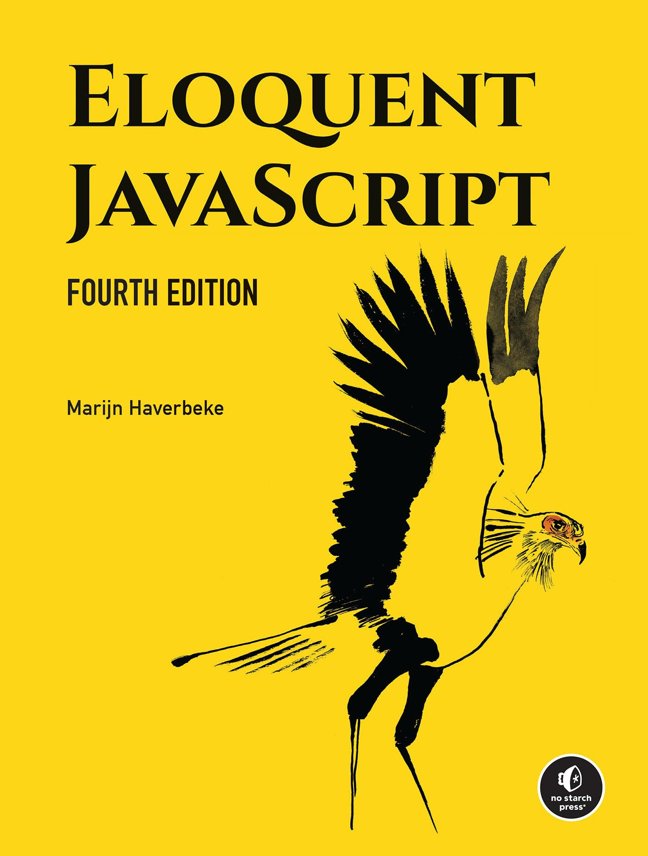
82Eloquent JavaScript, 4th Edition
Start building beautiful web applications in JavaScript with the bestselling introduction to the language, updated with new features, fresh exercises, and fun projects.JavaScript, the programming language that allows us to add programs to web pages, lies at the heart of almost every modern web application, from social media sites to browser-based games. Just about every device can run it, making it a great choice for writing universally useful code.The fourth edition of this classic textbook takes you on a journey through the language of the web, starting from its basic elements and building up to engaging, complete programs. The author’s personal experiences from years of maintaining popular open source projects enliven the text with practical insights and examples. This edition of Eloquent JavaScript updates the book to describe the 2024 version of JavaScript, and shifts the attention given to some topics to better reflect current development practices.The text takes a practical approach to teaching, rooting theory in plenty of motivating examples. The first half of the book describes the fundamentals of the language, whereas the second half shows how to apply it in two programming environments: the web browser and Node.js. Five project chapters show how to build bigger programs, working through these projects in a piecemeal, conversational way. They include a pathfinding robot, a small programming language, a platform game, a pixel drawing program, and a simple dynamic website.Exercises provided at the end of most chapters will challenge you to creatively apply the concepts and techniques introduced. The book’s companion website provides an interactive environment for working on these exercises and playing with the example programs.Whether you’re looking to learn JavaScript or to deepen your programming skills, you’ll find this book full of stimulating material.Updated to ECMAScript 2024
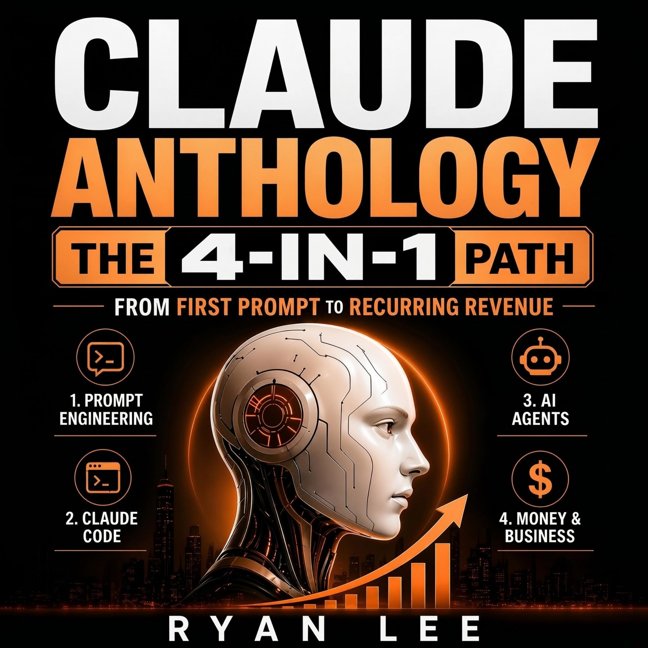
83Claude Anthology: The 4-in-1 Path From First Prompt to Recurring Revenue | Prompt Engineering, Claude Code, AI Agents, and Money & Business
You're spending hours wrestling with Claude—rewriting prompts, copying outputs, watching tutorials that were outdated before you finished them—and you still can't figure out how to make AI do anything that actually matters for your bottom line. Meanwhile, someone with half your skills just automated their entire workflow, launched a side income stream, and did it all with the same tool sitting open in your browser right now. The difference wasn't talent. It was knowing how to talk to Claude like a professional instead of guessing like a tourist. Imagine opening Claude tomorrow and knowing—not hoping—exactly how to engineer prompts that produce professional-grade output on the first try. Imagine deploying Claude Code to build tools you'd normally pay a developer thousands for. Imagine setting up AI agents that handle repetitive work while you sleep, then waking up to a system that generates revenue. That's a skill stack, and it's four layers deep. You'll gain prompt engineering mastery that eliminates trial-and-error and gets precise results from your very first interaction. You'll develop Claude Code fluency that lets you build and ship real projects—even if you've never written a line of code. You'll learn AI agent architecture that runs workflows autonomously, freeing you from tasks that eat your hours. And you'll walk away with a concrete monetization framework that turns Claude proficiency into freelance services, digital products, and recurring revenue. You already know AI is reshaping how people work and earn. The only question is whether you'll be the one using it—or the one replaced by someone who does.Start listening now. The gap between where you are and where you could be is exactly one listen away.PLEASE NOTE: When you purchase this title, the accompanying PDF will be available in your Audible Library along with the audio.
Express in Action: Node Applications with Express and Its Companion Tools
"Express in Action" is a carefully designed tutorial that teaches developers how to build web applications using Node and Express. It starts by introducing Node's unique characteristics and then shows how they map to the features of Express. With a clear vision of how an Express application looks, readers can systematically explore key development techniques, meet the rich ecosystem of companion tools and libraries, and even get a glimpse into its inner workings. After just a few chapters, they'll be able to build a simple Node app. By the end of the book, they'll know how to test it, hook it up to a database, and even automate the dev process.
Purchase of the print book includes a free eBook in PDF, Kindle, and ePub formats from Manning Publications.
Web Development with Node and Express: Leveraging the JavaScript Stack
Express strikes a balance between a robust framework and no framework at all, allowing you a free hand in your architecture choices. With this book, frontend and backend engineers familiar with JavaScript will discover new ways of looking at web development.Create webpage templating system for rendering dynamic dataDive into request and response objects, middleware, and URL routingSimulate a production environment for testing and developmentFocus on persistence with document databases, particularly MongoDBMake your resources available to other programs with RESTful APIsBuild secure apps with authentication, authorization, and HTTPSIntegrate with social media, geolocation, and other third-party servicesImplement a plan for launching and maintaining your appLearn critical debugging skills
This book covers Express 4.0.
86Mastering Regular Expressions
If you don't use regular expressions yet, you will discover in this book a whole new world of mastery over your data. If you already use them, you'll appreciate this book's unprecedented detail and breadth of coverage. If you think you know all you need to know about regularexpressions, this book is a stunning eye-opener.
As this book shows, a command of regular expressions is an invaluable skill. Regular expressions allow you to code complex and subtle text processing that you never imagined could be automated. Regular expressions can save you time and aggravation. They can be used to craft elegant solutions to a wide range of problems. Once you've mastered regular expressions, they'll become an invaluable part of your toolkit. You will wonder how you ever got by without them.
Yet despite their wide availability, flexibility, and unparalleled power, regular expressions are frequently underutilized. Yet what is power in the hands of an expert can be fraught with peril for the unwary. Mastering Regular Expressions will help you navigate the minefield to becoming an expert and help you optimize your use of regular expressions.
Mastering Regular Expressions, Third Edition, now includes a full chapter devoted to PHP and its powerful and expressive suite of regular expression functions, in addition to enhanced PHP coverage in the central "core" chapters. Furthermore, this edition has been updated throughout to reflect advances in other languages, including expanded in-depth coverage of Sun's java.util.regex package, which has emerged as the standard Java regex implementation.Topics include:
A comparison of features among different versions of many languages and tools
How the regular expression engine works
Optimization (major savings available here!)
Matching just what you want, but not what you don't want
Sections and chapters on individual languages
Written in the lucid, entertaining tone that makes a complex, dry topic become crystal-clear to programmers, and sprinkled with solutions to complex real-world problems, Mastering Regular Expressions, Third Edition offers a wealth information that you can put to immediateuse.
Reviews of this new edition and the second edition:
"There isn't a better (or more useful) book available on regular expressions."
--Zak Greant, Managing Director, eZ Systems
"A real tour-de-force of a book which not only covers the mechanics of regexes in extraordinary detail but also talks about efficiency and the use of regexes in Perl, Java, and .NET...If you use regular expressions as part of your professional work (even if you already have a good book on whatever language you're programming in) I would strongly recommend this book to you."
--Dr. Chris Brown, Linux Format
"The author does an outstanding job leading the reader from regexnovice to master. The book is extremely easy to read and chock full ofuseful and relevant examples...Regular expressions are valuable toolsthat every developer should have in their toolbox. Mastering RegularExpressions is the definitive guide to the subject, and an outstandingresource that belongs on every programmer's bookshelf. Ten out of TenHorseshoes."
--Jason Menard, Java Ranch
AngularJS: Up and Running: Enhanced Productivity with Structured Web Apps
Guided by two engineers who worked on AngularJS at Google, you'll learn the components needed to build data-driven applications, using declarative programming and the Model-view-controller pattern. You'll also learn how to conduct unit tests on each part of your application.
Learn how to use controllers for moving data to and from views
Understand when to use AngularJS services instead of controllers
Communicate with the server to store, fetch, and update data asynchronously
Know when to use AngularJS filters for converting data and values to different formats
Implement single-page applications, using ngRoute to select views and navigation
Dive into basic and advanced directives for creating reusable components
Write an end-to-end test on a live version of your entire application
Use best practices, guidelines, and tools throughout the development cycle
88JavaScript QuickStart Guide: The Simplified Beginner's Guide to Building Interactive Websites and Creating Dynamic Functionality Using Hands-On Projects (Coding & Programming - QuickStart Guides)
THE ULTIMATE BEGINNER'S GUIDE TO LEARNING JAVASCRIPT IN 2025! **Includes FREE Digital Bonuses! GitHub Repository, Cheat Sheets, and More!**Learn Why QuickStart Guides are Loved by Over 1 Million Readers Around the World Master the most popular programming language in the world. Learn how to bring websites to life with the power of JavaScript, add dynamic interactivity and rich animations to otherwise dull webpages, all with the versatile programming language that builds apps, websites, and more!The Easiest Way to Learn JavaScript In a Step-by-Step Comprehensive Guide Without the power of JavaScript, there is no modern internet.JavaScript powers everything from the website interactivity we take for granted every day to full-scale web applications run by multi-billion dollar corporations. It’s no surprise then, that JavaScript is the most popular programming language in the world and massively in demand across the tech sector. Written by a senior developer and programming expert with two decades of JavaScript and programming experience.In JavaScript QuickStart Guide senior developer Robert Oliver presents the fastest and easiest way to master JavaScript fundamentals. Written specifically for beginners and drawing on over two decades of experience coding and programming, this book’s practical, project-based approach can be used by anyone to learn to program with JavaScript.Learn by doing with practical follow-along JavaScript projects. It doesn’t matter if you are new to web development, an existing developer looking to broaden your horizons, or simply looking for a career change or promotion–using this book and Robert’s simplified, hands-on approach anyone with any level of experience can master JavaScript fundamentals!JavaScript QuickStart Guide Is Perfect For: Jobseekers, career changers, and anyone in the job market looking to enter the lucrative tech sectorNew and experienced web developers who want to learn or brush up on critical web development skillsDesigners, data analysts, gig workers, and side-hustlers who want to upskill and unlock new earning capacityStudents, recent college grads, and soon-to-be coding bootcampers who want to hit the ground running with a learning edgeAnyone who wants to learn how to bring webpages to life with the power of JavaScript quickly and easily!With JavaScript QuickStart Guide, You'll Easily Understand These Crucial Concepts: Practical JavaScript - Set Up Your Development Space and Build a Working Portfolio-Ready ProjectJavaScript Core Fundamentals - How to Use Variables, Objects, Strings, Functions, and More!Programming Essentials - Troubleshooting, Debugging, Writing Clean Code, Tips and TimesaversAdvanced JavaScript Concepts - Animating with JavaScript, Mastering jQuery, And Creating InteractivityCompleting The Stack - Expanding Your Horizons Using Node.js, AJAX, React, and GitHubGo Beyond the Book with Exclusive QuickClips Videos Look for QuickClips QR codes when reading this book. Scan to access exclusive videos directly from the author at key points to enhance your learning and go beyond the book!**LIFETIME ACCESS TO FREE BONUS RESOURCES** JavaScript QuickStart Guide comes with lifetime access to FREE digital resources you can access from inside the book! Each of these bonuses is crafted with our expert author to help learn how to program with JavaScript as fast as possible.GitHub Code Repository JavaScript Events Cheat SheetObject Functionality Reference Guide & More!
89Get Coding! Learn HTML, CSS, and JavaScript and Build a Website, App, and Game
Crack open this book and set off on several fun missions while simultaneously learning the basics of writing code. Want to make a website from scratch? Create an app? Build a game? All the tools are here, laid out in a user-friendly format that leads kids on an imaginary quest to keep a valuable diamond safe from dangerous jewel thieves. Presented by Young Rewired State an international collective of tech-savvy kids in easy-to-follow, bite-size chunks, the real-life coding skills taught in this engaging, comprehensive guide may just set young readers on the path to becoming technology stars of the future."
90Programming Typescript: Making Your JavaScript Applications Scale
If you're a programmer with intermediate JavaScript experience, author Boris Cherny will teach you how to master the TypeScript language. You'll understand how TypeScript can help you eliminate bugs in your code and enable you to scale your code across more engineers than you could before.
In this book, you'll:
Start with the basics: Learn about TypeScript's different types and type operators, including what they're for and how they're used
Explore advanced topics: Understand TypeScript's sophisticated type system, including how to safely handle errors and build asynchronous programs
Dive in hands-on: Use TypeScript with your favorite frontend and backend frameworks, migrate your existing JavaScript project to TypeScript, and run your TypeScript application in production
jQuery Pocket Reference
jQuery is the "write less, do more" JavaScript library. Its powerful features and ease of use have made it the most popular client-side JavaScript framework for the Web. This book is jQuery's trusty companion: the definitive "read less, learn more" guide to the library.
jQuery Pocket Reference explains everything you need to know about jQuery, completely and comprehensively. You'll learn how to:
Select and manipulate document elements
Alter document structure
Handle and trigger events
Create visual effects and animations
Script HTTP with Ajax utilities
Use jQuery's selectors and selection methods, utilities, plugins and more
The 25-page quick reference summarizes the library, listing all jQuery methods and functions, with signatures and descriptions.
92You Don't Know JS Yet: Get Started
93Effective TypeScript: 83 Specific Ways to Improve Your TypeScript
TypeScript is a typed superset of JavaScript with the potential to solve many of the headaches for which JavaScript is famous. But TypeScript has a learning curve of its own, and understanding how to use it effectively takes time and practice. Using the format popularized by Effective C++ and Effective Java (both Addison-Wesley), this practical book features 83 items that give specific advice on what to do and what not to do, and how to think about the language. Author Dan Vanderkam shows you how to apply each item's advice through concrete examples. This book will help you advance from a beginning or intermediate user familiar with TypeScript basics to an expert who knows how to use the language well. Updated for TypeScript 5, this second edition includes two new chapters on type-level programming and TypeScript recipes. Learn the nuts and bolts of TypeScript's type system Use type inference to get full safety with a minimum of type annotations Design types to make your code safer and more understandable Model complex APIs using generic types and type-level programming Understand how dependencies and type declaration files work in TypeScript Successfully migrate your JavaScript code base to TypeScript
Elixir in Action
95Full-Stack React, TypeScript, and Node: Build scalable and cloud-ready web applications using modern React, TypeScript, and Docker
Explore the evolving landscape of full-stack development with the latest web technologies to build production-ready React applications and deploy them using Docker on AWS.Free with your book: DRM-free PDF version + access to Packt's next-gen Reader*A practical, hands-on guide for building production-ready applications with confidence - Luca Del Puppo- Senior Software Engineer|Google Developer ExpertA practical guide to full-stack web development that builds strong fundamentals while showing how to use LLM powered coding tools effectively.- Adil Aliyev- Senior Software EngineerA valuable resource for developers looking to build scalable applications with today's technology. Chetan Nada- SDE 2Key FeaturesNew Update: Chapters on monitoring, observability, and AI-assisted developmentMaster the architecture of React 19 and modern single-page applications (SPAs)Containerize with Docker and Podman, automate workflows with CI/CD and deploy to the cloudBook DescriptionIn the fast-paced world of web development, React is a widely used library for building applications, while Node.js and Express support scalable server-side solutions and web services. TypeScript enhances JavaScript projects with robustness and maintainability, making it an essential tool for large-scale applications.This edition provides a hands-on guide to mastering these technologies, with new chapters and updated content that reflects current industry practices. Begin with a solid foundation in TypeScript to build high-quality web applications. Explore React 19, leveraging the Hooks API and Redux Toolkit for state management. Then transition to server-side development with Express, incorporating modern practices like JWT-based authentication and Prisma ORM for database management. A major focus of this edition is production readiness. Learn how to containerize your application with Docker and Podman, automate builds and tests with GitHub Actions, and deploy to the cloud.New chapters add monitoring and observability with OpenTelemetry and Grafana plus a hands-on guide to AI-assisted development with LLM coding agents. Other updates include Vitest for testing and expanded content on Postgres and Prisma ORM.By the end of this book, you will have built and deployed a comprehensive full-stack application, ready for production.What you will learnBuild a full-stack application using React 19, TypeScript, and Node.jsApply TypeScript's key features to improve code quality and maintainabilityBuild React apps with functional components, Hooks and Redux ToolkitTest frontend and backend code with Vitest and React Testing LibrarySet up an Express API with PostgreSQL and Prisma from scratchSecure your API with JWT authentication and authorizationContainerize applications with Docker and Podman, then deploy to the cloud with CI/CDAdd monitoring and observability, and explore AI-assisted developmentWho this book is forThis book is designed for experienced developers who are new to full-stack web development. It is ideal for those with production programming experience in any language looking to transition into building full-stack applications using modern web technologies. A good understanding of JavaScript is required.Table of ContentsUnderstanding TypeScriptAuthentication and AuthorizationBuilding the Full-Stack ApplicationDeploying Full-Stack ApplicationsAI-Assisted Development with LLM Coding Agents(N.B. Please use the Read Sample option to see detailed chapters.)
Beginning JavaScript
JavaScript is a scripting language that enables you to enhance static web applications by providing dynamic, personalized, and interactive content. This improves the experience of visitors to your site and makes it more likely that they will visit again. You must have seen the flashy drop-down menus, moving text, and changing content that are now widespread on web sites—they are enabled through JavaScript. Supported by all the major browsers, JavaScript is the language of choice on the Web. It can even be used outside web applications—to automate administrative tasks, for example.
This book aims to teach you all you need to know to start experimenting with JavaScript: what it is, how it works, and what you can do with it. Starting from the basic syntax, you'll move on to learn how to create powerful web applications. Don't worry if you've never programmed before—this book will teach you all you need to know, step by step. You'll find that JavaScript can be a great introduction to the world of programming: with the knowledge and understanding that you'll gain from this book, you'll be able to move on to learn newer and more advanced technologies in the world of computing.
In order to get the most out of this book, you'll need to have an understanding of HTML and how to create a static web page. You don't need to have any programming experience.
This book will also suit you if you have some programming experience already, and would like to turn your hand to web programming. You will know a fair amount about computing concepts, but maybe not as much about web technologies.
Alternatively, you may have a design background and know relatively little about the Web and computing concepts. For you, JavaScript will be a cheap and relatively easy introduction to the world of programming and web application development.
Whoever you are, we hope that this book lives up to your expectations.
You'll begin by looking at exactly what JavaScript is, and taking your first steps with the underlying language and syntax. You'll learn all the fundamental programming concepts, including data and data types, and structuring your code to make decisions in your programs or to loop over the same piece of code many times.
Once you're comfortable with the basics, you'll move on to one of the key ideas in JavaScript—the object. You'll learn how to take advantage of the objects that are native to the JavaScript language, such as dates and strings, and find out how these objects enable you to manage complex data and simplify your programs. Next, you'll see how you can use JavaScript to manipulate objects made available to you in the browser, such as forms, windows, and other controls. Using this knowledge, you can start to create truly professional-looking applications that enable you to interact with the user.
Long pieces of code are very hard to get right every time—even for the experienced programmer—and JavaScript code is no exception. You look at common syntax and logical errors, how you can spot them, and how to use the Microsoft Script Debugger to aid you with this task. Also, you need to examine how to handle the errors that slip through the net, and ensure that these do not detract from the experience of the end user of your application.
From here, you'll move on to more advanced topics, such as using cookies and jazzing up your web pages with dynamic HTML and XML. Finally, you'll be looking at a relatively new and exciting technology, remote scripting. This allows your JavaScript in a HTML page to communicate directly with a server, and useful for, say, looking up information on a database sitting on your server. If you have the Google toolbar you'll have seen something like this in action already. When you type a search word in the Google toolbar, it comes up with suggestions, which it gets via the Google search database.
All the new concepts introduced in this book will be illustrated with practical examples, which enable you to experiment with JavaScript and build on the theory that you have just learned. The appendix provides solutions to the exercises included at the end of most chapters throughout the book.
During the first half of the book, you'll also be building up a more complex sample application—an online trivia quiz—which will show you how JavaScript is used in action in a real-world situation.

97You Don't Know JS Yet: The Unbooks
The Node Beginner Book
99