We've ranked the best afghanistan books using expert recommendations, sales data, and millions of reader ratings. At Shortform, we know books. Our book guides are the best in the world. Learn why.
Cover unavailable
1
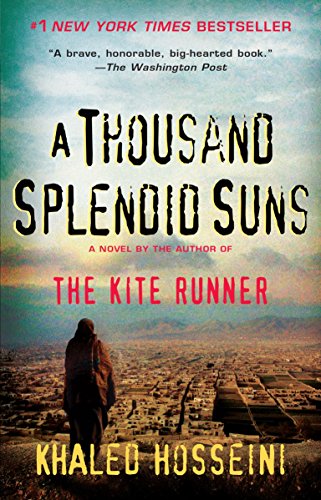
A Thousand Splendid Suns
Khaled Hosseini
5.0
A Thousand Splendid Suns is a breathtaking story set against the volatile events of Afghanistan's last thirty years—from the Soviet invasion to the reign of the Taliban to post-Taliban rebuilding—that puts the violence, fear, hope, and faith of this country in intimate, human terms. It is a tale of two generations of characters brought jarringly together by the tragic sweep of war, where personal lives—the struggle to survive, raise a family, find happiness—are inextricable from the history playing out around them.
Propelled by the same storytelling instinct that made The Kite Runner a beloved classic, A Thousand Splendid Suns is at once a remarkable chronicle of three decades of Afghan history and a deeply moving account of family and friendship. It is a striking, heart-wrenching novel of an unforgiving time, an unlikely friendship, and an indestructible love—a stunning accomplishment. --front flap

I would encourage people to read it because it gives you a sense of Afghanistan’s incredible history and the role women have played within that history [source]
Cover unavailable
2
The Kite Runner
Khaled Hosseini and Simon & Schuster Audi
4.9
The unforgettable, heartbreaking story of the unlikely friendship between a wealthy boy and the son of his father’s servant, The Kite Runner is a beautifully crafted novel set in a country that is in the process of being destroyed. It is about the power of reading, the price of betrayal, and the possibility of redemption; and an exploration of the power of fathers over sons—their love, their sacrifices, their lies.
A sweeping story of family, love, and friendship told against the devastating backdrop of the history of Afghanistan over the last thirty years, The Kite Runner is an unusual and powerful novel that has become a beloved, one-of-a-kind classic. --khaledhosseini.com
…
Recommended by James Altucher, Ann Miura-Ko, Magda Marcu, and 1 others.
Ann Miura-Ko recommended this book on the podcast "The Tim Ferriss Show". [source]
Magda Marcu
I’m currently reading “The Kite Runner”. I never have expectations from books, I let them surprise me as I get into the story. Learning about characteristics of different cultures, in this case the Afghan one, it’s one aspect I am interested in. [source]
Cover unavailable
3
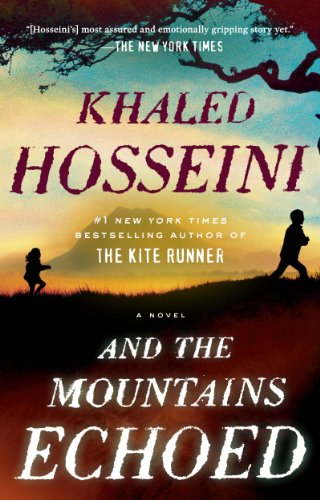
And the Mountains Echoed
Khaled Hosseini
4.6
So, then. You want a story and I will tell you one...Afghanistan, 1952. Abdullah and his sister Pari live with their father and stepmother in the small village of Shadbagh. Their father, Saboor, is constantly in search of work and they struggle together through poverty and brutal winters. To Abdullah, Pari - as beautiful and sweet-natured as the fairy for which she was named - is everything. More like a parent than a brother, Abdullah will do anything for her, even trading his only pair of shoes for a feather for her treasured collection. Each night they sleep together in their cot, their heads touching, their limbs tangled. One day the siblings journey across the desert to Kabul with their father. Pari and Abdullah have no sense of the fate that awaits them there, for the event which unfolds will tear their lives apart; sometimes a finger must be cut to save the hand. Crossing generations and continents, moving from Kabul, to Paris, to San Francisco, to the Greek island of Tinos, with profound wisdom, depth, insight and compassion, Khaled Hosseini writes about the bonds that define us and shape our lives, the ways in which we help our loved ones in need, how the choices we make resonate through history and how we are often surprised by the people closest to us.
…
Cover unavailable
4
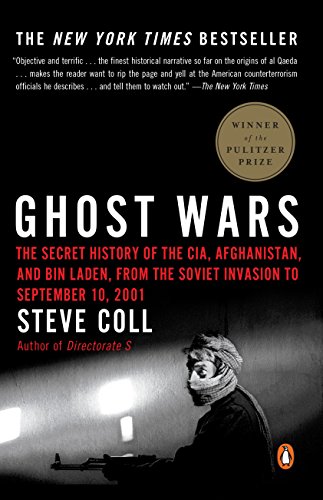
Ghost Wars: The Secret History of the CIA, Afghanistan, and Bin Laden from the Soviet Invasion to September 10, 2001
Steve Coll
4.5
The news-breaking book that has sent shockwaves through the Bush White House, Ghost Wars is the most accurate and revealing account yet of the CIA's secret involvement in al-Qaeda's evolution. It won the Pulitzer Prize in 2005.
Prize-winning journalist Steve Coll has spent years reporting from the Middle East, accessed previously classified government files and interviewed senior US officials and foreign spymasters. Here he gives the full inside story of the CIA's covert funding of an Islamic jihad against Soviet forces in Afghanistan, explores how this sowed the seeds of Bin Laden's rise, traces how he built his global network and brings to life the dramatic battles within the US government over national security. Above all, he lays bare American intelligence's continual failure to grasp the rising threat of terrorism in the years leading to 9/11 - and its devastating consequences.
…
Cover unavailable
5
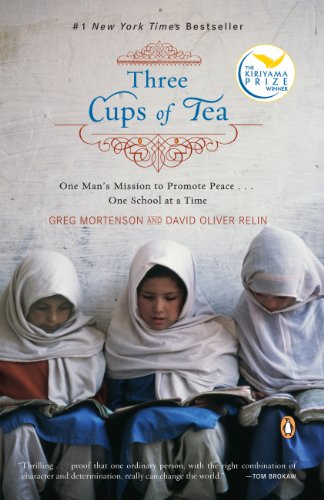
Three Cups of Tea: One Man's Mission to Promote Peace ... One School at a Time
Greg Mortenson, David Oliver Relin
4.5
The inspiring account of one man's campaign to build schools in the most dangerous, remote, and anti-American reaches of Asia.
In April 2011, the CBS documentary "60 Minutes" called into question Greg Mortenson's work. The program alleged several inaccuracies in Three Cups of Tea, and its sequel, Stones into Schools, as well as financial improprieties in the operation of Mortenson's Central Asia Institute. Questions were also raised about Mortenson's claim that he got lost near K2 and ended up in Korphe; that he was captured by the Taliban in 1996; the number of schools the CAI claimed to have built; and whether CAI funds had been used appropriately for Mortenson's book tours. Jon Krakauer, who had supported the CAI to the tune of $75,000, also questioned Mortenson's accounts, and released his allegations in a lengthy article titled Three Cups of Deceit.
…
Recommended by Gretchen Peters, Jennifer Steil, and Nicholas Kristof.
Gretchen Peters
I went to a refugee camp after 9/11 where people were living in tents and boiling grass to make tea and at least one family offered to let me sleep in their tent. [source]

Jennifer Steil
Greg Mortenson has changed literally thousands and thousands of lives. [source]
I think Greg does a very good job of providing a more nuanced portrait of the Islamic world and what is possible in it. [source]
Cover unavailable
6
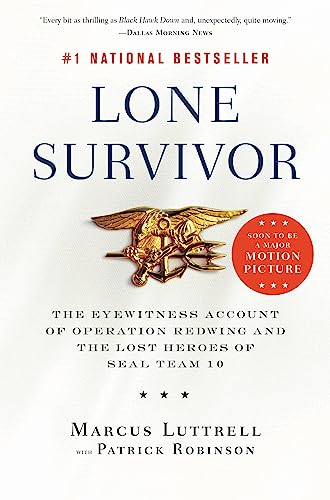
Lone Survivor: The Eyewitness Account of Operation Redwing and the Lost Heroes of SEAL Team 10
Marcus Luttrell
4.5
On a clear night in late June 2005, four U.S. Navy SEALs left their base in northern Afghanistan for the mountainous Pakistani border. Their mission was to capture or kill a notorious al Qaeda leader known to be ensconced in a Taliban stronghold surrounded by a small but heavily armed force. Less then twenty-four hours later, only one of those Navy SEALs remained alive.
This is the story of fire team leader Marcus Luttrell, the sole survivor of Operation Redwing, and the desperate battle in the mountains that led, ultimately, to the largest loss of life in Navy SEAL history. But it is also, more than anything, the story of his teammates, who fought ferociously beside him until he was the last one left-blasted unconscious by a rocket grenade, blown over a cliff, but still armed and still breathing. Over the next four days, badly injured and presumed dead, Luttrell fought off six al Qaeda assassins who were sent to finish him, then crawled for seven miles through the mountains before he was taken in by a Pashtun tribe, who risked everything to protect him from the encircling Taliban killers.
A six-foot-five-inch Texan, Leading Petty Officer Luttrell takes us, blow-by-blow, through the brutal training of America's warrior elite and the relentless rites of passage required by the Navy SEALs. He transports us to a monstrous battle fought in the desolate peaks of Afghanistan, where the beleaguered American team plummeted headlong a thousand feet down a mountain as they fought back through flying shale and rocks. In this rich , moving chronicle of courage, honor, and patriotism, Marcus Luttrell delivers one of the most powerful narratives ever written about modern warfare-and a tribute to his teammates, who made the ultimate sacrifice for their country.
…
Cover unavailable
7
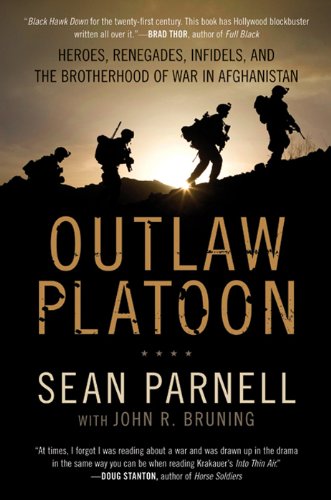
Outlaw Platoon: Heroes, Renegades, Infidels, and the Brotherhood of War in Afghanistan
Sean Parnell and John Bruning
4.5
A riveting story of American fighting men, Outlaw Platoon is Lieutenant Sean Parnell’s stunning personal account of the legendary U.S. Army’s 10th Mountain Division’s heroic stand in the mountains of Afghanistan.
Acclaimed for its vivid, poignant, and honest recreation of sixteen brutal months of nearly continuous battle in the deadly Hindu Kesh, Outlaw Platoon is a Band of Brothers or We Were Soldiers Once and Young for the early 21st century—an action-packed, highly emotional true story of enormous sacrifice and bravery.
A magnificent account of heroes, renegades, infidels, and brothers, it stands with Sebastian Junger’s War as one of the most important books to yet emerge from the heat, smoke, and fire of America’s War in Afghanistan.
…
Cover unavailable
8
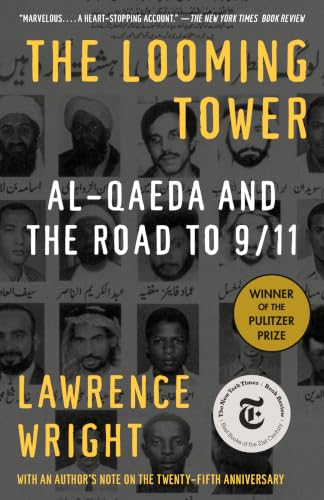
The Looming Tower: Al-Qaeda and the Road to 9/11
Lawrence Wright
4.4
A sweeping narrative history of the events leading to 9/11, a groundbreaking look at the people and ideas, the terrorist plans and the Western intelligence failures that culminated in the assault on America. Lawrence Wright's remarkable book is based on five years of research and hundreds of interviews that he conducted in Egypt, Saudi Arabia, Pakistan, Afghanistan, Sudan, England, France, Germany, Spain, and the United States.
The Looming Tower achieves an unprecedented level of intimacy and insight by telling the story through the interweaving lives of four men: the two leaders of al-Qaeda, Osama bin Laden and Ayman al-Zawahiri; the FBI's counterterrorism chief, John O'Neill; and the former head of Saudi intelligence, Prince Turki al-Faisal.
As these lives unfold, we see revealed: the crosscurrents of modern Islam that helped to radicalize Zawahiri and bin Laden . . . the birth of al-Qaeda and its unsteady development into an organization capable of the American embassy bombings in Kenya and Tanzania and the attack on the USS Cole . . . O'Neill's heroic efforts to track al-Qaeda before 9/11, and his tragic death in the World Trade towers . . . Prince Turki's transformation from bin Laden's ally to his enemy . . . the failures of the FBI, CIA, and NSA to share intelligence that might have prevented the 9/11 attacks.
The Looming Tower broadens and deepens our knowledge of these signal events by taking us behind the scenes. Here is Sayyid Qutb, founder of the modern Islamist movement, lonely and despairing as he meets Western culture up close in 1940s America; the privileged childhoods of bin Laden and Zawahiri; family life in the al-Qaeda compounds of Sudan and Afghanistan; O'Neill's high-wire act in balancing his all-consuming career with his equally entangling personal life--he was living with three women, each of them unaware of the others' existence--and the nitty-gritty of turf battles among U.S. intelligence agencies.
Brilliantly conceived and written, The Looming Tower draws all elements of the story into a galvanizing narrative that adds immeasurably to our understanding of how we arrived at September 11, 2001. The richness of its new information, and the depth of its perceptions, can help us deal more wisely and effectively with the continuing terrorist threat.
…
Recommended by Audrey Kurth Cronin, Bryan Callen, Lloyd Gardner, and 5 others.
Audrey Kurth Cronin
Reading this one book gives you an excellent grasp of the human story and the context from which al-Qaeda emerged. [source]
Wright looks at the linkage between the Egyptian Jihad and Al-Qaeda. It is a worthwhile book to read to try to understand the whole problem. [source]

Cover unavailable
9
The Pearl That Broke Its Shell
Nadia Hashimi
4.4
Afghan-American Nadia Hashimi's literary debut novel, The Pearl that Broke Its Shell is a searing tale of powerlessness, fate, and the freedom to control one's own fate that combines the cultural flavor and emotional resonance of the works of Khaled Hosseini, Jhumpa Lahiri, and Lisa See.
In Kabul, 2007, with a drug-addicted father and no brothers, Rahima and her sisters can only sporadically attend school, and can rarely leave the house. Their only hope lies in the ancient custom of bacha posh, which allows young Rahima to dress and be treated as a boy until she is of marriageable age. As a son, she can attend school, go to the market, and chaperone her older sisters.
But Rahima is not the first in her family to adopt this unusual custom. A century earlier, her great-aunt, Shekiba, left orphaned by an epidemic, saved herself and built a new life the same way.
Crisscrossing in time, The Pearl the Broke Its Shell interweaves the tales of these two women separated by a century who share similar destinies. But what will happen once Rahima is of marriageable age? Will Shekiba always live as a man? And if Rahima cannot adapt to life as a bride, how will she survive?
…
Cover unavailable
10
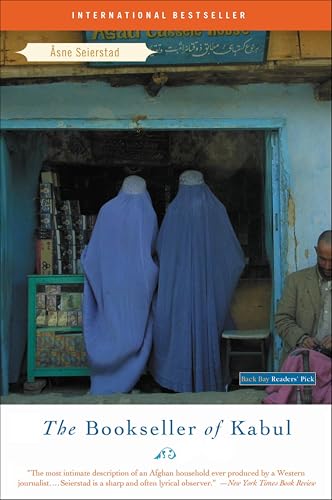
The Bookseller of Kabul
Asne Seierstad, Ingrid Christophersen
4.4
In spring 2002, following the fall of the Taliban, Åsne Seierstad spent four months living with a bookseller and his family in Kabul.
For more than twenty years Sultan Khan defied the authorities—be they communist or Taliban—to supply books to the people of Kabul. He was arrested, interrogated and imprisoned by the communists, and watched illiterate Taliban soldiers burn piles of his books in the street. He even resorted to hiding most of his stock—almost ten thousand books—in attics all over Kabul.
But while Khan is passionate in his love of books and his hatred of censorship, he also has strict views on family life and the role of women. As an outsider, Åsne Seierstad found herself in a unique position, able to move freely between the private, restricted sphere of the women—including Khan’s two wives—and the freer, more public lives of the men.
It is an experience that Seierstad finds both fascinating and frustrating. As she steps back from the page and allows the Khans to speak for themselves, we learn of proposals and marriages, hope and fear, crime and punishment. The result is a genuinely gripping and moving portrait of a family, and a clear-eyed assessment of a country struggling to free itself from history.' to 'This mesmerizing portrait of a proud man who, through three decades and successive repressive regimes, heroically braved persecution to bring books to the people of Kabul has elicited extraordinary praise throughout the world and become a phenomenal international bestseller. The Bookseller of Kabul is startling in its intimacy and its details—a revelation of the plight of Afghan women and a window into the surprising realities of daily life in today’s Afghanistan.'
…
Cover unavailable
11
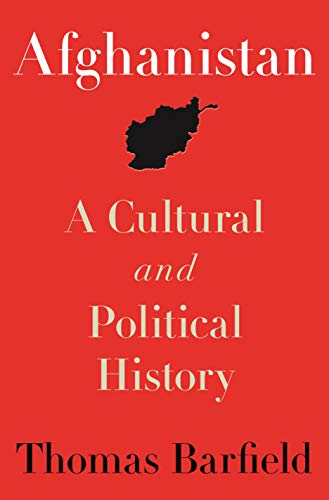
Afghanistan: A Cultural and Political History
Thomas Barfield
4.3
Afghanistan traces the historic struggles and the changing nature of political authority in this volatile region of the world, from the Mughal Empire in the sixteenth century to the Taliban resurgence today. Thomas Barfield introduces readers to the bewildering diversity of tribal and ethnic groups in Afghanistan, explaining what unites them as Afghans despite the regional, cultural, and political differences that divide them. He shows how governing these peoples was relatively easy when power was concentrated in a small dynastic elite, but how this delicate political order broke down in the nineteenth and twentieth centuries when Afghanistan's rulers mobilized rural militias to expel first the British and later the Soviets. Armed insurgency proved remarkably successful against the foreign occupiers, but it also undermined the Afghan government's authority and rendered the country ever more difficult to govern as time passed. Barfield vividly describes how Afghanistan's armed factions plunged the country into a civil war, giving rise to clerical rule by the Taliban and Afghanistan's isolation from the world. He examines why the American invasion in the wake of September 11 toppled the Taliban so quickly, and how this easy victory lulled the United States into falsely believing that a viable state could be built just as easily.
Afghanistan is essential reading for anyone who wants to understand how a land conquered and ruled by foreign dynasties for more than a thousand years became the graveyard of empires for the British and Soviets, and what the United States must do to avoid a similar fate.
-- "Daily Star"
…
Recommended by Andrew Exum.
Andrew Exum
Yes. The first three books that I’ve recommended are all eminently readable. Both Barfield and Edwards are obviously Afghan hands, they know a lot about Afghanistan, but they present the material in a very accessible way. They really are a delight to read. When you think about anthropological texts on Afghanistan, you think of pretty dry reading – that’s not these books at all. They’re really delightful, if very sobering. [source]
Cover unavailable
12
War
Sebastian Junger
4.3
In his breakout bestseller, The Perfect Storm, Sebastian Junger created "a wild ride that brilliantly captures the awesome power of the raging sea and the often futile attempts of humans to withstand it" (Los Angeles Times Book Review).
Now, Junger turns his brilliant and empathetic eye to the reality of combat--the fear, the honor, and the trust among men in an extreme situation whose survival depends on their absolute commitment to one another. His on-the-ground account follows a single platoon through a 15-month tour of duty in the most dangerous outpost in Afghanistan's Korengal Valley. Through the experiences of these young men at war, he shows what it means to fight, to serve, and to face down mortal danger on a daily basis.
…
Cover unavailable
13
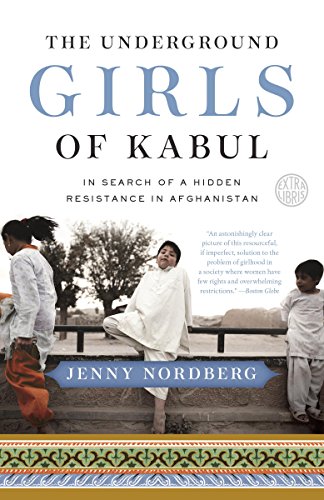
The Underground Girls of Kabul: In Search of a Hidden Resistance in Afghanistan
Jenny Nordberg
4.3
An investigative journalist uncovers a hidden custom that will transform your understanding of what it means to grow up as a girl.
In Afghanistan, a culture ruled almost entirely by men, the birth of a son is cause for celebration and the arrival of a daughter is often mourned as misfortune. A bacha posh (literally translated from Dari as "dressed up like a boy") is a third kind of child – a girl temporarily raised as a boy and presented as such to the outside world. Jenny Nordberg, the reporter who broke the story of this phenomenon for the New York Times, constructs a powerful and moving account of those secretly living on the other side of a deeply segregated society where women have almost no rights and little freedom.
The Underground Girls of Kabul is anchored by vivid characters who bring this remarkable story to life: Azita, a female parliamentarian who sees no other choice but to turn her fourth daughter Mehran into a boy; Zahra, the tomboy teenager who struggles with puberty and refuses her parents' attempts to turn her back into a girl; Shukria, now a married mother of three after living for twenty years as a man; and Nader, who prays with Shahed, the undercover female police officer, as they both remain in male disguise as adults.
At the heart of this emotional narrative is a new perspective on the extreme sacrifices of Afghan women and girls against the violent backdrop of America's longest war. Divided into four parts, the book follows those born as the unwanted sex in Afghanistan, but who live as the socially favored gender through childhood and puberty, only to later be forced into marriage and childbirth. The Underground Girls of Kabul charts their dramatic life cycles, while examining our own history and the parallels to subversive actions of people who live under oppression everywhere.
…
Cover unavailable
14
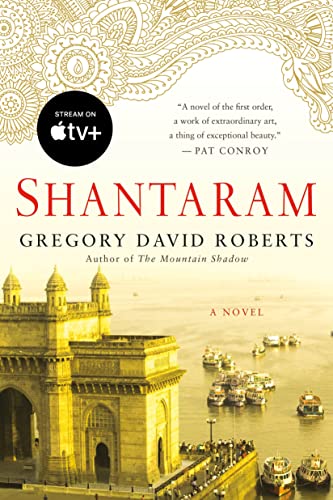
Shantaram
Gregory David Roberts
4.3
"It took me a long time and most of the world to learn what I know about love and fate and the choices we make, but the heart of it came to me in an instant, while I was chained to a wall and being tortured."
So begins this epic, mesmerizing first novel set in the underworld of contemporary Bombay. Shantaram is narrated by Lin, an escaped convict with a false passport who flees maximum security prison in Australia for the teeming streets of a city where he can disappear.
Accompanied by his guide and faithful friend, Prabaker, the two enter Bombay's hidden society of beggars and gangsters, prostitutes and holy men, soldiers and actors, and Indians and exiles from other countries, who seek in this remarkable place what they cannot find elsewhere.
As a hunted man without a home, family, or identity, Lin searches for love and meaning while running a clinic in one of the city's poorest slums, and serving his apprenticeship in the dark arts of the Bombay mafia. The search leads him to war, prison torture, murder, and a series of enigmatic and bloody betrayals. The keys to unlock the mysteries and intrigues that bind Lin are held by two people. The first is Khader Khan: mafia godfather, criminal-philosopher-saint, and mentor to Lin in the underworld of the Golden City. The second is Karla: elusive, dangerous, and beautiful, whose passions are driven by secrets that torment her and yet give her a terrible power.
Burning slums and five-star hotels, romantic love and prison agonies, criminal wars and Bollywood films, spiritual gurus and mujaheddin guerrillas – this huge novel has the world of human experience in its reach, and a passionate love for India at its heart. Based on the life of the author, it is by any measure the debut of an extraordinary voice in literature.
…
Recommended by Richard Branson, Henry Medine, Irina Marinescu, and 3 others.
Today is World Book Day, a wonderful opportunity to address this #ChallengeRichard sent in by Mike Gonzalez of New Jersey: Make a list of your top 65 books to read in a lifetime. [source]
Henry Medine
I promote range and diversity. Thus, I recommend readers to expose themselves to as many different topics as possible. I usually have 2-4 books I refer back to at any given time. They range in topics from management, art, spirituality and philosophy. Trying to get the engineering thing going but don't much of a mind for science. [source]
Irina Marinescu
I am always eager to learn how people think and form friendships, how they deal with life's challenges and still remain human. This book delivers that and even more! Shantaram takes you on an incredible journey and you return a changed person. [source]
Cover unavailable
15
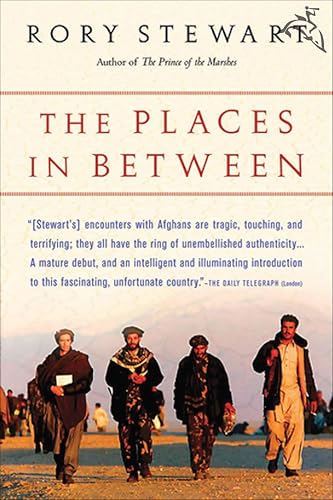
The Places in Between
Rory Stewart
4.3
In January 2002 Rory Stewart walked across Afghanistan-surviving by his wits, his knowledge of Persian dialects and Muslim customs, and the kindness of strangers. By day he passed through mountains covered in nine feet of snow, hamlets burned and emptied by the Taliban, and communities thriving amid the remains of medieval civilizations. By night he slept on villagers' floors, shared their meals, and listened to their stories of the recent and ancient past. Along the way Stewart met heroes and rogues, tribal elders and teenage soldiers, Taliban commanders and foreign-aid workers. He was also adopted by an unexpected companion-a retired fighting mastiff he named Babur in honor of Afghanistan's first Mughal emperor, in whose footsteps the pair was following. Through these encounters--by turns touching, confounding, surprising, and funny--Stewart makes tangible the forces of tradition, ideology, and allegiance that shape life in the map's countless places in between.
…
Cover unavailable
16
Kabul Beauty School: An American Woman Goes Behind the Veil
Deborah Rodriguez, Kristin Ohlson
4.3
Soon after the fall of the Taliban, in 2001, Deborah Rodriguez went to Afghanistan as part of a group offering humanitarian aid to this war-torn nation. Surrounded by men and women whose skills–as doctors, nurses, and therapists–seemed eminently more practical than her own, Rodriguez, a hairdresser and mother of two from Michigan, despaired of being of any real use. Yet she soon found she had a gift for befriending Afghans, and once her profession became known she was eagerly sought out by Westerners desperate for a good haircut and by Afghan women, who have a long and proud tradition of running their own beauty salons. Thus an idea was born.
With the help of corporate and international sponsors, the Kabul Beauty School welcomed its first class in 2003. Well meaning but sometimes brazen, Rodriguez stumbled through language barriers, overstepped cultural customs, and constantly juggled the challenges of a postwar nation even as she learned how to empower her students to become their families’ breadwinners by learning the fundamentals of coloring techniques, haircutting, and makeup.
Yet within the small haven of the beauty school, the line between teacher and student quickly blurred as these vibrant women shared with Rodriguez their stories and their hearts: the newlywed who faked her virginity on her wedding night, the twelve-year-old bride sold into marriage to pay her family’s debts, the Taliban member’s wife who pursued her training despite her husband’s constant beatings. Through these and other stories, Rodriguez found the strength to leave her own unhealthy marriage and allow herself to love again, Afghan style.
With warmth and humor, Rodriguez details the lushness of a seemingly desolate region and reveals the magnificence behind the burqa. Kabul Beauty School is a remarkable tale of an extraordinary community of women who come together and learn the arts of perms, friendship, and freedom.
From the Hardcover edition.
…
Cover unavailable
17
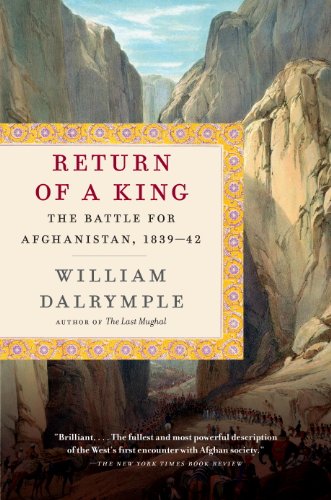
Return of a King: The Battle for Afghanistan
William Dalrymple
4.3
In the spring of 1839 British forces invaded Afghanistan for the first time, re-establishing Shah Shuja on the throne, in reality as their puppet, and ushering in a period of conflict over the territory still unresolved today. In 1842, the Afghan people rose in answer to the call for jihad against the foreign occupiers, and the country exploded into violent rebellion. In what is arguably the greatest military humiliation ever suffered by the West in the East, more than eighteen thousand cold and hungry British troops, Indian sepoys and camp followers retreated through the icy mountain passes, and of the last survivors who made their final stand at the village of Gandamak, only one man, Dr Brydon, made it through to the British garrison at Jellalabad. An entire army of what was then the most powerful military nation in the world was utterly routed by poorly equipped tribesmen. The West's first disastrous entanglement in Afghanistan has clear and relevant parallels with the current deepening crisis today, with extraordinary similarities between what NATO faces in cities like Kabul and Kandahar, and that faced by the British in the very same cities, fighting the very same tribes, nearly two centuries ago. History at its most urgent, The Return of a King is the definitive analysis of the first Afghan war. With access to a whole range of previously undiscovered sources, including crucial new material in Russian, Urdu and Persian, and contemporary Afghan accounts including the autobiography of Shah Shuja himself, prize-winning and bestselling historian William Dalrymple's masterful retelling of Britain's greatest imperial disaster is a powerful and important parable of neo-colonial ambition and cultural collision, folly and hubris, for our times.
…
Cover unavailable
18
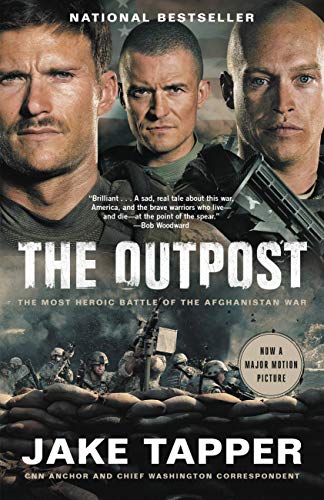
The Outpost: An Untold Story of American Valor
Jake Tapper
4.3
At 6:00 a.m. on the morning of October 3, 2009, Combat Outpost Keating was viciously attacked by Taliban insurgents. The 53 U.S. troops, having been stationed at the bottom of three steep mountains, were severely outmanned by nearly 400 Taliban fighters. Though the Americans ultimately prevailed, their casualties made it one of the war's deadliest battles for U.S. forces. And after more than three years in that dangerous and vulnerable valley a mere 14 miles from the Pakistan border, the U.S. abandoned and bombed the camp. A Pentagon investigation later concluded that there was no reason for Outpost Keating to have been there in the first place.
The Outpost is a tour de force of investigative journalism. Jake Tapper exposes the origins of this tragic and confounding story, exploring the history of the camp and detailing the stories of soldiers heroic and doomed, shadowed by the recklessness of their commanders in Washington, D.C. and a war built on constantly shifting sands.
…
Cover unavailable
19
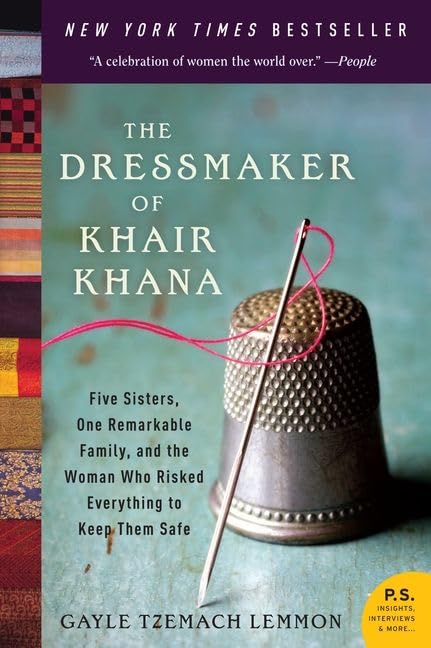
The Dressmaker of Khair Khana: Five Sisters, One Remarkable Family, and the Woman Who Risked Everything to Keep Them Safe
Gayle Tzemach Lemmon
4.3
Kamila Sidiqi's life changed overnight when the Taliban seized control of Afghanistan. After her father and brother were forced to flee, she became the sole breadwinner for her five siblings. Banned from school, confined to her home, and armed only with determination, she picked up a needle and thread to create a thriving business that saved their lives.
The Dressmaker of Khair Khana tells the incredible true story of this unlikely entrepreneur who mobilized her community under the Taliban. A story of war, it is also a story of family, faith, and resilience in the face of despair. These women are not victims—they are the glue that holds families together; they are the backbone and the heart of their nation. Kamila Sidiqi's journey will inspire you, but it will also change the way you think about one of the most important political and humanitarian issues of our time.
…
Cover unavailable
20
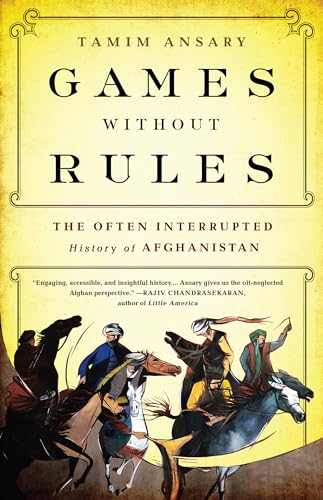
Games without Rules: The Often-Interrupted History of Afghanistan
Tamim Ansary
4.3
Today, most Westerners still see the war in Afghanistan as a contest between democracy and Islamist fanaticism. That war is real; but it sits atop an older struggle, between Kabul and the countryside, between order and chaos, between a modernist impulse to join the world and the pull of an older Afghanistan: a tribal universe of village republics permeated by Islam.
Now, Tamim Ansary draws on his Afghan background, Muslim roots, and Western and Afghan sources to explain history from the inside out, and to illuminate the long, internal struggle that the outside world has never fully understood. It is the story of a nation struggling to take form, a nation undermined by its own demons while, every 40 to 60 years, a great power crashes in and disrupts whatever progress has been made. Told in conversational, storytelling style, and focusing on key events and personalities, Games without Rules provides revelatory insight into a country at the center of political debate.
…
Cover unavailable
21
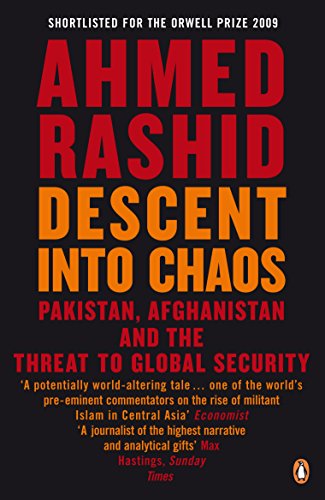
Descent into Chaos: How the War Against Islamic Extremism Is Being Lost in Pakistan, Afghanistan and Central Asia
Ahmed Rashid
4.3
After September 11th, Ahmed Rashid's crucial book "Taliban" introduced American readers to that now notorious regime. In this new work, he returns to Pakistan, Afghanistan, and Central Asia to review the catastrophic aftermath of America's failed war on terror. Called "Pakistan's best and bravest reporter" by Christopher Hitchens, Rashid has shown himself to be a voice of reason amid the chaos of present-day Central Asia. "Descent Into Chaos" is his blistering critique of American policy-a dire warning and an impassioned call to correct these disasterous strategies before these failing states threaten global stability and bring devastation to our world.
…
Recommended by Gretchen Peters, Paddy Docherty, and Thomas Barfield.
Gretchen Peters
This is a thorough analysis of how Western policy towards the region has made things worse since 2001. It is pretty bleak. Rashid joked to me while he was writing it that the working title was, What A Fucking Mess. [source]
Paddy Docherty
Because it is the authoritative account of the current situation in the region. I would recommend it to anyone wanting to understand what’s going on in Pakistan and Afghanistan. [source]
Thomas Barfield
His book about the Taliban came to prominence after 9/11. What Rashid manages to do is to show that this is a transnational problem. [source]
Cover unavailable
22
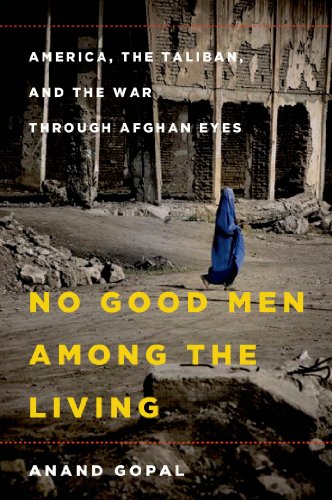
No Good Men Among the Living: America, the Taliban, and the War through Afghan Eyes
Anand Gopal
4.3
Pulitzer Prize in General Nonfiction finalist
National Book Award in Nonfiction finalist
Helen Bernstein Journalism Award finalist
2014 Ridenhour Prize Winner
New York Times Notable Book
As U.S. troops prepare to withdraw, the shocking tale of how the American military had triumph in sight in Afghanistan—and then brought the Taliban back from the dead
In the popular imagination, Afghanistan is often regarded as the site of intractable conflict, the American war against the Taliban a perpetually hopeless quagmire. But as Anand Gopal demonstrates in this stunning chronicle, top Taliban leaders were in fact ready to surrender within months of the U.S. invasion of Afghanistan, renouncing all political activity and submitting to the new government. Effectively, the Taliban ceased to exist—yet the American forces were not ready to accept such a turnaround. Driven by false intelligence from corrupt warlords and by a misguided conviction that Taliban members could never change sides, the U.S. instead continued to press the conflict, resurrecting the insurgency that persists to this day.
Gopal’s dramatic narrative, full of vivid personal detail, follows three Afghans through years of U.S. missteps: a Taliban commander, a U.S.-backed warlord, and a housewife trapped in the middle of the fighting. With its intimate accounts of life in small Afghan villages, and harrowing tales of crimes committed by Taliban leaders and American-supported provincial officials alike, No Good Men Among the Living lays bare the workings of America’s longest war and the truth behind its prolonged agony. A thoroughly original exposé of the conflict that is still being fought, it shows just how the American intervention went so desperately wrong.
…
Recommended by Nikhil Goyal.
Nikhil Goyal
Great day to read Anand Gopal's seminal book on the war in Afghanistan: "No Good Men Among the Living: America, the Taliban, and the War through Afghan Eyes." [source]
Cover unavailable
23
Where Men Win Glory: The Odyssey of Pat Tillman
Jon Krakauer
4.3
This edition has been updated to reflect new developments and includes new material obtained through the Freedom of Information Act.
Pat Tillman walked away from a multimillion-dollar NFL contract to join the Army and became an icon of post-9/11 patriotism. When he was killed in Afghanistan two years later, a legend was born. But the real Pat Tillman was much more remarkable, and considerably more complicated than the public knew...
A stunning account of a remarkable young man's heroic life and death, from the bestselling author of Into the Wild, Into Thin Air, and Under the Banner of Heaven.
Jon Krakauer’s biography of Pat Tillman, Where Men Win Glory, was the most inspiring and moving book I read this year. [source]
Cover unavailable
24
Taliban: Militant Islam, Oil and Fundamentalism in Central Asia
Ahmed Rashid
4.3
Correspondent Ahmed Rashid brings the shadowy world of the Taliban—the world’s most extreme & radical Islamic organization—into sharp focus in this enormously insightful book. He offers the only authoritative account of the Taliban available to English-language readers, explaining the Taliban’s rise to power, its impact on Afghanistan & the region, its role in oil & gas company decisions, & the effects of changing American attitudes toward the Taliban. He also describes the new face of Islamic fundamentalism & explains why Afghanistan has become the world center for international terrorism. New to this updated edition of the #1 NY Times Bestseller with more than 1.5 million copies sold worldwide: How the Taliban has regained its strength. How & why the Taliban has spread across Central Asia. How the Taliban has helped Al’Qaida’s spread into Europe, North Africa, the Middle East & the Far East. Why the Afghan people feel the United States is losing the war. A major new introduction and an all-new final chapter.
…
Recommended by Jonathan Powell.
Jonathan Powell
9/11 was a big shock. When the first plane hit I thought it was an accident. When I was told of a second plane, I assumed it was a loop on the film. Once I knew the truth, I spent the rest of the day dealing with the consequences and trying to make sure the UK wasn’t under attack. [source]
Cover unavailable
25
Stones Into Schools: Promoting Peace With Books, Not Bombs, in Afghanistan and Pakistan
Greg Mortenson, Khaled Hosseini
4.3
From the author of the #1 bestseller Three Cups of Tea, the continuing story of this determined humanitarian's efforts to promote peace through education.
In this dramatic first-person narrative, Greg Mortenson picks up where Three Cups of Tea left off in 2003, recounting his relentless, ongoing efforts to establish schools for girls in Afghanistan; his extensive work in Azad Kashmir and Pakistan after a massive earthquake hit the region in 2005; and the unique ways he has built relationships with Islamic clerics, militia commanders, and tribal leaders. He shares for the first time his broader vision to promote peace through education and literacy, as well as touching on military matters, Islam, and women-all woven together with the many rich personal stories of the people who have been involved in this remarkable two-decade humanitarian effort.
Since the 2006 publication of Three Cups of Tea, Mortenson has traveled across the U.S. and the world to share his vision with hundreds of thousands of people. He has met with heads of state, top military officials, and leading politicians who all seek his advice and insight. The continued phenomenal success of Three Cups of Tea proves that there is an eager and committed audience for Mortenson's work and message.
…
Cover unavailable
26
The Great Game: The Struggle for Empire in Central Asia
Peter Hopkirk
4.2
Hopkirk's spellbinding account of the great imperial struggle for supremacy in Central Asia has been hailed as essential reading with that era's legacy playing itself out today. The Great Game between Victorian Britain & Tsarist Russia was fought across desolate terrain from the Caucasus to China, over the lonely passes of the Parmirs & Karakorams, in the blazing Kerman & Helmund deserts, & thru the caravan towns of the old Silk Road-both powers scrambling to control access to the riches of India & the East. When play first began, the frontiers of Russia & British India lay 2000 miles apart; by the end, this distance had shrunk to 20 miles at some points. Now, in the vacuum left by the disintegration of the USSR, there's once again talk of Russian soldiers "dipping their toes in the Indian Ocean." The Washington Post has said that "every story Peter Hopkirk touches is totally engrossing." In this gripping narrative he recounts a breathtaking tale of espionage & treachery thru the actual experiences of its colorful characters. Based on meticulous scholarship & on-the-spot research, this is the history at the core of today's geopolitics.
…
Recommended by Stephen Evans.
Stephen Evans
This takes me away from London and cholera to Afghanistan, the North West Frontier and Central Asia. Hopkirk’s Great Game is a history of the game of exploration and espionage played out by representatives of Britain and Russia in the 19th century. [source]
Cover unavailable
27
Red Platoon: A True Story of American Valor
Clinton Romesha
4.2
THE NEW YORK TIMES BESTSELLER
The only comprehensive, firsthand account of the fourteen-hour firefight at the Battle of Keating by Medal of Honor recipient Clinton Romesha, for readers of Black Hawk Down by Mark Bowden and Lone Survivor by Marcus Luttrell.
"'It doesn't get better.' To us, that phrase nailed one of the essential truths, maybe even the essential truth, about being stuck at an outpost whose strategic and tactical vulnerabilities were so glaringly obvious to every soldier who had ever set foot in that place that the name itself--Keating--had become a kind of backhanded joke."
In 2009, Clinton Romesha of Red Platoon and the rest of the Black Knight Troop were preparing to shut down Command Outpost (COP) Keating, the most remote and inaccessible in a string of bases built by the US military in Nuristan and Kunar in the hope of preventing Taliban insurgents from moving freely back and forth between Afghanistan and Pakistan. Three years after its construction, the army was finally ready to concede what the men on the ground had known immediately: it was simply too isolated and too dangerous to defend.
On October 3, 2009, after years of constant smaller attacks, the Taliban finally decided to throw everything they had at Keating. The ensuing fourteen-hour battle--and eventual victory--cost eight men their lives.
Red Platoon is the riveting firsthand account of the Battle of Keating, told by Romesha, who spearheaded both the defense of the outpost and the counterattack that drove the Taliban back beyond the wire and received the Medal of Honor for his actions.
"A vitally important story that needs to be understood by the public, and I cannot imagine an account that does it better justice that Romesha's."--Sebastian Junger, journalist and author of The Perfect Storm
"Red Platoon is sure to become a classic of the genre."--Hampton Sides, author of Ghost Soldiers and In the Kingdom of Ice
…
Cover unavailable
28
Caravans
James A. Michener and Steve Berry
4.2
In this romantic adventure of wild Afghanistan, master storyteller James Michener mixes the allure of the past with the dangers of today. After an impetuous American girl, Ellen Jasper, marries a young Afghan engineer, her parents hear no word from her. Although she wants freedom to do as she wishes, not even she is sure what that means. In the meantime, she is as good as lost in that wild land, perhaps forever.... "An extraordinary novel....Brilliant." THE NEW YORK TIMES
From the Paperback edition.
…
Cover unavailable
29
The Breadwinner (The Breadwinner, #1)
Deborah Ellis
4.2
Since the Taliban took over Afghanistan, 11-year-old Parvana has rarely been outdoors. Barred from attending school, shopping at the market, or even playing in the streets of Kabul, the heroine of Deborah Ellis's engrossing children's novel The Breadwinner is trapped inside her family's one-room home. That is, until the Taliban hauls away her father and Parvana realizes that it's up to her to become the "breadwinner" and disguise herself as a boy to support her mother, two sisters, and baby brother. Set in the early years of the Taliban regime, this topical novel for middle readers explores the harsh realities of life for girls and women in modern-day Afghanistan. A political activist whose first book for children, Looking for X, dealt with poverty in Toronto, Ellis based The Breadwinner on the true-life stories of women in Afghan refugee camps.
In the wily Parvana, Ellis creates a character to whom North American children will have no difficulty relating. The daughter of university-educated parents, Parvana is thoroughly westernized in her outlook and responses. A pint-sized version of Offred from Margaret Atwood's The Handmaid's Tale, Parvana conceals her critique of the repressive Muslim state behind the veil of her chador. Although the dialogue is occasionally stilted and the ending disappointingly sketchy, The Breadwinner is essential reading for any child curious about ordinary Afghans. Like so many books and movies on the subject, it is also eerily prophetic. "Maybe someone should drop a big bomb on the country and start again," says a friend of Parvana's. "'They've tried that,' Parvana said, 'It only made things worse.'" (Ages 9 to 12) --Lisa Alward
…
Cover unavailable
30
Directorate S: The C.I.A. and America's Secret Wars in Afghanistan and Pakistan
Steve Coll
4.2
Winner of the 2018 National Book Critics Circle Award for Nonfiction
Longlisted for the 2018 National Book Award for Nonfiction
From the Pulitzer Prize-winning author of Ghost Wars, the epic and enthralling story of America's intelligence, military, and diplomatic efforts to defeat Al Qaeda and the Taliban in Afghanistan and Pakistan since 9/11
Prior to 9/11, the United States had been carrying out small-scale covert operations in Afghanistan, ostensibly in cooperation, although often in direct opposition, with I.S.I., the Pakistani intelligence agency. While the US was trying to quell extremists, a highly secretive and compartmentalized wing of I.S.I., known as "Directorate S," was covertly training, arming, and seeking to legitimize the Taliban, in order to enlarge Pakistan's sphere of influence. After 9/11, when fifty-nine countries, led by the U. S., deployed troops or provided aid to Afghanistan in an effort to flush out the Taliban and Al Qaeda, the U.S. was set on an invisible slow-motion collision course with Pakistan.
Today we know that the war in Afghanistan would falter badly because of military hubris at the highest levels of the Pentagon, the drain on resources and provocation in the Muslim world caused by the U.S.-led invasion of Iraq, and corruption. But more than anything, as Coll makes painfully clear, the war in Afghanistan was doomed because of the failure of the United States to apprehend the motivations and intentions of I.S.I.'s "Directorate S". This was a swirling and shadowy struggle of historic proportions, which endured over a decade and across both the Bush and Obama administrations, involving multiple secret intelligence agencies, a litany of incongruous strategies and tactics, and dozens of players, including some of the most prominent military and political figures. A sprawling American tragedy, the war was an open clash of arms but also a covert melee of ideas, secrets, and subterranean violence.
Coll excavates this grand battle, which took place away from the gaze of the American public. With unsurpassed expertise, original research, and attention to detail, he brings to life a narrative at once vast and intricate, local and global, propulsive and painstaking.
This is the definitive explanation of how America came to be so badly ensnared in an elaborate, factional, and seemingly interminable conflict in South Asia. Nothing less than a forensic examination of the personal and political forces that shape world history, Directorate S is a complete masterpiece of both investigative and narrative journalism.
…
Cover unavailable
31
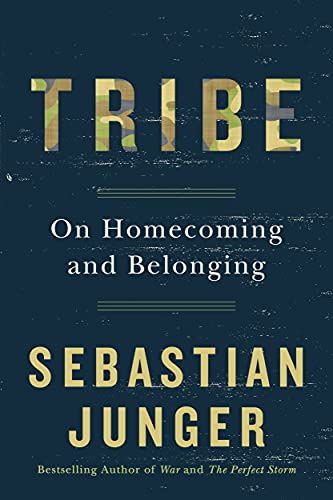
Tribe: On Homecoming and Belonging
Sebastian Junger
4.2
Sebastian Junger, the bestselling author of War and The Perfect Storm, takes a critical look at post-traumatic stress disorder and the many challenges today’s returning veterans face in modern society.
There are ancient tribal human behaviors-loyalty, inter-reliance, cooperation-that flare up in communities during times of turmoil and suffering. These are the very same behaviors that typify good soldiering and foster a sense of belonging among troops, whether they’re fighting on the front lines or engaged in non-combat activities away from the action. Drawing from history, psychology, and anthropology, bestselling author Sebastian Junger shows us just how at odds the structure of modern society is with our tribal instincts, arguing that the difficulties many veterans face upon returning home from war do not stem entirely from the trauma they’ve suffered, but also from the individualist societies they must reintegrate into.
A 2011 study by the Canadian Forces and Statistics Canada reveals that 78 percent of military suicides from 1972 to the end of 2006 involved veterans. Though these numbers present an implicit call to action, the government is only just taking steps now to address the problems veterans face when they return home. But can the government ever truly eliminate the challenges faced by returning veterans? Or is the problem deeper, woven into the very fabric of our modern existence? Perhaps our circumstances are not so bleak, and simply understanding that beneath our modern guises we all belong to one tribe or another would help us face not just the problems of our nation but of our individual lives as well.
Well-researched and compellingly written, this timely look at how veterans react to coming home will reconceive our approach to veteran’s affairs and help us to repair our current social dynamic.
To balance out that depressing book, I highly recommend David Brooks’ The Road To Character, Sebastian Junger’s Tribe and Chuck Klosterman’s What If We’re Wrong. [source]
Andrew Youderian
And finally, the book "Tribe" by Sebastian Junger reinforced in my the importance of relationships and in-person community, and made it something I'm trying to prioritize more in my life. [source]
Jason Kander
After years of people recommending it, I finally picked up Tribe by @SebastianJunger. I’m halfway done and it’s already the best non-fiction book I’ve read in years. [source]
Cover unavailable
32
When the Moon is Low
Nadia Hashimi
4.2
Mahmoud's passion for his wife Fereiba, a schoolteacher, is greater than any love she's ever known. But their happy, middle-class world—a life of education, work, and comfort—implodes when their country is engulfed in war, and the Taliban rises to power.
In Kabul, we meet Fereiba, a schoolteacher who puts her troubled childhood behind her when she finds love in an arranged marriage. But Fereiba's comfortable life implodes when the Taliban rises to power and her family becomes a target of the new fundamentalist regime. Forced to flee with her three children, Fereiba has one hope for survival: to seek refuge with her sister's family in London.
Traveling with forged papers and depending on the kindness of strangers, Fereiba and the children make a dangerous crossing into Iran under cover of darkness, the start of a harrowing journey that reduces her from a respected wife and mother to a desperate refugee.
Eventually they fall into the shadowy underground network of the undocumented who haunt the streets of Europe's cities. And then, in a busy market square in Athens, their fate takes a frightening turn when Fereiba's teenage son, Saleem, becomes separated from the rest of the family. Without his mother, Saleem is forced, abruptly and unforgivingly, to come of age in a world of human trafficking and squalid refugee camps.
Heartbroken, Fereiba has no choice but to continue on with only her daughter and baby. Mother and son cross border after perilous border, risking their lives in the hope of finding a place where they can be reunited.
…
Cover unavailable
33
A Fort of Nine Towers: An Afghan Family Story
Qais Akbar Omar
4.2
The surprising, stunning book that took the publishing world by storm: a coming-of-age memoir of unimaginable perils and unexpected joys, steeped in the rhythms of folk tales and poetry, that is as unforgettable as it is rare--a treasure for readers. Qais Akbar Omar was born in Kabul in a time of relative peace. Until he was 7, he lived with his father, a high school physics teacher, and mother, a bank manager, in the spacious, garden-filled compound his grandfather had built. Noisy with the laughter of his cousins (with whom they lived in the typical Afghan style), fragrant with the scent of roses and apple blossoms, and rich in shady, tucked-away spots where Qais and his grandfather sat and read, home was the idyllic centre of their quiet, comfortable life.
But in the wake of the Russian withdrawal and the bloody civil conflict that erupted, his family was forced to flee and take refuge in the legendary Fort of Nine Towers, a centuries-old palace in the hills on the far side of Kabul. On a perilous trip home, Omar and his father were kidnapped, narrowly escaping, and the family fled again, his parents leading their 6 children on a remarkable, sometimes wondrous journey. Hiding inside the famous giant Bamiyan Buddhas sculpture, and among Kurchi herders, Omar cobbles together an education, learning the beautiful art of carpet-weaving from a deaf mute girl, which will become the family's means of support. Against a backdrop of uncertainty, violence and absurdity, young Qais Omar weaves together a story--and a self--that is complex, colourful, and profound.
…
Cover unavailable
34
The Only Thing Worth Dying For: How Eleven Green Berets Fought for a New Afghanistan
Eric Blehm
4.2
Eric Blehm, author of the award-winning The Last Season, is back with another true adventure story, The Only Thing Worth Dying For. Set in the immediate aftermath of 9/11, The Only Thing Worth Dying For chronicles the untold story of the team of Green Berets led by Captain Jason Amerine that conquered the Taliban and helped bring Hamid Karzai to power in Afghanistan. In the tradition of Black Hawk Down, The Only Thing Worth Dying For is, in the words of former Congressman Charlie Wilson (from Charlie Wilson's War), "the one book you must read if you have any hope of understanding what our fine American soldiers are up against in Afghanistan."
…
Cover unavailable
35
Afghanistan: A Military History from Alexander the Great to the War Against the Taliban
Stephen Tanner
4.2
For over 2,500 years, the forbidding territory of Afghanistan has served as a vital crossroads for armies and has witnessed history-shaping clashes between civilizations: Greek, Arab, Mongol, and Tartar, and, in more recent times, British, Russian, and American. When U.S. troops entered Afghanistan in the weeks following September 11, 2001, they overthrew the Afghan Taliban regime and sent the terrorists it harbored on the run. But America's initial easy victory is in sharp contrast to the difficulties it faces today in confronting the Taliban resurgence.Originally published in 2002, Stephen Tanner's Afghanistan has now been completely updated to include the crucial turn of events since America first entered the country.
…
Cover unavailable
36
Charlie Wilson's War: The Extraordinary Story of How the Wildest Man in Congress and a Rogue CIA Agent Changed the History of our Times
George Crile
4.2
Charlie Wilson's War was a publishing sensation and a New York Times, Washington Post, and Los Angeles Times bestseller. In the early 1980s, a Houston socialite turned the attention of maverick Texas congressman Charlie Wilson to the ragged band of Afghan "freedom fighters" who continued, despite overwhelming odds, to fight the Soviet invaders. Wilson, who sat on the all-powerful House Appropriations Committee, managed to procure hundreds of millions of dollars to support the mujahideen. The arms were secretly procured and distributed with the help of an out-of-favor CIA operative, Gust Avrokotos, whose working-class Greek-American background made him an anomaly among the Ivy League world of American spies. Avrakotos handpicked a staff of CIA outcasts to run his operation and, with their help, continually stretched the Agency's rules to the breaking point. Moving from the back rooms of the Capitol, to secret chambers at Langley, to arms-dealers' conventions, to the Khyber Pass, this book presents an astonishing chapter of our recent past, and the key to understanding what helped trigger the sudden collapse of the Soviet Union and ultimately led to the emergence of a brand-new foe in the form of radical Islam.
…
Cover unavailable
37
No Easy Day: The Firsthand Account of the Mission That Killed Osama Bin Laden
Mark Owen, Kevin Maurer
4.2
For the first time anywhere, the first-person account of the planning and execution of the Bin Laden raid from a Navy Seal who confronted the terrorist mastermind and witnessed his final moment
From the streets of Iraq to the rescue of Captain Richard Phillips in the Indian Ocean, and from the mountaintops of Afghanistan to the third floor of Osama Bin Laden's compound, operator Mark Owen of the U.S. Naval Special Warfare Development Group--commonly known as SEAL Team Six--has been a part of some of the most memorable special operations in history, as well as countless missions that never made headlines.
No Easy Day puts readers alongside Owen and the other handpicked members of the twenty-four-man team as they train for the biggest mission of their lives. The blow-by-blow narrative of the assault, beginning with the helicopter crash that could have ended Owen's life straight through to the radio call confirming Bin Laden’s death, is an essential piece of modern history.
In No Easy Day, Owen also takes readers onto the field of battle in America's ongoing War on Terror and details the selection and training process for one of the most elite units in the military. Owen's story draws on his youth in Alaska and describes the SEALs' quest to challenge themselves at the highest levels of physical and mental endurance. With boots-on-the-ground detail, Owen describes numerous previously unreported missions that illustrate the life and work of a SEAL and the evolution of the team after the events of September 11. In telling the true story of the SEALs whose talents, skills, experiences, and exceptional sacrifices led to one of the greatest victories in the War on Terror, Mark Owen honors the men who risk everything for our country, and he leaves readers with a deep understanding of the warriors who keep America safe.
…
Cover unavailable
38
The Photographer
Emmanuel Guibert
4.2
In 1986, Afghanistan was torn apart by a war with the Soviet Union. This graphic novel/photo-journal is a record of one reporter’s arduous and dangerous journey through Afghanistan, accompanying the Doctors Without Borders. Didier Lefevre’s photography, paired with the art of Emmanuel Guibert, tells the powerful story of a mission undertaken by men and women dedicated to mending the wounds of war.
Cover unavailable
39
An Unexpected Light: Travels in Afghanistan
Jason Elliot
4.2
Cover unavailable
40
Lions of Kandahar: The Story of a Fight Against All Odds
Rusty Bradley, Kevin Maurer
4.2
One of the most critical battles of the Afghan War is now revealed as never before. Lions of Kandahar is an inside account from the unique perspective of an active-duty U.S. Army Special Forces commander, an unparalled warrior with multiple deployments to the theater who has only recently returned from combat there.
Southern Afghanistan was slipping away. That was clear to then-Captain Rusty Bradley as he began his third tour of duty there in 2006. The Taliban and their allies were infiltrating everywhere, poised to reclaim Kandahar Province, their strategically vital onetime capital. To stop them, the NATO coalition launched Operation Medusa, the largest offensive in its history. The battlefield was the Panjwayi Valley, a densely packed warren of walled compounds that doubled neatly as enemy bunkers, lush orchards, and towering marijuana stands, all laced with treacherous irrigation ditches. A mass exodus of civilians heralded the carnage to come.
Dispatched as a diversionary force in support of the main coalition attack, Bradley’s Special Forces A-team and two others, along with their longtime Afghan Army allies, watched from across the valley as the NATO force was quickly engulfed in a vicious counterattack. Key to relieving it and calling in effective air strikes was possession of a modest patch of high ground called Sperwan Ghar. Bradley’s small detachment assaulted the hill and, in the midst of a savage and unforgettable firefight, soon learned they were facing nearly a thousand seasoned fighters—from whom they seized an impossible victory.
Now Bradley recounts the whole remarkable story as it actually happened. The blistering trek across Afghanistan’s infamous Red Desert. The eerie traces of the elusive Taliban. The close relations with the Afghan people and army, a primary mission focus. Sperwan Ghar itself: unremitting waves of fire from machine guns and rocket-propelled grenades; a targeted truck turned into an inferno; the death trap of a cut-off compound. Most important: the men, Americans and Afghans alike—the “shaky” medic with nerves of steel and a surgeon’s hands in battle; the tireless sergeant who seems to be everywhere at once; the soft-spoken intelligence officer with laser-sharp insight; the diminutive Afghan commander with a Goliath-sized heart; the cool maverick who risks all to rescue a grievously wounded comrade—each unique, all indelible in their everyday exercise of extraordinary heroism.
Praise for Lions of Kandahar “A raw and authentic war story about untamed Green Berets in action.”—Dalton Fury, New York Times bestselling author of Kill Bin Laden
“A powerful and gripping account of a battle that helped shape the war in Afghanistan . . . With crisp writing and page-turning action, Lions of Kandahar is one of the best books written about the conflict.”—Mitch Weiss, Pulitzer Prize–winning investigative journalist and co-author of Tiger Force: A True Story of Men and War
“One of the most important documents to emerge from the war in Afghanistan.”—The Seattle Times
“Powerful . . . a riveting account of a strategic battle that doesn’t glorify war or focus on heroic deeds . . . Make room on your military bookshelf for Lions of Kandahar.”—San Antonio Express-News “Bradley takes the reader into battle.”—Time
…
Cover unavailable
41
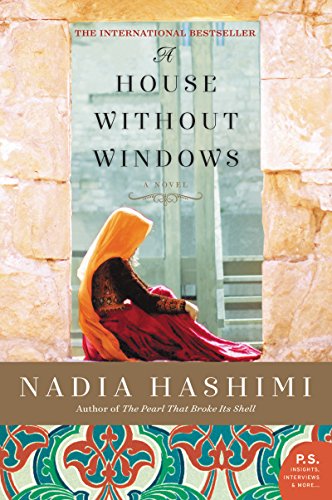
A House Without Windows
Nadia Hashimi
4.1
A vivid, unforgettable story of an unlikely sisterhood—an emotionally powerful and haunting story of friendship that illuminates the plight of women in a traditional culture, from the author of the bestselling The Pearl That Broke Its Shell and When the Moon Is Low.
For two decades, Zeba was a loving wife, a patient mother, and a peaceful villager. But her quiet life is shattered when her husband, Kamal, is found brutally murdered with a hatchet in the courtyard of their home. Nearly catatonic with shock, Zeba is unable to account for her whereabouts at the time of his death. Her children swear their mother could not have committed such a heinous act. Kamal’s family is sure she did, and demands justice. Barely escaping a vengeful mob, Zeba is arrested and jailed.
Awaiting trial, she meets a group of women whose own misfortunes have led them to these bleak cells: eighteen-year-old Nafisa, imprisoned to protect her from an “honor killing”; twenty-five-year-old Latifa, a teen runaway who stays because it is safe shelter; twenty-year-old Mezghan, pregnant and unmarried, waiting for a court order to force her lover’s hand. Is Zeba a cold-blooded killer, these young women wonder, or has she been imprisoned, like them, for breaking some social rule? For these women, the prison is both a haven and a punishment; removed from the harsh and unforgiving world outside, they form a lively and indelible sisterhood.
Into this closed world comes Yusuf, Zeba’s Afghan-born, American-raised lawyer whose commitment to human rights and desire to help his homeland have brought him back. With the fate this seemingly ordinary housewife in his hands, Yusuf discovers that, like the Afghanistan itself, his client may not be at all what he imagines.
A moving look at the lives of modern Afghan women, The House with No Windows is astonishing, frightening, and triumphant.
…
Cover unavailable
42
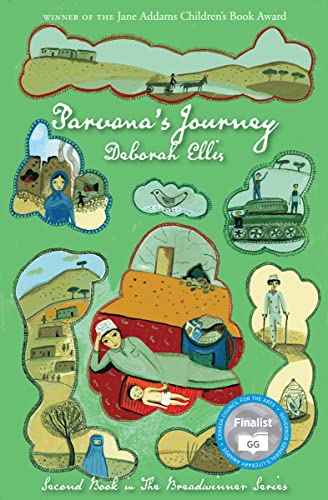
Parvana's Journey (The Breadwinner, #2)
Deborah Ellis
4.1
In Parvana's Journey, the Taliban still control Afghanistan, but Kabul is in ruins. Parvana's father has just died, and her mother, sister, and brother could be anywhere in the country. Parvana knows she must find them. Despite her youth, Parvana sets out alone, masquerading as a boy. She soon meets other children who are victims of war -- an infant boy in a bombed-out village, a nine-year-old girl who thinks she has magic powers over landmines, and a boy with one leg. The children travel together, forging a kind of family out of sheer need. The strength of their bond makes it possible to survive the most desperate conditions.
All royalties from the sale of this book will go to Women for Women, an organization that helps women in Afghanistan.
…
Cover unavailable
43
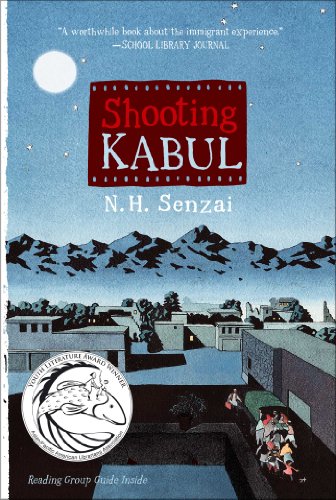
Shooting Kabul
N. H. Senzai
4.1
In the summer of 2001, twelve-year-old Fadi's parents make the difficult decision to illegally leave Afghanistan and move the family to the United States. When their underground transport arrives at the rendezvous point, chaos ensues, and Fadi is left dragging his younger sister Mariam through the crush of people. But Mariam accidentally lets go of his hand and becomes lost in the crowd, just as Fadi is snatched up into the truck. With Taliban soldiers closing in, the truck speeds away, leaving Mariam behind.
Adjusting to life in the United States isn't easy for Fadi's family, and as the events of September 11th unfold the prospects of locating Mariam in a war torn Afghanistan seem slim. When a photography competition with a grand prize trip to India is announced, Fadi sees his chance to return to Afghanistan and find his sister. But can one photo really bring Mariam home?
Based in part on Ms. Senzai's husband's own experience fleeing his home in Soviet-controlled Afghanistan in the 1970's, Shooting Kabul is a powerful story of hope, love, and perseverance.
…
Cover unavailable
44
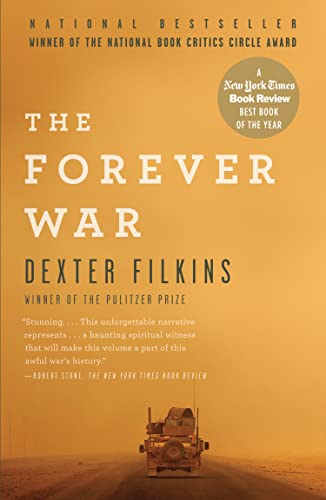
The Forever War
Dexter Filkins
4.1
From the front lines of the battle against Islamic fundamentalism, a searing, unforgettable book that captures the human essence of the greatest conflict of our time.
Through the eyes of Dexter Filkins, the prizewinning New York Times correspondent whose work was hailed by David Halberstam as “reporting of the highest quality imaginable,” we witness the remarkable chain of events that began with the rise of the Taliban in the 1990s, continued with the attacks of 9/11, and moved on to the wars in Afghanistan and Iraq.
Filkins’s narrative moves across a vast and various landscape of amazing characters and astonishing scenes: deserts, mountains, and streets of carnage; a public amputation performed by Taliban; children frolicking in minefields; skies streaked white by the contrails of B-52s; a night’s sleep in the rubble of Ground Zero.
We embark on a foot patrol through the shadowy streets of Ramadi, venture into a torture chamber run by Saddam Hussein. We go into the homes of suicide bombers and into street-to-street fighting with a battalion of marines. We meet Iraqi insurgents, an American captain who loses a quarter of his men in eight days, and a young soldier from Georgia on a rooftop at midnight reminiscing about his girlfriend back home. A car bomb explodes, bullets fly, and a mother cradles her blinded son.
Like no other book, The Forever War allows us a visceral understanding of today’s battlefields and of the experiences of the people on the ground, warriors and innocents alike. It is a brilliant, fearless work, not just about America’s wars after 9/11, but ultimately about the nature of war itself.
…
Recommended by Kanan Makiya.
Kanan Makiya
Iraq is a country with a particularly violent history of formation. In this book you capture a flavour of some of the human complexity that history left behind. [source]
Cover unavailable
45
A Short Walk in the Hindu Kush
Eric Newby
4.1
When Eric Newby, fashion industry worker and inexperienced hill walker, decided after 10 years in haute couture he needed a change he took 4 days training in Wales then walked the Hindu Kush. This is his account of an entertaining time in the hills!
Recommended by Sandy Gall.
Sandy Gall
Well, it’s terribly funny. I think Eric Newby is one of the best travel writers Britain has ever produced. I love reading this book. I’ve read it two or three times, and each time I fell about laughing. He writes terribly well. Evelyn Waugh actually wrote the preface to this book thinking it was by another Eric Newby, and ended up admiring this one. The book is about Newby and his young diplomat friend who went off on an expedition to Afghanistan in the 1950s with the intention of climbing Mir Samir – the highest mountain there – although neither had any experience of mountaineering or had even used a rope before. But they were young, fit and enthusiastic and they very nearly got to the top. [source]
Cover unavailable
46
Born Under a Million Shadows
Andrea Busfield
4.1
For fans of THE KITE RUNNER by Khaled Hossein and Yasmin Khadra's THE SWALLOWS OF KABUL, a devastating tale of forbidden love between an Englishwoman and a Kabul warlord.
The Taliban have disappeared from Kabul's streets, but the long shadows of their brutal regime remain. In his short life eleven-year-old Fawad has known more grief than most: his father and brother have been killed, his sister has been abducted, and Fawad and his mother, Mariya, must rely on the charity of family to eke out a hand-to-mouth existence. Then Mariya finds a position as housekeeper for a charismatic western woman, Georgie, and Fawad dares to hope for an end to their struggle. He soon discovers that his beloved Georgie is caught up in a dangerous love affair with the powerful Afghan warlord Haji Khan, a legendary name on the streets of Kabul. At first resentful of Haji Khan's presence, Fawad learns that love can move a man to act in surprising ways, and an overwhelming act of generosity persuades him of the warlord's good intentions. But even a man as influential as Haji Khan can't protect Fawad from the next tragedy to blight his young life, a tragedy so devastating that it threatens to destroy the one thing Fawad thought he could never lose: his love for his country.
…
Cover unavailable
47
Afgantsy: The Russians In Afghanistan, 1979-1989
Rodric Braithwaite
4.1
In a timely and eye-opening book Rodric Braithwaite examines the Russian experience in that most recent war in Afghanistan (after Alexander's conquests and the many British imperial wars and skirmishes). Largely basing his account on Russian sources and interviews he shows the war through the eyes of the Russians themselves - politicians, officers, soldiers, advisers, journalist, women. As former ambassador to Moscow, Rodric Braithwaite brings his unique insights to the Soviet war in Afghanistan. The story has been distorted not only by Cold War propaganda but also by the myths of the nineteenth century Great Game. It moves from the high politics of the Kremlin to the lonely Russian conscripts in isolated mountain outposts. The parallels with Afghanistan today speak for themselves. 'A superb achievement of narrative history, sensitive writing and exciting fresh research': so wrote Simon Sebag Montefiore about Rodric Braithwaite's bestseller Moscow 1941. But those words, and many others of praise that were given it, could equally apply to his new book.
…
Cover unavailable
48
Zinky Boys: Soviet Voices from the Afghanistan War
Svetlana Alexievich
4.1
Winner of the Nobel Prize: “For her polyphonic writings, a monument to suffering and courage in our time.” —Swedish Academy, Nobel Prize citation
From 1979 to 1989 a million Soviet troops engaged in a devastating war in Afghanistan that claimed 50,000 casualties—and the youth and humanity of many tens of thousands more. Creating controversy and outrage when it was first published in the USSR—it was called by reviewers there a “slanderous piece of fantasy” and part of a “hysterical chorus of malign attacks”—Zinky Boys presents the candid and affecting testimony of the officers and grunts, nurses and prostitutes, mothers, sons, and daughters who describe the war and its lasting effects. What emerges is a story that is shocking in its brutality and revelatory in its similarities to the American experience in Vietnam. The Soviet dead were shipped back in sealed zinc coffins (hence the term “Zinky Boys”), while the state denied the very existence of the conflict. Svetlana Alexievich brings us the truth of the Soviet-Afghan War: the beauty of the country and the savage Army bullying, the killing and the mutilation, the profusion of Western goods, the shame and shattered lives of returned veterans. Zinky Boys offers a unique, harrowing, and unforgettably powerful insight into the harsh realities of war.
…
Cover unavailable
49
In the Sea there are Crocodiles
Fabio Geda
4.1
One night before putting him to bed, Enaiatollah's mother tells him three things: don't use drugs or weapons, don't cheat, don't steal. The next day he wakes up to find she isn't there. Ten-year-old Enaiatollah is left alone at the border of Pakistan to fend for himself.
In a book that takes a true story and shapes it into a beautiful piece of fiction, Italian novelist Fabio Geda describes Enaiatollah's remarkable five-year journey from Afghanistan to Italy where he finally managed to claim political asylum aged fifteen. His ordeal took him through Iran, Turkey and Greece, working on building sites in order to pay people-traffickers, and enduring the physical misery of dangerous border crossings squeezed into the false bottoms of lorries or trekking across inhospitable mountains. A series of almost implausible strokes of fortune enabled him to get to Turin, find help from an Italian family and meet Fabio Geda, with whom he became friends.
The result of their friendship is this unique book in which Enaiatollah's engaging, moving voice is brilliantly captured by Geda's subtly simple storytelling. In Geda's hands, Enaiatollah's journey becomes a universal story of stoicism in the face of fear, and the search for a place where life is liveable.
…
Recommended by Gill Lewis.
Gill Lewis
This book makes you think about the enormity of the decision to leave home. And how will you ever create a new home. It is also a very readable book. [source]
Cover unavailable
50
Swallows of Kabul
Yasmina Khadra
4.1
Since the ascendancy of the Taliban the lives of Mosheen and his beautiful wife, Zunaira, have been gradually destroyed. Mosheen's dream of becoming a diplomat has been shattered and Zunaira can no longer even appear on the streets of Kabul unveiled. Atiq is a jailer who guards those who have been condemned to death; the darkness of prison and the wretchedness of his job have seeped into his soul. Atiq's wife, Musarrat, is suffering from an illness no doctor can cure. Yet, the lives of these four people are about to become inexplicably intertwined, through death and imprisonment to passion and extraordinary self-sacrifice.
The Swallows of Kabul is an astounding and elegiac novel of four people struggling to hold on to their humanity in a place where pleasure is a deadly sin and death has become routine.
…
Cover unavailable
51
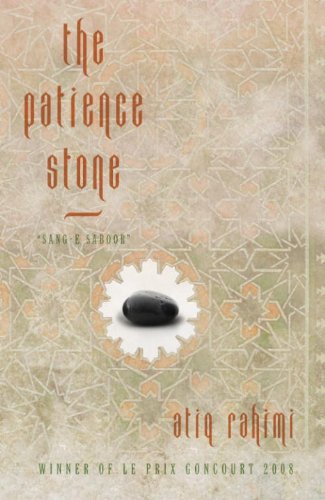
The Patience Stone
Atiq Rahimi, Polly Mclean, Khaled Hosseini
4.1
“For far too long, Afghan women have been faceless and voiceless. Until now. With The Patience Stone, Atiq Rahimi gives face and voice to one unforgettable woman–and, one could argue, offers her as a proxy for the grievances of millions…it is a rich read, part allegory, part a tale of retribution, part an exploration of honor, love, sex, marriage, war. It is without doubt an important and courageous book.” from the introduction by Khaled Hosseini, author of The Kite Runner and A Thousand Splendid Suns
In Persian folklore, Syngue Sabour is the name of a magical black stone, a patience stone, which absorbs the plight of those who confide in it. It is believed that the day it explodes, after having received too much hardship and pain, will be the day of the Apocalypse. But here, the Syngue Sabour is not a stone but rather a man lying brain-dead with a bullet lodged in his neck. His wife is with him, sitting by his side. But she resents him for having sacrificed her to the war, for never being able to resist the call to arms, for wanting to be a hero, and in the end, after all was said and done, for being incapacitated in a small skirmish. Yet she cares, and she speaks to him. She even talks to him more and more, opening up her deepest desires, pains, and secrets. While in the streets rival factions clash and soldiers are looting and killing around her, she speaks of her life, never knowing if her husband really hears. And it is an extraordinary confession, without restraint, about sex and love and her anger against a man who never understood her, who mistreated her, who never showed her any respect or kindness. Her admission releases the weight of oppression of marital, social, and religious norms, and she leads her story up to the great secret that is unthinkable in a country such as Afghanistan. Winner of the Prix Goncourt, The Patience Stone captures with great courage and spare, poetic, prose the reality of everyday life for an intelligent woman under the oppressive weight of the Taliban regime in Afghanistan.
The sun is setting on the Western world. Slowly but surely, the direction in which the world spins has reversed: where for the last five centuries the globe turned westwards on its axis, it now turns to the east...For centuries, fame and fortune was to be found in the west - in the New World of the Americas. Today, it is the east which calls out to those in search of adventure and riches. The region stretching from eastern Europe and sweeping right across Central Asia deep into China and India, is taking centre stage in international politics, commerce and culture - and is shaping the modern world. This region, the true centre of the earth, is obscure to many in the English-speaking world. Yet this is where civilization itself began, where the world's great religions were born and took root. The Silk Roads were no exotic series of connections, but networks that linked continents and oceans together. Along them flowed ideas, goods, disease and death. This was where empires were won - and where they were lost. As a new era emerges, the patterns of exchange are mirroring those that have criss-crossed Asia for millennia. The Silk Roads are rising again. A major reassessment of world history, The Silk Roads> is an important account of the forces that have shaped the global economy and the political renaissance in the re-emerging east.
…
Recommended by Professor Frank Mcdonough and Raoul Pal.
Professor Frank Mcdonough
Christmas is coming and if you want to give a thought-provoking book to that history fan in your life then the recent books by the brilliant @peterfrankopan will satisfy. Some write books, this guy changes perceptions. https://t.co/gWZWZnv5TN [source]
Raoul Pal
@The92ers @zerohedge It’s fascinating. The Peter Frankopan book on the Silk Roads told history well from the perspective of Iran in particular [source]
Cover unavailable
53
The Last Man (Mitch Rapp, #13)
Vince Flynn
4.1
A pulse-pounding thriller by #1 New York Times bestselling phenomenon Vince Flynn, as Mitch Rapp heads to Afghanistan to track down a missing CIA agent. The four dead guards didn’t concern Mitch Rapp as much as the absence of the man they’d been paid to protect. Joe Rickman wasn’t just another foot soldier. For the last eight years Rickman had ran the CIA’s clandestine operations in Afghanistan. It was a murky job that involved working with virtually every disreputable figure in the Islamic Republic. More than a quarter billion dollars in cash had passed through Rickman’s hands during his tenure as the master of black ops and no one with a shred of sense wanted to know the details of how that money had been spent.
At first glance it looks as if Rickman has been kidnapped, but Rapp knows certain things about his old friend that cause him to wonder if something more disturbing isn’t afoot. Irene Kennedy, the director of the CIA, has ordered Rapp to find Rickman at all costs. Rapp must navigate the ever-shifting landscape of Afghanistan as the Taliban, Iranians, Pakistanis and Russians all plot to claim their piece of the war torn state.
With Afghanistan crumbling around him, Rapp must be as ruthless as his enemies and as deceitful as people in his own government if he has any hopes of completing his mission.
…
Cover unavailable
54
Into the Fire: A Firsthand Account of the Most Extraordinary Battle in the Afghan War
Dakota Meyer
4.1
“The story of what Dakota did . . . will be told for generations.” — President Barack Obama, from remarks given at Meyer’s Medal of Honor ceremony.
In the fall of 2009, Taliban insurgents ambushed a patrol of Afghan soldiers and Marine advisors in a mountain village called Ganjigal. Firing from entrenched positions, the enemy was positioned to wipe out one hundred men who were pinned down and were repeatedly refused artillery support. Ordered to remain behind with the vehicles, twenty-one year-old Marine corporal Dakota Meyer disobeyed orders and attacked to rescue his comrades.
With a brave driver at the wheel, Meyer stood in the gun turret exposed to withering fire, rallying Afghan troops to follow. Over the course of the five hours, he charged into the valley time and again. Employing a variety of machine guns, rifles, grenade launchers, and even a rock, Meyer repeatedly repulsed enemy attackers, carried wounded Afghan soldiers to safety, and provided cover for dozens of others to escape—supreme acts of valor and determination. In the end, Meyer and four stalwart comrades—an Army captain, an Afghan sergeant major, and two Marines—cleared the battlefield and came to grips with a tragedy they knew could have been avoided. For his actions on that day, Meyer became the first living Marine in three decades to be awarded the Medal of Honor.
Into the Fire tells the full story of the chaotic battle of Ganjigal for the first time, in a compelling, human way that reveals it as a microcosm of our recent wars. Meyer takes us from his upbringing on a farm in Kentucky, through his Marine and sniper training, onto the battlefield, and into the vexed aftermath of his harrowing exploits in a battle that has become the stuff of legend.
Investigations ensued, even as he was pitched back into battle alongside U.S. Army soldiers who embraced him as a fellow grunt. When it was over, he returned to the States to confront living with the loss of his closest friends. This is a tale of American values and upbringing, of stunning heroism, and of adjusting to loss and to civilian life.
We see it all through Meyer’s eyes, bullet by bullet, with raw honesty in telling of both the errors that resulted in tragedy and the resolve of American soldiers, U.S.Marines, and Afghan soldiers who’d been abandoned and faced certain death.
Meticulously researched and thrillingly told, with nonstop pace and vivid detail, Into the Fire is the true story of a modern American hero.
“Sergeant Meyer embodies all that is good about our nation’s Corps of Marines. . . . [His] heroic actions . . . will forever be etched in our Corps’ rich legacy of courage and valor.” —General James F. Amos, Commandant of the Marine Corps
…
Cover unavailable
55
Words in the Dust
Trent Reedy
4.1
Zulaikha hopes. She hopes for peace, now that the Taliban have been driven from Afghanistan; a good relationship with her hard stepmother; and one day even to go to school, or to have her cleft palate fixed. Zulaikha knows all will be provided for her--"Inshallah," God willing.
Then she meets Meena, who offers to teach her the Afghan poetry she taught her late mother. And the Americans come to her village, promising not just new opportunities and dangers, but surgery to fix her face. These changes could mean a whole new life for Zulaikha--but can she dare to hope they'll come true?
…
Cover unavailable
56
I Am Malala: The Story of the Girl Who Stood Up for Education and Was Shot by the Taliban
I come from a country that was created at midnight. When I almost died it was just after midday.
When the Taliban took control of the Swat Valley in Pakistan, one girl spoke out. Malala Yousafzai refused to be silenced and fought for her right to an education.
On Tuesday, October 9, 2012, when she was fifteen, she almost paid the ultimate price. She was shot in the head at point-blank range while riding the bus home from school, and few expected her to survive.
Instead, Malala's miraculous recovery has taken her on an extraordinary journey from a remote valley in northern Pakistan to the halls of the United Nations in New York. At sixteen, she has become a global symbol of peaceful protest and the youngest-ever Nobel Peace Prize laureate.
I Am Malala is the remarkable tale of a family uprooted by global terrorism, of the fight for girls' education, of a father who, himself a school owner, championed and encouraged his daughter to write and attend school, and of brave parents who have a fierce love for their daughter in a society that prizes sons.
…
Recommended by Adrienne Kisner.
Adrienne Kisner
Malala’s story of triumph is a battle cry for girls (and boys) everywhere. Education can set you free. [source]
Cover unavailable
57
Alone at Dawn: Medal of Honor Recipient John Chapman and the Untold Story of the World's Deadliest Special Operations Force
Dan Schilling
4.1
The New York Times bestselling true account of John Chapman, Medal of Honor recipient and Special Ops Combat Controller, and his heroic one-man stand during the Afghan War, as he sacrificed his life to save the lives of twenty-three comrades-in-arms.
In the predawn hours of March 4, 2002, just below the 10,469-foot peak of a mountain in eastern Afghanistan, a fierce battle raged. Outnumbered by Al Qaeda fighters, Air Force Combat Controller John Chapman and a handful of Navy SEALs struggled to take the summit in a desperate bid to find a lost teammate.
Chapman, leading the charge, was gravely wounded in the initial assault. Believing he was dead, his SEAL leader ordered a retreat. Chapman regained consciousness alone, with the enemy closing in on three sides.
John Chapman's subsequent display of incredible valor -- first saving the lives of his SEAL teammates and then, knowing he was mortally wounded, single-handedly engaging two dozen hardened fighters to save the lives of an incoming rescue squad -- posthumously earned him the Medal of Honor. Chapman is the first airman in nearly fifty years to be given the distinction reserved for America's greatest heroes.
Alone at Dawn is also a behind-the-scenes look at the Air Force Combat Controllers: the world's deadliest and most versatile special operations force, whose members must not only exceed the qualifications of Navy SEAL and Army Delta Force teams but also act with sharp decisiveness and deft precision -- even in the face of life-threatening danger.
Drawing from firsthand accounts, classified documents, dramatic video footage, and extensive interviews with leaders and survivors of the operation, Alone at Dawn is the story of an extraordinary man's brave last stand and the brotherhood that forged him.
…
Cover unavailable
58
Little America: The War Within the War for Afghanistan
Rajiv Chandrasekaran
4.1
A New York Times Notable Book A Washington Post Notable Book A St. Louis Post-Dispatch Best Book of the Year
The author of the acclaimed bestseller and National Book Award finalist, Imperial Life in the Emerald City, tells the startling, behind-the-scenes story of the US’s political and military misadventure in Afghanistan. In this meticulously reported and illuminating book, Rajiv Chandrasekaran focuses on southern Afghanistan in the year of President Obama’s surge, and reveals the epic tug of war that occurred between the president and a military that increasingly went its own way. The profound ramifications this political battle had on the region and the world are laid bare through a cast of fascinating characters—disillusioned and inept diplomats, frustrated soldiers, headstrong officers—who played a part in the process of pumping American money and soldiers into Afghan nation-building. What emerges in Little America is a detailed picture of unsavory compromise—warlords who were to be marginalized suddenly embraced, the Karzai family transformed from foe to friend, fighting corruption no longer a top priority—and a venture that became politically, financially, and strategically unsustainable.
…
Cover unavailable
59
The Punishment of Virtue
Sarah Chayes
4.1
What happens when the War on Terror media circus packs up and leaves town? One brave foreign woman stayed behind to find out. This is her extraordinary report back to the rest of the world.
Recommended by Gretchen Peters.
Gretchen Peters
This is by a former National Public Radio reporter who moved to Afghanistan after 9/11 and stayed. She is completely immersed in the community and is unflinching in her account of what has gone wrong here, especially as regards political corruption. She very accurately captures the simple nobility of the Afghan people and gives a brilliant portrayal of living in these communities. People are amazed that I, as a six-foot blond woman, was allowed to move around so freely in the border areas but I was always, well, not always but almost always, well-treated. The friendliness is tremendous and I rarely had problems. In fact I was lucky because I had access to women – that 50 per cent of the population that my male colleagues did not have access to. [source]
Cover unavailable
60
In the Graveyard of Empires: America's War in Afghanistan
Seth G. Jones
4.1
A definitive account of the American experience in Afghanistan from the rise of the Taliban to the depths of the insurgency.
Longtime Afghanistan expert and RAND analyst Seth G. Jones watched as American optimism evaporated after the Taliban defeat in 2001; by 2005, a new "war of a thousand cuts" had brought Afghanistan to its knees. Harnessing important new historical research on insurgencies and integrating thousands of declassified government documents, Jones shows how the siphoning of resources to Iraq left U.S. and NATO forces in Afghanistan ineffectual and without support.
Through interviews with prominent figures, including ambassador Zalmay Khalilzad and commander Karl Eikenberry, Jones explains how a growing sanctuary for insurgents in Pakistan and a collapsing government in Kabul catalyzed the Taliban resurgence. Examining what has worked thus far—and what hasn't—Jones argues that we must take a radically new approach to the war if the United States is to avoid the disastrous fate that has befallen every world power to enter the region, from Alexander the Great to the Soviet Union.
…
Cover unavailable
61
The Taliban Shuffle: Strange Days in Afghanistan and Pakistan
Kim Barker
4.1
A true-life Catch-22 set in the deeply dysfunctional countries of Afghanistan and Pakistan, by one of the region’s longest-serving correspondents.
Kim Barker is not your typical, impassive foreign correspondent—she is candid, self-deprecating, laugh-out-loud funny. At first an awkward newbie in Afghanistan, she grows into a wisecracking, seasoned reporter with grave concerns about our ability to win hearts and minds in the region. In The Taliban Shuffle, Barker offers an insider’s account of the “forgotten war” in Afghanistan and Pakistan, chronicling the years after America’s initial routing of the Taliban, when we failed to finish the job.
When Barker arrives in Kabul, foreign aid is at a record low, electricity is a pipe dream, and of the few remaining foreign troops, some aren’t allowed out after dark. Meanwhile, in the vacuum left by the U.S. and NATO, the Taliban is regrouping as the Afghan and Pakistani governments flounder. Barker watches Afghan police recruits make a travesty of practice drills and observes the disorienting turnover of diplomatic staff. She is pursued romantically by the former prime minister of Pakistan and sees adrenaline-fueled colleagues disappear into the clutches of the Taliban. And as her love for these hapless countries grows, her hopes for their stability and security fade.
Swift, funny, and wholly original, The Taliban Shuffle unforgettably captures the absurdities and tragedies of life in a war zone.
…
Cover unavailable
62
The Operator: Firing the Shots that Killed Osama bin Laden and My Years as a SEAL Team Warrior
Robert O'Neill
4.1
Stirringly evocative, thought-provoking, and often jaw-dropping, The Operator ranges across SEAL Team Operator Robert O’Neill’s awe-inspiring four-hundred-mission career that included his involvement in attempts to rescue “Lone Survivor” Marcus Luttrell and abducted-by-Somali-pirates Captain Richard Phillips and culminated in those famous three shots that dispatched the world’s most wanted terrorist, Osama bin Laden.
In these pages, O’Neill describes his idyllic childhood in Butte, Montana; his impulsive decision to join the SEALs; the arduous evaluation and training process; and the even tougher gauntlet he had to run to join the SEALs’ most elite unit. After officially becoming a SEAL, O’Neill would spend more than a decade in the most intense counterterror effort in US history. For extended periods, not a night passed without him and his small team recording multiple enemy kills—and though he was lucky enough to survive, several of the SEALs he’d trained with and fought beside never made it home.
The Operator describes the nonstop action of O’Neill’s deployments in Iraq and Afghanistan, evokes the black humor of years-long combat, brings to vivid life the lethal efficiency of the military’s Tier One units, and reveals firsthand details of the most celebrated terrorist takedown in history.
…
Cover unavailable
63
Not A Good Day To Die: The Untold Story of Operation Anaconda
SEAN NAYLOR
4.1
If you loved American Sniper you will love Not a Good Day to Die: The Untold Story of Operation Anaconda. Award-winning journalist Sean Naylor, an eyewitness to the action, vividly portrays the fight for Afghanistan's most hostile battleground.
At dawn on March 2, 2002, the first major battle of the 21st Century began. Over 200 soldiers of the 101st Airborne and 10th Mountain Divisions flew into Afghanistan's Shahikot valley - and into the mouth of a buzz-saw. They were about to pay a bloody price for strategic, higher-level miscalculations that underestimated the enemy's strength and willingness to fight.
After the attacks of September 11, 2001, Coalition forces quickly toppled the Taliban regime from the seat of government. But, believing the war to be all but over, the Pentagon and US Central Command refused to commit the forces required to achieve total victory in Afghanistan. Instead, they delegated responsibility for fighting the war's biggest battle to a tangle of untested units thrown together at the last moment.
Then the world watched as Anaconda seemed to unravel.
Denied the extra infantry, artillery and close air support with which they trained to go to war, the soldiers of this airborne assault fought for survival in brutal high-altitude combat. Backed up by a small, but crucial, team of special forces, they were all that stood between the Coalition and a military disaster.
Perfect for fans of Black Hawk Down, Zero Dark Thirty, Chris Ryan, and Andy McNab.
About the author: Sean Naylor is a senior writer for the Army Times. He has covered the Afghan mujahideen's war against the Soviets, and American military operations in Somalia, Haiti, Bosnia, Afghanistan, and Iraq. Named one of the 22 "unsung" influential print reporters in Washington by American Journalism Review in May 2002, he earned the White House Correspondents' Association's prestigious Edgar A. Poe Award for his coverage of Operation Anaconda.
…
Cover unavailable
64
Roberts Ridge: A Story of Courage and Sacrifice on Takur Ghar Mountain, Afghanistan
Malcolm MacPherson
4.1
Afghanistan, March 2002. In the early morning darkness on a frigid mountaintop, a U.S. soldier is stranded, alone, surrounded by fanatical al Qaeda fighters. For the man’s fellow Navy SEALs, and for waiting teams of Army Rangers, there was only one rule now: leave no one behind. In this gripping you-are-there account–based on stunning eyewitness testimony and painstaking research–journalist Malcolm MacPherson thrusts us into a drama of rescue, tragedy, and valor in a place that would be known as...
ROBERTS RIDGE
For an elite team of SEALs, the mission seemed straightforward enough: take control of a towering 10,240-foot mountain peak called Takur Ghar. Launched as part of Operation Anaconda–a hammer-and-anvil plan to smash Taliban al Qaeda in eastern Afghanistan –the taking of Takur Ghar would offer U.S. forces a key strategic observation post. But the enemy was waiting, hidden in a series of camouflaged trenches and bunkers–and when the Special Forces chopper flared on the peak to land, it was shredded by a hail of machine-gun, small arms, and RPG rounds. A red-haired SEAL named Neil Roberts was thrown from the aircraft. And by the time the shattered helicopter crash-landed on the valley floor seven miles away, Roberts’s fellow SEALs were determined to return to the mountain peak and bring him out–no matter what the cost.
Drawing on the words of the men who were there–SEALs, Rangers, medics, combat air controllers, and pilots–this harrowing true account, the first book of its kind to chronicle the battle for Takur Ghar, captures in dramatic detail a seventeen-hour pitched battle fought at the highest elevation Americans have ever waged war. At once an hour-by-hour, bullet-by-bullet chronicle of a landmark battle and a sobering look at the capabilities and limitations of America’s high-tech army, Roberts Ridge is the unforgettable story of a few dozen warriors who faced a single fate: to live or die for their comrades in the face of near-impossible odds.
…
Cover unavailable
65
The Bear Went Over the Mountain: Soviet Combat Tactics in Afghanistan
Lester W. Grau and David M. Glantz
4.1
This rare 10th anniversary edition (published in 2007) contains a new introduction by expert Soviet historian David M. Glantz. In addition all maps and graphics have been enhanced from the 1996 edition. "When the Soviet Union decided to invade Afghanistan, they evaluated their chances for success upon their experiences in East Germany, Hungary and Czechoslovakia. Unfortunately for their soldiers, as well as the people of Afghanistan, they ignored not only the experiences of the British in the same region, but also their own experience with the Basmachi resistance fighters in Central Asia from 1918-1933. Consequently, in Afghanistan the Soviet army found its tactics inadequate to meet the challenges posed by the difficult terrain and the highly motivated mujahideen freedom fighters. To capture the lessons their tactical leaders learned in Afghanistan and to explain the change in tactics that followed, the Frunze Military Academy compiled this book for their command and general staff combat arms officers. The lessons are valuable not just for Russian officers, but for the tactical training of platoon, company and battalion leaders of any nation likely to engage in conflicts involving civil war, guerrilla forces and rough terrain. This is a book dealing with the starkest features of the unforgiving landscape of tactical combat: casualties and death, adaptation, and survival." (From the original foreword by Hans Binnendijk, 1996)
…
Cover unavailable
66
The Far Pavilions
M. M. Kaye
4.1
A magnificent romantic/historical/adventure novel set in India at the time of mutiny. The Far Pavilions is a story of 19th Century India, when the thin patina of English rule held down dangerously turbulent undercurrents. It is a story about and English man - Ashton Pelham-Martyn - brought up as a Hindu and his passionate, but dangerous love for an Indian princess. It's a story of divided loyalties, of tender camaraderie, of greedy imperialism and of the clash between east and west. To the burning plains and snow-capped mountains of this great, humming continent, M.M. Kaye brings her quite exceptional gift of immediacy and meticulous historical accuracy, plus her insight into the human heart.
…
Cover unavailable
67
Flashman
Fraser, Georges McDonald, P. Clinquart
4.1
For starters, Harry Flashman is expelled from school as a drunken bully. After seducing his father's mistress, he begins a secret life that leads from the boudoirs and bordellos of Victorian England to the erotic frontiers of her exotic Empire. Along the way he lies, cheats, steals, fights fixed duels, betrays his country and proves a coward on the battlefield.
"The refreshingly funny and ribald adventure story told by a rogue who is a cross between Byron's Don Juan and Fielding's Tom Jones." (Best Sellers)
…
Recommended by Turtle Bunbury.
Turtle Bunbury
I have always been really interested in the 19th century and these books put a lot of it in context for me. They are brilliantly written and excellently researched. Flashman is a character whom George McDonald Fraser takes on from the moment he is expelled from Tom Brown’s School, creating 12 fictional memories. For me, they really brought history to life. It introduced me to history from all over the world. Flashman was knocking around the whole of the British Empire, as well as in North America and the jungles of Madagascar. It gave me a useful insight into global history. [source]
Cover unavailable
68
Fool's Errand: Time to End the War in Afghanistan
Scott Horton
4.1
“In Fool’s Errand, Scott Horton masterfully explains the tragedy of America’s longest war and makes the case for immediate withdrawal. I highly recommend this excellent book on America’s futile and self-defeating occupation of Afghanistan.” — Daniel Ellsberg, Pentagon Papers whistleblower and author of The Doomsday Machine: Confessions of a Nuclear War Planner
“The real story of the disastrous U.S. war in Afghanistan must be written so that future generations may understand the folly of Washington’s warmongers. Scott Horton’s Afghan war history is an important contribution to this vital effort.” — Ron Paul, M.D., former U.S. congressman and author of Swords into Plowshares: A Life in Wartime and a Future of Peace and Prosperity
“Scott Horton’s, Fool’s Errand: Time to End the War in Afghanistan, is a definitive, authoritative and exceptionally well-resourced accounting of America’s disastrous war in Afghanistan since 2001. Scott’s book deserves not just to be read, but to be kept on your shelf, because as with David Halberstam’s The Best and Brightest or Neil Sheehan’s A Bright Shining Lie, I expect Horton’s book to not just explain and interpret a current American war, but to explain and interpret the all too predictable future American wars, and the unavoidable waste and suffering that will accompany them.” — Capt. Matthew Hoh, USMC (ret.), former senior State Department official, Zabul Province, Afghanistan, Senior Fellow at the Center for International Policy
“Fool’s Errand is a hidden history of America’s forgotten war, laid bare in damning detail. Scott Horton masterfully retells the story of America’s failed intervention, exposes how Obama’s troop surge did not bring Afghanistan any closer to peace, and warns that the conflict could go on in perpetuity — unless America ends the war. As Trump threatens to send more troops to Afghanistan, Horton shows why the answer to a brutal civil war is not more war, which makes Fool’s Errand a scintillating and sorely needed chronicle of the longest war in American history.” — Anand Gopal, journalist and author of No Good Men Among the Living: America, the Taliban, and the War Through Afghan Eyes
“Scott Horton’s new book Fool’s Errand: Time to End the War in Afghanistan has a title that tells you where it is going, but to think that is all it is about would be to sell short a comprehensive work that takes the reader on a long journey starting in the 1980s. Indeed, if there were a university course on what went wrong with Afghanistan, starting with Ronald Reagan’s Holy Warriors and continuing with George W. Bush’s ouster of the Taliban leading to 15 years of feckless nation building, this book could well serve as the textbook. Horton provides insights into key decision-making along the way as he meticulously documents the dreadful series of misadventures that have brought us to the latest surge, which will fail just like all the others. The book is highly recommended both for readers who already know a lot about Afghanistan as well as for those who want to learn the basics about America’s longest war.” — Philip Giraldi, former CIA and DIA officer, executive director of the Council for the National Interest
…
Cover unavailable
69
Earth and Ashes
Atiq Rahimi, Erdag M. Goknar
4.1
When the Soviet army arrives in Afghanistan, the elderly Dastaguir witnesses the destruction of his village and the death of his clan. His young grandson Yassin, deaf from the sounds of the bombing, is one of the few survivors. The two set out through an unforgiving landscape, searching for the coal mine where Murad, the old man's son and the boy's father, works. They reach their destination only to learn that they must wait and rely for help on all that remains to them: a box of chewing tobacco, some unripe apples, and the kindness of strangers. Haunting in its spareness, Earth and Ashes is a tale of devastating loss, but also of human perseverance in the face of madness and war.
…
Cover unavailable
70
The Favored Daughter: One Woman's Fight to Lead Afghanistan into the Future
Fawzia Koofi, Nadene Ghouri
4.1
The nineteenth daughter of a local village leader in rural Afghanistan, Fawzia Koofi was left to die in the sun after birth by her mother. But she survived, and perseverance in the face of extreme hardship has defined her life ever since. Despite the abuse of her family, the exploitative Russian and Taliban regimes, the murders of her father, brother, and husband, and numerous attempts on her life, she rose to become the first Afghani woman Parliament speaker. Here, she shares her amazing story, punctuated by a series of poignant letters she wrote to her two daughters before each political trip—letters describing the future and freedoms she dreamed of for them and for all the women of Afghanistan.
Her story movingly captures the political and cultural moment in Afghanistan, a country caught between the hope of progress and the bitter truth of history.
…
Cover unavailable
71
Farewell Kabul: From Afghanistan to a More Dangerous World
Christina Lamb
4.0
From the award-winning co-author of ‘I Am Malala’, this book asks just how the might of NATO, with 48 countries and 140,000 troops on the ground, failed to defeat a group of religious students and farmers? How did it go so wrong?
Twenty-seven years ago, Christina Lamb left Britain to become a journalist in Pakistan. She crossed the Hindu Kush into Afghanistan with mujaheddin fighting the Russians and fell unequivocally in love with this fierce country of pomegranates and war, a relationship which has dominated her adult life.
Since 2001, Lamb has watched with incredulity as the West fought a war with its hands tied, committed too little too late, failed to understand local dynamics and turned a blind eye as their Taliban enemy was helped by their ally Pakistan.
Farewell Kabul tells how success was turned into defeat in the longest war fought by the United States in its history and by Britain since the Hundred Years War. It has been a fiasco which has left Afghanistan still one of the poorest nations on earth, the Taliban undefeated, and nuclear armed Pakistan perhaps the most dangerous place on earth.
With unparalleled access to all key decision-makers in Afghanistan, Pakistan, London and Washington, from heads of state and generals as well as soldiers on the ground, Farewell Kabul tells how this happened.
In Afghanistan, Lamb has travelled far beyond Helmand – from the caves of Tora Bora in the south to the mountainous bad lands of Kunar in the east; from Herat, city of poets and minarets in the west, to the very poorest province of Samangan in the north. She went to Guantánamo, met Taliban in Quetta, visited jihadi camps in Pakistan and saw bin Laden’s house just after he was killed. Saddest of all, she met women who had been made role models by the West and had then been shot, raped or forced to flee the country.
This deeply personal book not only shows the human cost of political failure but explains how short-sighted encouragement of jihadis to fight the Russians, followed by prosecution of ill-thought-out wars, has resulted in the spread of terrorism throughout the Islamic world.
…
Cover unavailable
72
Redeployment
Phil Klay
4.0
Phil Klay's Redeployment takes readers to the frontlines of the wars in Iraq and Afghanistan, asking us to understand what happened there, and what happened to the soldiers who returned. Interwoven with themes of brutality and faith, guilt and fear, helplessness and survival, the characters in these stories struggle to make meaning out of chaos.
In "Redeployment", a soldier who has had to shoot dogs because they were eating human corpses must learn what it is like to return to domestic life in suburbia, surrounded by people "who have no idea where Fallujah is, where three members of your platoon died." In "After Action Report", a Lance Corporal seeks expiation for a killing he didn't commit, in order that his best friend will be unburdened. A Morturary Affairs Marine tells about his experiences collecting remains - of U.S. and Iraqi soldiers both. A chaplain sees his understanding of Christianity, and his ability to provide solace through religion, tested by the actions of a ferocious Colonel. And in the darkly comic "Money as a Weapons System", a young Foreign Service Officer is given the absurd task of helping Iraqis improve their lives by teaching them to play baseball. These stories reveal the intricate combination of monotony, bureaucracy, comradeship and violence that make up a soldier's daily life at war, and the isolation, remorse, and despair that can accompany a soldier's homecoming.
Redeployment is poised to become a classic in the tradition of war writing. Across nations and continents, Klay sets in devastating relief the two worlds a soldier inhabits: one of extremes and one of loss. Written with a hard-eyed realism and stunning emotional depth, this work marks Phil Klay as one of the most talented new voices of his generation.
As a devoted reader, the president has been linked to a lengthy list of novels and poetry collections over the years — he admits he enjoys a thriller. [source]
Cover unavailable
73
A Bed of Red Flowers: In Search of My Afghanistan
Nelofer Pazira
4.0
As a young girl growing up in 1970s Afghanistan, Nelofer Pazira seems destined for a bright future. The daughter of liberal-minded professionals, she enjoys a safe, loving and privileged life. Some of her early memories include convivial family picnics and New Years’ celebrations overlooking the thousands of red flowers that carpet the hills of Mazar. But Nelofer’s world is shattered when she is just five and her father is imprisoned for refusing to support the communist party. This episode plants a “seed of anger” in her, which is given plenty of opportunity to grow as the years unfold.
In 1979, the Soviets invade Afghanistan beginning a ten-year occupation. The country becomes an armed camp with Russians fighting U.S.-backed mujahidin fighters while trying to impose military rule. For Nelofer, daily life includes an endless succession of tanks, rockets screaming overhead and explosions in the street. During this time, she and her best friend, Dyana, seek refuge in their love of poetry. At eleven, the two girls throw stones at Soviet tanks and plot other acts of rebellion at the local school. As Nelofer gets older, she joins the resistance movement, distributes contraband books, studies guerilla warfare and hides a gun in her parent’s mint garden.
When Nelofer’s younger brother comes home from school in military garb, the family finally decides to flee Afghanistan. What follows is a perilous, clandestine journey across rugged mountains into Pakistan. But the life of a refugee is not what Nelofer expects. Though she once idealized the mujahidin as freedom fighters, she is shocked, as a woman, to find herself stripped of her personal freedom in their midst.
In 1990, Nelofer and her family are offered refugee status in Canada. Here she corresponds with her friend Dyana, whose letters reveal the increasing oppression of life under the Taliban. Fearing that her friend will kill herself, Pazira returns to Afghanistan to rescue her. This search becomes the basis for the acclaimed film Kandahar. Her journey to discover Dyana’s tragedy leads her finally to Russia, the land of her enemy, where she confronts the legacy of the Soviet invasion of her homeland first-hand.
A Bed of Red Flowersis a gripping, heart-rending story about a country caught in a struggle of the superpowers – and of the real people behind the politics. Universally acclaimed for its astute insights and extraordinary humanity, Pazira’s memoir won the Drainie-Taylor Biography Prize for 2005.The Winnipeg Free Press writes: “Powerfully written, A Bed of Red Flowers is a rare account of a misunderstood country and its intrepid people, trying to live ordinary lives under extraordinary circumstances.” The Gazette (Montreal) describes the book as “an outpouring of passionate non-fiction that captivates like the tales of Sheherazade.… It’s a remarkable journey. An inspiring read.”
…
Cover unavailable
74
A Woman Among Warlords: The Extraordinary Story of an Afghan Who Dared to Raise Her Voice
Malalai Joya
4.0
Malalai Joya was named one of Time magazine's 100 Most Influential People of 2010. An extraordinary young woman raised in the refugee camps of Iran and Pakistan, Joya became a teacher in secret girls' schools, hiding her books under her burqa so the Taliban couldn't find them; she helped establish a free medical clinic and orphanage in her impoverished home province of Farah; and at a constitutional assembly in Kabul, Afghanistan, in 2003, she stood up and denounced her country's powerful NATO-backed warlords. She was twenty-five years old. Two years later, she became the youngest person elected to Afghanistan's new Parliament. In 2007, she was suspended from Parliament for her persistent criticism of the warlords and drug barons and their cronies. She has survived four assassination attempts to date, is accompanied at all times by armed guards, and sleeps only in safe houses.
Joya takes us inside this massively important and insufficiently understood country, shows us the desperate day-to-day situations its remarkable people face at every turn, and recounts some of the many acts of rebellion that are helping to change it. A controversial political figure in one of the most dangerous places on earth, Malalai Joya is a hero for our times.
…
Cover unavailable
75
One Bullet Away: The Making of a Marine Officer
Nathaniel Fick
4.0
A former captain in the Marines’ First Recon Battalion, who fought in Afghanistan and Iraq, reveals how the Corps trains its elite and offers a point-blank account of twenty-first-century battle.
If the Marines are “the few, the proud,” Recon Marines are the fewest and the proudest. Only one Marine in a hundred qualifies for Recon, charged with working clandestinely, often behind enemy lines. Fick’s training begins with a hellish summer at Quantico, after his junior year at Dartmouth, and advances to the pinnacle—Recon—four years later, on the eve of war with Iraq. Along the way, he learns to shoot a man a mile away, stays awake for seventy-two hours straight, endures interrogation and torture at the secretive SERE course, learns to swim with Navy SEALs, masters the Eleven Principles of Leadership, and much more.
His vast skill set puts him in front of the front lines, leading twenty-two Marines into the deadliest conflict since Vietnam. He vows he will bring all his men home safely, and to do so he’ll need more than his top-flight education. He’ll need luck and an increasingly clear vision of the limitations of his superiors and the missions they assign him. Fick unveils the process that makes Marine officers such legendary leaders and shares his hard-won insights into the differences between the military ideals he learned and military practice, which can mock those ideals. One Bullet Away never shrinks from blunt truths, but it is an ultimately inspiring account of mastering the art of war.
Ellis, the American. Jean-Pierre, the Frenchman. They were two men on opposite sides of the cold war, with a woman torn between them. Together, they formed a triangle of passion and deception, racing from terrorist bombs in Paris to the violence and intrigue of Afghanistan - to the moment of truth and deadly decision for all of them...
Cover unavailable
77
My Forbidden Face: Growing Up Under the Taliban: A Young Woman's Story
Latifa,
4.0
My Forbidden Face provides a moving and highly personal account of life under the Taliban regime. With painful honesty and clarity, Latifa describes her ordered world falling apart, in the name of a fanaticism that she could not comprehend, and replaced by a world where terror and oppression reigned.
Cover unavailable
78
Mayhem 337: Memoir of a Combat Advisor in Afghanistan
Chad Rickard
4.0
By 2008 Chad Rickard was a decorated multi-tour Iraq War veteran with hundreds of combat missions under his belt. He was a seasoned infantryman and senior Army NCO with a burning desire to deploy to Afghanistan and join the fight against Taliban and Al Qaeda forces bent on keeping American influence out of the Middle East. Like many Americans Chad felt personally stricken by the attacks on 9/11 and he yearned to take part in his Nation's retaliation for the atrocities planned within the sanctity of Afghanistan's borders. When the opportunity arose to deploy as a Combat Advisor to an Afghan Infantry Battalion he seized the opportunity and headed to Fort Riley, Kansas to attend U.S. Army Combat Advisor School. After months of intensive training in Afghan customs, culture and language in addition to tactical training on the direction of close air support and artillery Rickard was dropped into a hotbed of action in Afghanistan's Khost Province. In Khost, former home to one of Osama Bin Laden's largest terror training camps, Rickard's team went toe to toe with Haqqani Taliban on numerous occasions, often leaving a staggering body count in their wake. In Mayhem 337, Rickard powerfully recounts his experiences during a nine month period of intense combat deep in the mountains of Eastern Afghanistan. His graphic account guides you through intense combat from the streets of Khost City, to deadly mountain warfare while based at an austere combat outpost. He vividly describes the sights and sounds of battle as well as the heartbreaking aftermath of fallen comrades. From IED laden roads to air assault missions and hostage standoffs, Rickard's story leaves nothing to the imagination. His riveting memoir brings recognition and honor to the Embedded Transition Team legacy that is but a footnote in U.S. military history.
…
Cover unavailable
79
Nasreen's Secret School: A True Story from Afghanistan
Jeanette Winter
4.0
Renowned picture book creator Jeanette Winter tells the story of a young girl in Afghanistan who attends a secret school for girls.
Young Nasreen has not spoken a word to anyone since her parents disappeared.
In despair, her grandmother risks everything to enroll Nasreen in a secret school for girls. Will a devoted teacher, a new friend, and the worlds she discovers in books be enough to draw Nasreen out of her shell of sadness?
Based on a true story from Afghanistan, this inspiring book will touch readers deeply as it affirms both the life-changing power of education and the healing power of love.
…
Cover unavailable
80
The Story of My Life: An Afghan Girl on the Other Side of the Sky
Farah Ahmedi, Tamim Ansary
4.0
Cover unavailable
81
Extra Credit
Andrew Clements, Mark Elliott
4.0
It isn’t that Abby Carson can’t do her schoolwork. She just doesn’t like doing it. And in February a warning letter arrives at her home. Abby will have to repeat sixth grade—unless she meets some specific conditions, including taking on an extra-credit project to find a pen pal in a distant country. Seems simple enough. But when Abby’s first letter arrives at a small school in Afghanistan, the village elders agree that any letters going back to America must be written well. In English. And the only qualified student is a boy, Sadeed Bayat. Except in this village, it is not proper for a boy to correspond with a girl. So Sadeed’s younger sister will write the letters. Except she knows hardly any English. So Sadeed must write the letters. For his sister to sign. But what about the villagers who believe that girls should not be anywhere near a school? And what about those who believe that any contact with Americans is . . . unhealthy? Not so simple. But as letters flow back and forth—between the prairies of Illinois and the mountains of central Asia, across cultural and religious divides, through the minefields of different lifestyles and traditions—a small group of children begin to speak and listen to one another. And in just a few short weeks, they make important discoveries about their communities, about their world, and most of all, about themselves.
…
Cover unavailable
82
The Accidental Guerrilla: Fighting Small Wars in the Midst of a Big One
David Kilcullen
4.0
David Kilcullen is one of the world's most influential experts on counterinsurgency and modern warfare, a ground-breaking theorist whose ideas "are revolutionizing military thinking throughout the west" (Washington Post). Indeed, his vision of modern warfare powerfully influenced America's decision to rethink its military strategy in Iraq and implement "the Surge," now recognized as a dramatic success. In The Accidental Guerrilla, Kilcullen provides a remarkably fresh perspective on the War on Terror. Kilcullen takes us "on the ground" to uncover the face of modern warfare, illuminating both the big global war (the "War on Terrorism") and its relation to the associated "small wars" across the globe: Iraq, Afghanistan, Indonesia, Thailand, the Pakistani tribal zones, East Timor and the horn of Africa. Kilcullen sees today's conflicts as a complex interweaving of contrasting trends--local insurgencies seeking autonomy caught up in a broader pan-Islamic campaign--small wars in the midst of a big one. He warns that America's actions in the war on terrorism have tended to conflate these trends, blurring the distinction between local and global struggles and thus enormously complicating our challenges. Indeed, the US had done a poor job of applying different tactics to these very different situations, continually misidentifying insurgents with limited aims and legitimate grievances--whom he calls "accidental guerrillas"--as part of a coordinated worldwide terror network. We must learn how to disentangle these strands, develop strategies that deal with global threats, avoid local conflicts where possible, and win them where necessary. Colored with gripping battlefield experiences that range from the jungles and highlands of Southeast Asia to the mountains of the Afghanistan-Pakistan border to the dusty towns of the Middle East, The Accidental Guerrilla will, quite simply, change the way we think about war. This book is a must read for everyone concerned about the war on terror.
…
Recommended by Mary Habeck and Mary Kaldor.
Mary Habeck
Kilcullen writes from both a theoretical and an experiential point of view. [source]
Mary Kaldor
Counter-insurgency, according to Kilcullen, is about protecting people and about separating the accidental guerrillas from the real Al-Qaida people. [source]
Cover unavailable
83
The Operators: The Wild and Terrifying Inside Story of America's War in Afghanistan
Michael Hastings
4.0
In June 2010, Michael Hastings's extraordinary, uncensored "Rolling Stone "article, "The Runaway General," shocked the world and set off a series of events that culminated in the resignation of General Stanley McChrystal. Now, THE OPERATORS will lead us even deeper into the war, its politics, and its major players at a time when such insight is demanded and desperately needed. Based on exclusive reporting in Afghanistan, Europe, the Middle East, and Washington, DC, this landmark work of journalism will elucidate as never before the United States' involvement in Afghanistan in vivid, unforgettable detail. Part wild travelogue, part expos, and part sobering analysis, THE OPERATORS promises an unprecedented behind-the-scenes account of the war from the only journalist uniquely poised to tell it.
…
Cover unavailable
84
Three Cups of Deceit: How Greg Mortenson, Humanitarian Hero, Lost His Way
Jon Krakauer
4.0
Greg Mortenson has built a global reputation as a selfless humanitarian and children’s crusader, and he’s been nominated for the Nobel Peace Prize. He is also not what he appears to be. As acclaimed author Jon Krakauer discovered, Mortenson has not only fabricated substantial parts of his bestselling books Three Cups of Tea and Stones into Schools, but has also misused millions of dollars donated by unsuspecting admirers like Krakauer himself.
This is the tragic tale of good intentions gone very wrong.
…
Cover unavailable
85
No Way Out: A Story of Valor in the Mountains of Afghanistan
Mitch Weiss and Kevin Maurer
4.0
In a remote, enemy-held valley in Afghanistan, a Special Forces team planned to scale a steep mountain to surprise and capture a terrorist leader. But before they found the target, the target found them…
The team was caught in a deadly ambush that not only threatened their lives, but the entire mission. The elite soldiers fought huddled for hours on a small rock ledge as rocket-propelled grenades and heavy machine-gun fire rained down on them. With total disregard for their own safety, they tended to their wounded and kept fighting to stay alive. When the battle finally ended, ten soldiers had earned Silver Stars—the Army’s third highest award for combat valor. It was the most Silver Stars awarded to any unit in one battle since Vietnam.
Based on dozens of interviews with those who were there, No Way Out is a compelling narrative of an epic battle that not only tested the soldiers’ mettle but serves as a cautionary tale. Be careful what you ask a soldier to do because they will die trying to accomplish their mission.
…
Cover unavailable
86
Level Zero Heroes: The Story of U.S. Marine Special Operations in Bala Murghab, Afghanistan
Michael Golembesky and John R. Bruning
4.0
A New York Times Best seller!
In Level Zero Heroes, Michael Golembesky follows the members of U.S. Marine Special Operations Team 8222 on their assignment to the remote and isolated Taliban stronghold known as Bala Murghab as they conduct special operations in an effort to break the Taliban's grip on the Valley. What started out as a routine mission changed when two 82nd Airborne Paratroopers tragically drowned in the Bala Murghab River while trying to retrieve vital supplies from an air drop that had gone terribly wrong. In this one moment, the focus and purpose of the friendly forces at Forward Operating Base Todd, where Team 8222 was assigned, was forever altered as a massive clearing operation was initiated to break the Taliban's stranglehold on the valley and recover the bodies.
From close-quarters firefights in Afghan villages to capturing key-terrain from the Taliban in the unforgiving Afghan winter, this intense and personal story depicts the brave actions and sacrifices of MSOT 8222. Readers will understand the hopelessness of being pinned down under a hail of enemy gunfire and the quake of the earth as a 2000 lb. guided bomb levels a fortified Taliban fighting position. A powerful and moving story of Marine Operators doing what they do best, Level Zero Heroes brings to life the mission of these selected few that fought side-by-side in Afghanistan, in a narrative as action-packed and emotional as anything to emerge from the Special Operations community contribution to the Afghan War.
…
Cover unavailable
87
Lest We Forget: An Army Ranger Medic's Journey
leo jenkins
4.0
The expanded second edition of the best selling memoir by Ranger medic, Leo JenkinsA rare look inside the experience of an Army Ranger medic. The compelling true story of what it takes to become and work as a special operations combat medic during the height of the global war on terrorism.Detailed accounts (and pictures) from the search and rescue operation for the US Navy Seals who were compromised in the mountains of Afghanistan during operation Redwings (best selling book, Lone Survivor by Marcus Luttrell) is just one of the many combat operations described in this thrilling book. Take a look inside the US special operations medical course as the author trains for the reality of combat in Iraq and Afghanistan. This expanded second edition includes roughly twenty percent more vulgar, honest, laugh out loud, content.
…
Recommended by Grant Shapps Mp.
Grant Shapps Mp
Great to meet Andy Chapman who’s the Chairman of Lemsford Local History Group. Andy has written a fascinating book about local Lemsford residents who fought in WW1 and their incredibly poignant stories. Find out more here: https://t.co/vD0DcRvegE https://t.co/WBvMtHFZzD [source]
Cover unavailable
88
The Sewing Circles of Herat: A Personal Voyage Through Afghanistan
Christina Lamb
4.0
Twenty-one-year-old Christina Lamb left suburban England for Peshawar on the frontier of the Afghan war. Captivated, she spent two years tracking the final stages of the mujaheddin victory over the Soviets, as Afghan friends smuggled her in and out of their country in a variety of guises.
Returning to Afghanistan after the attacks on the World Trade Center to report for Britain's Sunday Telegraph, Lamb discovered the people no one else had written about: the abandoned victims of almost a quarter century of war. Among them, the brave women writers of Herat who risked their lives to carry on a literary tradition under the guise of sewing circles; the princess whose palace was surrounded by tanks on the eve of her wedding; the artist who painted out all the people in his works to prevent them from being destroyed by the Taliban; and Khalil Ahmed Hassani, a former Taliban torturer who admitted to breaking the spines of men and then making them stand on their heads.
Christina Lamb's evocative reporting brings to life these stories. Her unique perspective on Afghanistan and deep passion for the people she writes about make this the definitive account of the tragic plight of a proud nation.
…
Cover unavailable
89
Service: A Navy SEAL at War
Marcus Luttrell, James D. Hornfischer
4.0
Navy SEAL Marcus Luttrell returned from his star-crossed mission in Afghanistan with his bones shattered and his heart broken. So many had given their lives to save him-and he would have readily done the same for them. As he recuperated, he wondered why he and others, from America's founding to today, had been willing to sacrifice everything-including themselves-for the sake of family, nation, and freedom.
In Service, we follow Marcus Luttrell to Iraq, where he returns to the battlefield as a member of SEAL Team 5 to help take on the most dangerous city in the world: Ramadi, the capital of war-torn Al Anbar Province. There, in six months of high-intensity urban combat, he would be part of what has been called the greatest victory in the history of U.S. Special Operations forces. We also return to Afghanistan and Operation Redwing, where Luttrell offers powerful new details about his miraculous rescue. Throughout, he reflects on what it really means to take on a higher calling, about the men he's seen lose their lives for their country, and the legacy of those who came and bled before.
A thrilling war story, Service is also a profoundly moving tribute to the warrior brotherhood, to the belief that nobody goes it alone, and no one will be left behind.
…
Cover unavailable
90
First In: An Insider's Account of How the CIA Spearheaded the War on Terror in Afghanistan
Gary Schroen
4.0
While America held its breath in the days immediately following 9/11, a small but determined group of CIA agents covertly began to change history. This is the riveting first-person account of the treacherous top-secret mission inside Afghanistan to set the stage for the defeat of the Taliban and launch the war on terror.
As thrilling as any novel, First In is a uniquely intimate look at a mission that began the U.S. retaliation against terrorism–and reclaimed the country of Afghanistan for its people.
From the Hardcover edition.
…
Cover unavailable
91
Unconventional Chaplain: Winning Hearts and Minds in Afghanistan 2002-2003
COL Andy Meverden
4.0
Cover unavailable
92
Dog Company: A True Story of American Soldiers Abandoned by Their High Command
Roger Hill
4.0
Now with a foreword by Sean Hannity!
The Army does not want you to read this book. It does not want to advertise its detention system that coddles enemy fighters while putting American soldiers at risk. It does not want to reveal the new lawyered-up Pentagon war ethic that prosecutes U.S. soldiers and Marines while setting free spies who kill Americans. This very system ambushed Captain Roger Hill and his men. Hill, a West Point grad and decorated combat veteran, was a rising young officer who had always followed the letter of the military law. In 2007, Hill got his dream job: infantry commander in the storied 101st Airborne. His new unit, Dog Company, 1-506th, had just returned stateside from the hell of Ramadi. The men were brilliant in combat but unpolished at home, where paperwork and inspections filled their days. With tough love, Hill and his First Sergeant, an old-school former drill instructor named Tommy Scott, turned the company into the top performers in the battalion. Hill and Scott then led Dog Company into combat in Afghanistan, where a third of their men became battlefield casualties after just six months. Meanwhile, Hill found himself at war with his own battalion commander, a charismatic but difficult man who threatened to relieve Hill at every turn. After two of his men died on a routine patrol, Hill and a counterintelligence team busted a dozen enemy infiltrators on their base in the violent province of Wardak. Abandoned by his high command, Hill suddenly faced an excruciating choice: follow Army rules the way he always had, or damn the rules to his own destruction and protect the men he'd grown to love.
…
Cover unavailable
93
The Road to Oxiana
Robert Byron and Paul Fussell
4.0
In 1933 the delightfully eccentric Robert Byron set out on a journey through the Middle East via Beirut, Jerusalem, Baghdad and Teheran to Oxiana -the country of the Oxus, the ancient name for the river Amu Darya which forms part of the border between Afghanistan and the Soviet Union. His arrival at his destination, the legendary tower of Qabus, although a wonder in itself, it not nearly so amazing as the thoroughly captivating, at times zany, record of his adventures.
In addition to its entertainment value, The Road to Oxiana also serves as a rare account of the architectural treasures of a region now inaccessible to most Western travellers. When Paul Fussell "rediscovered" The Road to Oxiana in his recent book Abroad, he whetted the appetite of a whole new generation of readers. In his new introduction, written especially for this volume, Fussell writes: "Reading the book is like stumbling into a modern museum of literary kinds presided over by a benign if eccentric curator. Here armchair travellers will find newspaper clippings, public signs and notices, official forms, letters, diary entries, essays on current politics, lyric passages, historical and archaeological dissertations, brief travel narratives (usually of comic-awful delays and disasters), and--the triumph of the book--at least twenty superb comic dialogues, some of them virtually playlets, complete with stage directions and musical scoring."
…
Recommended by Colin Thubron, Nicholas Shakespeare, Sandy Gall, and 1 others.
Oxiana is a coinage of his, and it doesn’t geographically specifically exist. It was a way of saying Persia (as it was to him) and Afghanistan. Byron’s journey starts in Venice and ends in what is now Pakistan. He went there in 1933-34, not long before he died in World War II, drowned when his ship was torpedoed. Although the book is terrifically chauvinistic – he’s appalling when he writes about the local people, almost always without sympathy and sometimes with extreme colonial arrogance – it’s full of wonderful descriptions. [source]
Nicholas Shakespeare
Byron was Chatwin’s first conscious model. The book is a candid account of a journey made in 1933 in search of Seljuk tombs. [source]
Sandy Gall
One of the classic books about travelling in Afghanistan. It’s fun to travel with Byron and hear what he has to say, although he is quite a snob. [source]
Cover unavailable
94
Horse Soldiers: The Extraordinary Story of a Band of US Soldiers Who Rode to Victory in Afghanistan
Doug Stanton
4.0
The inspiration for the major motion picture 12 Strong from Jerry Bruckheimer, starring Chris Hemsworth and Michael Shannon.
From the New York Times bestselling author of In Harm’s Way comes a true-life story of American soldiers overcoming great odds to achieve a stunning military victory.
Horse Soldiers is the dramatic account of a small band of Special Forces soldiers who secretly entered Afghanistan following 9/11 and rode to war on horses against the Taliban. Outnumbered forty to one, they pursued the enemy army across the mountainous Afghanistan terrain and, after a series of intense battles, captured the city of Mazar-i-Sharif, which was strategically essential to defeat their opponent throughout the country.
The bone-weary American soldiers were welcomed as liberators as they rode into the city, and the streets thronged with Afghans overjoyed that the Taliban regime had been overthrown.
Then the action took a wholly unexpected turn. During a surrender of six hundred Taliban troops, the Horse Soldiers were ambushed by the would-be POWs. Dangerously overpowered, they fought for their lives in the city’s immense fortress, Qala-i-Janghi, or the House of War. At risk were the military gains of the entire campaign: if the soldiers perished or were captured, the entire effort to outmaneuver the Taliban was likely doomed.
Deeply researched and beautifully written, Stanton’s account of the Americans’ quest to liberate an oppressed people touches the mythic. The soldiers on horses combined ancient strategies of cavalry warfare with twenty-first-century aerial bombardment technology to perform a seemingly impossible feat. Moreover, their careful effort to win the hearts of local townspeople proved a valuable lesson for America’s ongoing efforts in Afghanistan.
…
Cover unavailable
95
Fearless
Eric Blehm
4.0
Falon Whyte books a cruise for her girlfriend of two years. What she hopes will be a fun vacation quickly turns out to be a nightmare. Falon is normally a woman who can roll with the punches, but life delivers a series of blows that knock her on her butt and leave her stranded in Honduras with the company of an uptight woman she doesn’t like.
Haley Hollis isn’t having a good time, either. She spends two nights on the top deck of the ship after being locked out by her sexually adventurous cabin mate. Desperate to do something fun, she accepts an invitation from a new friend to join him on a zip line excursion. She only thinks the trip down the side of a mountain on a wire is the most terrifying thing she’ll ever experience.
What Falon and Haley think is a disaster turns into a magical adventure in Robin Alexander’s latest romantic comedy, Fearless.
…
Cover unavailable
96
I Am Pilgrim
Terry Hayes
4.0
A breakneck race against time...and an implacable enemy. An anonymous young woman murdered in a run-down hotel, all identifying characteristics dissolved by acid. A father publicly beheaded in the blistering heat of a Saudi Arabian public square. A notorious Syrian biotech expert found eyeless in a Damascus junkyard. Smoldering human remains on a remote mountainside in Afghanistan. A flawless plot to commit an appalling crime against humanity. One path links them all, and only one man can make the journey. Pilgrim.'
…
Recommended by Cat Williams-Treloar.
Cat Williams-Treloar
A close second favourite is "I am Pilgrim" by Terry Hayes. I was gifted this book from a close friend who was living in the Middle East. I was blown away by the intricacies, empathy and human angle of conflict. I hadn't walked in someone else's shoes like that for a very long time. [source]
Cover unavailable
97
Sea Stories: My Life in Special Operations
William H. McRaven
4.0
The #1 New York Times bestselling author of Make Your Bed is back with a wise and witty memoir of life lessons from his 37-year career as a Navy SEAL and commander of America's Special Forces.
Admiral William H. McRaven is a part of American military history, having orchestrated some of the most famous missions in recent memory, including the capture of Saddam Hussein, the rescue of Captain Richard Phillips, and the raid to kill Osama bin Laden.
Sea Stories begins in 1963 at a French Officer's Club in Paris, where Allied officers and their wives gathered to have drinks and tell stories about their adventures during World War II -- the place where a young William McRaven learned the value of a good story. Sea Stories is an unforgettable look back on one man's incredible life, from childhood days sneaking into high-security nuclear sites to a day job of hunting terrorists and rescuing hostages.
Action-packed, humorous, and full of valuable life lessons like those exemplified in McRaven's bestselling book, Make Your Bed, Sea Stories is a remarkable memoir from one of America's most accomplished leaders.
…
Cover unavailable
98
The Wars of Afghanistan: Messianic Terrorism, Tribal Conflicts, and the Failures of Great Powers
Peter Tomsen
4.0
Cover unavailable
99
Afghanistan, Where God Only Comes To Weep
Siba Shakib
4.0
Shirin-Gol was just a young girl when her village was levelled by the Russians' bombs in 1979. After the men in her family joined the resistance, she fled with the women and children to the capital, Kabul, and so began a life of day-to-day struggle in her war-torn country. A life that includes a period living in the harsh conditions of a Pakistani refugee camp, being forced into a marriage to pay off her brother's gambling debts, selling her body and begging for the money to feed her growing family, an attempted suicide, and an unsuccessful endeavour to leave Afghanistan for Iran after the Taliban seized control of her country. Told truthfully and with unflinching detail to writer and documentary-maker Siba Shakib, and incorporating some of the shocking experiences of Shirin-Gol's friends and family members, this is the story of the fate of many of the women in Afghanistan. But it is also a story of great courage, the moving story of a proud woman, a woman who did not want to be banished to a life behind the walls of her house, or told how to dress, who wanted an education for her children so that they could have a chance of a future, to live their lives without fear and poverty. .
…
Cover unavailable
100
Ashley's War: The Untold Story of a Team of Women Soldiers on the Special Ops Battlefield
Gayle Tzemach Lemmon
4.0
From the author of the New York Times bestseller The Dressmaker of Khair Khana comes the poignant and gripping story of a groundbreaking team of female American warriors who served alongside Special Operations soldiers on the battlefield in Afghanistan—including Ashley White, a beloved soldier who died serving her country’s cause.
In 2010, the U.S. Army Special Operations Command created Cultural Support Teams, a pilot program to put women on the battlefield alongside Green Berets and Army Rangers on sensitive missions in Afghanistan. The idea was that women could access places and people that had remained out of reach, and could build relationships—woman to woman—in ways that male soldiers in a conservative, traditional country could not. Though officially banned from combat, female soldiers could be “attached” to different teams, and for the first time, women throughout the Army heard the call to try out for this special ops program.
In Ashley’s War, Gayle Tzemach Lemmon uses exhaustive firsthand reporting and a finely tuned understanding of the complexities of war to tell the story of CST-2, a unit of women hand-picked from across the Army, and the remarkable hero at its heart: 1st Lt. Ashley White, who would become the first Cultural Support Team member killed in action and the first CST remembered on the Army Special Operations Memorial Wall of Honor alongside the Army Rangers with whom she served.
Transporting readers into this little-known world of fierce women bound together by valor, danger, and the desire to serve, Ashley’s War is a riveting combat narrative and a testament to the unbreakable bonds born of war.
Gayle Tzemach Lemmon is a Senior Fellow at the Council on Foreign Relations and a contributor to The Atlantic’s Defense One. She is the bestselling author of The Dressmaker of Khair Khana and writes regularly for leading media outlets. A Fulbright scholar and Robert Bosch Fellow, she began reporting from conflict regions during MBA study at the Harvard Business School following nearly a decade covering politics at ABC News.