Book summary audio lets you learn the main ideas from a book without sitting down to read the entire text. But not all audiobook summaries offer the same experience. Some focus on delivering a book’s key ideas in around 15 minutes, while others give you more time to explore the ideas, explanations, and examples behind them.
If you want more than a quick overview of your next book, you may want an audio experience that provides more context and opportunities to explore the material further. Below, I’ve pulled together six book summary apps that offer audio experiences, plus tips that can help you make the most of audio summaries.
Table of Contents
The Best Book Summary Audio Apps Compared
Different book summary apps take different approaches to audio. Some are built around short, predictable listening sessions, while others connect audio to a larger collection of written or interactive material.
| App | Audio approach | Typical length |
| Shortform | Audio versions of book guides, podcast guides, and original articles | 15 minutes to over an hour, depending on the guide |
| Blinkist | Audio versions of Blinks | Around 15 minutes |
| Headway | Audio versions of book summaries | Around 15–20 minutes |
| StoryShots | Audio alongside multiple formats | Varies |
| 12min | Audio versions of book summaries | Around 12 minutes |
| getAbstract | Audio versions of abstracts | Up to around 15 minutes |
1. StoryShots
StoryShots offers audio alongside other ways of consuming its book summaries. You can listen to shortened versions of the summaries for free, and you will be required to upgrade to a Premium subscription for the full version.
- Audio for every summary available: Yes; however, some book summaries will ask you to generate the audio if it’s not available yet. This can take quite some time to generate.
- Audio language options: Multiple languages are available. As with Headway, on some iOS versions, you may need to change your phone’s overall language instead.
- Playback speed: 0.5x–2x. The speed can’t be adjusted for the free summary of the day.
- Ads: Yes
- Read while listening: Yes
The main thing to consider with StoryShots is how its audio fits into its broader multimedia approach. If you like having multiple formats available for the same book, audio gives you another way to consume the material.
2. 12min
12min builds its format around short nonfiction book summaries designed to be consumed in about 12 minutes. The service offers both text and audio versions.
- Audio for every summary available: Yes
- Audio language options: English, Spanish, and Portuguese
- Playback speed: 0.5x–3x
- Ads: No
- Read while listening: Yes, with the Premium plan
The wide playback-speed range gives listeners more control over how they use those summaries. You can slow the audio down when you want more time to process an unfamiliar idea or speed it up when you’re reviewing material you already know.
3. getAbstract
getAbstract offers audio versions for most of its summaries, with the audio versions designed to be around 15 minutes. The company says most abstracts are available in audio format and that new abstracts are generally produced with human-voice audio, although artificial intelligence may sometimes assist with production when required permissions aren’t available.
- Audio for every summary available: Most summaries are available in audio.
- Audio language options: English, German, Spanish, Russian, Chinese, Portuguese, and French
- Playback speed: Adjustable
- Ads: Unknown
- Read while listening: Yes
getAbstract’s audio is particularly oriented toward professional learning. Its audio summaries give professionals hands-free access to condensed business and nonfiction content.
4. Shortform
Shortform is a premium learning platform that provides audio versions of its nonfiction book guides. Rather than treating audio as a separate product, Shortform connects listening to its written guides, so you can listen when you’re away from a screen and return to the guide when you want to explore an idea further.
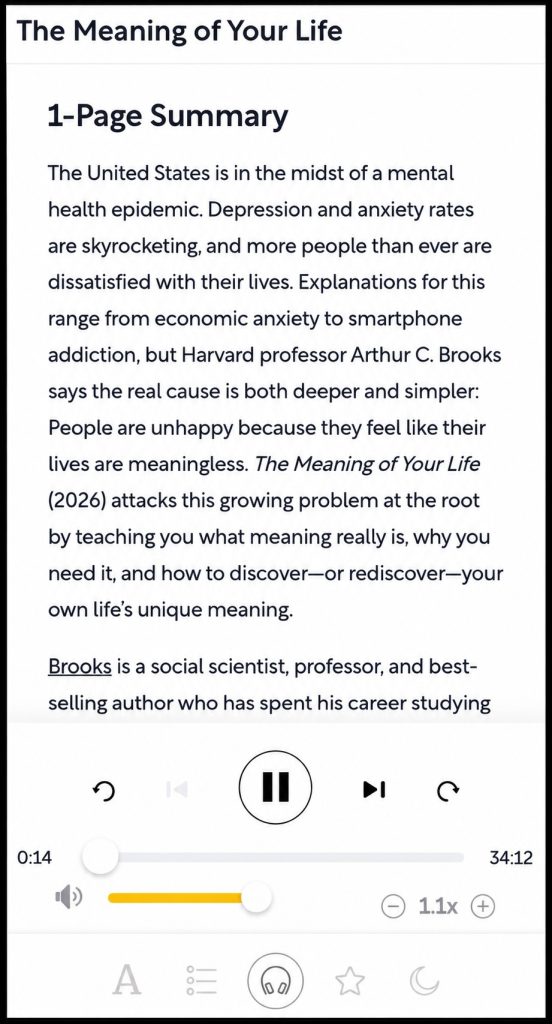
- Audio for every guide available: Yes—Shortform subscribers can listen to any book guide or original article of their choosing.
- Audio language options: English only. Shortform content is available in English, Spanish, German, and Brazilian Portuguese, but audio is currently available only in English.
- Playback speed: 0.3x–3.5x
- Ads: No
- Read while listening: Yes
- Offline listening: Yes
Shortform book guides combine a book’s main ideas with additional explanation and analysis. Depending on the guide, they may also include examples, exercises, and other tools for exploring and applying the ideas.
Take How to Win Friends and Influence People. The Shortform guide doesn’t simply list the book’s conclusions; it gives you a way to explore the ideas and consider how they might apply to your own interactions.
Shortform’s guides aren’t designed around fitting every book into a fixed 12- or 15-minute window. The audio is part of a broader learning experience, giving you more ways to engage with the material when you want to go beyond a quick recap. That can be useful if you’ve ever finished a short book summary and thought, “That sounds interesting, but I don’t really understand how I’d use it.”
Want to learn more about Shortform’s content and features? Check out my guide to Shortform.
Examples of Shortform Book Guides You Can Listen To
Shortform covers more than 10,000 nonfiction books across more than 30 categories, so the library extends well beyond one type of reader or subject.
Here are a few examples of the kinds of book guides you can explore with a subscription:
The variety means you can use Shortform audio for different listening goals: learning about a new subject, revisiting a familiar idea, or putting ideas into practice in real time.
5. Blinkist
Blinkist is built around concise book summaries called Blinks. Most Blinks take around 15 minutes to read or listen to, and every Blink has both a text and audio version. Blinkist’s audio is professionally produced and allows listeners to switch between audio and text.
- Audio for every summary available: Yes
- Audio language options: English, Spanish, German, and Portuguese—However, some users have reported that some languages aren’t available for all summaries.
- Playback speed: 0.5x–2x
- Ads: No
- Read while listening: Yes
- Offline listening: Yes
Blinkist’s audio closely follows the written Blink. The format is designed primarily for getting a book’s key ideas in a relatively short listening session.
If your main goal is to learn what a book is about or review its central ideas quickly, that concise format may be exactly what you’re looking for.
6. Headway
Every Headway summary is available in both text and audio. Headway claims that its summaries are narrated by professional voice actors, although I found that some summaries use AI-generated narration.
- Audio for every summary available: Yes
- Audio language options: Headway says you can listen to the app’s summaries in English, Spanish, French, German, Portuguese, Italian, Polish, Japanese, Czech, Romanian, and Hungarian. However, users have found that Portuguese doesn’t apply to every summary. On some iOS versions, you may need to change your phone’s overall language instead.
- Playback speed: 0.5x–2x
- Ads: No
- Read while listening: Yes
Headway’s audio fits its emphasis on short, manageable learning sessions. Its summaries are designed to communicate the core ideas of a book in about 15–20 minutes, while professional narration makes them practical to listen to on the go.
What Makes a Good Audiobook Summary?
Listening to a summary isn’t automatically useful just because it’s convenient. The quality of the experience depends on both what you hear and how you hear it.
When evaluating an audiobook summary, consider these three factors.
Factor #1: The Right Level of Depth
A useful summary needs to do more than string together a list of takeaways. Ask:
- Does it explain the author’s main ideas?
- Does it provide enough context to understand those ideas?
- Does the length give the material enough room to make sense?
- Does it distinguish between a book’s central argument and its supporting points?
Shorter isn’t automatically better. A concise summary can be useful when you want a quick overview. But, if you’re listening because you want to understand an idea well enough to remember it, discuss it, or apply it, you may want more than a list of conclusions.
For example, hearing that an author recommends a particular habit is different from understanding why they recommend it, what problem they’re trying to solve, and how the idea might apply to your own situation.
The goal isn’t to find the longest audio summary. It’s to find a format that gives you enough of the book’s substance for what you want to accomplish.
Factor #2: Audio Quality
Even a well-written summary can be difficult to follow if the audio experience is distracting. Consider:
- Is the narration natural and easy to listen to?
- Is the pacing comfortable?
- Can you follow the ideas without looking at a screen?
- Does the audio sound polished enough for a longer listening session?
Factor #3: Audio vs. Text
A useful audio experience doesn’t necessarily require you to choose between listening and reading.
Sometimes an idea is easy to absorb while listening. Other times, you may want to stop, reread a passage, or look at an example. That’s why it’s useful to know whether a service lets you move easily between audio and text.
Listening can give you the convenience of learning away from a screen, while text can give you more control when you want to examine an idea closely. For example, you might listen while commuting or walking and return to the written material later when you want to revisit something that caught your attention.
How to Get More From an Audiobook Summary
You don’t have to treat audio summaries as purely passive listening. Six simple techniques can help you pay closer attention, connect ideas to your own life, and remember what was worth hearing.
1. Give the Audio a Job
Audio is easy to play in the background, which can also make it easy to lose track of what you’re hearing. Before you start, give yourself something specific to listen for.
Instead of simply thinking, I’m going to listen to this book, try:
- What does this author say about procrastination?
- Is there an idea here I could use at work?
- What’s the author’s main argument?
- Would this book actually change how I approach this problem?
Having a question in mind gives you something to listen for and makes it easier to notice when your attention starts to wander.
2. Pause and Predict
Every so often, pause the audio and ask, What do I think the author is going to say next?
Then resume listening and see whether you were right. You don’t have to do this constantly. Try it when the author introduces an important problem, claim, or concept. Making yourself anticipate the next idea turns listening from simply receiving information into a more active process.
3. Argue With the Author
You don’t have to agree with everything you hear. When you encounter an important claim, ask, Do I actually believe this?
Then think of the strongest argument you could make against it. What assumption might the author be making? When might the advice not work? Is there another way to interpret the problem?
This is particularly useful with nonfiction because it encourages you to engage with an author’s reasoning rather than simply collecting their conclusions.
4. Put the Ideas Somewhere Real
When you hear an idea that seems useful, connect it to something that already exists in your life. Ask, Where does this show up for me?
It could be:
- A person
- A situation
- A habit
- A problem
- A decision
- A goal
For example, if you’re listening to a book about procrastination, don’t stop at remembering the author’s explanation. Think about a time you procrastinated recently and ask whether the idea would have changed what you did. This gives an abstract idea somewhere to land.
| Having Trouble Staying Focused? In Effortless, Greg McKeown argues that an effortless mindset—one in which you’re focused, rested, and aware of your surroundings—can make challenging tasks feel easier. Shortform’s guide connects this idea to flow states, which can help you concentrate on the task at hand. You can apply the same idea to audiobook summaries. Instead of pressing play and hoping you stay engaged, create conditions that make listening easier: Choose a time when you’re alert, minimize distractions, and give yourself something specific to listen for. If your attention starts to drift, you can also switch to the written guide when you want to see or revisit something more closely. |
5. Leave With One Idea to Test
You don’t need to put every lesson from a book into practice. Instead, choose one idea that you can actually try.
At the end of the summary, write down:
- The idea:
- What I’ll change:
- When I’ll try it:
- How I’ll know whether it helped:
Then give yourself a reasonable amount of time to test it. This turns the summary into something you can experiment with rather than something you simply finished. If the idea works, keep it. If it doesn’t, you can reconsider it—or return to the guide for more context.
6. Follow Up on What Sticks
You probably won’t remember everything you hear, and you don’t need to.
Instead, notice which ideas stay with you after the audio ends. The next day, try recalling the few points you found most interesting without replaying the summary. A week later, ask whether any of those ideas have stayed relevant.
If something continues to interest you, that’s a reason to explore it further. You might return to the written guide, look for related material, or read the book itself. The goal isn’t to prove that you remember every detail. It’s to notice which ideas were useful enough to deserve more of your attention.
Conclusion
When comparing services, look beyond how quickly they summarize a book. Consider how much context they provide, how the audio sounds, how easily you can move between audio and text, and whether there’s an opportunity to explore an idea further.
FAQ
What is book summary audio?
Book summary audio is a condensed, spoken version of a book’s main ideas. Unlike an audiobook, which contains the book itself, an audio summary selects and condenses the material so you can learn or review key ideas in less time.
How long are audiobook summaries?
There isn’t one standard length. Some services offer summaries that take around 12 to 15 minutes to listen to, while others provide more time for explanation and context. The right length depends on whether you want a quick overview or more opportunity to explore the book’s ideas.
Are audiobook summaries the same as audiobooks?
No. An audiobook contains the book itself, while an audio summary condenses the original material. Audiobooks are designed to give you the full reading experience; book summaries focus on helping you learn the central ideas in less time.
Are audiobook summaries worth listening to?
They can be useful if you want to learn the main ideas from a book, decide whether you want to read it, or revisit ideas from books you’ve already read. Short summaries are particularly useful for getting a quick overview, while more comprehensive formats can provide additional context and explanation.
What makes a good audiobook summary?
A good audiobook summary should accurately represent the book’s central ideas while providing enough context to make those ideas understandable. You should also consider the quality of the narration, the length of the summary, whether you can switch between audio and text, and whether the service gives you ways to explore an idea further.
What are the best apps for listening to book summaries?
Different apps take different approaches to book summary audio. Blinkist and 12min emphasize concise summaries, Headway focuses on short learning sessions, StoryShots offers audio alongside multiple formats, getAbstract focuses heavily on professional and business content, and Shortform provides audio versions of its nonfiction book guides alongside its original articles.
Does Shortform have audio?
Yes. Shortform provides audio versions of its nonfiction book guides, so subscribers can listen to guides when they don’t want to read from a screen. Shortform also supports offline listening on desktop and mobile.
What books can I listen to on Shortform?
Shortform offers more than 10,000 nonfiction book guides across more than 30 categories. Examples include Thinking, Fast and Slow, Sapiens, Why We Sleep, The Creative Act, Good to Great, A Brief History of Time, Meditations, and The Intelligent Investor.
How does Shortform’s audio work?
Shortform’s audio is connected to its written book guides, so you can listen to a guide and return to the written material when you want to examine an idea more closely. Audio is available for Shortform’s book guides and original articles, and you can listen offline.
Can I try Shortform audio for free?
New members get a five-day free trial of Shortform. During the trial, you can explore Shortform’s book guides and listen to their audio versions before deciding whether to continue with a subscription.
