Want to know what books Matthew Syed recommends? We've researched interviews, social media posts, podcasts, and articles to build a comprehensive list of Matthew Syed's favorite book recommendations of all time. At Shortform, we know books. Our book guides are the best in the world. Learn why.
Cover unavailable
1
The Cambridge Handbook of Expertise and Expert Performance
K. Anders Ericsson, Neil Charness, Paul J. Feltovich, Robert R. Hoffman
4.4
This book was the first handbook where the world's foremost 'experts on expertise' reviewed our scientific knowledge on expertise and expert performance and how experts may differ from non-experts in terms of their development, training, reasoning, knowledge, social support, and innate talent. Methods are described for the study of experts' knowledge and their performance of representative tasks from their domain of expertise. The development of expertise is also studied by retrospective interviews and the daily lives of experts are studied with diaries. In 15 major domains of expertise, the leading researchers summarize our knowledge on the structure and acquisition of expert skill and knowledge and discuss future prospects. General issues that cut across most domains are reviewed in chapters on various aspects of expertise such as general and practical intelligence, differences in brain activity, self-regulated learning, deliberate practice, aging, knowledge management, and creativity.
Yes, it’s a remarkable compendium of essays by the leading academics in the field, explaining how excellence is constructed in each of those areas. It is remarkably extensive, authoritative but also deeply entertaining. It covers everything from expertise in chess to expertise in psychology and computer science and mathematics. There is sexual expertise and medicine as well. Throughout all these different fields the consensus is the excellence is constructed on hard work but it nuances that explanation all the way through For me it is a wonderful set of essays and required reading for anyone interested in the subject. [source]
Cover unavailable
2
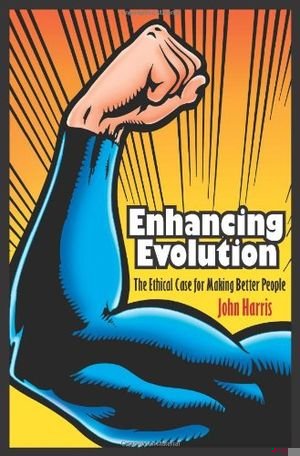
Enhancing Evolution: The Ethical Case for Making Better People
John Harris
3.4
Decisive biotechnological interventions in the lottery of human life--to enhance our bodies and brains and perhaps irreversibly change our genetic makeup--have been widely rejected as unethical and undesirable, and have often met with extreme hostility. But in Enhancing Evolution, leading bioethicist John Harris dismantles objections to genetic engineering, stem-cell research, designer babies, and cloning to make a forthright, sweeping, and rigorous ethical case for using biotechnology to improve human life.
Human enhancement, Harris argues, is a good thing--good morally, good for individuals, good as social policy, and good for a genetic heritage that needs serious improvement. Enhancing Evolution defends biotechnological interventions that could allow us to live longer, healthier, and even happier lives by, for example, providing us with immunity from cancer and HIV/AIDS. But the book advocates far more than therapies designed to free us from sickness and disability. Harris champions the possibility of influencing the very course of evolution to give us increased mental and physical powers--from reasoning, concentration, and memory to strength, stamina, and reaction speed. Indeed, he supports enhancing ourselves in almost any way we desire. And it's not only morally defensible to enhance ourselves, Harris says. In some cases, it's morally obligatory.
Whether one looks upon biotechnology with hope, fear, or a little of both, Enhancing Evolution makes a case for it that no one can ignore.
Harris is a brilliant essayist and the book explores and explodes a great deal of conservatism in bioethics. His arguments are compelling. He is sort of a radical utilitarian. He thinks that we should embrace any technologies that make life go better for humanity and not to turn these things down because either we feel squeamish or it sounds too radical. He says the basic test is: does it make life better? And if that is stem cell research or intervening in evolution to make humans longer-lived or more intelligent we should go and do it. [source]
Cover unavailable
3
Self-Theories: Their Role in Motivation, Personality, and Development
Carol Dweck
4.3
This innovative text sheds light on how people work -- why they sometimes function well and, at other times, behave in ways that are self-defeating or destructive. The author presents her groundbreaking research on adaptive and maladaptive cognitive-motivational patterns and shows: * How these patterns originate in people's self-theories * Their consequences for the person -- for achievement, social relationships, and emotional well-being * Their consequences for society, from issues of human potential to stereotyping and intergroup relations * The experiences that create them
This outstanding text is a must-read for researchers in social psychology, child development, and education, and is appropriate for both graduate and senior undergraduate students in these areas.
This is an absolutely revolutionary book because it reflects Dweck’s research over many years as a professor of psychology at Stanford University where she argues that the pattern of success and failure in the world are very much to do not with our talent but our mind sets or our beliefs. Essentially, what she means by that is that if you believe that success hinges on talent, it follows that any time you fail you are likely to interpret that as meaning that you have insufficient talent and you are likely to give up, which is a perfectly rational thing to do if your premise is correct. [source]
Cover unavailable
4
Heuristics and Biases: The Psychology of Intuitive Judgment
Thomas Gilovich, Dale Griffin, Daniel Kahneman
4.4
Judgment pervades human experience. Do I have a strong enough case to go to trial? Will the Fed change interest rates? Can I trust this person? This book examines how people answer such questions. How do people cope with the complexities of the world economy, the uncertain behavior of friends and adversaries, or their own changing tastes and personalities? When are people's judgments prone to bias, and what is responsible for their biases? This book compiles psychologists' best attempts to answer these important questions.
This is another really good set of essays in a rapidly growing branch of intellectual enquiry called behavioural economics where they look at the irrationalities in the way that humans behave. I thought this was brilliant. One essay in particular on irrational optimism caught my eye. It’s the idea that individuals who have slightly inflated expectations of their own abilities tend to persevere longer and perform better. [source]
Cover unavailable
5
The Mighty Walzer
Howard Jacobson
3.8
From the beginning Oliver Walzer is a natural - at ping-pong. Even with his improvised bat (the Collins Classic edition of Dr Jekyll and Mr Hyde) he can chop, flick, half-volley like a champion. At sex he is not so adept, but with tuition from Sheeny Waxman, fellow member of the Akiva Social Club Table Tennis Team and stalwart of the Kardomah coffee bar, his game improves.
Up until recently those of us who admired his work were very much like a sort of cult following. He hadn’t had much serious recognition but now he has won the Booker prize for another book, The Finkler Question, he has suddenly become mainstream which has led to a bit of a crisis of identity for those of us who love his books! [source]